Regional summary of 4 dive sites. Figures are averages across the sites that report them (n = sites with a value); each site's own page has its individual values.
Dominica's southwest-coast marine reserve is a sponge-dominated seascape of volcanic pinnacles, rocky knolls, and black-coral walls, while Toucari Bay on the northwest coast is the coral-rich exception. Tissue loss consistent with disease was photographed on two great star corals at Scott's Head.
Heat stress
sea surface temperature (SST) (left axis)DHW under 2DHW 2–3DHW 3–5DHW 5–8DHW 8–10DHW over 10 (🔥 above 12)
Daily SST (line) and weekly maximum Degree Heating Weeks (bars), Jan 2023–Oct 2026, NOAA Coral Reef Watch 5-km Leeward Caribbean Islands virtual station. Dashed line: bleaching threshold (maximum monthly mean 28.3°C + 1°C). DHW ≥ 4: bleaching likely; ≥ 8: severe bleaching and mortality likely. A bar is drawn only where DHW exceeds zero, so a stretch with no bar is accumulated heat stress of zero, not missing data — the SST line runs the full period.
4 sites in this region — click a marker to open that site.
Regional setting
Dominica, the northernmost of the Windward Islands, is a steep, mountainous volcanic island ringed mostly by rocky cliffs, and its narrow shelf leaves little room for shallow reef growth (Wells 1988). West-coast surveys reported by Goodwin (1985) and summarized by Wells (1988) found water deeper than 180 m within a kilometer of shore at every site visited and no true coral reefs, although corals extensively covered rocks and boulders at Scotts Head, Soufrière, Toucari, and several other west-coast sites. At Scotts Head the living cover was mainly algal turf and sponges, with some Agaricia, Siderastrea siderea, and Meandrina meandrites, and there were signs of periodic sediment loading. Toucari Bay, inside the then-proposed Cabrits National Park, had the greatest diversity and extent of living cover on that coast: 18 species between 12 and 25 m, with Montastraea annularis the most abundant. In all, 23 coral species in 14 genera were recorded along the west coast. Hurricane David struck in 1979 and did great damage on land, although how it affected the reefs was never recorded. Spalding et al. (2001) similarly describe only limited reef development on the narrow coastal shelves, point to important coral communities along the island's southern, western, and northwestern shores that had seen little human impact, and estimate Dominica's coral reef area at less than 100 km².
Souter et al. (2021) report recent trends only for the Eastern and Southern Caribbean as a whole, a subregion that groups the Lesser Antilles with Trinidad and Tobago, Aruba, Bonaire, Curaçao, and Venezuela. Across it, mean hard coral cover fell from about 26.2% in 1999 to 14.5% in 2019, the largest decline among the five Caribbean subregions, while algal cover nearly tripled between 1987 and 2019 to reach 48.3%. For the Caribbean as a whole, the same report links these losses to the 2005 mass bleaching, hurricanes, polluted, and nutrient-enriched coastal water, and overfishing of herbivores such as parrotfishes, and it names invasive lionfish, Sargassum influxes since 2011, and stony coral tissue loss disease (SCTLD) as newer threats; SCTLD, first seen in Florida in 2014, had been confirmed in 19 Caribbean countries and territories by October 2021. Earlier, Wilkinson (2006), drawing on the 2004 Caribbean Reefs at Risk assessment, placed the Lesser Antilles among the areas most threatened by coastal development and singled out its high islands for land-based pollution and sediment.
Overview
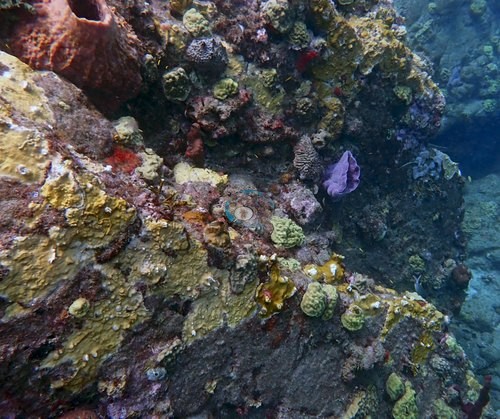
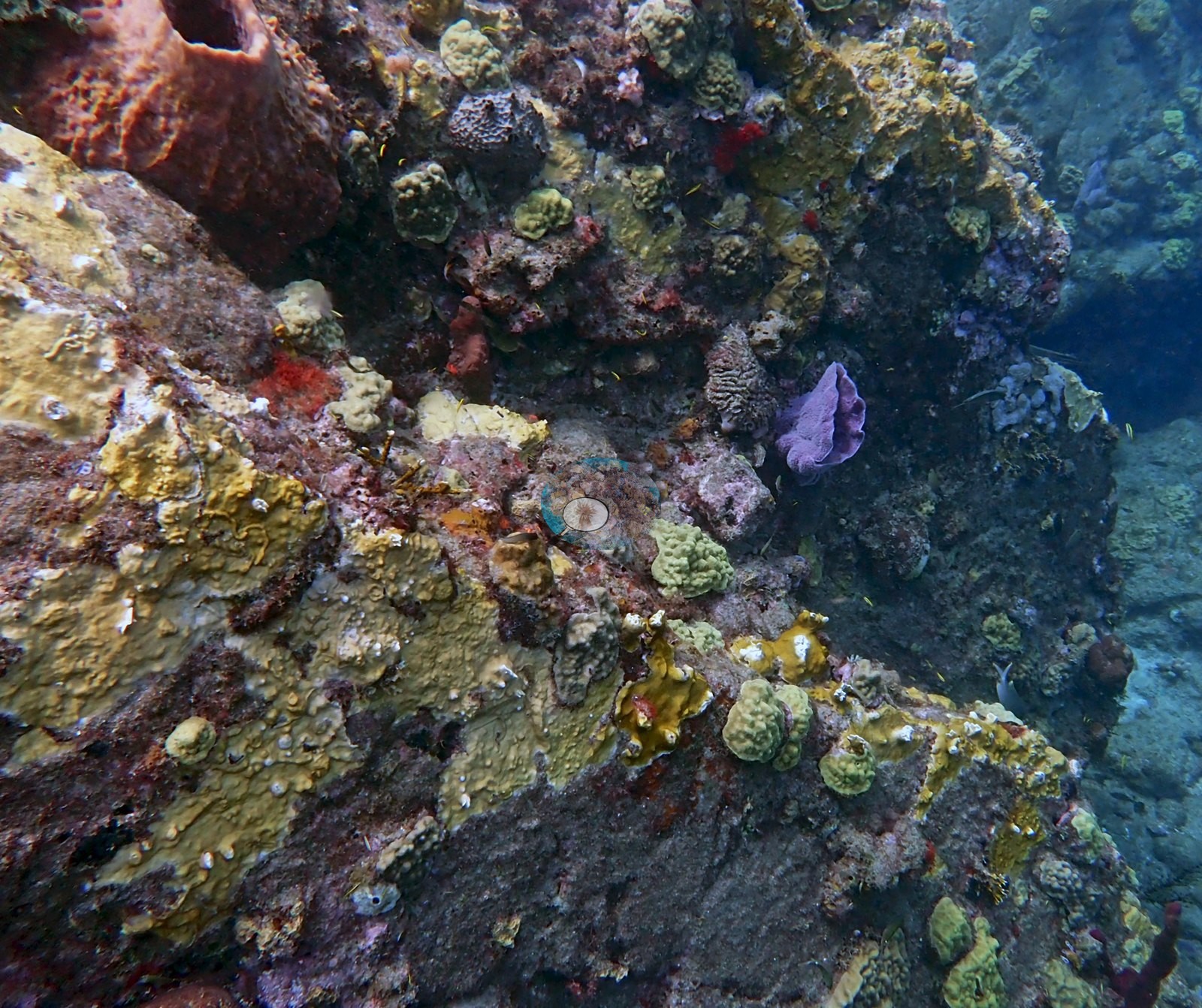
The four Dominica sites fall in two settings. Three sit in the Soufriere-Scotts Head Marine Reserve on the southwest coast: Coral Gardens and Scott's Head Pinnacle, both dived on 22 June 2022 at 15.2 m and 23.8 m, and Champagne Reef, known for the volcanic gas bubbles that rise through it. The fourth is Toucari Bay, a shallow fringing reef on the northwest coast. In the reserve, sponges rather than corals supply most of the vertical structure. Coral Gardens is a set of low rocky knolls and rubble-and-sand flats where meter-tall giant barrel sponges, thickets of red rope sponge, and yellow tube sponges stand over turf-covered pavement. Scott's Head Pinnacle is a steep volcanic pinnacle cut by narrow sand canyons, its walls clothed in barrel, tube, and rope sponges and thickets of black coral.
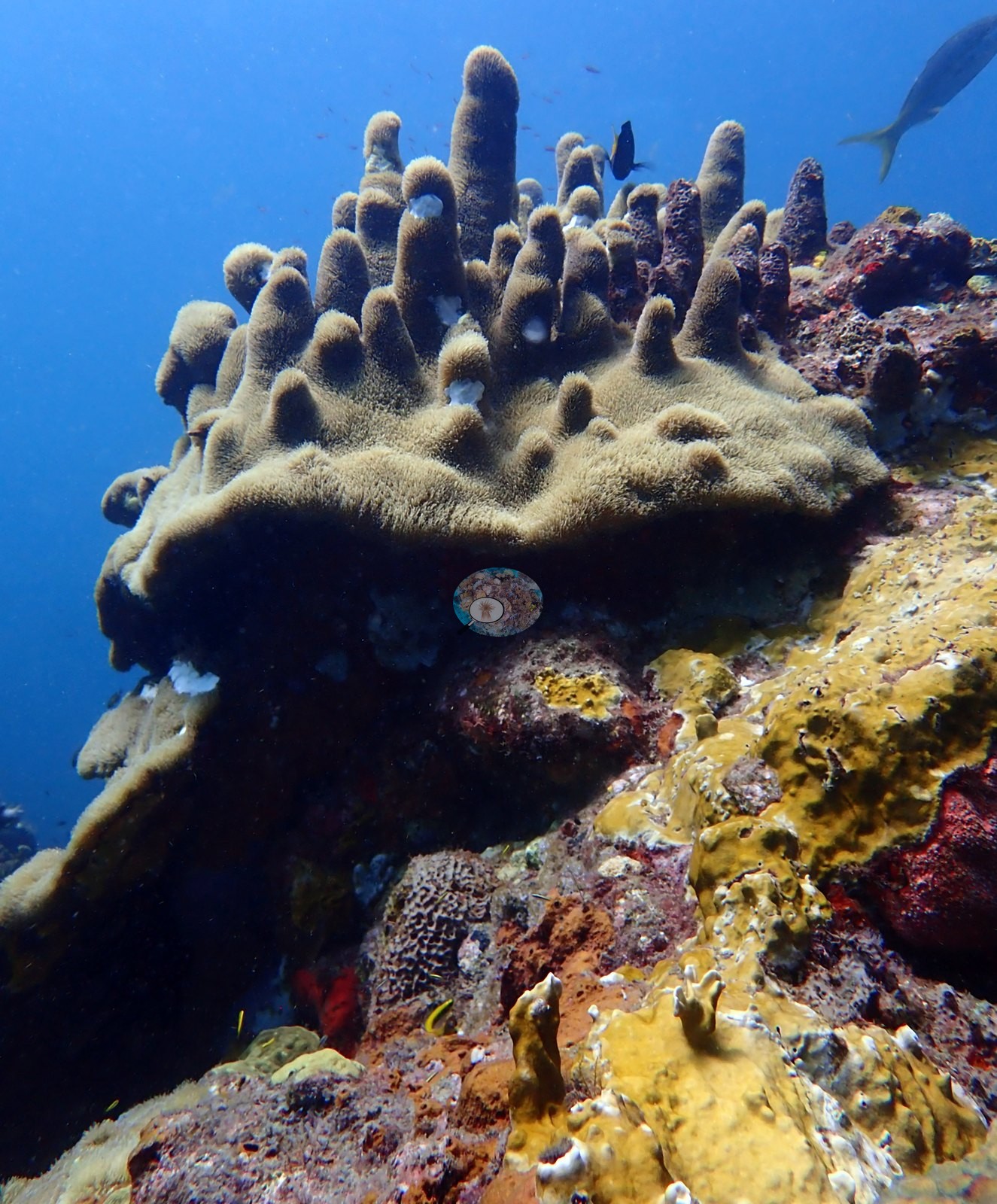
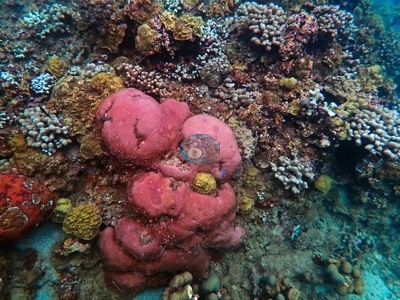
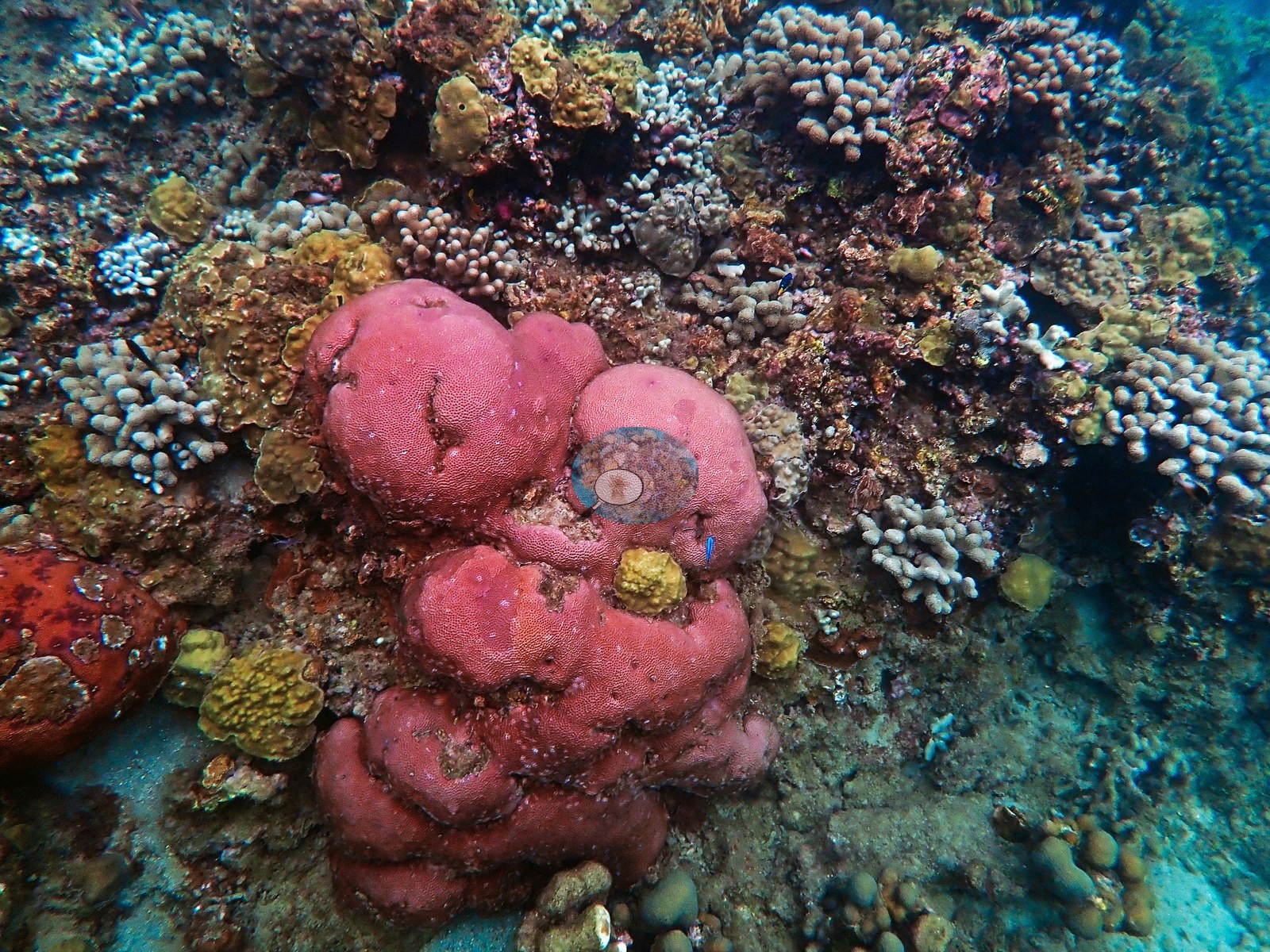
Hard coral in the reserve occurs mostly as scattered small-to-medium colonies: brain corals (Pseudodiploria/Diploria), mounding Montastraea cavernosa, green Porites astreoides, pale Agaricia plates, and one large Dendrogyra cylindrus pillar coral on the Scott's Head crest. Toucari Bay is the coral-rich exception. Dense stands of boulder star coral (Orbicella) and brain corals, pale finger-coral thickets consistent with Porites porites, and mustard hill coral patches crowd its boulders, with red and orange encrusting sponges between them and a slope dropping into deep blue. Blind Claude computer-vision point counts of Anderson's edited photographs put coral cover at 29% at Champagne Reef (scored from the Boondoggle dive off Champagne beach the same day), 28% at Toucari Bay, 15% at Scott's Head Pinnacle, and 11% at Coral Gardens; the medians are lower (20%, 27%, 10%, and 6.2%) because a few colony-focused photos raise the means.
Disease is the main condition signal. At Scott's Head, two M. cavernosa colonies show bright white bands of active tissue loss, the appearance of tissue-loss disease; stony coral tissue loss disease was documented in Dominica in 2022, but the photographs cannot name the agent. Anderson's record for Toucari notes few visible signs of disease, although one boulder star coral stand carries stark white patches of recent partial mortality. No bleaching was evident at the photographed sites. At Coral Gardens the concern is structural: turf-covered pavement, rubble, and sand where framework-building corals would be expected.
Fish life is conspicuous throughout, including clouds of chromis and streams of creole wrasse at Coral Gardens, great barracuda, blackbar soldierfish, and a scorpionfish at Scott's Head, and a foureye butterflyfish and bluehead wrasse over the Toucari slope.
Highlights
Toucari Bay is the coral-rich site, with dense boulder star and brain coral stands.photo: Dominica - Toucari Bay
Scott's Head Pinnacle is a steep volcanic pinnacle of sponge and black-coral walls with a large pillar coral on its crest.photo: Dominica - Scott's Head Pinnacle
Sponges, not corals, provide most of the vertical structure in the Soufriere-Scotts Head reserve.
Active tissue loss consistent with disease was photographed on two great star coral colonies at Scott's Head.
Notable observations
Dominica - Scott's Head Pinnacle: Disease: two frames show unambiguous active tissue loss on Montastraea cavernosa (bright white band between live tissue and freshly denuded skeleton; irregular white lesion margins); consistent with tissue-loss disease, SCTLD documented in Dominica in 2022, but photographs alone cannot name the agent; bare white patches on other mounding colonies
Dominica - Toucari Bay: Boulder star coral (Orbicella) stand with conspicuous partial mortality: stark white patches of bare skeleton with sharp margins, consistent with recent tissue loss (photo observation only)
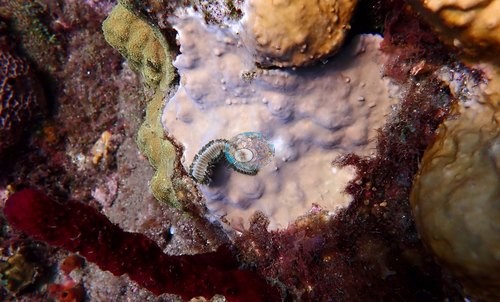
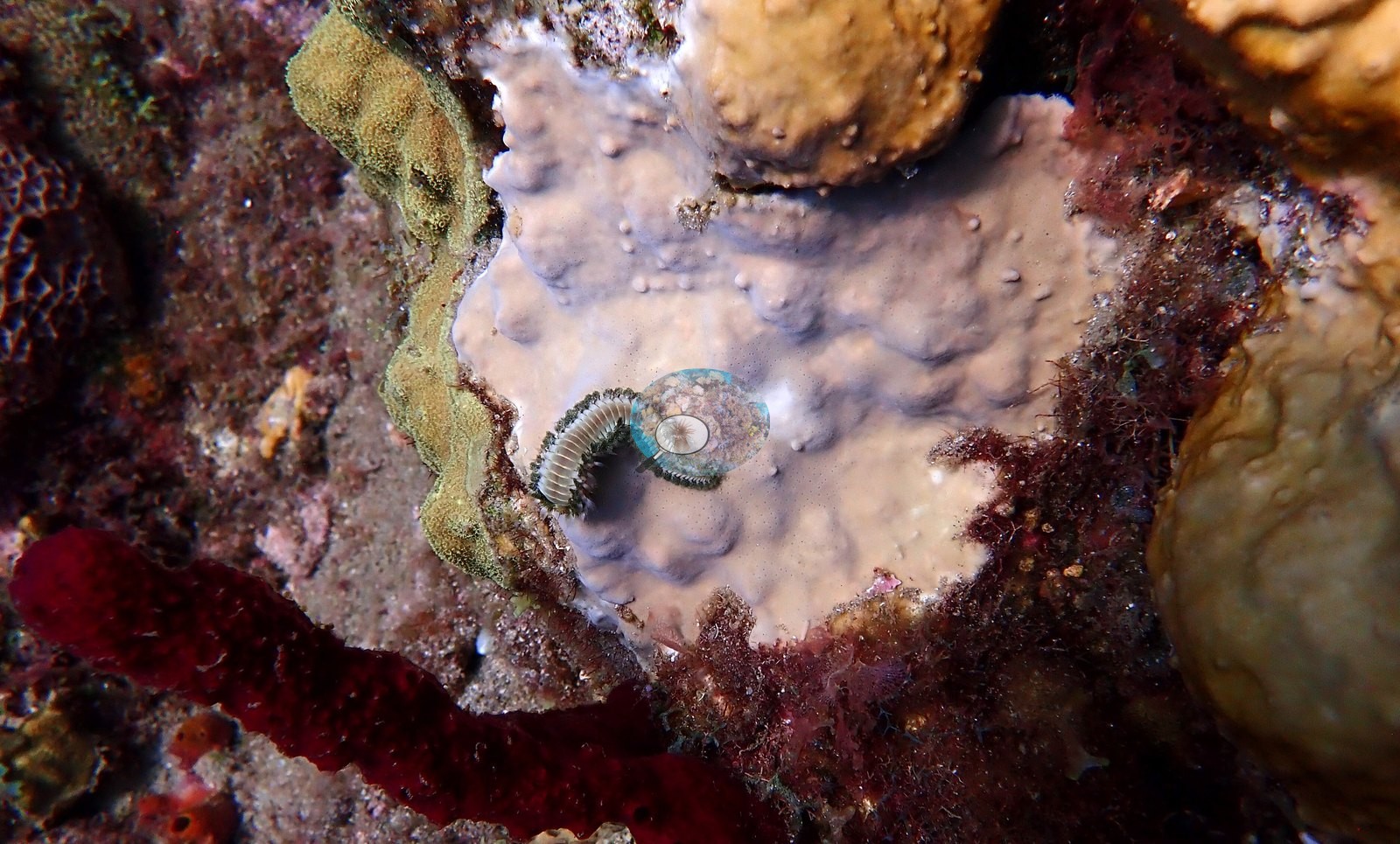
Dominica - Coral Gardens: A bearded fireworm, a coral predator, crawling across a pale encrusting surface (sponge vs pale coral unresolved); an empty queen conch shell on rubble, consistent with natural mortality or harvest
Coral cover over time (pooled)
One point per year: the mean of every hard coral cover value available for this region that year — Anderson’s own dives and every independent survey station within 5 km of them. The vertical bar is the full range behind that mean. Different programs use different methods at different stations, so this is a regional summary, not a single comparable series. Years resting on fewer than three values are drawn as smaller points (2004, 2007, 2008, 2009, 2014). Non-CRD points are from Reef Check Foundation. Marker shape: his own dives, other organizations’ surveys.
Spalding MD, et al. (2001) World Atlas of Coral Reefs. University of California Press, Berkeley. [PDF]
Wells SM (ed.) (1988) Coral Reefs of the World. Volume 1: Atlantic and Eastern Pacific. UNEP/IUCN, Cambridge. [PDF]
Wilkinson C (2006) Status of coral reefs of the world: summary of threats and remedial action. In: Côté IM, Reynolds JD (eds) Coral Reef Conservation. Cambridge University Press, Cambridge. [PDF]


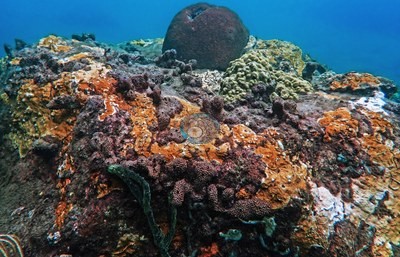 photo: Dominica - Toucari Bay
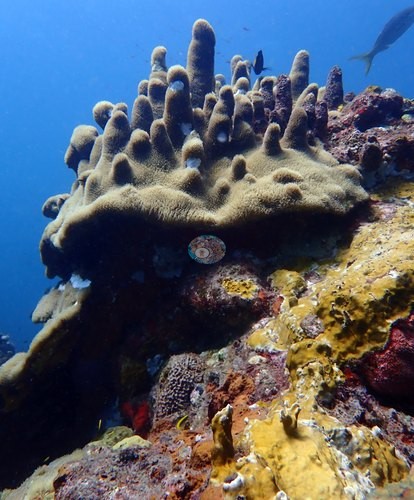 photo: Dominica - Scott's Head Pinnacle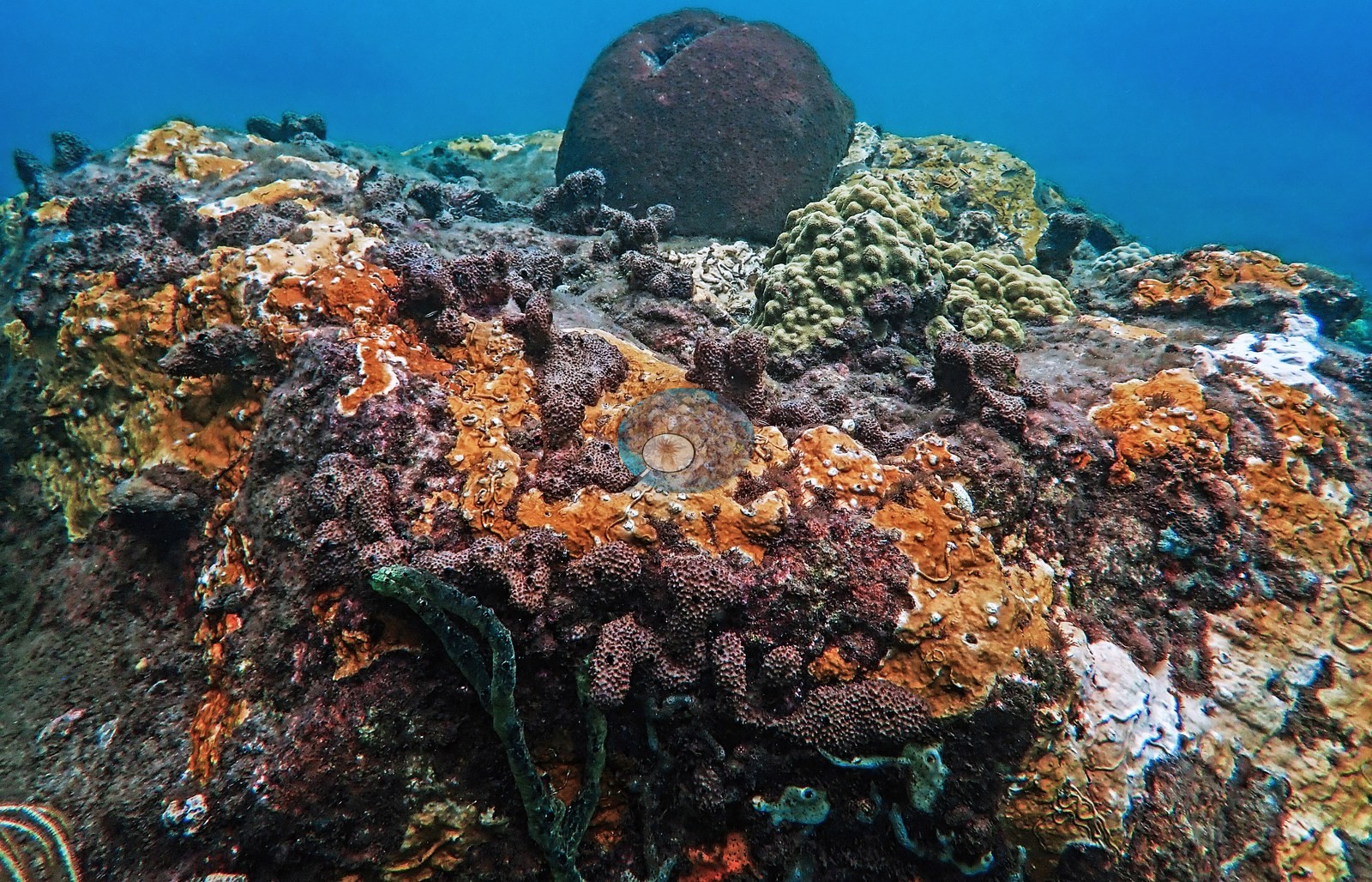
 © Coral Reef Diagnostics.