
Fiji - Matuku (FJMT13)

Part of the regional summaries: Fiji - Matuku, Fiji - Moala Group (Moala / Totoya / Matuku), and Fiji - Lau
More info
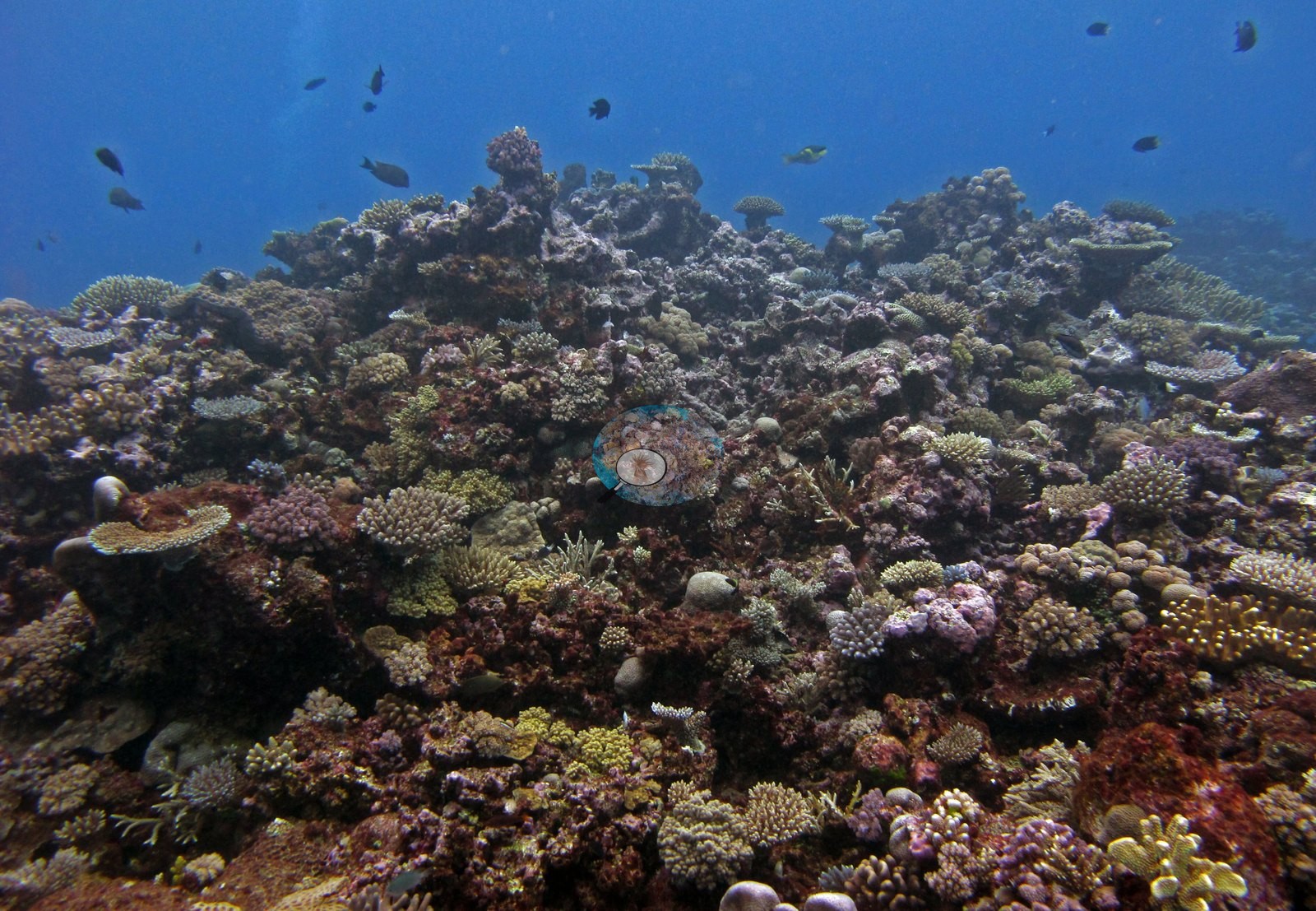
Fiji (NOAA CRW virtual station)A broad, coral-crowded ridge on Matuku's fore reef, dived to 15.8 m, where the framework looks dense but the living coral is patchy (26% cover), with pink coralline algae sheeting old rubble between small table Acropora and Pocillopora. The slope drops away as a near-vertical wall; none of the six photographs shows disease or crown-of-thorns, but two of the six colonies Anderson sampled were partly bleached, one about 80%. Surveyed on the Living Oceans Foundation's Global Reef Expedition.
E dua na dela raraba e vonu ena lase ena yasana i tuba ni cakau (fore reef) i Matuku, a nunu kina ki na 15.8 m, ka rairai vonu na ivakatudei (framework) ia na lase bula e veitawasei tu (26% na ubi ni lase), ka ubia na lumi vakalase (coralline algae) e roka (pink) na tikitiki ni lase mate (rubble) makawa ena maliwa ni Acropora vakatepeli lalai kei na Pocillopora. Na baba e lutu sobu me vaka e dua na bati e voleka ni tu dodonu; e sega ni laurai e dua na mate se bula (crown-of-thorns) ena ono na itaba (six photographs), ia e rua vei ira na ono na lase a taura kina na ivakaraitaki ko Anderson e vulavula vakalailai (partly bleached), e dua e rauta ni 80%.
AI translation of this summary; the English is authoritative. (low confidence)
CTD-cast midpoint of 26.8–26.9°C
Two other CRD dive sites with their own pages within 5 km shown in orange — click a marker to open its page.
Site description
Setting
In the frames visibility is moderate, with a soft blue haze over anything past a few meters; Anderson's notes call the water murky.
General benthic features
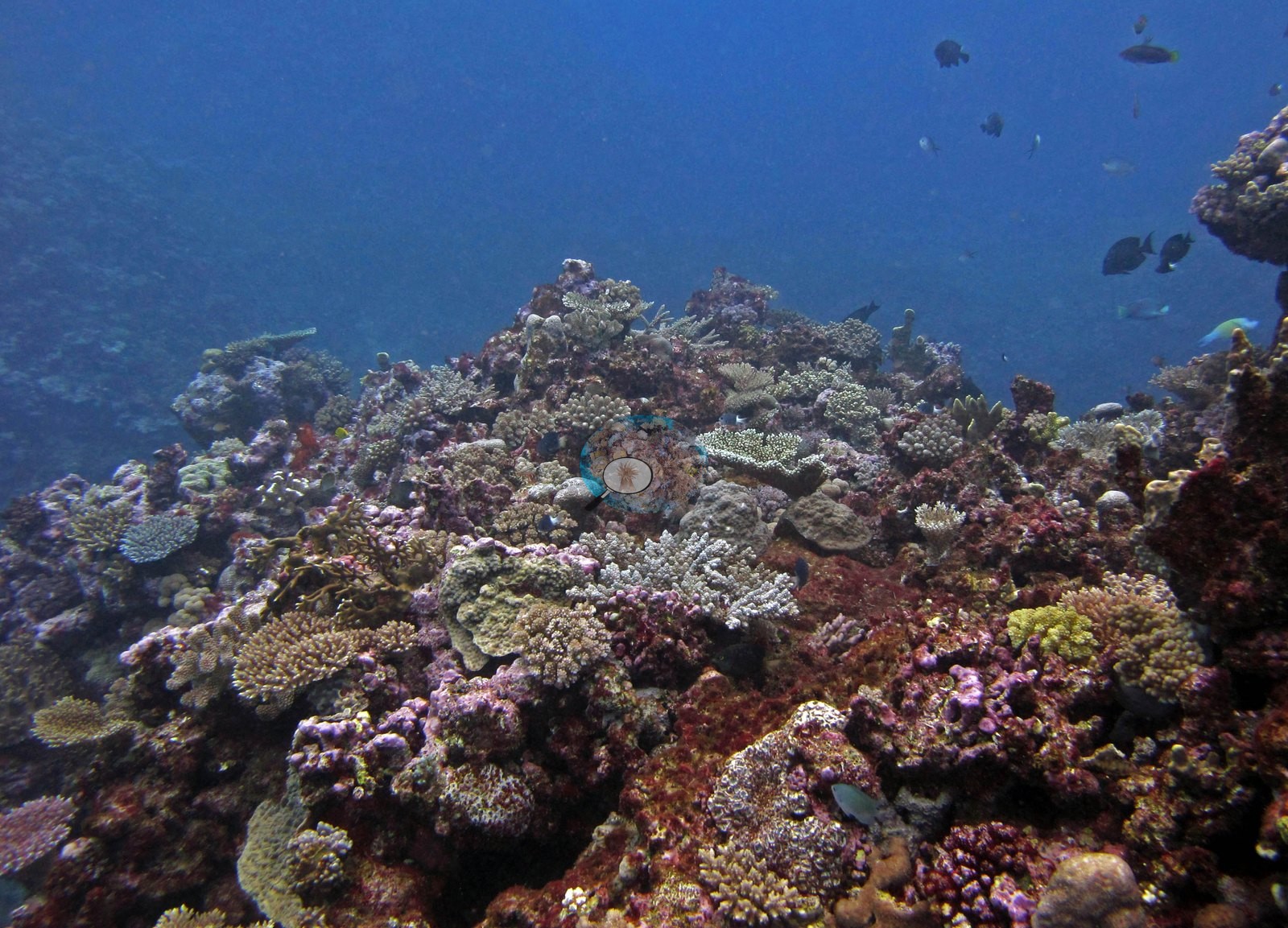
The photographs show why the number reads lower than the eye expects: the framework is dense but the living veneer is patchy, with pink and mauve crustose coralline algae sheeting over most of the old skeletal rubble between colonies (e.g., Image 1).
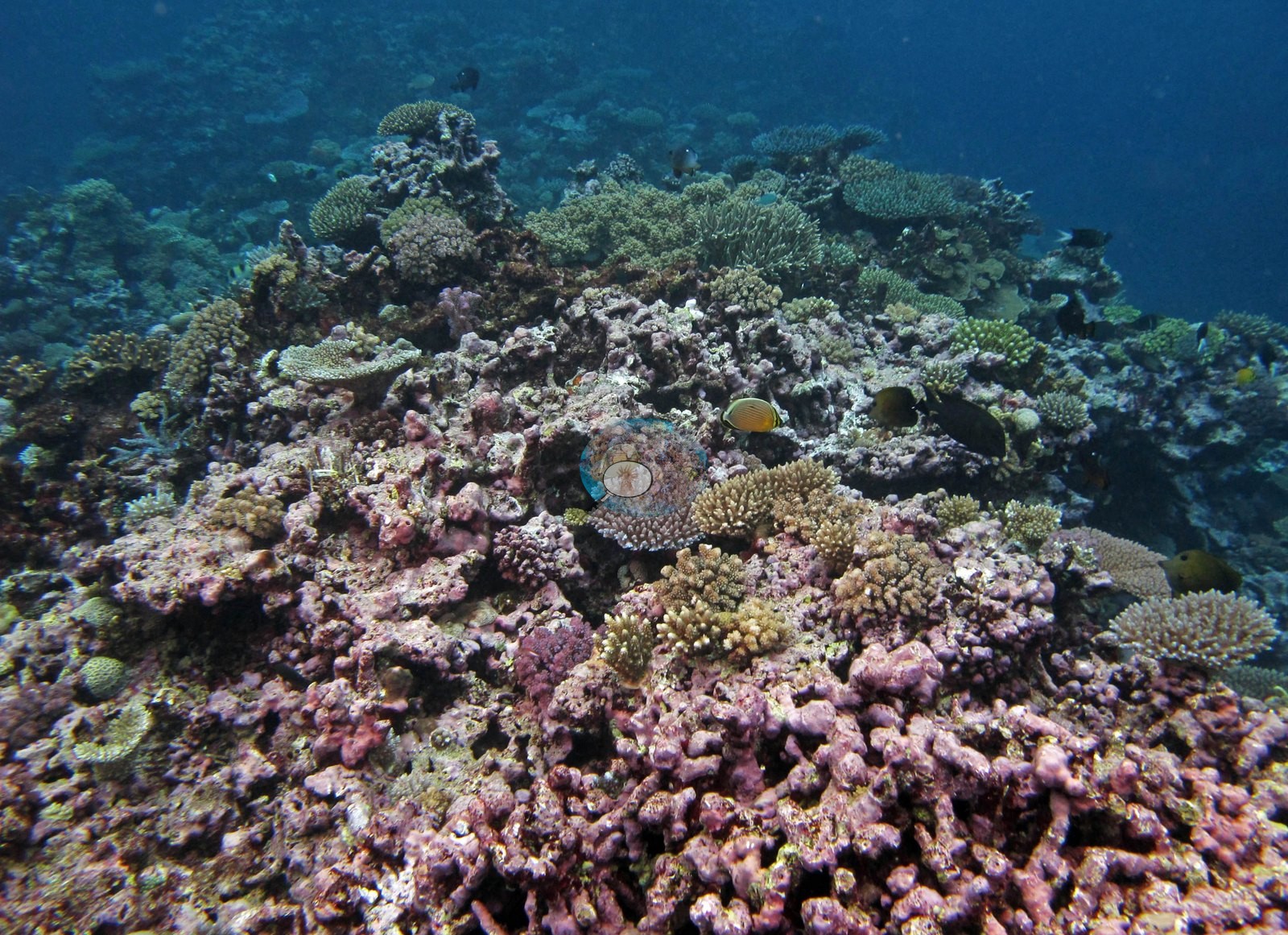
Small tabular and corymbose Acropora plates sit scattered across the ridge top alongside stubby Pocillopora heads and low mounding colonies, a few table plates already broad enough to shade the pavement beneath them (e.g., Image 5).
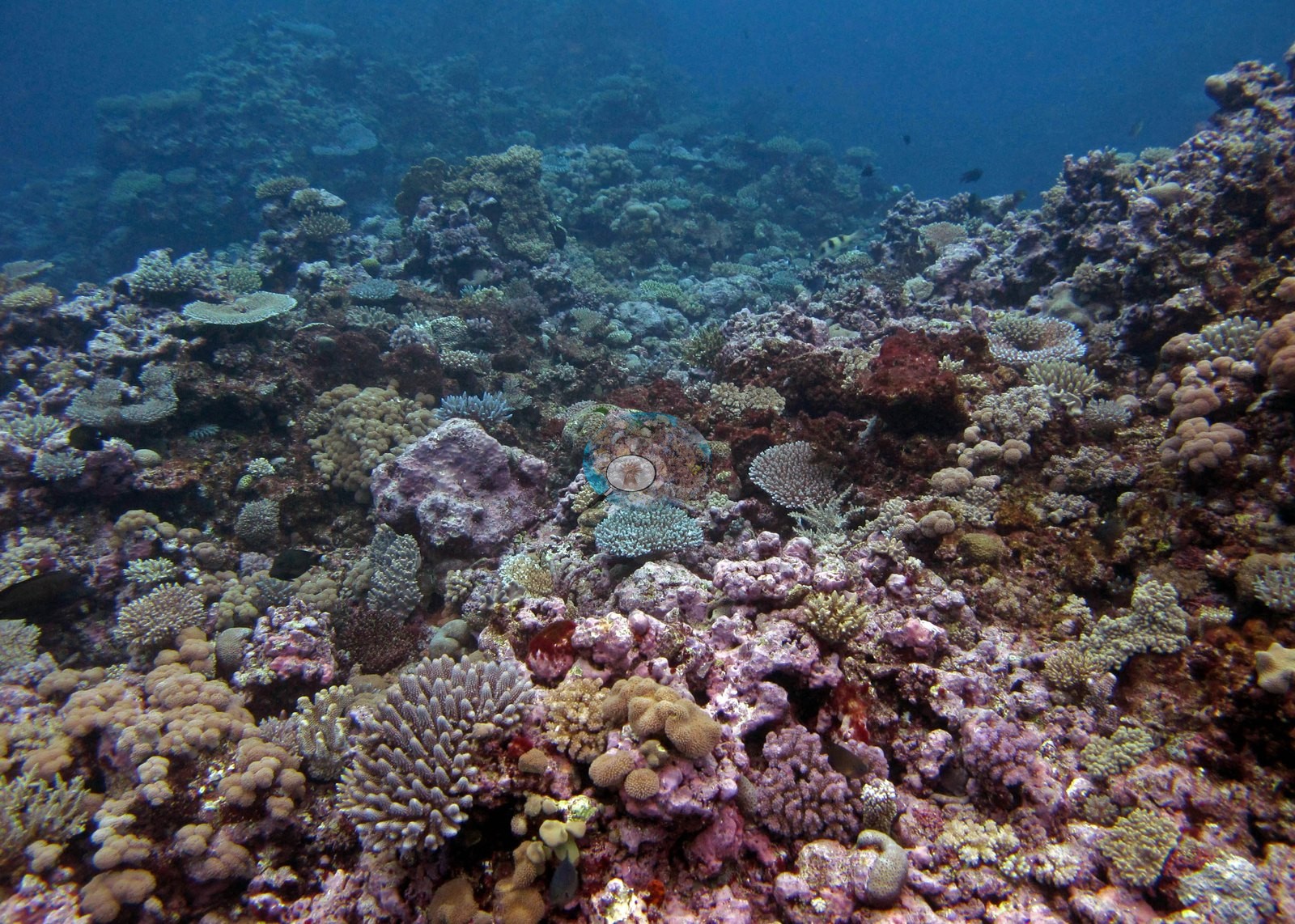
Rusty-red and olive turf and fleshy algae fill the hollows, matching the high algal fraction logged here (e.g., Image 3).
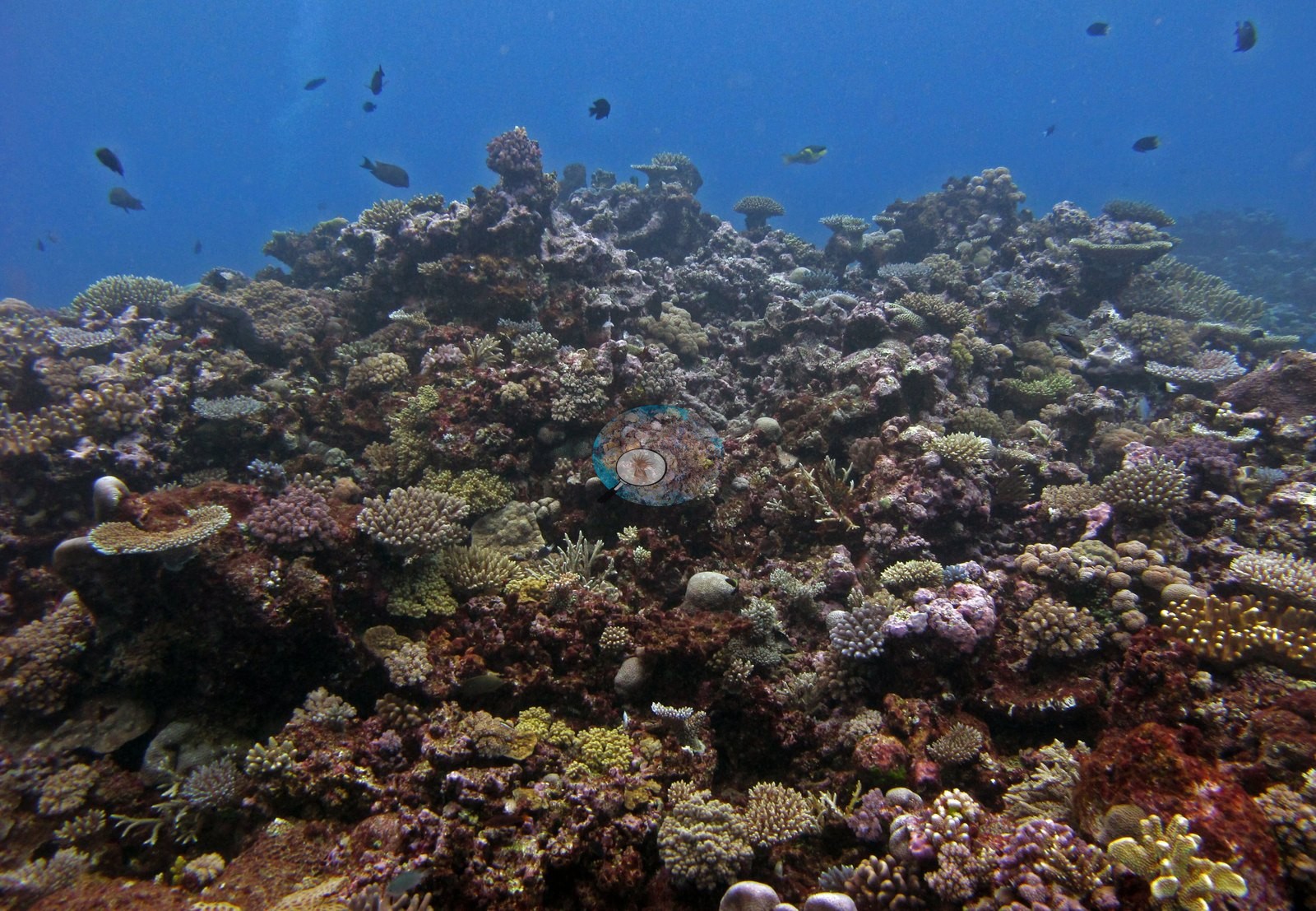
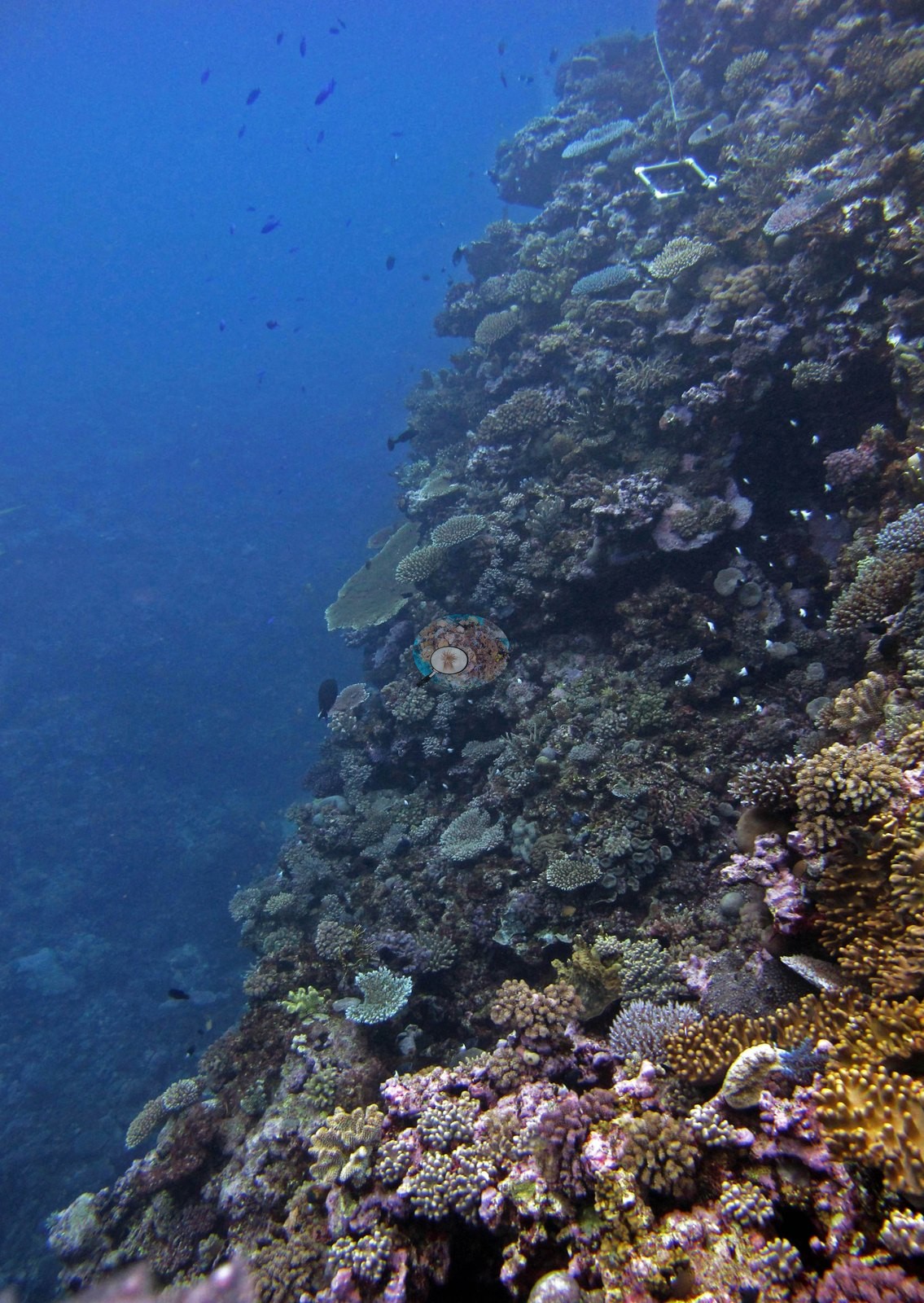
One frame follows the slope down into blue water, the reef falling away as a near-vertical wall of coral and coralline pavement; a rectangular survey quadrat is visible clipped to the reef in the upper corner (e.g., Image 4).
Coral cover
- Reference: Khaled bin Sultan Living Oceans Foundation, Global Reef Expedition (in situ transect)
- On the Matuku fore reef (station CTD cast to 19.2 m), the GRE team worked a broad, coral-crowded ridge that point-count survey put at 26% living cover.
- Transect mean 26 ± 5.2% SE (n = 4 transects; Living Oceans Foundation per-transect benthic data); the headline above is this all-transect mean.
Stressors
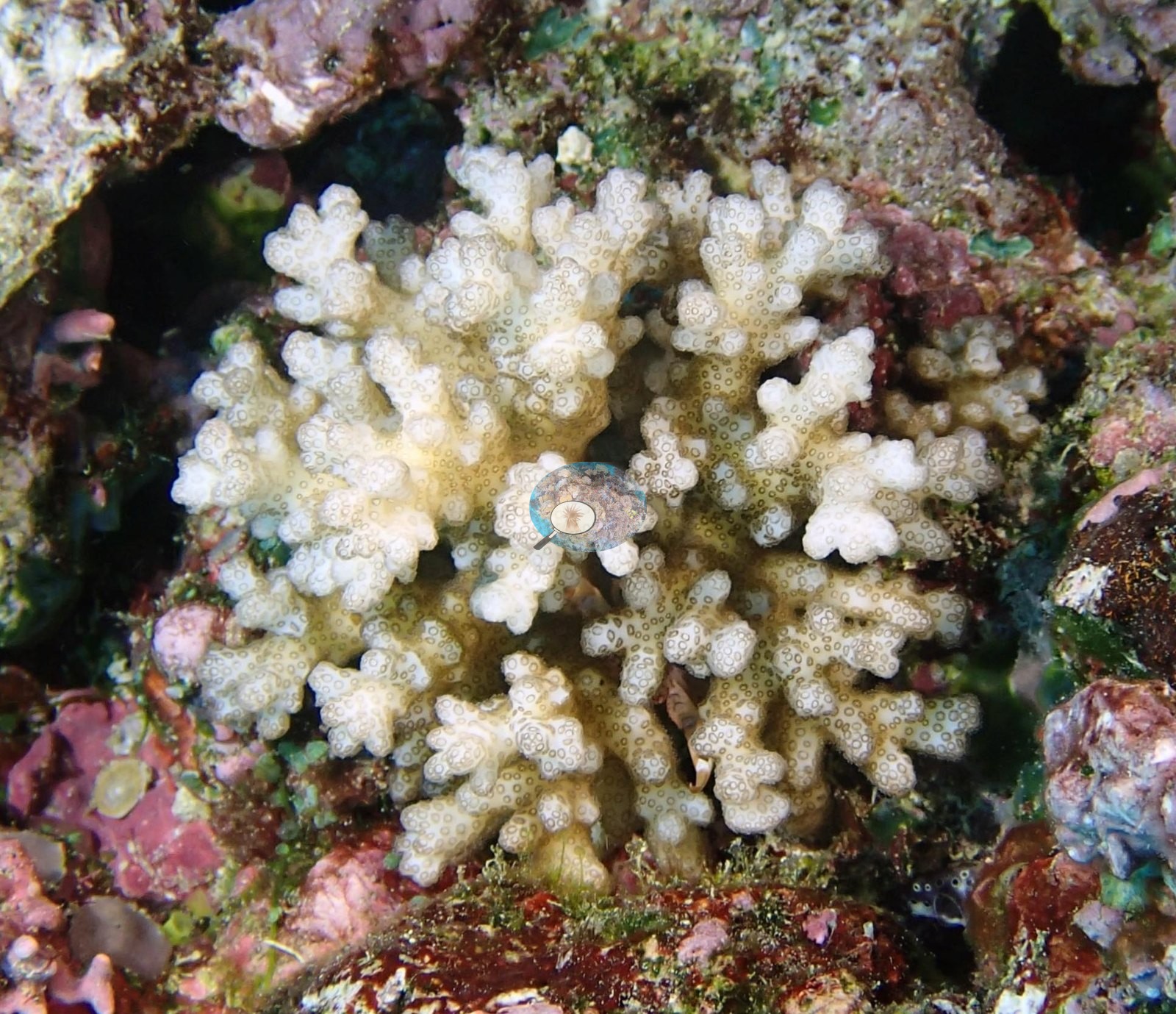
A young, untagged branching colony is pale and partly bleached (e.g., Image 6); no disease or crown-of-thorns damage is apparent in these frames, and Anderson's sample records for the dive list six colonies, one of them very pale and about 80% bleached and another about 20% bleached.
Of the five coral colonies from this site with an outlier score, one (20%) was flagged as a physiological outlier (Mayfield et al. 2017, PLoS ONE). The Living Oceans Foundation transects here recorded 13% cyanobacteria and no recently dead coral on the transect lines.
Fish and other fauna
Damselfishes hover in loose clouds over the crest, a pair of butterflyfish work the branch bases, and parrotfish drift along the edge (e.g., Image 2).
Comparisons with other data
Apart from the Living Oceans Foundation survey shown here, we found no other surveys at this site as of 2026. If you would like to share yours, please email us.
Other notes
Survey team's site notes: Visibility was poor, with a fair amount of suspended sedimentation. Large branching acroporids with some recent mortality was common. Drupella snails were found on several colonies which could account for some recent mortality scars on the acroporids. Plating Pachyseris and Echinopora colonies common at base of slope.
Data & links
- Download benthic survey data (CSV) ↗
- Download all LOF-GRE data (933 sites) ↗
- Photo portfolio ↗
- Coral Reef Diagnostics page for this area ↗
All images from Coral Reef Diagnostics. Data are from the Khaled bin Sultan Living Oceans Foundation Global Reef Expedition and Coral Reef Diagnostics.
© Coral Reef Diagnostics.