
Part of the regional summaries: Fiji - Kabara, Fiji - Southern Lau (Kabara / Fulaga), and Fiji - Lau
More info
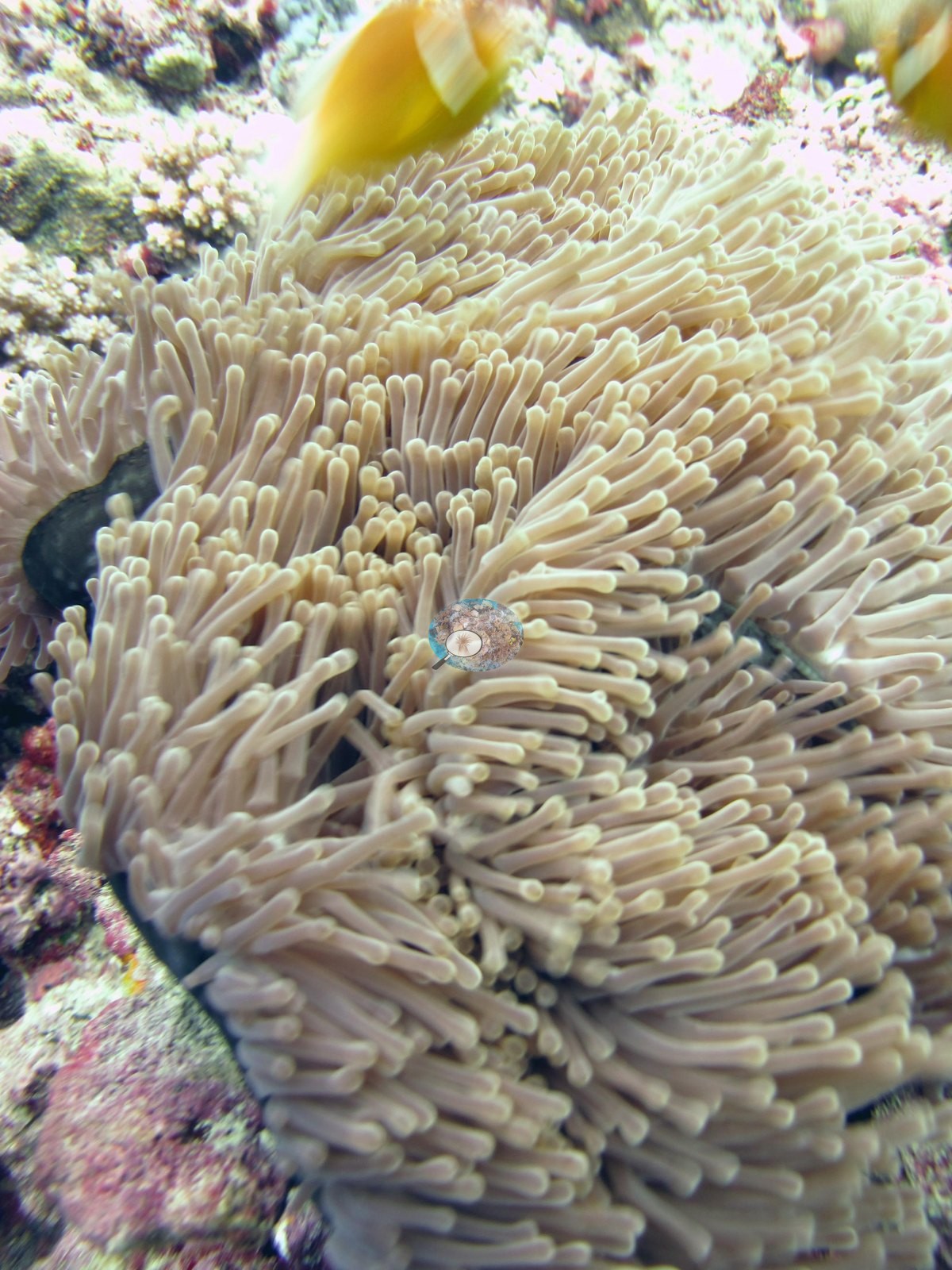
Fiji (NOAA CRW virtual station)A fore-reef station off Kabara in southern Lau with 62% live coral. The survey notes describe spur-and-groove structure on a 5-12 m terrace, and the only surviving photograph shows an anemone and its anemonefish. Surveyed on the Living Oceans Foundation's Global Reef Expedition.
E dua na vanua ni vakadidike ena yasana i tuba ni cakau (fore reef) mai Kabara ena yasana i ceva i Lau ka 62% na lase bula. Na ivola ni vakadidike e vakamacalataka na ivakarau ni spur-and-groove ena dua na vanua raraba (terrace) ena 5-12 m, ka na dua ga na itaba e se tiko e vakaraitaka e dua na anemone kei na nona ika (anemonefish).
AI translation of this summary; the English is authoritative. (low confidence)
CTD-cast midpoint of 26.2–26.6°C
Two other CRD dive sites with their own pages within 5 km shown in orange — click a marker to open its page.
🗺 Detailed map of the Global Reef Expedition dive sites, Kabara, Fiji (Khaled bin Sultan Living Oceans Foundation; opens in a new window)
Site description
Setting
FJKA32 is a fore-reef station off Kabara, a raised limestone island in southern Lau, surveyed on 13 June 2013 during the Global Reef Expedition.
General benthic features
Only a single photograph survives from this dive, and it is a blurred close-up of one large host anemone with long pale tan tentacles on coralline-encrusted pavement, with an anemonefish crossing the top of the frame. That is the whole of the photographic record: it shows an anemone and its fish, and it settles nothing about the reef's structure, zonation, coral community, or condition. Everything quantitative here therefore rests on the benthic transect, and everything descriptive on the expedition's own site notes, which characterize the Kabara fore reef as spur-and-groove structure on a 5-12 m terrace with sediment accumulating between the spurs and the slope steepening sharply below about 15 m — the survey team's characterization, not an observation from imagery.
Coral cover
- Reference: Khaled bin Sultan Living Oceans Foundation, Global Reef Expedition (in situ transect)
- An in situ benthic transect (station CTD cast to 13.5 m) recorded 62% live coral cover (LOF-GRE in situ benthic transect; the expedition's Fiji coral data workbook).
- No algal-cover value was logged for this transect, so no coral-versus-algae balance can be quoted here.
Stressors
Recent thermal exposure at the Fiji virtual station averages an annual maximum of 8.9 degree-heating-weeks (NOAA Coral Reef Watch, 2021-2025), above the 8 DHW severe-bleaching level. No crown-of-thorns starfish (COTS) or other corallivores were evident.
Comparisons with other data
Around 15 m the slope becomes very steep, with lots of small-medium sized acroporids and Pocillopora. Survey team's notes for FJKA31 (a different Kabara station): FJKA31 had mixed habitats of shallow fore reef terrace with small acroporid colonies and fore reef sand flats. Large Porites lobata colonies and tabular acroporids occur within the sand flats, especially in deeper areas (30-50 m).
Dive record
Anderson's dive here began at 15:38 on 13 June 2013 and lasted 62 minutes; the expedition team's survey dive at this station was logged earlier that afternoon (13:47-14:50).
Data & links
All images from Coral Reef Diagnostics. Data are from the Khaled bin Sultan Living Oceans Foundation Global Reef Expedition, Coral Reef Diagnostics, and NOAA Coral Reef Watch.
 © Coral Reef Diagnostics.