
Saudi Red Sea - Al Fasmah (Yanbu)
Part of the regional summaries: Saudi Arabia - Yanbu, Saudi Arabia, and Red Sea
More info
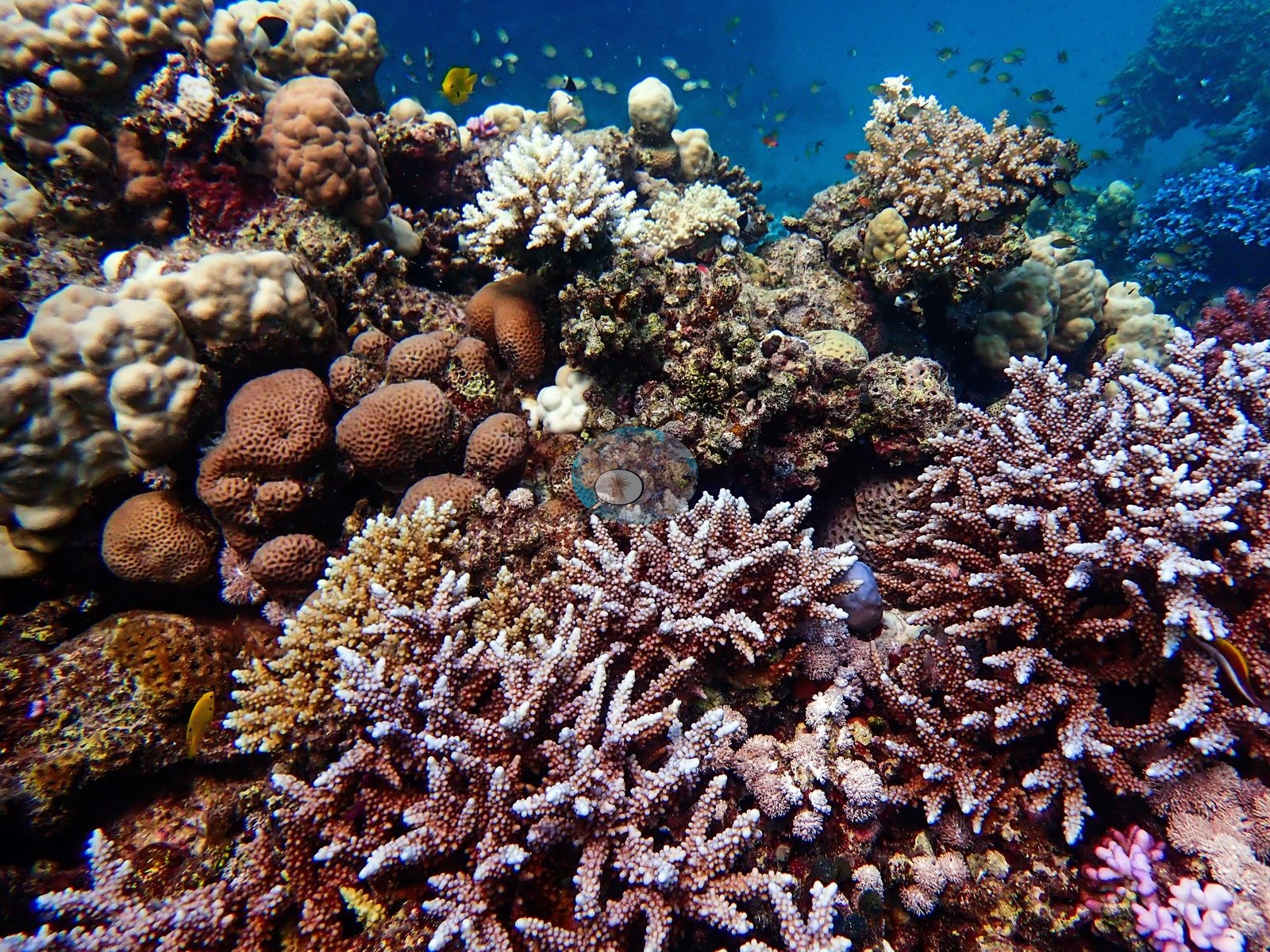
Makkah-Madine Saudi Arabia (NOAA CRW virtual station) · Northern and Central Red Sea ecoregion mean=12.2°C-heating weeksAl Fasmah, dived the same Yanbu morning as Alrass Alakhdar, is unusually uniform frame to frame - a densely and evenly covered reef cut by narrow gullies and canyons, with cobalt Acropora, apricot corymbose Acropora, and magenta pocilloporids over coralline rock. Published cover was 22% with 27.8% of coral tissue bleached - less than half the bleaching seen at Alrass Alakhdar earlier that same morning, though stark-white colonies still recur through the frames.
الفسمة، التي غُطست في صباح ينبع نفسه مع الرأس الأخضر، متجانسة بدرجة غير معتادة من صورة إلى أخرى: شعبة مغطاة بكثافة وانتظام تقطعها أخاديد وممرات ضيقة، مع Acropora بلون كوبالتي، وAcropora عنقودي مسطح بلون المشمش، ومرجانيات شوكية أرجوانية فوق صخر مرجاني.
ترجمة هذا الملخص بالذكاء الاصطناعي؛ النص الإنجليزي هو المعتمد. Translated from the site’s shorter map summary.
Two independent survey stations shown with the program’s logo — click one to see how far it is from this site.
Site description
Setting
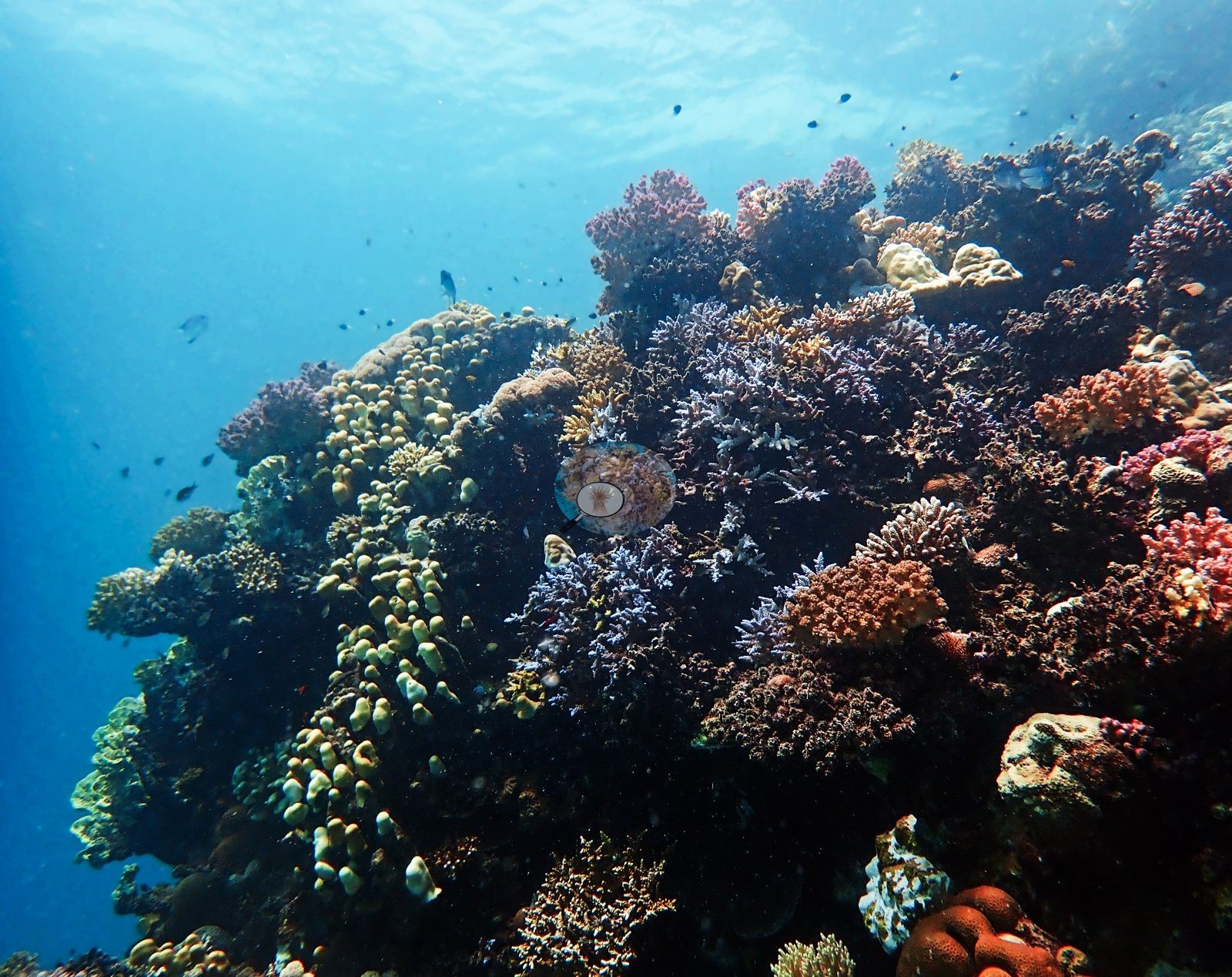
The structure is a shallow reef complex cut by gullies and canyons — one frame looks up a narrow blue channel between two vertical coral-covered walls, chromis stacked through it.
General benthic features
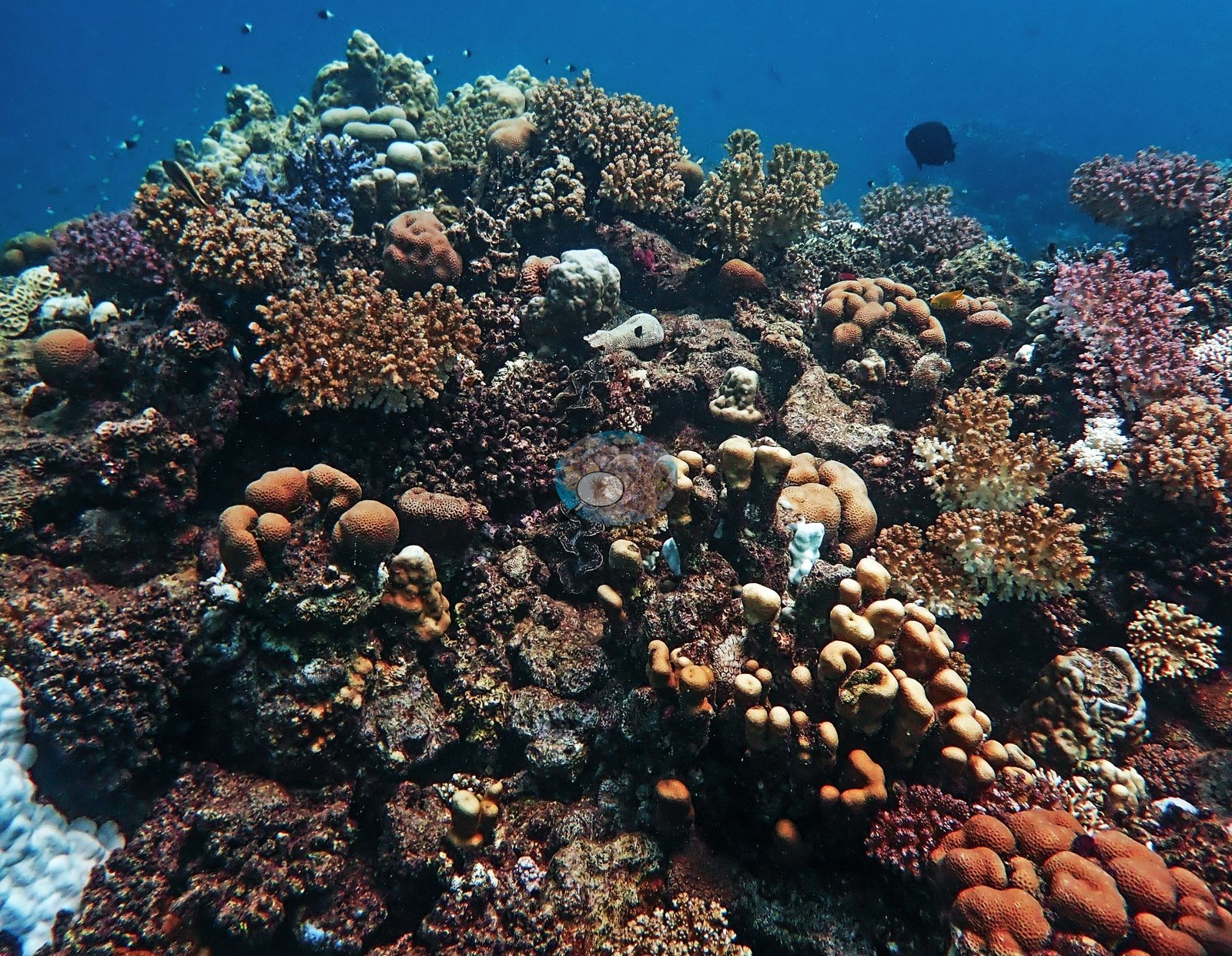
The reef top is genuinely rich and, in the shallow strobe-lit frames, spectacularly colored: cobalt and powder-blue digitate Acropora, apricot and salmon corymbose Acropora, magenta and lilac pocilloporids, yellow-green Turbinaria-type plates, mustard Millepora-type fire coral, tan and cream knobby Porites, olive faviids, and orange encrusting sponge, packed close over coralline-crusted rock (e.g., Image 1, Image 3, Image 4).
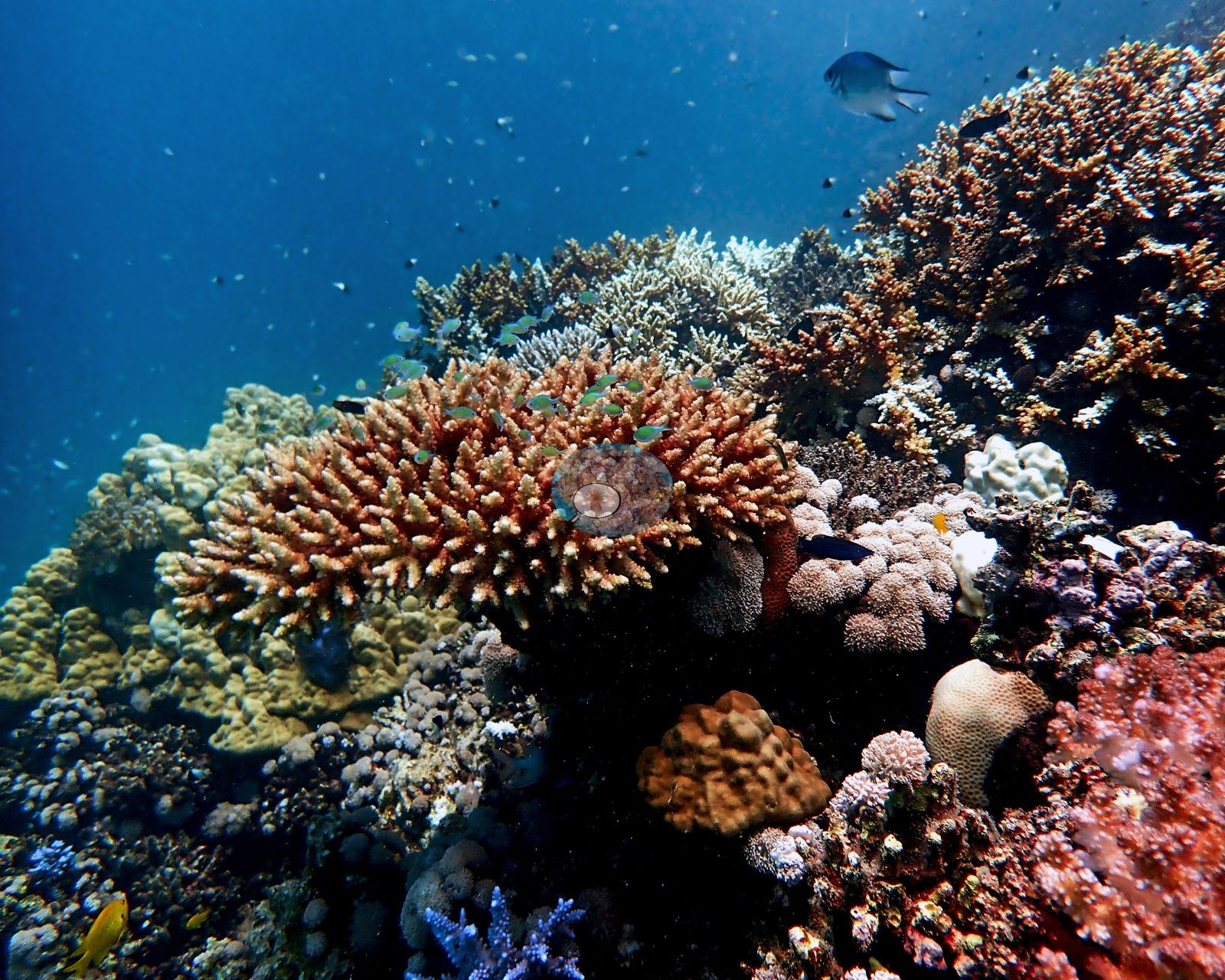
A large apricot corymbose Acropora table with a school of green chromis over it is the single best-composed frame of the dive (e.g., Image 2).
Coral cover
Coral cover is 22.0% ± 12.2 across 116 photographs, quoted verbatim from Mayfield, A.B. (2025) Environments 12:248 — Red Sea 2023-24 bleaching; CoralNet point annotation, Appendix A — a manual, diver-annotated CoralNet point count from Anderson's own published work, not a computer vision output and not recomputed here. Note that the standard deviation here (12.2) is the tightest of the Saudi sites in this set: frame to frame, this reef is unusually consistent.
Stressors
Condition: the reef was in the 2023 thermal-stress event when photographed, and white colonies appear repeatedly.
Comparisons with other data
A published figure above about 70% usually reflects the surveyors choosing the most coral-rich patch, so read it as a best-patch number rather than a site mean.
Dive record
A late-morning dive to 15 m on 16 September 2023 with Umluj Dive Center — the second dive of the Yanbu day that began at Alrass Alakhdar.
Other notes
Anderson's folder spells it "Alfasmah"; the site record carries it as Al Fasmah. See flags.
Independent surveys nearby
Within 5 km, 2 independent survey stations recorded hard coral cover in 2015. The most recent nearby survey is from 2015, so these values predate recent heat stress. This site's own estimate (22%) sits 29.0 points below the range of these surveys (51%, excluding 1 best-patch value above 70% that is not a site mean); the methods differ, so the comparison is context, not a like-for-like test.
Collected by other programs using different methods, so these are context for the figures above, not a like-for-like comparison. Where a station was surveyed more than once the range is shown. Station names are not dive-site names. Values marked best patch exceed 70%: surveyors usually chose the richest area, so they are not site means.
| Agency | Site / location | Date | Hard coral cover (%) | Distance | Link |
|---|---|---|---|---|---|
| Aeby et al. (2021) | Yanbu 4 | 2015 | 83% best patch | 1.48 km | HeatCRD database |
| Aeby et al. (2021) | Yanbu 6 | 2015 | 51% | 1.79 km | HeatCRD database |
Data & links
- CoralNet image repository for this region ↗
- HeatCRD database ↗
- (reference) ↗
- Photo portfolio ↗
- Coral Reef Diagnostics country page ↗
All images from Coral Reef Diagnostics. Data are from Coral Reef Diagnostics and the organizations named in the data-sources table above.
© Coral Reef Diagnostics.
References
- Aeby GS, Shore A, Jensen T, Ziegler M, Work T, Voolstra CR (2021). A comparative baseline of coral disease in three regions along the Saudi Arabian coast of the central Red Sea. PLOS ONE 16:e0246854. PDF
- Mayfield AB (2025). Using Tourist Diver Photos to Assess the Effects of Marine Heatwaves on Central Red Sea Coral Reefs. Environments 12:248. PDF