
Indonesia - Halmahera: Mugia
Part of the regional summaries: Indonesia - Halmahera and Indonesia - Maluku
More info
North Maluku (NOAA CRW virtual station)Mugia is a night dive over an extensive bed of stacked foliose plate coral, with a resting green turtle and dense fine-branched thickets, but two frames show a large crown-of-thorns starfish out and active amid turf-covered dead branching rubble - a real stressor, though no fresh feeding scar was caught on living coral. Anderson also logged a whitetip shark and a huge cuttlefish.
Mugia adalah penyelaman malam di atas hamparan luas karang lembaran bersusun, dengan seekor penyu hijau yang sedang beristirahat dan rumpun bercabang halus yang rapat; namun dua bingkai memperlihatkan seekor bintang laut mahkota duri besar yang aktif di antara pecahan karang bercabang mati yang tertutup alga — sebuah pemicu tekanan yang nyata, meskipun tidak terekam bekas pemangsaan baru pada karang hidup. Anderson juga mencatat seekor hiu sirip putih dan seekor sotong berukuran besar.
Terjemahan ringkasan ini oleh AI; versi bahasa Inggris yang berlaku.
Two other CRD dive sites within 5 km shown in orange — click a marker to open its page.
6 of these 8 photographs are shown beside the text that discusses them under "Site description" below.
Site description
General benthic features
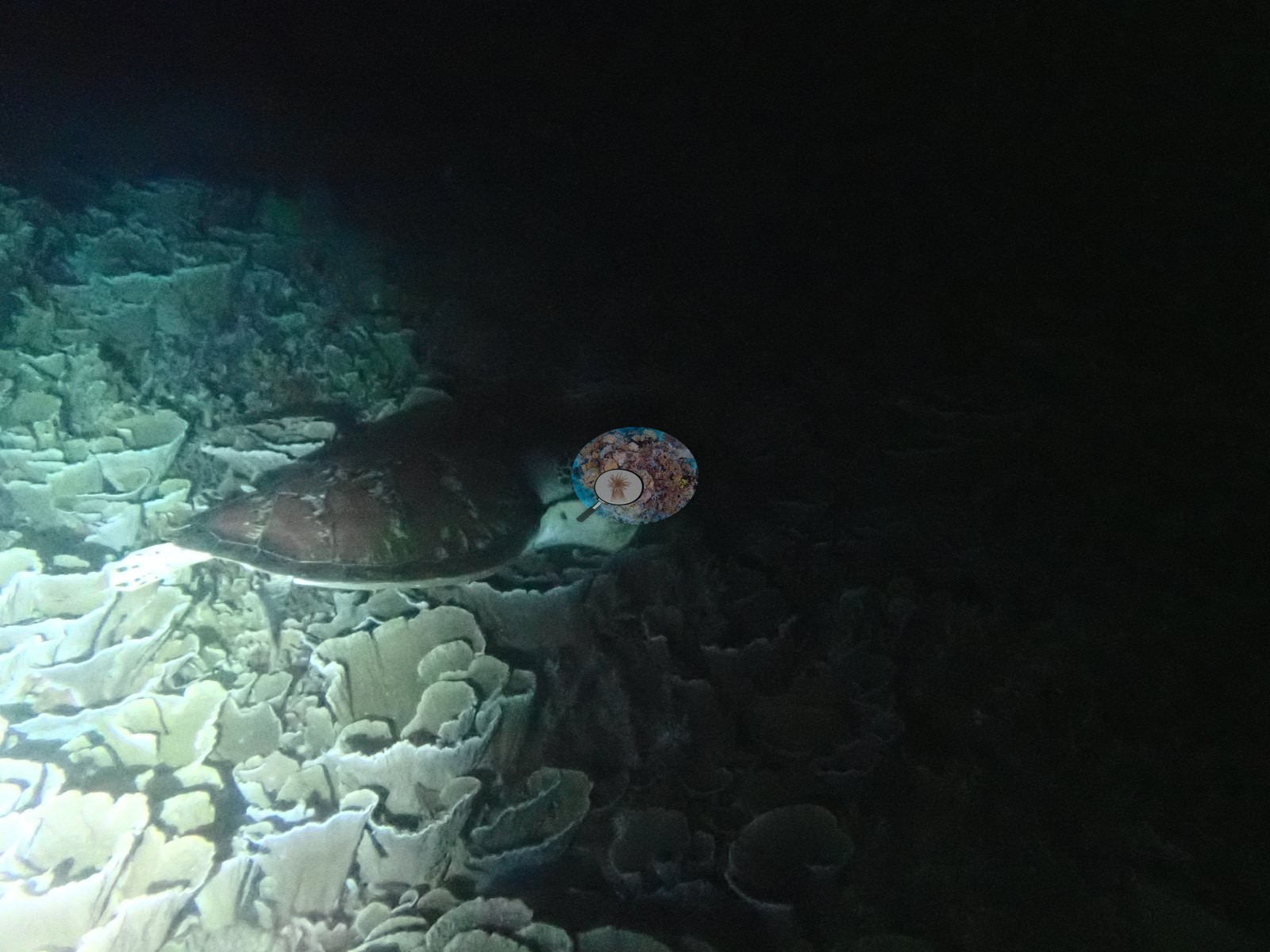
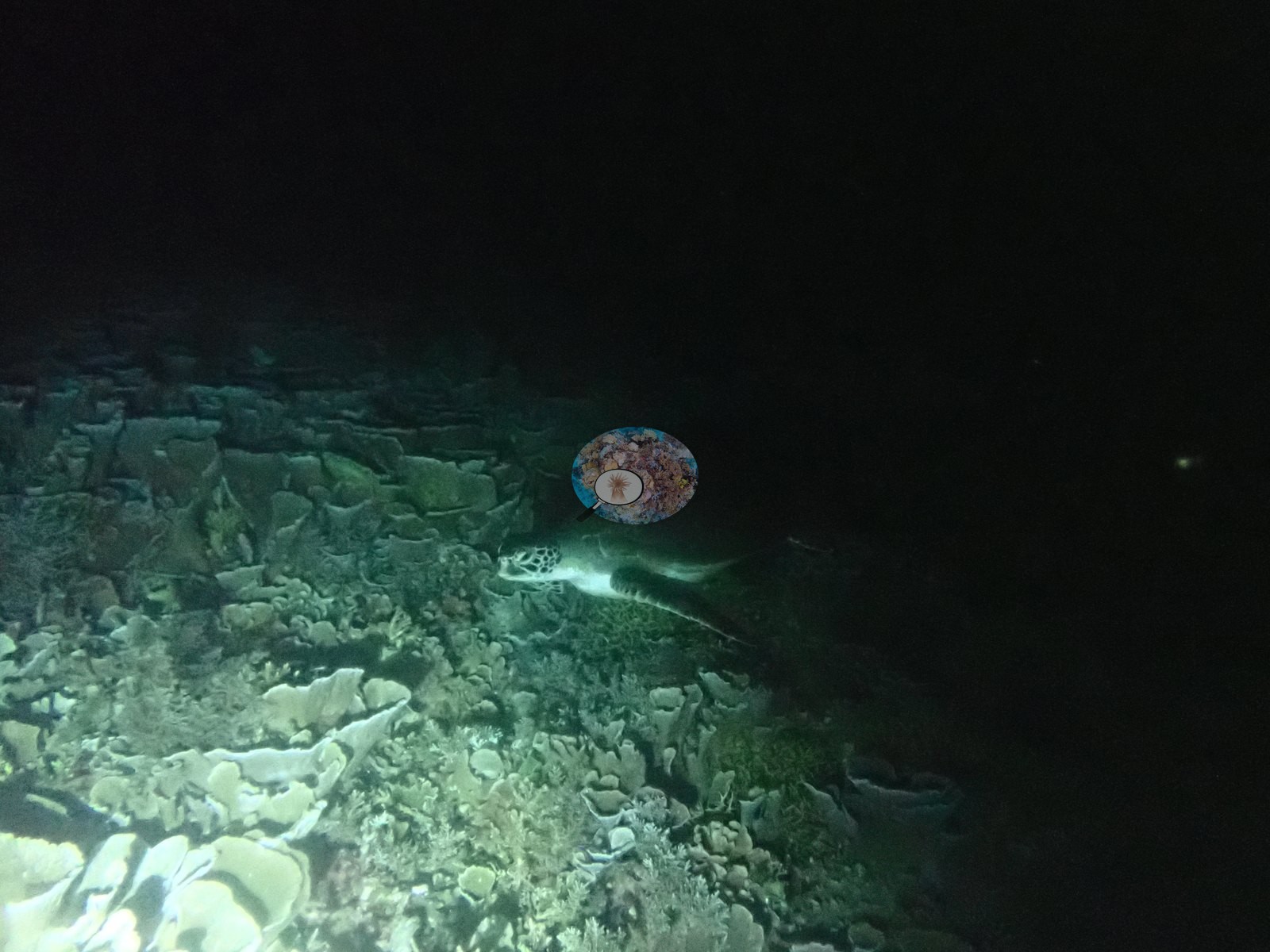
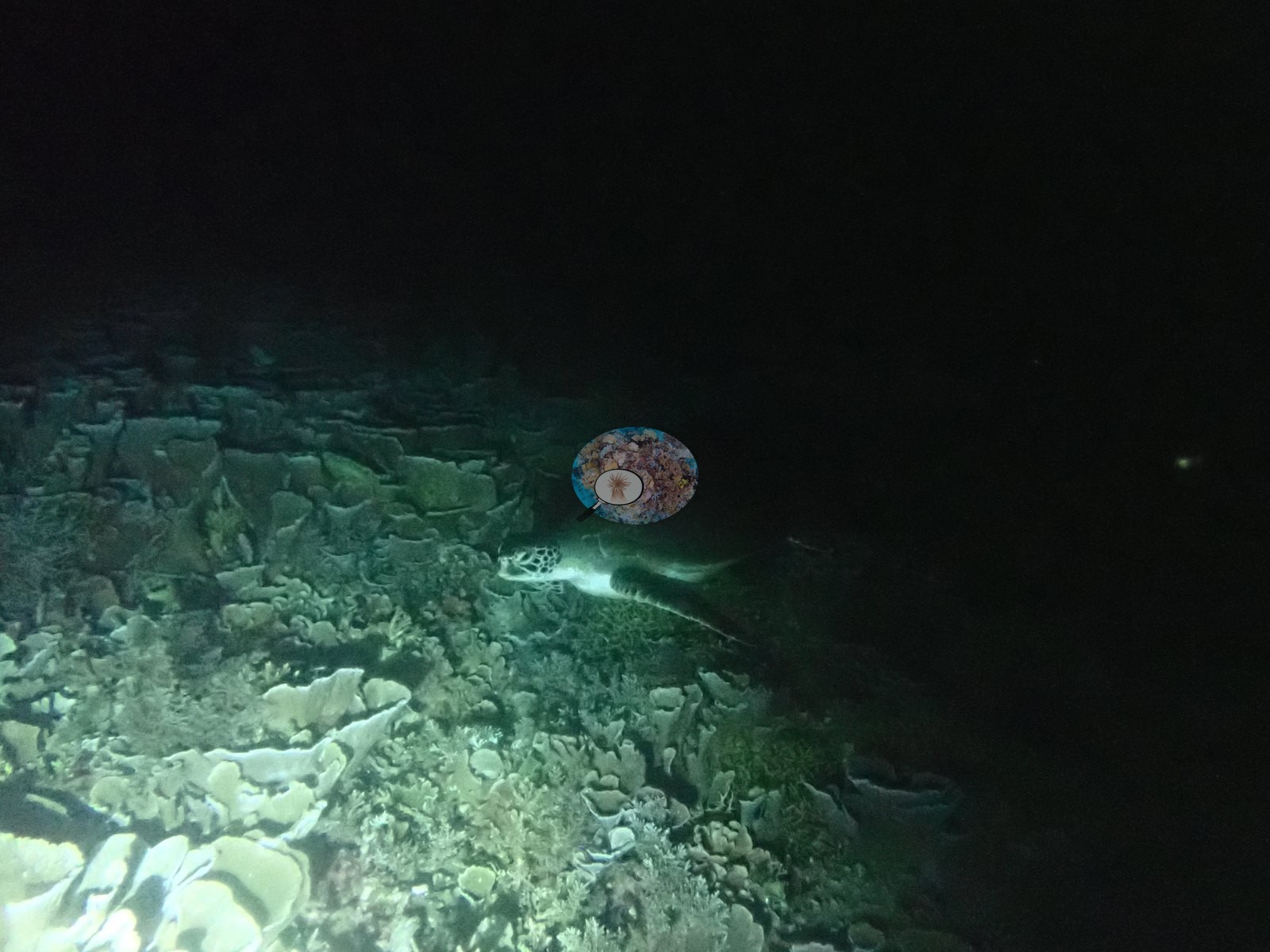
The reef itself, in the two frames that show it wide, is a bed of stacked, upward-cupped foliose plates — tiered shelving plate after plate to the edge of the light, consistent with Turbinaria and foliose Montipora-type corals — and it is genuinely extensive, matching the "amazing coral cover" in Anderson's field note (e.g., Image 3).
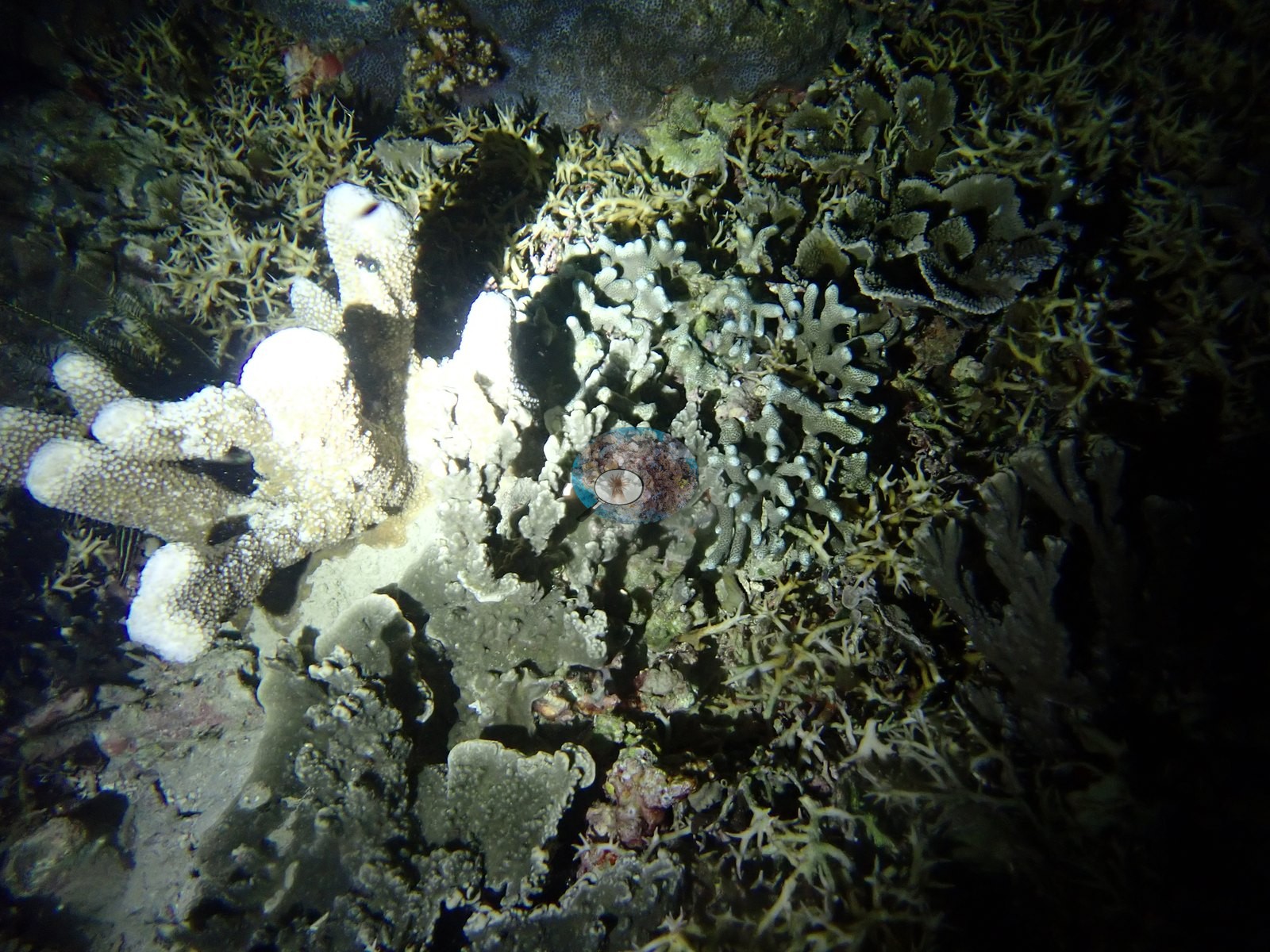
The one close reef frame is the most informative on composition: dense fine-branched yellow-green thickets consistent with Seriatopora and Acropora, cream knobby branches consistent with Pocillopora, gray-green digitate colonies with polyps fully expanded, and foliose plates packed together with almost no bare substrate between them (e.g., Image 1).
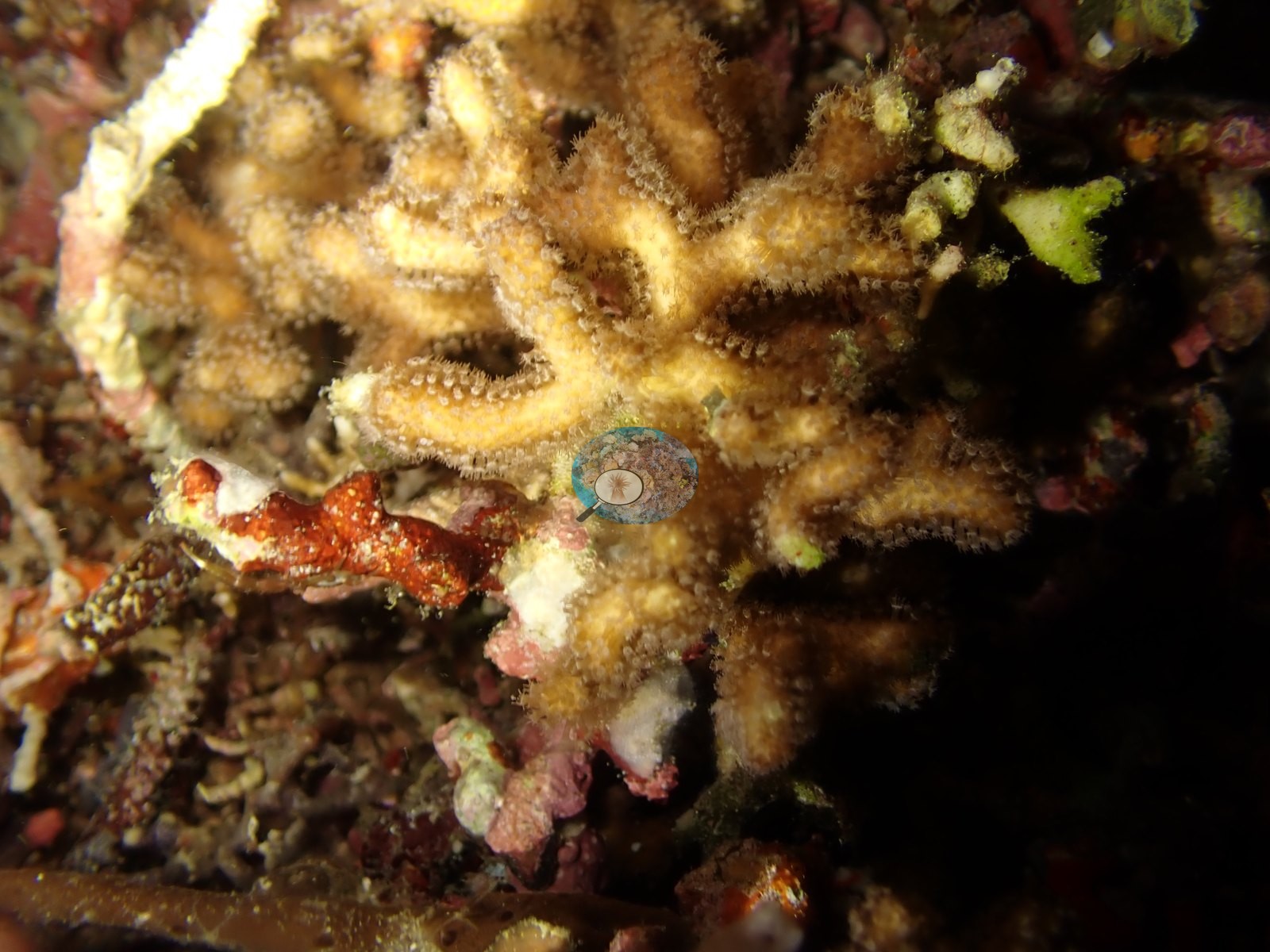
The macro frame is a tan-gold branching colony with its polyps out, consistent with a branching Porites, growing over pink crustose coralline algae with a red-orange encrusting sponge alongside it (e.g., Image 2).
Coral cover
Coral cover has not been estimated for this site. Mugia was a night dive shot as macro rather than reef-scale frames, so no computer vision figure applies and none is published.
Stressors
The condition finding at this site is crown-of-thorns. Two frames show a large Acanthaster-type crown-of-thorns starfish — on the order of 30 cm across, pale blue-gray disc, orange-tipped spines, out, and active in the open as they are at night — and the substrate immediately around it in both frames is turf-covered dead branching rubble rather than living thicket, with only a laminar gray-brown plate consistent with Pachyseris and a few live branches surviving at the frame edges (e.g., Image 5, Image 9).
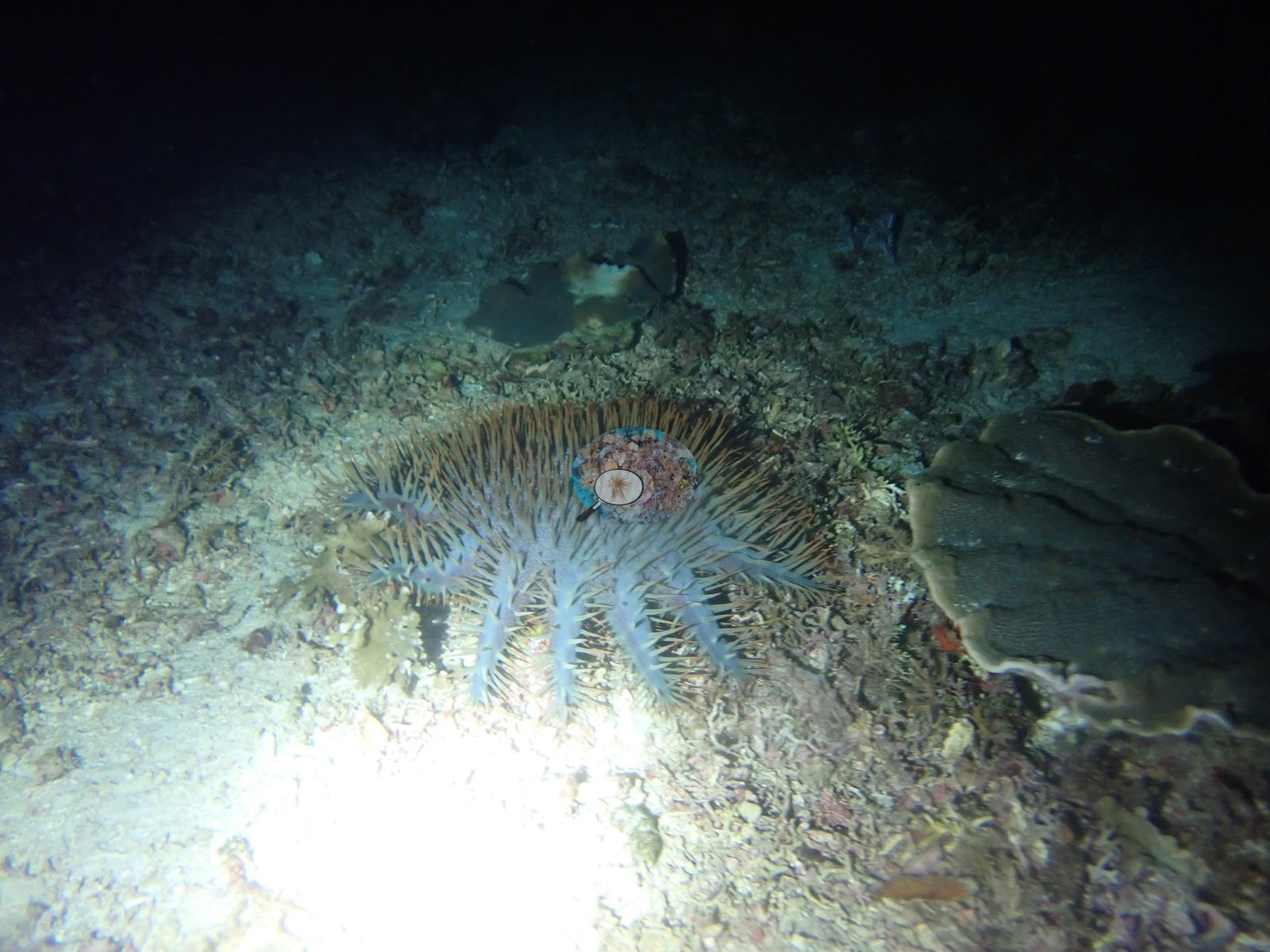
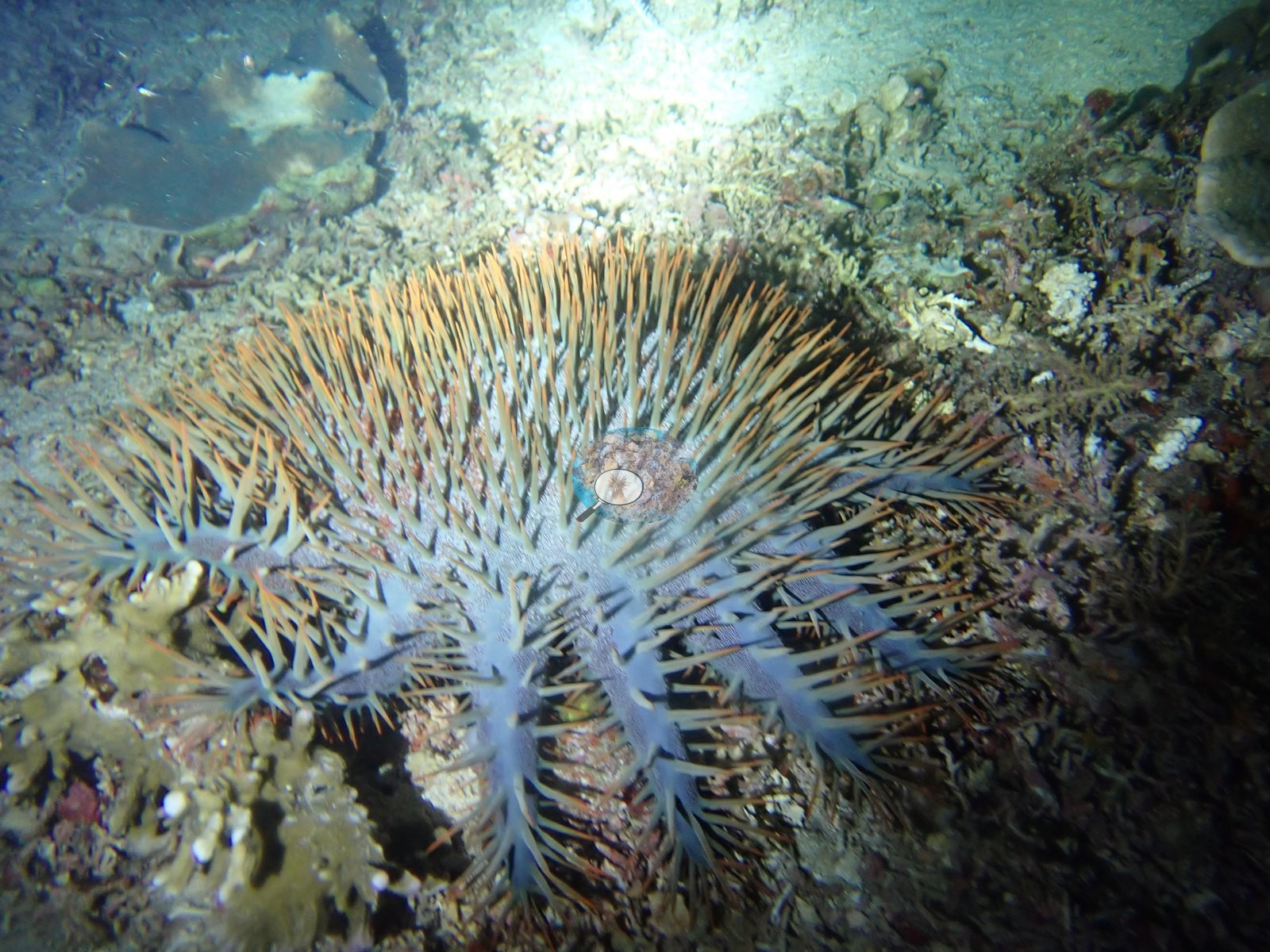
The two frames may be one animal photographed twice; nothing in them settles that. No feeding scar was caught on a living colony in these six frames, so this is recorded as a crown-of-thorns presence with associated dead substrate, not as documented active predation. No bleaching and no disease were seen, with the color caveat above standing.
Fish and other fauna
Fauna: a green turtle, consistent with Chelonia mydas, resting on the foliose plate bed across two frames (e.g., Image 4).
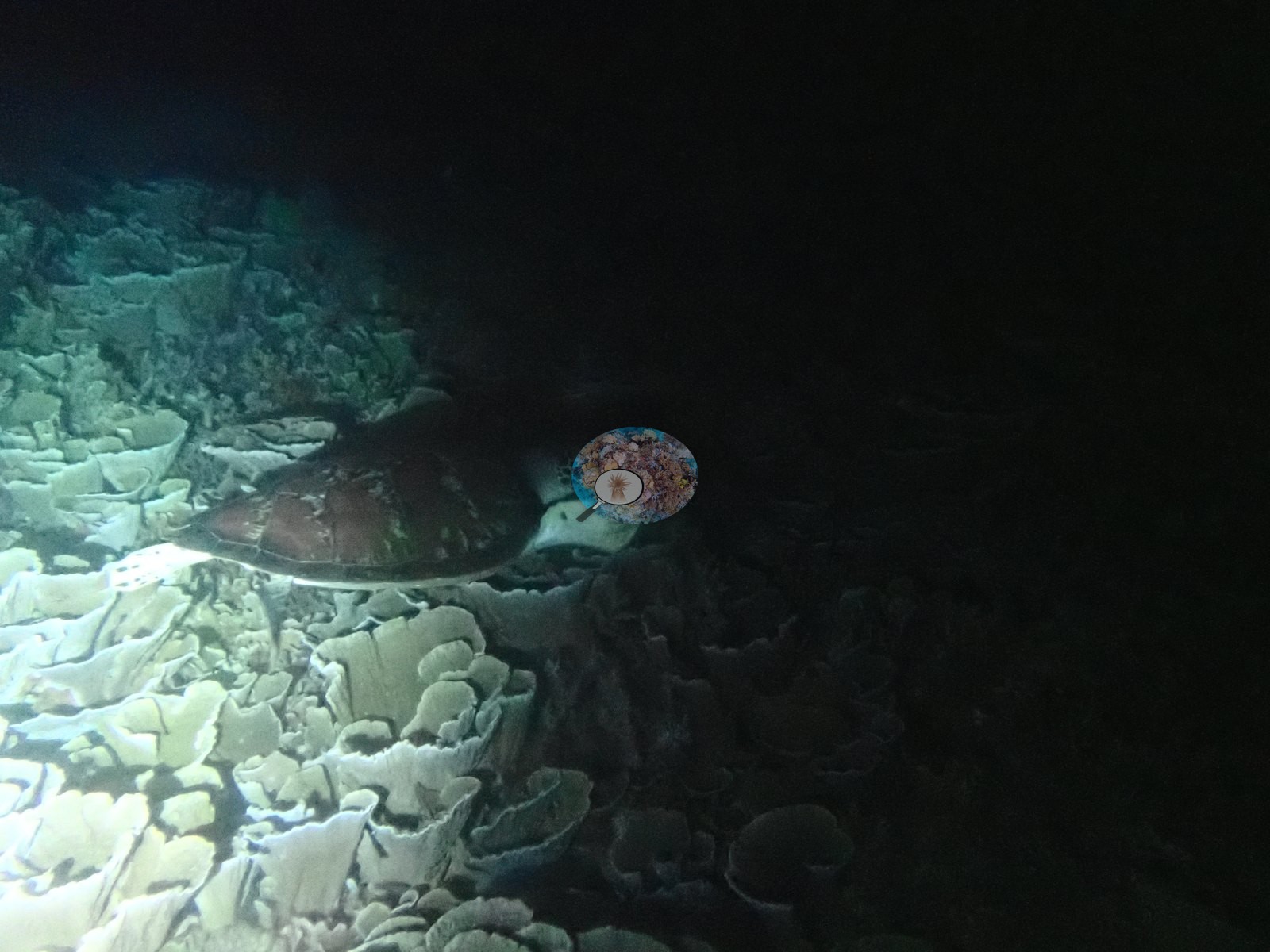
Anderson's field note adds a whitetip reef shark and a huge cuttlefish, and records that he hunted for walking sharks here without luck — he had found them in numbers three nights earlier at Pantai Falajawa.
Comparisons with other data
No prior survey data from this site. If you would like to share yours, please email us.
Dive record
Mugia was a night dive on 13 August 2026, the fourth and last dive of that day on the August 2026 Halmahera crossing aboard the liveaboard Ambai (Wallacea Dive Cruises), to a maximum of 17.6 m in 24-25°C water — the cold end of the trip, on the same day and in the same water body as Jerot, where Anderson logged 22-25°C and weird thermoclines and wondered in his log whether this is an upwelling area.
Other notes
Only six still frames survive the dive, plus one movie clip and a raw folder, and all six were reviewed. Every one is a flash exposure against a black background, which is the folder evidence that settles the dive as nocturnal, and it also means no site cover figure is published here and that color cannot be used to score bleaching: nocturnal flash whitens branch tips and washes out pigment, and coral polyps are expanded, both of which imitate pallor. Anderson's field note: “turtle, white tip, huge cuttlefish, hunted for walking sharks but no luck, amazing coral cover”
Data & links
All images from Coral Reef Diagnostics.
© Coral Reef Diagnostics.