
Indonesia - Halmahera: AM Point 2
Part of the regional summaries: Indonesia - Halmahera and Indonesia - Maluku
More info
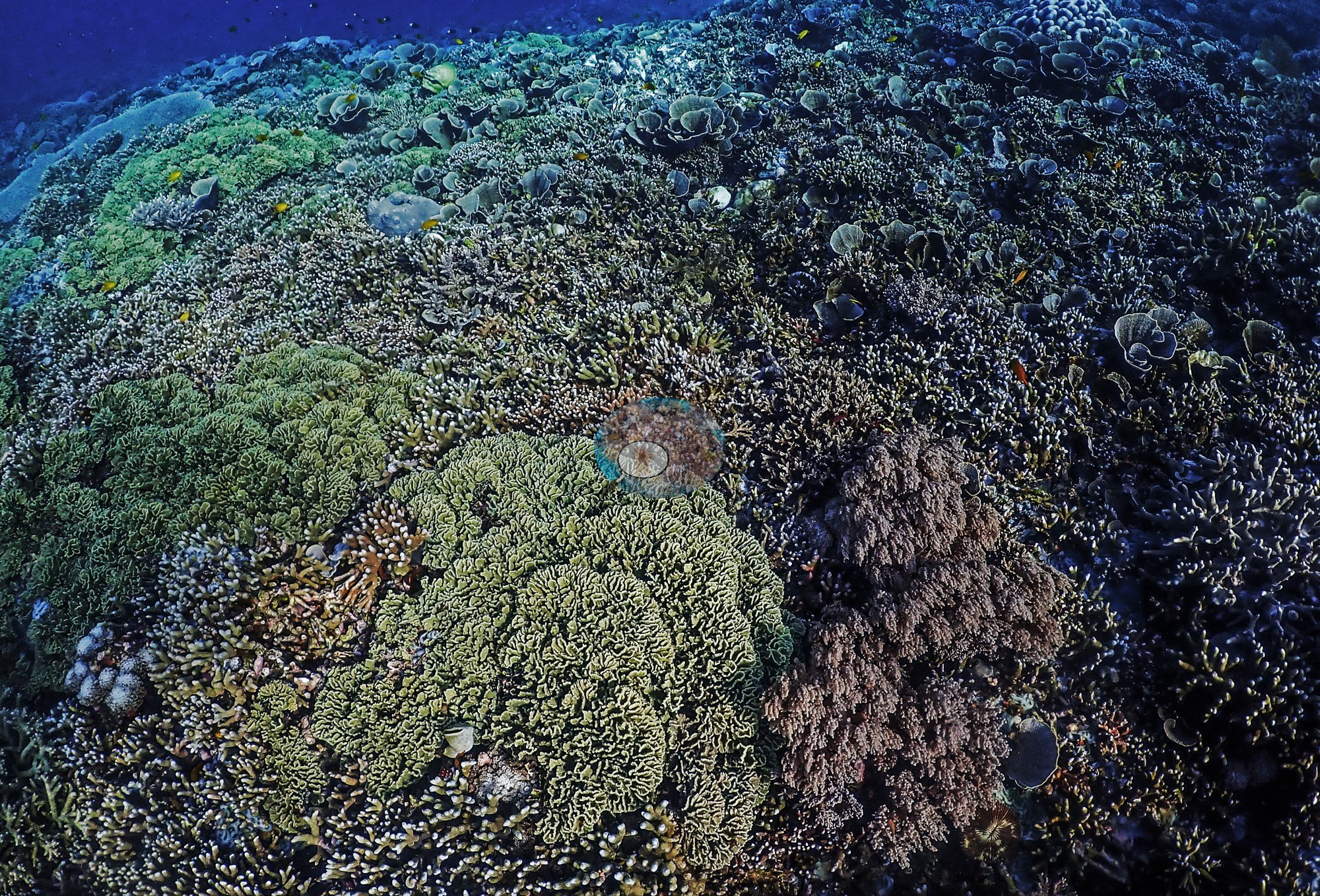
North Maluku (NOAA CRW virtual station)AM Point 2 is a genuinely multi-habitat dive spanning a sponge- and octocoral-draped deep wall, a near-monospecific Sarcophyton/Sinularia soft-coral meadow, patches of old branching-coral rubble from past breakage, and a spectacular near-total-cover outer wall of tabulate Acropora tables and foliose plate fields. No bleaching or COTS observed. A blind Claude computer-vision point count puts coral cover around 40%. It swings widely from frame to frame, reflecting real habitat variety rather than measurement noise.
AM Point 2 benar-benar merupakan penyelaman multi-habitat, mencakup dinding dalam yang berselimut spons dan oktokoral, padang karang lunak Sarcophyton/Sinularia yang nyaris monospesifik, bercak-bercak pecahan karang bercabang lama akibat kerusakan masa lalu, serta dinding luar yang menakjubkan dengan tutupan nyaris penuh berupa meja Acropora tabulat dan hamparan karang lembaran. Tidak teramati pemutihan maupun bintang laut mahkota duri.
Terjemahan ringkasan ini oleh AI; versi bahasa Inggris yang berlaku. Translated from the site’s shorter map summary.
47 of these 54 photographs are shown beside the text that discusses them under "Site description" below.
Site description
General benthic features
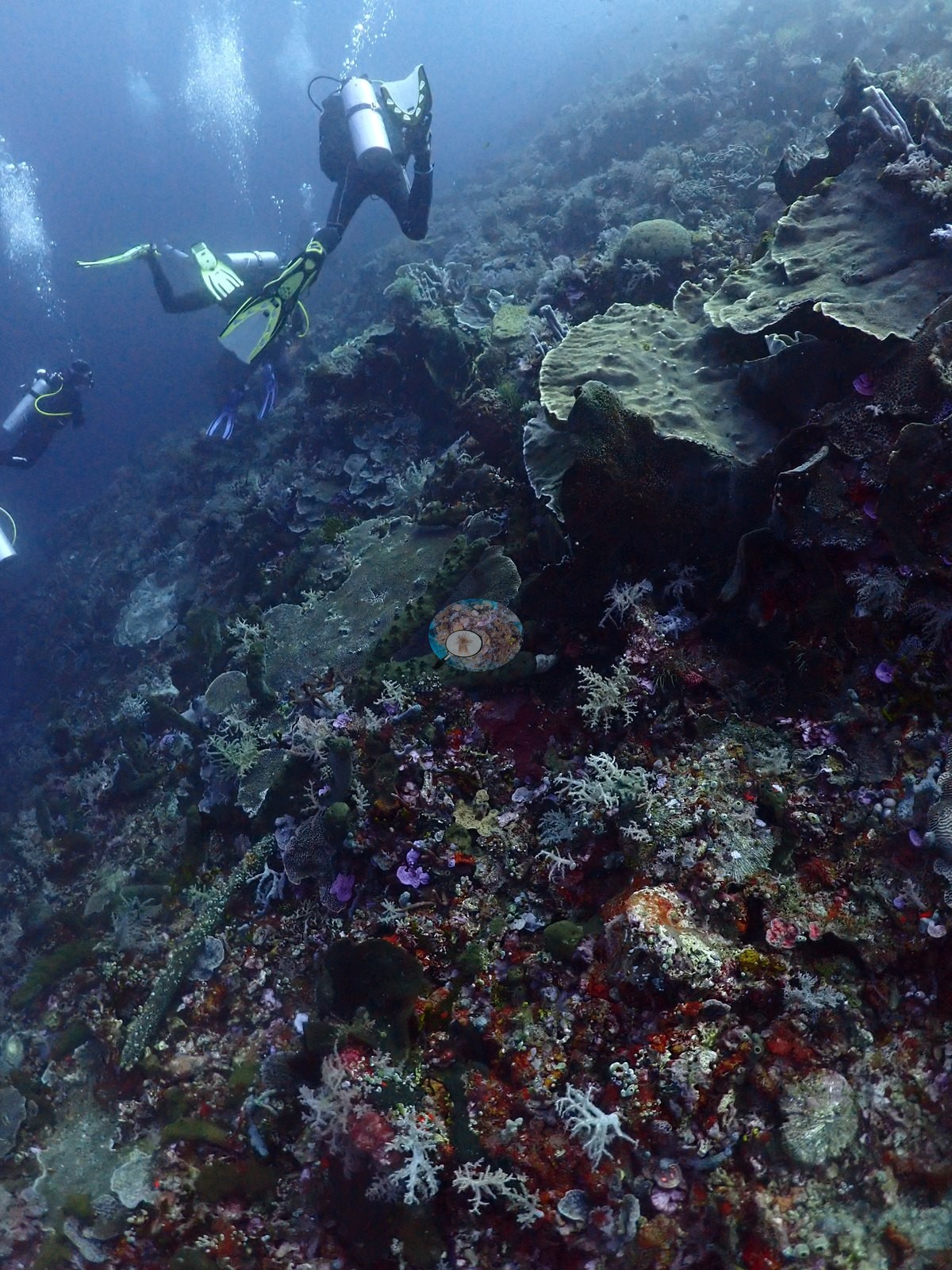
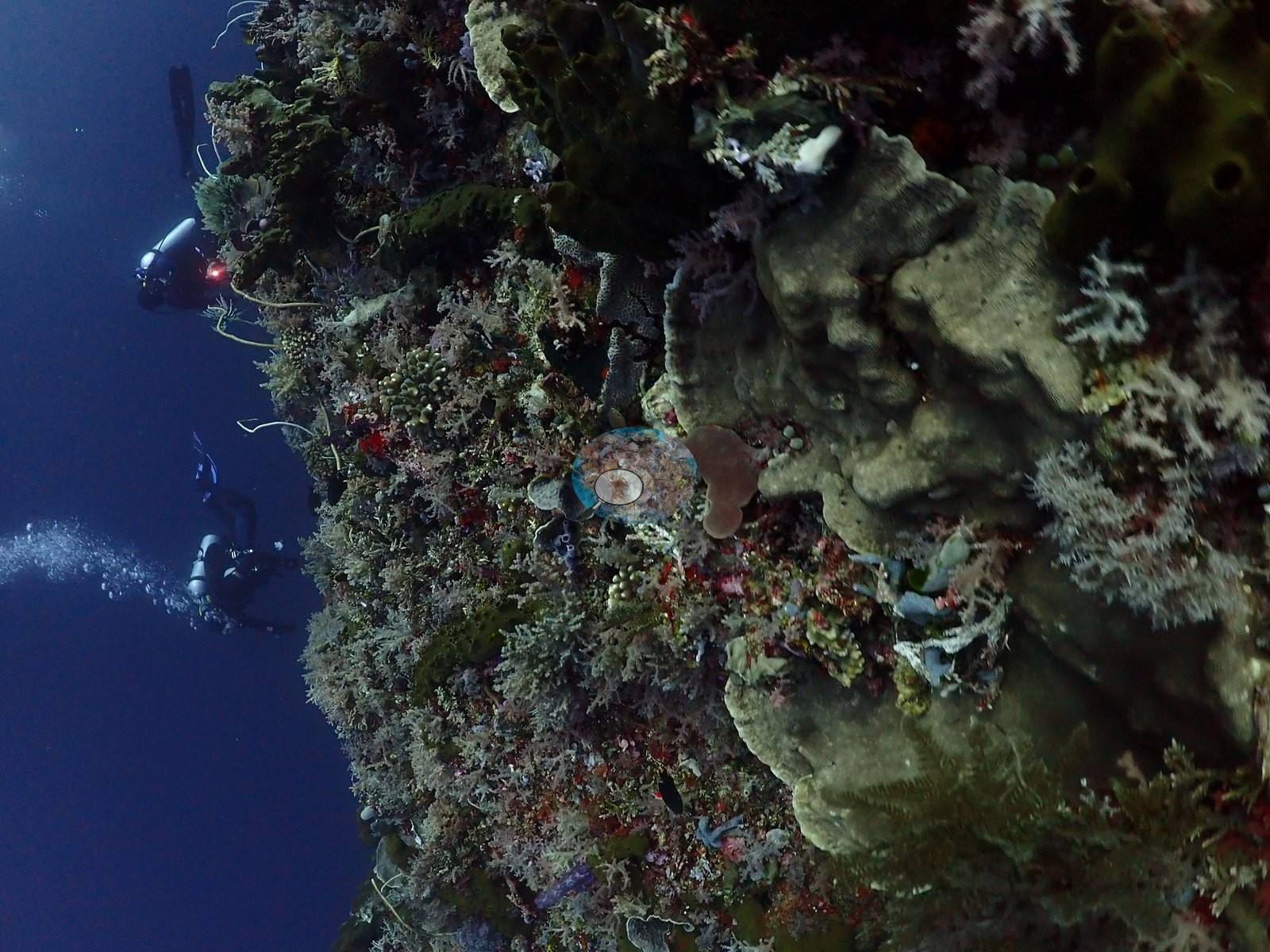
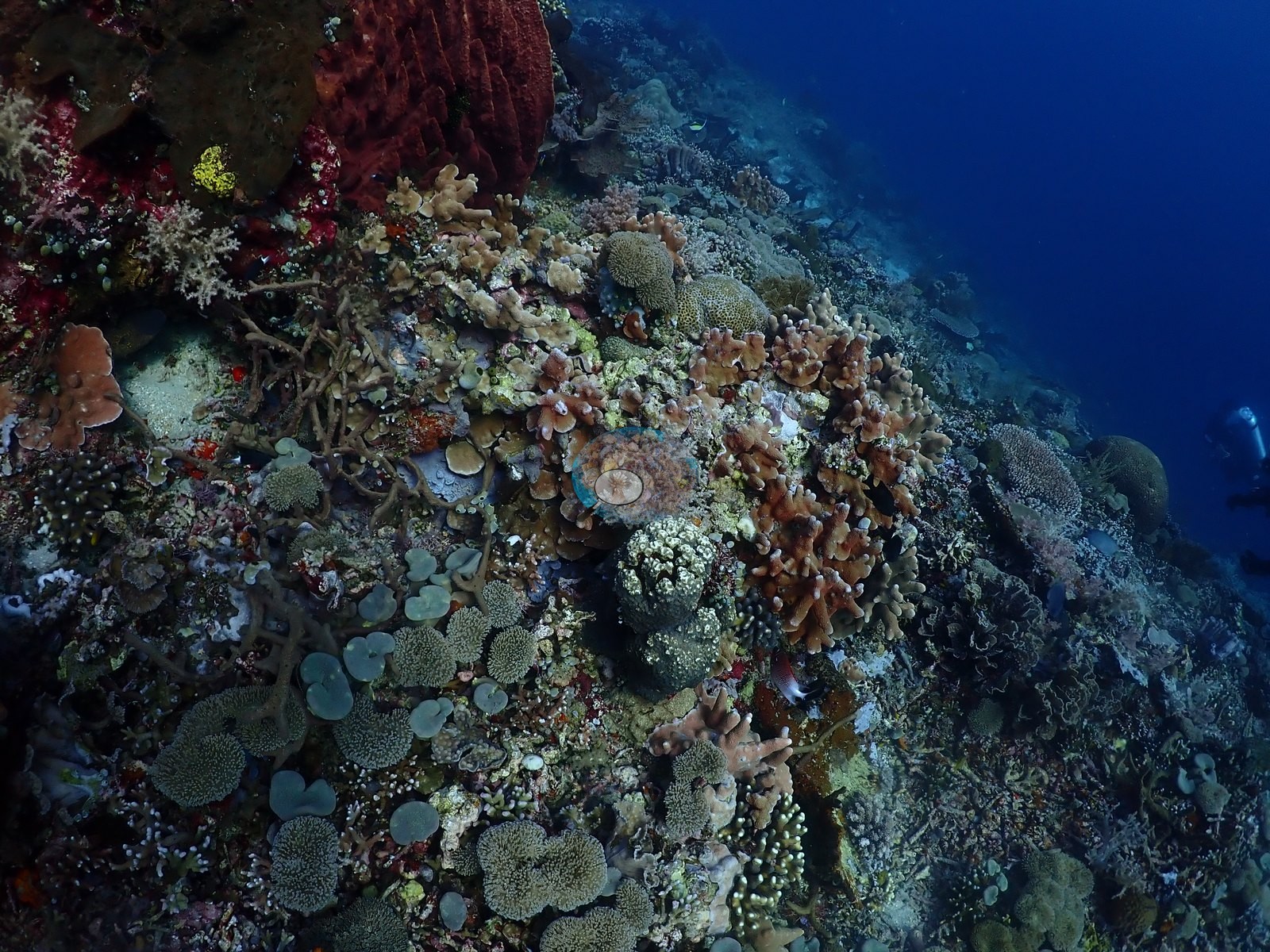
Deep wall (3396–3442): dim, silt-dusted, a matrix of red crustose coralline algae and a heavy filter-feeder community — olive perforated tube/repent sponges, lavender encrusting sponges and ascidians, pink and red barrels, azooxanthellate Dendronephthya/Scleronephthya-type soft corals, white sea whips, lacy gorgonians, crinoids (e.g., Image 10, Image 16, Image 31, Image 37, Image 38, Image 55).
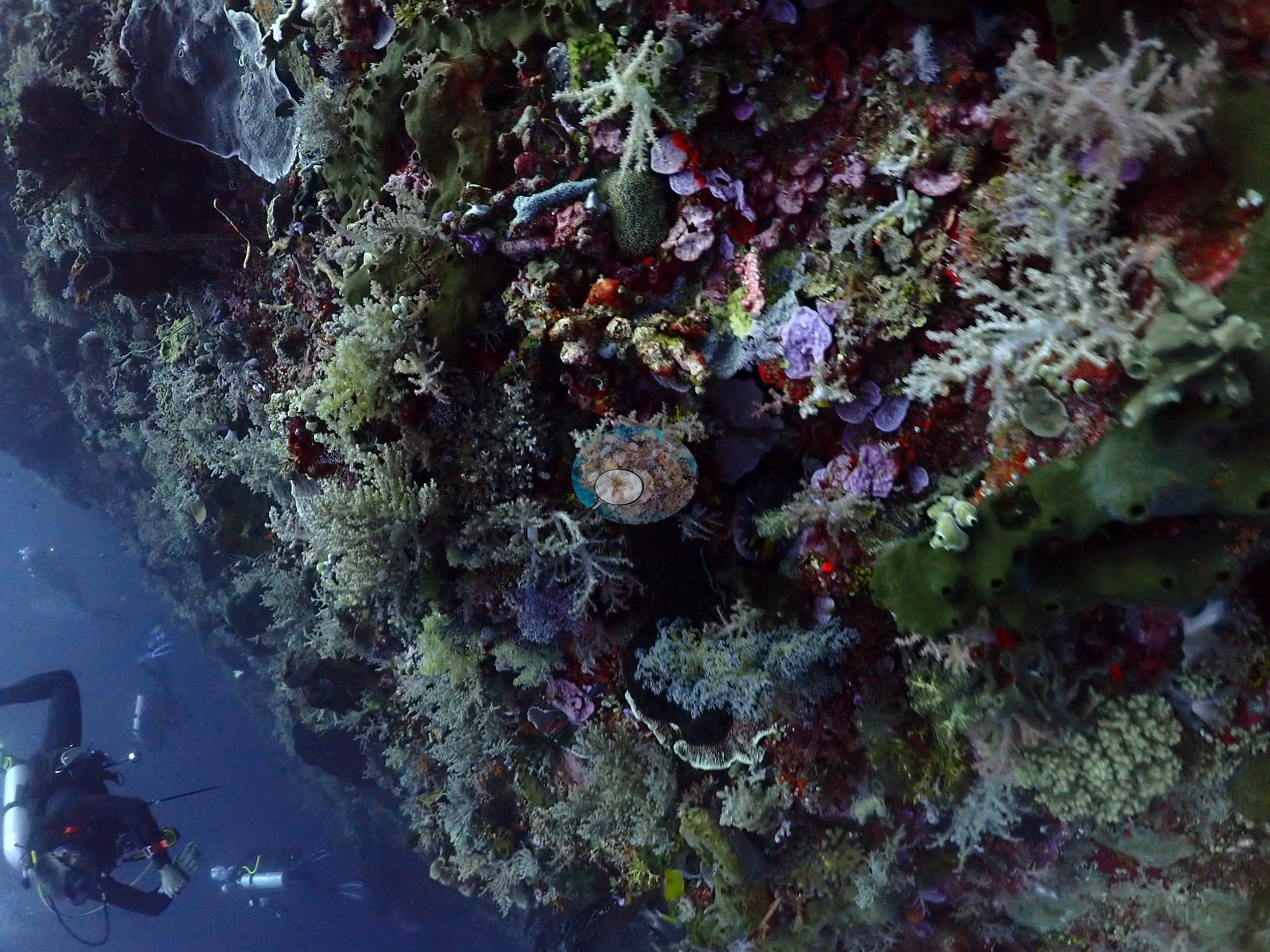
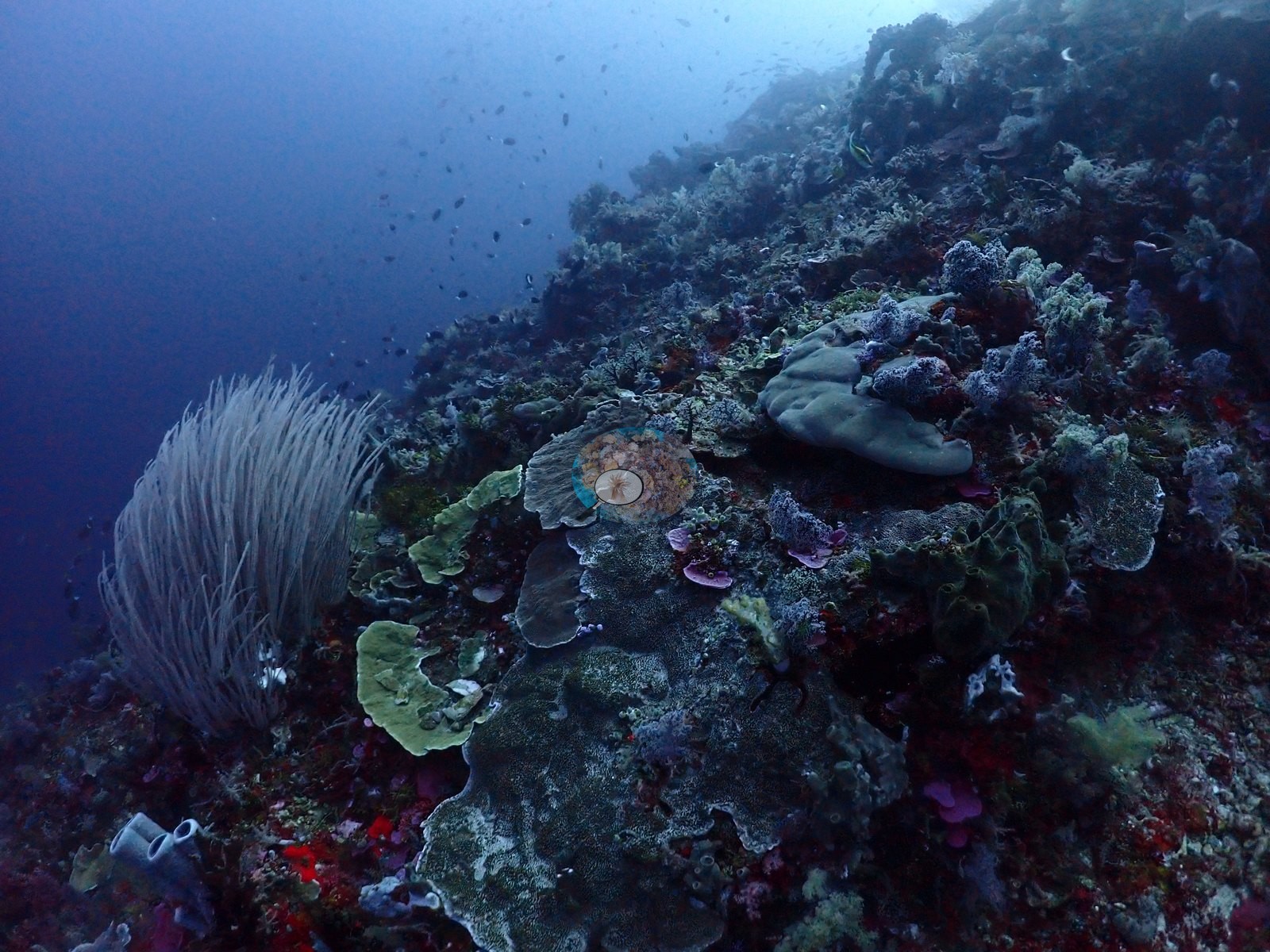
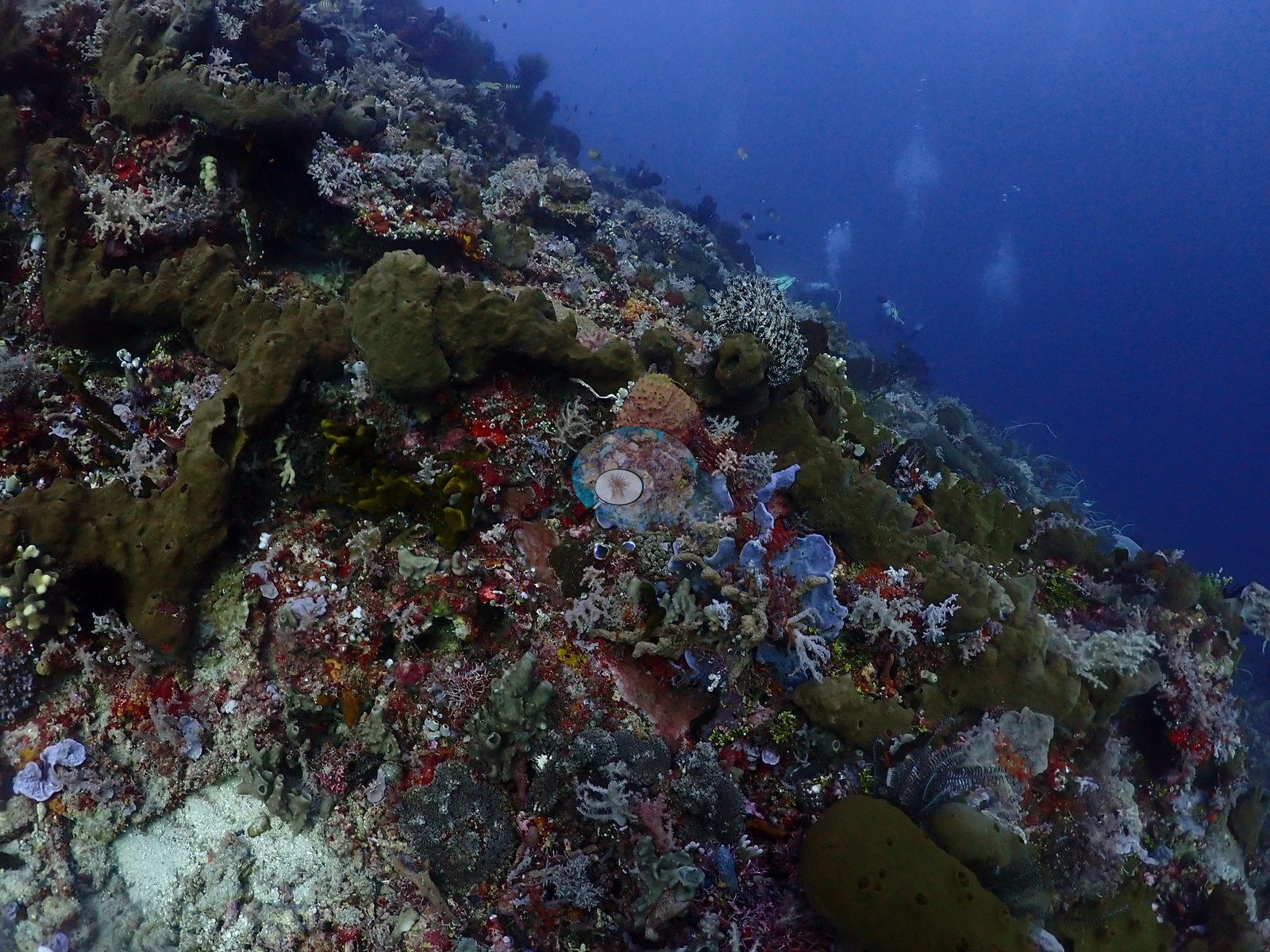
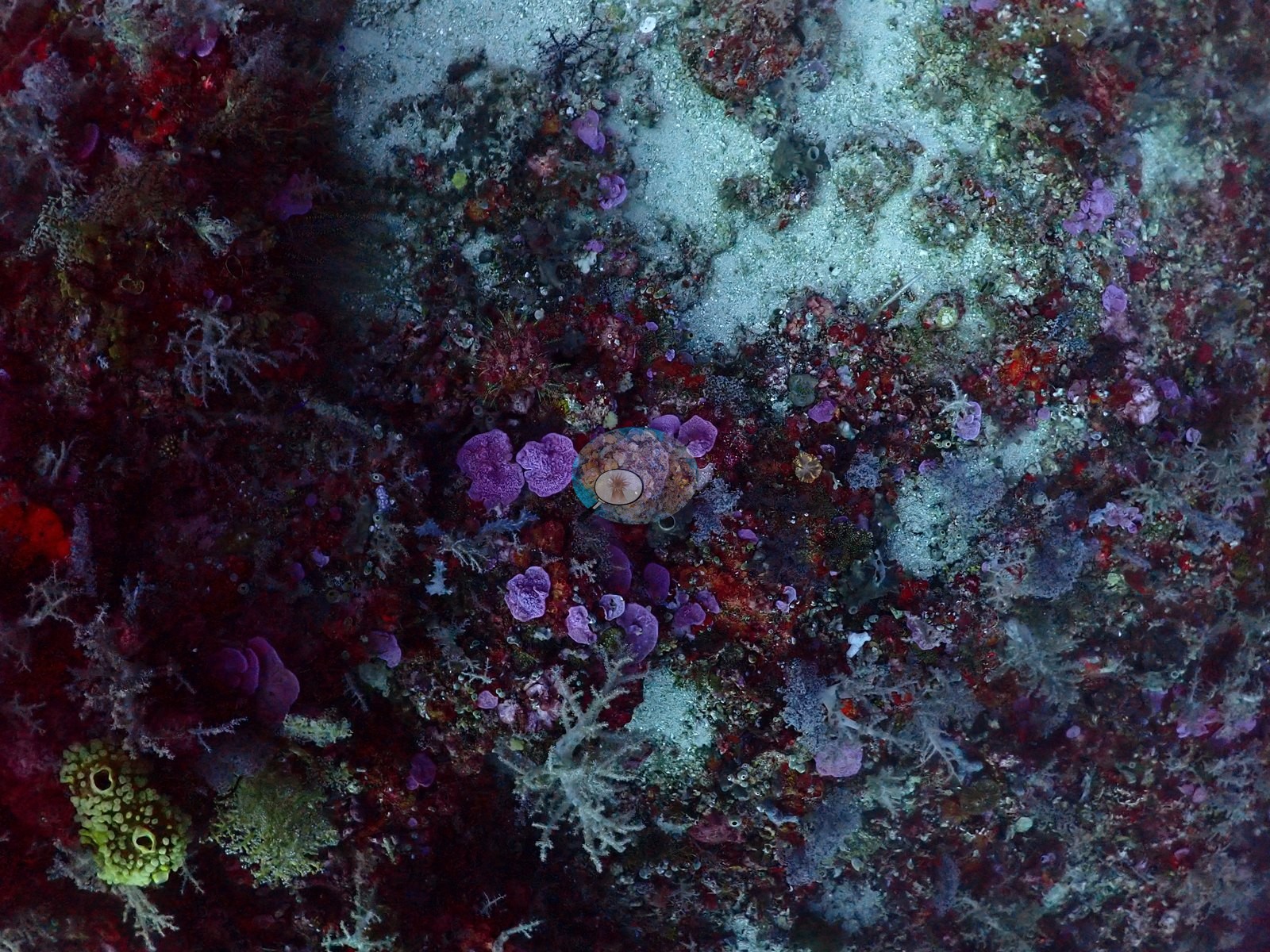
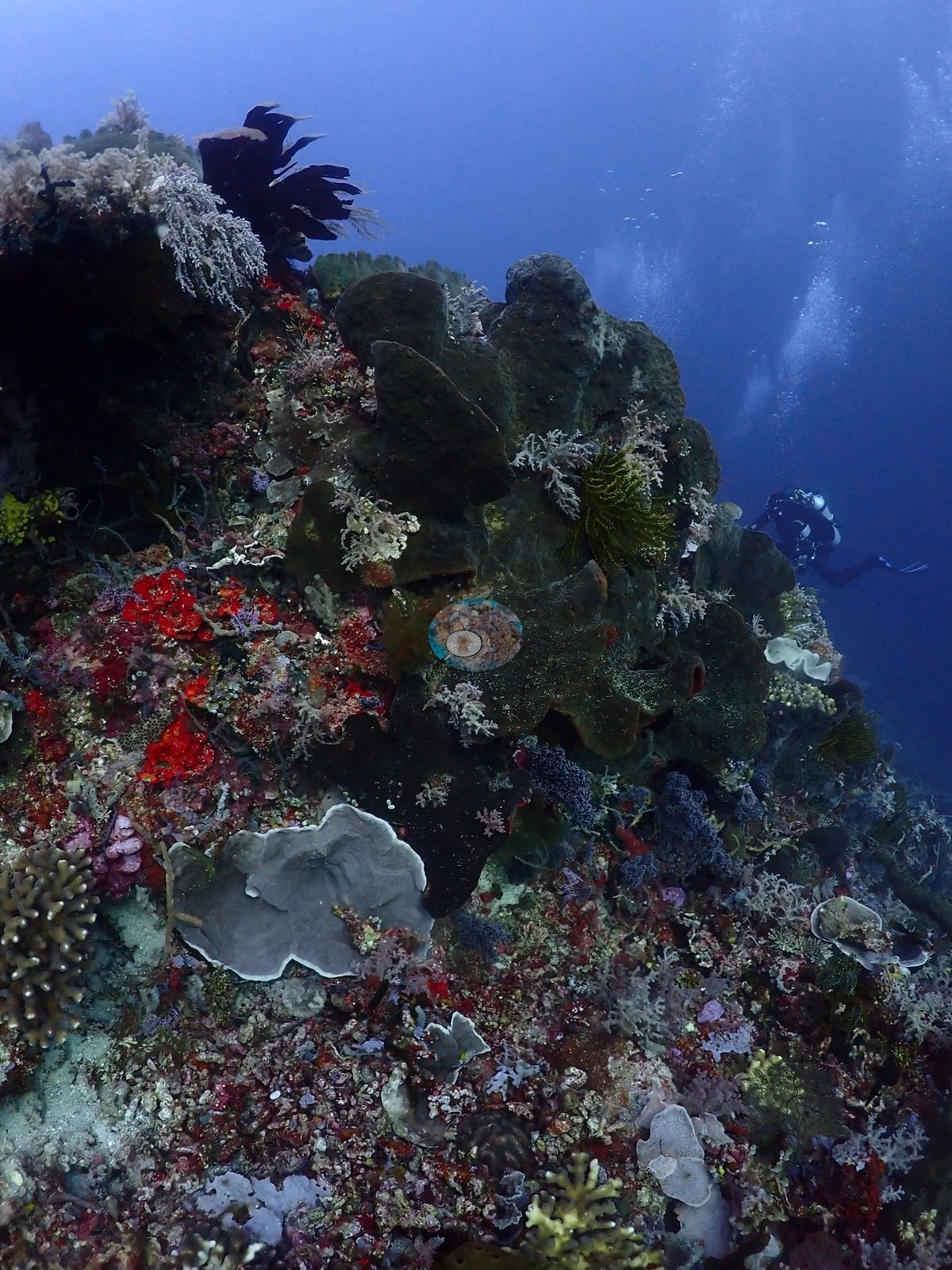
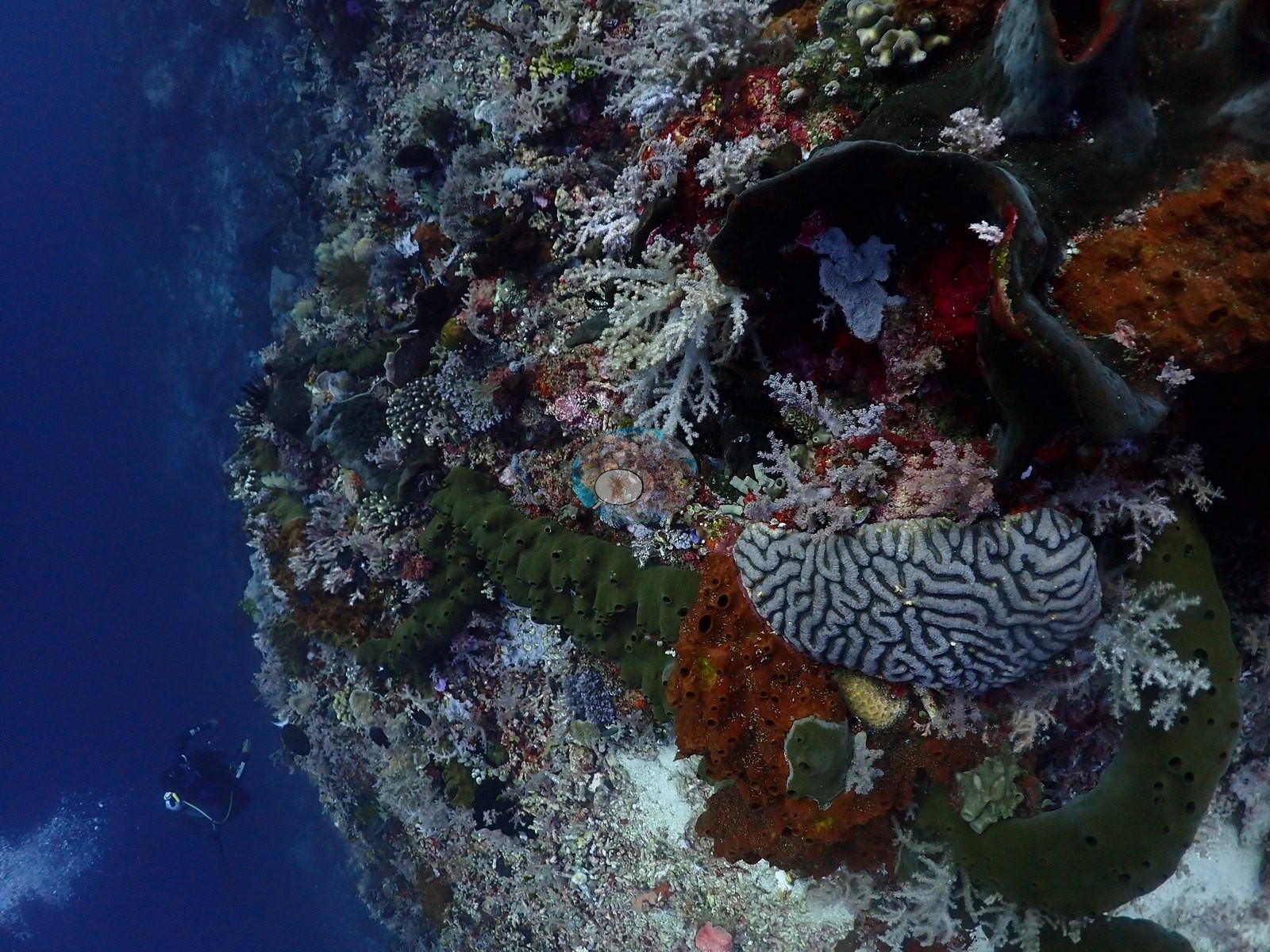
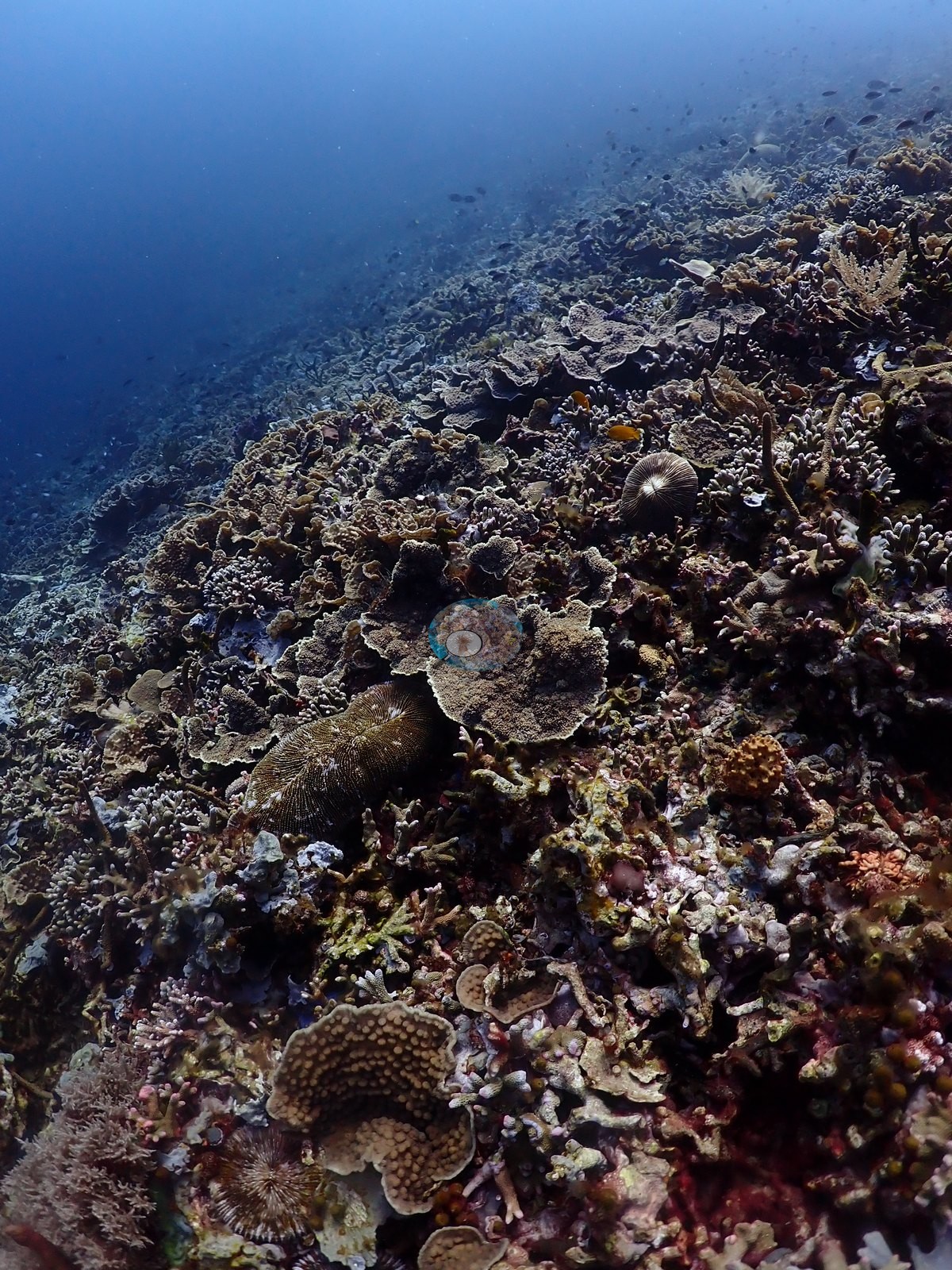
Hard coral scattered: Pachyseris speciosa-type plates, foliose Montipora, meandroid Platygyra/Leptoria brains, fungiids, a Diploastrea-type dome (e.g., Image 1, Image 9, Image 11, Image 12, Image 14, Image 21, Image 41, Image 44).
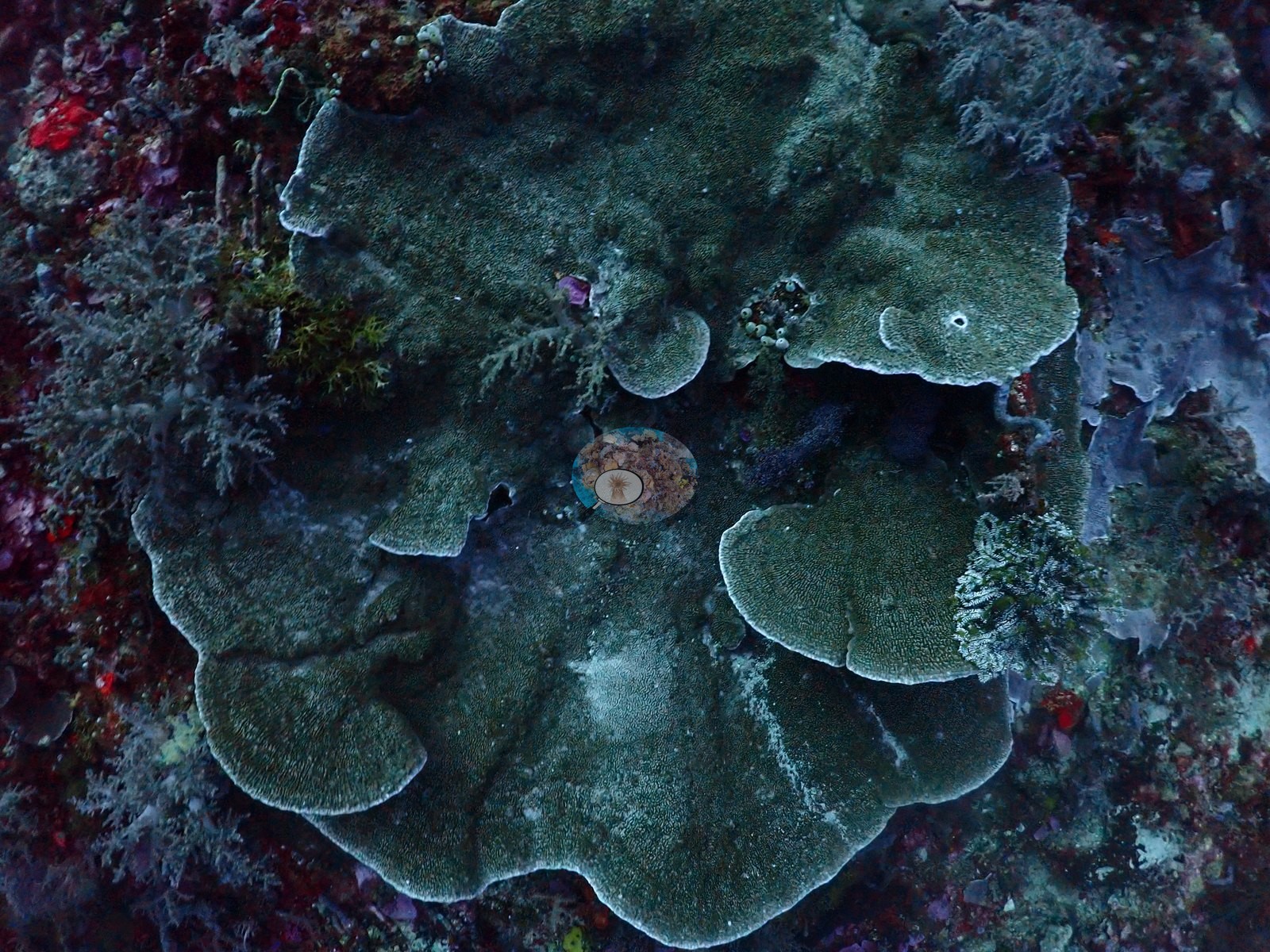
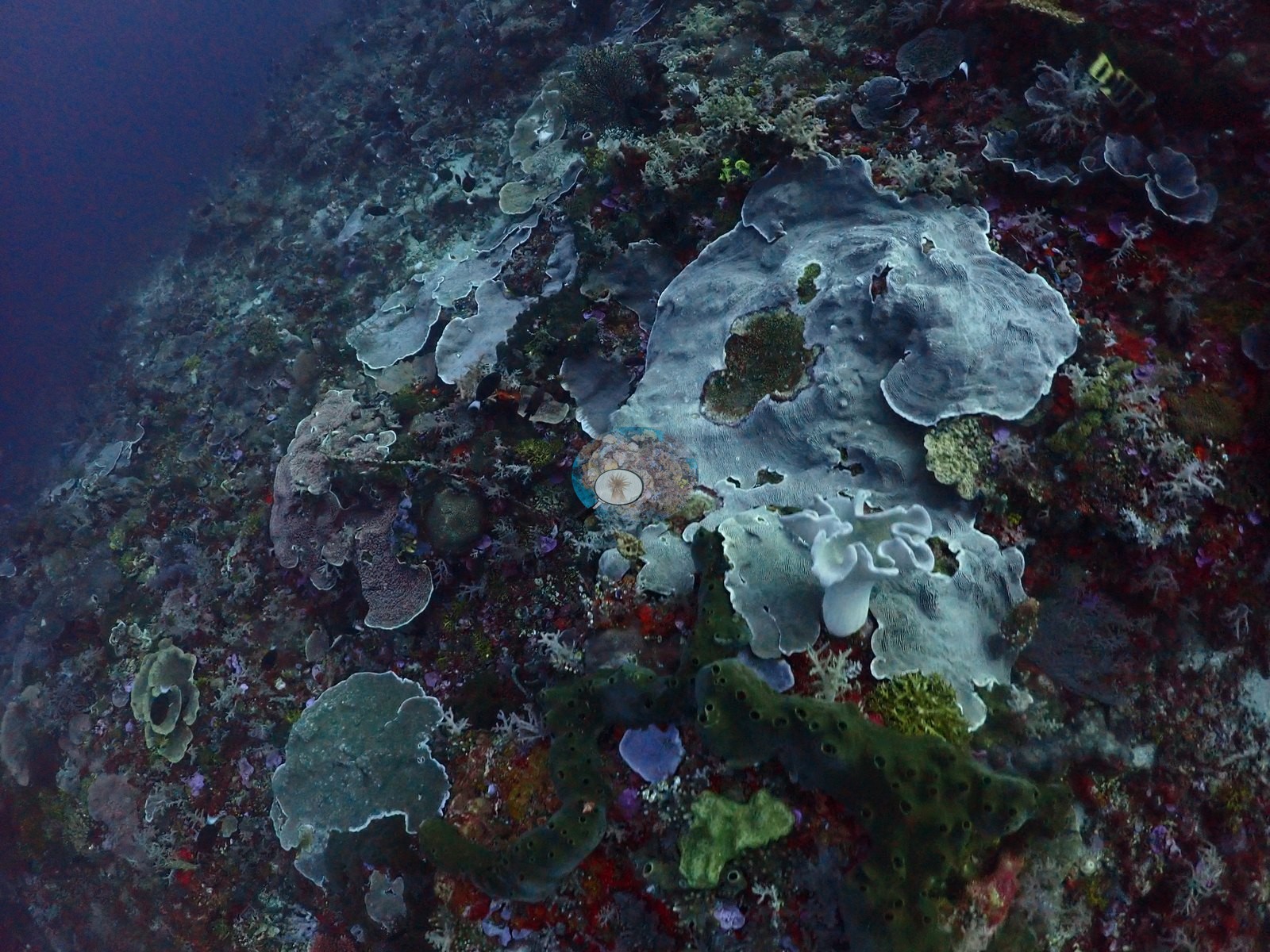
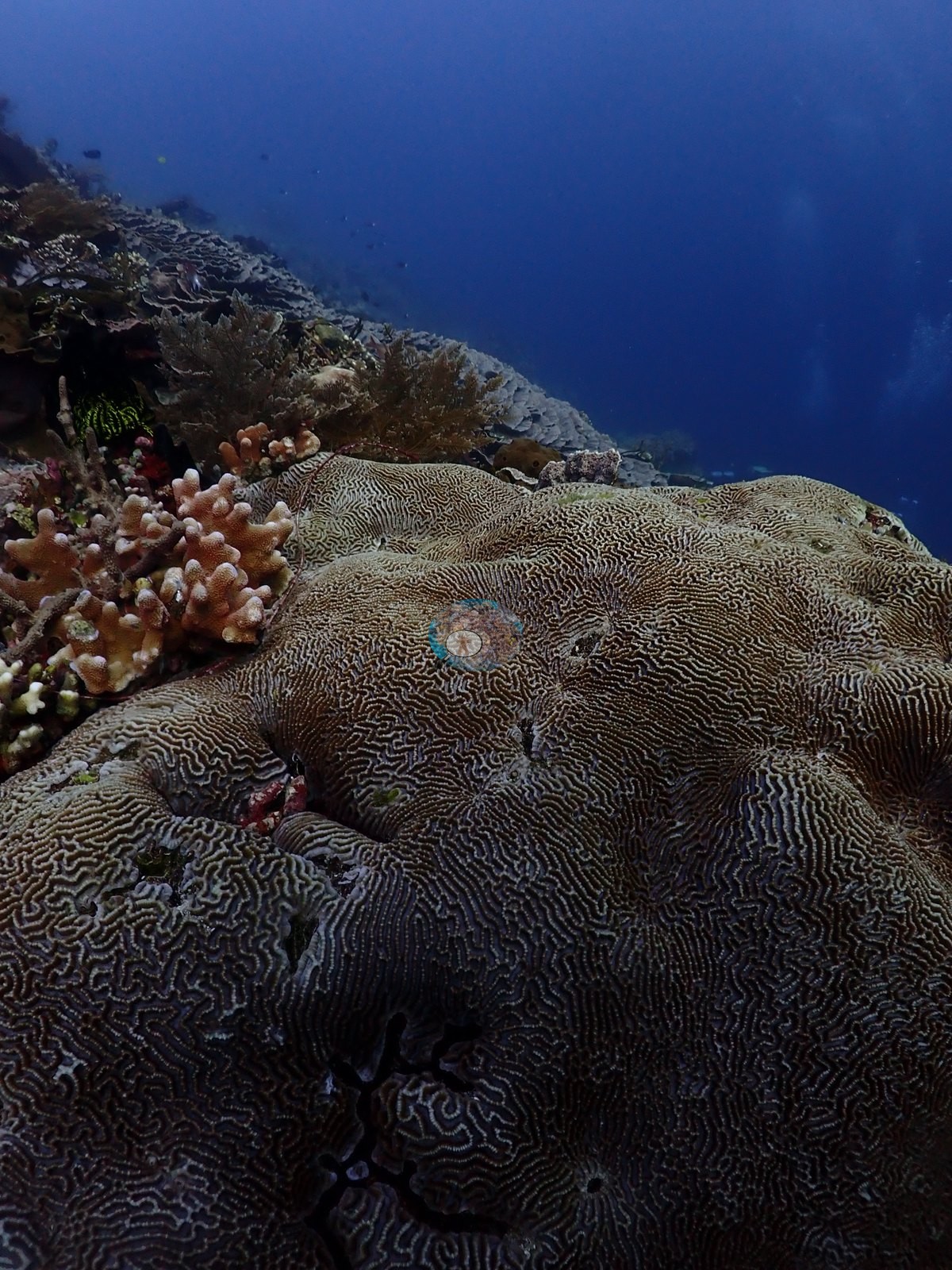
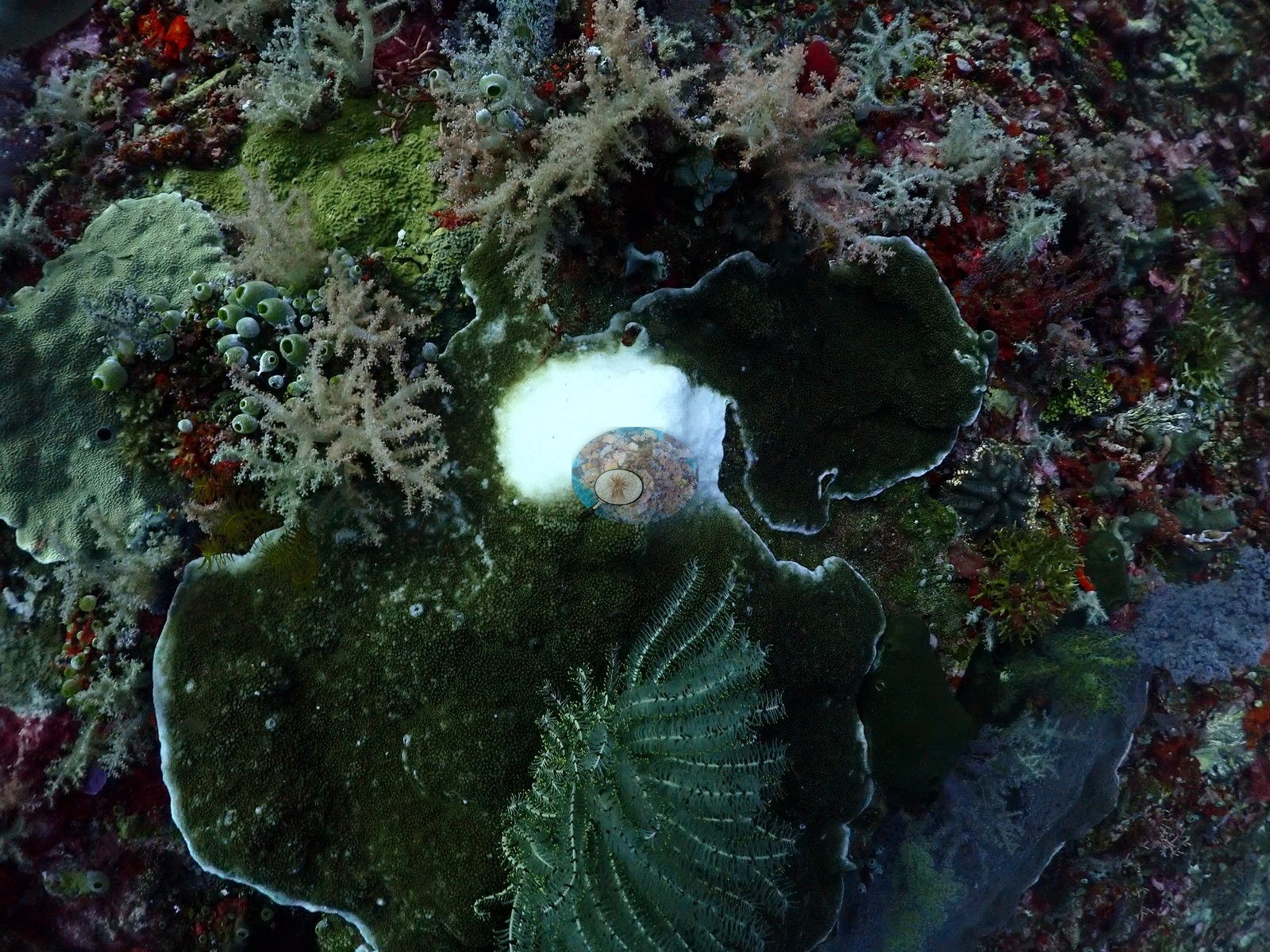
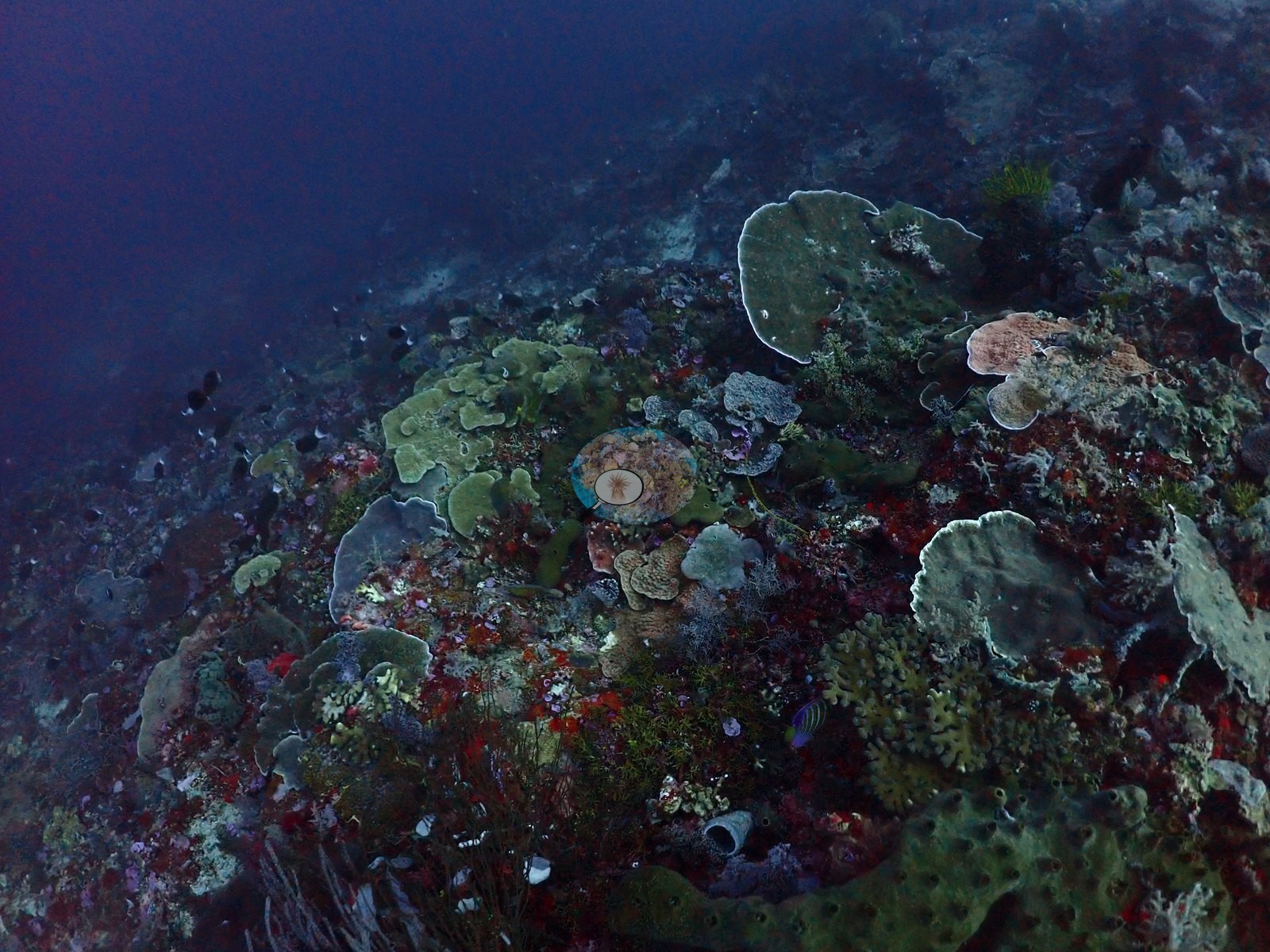
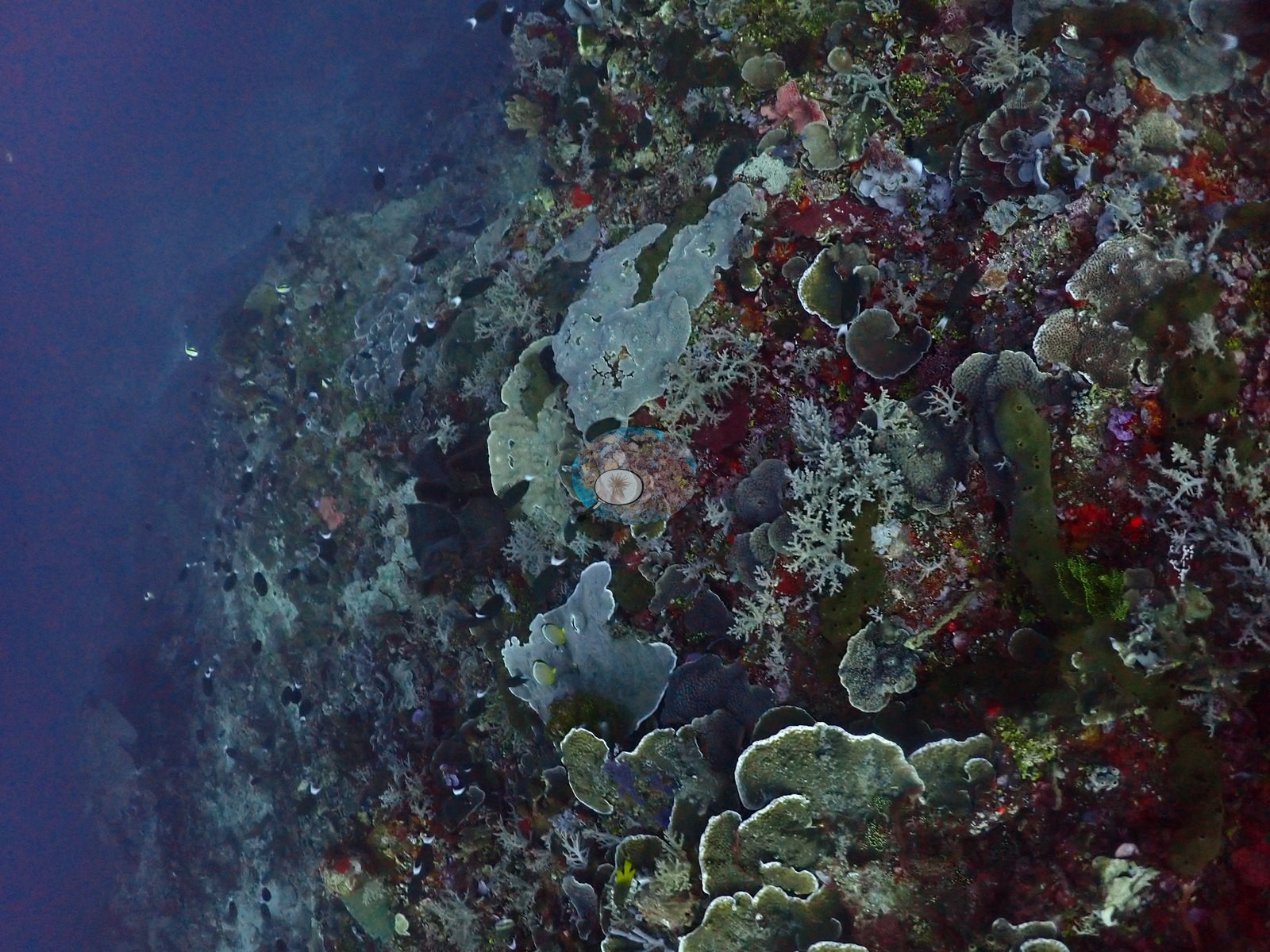
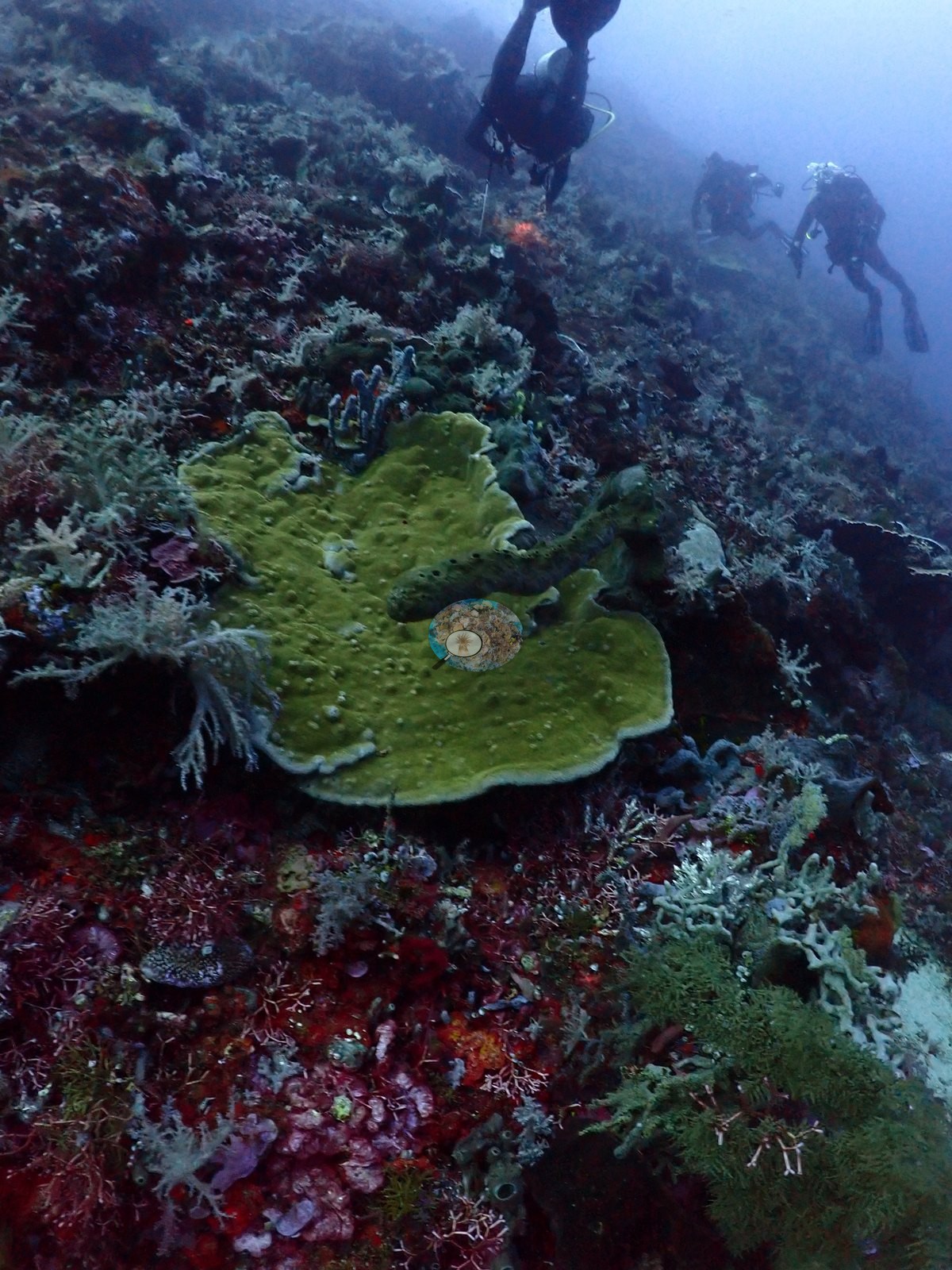
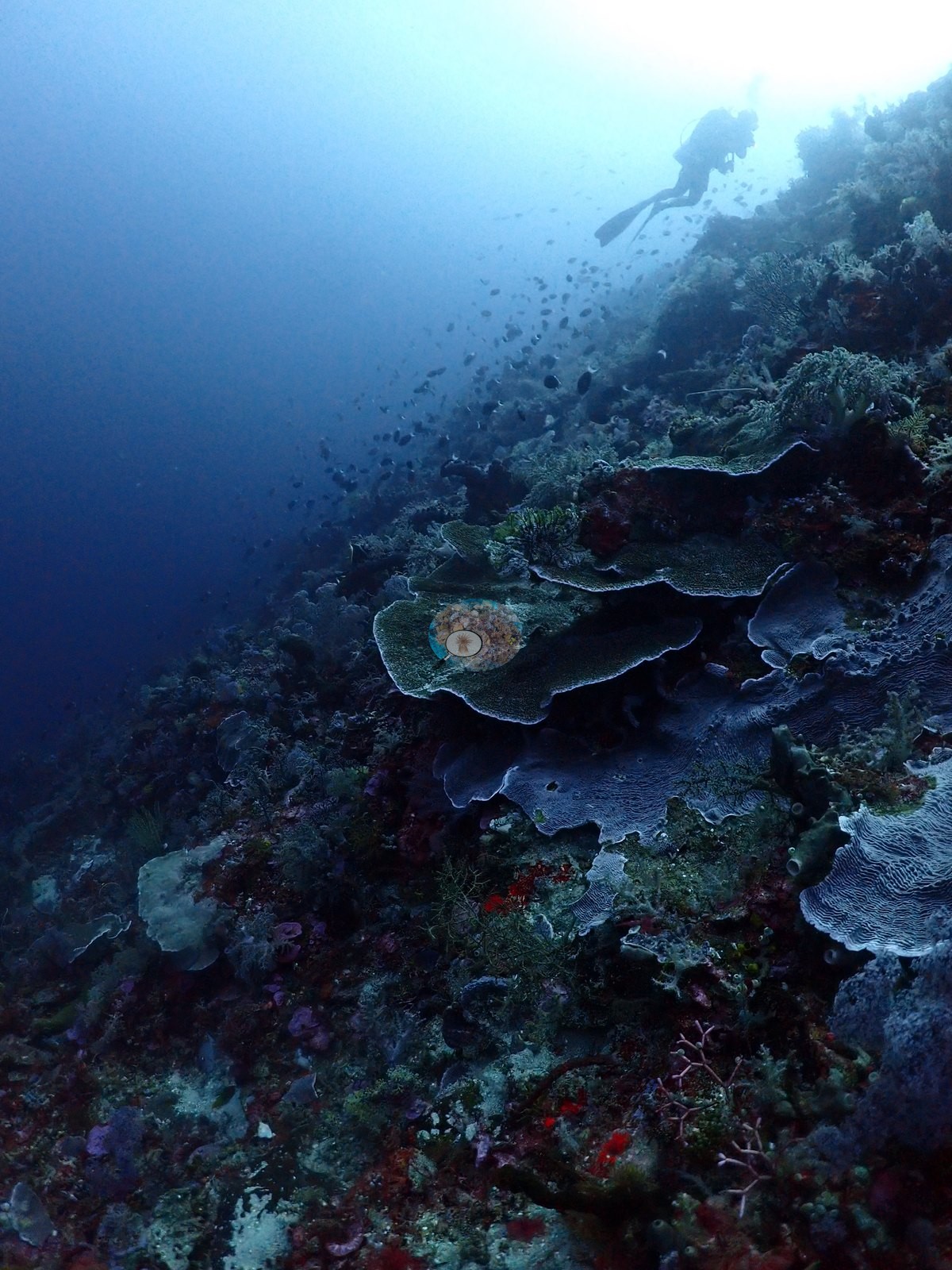
Mid slope (3443–3463): very high generic diversity plus an extensive shingled foliose plate field (Echinopora lamellosa/Montipora-type) with big tabulate Acropora tables; Tridacna in 3443 (e.g., Image 3, Image 35).
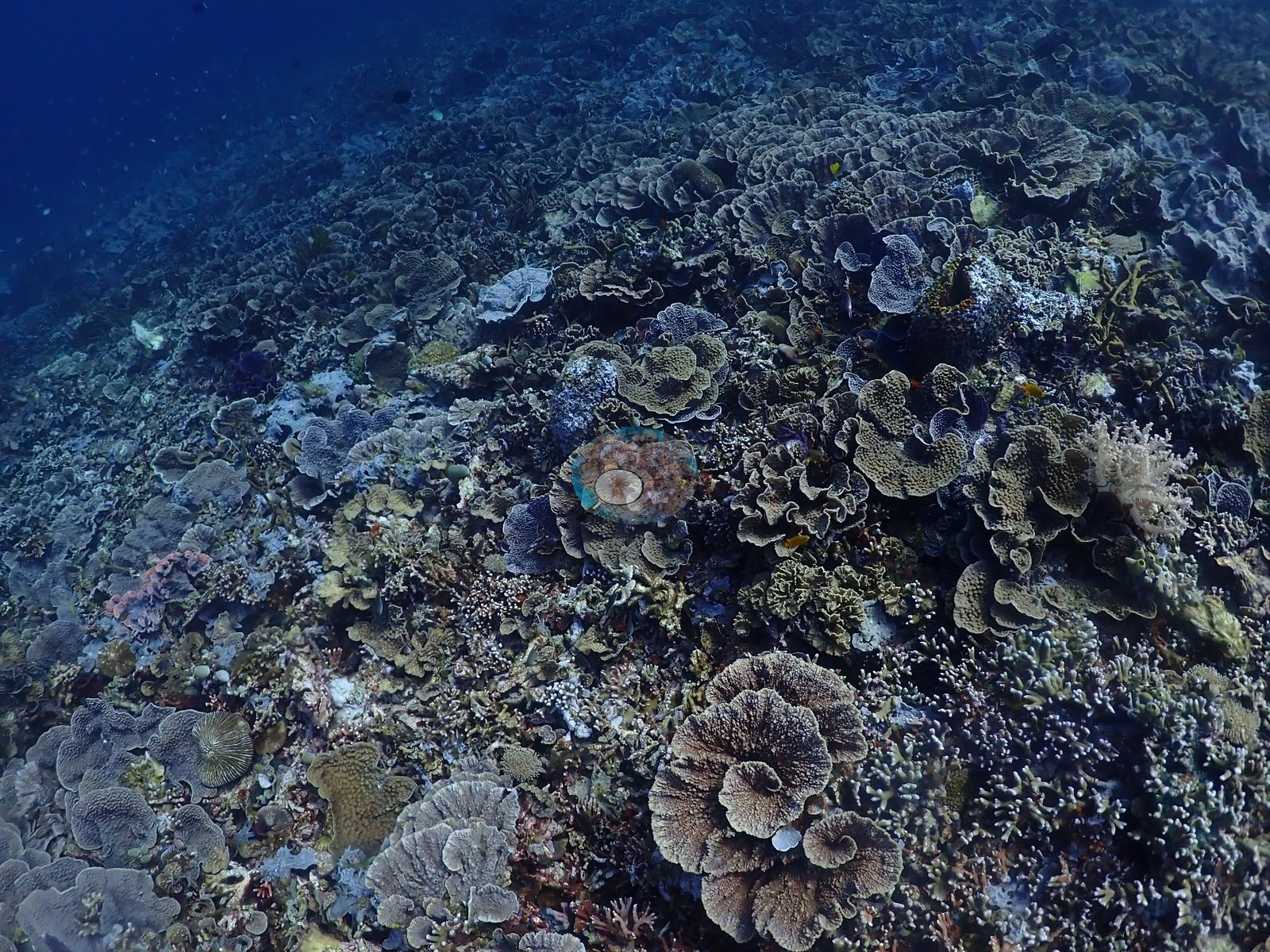
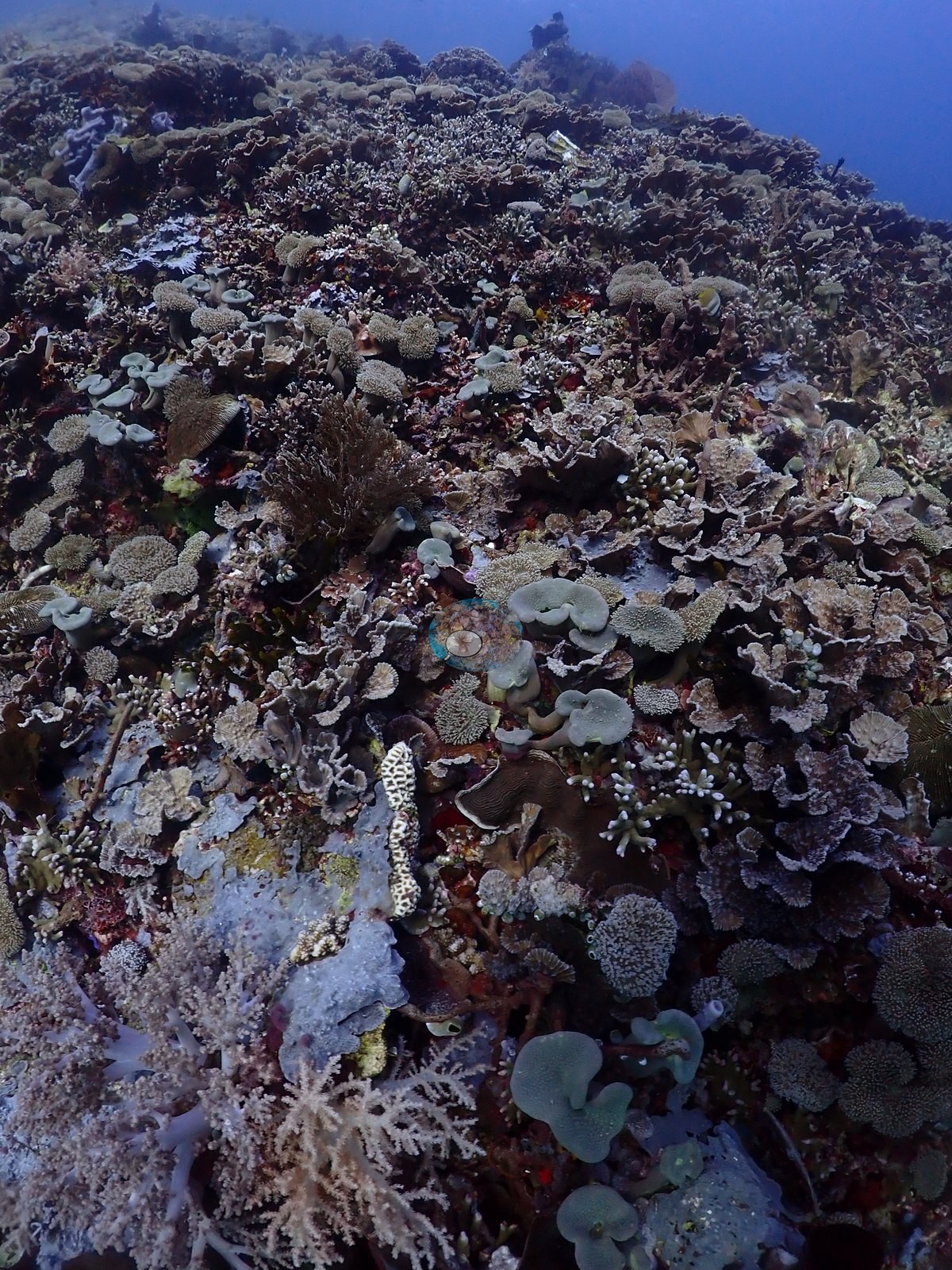
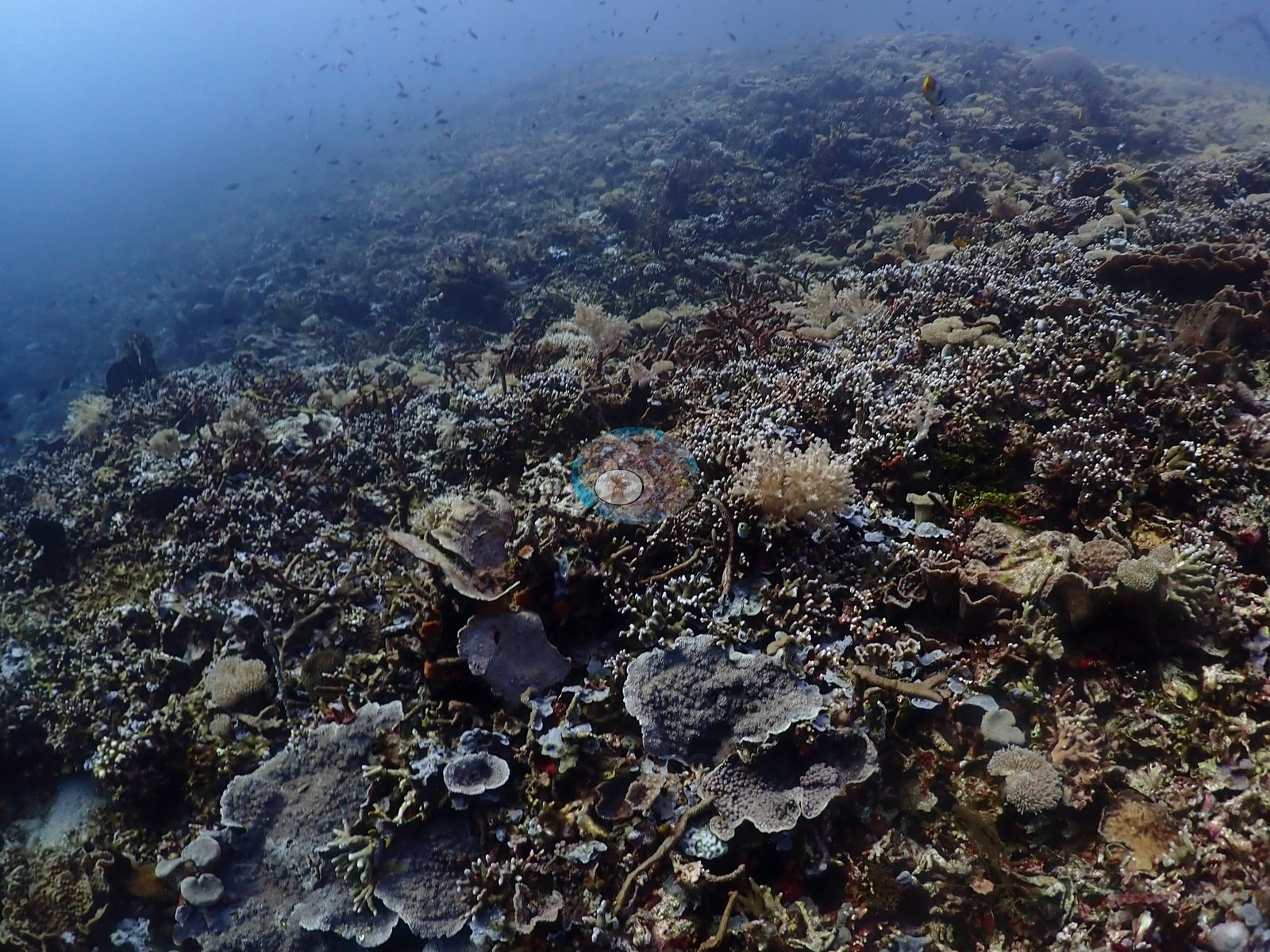
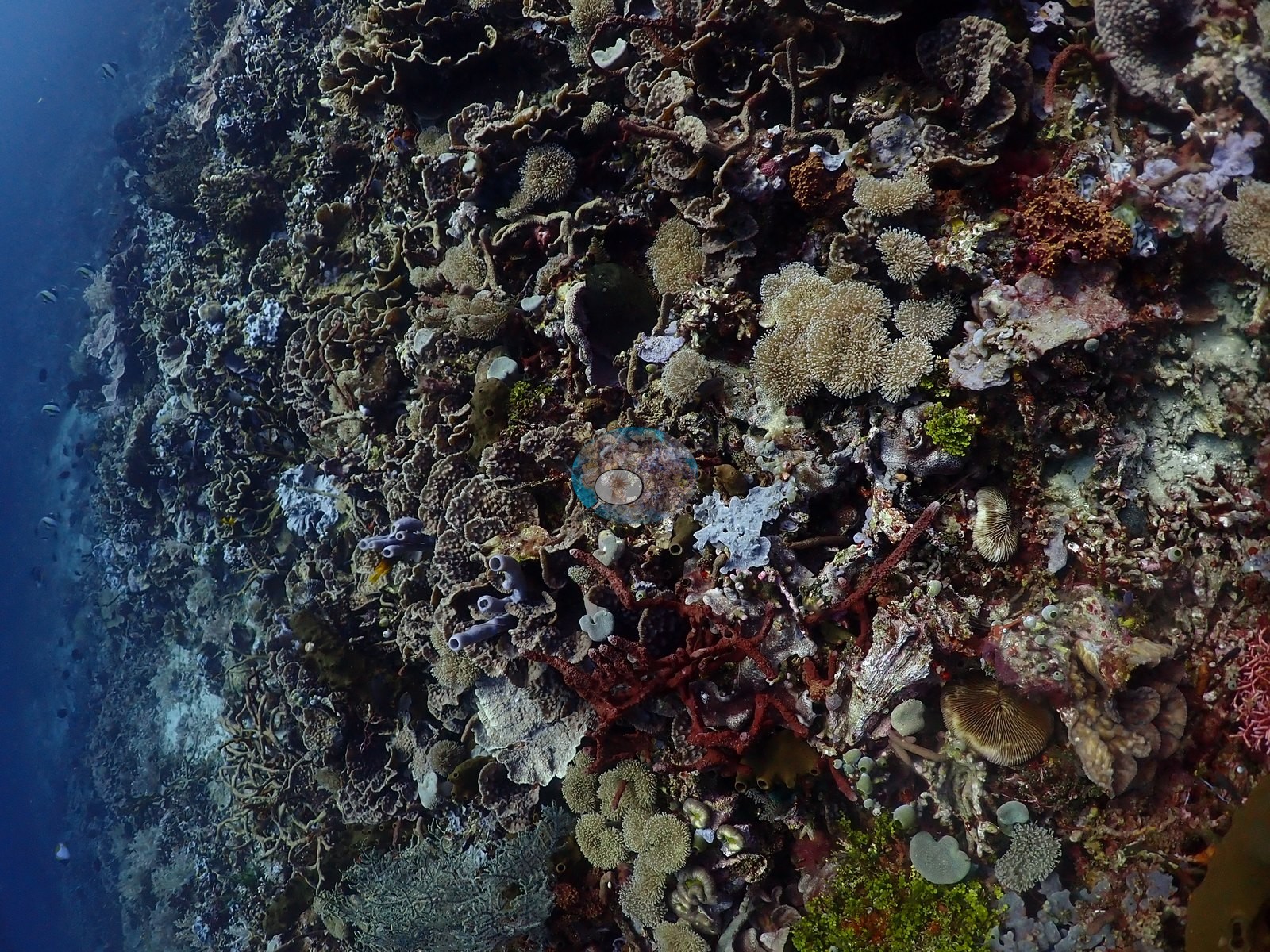
Upper slope (3465–3475): white sand and coralline-crusted rubble with almost no coral in some frames, then a vast lavender fine-branched thicket (consistent with Montipora digitata/Anacropora), gray Sarcophyton toadstools, leopard-patterned sea cucumbers, and mauve foliose plate fields threaded with red branching macroalgae (Galaxaura-type) with bannerfish (e.g., Image 17, Image 22, Image 50).
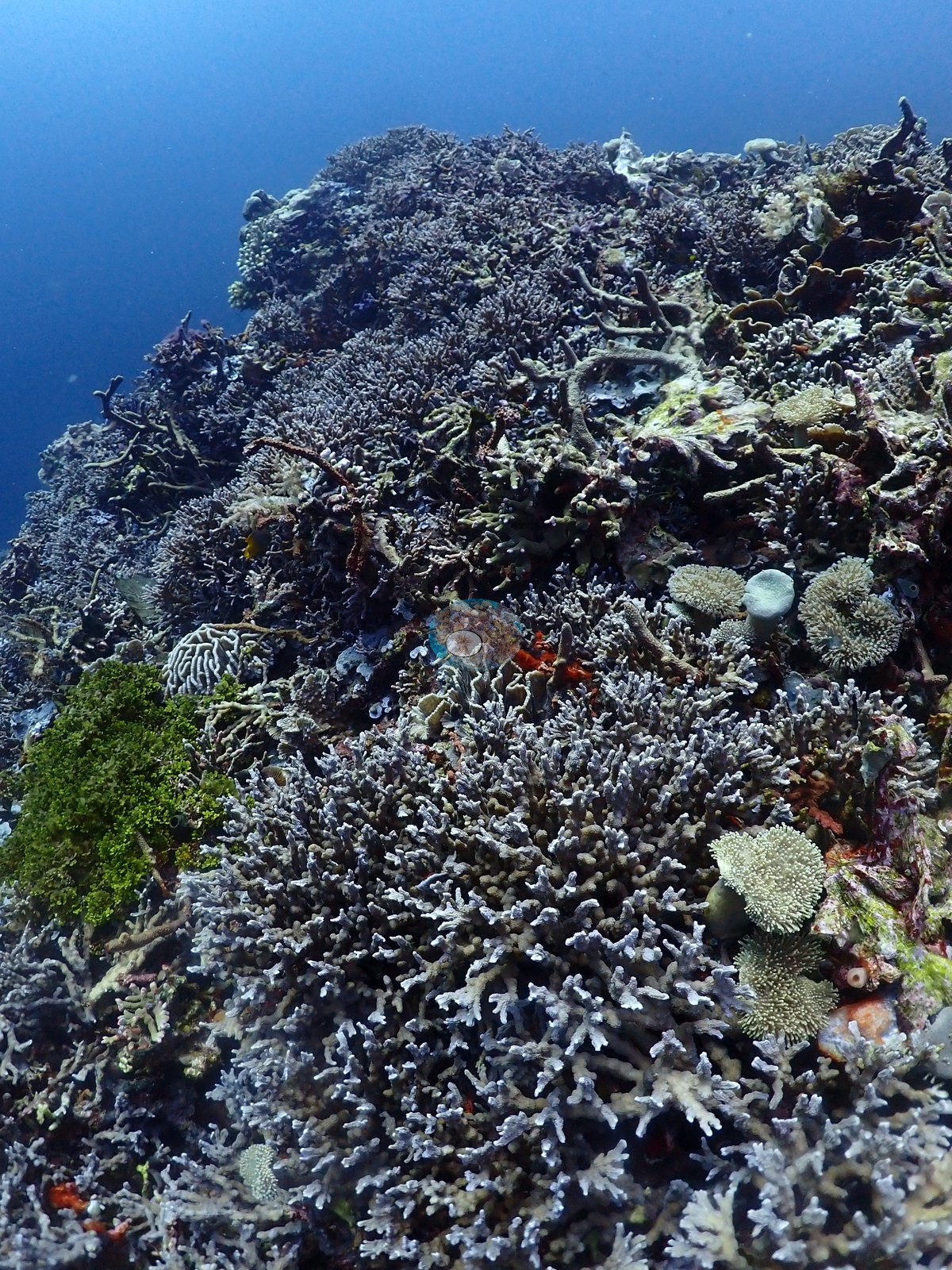
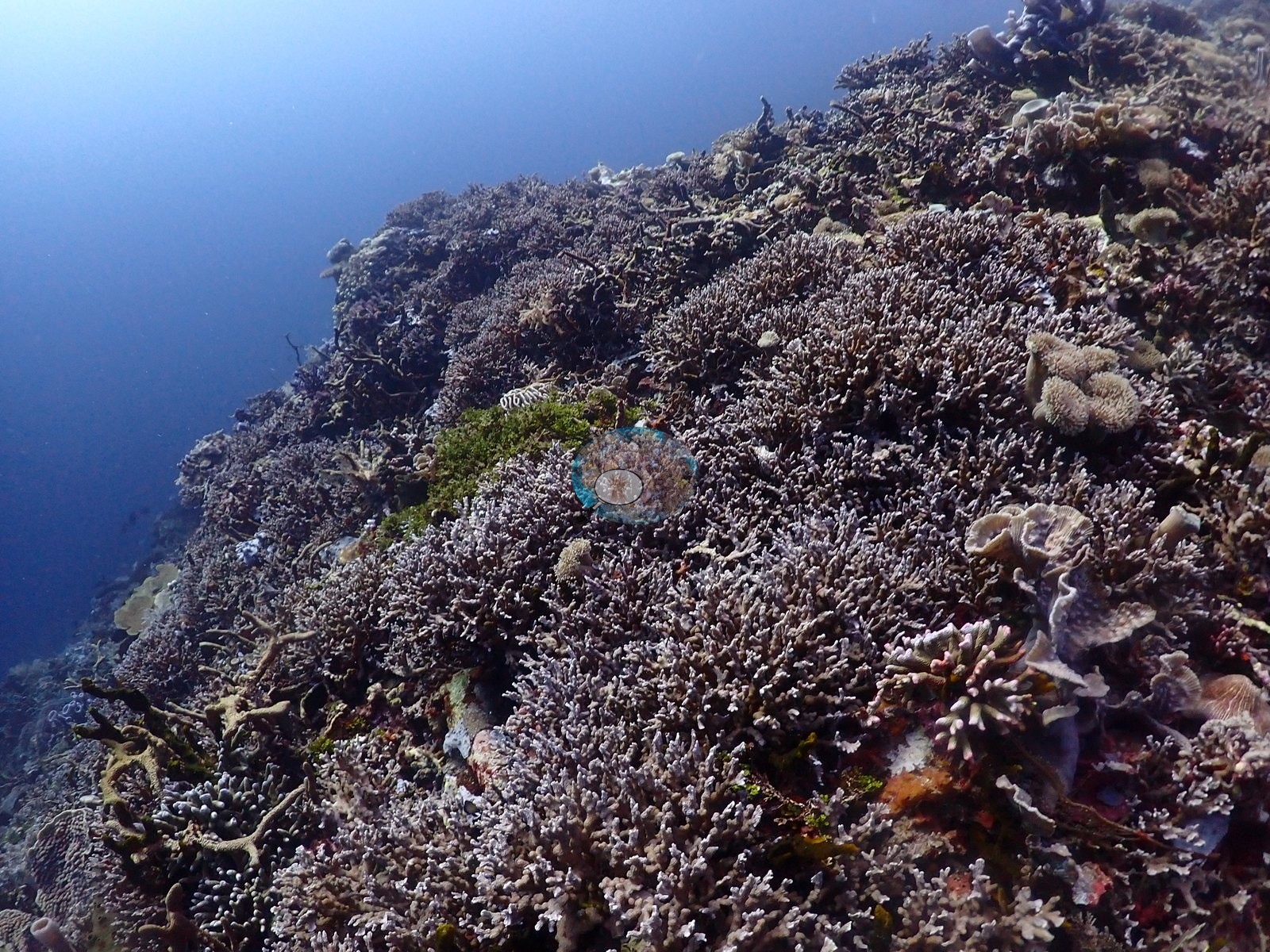
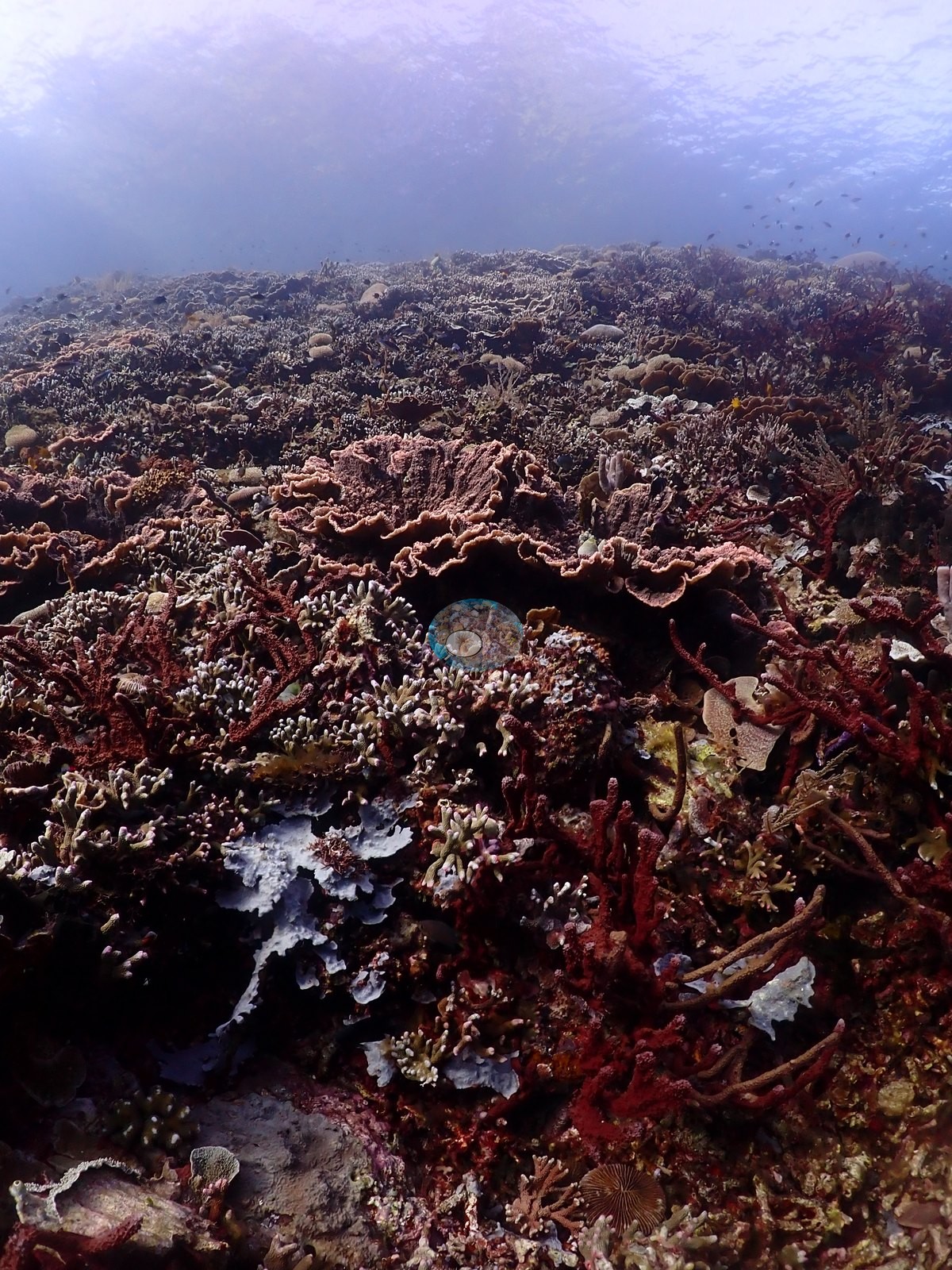
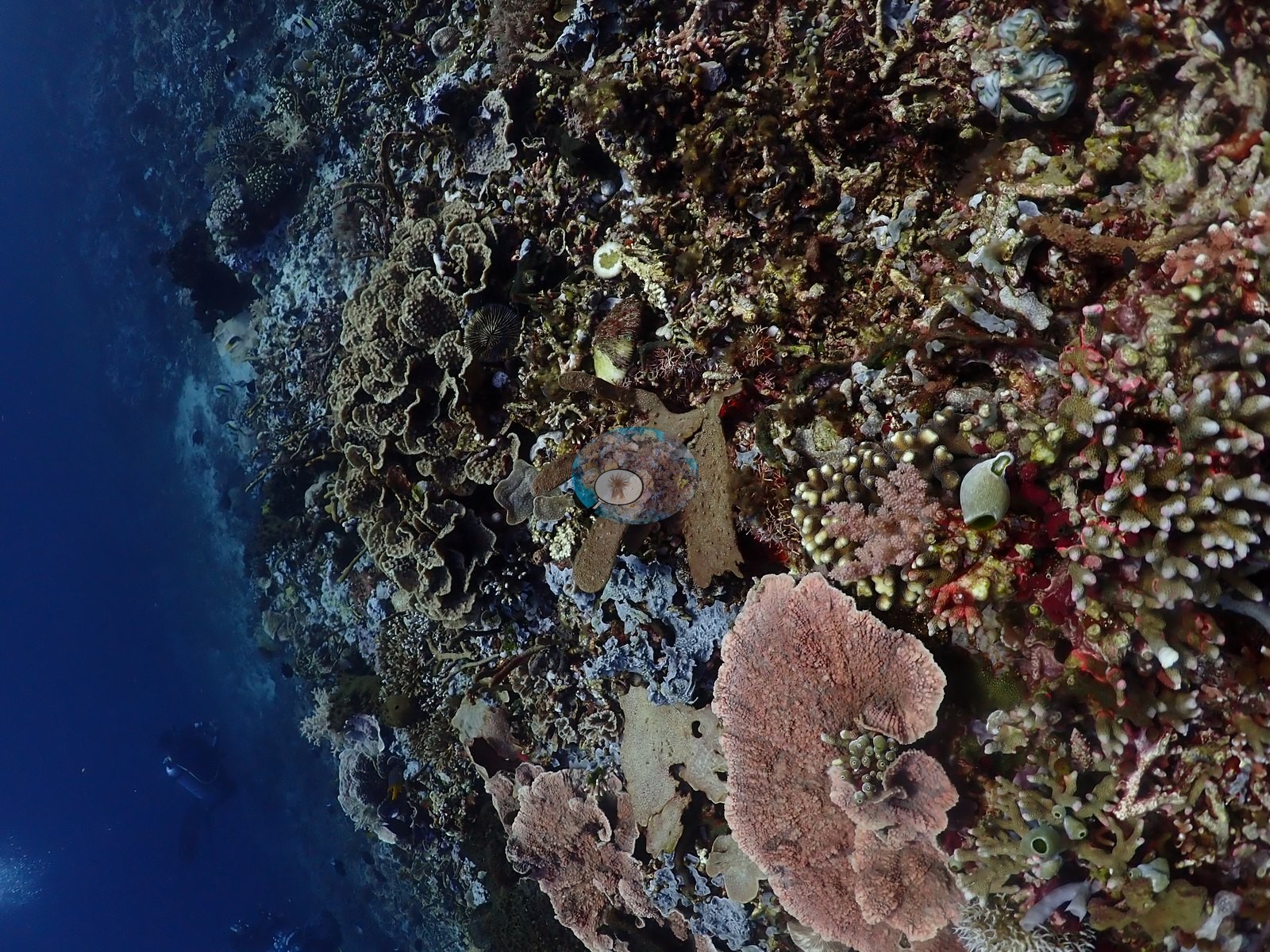
Frames 3476–3487 add extensive mauve and salmon foliose Montipora plate fields at near-continuous cover, abundant green barrel ascidians (Didemnum molle), red gorgonians with polyps out, lavender tube sponges, and one broad broken-coral rubble plain with small recruits. Shallow reef top / crest (3488–3508) is a near-continuous, structurally complex mixed-genus pavement (e.g., Image 4, Image 13).
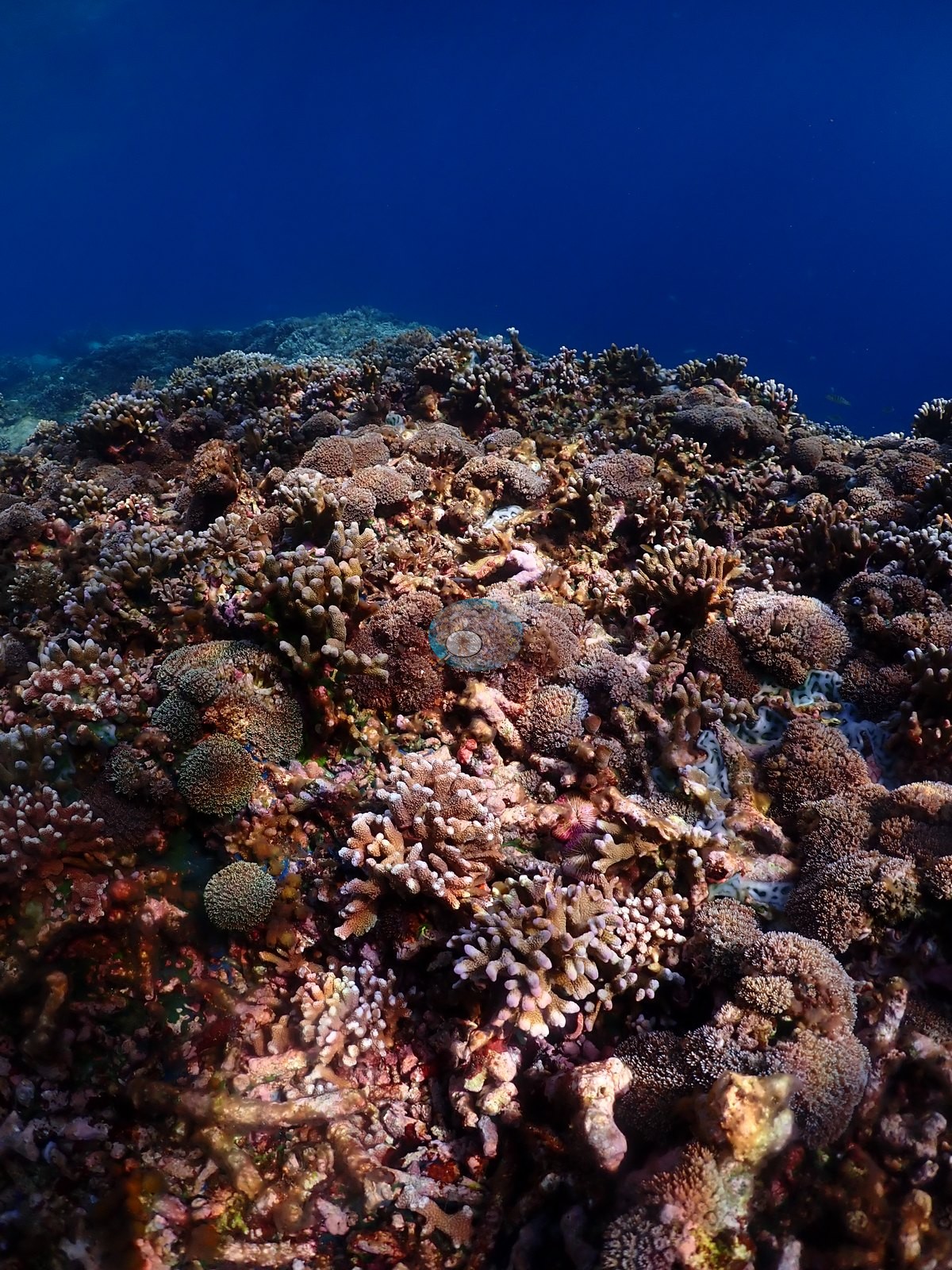
Shingled foliose plating in three distinct color morphs — salmon-pink, mauve-lavender, and pale gray-green (Echinopora lamellosa and foliose Montipora) — forms meter-scale monospecific stands (3498, 3507) inside a matrix of white-tipped branching Acropora, Seriatopora/Pocillopora-type thickets, digitate and corymbose colonies, encrusting Montipora, and frequent free-living fungiids. Deep-red branching macroalgae and red encrusting sponge thread through the framework in 3488, 3502, and 3504, and 3488 is unusual in being dominated by red crustose and foliose coralline rather than coral (e.g., Image 28, Image 51).
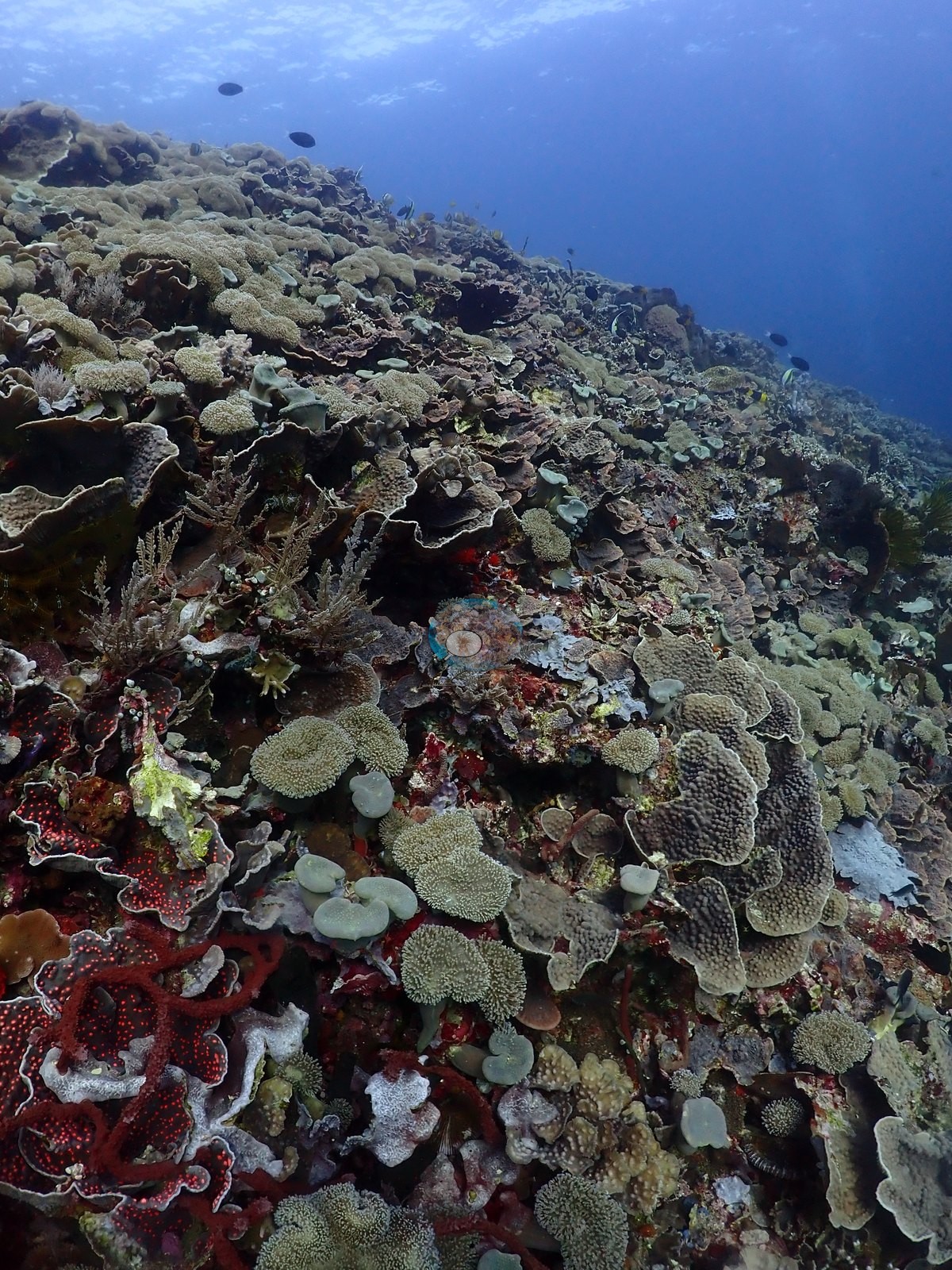
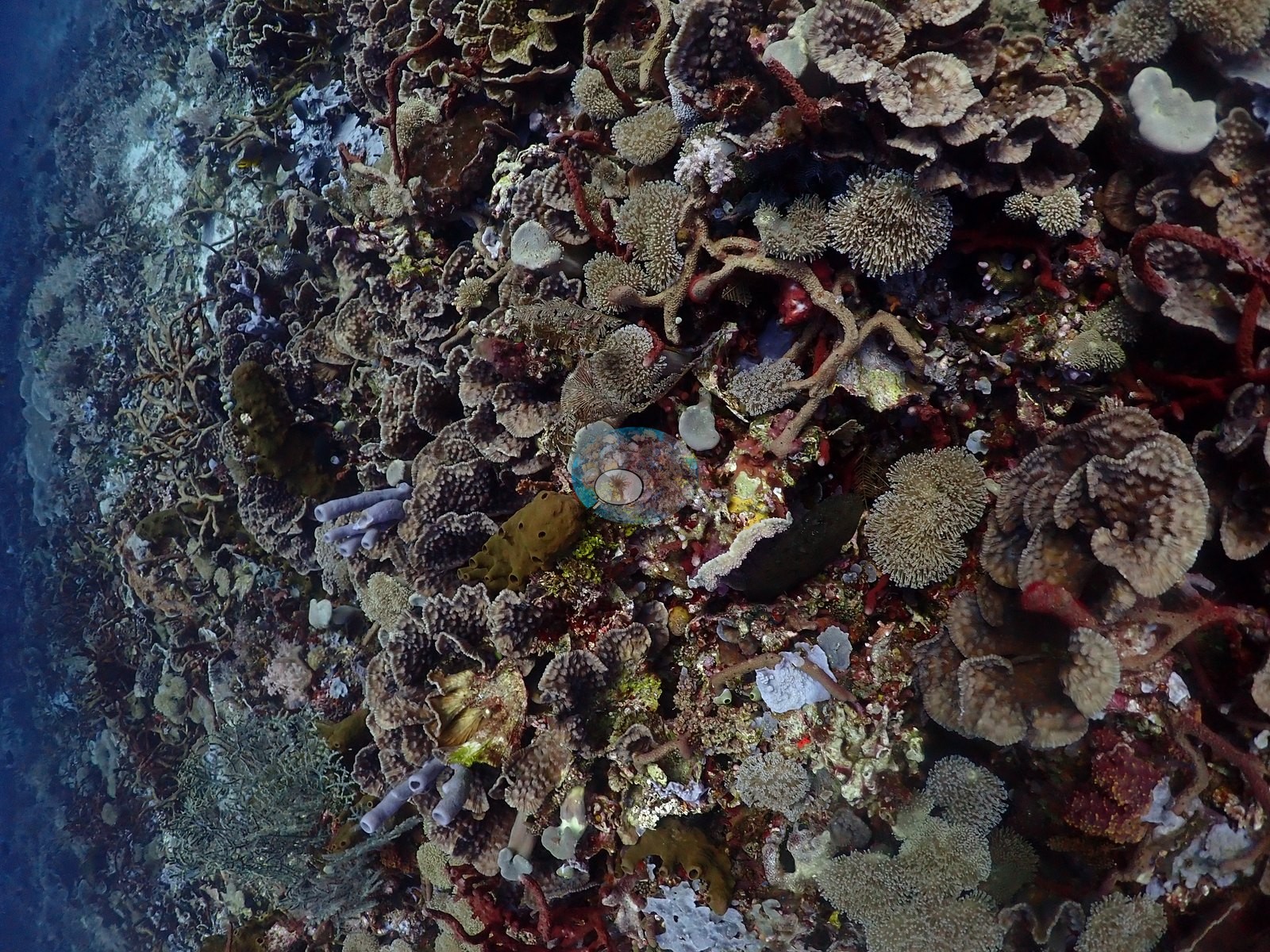
Lavender and purple tube sponges, green barrel ascidians, crinoids, and a brittle star recur throughout; chromis and anthias shoal over the top in 3490 and 3499, with yellow butterflyfish and damsels in 3502 and 3508. Frames 3509–3528 turn the dive again, onto a stretch where octocorals, not stony coral, hold the ground: broad fields of gray-green and tan Sarcophyton/Sinularia toadstools carpet the upper slope in 3509, 3512, 3519, 3524, 3525, and 3526, with stony colonies reduced to emergents within them. Large dark red-brown repent sponges sprawl meters across the framework in 3519 and 3520, and massive red barrel sponges stand on the slope in 3514, 3515, and 3517. Individual set-pieces: a pale tabulate Acropora table roughly 1.5 m across in 3521, with a small branching colony rooted in a gap at its center; a vivid salmon-pink meandroid brain (Lobophyllia/Symphyllia-type) in 3524; and a single large elongate fungiid filling the frame in 3527. Crucially, 3522 and 3528 document extensive plains of broken branching-coral rubble, pink with crustose coralline and grading into open sand, carrying only isolated survivors — a corymbose Acropora plate and a golden bushy hydroid/hydrocoral colony with yellow and black crinoids in 3528 (e.g., Image 43).
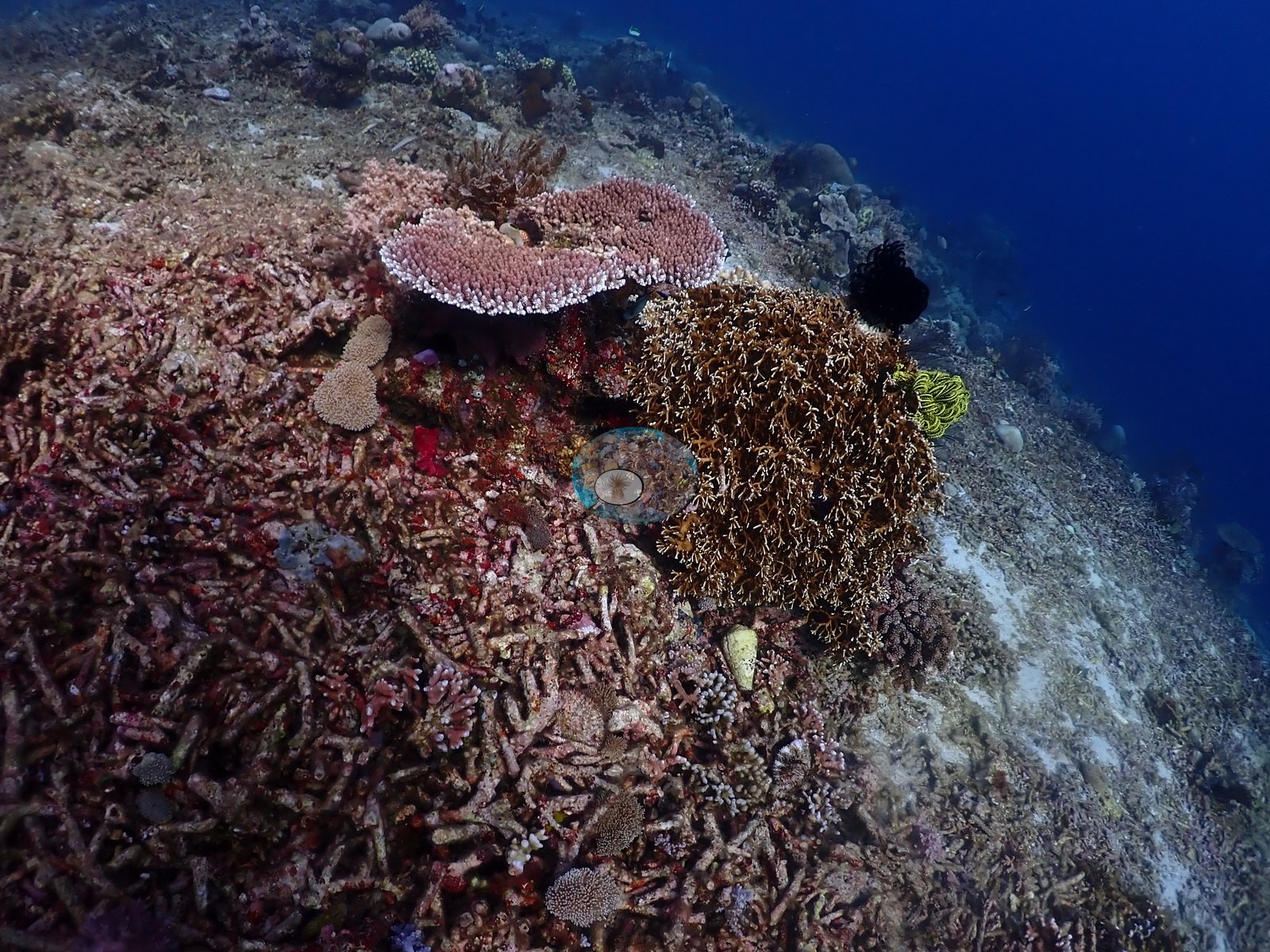
These rubble plains, together with the sand patches in 3512 and 3516, sit at the low end of the dive's cover range and indicate past physical breakage on this part of the slope. Frames 3529–3538 resolve what that octocoral ground actually is: not scattered colonies but a near-monospecific soft-coral meadow. In 3531 and 3532 tan and olive Sarcophyton/Sinularia toadstools carpet the entire visible slope to the horizon in an essentially unbroken sheet, with only narrow gutters of coralline-crusted rubble showing through; 3530, 3533, 3535, and 3537 work the same meadow closer, where free-living fungiids and the occasional branching colony sit as emergents inside the octocoral matrix (e.g., Image 18, Image 33, Image 39).
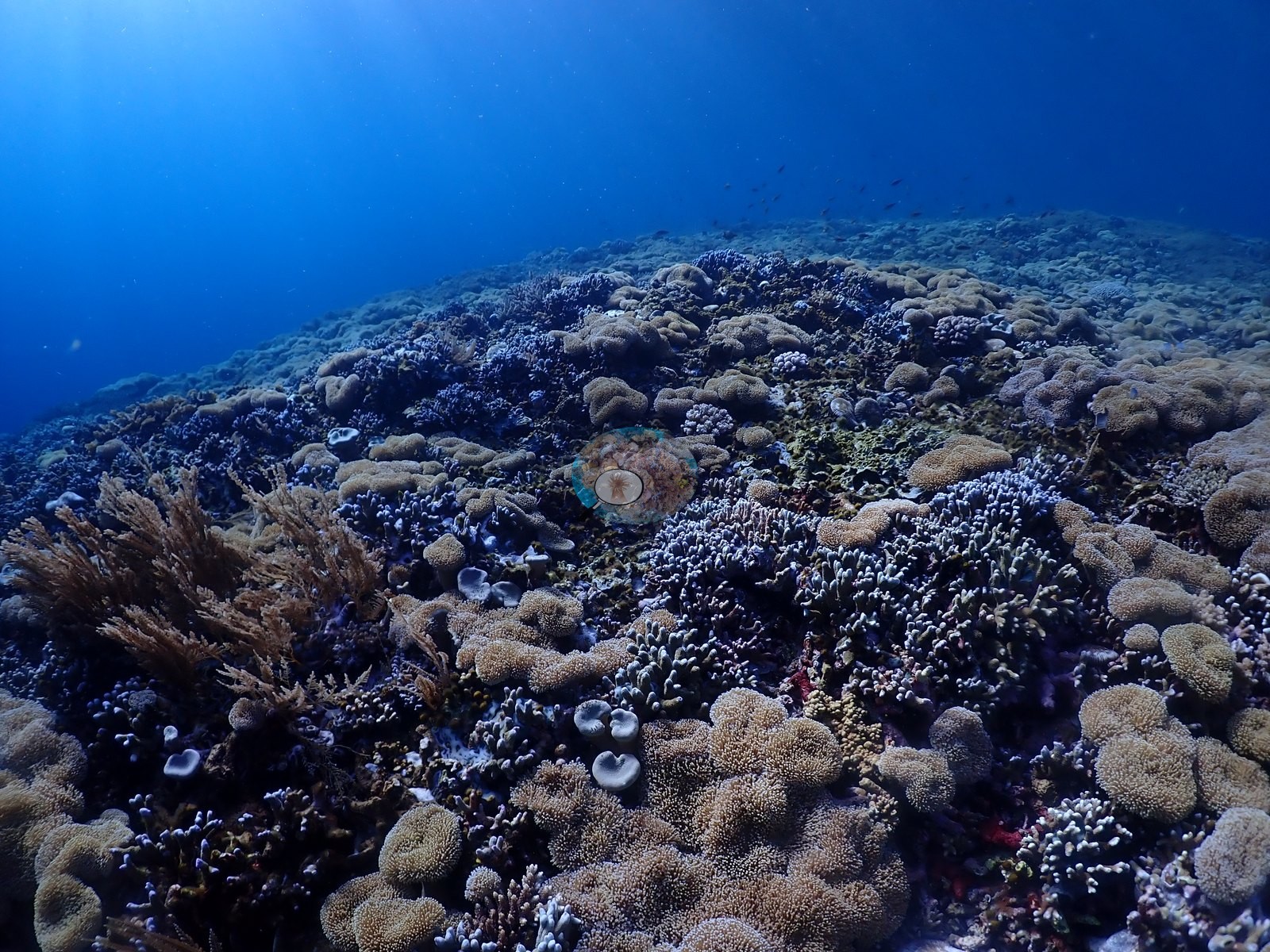
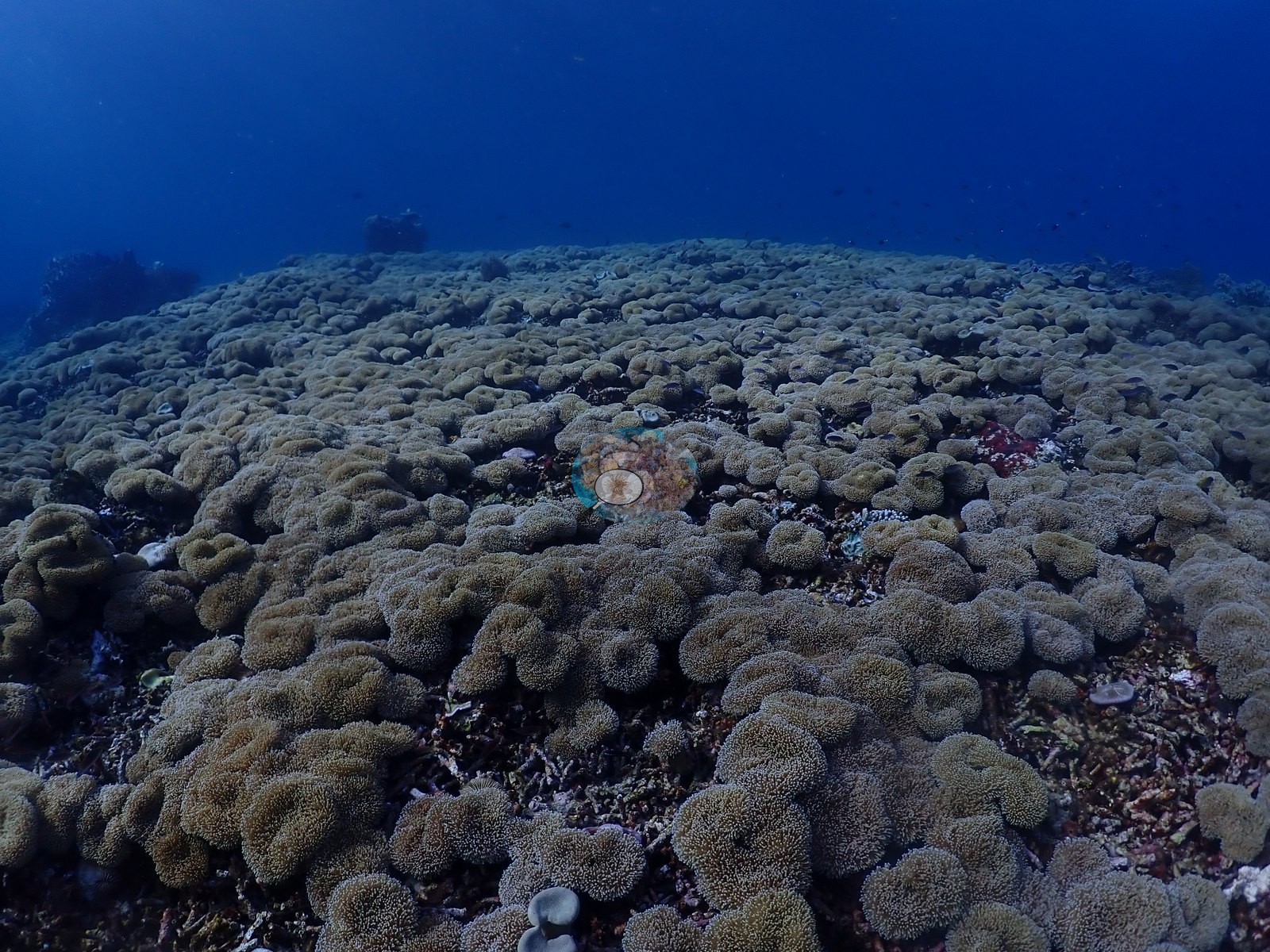
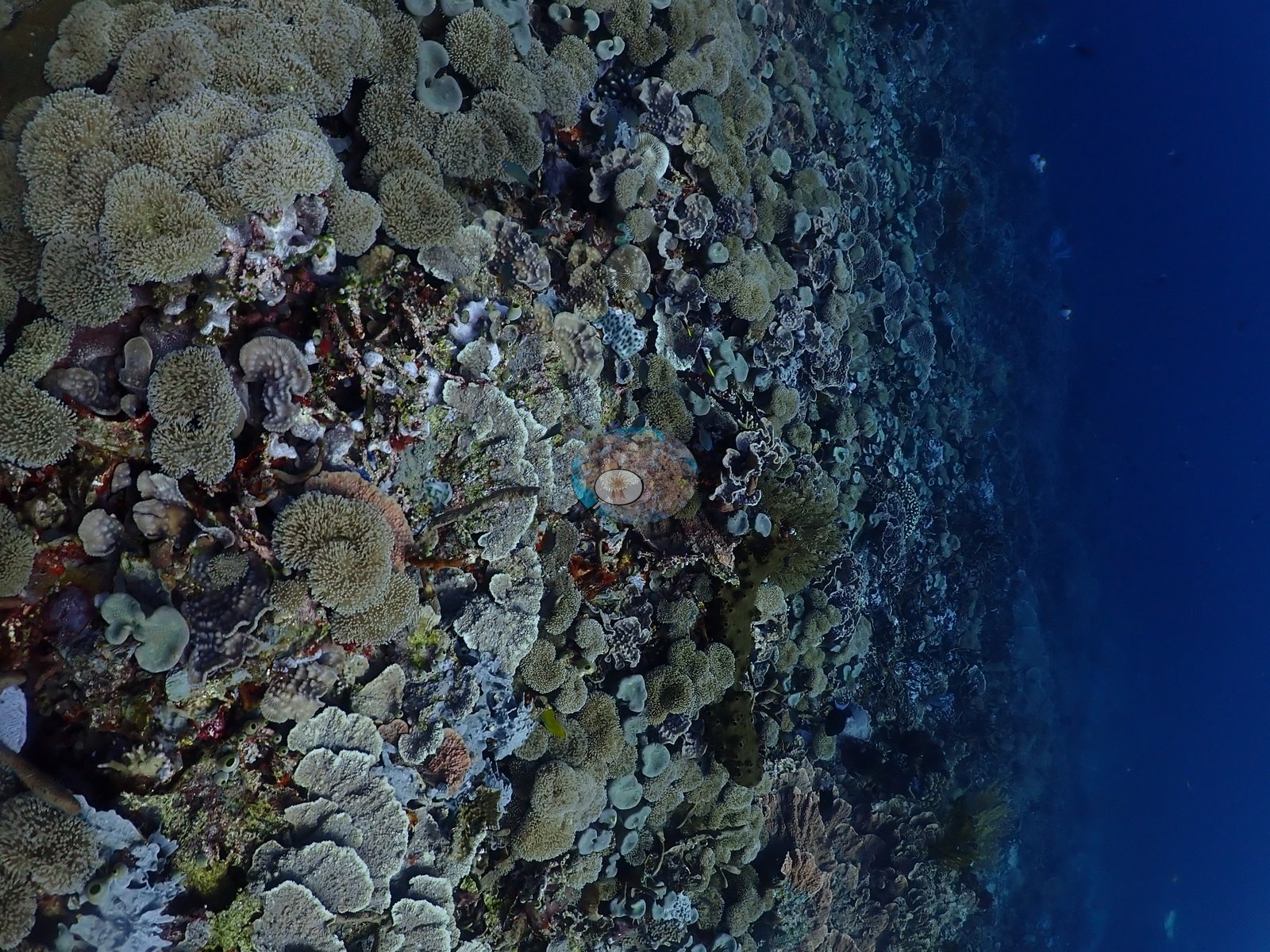
This meadow is the single most extensive habitat on the dive and is almost certainly what pulls the site mean down relative to the shallow plate-and-branching crest, since soft coral does not count as hard-coral cover. Away from the meadow, 3534, 3536, and 3538 hold a genuinely mixed, near-continuous assemblage: blue-gray and lavender digitate and branching Acropora, cream-yellow corymbose colonies, foliose plates, olive-yellow colonial ascidians in 3537, and Tridacna clams with white-and-green maze mantles in 3535, 3536, and 3537. Frames 3539–3550 enter a fourth, shallow habitat — a sunlit reef flat and crest with the surface visible overhead, and an assemblage built on robust massive and columnar growth forms rather than plates or octocorals. Thick-fingered columnar Porites (P. cylindrica/rus habit) dominate, standing as raised stands and bommies in 3541, 3547, and 3548, alongside large smooth massive Porites domes in maroon, purple-brown, and olive (e.g., Image 34).
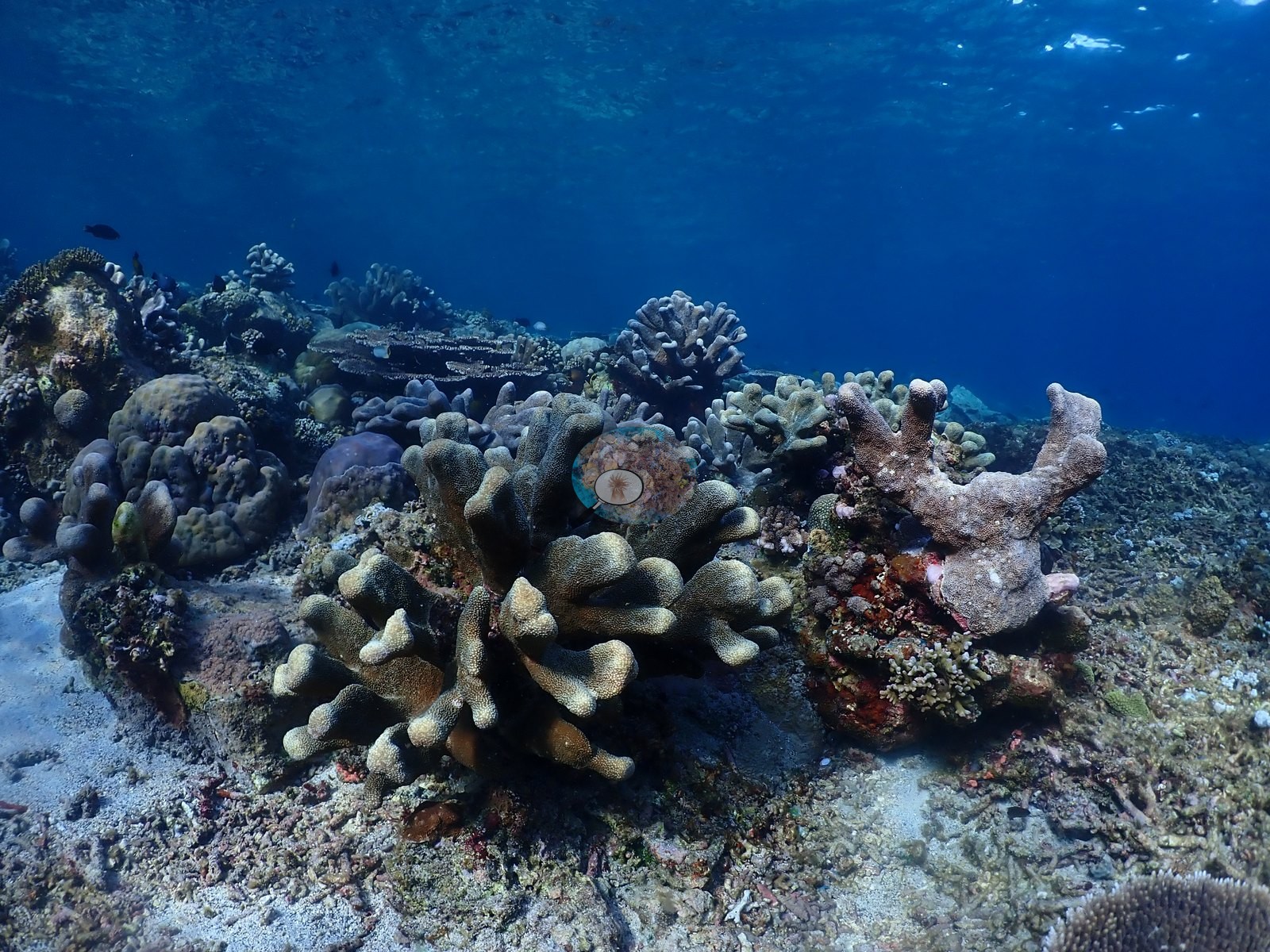
Tabulate Acropora tables recur across the flat (3540, 3542, 3544), green ruffled columnar-foliose Pavona-type colonies form ridges in 3543–3547, and a distinctive golden-brown ruffled hydrocoral consistent with Millepora appears in 3543, 3545, and 3546. Healthy staghorn and corymbose Acropora thickets close the sequence in 3549 and 3550 (e.g., Image 54).
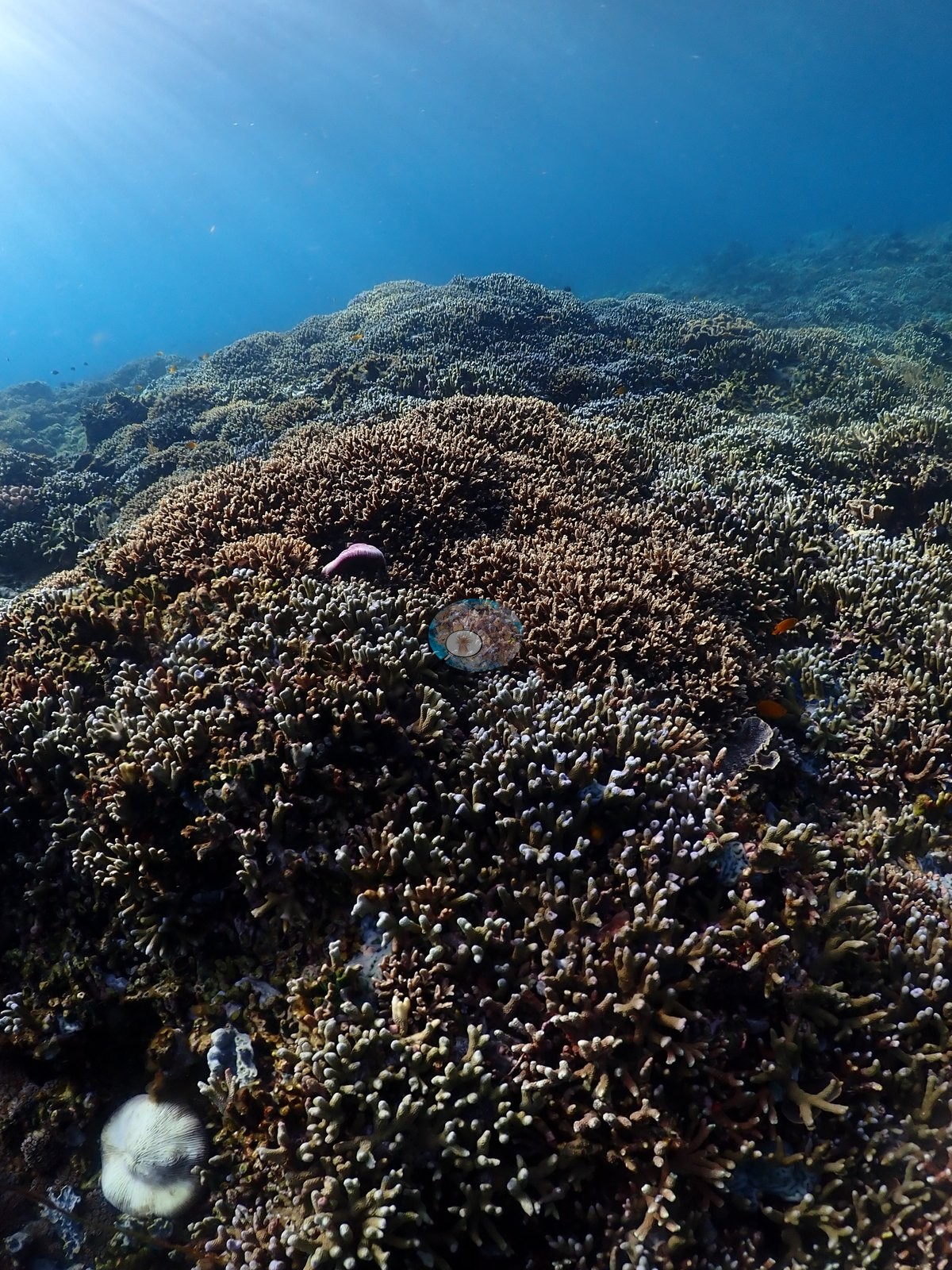
Frames 3551–3563 work the shallow ground harder and expose how sharply it alternates between near-continuous coral and near-bare substrate. At the rich end, 3557 opens onto a vast blue-gray and tan branching field running to the horizon, and 3562 is a near-monospecific stand of overlapping corymbose Acropora filling the frame; 3561 shows a steep face carpeted in rounded encrusting Montipora-type plates with several Tridacna mantles set into it. At the poor end, 3556 is mostly bare turfed boulders and pavement carrying only scattered Pocillopora, an orange-tan meandroid brain, and a few small massives. Color standouts: a vivid violet branching Acropora in 3560, magenta Pocillopora through 3552–3556, and a fleshy large-corallite colony consistent with Goniopora in 3552 (e.g., Image 45).
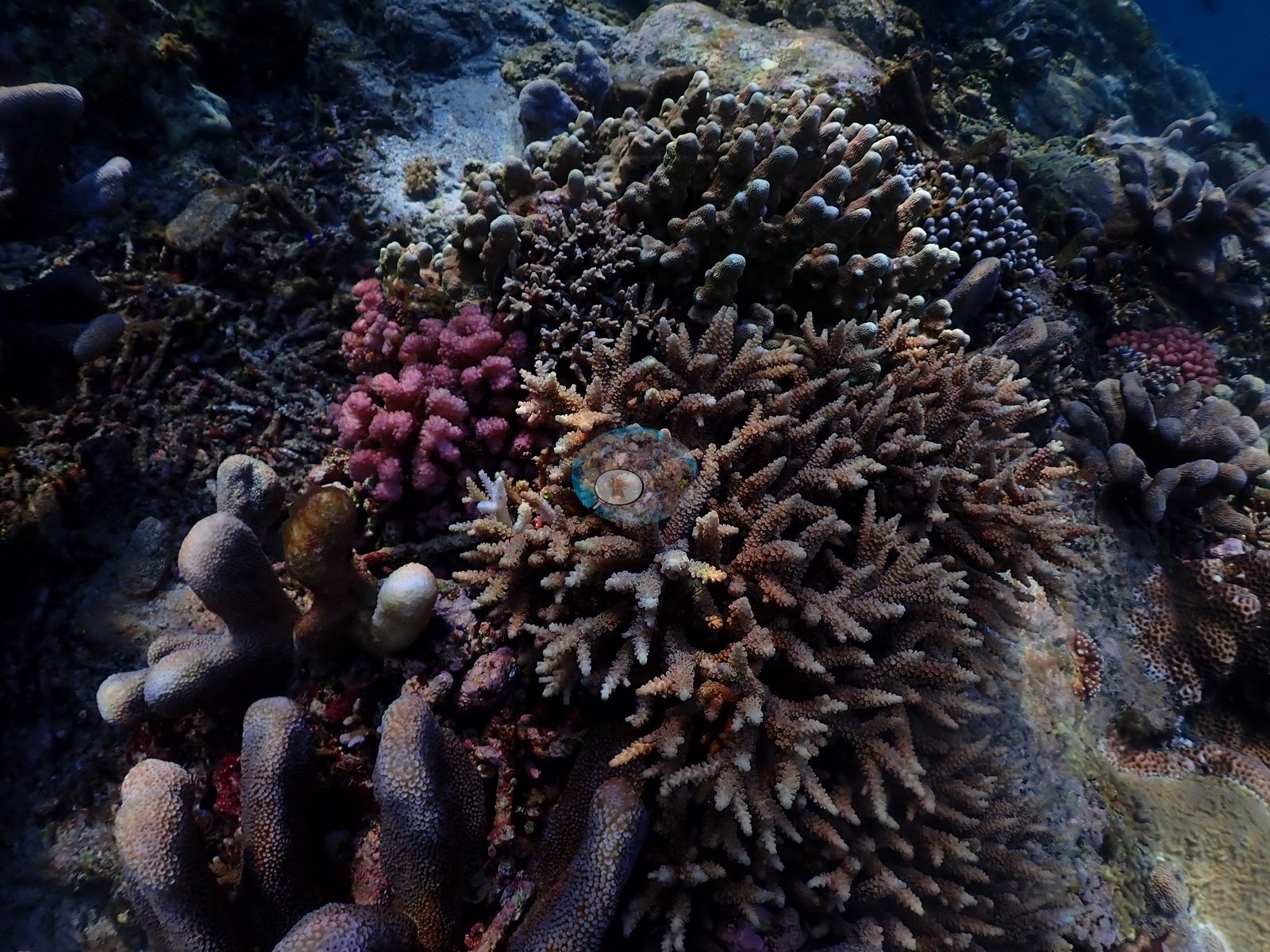
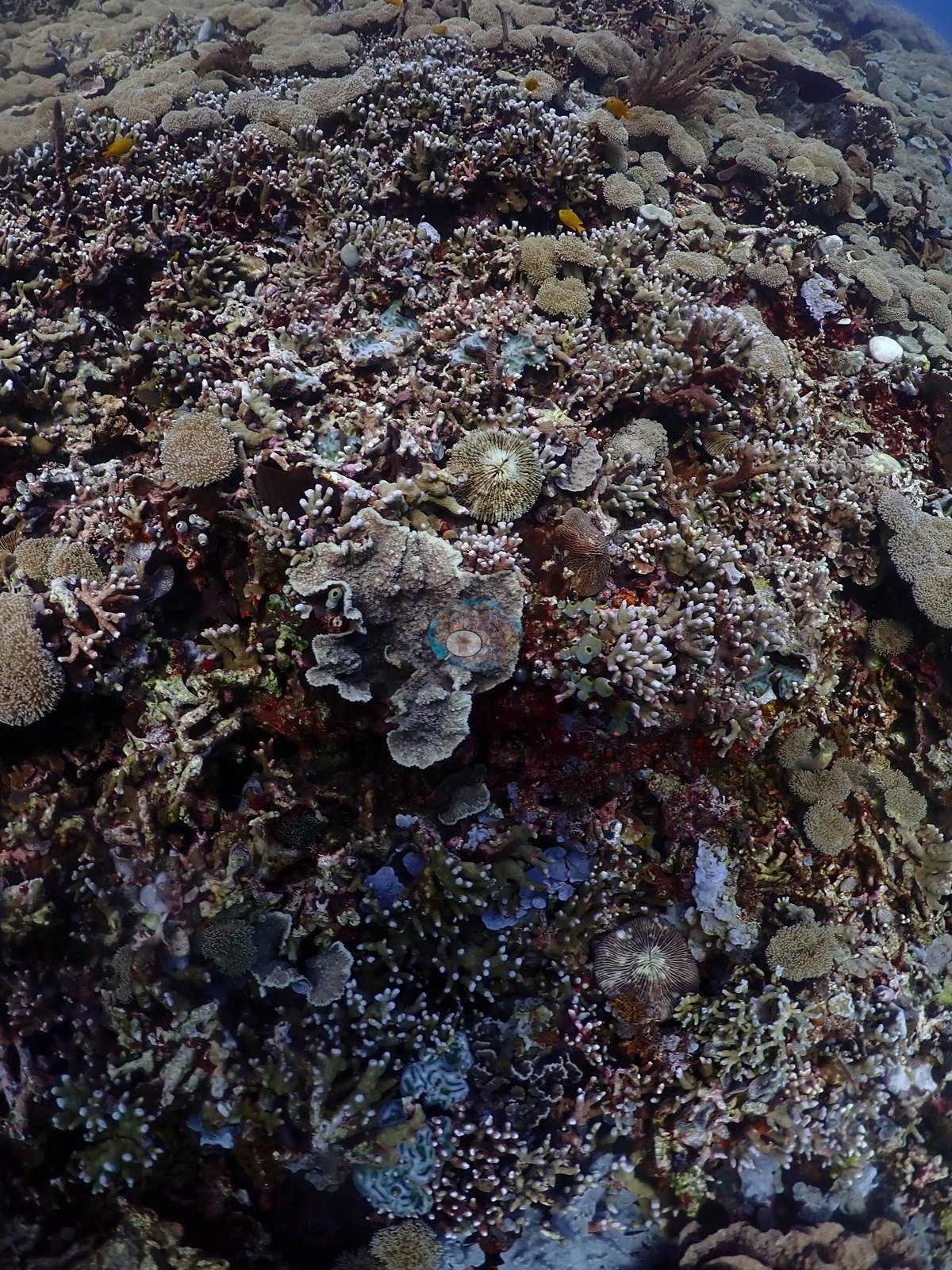
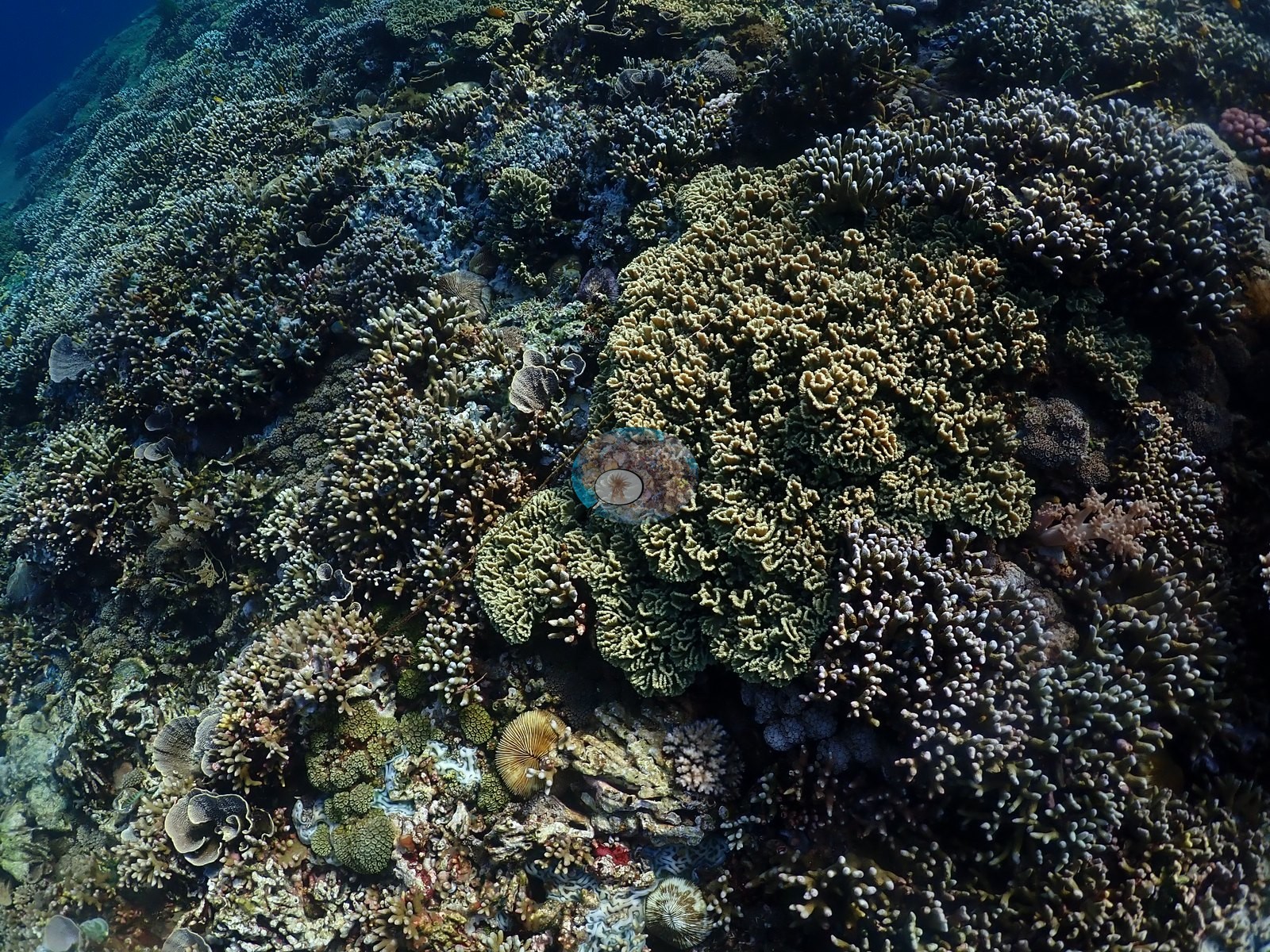
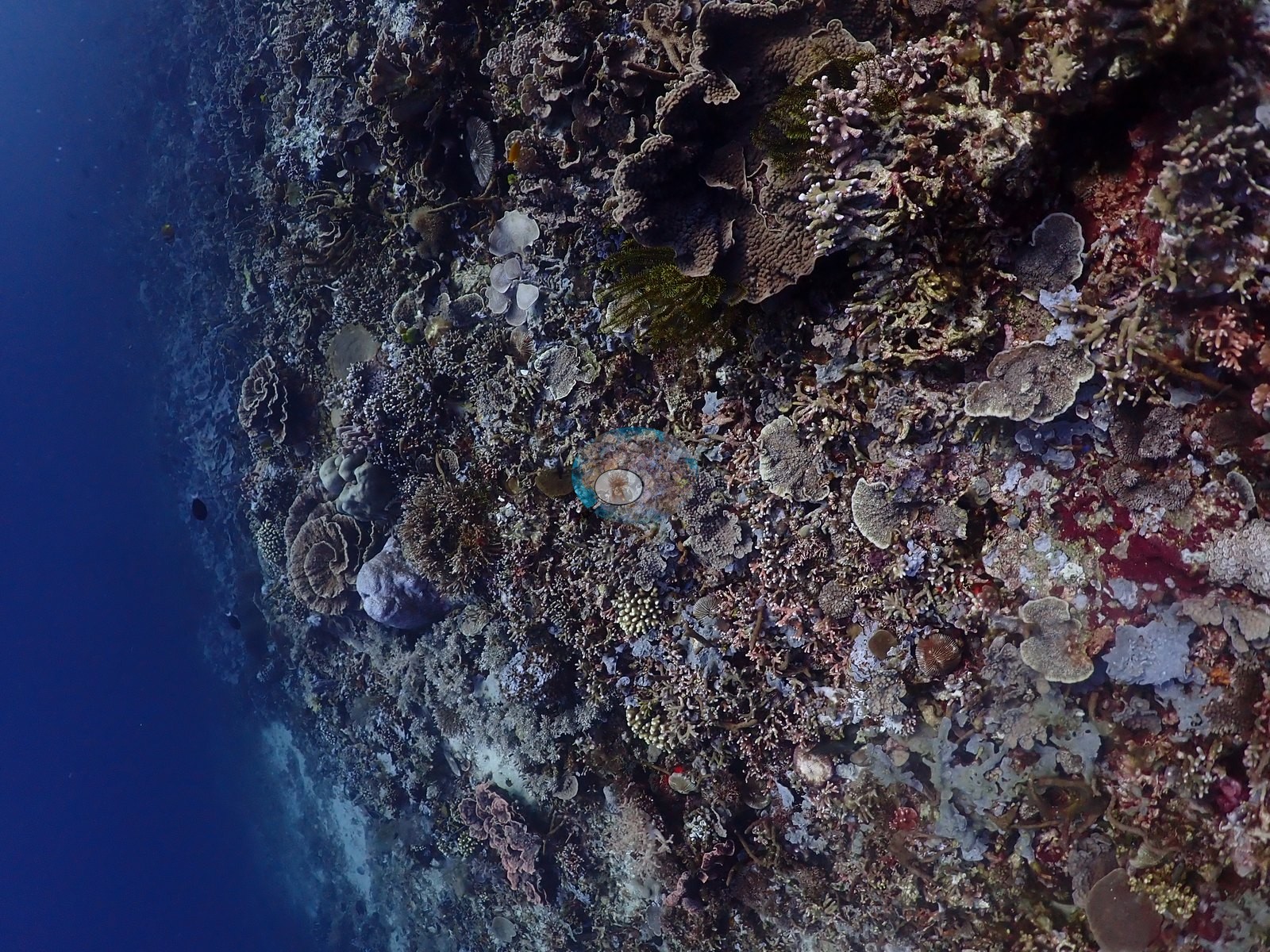
Frames 3564–3575 are the highest-cover ground on the whole dive — a steep slope falling into deep blue, sheeted almost wall-to-wall in living coral. Two growth forms share it: carpets of fine-branching pale gray-green Acropora/Seriatopora, and vast fields of brown ruffled foliose plating consistent with Echinopora lamellosa or Merulina, which in 3570 and 3571 form a continuous lettuce-like expanse meters across with orange anthias hanging over it (e.g., Image 7, Image 20, Image 23).
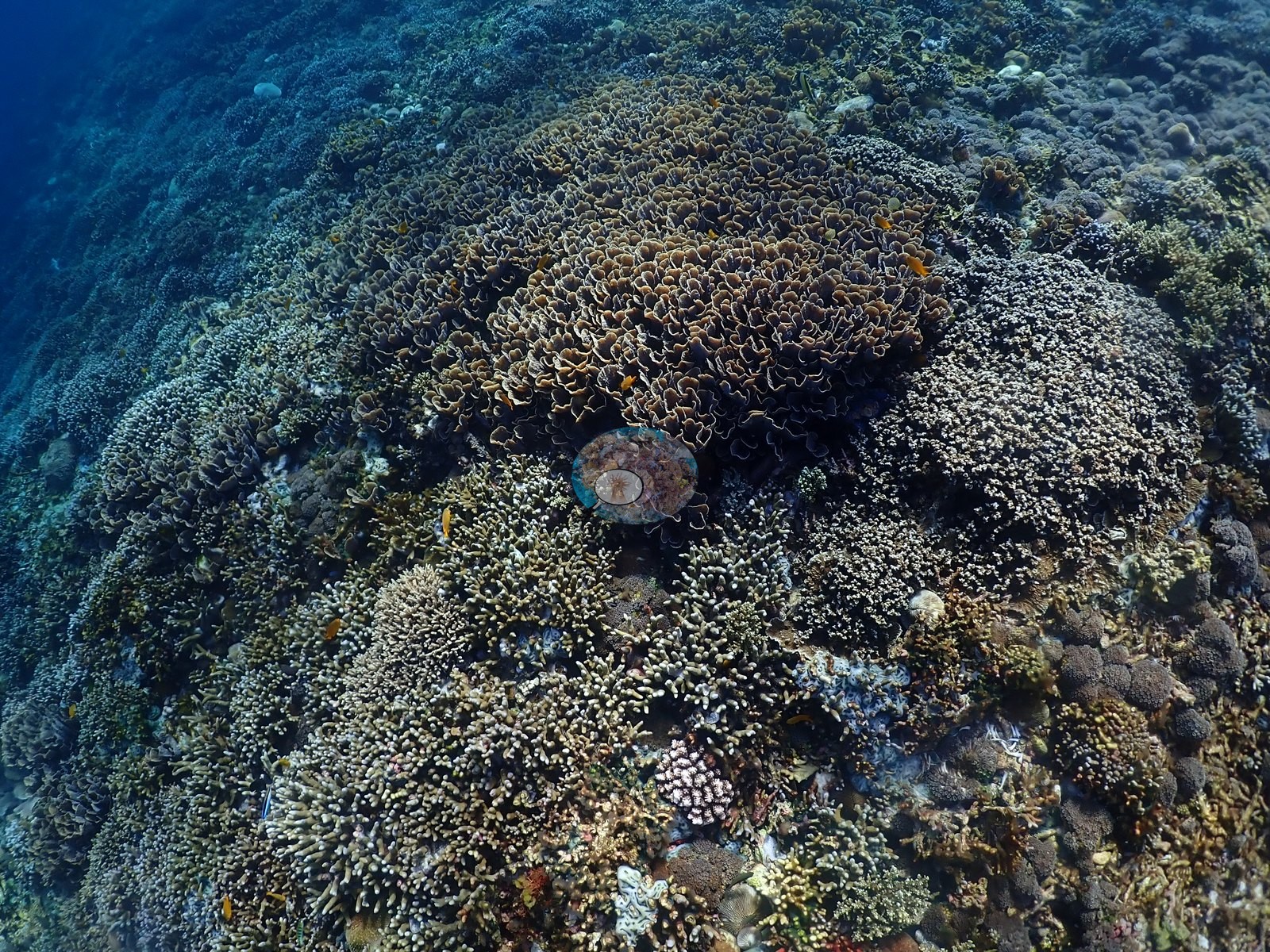
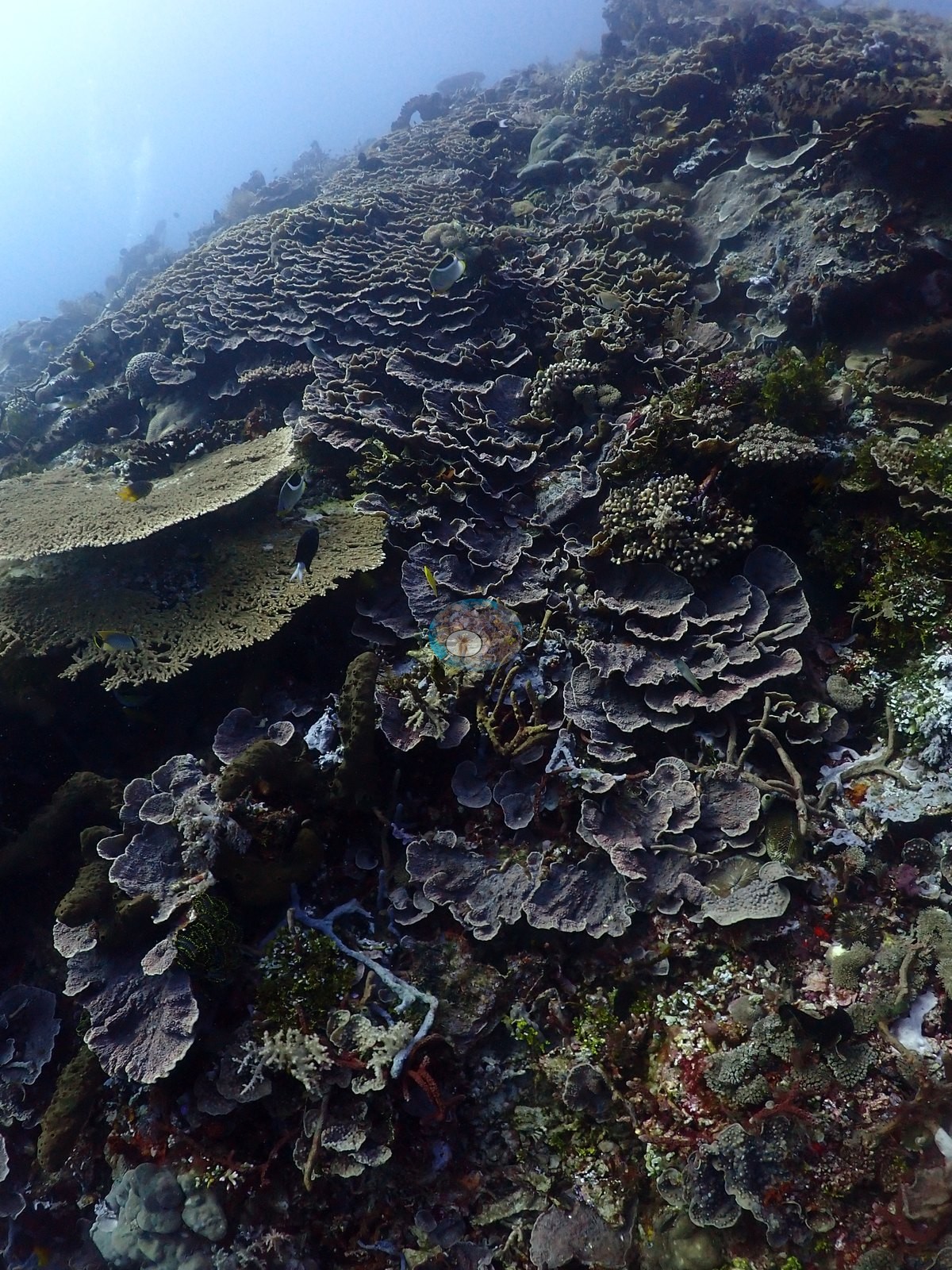
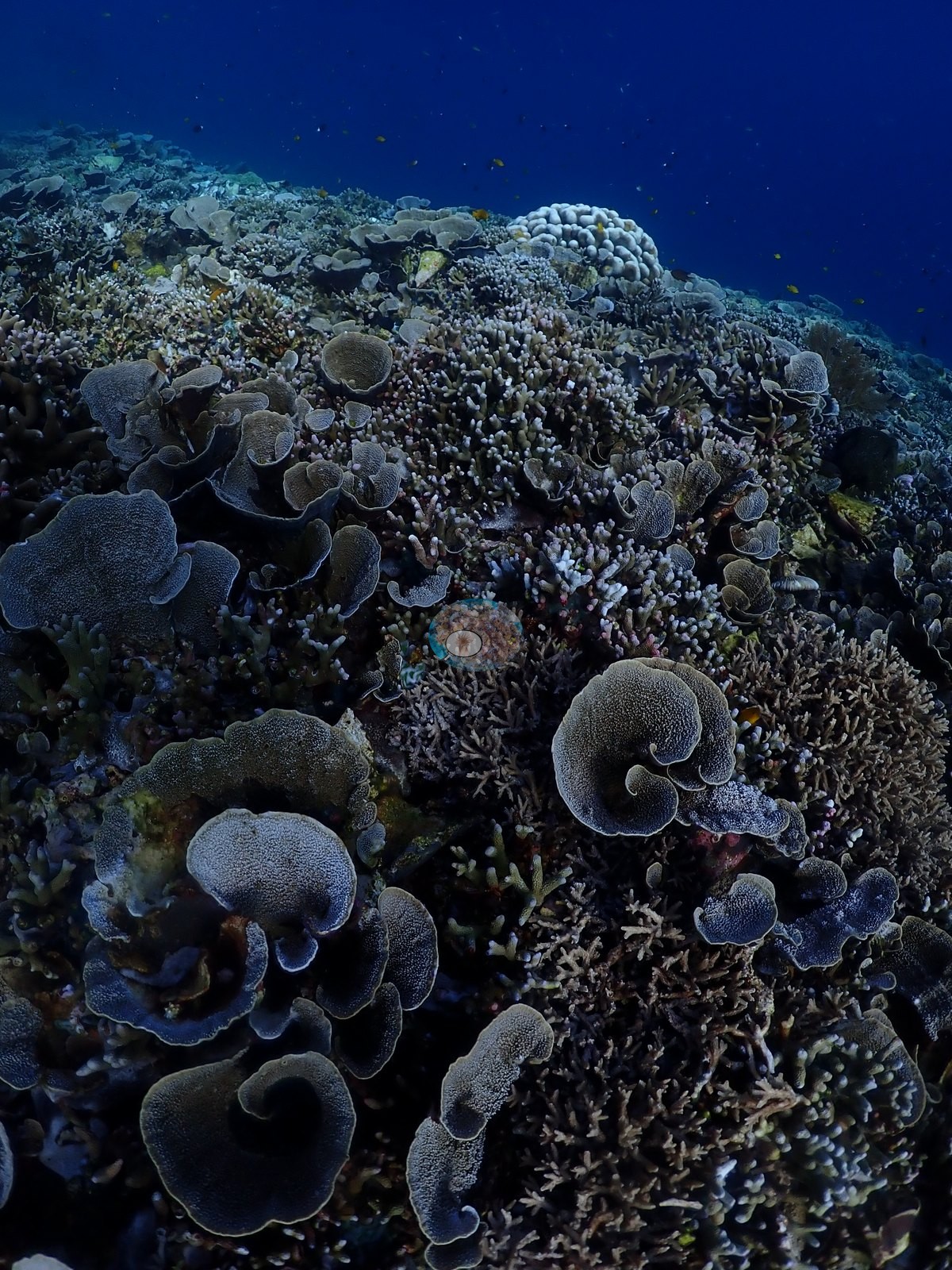
Rounded encrusting Montipora discs tile the steeper faces (3568), and a large smooth gray-blue plating colony and dark foliose rosettes punctuate 3569 (e.g., Image 48).
Free-living fungiids are conspicuously abundant here, six to eight per frame in 3573 and 3575 — a far higher density than anywhere shallower. Frames 3576–3589 hold that near-total cover across a long stretch of slope, with yellow-green ruffled foliose fields and fine-branching Acropora carpets interlocking so completely that bare substrate is essentially absent from 3578–3584 (e.g., Image 27).
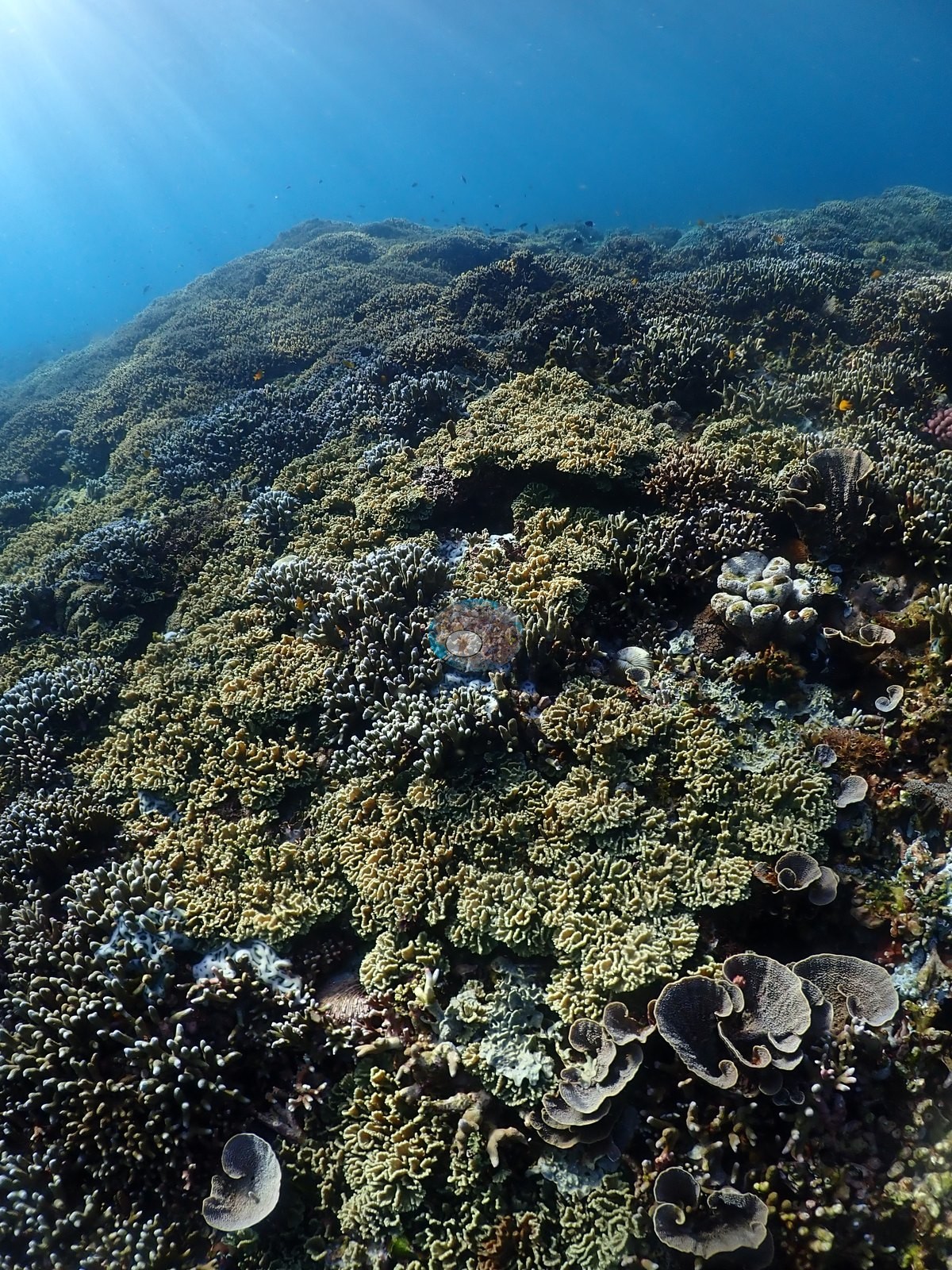
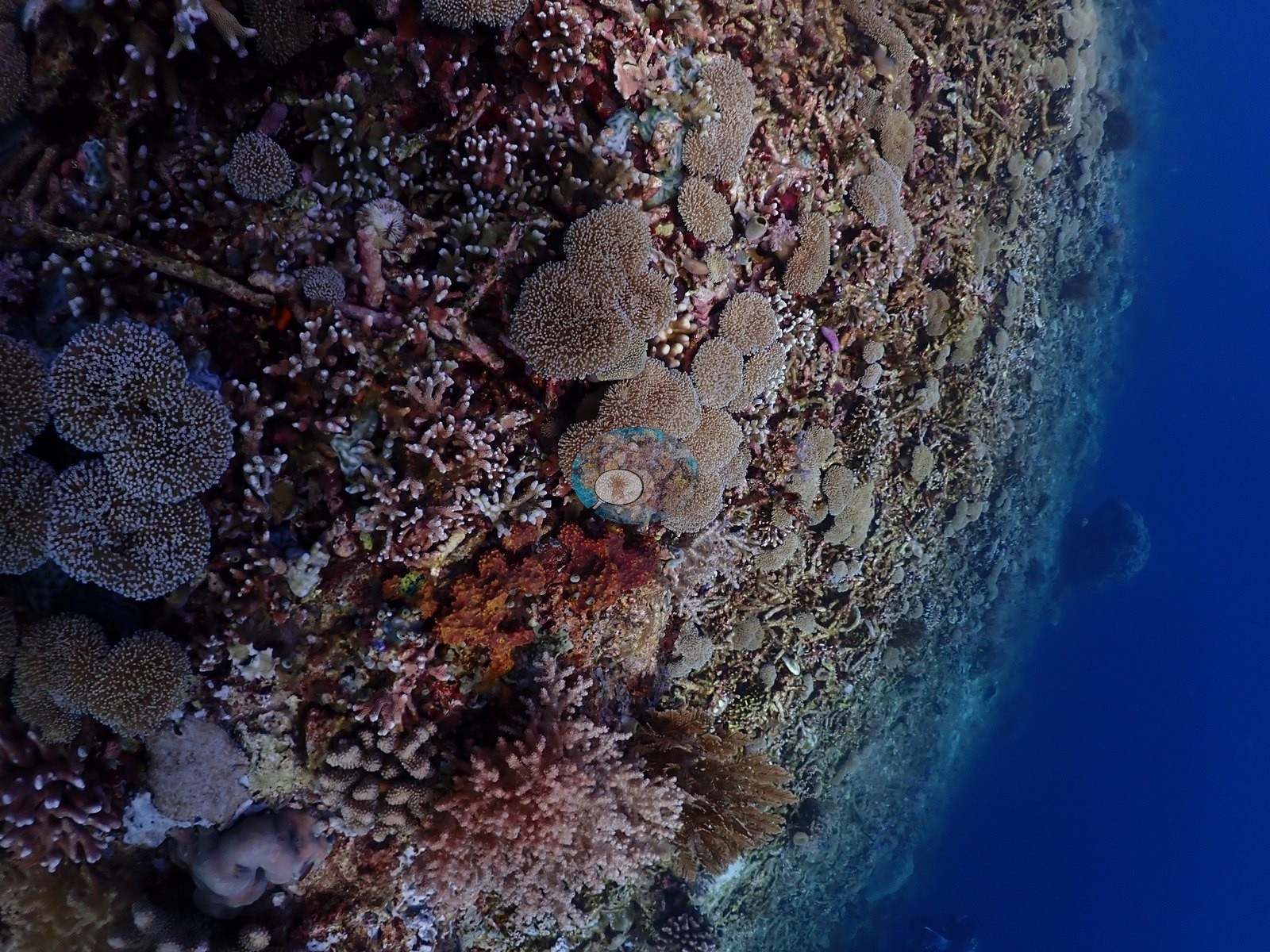
Bright green crinoids perch in 3582 and 3583, tabulate plates reappear in 3583 and 3584, and 3584 adds a tan meandroid brain and a corymbose Acropora table side by side. 3589 opens onto a field of overlapping tabulate Acropora tables with a diver and bubble trail overhead, a large smooth cream massive Porites dome and a pale meandroid brain anchoring the foreground. Frames 3590–3604 close the reviewed portion on the outer wall and drop-off, and this is the structural high point of the site. The wall runs near-vertical into blue water and is sheeted continuously in coral from the lip downward (3592, 3596, 3597, 3601), with divers giving scale in 3592, 3595, 3601, and 3604 (e.g., Image 2, Image 8, Image 19, Image 42).
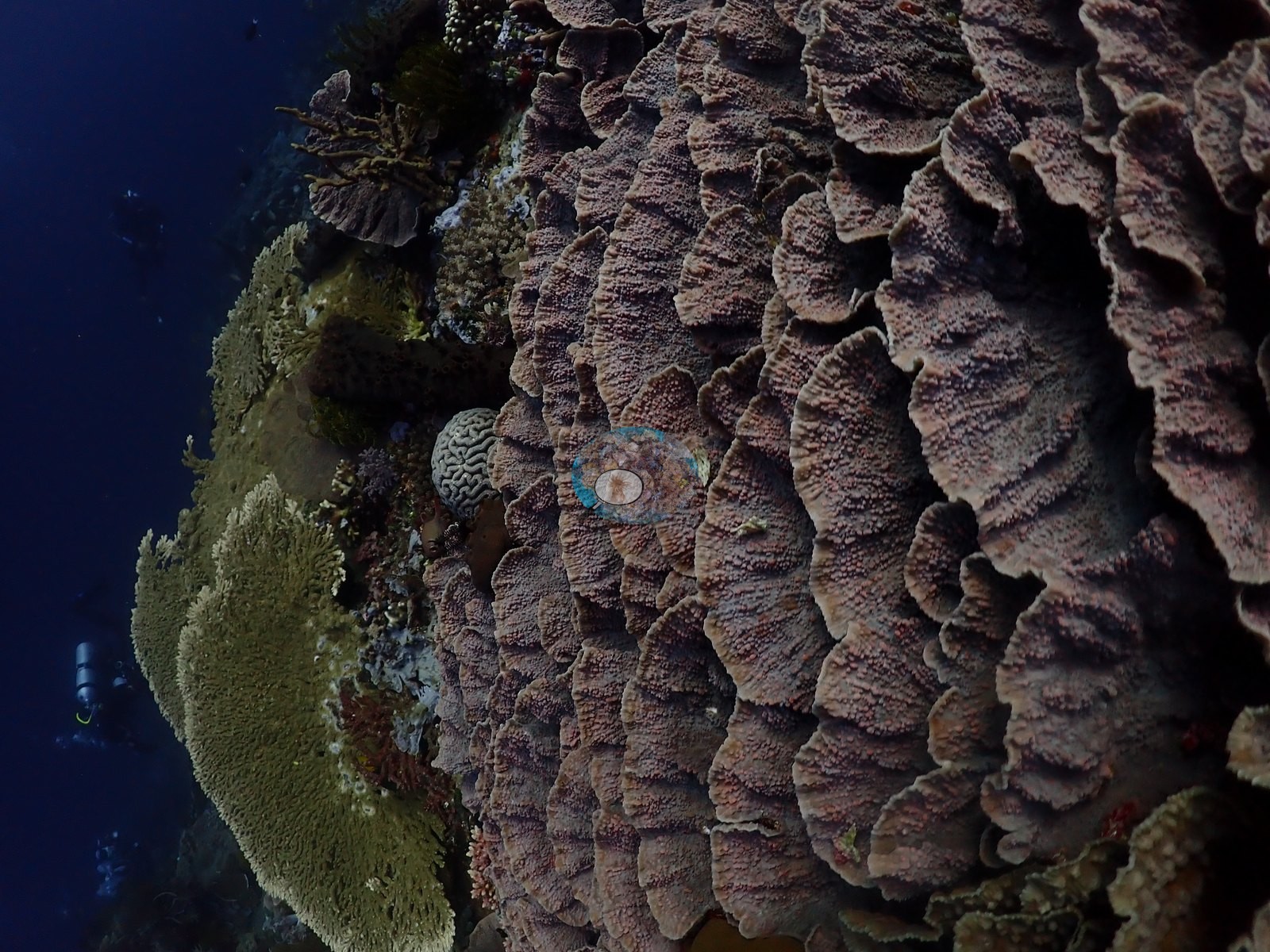
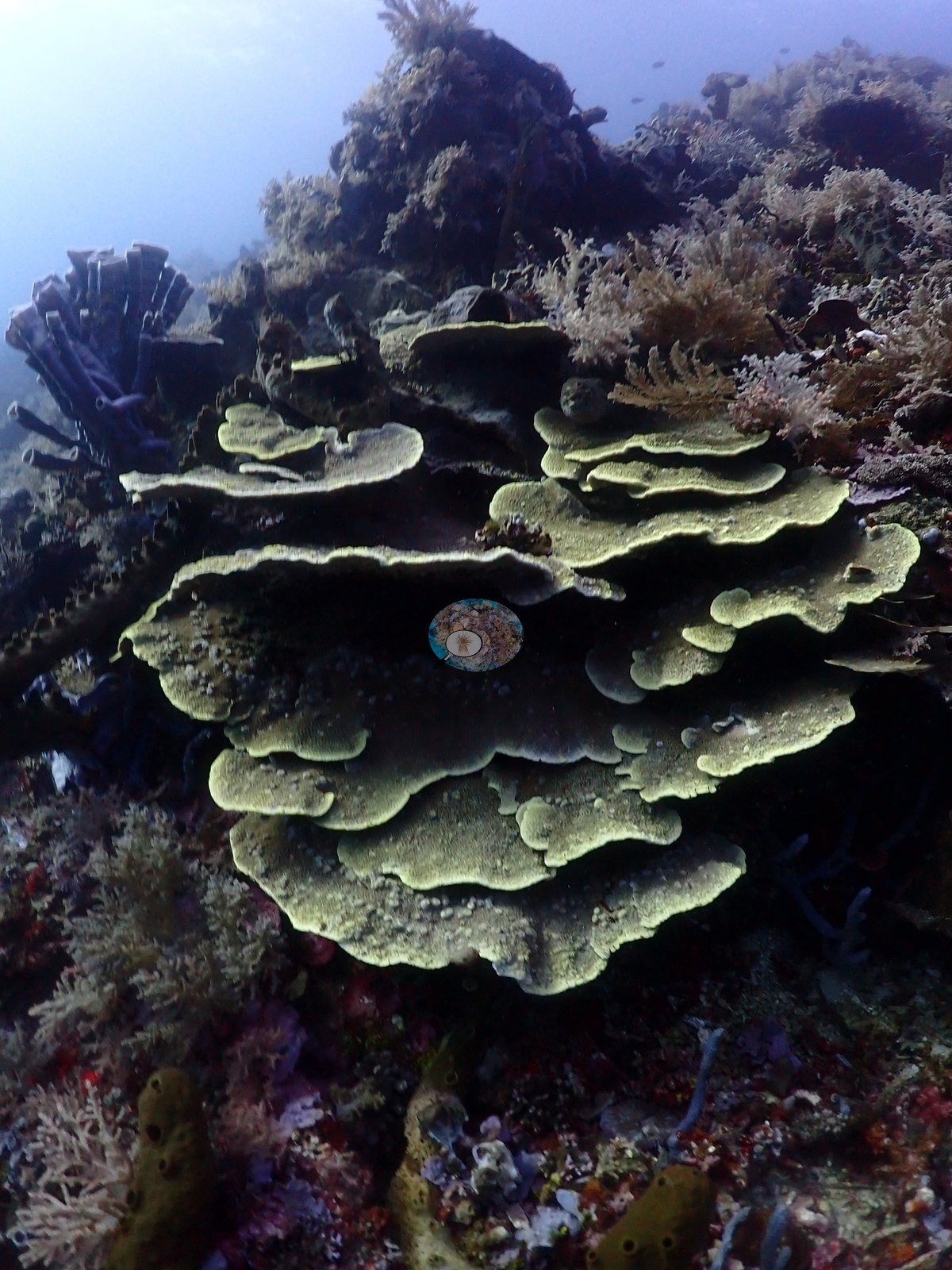
Gray-brown cabbage-like foliose rosettes dominate the upper wall in 3590, 3593, and 3594, giving way downslope to extensive fields of large overlapping tabulate Acropora tables — 3595, 3598, and 3600 show tables stacked in tiers across tens of meters, individually approaching a meter or more (e.g., Image 6, Image 24). 3604 ends on a vast near-monospecific staghorn Acropora thicket carpeting the slope with a diver silhouetted above it.
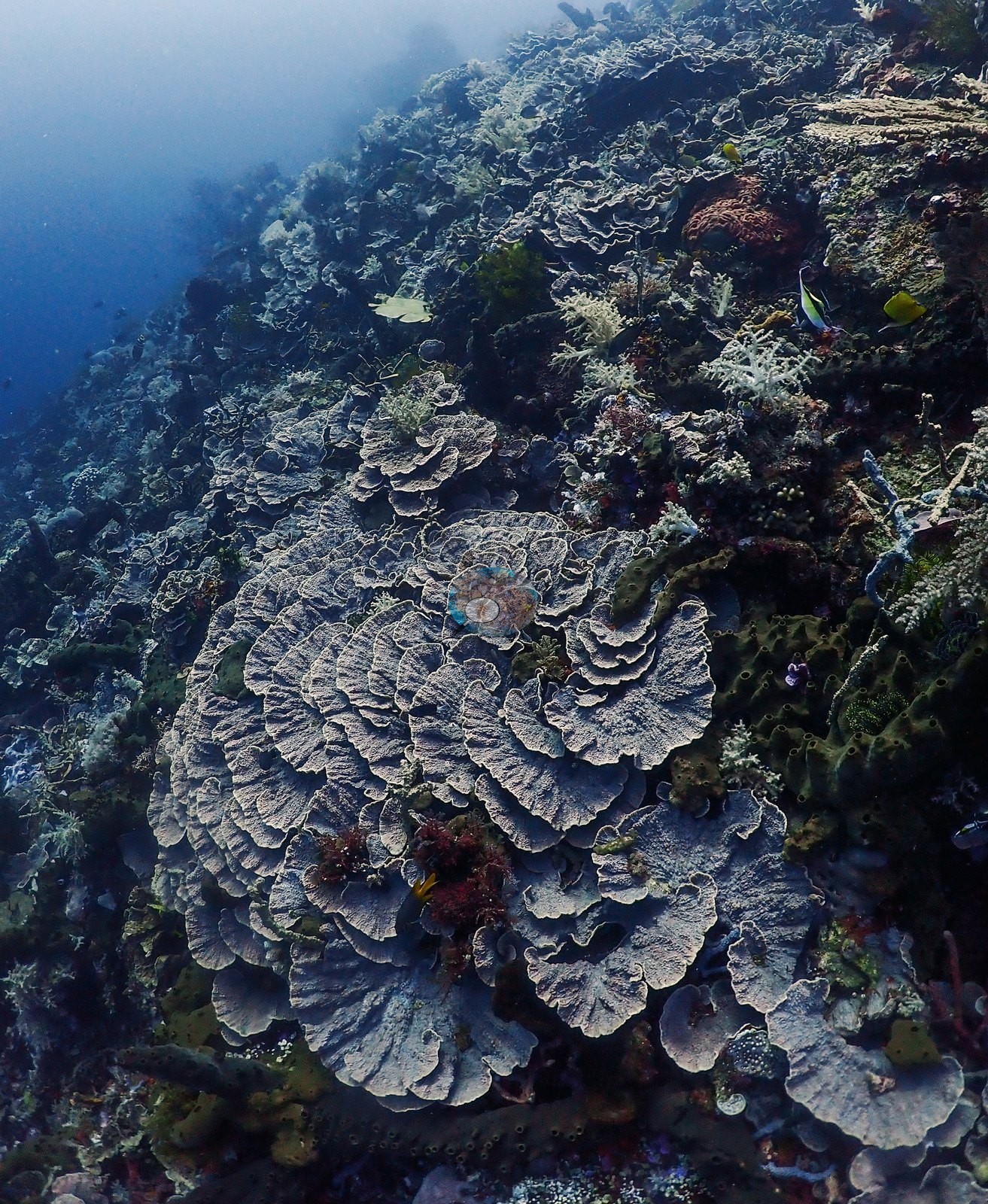
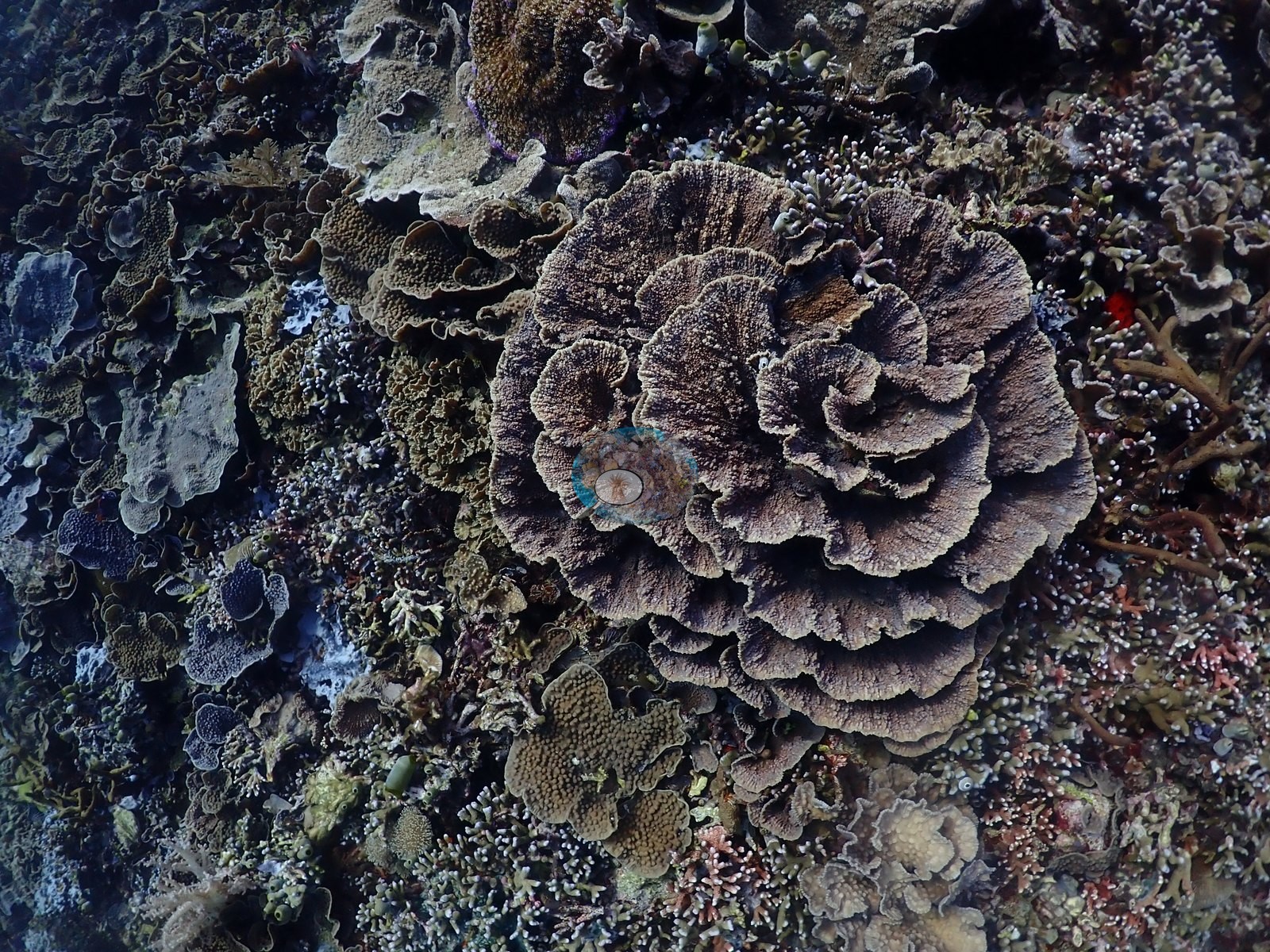
Blue-tinted encrusting colonies thread through the branching in 3603. This outer-wall zone, not the shallow crest, is where the site's structural complexity peaks. Frames 3605–3632 and the supplied wide-angle frame close the dive on the outer wall and reef top, and this is where AM Point 2 justifies the log note. Tabulate Acropora tables dominate: single plates near a meter across in 3616–3618, tiered ranks descending the wall in 3621 and 3622, and in 3631 and 3632 a rosette-like cluster of overlapping tables viewed from above (e.g., Image 26, Image 29). 3625 and 3629 open onto branching-Acropora plains running unbroken to the horizon in lavender, pink, and bronze, with scattered fungiids, urchins, and a sea cucumber set into them (e.g., Image 25, Image 49).
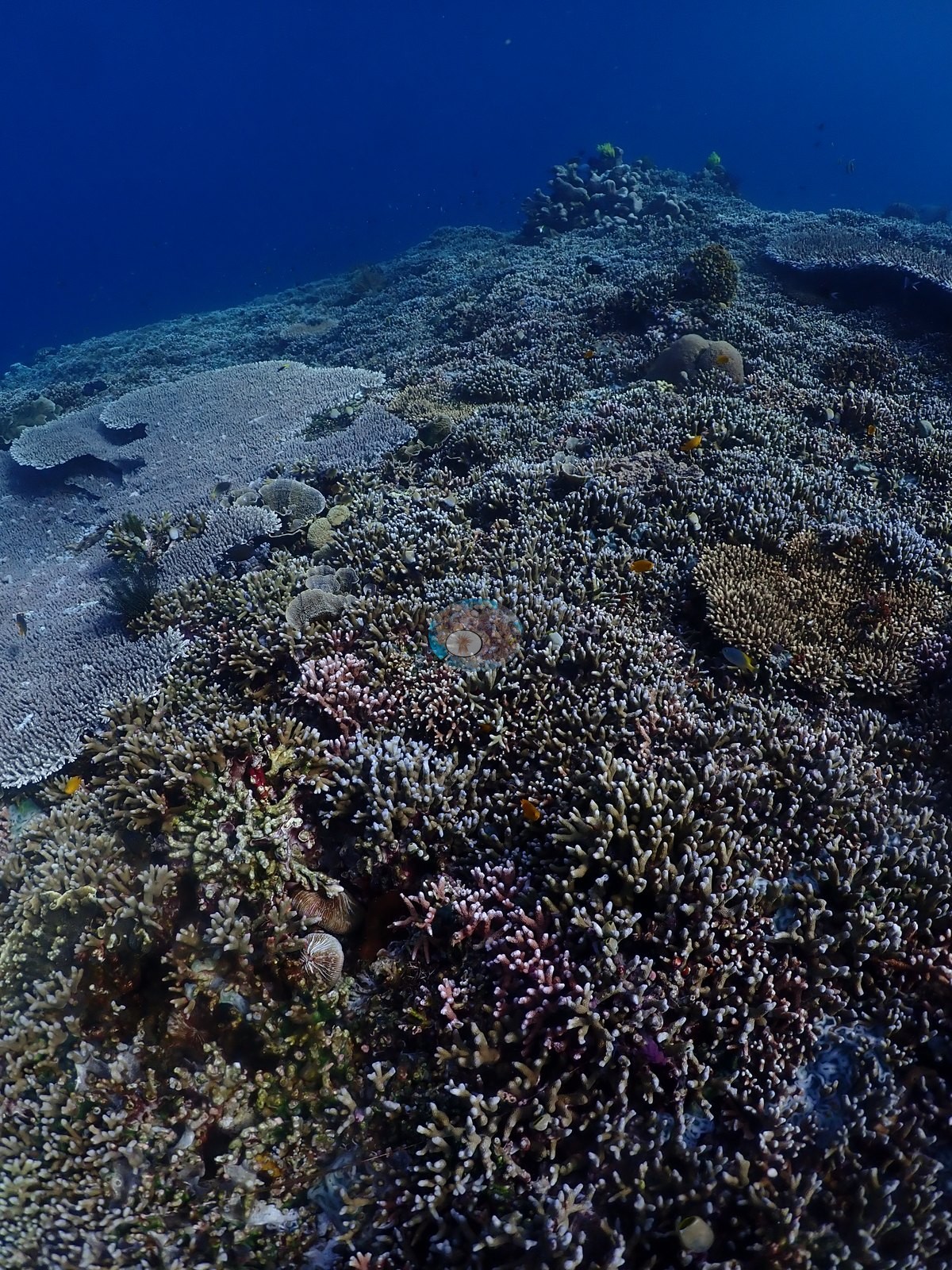
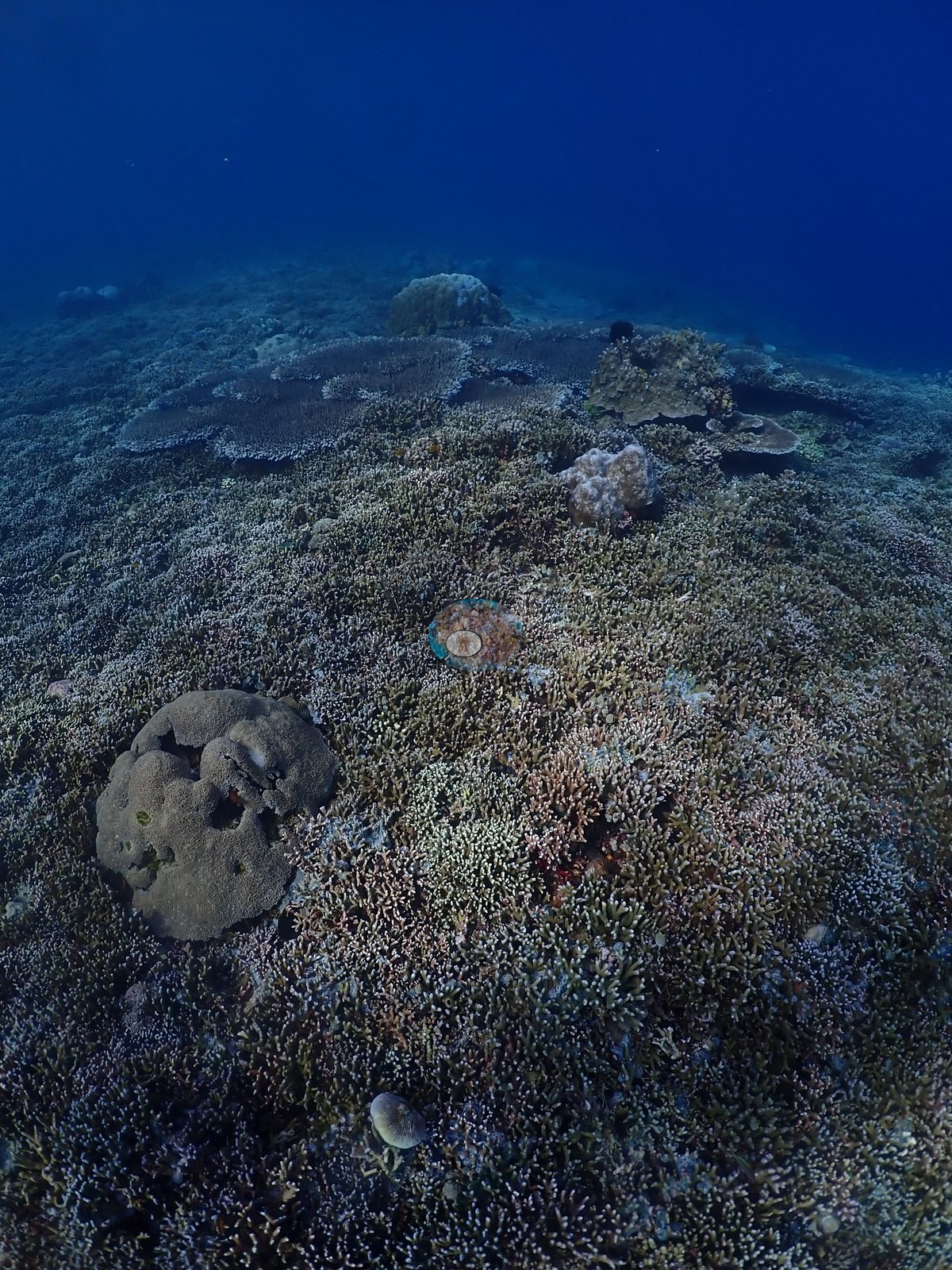
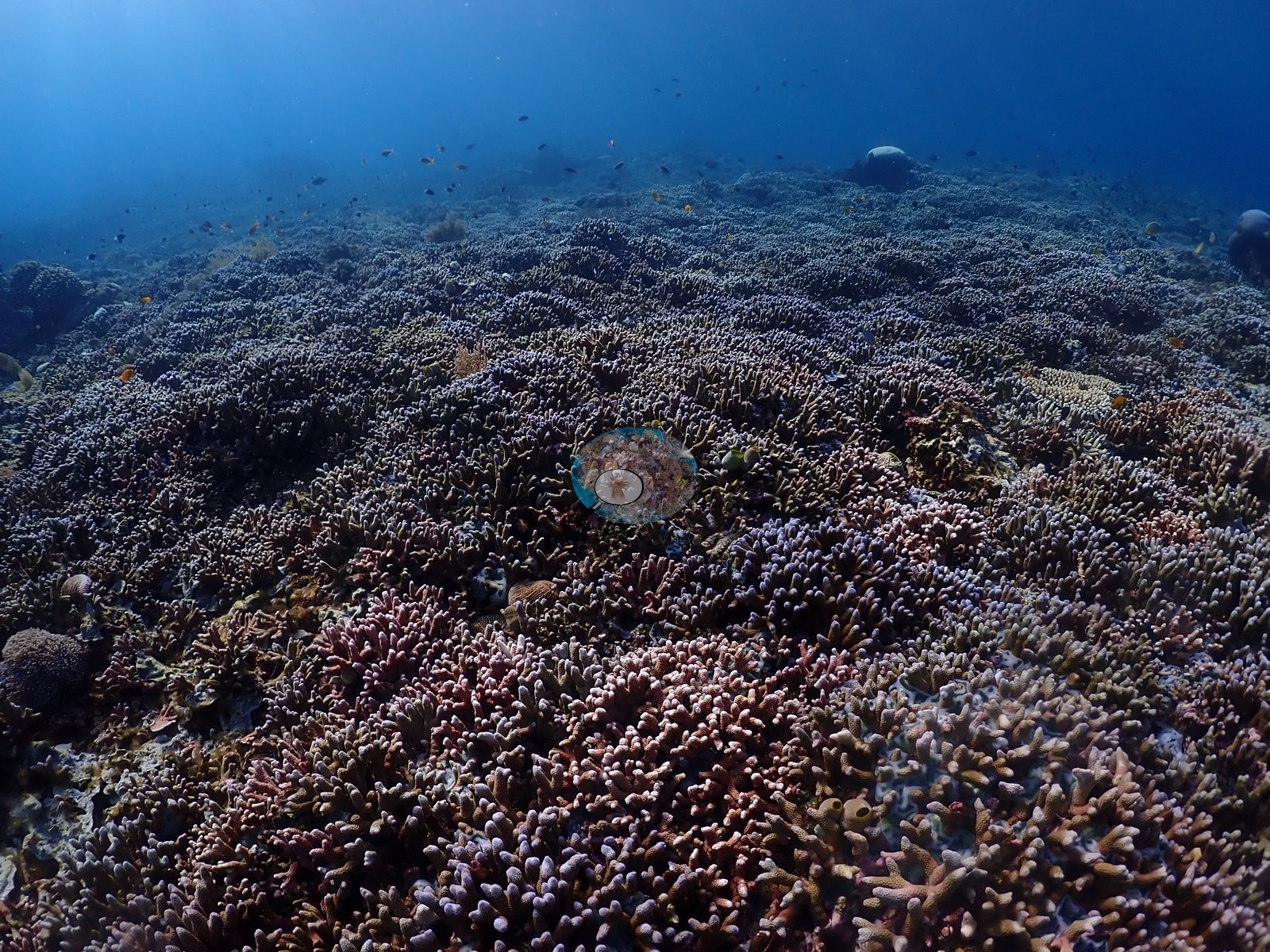
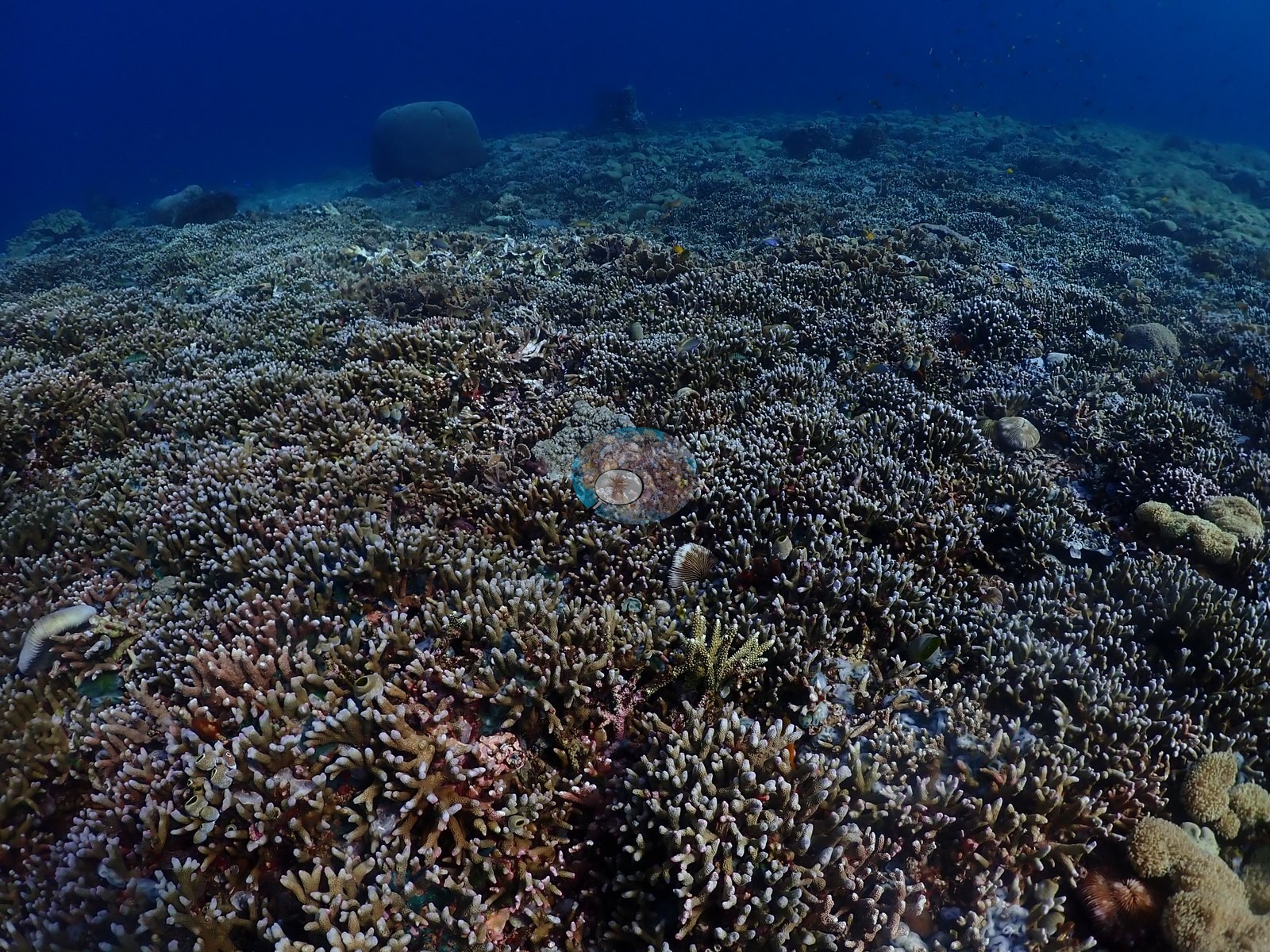
Large smooth massive Porites bommies punctuate the table fields (3623, 3624, 3630), and brown ruffled foliose plating returns in quantity in 3614 and 3615 (e.g., Image 47).
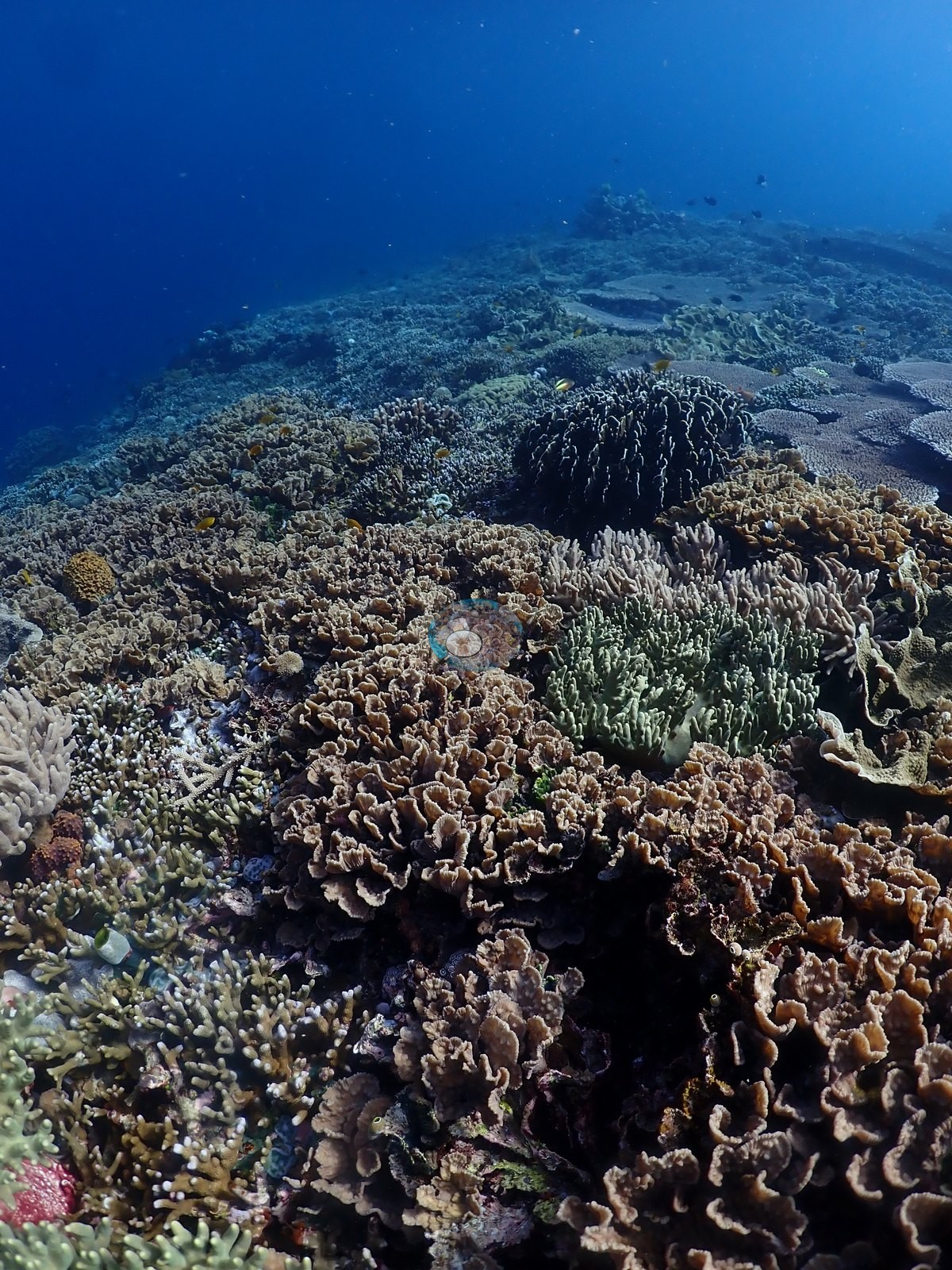
The supplied wide-angle frame is the site's signature image: ruffled foliose Echinopora fields in the foreground, ranks of tabulate tables behind, massive Porites bommies to the right, and anthias over the whole scene (e.g., Image 5).
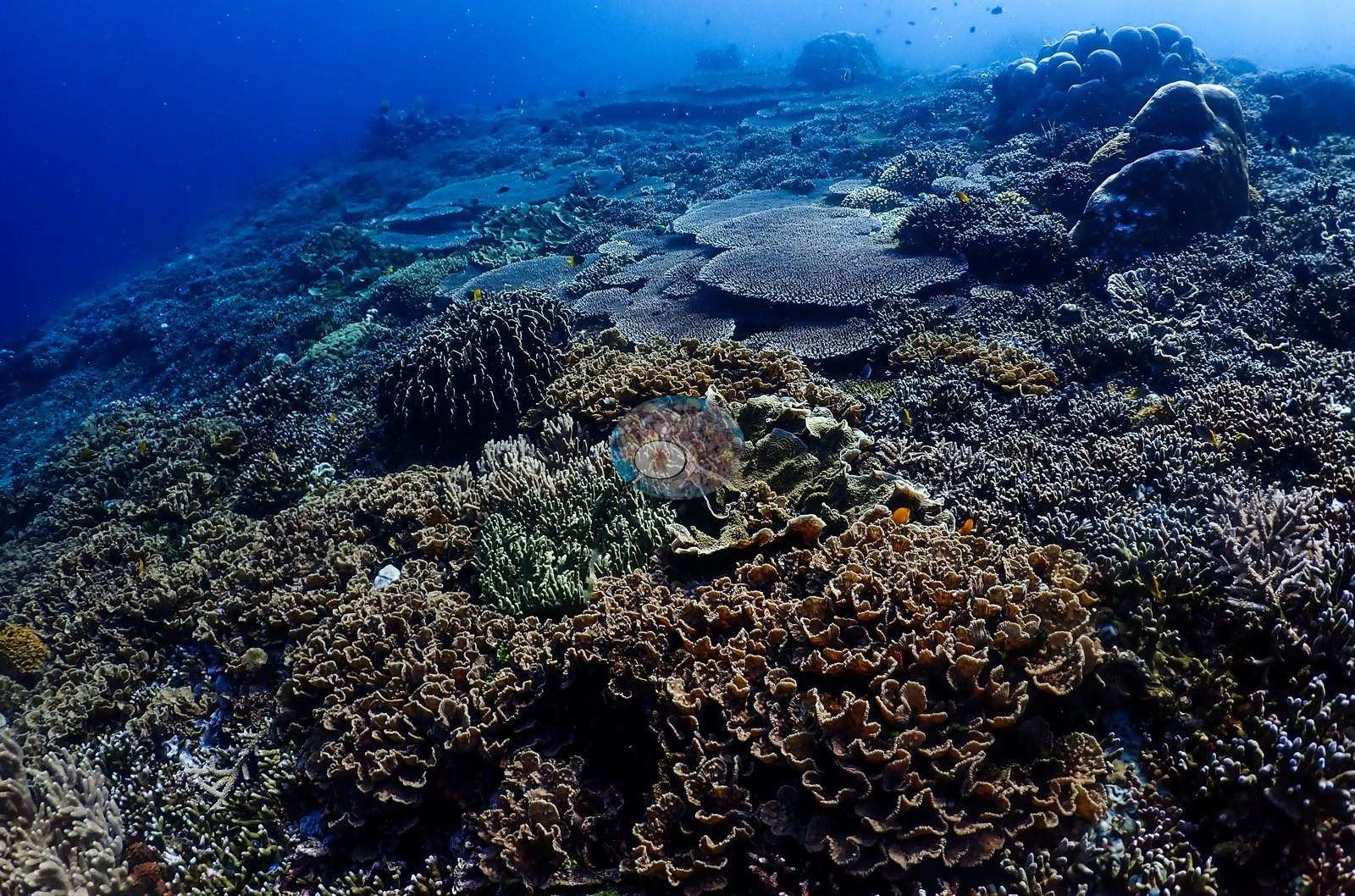
Taken across all 225 frames reviewed, AM Point 2 is a genuinely multi-habitat site — sponge-and-octocoral deep wall, shallow foliose crest, octocoral meadow, columnar-Porites flat, near-total-cover steep slope, and outer-wall table fields — and that, not measurement noise, is what produces the wide spread in cover.
Coral cover
Coral cover: 40% — a blind Claude computer-vision point count of 223 of Anderson's unedited photographs (20 points per photo; water, fish, and obstructions excluded). Other computer-vision methods are listed in the method table. Cover here is high and diversity is the broadest on the dive, but it is interrupted by substantial sand and broken-rubble aprons (3539, 3540, 3547) and by turf-covered dead framework (3549, 3550) — the same patchiness that drives the spread. Note that the site mean understates the stony-coral story, since the extensive Sarcophyton/Sinularia meadow scores as non-hard coral cover.
Stressors
Between the two, 3558 is diagnostic: a close view of dead branching rubble almost completely smothered by a brown encrusting overgrowth (sponge, ascidian, or Lobophora-type alga — not resolvable at this scale), with only two small purple Acropora recruits surviving on it. Read together with the rubble plains of 3522, 3528 and the dead apron fringing the branching field in 3557, this points to a real mortality event on the shallow reef that is now being colonized rather than recovering as coral. The exception is 3566, another matrix of dead, turf-covered branching rubble carrying only scattered pale Acropora recruits, and the vast branching field of 3567 likewise runs over a brown encrusting dead base — so even on this rich slope the living veneer sits on a substantial dead framework. No crown-of-thorns starfish (COTS) or other corallivores evident.
Fish and other fauna
Tridacna mantles are recurrent (3495, 3505, 3507), several with the blue-and-green maze patterning. A small orange sea star appears in 3536, and the golden bushy hydroid colony of 3528 recurs in 3529 hosting both a bright yellow and a black crinoid. Tridacna mantles, a golden feathery crinoid (3574), and schooling anthias complete it.
Comparisons with other data
No prior survey data from this site. If you would like to share yours, please email us.
Other notes
Divers appear in-frame in 3489, 3501, 3502, and 3506. The wide spread (Claude: 40% ± 28, range=0–100%) is a genuine two-habitat signal, not noise: the sponge- and coralline-dominated deep wall and the bare sand/rubble patches sit at one end, this shallow plate-and-branching pavement at the other — the dive log's “amazing corals in the shallows” is borne out by the imagery. Divers appear again in 3512, 3514, 3522, and 3523. Divers are in 3530, 3533, 3535, and 3538. A diver appears in 3549. 3585 is the anomaly of the dive: a flat pale rectangular slab lying on the slope with several small coral colonies established on its upper surface and block-like objects at its margins — the geometry is artificial rather than reef rock, and it reads as a deployed substrate or settlement module rather than natural framework. It is not identifiable from this frame alone and is logged rather than interpreted. A snorkeler or freediver hangs over the reef in 3628 and a diver's fin enters 3632, both giving scale.
CV model comparison
More info
DINOv3 and CoralSCOP were run on the same photos and are listed for comparison. Coralscapes v2 and v1 were also run but are not shown: Anderson does not consider Coralscapes reliable for these photos. No diver transect exists for this trip, so agreement between the rows is not accuracy, and as of September 2026 no computer-vision method estimates coral cover accurately on new images; treat every row as indicative.| Method | Hard-coral cover (%) |
|---|---|
| In-house DINOv3 | 33.4 |
| CoralSCOP unedited | 28.0 |
| Claude | 40.4 |
Data & links
All images from Coral Reef Diagnostics. Data are from Coral Reef Diagnostics.
© Coral Reef Diagnostics.