
Part of the regional summaries: Tonga - Ha'apai and Tonga
More info
Southern Tonga (NOAA CRW virtual station)Large spurs 20-50 m wide and over 100 m long run off an emergent island, topped with thick table acroporids. In places soft corals dominate, with leathery Lobophytum colonies 6-7 m wide carpeting dead rock and overgrowing hard corals. Surveyed on the Living Oceans Foundation's Global Reef Expedition.
Ko e ngaahi spurs lalahi ʻoku 20-50 m hono fālahi pea loloa ʻaki ʻa e 100 m tupu ʻoku mafola atu mei ha motu ʻoku hā hake mei he tahi, ʻoku ʻi honau funga ʻa e ngaahi acroporid fakatēpile (table) matolu. ʻI ha ngaahi feituʻu, ʻoku puleʻi ʻe he feo molū (soft corals), mo e ngaahi kulupu Lobophytum fakakili (leathery) ʻoku 6-7 m hono fālahi ʻoku nau ʻufiʻufi ʻa e maka mate pea tupu ʻi ʻolunga ʻi he ngaahi feo fefeka.
AI translation of this summary; the English is authoritative. (low confidence)
CTD-cast midpoint of 25.5–26.2°C
More info
Anderson's dive computer read 23.3°C (a single reading, probably a dive mean).17 of the 18 photographs on this page are shown beside the text that discusses them under "Site description" below.
Site description
Setting
Lagoonal patch reef. Emergent island with large spurs extending off the island. These run from 3-4 m to 20 m; others are from 6-8 m to 20 m. They are 20-50 m wide and 100+ meters long. They are separated by wide channels with a lot of rubble. The spurs end at 18-22 m in large sandy rubble field. The deeper spurs slope steeply from 10-12 m to 20 m, ending in sand.
General benthic features
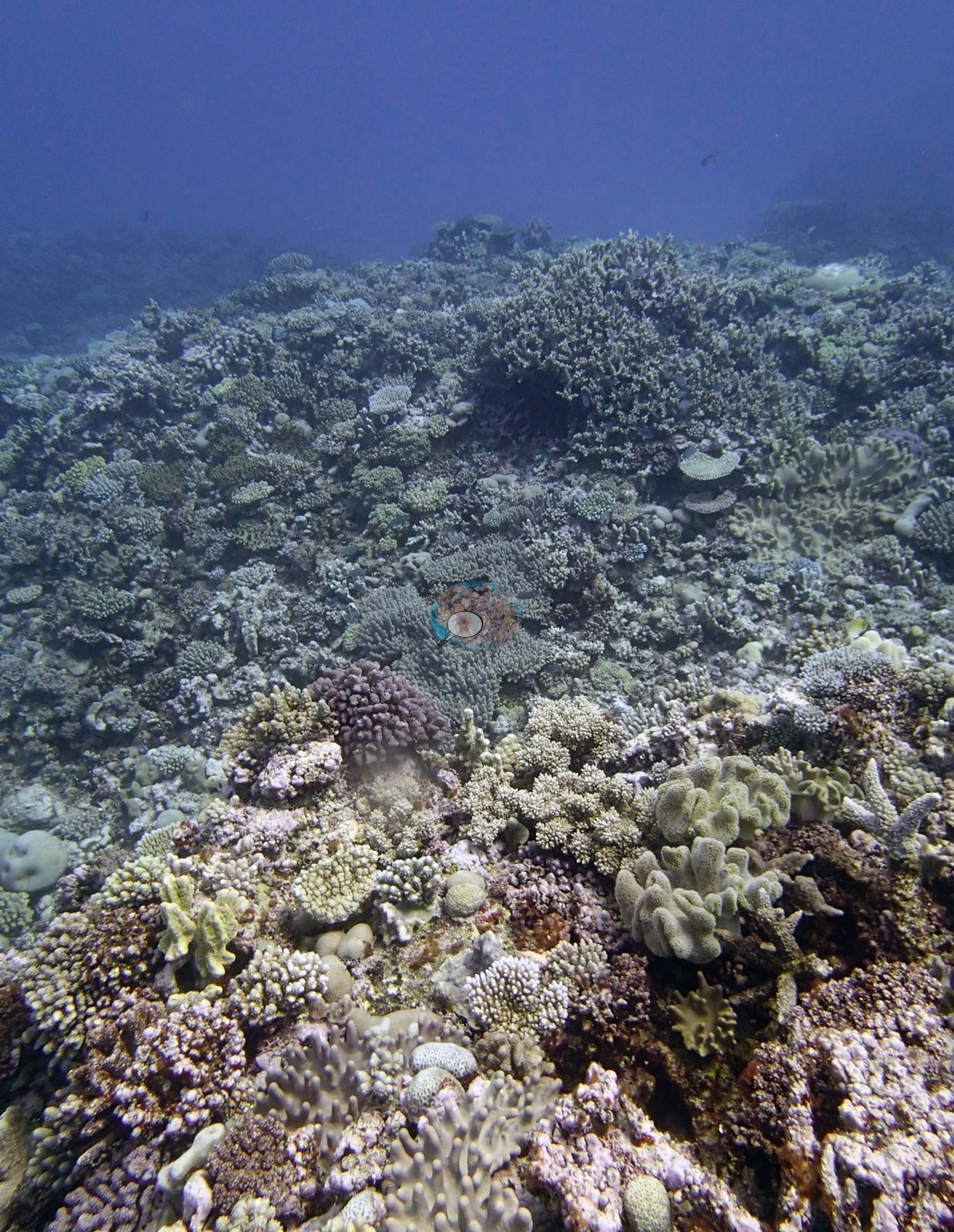
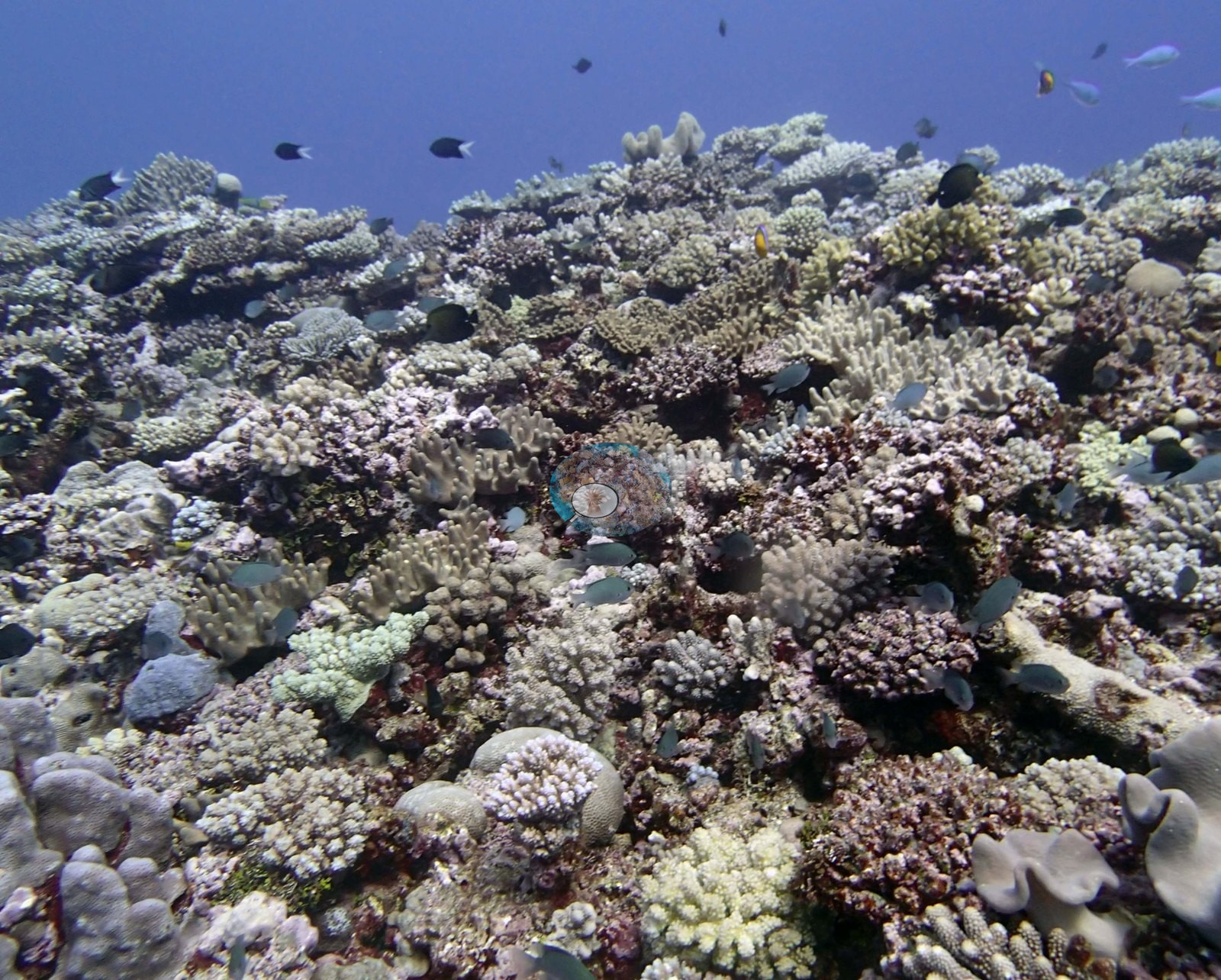
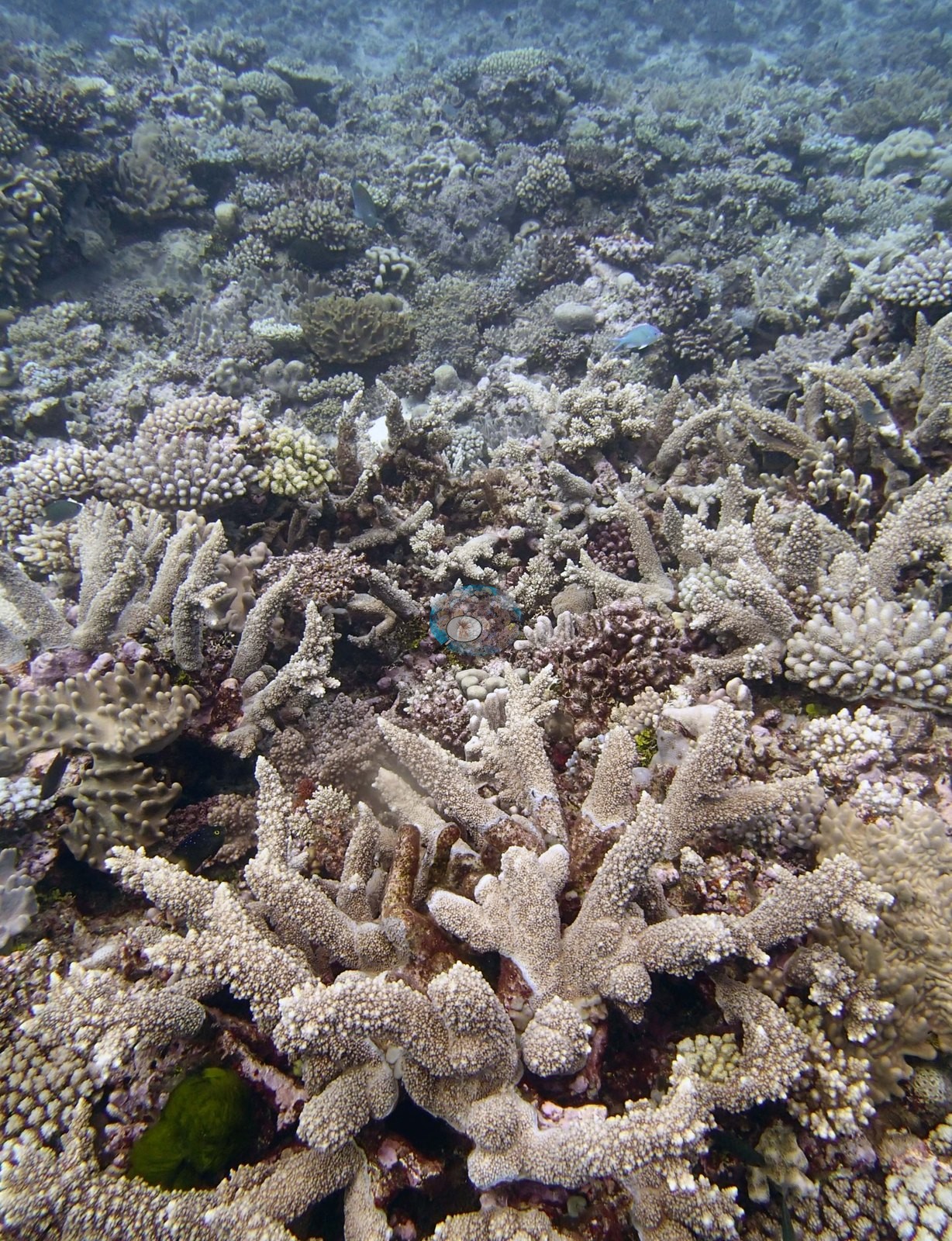
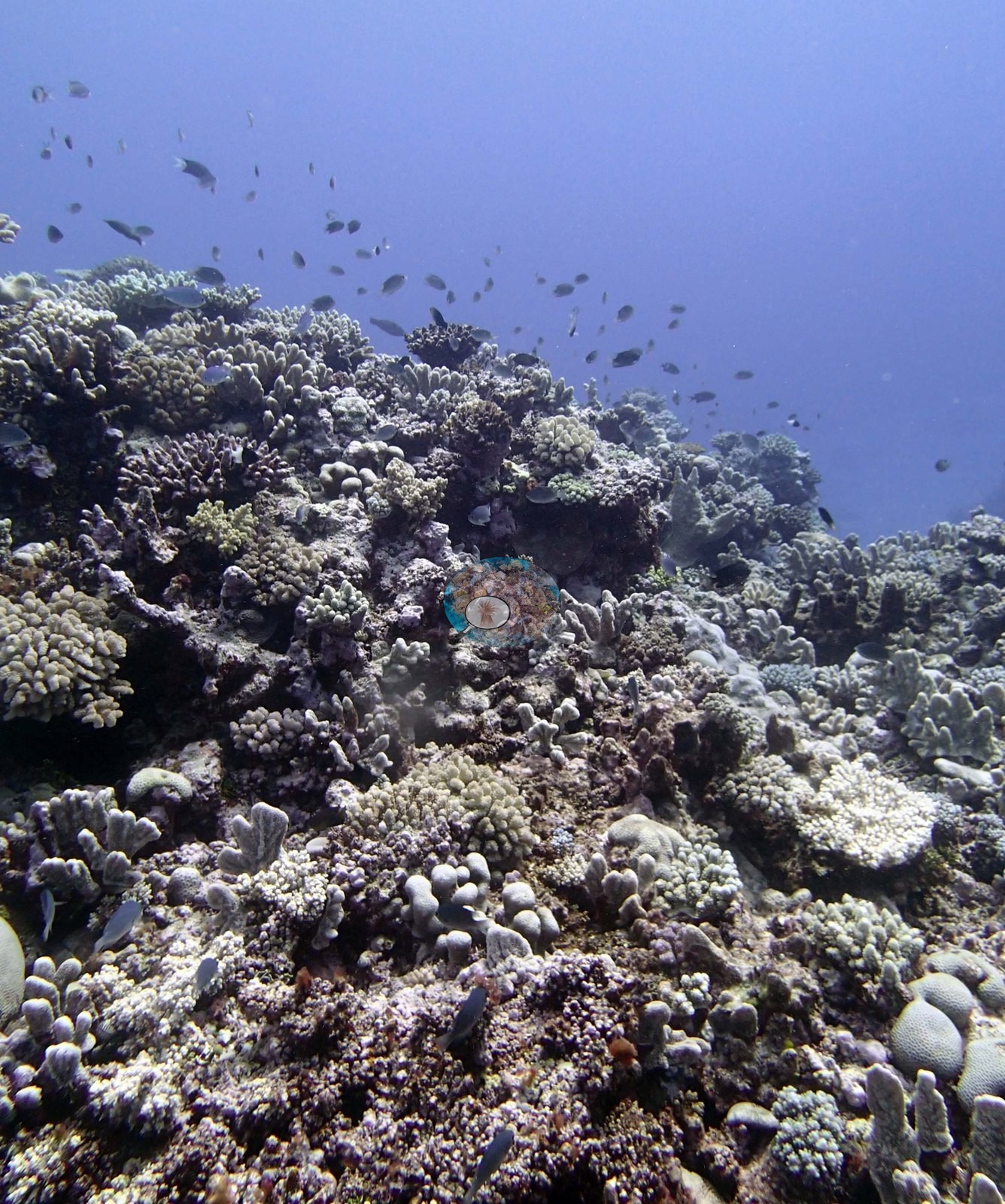
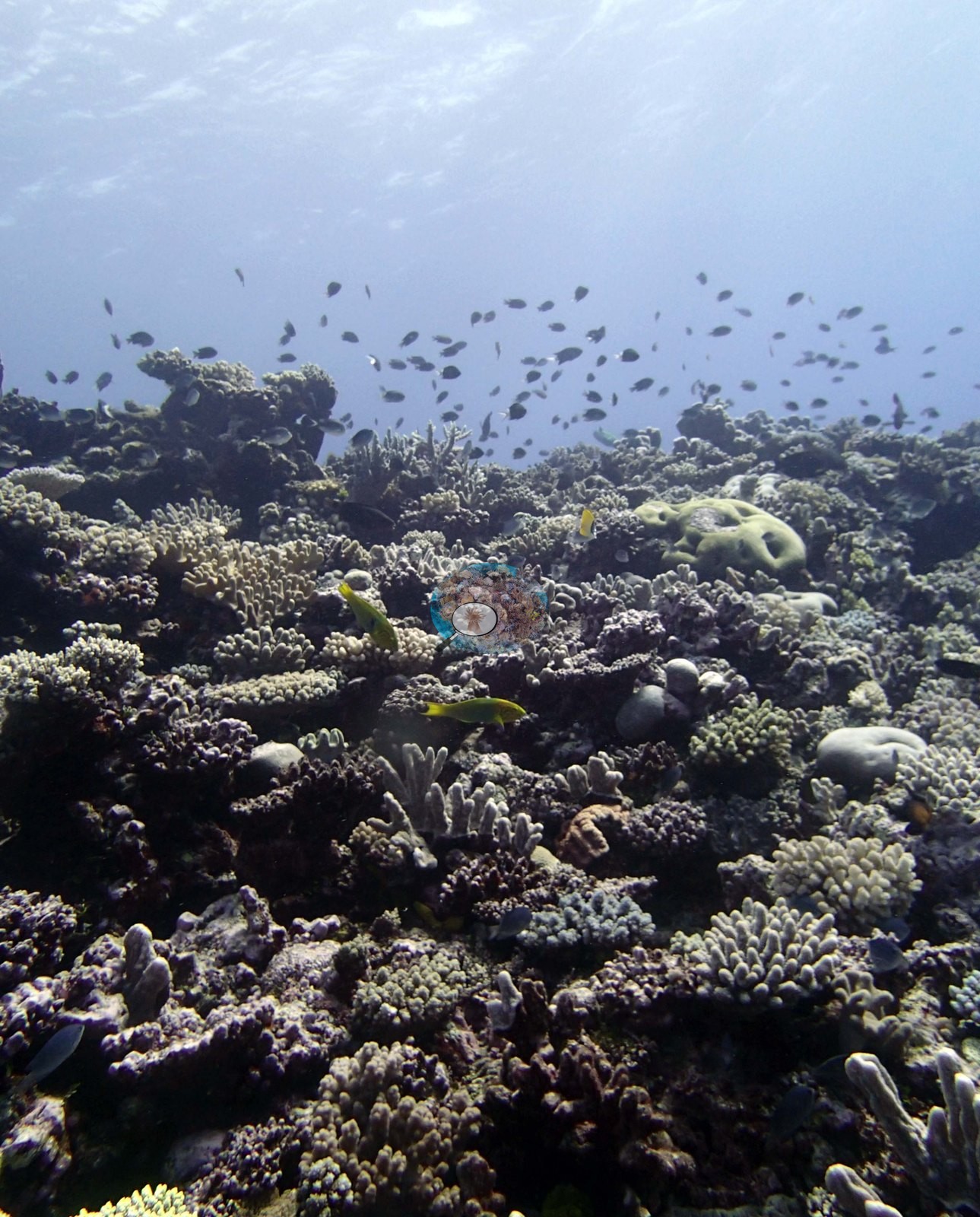
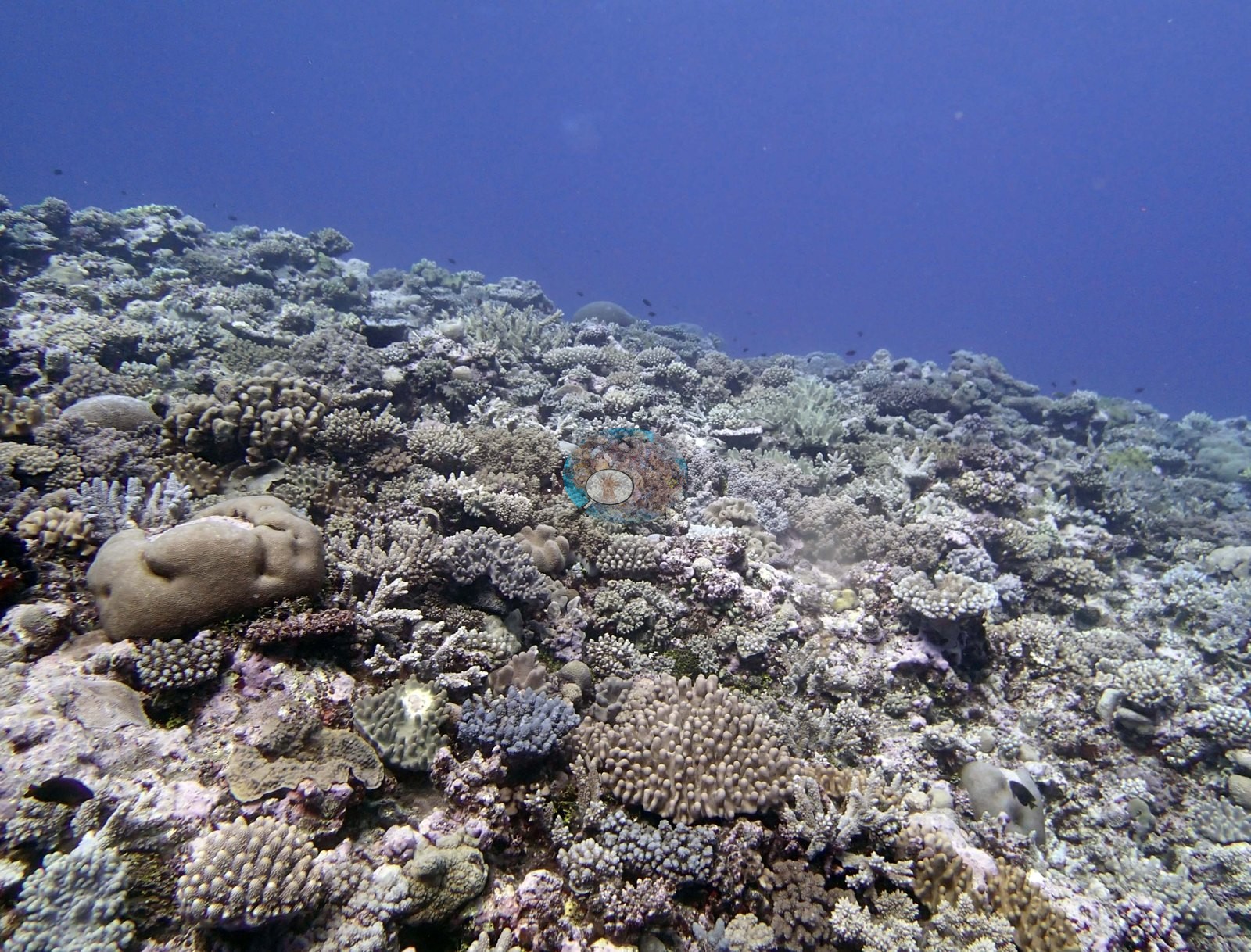
The wide frames show a dense, structurally complex reef top with very little open substrate in view. The bottom is a near-continuous carpet of small to medium stony coral: corymbose and digitate colonies packed shoulder to shoulder, thick-branched staghorn thickets filling the foreground of Image 2, small tables, bushy branching colonies, rounded massive and encrusting forms, and low foliose and plating colonies between them.
The palette is pale — cream, buff, pale lavender-mauve, gray-green, and chartreuse — under bright ambient light in most frames. Fleshy octocorals are present but subordinate: pale gray lobate and digitate leather-coral colonies sit among the stony corals in Image 1 and Image 8 rather than dominating them, which is worth noting against the survey record of soft-coral-dominated patches elsewhere at this site.
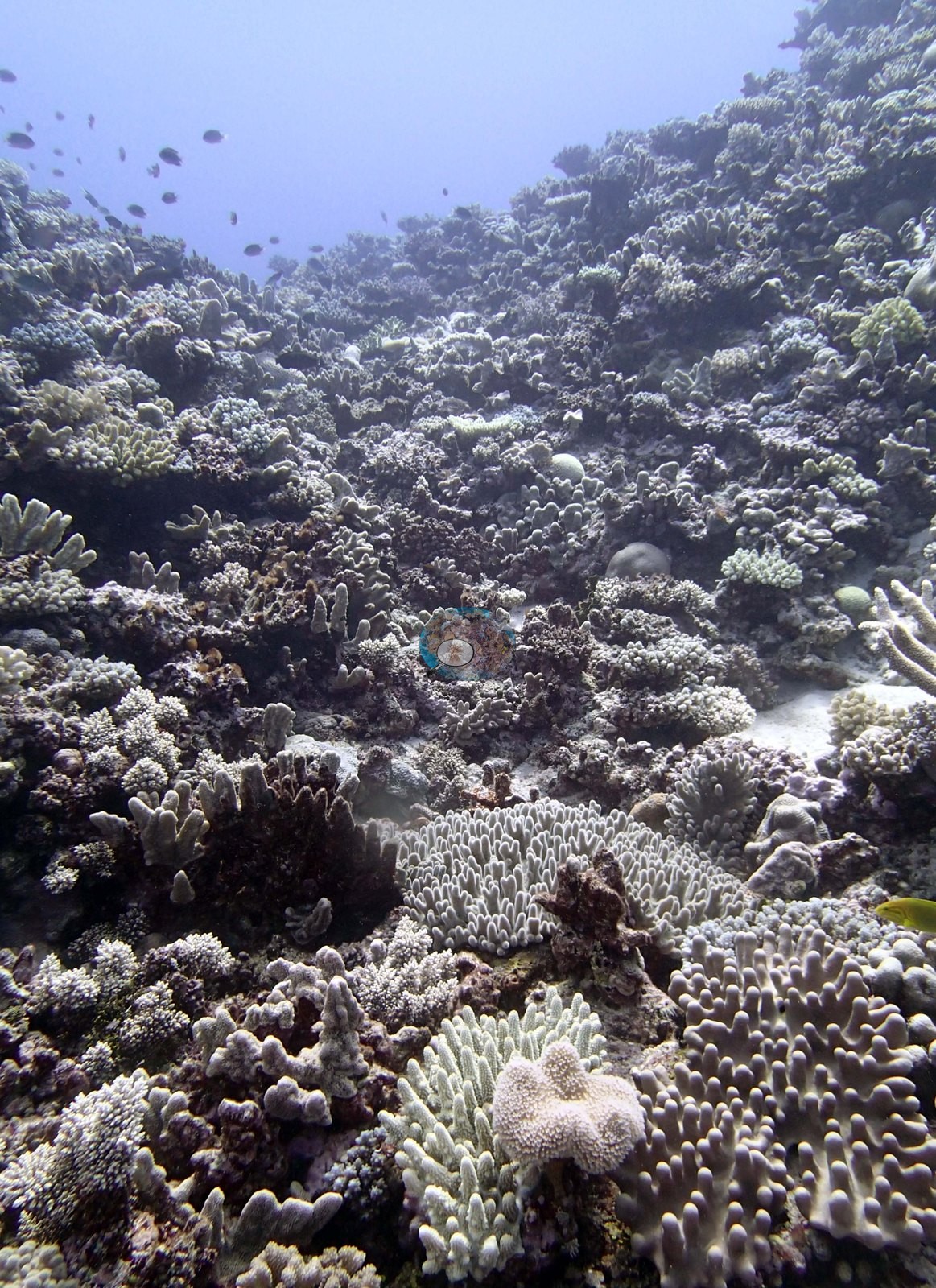
Segmented green calcified algae appear in several of the close reef-top frames (e.g., Image 7, Image 17, Image 20), along with pink and maroon crustose coralline algae on exposed rock. Image 9, Image 12, and Image 13 look up and along the reef top toward blue water with loose schools of dark damselfishes overhead and a yellow goatfish working the bottom; the frames do not extend to the spur-and-channel structure or the deeper strata the surveyors recorded, and cannot speak to them.
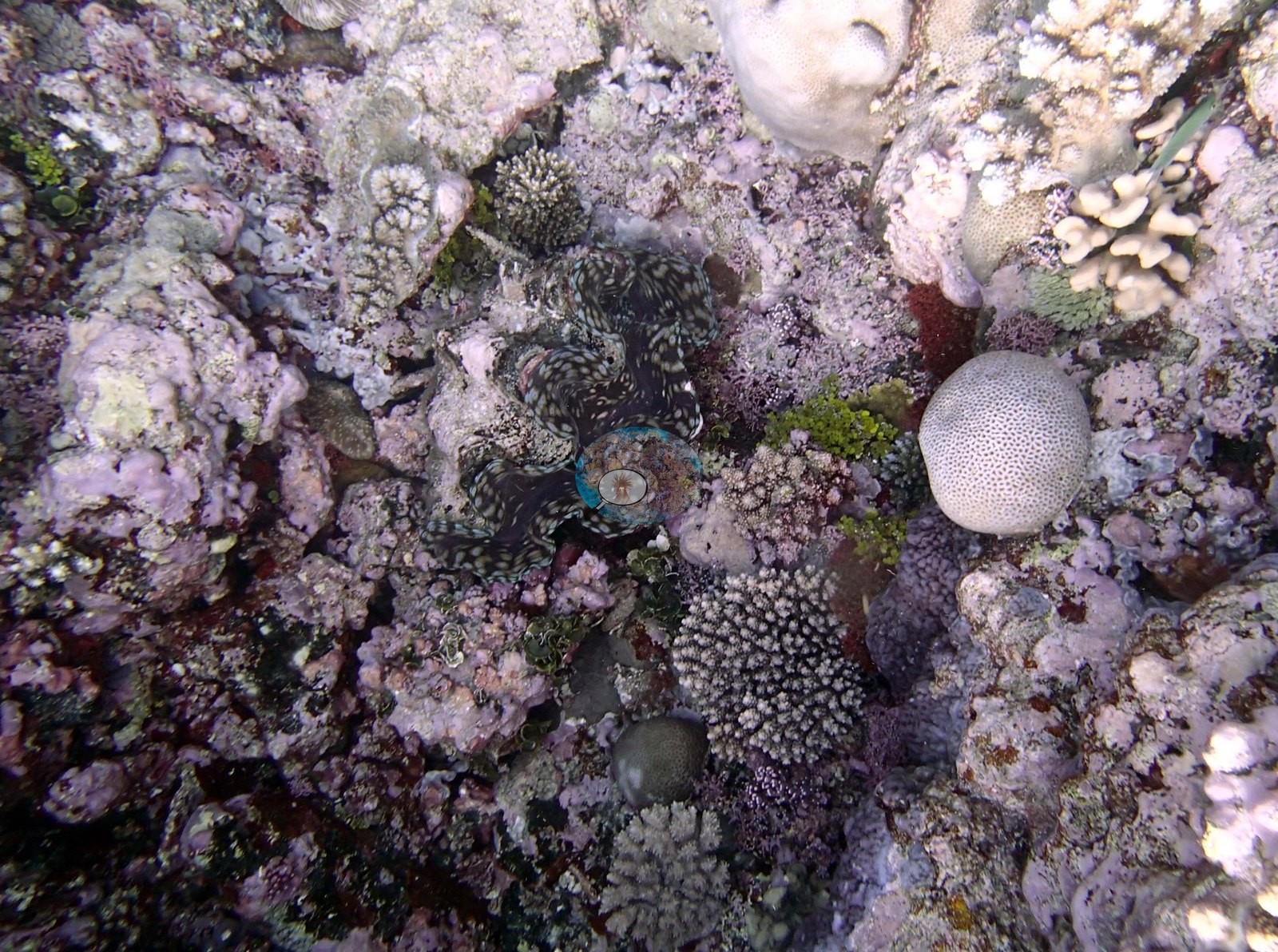
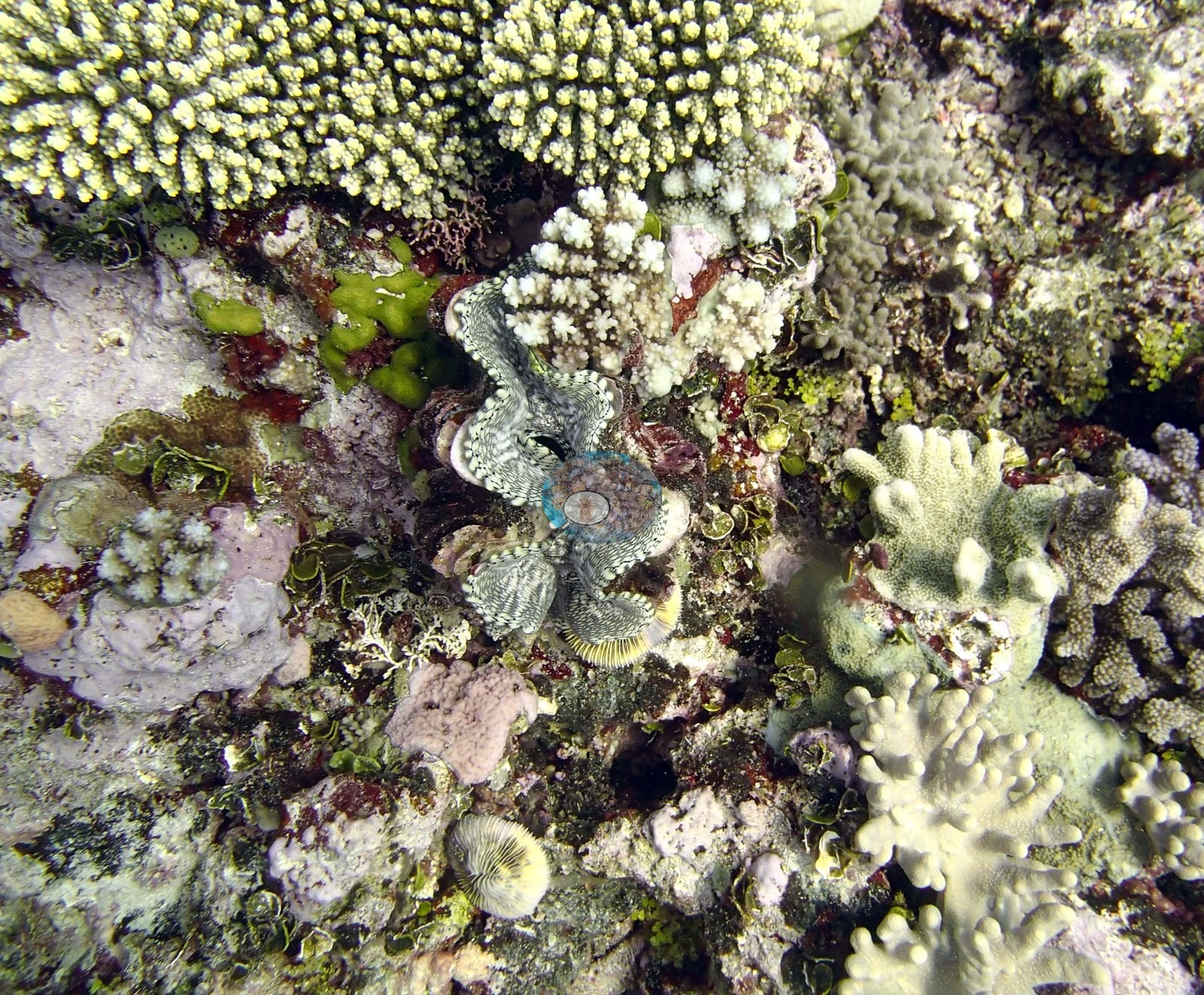
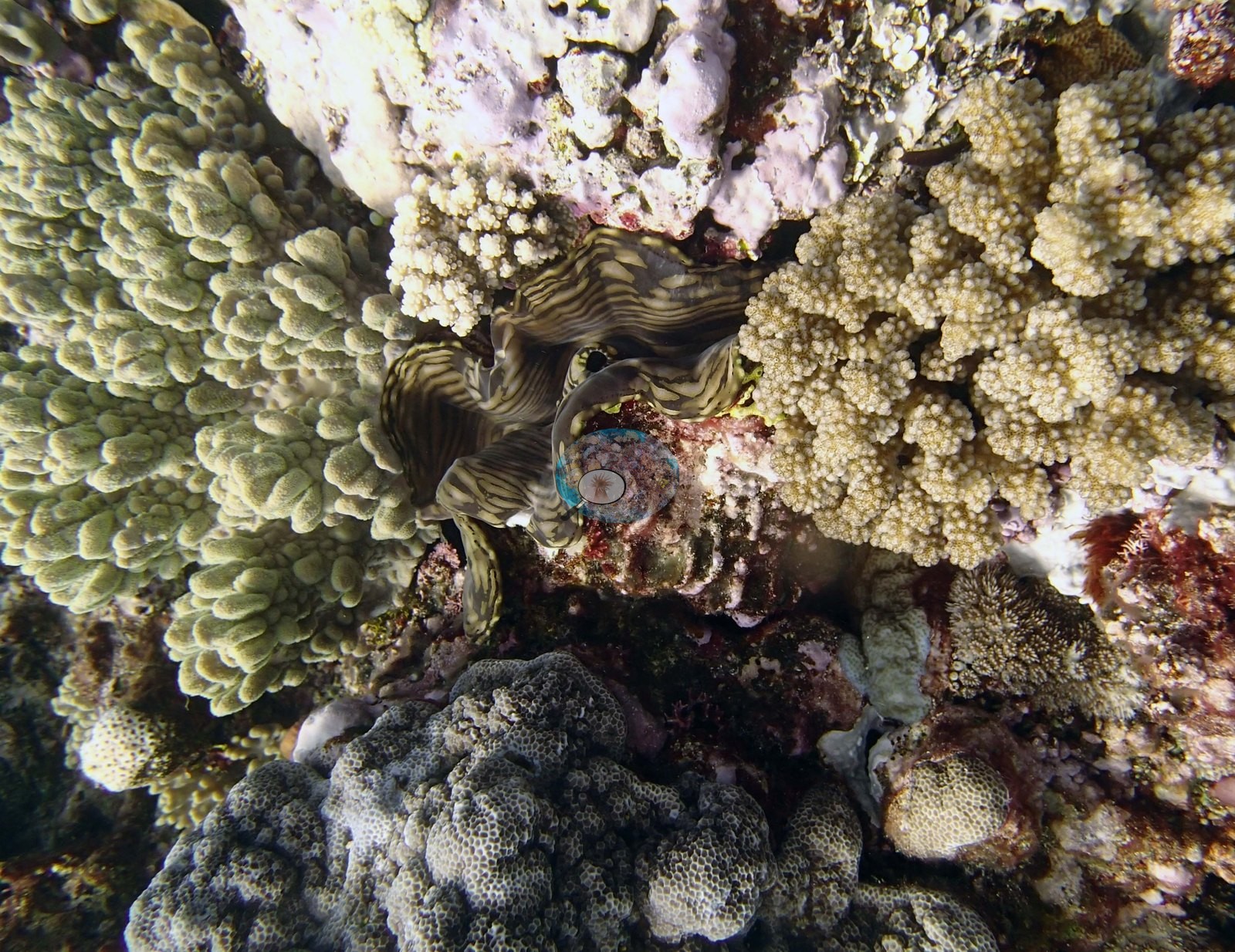
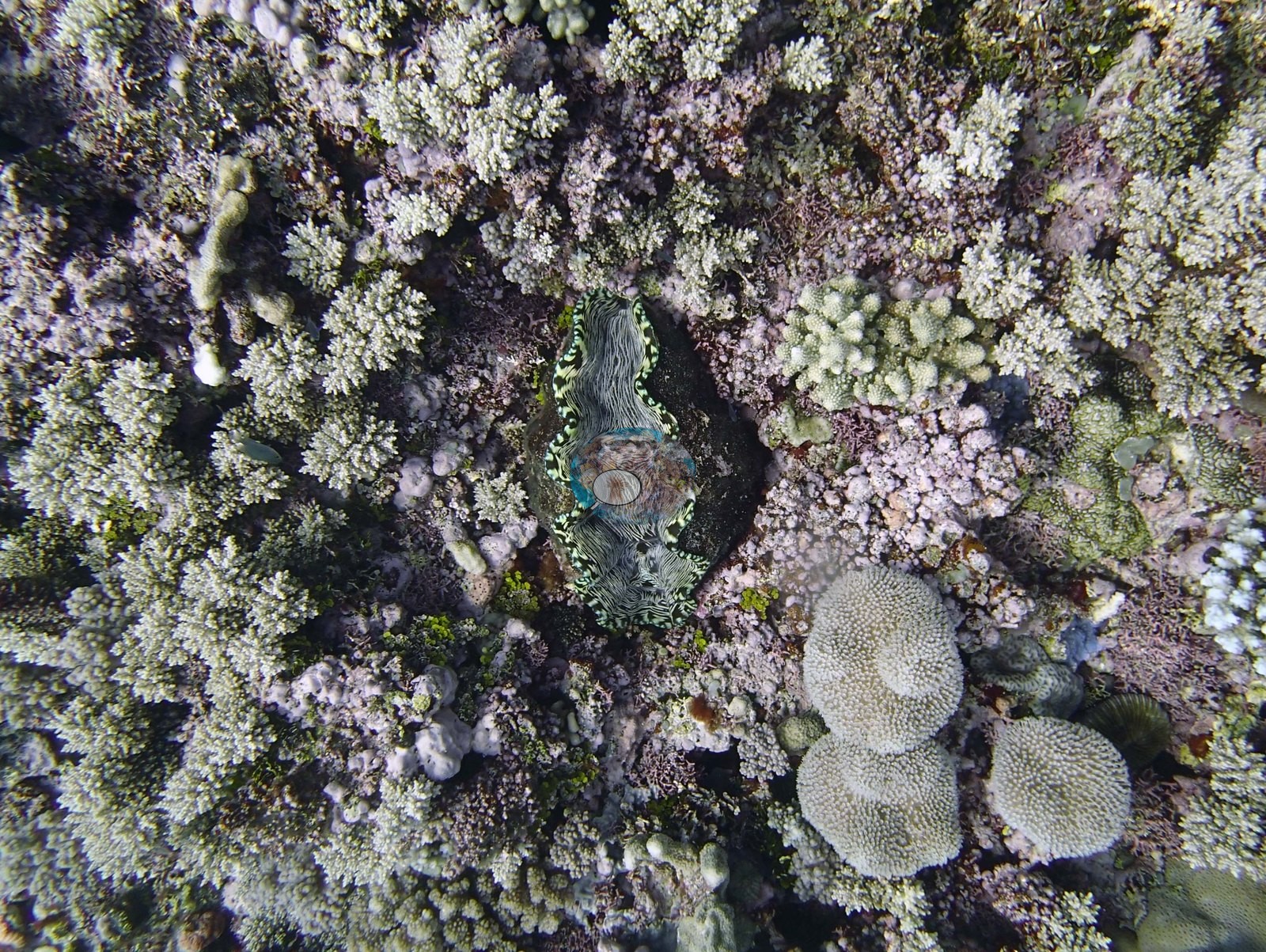
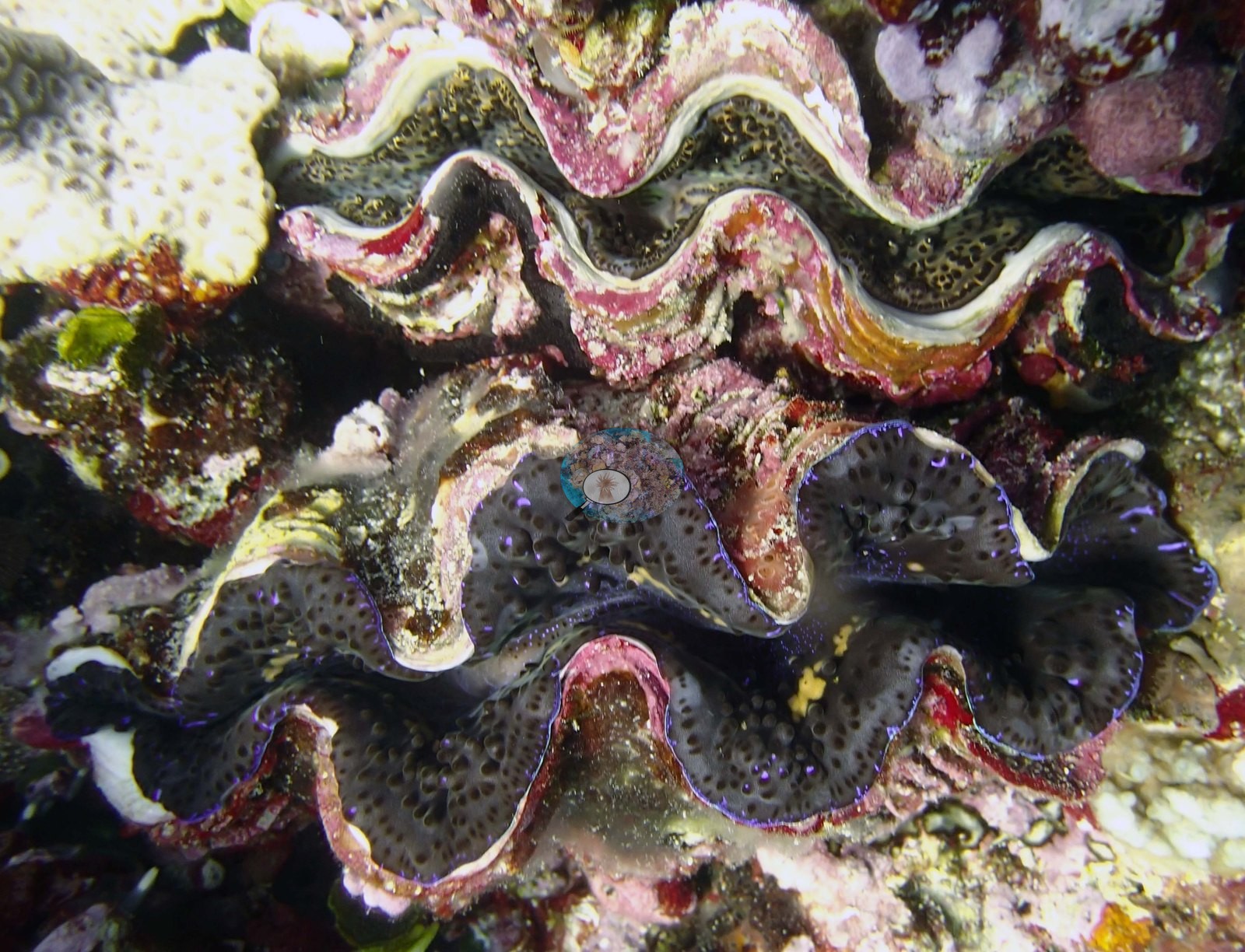
Fauna — the giant clams are the site's photographic headline. Five separate frames (e.g., Image 3, Image 7, Image 17, Image 20) record giant clams set into the reef framework among branching corals, each with the mantle fully open and patterned in olive, black, gold, and purple with iridescent flecks; Image 22 is a close-up of two mantles side by side.
At the bases of some of the spurs and mounds closest to the island is an undercut ledge with little coral colonization. Shallow reef community is dominated by thick table acroporids, digitate, bottlebrush, and staghorn acroporids, small to medium Pocillopora colonies, small to medium massives including Favia stelligera, Pavona clavus, Goniastrea, Lobophyllia, Montipora, and other species. Some areas have 50-90% cover of soft corals. Several Lobophytum colonies were 6-7 m wide, carpeting dead substrates and overgrowing corals. Pocillopora seems to avoid being overgrown, but massive faviids are readily overgrown.
Coral cover
- Reference: Khaled bin Sultan Living Oceans Foundation, Global Reef Expedition (in situ transect)
- Coral cover 42%, from an LOF-GRE in situ transect — a diver transect measurement and the authoritative value for this site.
- Coral cover ranges from upwards of 50-60% at 5-10 m depth to areas with 10-20% and 60% soft corals.
- Transect mean 42 ± 4.8% SE (n = 5 transects; Living Oceans Foundation per-transect benthic data); the headline above is this all-transect mean.
Stressors
Most colonies across the wide frames are pigmented, if pale-toned, but the branching colonies in one frame are paling, an early stage of bleaching: gray-white to cream-white with whiter tips beside pigmented neighbors (e.g., Image 23).
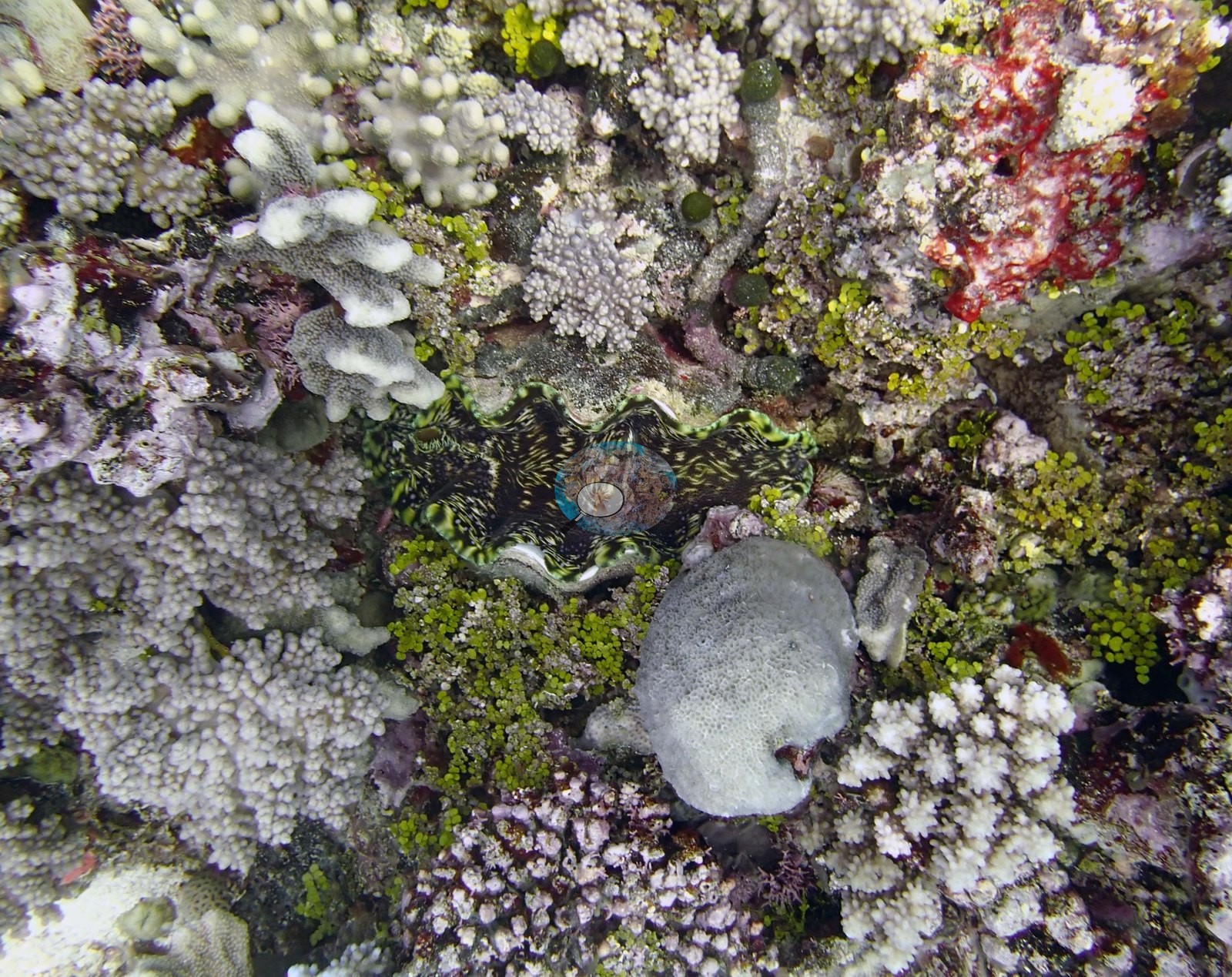
No crown-of-thorns, disease lesion, or clear predation scar resolves at these ranges. The Living Oceans Foundation transects here recorded 2.1% cyanobacteria and no recently dead coral.
Fish and other fauna
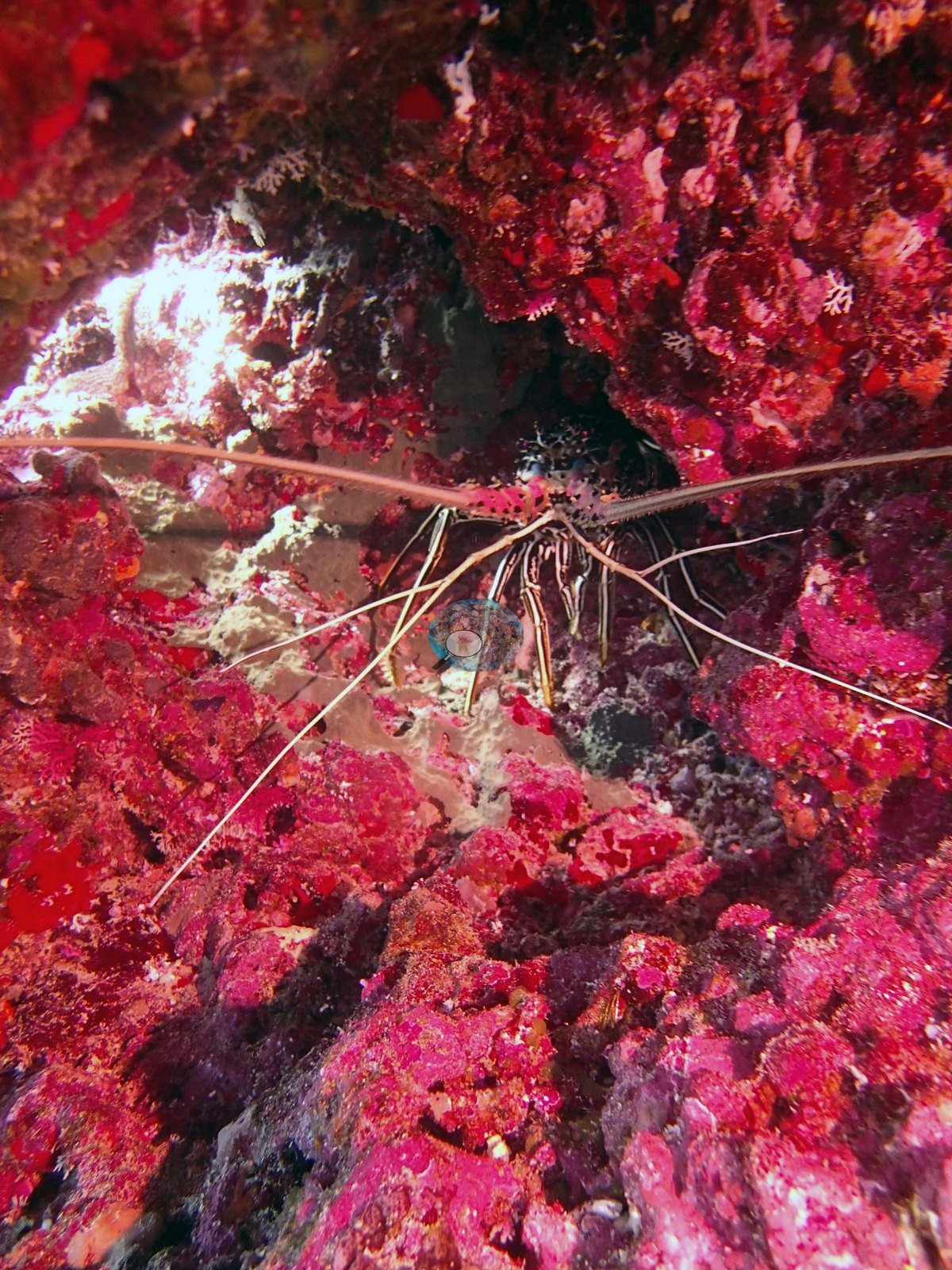
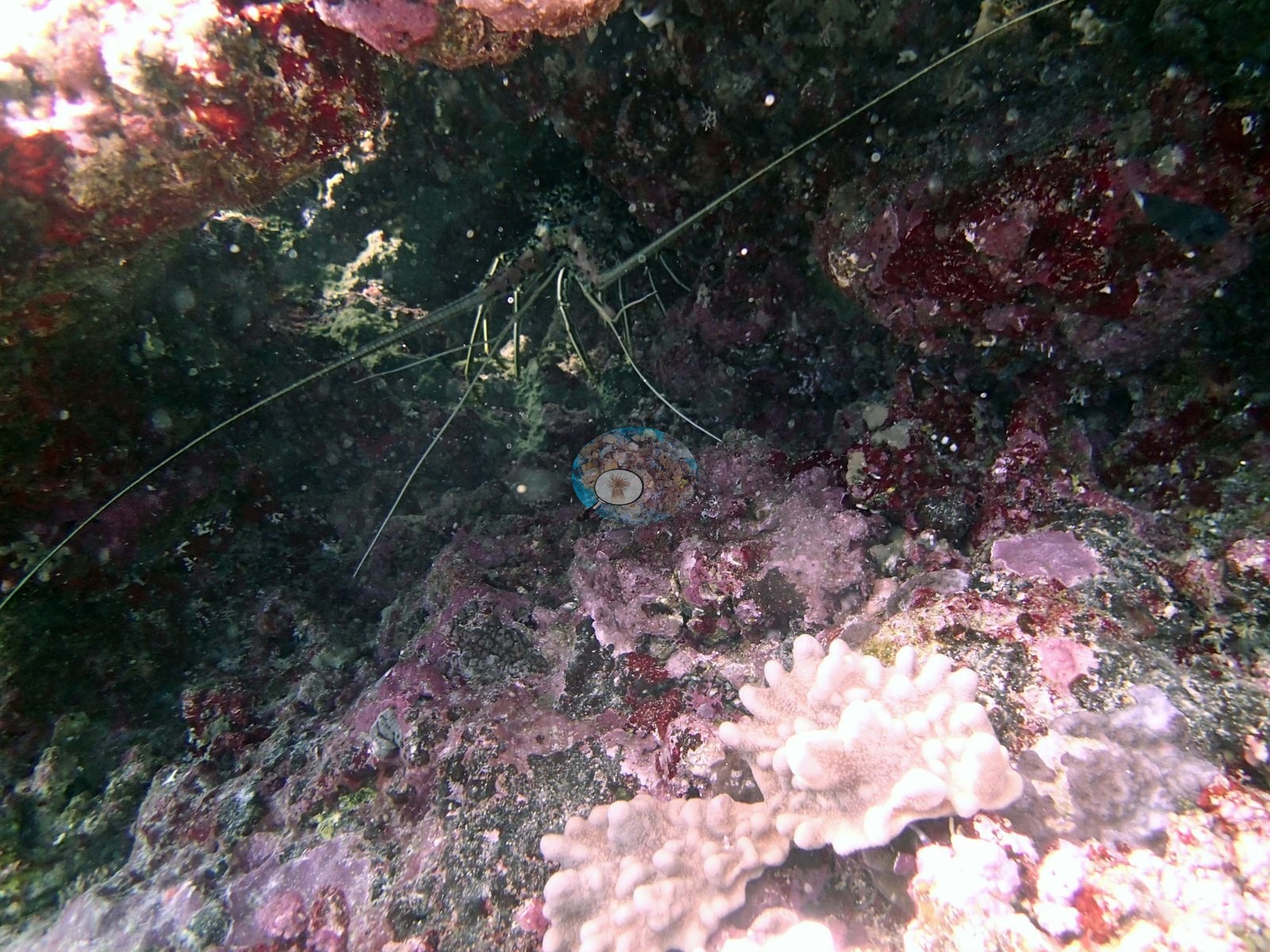
A spiny lobster is photographed twice deep under a crimson coralline- and sponge-encrusted overhang (e.g., Image 4, and again in Image 18, which is too dark to add anything).
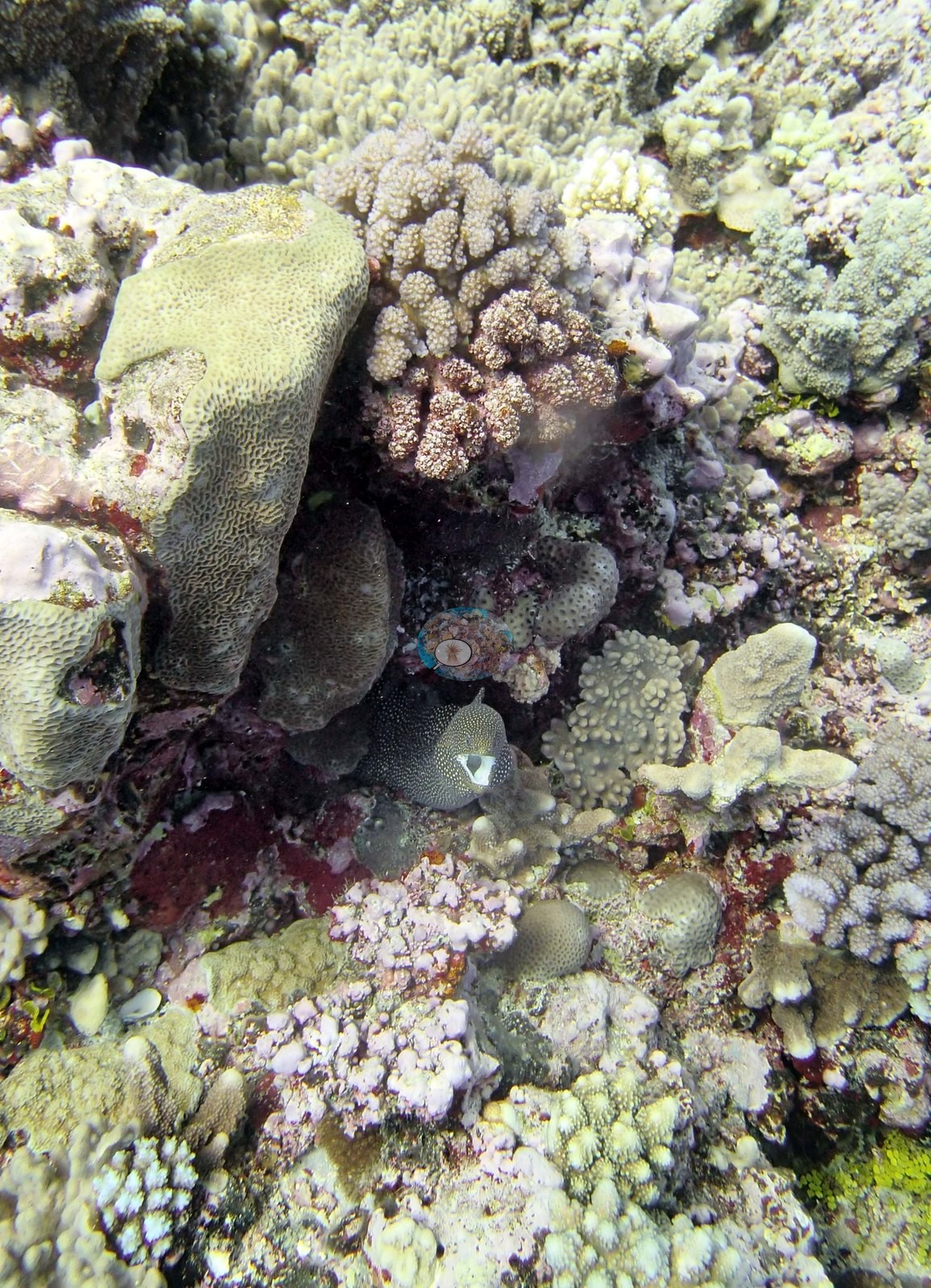
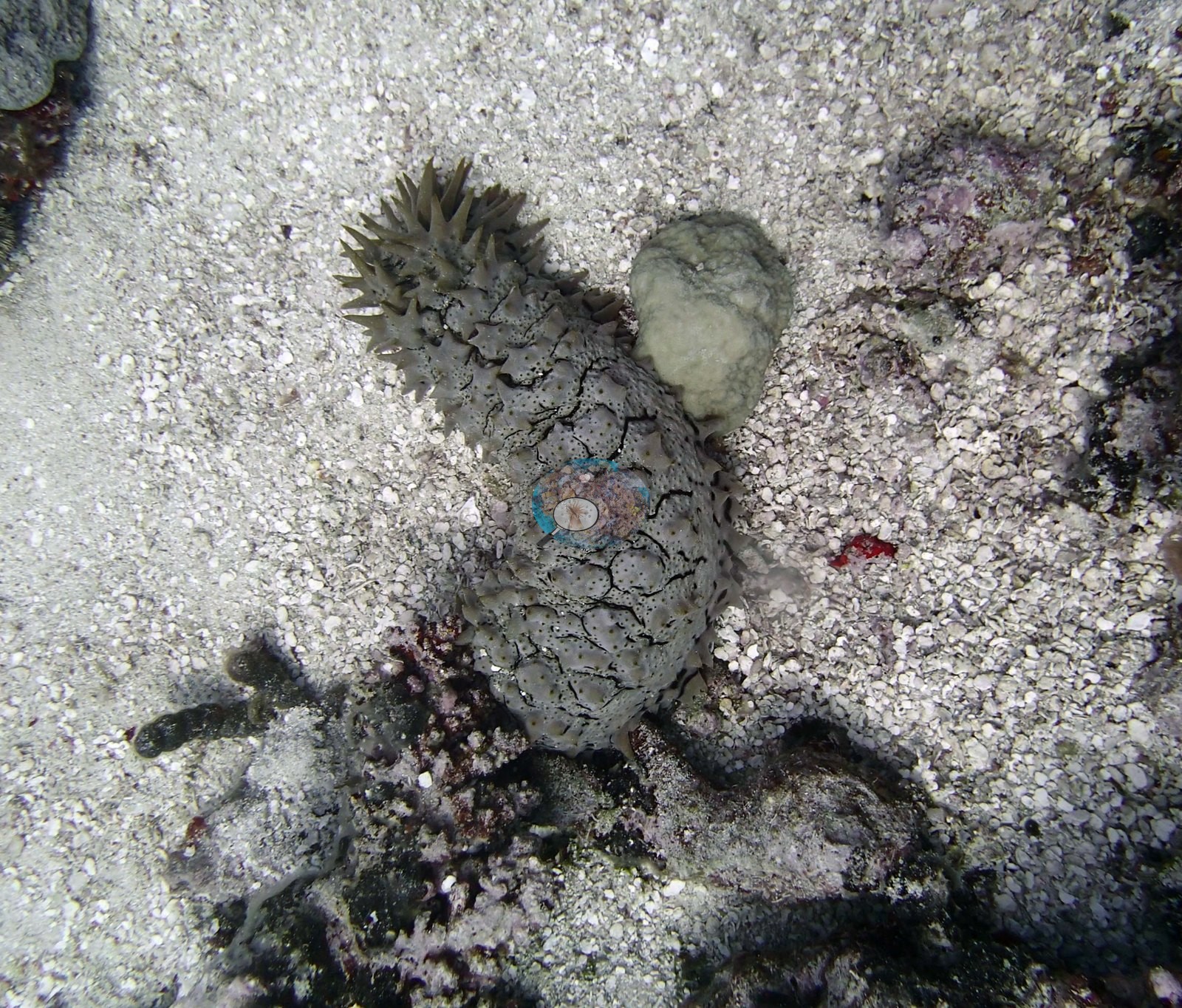
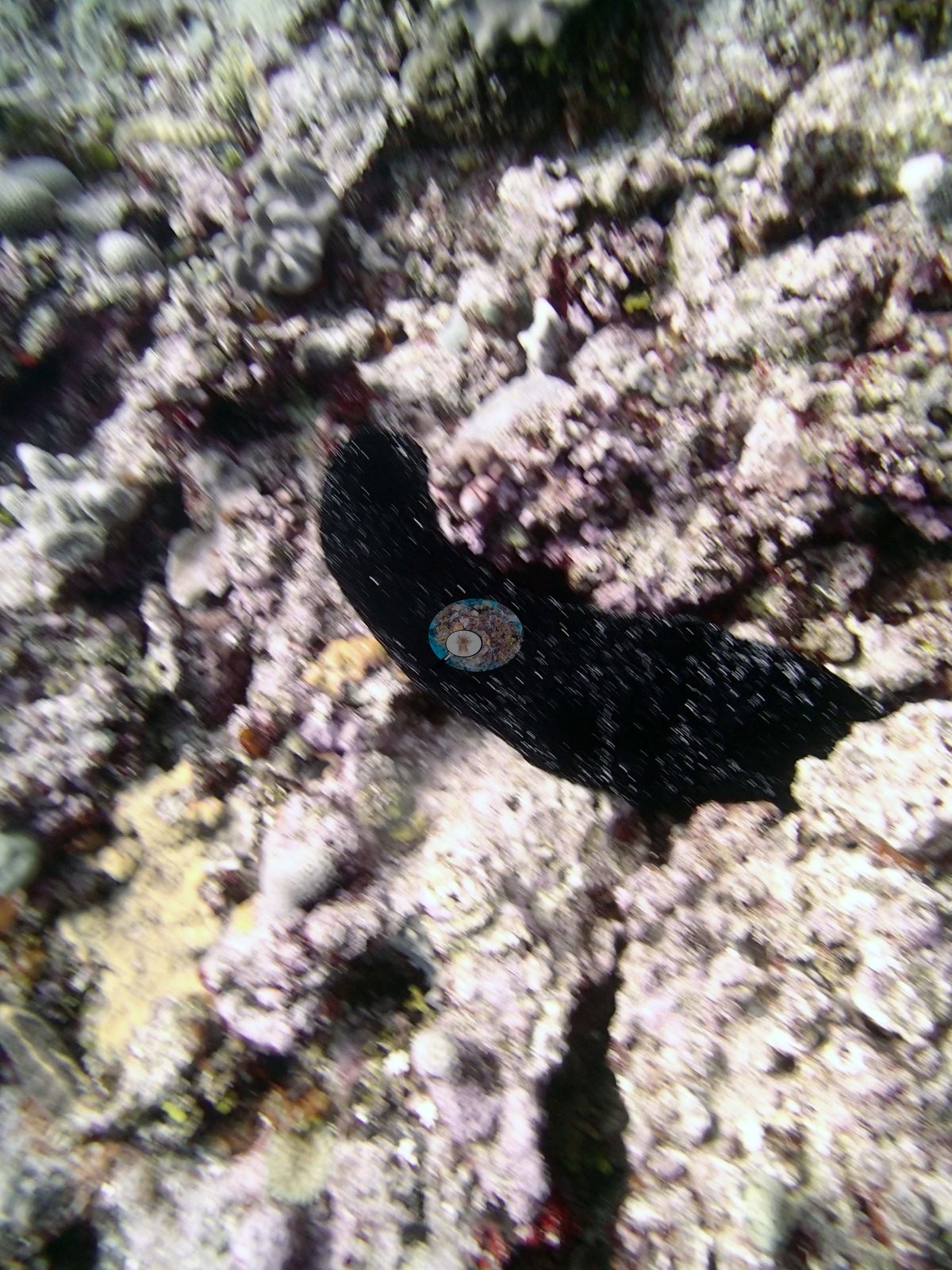
A small moray peers out from beneath a massive colony in Image 15, and two sea cucumbers are recorded on coarse white carbonate sand and rubble (e.g., Image 5, Image 16), one large and papillate, the other dark and out of focus.
Comparisons with other data
Apart from the Living Oceans Foundation survey shown here, we found no other surveys at this site as of 2026. If you would like to share yours, please email us.
Other notes
None of the target Pocillopora ('no Pdam') was taken here, so there are no sampled-colony frames; everything on this page is read from habitat frames. Seven are wide reef views (e.g., Image 1, Image 2, Image 13); the remaining eleven are close subject frames of giant clams, a lobster, a moray, and sea cucumbers. No frame carries a quadrat, scale bar, or transect line. The photographs cannot settle this site's cover, zonation, relief, or condition.
Survey team's site notes: On the sides are small thickets of thick staghorn and bottlebrush acroporids, Coscinaraea columns, Goniastrea, medium Porites colonies. The more vertical areas have Echinopora, Pachyseris, Montipora, and large Mycedium plates, along with Isopora crusts, medium-sized Pocillopora, and other species. Halimeda increases from 5.0% at 10 m depth to 20% at 20 m. In the sand/rubble fields are some low-relief framework with 5-10% cover of corals, mostly small (10-20 cm) faviids, Lobophyllia, Symphyllia, and other species.
CV model comparison
More info
The photo row below is a methods comparison only: it is never averaged with the transect and never used as the headline. It compares site means only: the photos come from the same survey dive as the transect but not from the same points.| Method | Hard coral cover (%) | Photos (n) ± SE |
|---|---|---|
| Transect mean (all transects) | 42.1 | |
| CoralSCOP unedited | 41.2* | n = 13 · SE 3.5 |
| Claude (edited photos) | 45.1* | n = 13 · SE 4.9 |
The two computer-vision methods agree within 3.9 pp (41.2–45.1%) and read within 3.0 pp of the in-water transect (42.1%).
*Based on only 13 reef-habitat photos; this estimate is less certain.
See a more detailed, stand-alone version of this table.
Data & links
- Download benthic survey data (CSV) ↗
- Download all LOF-GRE data (933 sites) ↗
- Photo portfolio ↗
- Coral Reef Diagnostics region page ↗
All images from Coral Reef Diagnostics. Data are from the Khaled bin Sultan Living Oceans Foundation Global Reef Expedition and Coral Reef Diagnostics.
 © Coral Reef Diagnostics.