
Part of the regional summaries: Tonga - Ha'apai and Tonga
More info
Southern Tonga (NOAA CRW virtual station)A scoured, low-relief windward reef in Ha'apai where the most striking feature is a dense carpet of green anemones spreading over several square meters of pink coralline pavement. The stony corals are small and low-lying, and a school of several dozen barracuda passed overhead, and none of the five photographs shows bleaching or disease. Surveyed on the Living Oceans Foundation's Global Reef Expedition.
Ko ha hakau kuo tafiʻi mo māʻulalo ʻi he tafaʻaki ki he matangi (windward) ʻi Haʻapai, ko hono meʻa fakaofo taha ko ha falikiliki fefuʻifuʻi ʻo e ʻanemone lanu mata (green anemones) ʻoku mafola ʻi ha ngaahi mita sikuea ʻe niʻihi ʻo e tuʻunga feo lanu piliki (pink coralline pavement). ʻOku īkiiki mo māʻulalo ʻa e ngaahi feo fefeka, pea naʻe ʻalu atu ʻi ʻolunga ha kulupu ʻo e ono (barracuda) ʻe hongofulu tupu, pea ʻoku ʻikai hā ha hinehina (bleaching) pe mahaki ʻi ha taha ʻo e ngaahi tā (photographs) ʻe nima.
AI translation of this summary; the English is authoritative. (low confidence)
CTD-cast midpoint of 24.2–24.4°C
More info
Anderson's dive computer read 22.8°C (a single reading, probably a dive mean).4 of the 5 photographs on this page are shown beside the text that discusses them under "Site description" below.
Site description
General benthic features
The dominant impression from this set is not stony coral at all: two frames show a dense carpet of fleshy anemone-like polyps — green columns topped with short, crowded gray-white tentacles — blanketing low, coralline-encrusted pavement over several square meters, with small dark damselfish tucked among them (e.g., Image 3, Image 4).
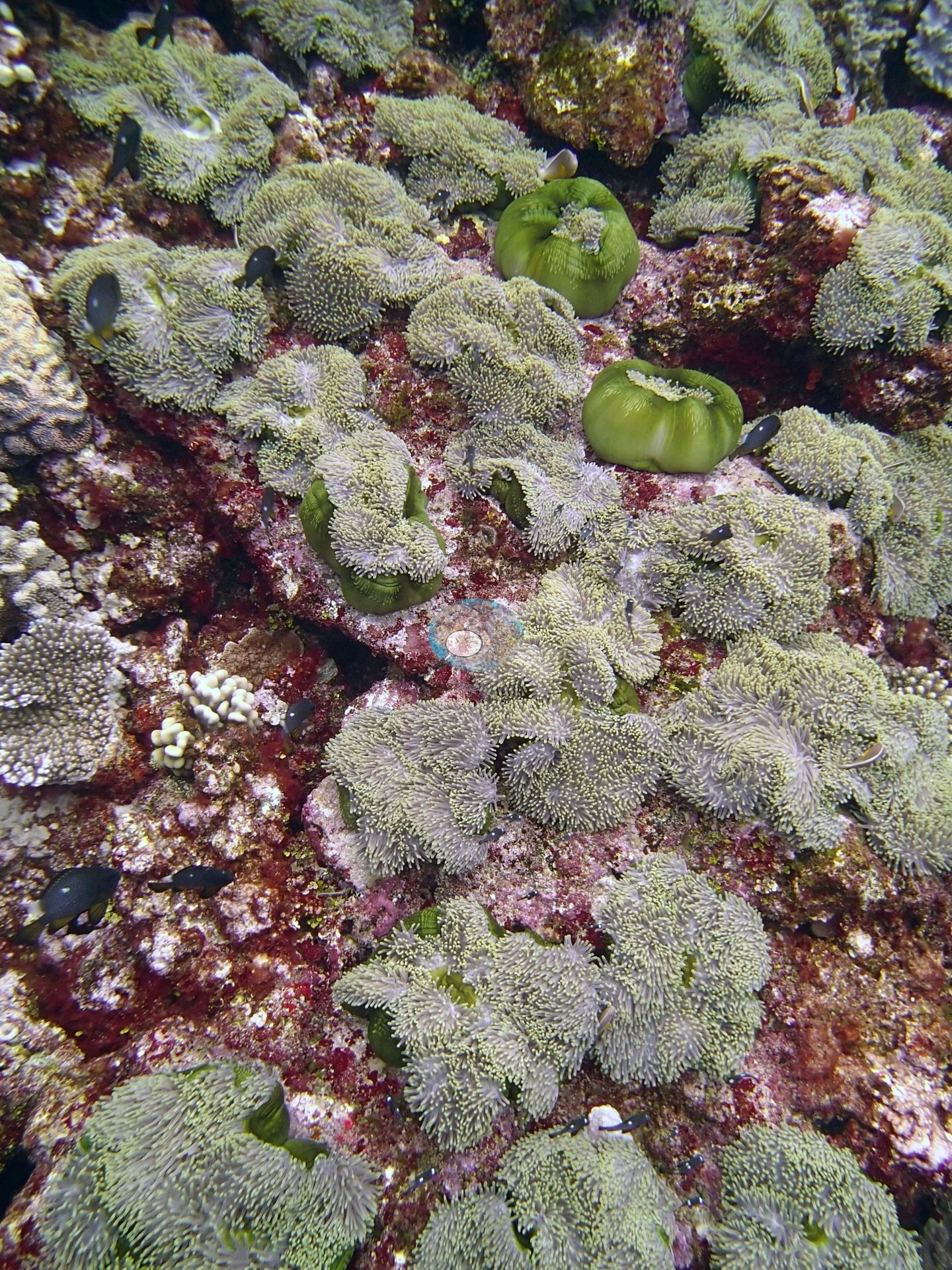
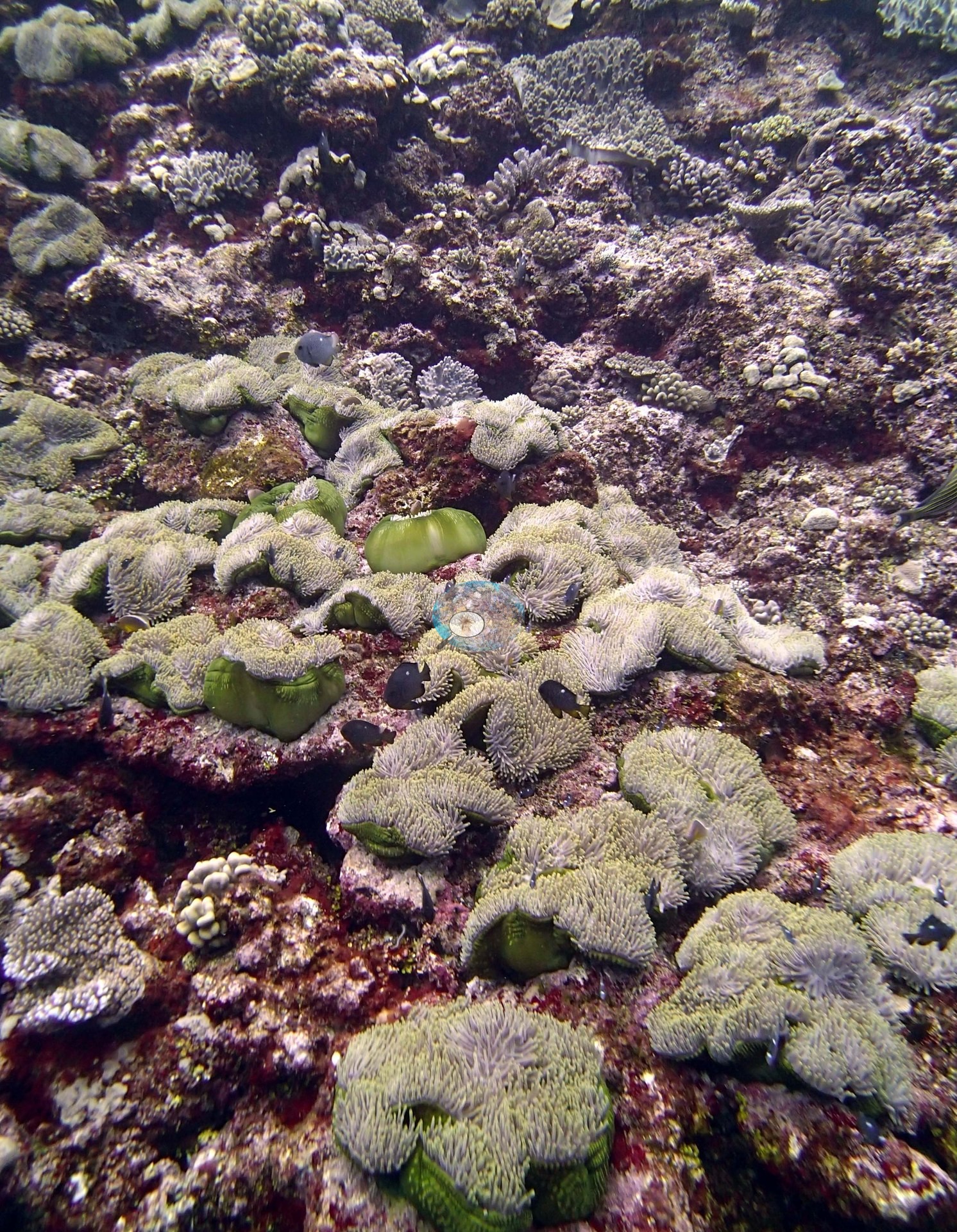
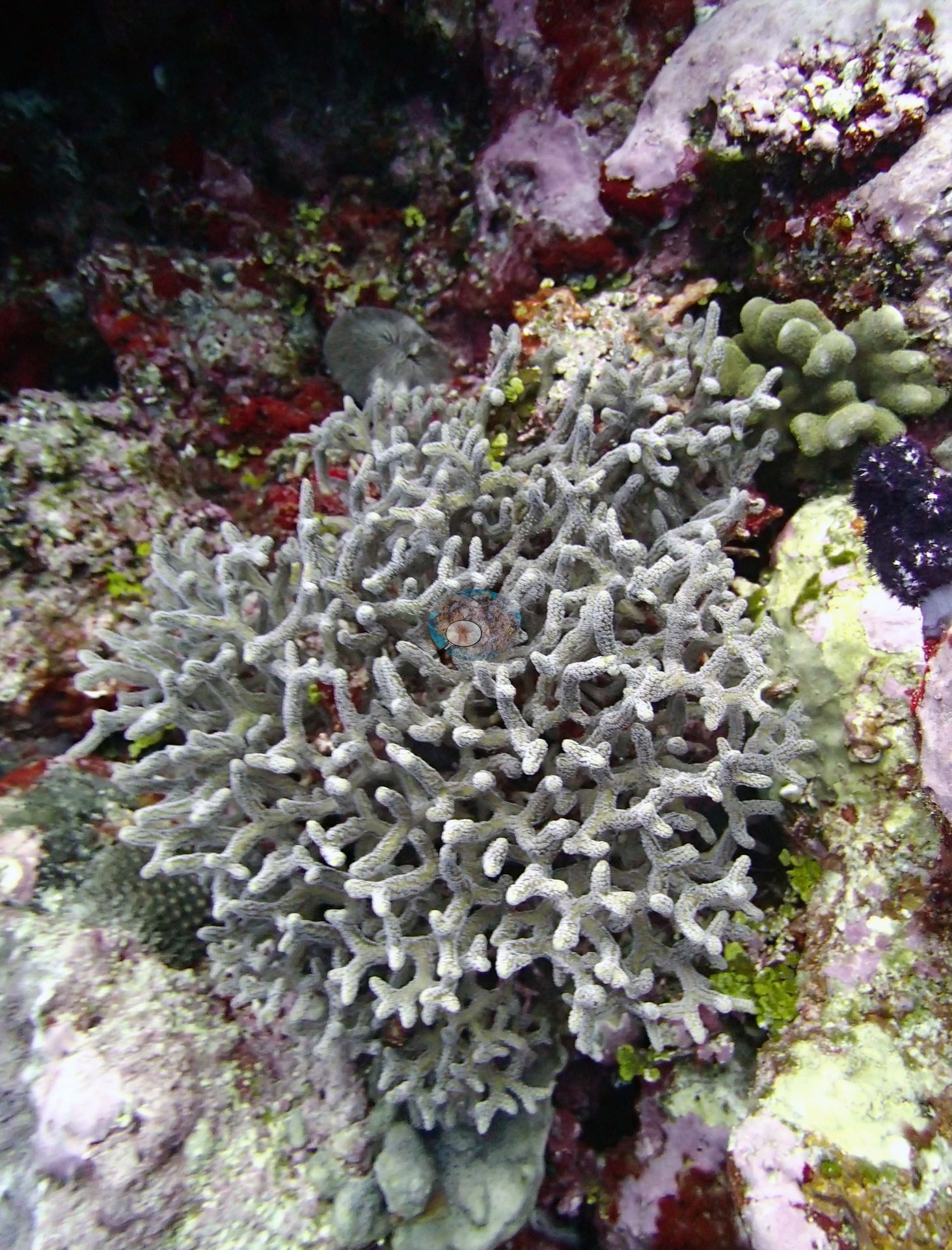
Anderson recorded a meadow of abundant anemones in these frames; they cannot be resolved to species from the images, but their abundance here is striking. Around and between them the substrate is crimson and pink crustose coralline algae with yellow-green turf patches, and the stony corals present are small: cream digitate and corymbose colonies, thin plate fragments, low knobby mounds, mostly under 20 cm and low-lying, which matches the survey record of a scoured, low-relief windward reef where most corals are 10-20 cm and no more than 15 cm tall. A third frame is a close portrait of a single pale gray finely branched colony roughly 40 cm across with blunt, anastomosing branch tips (Anderson's Seriatopora caliendrum, in its natural color), growing out of deep maroon coralline crust beside a small green knobby colony and a dark patch of sponge or urchin (e.g., Image 2).
Coral cover
- Reference: Khaled bin Sultan Living Oceans Foundation, Global Reef Expedition (in situ transect)
- Coral cover 26%, from LOF-GRE in situ transects (the mean of all of this station's own transects in the expedition's per-transect benthic data) — a diver transect measurement, not a photographic or computer vision estimate.
- Transect mean 26 ± 2.2% SE (n = 7 transects; Living Oceans Foundation per-transect benthic data); the headline above is this all-transect mean.
Stressors
No bleaching or disease is visible anywhere in the set. The Living Oceans Foundation transects here recorded 0.9% cyanobacteria and no recently dead coral; they carry no bleaching, disease, or crown-of-thorns field.
Fish and other fauna
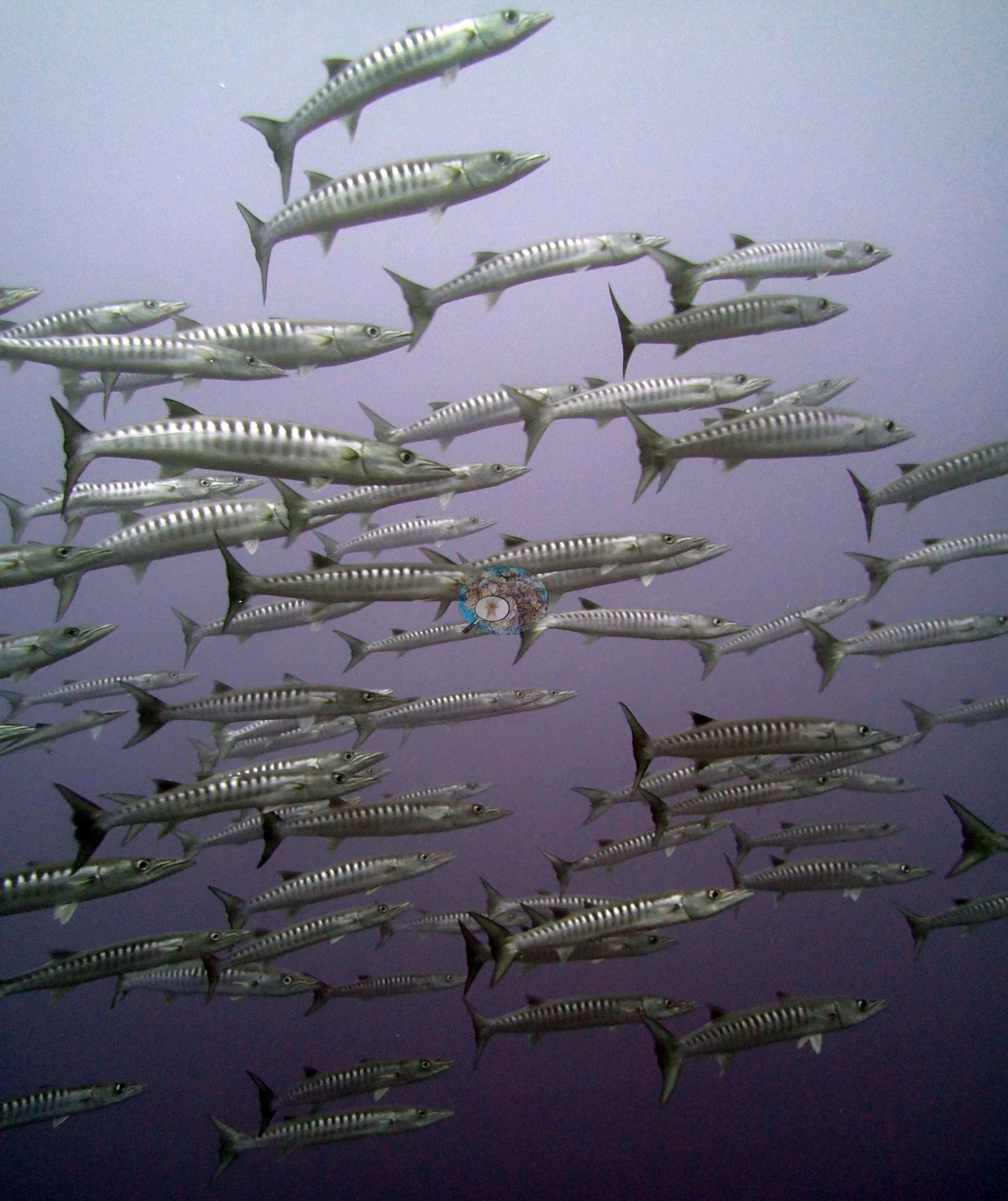
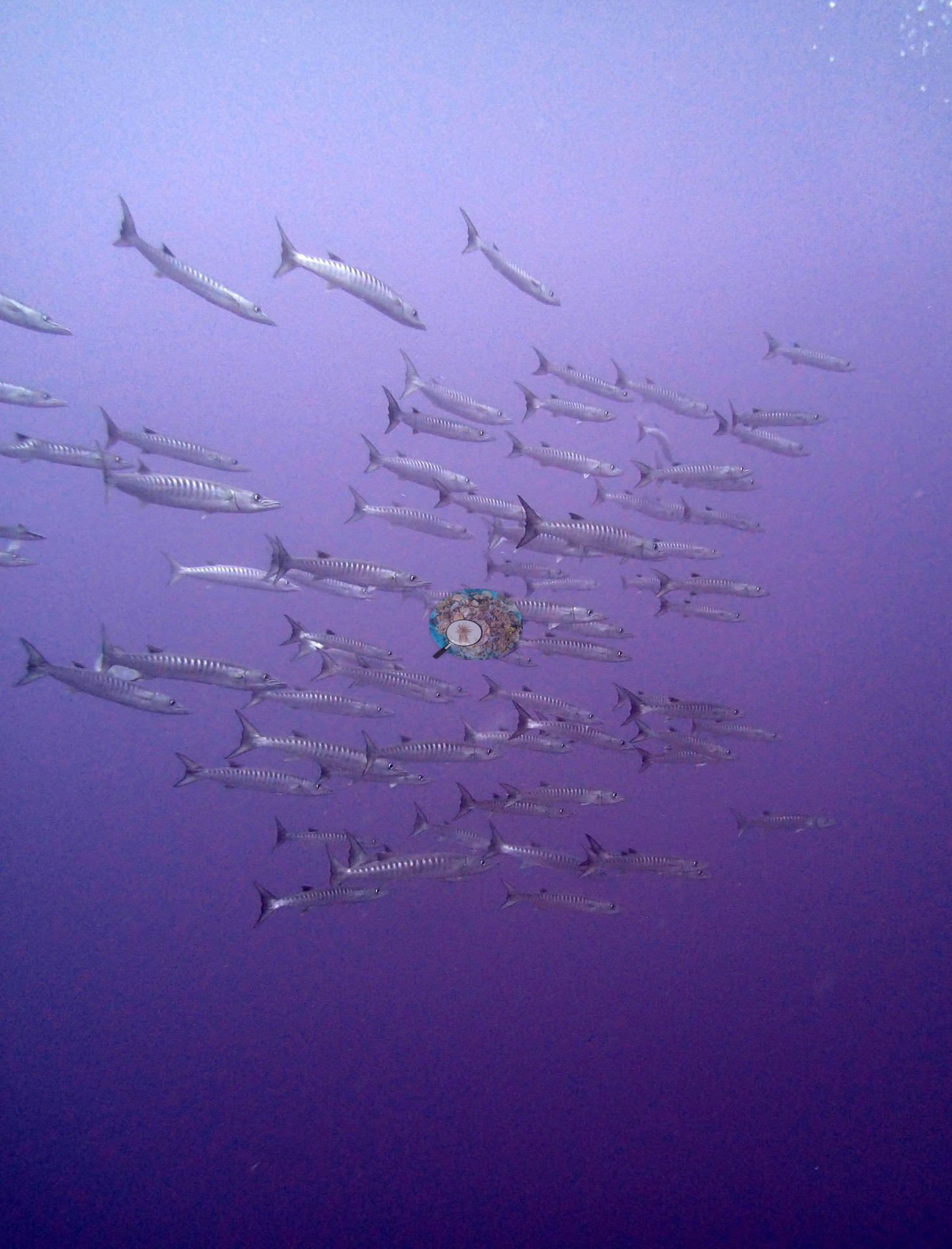
Another frame is a mid-water school of several dozen barracuda (Sphyraena) with a strong magenta color cast and no benthos (e.g., Image 1).
Comparisons with other data
Apart from the Living Oceans Foundation survey shown here, we found no other surveys at this site as of 2026. If you would like to share yours, please email us.
Other notes
Survey team's site notes: At 5 m there are small 5-15 cm low-relief corals at < 2.0% live cover with 5.0% soft corals and 5.0% Palythoa, small tufts of Halimeda, erect CCA, and crustose CCA. Slightly deeper the CCA is covered in turf (60% cover). The reef slopes gradually to 8 m then more steeply to 30 m. At the edge of the drop (10 m) there is 10% coral cover, mostly small Montastrea, massive Montipora foveolata, Astreopora, thick plating and tabular acropora, Platygyra, and other species. The bottom has good CCA and there are numerous 10-20 cm tall spires of CCA. At 15 m the cover is 10-20% dominated by very large plates of Montipora (one 6 m across), thick table Acroporas, and staghorn and digitate Acropora with 10% cover Millepora. Cover declines to 15% at 25-30 m with some medium to large Porites (50-80 cm) mostly submassive, large plates of Isopora, Pachyseris, Mycedium, and other plates.
Data & links
- Download benthic survey data (CSV) ↗
- Download all LOF-GRE data (933 sites) ↗
- Photo portfolio ↗
- Coral Reef Diagnostics region page ↗
All images from Coral Reef Diagnostics. Data are from the Khaled bin Sultan Living Oceans Foundation Global Reef Expedition and Coral Reef Diagnostics.
 © Coral Reef Diagnostics.