
Part of the regional summaries: Tonga - Ha'apai and Tonga

More info
Southern Tonga (NOAA CRW virtual station)A Ha'apai fore reef that swings between dense patches of staghorn and table acroporids and broad expanses of turf-covered dead framework with scattered small colonies. Its Coral Health Index is 1.01 out of 5; Anderson's sampling sheet records four of the seven colonies sampled as half to fully bleached, and a close frame shows mats of red club-tipped polyps, identified as a brick-red anemone, carpeting the rock. Surveyed on the Living Oceans Foundation's Global Reef Expedition.
Ko ha tafaʻaki tuʻa ʻo e hakau (fore reef) ʻi Haʻapai ʻoku fetongitongi ai ʻa e ngaahi konga matolu ʻo e acroporid staghorn mo fakatēpile (table) mo e ngaahi feituʻu fālahi ʻo e hakau mate kuo ʻufiʻufi ʻe he limu nounou (turf) mo e ngaahi kiʻi kulupu mavahevahe. Ko hono Coral Health Index ko e 1.01 mei he 5; ʻoku lēkooti ʻe he pepa sampling ʻa Anderson ko e kulupu ʻe fā ʻi he kulupu ʻe fitu naʻe toʻo sīpinga mei ai naʻe hinehina ʻaki ʻa e vaeua ki he kotoa, pea ʻoku fakahā ʻe ha tā ofi ʻa e ngaahi falikiliki ʻo e ngaahi polyp kulokula ʻoku fakatuʻunga hono muʻa (club-tipped polyps), ʻa ia naʻe ʻiloʻi ko ha ʻanemone kulokula hangē ha piliki (brick-red anemone), ʻoku nau ʻufiʻufi ʻa e maka.
AI translation of this summary; the English is authoritative. (low confidence)
CTD-cast midpoint of 24.7–25.3°C
More info
Anderson's dive computer read 23.3°C (a single reading, probably a dive mean).Site description
General benthic features
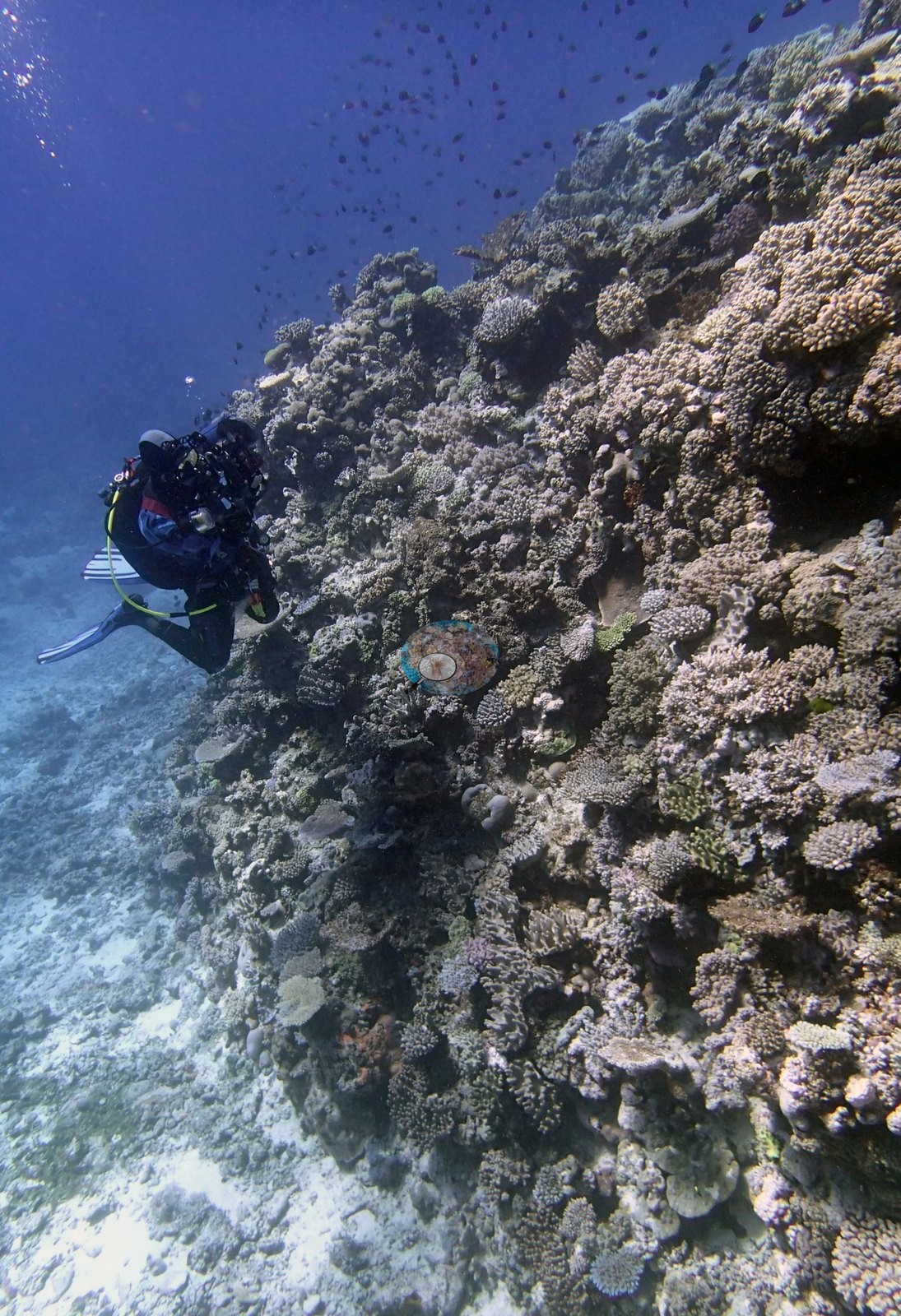
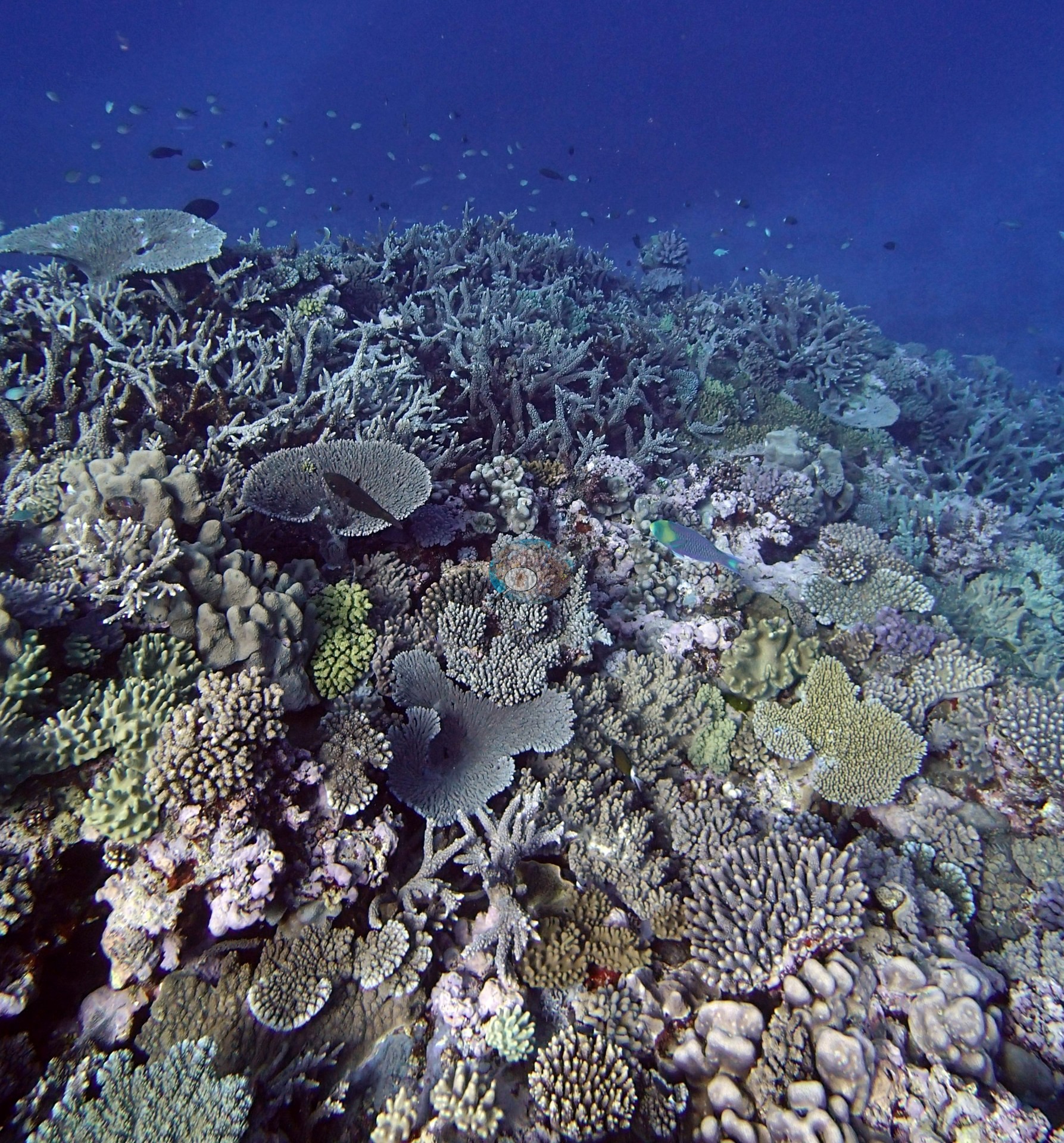
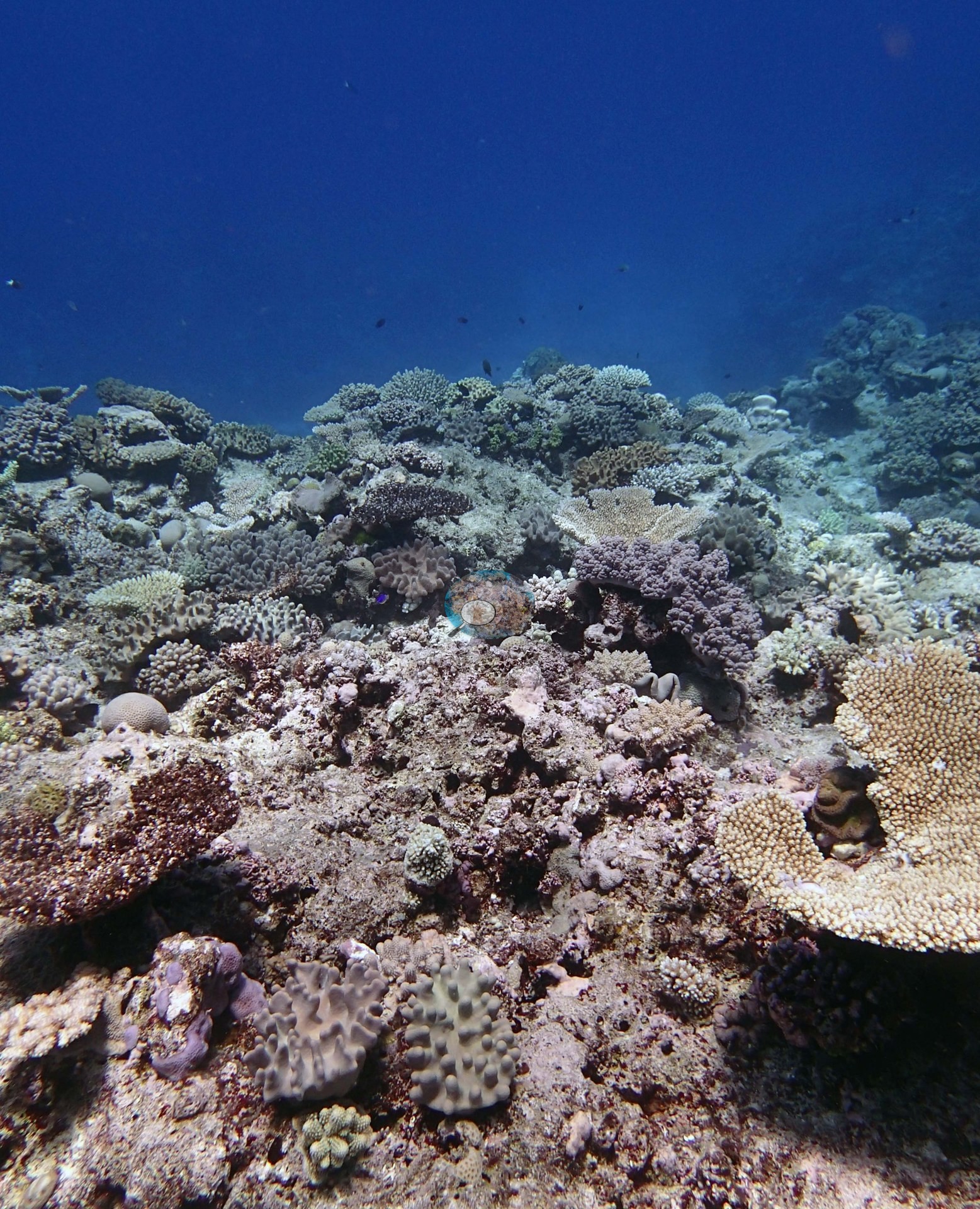
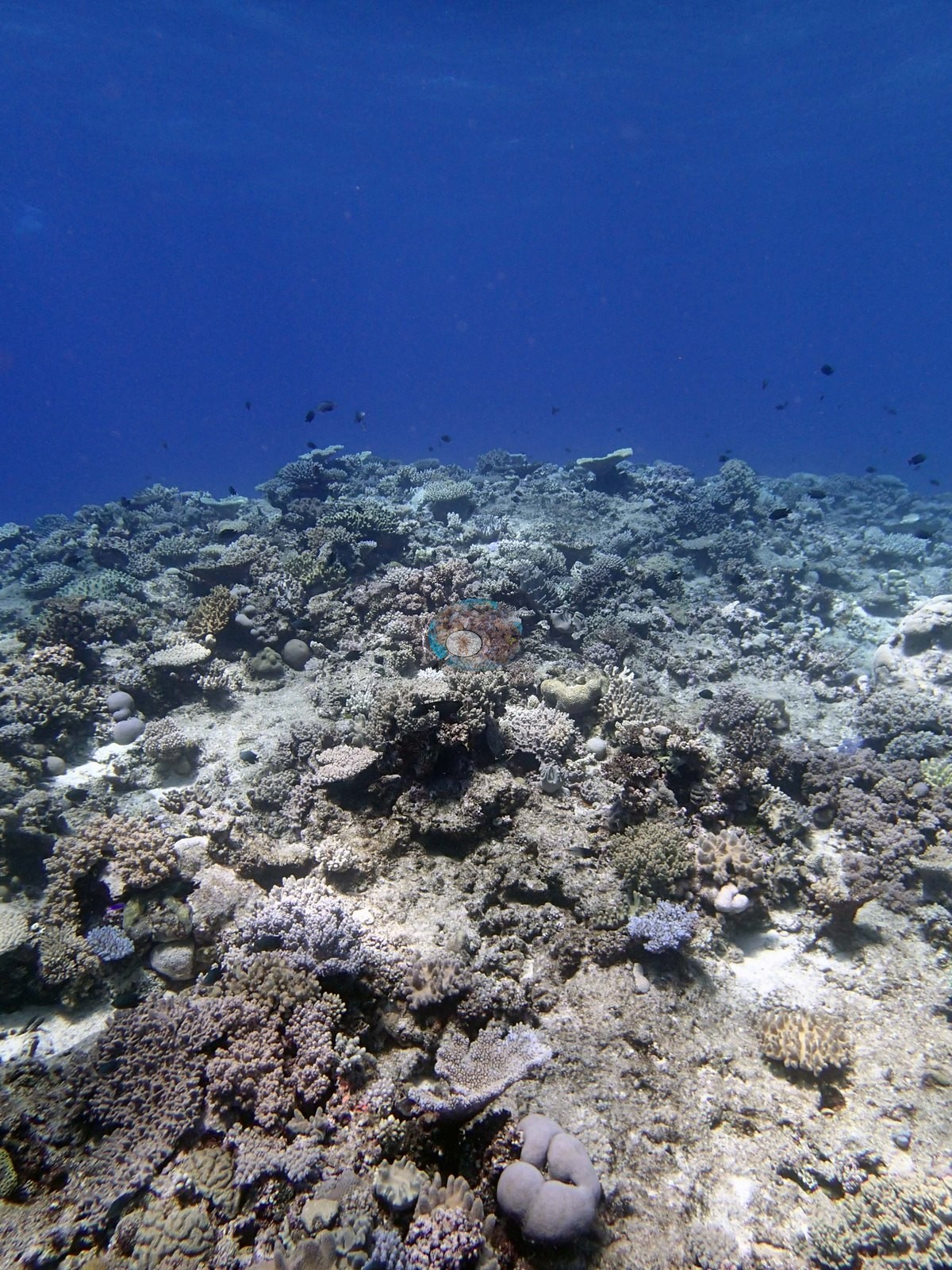
Image 5 and Image 3 are the structural frames: Image 5 shows a diver hanging beside the steep flank of a coral mound rising off pale sand, its side packed with tan and lilac corymbose and digitate acroporids, cream and tan plating colonies, and small tables under a cloud of small planktivores; Image 3 is a clear wide view — a complex reef top of stacked acroporid tables, dense branching and staghorn thickets, pale green plating colonies, and blue-gray encrusting growth running away into deep blue, with a parrotfish working through it. Image 4 and Image 8 are the counterpoint and look like the wide low spurs the surveyors described: broad, flat bottoms where small scattered colonies — a pale table plate, cream digitate colonies, gray lumpy massive mounds, a tan corymbose head, lobate soft corals — sit in large expanses of pale pavement, rubble, and dark reddish-brown turf-covered dead framework.
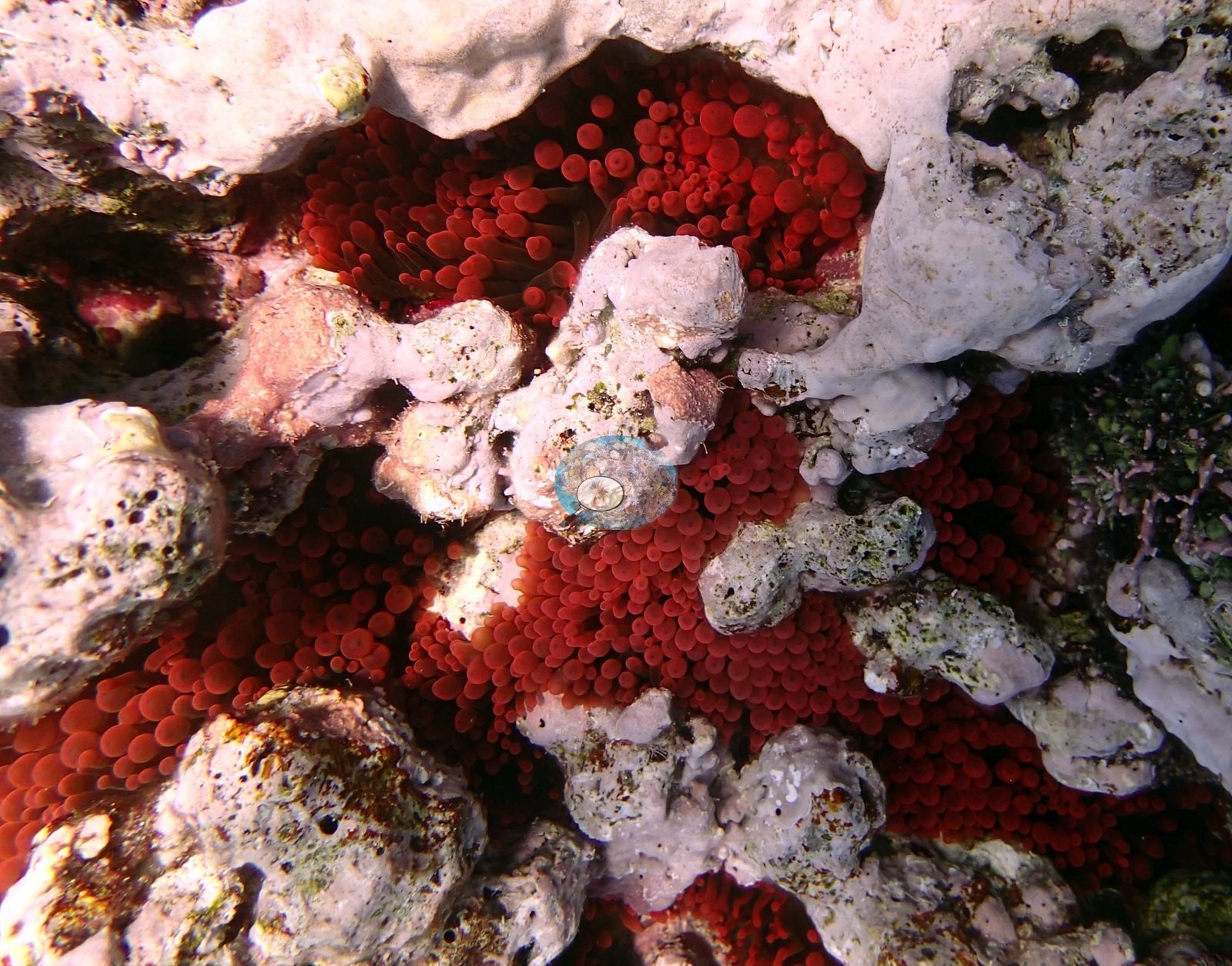
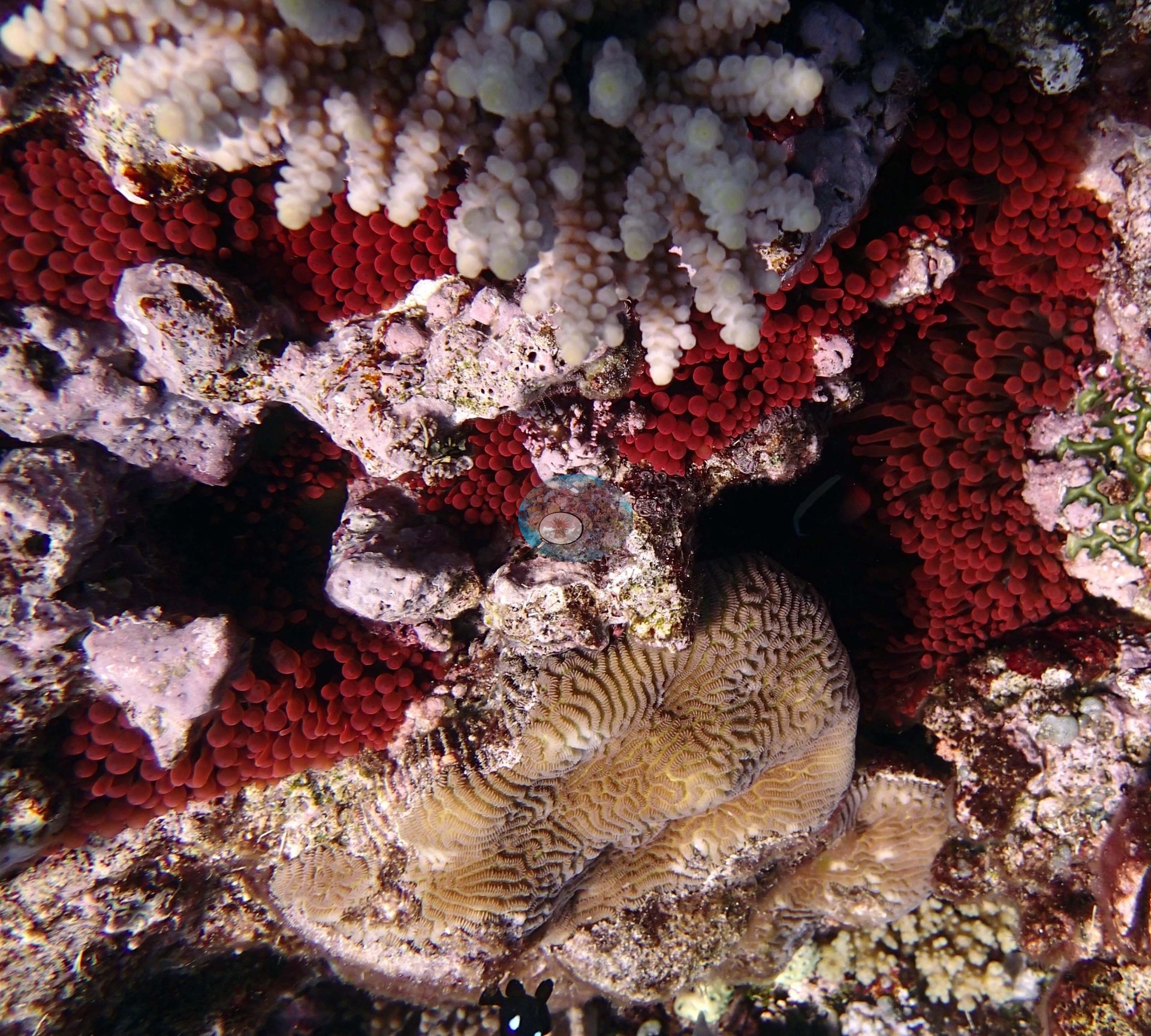
The three close frames are the site's most distinctive images. Image 6 and Image 2, which Anderson identified as brick-red anemones, show dense carpets of brick-red club-tipped polyps spreading over the framework between pink and white coralline-crusted knobs, with a tan brain coral with meandering valleys sitting in the middle of the red carpet in Image 2 and small green algal tufts at the margins.
Coral cover
- Reference: Khaled bin Sultan Living Oceans Foundation, Global Reef Expedition (in situ transect)
- 26%, from the Khaled bin Sultan Living Oceans Foundation's in situ transect survey (Global Reef Expedition site data); the photographs illustrate the site. Coral Health Index 1.01/5 (Mayfield & Dempsey 2025, Discover Oceans formula).
- Transect mean 26 ± 3.3% SE (n = 6 transects; Living Oceans Foundation per-transect benthic data); the headline above is this all-transect mean.
Stressors
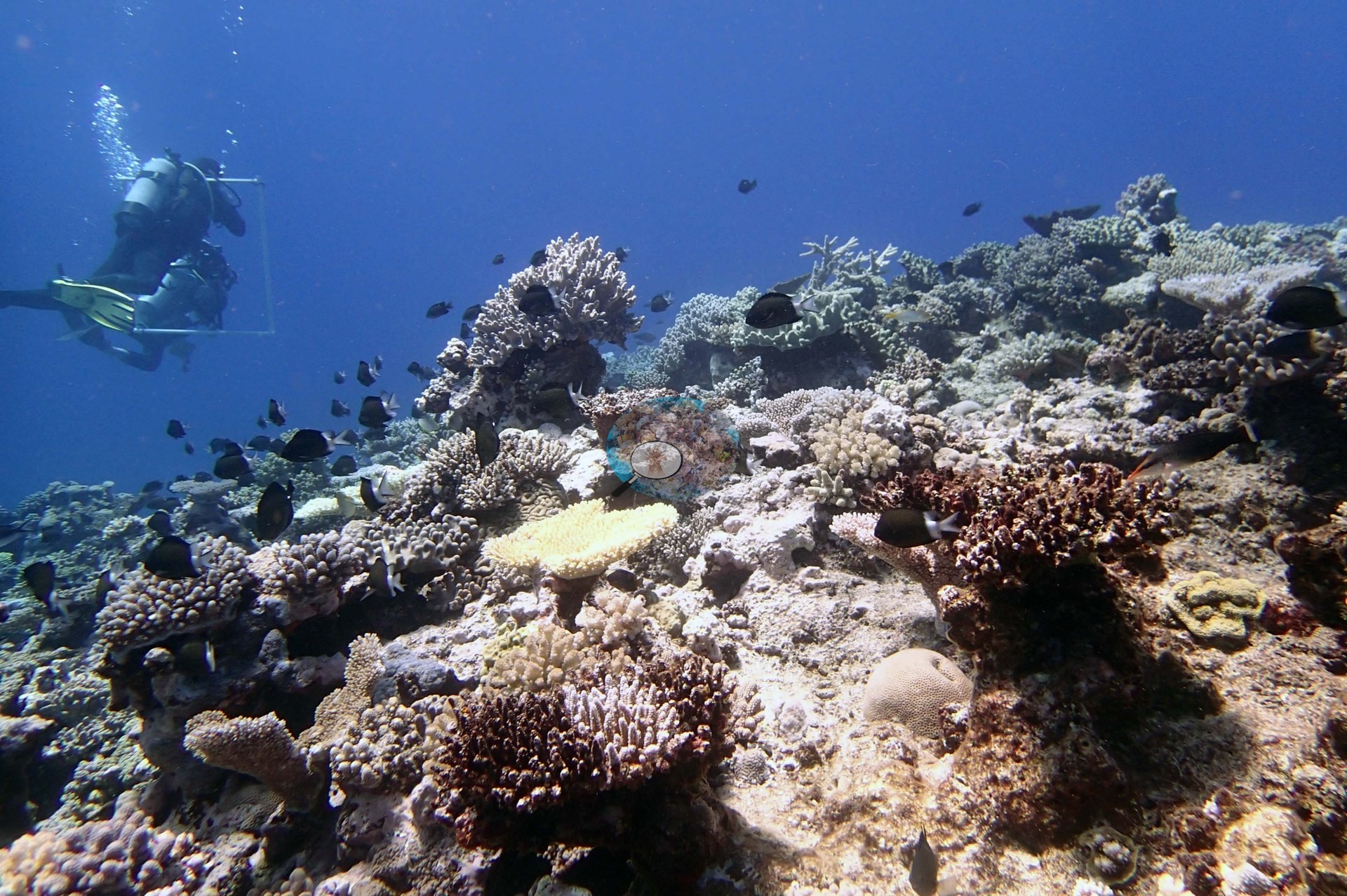
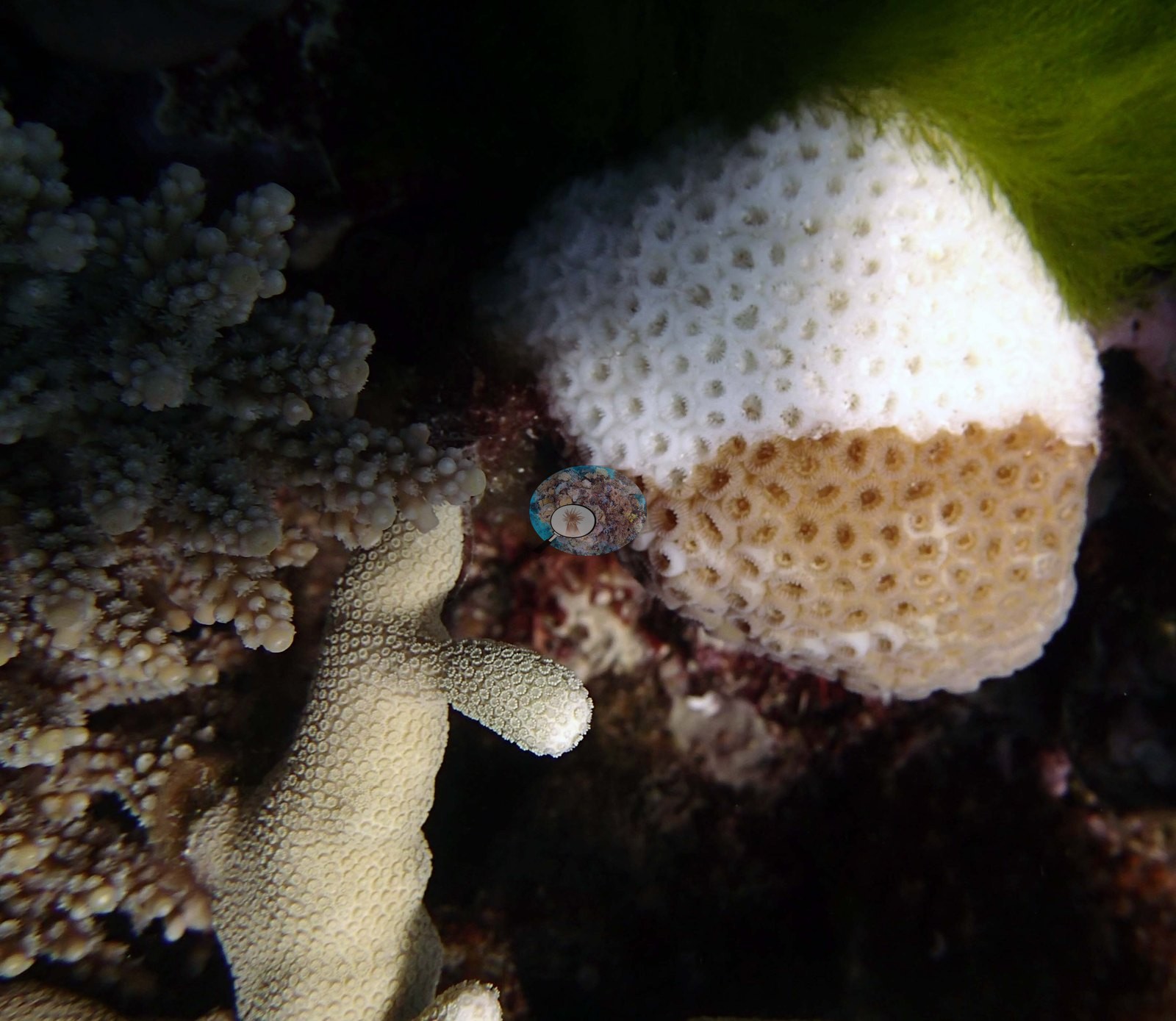
Image 1 shows a second diver carrying a rectangular quadrat frame over a reef top busy with damselfish and butterflyfish; one flat plate colony in that frame is conspicuously pale cream-yellow against its darker neighbors, and the photograph cannot separate a naturally pale morph from bleached or recently dead tissue. Image 7, which Anderson recorded as a dying coral, shows exactly that: a massive colony with large widely spaced corallites whose upper surface is bare white skeleton already carrying green filamentous algae while its lower third still holds tan living tissue — partial mortality caught in a single colony, which is consistent with the surveyors' note of many corals with partial mortality here, though one colony cannot stand for the site.
Anderson's sampling sheet for this dive records heavy bleaching among the seven Pocillopora colonies sampled: colonies 37, 42, and 43 fully bleached (37 'dying', 43 still with live tissue), colony 38 half bleached with partial mortality, colony 40 about 20% bleached, and colony 39 very pale. Typical recent thermal stress: mean annual maximum of 8.1°C-weeks (Degree Heating Weeks, 2021-2025, NOAA CRW; Southern Tonga virtual station). The Living Oceans Foundation transects here recorded 0.7% cyanobacteria and no recently dead coral.
Comparisons with other data
James Cook University and the Ministry of Fisheries Tonga surveyed a nearby station (Haafeva SMA 3), 0.41 km from the pin; we could not confirm that it is the same reef. If you have survey data from this site to share, please email us.
Other notes
Photo review of 8 habitat frames plus 36 sampled-colony close-ups (Ha'apai, 17 Sep 2013). The account on this page is written from the habitat frames only; the colony images are treated purely as a record of what was sampled. Five of the eight are wide or mid-range reef views, two are close detail shots, and one is a named condition photograph; none carries a scale bar or transect line, so no measurement can be taken from any of them. The wide frames divide the site in two, and both halves are worth recording. Seven Pocillopora colonies were sampled at this site (colonies 37 to 43); Anderson's own field records label 37 to 42 as P. acuta and 43 as P. damicornis with a query. The 36 close-ups are repeat polyp-scale macro and tag shots of only those seven colonies and describe the colonies, not the reef.
Survey team's site notes: Fore reef adjacent to east side of island. Shallows have large mounds that are 1-3 m on top and slope steeply on the sides and seaward edge to 10-15 m. The tops have moderately low coral (10-20%) with a high number of damselfish algal lawns in staghorns, 20% cover of soft coral (Lobophytum, Sinularia, Sarcophyton). The sides have patches of up to 2 m plating corals including Pachyseris and Porites rus, some larger massive Favia stelligera, Pocillopora, and acroporids. Very wide, low relief (< 1 m above sand) spurs gradually slope to deeper water. There are occasional larger pieces of framework, up to 1 m tall, but most of the spurs have small to medium corals and dead skeletons up to about 50 cm tall. Cover is relatively low (10-20%), there are large numbers of medium sized dead acroporids (5-10%) and many corals with partial mortality. Spurs are dominated by Goniastrea, small table acroporids and staghorn coral, Montipora crusts, Stylophora, small Montastrea, Favia, and other faviids, Pocillopora with more plating corals deeper. Much of the hardground is covered in turf algae on CCA, with patches of cyanobacteria. Moderate numbers of sea cucumbers (4 species) in sandy areas, especially the small spiky black cucumber shallow (8-10 m). No macroalgae; some small patches of Halimeda at the bases of the ledge at 10-12 m depth.
Data & links
- Download benthic survey data (CSV) ↗
- Download all LOF-GRE data (933 sites) ↗
- Photo portfolio ↗
- Coral Reef Diagnostics region page ↗
All images from Coral Reef Diagnostics. Data are from the Khaled bin Sultan Living Oceans Foundation Global Reef Expedition and Coral Reef Diagnostics.
© Coral Reef Diagnostics.