
Part of the regional summaries: Tonga - Ha'apai and Tonga
More info
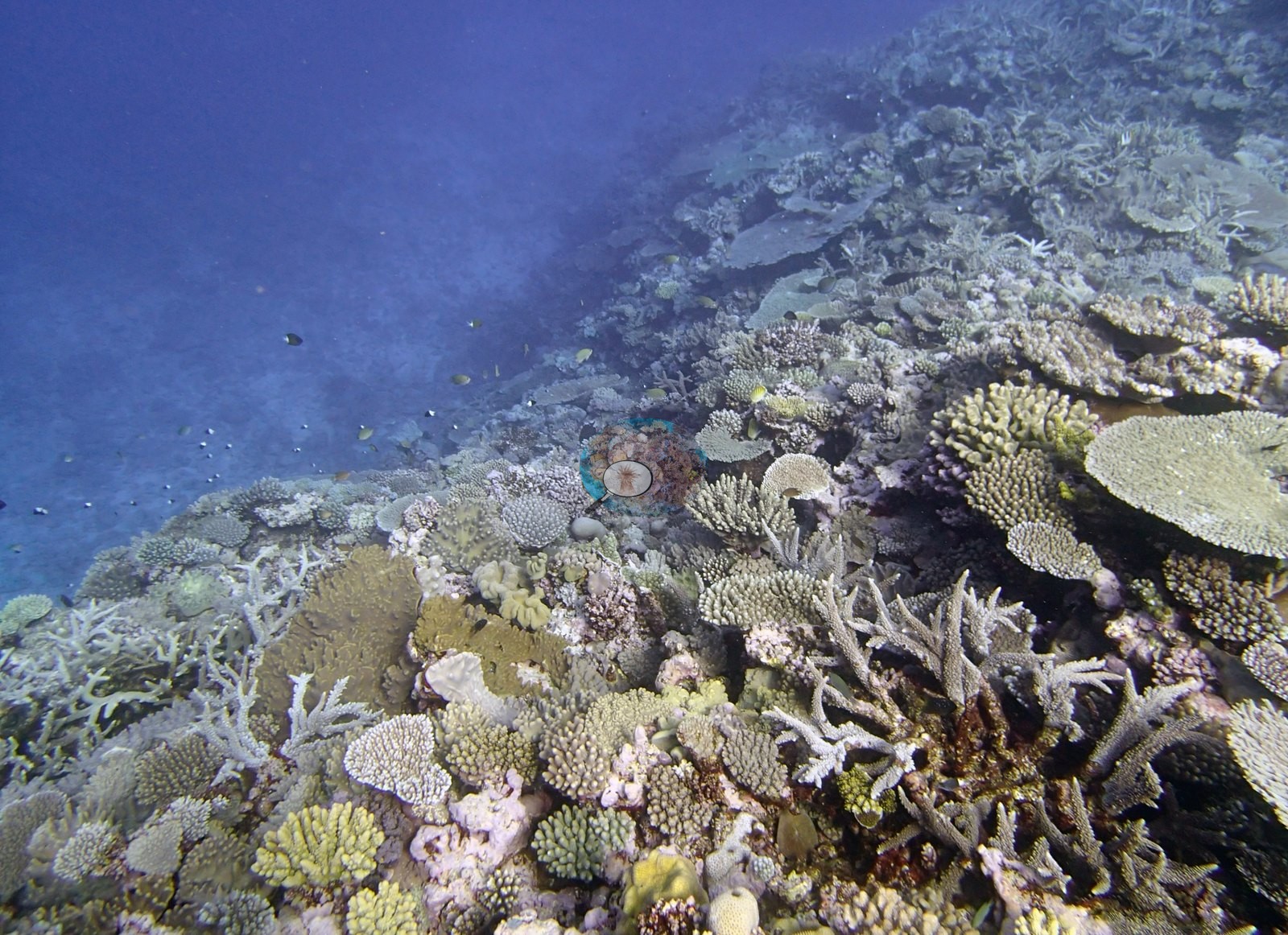
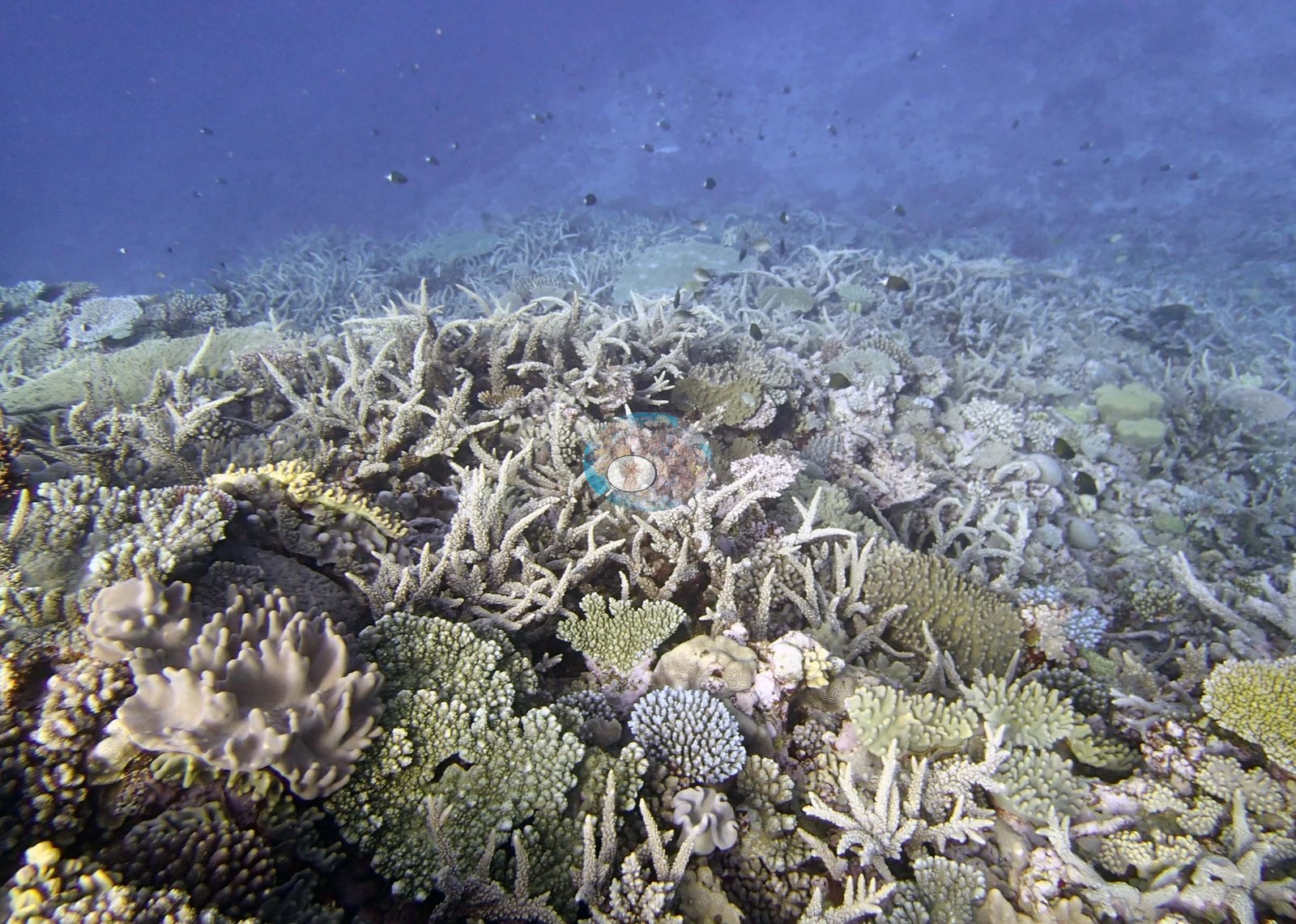
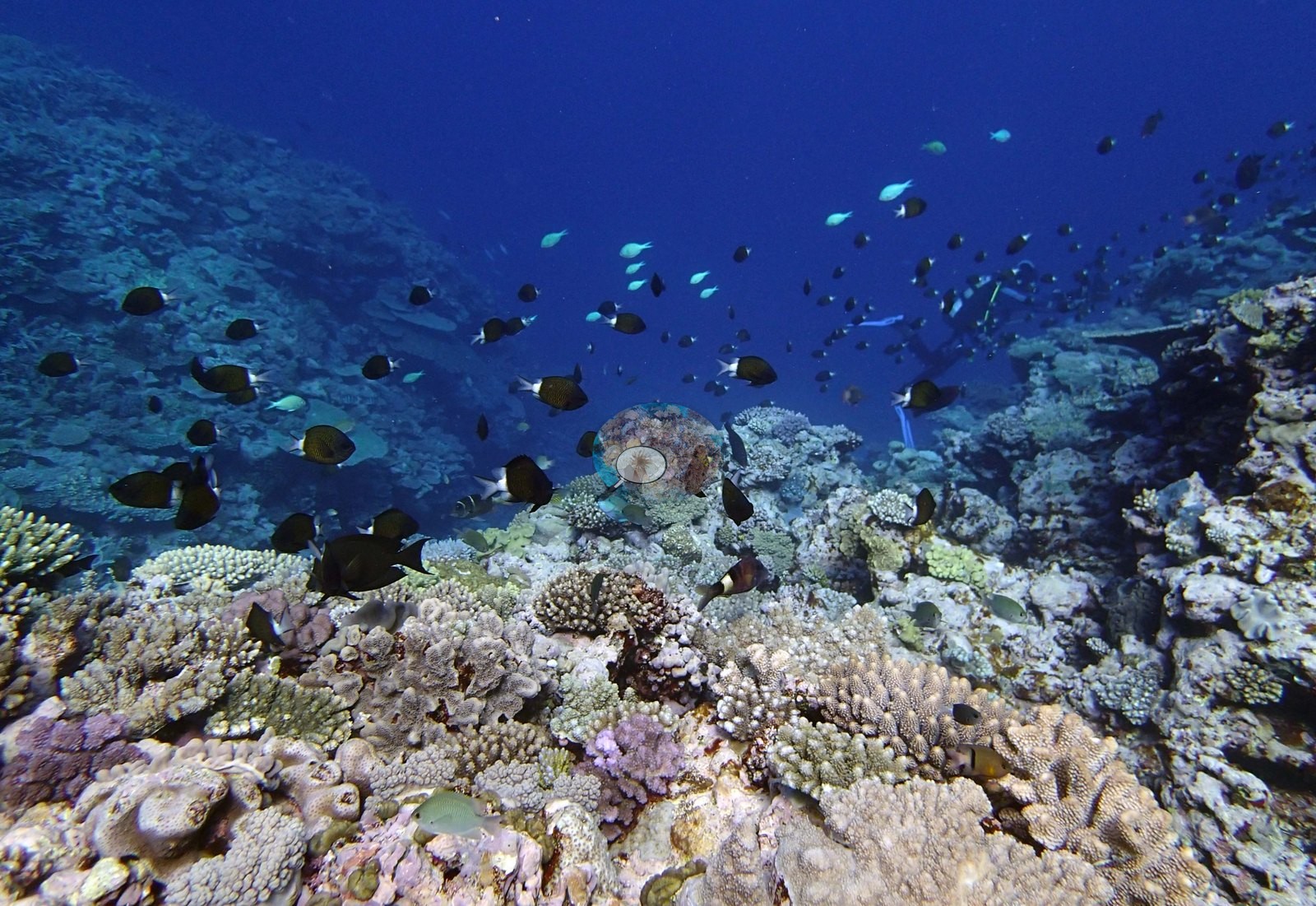
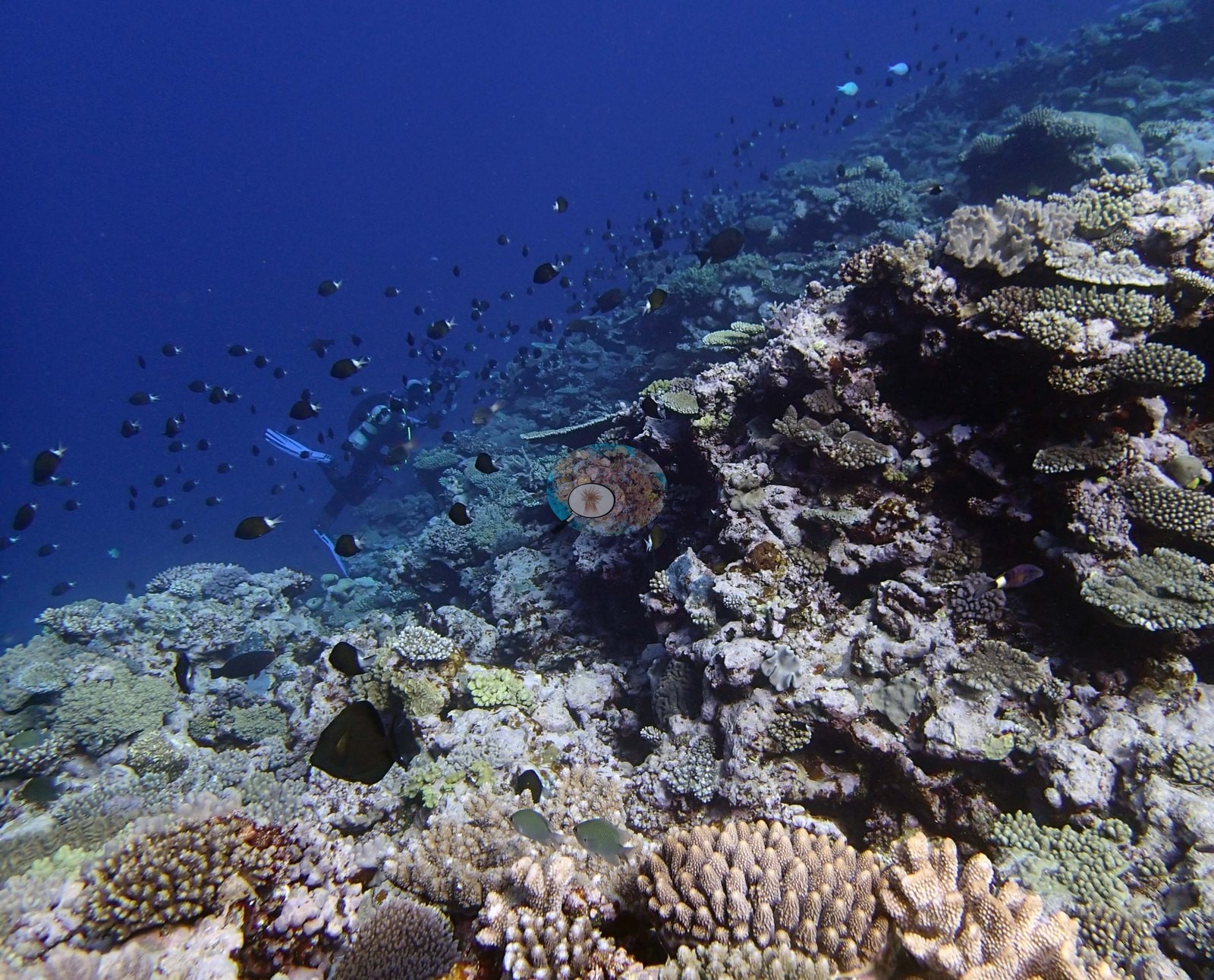
Southern Tonga (NOAA CRW virtual station)A high-relief Ha'apai reef where living coral covers most of the benthos: flat-topped mounds and spurs carpeted with small branching Acropora and meter-wide tables, dropping steeply into deep blue under dense clouds of damselfish and chromis. Extensive staghorn stands were bleached pale gray-white, and the survey recorded some staghorn on the spur sides as dead or partly dead and colonized by damselfish. Surveyed on the Living Oceans Foundation's Global Reef Expedition.
Ko ha hakau māʻolunga (high-relief) ʻi Haʻapai ʻoku ʻufiʻufi ai ʻe he feo moʻui ʻa e lahi taha ʻo e takele tahi (benthos): ko e ngaahi puke mo e spurs funga lafalafa kuo ʻufiʻufi ʻe he kiʻi Acropora fakavaʻavaʻa mo e ngaahi tēpile ʻoku mita ʻe taha hono fālahi, ʻoku tō hifo fakafokifā ki he tahi lanu pulū loloto ʻi lalo ʻi he ngaahi ʻao fefuʻifuʻi ʻo e damselfish mo e chromis. Naʻe hinehina (bleached) ha ngaahi vao staghorn lalahi ʻo lanu efuefu-hinehina vaivai, pea naʻe lēkooti ʻe he savea ʻa e niʻihi ʻo e staghorn ʻi he ngaahi tafaʻaki ʻo e spurs naʻe mate pe mate ha konga pea kuo nofoʻi ʻe he damselfish.
AI translation of this summary; the English is authoritative. (low confidence)
CTD-cast midpoint of 24.4–24.6°C
More info
Anderson's dive computer read 22.8°C (a single reading, probably a dive mean).Site description
General benthic features
The sixteen habitat frames show that this is a high-relief, coral-dominated site where living coral occupies most of the visible bottom in almost every frame. The dominant texture across the set is a near-continuous pavement of small corymbose and digitate acroporids running to the limit of visibility, punctuated by green and yellow-green tabulate plates, tan folded foliose colonies, and small knobby massives (e.g., Image 12, Image 13, Image 14, Image 20, Image 21).
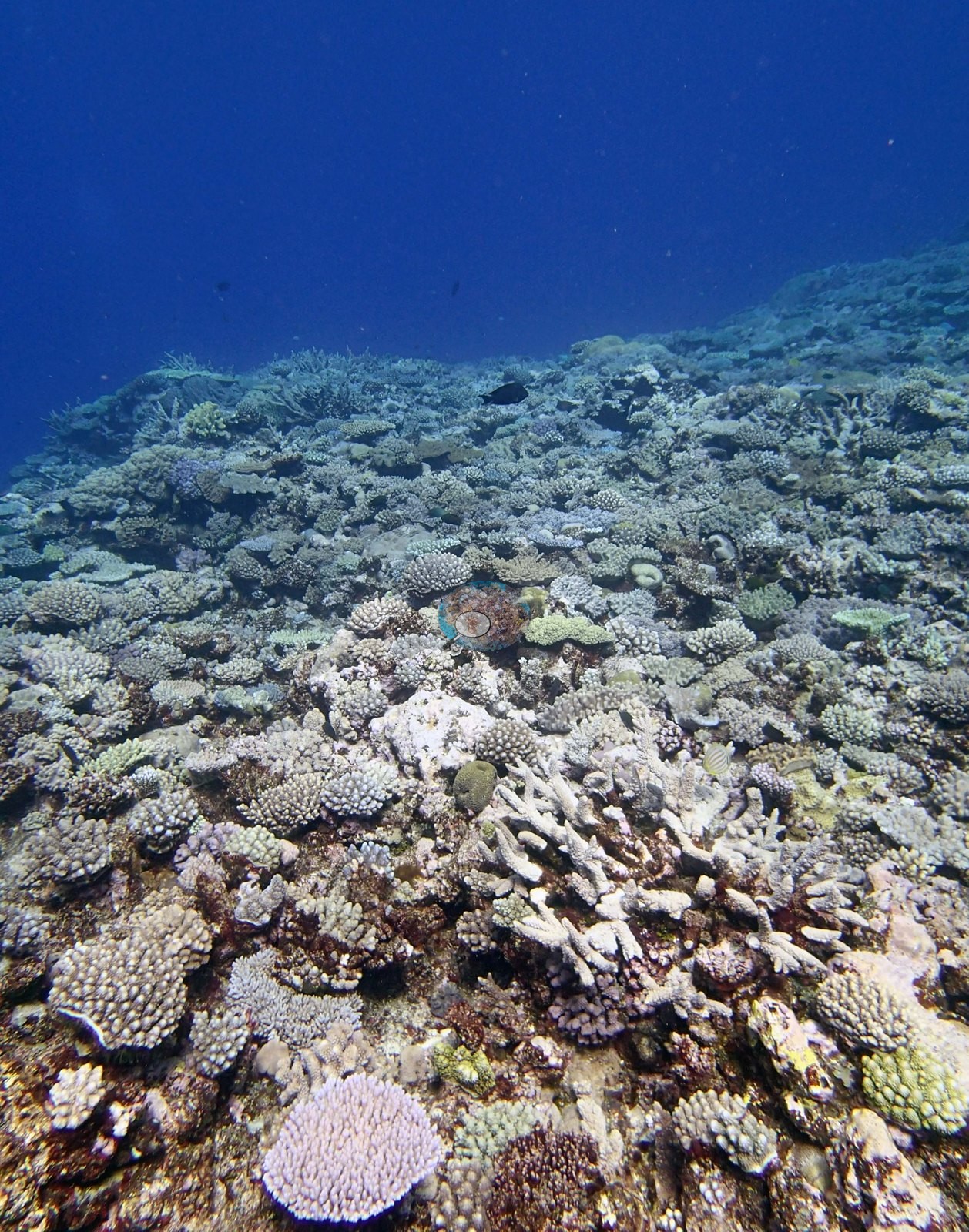
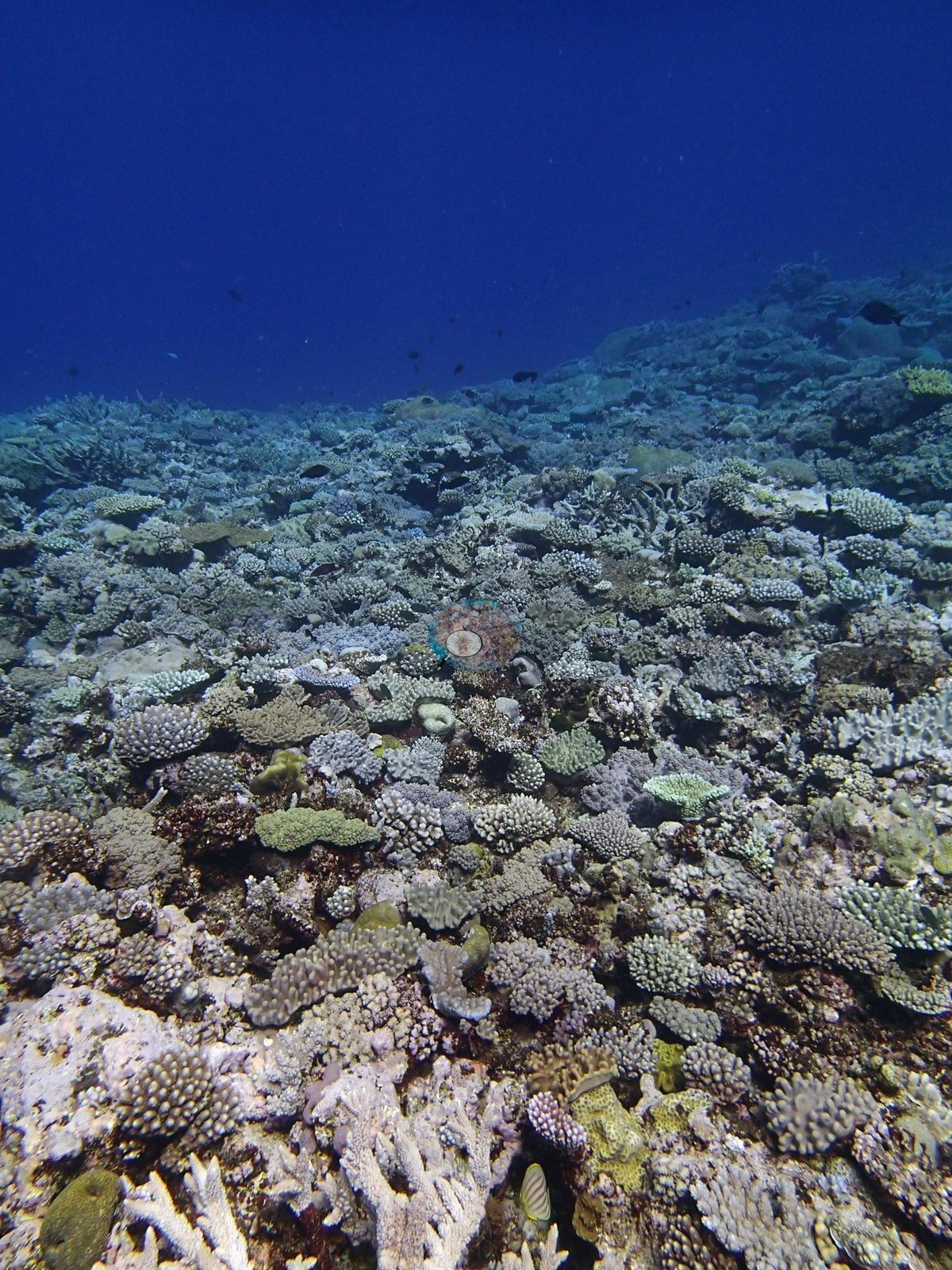
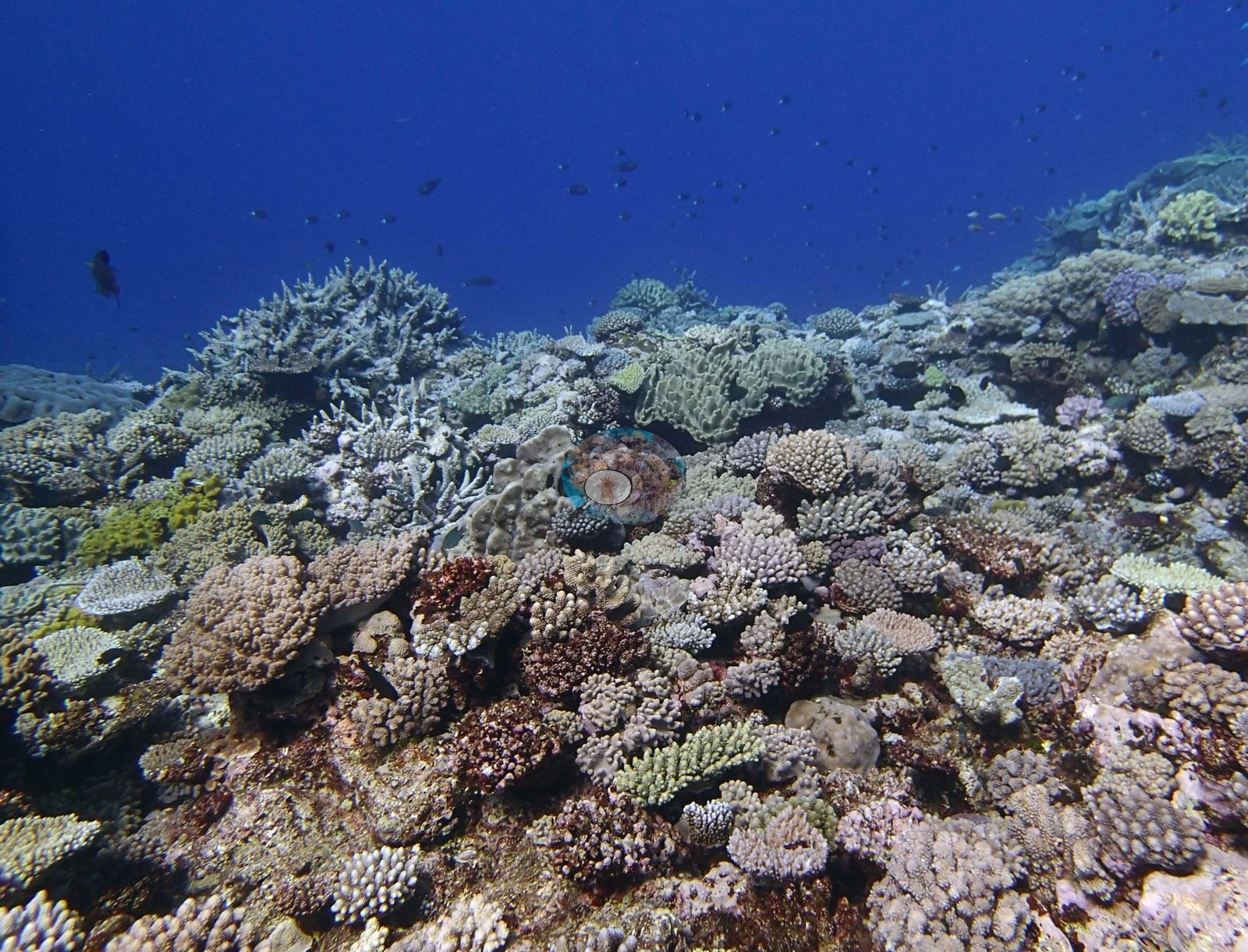
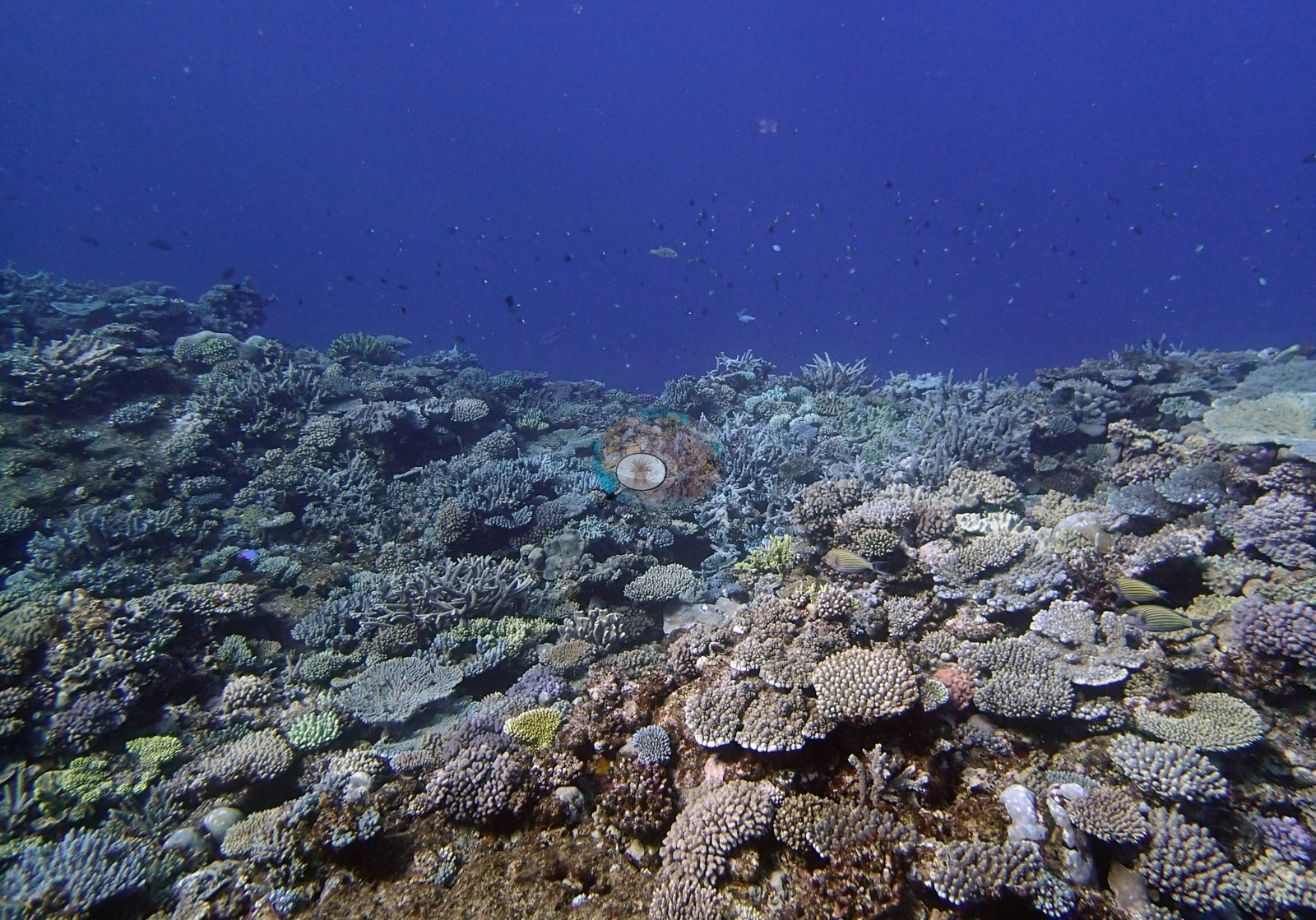
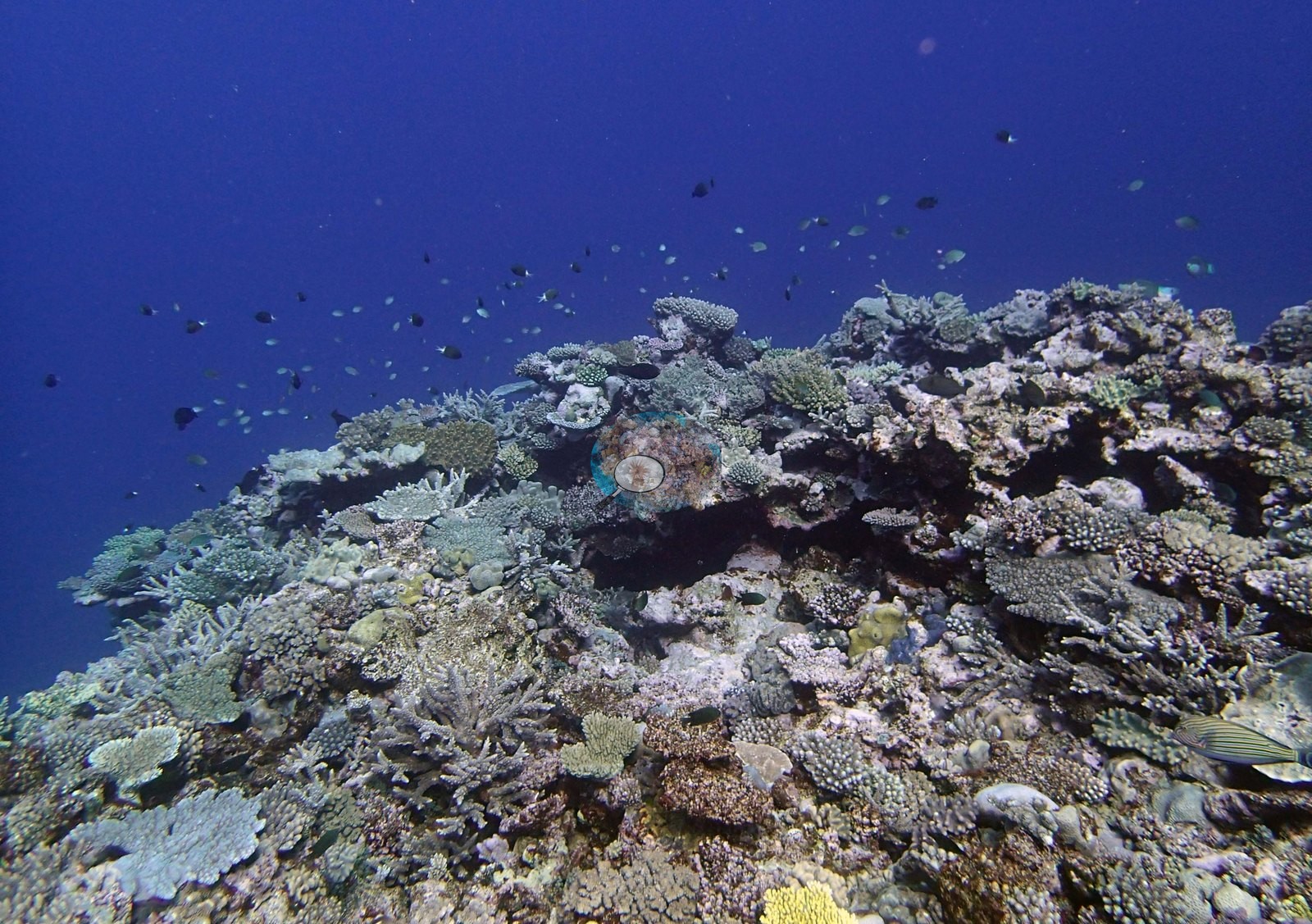
Wider frames show the structure: broad flat-topped mounds and spurs whose tops carry that acroporid carpet and whose flanks drop steeply into deep blue (e.g., Image 7, Image 10, Image 11, Image 19), one of them with a survey diver and a column of exhaust bubbles above the crest (e.g., Image 6, Image 16).
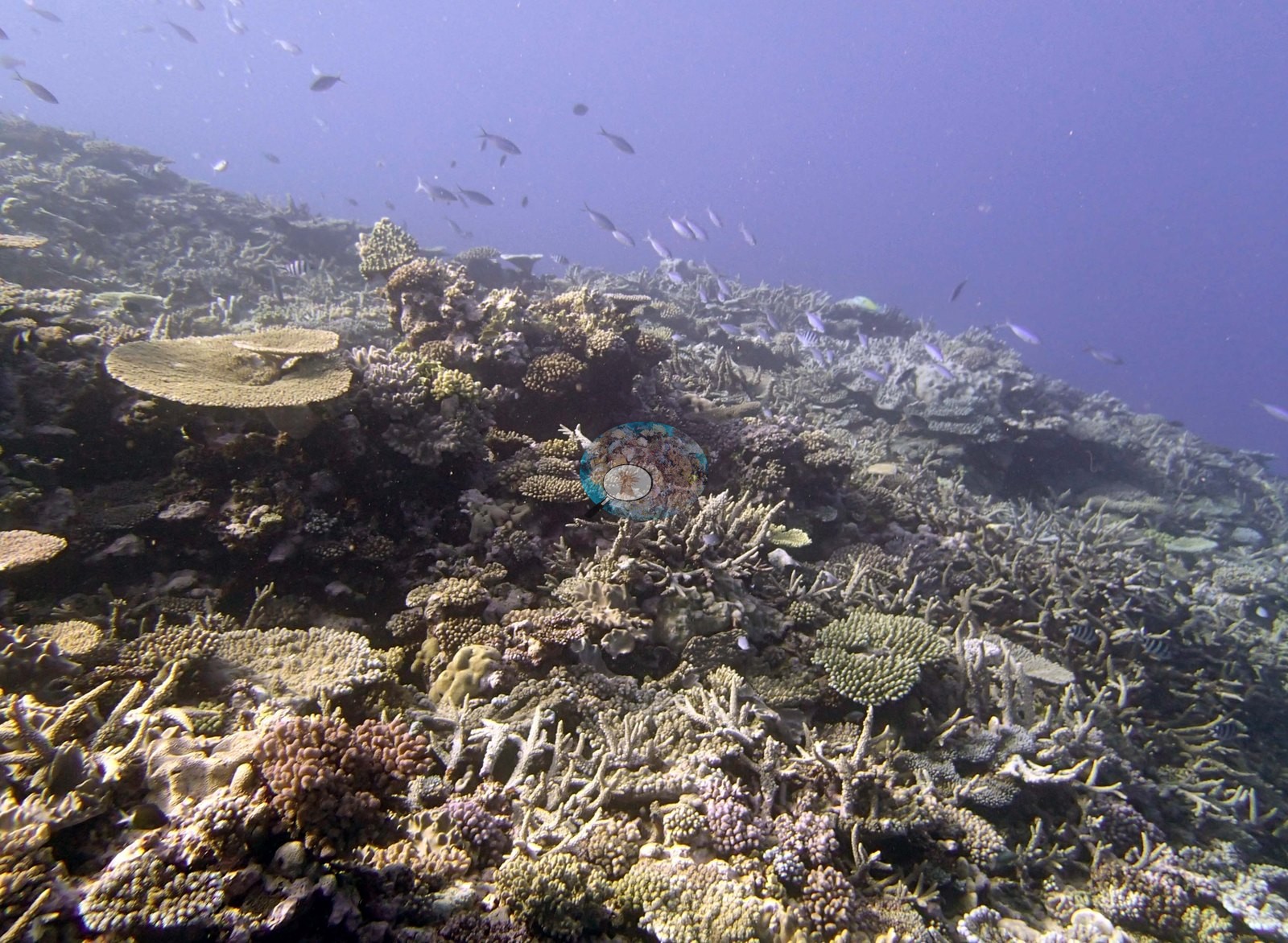
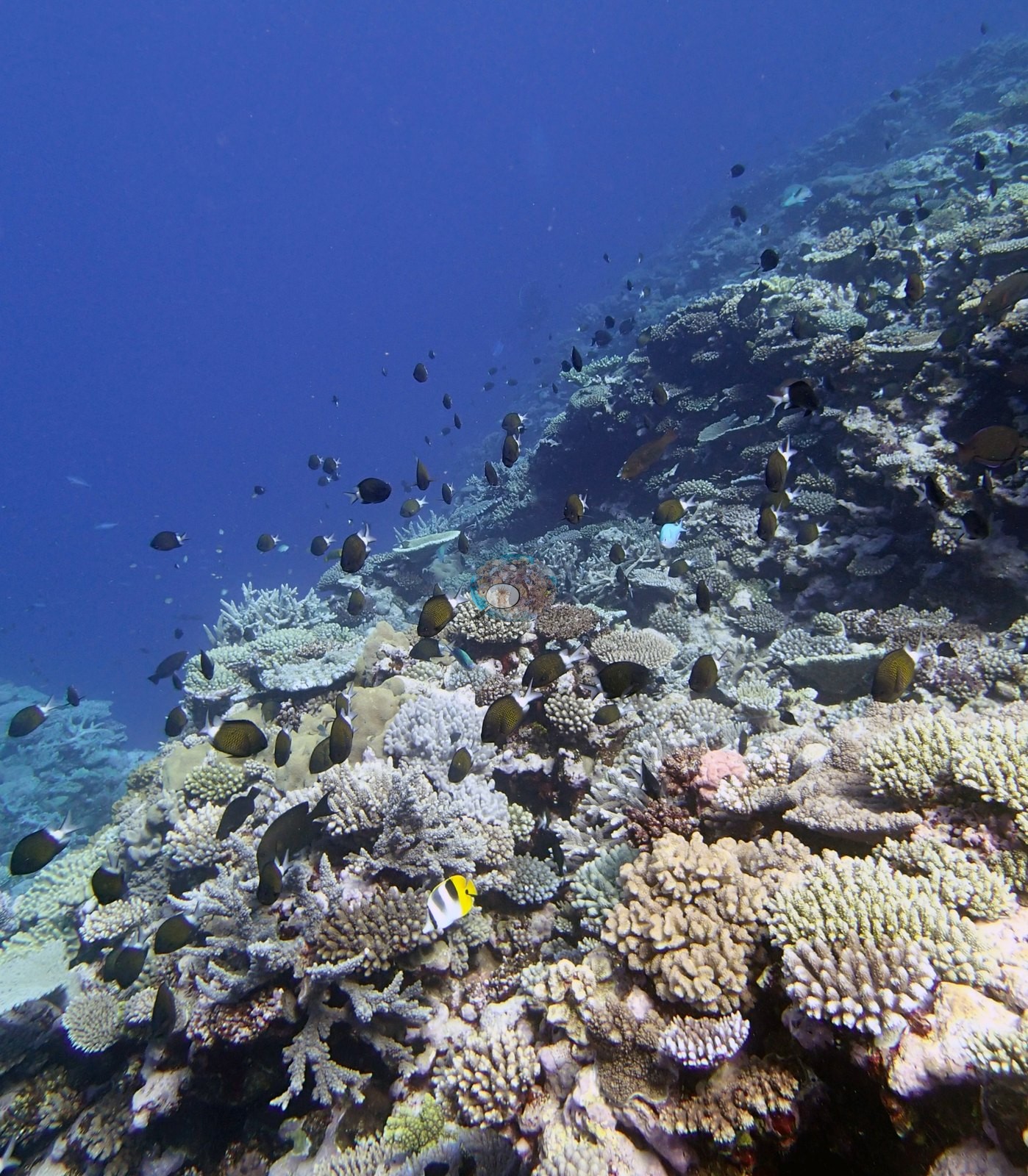
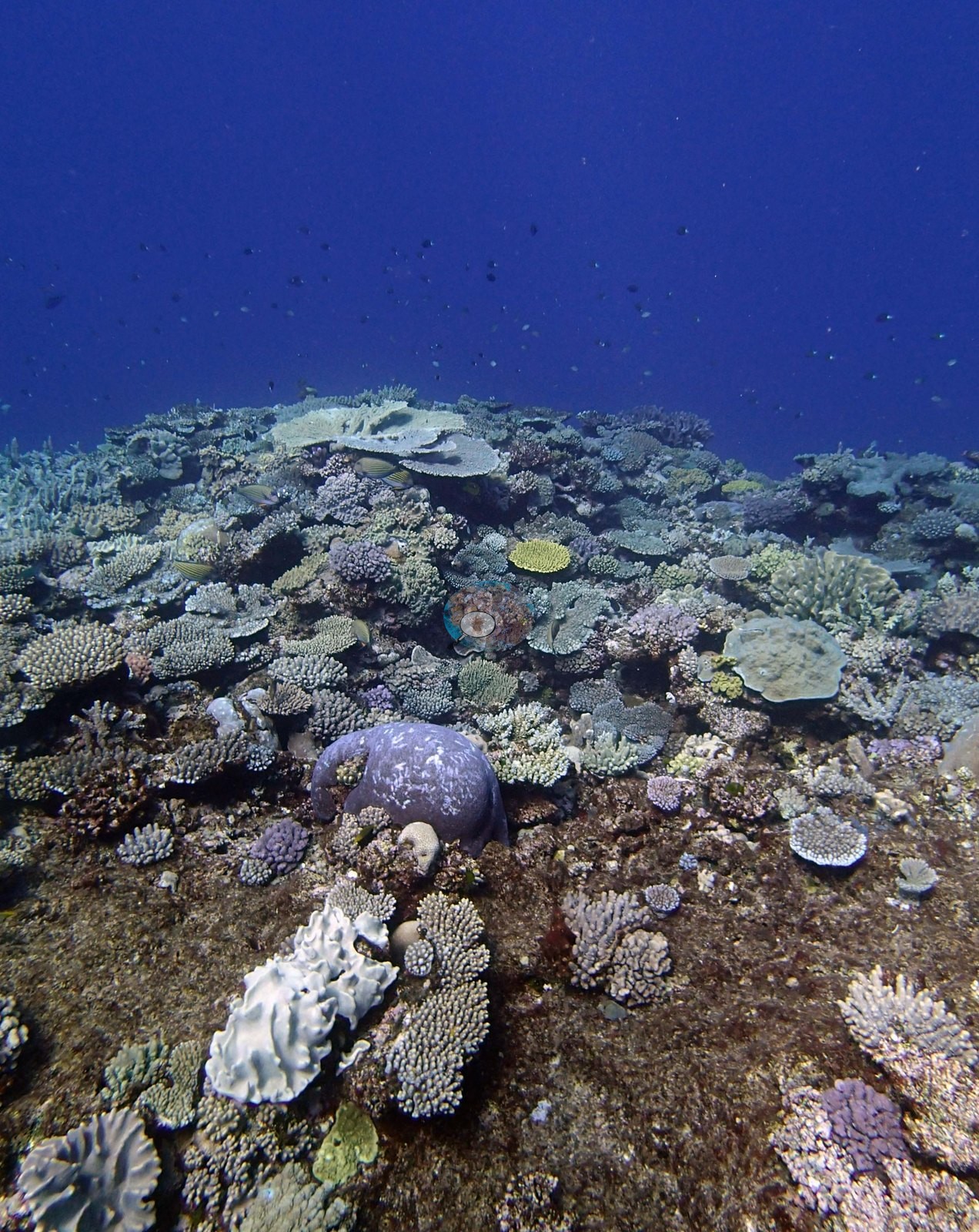
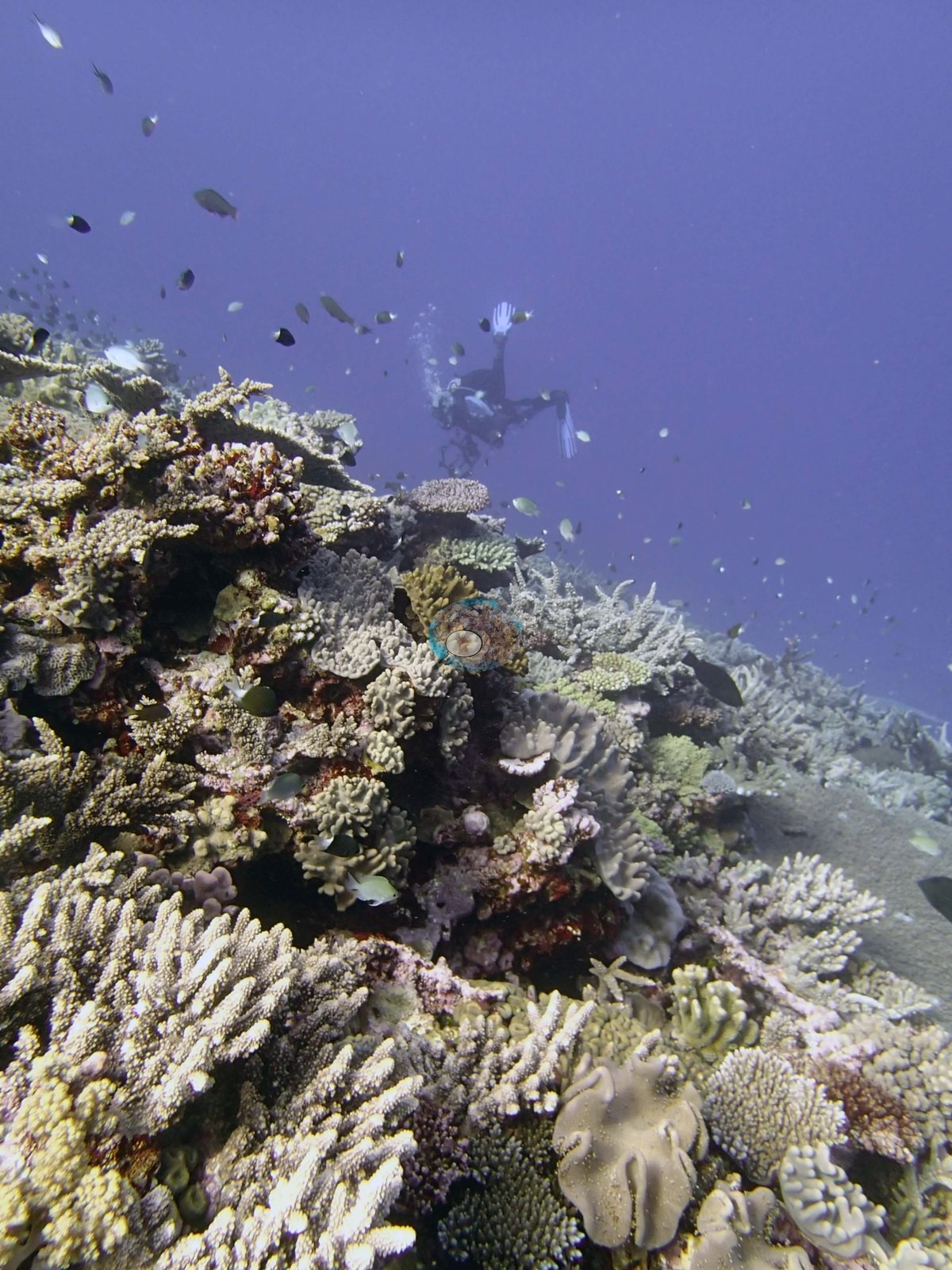
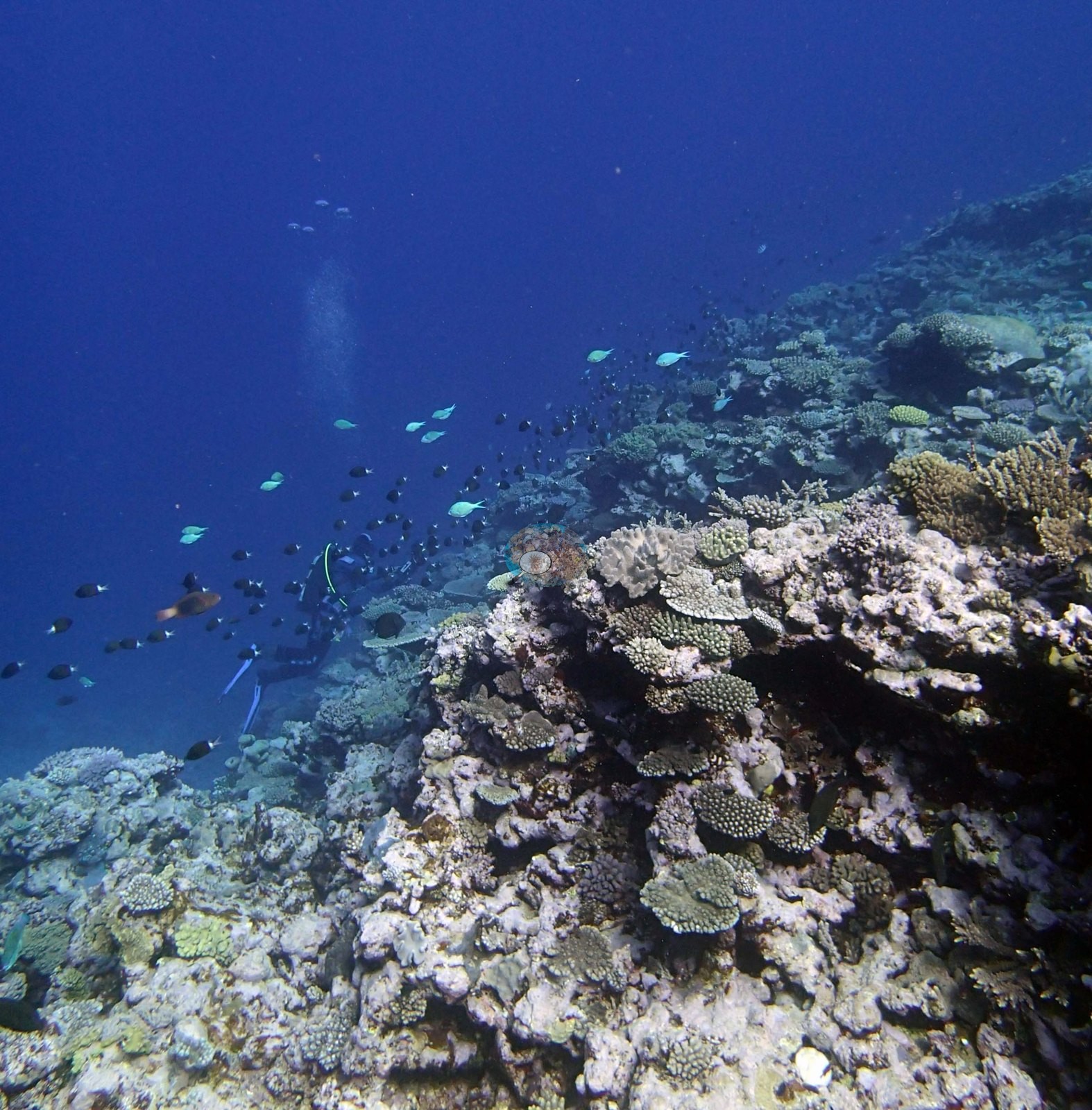
Larger set-pieces recur — meter-scale pale green and tan Acropora tables (e.g., Image 7, Image 10, Image 15), a lilac-purple massive head set among plating colonies (e.g., Image 19), a smooth lobed purple-gray soft-coral-form colony, and broad yellow-green tabulate plates beside cream ruffled foliose ones (e.g., Image 8).
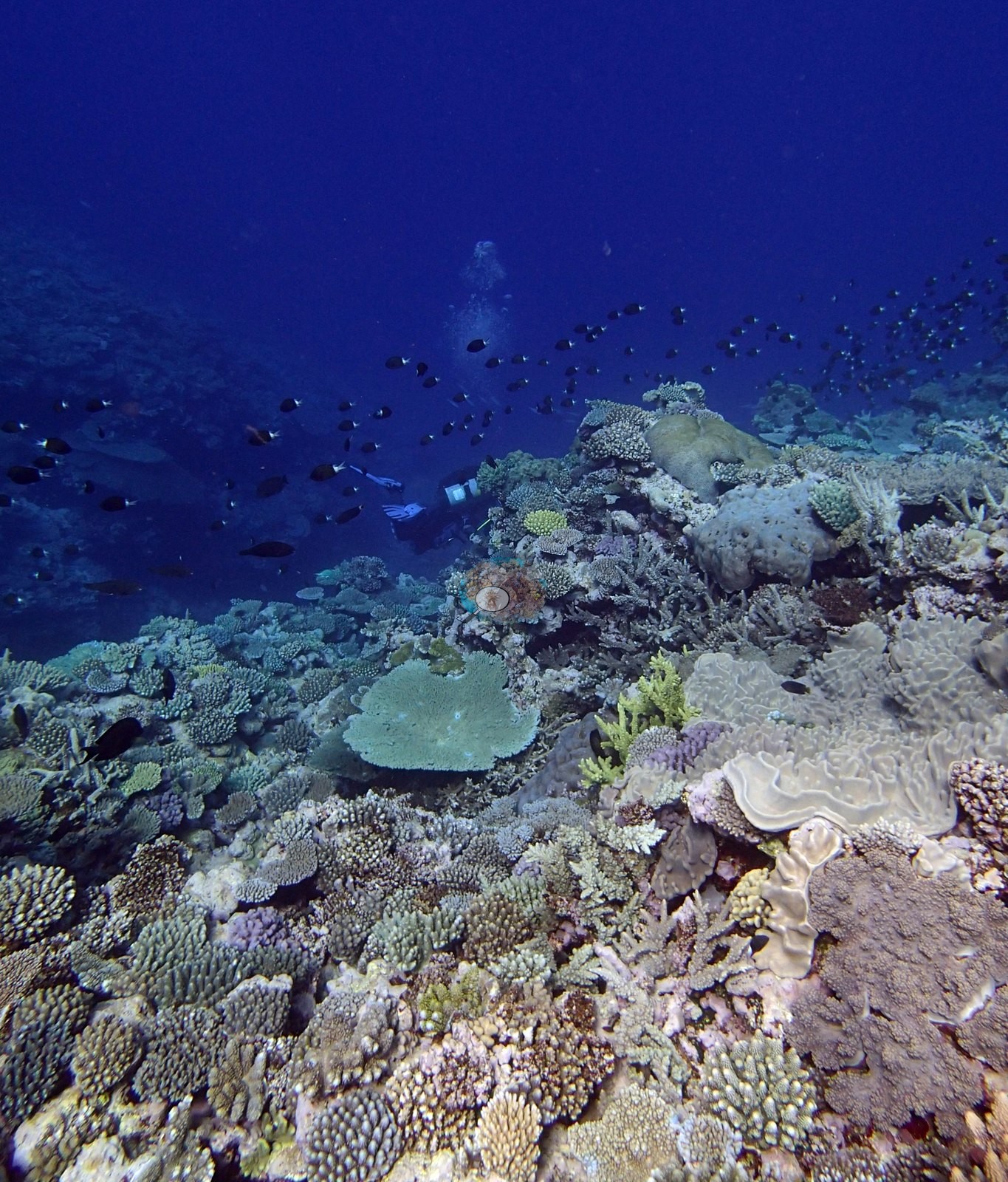
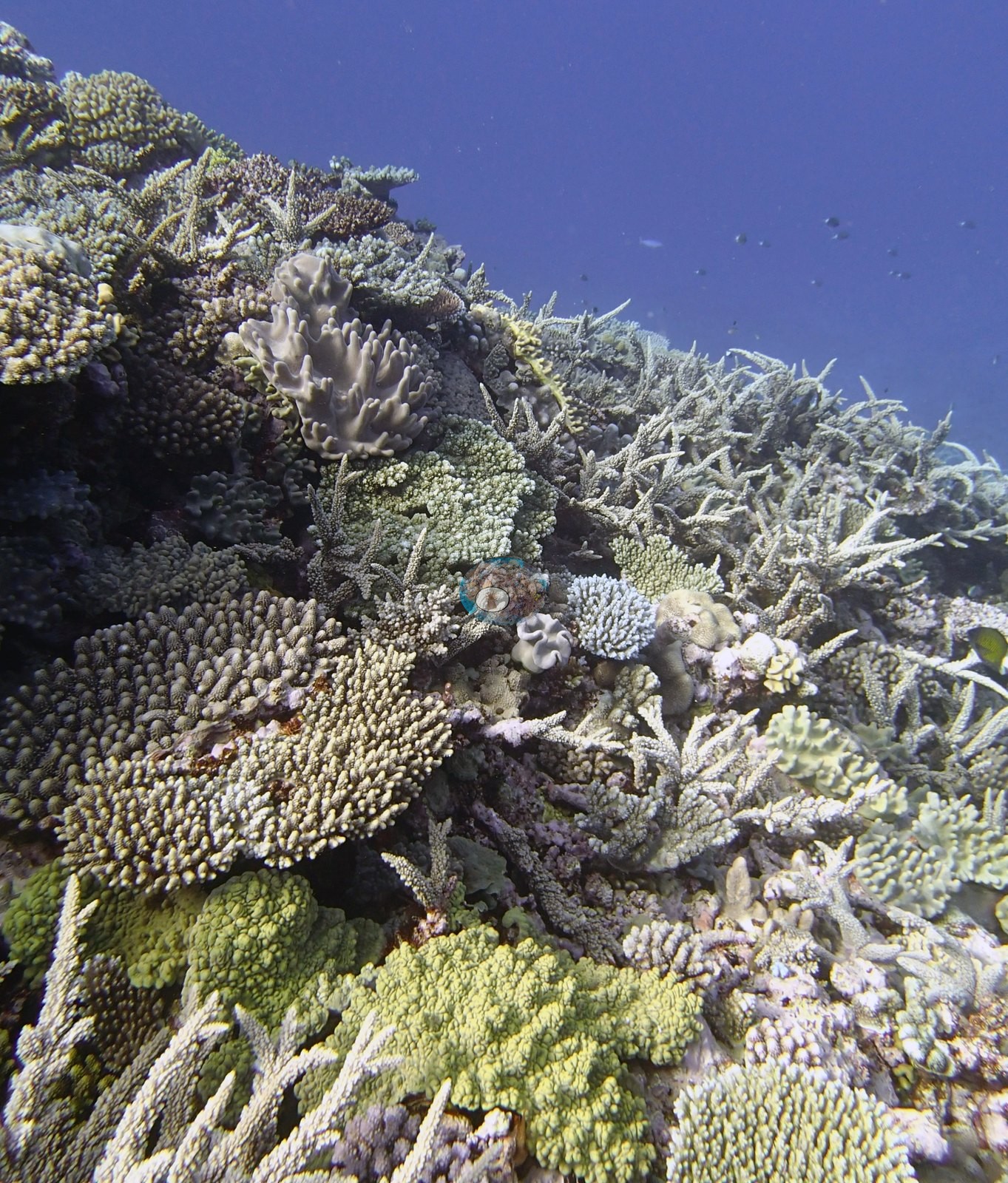
The staghorn is the other recurring feature. Several frames are filled by extensive interlocking stands of staghorn Acropora whose branches photograph pale gray-white against the green and olive colonies growing beneath them (e.g., Image 7, Image 9, Image 10, Image 19).
Coral cover
- Reference: Khaled bin Sultan Living Oceans Foundation, Global Reef Expedition (in situ transect)
- Coral cover 53%, from LOF-GRE in situ transects (the mean of all of this station's own transects in the expedition's per-transect benthic data) — a diver transect measurement, not a photographic or computer vision estimate. Coral Health Index 1.00/5 (Mayfield et al. 2021, Platax).
- Transect mean 53 ± 7.7% SE (n = 5 transects; Living Oceans Foundation per-transect benthic data); the headline above is this all-transect mean.
Stressors
The pale gray-white staghorn stands are bleached and still alive, by Anderson's reading of these frames (e.g., Image 9), and a ruffled colony in the foreground of Image 19 is bleached too (possibly a soft coral). It is worth reading alongside the site's own survey note, retained below, which records staghorn stands on the spur sides that are dead or partially dead and colonized by damselfish, and a small fraction of tables and staghorns dead in position. No bleaching percentage is offered or implied here. No crown-of-thorns starfish and no unambiguous disease lesion appears anywhere in the set. The 2013 survey notes for this site record corallivorous snails on some corals (under 1%) but no crown-of-thorns starfish or Culcita (Khaled bin Sultan Living Oceans Foundation expedition site notes, 2013; regional summary in Bruckner 2014). The Living Oceans Foundation transects here recorded no cyanobacteria and no recently dead coral.
Fish and other fauna
Fish are heavy in the water column: dense clouds of dark damselfish with pale tail bases and blue-green chromis over the coral in several frames (e.g., Image 16, Image 17, Image 18).
Comparisons with other data
Apart from the Living Oceans Foundation survey shown here, we found no other surveys at this site as of 2026. If you would like to share yours, please email us.
Other notes
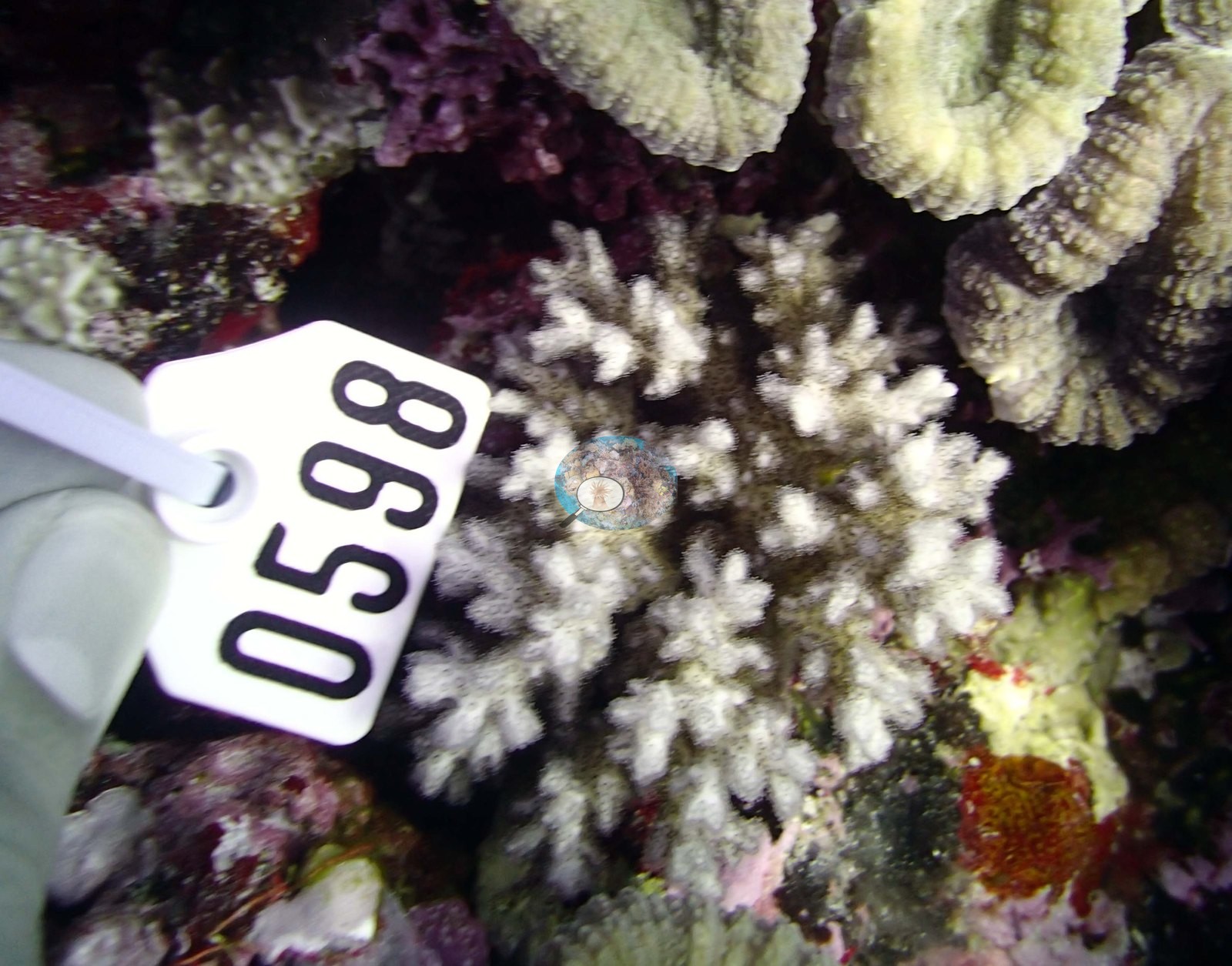
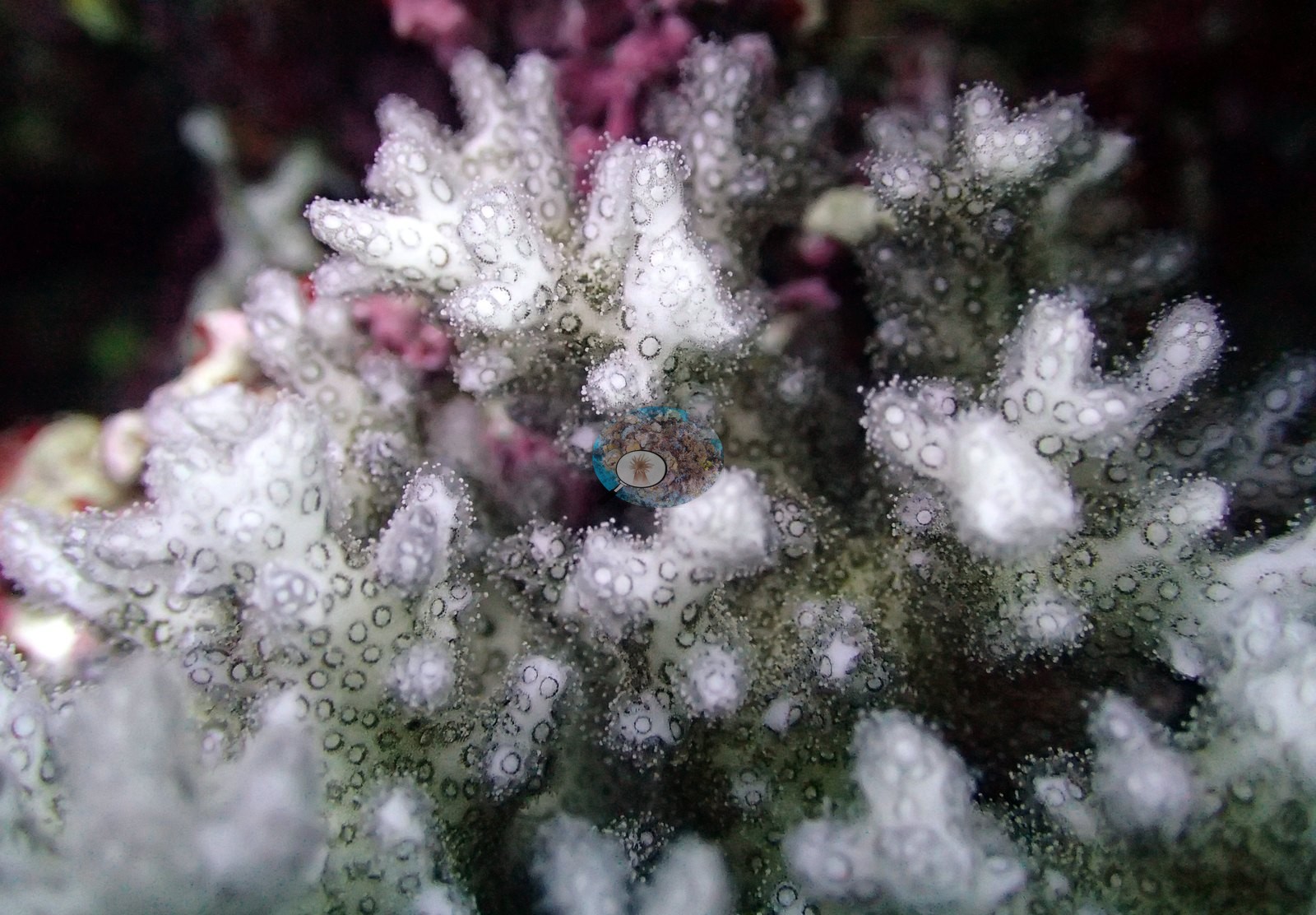
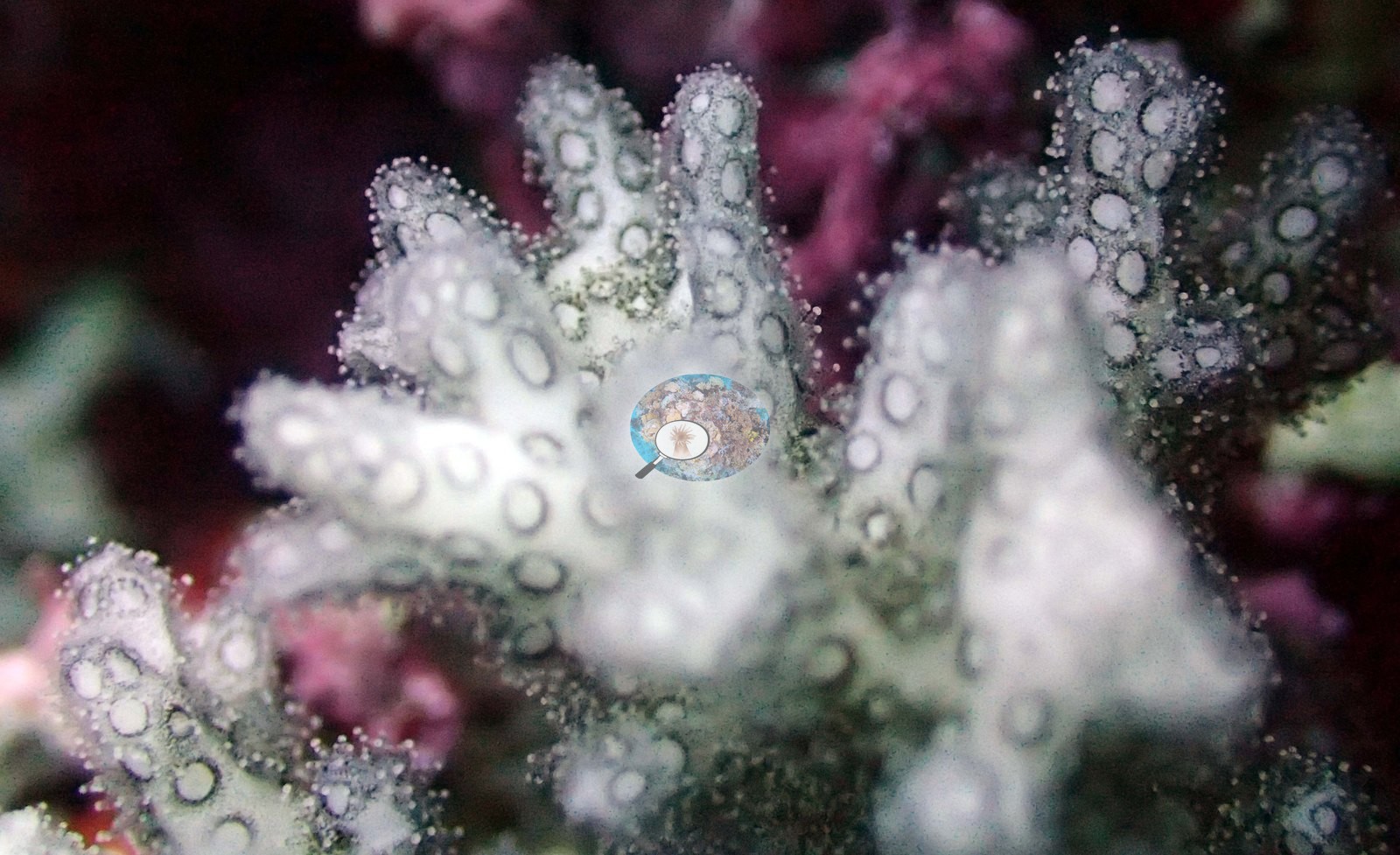
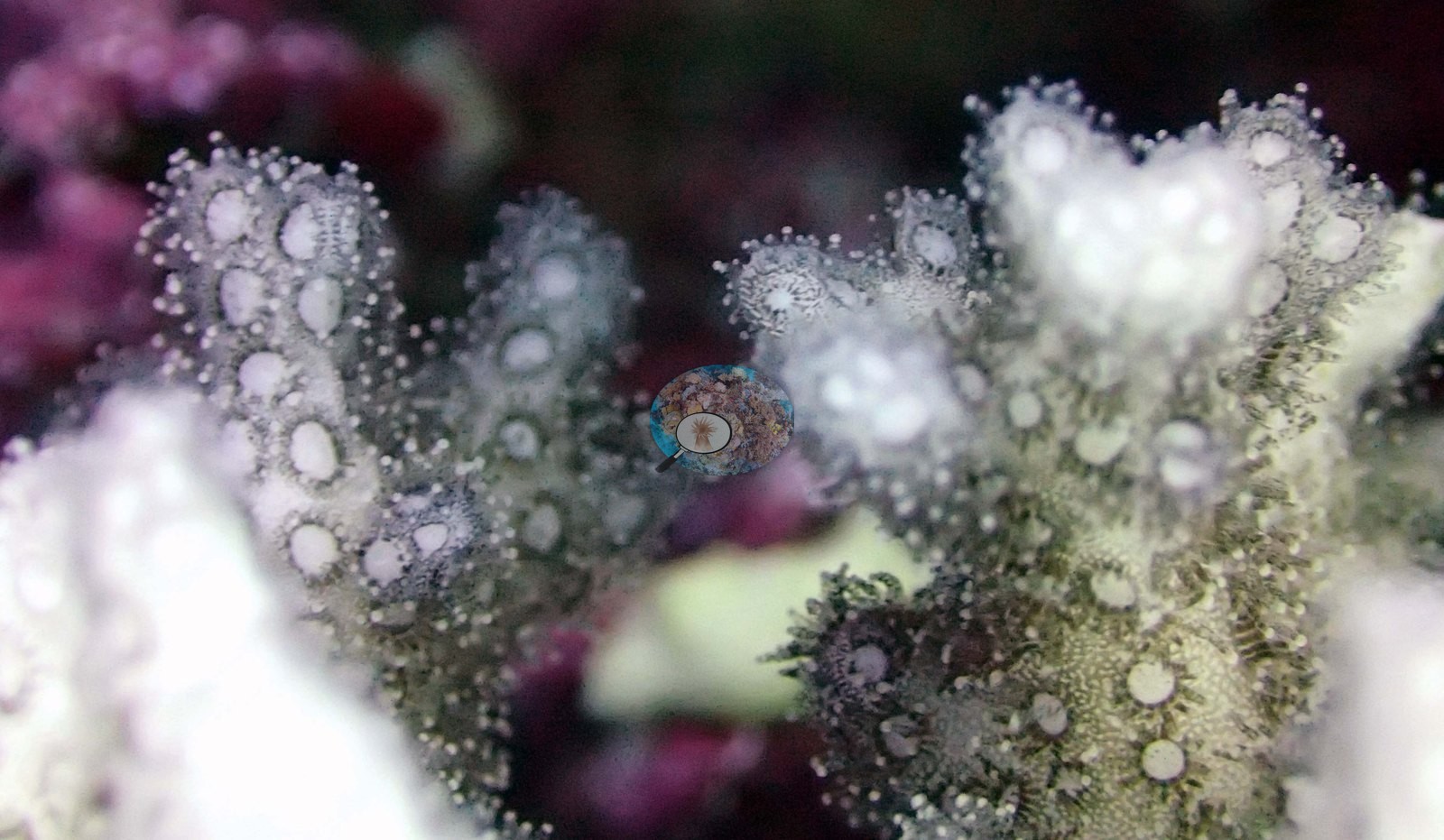
Survey team's site notes: Large mounds with flat tops at 6-8 m and steeply sloping sides extend to 15 m, then lower relief spurs slope gently to 35 m ending in sand and rubble. The shallow areas have large stands (some up to 10 m long) of staghorn and shorter branched acroporids intermixed with Pocillopora, other acroporids, and many massive species. Cover from 5-20 m is from 50-80% with 10-20% soft corals on shallow water and fewer in deep areas. At 20-30 m, cover drops to 30-40% with a dominance of large Lobophyllia (up to 1.5 m wide), intermixed with massives, plating Montipora, Echinophyllia, Goniastrea retiformis, table and staghorn acroporids, and other species. The sides and bases of spurs from 15-30 m have some stands of staghorn corals, but many of these are dead or partially dead and colonized by damselfish. About 5% of table acroporids and staghorns are dead in position, 2-3% have white syndrome or snail damage. No macroalgae, turf down deeper, CCA in shallow water. No macroalgae, good CCA, turf mainly near damselfish. Anderson sampled one colony here, colony 36 (P. acuta, 27 m), which the sheet records as "pale but likely healthy (very deep)", 0% bleached; Images 1-5 are that colony.
CV model comparison
More info
The photo row below is a methods comparison only: it is never averaged with the transect and never used as the headline. It compares site means only: the photos come from the same survey dive as the transect but not from the same points.| Method | Hard coral cover (%) | Photos (n) ± SE |
|---|---|---|
| Transect mean (all transects) | 52.8 | |
| CoralSCOP unedited | 28.9* | n = 16 · SE 1.6 |
| Claude (edited photos) | 48.1* | n = 16 · SE 5.7 |
The two computer-vision methods disagree by 19.2 pp (28.9–48.1%) and read 4.7–23.9 pp below the in-water transect (52.8%); the headline is the in-water transect because a diver transect is independent of the photographs.
*Based on only 16 reef-habitat photos; this estimate is less certain.
See a more detailed, stand-alone version of this table.
Data & links
- Download benthic survey data (CSV) ↗
- Download all LOF-GRE data (933 sites) ↗
- Photo portfolio ↗
- Coral Reef Diagnostics region page ↗
All images from Coral Reef Diagnostics. Data are from the Khaled bin Sultan Living Oceans Foundation Global Reef Expedition and Coral Reef Diagnostics.
 © Coral Reef Diagnostics.
References
- Mayfield AB, Dempsey AC, Chen CS (2021). Assessing coral health in the Kingdom of Tonga with a coral health index. Platax 18:53-78. DOI
- Bruckner AW (2014). Global Reef Expedition: Kingdom of Tonga. Field Report. Khaled bin Sultan Living Oceans Foundation, Landover, MD. 28 pp. PDF