
Part of the regional summaries: Australia (GBR) - Far North: Pink stations (Preservation Zone reefs) and Australia (GBR)
More info
Far Northern GBR (NOAA CRW virtual station)A scoured-looking reef platform holding 9-11 m depth for hundreds of meters, in an entry-restricted Preservation Zone, dived in a 2-3 knot current with 30 m visibility. Coral cover is 36% among algae and red cyanobacteria patches; a yellow-and-purple coral eel was the highlight, but several needle corals looked "terrible." Surveyed on the Living Oceans Foundation's Global Reef Expedition.
Eleven other CRD dive sites within 5 km shown in orange — click a marker to open its page.
🗺 Detailed map of the Global Reef Expedition dive sites, unnamed reefs 11-122, 11-096, and 11-091, northern Great Barrier Reef (Khaled bin Sultan Living Oceans Foundation; opens in a new window)
Site description
Setting
A reef platform that appeared scoured from the surface, stretching 9-11 m deep for hundreds of meters in every direction, this Preservation Zone reef fought back hard on this dive — a 2-3 knot current made the going tough, though visibility held at a clear 30 m. This is one of the GBR's most tightly protected zones: no entry without a permit, no take of any kind. The expedition's own site table classifies AU91111 as an outer barrier reef on an exposed aspect.
General benthic features
Alongside the hard coral already reported for this site, the same transects recorded 4.0% crustose coralline algae, 11% turf, 2.4% macroalgae, and 2.2% cyanobacteria. Non-living substrate came to 11% dead coral, 6.6% rubble, and 2.8% sand. These figures come from the expedition's own 933-site benthic master and are survey results, not photographic estimates.
Coral cover
- Reference: Khaled bin Sultan Living Oceans Foundation, Global Reef Expedition (in situ transect)
- Coral cover measured 36% in the point-count survey, built from the shallow-water 'usual suspects': Pocillopora eydouxi, Stylophora pistillata, Pocillopora damicornis, Acropora, and Isopora, with patches of red cyanobacteria and algae-covered pavement in between.
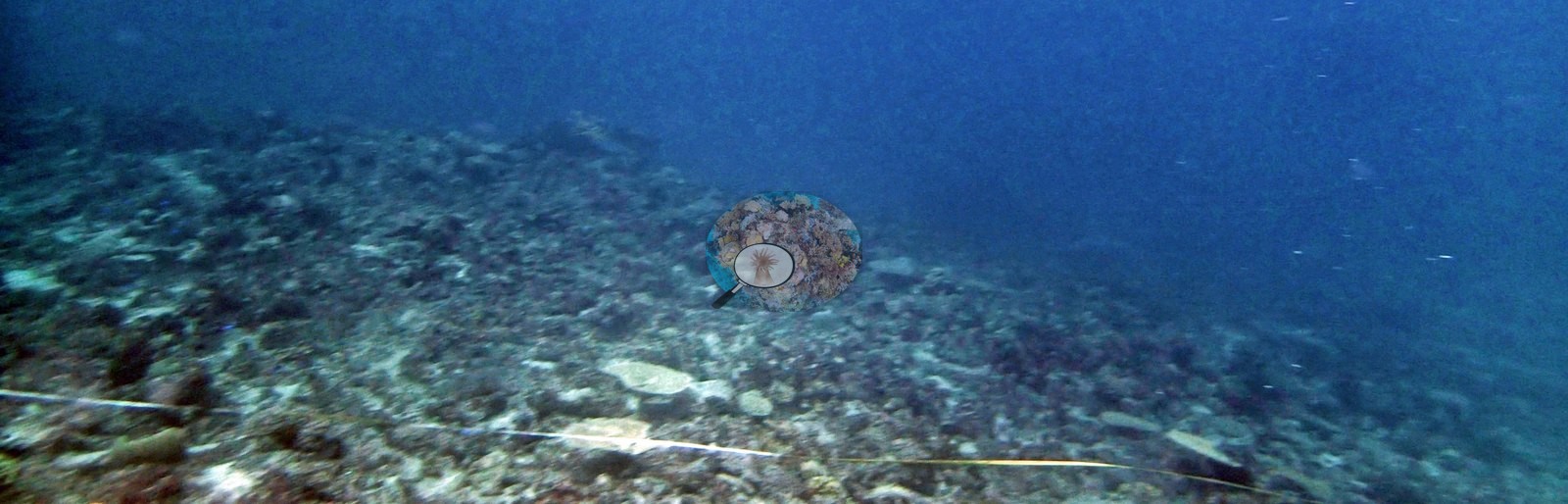
- The one wide benthic frame, taken low in the current, shows the survey tape running across that flat platform of pale pavement and rubble with scattered small colonies (e.g., Image 1).
- Transect mean 36 ± 4.4% SE (n = 9 transects; Living Oceans Foundation per-transect benthic data); the headline above is the expedition's station value.
Stressors
Less happily, his notes flag the needle corals: on his second transect (9.6 m) "S. caliendrum/hystrix both look terrible," and on his fifth (about 10 m) he listed Pocillopora damicornis, P. verrucosa, Seriatopora hystrix, and S. caliendrum with the note "all look sick/bleached." Many recruits at the site were dead, though these were not counted; his first and third transects also crossed patches of red cyanobacteria. No crown-of-thorns starfish (COTS) or other corallivores evident.
Fish and other fauna
A striking yellow-and-purple coral eel was the highlight sighting. Paired fish transects recorded about 32 fish species per transect and about 7.9 kg per 100 m2 of biomass.
Comparisons with other data
No prior survey data from this site. If you would like to share yours, please email us.
Data & links
- Download benthic survey data (CSV) ↗
- Download all LOF-GRE data (933 sites) ↗
- Photo portfolio ↗
- Coral Reef Diagnostics country page ↗
All images from Coral Reef Diagnostics. Data are from the Khaled bin Sultan Living Oceans Foundation Global Reef Expedition and Coral Reef Diagnostics.
 © Coral Reef Diagnostics.