
Part of the regional summaries: Australia (GBR) - Far North: Green stations (no-take reefs) and Australia (GBR)
More info
Northern GBR (NOAA CRW virtual station)A silty lagoon pocket on Ribbon Reef 7, no deeper than 12.3 m, built around dense, wrist-thick Acropora thickets, with algae close to twice the coral. Eight coral recruits were counted on five transects, and no bleaching, disease, or crown-of-thorns were reported. Surveyed on the Living Oceans Foundation's Global Reef Expedition.
Five other CRD dive sites within 5 km shown in orange — click a marker to open its page.
🗺 Detailed map of the Global Reef Expedition dive sites, Ribbon Reefs, northern Great Barrier Reef (Khaled bin Sultan Living Oceans Foundation; opens in a new window)
Site description
Setting
Global Reef Expedition station AUR706, a shallow, murky lagoonal site on Ribbon Reef 7, northern Great Barrier Reef (-15.2221, 145.7391), surveyed on 3 September 2014 in a no-take Green Zone.
General benthic features
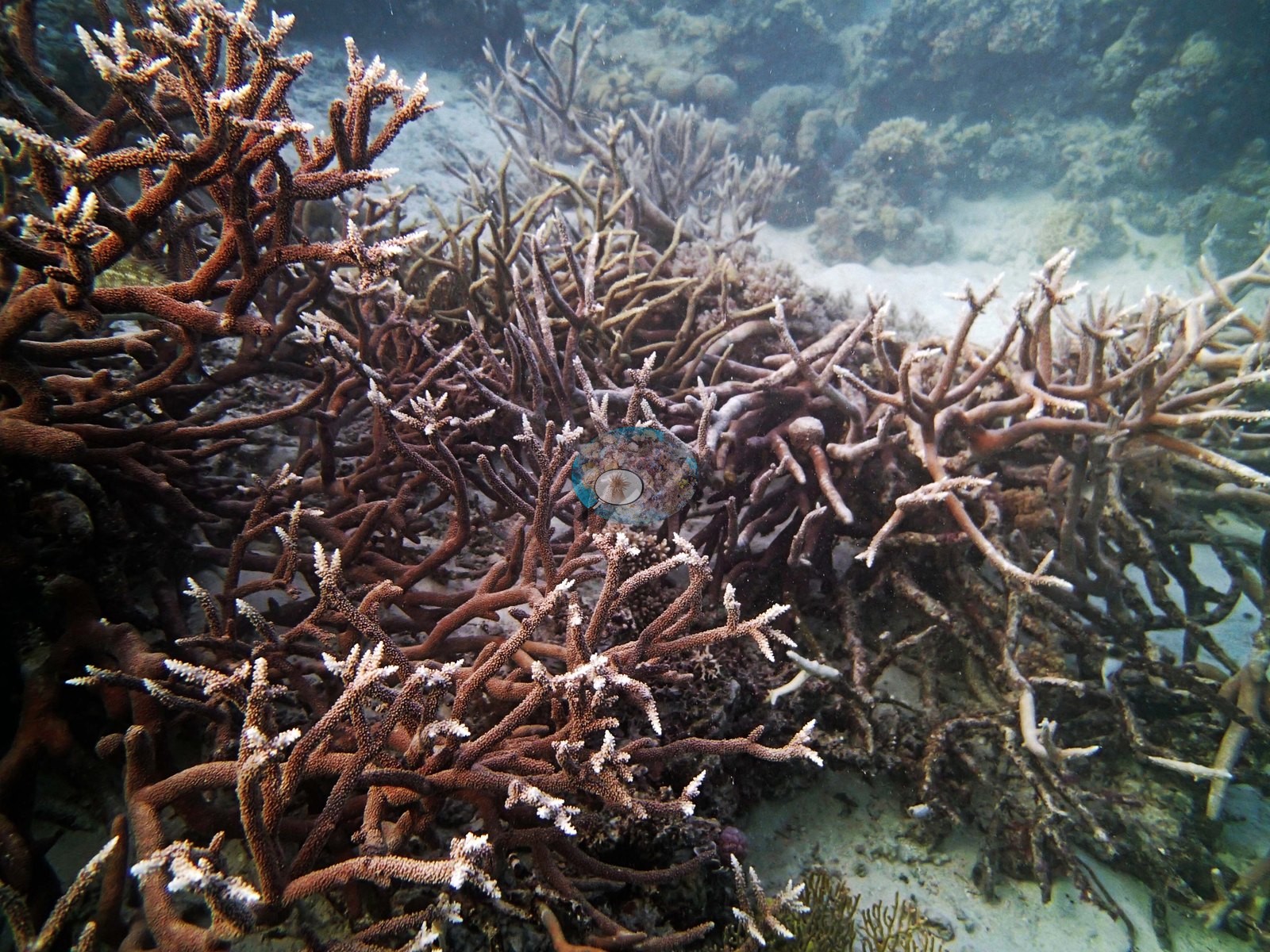
The reef was silty and no deeper than 12.3 m, built around dense, wrist-thick Acropora thickets with abundant Stylophora pistillata and Pocillopora damicornis and small massive Porites between. The one published frame shows a thicket of brown staghorn Acropora with pale growing tips over silty sand, with a few bare, algae-dusted branches among the living ones (e.g., Image 1).
Structural relief was high, and eight coral recruits were counted on five transects (1.6 per transect); no bleaching, disease, or crown-of-thorns starfish were reported.
Coral cover
- Reference: Khaled bin Sultan Living Oceans Foundation, Global Reef Expedition (in situ transect)
- The in situ benthic transects recorded 22% live coral cover against a 41% algal fraction on a dive to 12.3 m — algae close to twice the coral fraction.
- One transect was scored at this station (22%; n = 1, so no SE; Living Oceans Foundation per-transect benthic data); it is the expedition's station value printed above.
Stressors
Regional context, not an observation here: surveyed about eighteen months before the 2016 mass bleaching, an event that severely bleached hundreds of reefs on the northern Great Barrier Reef (Hughes et al. 2017); 5-year mean annual maximum thermal stress at the Northern GBR virtual station is 7.8 degree heating weeks.
Comparisons with other data
No prior survey data from this site. If you would like to share yours, please email us.
Other notes
Anderson's notes record the site as found well off its charted GBRMPA coordinates, so the mapped position is approximate.
Data & links
- Download benthic survey data (CSV) ↗
- Download all LOF-GRE data (933 sites) ↗
- Photo portfolio ↗
- Coral Reef Diagnostics country page ↗
All images from Coral Reef Diagnostics. Data are from the Khaled bin Sultan Living Oceans Foundation Global Reef Expedition and Coral Reef Diagnostics.
 © Coral Reef Diagnostics.