
Part of the regional summaries: Australia (GBR) - Far North: Green stations (no-take reefs) and Australia (GBR)
More info
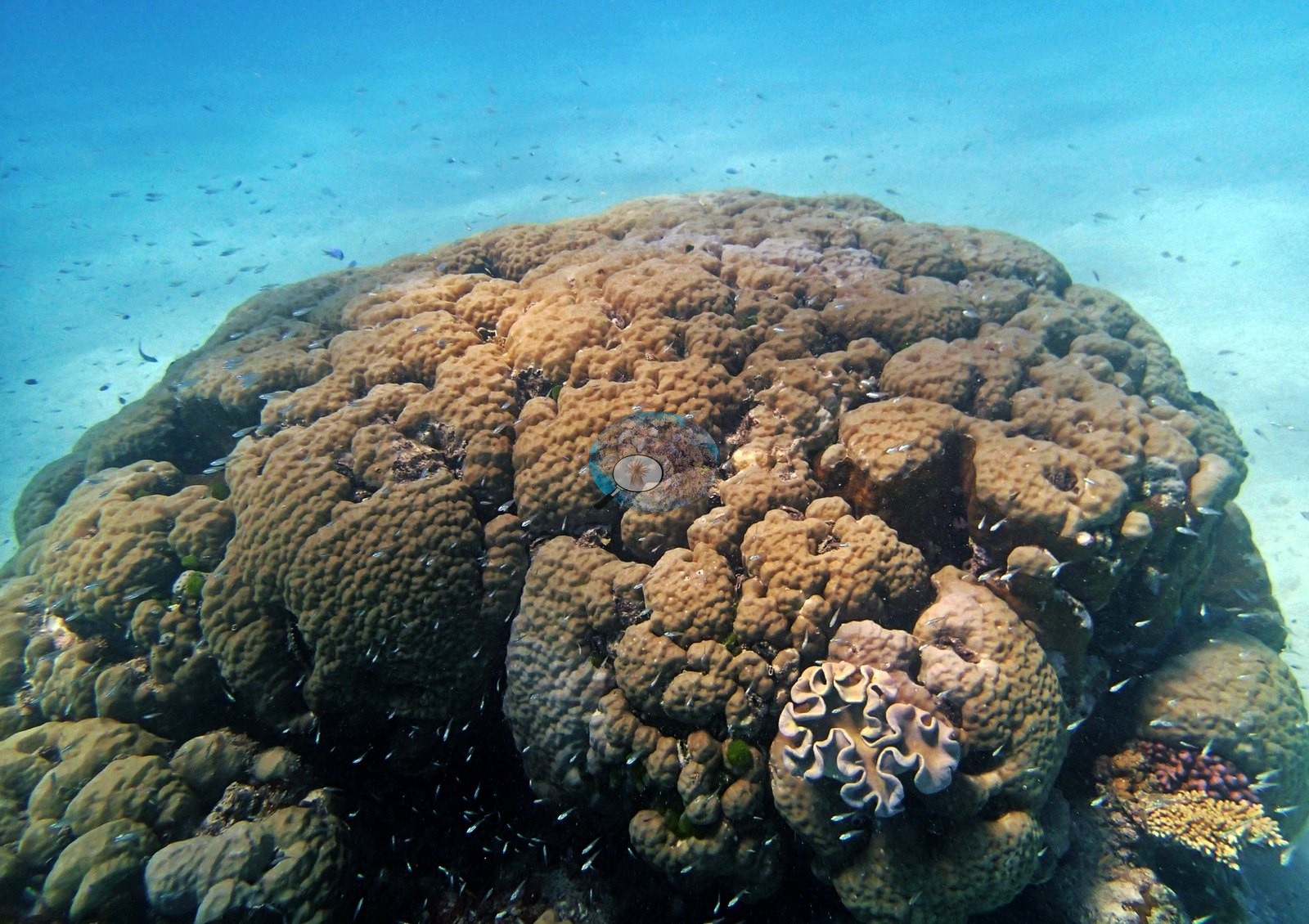
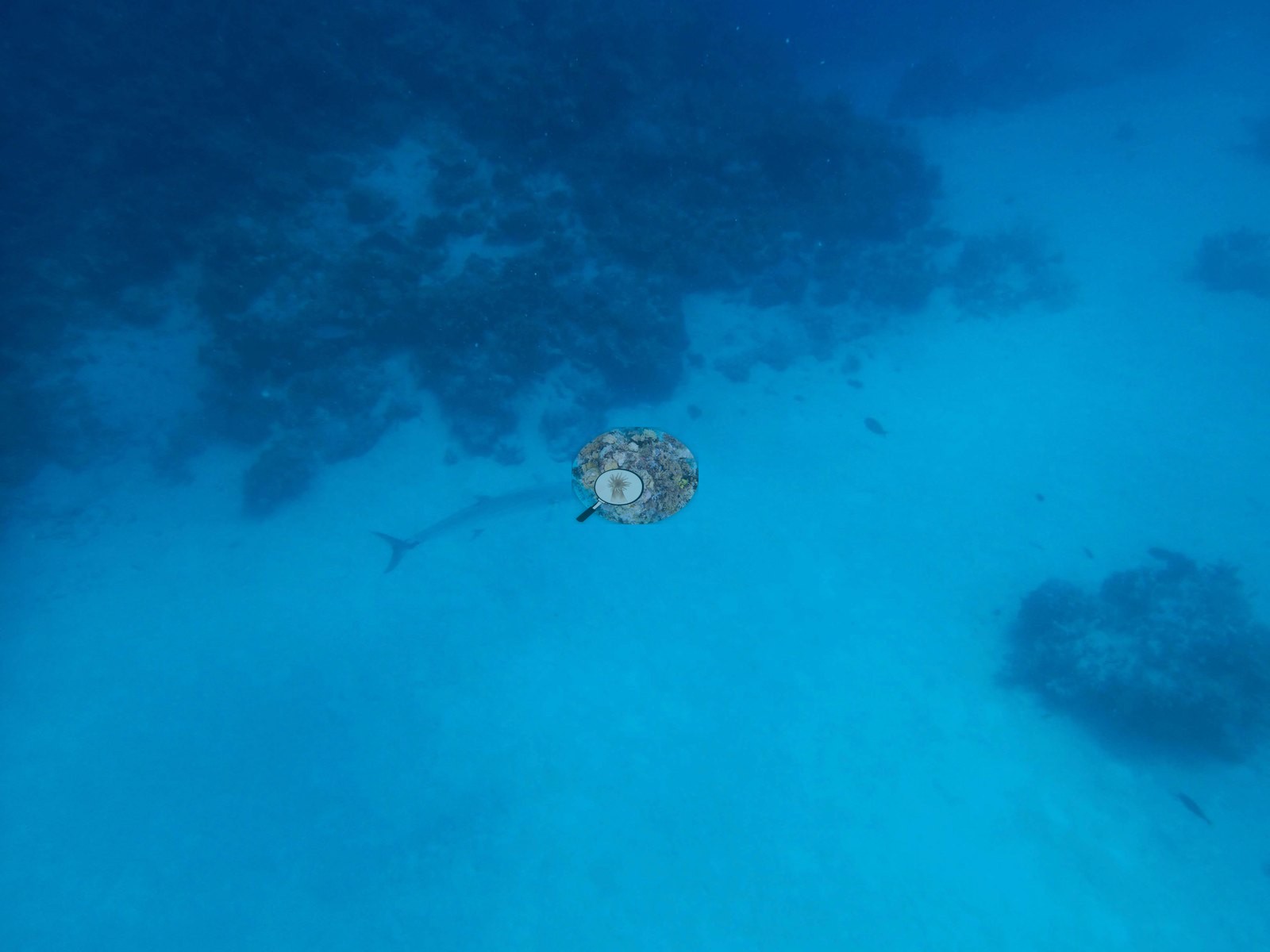
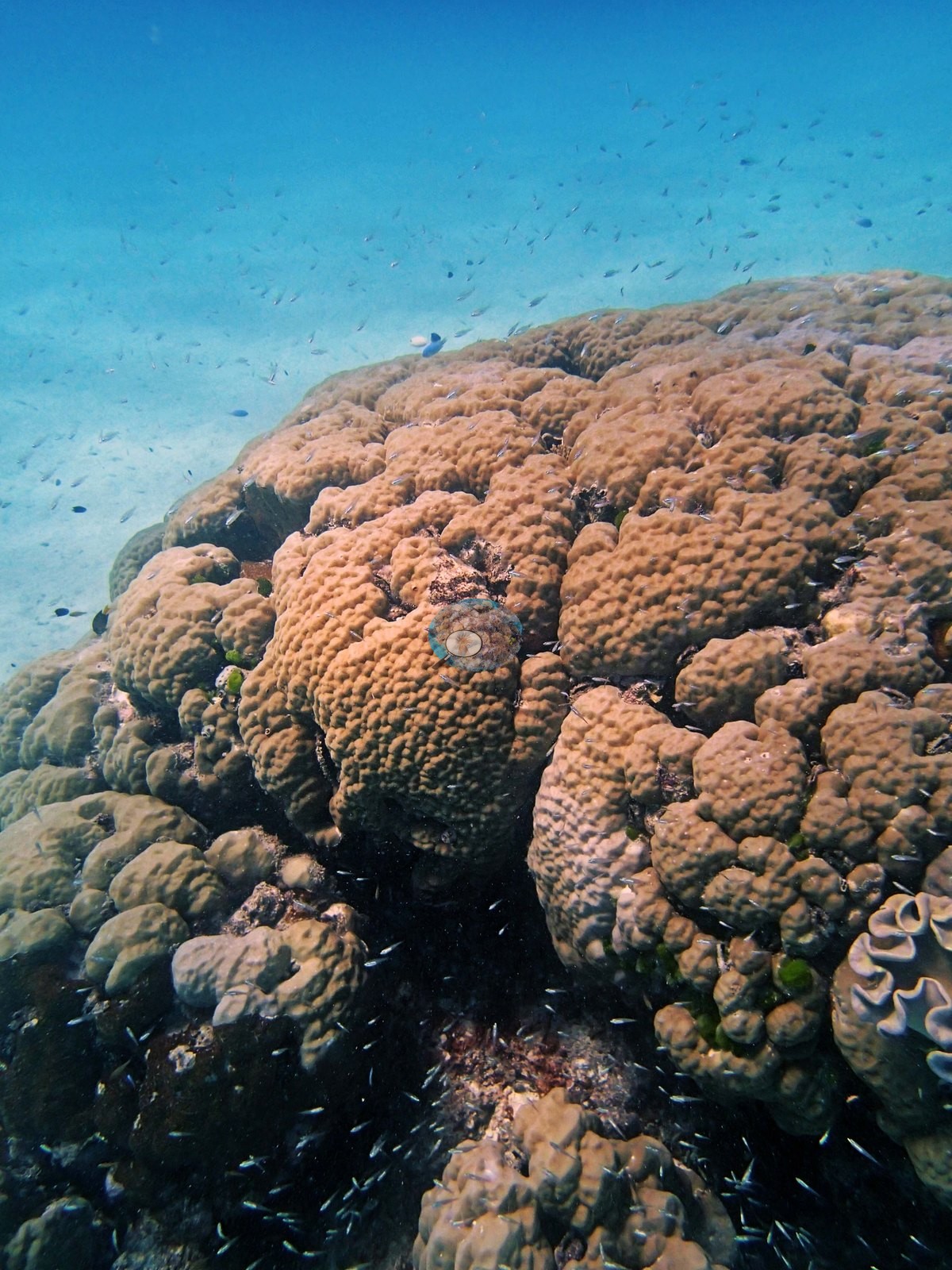
Northern GBR (NOAA CRW virtual station)On Ribbon Reef No. 7's intermediate-exposure flank, isolated coral heads sit in open white sand, some crowned by massive Porites domes several meters across and others packed with branching Acropora, encrusting sheets, and pink soft corals. Most coral looks normally colored; one partly bleached branching colony stands out. Surveyed on the Living Oceans Foundation's Global Reef Expedition.
Five other CRD dive sites within 5 km shown in orange — click a marker to open its page.
🗺 Detailed map of the Global Reef Expedition dive sites, Ribbon Reefs, northern Great Barrier Reef (Khaled bin Sultan Living Oceans Foundation; opens in a new window)
Site description
Setting
This is a no-take Green Zone: look, dive, photograph — but nothing leaves the water.
General benthic features
Thirteen frames from Ribbon Reef No. 7's intermediate-exposure flank, and they are consistent with the seascape already on record: isolated coral heads set in open white sand rather than a continuous reef. One frame looks down through clear blue onto that pattern directly — pale sand with dark bommies scattered across it and a fish crossing the gap (e.g., Image 1).
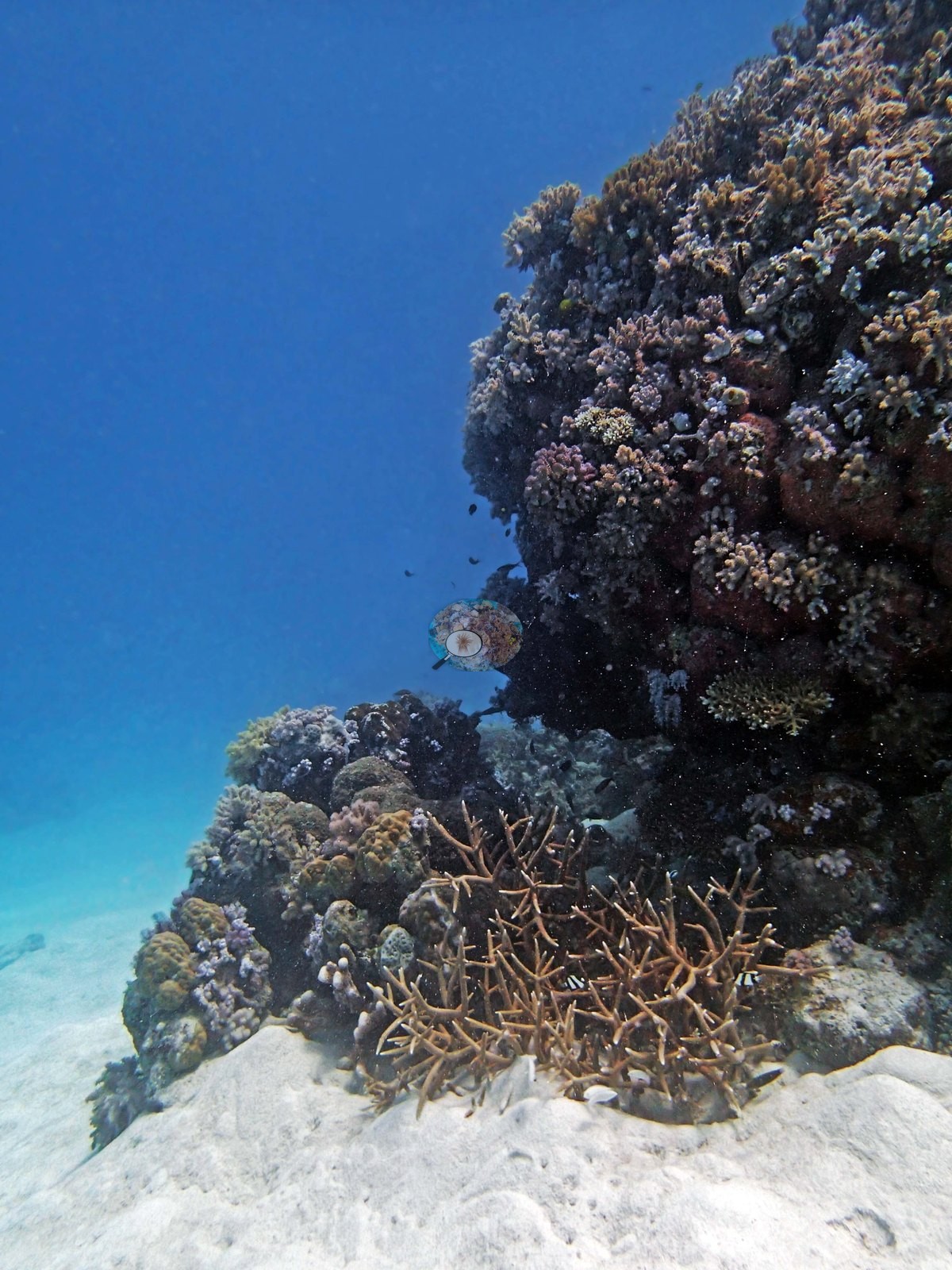
The strongest structural frames are each filled by a large massive Porites dome, lobed and knobbly, several meters across, with smaller colonies, and a fluted colony packed at its base and small planktivores hanging over it (e.g., Image 10, Image 11).
One frame shows the survey itself: a diver holding the PVC quadrat frame up against the flank of an isolated coral head, with open sand on either side (e.g., Image 4).
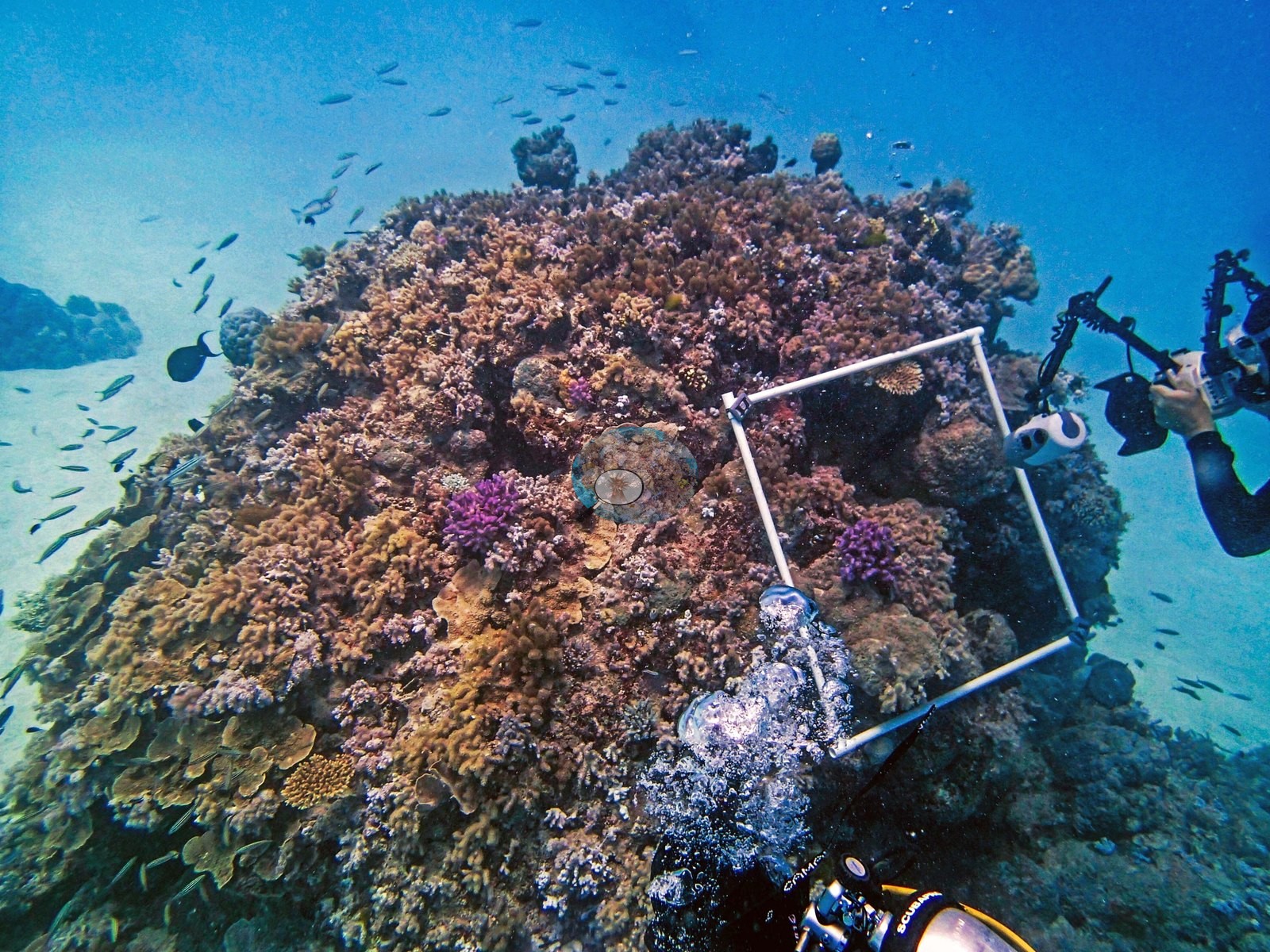
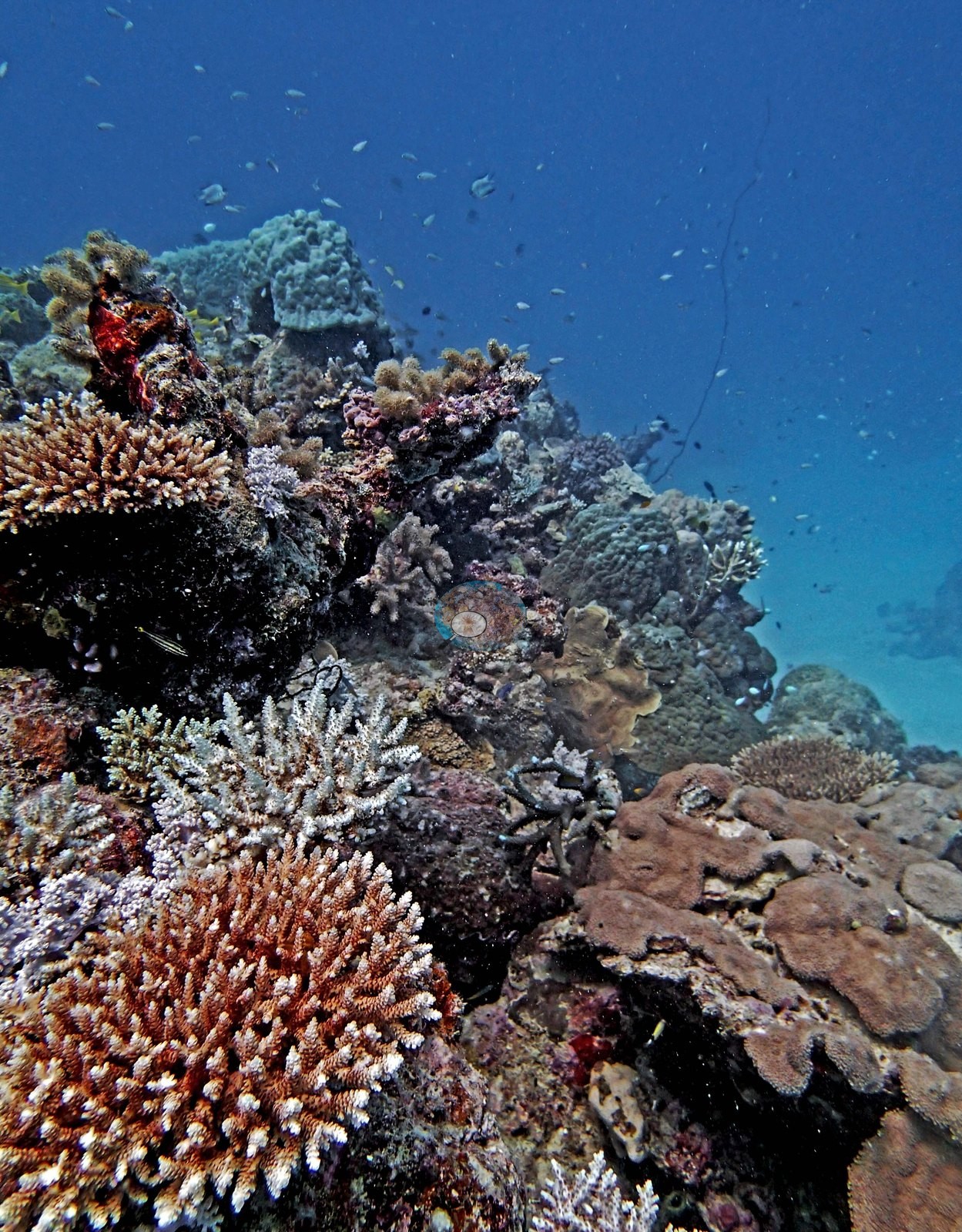
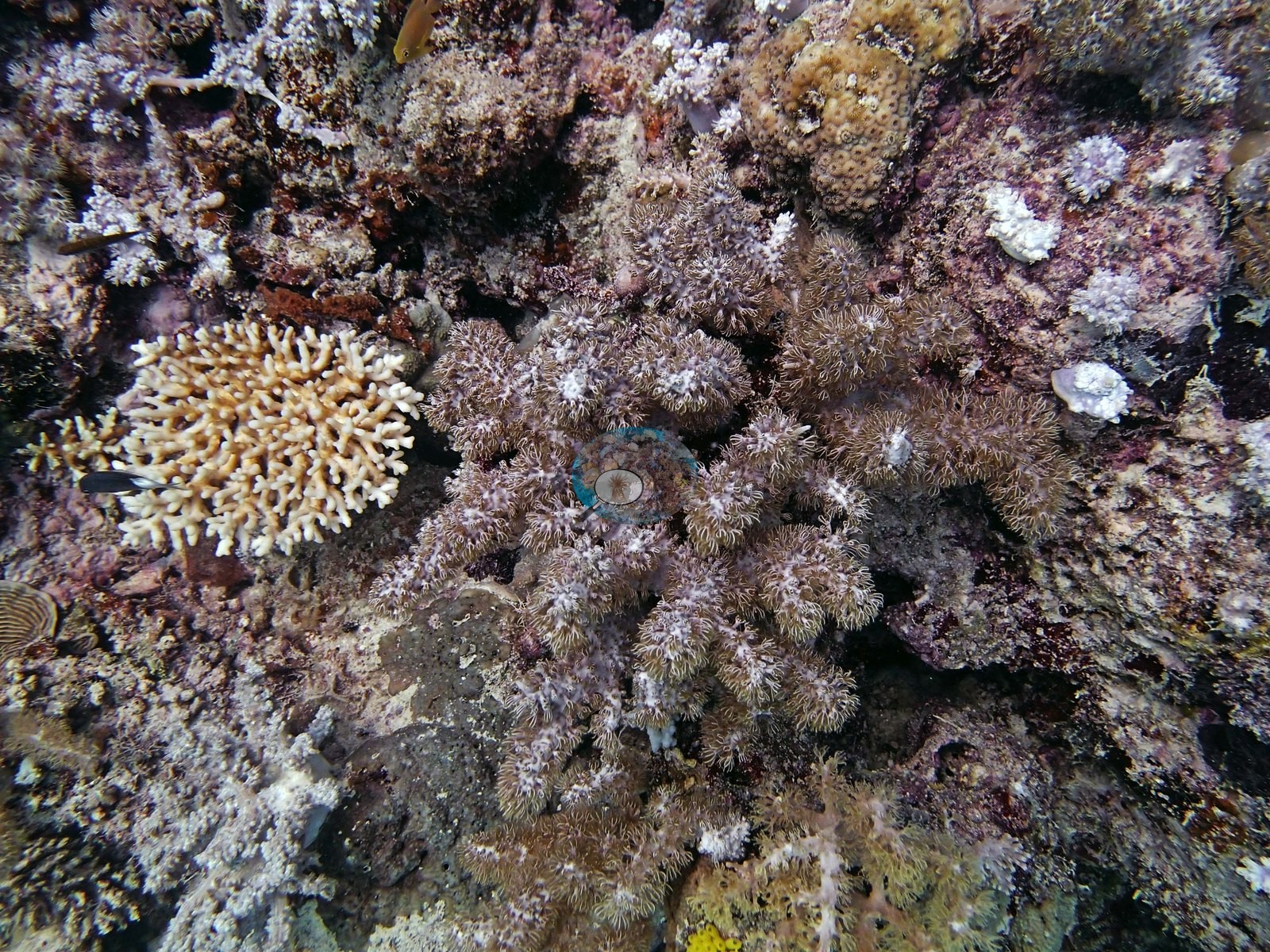
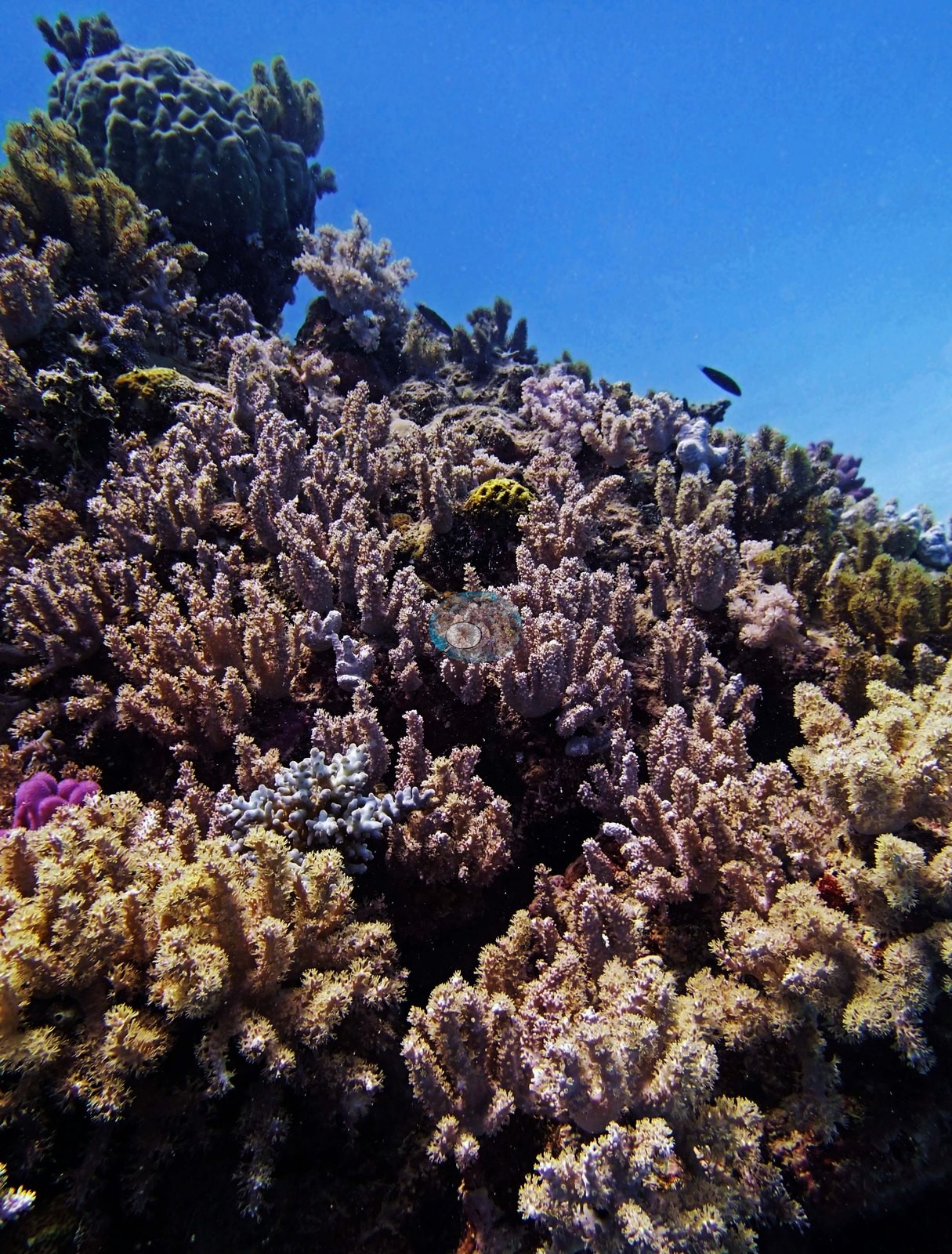
The close frames show what the bommie surfaces actually carry. Three are dense mixed assemblages — tan and cream corymbose and digitate Acropora, purple-gray branching colonies, encrusting sheets, small massives, and low soft corals, packed over crusted framework with very little clean space (e.g., Image 3, Image 5, Image 6).
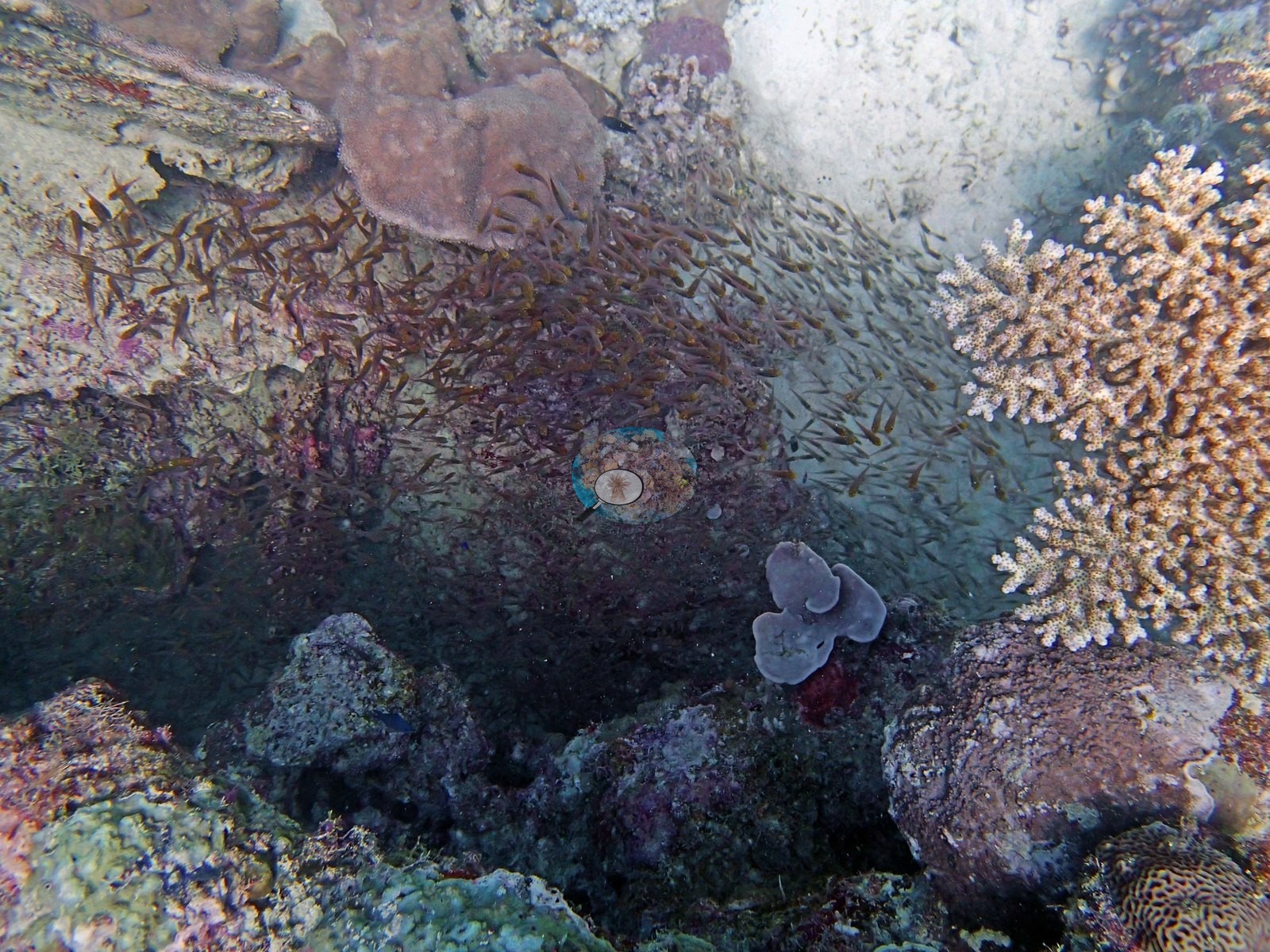
In a crevice between heads, a cloud of small glassy baitfish hung between a cream branching Acropora and a lilac leathery soft coral (e.g., Image 2).
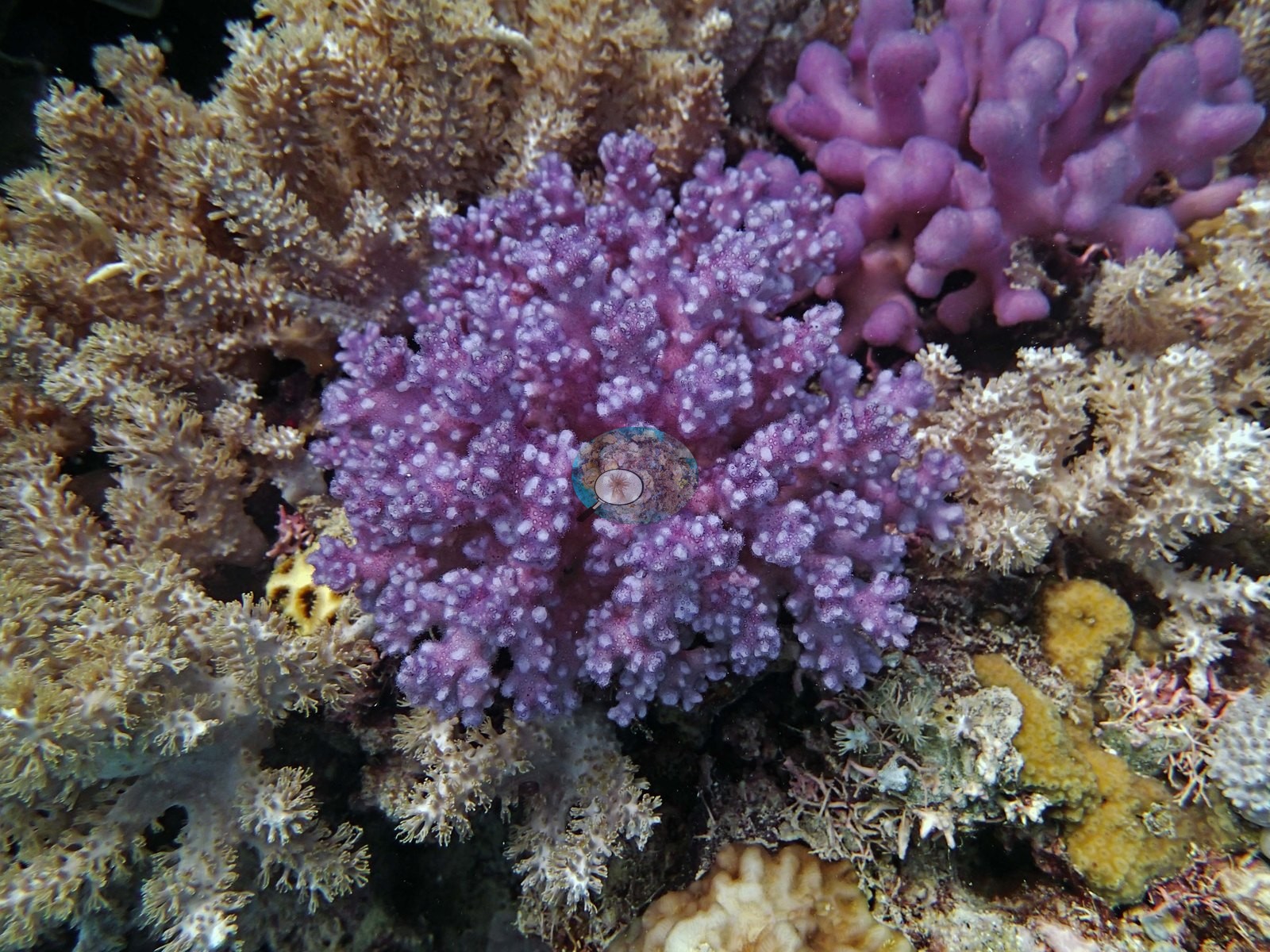
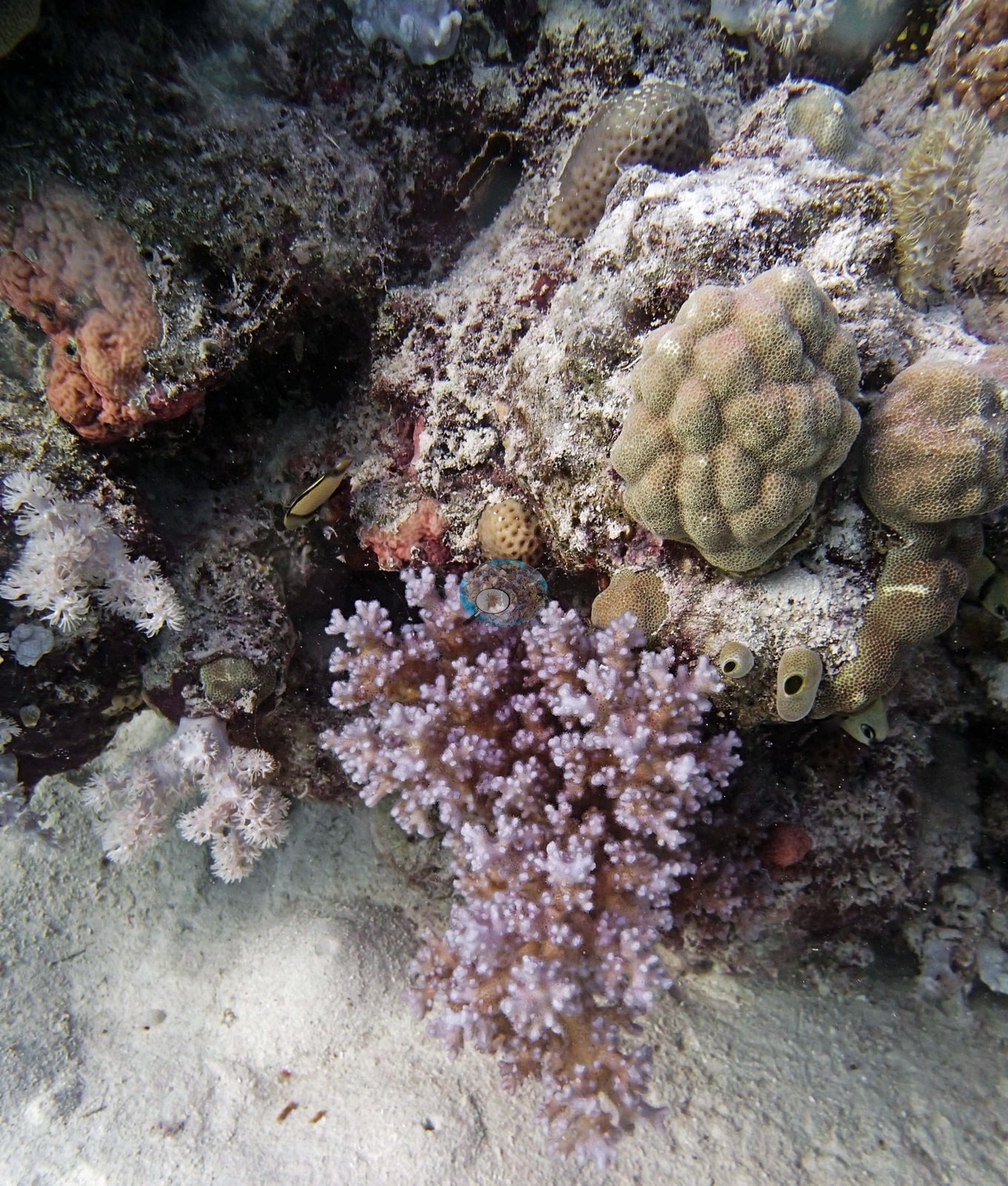
Soft corals are a real presence here rather than a footnote: in one frame, tan and cream branching soft corals ring a vivid purple branching hard coral and a lilac finger-shaped colony (e.g., Image 7), and at the sand line, small white soft corals flank a lilac branching colony and pale knobby massives (e.g., Image 12).
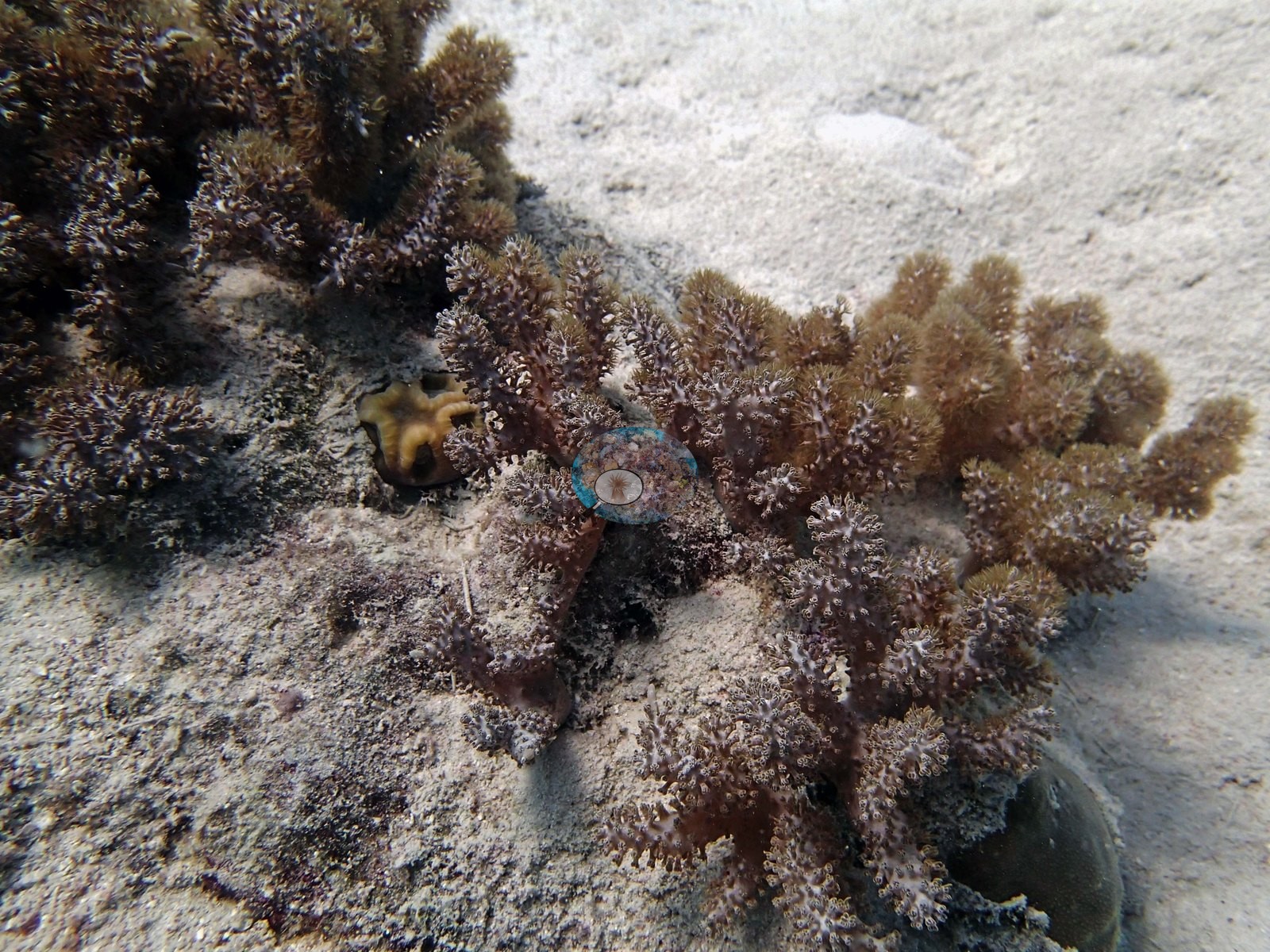
Three frames catch colonies growing right at the sand margin: a tufted brown branching colony spread across the sand (e.g., Image 8), a stand of staghorn Acropora at the foot of a tall bommie (e.g., Image 9), and a pale branching Acropora stand on sand (e.g., Image 13).
Coral cover
- Reference: Khaled bin Sultan Living Oceans Foundation, Global Reef Expedition (in situ transect)
- Coral cover 44%, from the LOF-GRE in situ point-count transects (Global Reef Expedition site data, 933 sites); it is not derived from these photographs.
- Algal cover 38% from the same transect.
- Transect mean 45 ± 6.5% SE (n = 3 transects; Living Oceans Foundation per-transect benthic data); the headline above is the expedition's station value (the headline weights each depth equally; one depth had a single transect).
Stressors
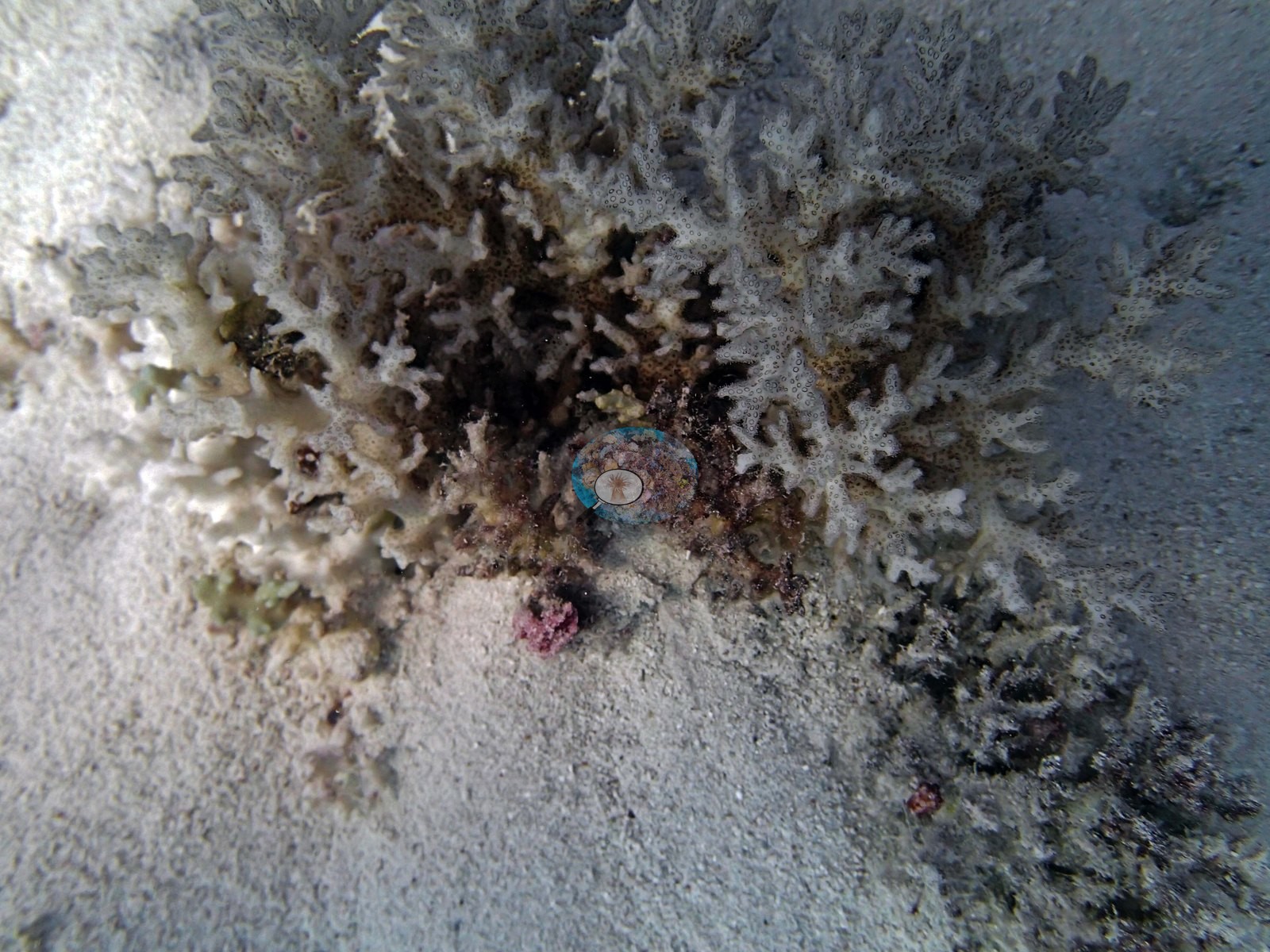
Most coral in the set is normally pigmented. The exception is the pale branching stand on sand, which is partly bleached: its outer branches are pale to white with polyps still visible, while the shaded interior stays brown; it is one colony in one frame, and no extent is estimated (e.g., Image 13). Nothing else in the set shows obvious lesions, and no crown-of-thorns seastars are visible.
Fish and other fauna
Anderson's notes for this dive also record a garden-eel patch, an enormous (2 m) Spanish mackerel, and an impressively large (3-4 m across) massive Porites.
Comparisons with other data
No prior survey data from this site. If you would like to share yours, please email us.
Other notes
What the frames cannot settle: depth, and how much of the bottom is sand. Every frame is framed on a coral head or on the survey, so the set gives no basis for judging the sand-to-reef ratio at this site — which is exactly the quantity the transect measures and the photographs do not.
Data & links
- Download benthic survey data (CSV) ↗
- Download all LOF-GRE data (933 sites) ↗
- Photo portfolio ↗
- Coral Reef Diagnostics country page ↗
All images from Coral Reef Diagnostics. Data are from the Khaled bin Sultan Living Oceans Foundation Global Reef Expedition and Coral Reef Diagnostics.
 © Coral Reef Diagnostics.