
Part of the regional summaries: Australia (GBR) - Far North: Green stations (no-take reefs) and Australia (GBR)
More info
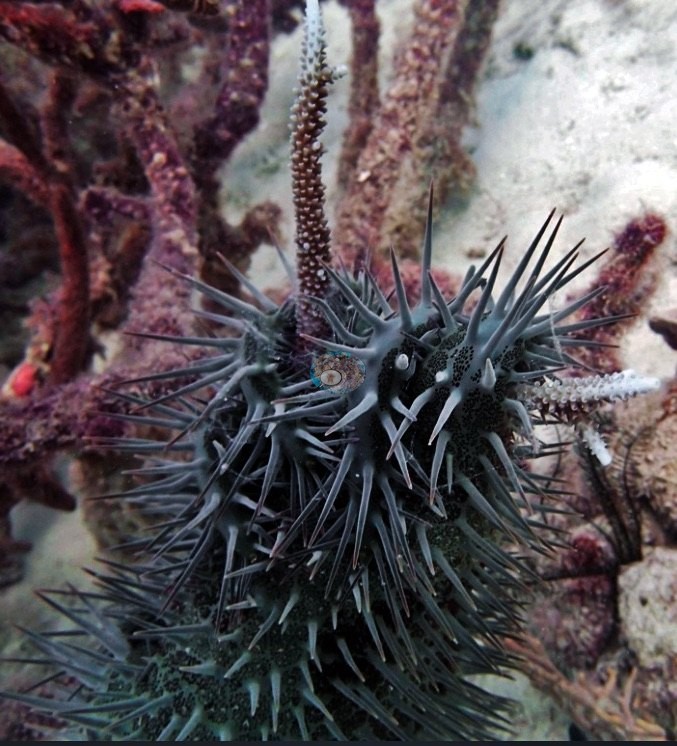
Northern GBR (NOAA CRW virtual station)A mid-shelf bommie field on Lark Reef showing two reef states side by side: shallow coral still at 40-50%, but Acropora thickets 90% dead or worse, with the expedition's first crown-of-thorns starfish, five in all, mostly feeding. Thick algal turf on the dead skeletons led Anderson to conclude the die-off predated the starfish; a giant clam and whitetip reef sharks were also seen. Surveyed on the Living Oceans Foundation's Global Reef Expedition.
One other CRD dive site within 5 km shown in orange — click a marker to open its page.
🗺 Detailed map of the Global Reef Expedition dive sites, Lark, Williamson, and unnamed reef 15-043, northern Great Barrier Reef (Khaled bin Sultan Living Oceans Foundation; opens in a new window)
Site description
Setting
Lark Reef's mid-shelf bommie field holds two very different reef states side by side. This is a no-take Green Zone, open to diving but closed to collecting.
General benthic features
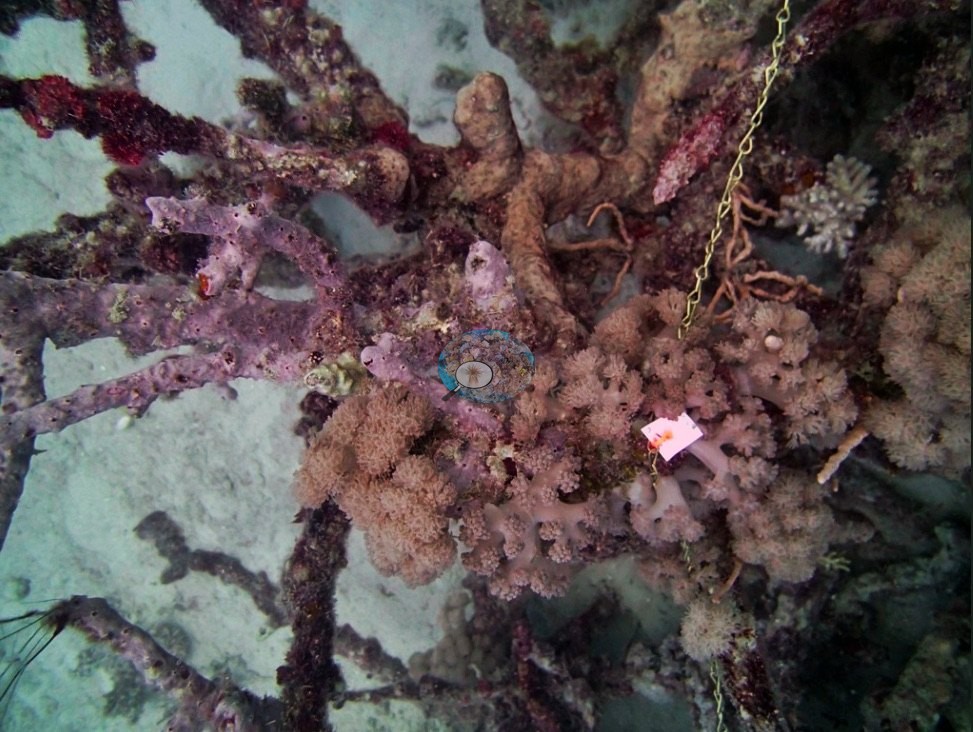
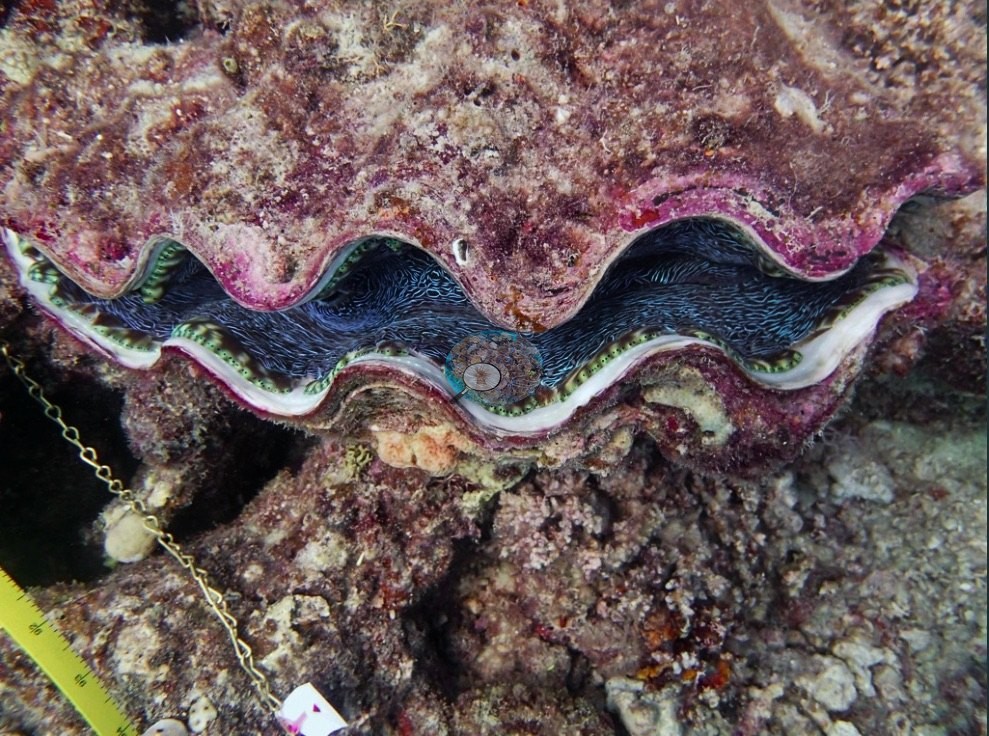
Anderson's photographs from this dive are evidence shots rather than scenery. One frame shows dead branch framework colonized by mauve soft corals with the numbered survey chain running across it, and another captures a giant clam, its mantle rippled iridescent blue-green, alongside the tape (e.g., Image 2, Image 1).
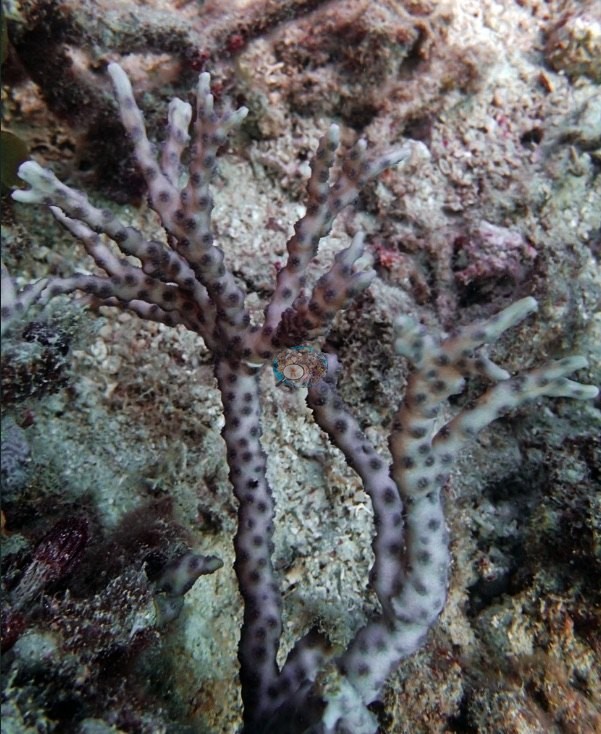
On the rubble and sand between the dead thickets, a lavender branching colony speckled with dark polyps still stood (e.g., Image 6).
Coral cover
- Reference: Khaled bin Sultan Living Oceans Foundation, Global Reef Expedition (in situ transect)
- Point-count cover across the site was 33%, with the shallowest coral still running 40-50% on dense acroporids, pocilloporids, and Porites, while the Acropora thickets had suffered 90% mortality or worse; a second bommie at 15 m was heavily scoured, with low coral cover (about 5.0% by his estimate), mainly Xenia soft corals.
- Transect mean 33 ± 9.1% SE (n = 4 transects; Living Oceans Foundation per-transect benthic data); the headline above is the expedition's station value.
- One wide frame shows what that mortality looks like: a collapsed staghorn thicket, its branches dead and furred in maroon turf, lying over bare sand (e.g., Image 7).
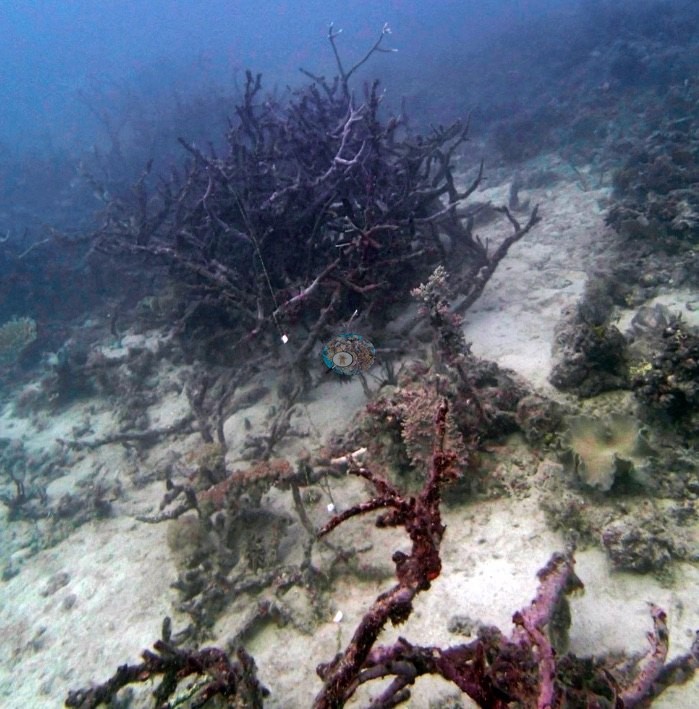
Stressors
One frame is a crown-of-thorns starfish hunched on a dead staghorn branch over bare sand, the first COTS sighting of the expedition, five in all, most of them actively feeding (e.g., Image 3).
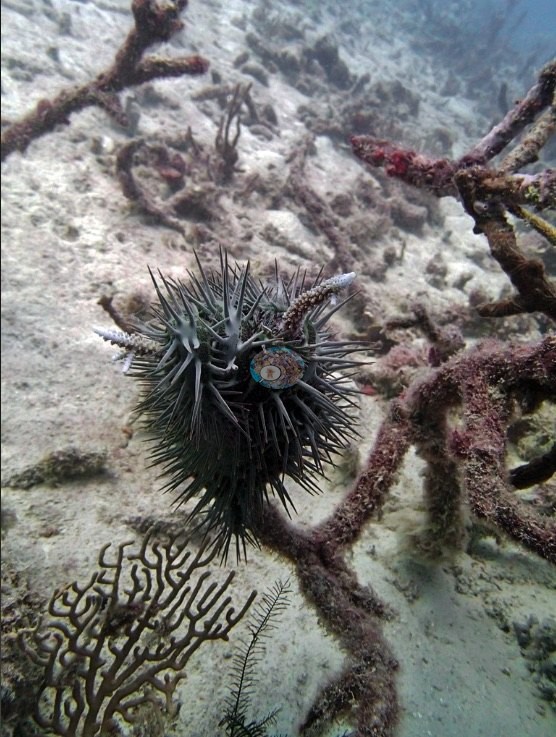
A second close-up shows a starfish wrapped around a staghorn stand, with a few living branch tips still standing clear of it (e.g., Image 8).
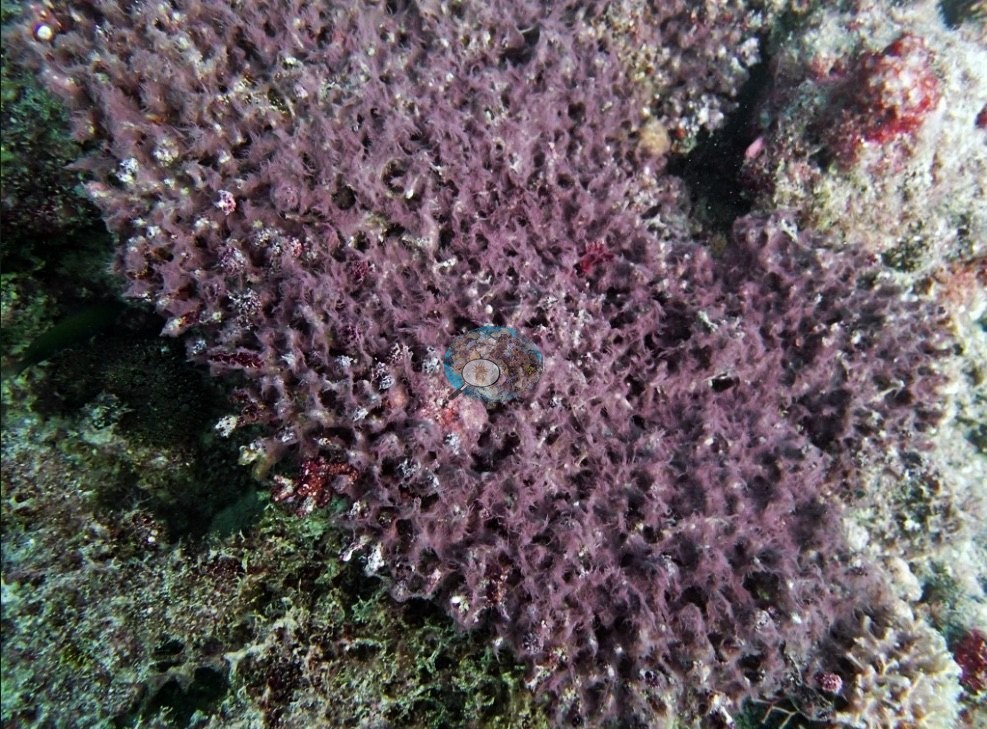
Two close-ups make Anderson's own argument about them: a staghorn branch furred solid with maroon turf algae beside still-living mauve tips, and a dead massive-coral skeleton, its corallite pits still visible, blanketed in purple algal turf (e.g., Image 4, Image 5).
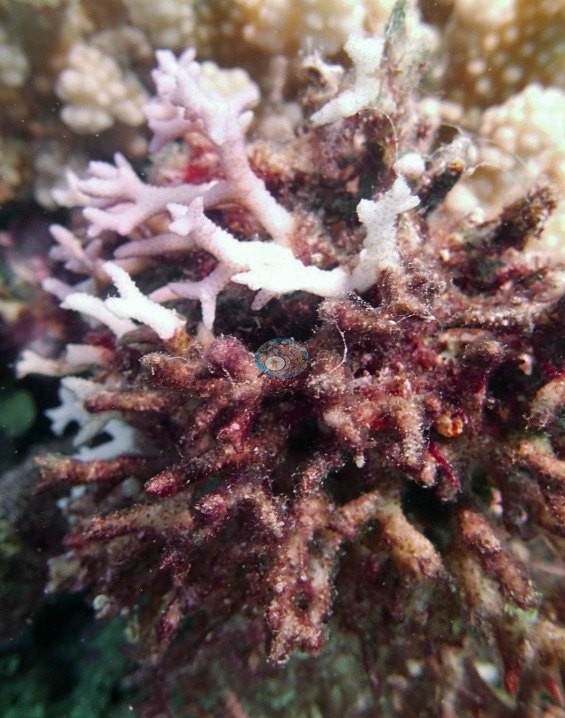
That overgrowth takes weeks, and Anderson read it as evidence the die-off here predated the starfish.
Fish and other fauna
White tip reef sharks patrolled the site.
Comparisons with other data
No prior survey data from this site. If you would like to share yours, please email us.
Data & links
- Download benthic survey data (CSV) ↗
- Download all LOF-GRE data (933 sites) ↗
- Photo portfolio ↗
- Coral Reef Diagnostics country page ↗
All images from Coral Reef Diagnostics. Data are from the Khaled bin Sultan Living Oceans Foundation Global Reef Expedition and Coral Reef Diagnostics.
 © Coral Reef Diagnostics.