
Part of the regional summaries: Australia (GBR) - Far North: Blue stations (Habitat Protection Zone reefs) and Australia (GBR)
More info
Far Northern GBR (NOAA CRW virtual station)A very murky dive, with 2-3 m visibility and silt settling over nearly everything, and a reef that shifts from a near-monoculture of plating Leptoseris/Pavona-type coral at 20 m to Goniopora and finger Porites in the shallows. Anderson noted that the once-common Pavona cactus had mostly died and been replaced by finger Porites. Surveyed on the Living Oceans Foundation's Global Reef Expedition.
Five other CRD dive sites within 5 km shown in orange — click a marker to open its page.
🗺 Detailed map of the Global Reef Expedition dive sites, Milman, Monkman, Parkinson, and unnamed reefs, northern Great Barrier Reef (Khaled bin Sultan Living Oceans Foundation; opens in a new window)
Site description
Setting
A very murky dive — just 2-3 m of visibility and thick suspended sediment settling over almost everything. The expedition's own site table classifies AU3995 as a sheltered mid shelf reef on an intermediate aspect.
General benthic features
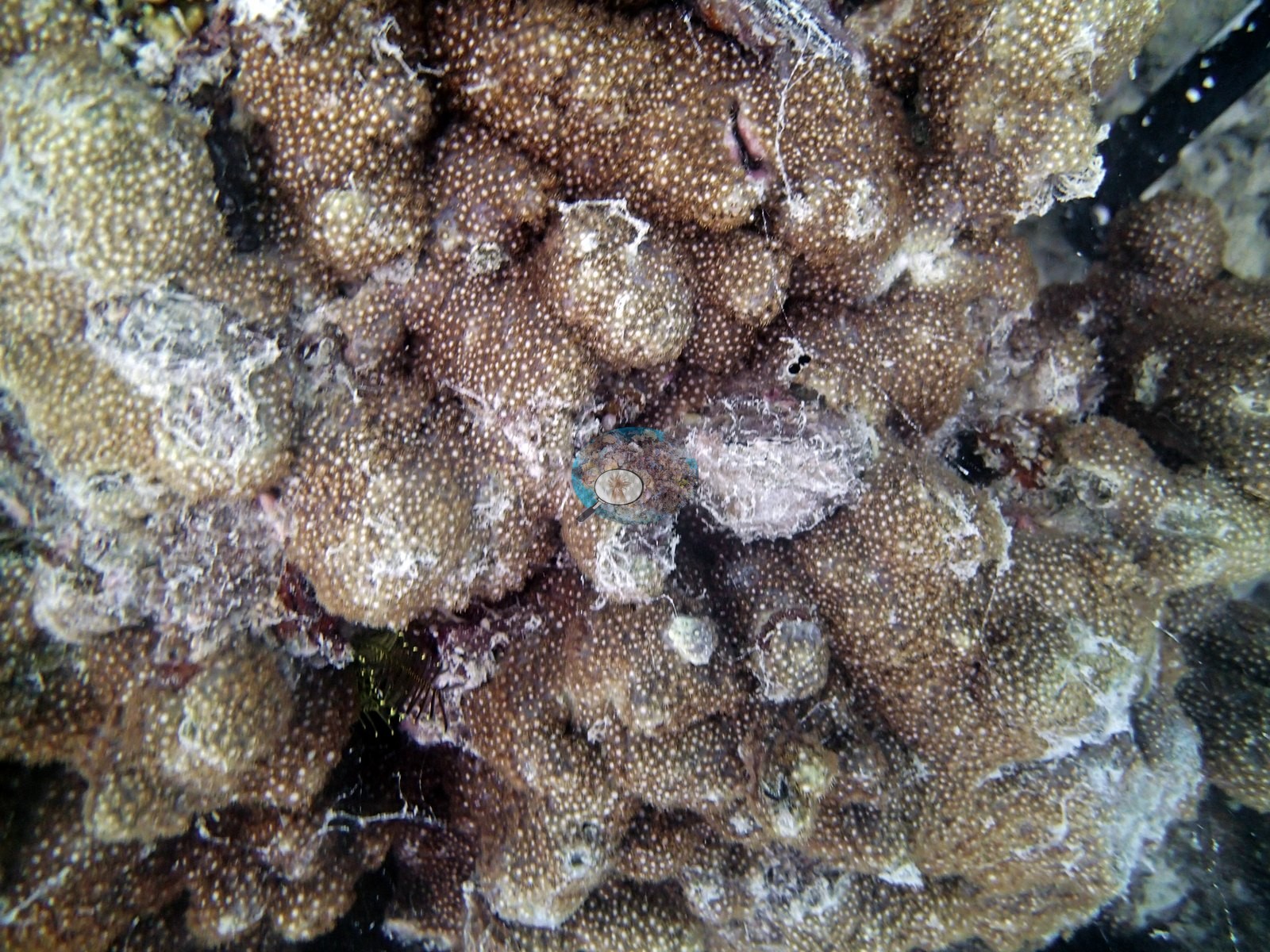
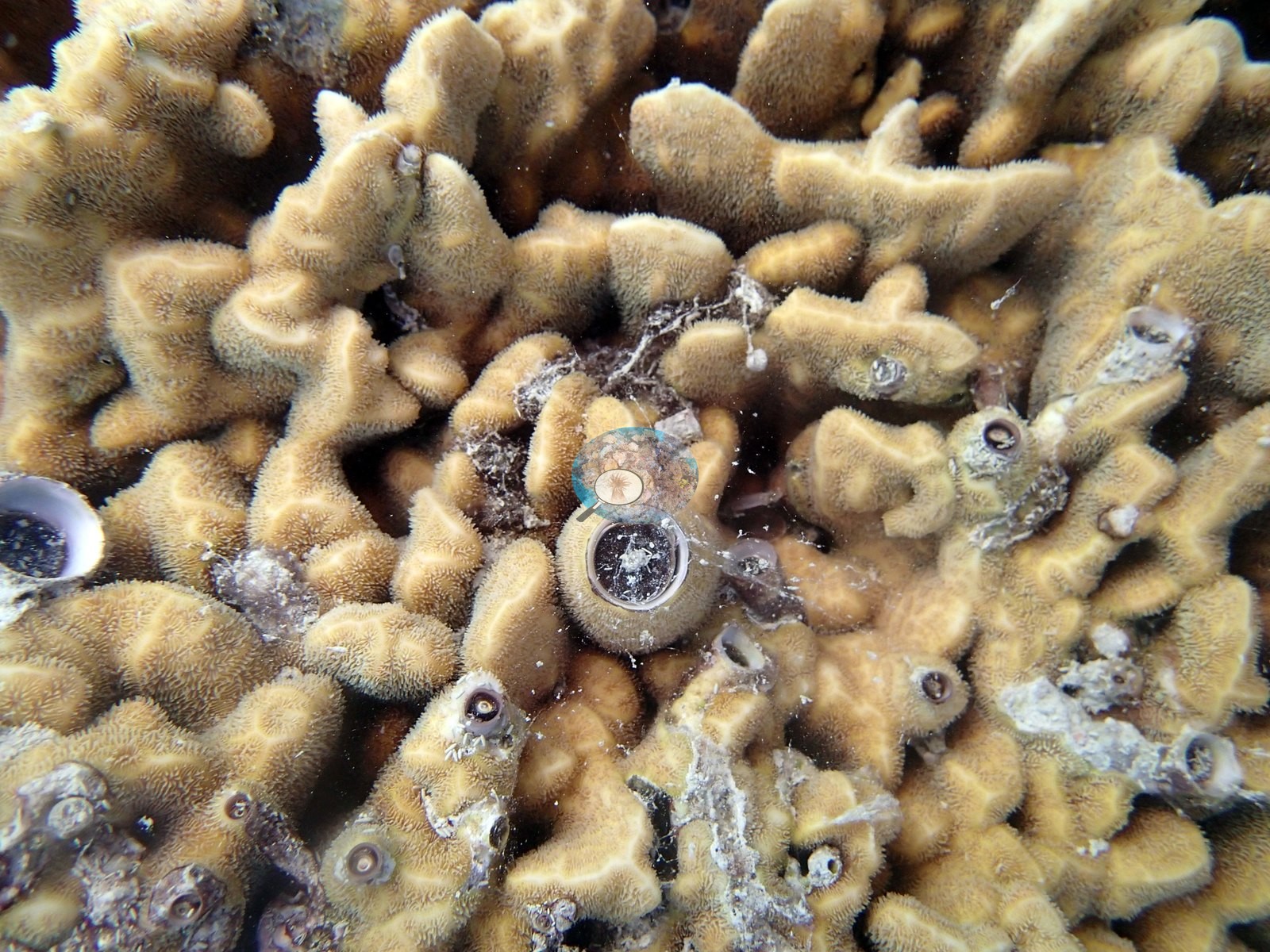
Down at 20 m the reef is nearly a monoculture of Leptoseris or Pavona cactus; move up to 8-10 m and Goniopora, Porites rus, and P. cylindrica take over, continuing into the 5-7 m band with massive Porites mixed in. Both photographs are close views that show the sediment load directly: a knobby massive colony with fine polyps, its surface draped in pale strands of silt and mucus (e.g., Image 1), and a tan colony of flattened, fused finger-like branches, studded with the round openings of tube-dwelling animals and strung with silt (e.g., Image 2).
Montipora was the most common coral genus on this station's transects (18% of the benthos), followed by Porites (9.8%), Goniopora (6.2%), Acropora and Pavona (1.7% each), and Montastrea and Pocillopora (1.0% each); bare substrate covered 31%, the largest non-coral class. Among the algal classes on this station's transects, sediment-laden turf (28%) led.
Coral cover
- Reference: Khaled bin Sultan Living Oceans Foundation, Global Reef Expedition (in situ transect)
- The expedition's in situ point-count transects at this station recorded 41% live coral cover against 28% total algal cover.
- Transect mean 38 ± 7.3% SE (n = 4 transects; Living Oceans Foundation per-transect benthic data); the headline above is the expedition's station value (the headline weights each depth equally; two depths had a single transect).
Stressors
Anderson noted that Pavona cactus appears to have been common here but had mostly died and been replaced by P. cylindrica. One deep transect was simply "covered by silt," with only Goniopora and a handful of other species clinging on. A lone crown-of-thorns starfish was also logged.
Fish and other fauna
Paired fish transects recorded about 25 fish species per transect and about 9.5 kg per 100 m2 of biomass.
Comparisons with other data
No prior survey data from this site. If you would like to share yours, please email us.
Data & links
- Download benthic survey data (CSV) ↗
- Download all LOF-GRE data (933 sites) ↗
- Photo portfolio ↗
- Coral Reef Diagnostics country page ↗
All images from Coral Reef Diagnostics. Data are from the Khaled bin Sultan Living Oceans Foundation Global Reef Expedition and Coral Reef Diagnostics.
 © Coral Reef Diagnostics.