
Part of the regional summaries: Australia (GBR) - Far North: Blue stations (Habitat Protection Zone reefs) and Australia (GBR)
More info
Far Northern GBR (NOAA CRW virtual station)A murky midshelf reef, only 3-4 m visibility, whose coral, concentrated at 5-7 m, includes a single Goniopora colony roughly 10 by 10 m. Deeper transects crossed old dead staghorn and a smothered brain coral; two white-and-orange nudibranchs he had not seen before brightened the dive. Surveyed on the Living Oceans Foundation's Global Reef Expedition.
Three other CRD dive sites within 5 km shown in orange — click a marker to open its page.
🗺 Detailed map of the Global Reef Expedition dive sites, Milman and Alpin Reefs, northern Great Barrier Reef (Khaled bin Sultan Living Oceans Foundation; opens in a new window)
2 of the 3 photographs on this page are shown beside the text that discusses them under "Site description" below.
Site description
Setting
A midshelf reef, windward from its position on the southeast side of its reef relative to the prevailing southeast trade winds, dived in thick, silty water with only 3-4 m visibility; Anderson noted it was typical of the leeward midshelf reefs the expedition had been seeing. Sits in a Habitat Protection (Blue) Zone, where line fishing is permitted.
General benthic features
The coral is concentrated at 5-7 m, a mix of Goniopora, Lobophyllia, Echinopora, massive Porites, and Diploastrea, with one transect built almost entirely around a single Goniopora colony an estimated 10 x 10 m across. Porites was the most common coral genus on this station's transects (9.6% of the benthos), followed by Goniopora (5.9%), Lobophyllia (4.6%), Montipora (4.1%), and Favites and Merulina (1.8% each); bare substrate covered 32%, the largest non-coral class. Among the algal classes on this station's transects, sediment-laden turf (14%) led, followed by turf (3.3%) and macroalgae (1.3%).
Coral cover
- Reference: Khaled bin Sultan Living Oceans Foundation, Global Reef Expedition (in situ transect)
- Overall point-count cover here came in at 42%, thinner on the deeper transects, several of which crossed old, dead staghorn Acropora skeletons and one smothered Diploastrea head.
- Transect mean 42 ± 7.0% SE (n = 7 transects; Living Oceans Foundation per-transect benthic data); the headline above is the expedition's station value (the headline weights each depth equally).
Stressors
No crown-of-thorns starfish (COTS) or other corallivores evident.
Fish and other fauna
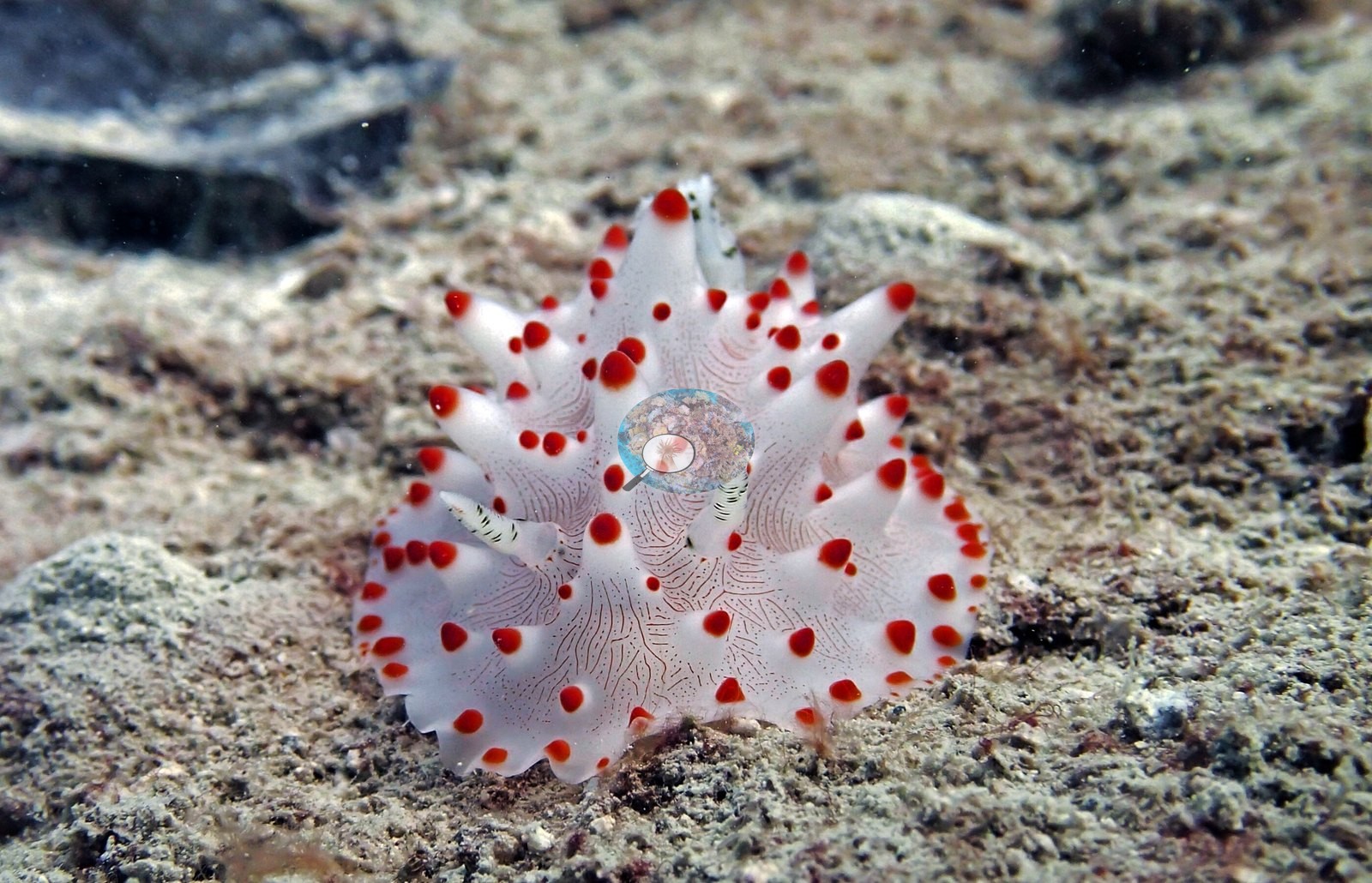
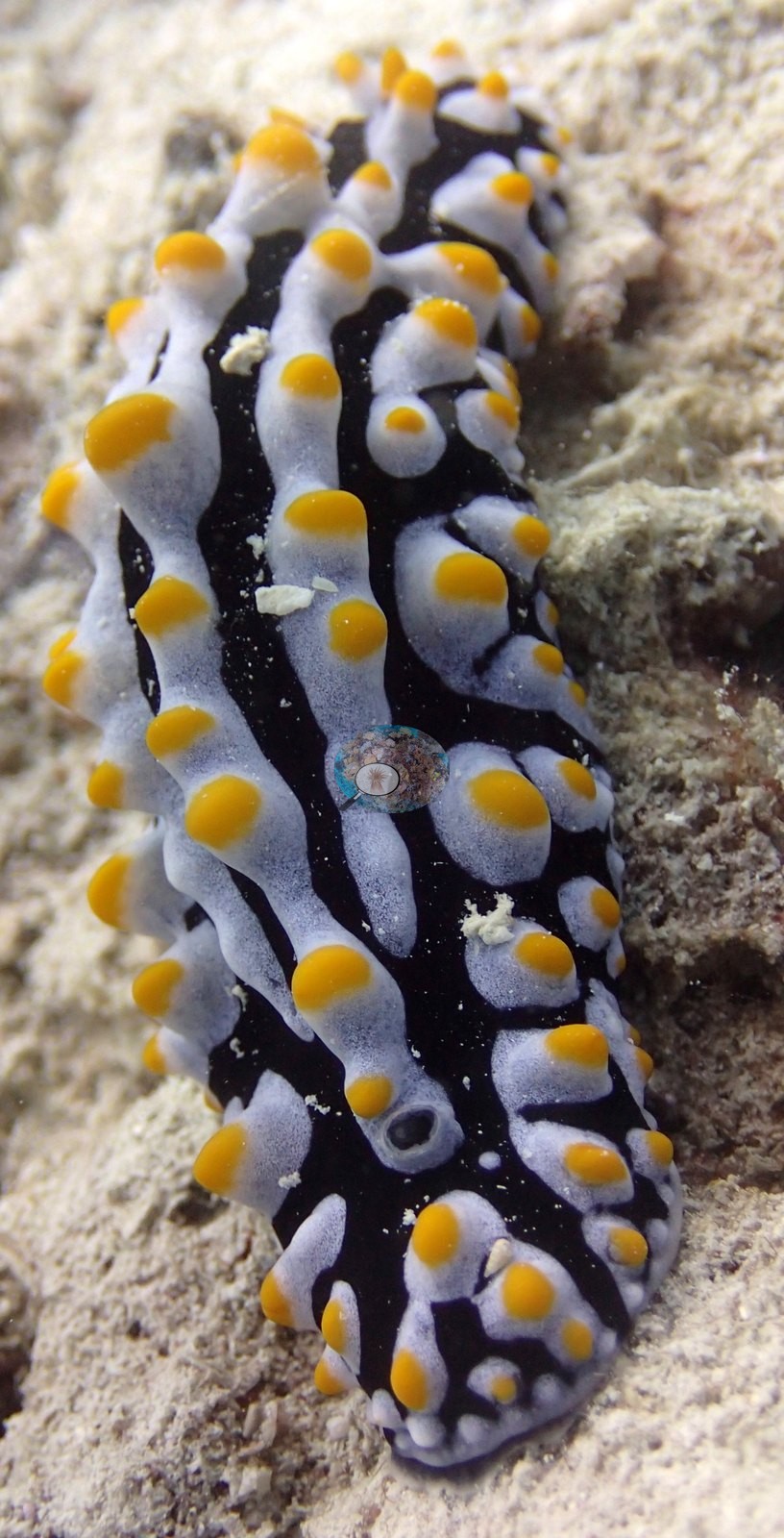
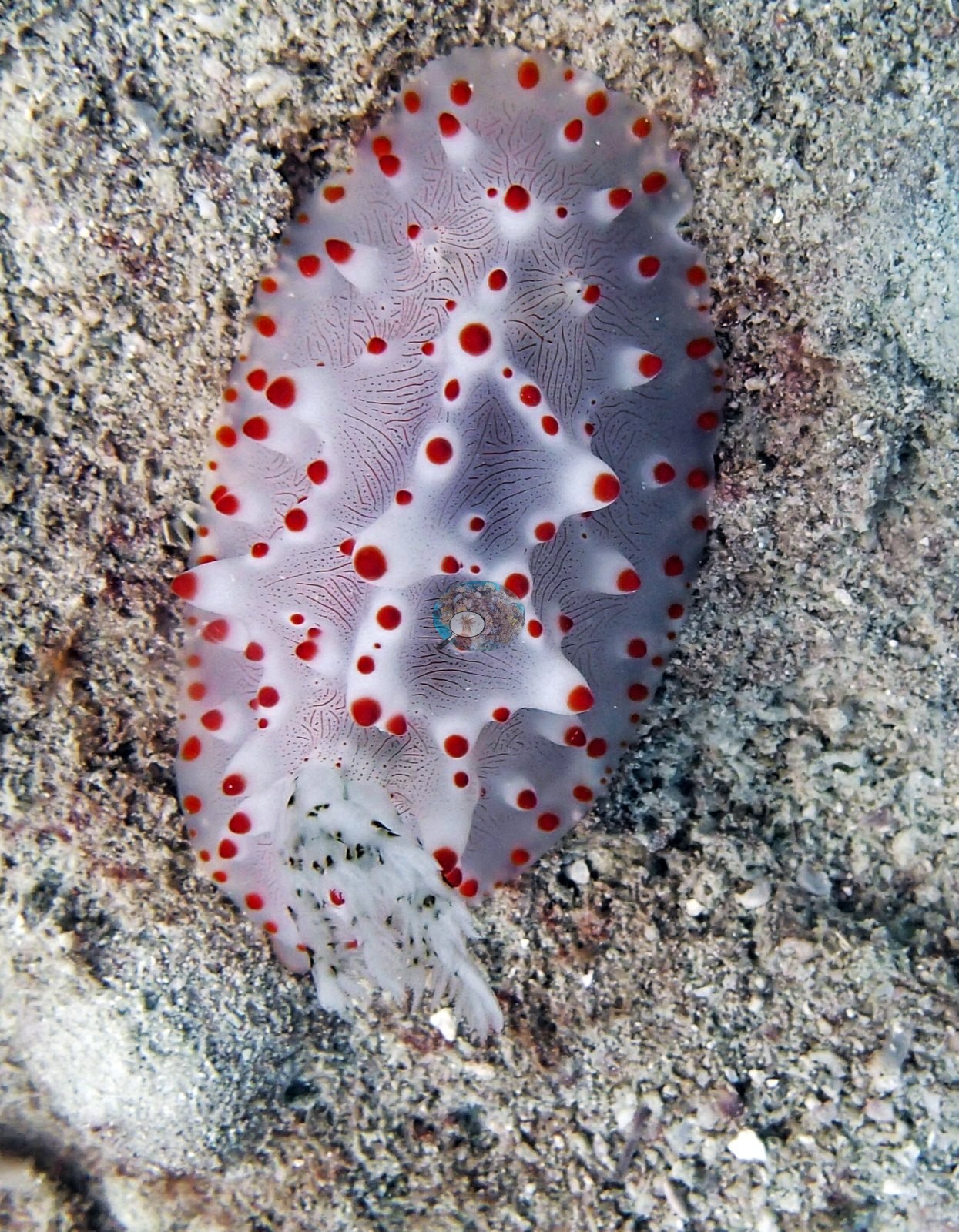
On the brighter side, two striking nudibranchs that Anderson had not seen before (white-bodied with orange dorsal spires) turned up along the transect line (e.g., Image 1, Image 2), and a gray reef shark was seen.
Paired fish transects recorded about 25 fish species per transect and about 9.3 kg per 100 m2 of biomass.
Comparisons with other data
No prior survey data from this site. If you would like to share yours, please email us.
Other notes
Aspect: Anderson's field notes and sheet describe a leeward midshelf reef (in the lee of the outer ribbon reefs); the expedition's 933-site table lists the station as an inner open lagoon reef with an 'exposed' aspect. Following the aspect rule used on these pages (the station's GPS position relative to its island or reef and the prevailing wind decides, ahead of slope facing, lagoon shelter, imagery, and field labels), 'windward' is printed, from its position on the southeast side of its reef relative to the prevailing southeast trade winds (about 1° off the upwind direction; the reef-edge reading agrees).
Data & links
- Download benthic survey data (CSV) ↗
- Download all LOF-GRE data (933 sites) ↗
- Photo portfolio ↗
- Coral Reef Diagnostics country page ↗
All images from Coral Reef Diagnostics. Data are from the Khaled bin Sultan Living Oceans Foundation Global Reef Expedition and Coral Reef Diagnostics.
 © Coral Reef Diagnostics.