
Part of the regional summaries: Fiji - Vanua Balavu, Fiji - Northern Lau (Vanua Balavu / Cicia / Nayau), and Fiji - Lau
More info
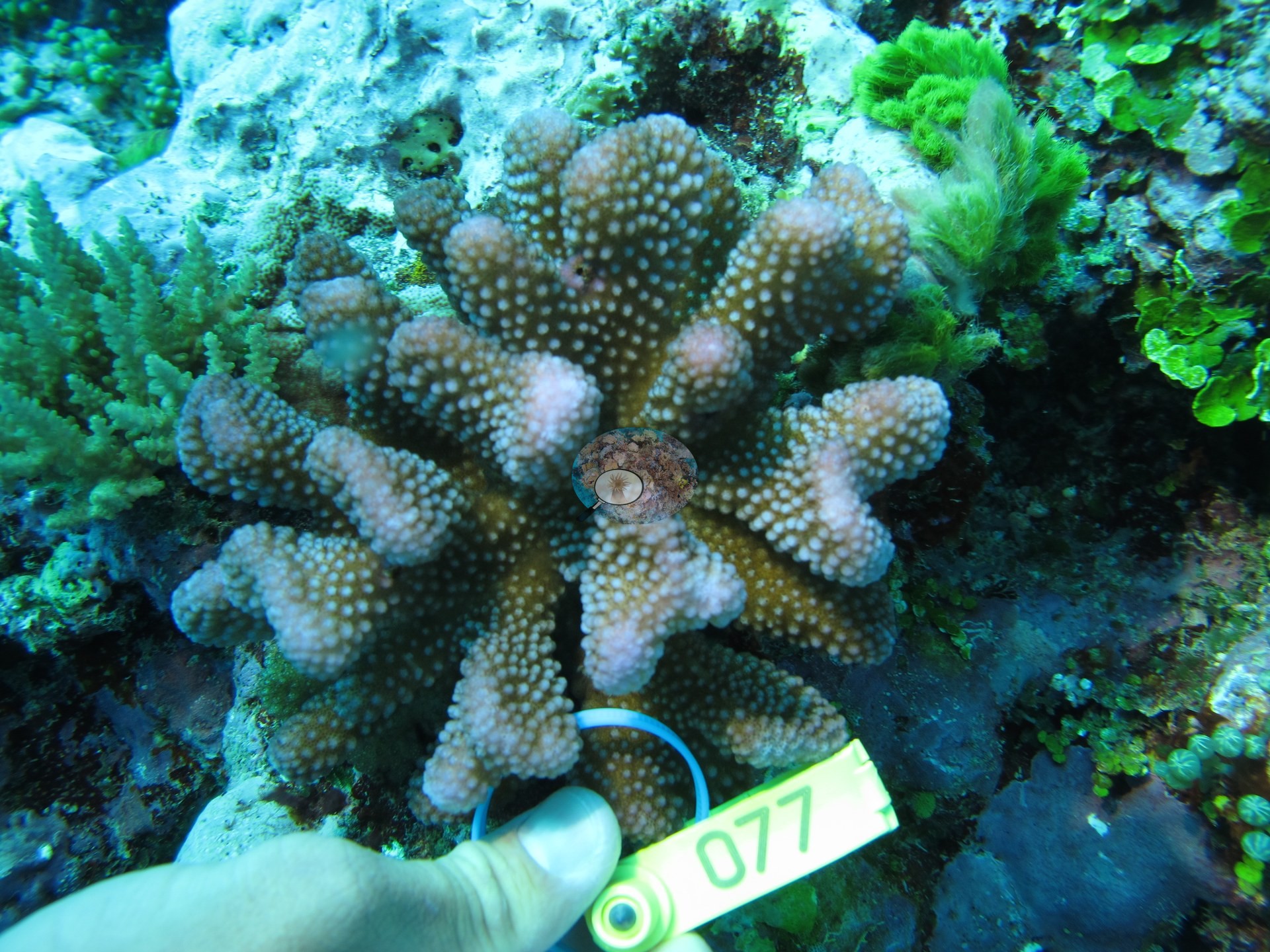
Fiji (NOAA CRW virtual station)A heavily algae-dominated Vanua Balavu reef with just 16% coral cover against about 80% algae, where the one photo shown here is of a small, healthy tagged branching colony (one sampled by teammate Joao) hemmed in by green macroalgae and segmented green calcareous algae. It captures the survey numbers well: individual corals holding small patches of rock on a reef taken over by algae. Surveyed on the Living Oceans Foundation's Global Reef Expedition.
E dua na cakau e Vanua Balavu e liu vakalevu kina na lumi, e 16% ga na ubi ni lase (coral cover) ni vakatauvatani kei na rauta ni 80% na lumi, ka na itaba e dua e vakaraitaki eke e baleta e dua na lase lalai vakatabataba e bula vinaka ka vakatakilakilataki (tagged) (e dua a taura kina na ivakaraitaki na nona itokani ni cakacaka ko Joao) e vakavolivoliti ena lumi drokadroka (macroalgae) kei na lumi drokadroka vakaikabakaba vakalase (segmented green calcareous algae). E vakaraitaka vinaka na iwiliwili ni vakadidike: na lase yadudua e taura tiko na vanua lalai ni vatu ena dua na cakau sa taura na lumi.
AI translation of this summary; the English is authoritative. (low confidence)
One other CRD dive site with its own page within 5 km shown in orange — click a marker to open its page.
🗺 Detailed map of the Global Reef Expedition dive sites, Vanua Balavu, Fiji (Khaled bin Sultan Living Oceans Foundation; opens in a new window)
Site description
General benthic features
A hand holds a numbered tag beside a fist-sized branching colony, one that teammate Joao sampled (Anderson's photo; it is not F125, the colony Anderson sampled), its stubby lobed branches olive-brown and studded all over with pale, evenly spaced polyps — tissue fully pigmented, no bleaching, no lesions, no predation scars (e.g., Image 1).
Everything around it is algae. Bright green tufted and feathery macroalgae crowd in from the right, chains of green calcareous discs stack up along the edges of the frame, and green filmy growth covers the pavement between the colony and the pale rubble behind. A thin-branched, green-pigmented colony occupies the left background. What the frame shows is a healthy individual coral holding a small patch of hard substrate on a reef where fleshy and calcified algae have taken most of the space — which is exactly the picture the survey numbers give.
Coral cover
- Reference: Khaled bin Sultan Living Oceans Foundation, Global Reef Expedition (in situ transect)
- Coral cover here measures just 16% by point-count survey against roughly 80% algae, and the one published photograph is a fair portrait of that balance.
- Transect mean 16 ± 2.3% SE (n = 4 transects; Living Oceans Foundation per-transect benthic data); the headline above is this all-transect mean.
Stressors
Anderson's sample sheet records the one colony sampled here (F125, P. damicornis) as healthy, with none of it bleached. The Living Oceans Foundation transects here recorded 7.0% cyanobacteria and no recently dead coral; they have no bleaching, disease, or crown-of-thorns field. Island-level context, not an observation here: the expedition's Vanua Balavu site notes record crown-of-thorns predation at station FJVB55 and possible crown-of-thorns feeding scars at FJVB67.
Comparisons with other data
Apart from the Living Oceans Foundation survey shown here, we found no other surveys at this site as of 2026. If you would like to share yours, please email us.
Other notes
No wider view of the site was available in this photo set. Anderson was busy sampling corals at this site, so the site description is derived from the Living Oceans Foundation's benthic transect data. Those transects recorded 16% hard coral cover. Anderson sampled 1 Pocillopora colony here, numbered 125 in the expedition series. Anderson's own photographs of F125 are not shown; the one published frame shows a colony Joao sampled, so the transect data, not the photograph, describe the site.
Data & links
- Download benthic survey data (CSV) ↗
- Download all LOF-GRE data (933 sites) ↗
- Photo portfolio ↗
- Coral Reef Diagnostics page for this area ↗
All images from Coral Reef Diagnostics. Data are from the Khaled bin Sultan Living Oceans Foundation Global Reef Expedition and Coral Reef Diagnostics.
 © Coral Reef Diagnostics.