
Part of the regional summaries: Fiji - Totoya, Fiji - Moala Group (Moala / Totoya / Matuku), and Fiji - Lau
More info
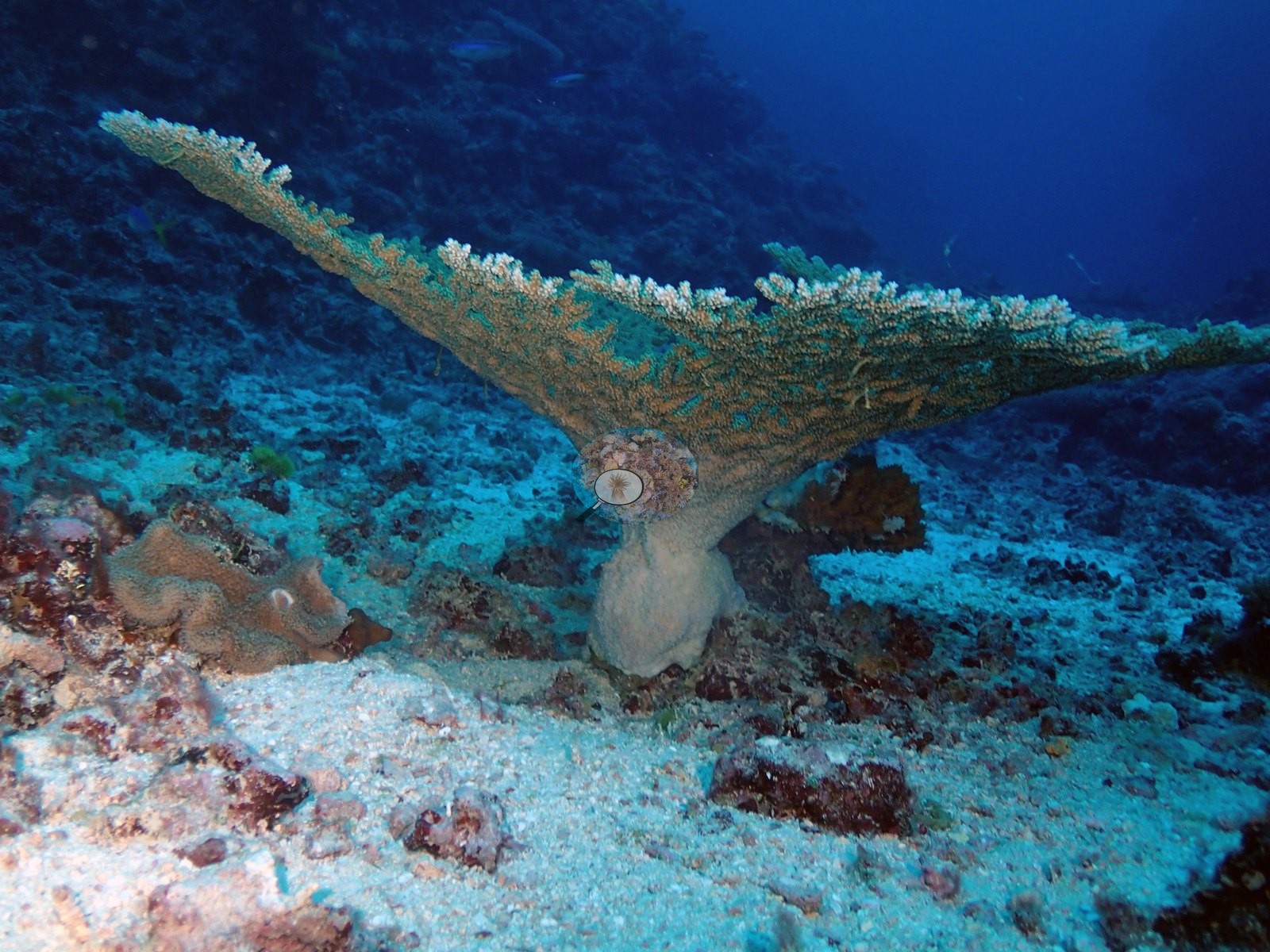
Fiji (NOAA CRW virtual station)A Totoya fore reef where the survey team reported large spur-and-groove ridges with sediment-filled grooves, big Acropora tables around 20-22 m, and large Diploastrea at 30 m, at 33% cover. The one colony Anderson sampled here was recorded as pale and small, not bleached. Surveyed on the Living Oceans Foundation's Global Reef Expedition.
E dua na yasana i tuba ni cakau (fore reef) e Totoya ka vola kina na ilawalawa ni vakadidike na spur-and-groove levu kei na groove e vonu ena soso (sediment), na lase tepeli levu ni Acropora ena rauta ni 20-22 m, kei na Diploastrea levu ena 30 m, ka 33% na ubi ni lase (coral cover). Na dua ga na lase a taura kina na ivakaraitaki ko Anderson eke a volai ni vulavula vakalailai (pale) ka lailai, ia e sega ni vulavula (bleached).
AI translation of this summary; the English is authoritative. (low confidence)
CTD-cast midpoint; the cast read 27.2°C throughout
Three other CRD dive sites with their own pages within 5 km shown in orange — click a marker to open its page.
🗺 Detailed map of the Global Reef Expedition dive sites, Totoya, Fiji (Khaled bin Sultan Living Oceans Foundation; opens in a new window)
Site description
General benthic features
Survey team's site notes: A diverse benthic community with the dominant scleractinian community differing by location. Shallower areas may be dominated by branching acroporids and (sub)massive poritids with encrusting and plating corals also present. Small mounds of hosting diverse mixed coral assemblages may be present. At greater depths, colonies take on plating morphologies and form a series of shingle-like structures. Prominent macroalgae include Halimeda, Caulerpa, and Dictyota. Large colonies of Diploastrea deep at 30 m. Large Acropora tables and branching Acropora near 20–22 m. High coral cover, with large spur and groove ridges. Sediment filled grooves, with large pieces of rubble. Shallower depths are dominated with small Acropora and Pocillopora colonies. Lobophytum common as well. Macroalgae become more common with depth due to the abatement of wave energy with increasing depth. The deeper fore reef habitats at the base of the reef were generally low relief sand flats, mostly uncolonized. Often there were sparse assemblages of cyanobacteria and small patches of macroalgae, along with isolated larger corals.
Coral cover
- Reference: Khaled bin Sultan Living Oceans Foundation, Global Reef Expedition (in situ transect)
- Coral cover 33% (the expedition's in situ transects).
- Transect mean 33 ± 3.5% SE (n = 6 transects; Living Oceans Foundation per-transect benthic data); the headline above is this all-transect mean.
Stressors
Anderson's sample sheet records the one colony sampled here (F6, P. damicornis, 4.5 m, low visibility) as “pale and small” but does not call it bleached. The Living Oceans Foundation transects here recorded 8.1% cyanobacteria and no recently dead coral; they have no bleaching, disease, or crown-of-thorns field. Archipelago-level context, not an observation here: the Lau field report calls bleaching rare, crown-of-thorns starfish scarce outside one Cicia reef, and disease low in prevalence, with Drupella lesions on 5-25% of corals.
Comparisons with other data
The one coral colony from this site with an outlier score was not flagged as a physiological outlier (Mayfield et al. 2017, PLoS ONE). The expedition's own site table classifies FJTO03 as a barrier reef on an intermediate aspect, surveyed on the fore reef, outside the lagoon. Alongside the hard coral already reported for this site, the same transects recorded 27% crustose coralline algae, 8.2% turf, 1.4% macroalgae, and 8.1% cyanobacteria. Non-living substrate came to 53% pavement, 4.4% dead coral, 7.5% rubble, and 1.7% sand. Paired fish transects recorded about 40 fish species per transect and about 19 kg per 100 m2 of biomass. The benthic figures are means of all of this station's own transects in the expedition's per-transect benthic records, and the fish figures come from its paired fish transects; all are survey results, not photographic estimates.
Dive record
FJTO03 (Totoya, Lau Archipelago): surveyed 3 Jun 2013 during the Khaled bin Sultan Living Oceans Foundation Global Reef Expedition.
Other notes
FJTO03 lies on Totoya, Lau Archipelago, surveyed 3 Jun 2013 during the Khaled bin Sultan Living Oceans Foundation Global Reef Expedition (station CTD cast to 23.0 m; Anderson's dive reached 21.6 m). Point-count transect scored living coral at 33% against 45% algae; those numbers come from the survey data, not from photographs. Exactly one habitat photograph exists for this station, so what follows describes that frame and nothing more.
It shows one thing. A large tabular Acropora, well over a meter across, spreads flat on a single stout central stalk, its upper surface tan and green with bright white growing tips crowding the rim. It stands on an open floor of coarse pale sand and scattered dark rubble, with a low leathery soft coral off to one side and small dark encrusting patches on the rubble. Behind it the ground rises into a darker, dimly-lit reef slope, and to the right the water falls away into deep blue. Living cover in the frame itself is sparse — the table is the structure; the floor around it is mostly unconsolidated sediment and rubble rather than reef. The coral looks healthy: full tissue, active growing margins, no bleaching, disease, or predation scarring visible.
What this frame cannot settle is nearly everything else. It gives no view of the shallower reef, no zonation, no depth profile, no sense of how much of the station looks like this, and no basis for a community list beyond the one table, the one soft coral, and the substrate immediately around them. A single tabletop coral photographed against open sand is a portrait, not a survey. Typical recent thermal stress: mean annual maximum of 8.9°C-weeks (Degree Heating Weeks, 2021-2025, NOAA CRW; Fiji virtual station).
Data & links
- Download benthic survey data (CSV) ↗
- Download all LOF-GRE data (933 sites) ↗
- Photo portfolio ↗
- Coral Reef Diagnostics region page ↗
All images from Coral Reef Diagnostics. Data are from the Khaled bin Sultan Living Oceans Foundation Global Reef Expedition and Coral Reef Diagnostics.
 © Coral Reef Diagnostics.