
Part of the regional summaries: Fiji - Moala, Fiji - Moala Group (Moala / Totoya / Matuku), and Fiji - Lau
More info
Fiji (NOAA CRW virtual station)A structurally dramatic Moala site defined by a narrow coral canyon, a steep-sided gully between near-vertical coral-crusted walls that divers can swim through. The surrounding reef is low, rugged framework with small corals, a giant clam, and a big, smooth olive-green Porites dome, at 29% cover. Surveyed on the Living Oceans Foundation's Global Reef Expedition.
E dua na vanua e Moala e veibuli vakaidina, e vakatakilakilataki ena dua na sala titobu ni lase (coral canyon) e rabailailai, e dua na qara balavu e titobu ena maliwa ni rua na bati e voleka ni tu dodonu ka ubi ena lase, e rawa ni ra qalo curu kina na dau nunu. Na cakau e wavokita e sega ni cecere, e veitaqataqa na kena ivakatudei, kei na lase lalai, e dua na vasua, kei na dua na ulu levu ni Porites e savasava ka roka (olive-green), ka 29% na ubi ni lase (coral cover).
AI translation of this summary; the English is authoritative. (low confidence)
CTD-cast midpoint of 27.1–27.2°C
Two other CRD dive sites with their own pages within 5 km shown in orange — click a marker to open its page.
🗺 Detailed map of the Global Reef Expedition dive sites, Moala, Fiji (Khaled bin Sultan Living Oceans Foundation; opens in a new window)
Site description
Setting
The defining feature of this station is its topography. Anderson's notes describe a coral canyon and interesting topography, and six of the fourteen frames (e.g., Image 1, Image 2, Image 3, Image 4, Image 7, Image 12) look into or along a narrow, steep-sided coral gully cut into the reef.
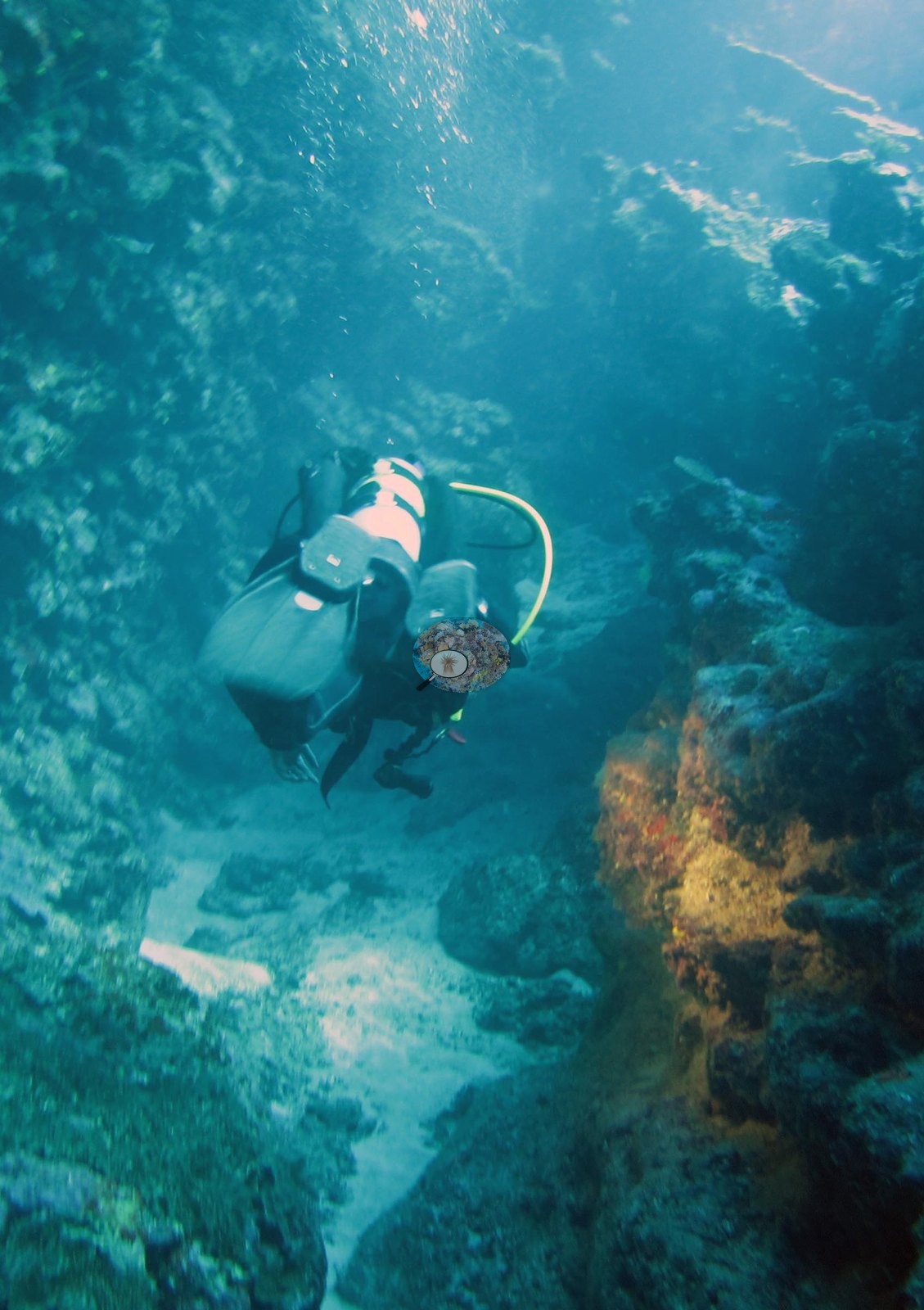
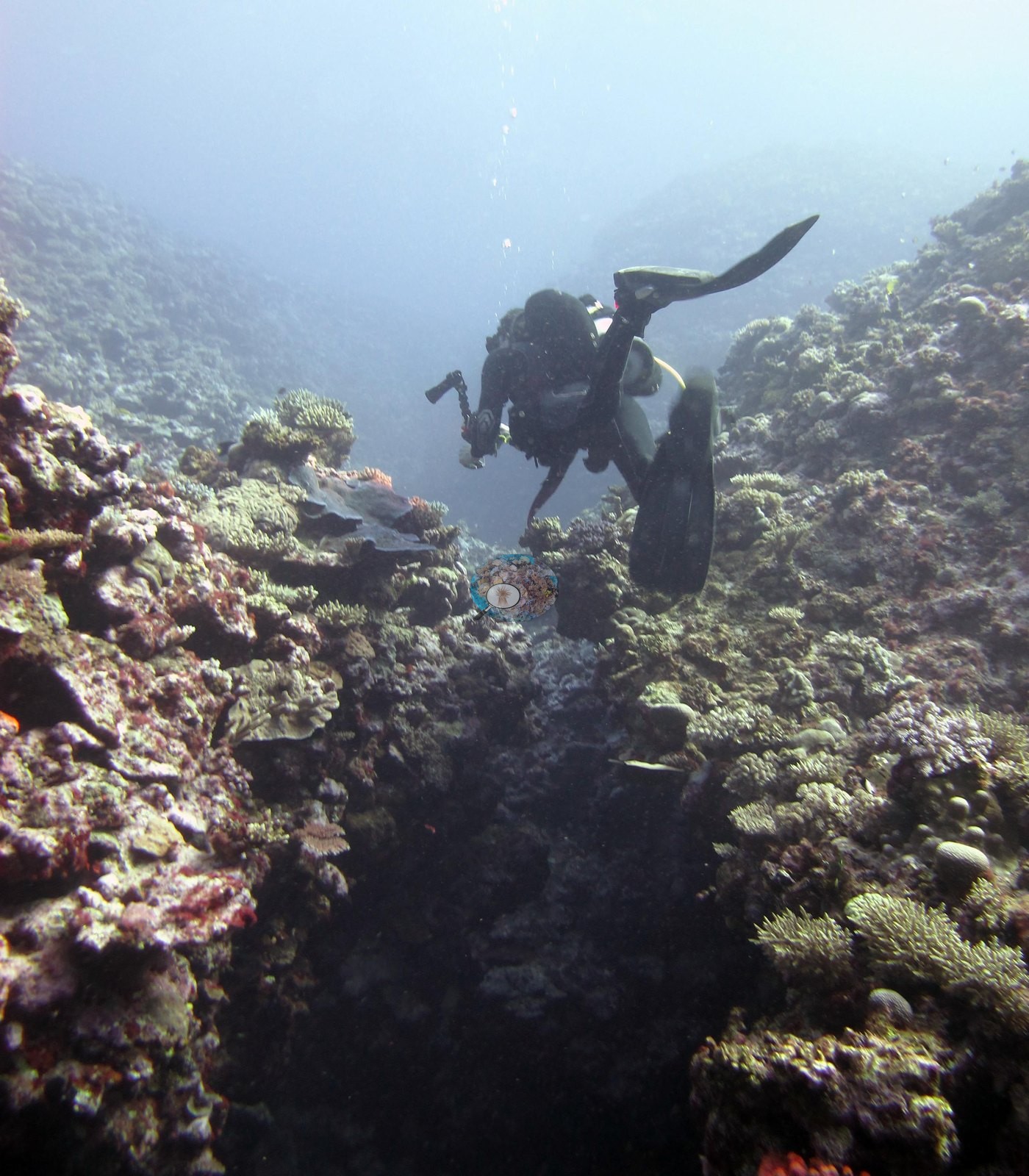
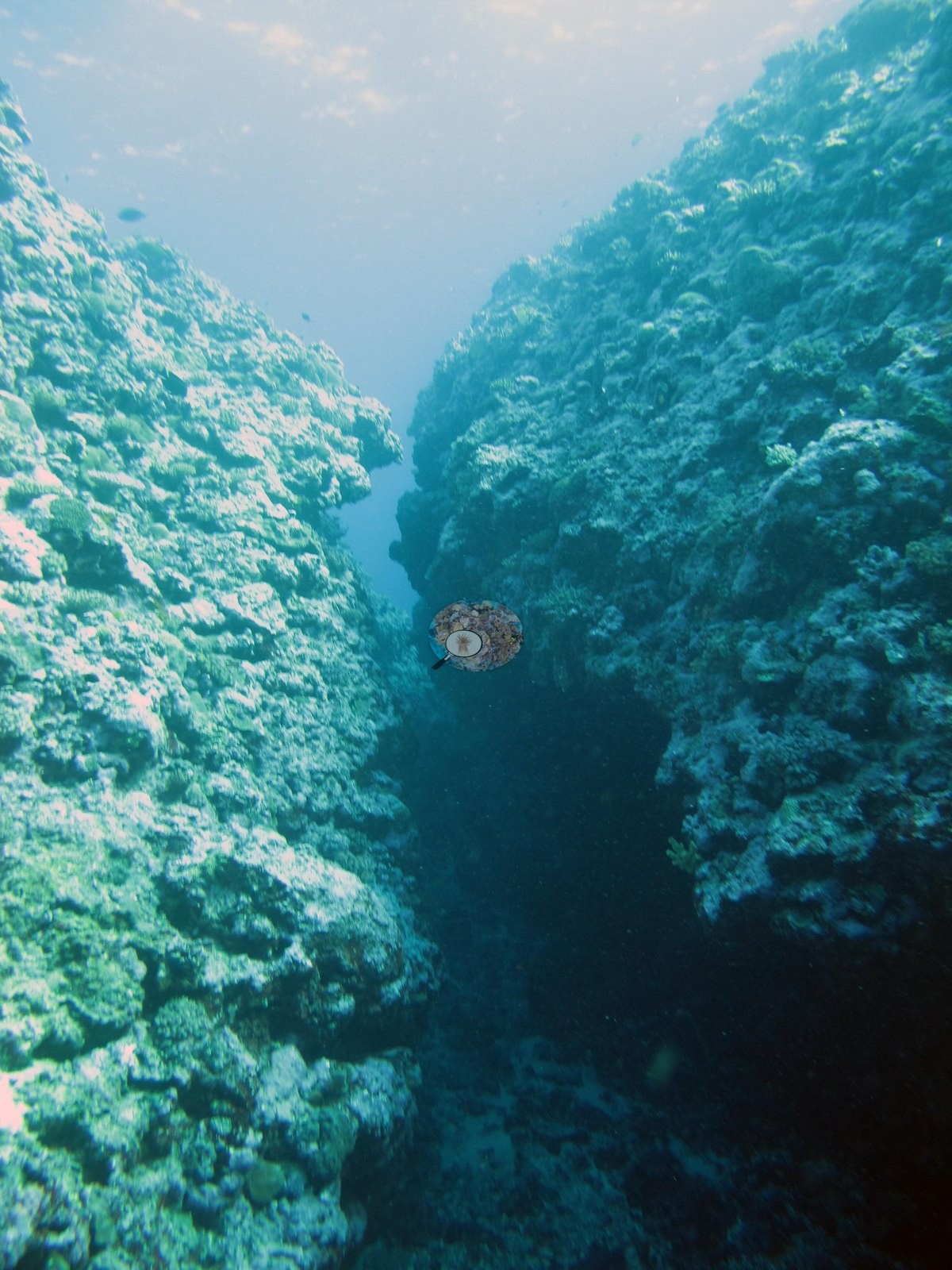
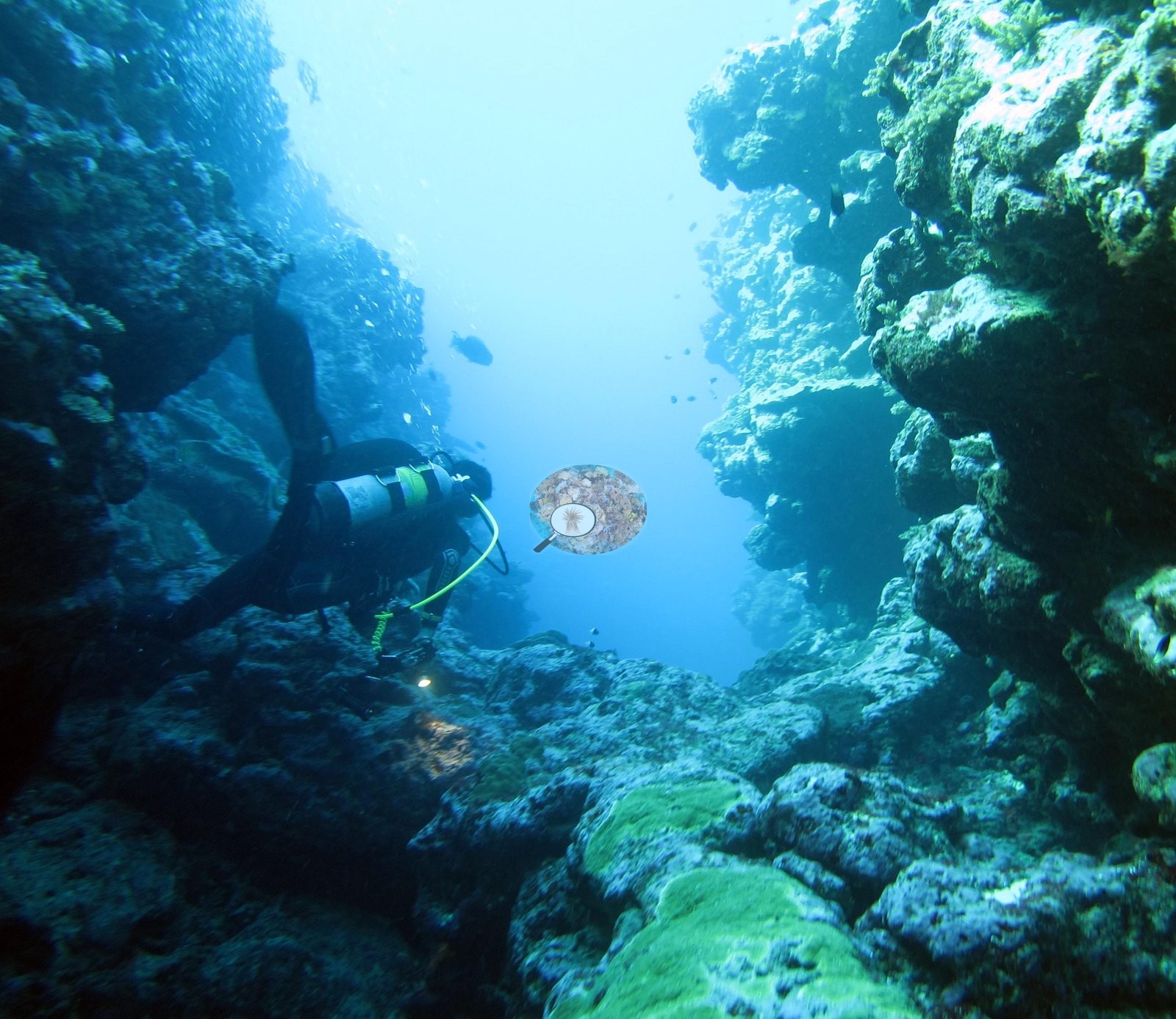
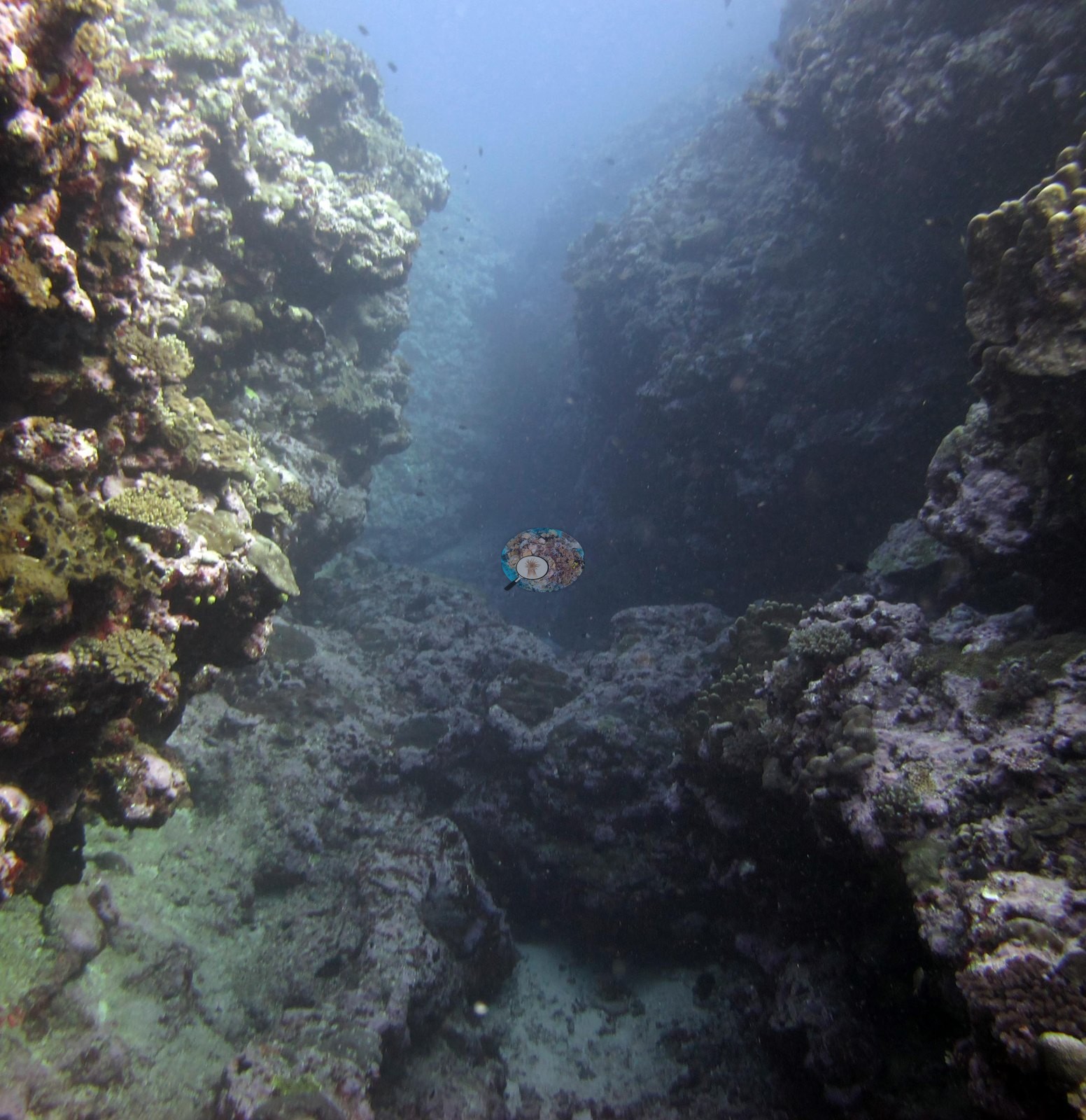
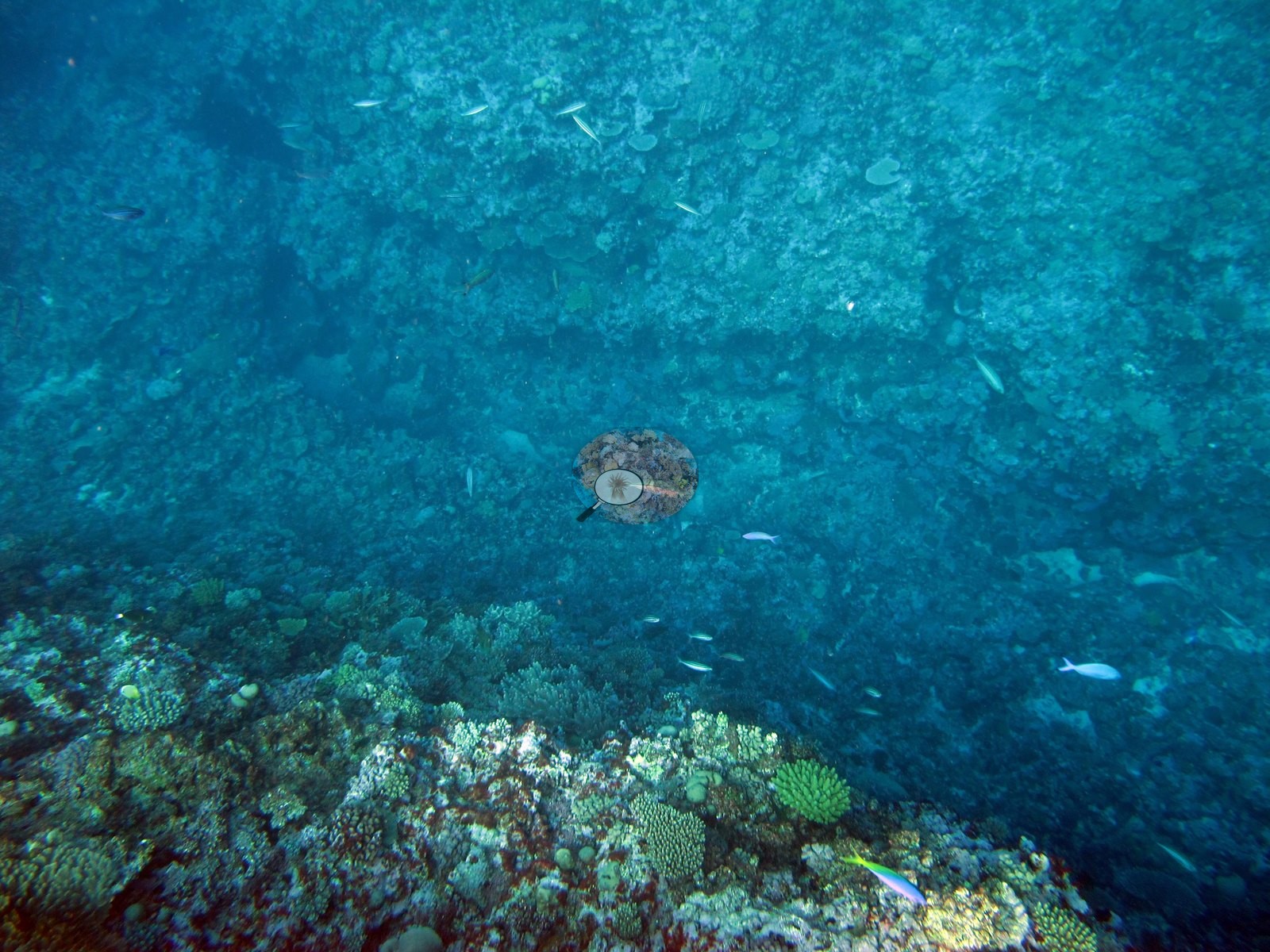
Image 3 is the clearest: two near-vertical coral-crusted walls closing in on a slot of blue water. Image 12 looks down into it from above, Image 7 along the floor between rock buttresses, and Image 2, Image 1, and Image 4 place a diver inside the gully for scale, in one case silhouetted against the light at the far end. This is a structurally dramatic site.
General benthic features
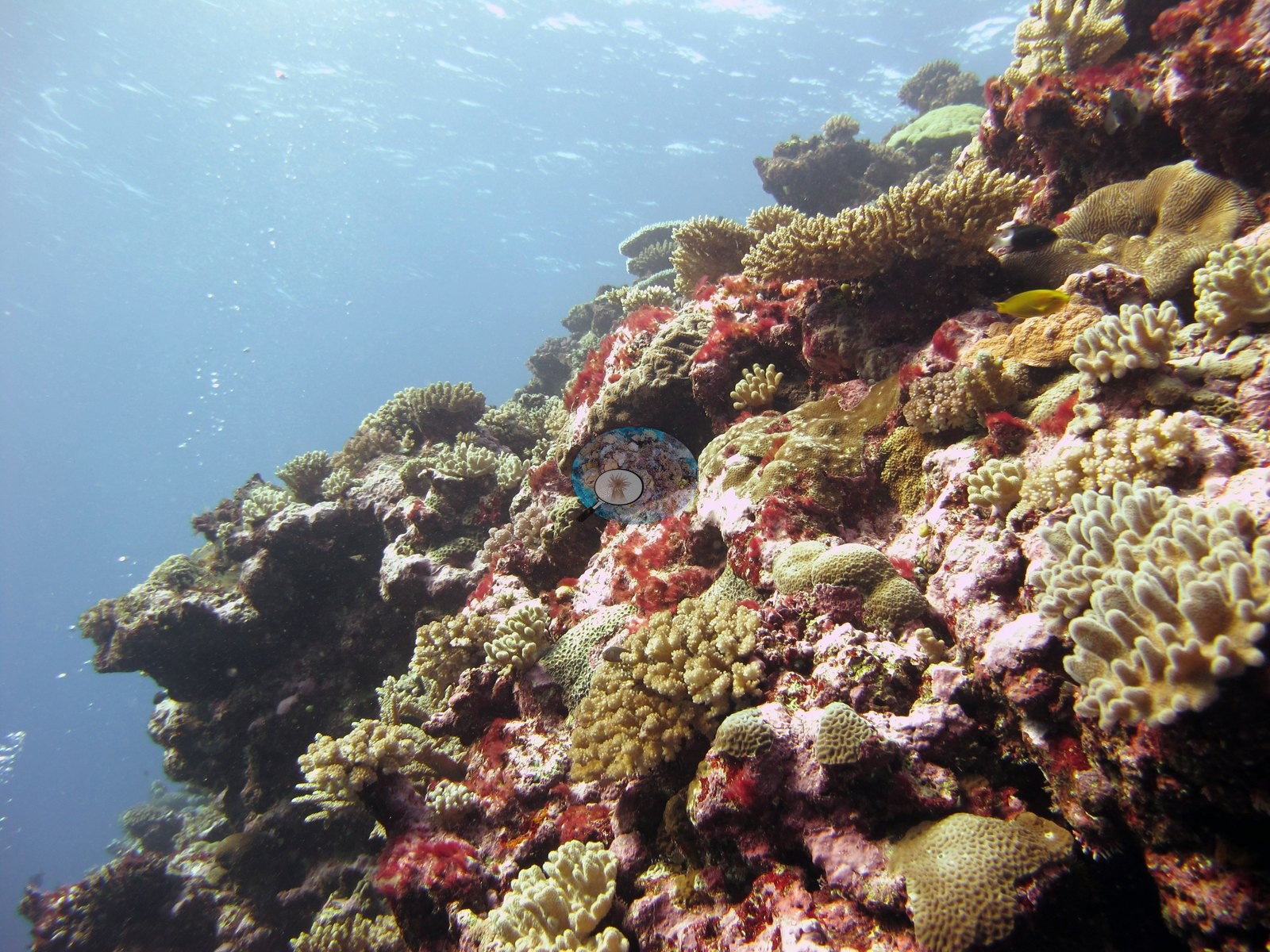
The reef surface itself (e.g., Image 5, Image 11) is a mixed, rather low and rugged framework: Image 5 looks along a ridge crest carrying cream and tan branching and encrusting colonies, olive and yellow-green colonies, pink and magenta coralline crust, and red encrusting patches, with turf between; Image 11, taken from about 3 m, looks across the shallow ground — an irregular rubble-and-framework surface with small branching and encrusting colonies scattered over it, a giant clam wedged into the bottom right of the frame, and fish overhead.
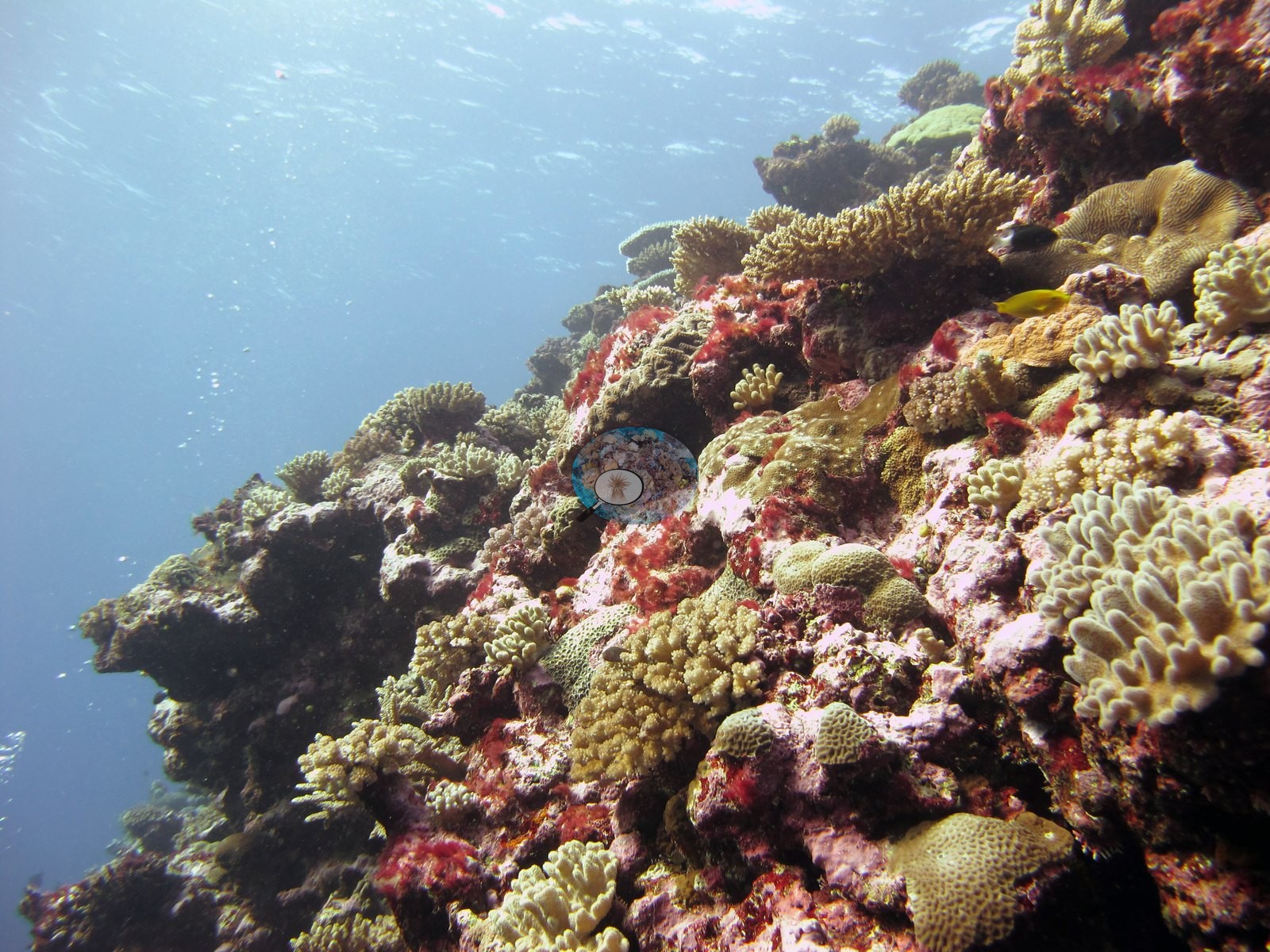
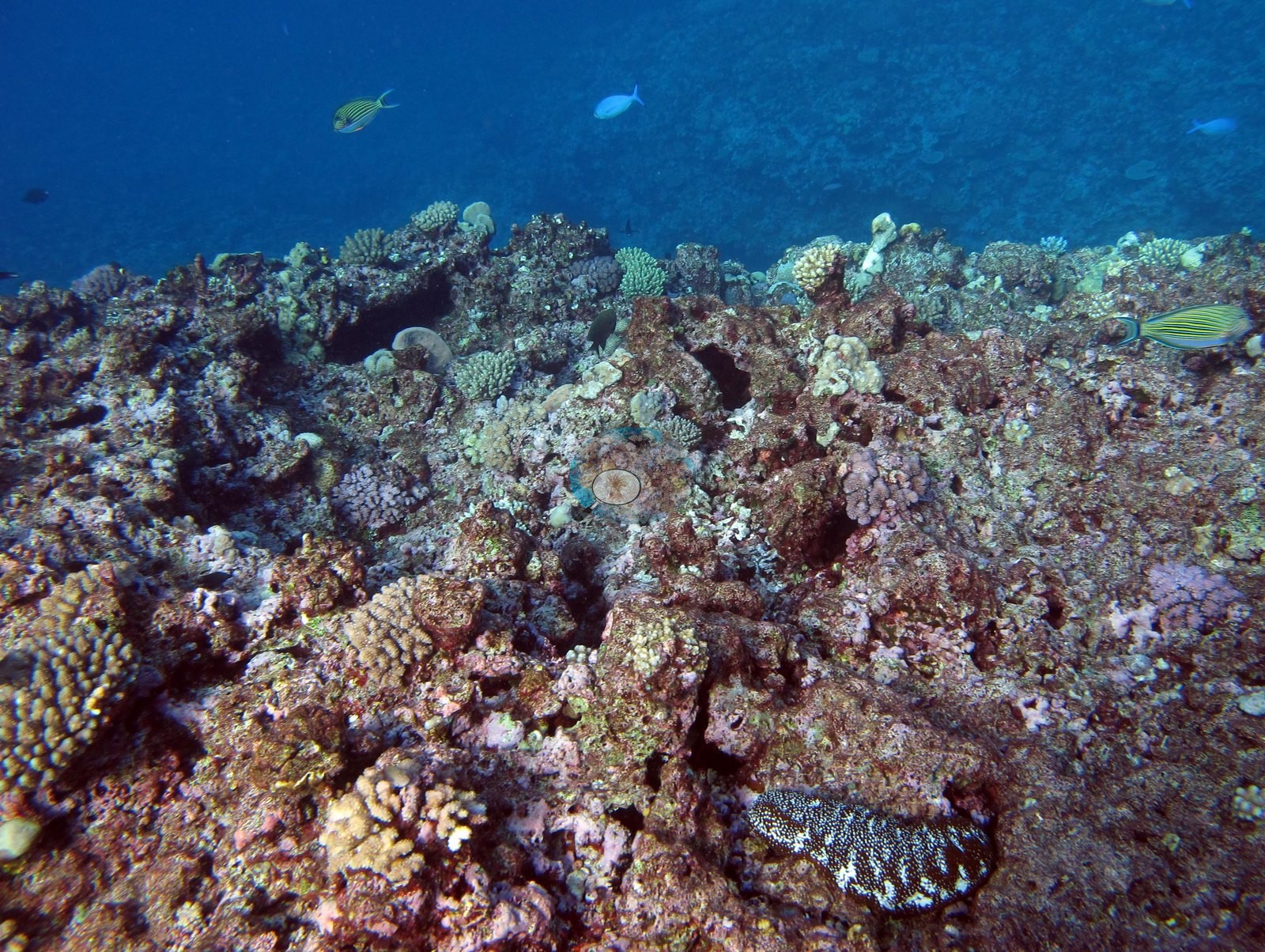
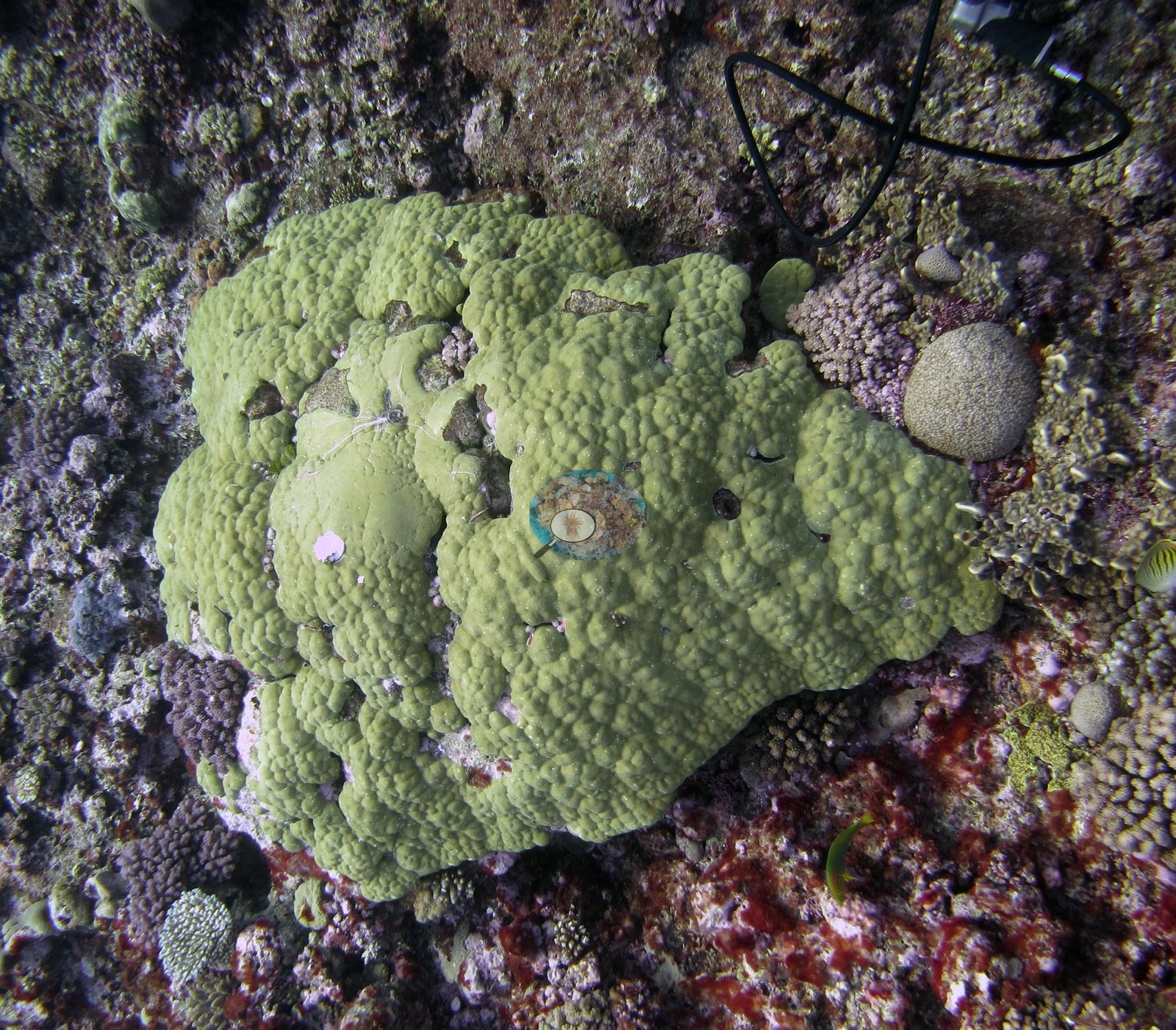
Image 10, identified as a massive Porites, shows a large smooth olive-green Porites dome, lobed and clean-surfaced, filling most of the frame with coralline-crusted rock around it.
Four frames are close colony portraits that Anderson noted as fluorescent, and they are the most vivid images in the set: a brilliant green knobby branching colony (e.g., Image 14), a bright orange knobby Pavona both in close macro (e.g., Image 9) and in place on the reef beside a mauve encrusting colony (e.g., Image 8), and a mussid with pale green polyps set in vivid pink-red skeletal walls (e.g., Image 6).
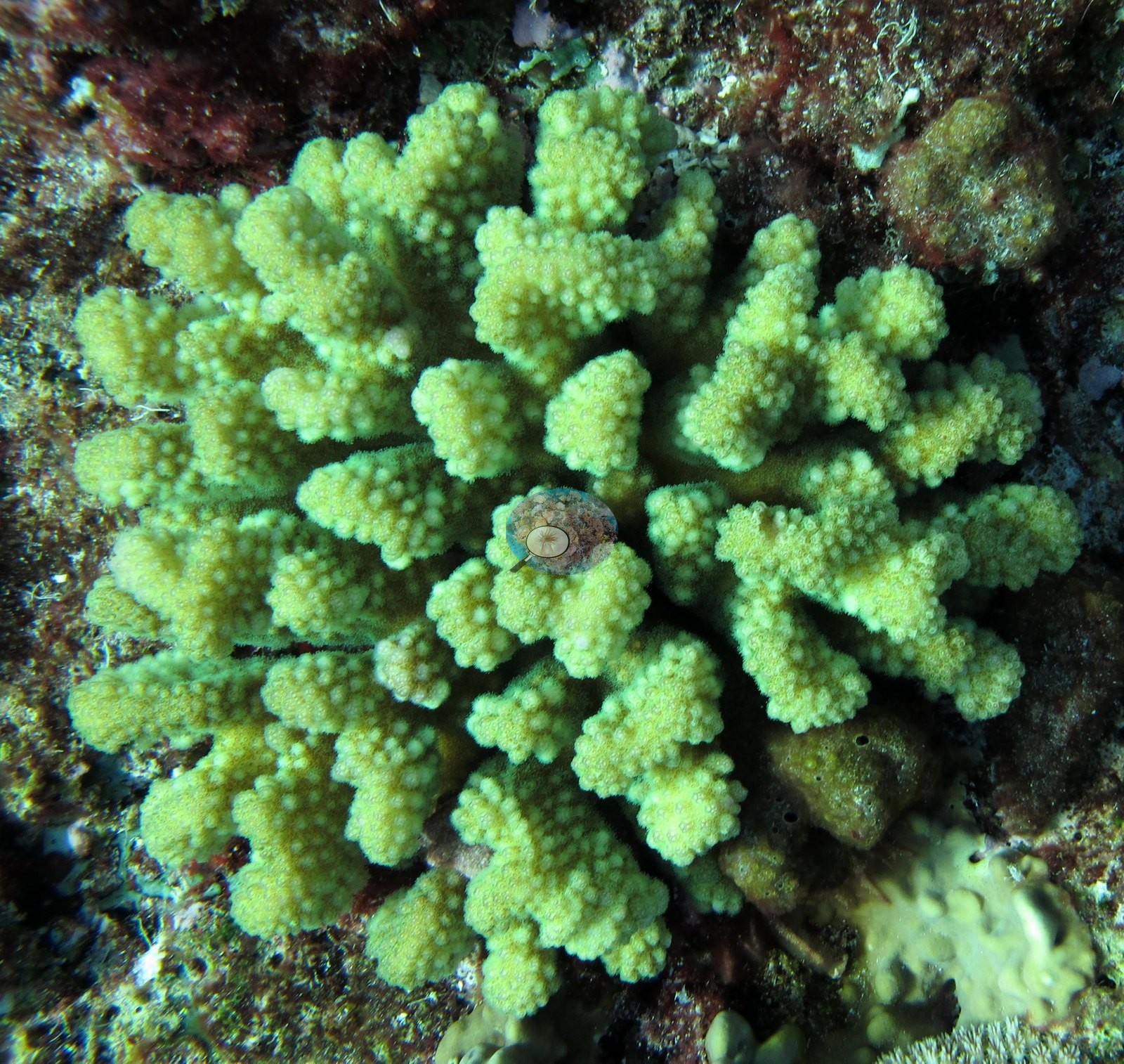
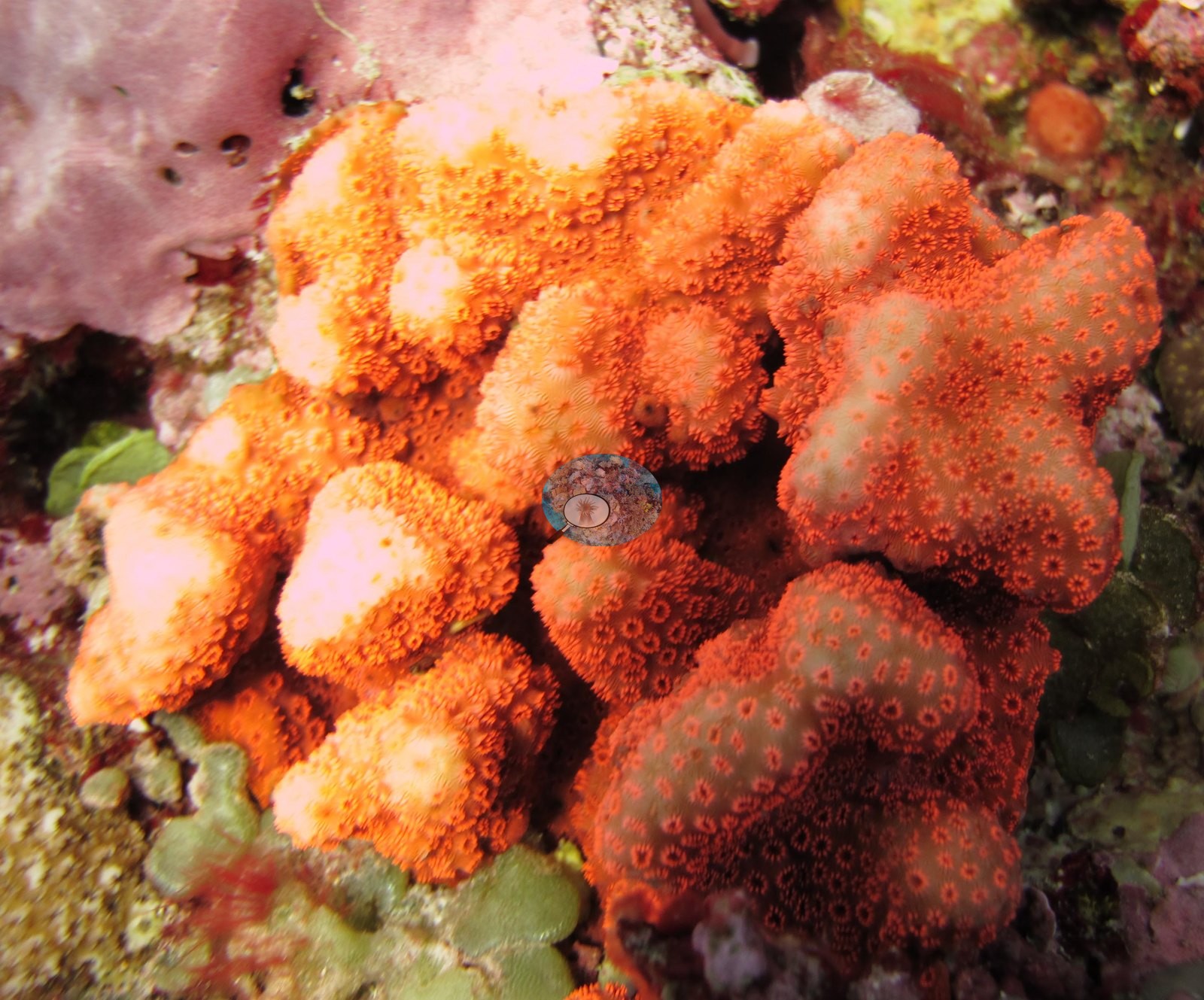
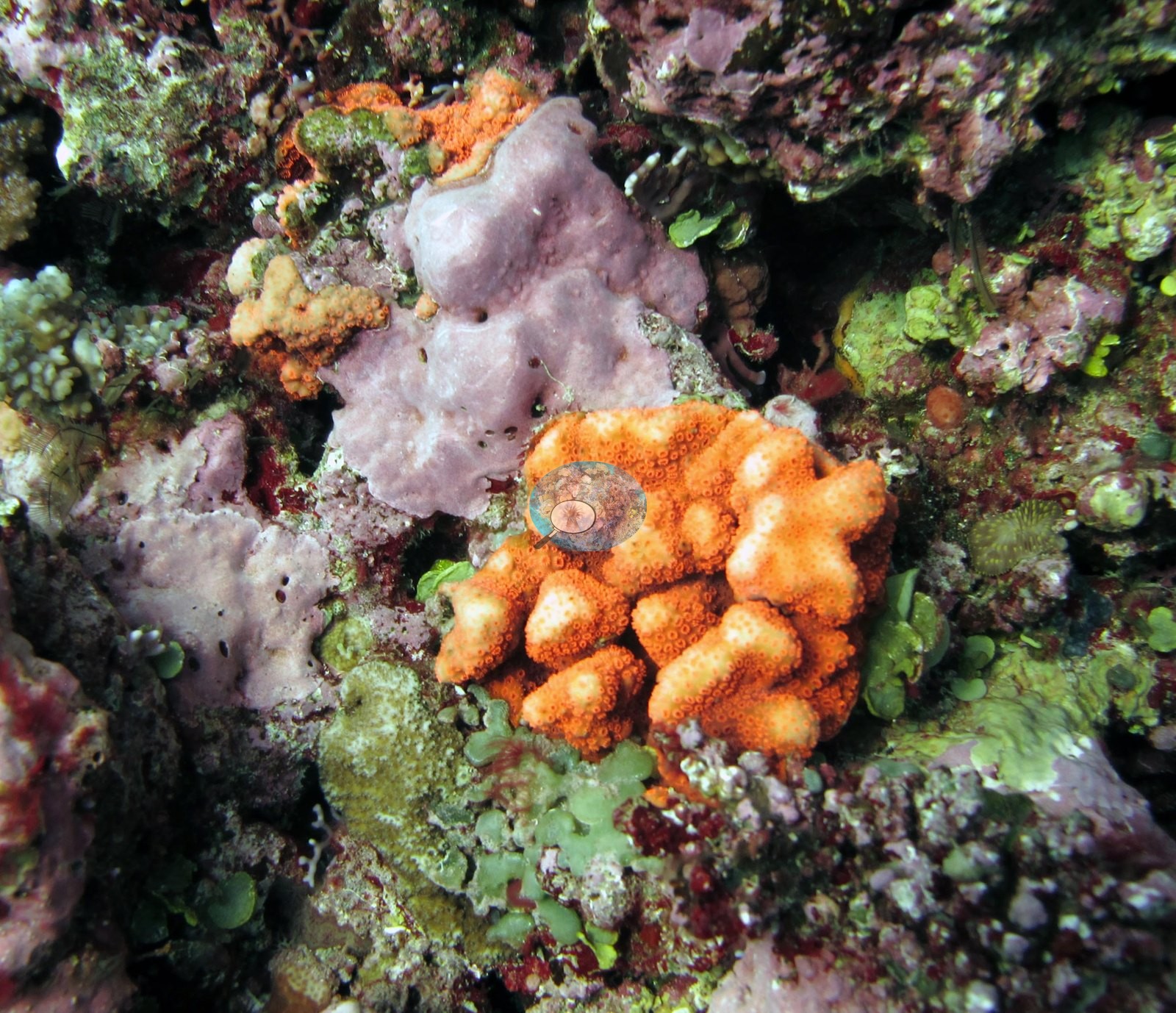
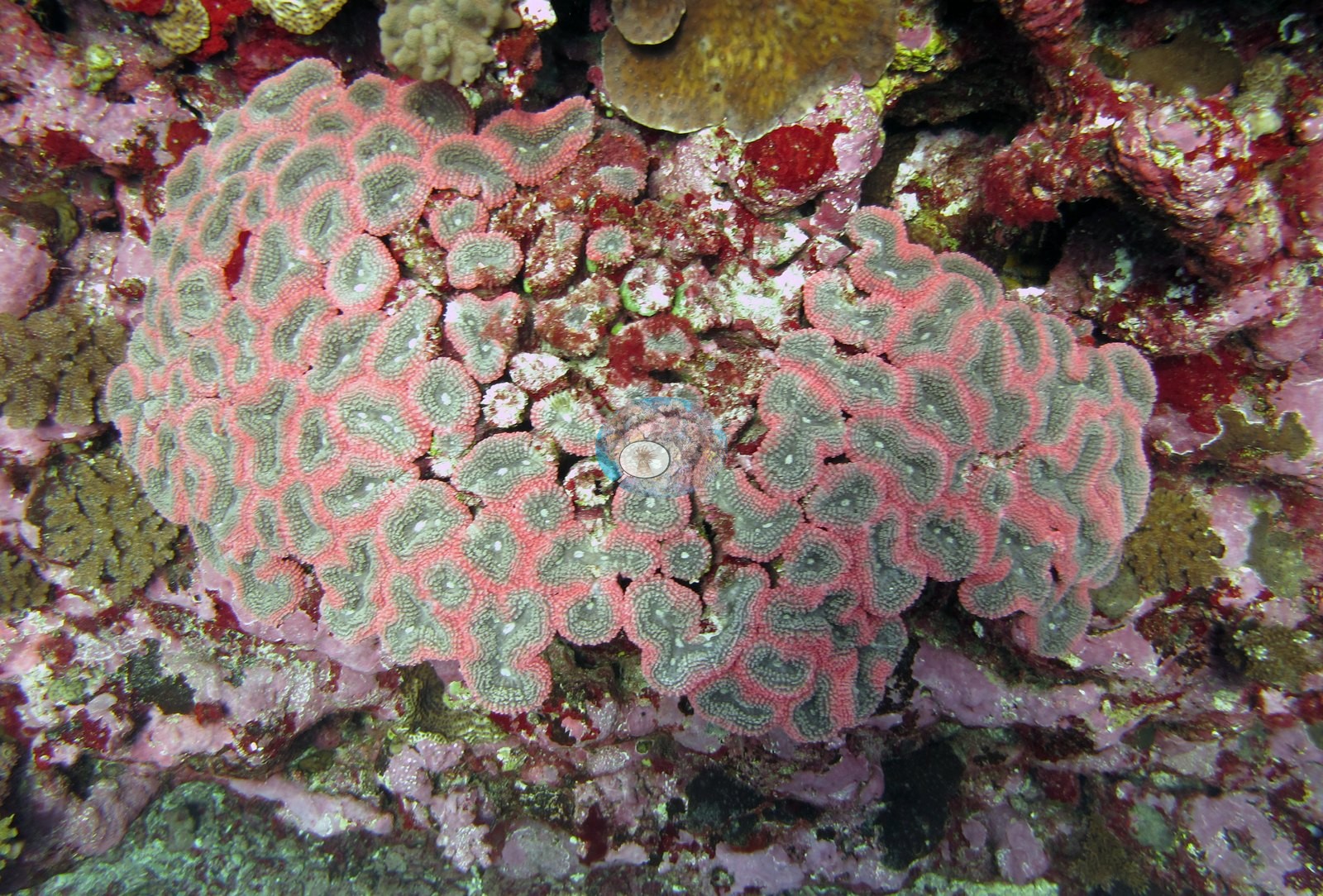
These are Anderson's identifications. They are single-colony frames, not habitat frames.
Coral cover
- Reference: Khaled bin Sultan Living Oceans Foundation, Global Reef Expedition (in situ transect)
- Coral cover 29%, from the LOF-GRE in situ benthic transect (the mean of all of this station's own transects in the expedition's per-transect benthic data) — a diver transect, and the authoritative figure for this site.
- Transect mean 29 ± 9.1% SE (n = 5 transects; Living Oceans Foundation per-transect benthic data); the headline above is this all-transect mean.
Stressors
Condition, qualitatively: no bleached, pale, or recently dead colonies appear in any of the 14 frames, and there are no disease lesions, no predation scars, and no crown-of-thorns seastars. Pigmentation in the close frames is unusually strong. The Living Oceans Foundation transects here recorded 12% cyanobacteria and no recently dead coral; they carry no bleaching, disease, or crown-of-thorns field.
Fish and other fauna
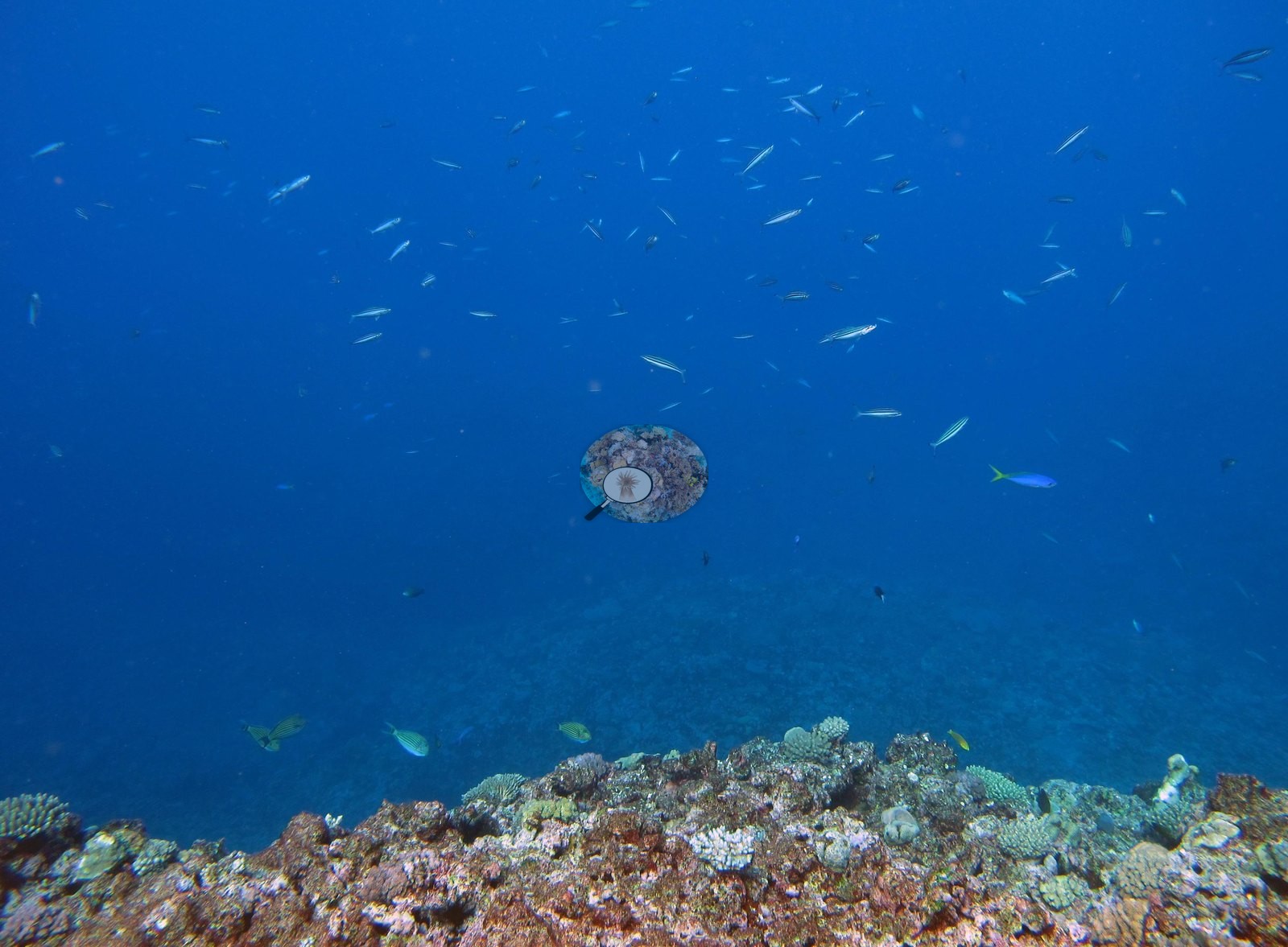
Image 13 is open water with a shoal of small fish over a thin strip of reef at the bottom edge.
Comparisons with other data
Apart from the Living Oceans Foundation survey shown here, we found no other surveys at this site as of 2026. If you would like to share yours, please email us.
Dive record
Moala, Lau Archipelago, dived 10 June 2013.
Other notes
What the frames cannot settle: the canyon frames are structure shots and carry little readable benthos, so the six of them cannot be used to characterize the community; depth is not recoverable except for the one frame Anderson noted at 3 m; and the colonies in the fluorescence frames are named from the field identifications, not from anything a photograph could settle.
Survey team's site notes: On the east side of the island (FJML23, FJML15, FJML22, FJML16), sites were on the fore reef slope. Large colonies of Porites and Diploastrea were common on the sides of the slope. Coming up the slope from 32 m, not very high coral cover, but CCA was common. Small colonies of Platygyra, Lobophyllia, and Echinopora were common.
Data & links
- Download benthic survey data (CSV) ↗
- Download all LOF-GRE data (933 sites) ↗
- Photo portfolio ↗
- Coral Reef Diagnostics page for this area ↗
All images from Coral Reef Diagnostics. Data are from the Khaled bin Sultan Living Oceans Foundation Global Reef Expedition and Coral Reef Diagnostics.
 © Coral Reef Diagnostics.