
Part of the regional summaries: Fiji - Moala, Fiji - Moala Group (Moala / Totoya / Matuku), and Fiji - Lau
More info
Fiji (NOAA CRW virtual station)A fore-reef slope on Moala's west side where Anderson's frames show coral build-ups packed with small to medium colonies, at 51% cover. The survey team reported build-ups spaced 15-20 m apart, coral continuing past 40 m on this side of the island, and feeding scars on table and plate corals likely from Culcita cushion stars. Surveyed on the Living Oceans Foundation's Global Reef Expedition.
E dua na baba ni yasana i tuba ni cakau (fore-reef slope) ena yasana i ra i Moala, ka na itaba nei Anderson e vakaraitaka na lase e vakasoqoni (build-ups) e vonu ena lase lalai kei na lase e sega ni levu sara, ka 51% na ubi ni lase (coral cover). Na ilawalawa ni vakadidike e vola ni veiyawaki na build-up oqo ena 15-20 m, e se tomana tiko na lase ka sivia na 40 m ena yasana oqo ni yanuyanu, kei na mavoa ni kana ena lase tepeli kei na lase vakaiteba ka rairai vakavuna na basaga Culcita (cushion stars).
AI translation of this summary; the English is authoritative. (low confidence)
CTD-cast midpoint of 27.1–27.3°C
🗺 Detailed map of the Global Reef Expedition dive sites, Moala, Fiji (Khaled bin Sultan Living Oceans Foundation; opens in a new window)
Site description
Setting
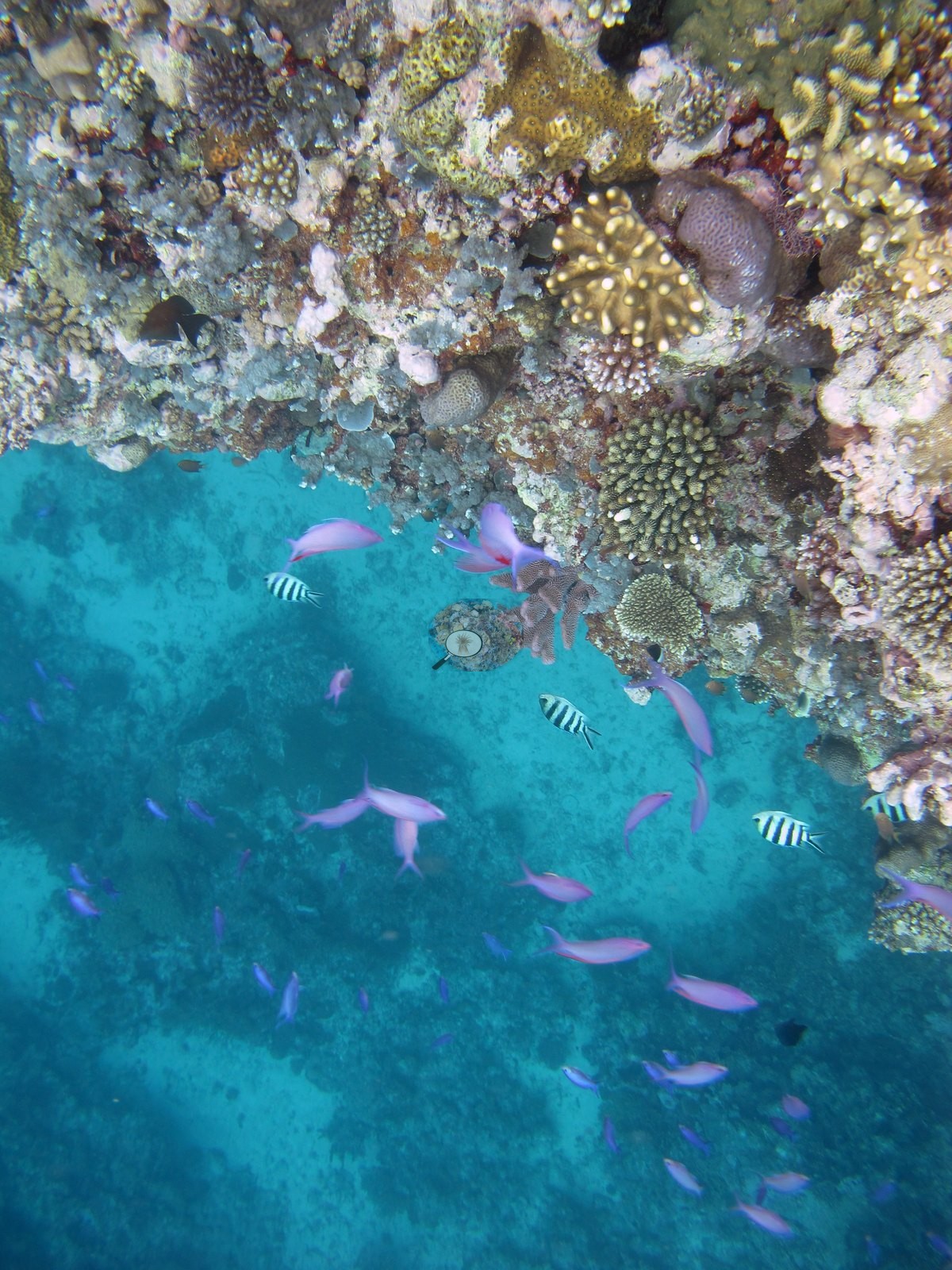
Image 10 looks out and down from under a shallow coral overhang into clear turquoise water, with the reef below visible through it — the best frame in the set for water clarity and the only one that conveys the site's shallow-to-deep transition at all.
Survey team's Moala notes. FJML19 and FJML20 were located on the west side of the island.
General benthic features
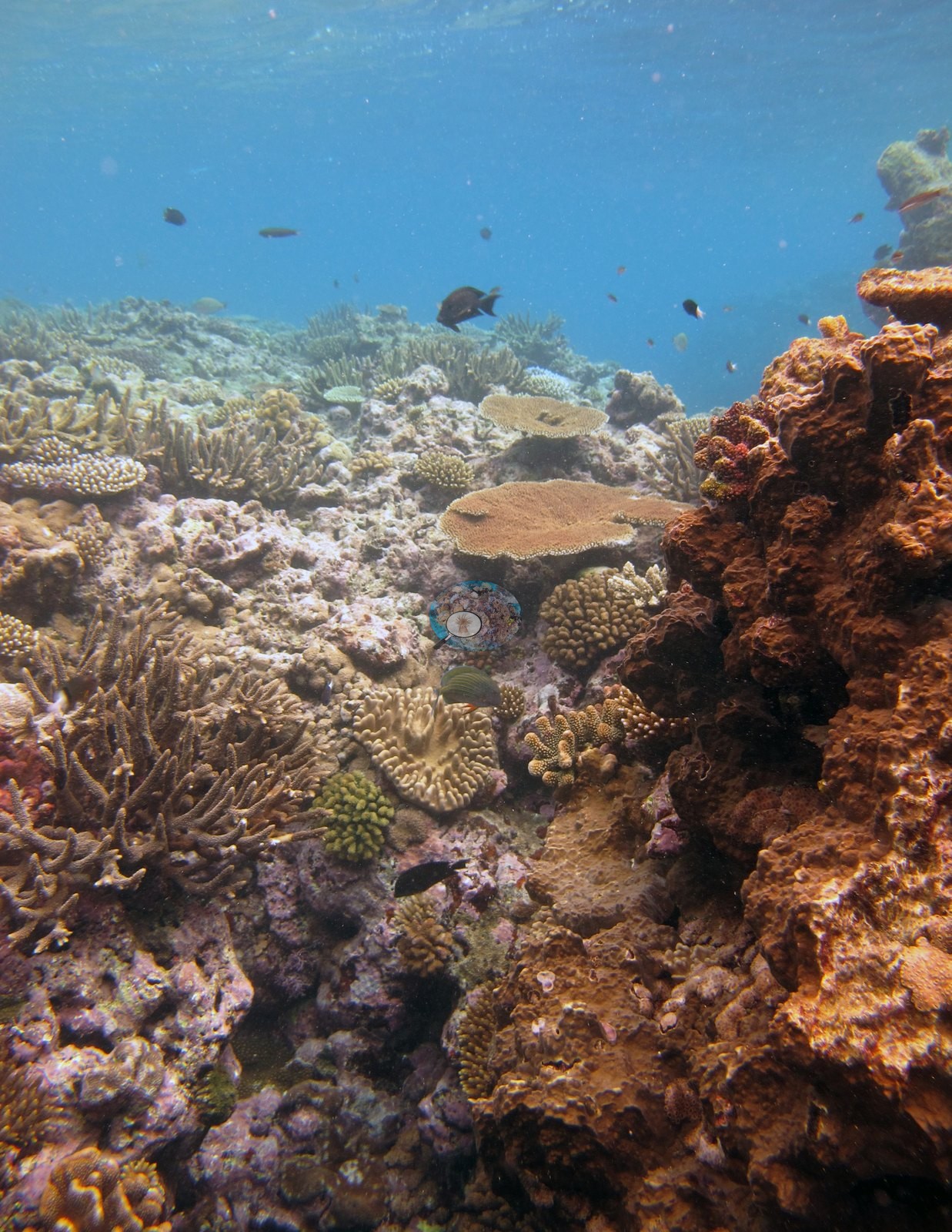
Ten habitat frames and three sampled-colony frames survive from the dive (Moala, Lau Archipelago, 9 Jun 2013 — the dive immediately before FJML20 on the same day, and written here only from its own frames). Anderson's own field identifications and notes are used throughout. The habitat frames are of coral build-ups on a fore-reef slope, shot mostly looking up their flanks. Image 1, Image 2, Image 9, Image 3, and Image 4 all show the same architecture: a steep-sided mound or spur rising out of the slope, its flank and crest packed with small to medium colonies, and open blue water immediately off to one side. Image 7 is the clearest single view of that structure — a build-up seen almost edge-on, its apex silhouetted against blue, its flanks falling away on both sides.
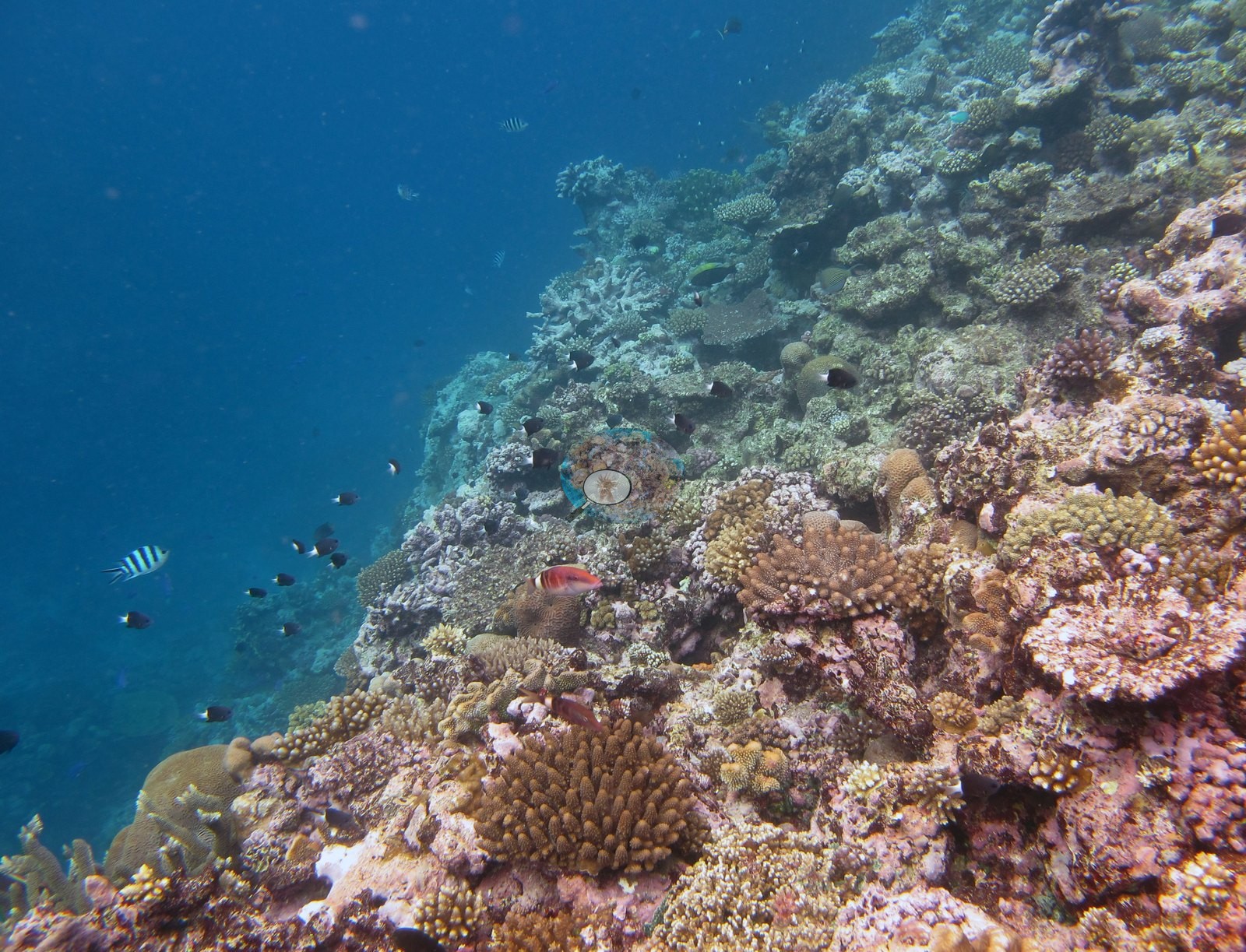
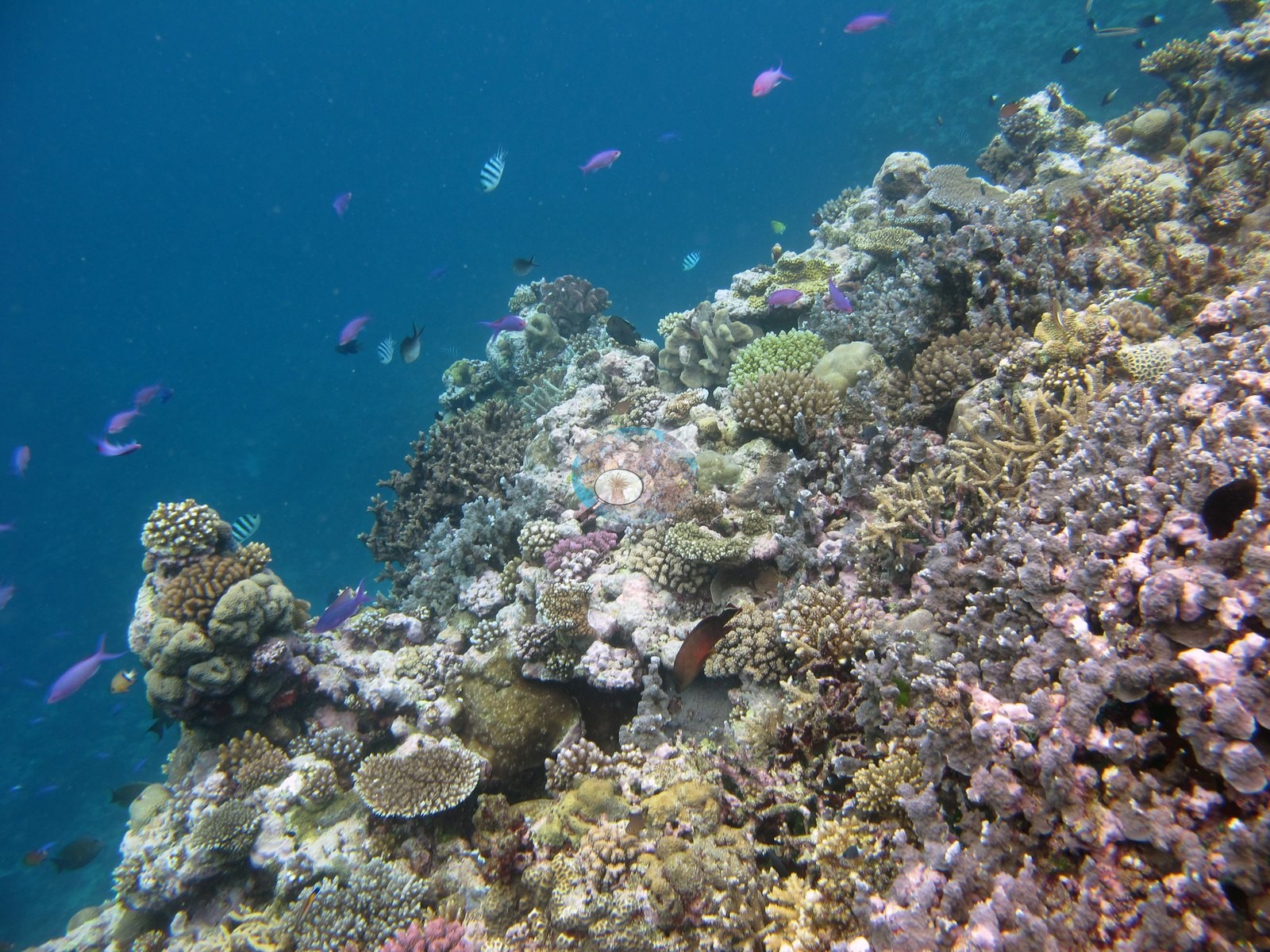
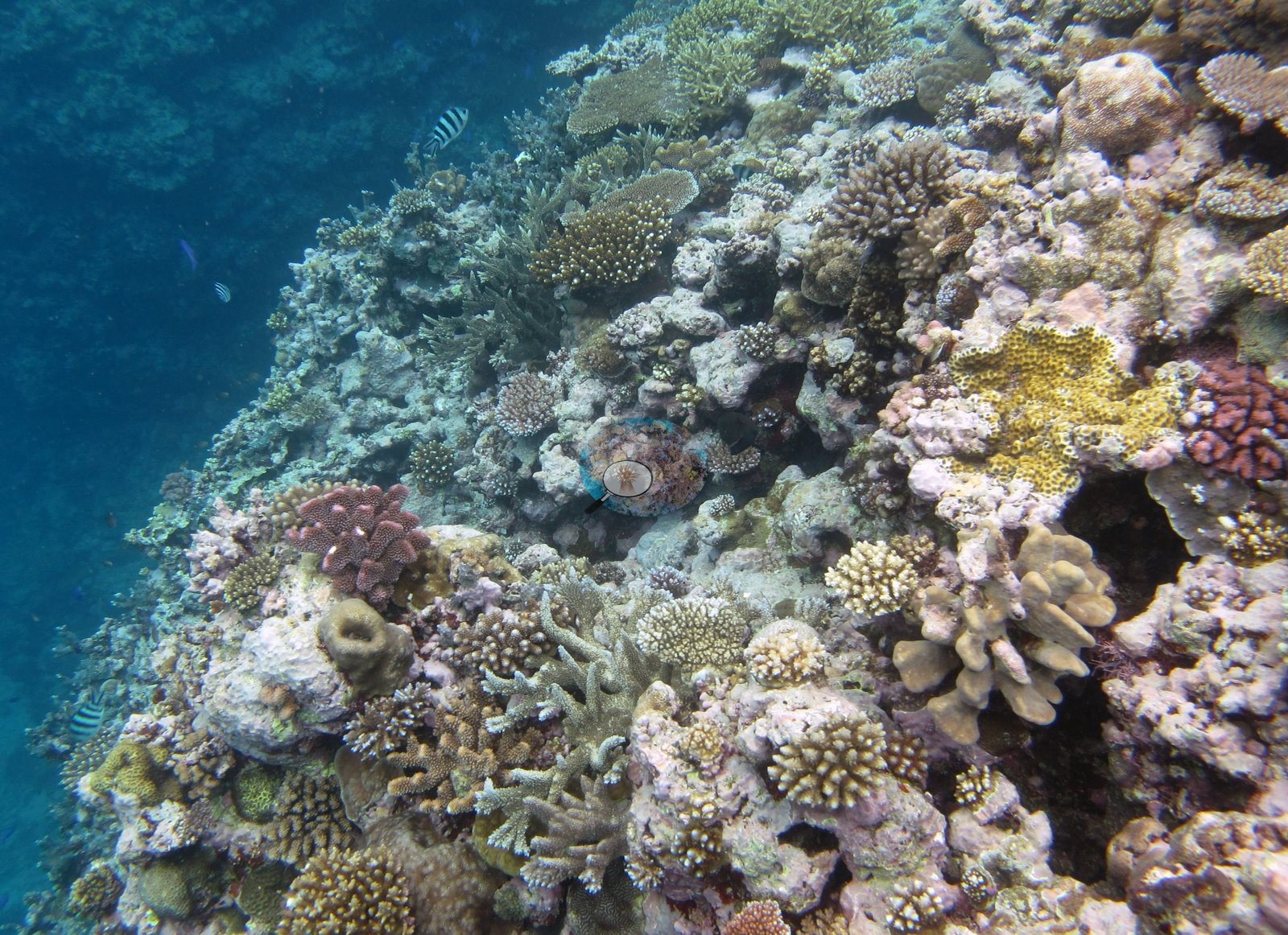
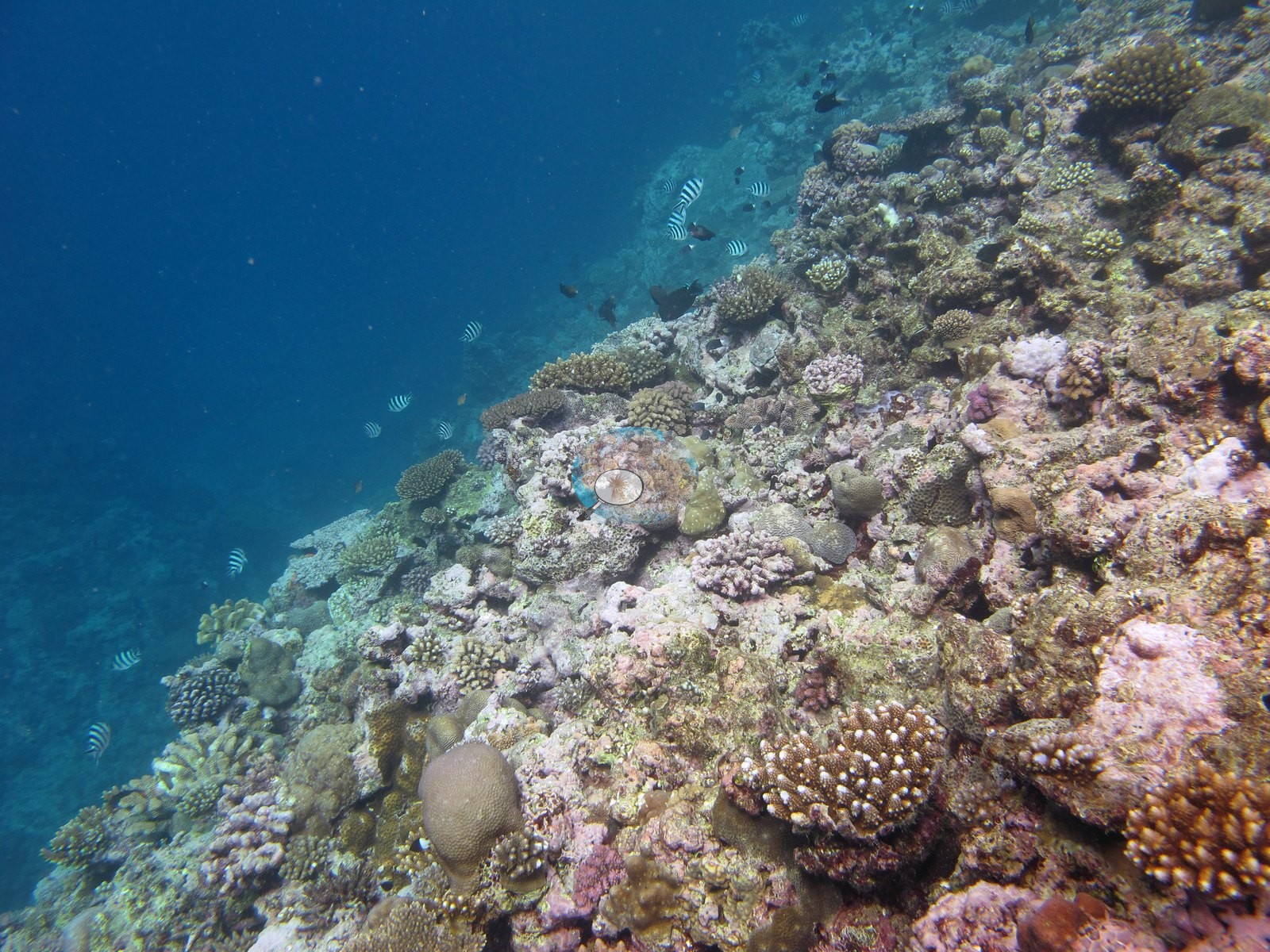
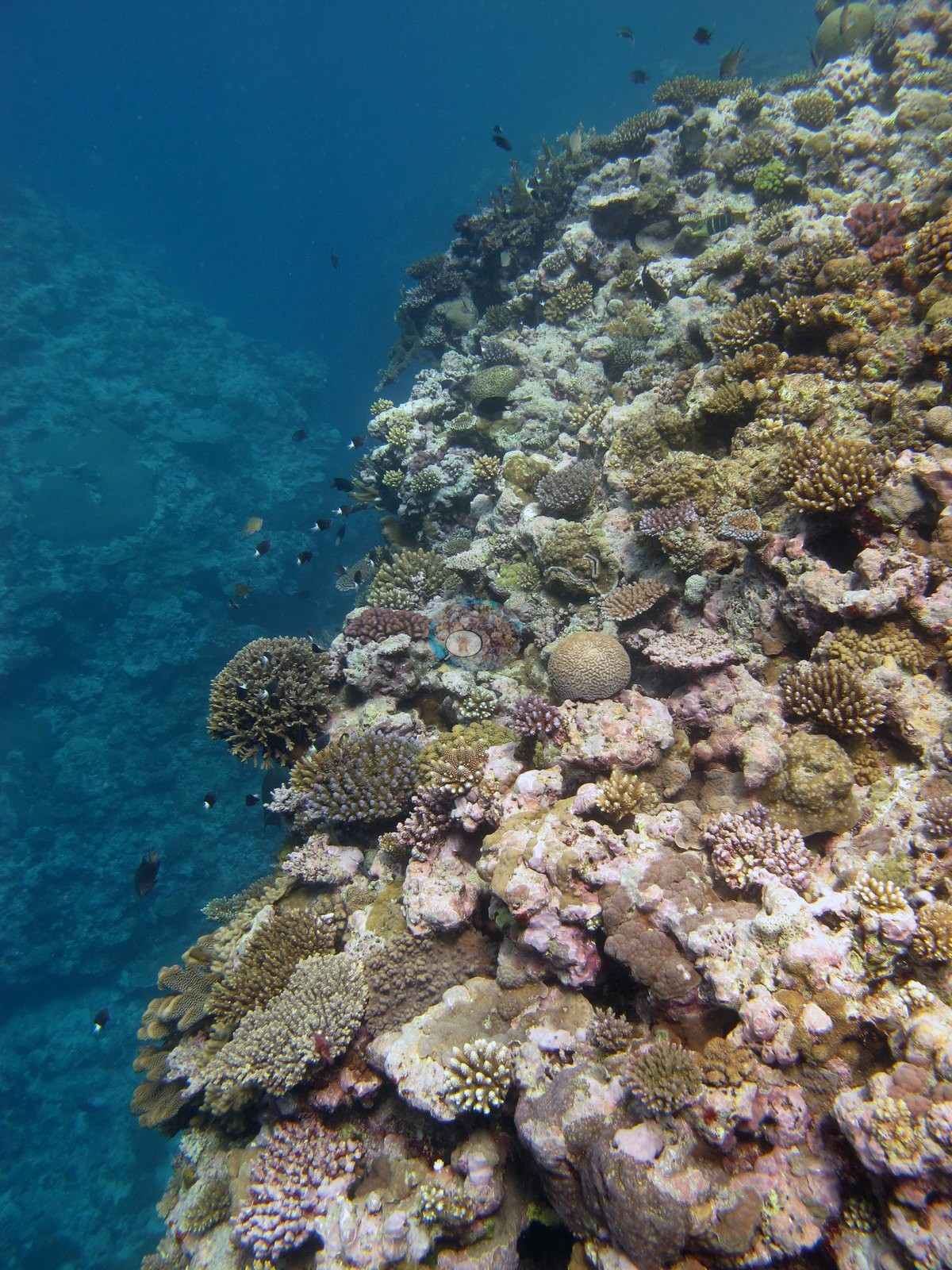
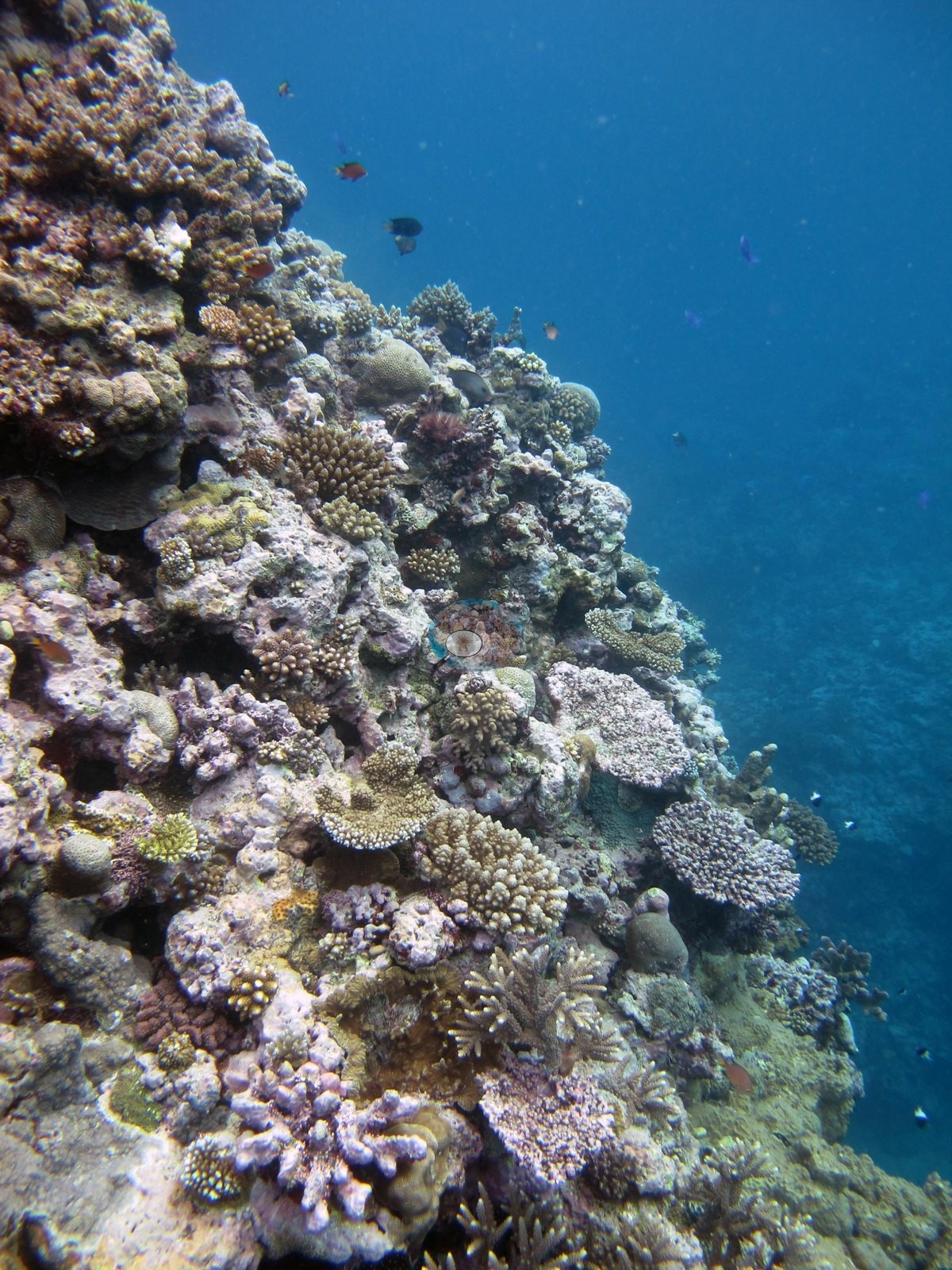
The colonies are densely set and highly mixed: corymbose and digitate acroporids in tan, cream, and pale green, thin tabular plates, mauve to purple bushy pocilloporid clumps, low foliose and encrusting sheets, rounded tan massives, and pink and mauve crustose coralline algae filling and coating the framework between them. A vivid yellow encrusting-to-foliose colony stands out at the right of Image 9. Two frames record the shallow end of the site. Image 5 is shot with the surface visible above, across a shallow reef top carrying tabular acroporid plates, branching stands, and mixed small colonies against a large orange-brown block of older framework at the right of the frame.
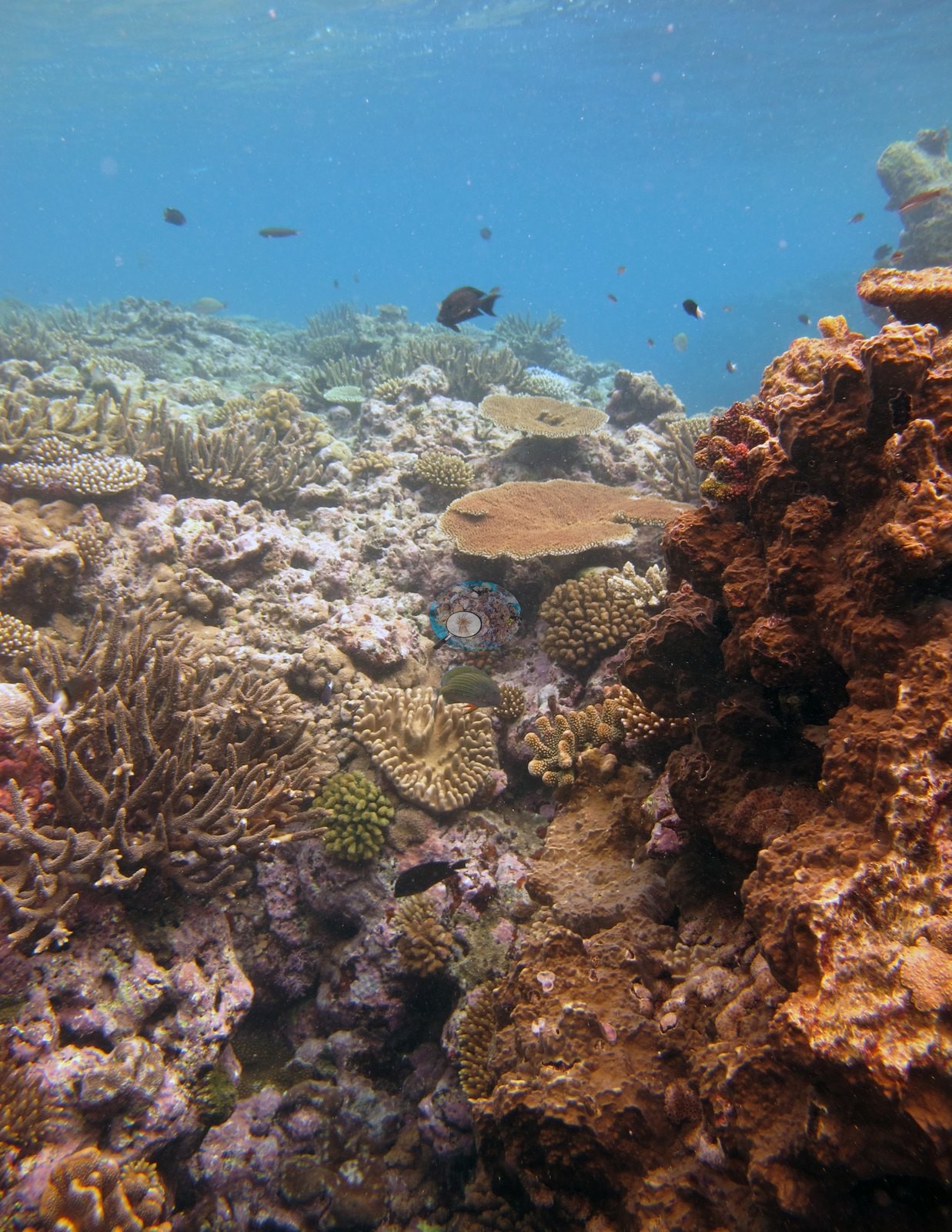
Two close subjects carry Anderson's own identifications. Image 6 is, by the field identification, a Pocillopora verrucosa whose growth form resembles P. damicornis, and shows a golden-tan bushy pocilloporid with prominent cream-white branch tips, set beneath a dark meandroid brain coral and against pink coralline crust.
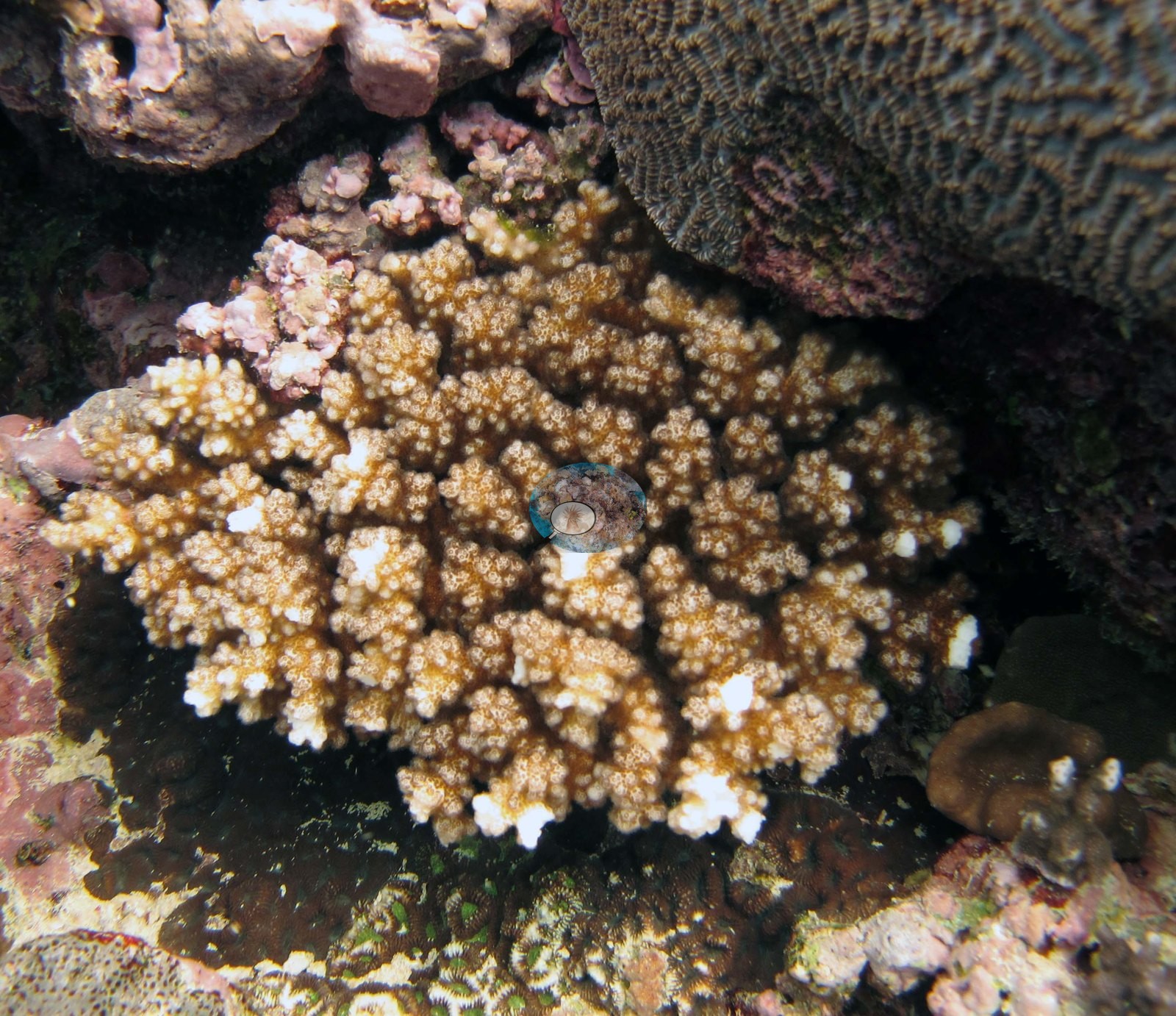
The white tips are described as seen; nothing in a single frame separates a growth margin from anything else, and no condition claim is made from them. The sampling is on record photographically. Three sampled-colony frames exist: two show the same tagged colony 43 (e.g., Image 11, Image 12), with a numbered cattle tag and bone clippers in shot on a tan branching colony; the third shows a tag and clippers on a dark branching colony, colony 42 (e.g., Image 13), which Anderson identified as Pocillopora verrucosa.
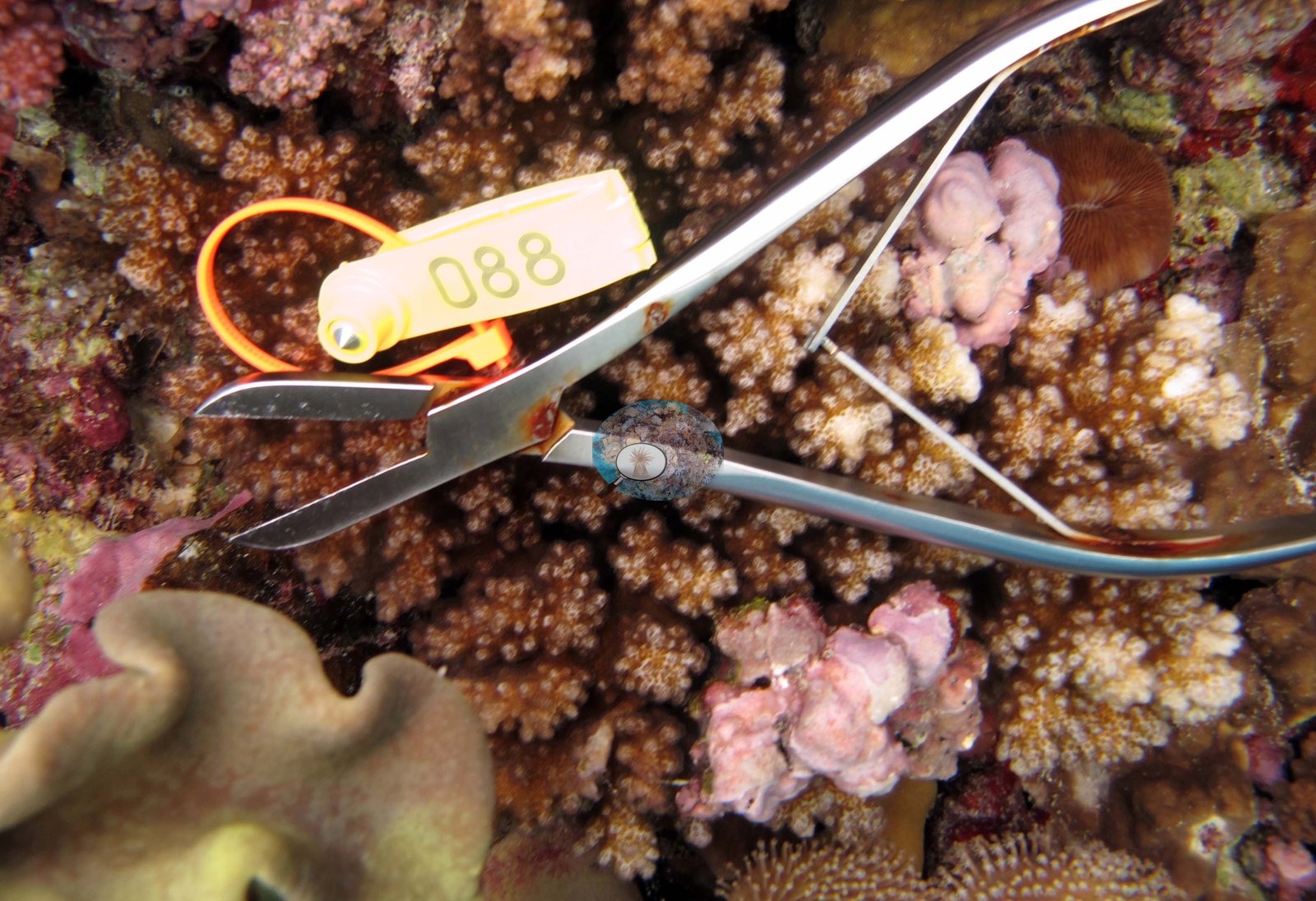
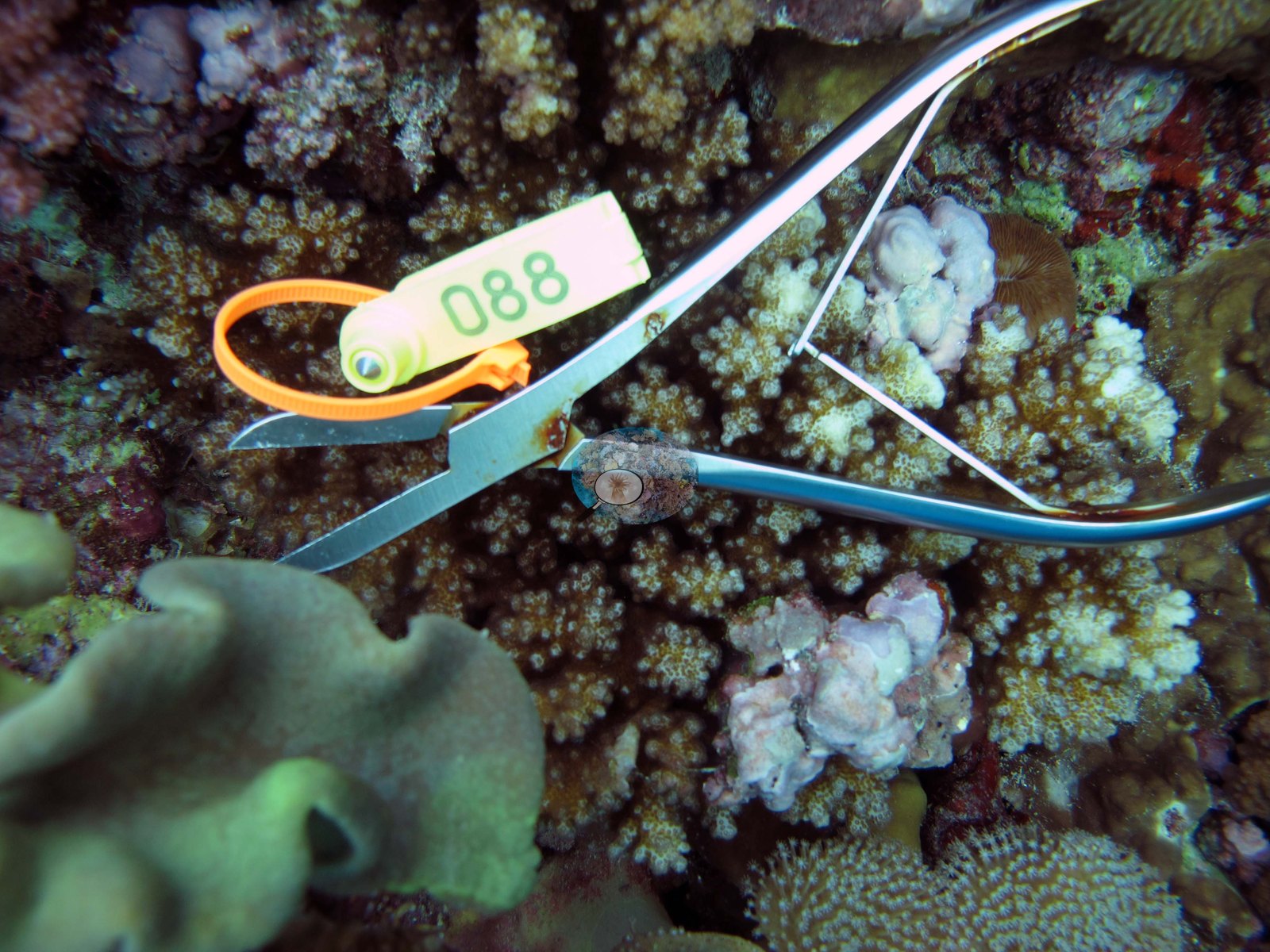
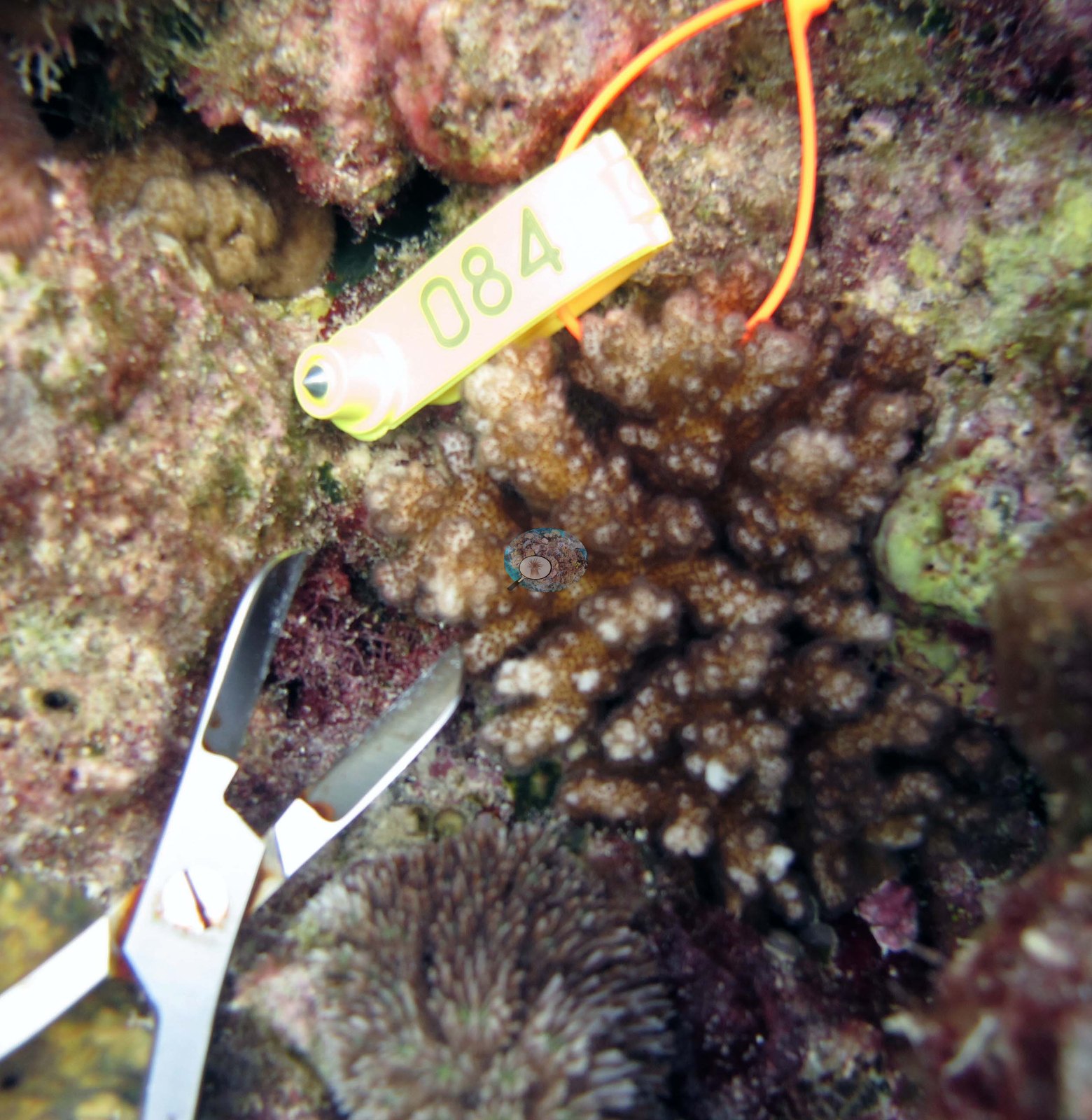
The sampling sheet records colonies F42 and F43 as sampled here.
Survey team's Moala notes (FJML19 and FJML20, with some lines written for the island's other stations). Up on the terrace, coral build ups on top of massive framework were common. Around 15–20 m was the approximate distance between each build up. Acroporids and other branching corals were common on the tops of the build ups. Down the slope, P. rus plates were common as well as stands of staghorn acroporids. On the fore reef terraces, a prominent spur and groove morphology was populated by small branching coral colonies with old mortality colonized by CCA. Most of the corals were smaller in size around 45–60 cm in diameter. Large colonies of Porites and Diploastrea were common on the sides of the slope. Small colonies of Platygyra, Lobophyllia, and Echinopora were common.
Coral cover
- Reference: Khaled bin Sultan Living Oceans Foundation, Global Reef Expedition (in situ transect)
- 51%, from the Khaled bin Sultan Living Oceans Foundation's in situ transect survey (Global Reef Expedition site data); the photographs illustrate the site.
- Where the camera is close, bare substrate is genuinely hard to find between colonies; that is a description of what those frames contain, not a cover measurement.
- There is no scale object, quadrat, or transect line in any frame, so no colony dimension here should be treated as measured.
- FJML19 and FJML20 were both on the fore reef slope, with slope and coral cover continuing beyond 40 m off the fore reef terrace.
- The survey team's notes add that moderate to high coral cover was found on the tops of the build ups.
- At the terrace level, less coral cover and higher turf and CCA coverage.
- On the island's east side, coming up the slope from 32 m, coral cover was not very high, but CCA was common.
- Transect mean 51 ± 7.9% SE (n = 5 transects; Living Oceans Foundation per-transect benthic data); the headline above is this all-transect mean.
Stressors
None of the corals with an outlier score at this site was flagged as a physiological outlier; island-wide (Moala), 1 of the 10 corals with an outlier score was (Mayfield et al. 2017). The frames cannot establish the site's depth zonation, cannot reach the deeper slope the survey describes below 40 m, and cannot confirm the Porites rus plates, staghorn stands, or Culcita feeding scars the surveyors recorded. No bleaching, disease lesion, or feeding scar resolves with confidence anywhere in the set. The survey team's notes record some feeding scars on table and plating corals at FJML19 and FJML20, likely due to an increase in Culcita sea stars at the two sites. The survey team's notes for FJML17 and FJML18 add that Porites rus colonies populated the edges of the overhangs where large sand flats were located, often with old coral rubble that could be evidence of a storm surge event. Typical recent thermal stress: mean annual maximum of 8.9°C-weeks (Degree Heating Weeks, 2021-2025, NOAA CRW; Fiji virtual station). The Living Oceans Foundation transects here recorded 6.8% cyanobacteria and no recently dead coral.
Fish and other fauna
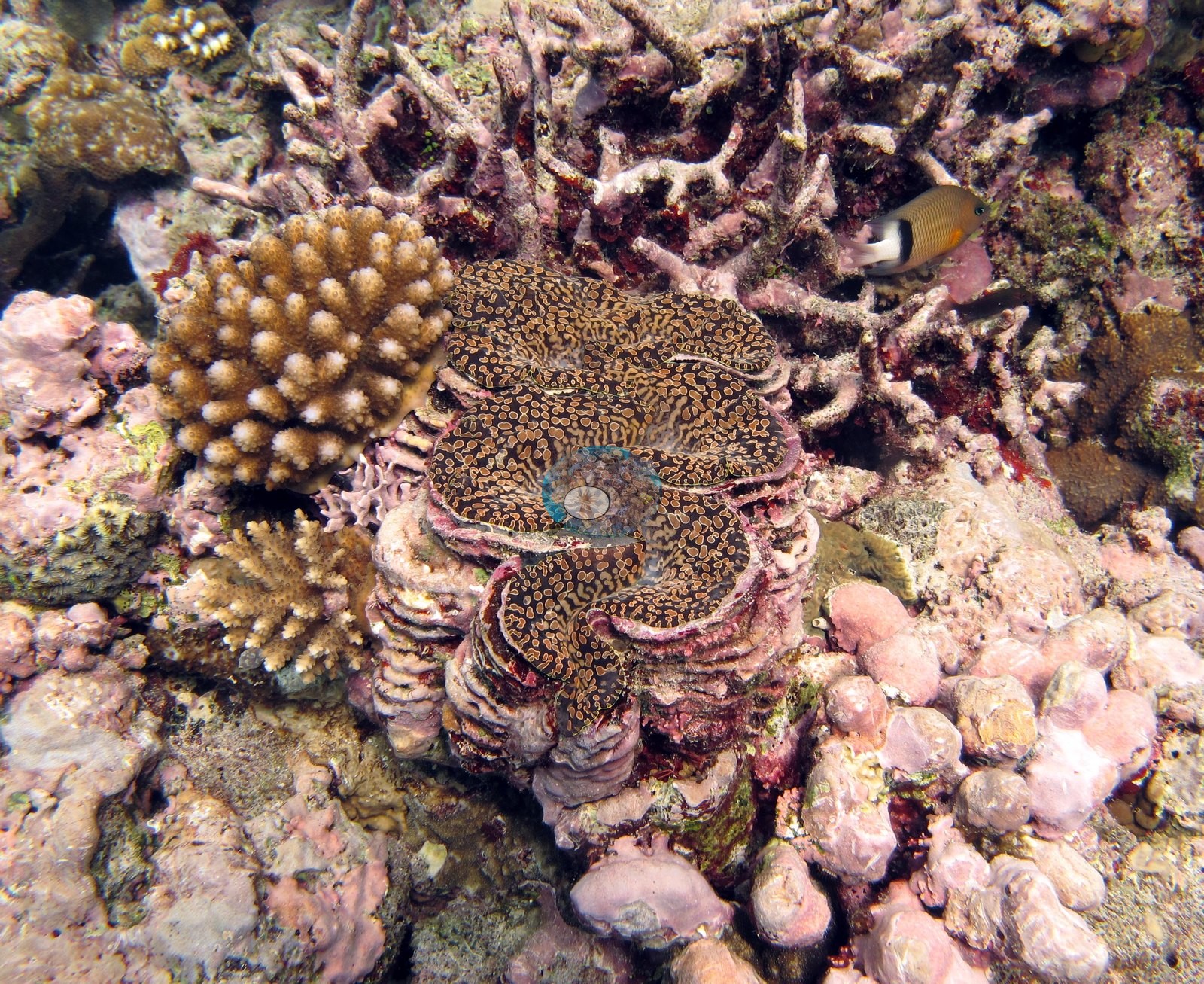
Image 8 is a giant clam (Anderson's identification) with a heavily patterned brown-and-gold mantle and fluted shell, wedged into the framework among branching colonies, with a butterflyfish alongside.
Fish are conspicuous but not dominant. Purple and magenta anthias hang over the slope in Image 2 and Image 10, black-and-white striped damselfishes and dark Chromis-type planktivores work the reef top through most of the wide frames, and a small red-orange fish sits tucked into the framework in Image 1.
Comparisons with other data
Apart from the Living Oceans Foundation survey shown here, we found no other surveys at this site as of 2026. If you would like to share yours, please email us.
Dive record
FJML19 (Moala, Lau Archipelago): surveyed 9 Jun 2013 during the Khaled bin Sultan Living Oceans Foundation Global Reef Expedition.
Data & links
- Download benthic survey data (CSV) ↗
- Download all LOF-GRE data (933 sites) ↗
- Photo portfolio ↗
- Coral Reef Diagnostics page for this area ↗
All images from Coral Reef Diagnostics. Data are from the Khaled bin Sultan Living Oceans Foundation Global Reef Expedition and Coral Reef Diagnostics.
 © Coral Reef Diagnostics.