
Part of the regional summaries: Fiji - Fulaga, Fiji - Southern Lau (Kabara / Fulaga), and Fiji - Lau
More info
Fiji (NOAA CRW virtual station)A Fulaga wall station, dived to 29 m: a near-vertical drop into open blue with foliose corals under overhangs and a sand apron far below. Coral is dense along the reef edge, where table and branching Acropora mix with soft corals and a single sea fan, at 35% cover. Surveyed on the Living Oceans Foundation's Global Reef Expedition.
E dua na vanua ni vakadidike ena bati ni cakau (wall) e Fulaga, a nunu kina ki na 29 m: e dua na bati ni cakau e voleka ni tu dodonu ka lutu ki na wasawasa karakarawa, kei na lase vakadrau ni kau (foliose) e ra ni vatu e dremo, kei na nuku e ra sara. E vuqa na lase ena bati ni cakau, e veiwaki kina na Acropora vakatepeli kei na vakatabataba kei na lase malumu (soft corals) kei na dua ga na iri ni wasawasa (sea fan), ka 35% na ubi ni lase (coral cover).
AI translation of this summary; the English is authoritative. (low confidence)
CTD-cast midpoint; the cast read 26.5°C throughout
Three other CRD dive sites with their own pages within 5 km shown in orange — click a marker to open its page.
🗺 Detailed map of the Global Reef Expedition dive sites, Fulaga, Fiji (Khaled bin Sultan Living Oceans Foundation; opens in a new window)
Site description
Setting
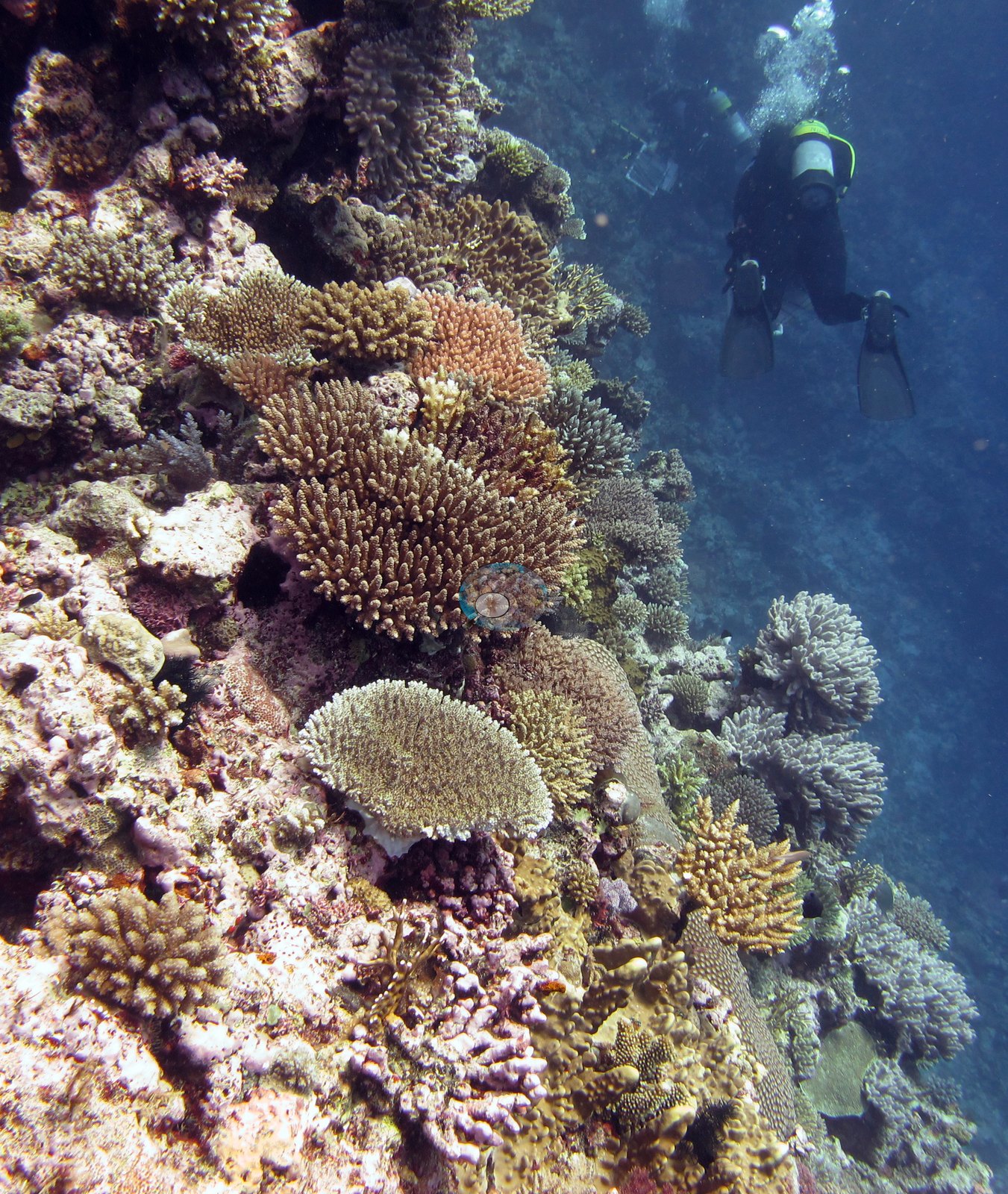
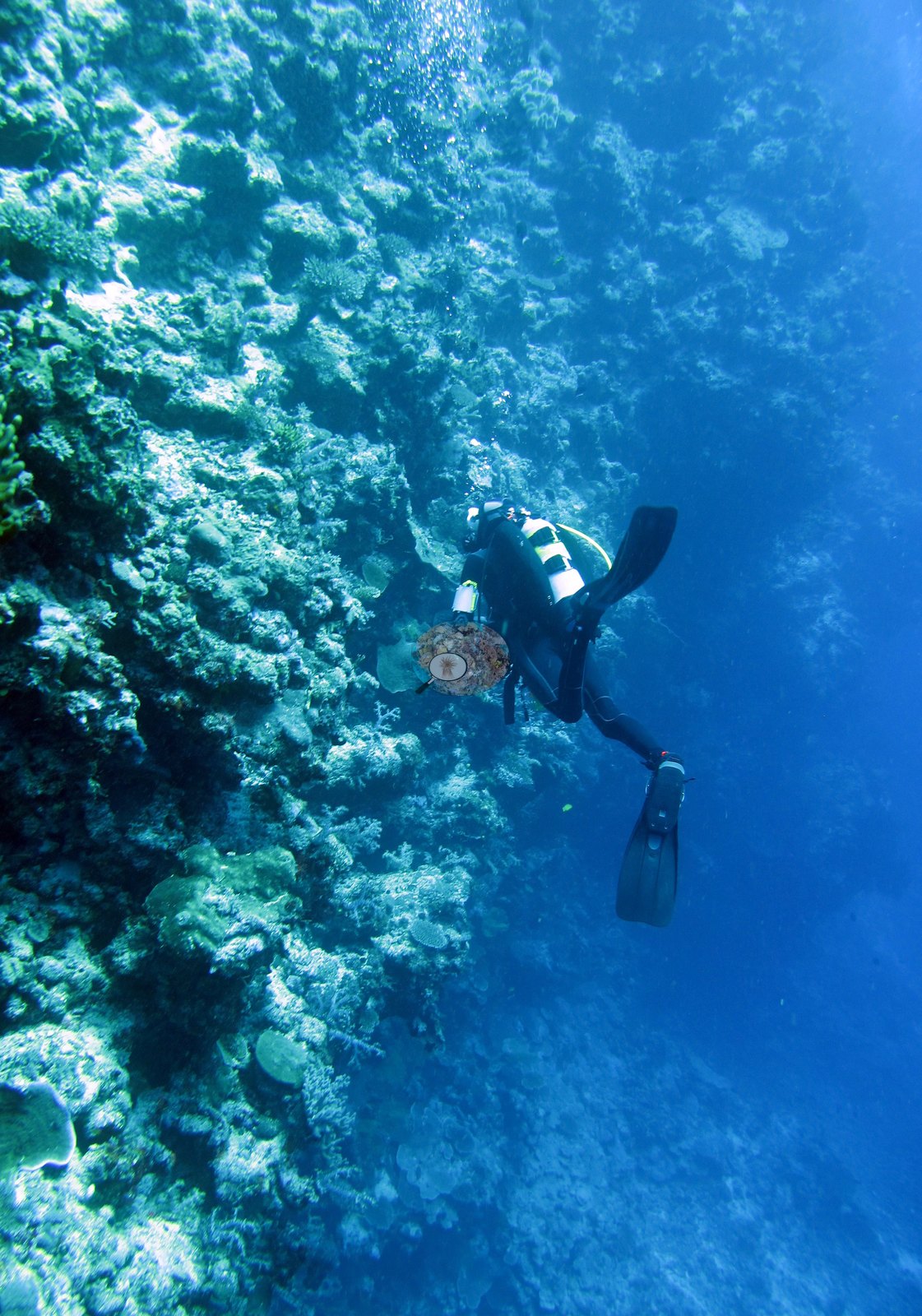
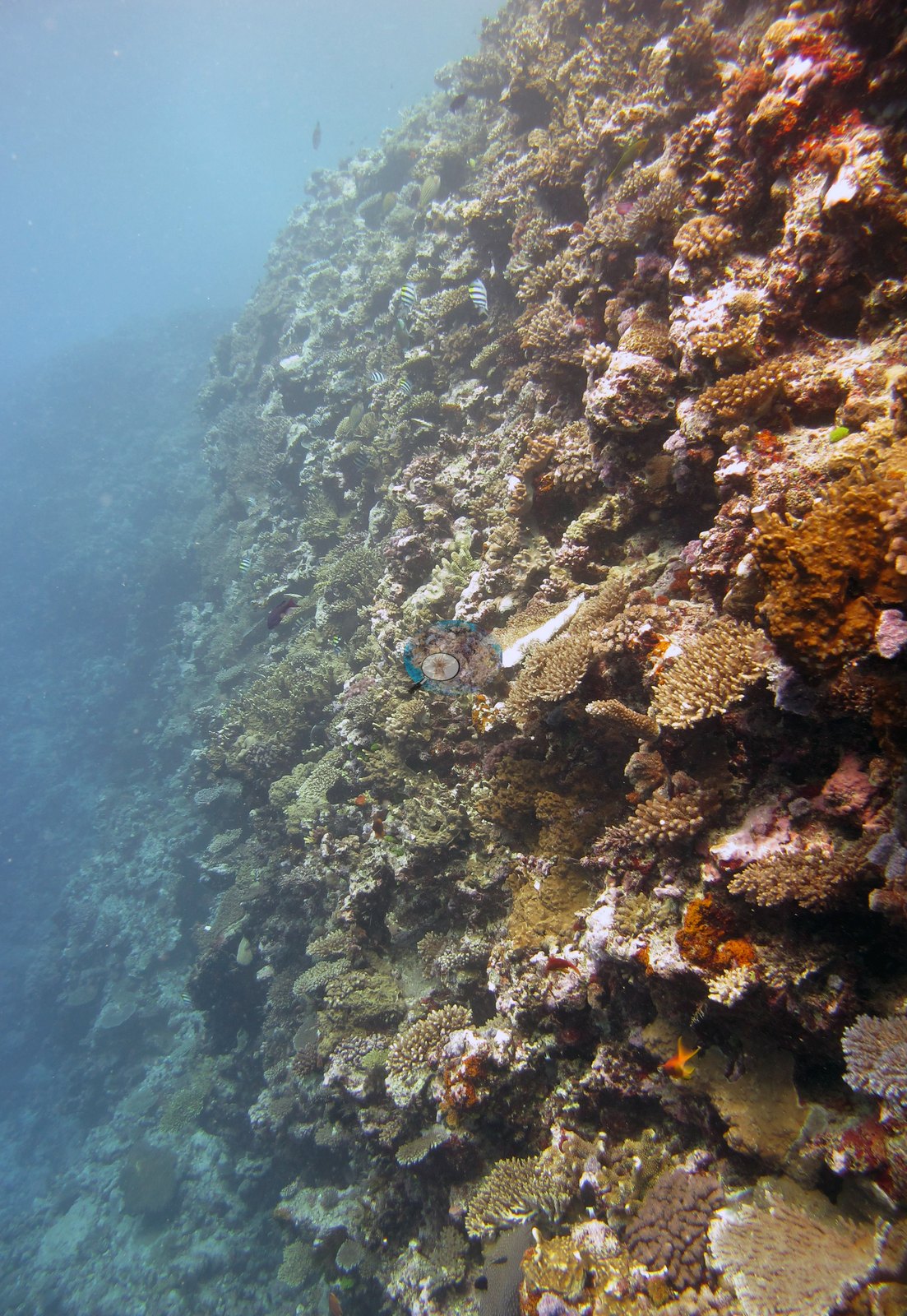
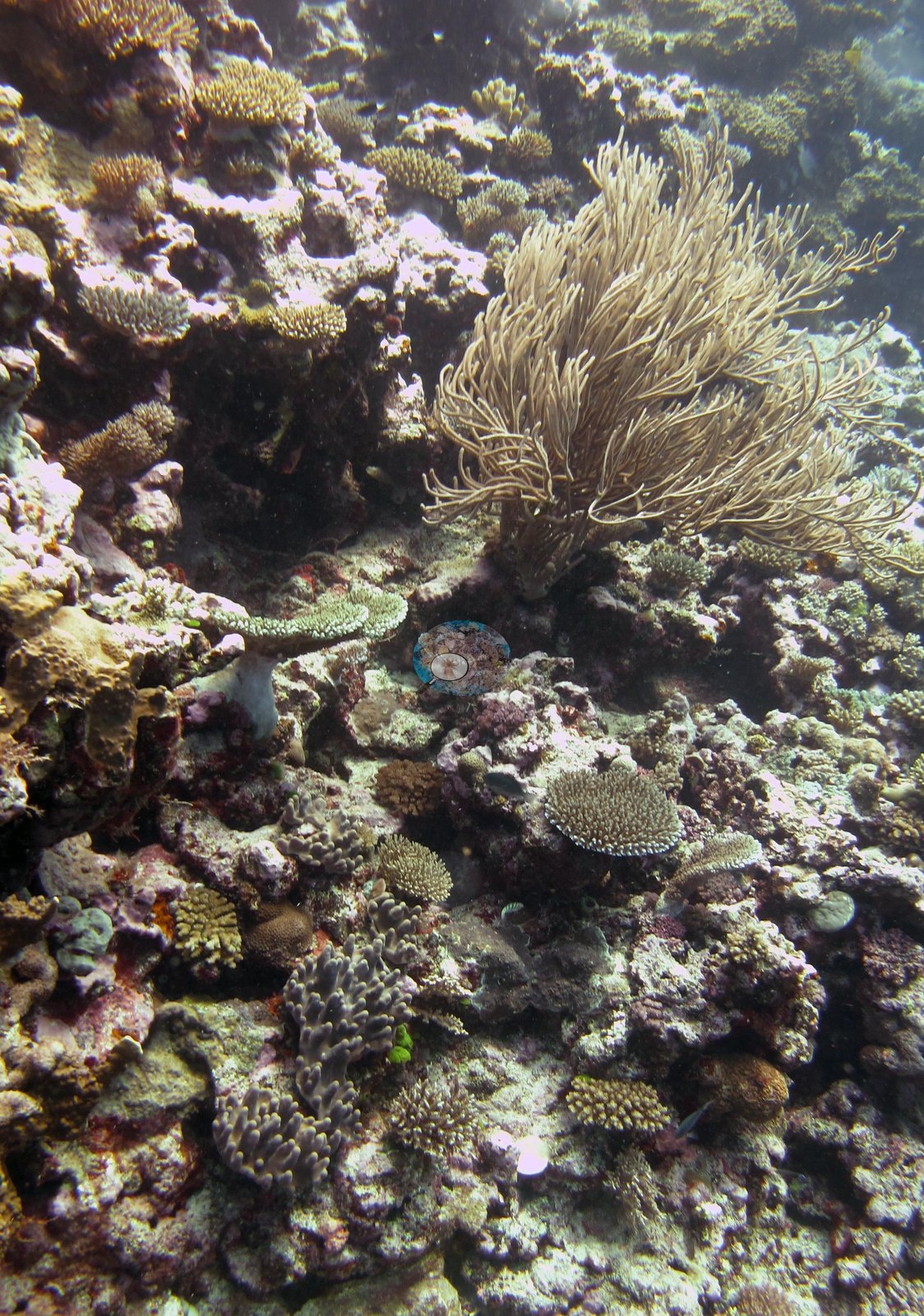
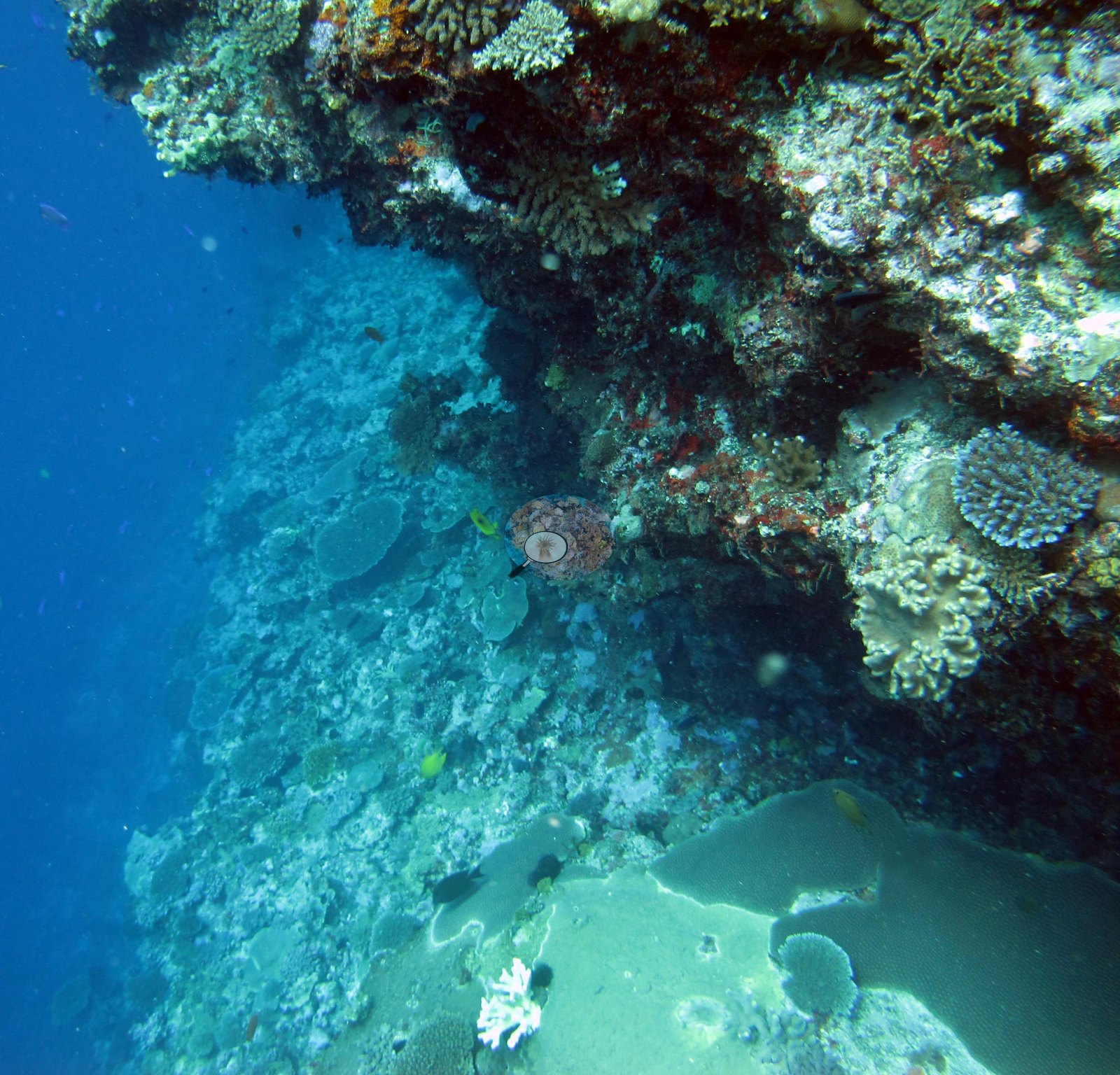
The frames describe a wall dive. Two of them, one showing a diver hanging off the face, look along a steep to near-vertical drop-off falling away into open blue water, its surface built of encrusting and small branching corals, coralline-crusted framework, and orange and red encrusting growth, with a pale sand and rubble apron visible far below.
General benthic features
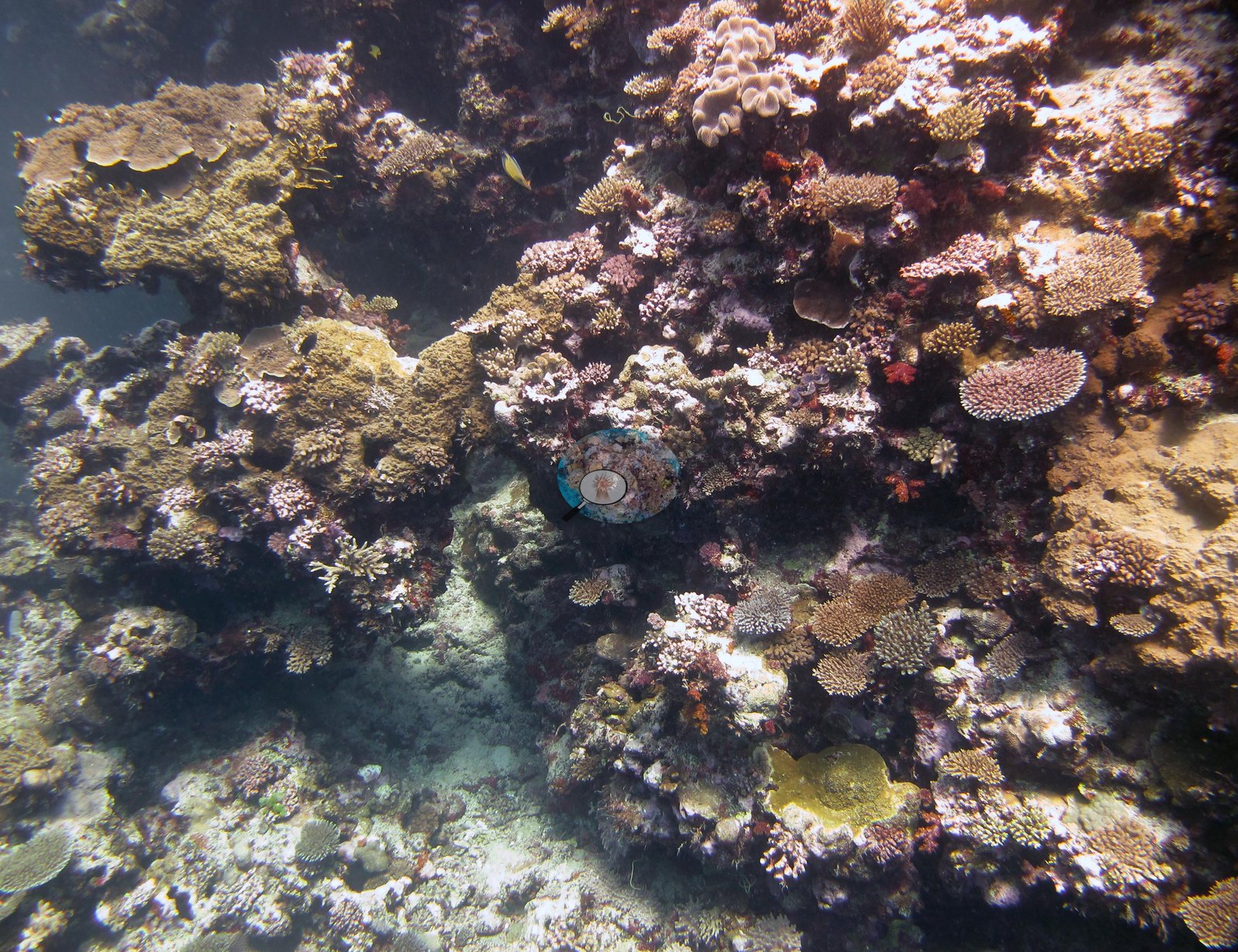
A third frame taken from beneath an overhang looks out from the shaded face into the blue, with foliose and lettuce-like colonies on the roof of the overhang. Where the ground eases back from the wall the reef is a mixed, small-colony assemblage rather than a thicket: corymbose and tabulate Acropora, branching pocilloporids, encrusting and small massive colonies including poritids, soft corals, and a single upright gorgonian sea fan on rubbly, coralline-encrusted pavement. A well-exposed frame, taken along the reef edge with a diver in the water column beyond it, shows dense coral along that edge — corymbose and tabulate Acropora plates and branching colonies packed along the lip before the substrate turns over and drops.
Coral cover
- Reference: Khaled bin Sultan Living Oceans Foundation, Global Reef Expedition (in situ transect)
- Coral cover 35%, from the LOF-GRE in situ transect (the mean of all of this station's own transects in the expedition's per-transect benthic data) — a diver transect measurement and the authoritative figure for this site, not derived from these photographs.
- This site also carries 43% algal cover from the same survey; that coral-versus-algae comparison belongs to the transect data, not to the imagery.
- Transect mean 35 ± 6.6% SE (n = 5 transects; Living Oceans Foundation per-transect benthic data); the headline above is this all-transect mean.
Stressors
One small branching colony in the overhang frame is stark white — either freshly bleached or recently dead — but that is a single colony in a single frame and says nothing about site condition; no other bleaching, disease lesion, or crown-of-thorns scar is visible in the set. Anderson's sampling record for this dive does note one sampled colony as mostly bleached or very pale, with a white exterior. The Living Oceans Foundation transects here recorded 9.4% cyanobacteria and no recently dead coral.
Comparisons with other data
Typical recent thermal stress: mean annual maximum of 8.9°C-weeks (Degree Heating Weeks, 2021-2025, NOAA CRW; Fiji virtual station).
Expedition habitat notes for Fulaga (island-wide, not this station): large monospecific stands of foliaceous and plating Pachyseris, Leptoseris, Montipora, and Merulina occur on more gradual slopes while encrusting and laminar morphologies become more common when the slope becomes close to vertical. A build-up of corals often forming a ridge or mound perforated by shore-perpendicular channels often occurs and runs parallel to the reef crest. The expedition's own site table classifies FJFU25 as a barrier reef on an exposed aspect, surveyed on the fore reef, outside the lagoon. Alongside the hard coral already reported for this site, the same transects recorded 25% crustose coralline algae, 5.8% turf, 1.4% macroalgae, 1.2% erect algae, and 9.4% cyanobacteria (43% algae in all). Non-living substrate came to 56% pavement, 4.8% dead coral, 3.0% rubble, and 0.8% sand. Paired fish transects recorded about 48 fish species per transect and about 32 kg per 100 m2 of biomass. The benthic figures are means of all of this station's own transects in the expedition's per-transect benthic records, and the fish figures come from its paired fish transects; all are survey results, not photographic estimates.
Dive record
FJFU25 (Fulaga, Lau Archipelago) was surveyed on 11 June 2013 during the Khaled bin Sultan Living Oceans Foundation's Global Reef Expedition, on a dive to 29 m (station CTD cast to 37.9 m).
Other notes
What follows is written from the site's six habitat photographs; the close-ups of the individually sampled Pocillopora colonies were reviewed separately and are not used to describe the reef.
The steep-face frames are hazier than the reef-edge frames, and the account of the wall itself is correspondingly coarse: encrusting-dominated with small branching colonies is as far as six frames will carry it.
Data & links
- Download benthic survey data (CSV) ↗
- Download all LOF-GRE data (933 sites) ↗
- Photo portfolio ↗
- Coral Reef Diagnostics page for this area ↗
All images from Coral Reef Diagnostics. Data are from the Khaled bin Sultan Living Oceans Foundation Global Reef Expedition and Coral Reef Diagnostics.
 © Coral Reef Diagnostics.