
Part of the regional summaries: Chagos Archipelago - Victory Bank / Great Chagos Bank North and Chagos Archipelago
More info
Chagos (NOAA CRW virtual station)The strongest blue-coral reef in Chagos: Heliopora makes up nearly four-fifths of all coral here, at 56% cover. Photos show dense thickets of upright folded blades standing at many heights, the best images of this habitat from the survey. Surveyed on the Living Oceans Foundation's Global Reef Expedition.
Three other CRD dive sites within 5 km shown in orange — click a marker to open its page.
🗺 Detailed map of the Global Reef Expedition dive sites, Victory Bank, Chagos (Khaled bin Sultan Living Oceans Foundation; opens in a new window)
4 of these 11 photographs are shown beside the text that discusses them under "Site description" below.
Site description
General benthic features
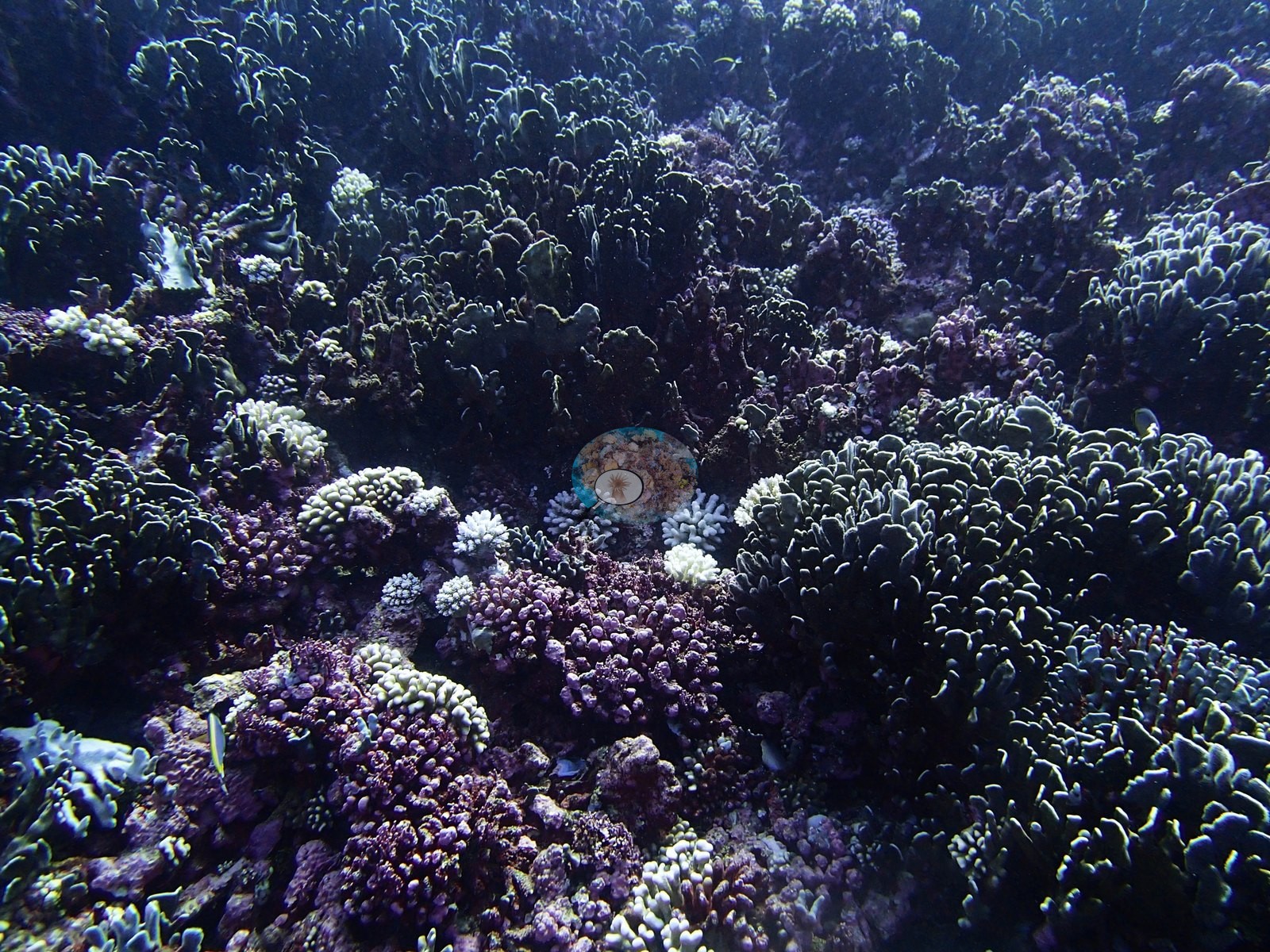
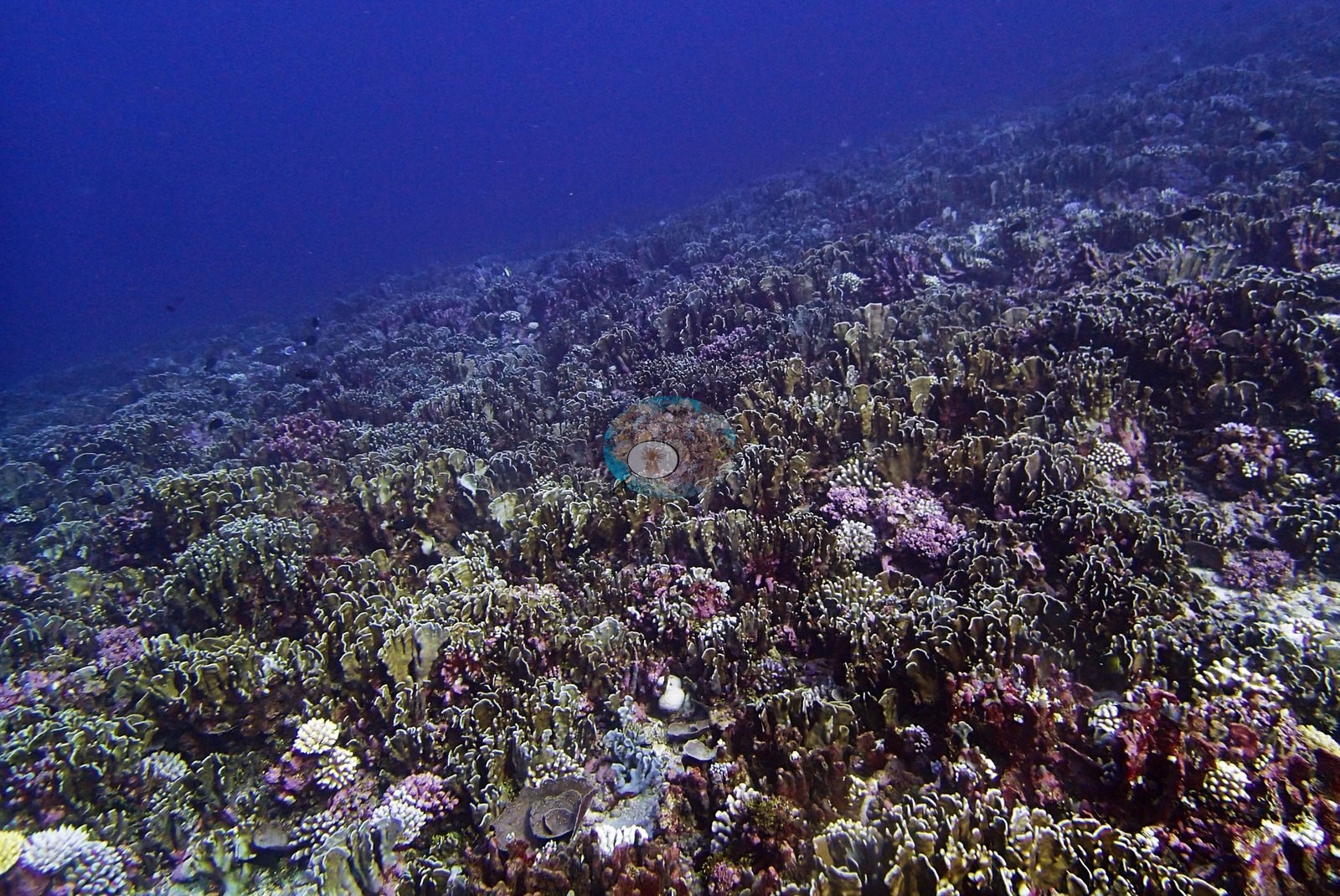
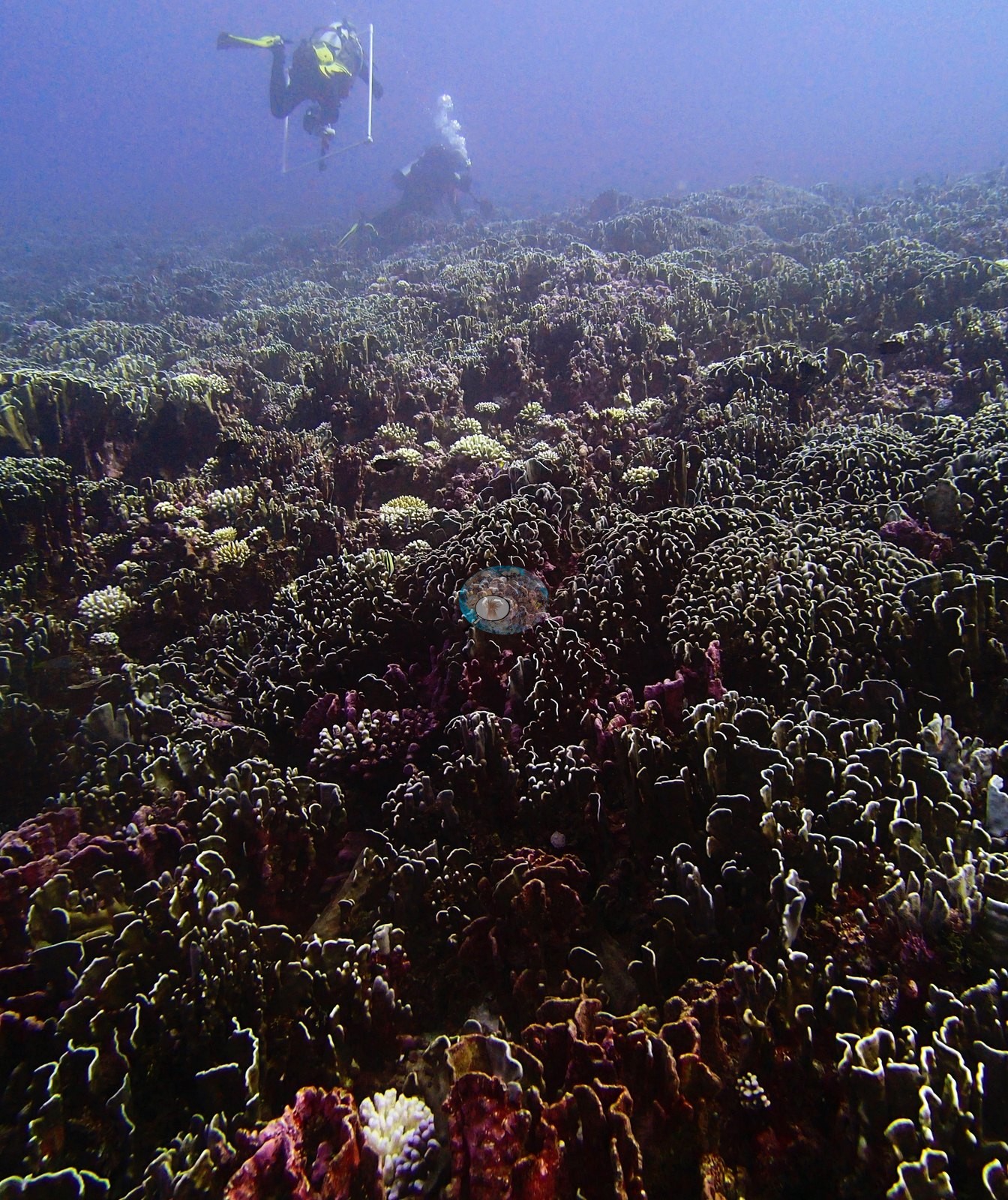
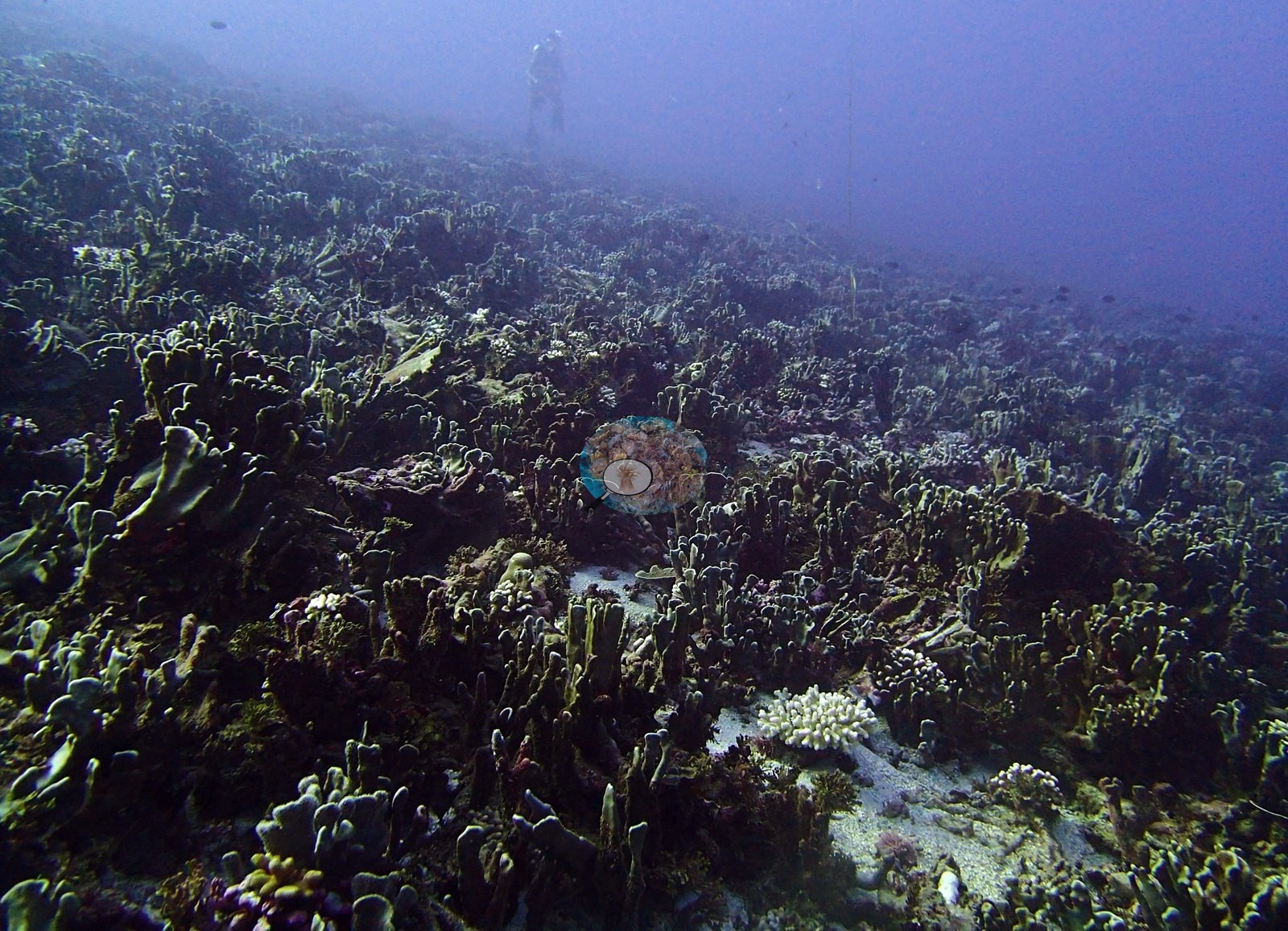
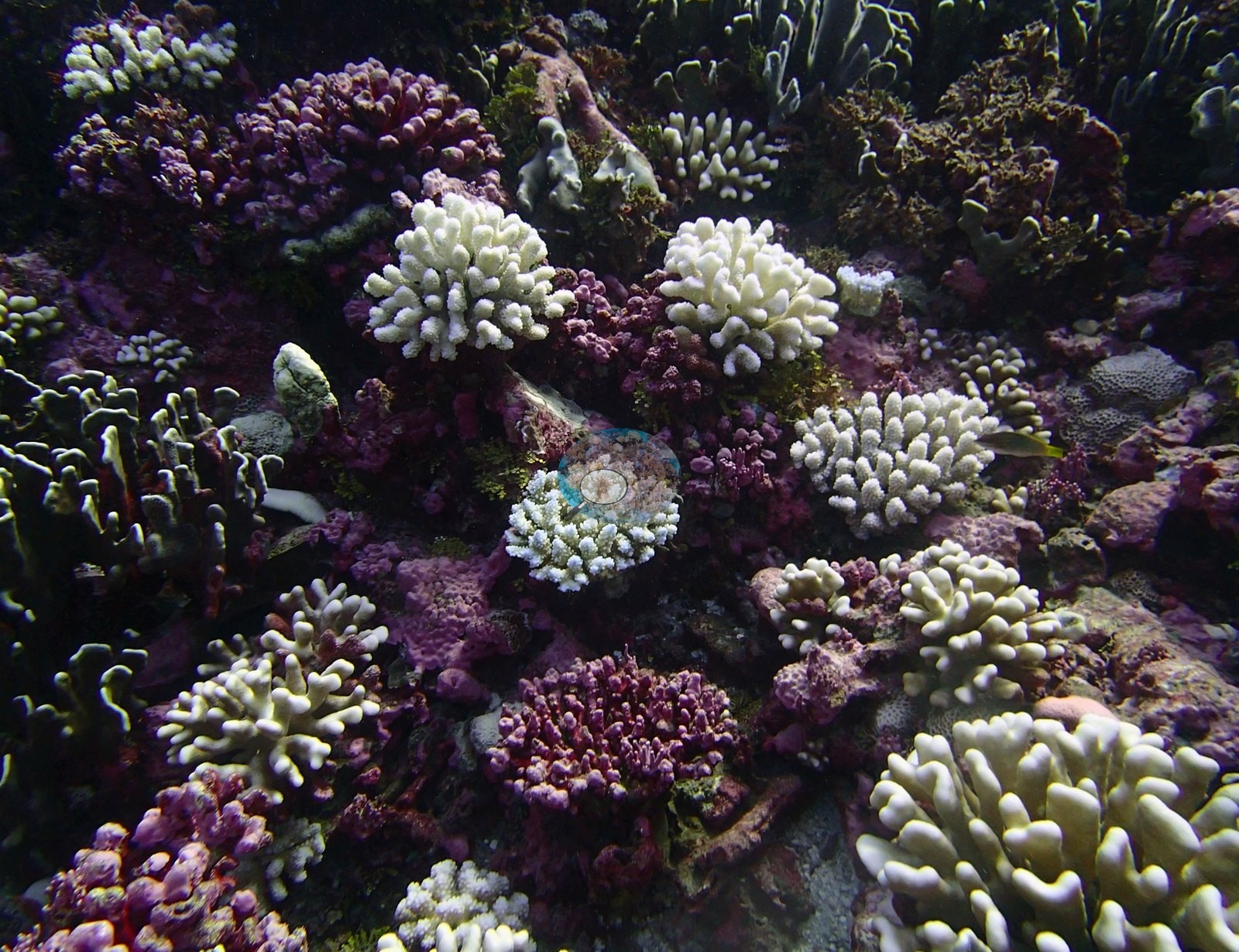
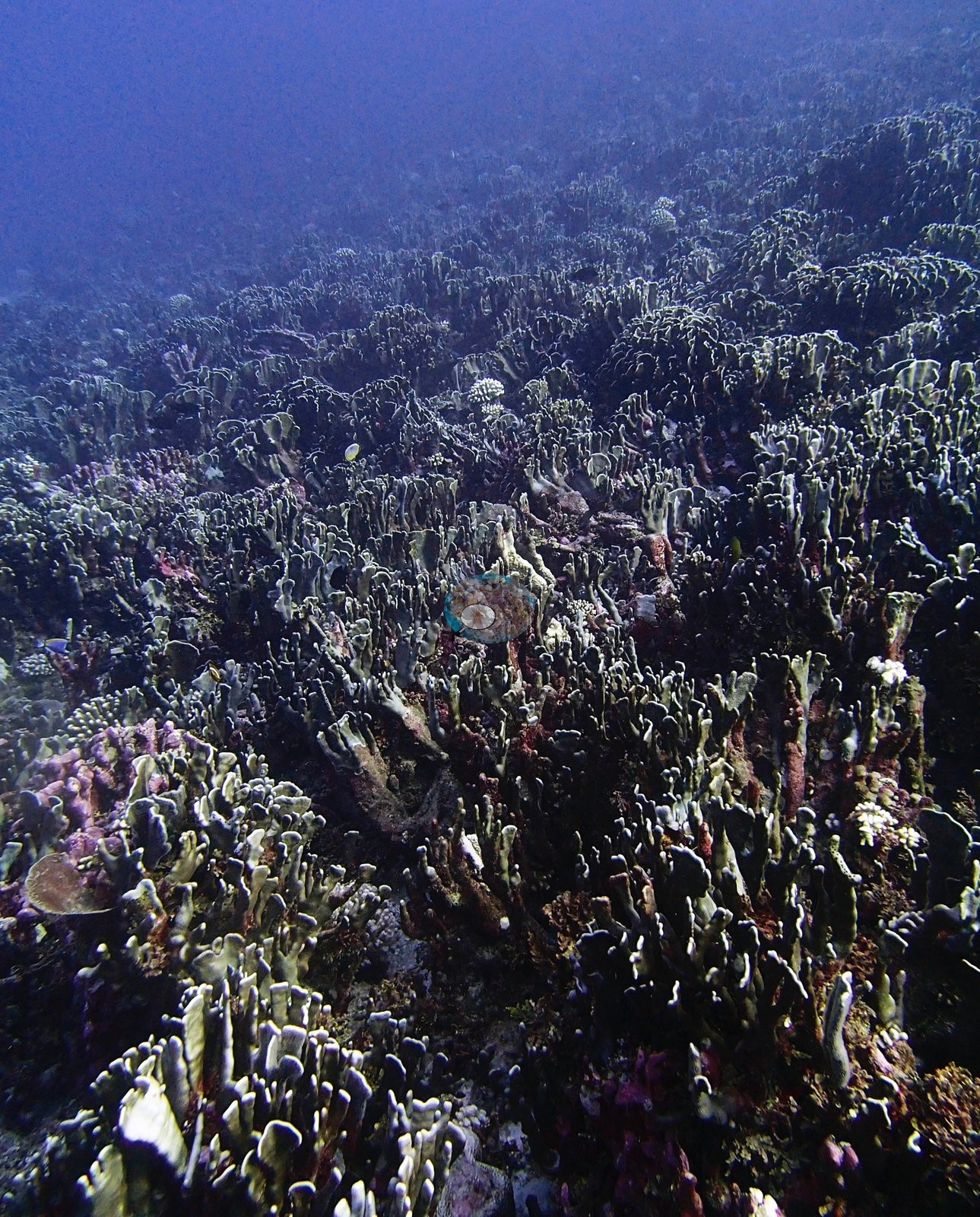
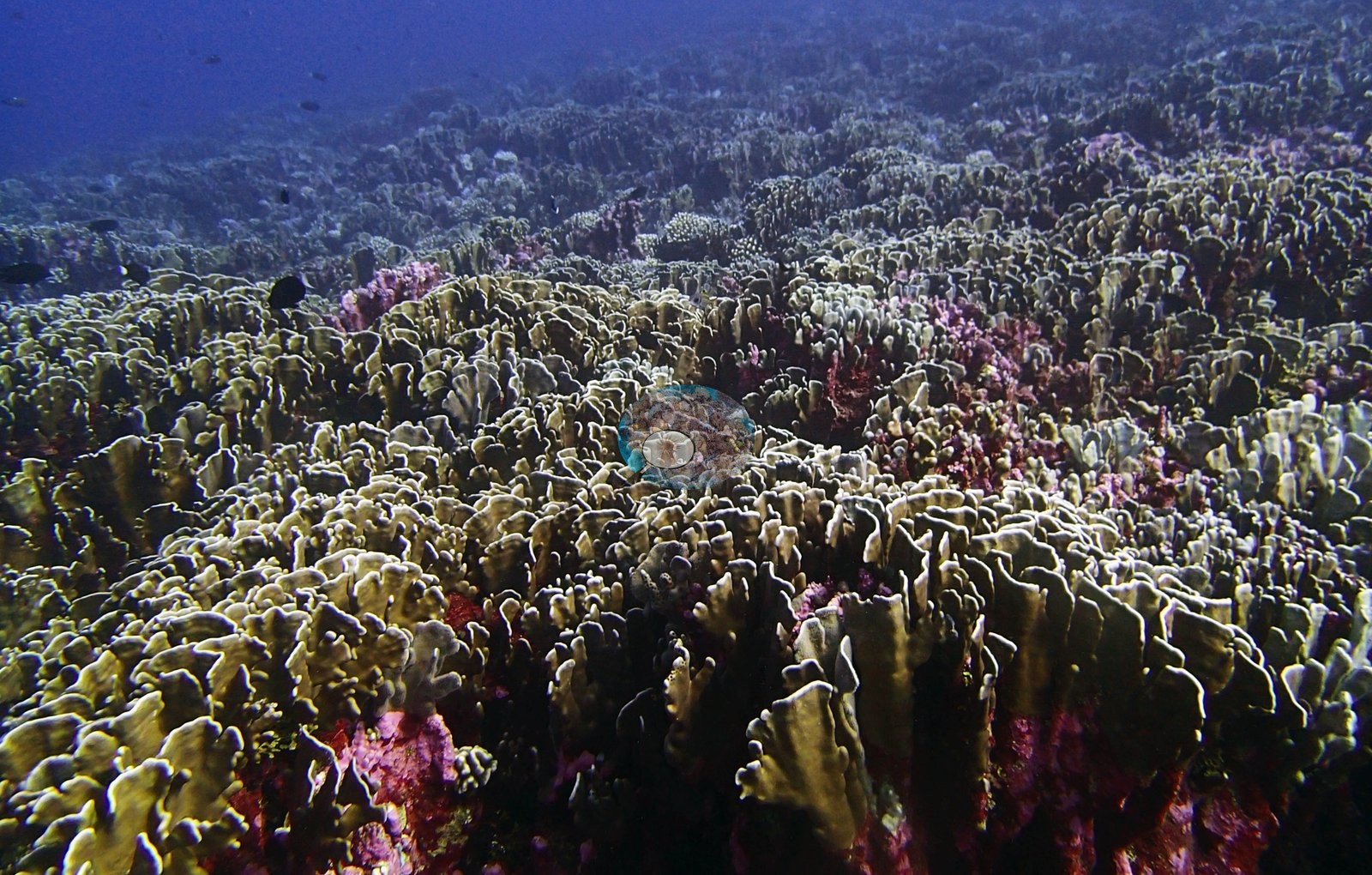
BIVB99 is a blue-coral reef, and the strongest one in the archipelago. Heliopora holds 44.14% of the benthos — 79% of all coral recorded — well above the 31.33% at BITB58, the only other site where the genus dominates. Every other genus is marginal: Stylophora 4.34%, Acropora 3.13%, Pocillopora 1.29%, then Montipora and Hydnophora at 0.38%, Favia 0.33%, and Echinopora 0.30%, with a further tail below that across 17 non-zero codes. Coralline algae hold 13.1% of the benthos, erect algae 9.8%, turf 9.9%, bare substrate 6.7%, macroalgae 3.4%, and non-coral invertebrates only 1.4%. Both transects are Heliopora stands and the shallower one is nearly a monoculture. Algal cover is high and steady in both bands (34.4% and 38.4%). Here the thicket is the subject. Two frames show extensive vertical relief where upright folded sheets occupy most of the available hard surface (e.g., Image 2); another shows repeated ridges and folded blades standing at multiple heights (e.g., Image 3); a short later run of frames retains that dense structure, interrupted by compact branching colonies and bright red-purple encrusting material.
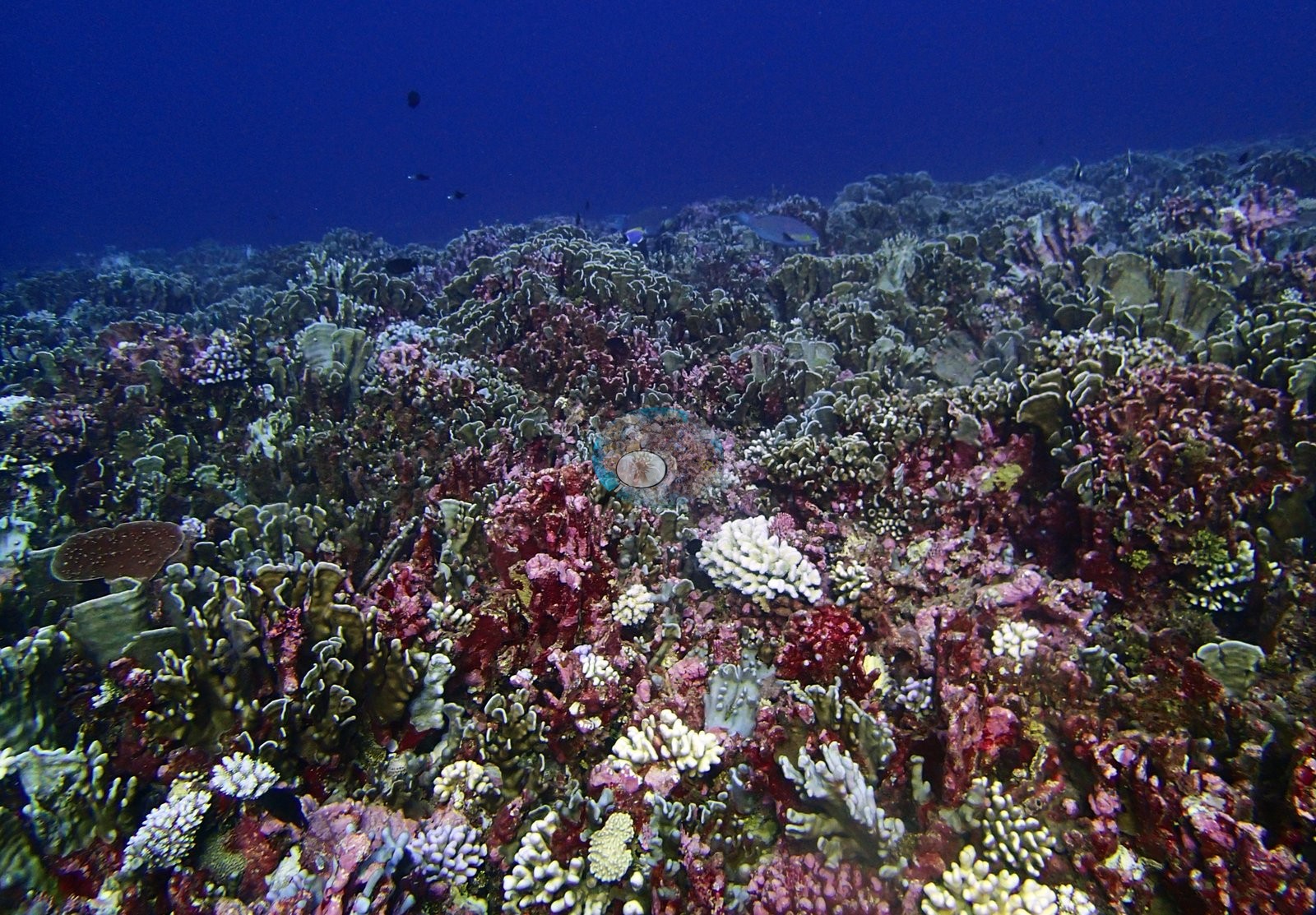
The sequence begins at a sandier margin, with open sand and scattered low colonies beside a table in the foreground, then moves quickly into the thicket (e.g., Image 1).
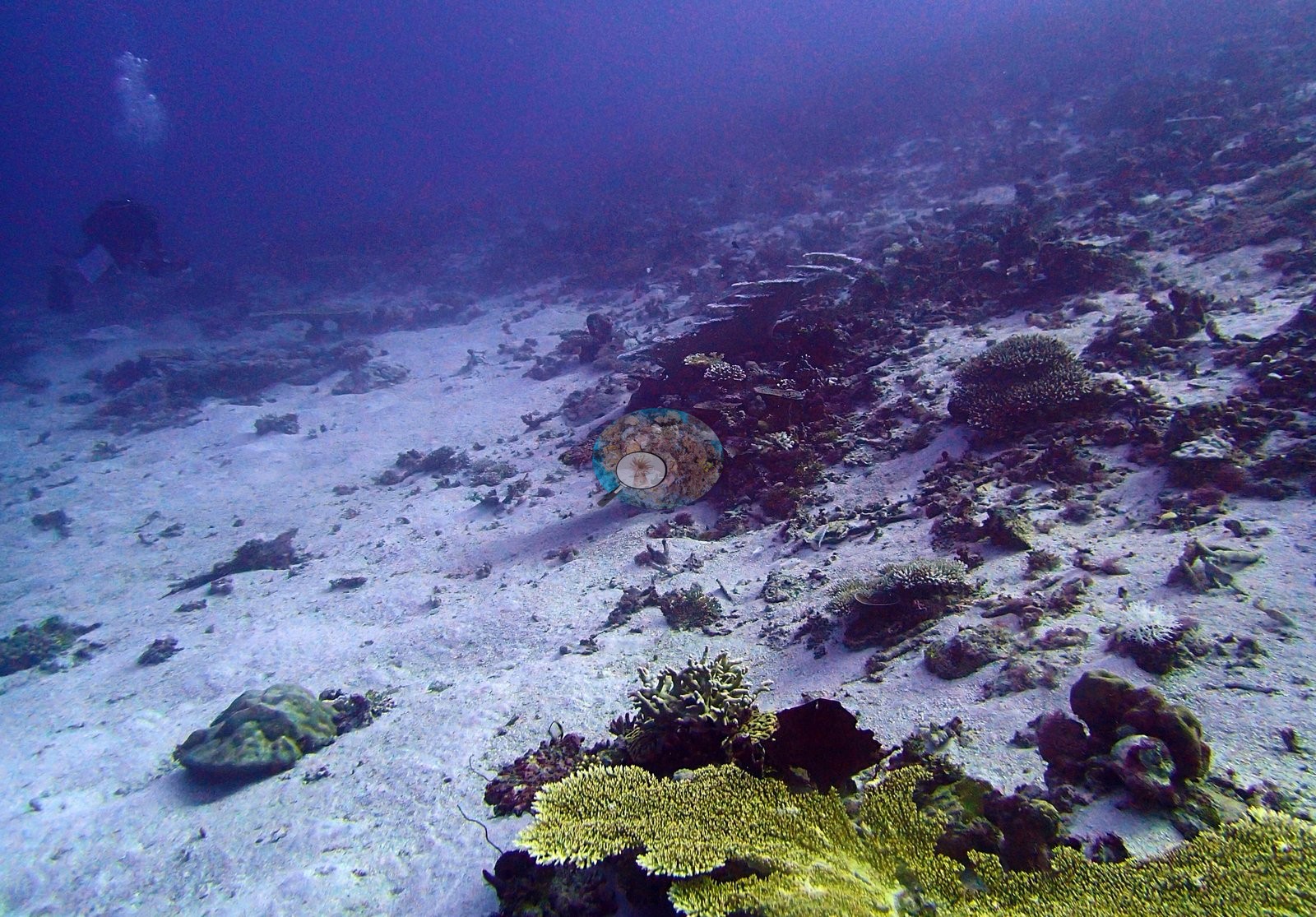
The upright, folded, blade-like growth form in these frames is exactly what a Heliopora coerulea stand looks like, and it is the best imagery of the genus in the Chagos set. The habitat is structurally intricate, its complexity generated by upright sheets rather than broad tables, with narrow channels and cavities between closely packed vertical blades. Red, pink, and purple encrusting surfaces are abundant beneath the sheets; some are compatible with crustose coralline algae — which the transects put at 13.1% — while others could be sponges or other encrusting organisms, and the stills do not support a single taxonomic label for every patch. The photographs document the blue-coral thicket itself — upright folded blades at multiple heights — plus heavy red-purple encrustation, a sandier outer margin, and localized bleaching restricted to compact branching colonies rather than the dominant sheets.
Coral cover
Coral cover is 56%, 16th of the 109 Chagos sites, against 36.4% algae. D3 carries 64.5% coral with Heliopora at 54.38% — 84% of the coral on that transect — across 12 genera. D4 falls to 46.6% with Heliopora at 33.90% (73% of coral) across 14 genera, and Acropora rising to second place at 4.65%. Assemblage composition. Formal surveys give 55.6% coral, 36.4% algae and 1.4% non-coral invertebrates, the coral 79% Heliopora.
Stressors
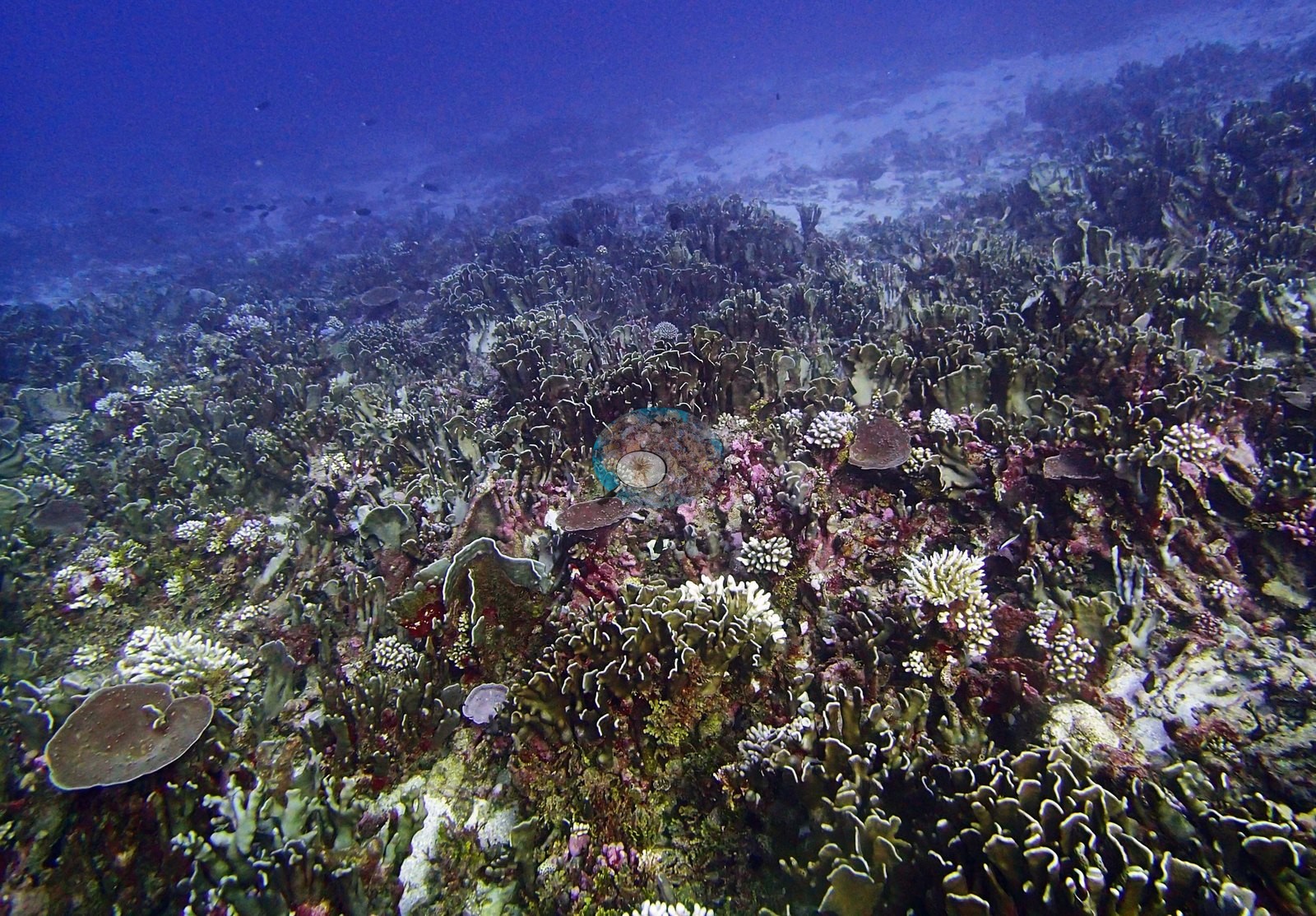
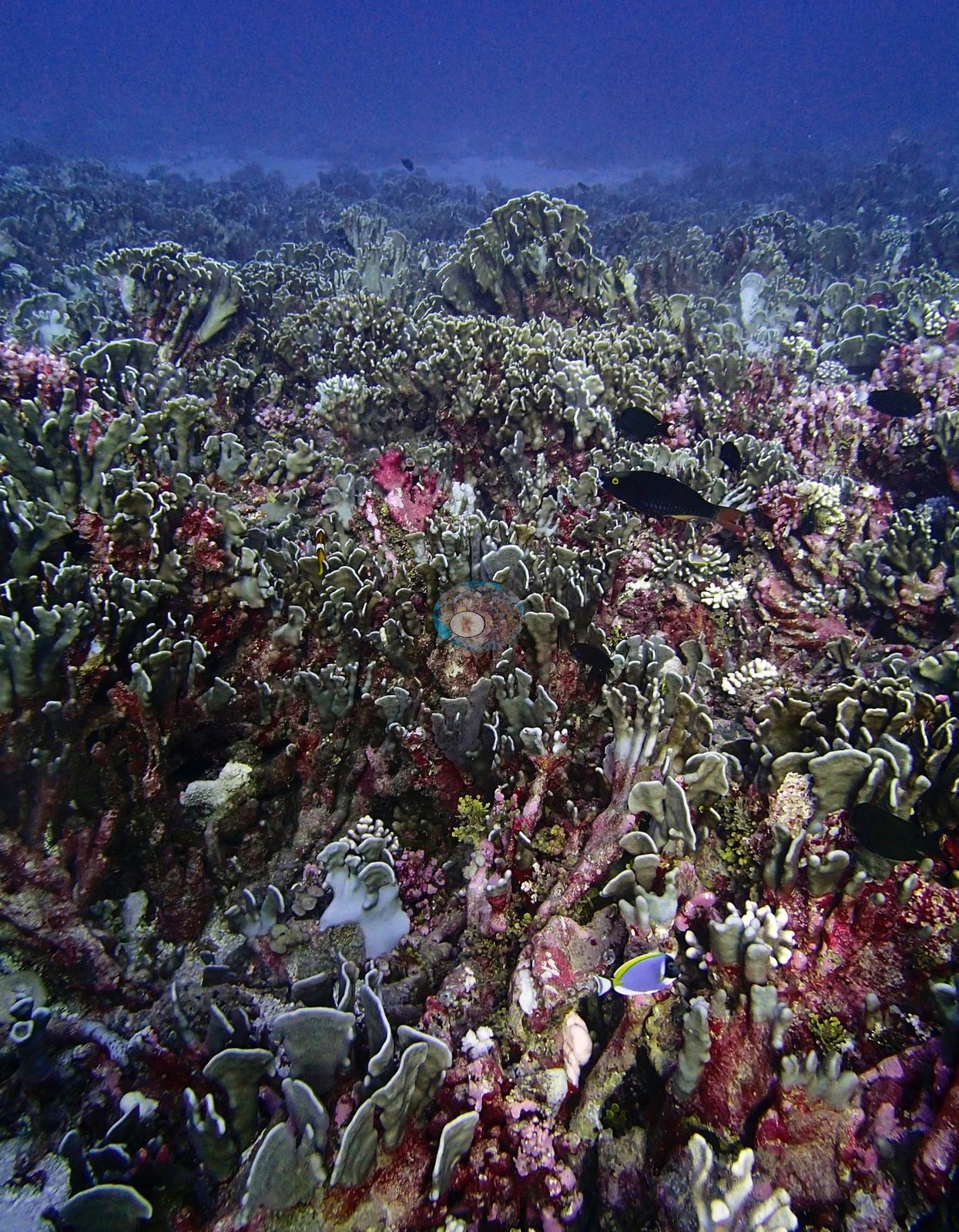
Bleaching is conspicuous but confined to the minority growth form. One frame shows several compact branching colonies nearly white across intact branches, immediately adjacent to purple-pigmented compact colonies and dark upright sheets (e.g., Image 4); smaller white colonies recur in a later frame.
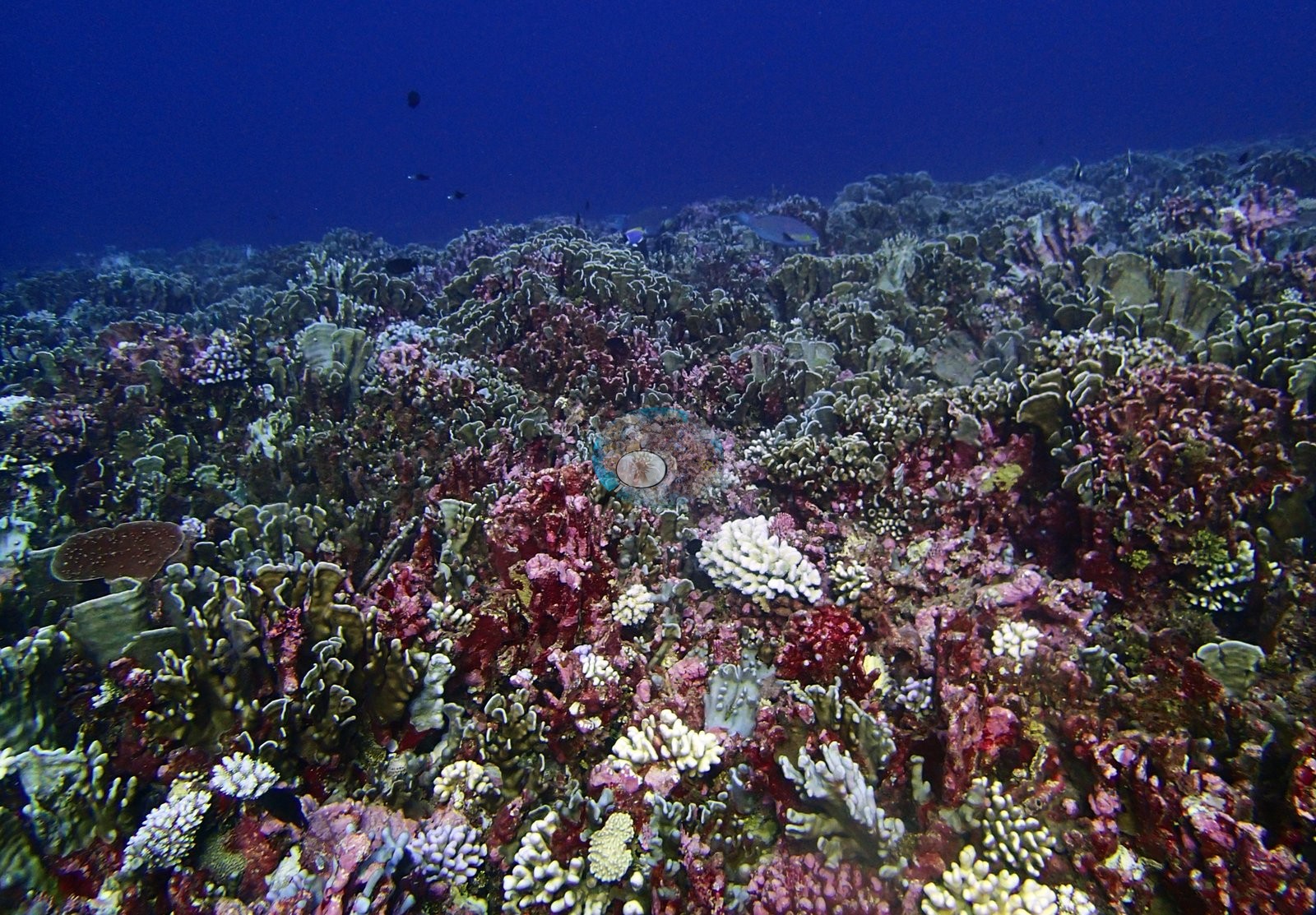
The dominant Heliopora sheets are not the affected component — they commonly carry pale rims, but those narrow margins may be normal growth, edge lighting, or species coloration and are not classified as bleaching. That the pale colonies occupy only part of a densely pigmented scene is consistent with the low published site value of 6.8%, 55th of 98, and the close-up deliberately centers the most striking colonies, so no proportion should be inferred from it. No crown-of-thorns starfish (COTS) or other corallivores evident.
Fish and other fauna
Small reef fishes use the narrow spaces between folds and branches throughout.
Comparisons with other data
No prior survey data from this site. If you would like to share yours, please email us.
Other notes
This site supplies the photographic evidence that BITB58 lacked. The BITB58 shard flags that its 93%-cover blue-coral transect was never captured on camera — the photographer shot the tabular Acropora zone instead.
CV model comparison
More info
Those are point counts on the photographs; this is a diver swimming a transect. The models and the reference never saw the same thing. ⚠ SITE-LEVEL ONLY. The 2,500 frames were not associated with any transect taken within 200 m of them, so transect-vs-image comparisons are site means, never frames. The transect value is already in the pin `cover` field (109 of 112 pins, sourced to the paper's suppl. S1) and is read from there, never re-imported. The transect is THE coral-cover value for this site and stands alone. The rows below it are a methods comparison only: no computer-vision value is averaged with it, feeds the headline, or carries over to the site's cover figure (Anderson, 2026-09-22).| Method | Hard-coral cover (%) |
|---|---|
| Transect (published) | 55.6 |
| CoralNet | 20.8 |
| In-house DINOv3 | 24.5 |
| CoralSCOP edited | 18.5 |
| Claude | 35.4 |
Data & links
- Read the full site report ↗
- Download benthic survey data (CSV) ↗
- Download all LOF-GRE data (933 sites) ↗
- CoralNet image repository for this region ↗
- Photo portfolio ↗
- Coral Reef Diagnostics page for this area ↗
All images from Coral Reef Diagnostics. Data are from Coral Reef Diagnostics.
 © Coral Reef Diagnostics.