
Part of the regional summaries: Chagos Archipelago - Salomon / Blenheim / Speakers Bank and Chagos Archipelago
More info
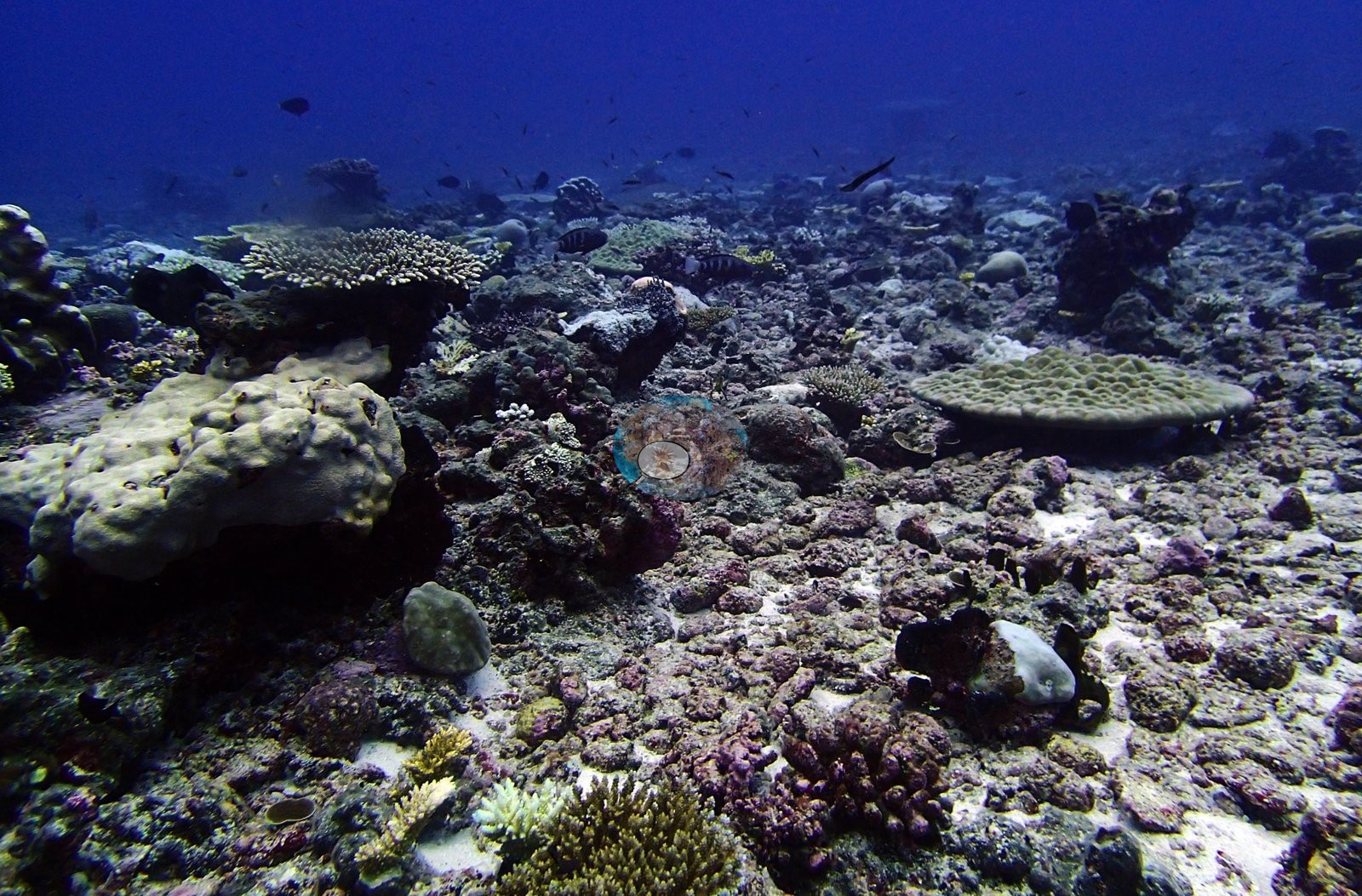
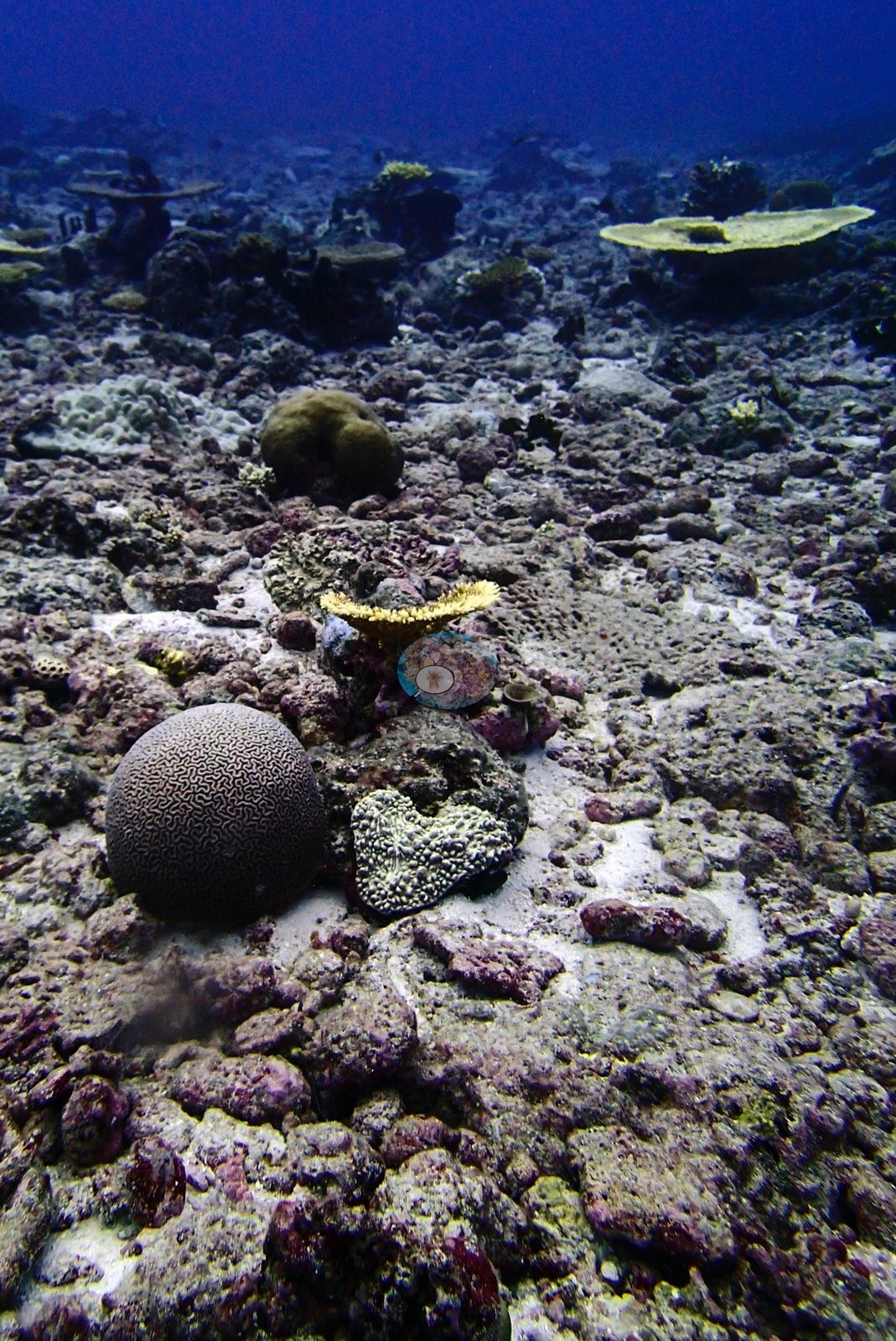
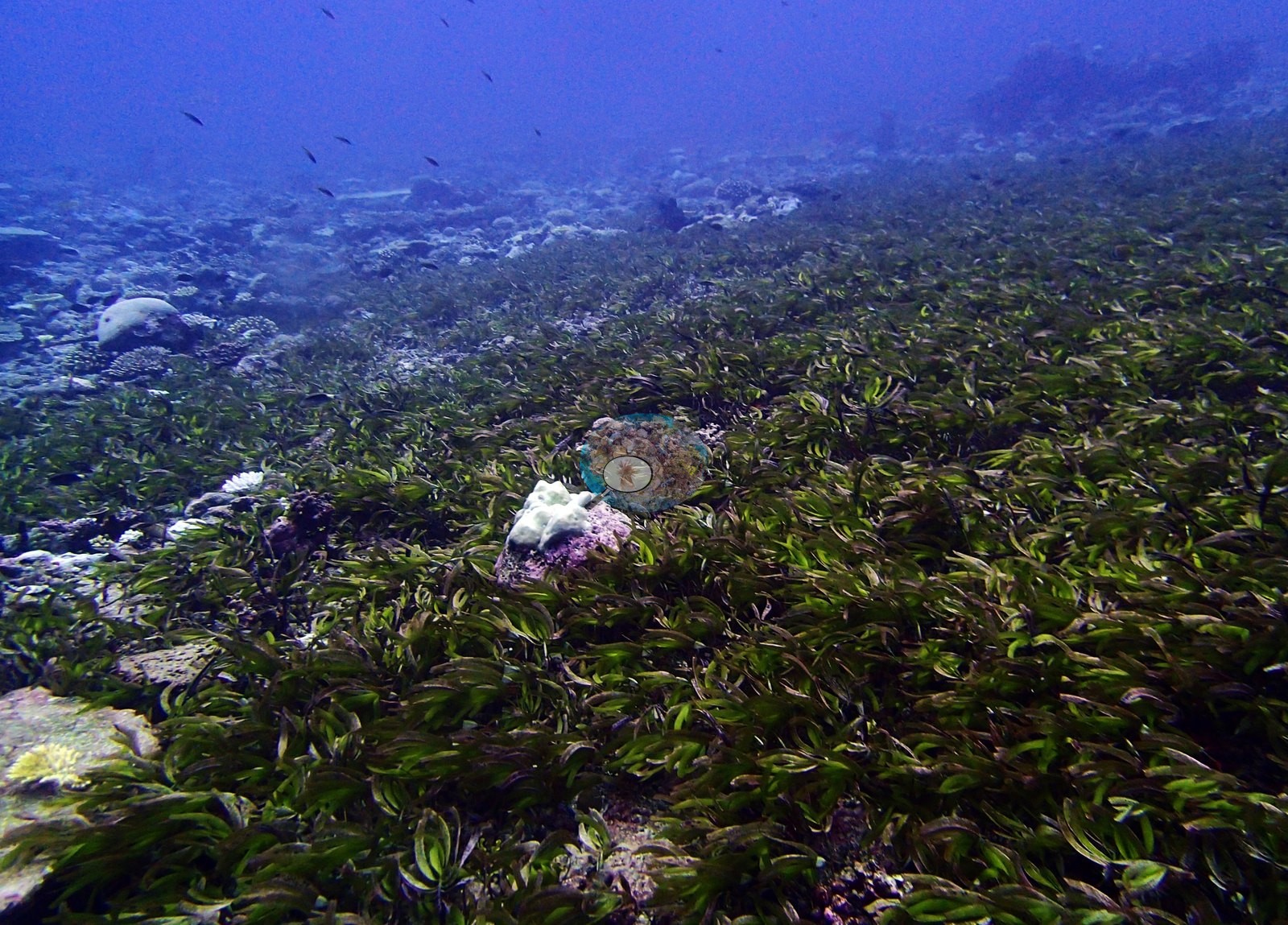
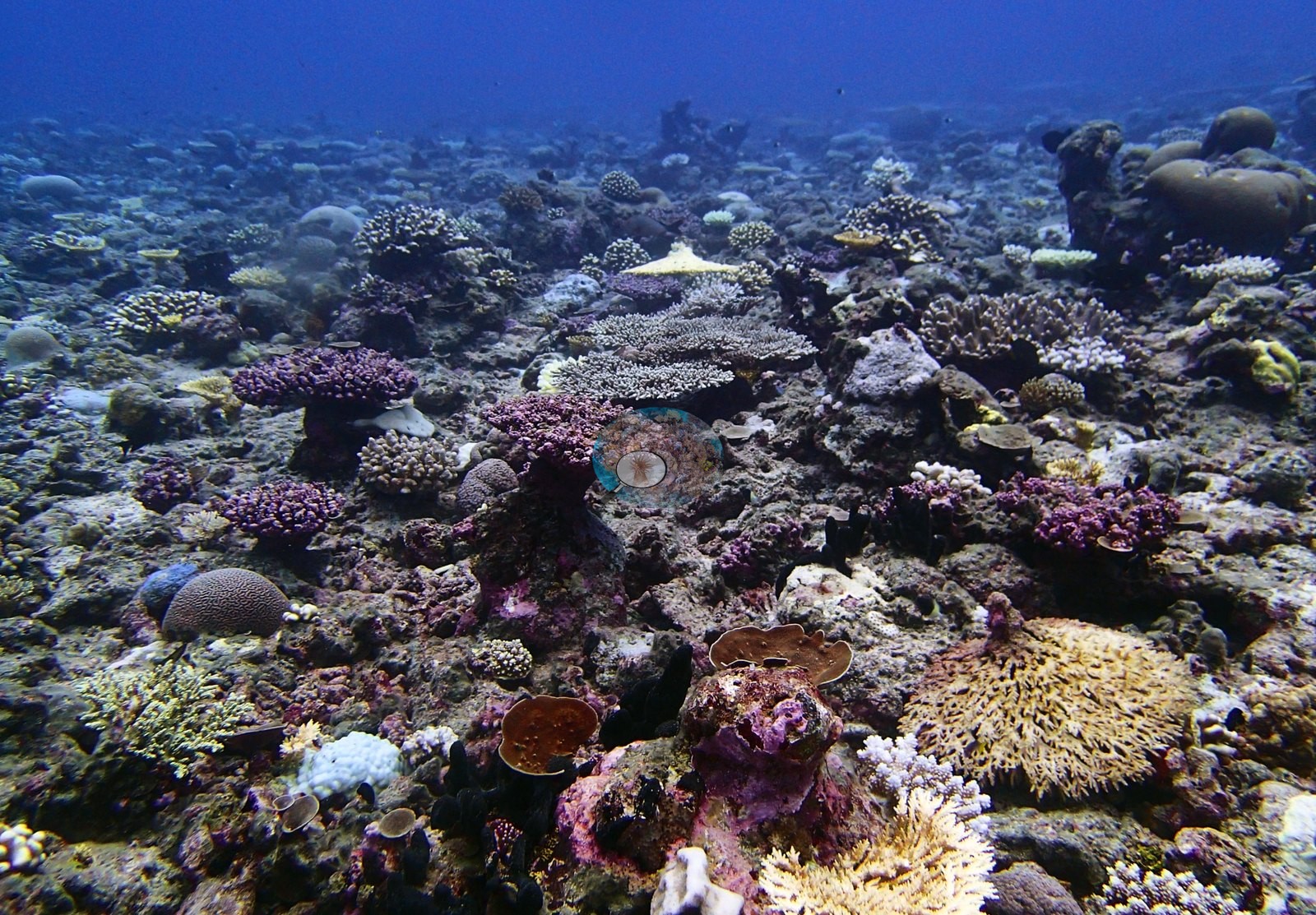
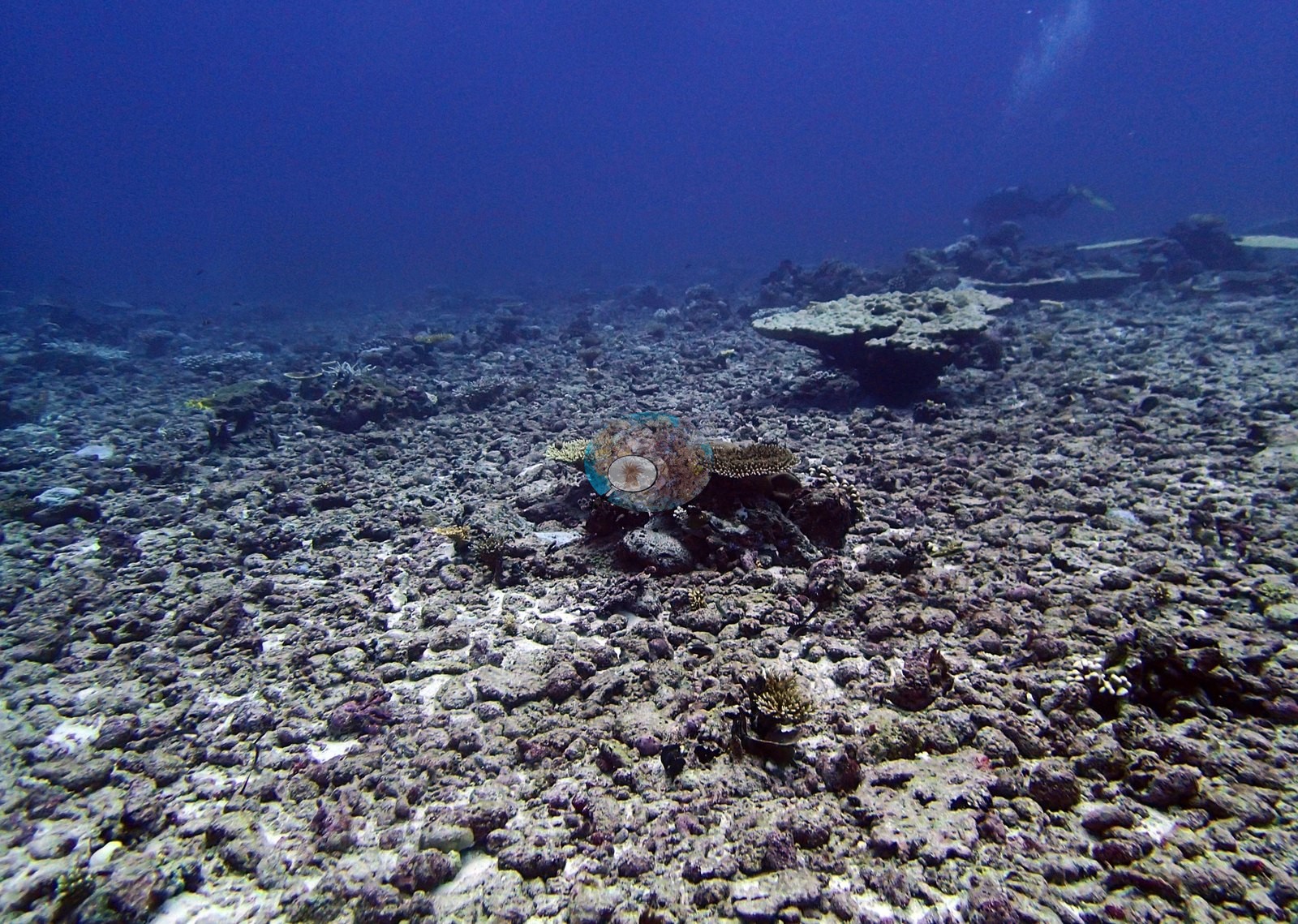
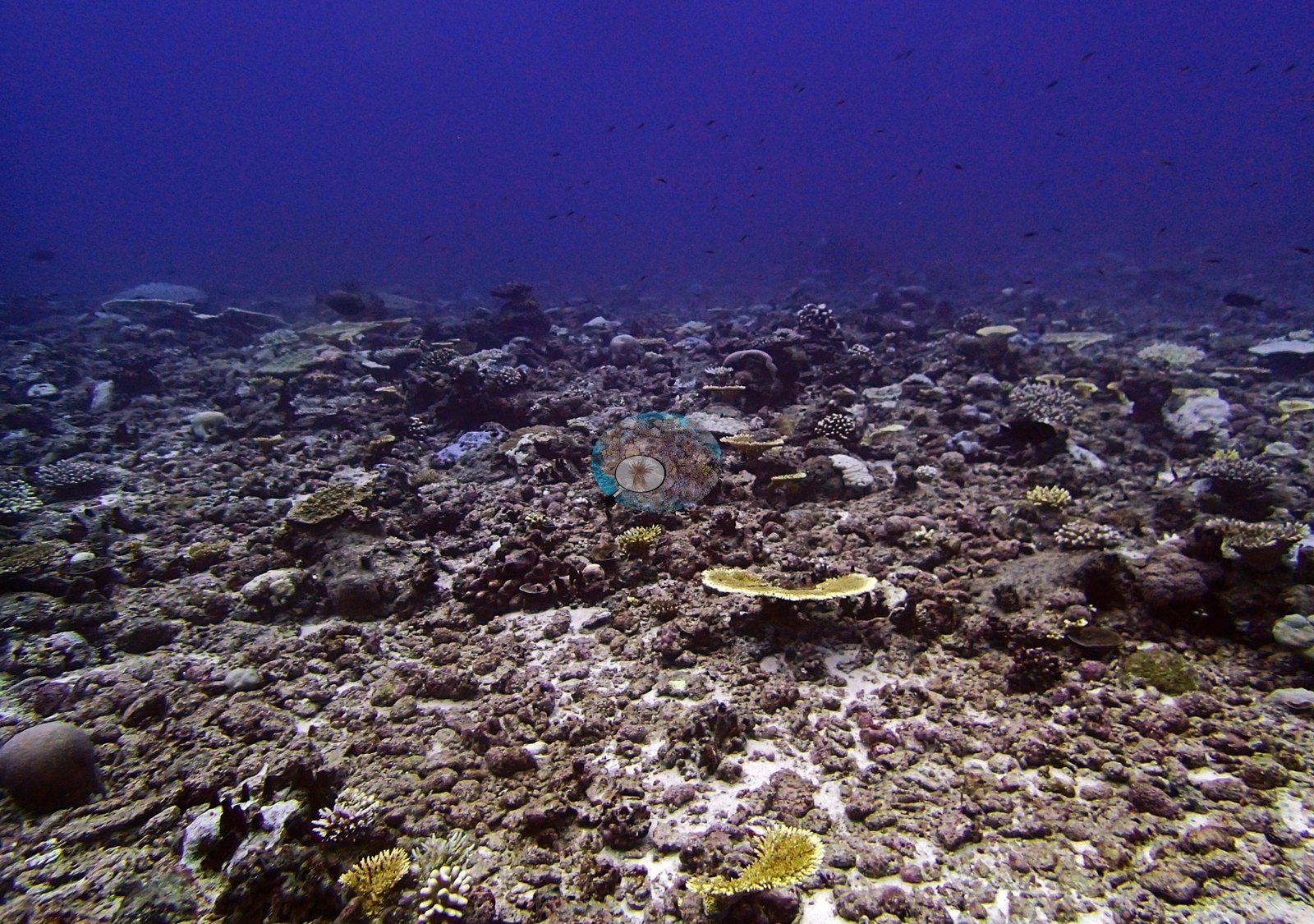
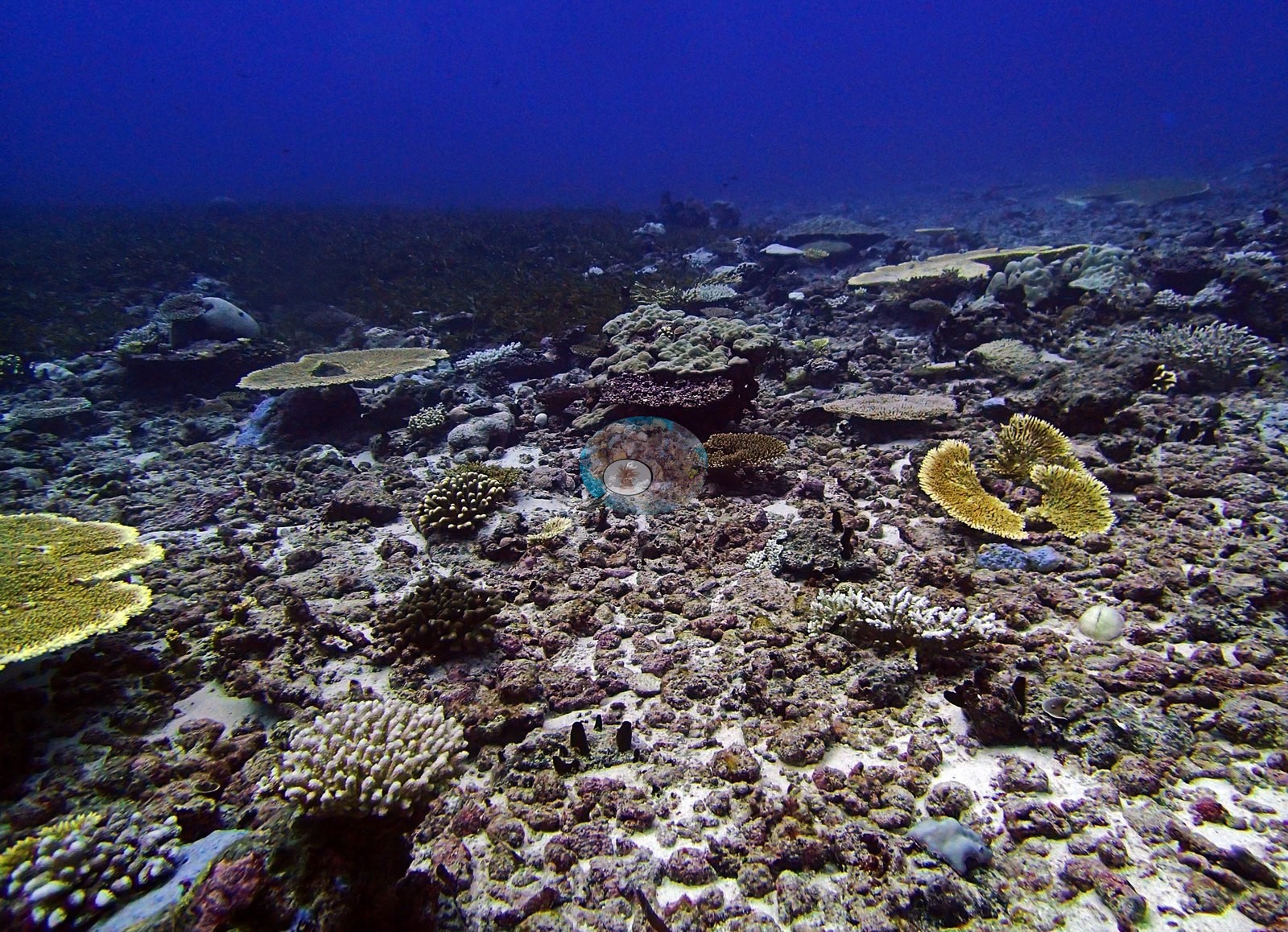
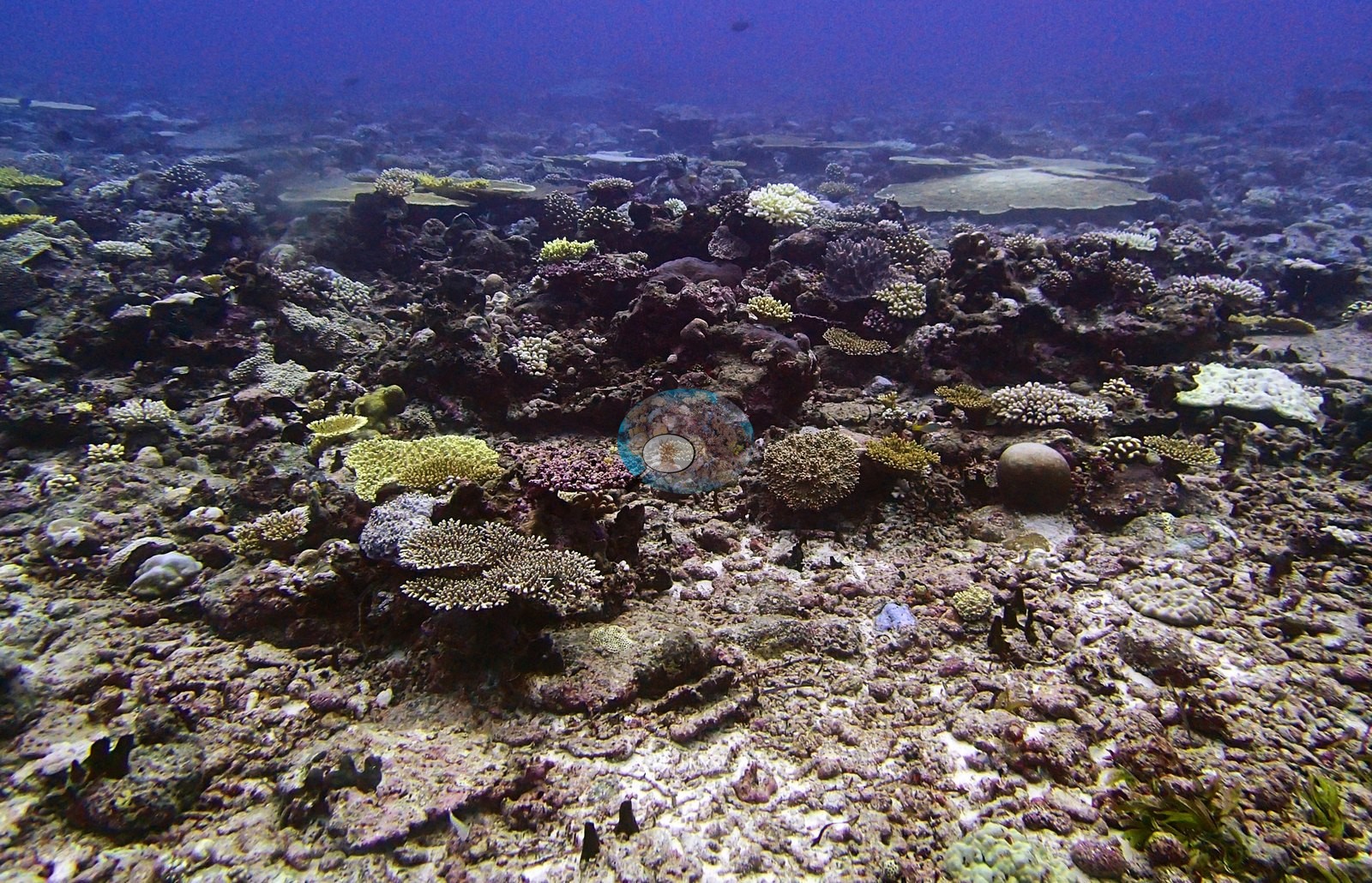
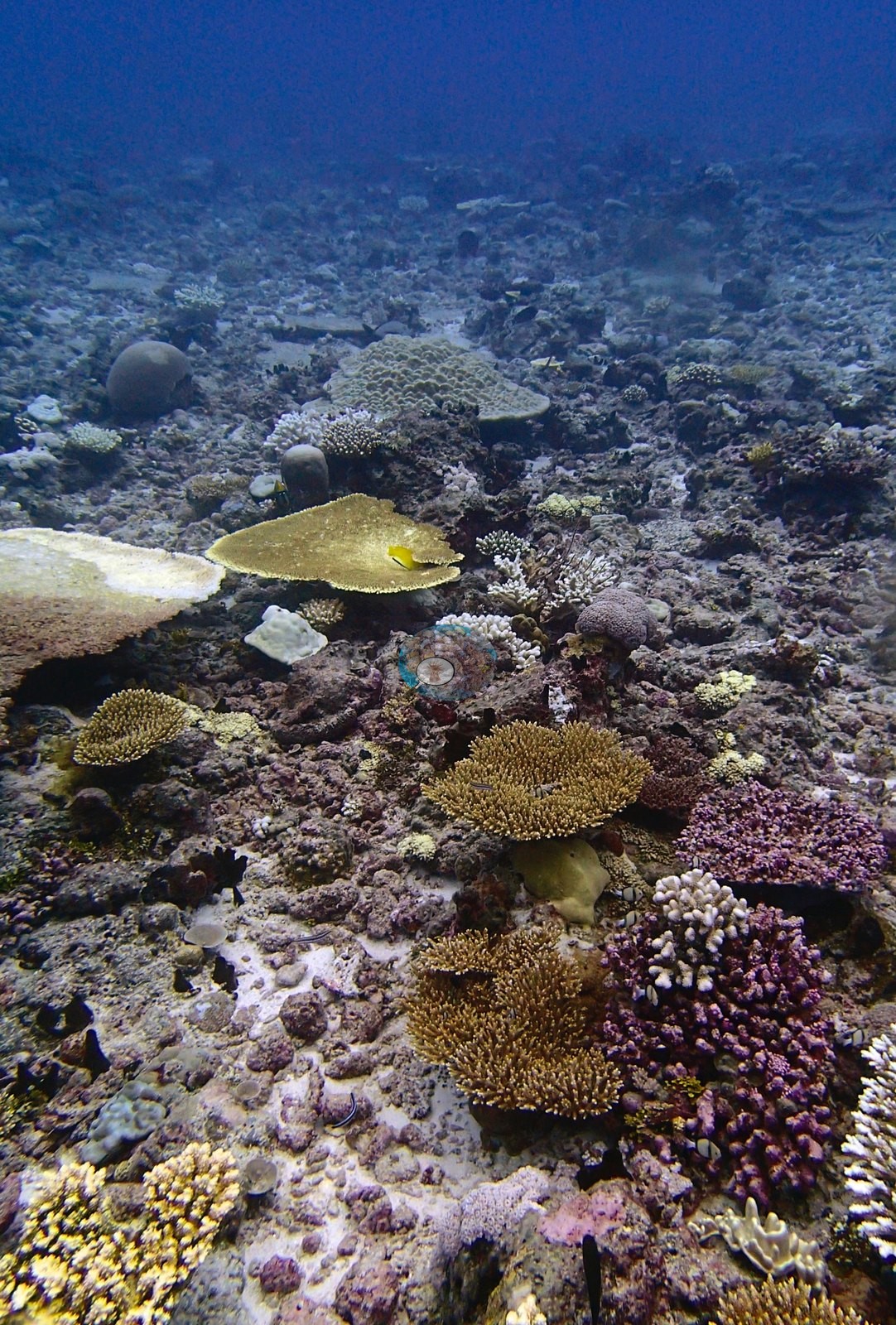
Chagos Archipelago, UK (NOAA CRW virtual station)A submerged bank reef on the east side of Speakers Bank, windward on Anderson's field sheet (dived to 19.7 m), with 37% coral cover and a heavy crust of coralline algae. Photos show several bleached colonies, including a white table on a dead one, though Anderson judged the bleaching not severe by percentage of colonies; no bleaching figure was published. Surveyed on the Living Oceans Foundation's Global Reef Expedition.
CTD-cast midpoint of 29.5–30.1°C
One other CRD dive site with its own page within 5 km shown in orange — click a marker to open its page.
🗺 Detailed map of the Global Reef Expedition dive sites, Speakers Bank, Chagos (Khaled bin Sultan Living Oceans Foundation; opens in a new window)
5 of the 19 photographs on this page are shown beside the text that discusses them under "Site description" below.
Site description
Setting
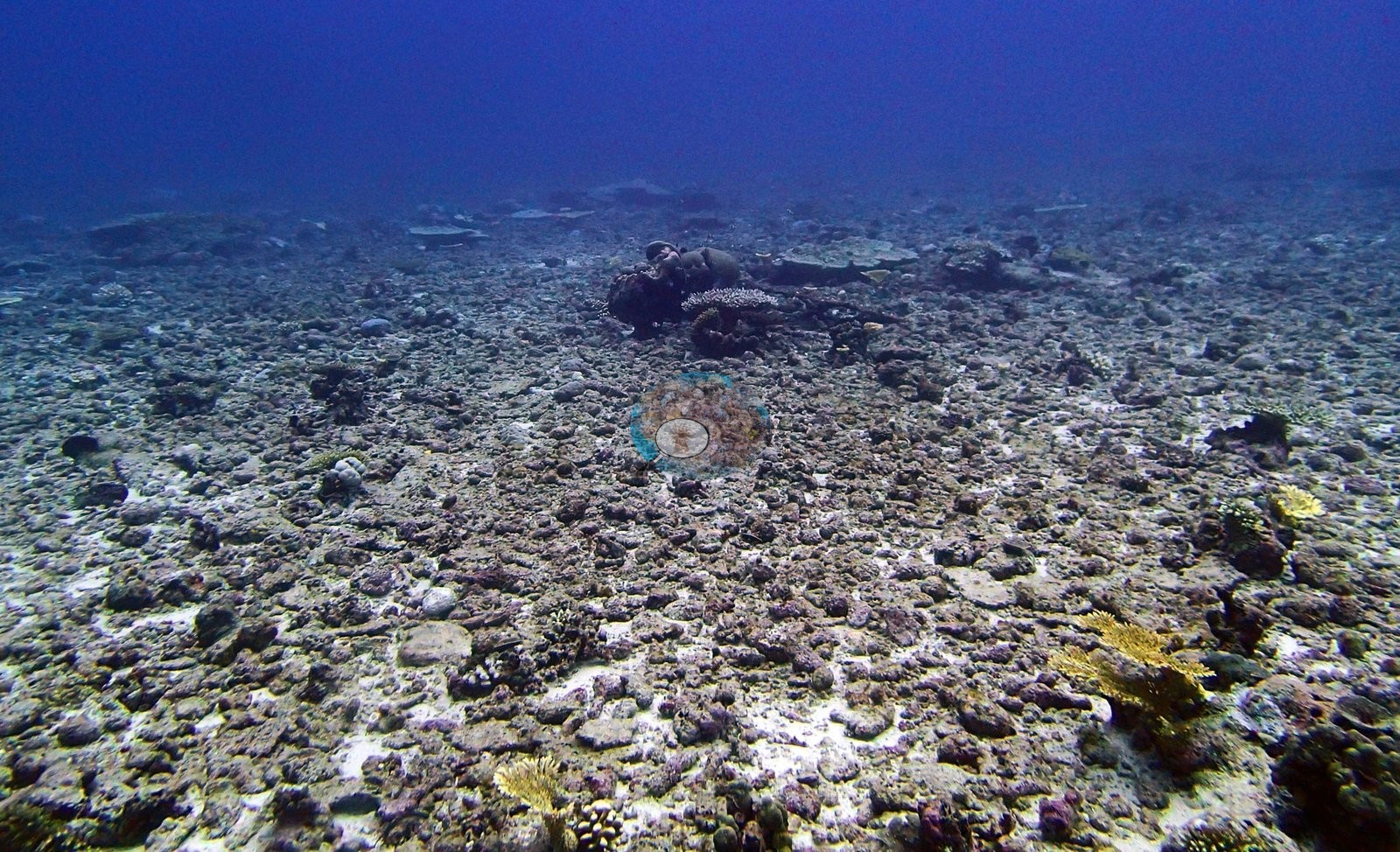
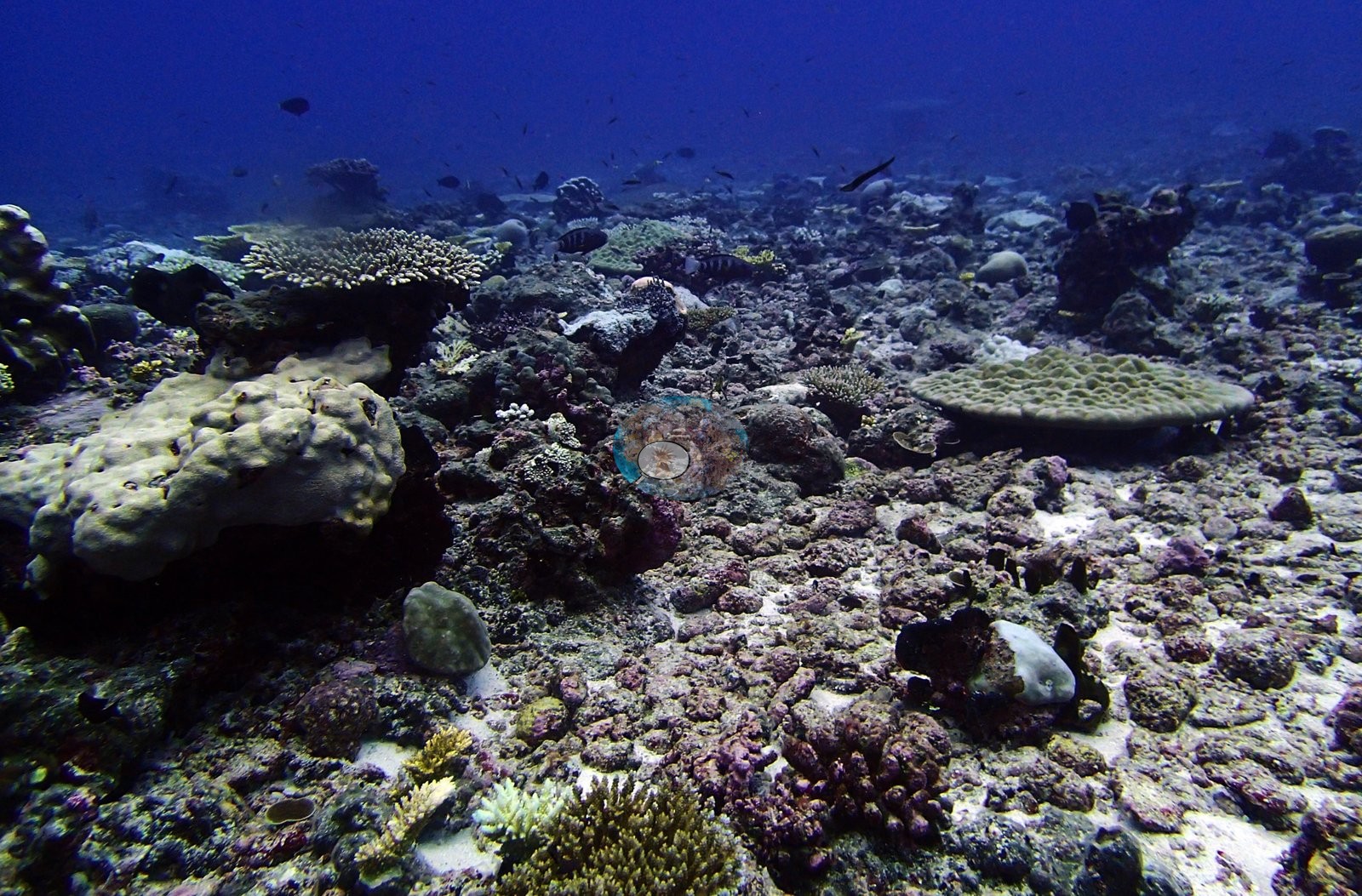
BISP115 is a submerged bank reef on the east side of Speakers Bank, windward on Anderson's field sheet, surveyed 3 May 2015 on a dive to 19.7 m (see Dive record below).
General benthic features
Only 14 genera were recorded, six of them holding 94% of the coral: Acropora 49%, Porites 24%, then Pocillopora, Montipora, Stylophora, and Platygyra.
Coral cover
- Reference: Mayfield & Dempsey (2026)
- CoralNet submission package
- Formal transects recorded 37% coral against 49% algae, with coralline algae taking 18% of the benthos.
- Transect mean 37 ± 3.5% SE (n = 11 transects; Living Oceans Foundation per-transect benthic data); the headline above is this all-transect mean, and the published station value, which weights each depth equally, is 42% (Mayfield & Dempsey 2026, Oceans, supplemental S1).
- Only two depth strata exist (10 transects and 1), and they invert completely — the shallower is Acropora-led at 20% of benthos against Porites 7.4%, while the deeper, a single transect, carries more coral at 48%, with Porites at 24% and Acropora down to 3.0%, so that single deep transect carries the Porites signal, while the mean of all 11 transects is Acropora-led.
- No CoralNet or Coralscapes product exists for this site either, so the transect figure is its only cover number.
- Live hard coral measured on the in situ benthic transects of the LOF BIOT-1 expedition (the mean of all of this station's transects), against total algal cover (all algal groups) of 49% of the benthos.
Stressors
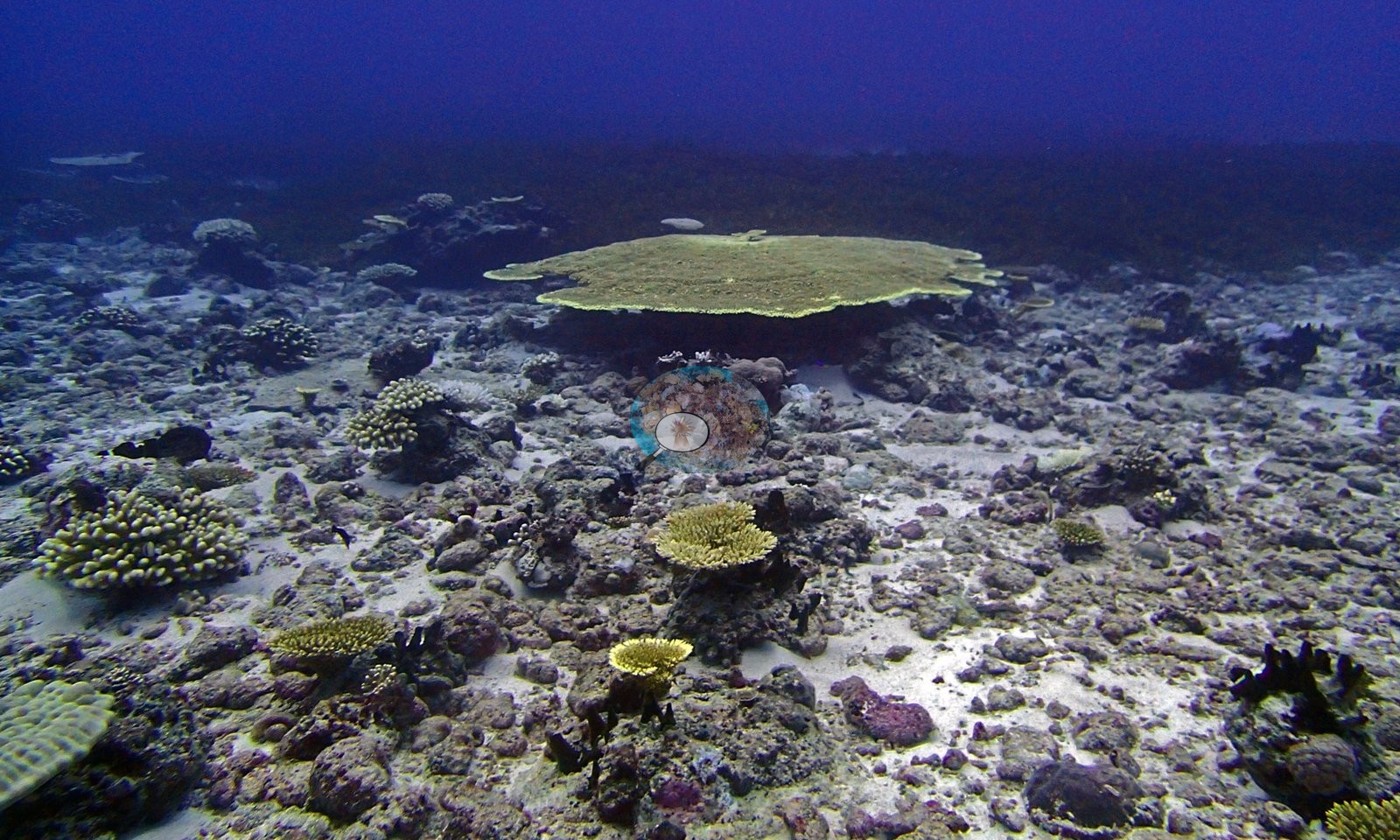
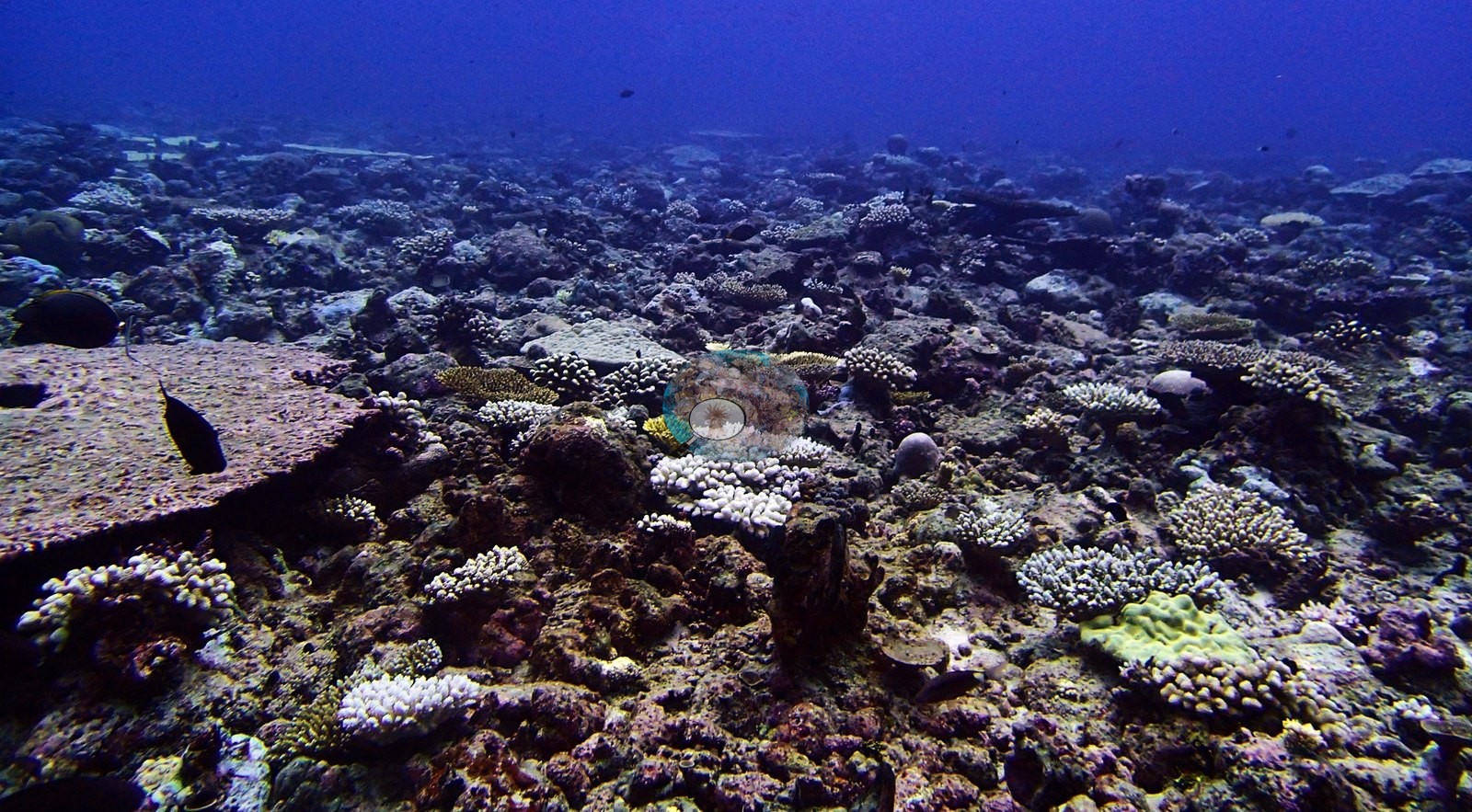
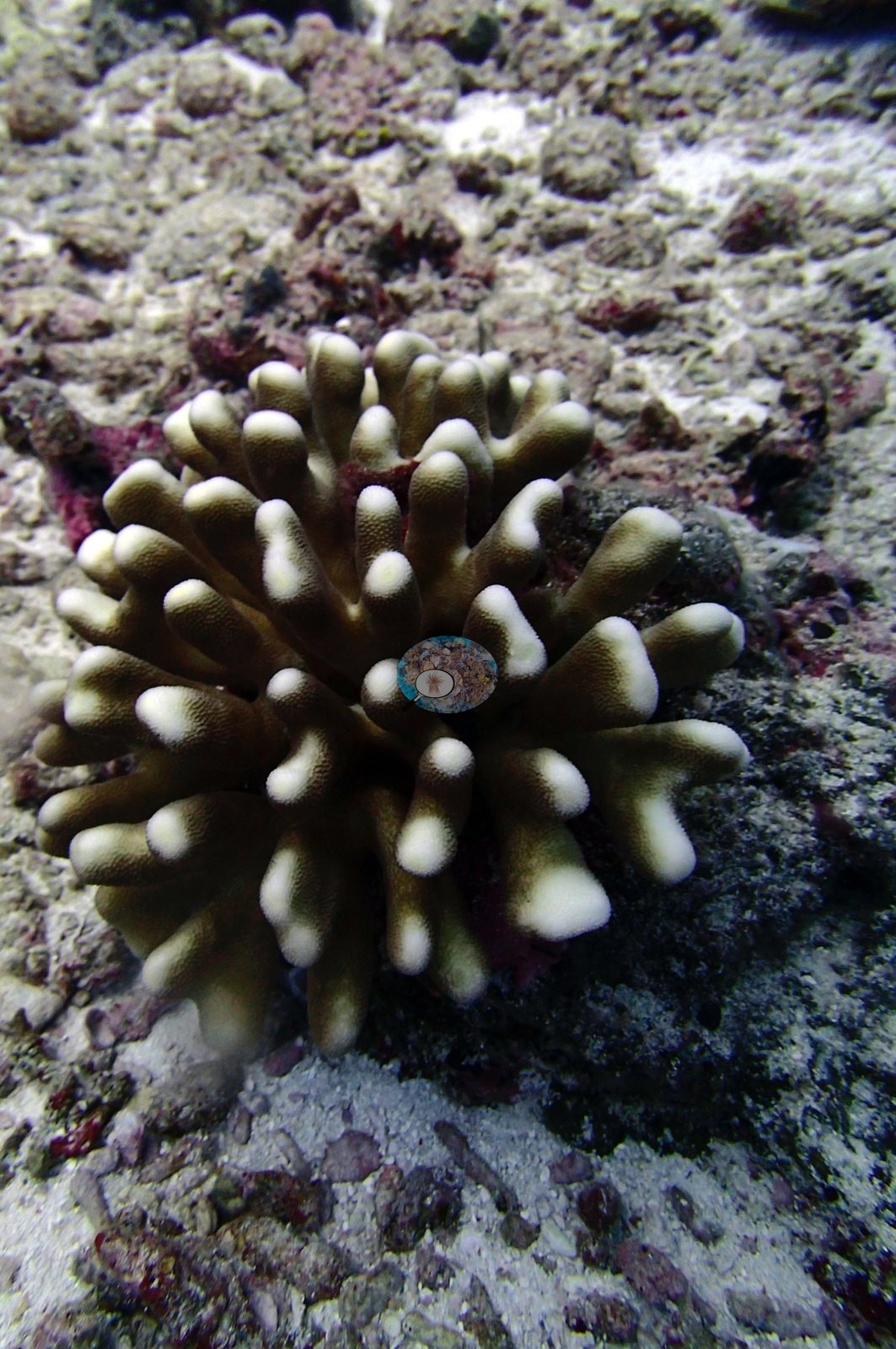
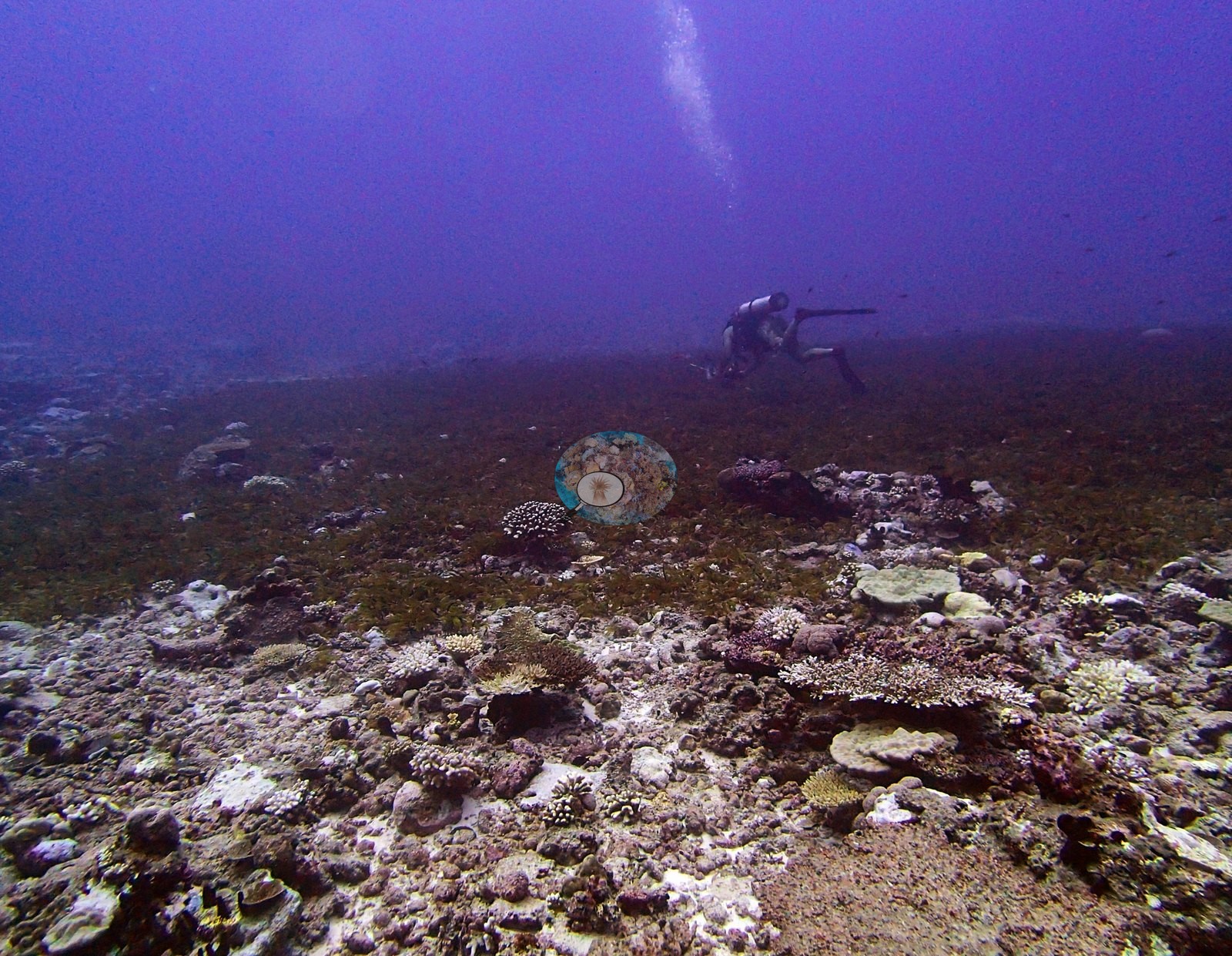
No bleaching value was published for this site (Mayfield & Dempsey 2026, suppl. S1). The photographs show bleached colonies in several frames: a white table on a turf-covered dead one (e.g., Image 5), white branching colonies beside pigmented ones (e.g., Image 6, Image 16), a white fine-branching colony (e.g., Image 7), and a pale yellow table (e.g., Image 13).
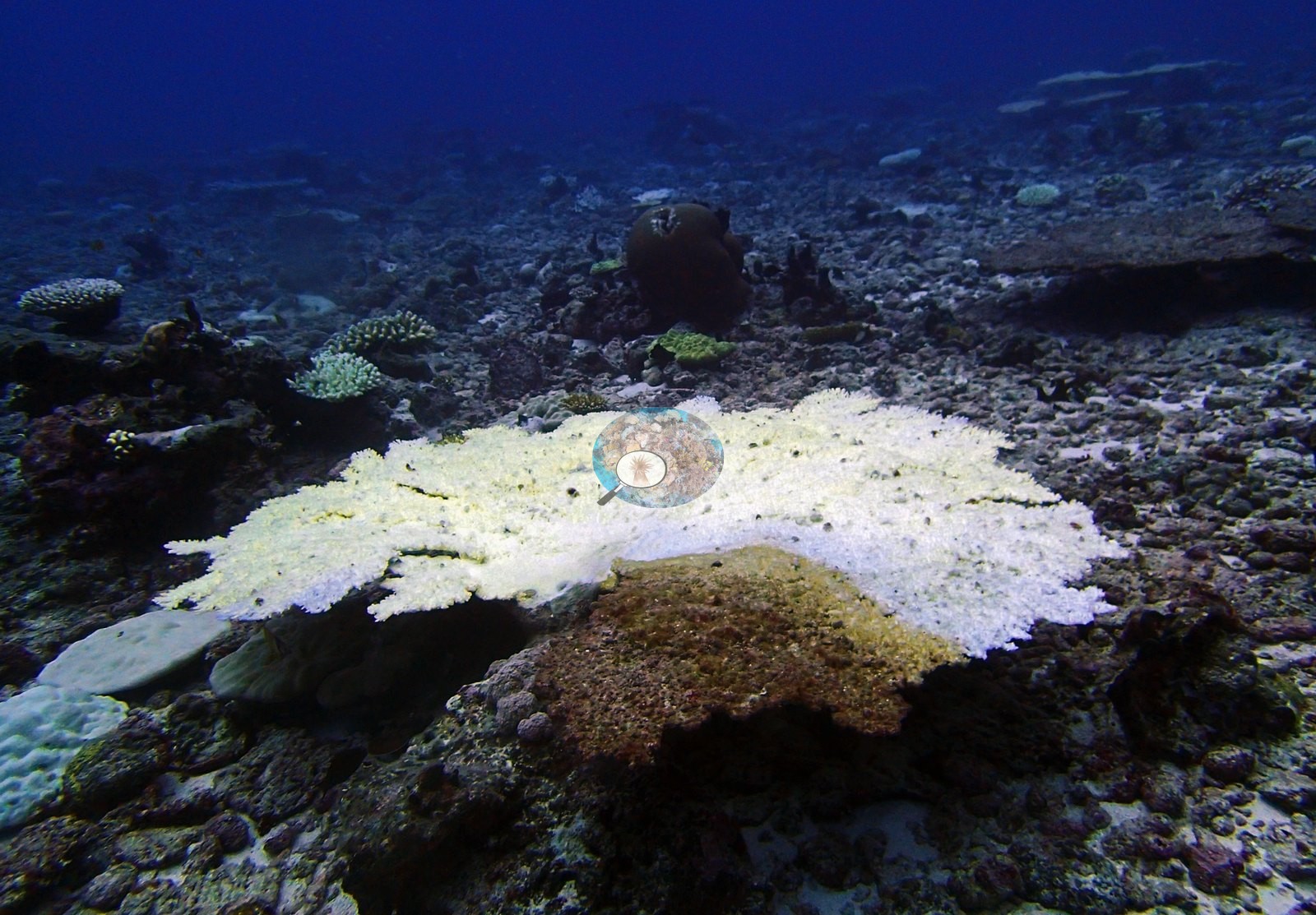
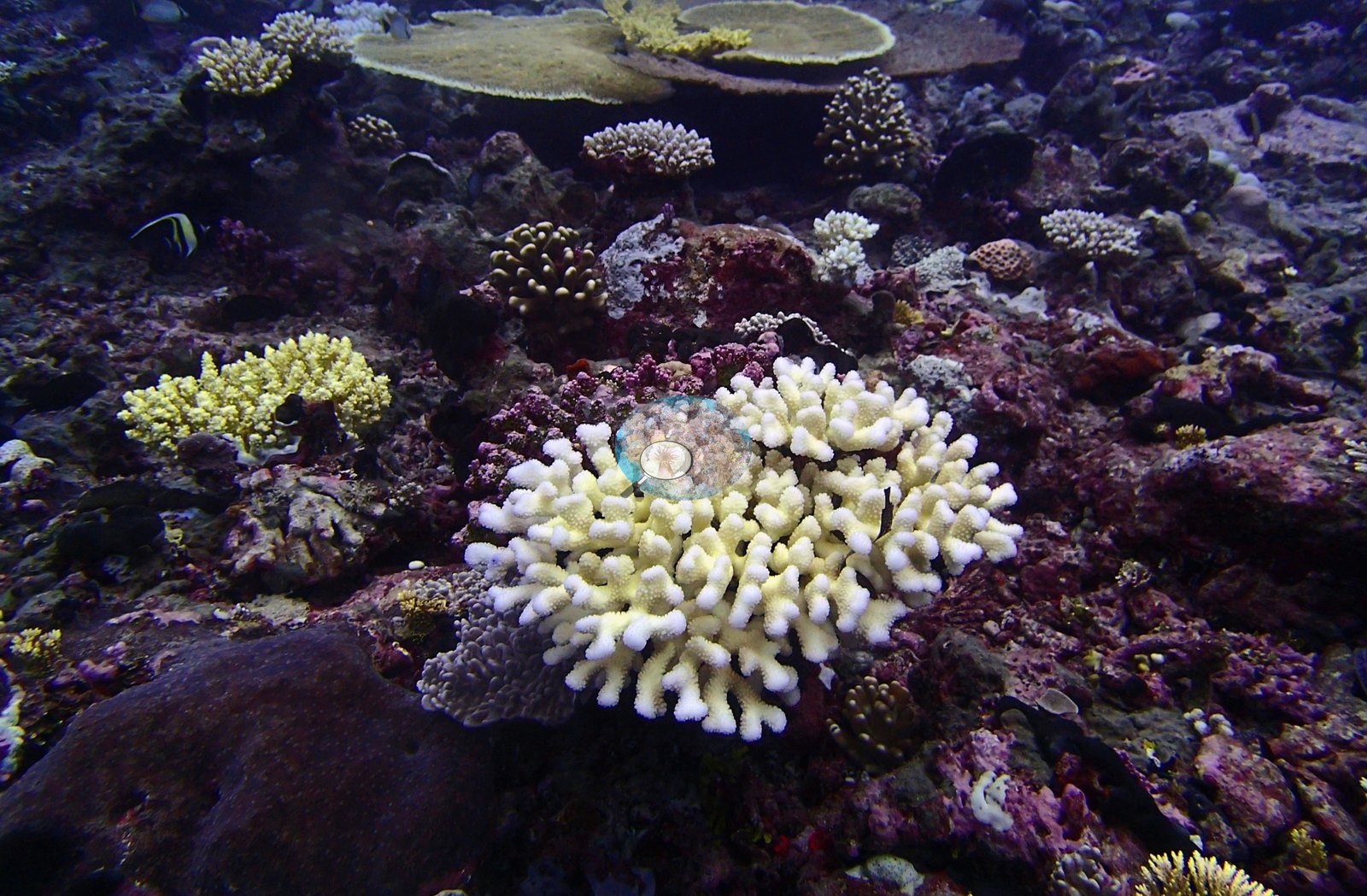
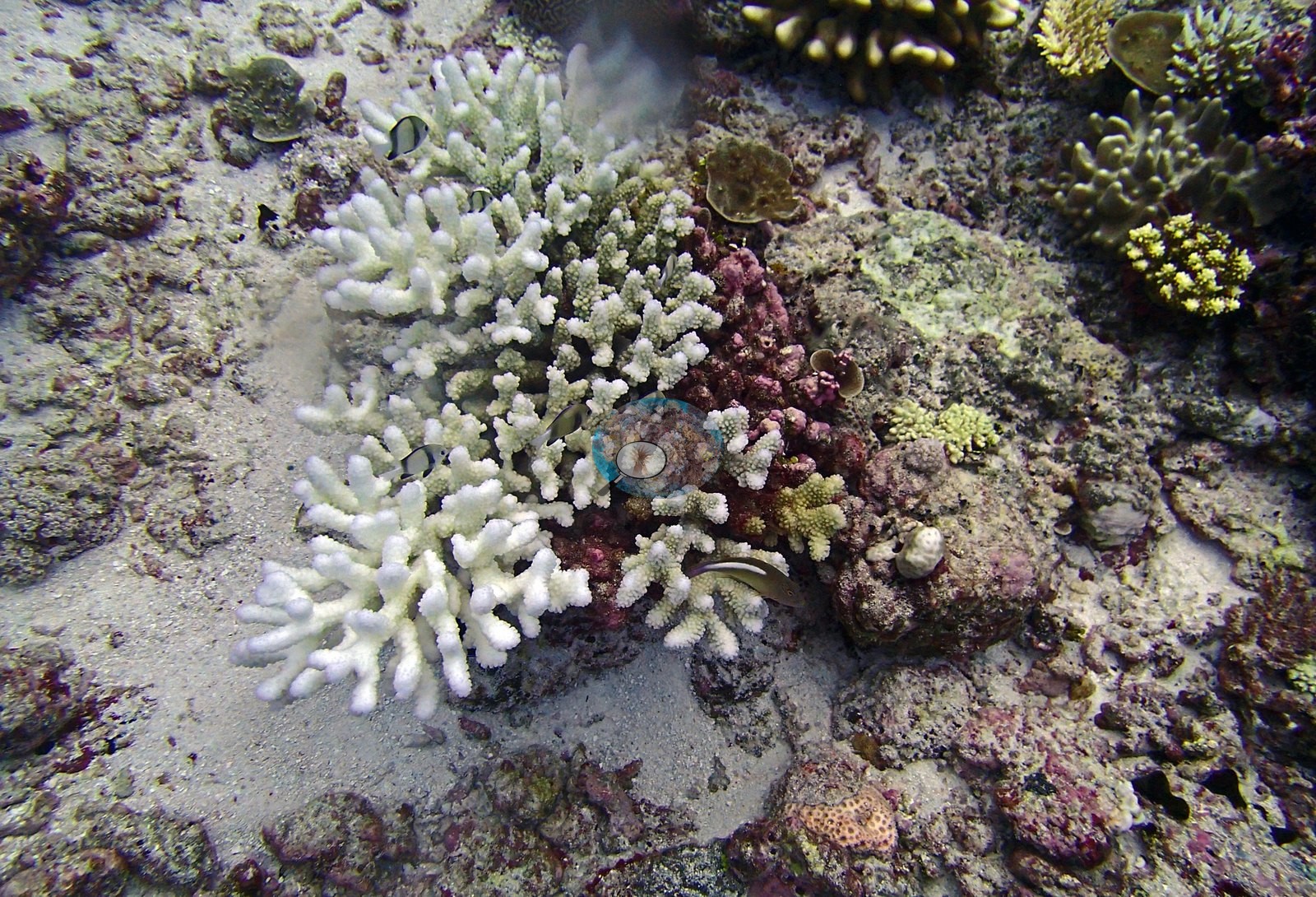
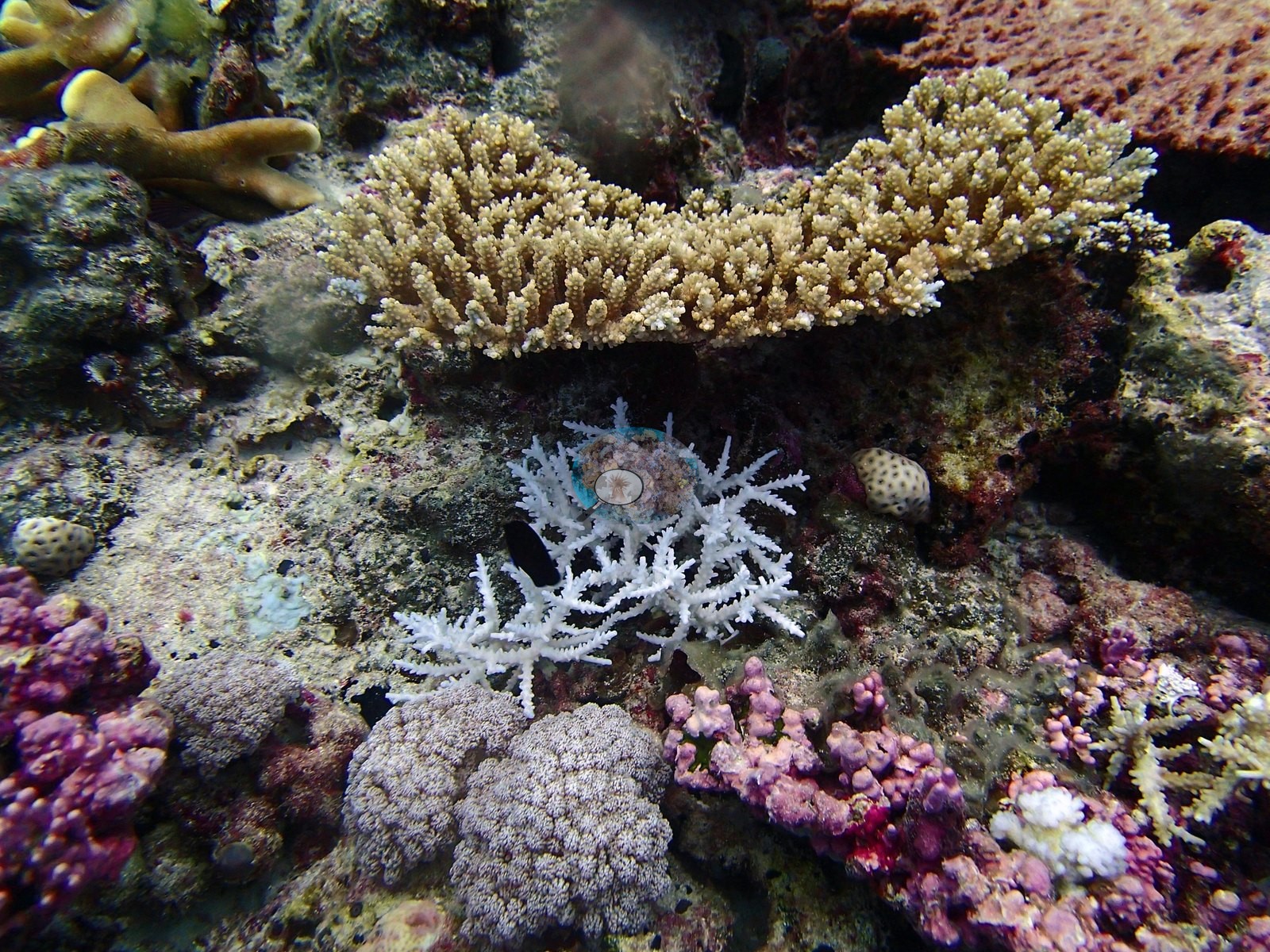
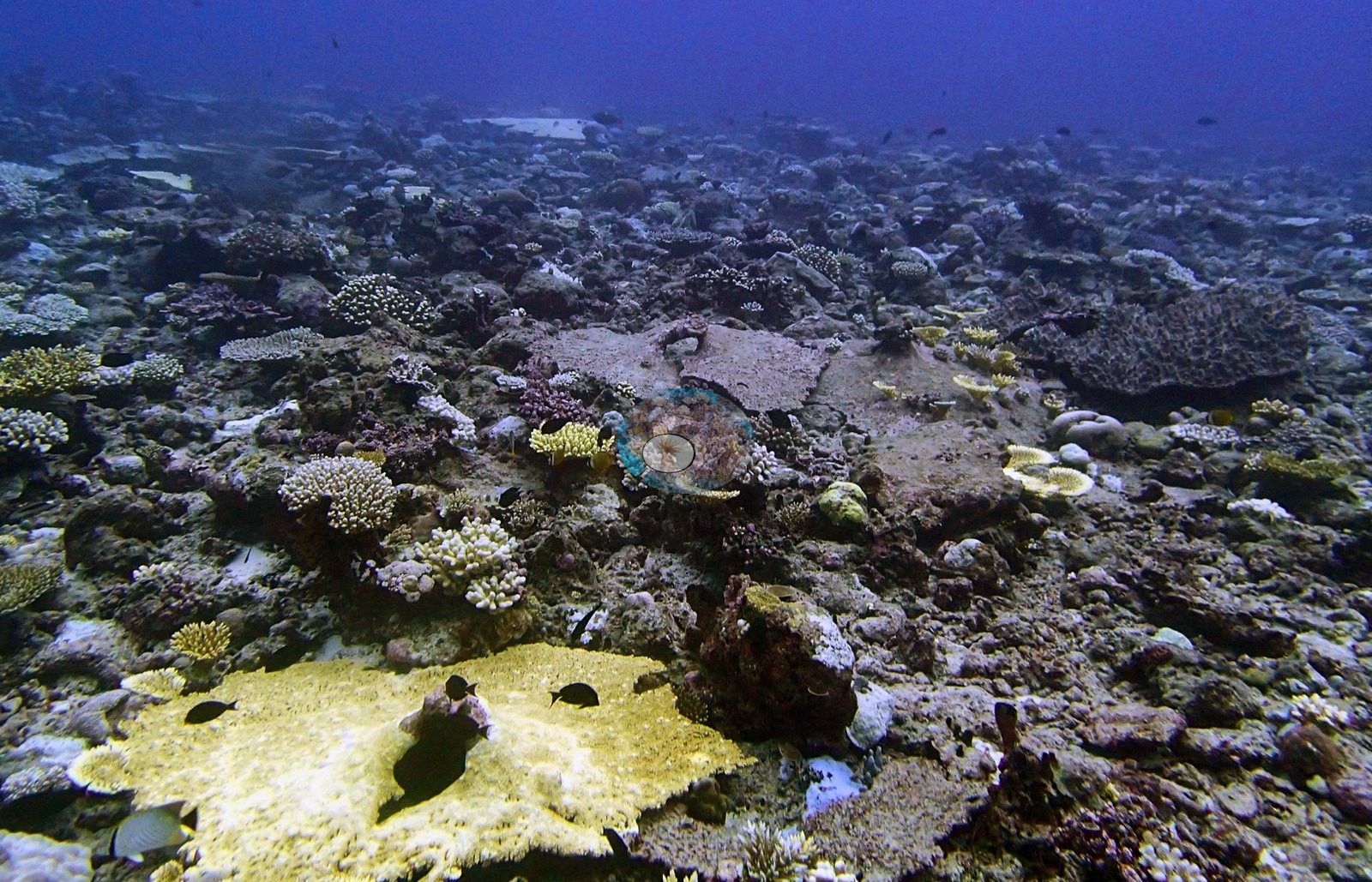
Anderson's note for the dive records bleaching in Pocillopora, Acropora, and Stylophora, “though not severe in terms of percentage of colonies”; three of the five pocilloporids sampled were 90-100% bleached (see Dive record below). No disease, predation, or crown-of-thorns was seen in the photographs. The Living Oceans Foundation transects here recorded 0.4% cyanobacteria and no recently dead coral.
Comparisons with other data
Apart from the Living Oceans Foundation survey shown here, we found no other surveys at this site as of 2026. If you would like to share yours, please email us.
Dive record
Anderson's morning dive on 3 May 2015 entered the water at 10:54 and lasted 55 minutes, to a maximum depth of 19.7 m (the field sheet); the notes describe a submerged bank with a very gradual slope (no reef could be found above 15 m or below 20 m), low coral cover, large patches of seagrass, emperors as the only notable fish, a mild current, no P. acuta or Seriatopora, and bleaching in Pocillopora, Acropora, and Stylophora, “though not severe in terms of percentage of colonies.” For a collaborator, Anderson sampled five pocilloporids (species by field call): Pocillopora sp. ChJo308 (collected 10:59 at 19.5 m; large, healthy, fairly pale), ChJo309 (11:04, 19.5 m; 90-95% bleached, with some algal smothering), ChJo311 (11:17, 16.0 m; healthy, among the most common corals at the site, with bleached colonies nearby), and ChJo312 (11:25, 16.1 m; 90% of the tissue unpigmented, live tissue still evident), and Pocillopora verrucosa ChJo310 (11:09, 19.1 m; 100% bleached, away from the main reef, live tissue still evident). Pocillopora acuta colonies from this archipelago were analyzed in Thomas et al. (2026, Global Ecology and Biogeography 35:e70305, https://doi.org/10.1111/geb.70305).
Other notes
Aspect follows Anderson's field sheet (LOF fellowship 2016 workbook: 'submerged bank', 'windward'); the expedition's 933-site table classes the station as 'protected' (bank reef). Esri World Imagery (no LOF habitat map covers Speakers Bank; the LOF Chagos habitat map covers only Peros Banhos) puts the pin on the east side of Speakers Bank, facing east (windward for the southeast trades), consistent with the sheet; nothing in Anderson's notes places it inside the lagoon.
Data & links
- Download benthic survey data (CSV) ↗
- Download all LOF-GRE data (933 sites) ↗
- CoralNet image repository for this region ↗
- Photo portfolio ↗
- Coral Reef Diagnostics page for this area ↗
All images from Coral Reef Diagnostics. Data are from the Khaled bin Sultan Living Oceans Foundation Global Reef Expedition and Coral Reef Diagnostics.
 © Coral Reef Diagnostics.