
Part of the regional summaries: Chagos Archipelago - Salomon / Blenheim / Speakers Bank and Chagos Archipelago
More info
Chagos (NOAA CRW virtual station)A high-cover but patchy Speakers Bank forereef (53.9% coral, among the least algal of all Chagos sites), dominated by Acropora tables. Cover doubles with depth, reaching 72% on the deepest transect, where the reef narrows to a near-monoculture of Acropora. Surveyed on the Living Oceans Foundation's Global Reef Expedition.
One other CRD dive site within 5 km shown in orange — click a marker to open its page.
🗺 Detailed map of the Global Reef Expedition dive sites, Speakers Bank, Chagos (Khaled bin Sultan Living Oceans Foundation; opens in a new window)
4 of these 7 photographs are shown beside the text that discusses them under "Site description" below.
Site description
Setting
BISP100 is a high-cover but visibly patchy forereef — 53.9% transect coral cover, 19th of the 109 Chagos sites, against only 24.5% algae (100th of 109, so among the least algal-dominated reefs surveyed).
General benthic features
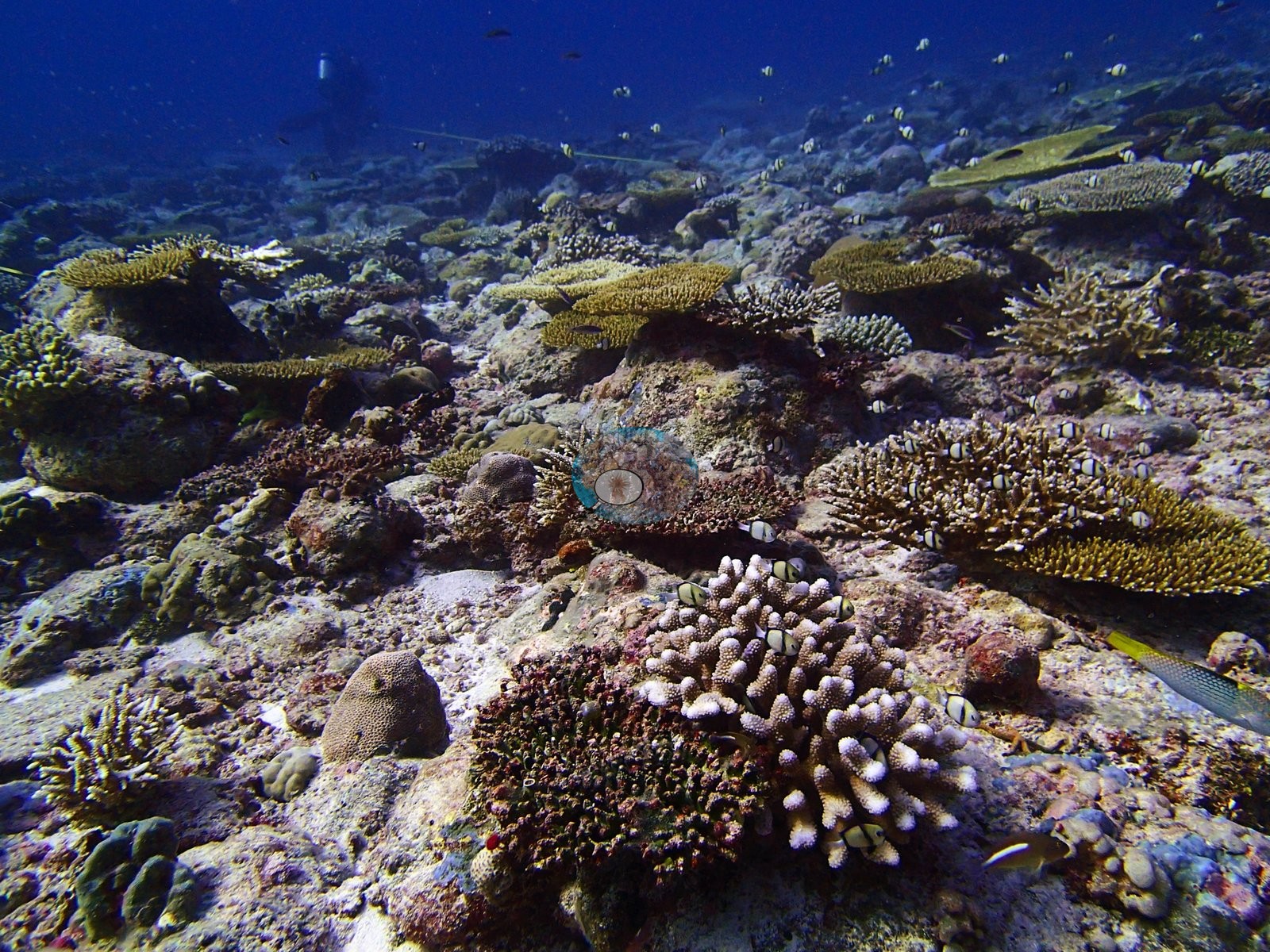
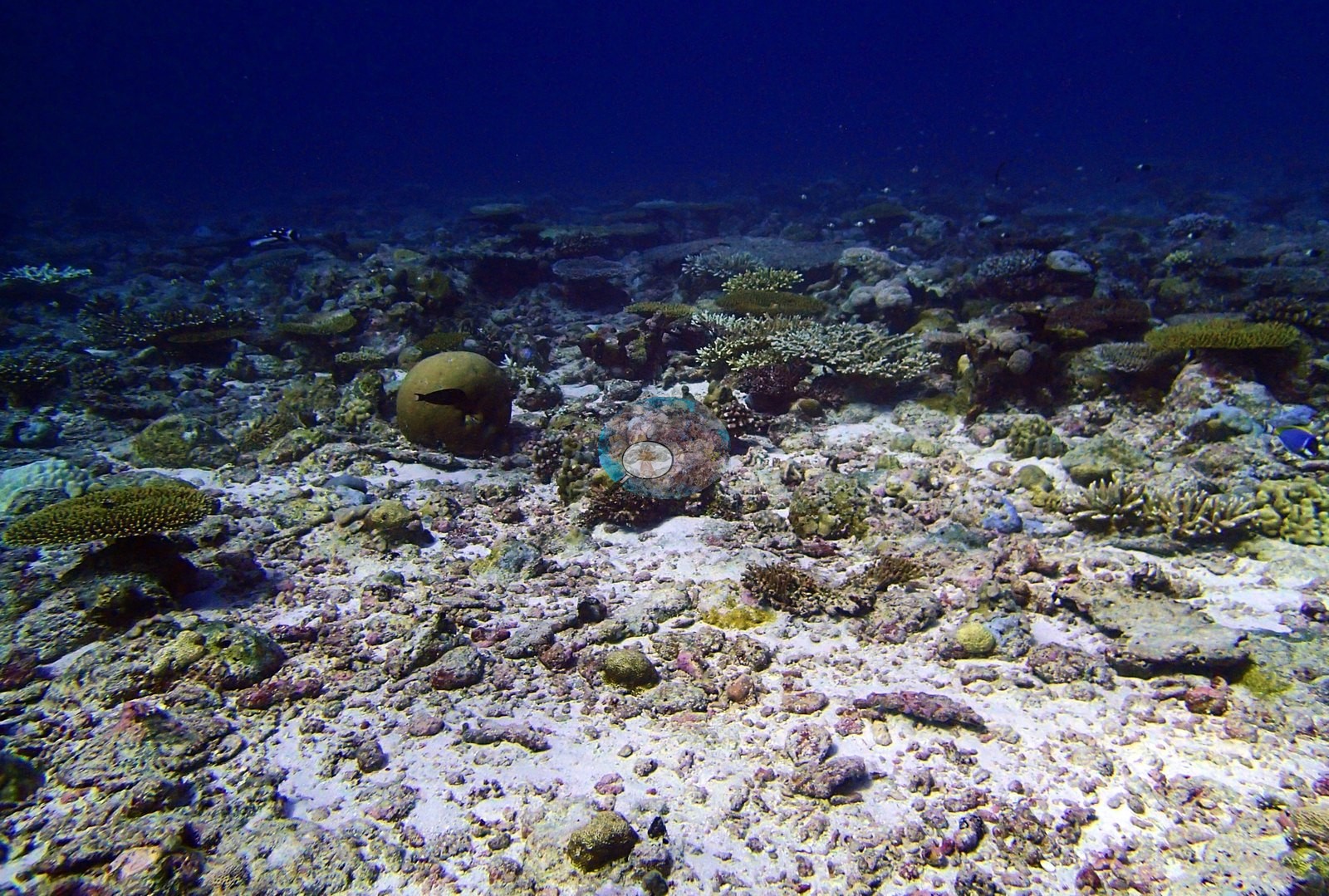
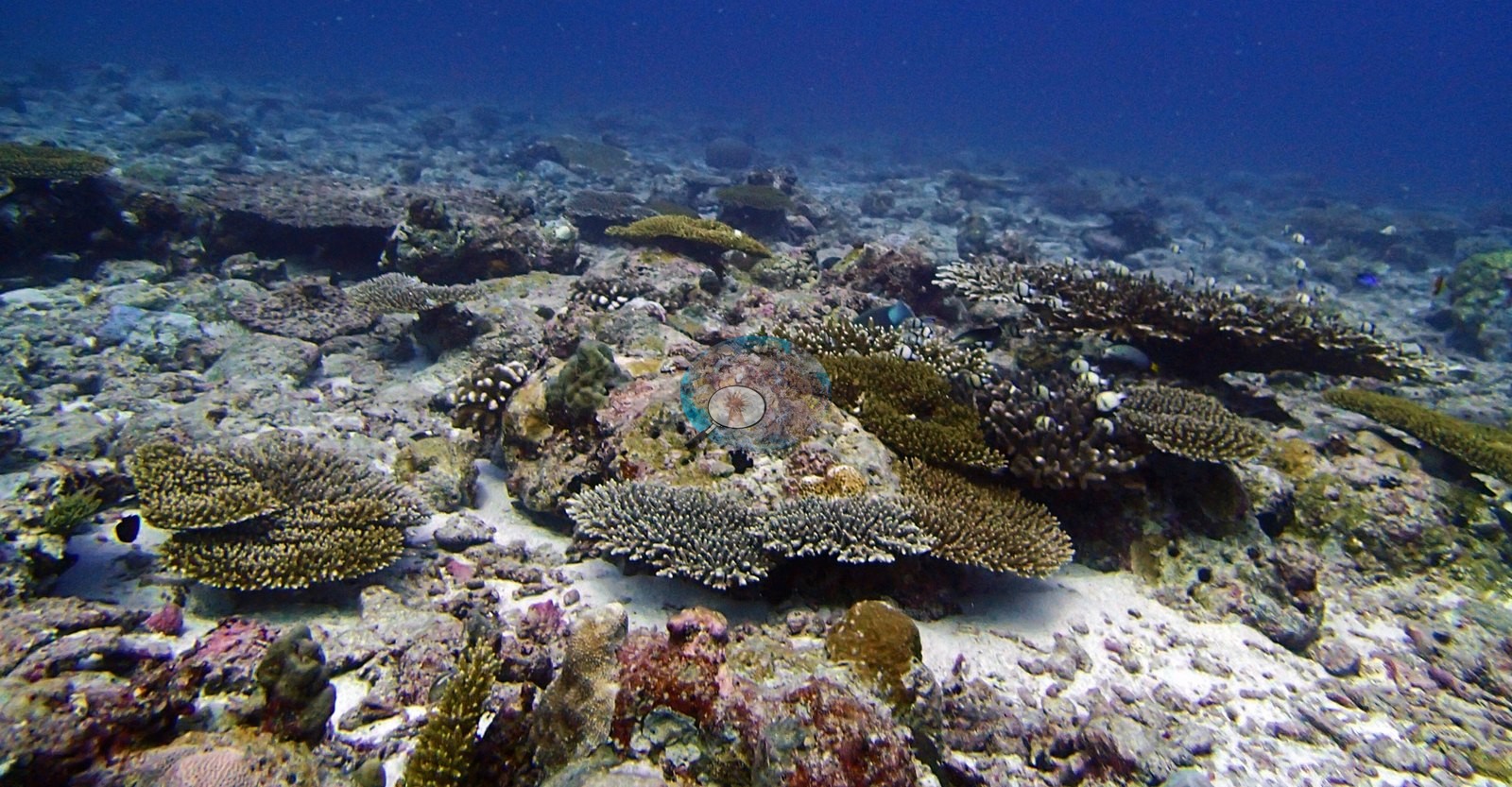
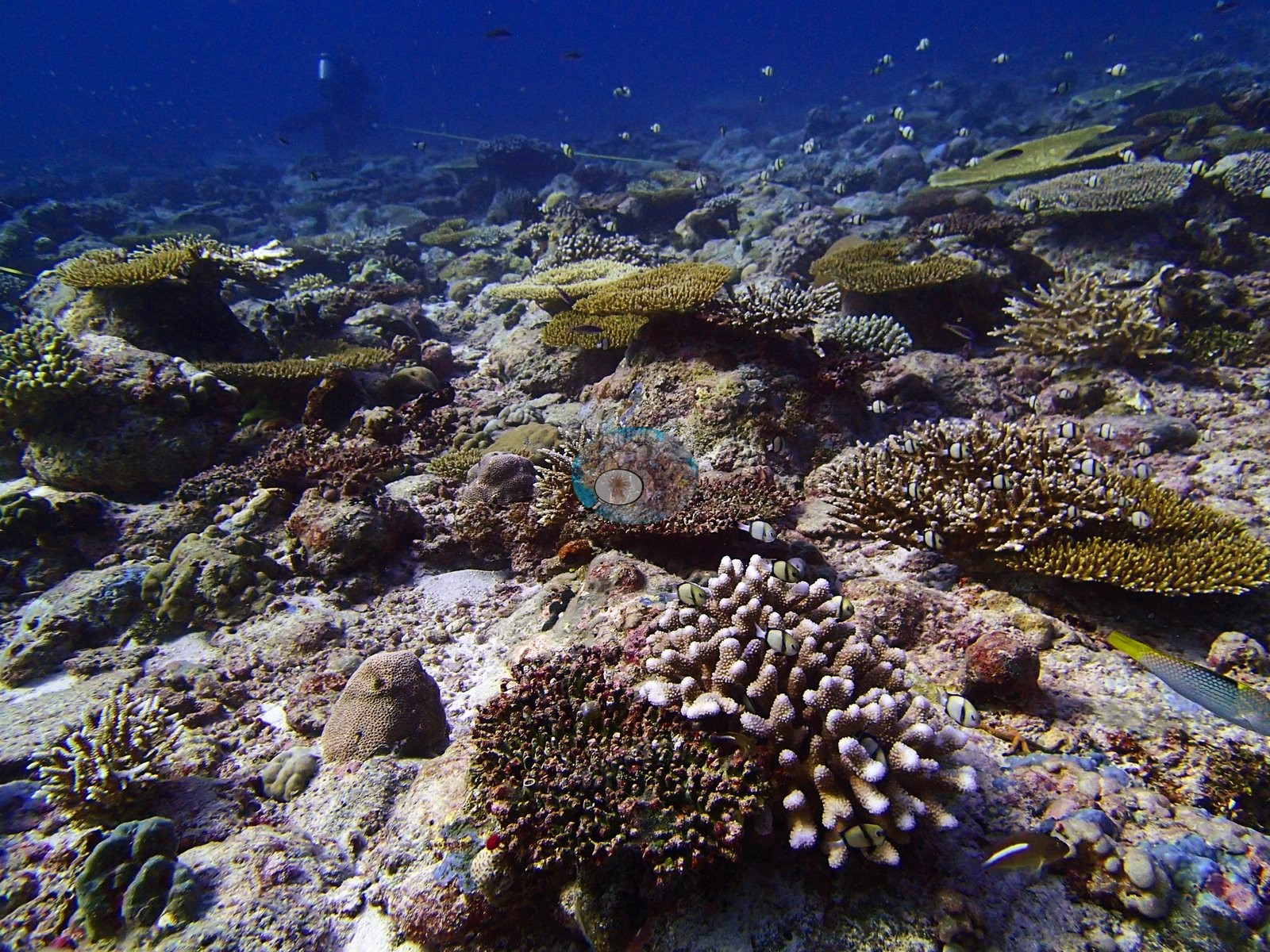
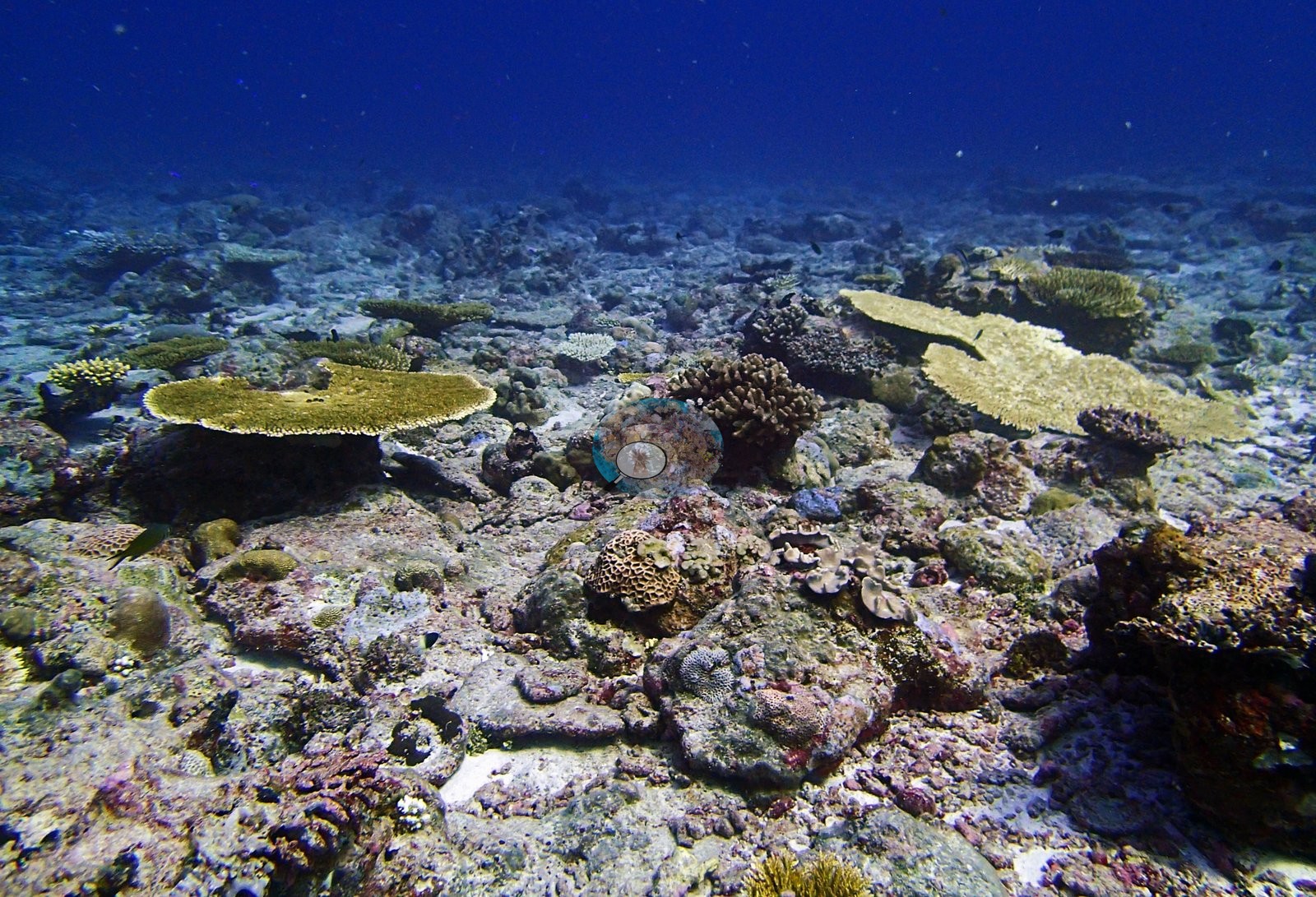
Bare substrate is the notable substrate figure at 19.4%, with turf 11.8%, coralline algae 5.8%, non-coral invertebrates 2.3%, macroalgae 2.0%, and erect algae 0.5%. The assemblage is strongly Acropora-led across 16 non-zero genera. Acropora holds 41.44% of the benthos — 77% of all coral recorded — then Porites 3.45%, Montipora 2.81%, Favia 1.33%, Pocillopora 1.21%, Astreopora 0.95%, Leptastrea 0.68%, and Goniastrea 0.58%. Seven further genera sit below 0.5%: Psammocora, Montastrea, Favites, Hydnophora, Platygyra, Acanthastrea, and Cyphastrea. The site mean of 41.44% Acropora therefore averages a moderately diverse shallow band onto a deep near-monoculture and should not be quoted alone. The reef architecture alternates between locally dense coral patches and open framework. One frame shows several overlapping tables and branched colonies set at different heights, producing shaded cavities and small fish refuges (e.g., Image 4); two others show the same arrangement at wider scale, with live plates spaced by pale pavement and older irregular substrate. (e.g., Image 3) Assemblage composition.
Formal surveys give 53.9% coral, 24.5% algae, and 2.3% non-coral invertebrates, the coral 77% Acropora and reaching 64% of the benthos on the deepest transect alone. The photographs document a patchy canopy of overlapping tables and branching colonies separated by pale pavement, one partly bleached colony, and a large holothurian.
Coral cover
Cover doubles with depth and the assemblage narrows sharply as it does. D3 carries 36.7% coral across 15 genera, with Acropora at 17.33% and a genuinely mixed runner-up field — Montipora 4.44%, Porites 4.35%, Astreopora 2.85%. D4 rises to 53.0% across only six genera with Acropora at 43.00%. D5 reaches 72.0% coral across just three genera — Acropora 64.00%, Montipora 4.00%, Porites 4.00% — on 7.0% algal cover. One frame is notably more open and is the one that best explains why a 53.9% site figure should not be attached to every view — the retained sequence supports a patchy rather than uniformly continuous canopy, which is also what the 19.4% bare-substrate figure records. (e.g., Image 1) No photographic cover estimate was made from these contrasts.
Stressors
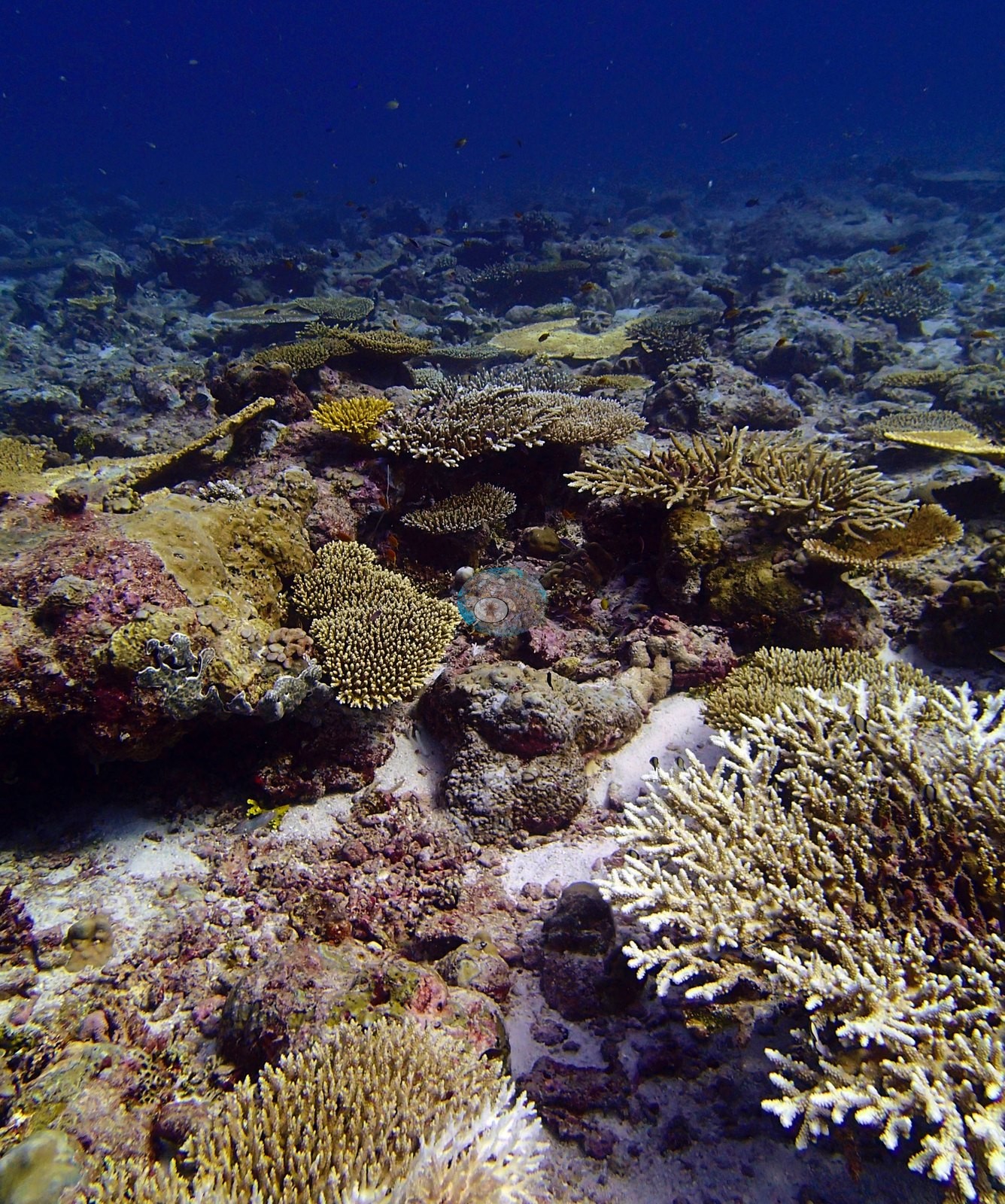
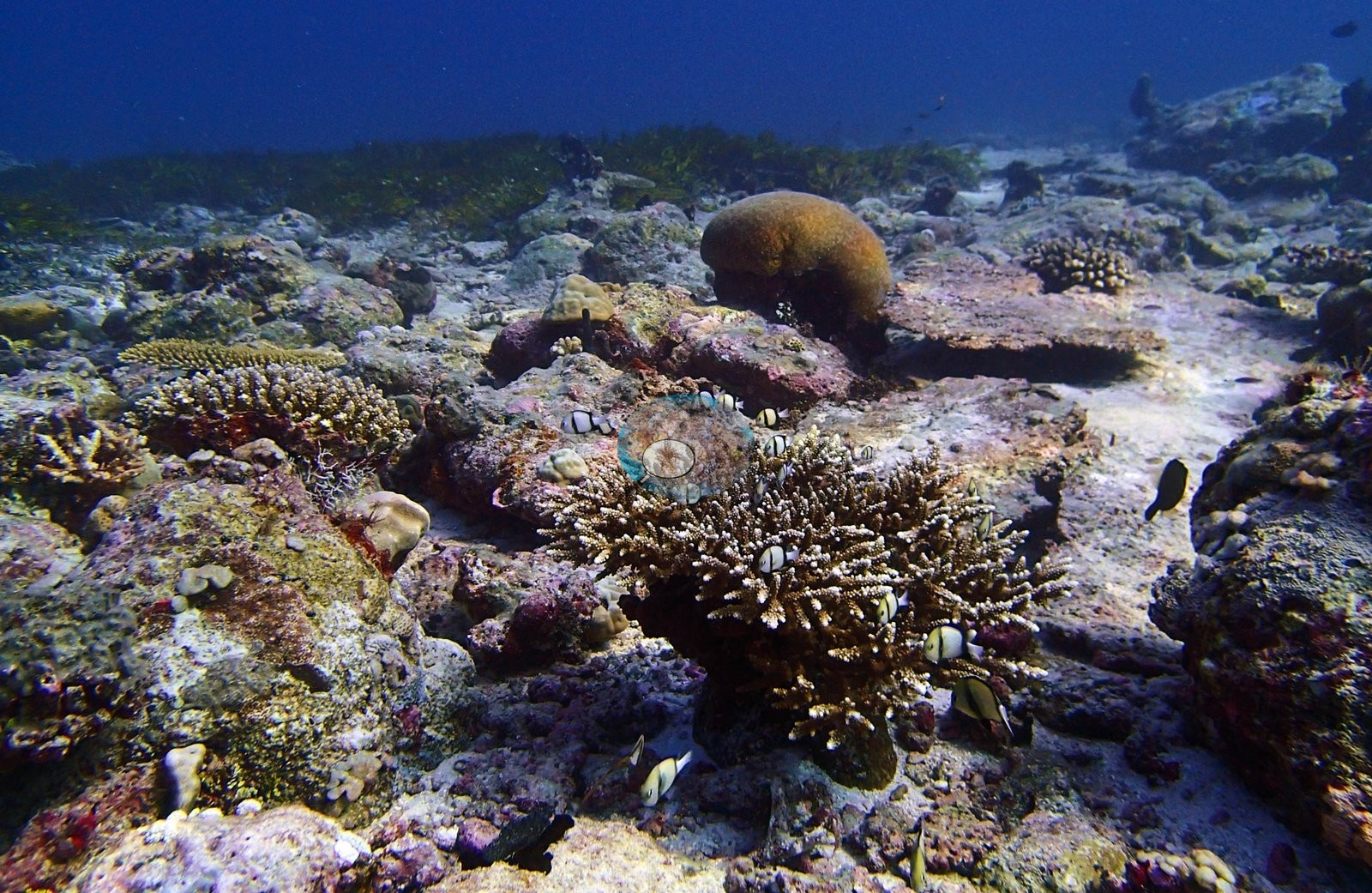
(e.g., Image 1) Coral condition is generally pigmented. The clearest condition frame is one in which much of a compact branching colony remains brown while numerous branch ends and several larger patches are white. (e.g., Image 2) (e.g., Image 2) Some of that could be normal growth margins, but its breadth across the colony makes partial bleaching plausible at medium confidence.
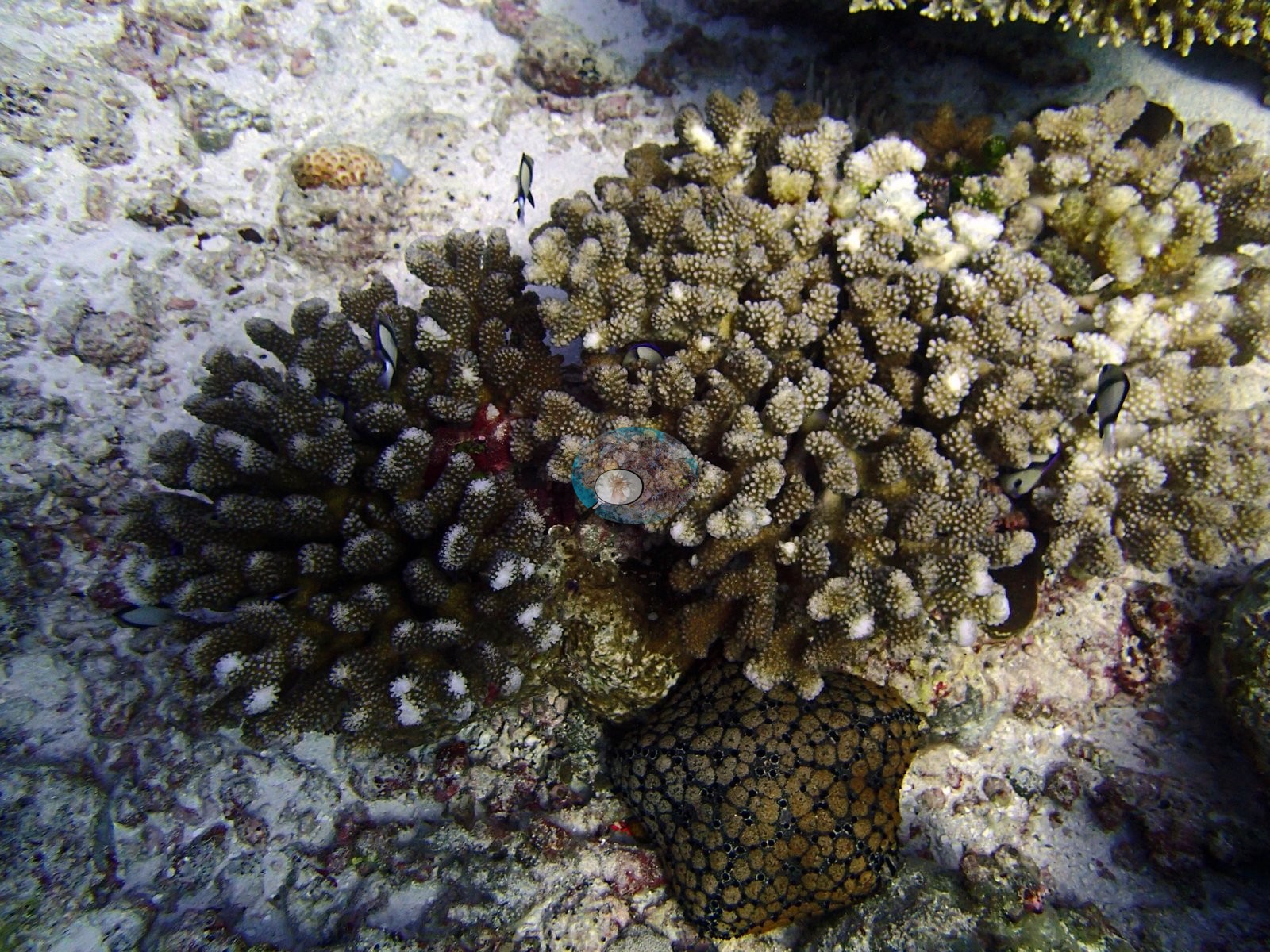
The overlapping-table frame contains additional pale-tipped branches where lighting and distance reduce certainty. The published figure of 4.8% ranks 72nd of 98 — low, and consistent with this reading. An important interpretive caution applies to this site's open frames: much of the pale ground is old skeletal material or sediment, not bleached tissue, distinguishable by its irregular eroded texture rather than intact coral surface. No crown-of-thorns starfish (COTS) or other corallivores evident.
Fish and other fauna
The clearest condition frame also holds a large dark reticulated sea-cucumber-like animal beneath the colony; the robust cylindrical body and patterned surface support an echinoderm, but the frame does not warrant a species name. Small black-and-white fishes shelter among the branches.
Comparisons with other data
No prior survey data from this site. If you would like to share yours, please email us.
CV model comparison
More info
Those are point counts on the photographs; this is a diver swimming a transect. The models and the reference never saw the same thing. ⚠ SITE-LEVEL ONLY. The 2,500 frames were not associated with any transect taken within 200 m of them, so transect-vs-image comparisons are site means, never frames. The transect value is already in the pin `cover` field (109 of 112 pins, sourced to the paper's suppl. S1) and is read from there, never re-imported. The transect is THE coral-cover value for this site and stands alone. The rows below it are a methods comparison only: no computer-vision value is averaged with it, feeds the headline, or carries over to the site's cover figure (Anderson, 2026-09-22).| Method | Hard-coral cover (%) |
|---|---|
| Transect (published) | 53.9 |
| CoralNet | 21.7 |
| In-house DINOv3 | 34.8 |
| CoralSCOP edited | 27.0 |
| Claude | 31.9 |
Data & links
- Read the full site report ↗
- Download benthic survey data (CSV) ↗
- Download all LOF-GRE data (933 sites) ↗
- CoralNet image repository for this region ↗
- Photo portfolio ↗
- Coral Reef Diagnostics page for this area ↗
All images from Coral Reef Diagnostics. Data are from Coral Reef Diagnostics.
 © Coral Reef Diagnostics.