
Chagos Archipelago - South Brother (BITB34.5)

Part of the regional summaries: Chagos Archipelago - Great Chagos Bank West / Brothers / Eagle and Chagos Archipelago
More info
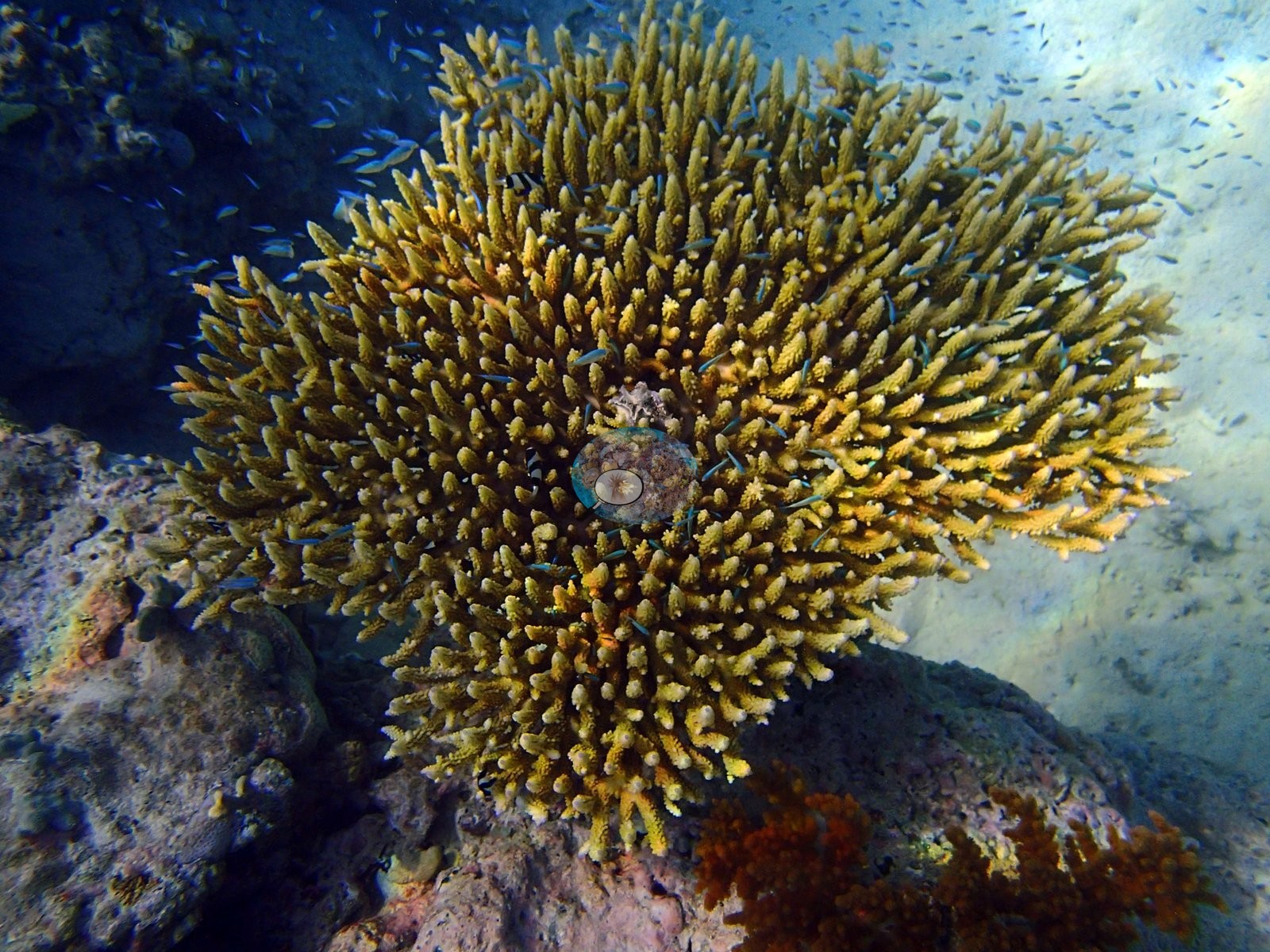
Chagos (NOAA CRW virtual station)A small, unsurveyed patch at South Brother with no transect of its own, best read alongside the neighboring station dived the same day, which carried 61% coral cover and 31 genera. Its photographs show a large golden-olive table coral with healthy pale growing tips, clouds of chromis, and a humbug damselfish. Surveyed on the Living Oceans Foundation's Global Reef Expedition.
Three independent survey stations shown with the program’s logo — click one to see how far it is from this site.
Fourteen other CRD dive sites within 5 km shown in orange — click a marker to open its page.
🗺 Detailed map of the Global Reef Expedition dive sites, Three Brothers, Chagos (Khaled bin Sultan Living Oceans Foundation; opens in a new window)
Site description
General benthic features
What the three frames show. The first frame carries the site: a large corymbose Acropora-type table, golden-olive with pale cream axial tips, on coralline-crusted pavement above open sand, with dense clouds of small blue-green damselfish (Chromis-type) and one banded humbug (Dascyllus-type) in the branches (e.g., Image 1).
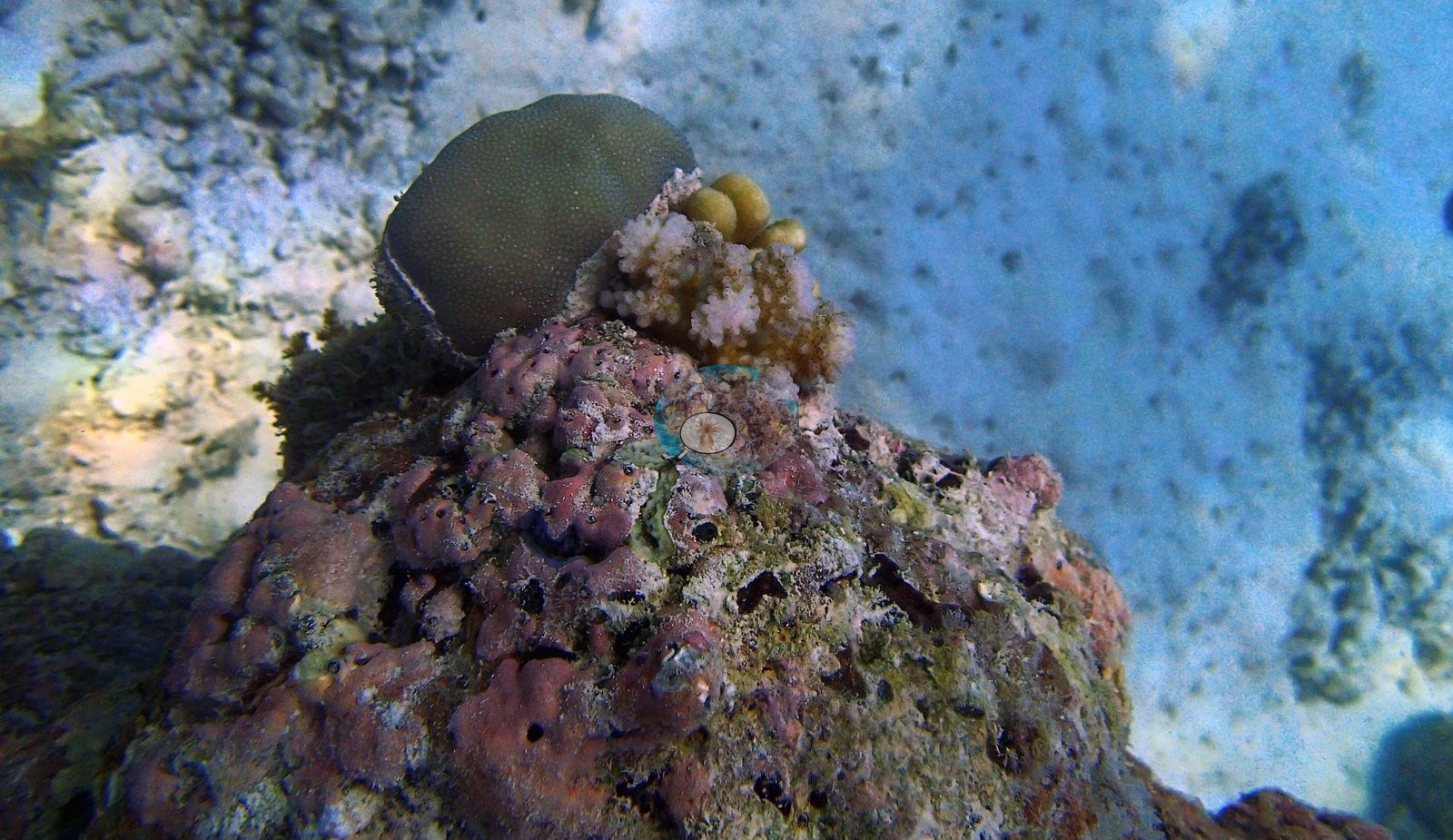
A grayish fluted structure among the branches is compatible with a tridacnid clam; lower right, dark red-orange fine-branched colonies compatible with a pocilloporid. The second frame is a coralline-crusted bommie with a smooth dark-olive encrusting plate of fine dense corallites (compatible with a Porites- or Montipora-type) and a pale cream knobby-branched colony compatible with a Pocillopora-type, still holding tan pigment low down (e.g., Image 2).
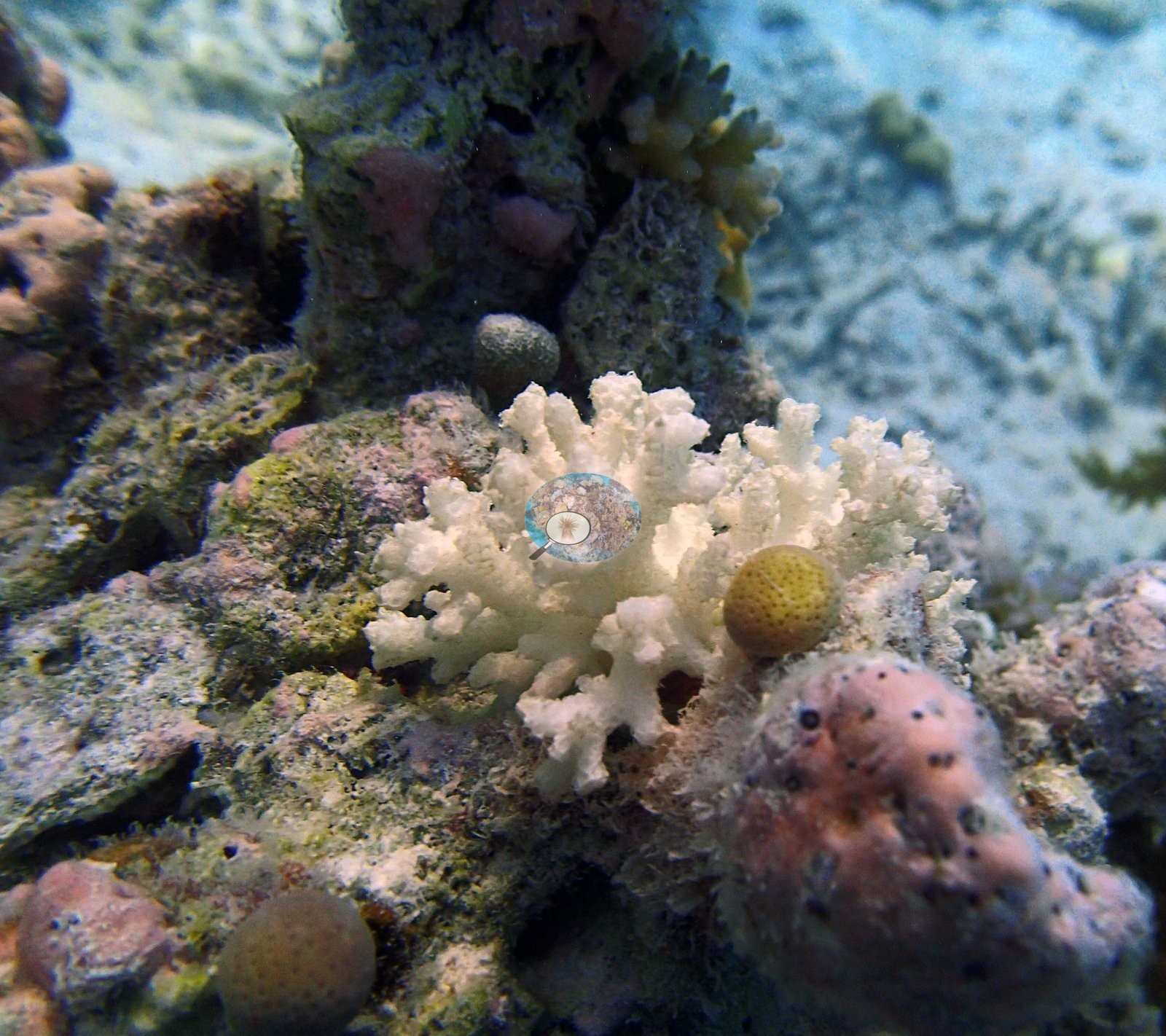
The third frame is dominated by a wholly chalk-white blunt-branched digitate colony, again compatible with a Pocillopora-type, beside a pigmented Porites-type knob, CCA crust, and heavy turf (e.g., Image 3).
One table coral, one bommie, one white colony — that is the whole record.
Coral cover
Coral cover: 47% — from imagery only, with no transect behind it. This is a ".5" site: informal survey images were annotated in CoralNet, but no formal benthic transect was ever run here. The figure describes the frames that were photographed, not a surveyed reef, and it is not comparable with the transect-derived cover quoted at the numbered sites nearby — it must never be pooled or averaged with them.
Stressors
The pale tips are normal axial growth, not bleaching — 0 bleached points of 30. The white colony is the bleaching signal, and its status is unresolved. All six bleached points fall in the second and third frames; the first has none. The 17.1% is the mean of three per-frame ratios — 0.0%, 30.0%, 21.4% — so two colonies in two photographs produce the entire figure. The third frame's colony reads chalky, granular, and filmed in its interstices: recently dead skeleton is at least as good a reading as live bleaching, and Coralscapes scored that frame 4.2% bleached against 6.0% dead, only 3.9% live. Reclassify it and the site falls to 10.0%; drop either frame and it reads 15.0% or 7.1%. The March discrepancy, stated plainly. 17.1% is the 7th-highest of 57 March sites (March mean 7.5%). But the diver who made these surveys records no bleaching in March or April — only May, and the half-month means agree: 6.1 / 8.2 / 8.4 / 10.0% through March–April against 31.8% in early May. The photographs do not corroborate 17.1% — the frame holding most of the coral is entirely unbleached, and the figure rests on two colonies, one possibly dead. Note too that three of the seven highest March figures are the ".5" half-sites — BIEA24.5 (27.8%), BIDI16.5 (19.7%), BITB34.5. They are not more bleached; they are more thinly sampled. No crown-of-thorns starfish (COTS) or other corallivores evident.
Comparisons with other data
The neighboring full site BITB34 — same island, same day, dived at 13:49 — supplies the context this one cannot: 61.1% transect cover, 31 genera, H′ = 2.206, Simpson 0.797, J′ = 0.642 (Acropora 40.6% of live coral).
Other notes
No transect exists. BITB34.5 is absent from all three benthic sheets — `benthic data by site (n=109)`, `by transect (1556)`, and `by site-depth (336)` — so there are no per-genus columns, no algal cover, no `PB`, no `PITS`, and no basis for genus richness, Shannon H′, Simpson, or Pielou's J′. Read BITB34.5 as a small unsurveyed patch inside that assemblage, never as an independent measurement of it.
CV model comparison
More info
Every other row is a method run on this site's own photographs (mean ± SD across photos), listed for comparison only; nothing is averaged with the headline. As of September 2026 no computer-vision method estimates coral cover accurately on new images, so treat these as indicative.| Method | Hard-coral cover (%) |
|---|---|
| CoralNet | 47.2 |
| In-house DINOv3 | 53.3 |
| CoralSCOP edited | 33.4 |
| Claude | 21.9 |
Independent surveys nearby
| Agency / program | Year(s) | Stations / distance | Link |
|---|---|---|---|
| Sheppard et al. (2008) | 2006 | 1 station, 4.36 km | Records ↓ |
| Spalding et al. 2025 (Chagos 2024 bleaching report) | 2024 | 1 station, 3.31 km | Records ↓ |
| XL Catlin Seaview Survey | 2015 | 1 station, 2.98 km | Records ↓ |
 Dr. Coral (CRD)Year-average (no detectable trend)
Within 5 km, 3 independent survey stations recorded hard coral cover in 7 records between 2006 and 2024. One survey since 2021 recorded 50%. This site's own estimate (47%) is indistinguishable from the recent value (50%): the 2.8-point gap is inside the ±7 percentage-point noise between methods; the methods differ, so the comparison is context, not a like-for-like test.
Collected by other programs using different methods (the XL Catlin Seaview Survey uses photo-transects with automated image annotation), so these are context for the figures above, not a like-for-like comparison. Where a station was surveyed more than once the range is shown. Station names are not dive-site names.
| Agency | Site / location | Date | Hard coral cover (%) | Distance | Link |
|---|---|---|---|---|---|
| Sheppard et al. (2008) | Great Chagos Bank | 2006 | 41% (5 surveys) | 4.36 km | HeatCRD database |
| XL Catlin Seaview Survey | transect 36004 | 2015 | 21% | 2.98 km | — |
| Spalding et al. 2025 (Chagos 2024 bleaching report) | Great Chagos Bank - Middle Brother, lagoon (E aspect, 1-3 m) | 2024 | 50% | 3.31 km | — |
Data & links
- Download all LOF-GRE data (933 sites) ↗
- CoralNet image repository for this region ↗
- HeatCRD database ↗
- (reference) ↗
- Photo portfolio ↗
- Coral Reef Diagnostics page for this area ↗
All images from Coral Reef Diagnostics. Data are from Coral Reef Diagnostics and the organizations named in the data-sources table above.
© Coral Reef Diagnostics.
References
- Mayfield AB, Dempsey AC (2026). Using tourist diver images to estimate coral cover and bleaching prevalence in a remote Indian Ocean coral reef system. Oceans 7(1):1. PDF
- Sheppard C, Harris A, Sheppard A (2008). Archipelago-wide coral recovery patterns since 1998 in the Chagos Archipelago, central Indian Ocean. Marine Ecology Progress Series 362:109-117. PDF
- Spalding M, Bourasseau M, et al. (2025). Coral bleaching and mortality in the Chagos Archipelago, 2024. British Indian Ocean Territory Administration report (gray literature). PDF