
Part of the regional summaries: Chagos Archipelago - Peros Banhos and Chagos Archipelago
2015-05-01
More info
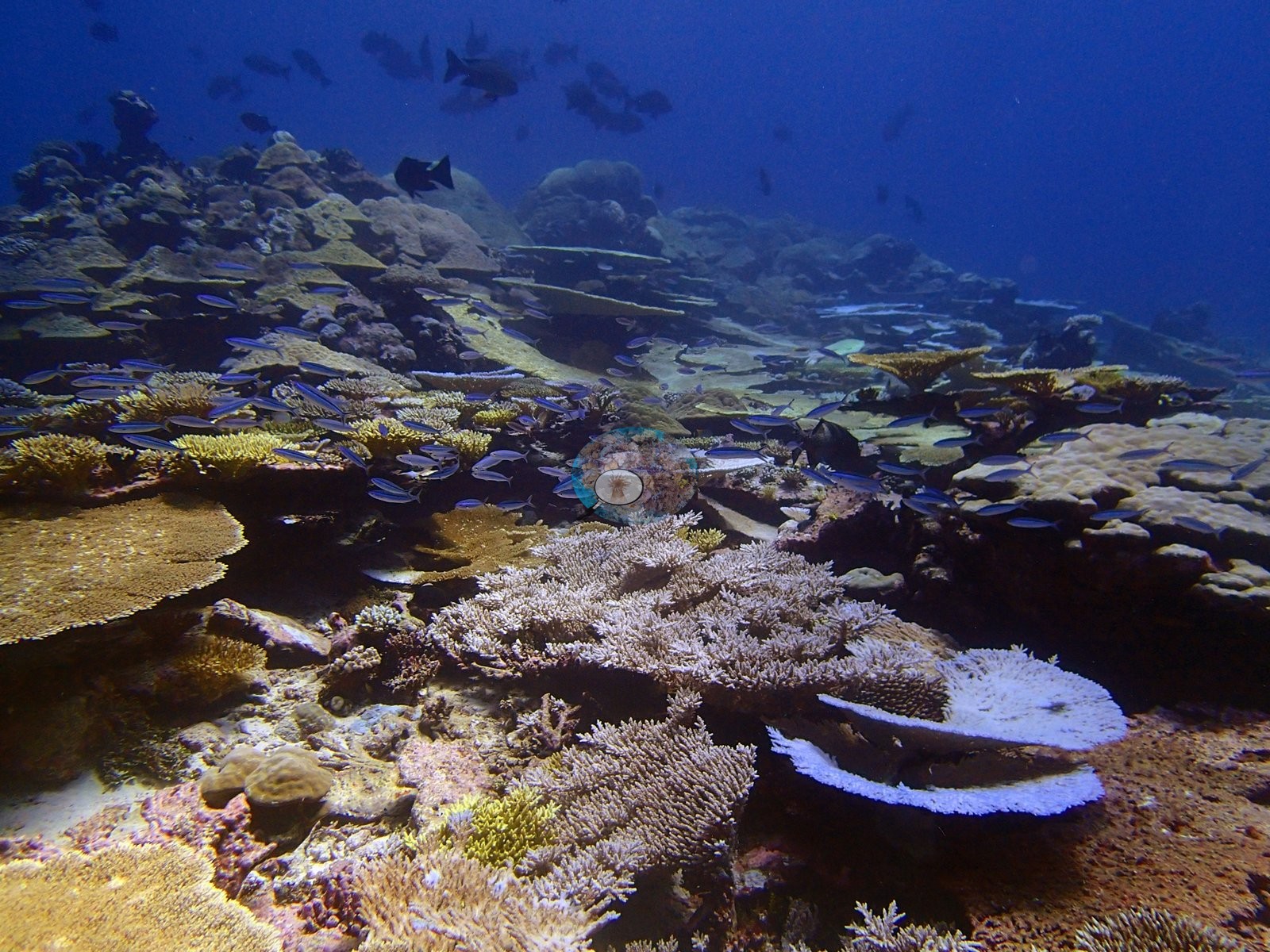
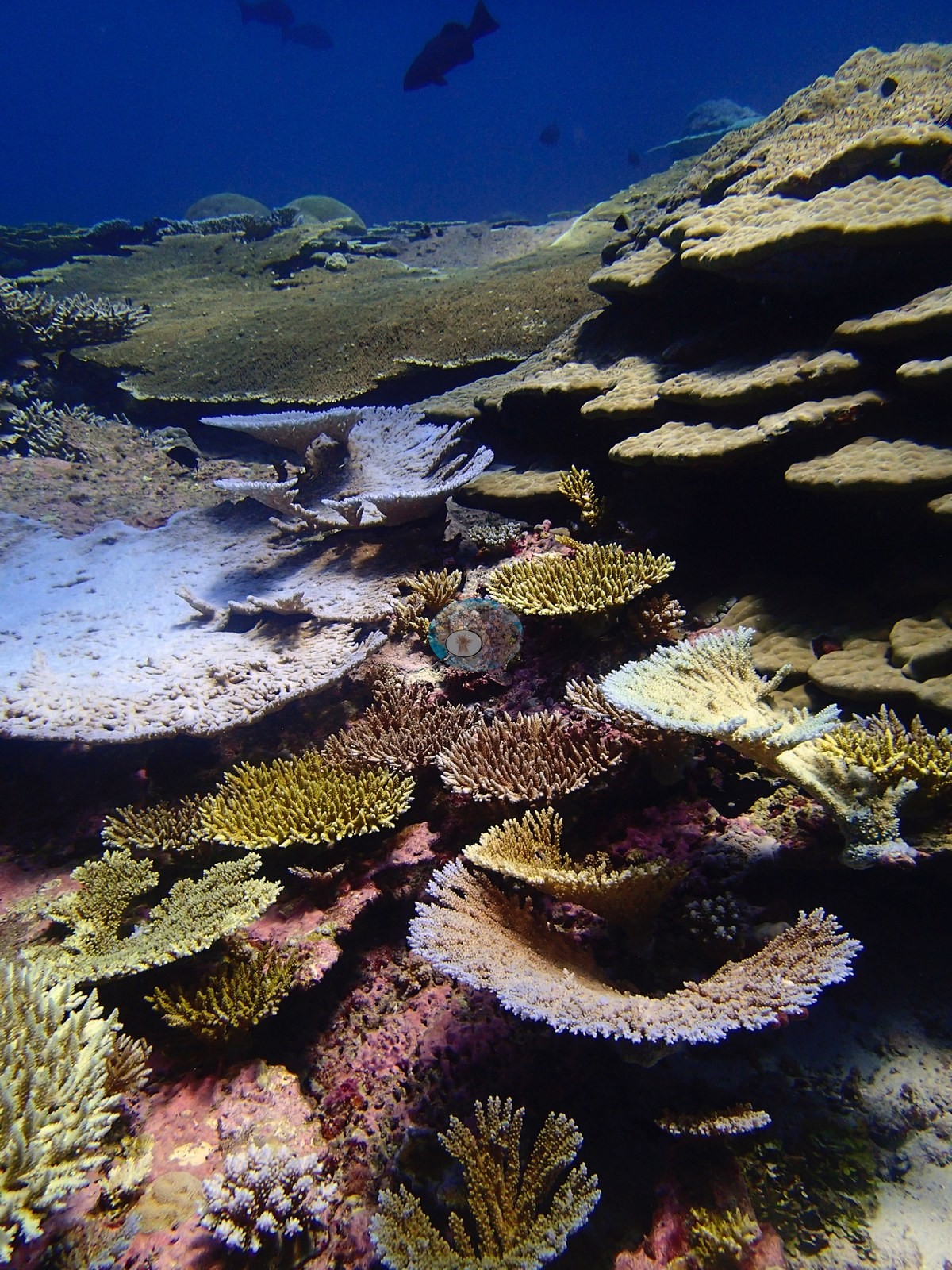
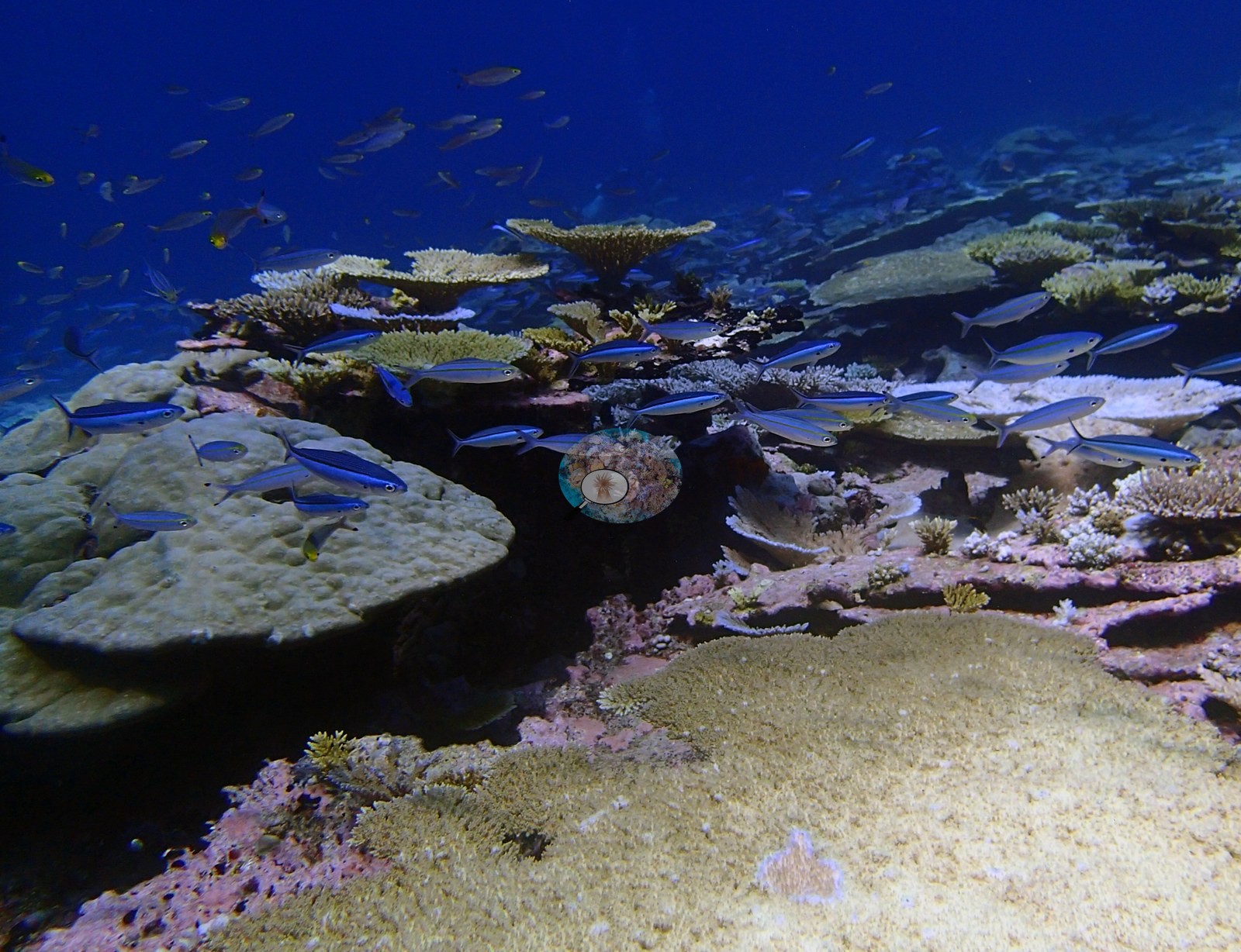
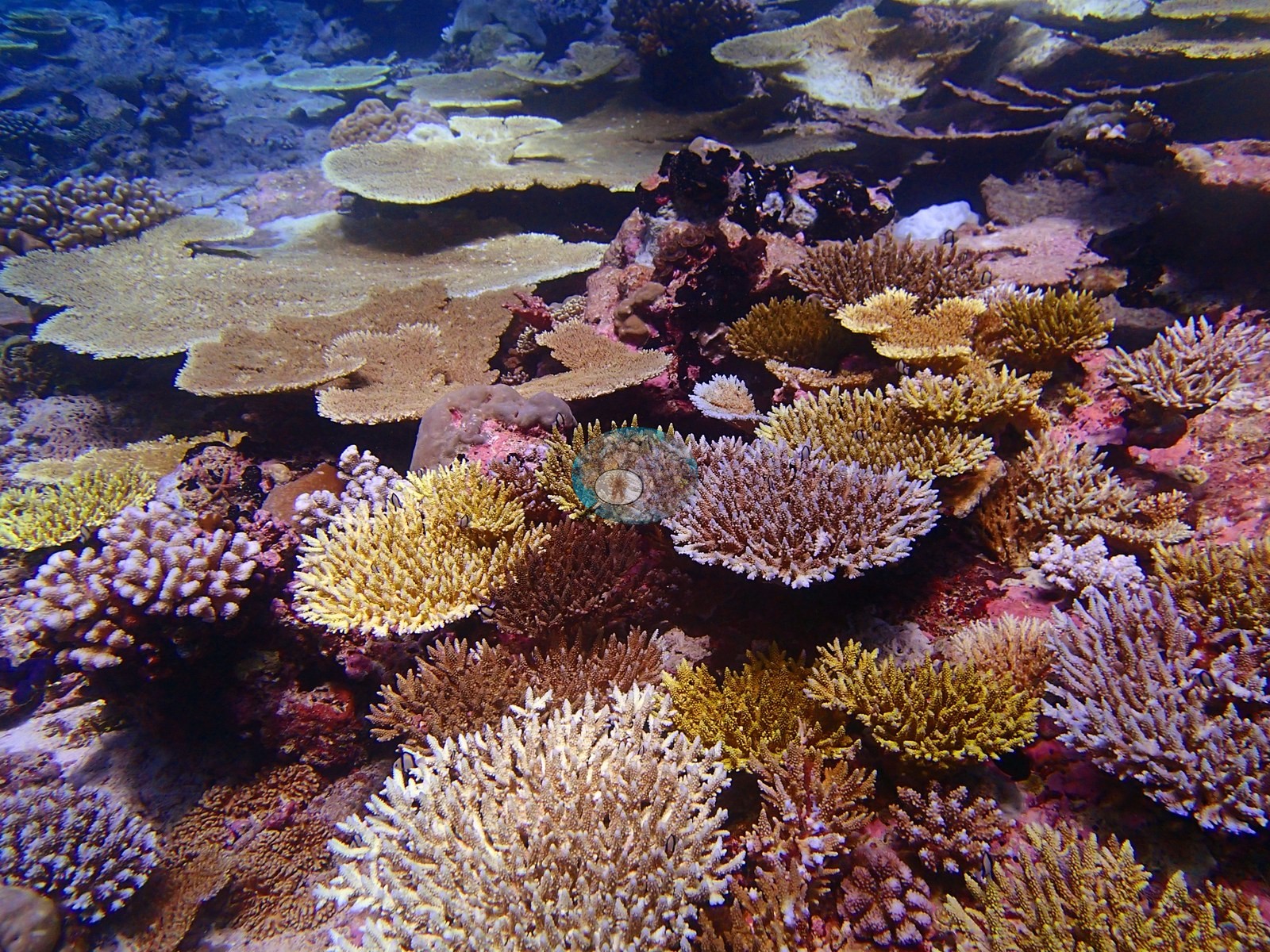
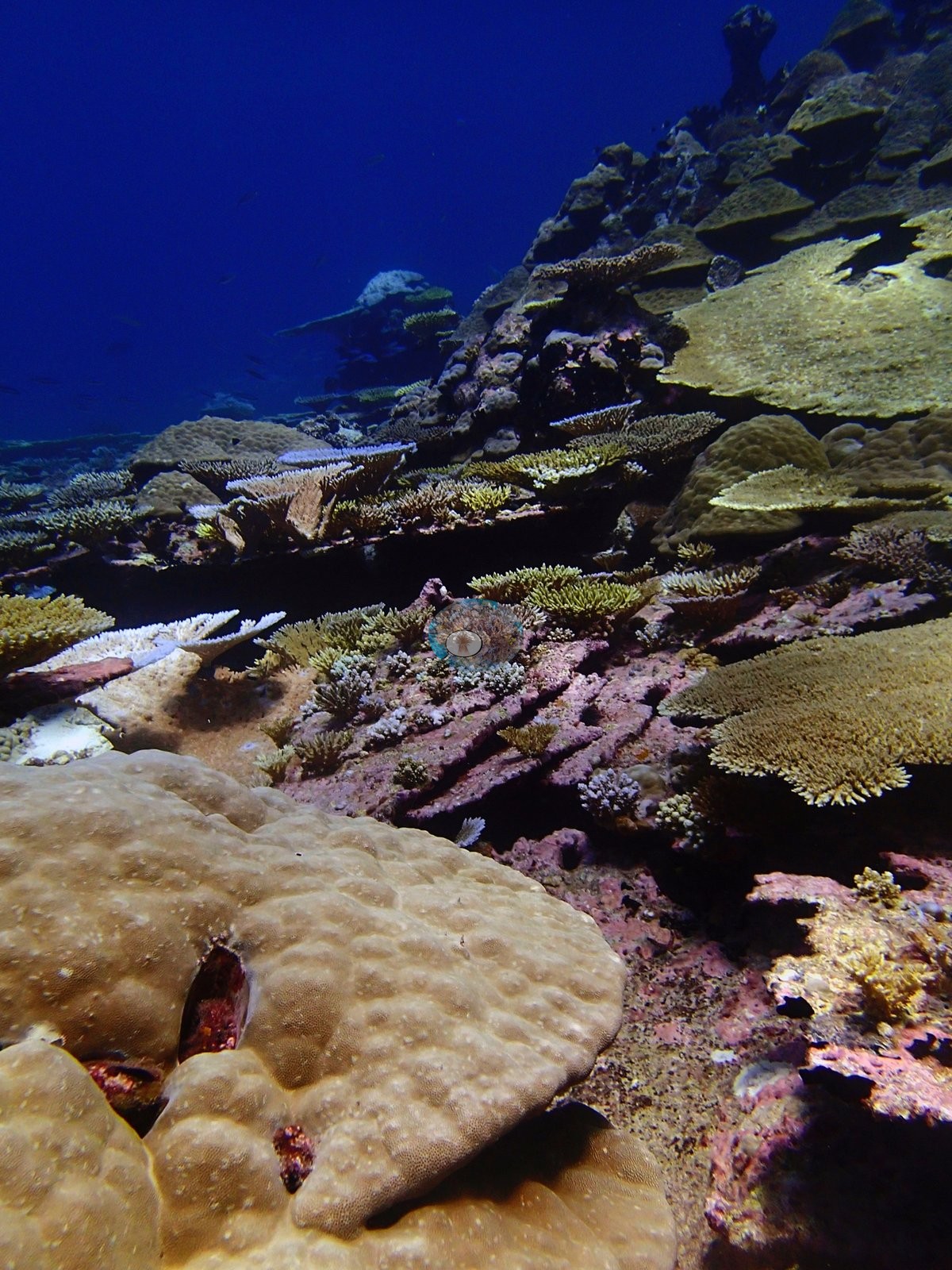
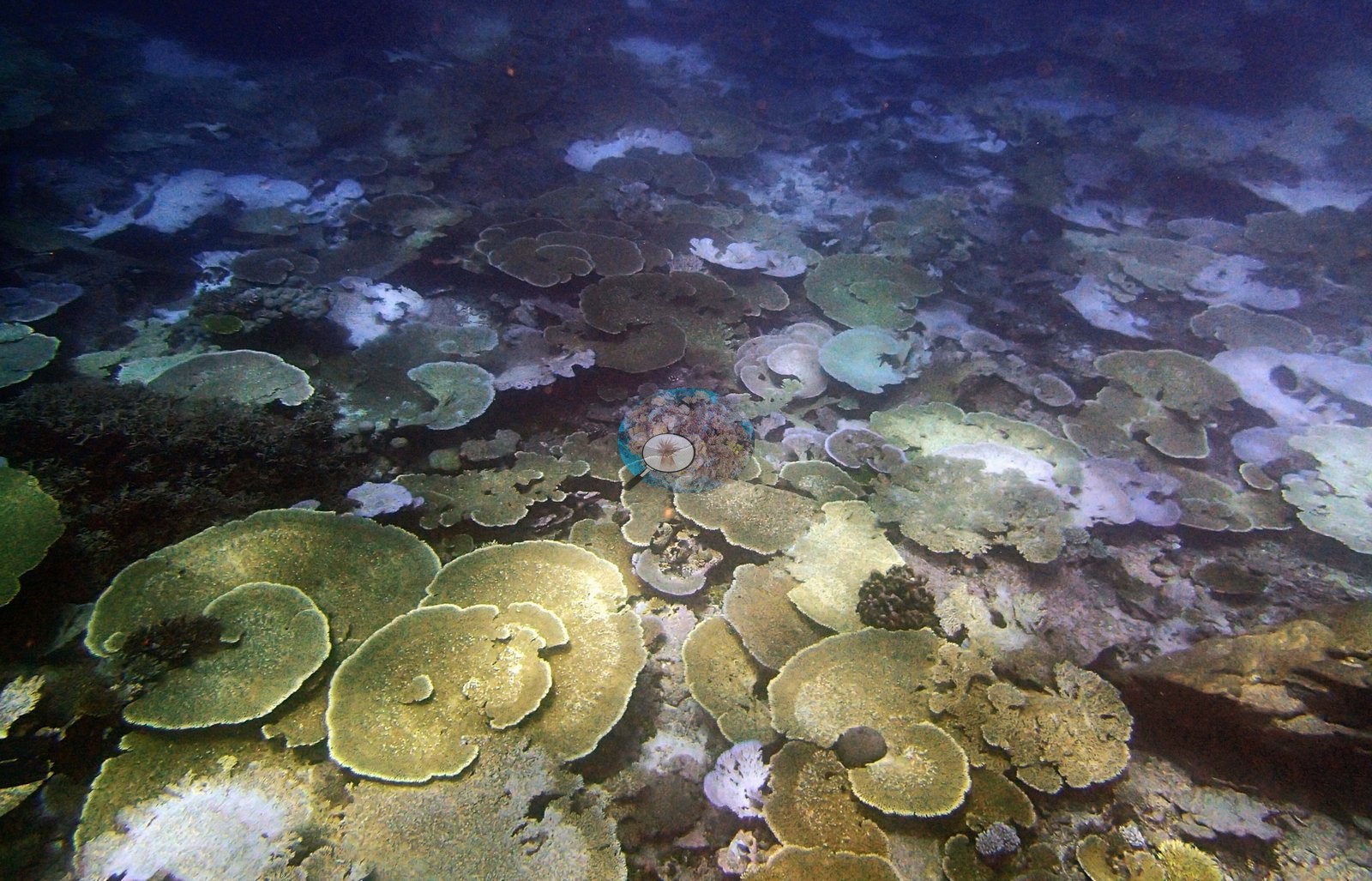
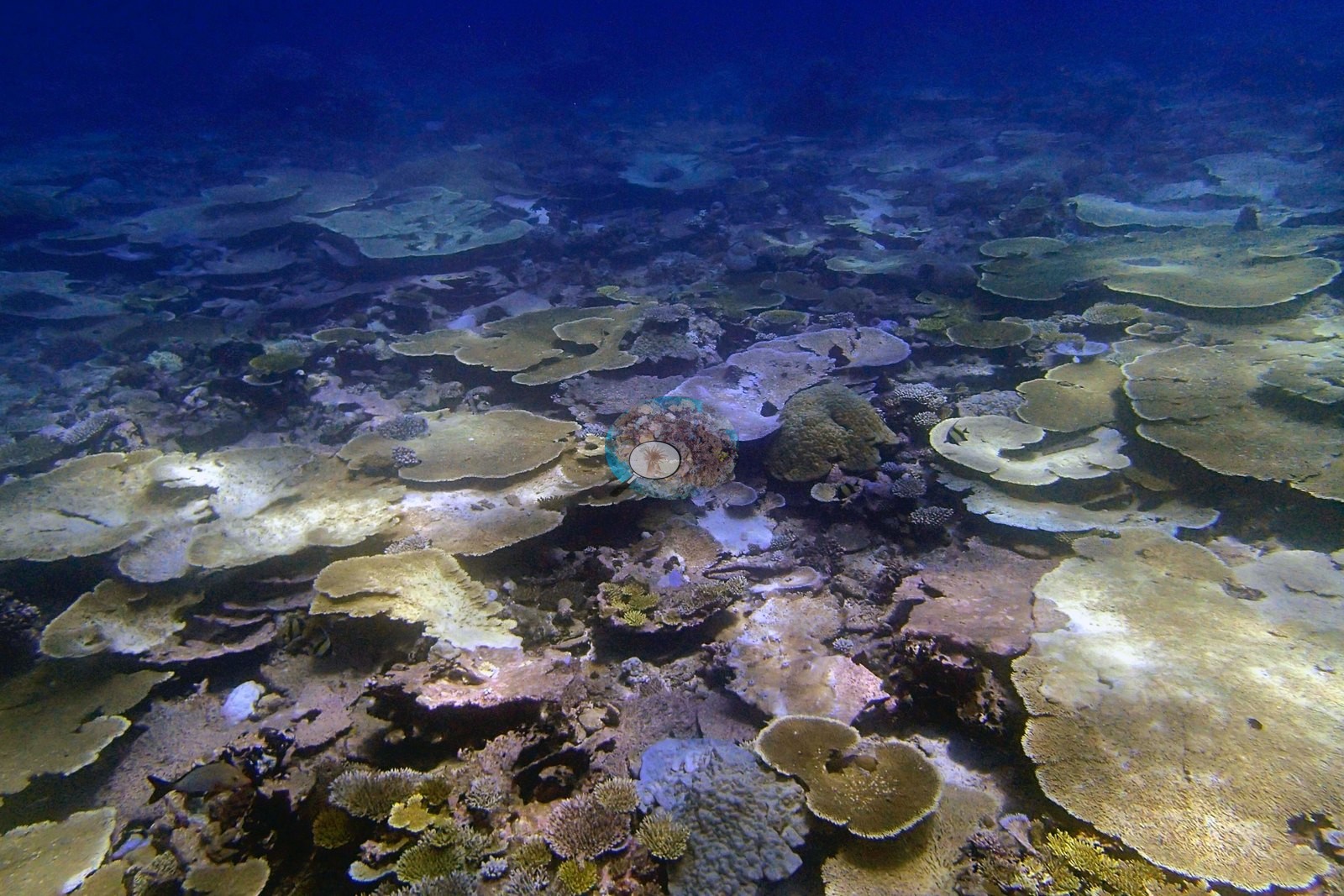
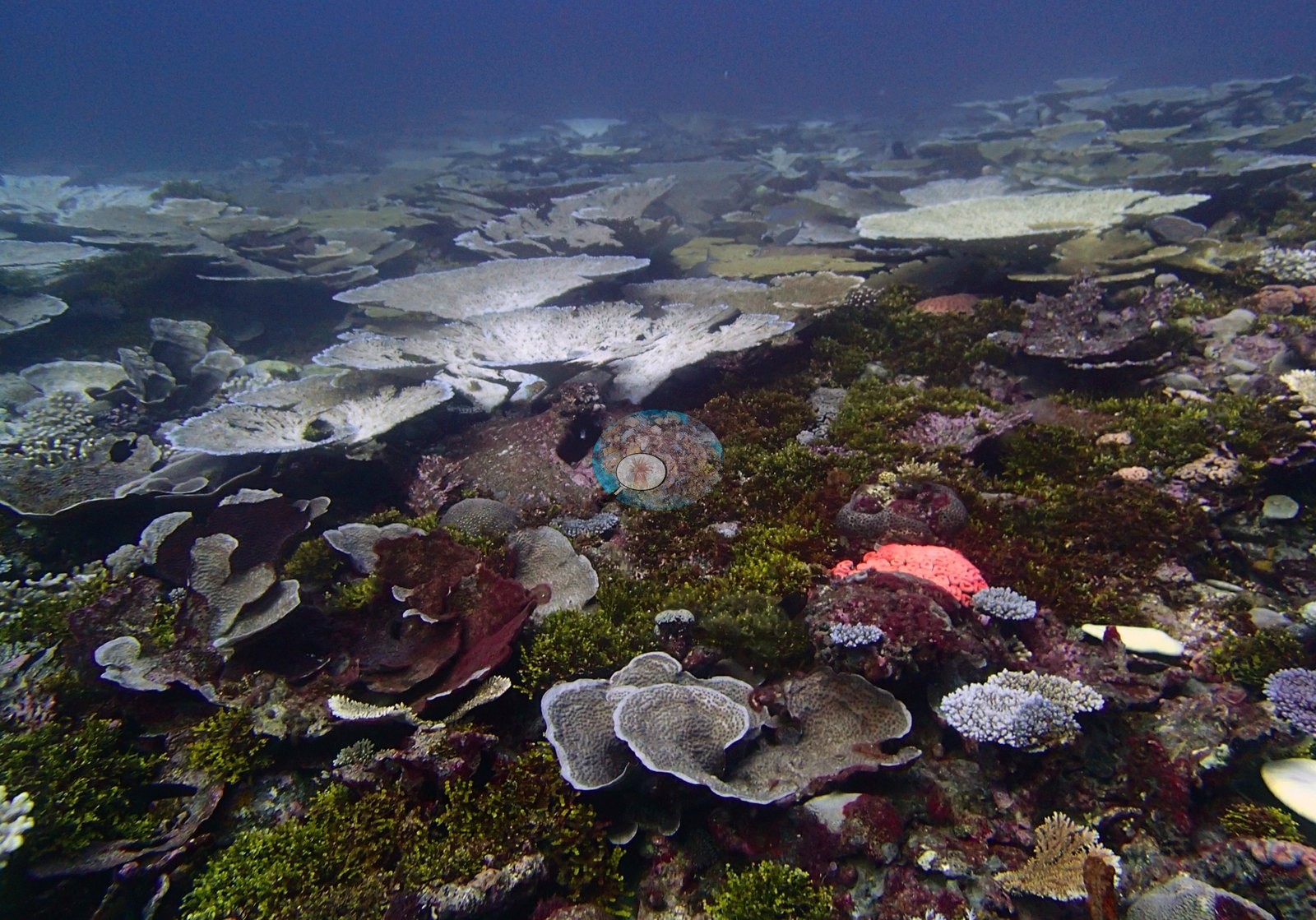
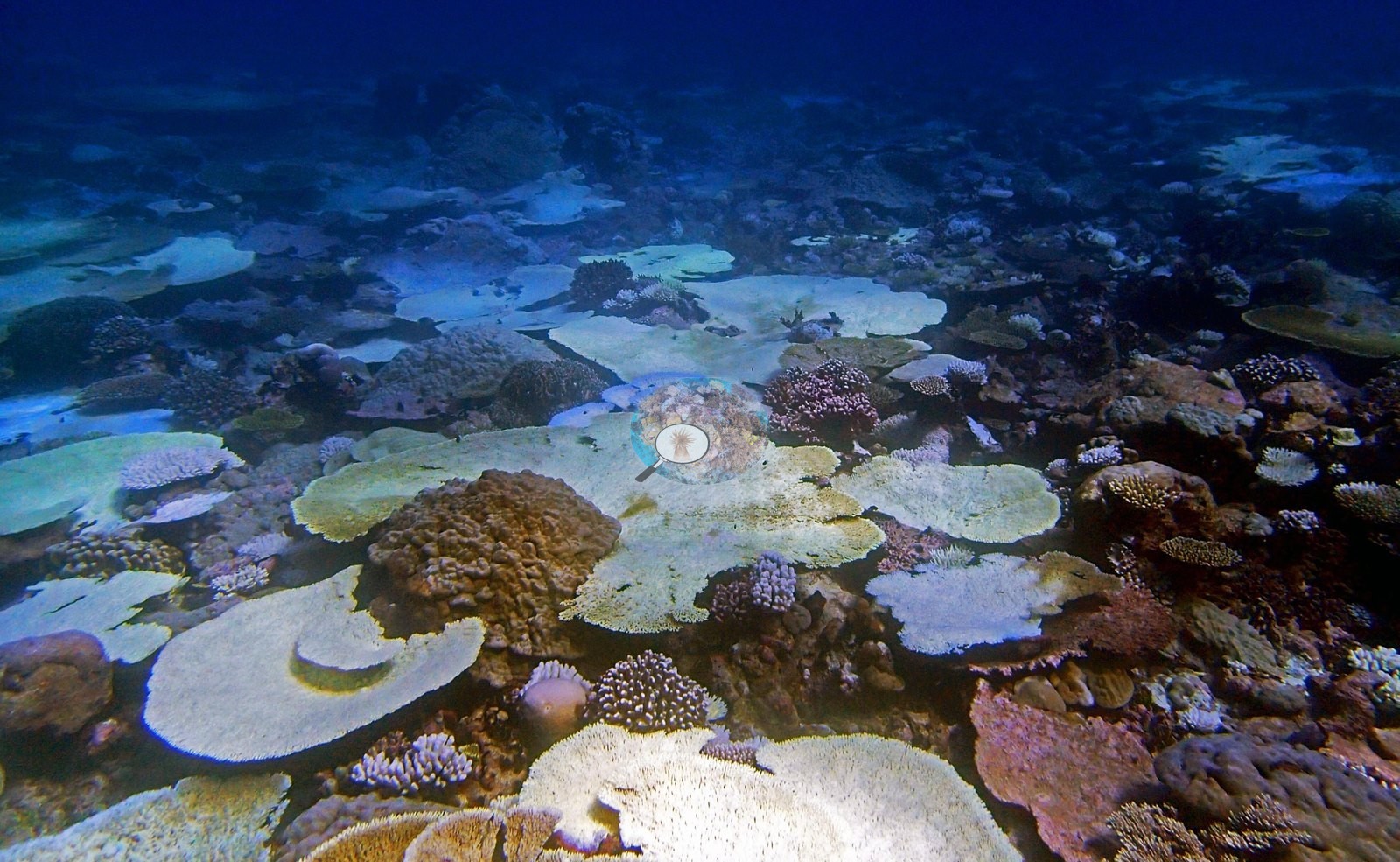
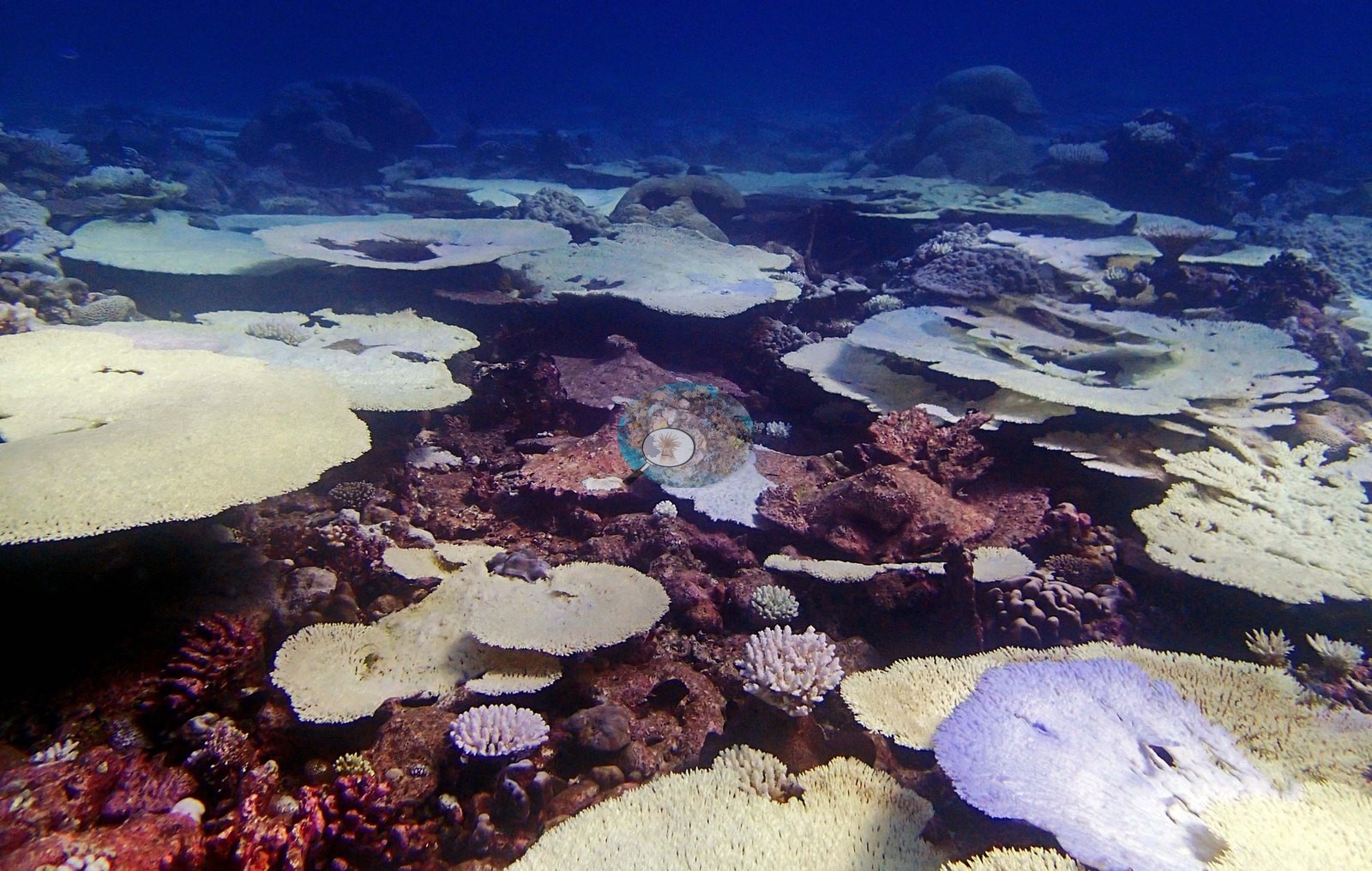
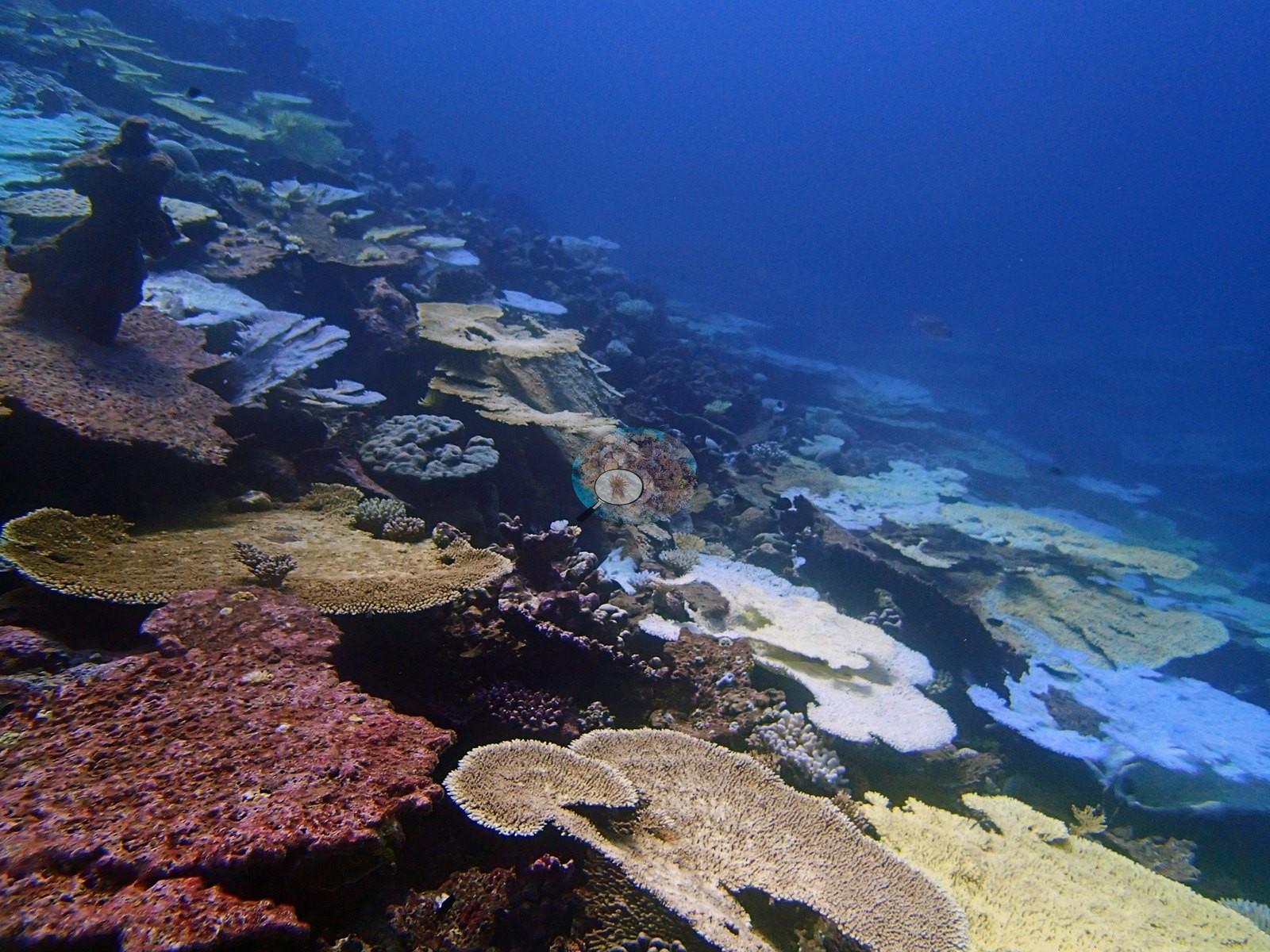
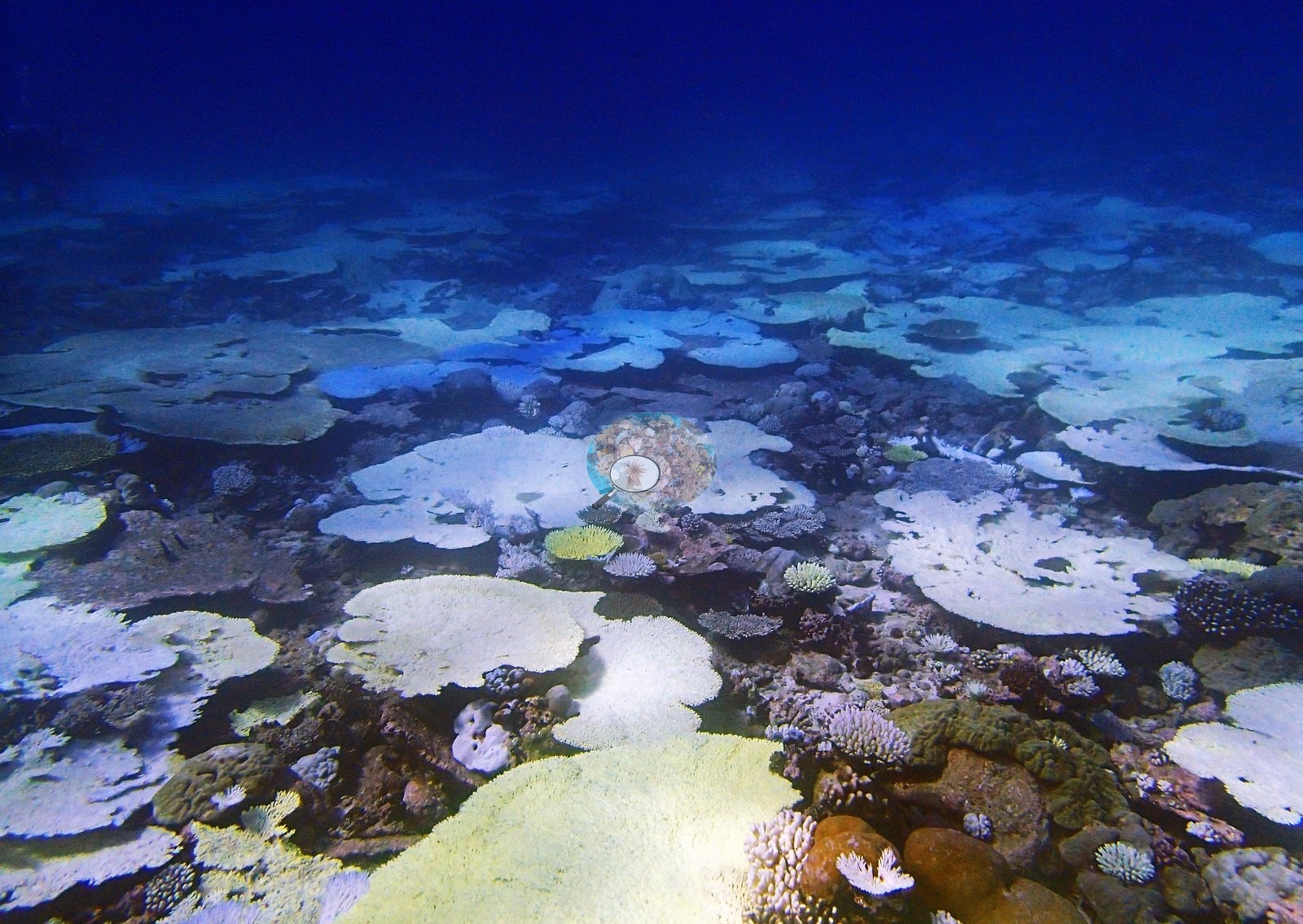
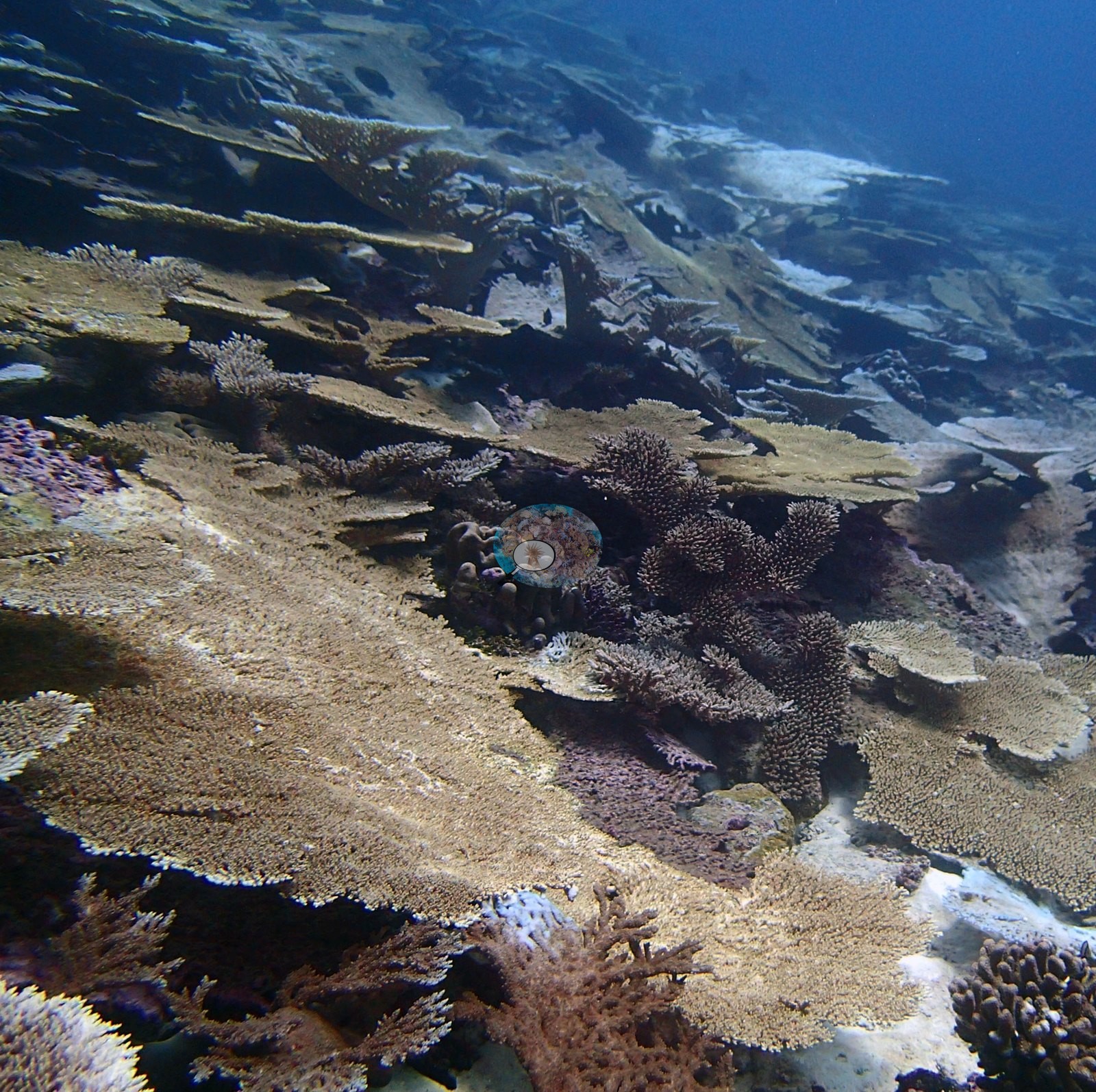
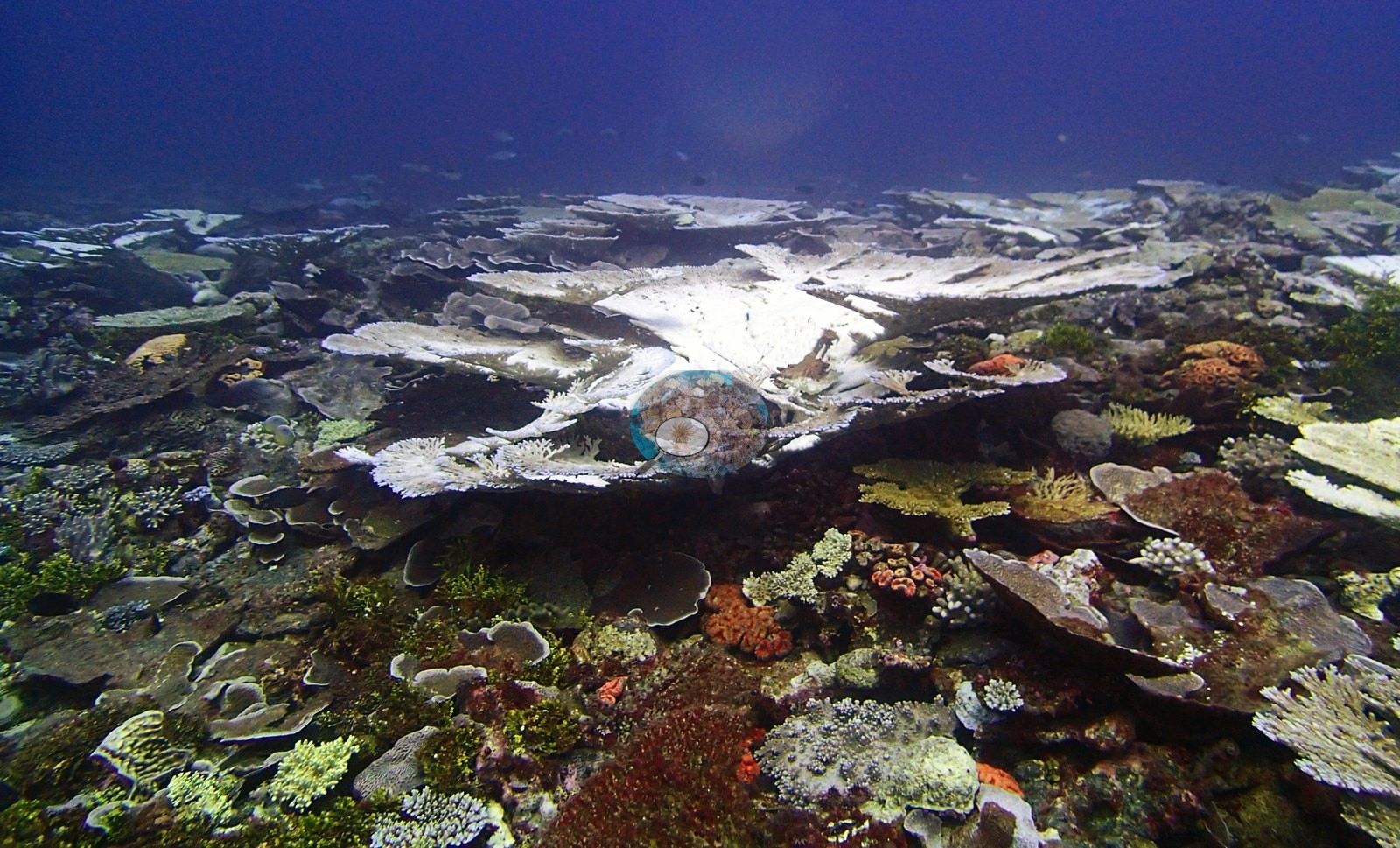
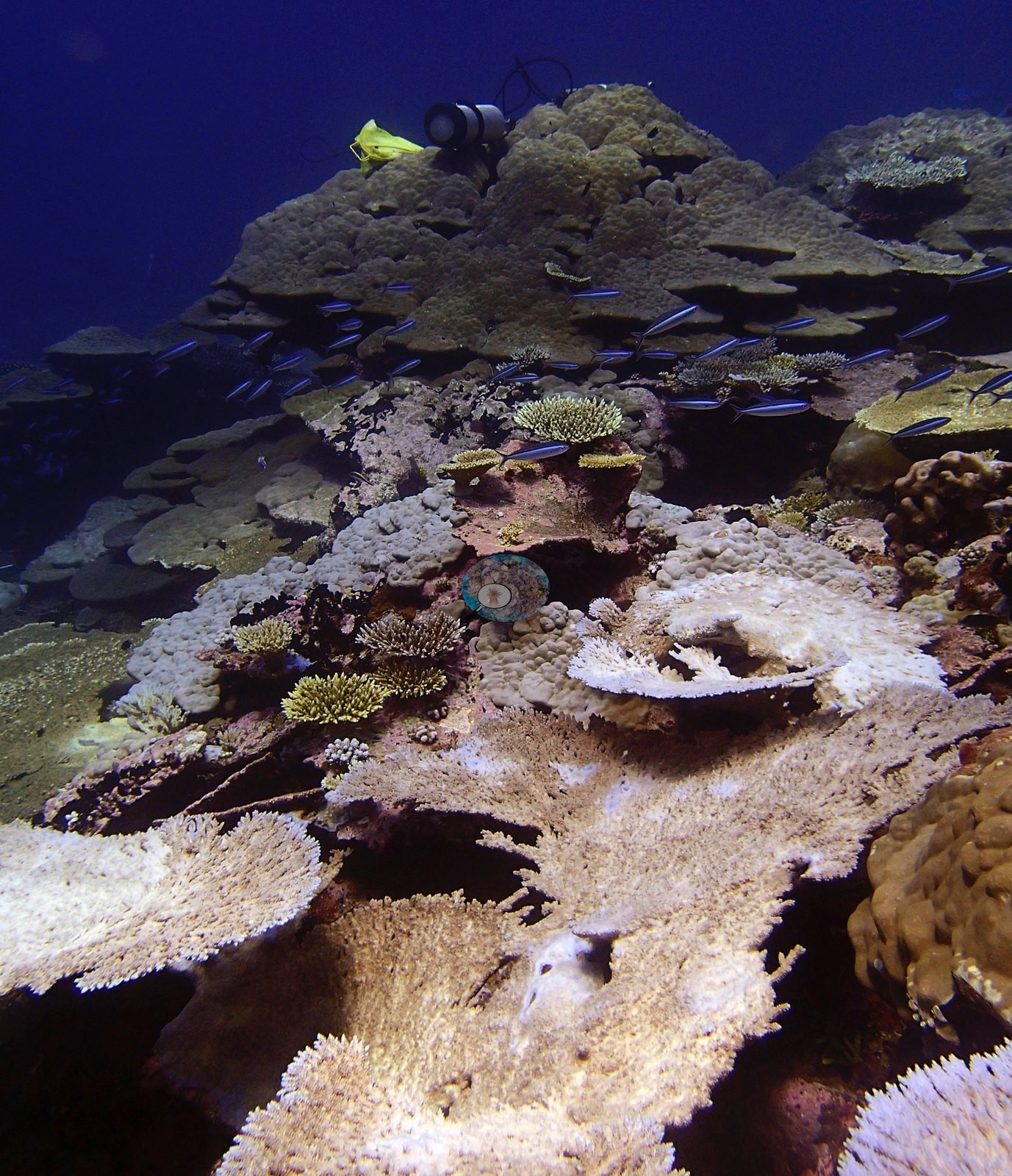
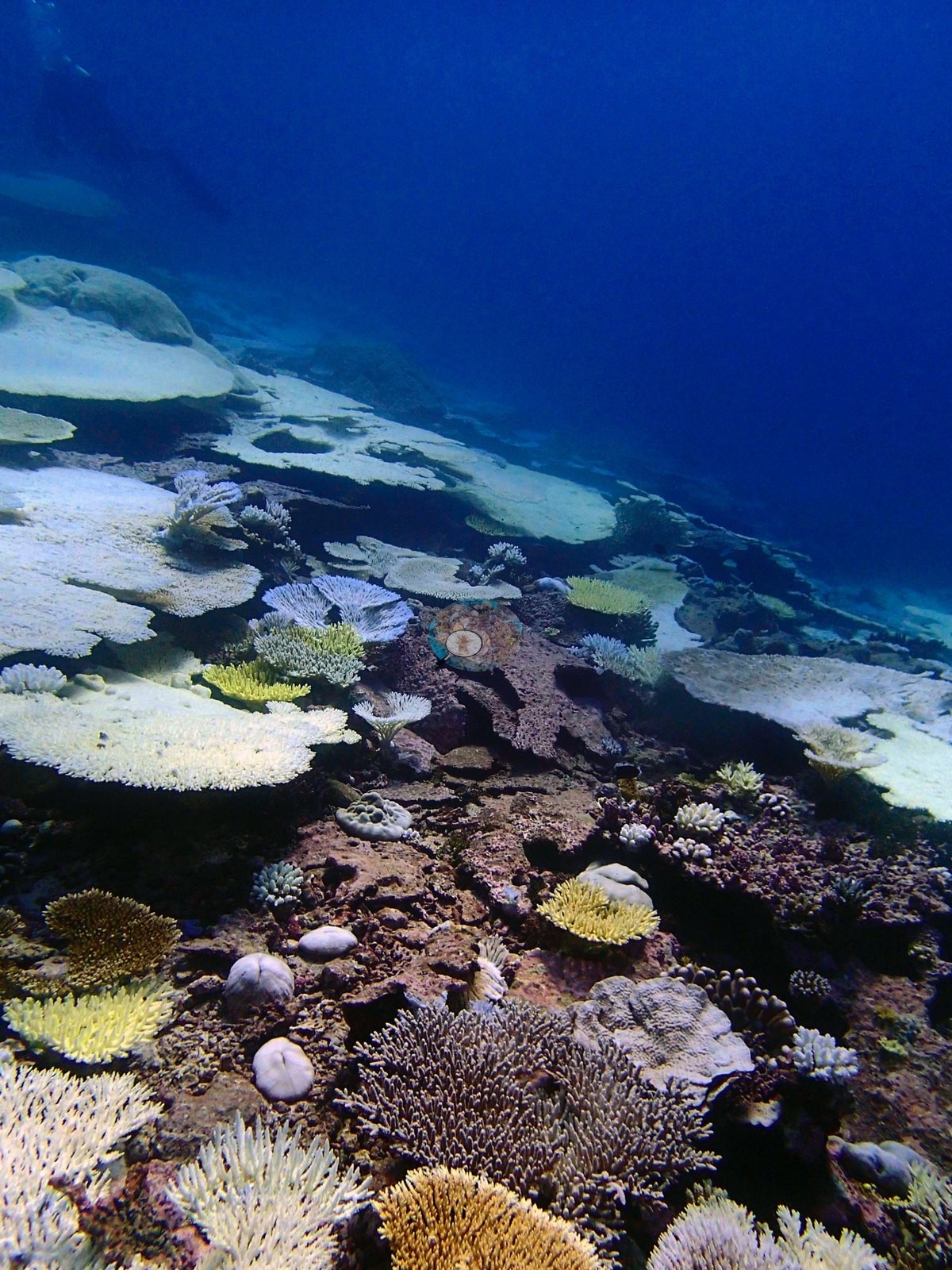
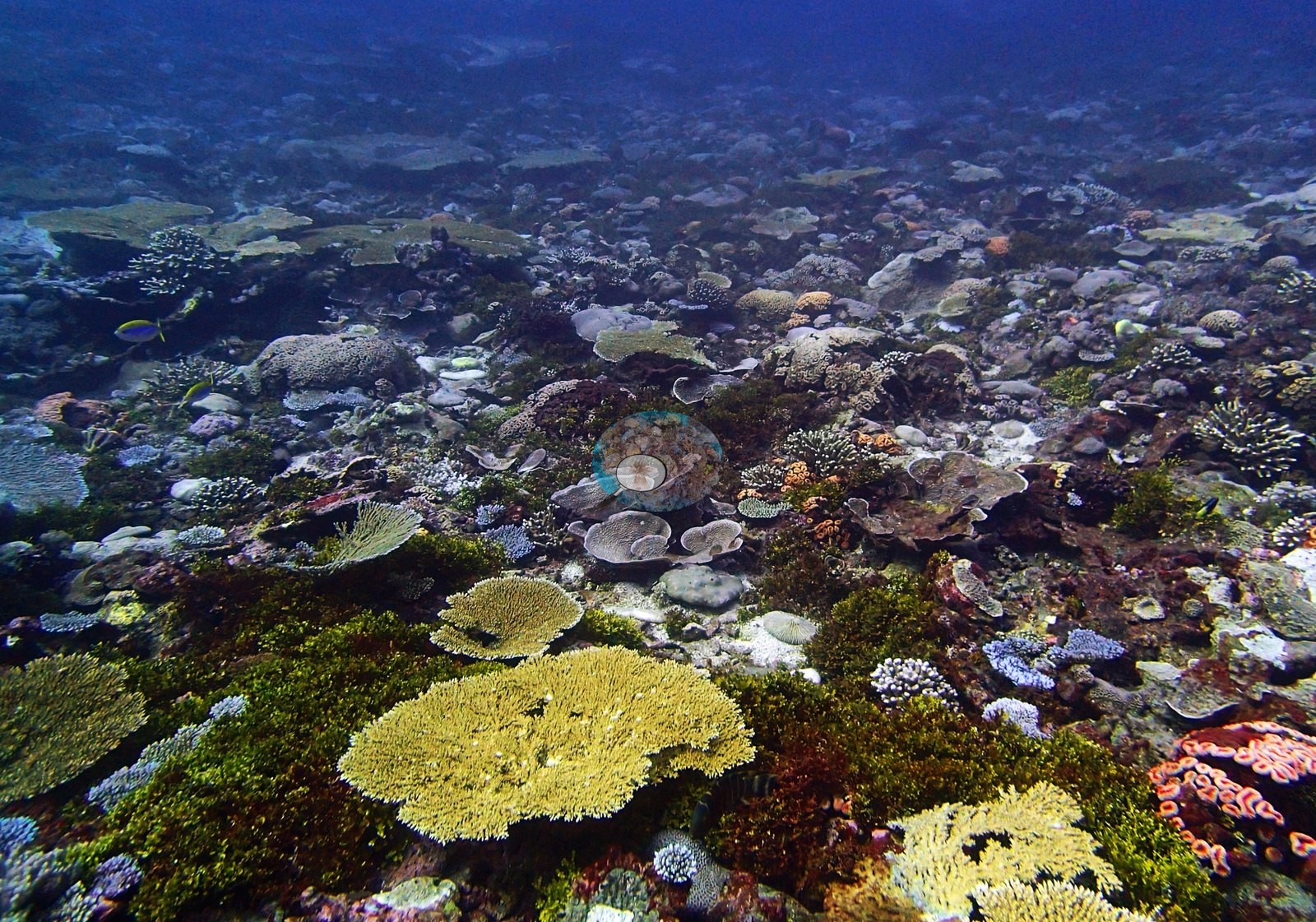
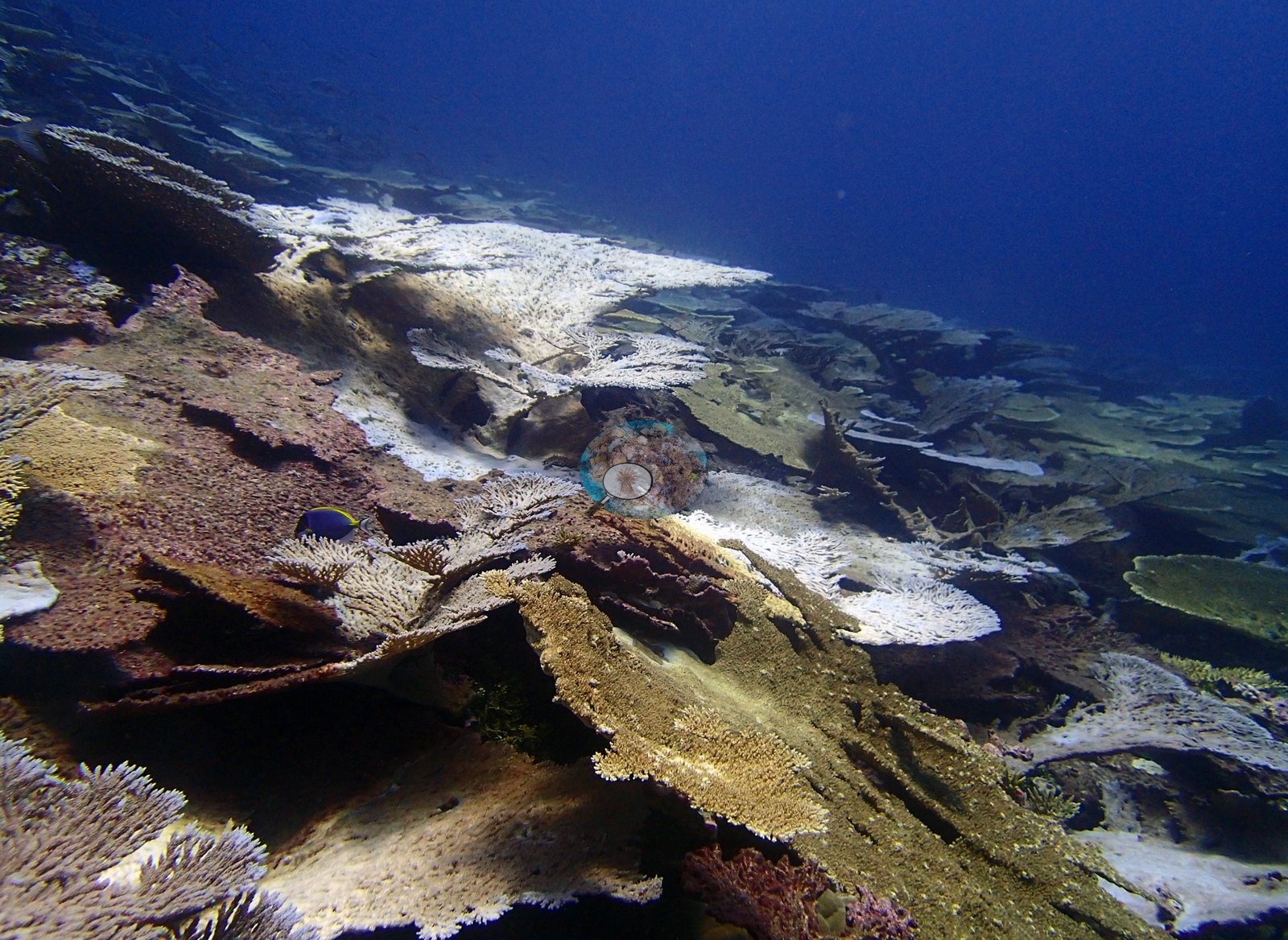
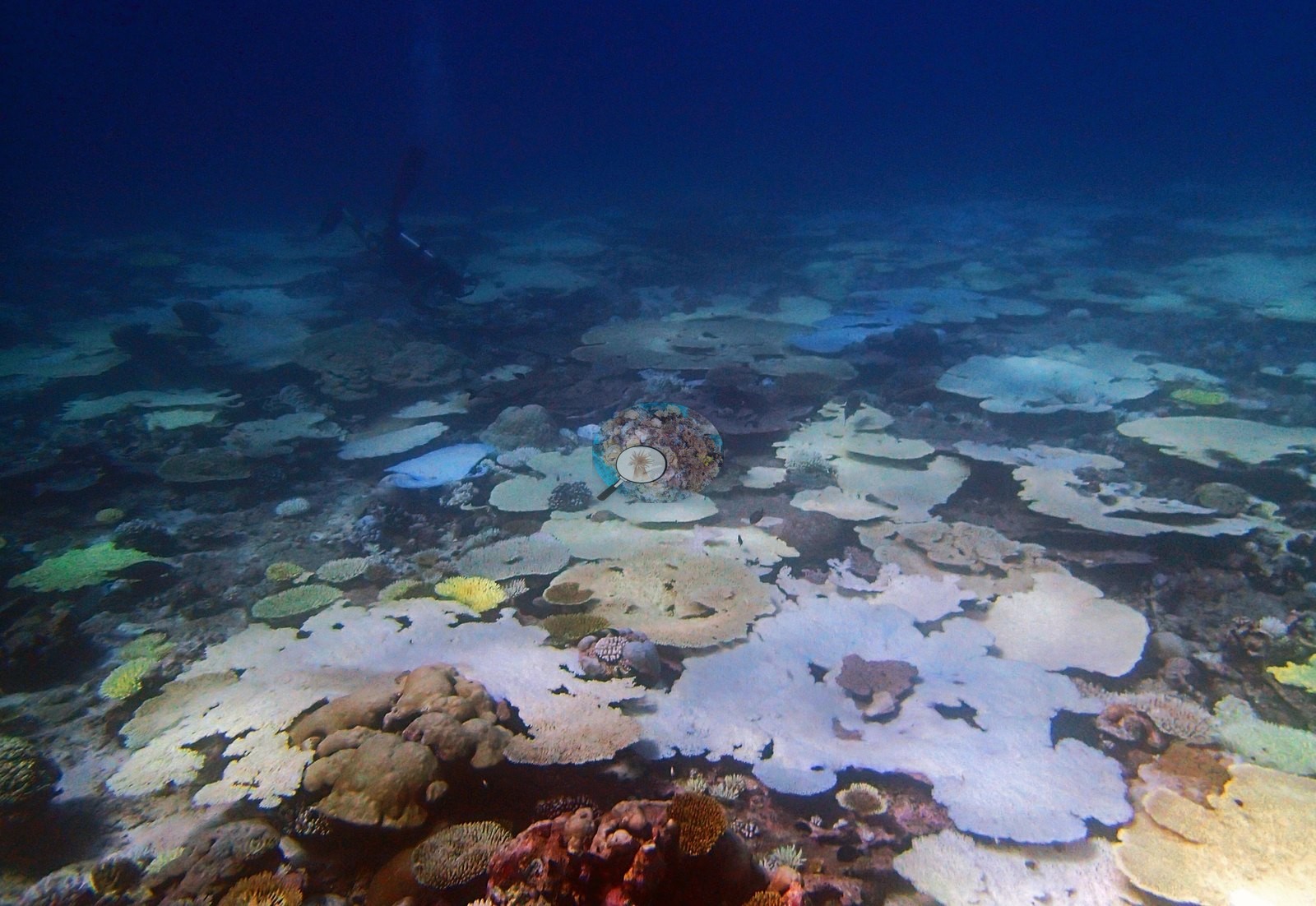
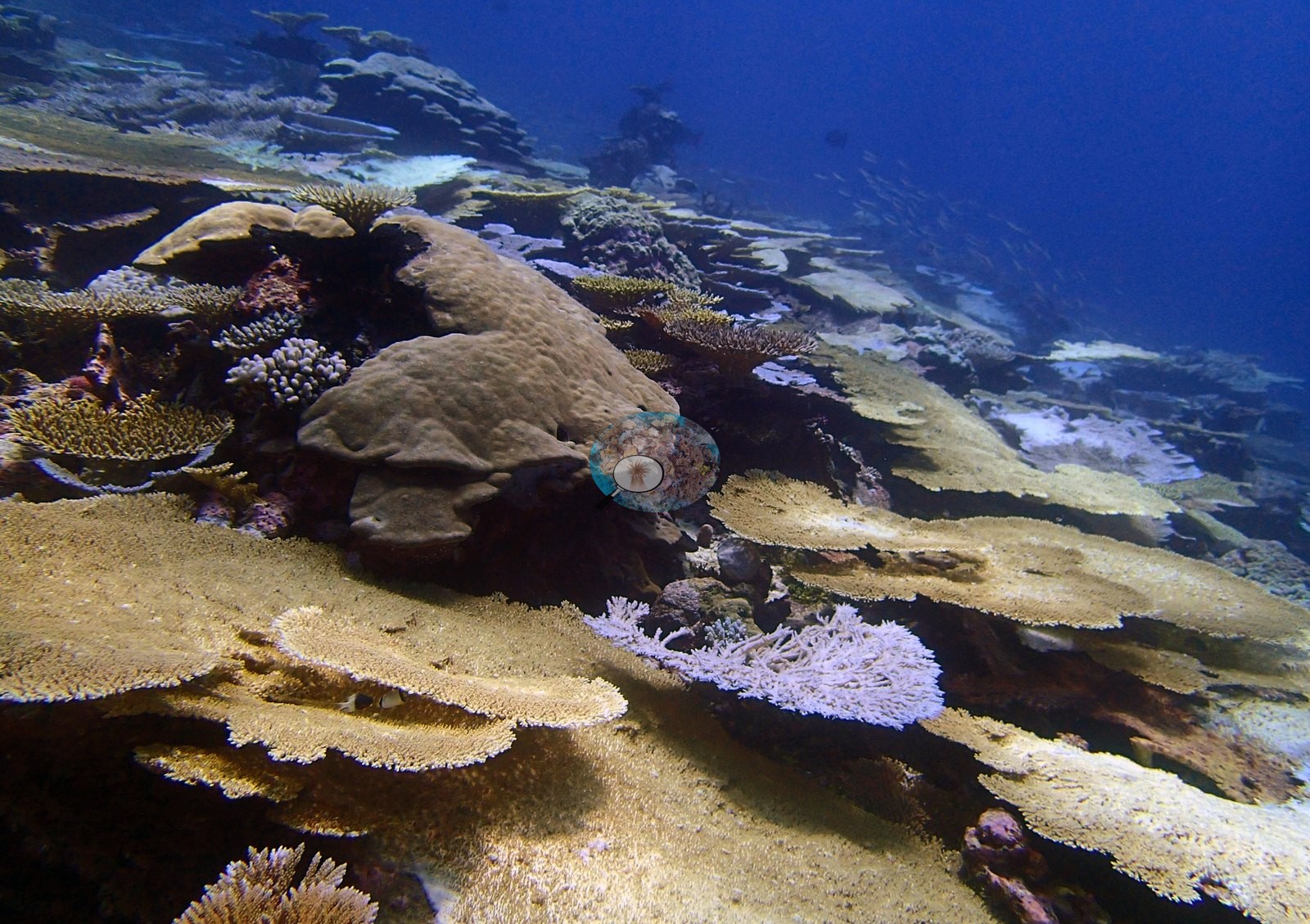
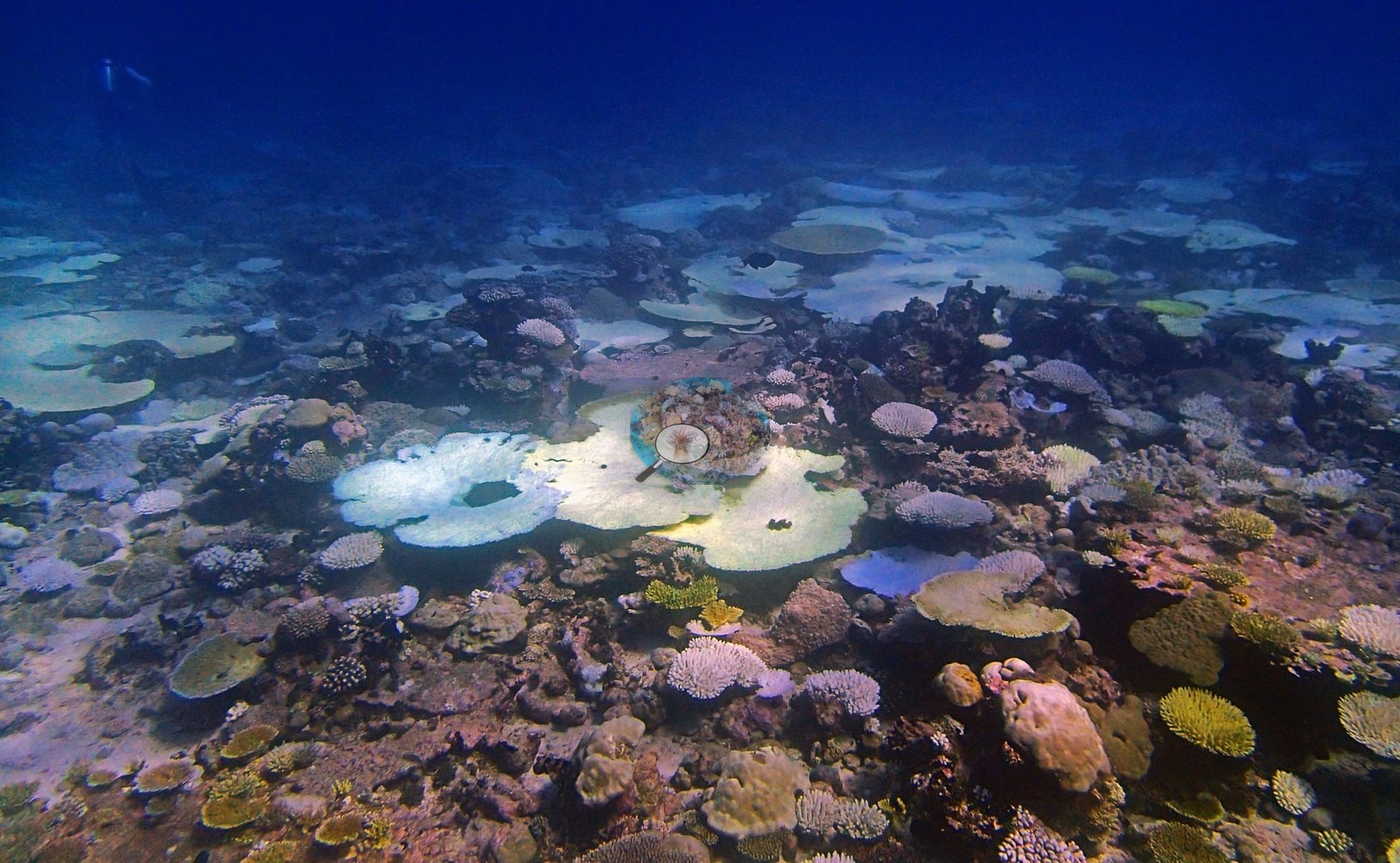
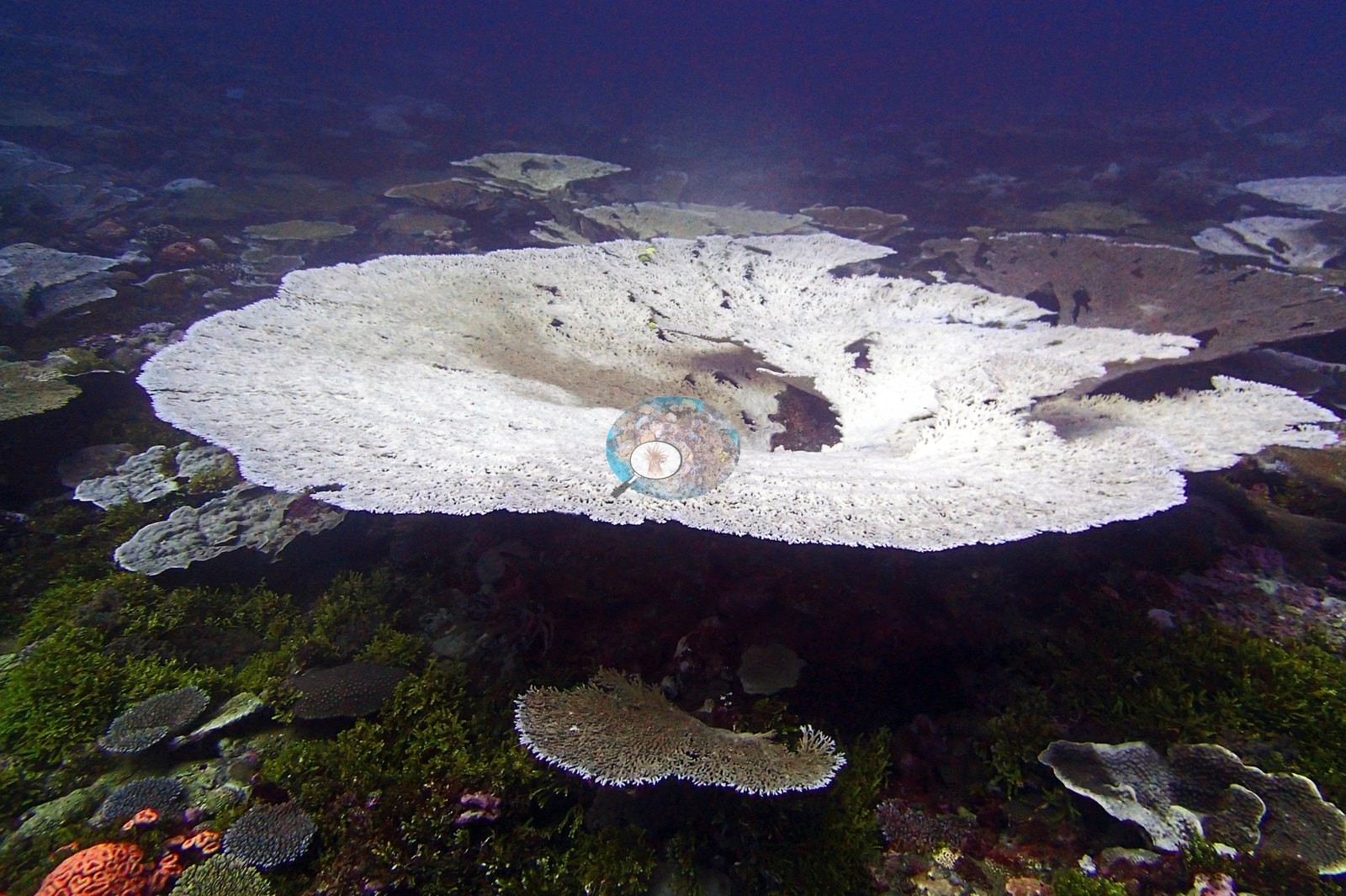
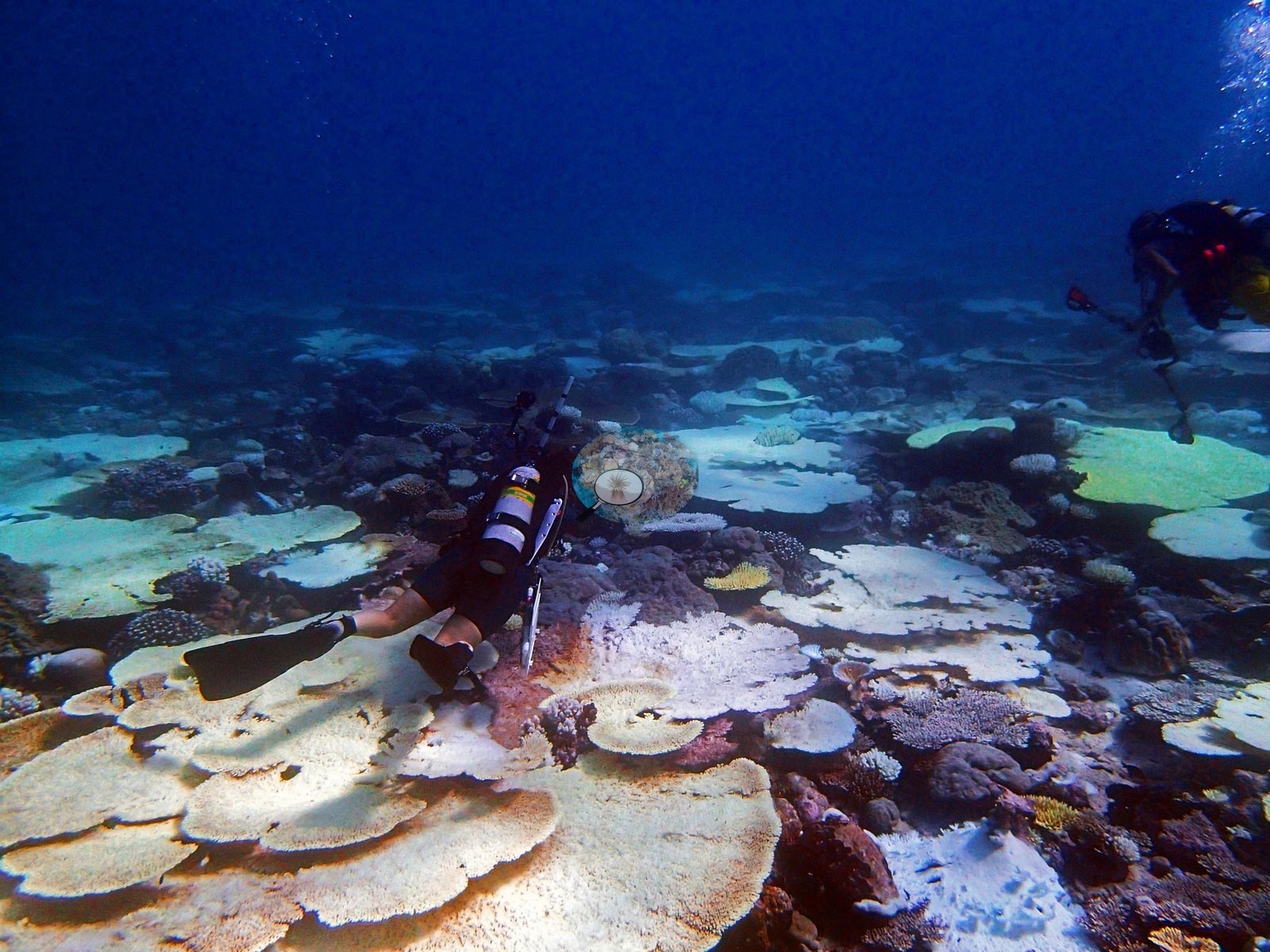
Chagos (NOAA CRW virtual station)A sheltered lagoon patch reef at 22 m with 60% coral cover, dominated by dense Acropora tables and plates. Bleaching jumped from 3.7% on 17 April to 33.3% two weeks later, when the photos show landscape-scale fields of stark-white tables beside still-pigmented patches. Surveyed on the Living Oceans Foundation's Global Reef Expedition.
🗺 Detailed map of the Global Reef Expedition dive sites, Peros Banhos, Chagos (Khaled bin Sultan Living Oceans Foundation; opens in a new window)
Site description
Setting
Setting: a protected, submerged lagoonal patch reef in Peros Banhos, surveyed at 22.3 m, 5.32515°S, 71.85739°E; temperature and salinity are not reported for this site. 1 May. The revisit frames show the reef in a visibly different state, and Anderson's own folder name says so. Also on record for this site: BIPB70 is a protected, submerged lagoonal patch reef in Peros Banhos, surveyed at 22.3 m on 17 April 2015.
General benthic features
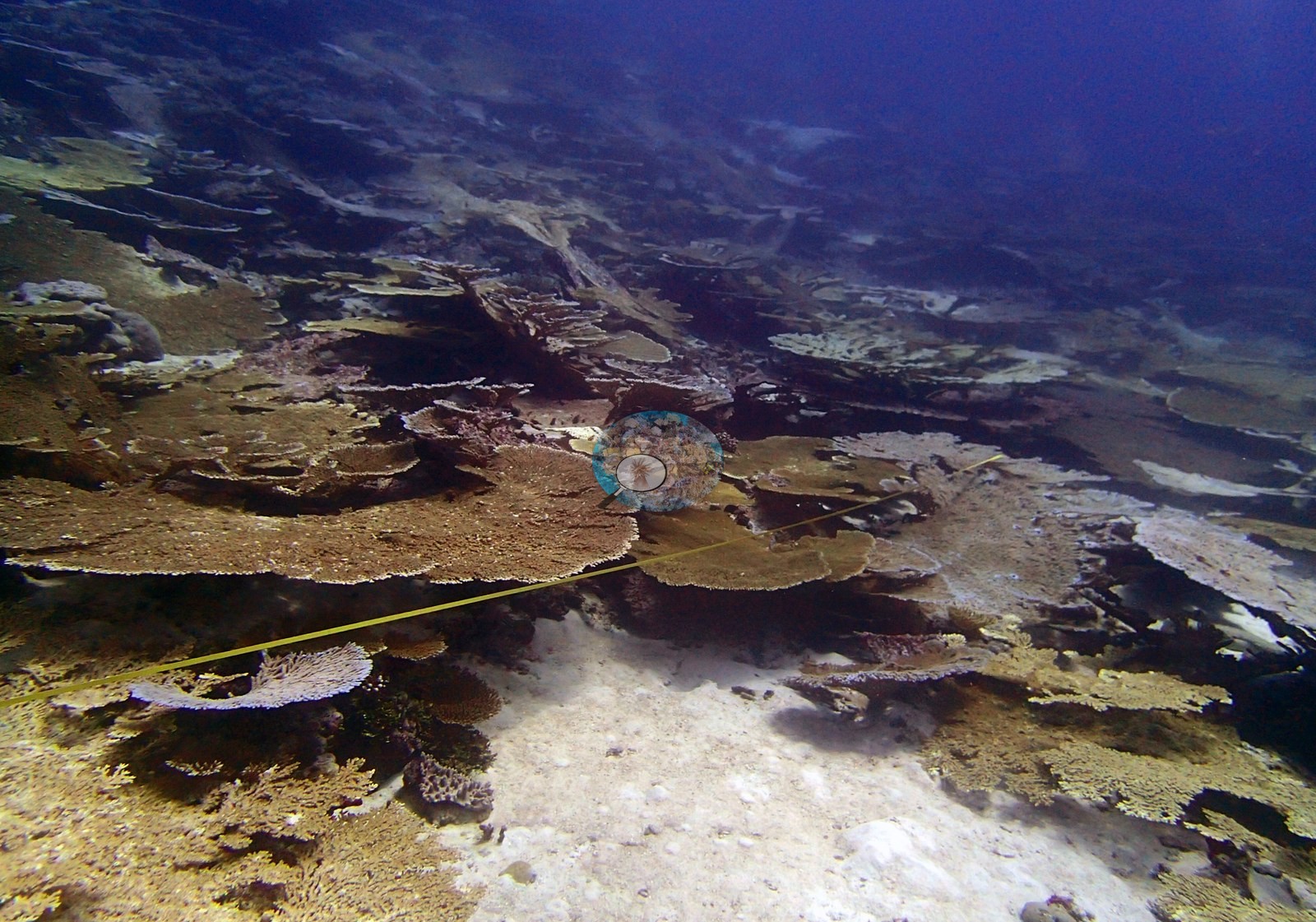
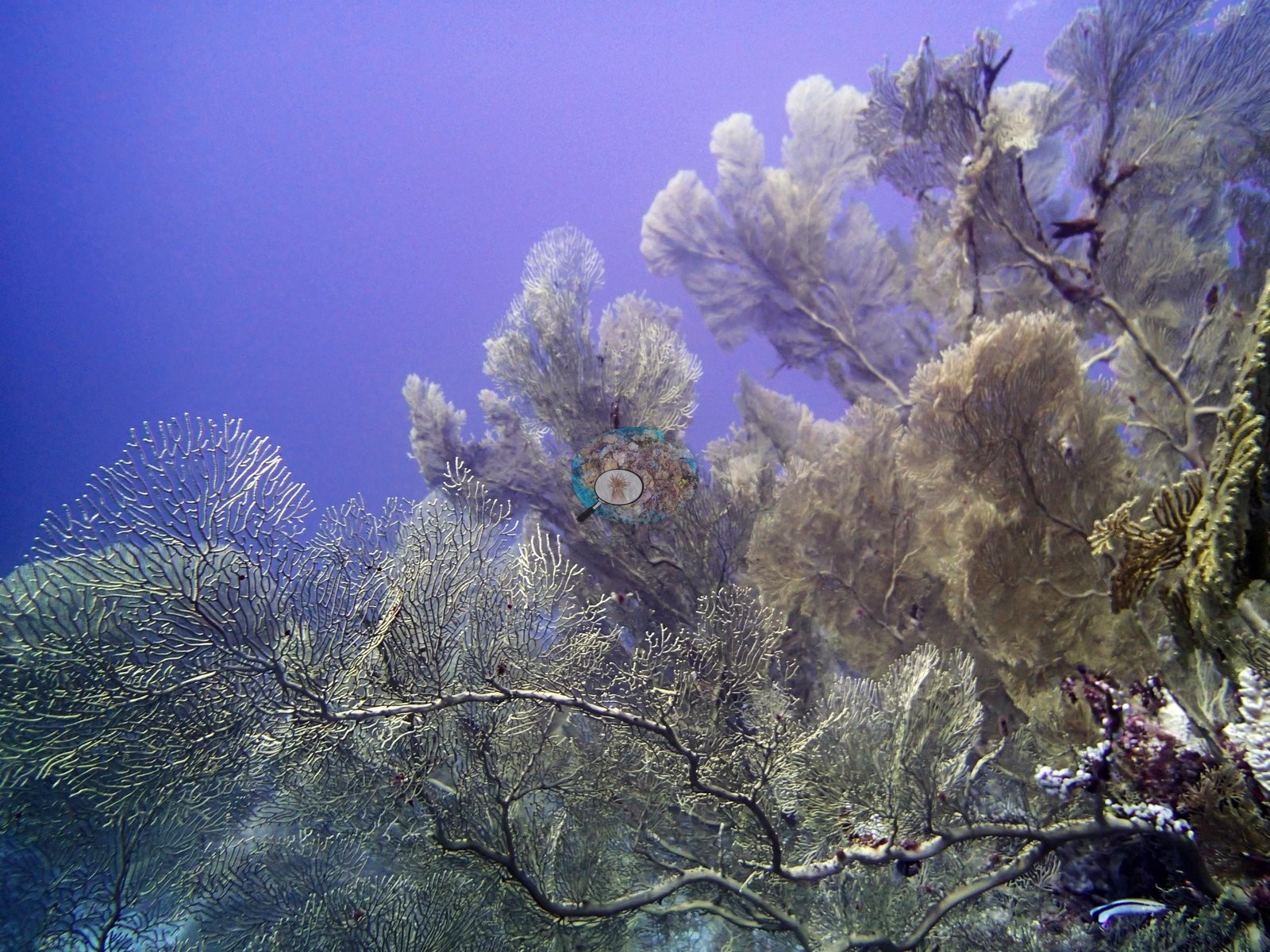
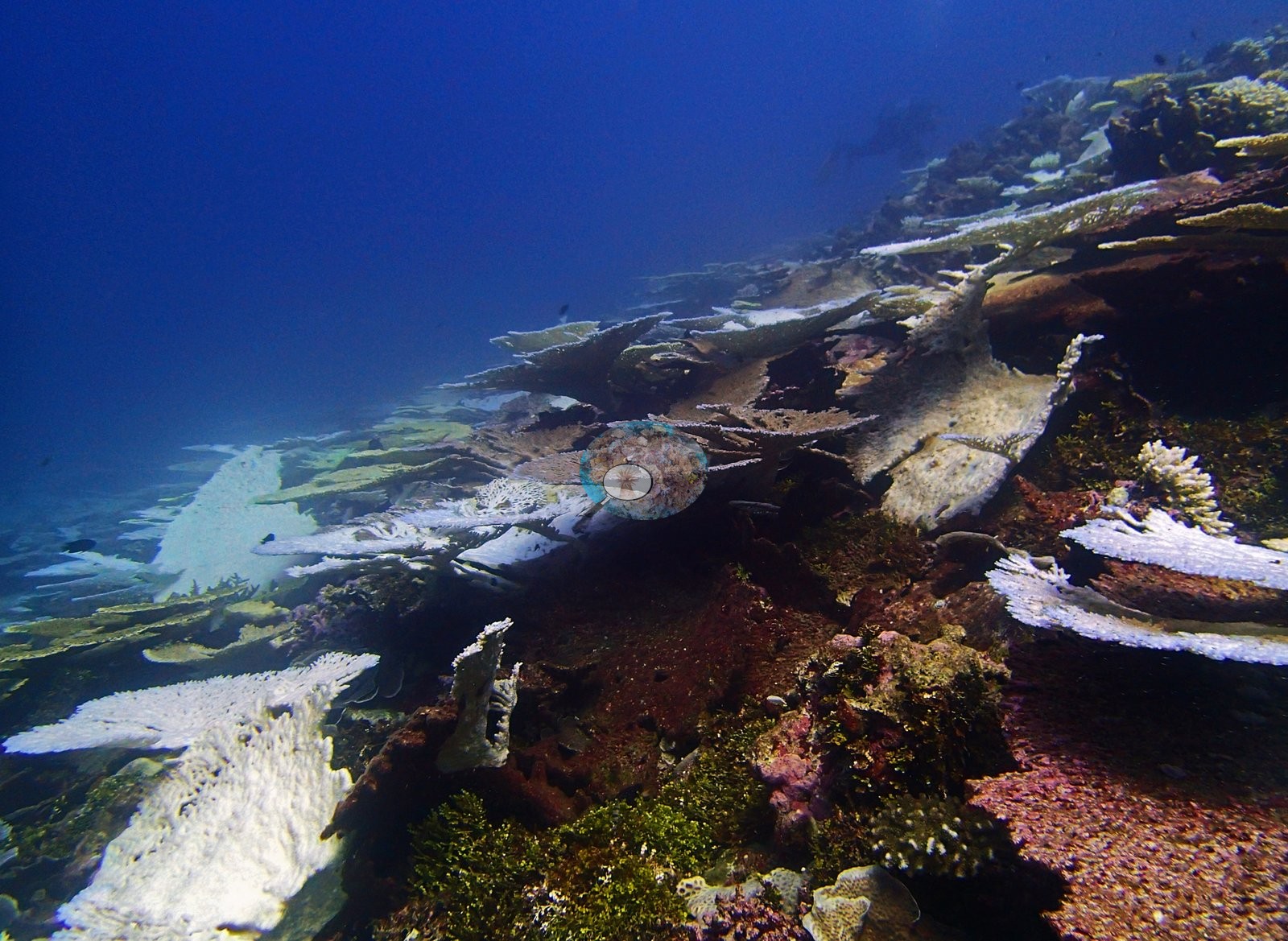
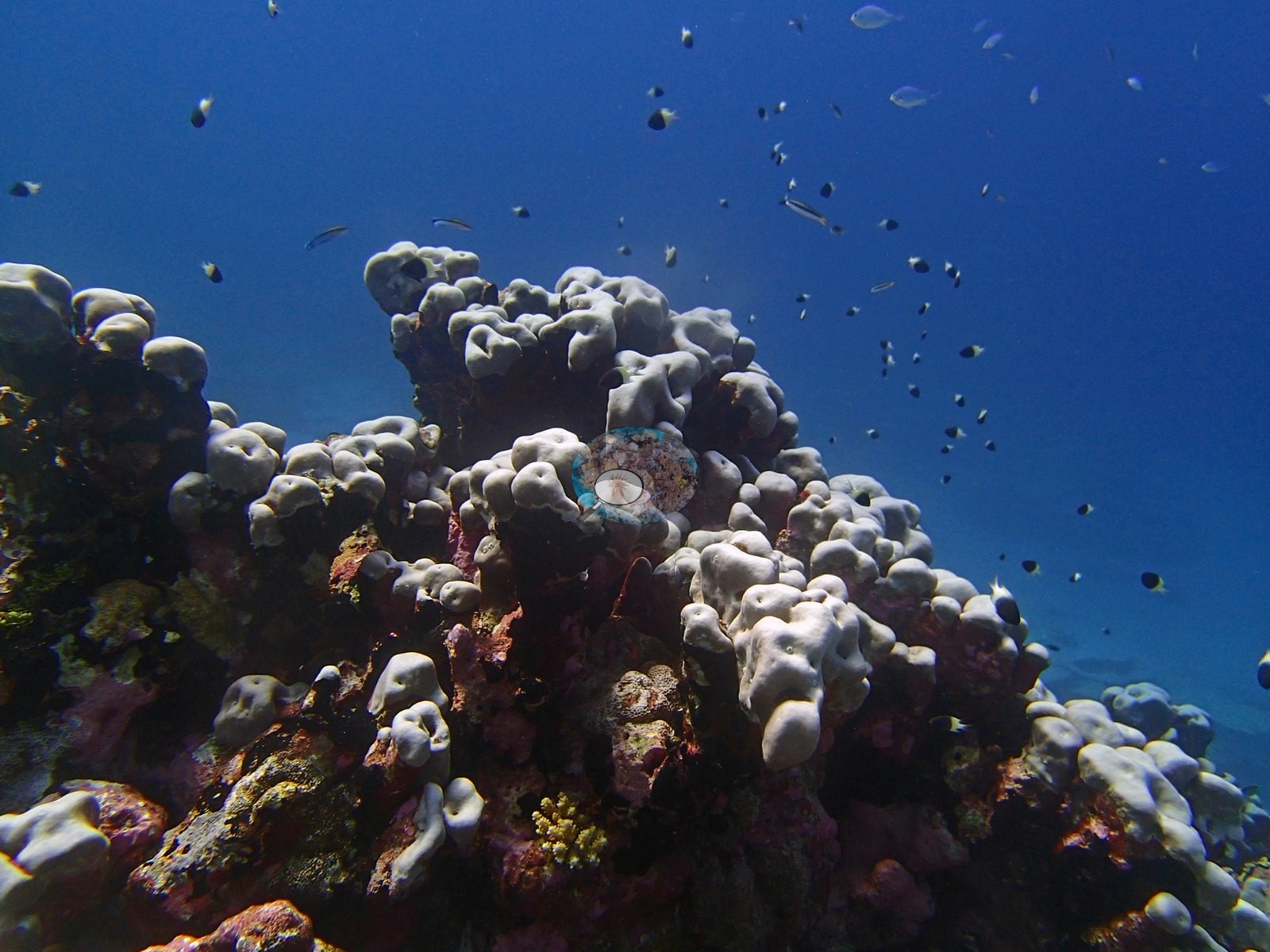
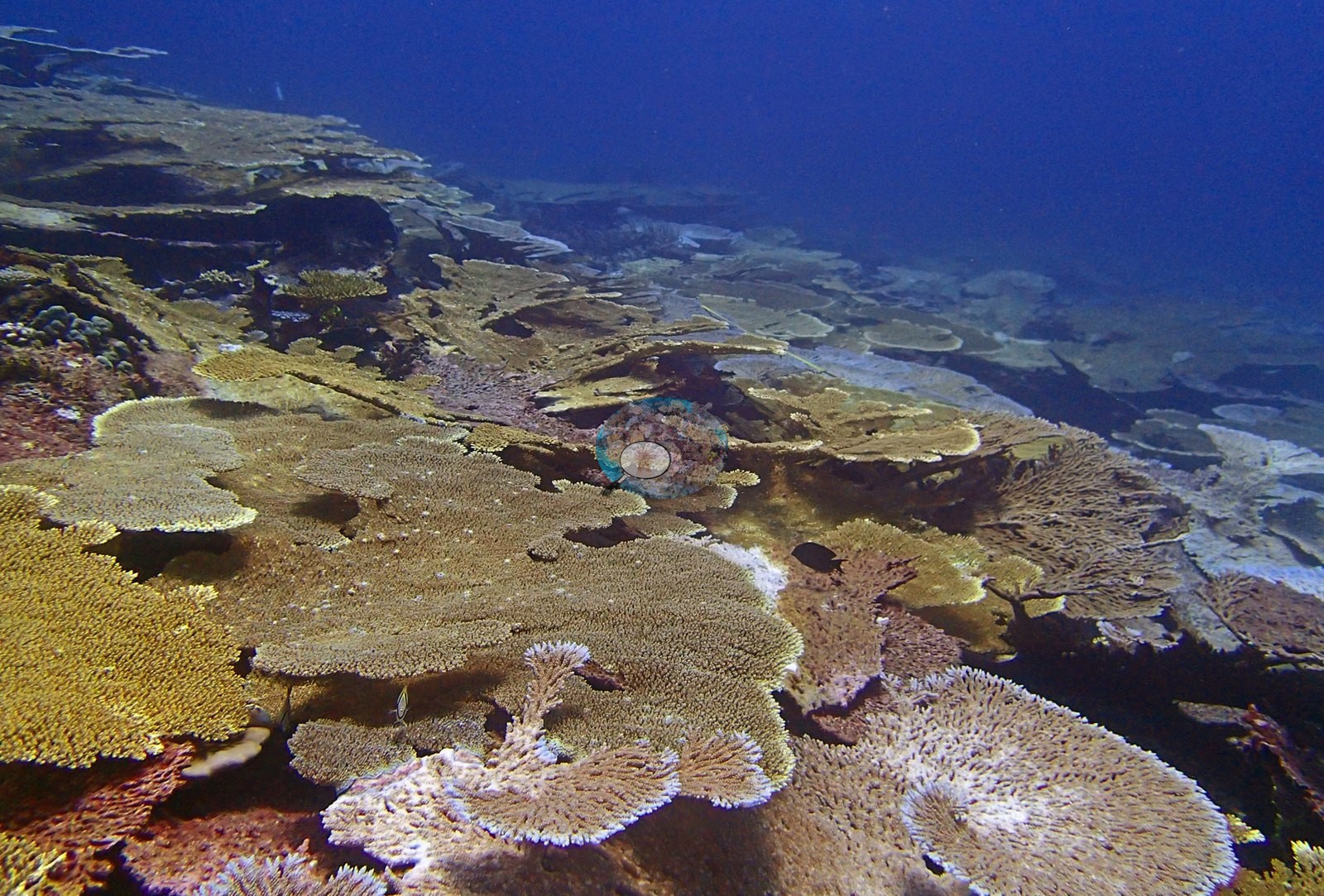
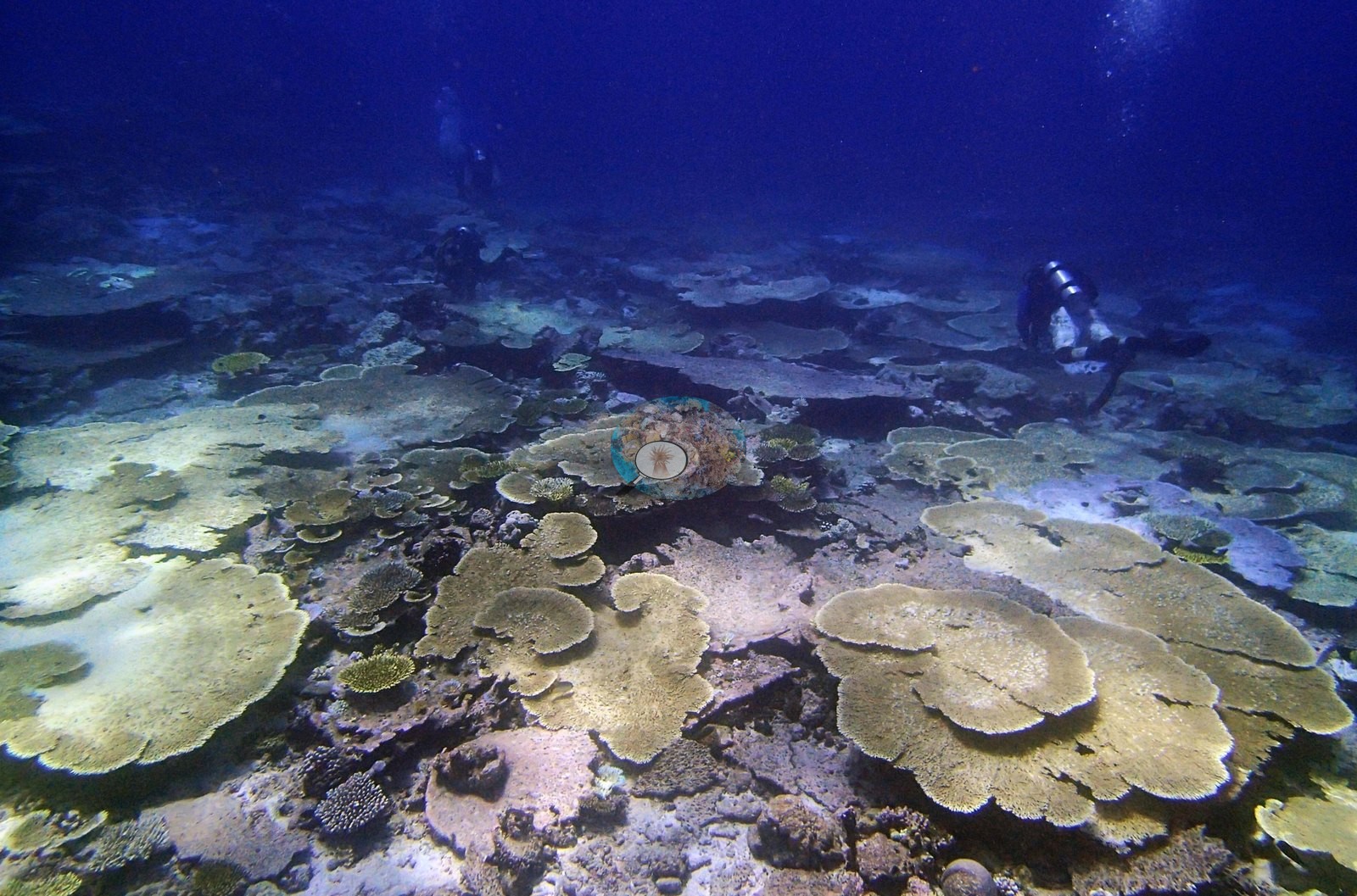
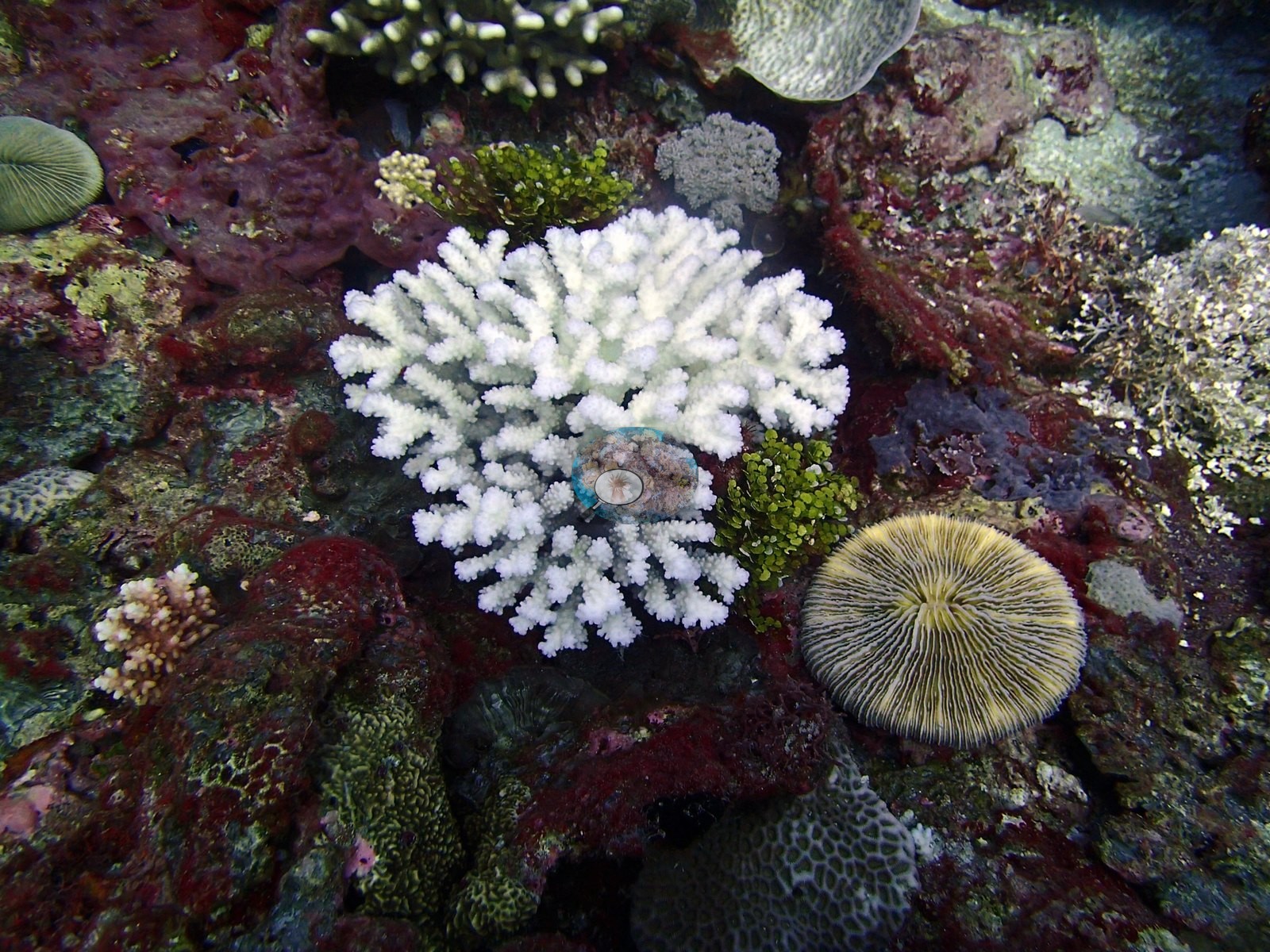
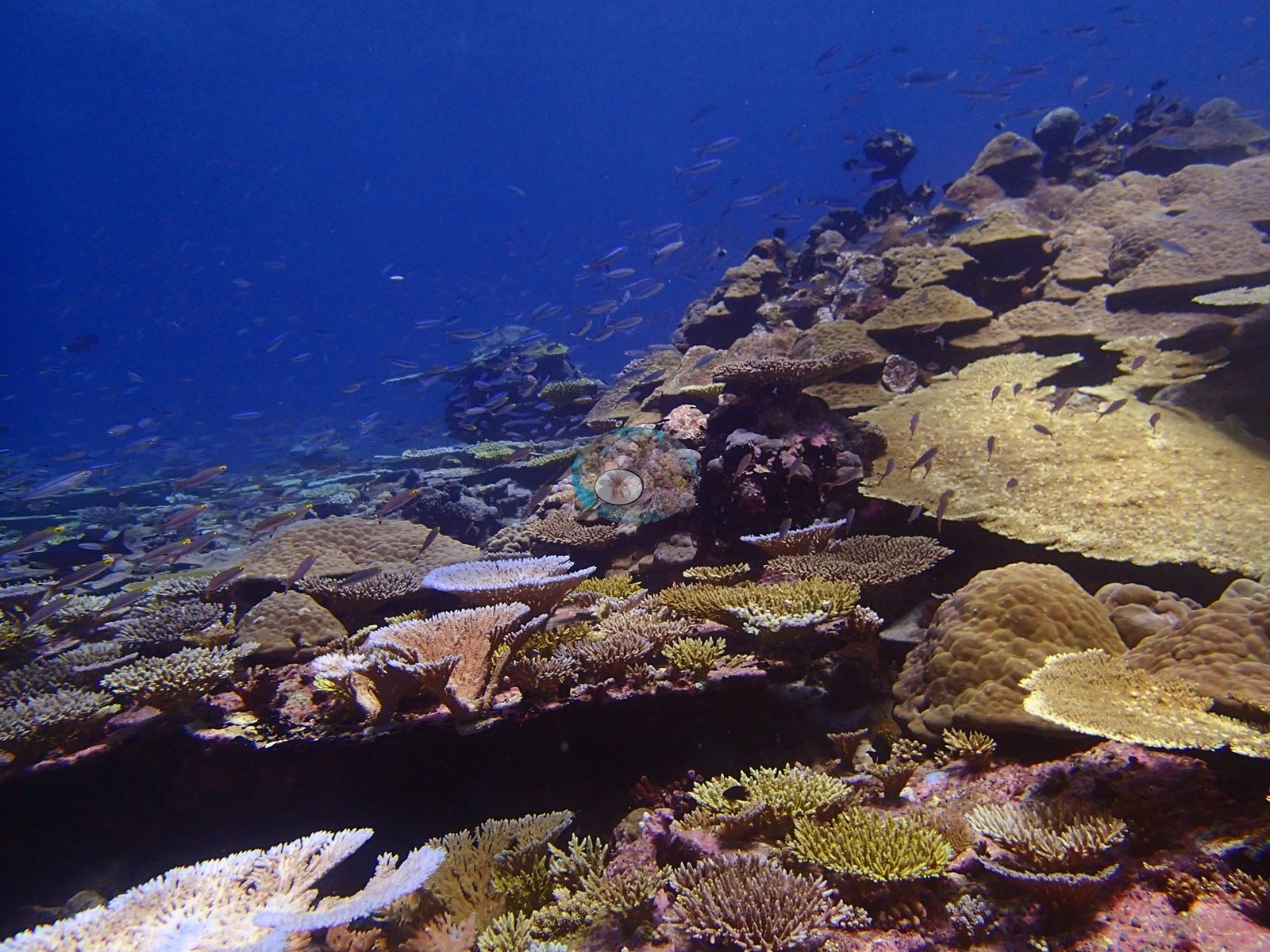
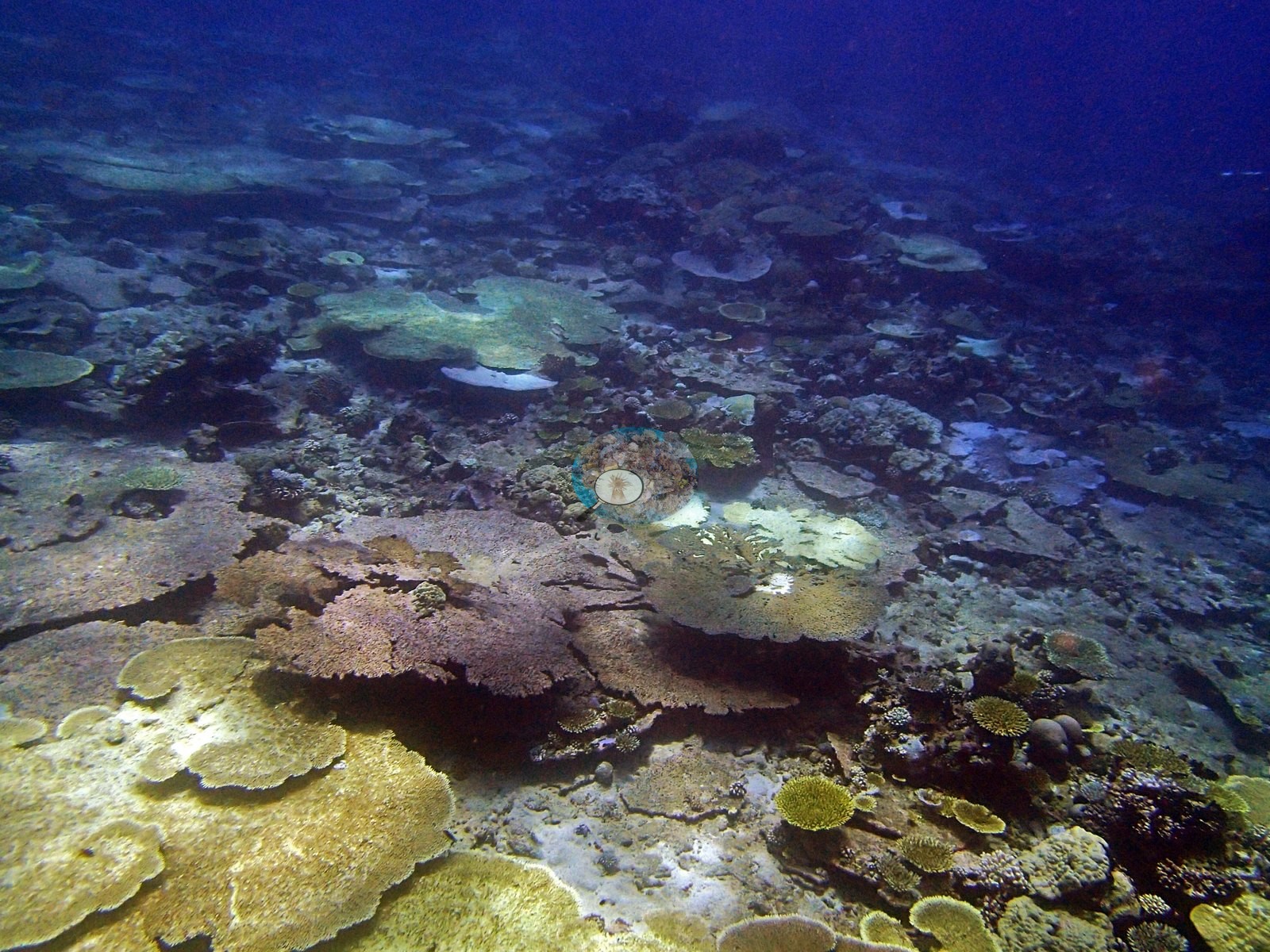
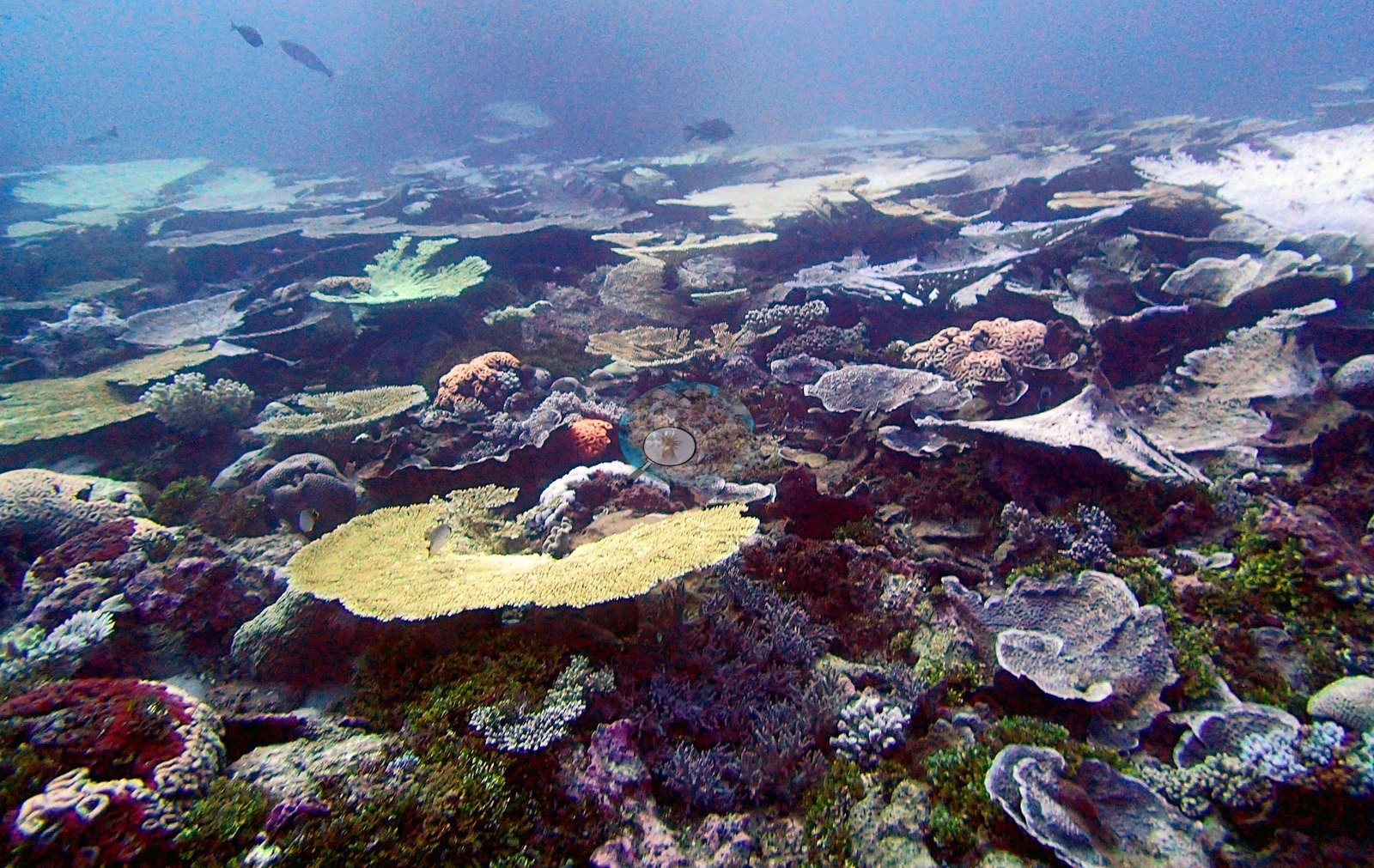
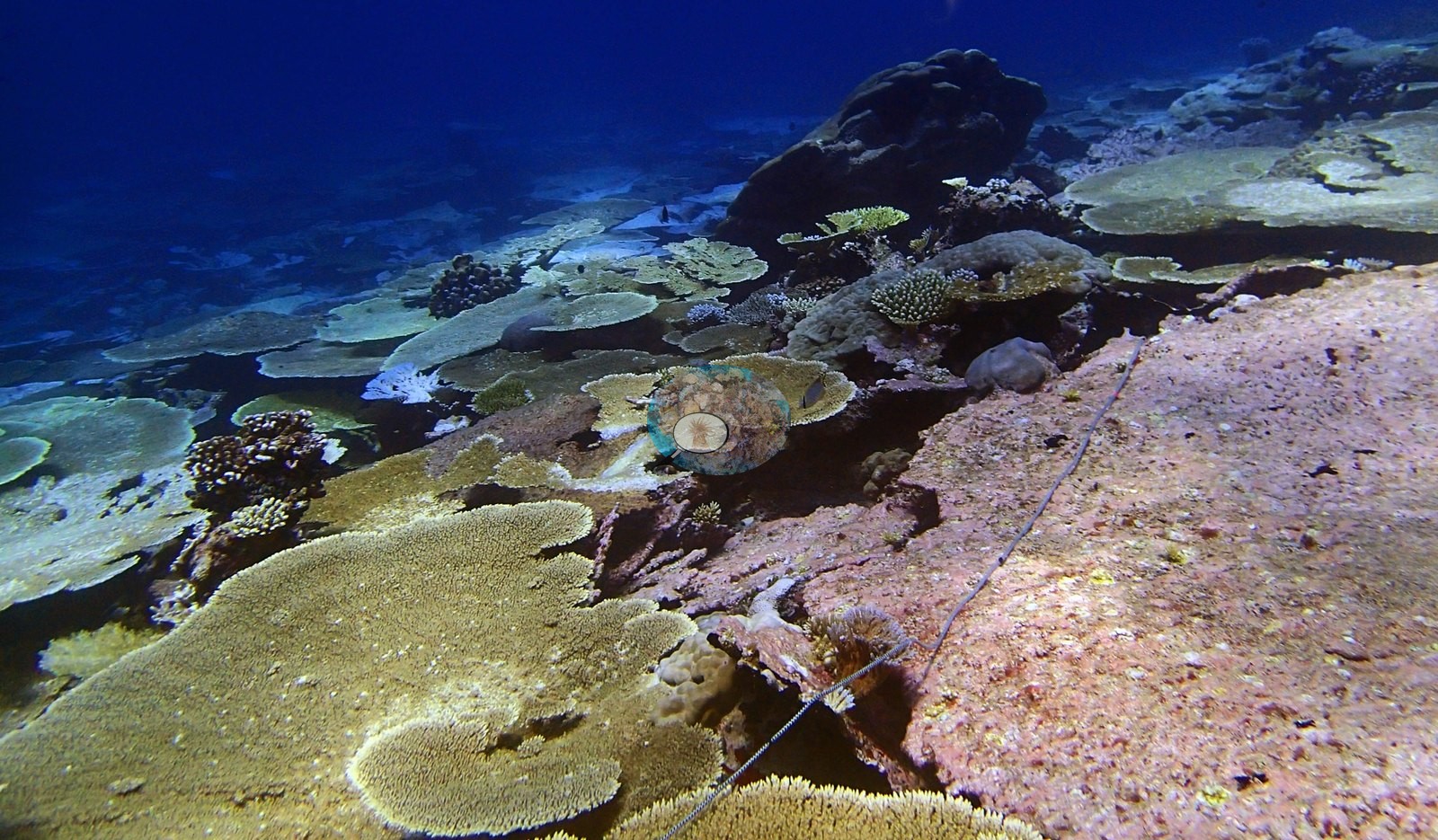
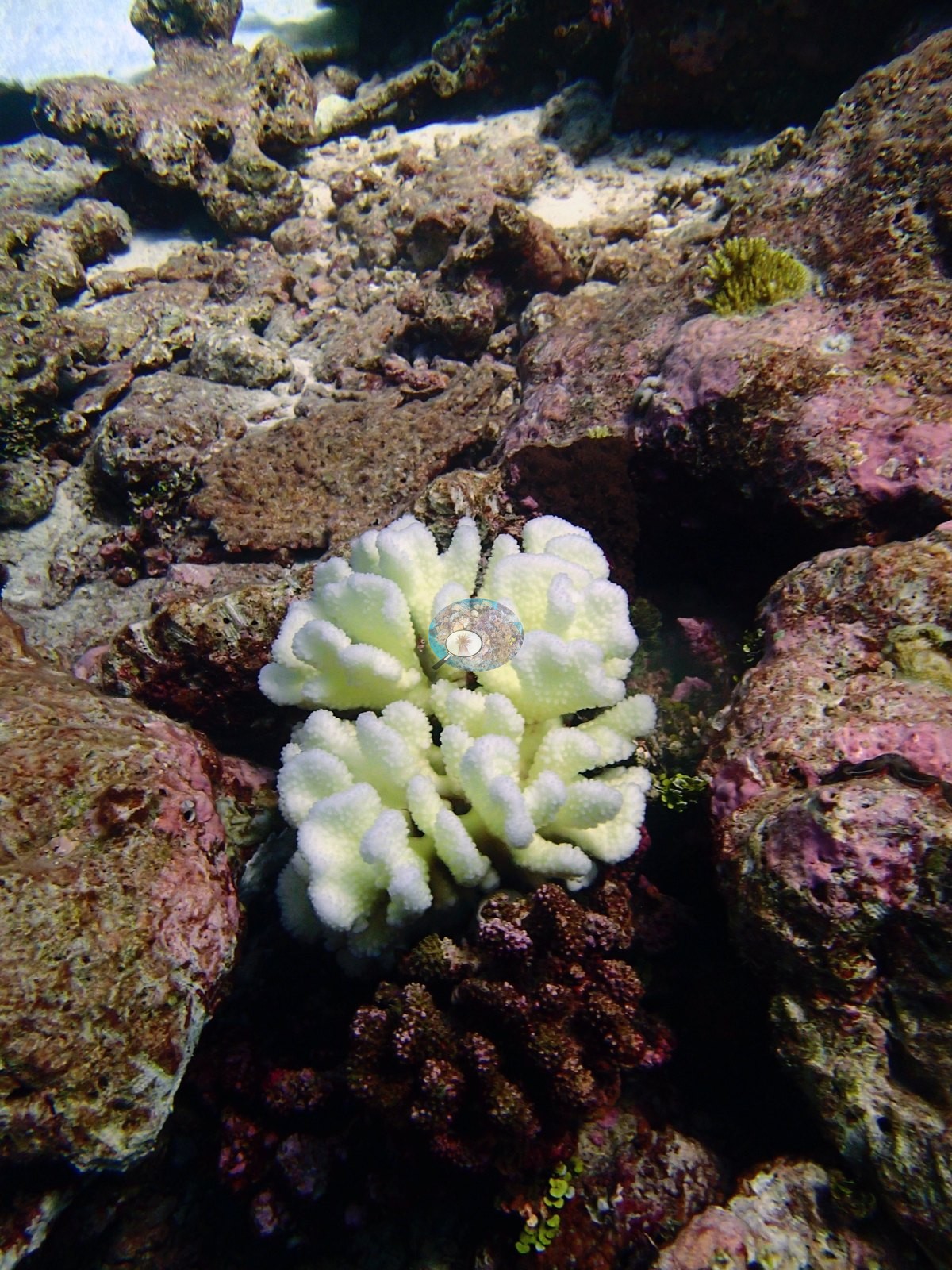
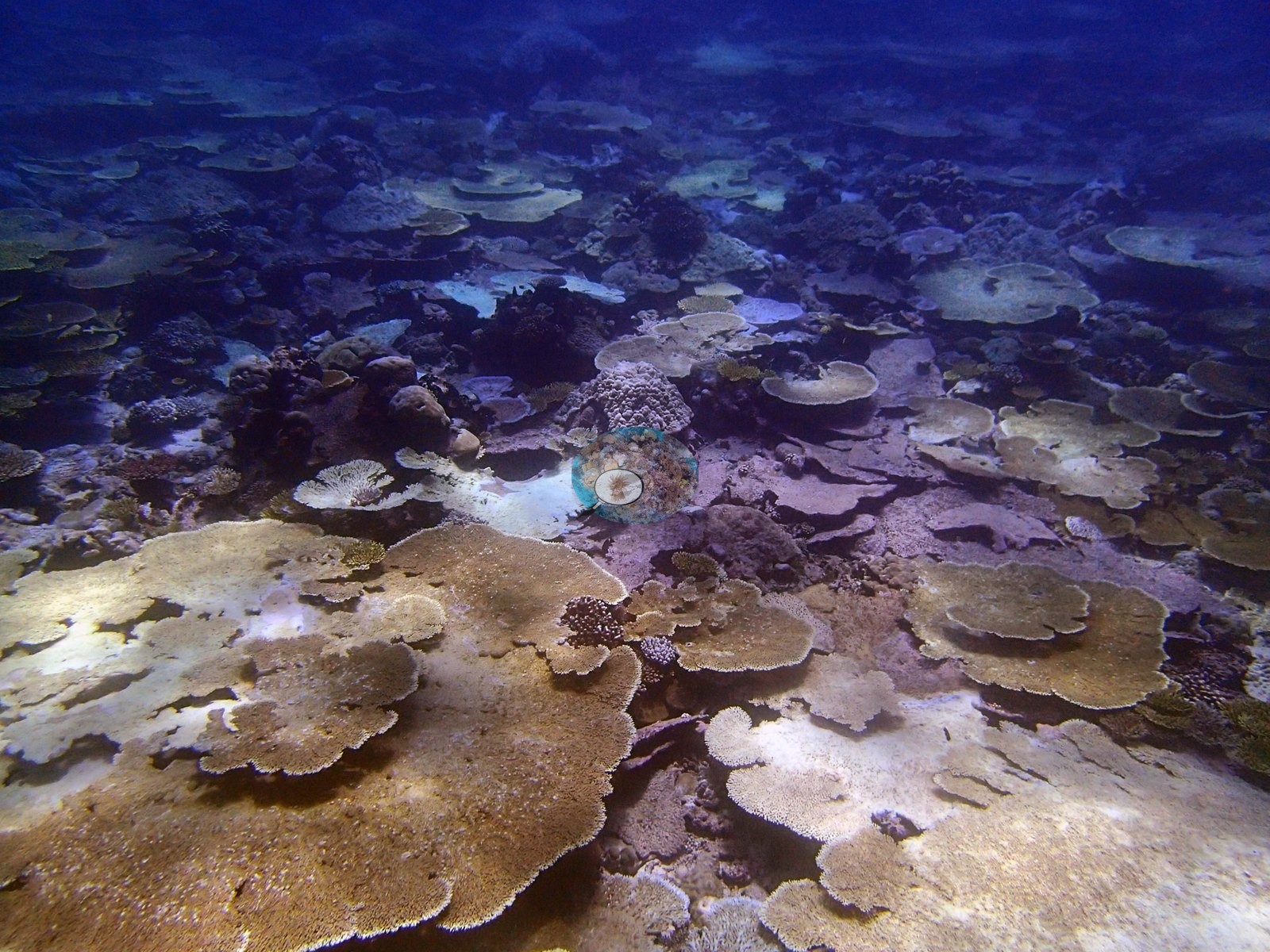
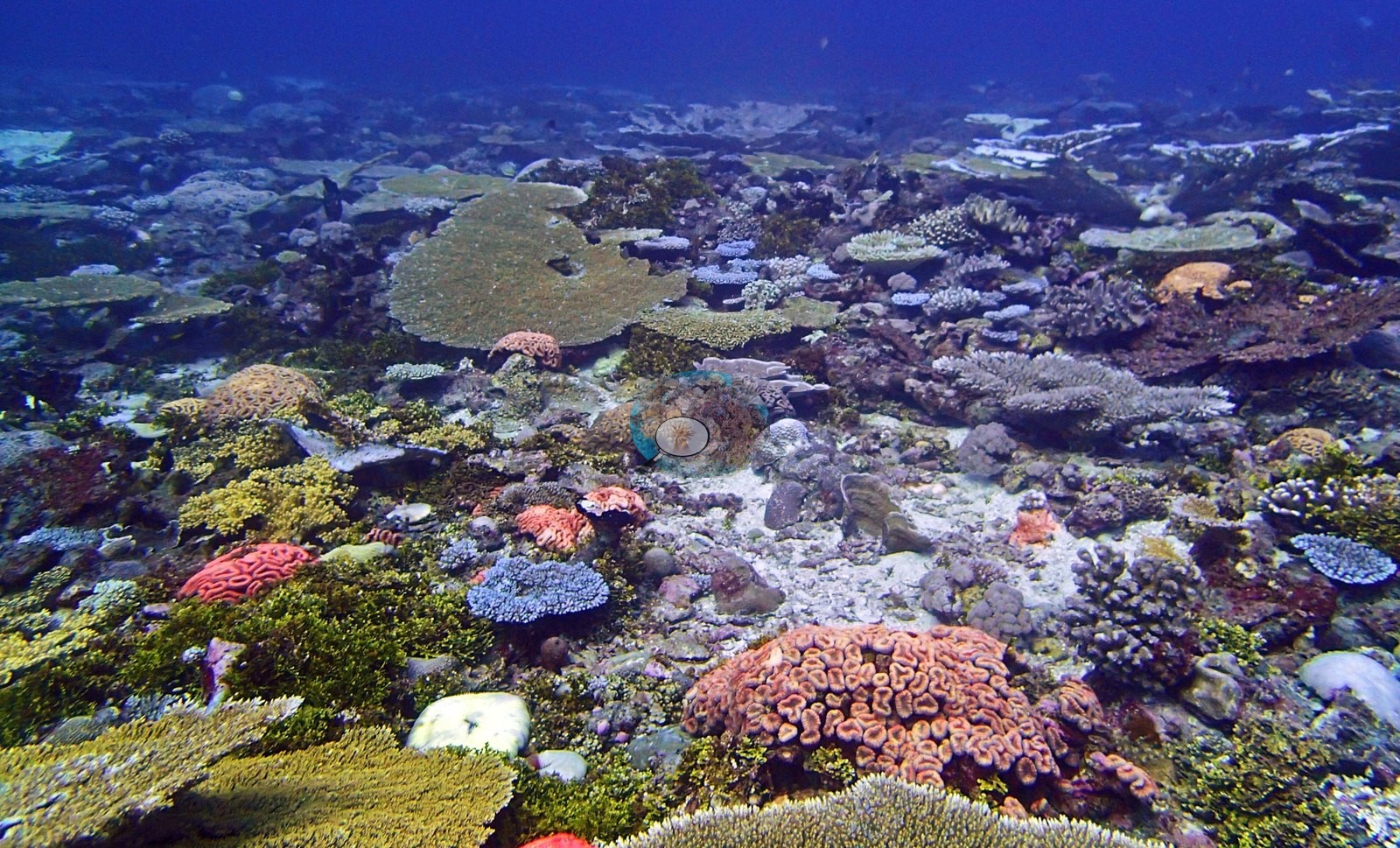
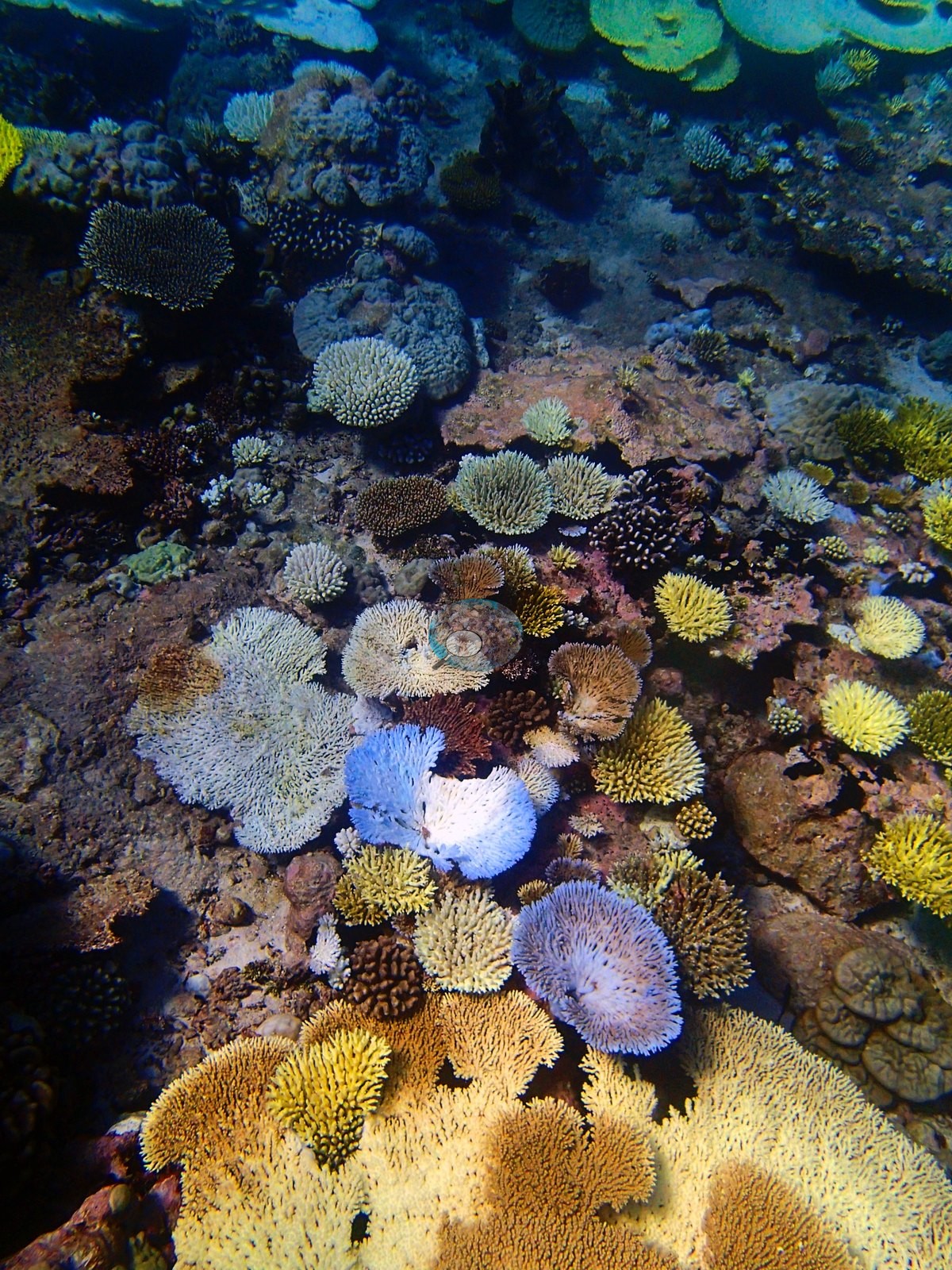
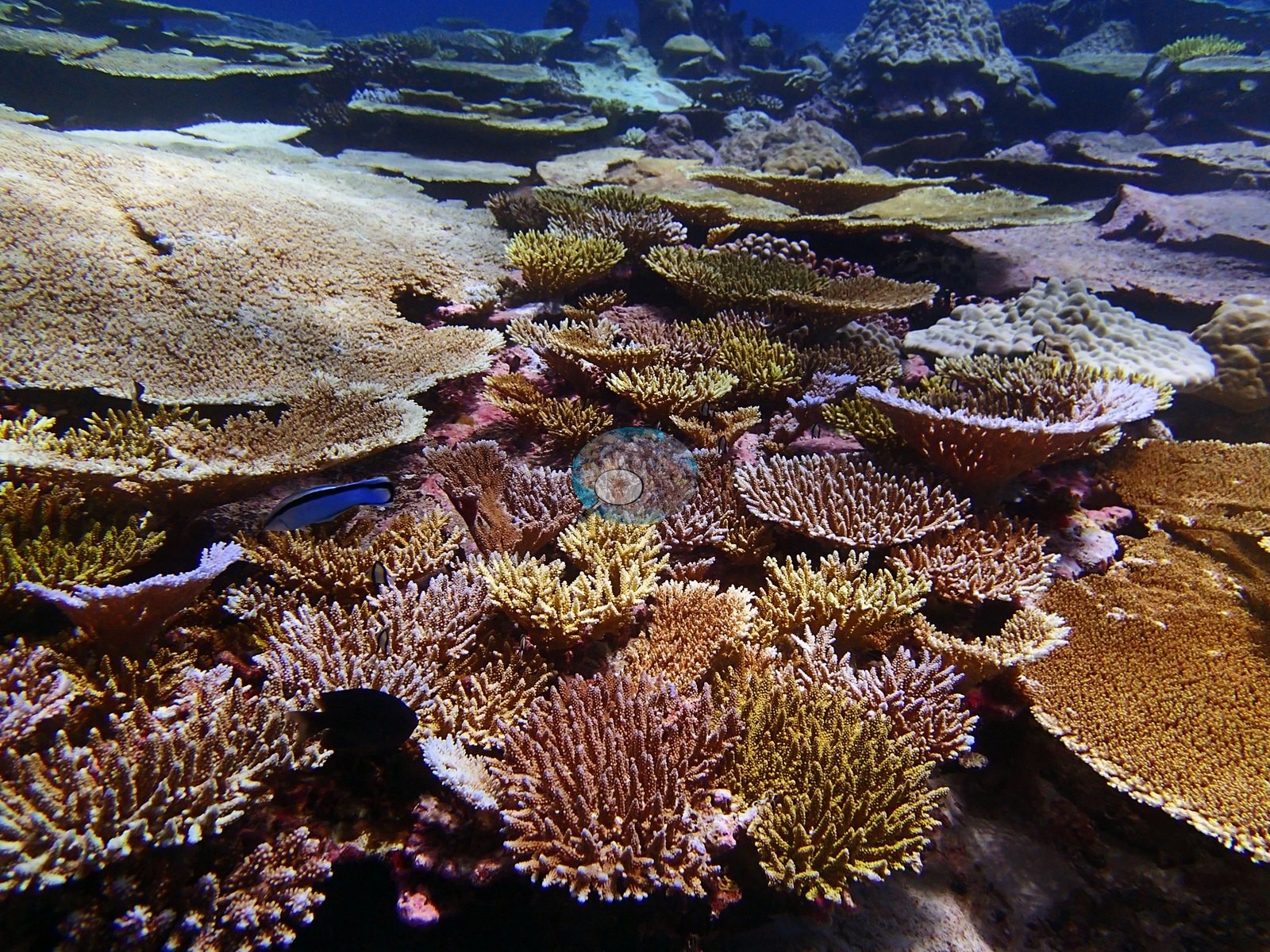
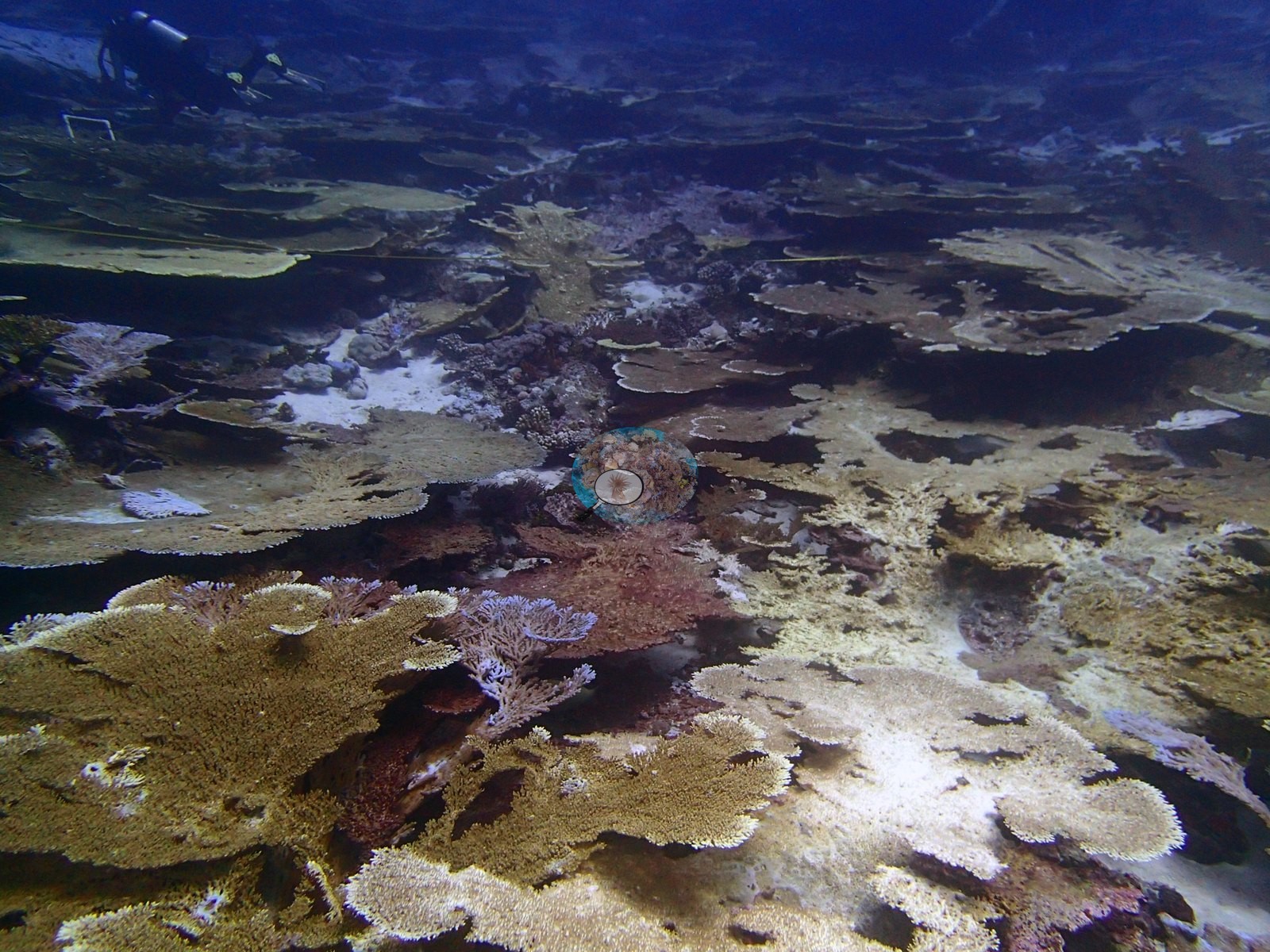
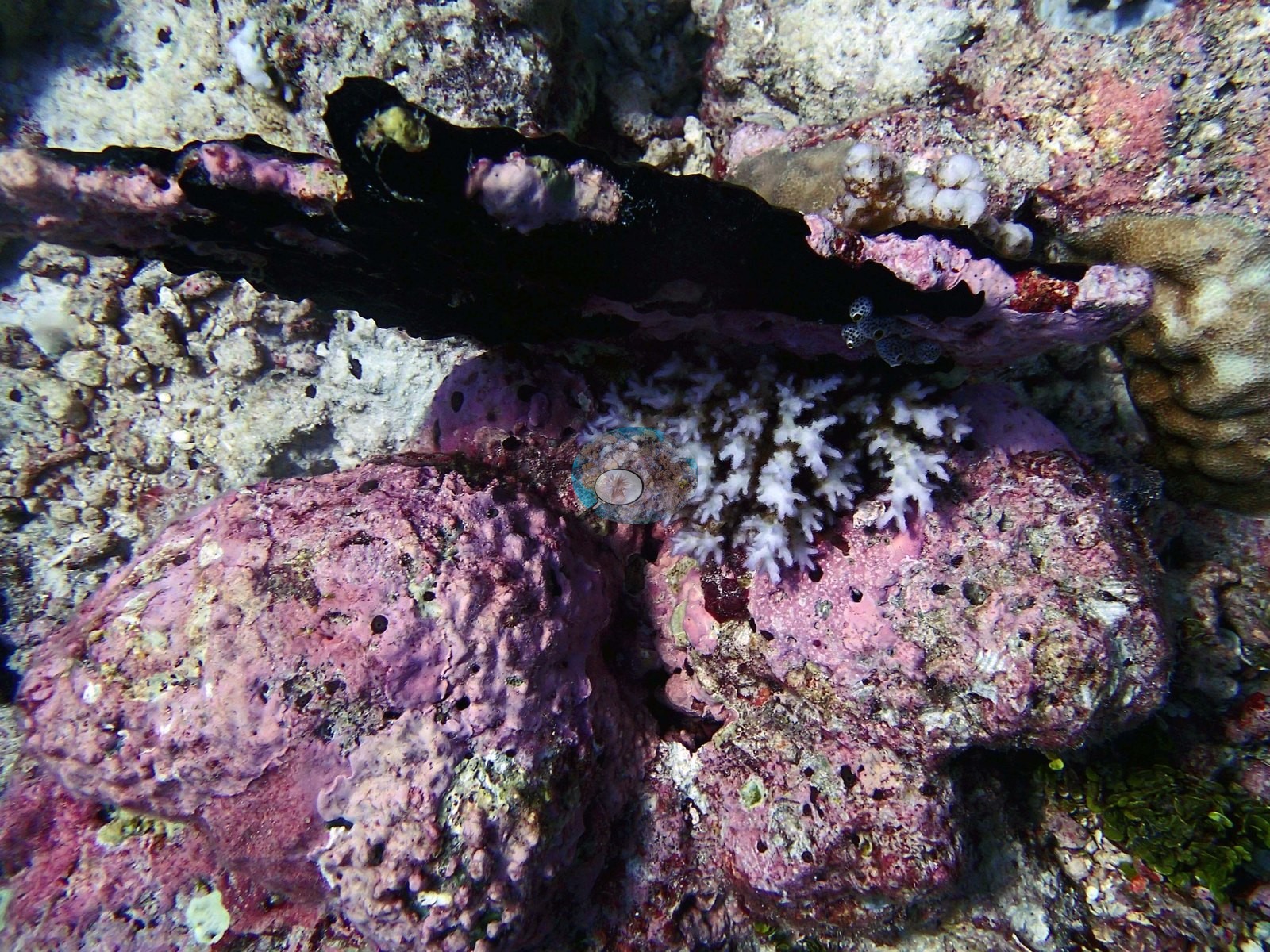
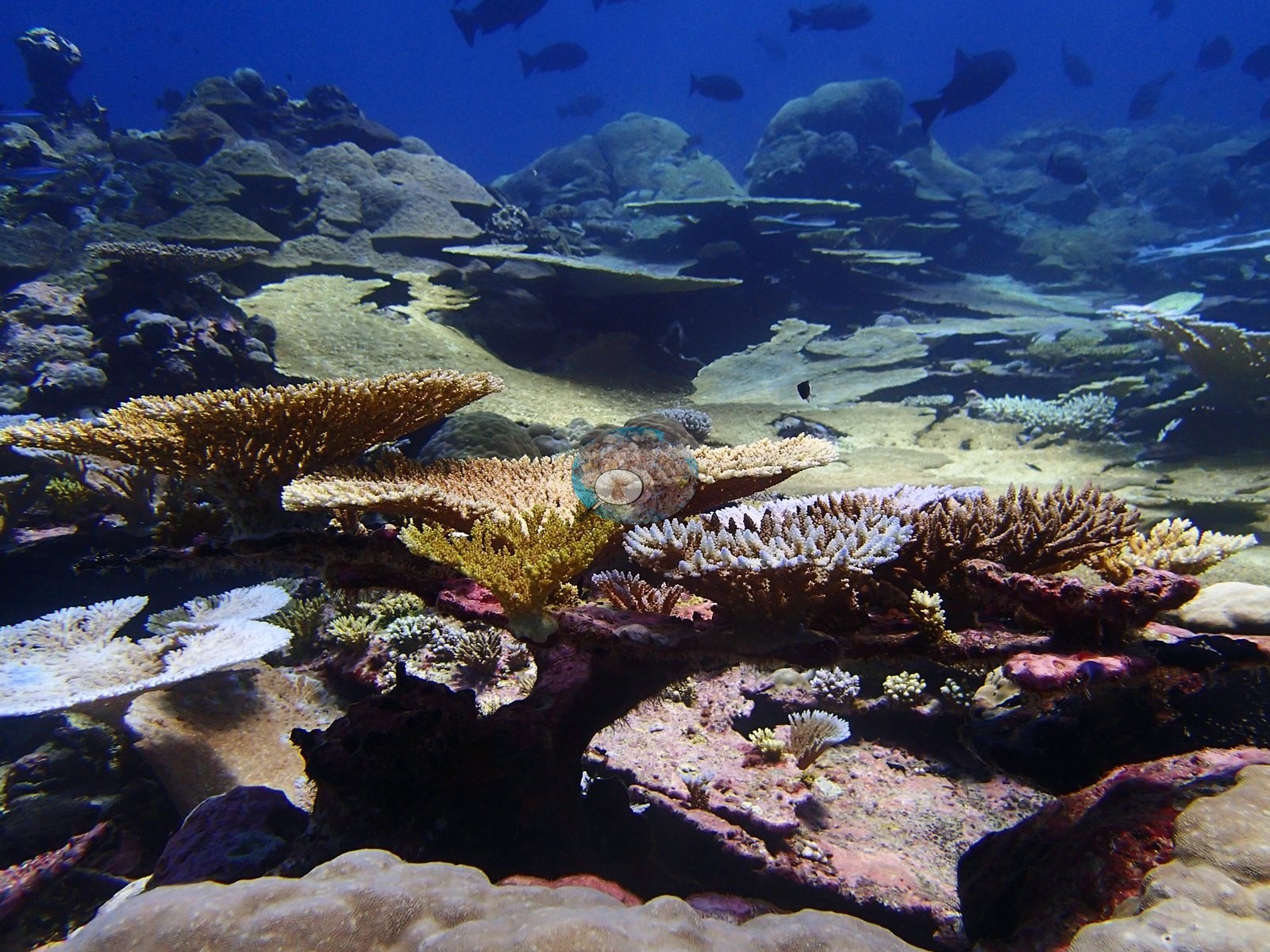
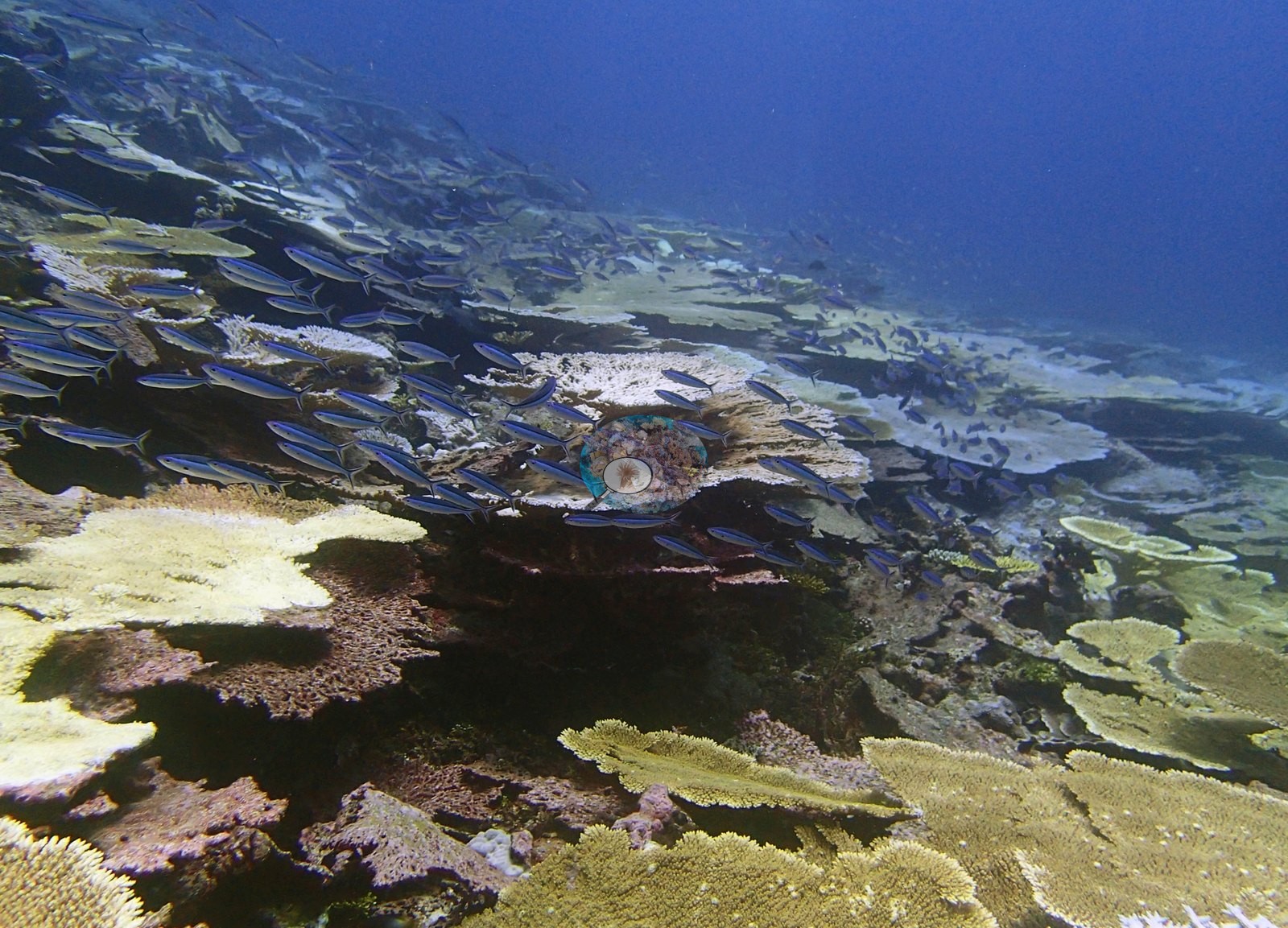
There are no sampled-colony frames. The folder label is Anderson's own field annotation of what that second dive was for, and the account below keeps the two visits separate. 17 April. The wide frames show a low-relief submerged bank whose surface is paved, almost edge to edge, in overlapping tabular and plate Acropora. No scale bar appears in any frame, so no colony dimension is quoted. P5010845 and P5010874 are single ghost-white tables set among still-pigmented neighbors; P5010886 carries a stark chalk-white tabular Acropora mid-frame beside cream-white massives, gold tables and pink-red colonies in the same view; P5010867 shows a white branching colony beside a pigmented mushroom coral; and P5010911 is an unambiguous, fully white Pocillopora colony photographed directly above a normally pigmented dark-brown Pocillopora — the within-frame contrast that rules out flash artifact or naturally pale tissue. The most severe frames come late: P5010898 shows extensive stark-white tabular and plating Acropora along a reef edge, P5010889–P5010890 and P5010913–P5010914 are wide views in which a large share of the tables and plates in frame are white or bone-cream, and P5010925 and P5010926 are landscape-scale views in which large white tables occupy the mid-ground and pale tables recede across the whole visible flat. Not all of the reef reads as affected: P5010846, P5010854 and P5010927 are dense, colorful reef in which gold and tan tabular and corymbose Acropora still dominate, with several conspicuously white or pale tables among them rather than across them. A reef whose coral is nearly three-quarters one thermally sensitive genus is maximally exposed to exactly this kind of event, and the photographs are consistent with that exposure.
Coral cover
The transect is this site's measurement. Coral cover 60%, from LOF BIOT-1 in situ transects (Mayfield & Dempsey 2026, Oceans, suppl. S1) — four formal transects across depth strata D2–D5, run on 17 April 2015, and the authoritative record of cover and community here. Algal cover is 32.9% of the benthos. At 60% cover BIPB70 ranks 9th of 109 Chagos sites. Everything photographic and model-derived below supplements this measurement and never qualifies, softens or disputes it. Assemblage composition from transect data — overwhelmingly a single-genus story. Twenty-eight genera are non-zero, but Acropora alone holds 42.92% of the benthos — 71% of all coral recorded here, in dense tabular and plate stands. A long tail follows well below it: Porites 3.06%, Echinopora 2.17%, Lobophyllia 2.10%, Pocillopora 1.86%, Montipora 1.68%, Fungia 1.03%, Seriatopora 0.81%, Goniastrea 0.70%, Favites 0.67%, then Heliopora at 0.50% (the HELI code — a blue coral, not the free-living mushroom Heliofungia the LOF codebook label suggests, per Anderson's corrected labeling in the benthic CSV), Stylophora 0.40%, Favia 0.33%, Herpolitha and Platygyra 0.30% each, Pavona 0.28%, Acanthastrea 0.25%, Montastrea 0.15%, and a scatter below 0.11% including Ctenella (CNEL — the Chagos-endemic monotypic genus, not Cynarina) at 0.11%, Leptastrea 0.11%, Astreopora 0.11%, Galaxea and Turbinaria 0.10% each, Psammocora 0.08%, Millepora and Oxypora 0.05% each, and Leptoseris and Symphyllia at 0.03%. The depth structure is the most important feature of the dataset and it splits the site into two very different reefs. D2 carries 69.3% coral, of which Acropora is 56.44% — 81% of the coral on that transect. D3 is higher still at 75.3% coral, with Acropora at 68.44% — 91% of the coral, an effective monoculture and the site's single highest-cover, highest-Acropora row. Then the pattern breaks. D4 drops to 41.4% coral, the site's lowest, on the site's highest algal cover of 48.8%, and Acropora falls to 19.80% — only 48% of a much more diverse coral component that now includes Lobophyllia 4.40%, Fungia 3.00%, Favites 2.00%, Pocillopora 2.00% and Porites 1.80%. D5 recovers somewhat to 55.0% coral (39.0% algae), with Acropora at 27.00% — still under half the coral present — and Echinopora 8.00%, Lobophyllia 4.00%, Montipora 3.00%, Seriatopora 3.00% and Goniastrea 2.00% filling out a genuinely mixed assemblage. The site-level figures of 60% cover and 42.92% Acropora describe neither zone well: they average a near-monoculture tabular Acropora reef (D2–D3, 69–75% cover) against a lower-cover, algae-heavier, genus-diverse zone (D4–D5, 41–55% cover) where Acropora holds under half the coral present. Never quote the site-level 42.92% Acropora as representative of either shallow transect. Computer-vision method comparison. Across the analyzed frames the same reef reads transect 60.3% · CoralNet points 28.8% · Coralscapes masks 26.5% — deviation −33.8 to −31.5 pp, mean of 3 = 38.5% ± 18.9. That spread reflects systematic method bias, not precision: photo methods read low at high cover, and BIPB70, at 60.3%, is near the top of the archipelago's cover range. The 60.3% transect figure is April-only and is unaffected by that pooling. Within the image products, the Coralscapes masks apportion live cover tabular Acropora 44.6%, other hard coral 22.8%, non-tabular Acropora 16.9% and massive/meandroid 10.2%; the independent 30-point human annotation of the same frames (1,530 points) apportions live coral Acropora 75.5%, Porites 15.2% and other hard coral 9.3%. Both image methods independently recover the transect's Acropora dominance even though neither recovers its absolute cover — they disagree about how much coral there is, not about what it is. P4170794 is the defining frame: pedestalled tables tiling the reef to the limit of visibility with a diver visible top-left — the visual counterpart of the 91%-Acropora D3 transect. They are consistent with Porites or Favites-type growth but are not confidently assignable from the imagery, and they are structural exceptions in an Acropora landscape — which is exactly what the transect's genus breakdown says independently. P4170867 is the most colorful frame in the set: a dense corymbose and digitate Acropora thicket in mixed yellow-green, brown-purple and cream color morphs, a visual counterpart to the genus-rich D4/D5 transects even though the frame itself is still Acropora-dominated. Survey apparatus is present and worth recording: a diver with a quadrat frame at the top of P4170817, a yellow transect tape laid across a table in P4170818, a thin line across the pavement in P4170861, and camera-and-strobe rigs in P4170851 and P4170875, with a diver resting on a massive coral head with camera and strobe in P4170866, giving useful scale. S1; an earlier training run scored the same May set at 26.3%). Formal transects recorded 60.3% live coral against 32.9% algae — 9th of 109 Chagos sites for cover — and the reef is overwhelmingly Acropora, which alone makes up 42.9% of the benthos and 71% of all coral present, in dense tabular and plate stands. Coral cover: 60%. Live hard coral measured on the in situ benthic transects of the LOF BIOT-1 expedition (Mayfield & Dempsey 2026, Oceans, supplemental S1), against algal cover of 32.9% of the benthos. The transect figure is this site's authoritative cover value; no image-derived product overrides it. Across methods the same reef reads: transects 60.3% · CoralNet points 28.8% · Coralscapes masks 26.5% (51 frames). These products have different sampling footprints and denominators and should not be averaged.
Stressors
Substrate is led by erect algae at 12.18%, well ahead of CCA (7.34%), turf (7.21%), macroalgae (5.12%), bare substrate (4.33%), non-coral invertebrates (2.48%), sediment-laden turf (1.05%) and cyanobacteria (0.03%) — a reef that is mostly coral or fleshy and erect algae, with very little bare space. The image products also pool the two dives. The multi-method table carries n = 51 photos against 28 April and 28 May frames, so the CoralNet and Coralscapes values blend a pre-bleaching and a bleaching-onset reef and are not interpretable as either one. Non-coral cover in the point set is led by CCA 6.8% and turf 6.2%; structural loss registers as dead coral 2.5% of image area and rubble 1%; conspicuous invertebrates appear as sponges in 40 frames, sea cucumbers in 4 and seagrass in 1. As an annotation statistic within the same pooled point set — not a site bleaching estimate, and not comparable with the published per-visit figures below — bleached points run to 4.6% of all annotated points, concentrated in Acropora 3.7%, other hard coral 0.5% and Pocillopora 0.3%. Two cautions about the image products at this site: human-model agreement is weaker for bleaching (r = 0.40) than for cover (r = 0.72), and the image-derived cover drop between the two visits (46.2% in April to 38.9% in May) must not be read as mortality — bleached coral is still live coral, and a seven-point change in fourteen days is far more likely to be the classifier reassigning white colonies than real tissue death. Image-by-image analysis — two dives, fourteen days apart, from two of Anderson's own folders. Fifty-six frames survive: 28 from the 17 April survey dive (BiPb70-finished, P4170791–P4170878, 14:21–15:17) and 28 from the 1 May revisit he filed as BiPb70b-bleaching-finished (P5010837–P5010928). P4170817, P4170818, P4170830–P4170836, P4170842–P4170843, P4170850–P4170851 and P4170866–P4170867 repeat the structure — dense, overlapping plate and table colonies stacked several deep over a hard pavement, cream, tan, and gold, laid over one another like roof tiles — with corymbose and staghorn thickets filling the gaps and only narrow strips of pale sand, rubble and pink-mauve coralline pavement showing between them. Brown lobate and hemispherical massives punctuate the tables: a meter-scale dome in P4170830, another in the foreground of P4170834 with dark boring scars in its surface, more in P4170842 and P4170850. Early in the sequence the reef still reads as largely pigmented: P5010854 is dominated by intact yellow-green Acropora tables, olive foliose colonies and brightly pigmented faviids, with only scattered pale branches, and P5010837–P5010838 are a gorgonian sea-fan garden on the upper slope whose fans are naturally pale and carry no bleaching signal. From mid-sequence the signal is unmistakable. P5010847 is the informative macro: a staghorn thicket showing an eerie electric-blue-and-white coloration on otherwise bleached branch tips, with stark white tissue, pale peach and vivid pale-blue pigment side by side — almost certainly host-pigment (GFP-like) fluorescence exposed as zooxanthellae are lost, not a distinct taxon. Some table surfaces in P5010898 are brown-olive rather than white, which is consistent with either recently dead, turf-colonized skeleton or pre-existing dead framework; fourteen days is fast for that transition and the photographs cannot separate the two, so no mortality is claimed here. Condition and bleaching. Anderson's published per-site figures are the authoritative record of condition at BIPB70: 3.7% of coral bleached on 17 April and 33.3% on 1 May (CoralNet annotations of the informal survey images, not diver estimates; % bleaching, 2nd training, Mayfield & Dempsey 2026, Oceans, suppl. No percentage of the reef bleached can be or has been read off these photographs, and none is estimated here; the frames are qualitative and are not offered as a check on either number. What they do show, qualitatively, is set out above: on 17 April a dense, largely tan-and-gold tabular Acropora canopy with a small number of conspicuously paler colonies in it, noting that at 22 m the ambient blue-green cast makes pale-versus-bleached an unreliable distinction at range in that set; on 1 May, whitening that is widespread, patchy at colony and patch scale rather than uniform, and clearly present in the same frames as fully pigmented reef. The taxonomic pattern matters at this site in particular. The visibly bleached colonies in the May set are overwhelmingly tabular and branching Acropora, with Pocillopora the clearest close-range case, while massive Porites-type heads and meandroid colonies largely retain brown pigmentation in the same frames — and BIPB70's April transects record Acropora at 42.92% of the benthos, 71% of all coral at the site. This is an observed association between the assemblage recorded in April and the condition photographed in May; it is not a tested causal claim. The gorgonian sea fans in P5010837–P5010838 are not scored in the hard-coral bleaching denominator. Unlike 17 April, when bleaching stood at 3.7%, the 1 May revisit two weeks later found 33.3% of the coral bleached, and the May photographs show the change unevenly: parts of the reef still fully pigmented, elsewhere landscape-scale fields of stark-white tables, and one unambiguous fully bleached Pocillopora photographed directly above a normally pigmented neighbor. The bleached colonies are overwhelmingly Acropora — the genus holding nearly three-quarters of this reef's coral. Both bleaching figures are CoralNet annotations of the informal survey images, not diver estimates, and human-model agreement is weaker for bleaching (r = 0.40) than for cover (r = 0.72). No crown-of-thorns starfish (COTS) or other corallivores evident.
Fish and other fauna
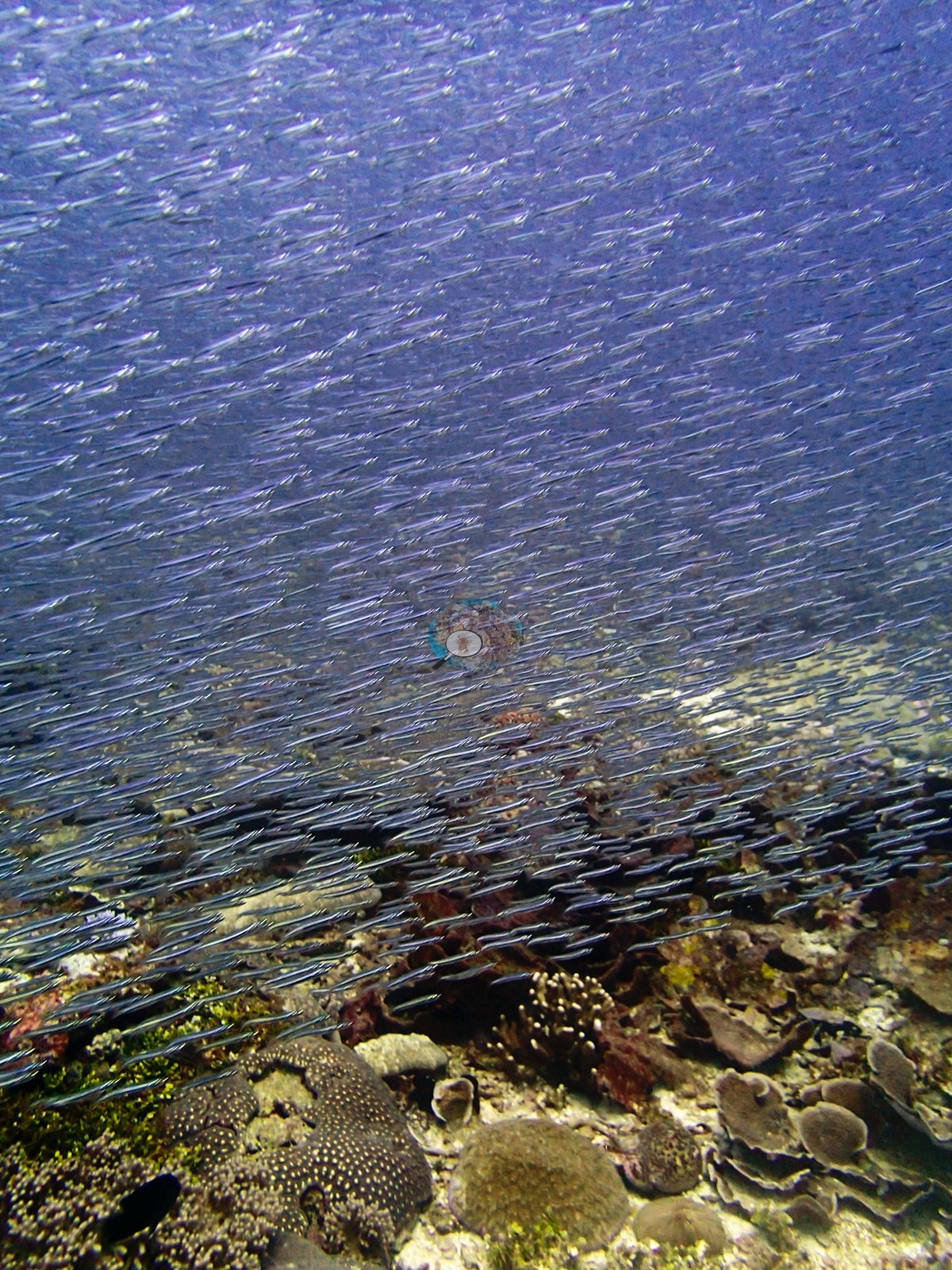
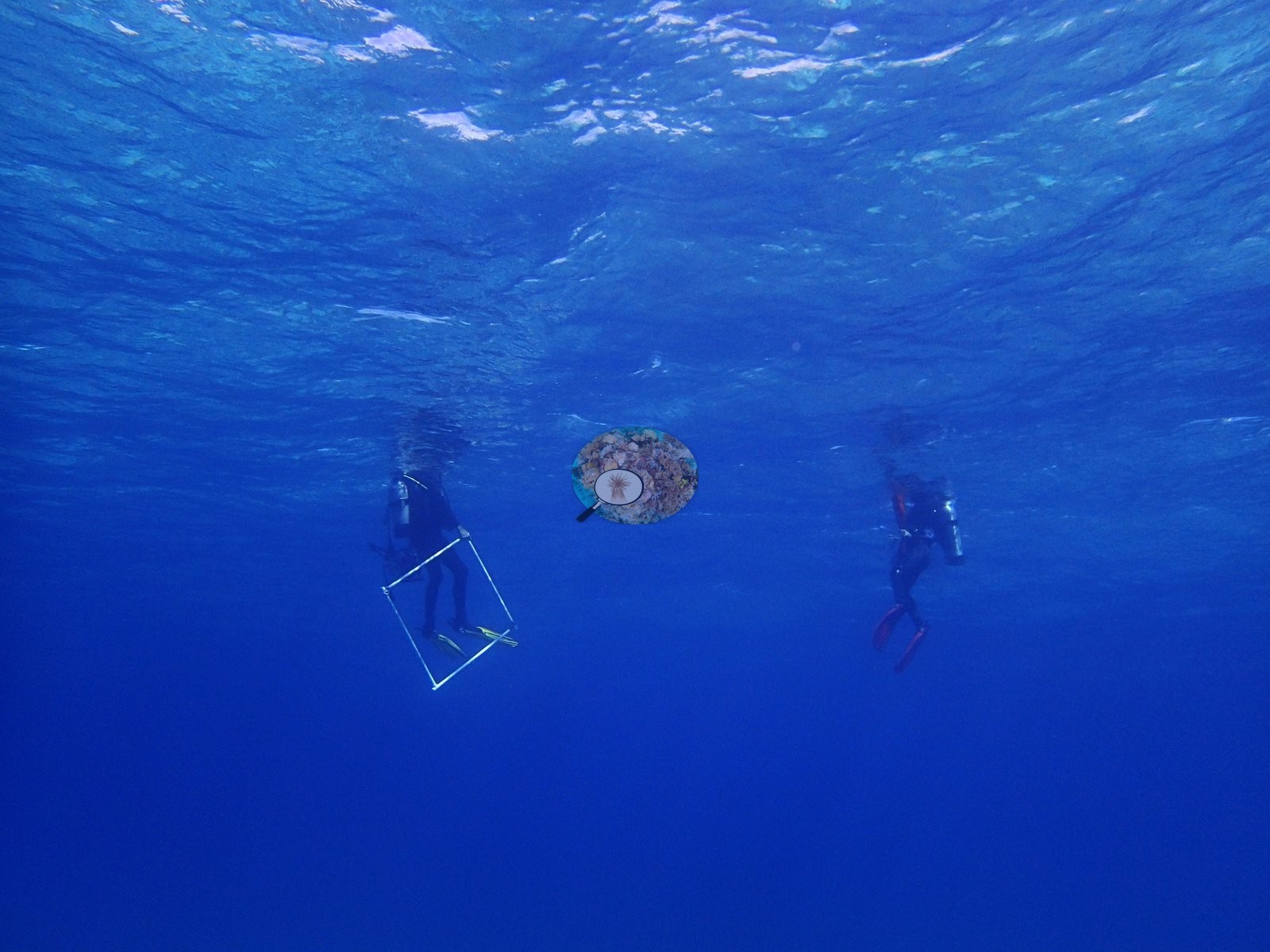
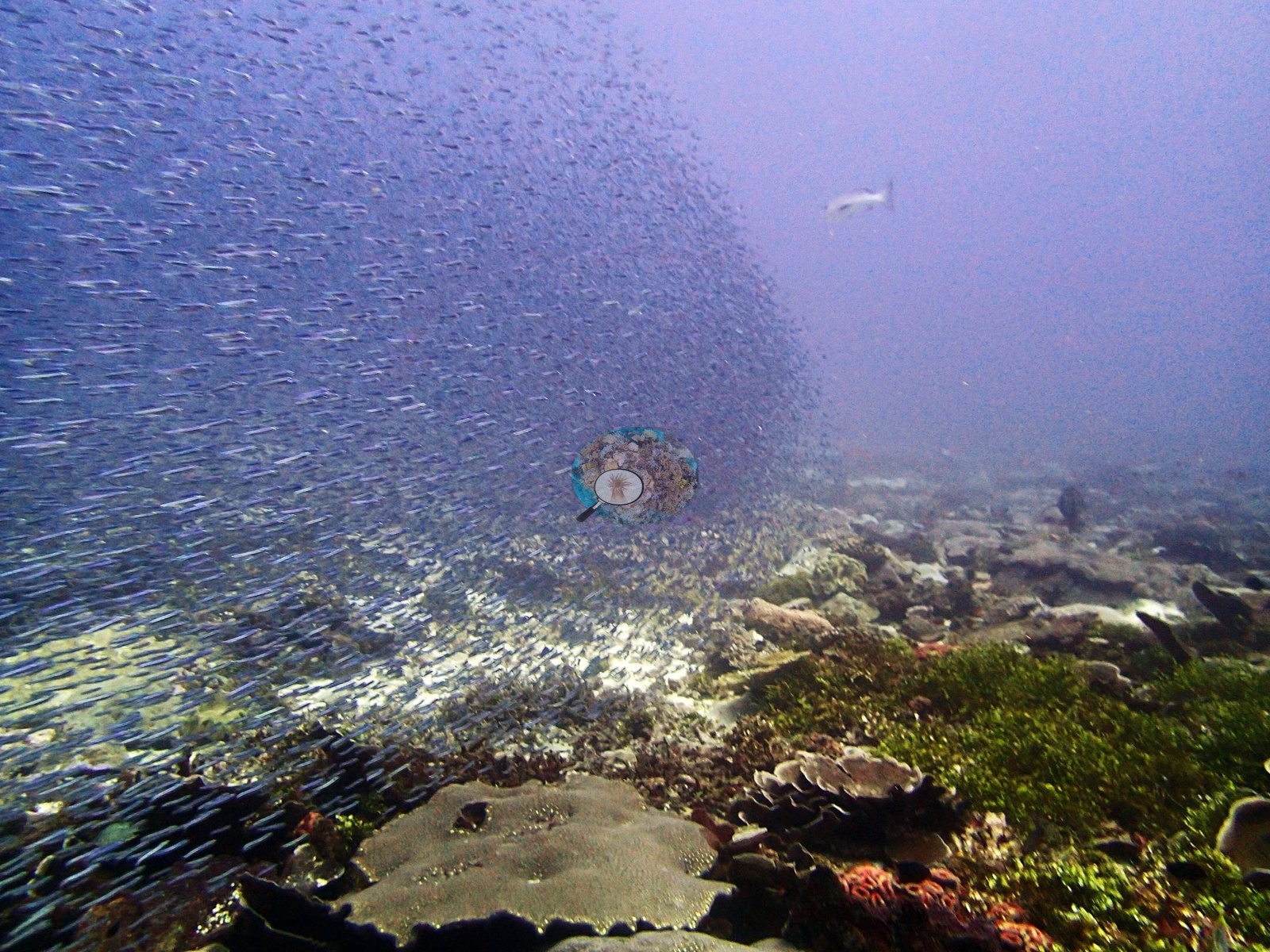
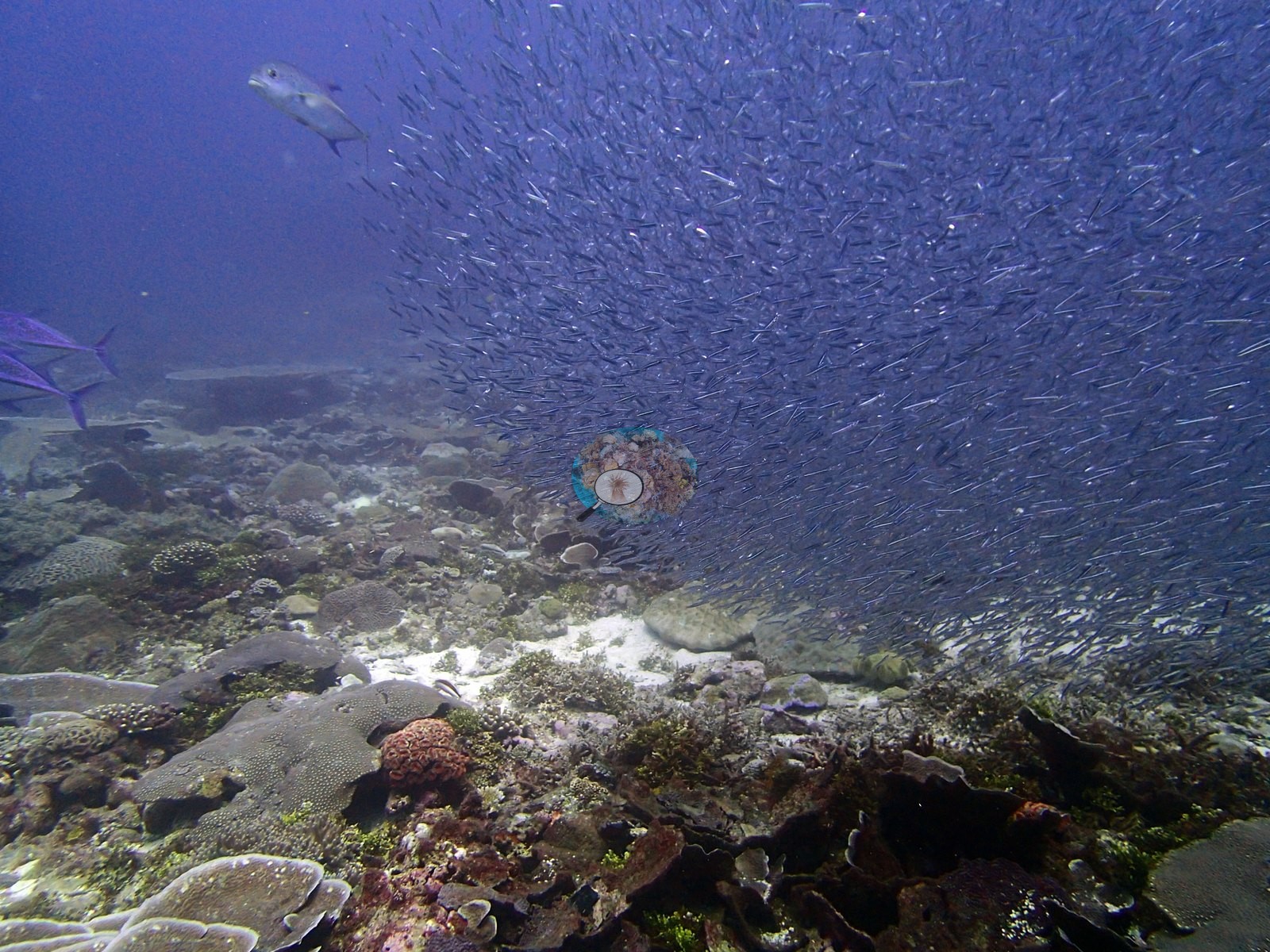
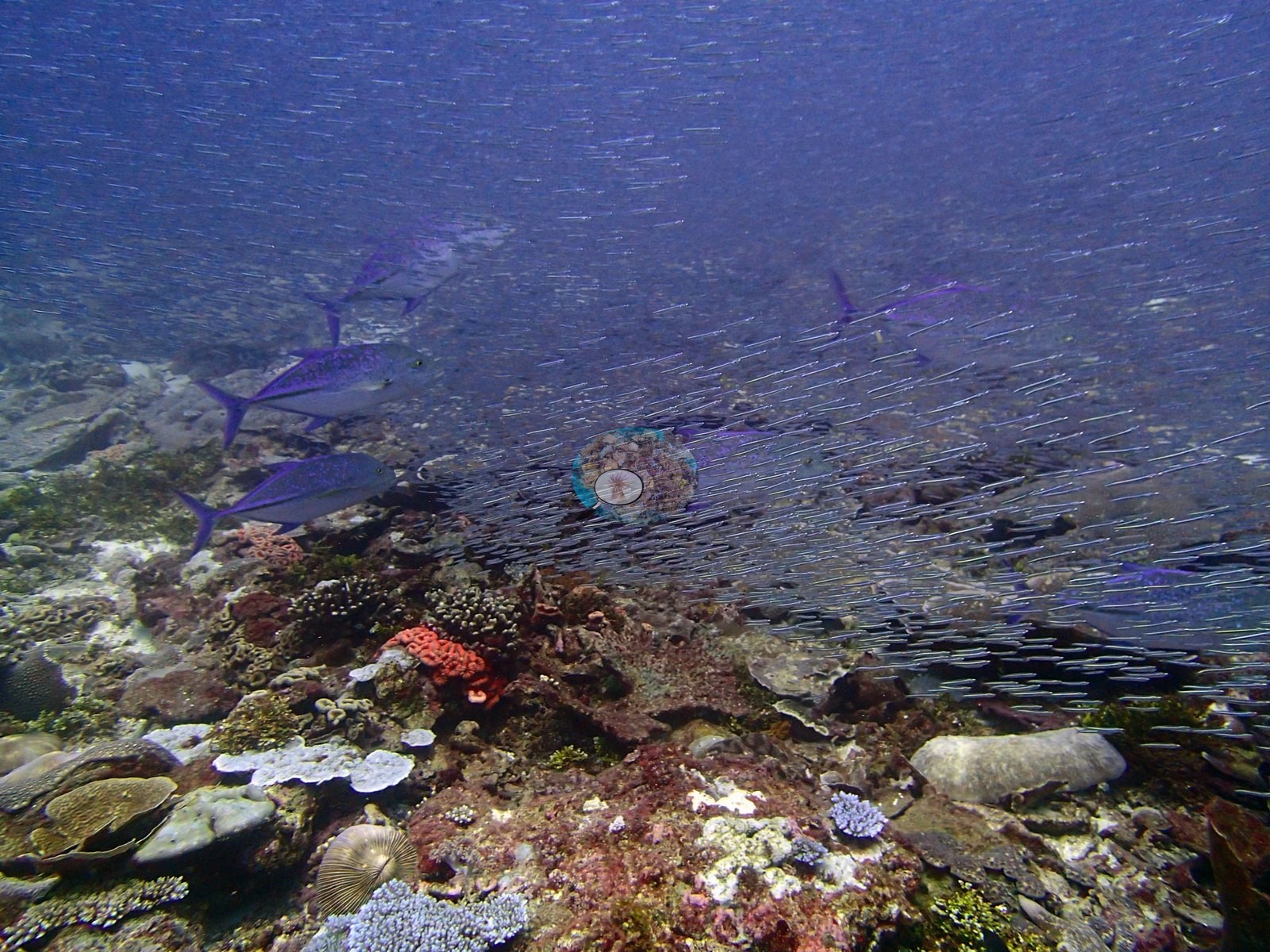
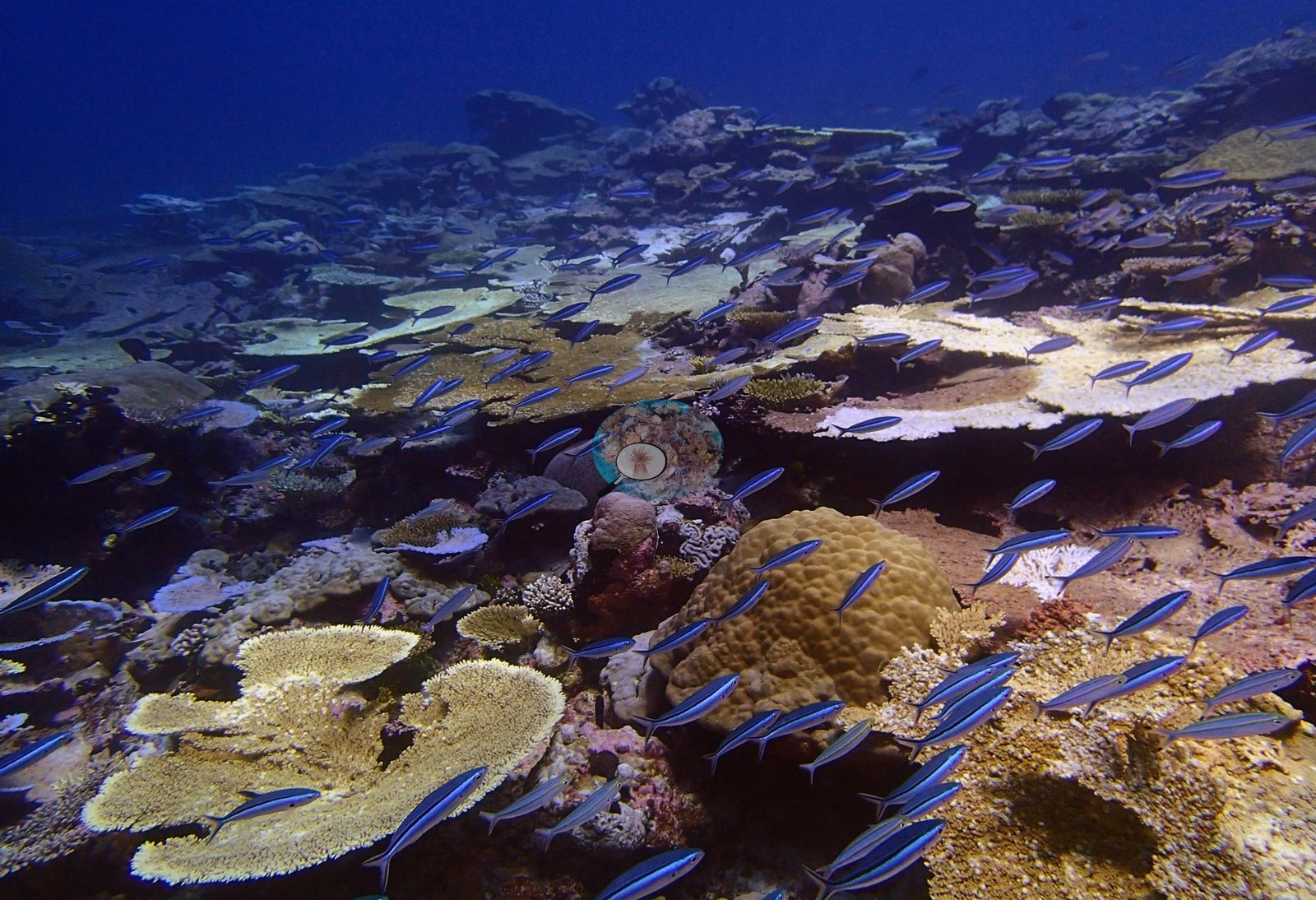
The first four frames (P4170791–P4170794) are shot into dense clouds of silversides over a lower, more mixed pavement of encrusting and foliose colonies, orange and red sponges and green fleshy algae, with bluefin-trevally-type jacks working the bait ball in P4170793; streams of blue-and-yellow fusiliers or anthias thread the coral canopy in P4170850–P4170851 and P4170861, and reef sharks cruise past divers in several wide shots. P5010912 is a stand of pale knobby-columnar colonies; P5010915 shows encrusting pink coralline pavement with a resting octopus or moray hidden among boulder coral; and P5010928 is water column only — two divers deploying a white PVC quadrat frame in blue water, no benthos.
Comparisons with other data
No prior survey data from this site. If you would like to share yours, please email us.
Dive record
The site was dived twice.
Survey summary
BIPB70 (Peros Banhos): surveyed twice, Apr–May 2015; bleaching rose from 3.7% (mid-April) to 33.3% of coral (early May) as the 2015 bleaching event set in (CoralNet analysis of informal survey images; Mayfield & Dempsey 2026, Oceans). Surveyed during the Khaled bin Sultan Living Oceans Foundation Global Reef Expedition.
CV model comparison
More info
Those are point counts on the photographs; this is a diver swimming a transect. The models and the reference never saw the same thing. ⚠ SITE-LEVEL ONLY. The 2,500 frames were not associated with any transect taken within 200 m of them, so transect-vs-image comparisons are site means, never frames. The transect value is already in the pin `cover` field (109 of 112 pins, sourced to the paper's suppl. S1) and is read from there, never re-imported. The transect is THE coral-cover value for this site and stands alone. The rows below it are a methods comparison only: no computer-vision value is averaged with it, feeds the headline, or carries over to the site's cover figure (Anderson, 2026-09-22).| Method | Hard-coral cover (%) |
|---|---|
| Transect (published) | 60.3 |
| CoralNet | 45.1 |
| In-house DINOv3 | 40.2 |
| CoralSCOP edited | 35.7 |
| Claude | 34.9 |
Dive history
Coral bleached: computer-vision (CoralNet) estimate from the survey images, per dive, as published in Mayfield & Dempsey (2026), supplemental file S1.
| Date | Time in | Max depth (m) | Bottom time (min) | Coral bleached (%) |
|---|---|---|---|---|
| 2015-04-17 | 10:18 | — | 61 | 3.7 |
| 2015-05-01 | — | — | — | 33.3 |
Data & links
- Read the full site report ↗
- Download benthic survey data (CSV) ↗
- Download all LOF-GRE data (933 sites) ↗
- CoralNet image repository for this region ↗
- Photo portfolio ↗
- Coral Reef Diagnostics page for this area ↗
All images from Coral Reef Diagnostics. Data are from Coral Reef Diagnostics.
 © Coral Reef Diagnostics.