
Part of the regional summaries: Chagos Archipelago - Peros Banhos and Chagos Archipelago
More info
Chagos (NOAA CRW virtual station)A genuine "great dive" (the field folder's own name): one of Chagos's most coral-rich reefs at 60% cover, carried almost entirely by Acropora and plate-forming Echinopora. Remarkably for Chagos, Porites is nearly absent, and the shallowest transect is a 94% Acropora monoculture. Surveyed on the Living Oceans Foundation's Global Reef Expedition.
Four independent survey stations shown with the program’s logo — click one to see how far it is from this site.
Three other CRD dive sites within 5 km shown in orange — click a marker to open its page.
🗺 Detailed map of the Global Reef Expedition dive sites, Peros Banhos, Chagos (Khaled bin Sultan Living Oceans Foundation; opens in a new window)
45 of these 47 photographs are shown beside the text that discusses them under "Site description" below.
Site description
Setting
BIPB62 is one of the most coral-abundant reefs in the archipelago and the folder name — "great dive" — is not an exaggeration.
General benthic features
It is also strikingly clean ground: non-coral invertebrates hold just 1.1% of the benthos (105th of 109) and crustose coralline algae 4.3% (104th of 109), with bare substrate at 10.1%, turf 14.1%, and erect algae 8.5%. Almost everything here is living coral or turf (e.g., Image 7, Image 19, Image 37, Image 39).
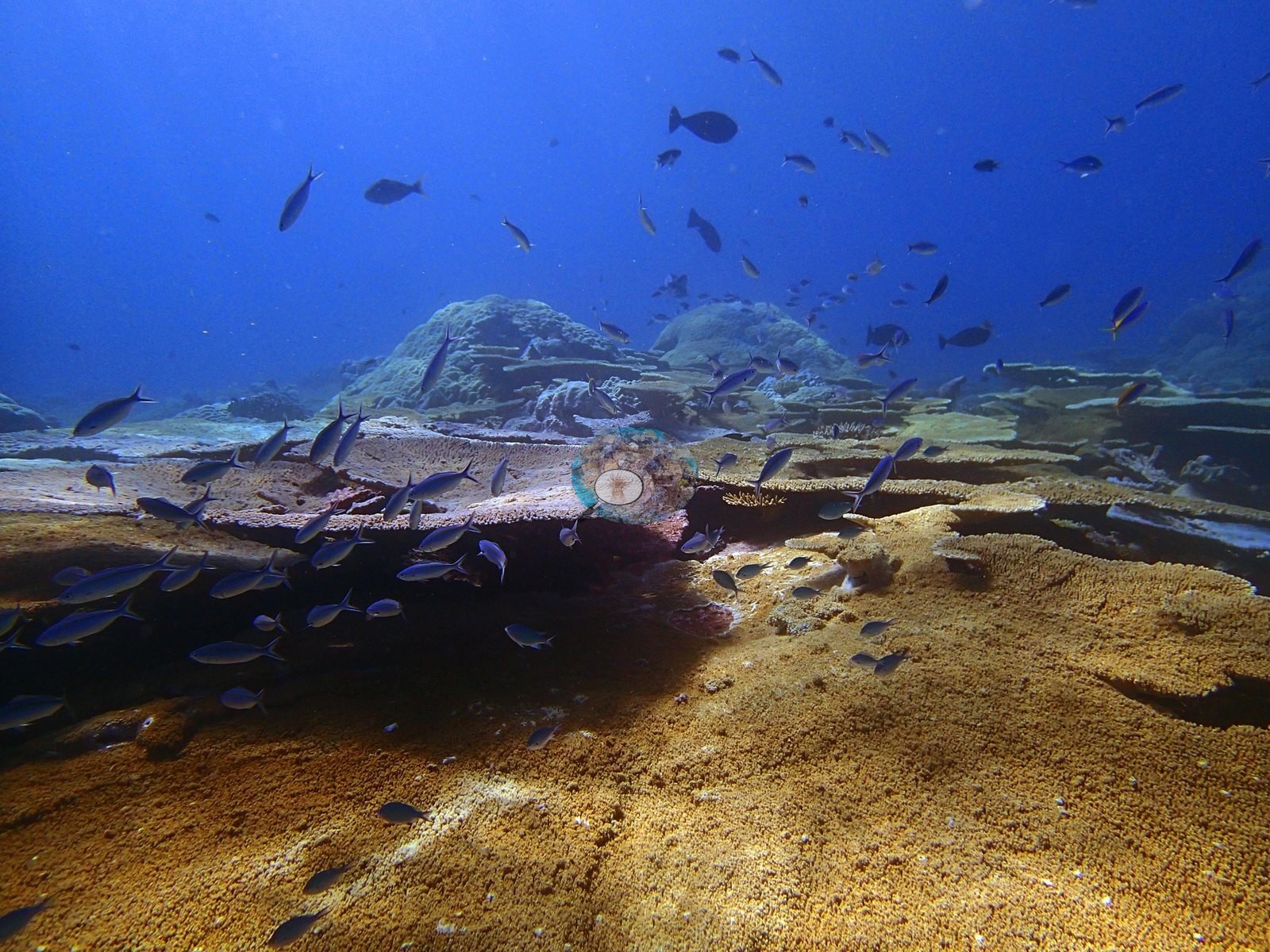
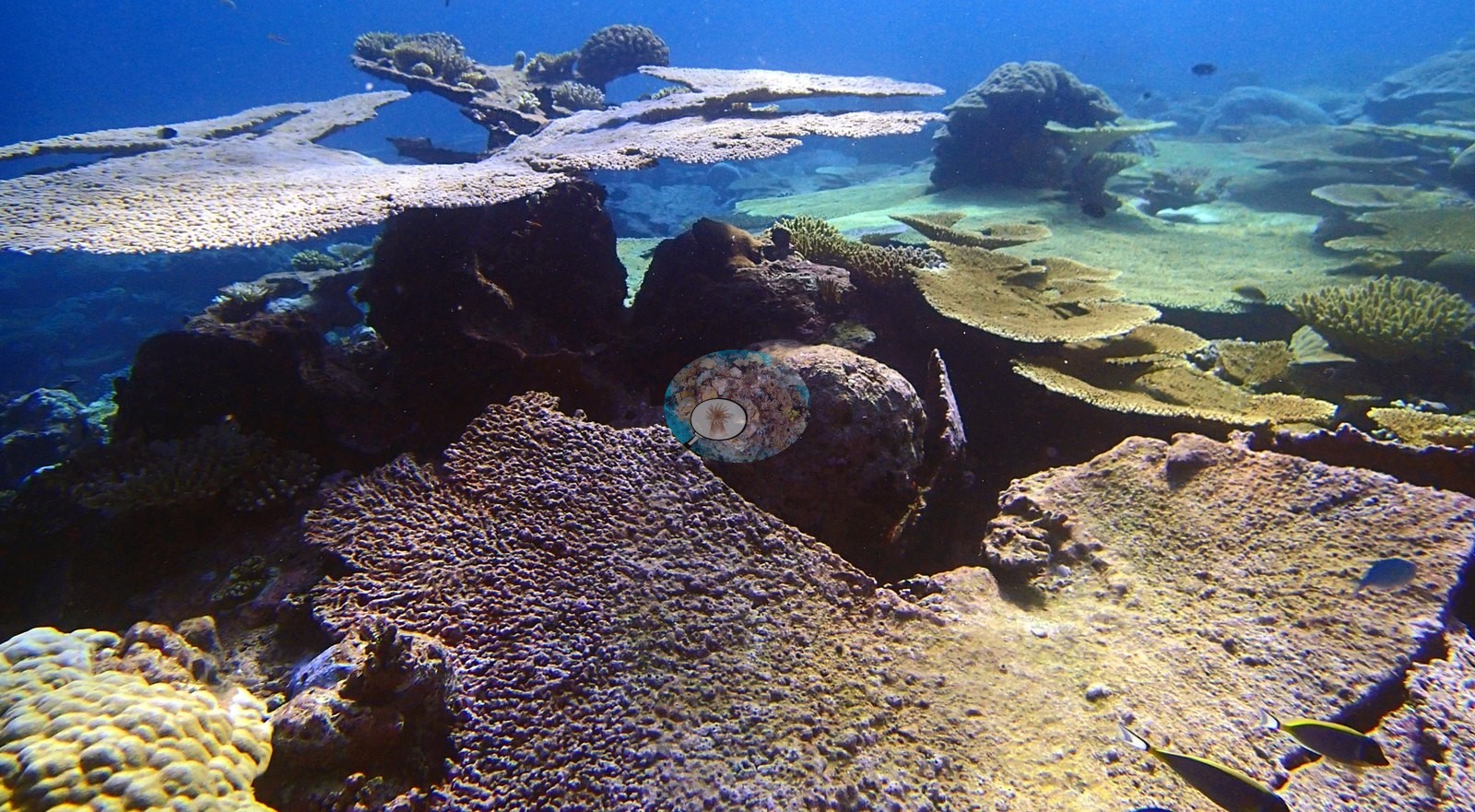
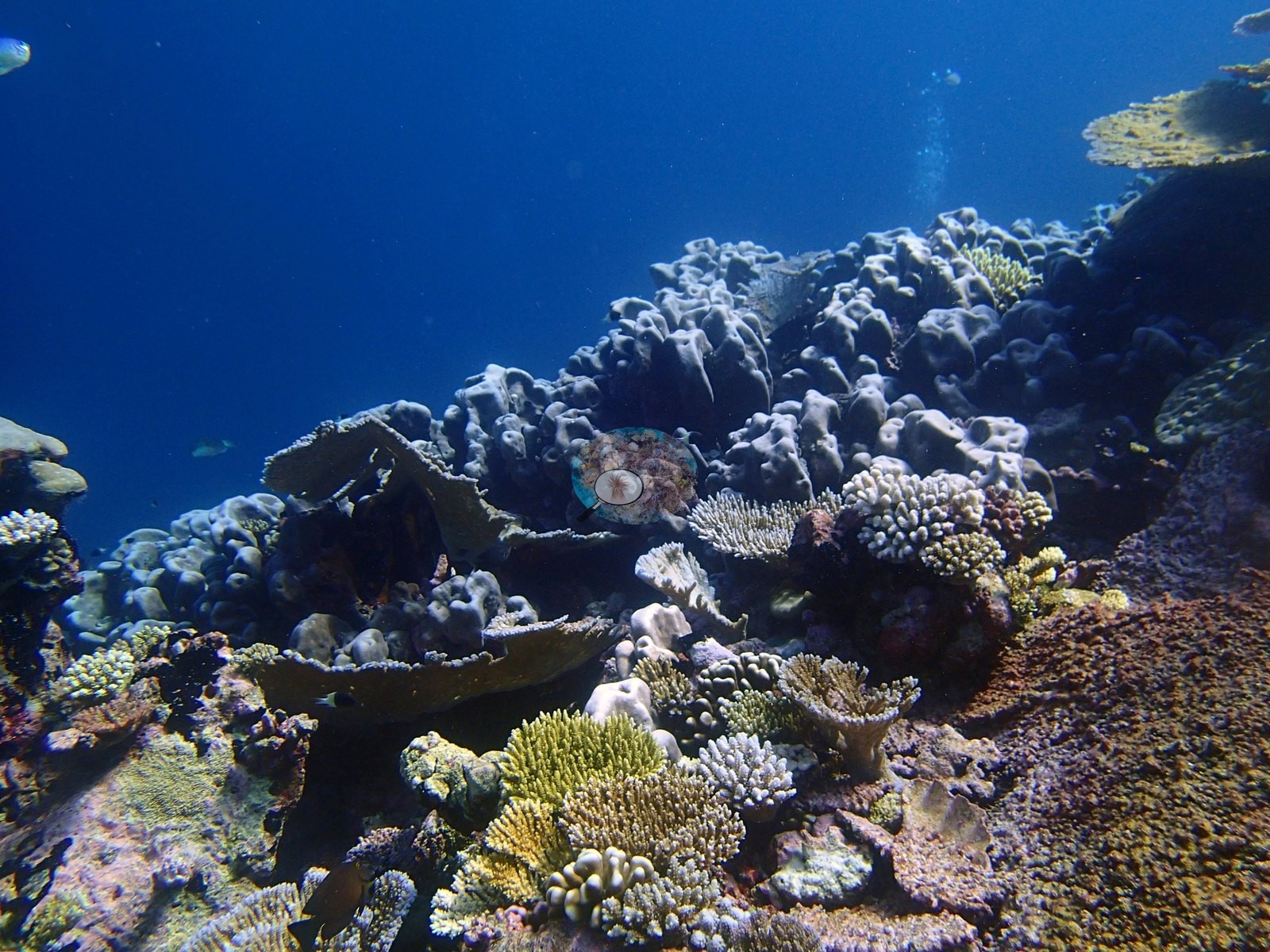
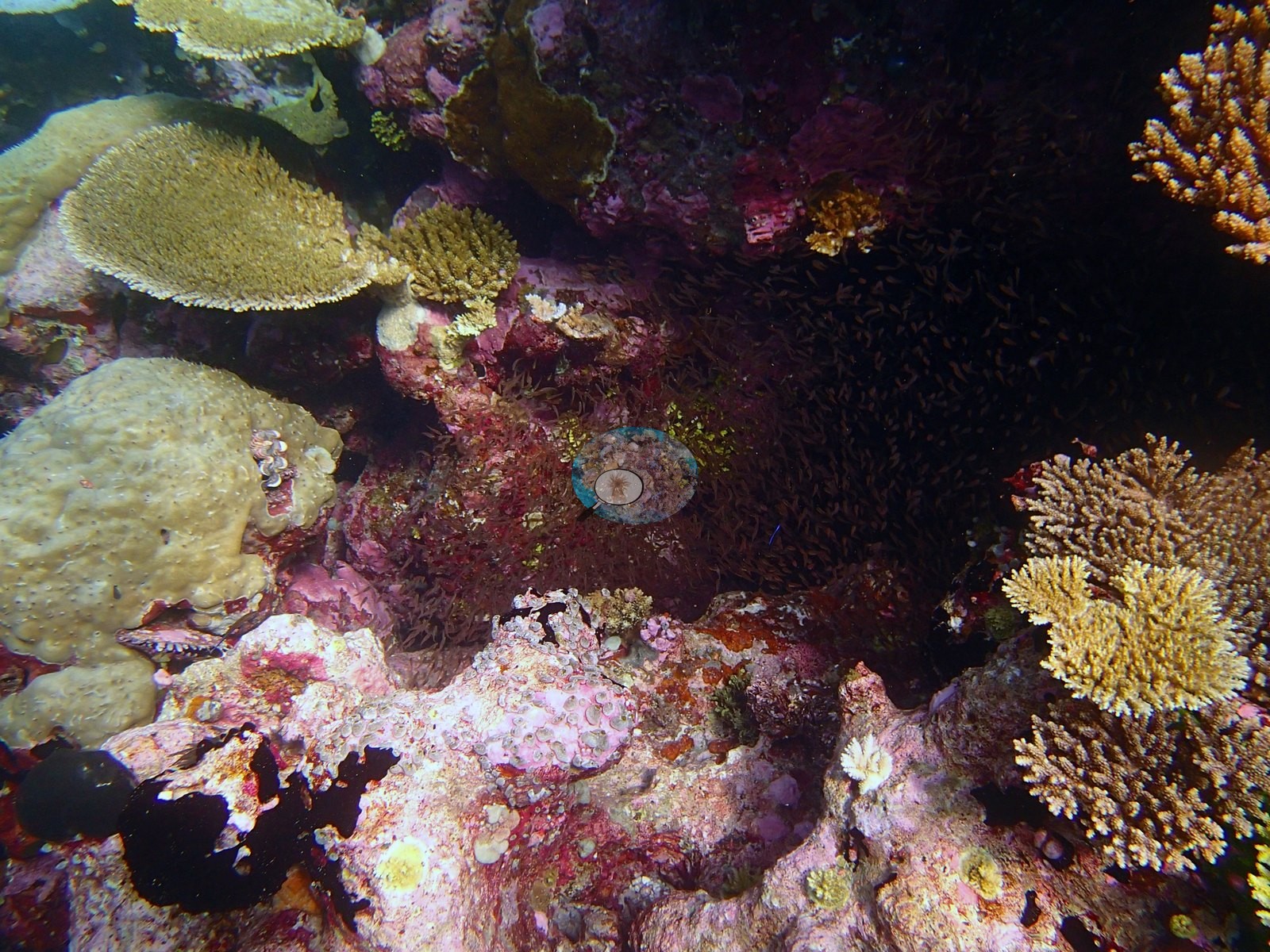
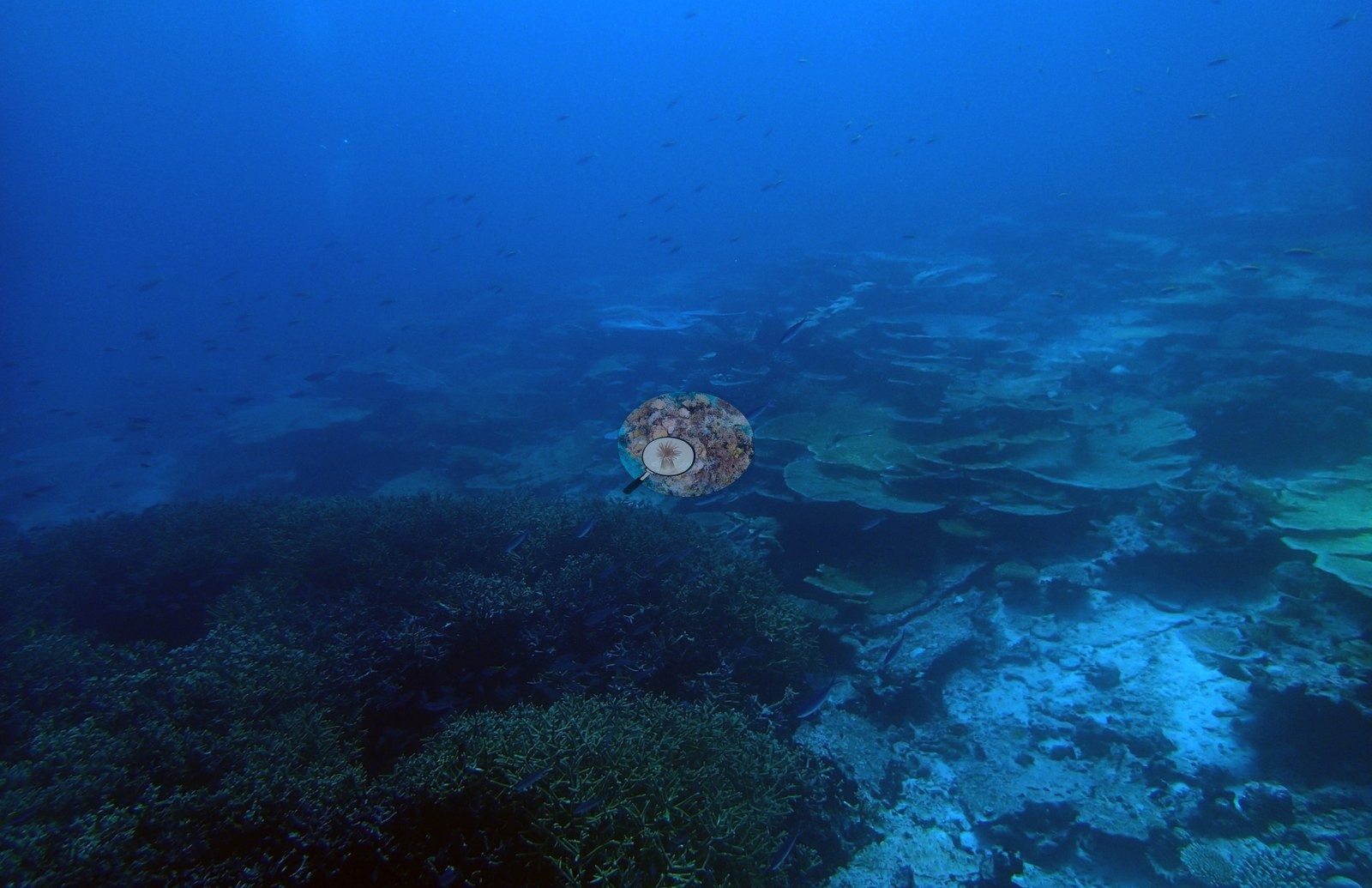
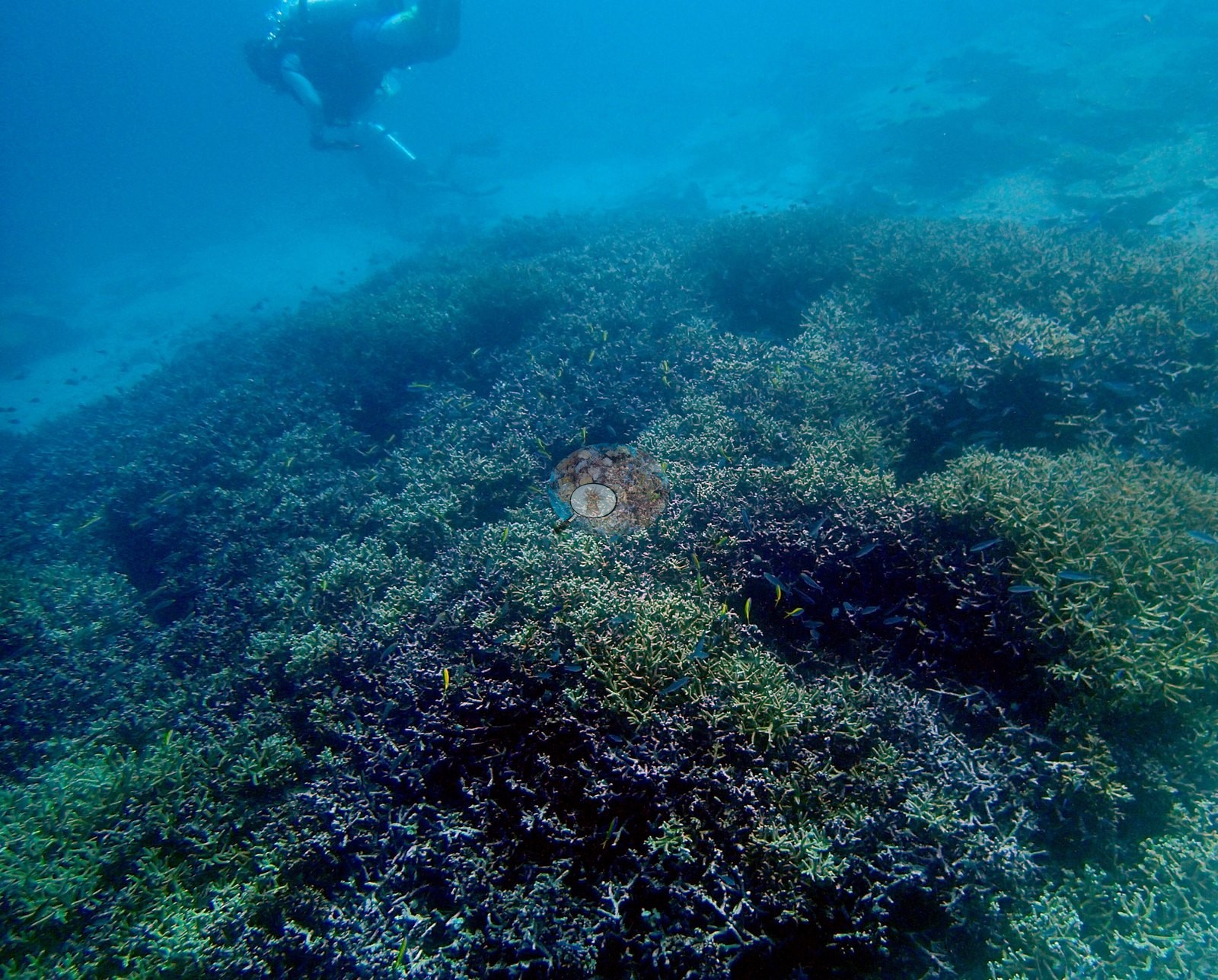
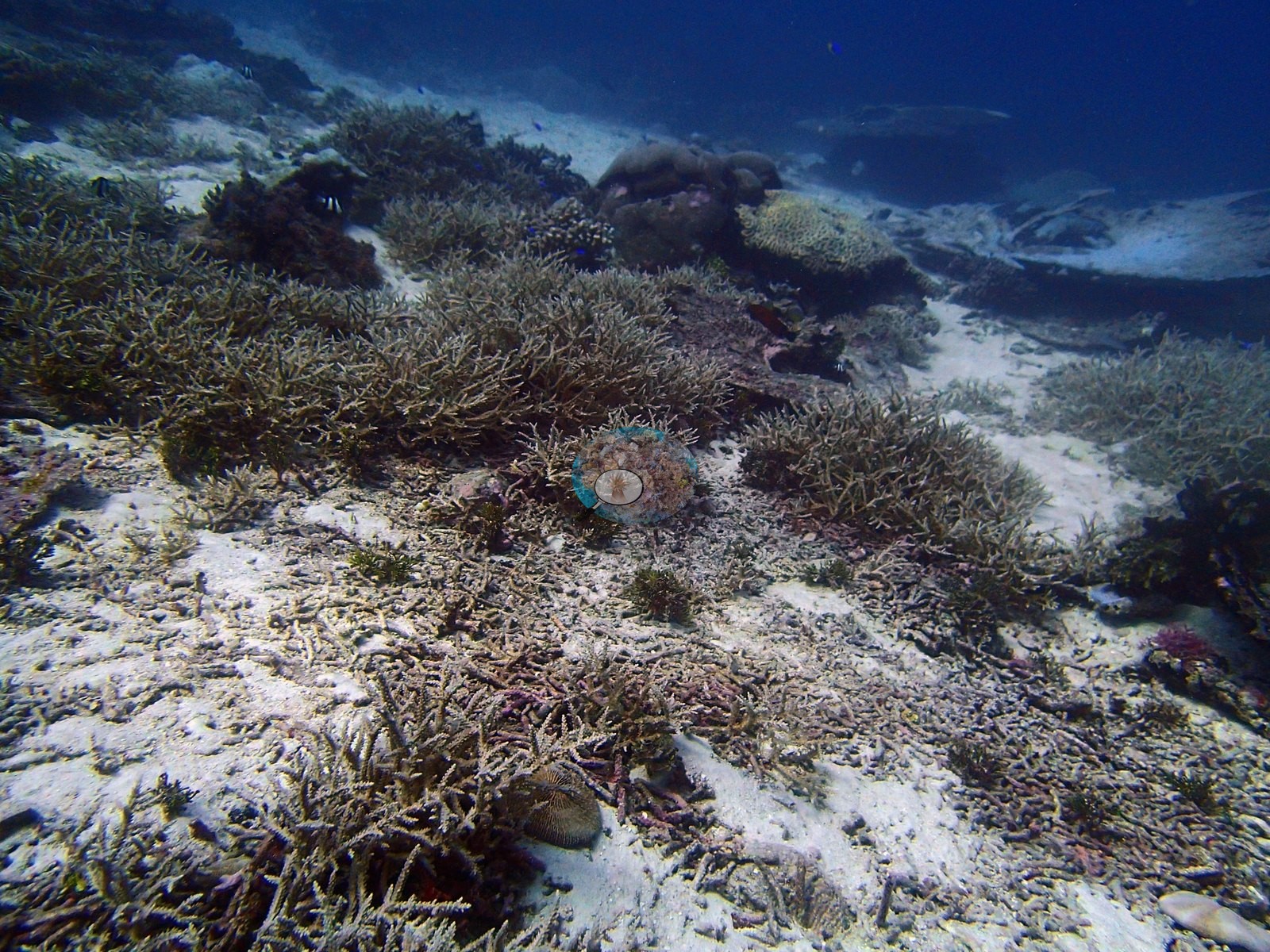
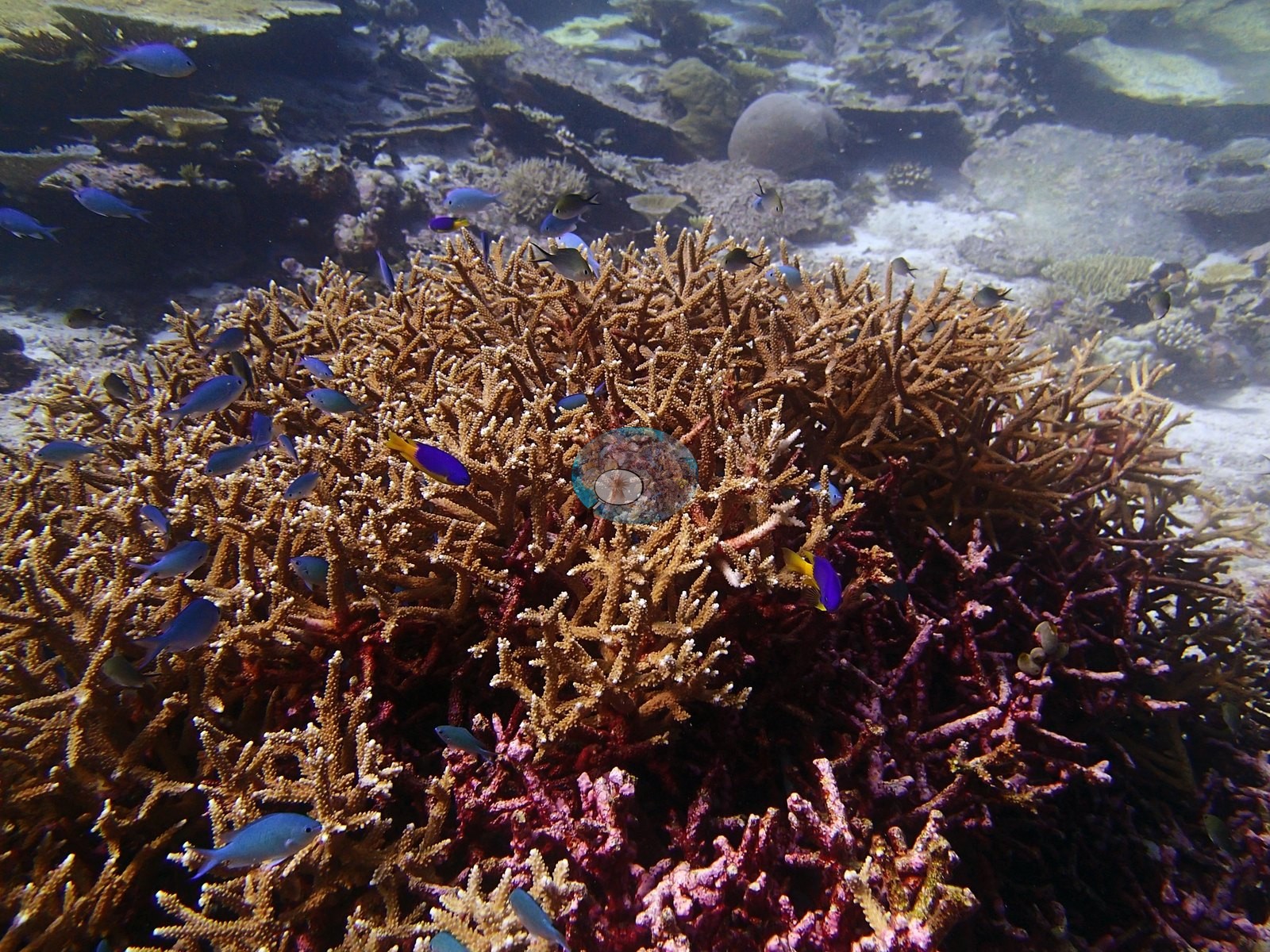
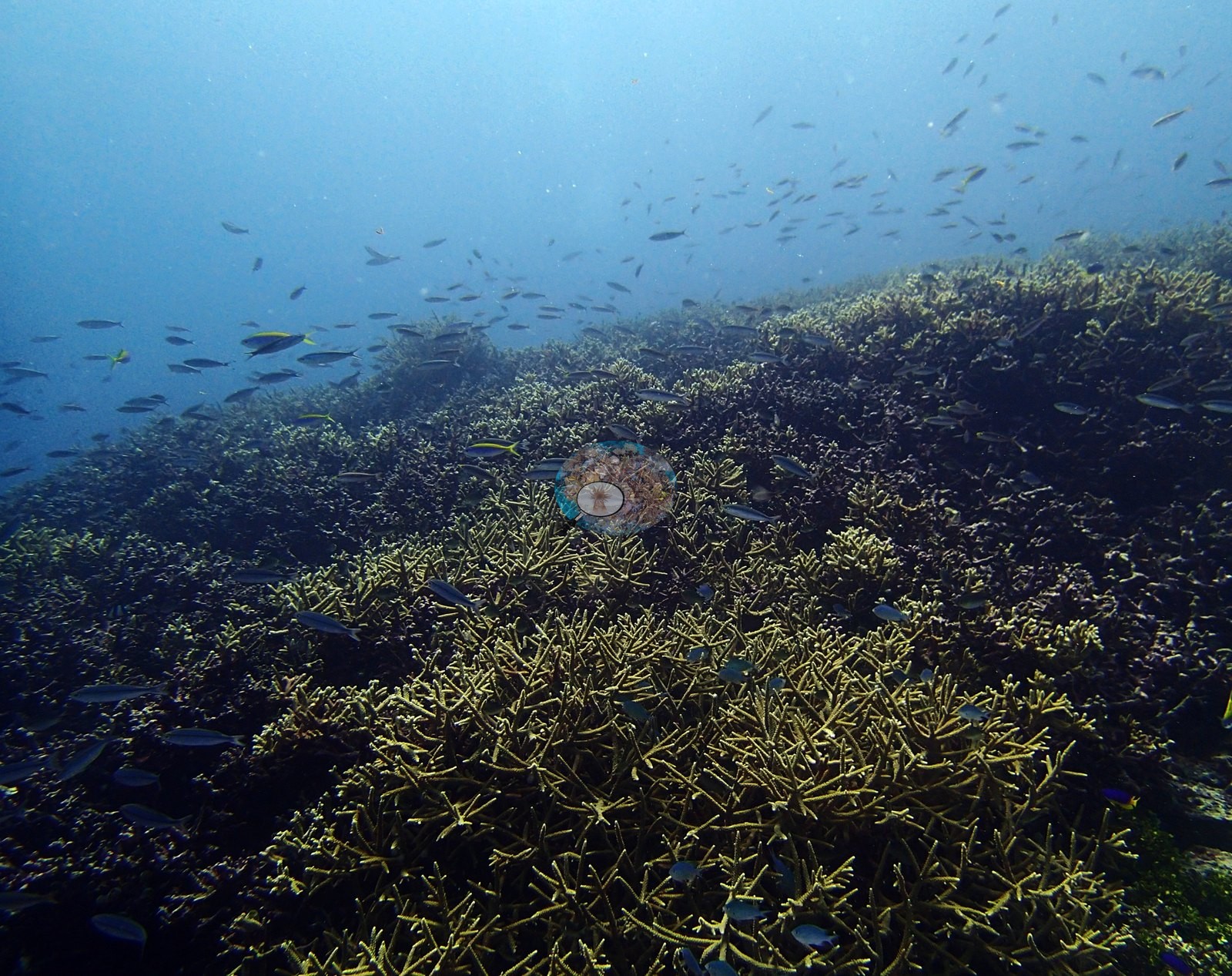
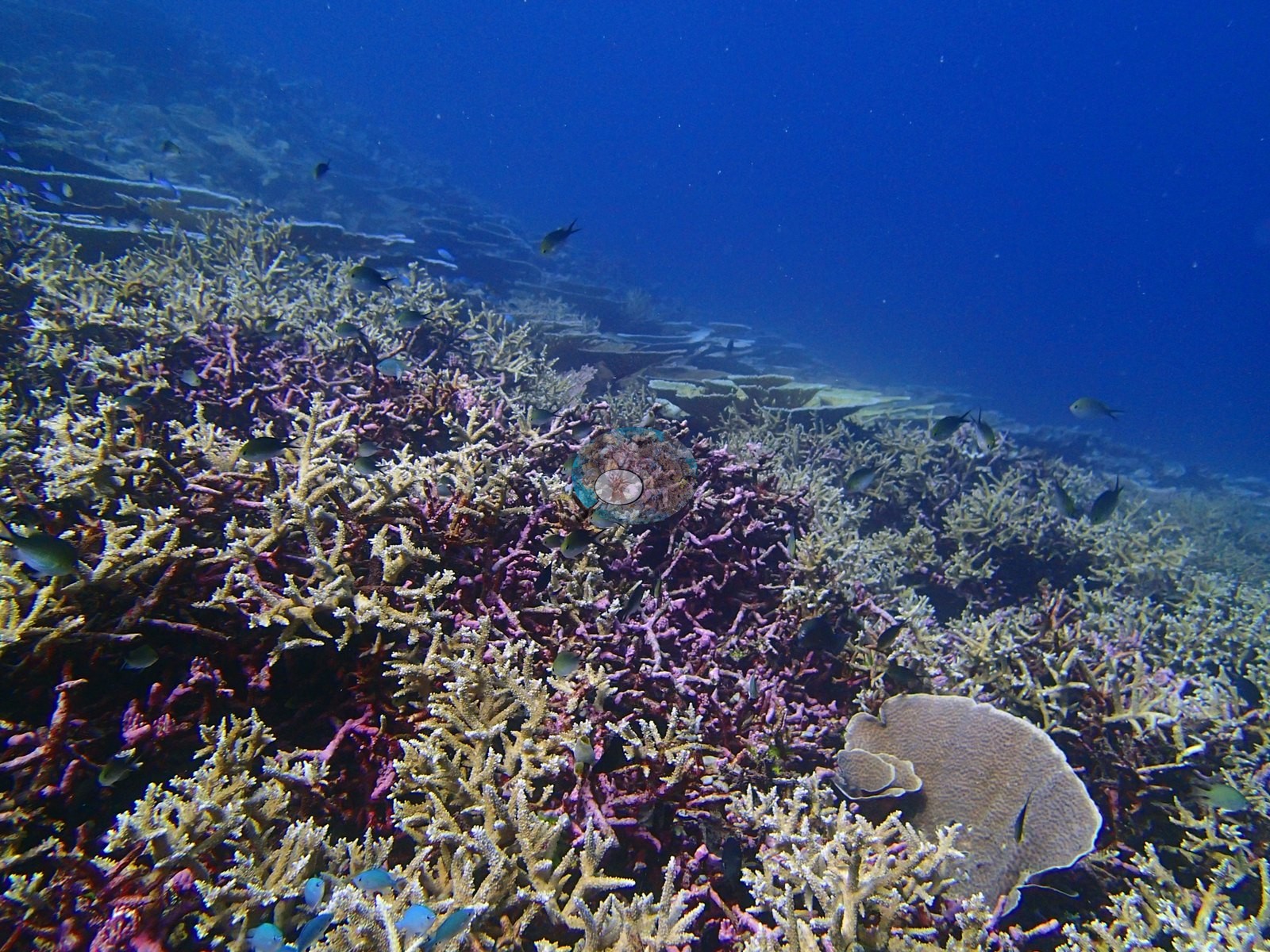
The assemblage is carried by two genera and only sixteen are non-zero. Acropora holds 22.13% of the benthos and Echinopora 19.25% — together 69% of all coral recorded — with Montipora third at 7.00% and Favia fourth at 4.94%. Then Lobophyllia 1.88%, Halomitra 1.25%, Platygyra 0.75%, Pocillopora 0.50%, Fungia 0.44%, and Porites at just 0.38% — a near-absence that is remarkable for Chagos and the single most surprising number in this dataset. Cynarina, Ctenactis, Favites, Cyphastrea, Stylophora, and Symphyllia fill out the tail below 0.32%. The depth zonation here is as extreme as anything in the Chagos set, and it is a two-genus story. D2 carries 65.5% coral of which Acropora alone is 61.50% — 94% of the coral on that transect, an effective monoculture. D3 drops to 50.75% and hands over to Montipora at 24.50% with Acropora second at 19.00%. D4 holds 61.0% and changes genus entirely: Echinopora 23.00% and Favia 19.00%, with Acropora down to 3.00%. D5 holds 61.0% and is a second monoculture — Echinopora at 54.00%, 89% of the coral on that transect*, with Acropora at 5.00% and Halomitra 2.00%, on the site's lowest algal cover of 17.0% and its highest bare substrate at 22.0%. Genus richness collapses at both ends, from ten codes at D3 to three at D5. The site-level figures of 22.13% Acropora and 19.25% Echinopora describe no actual transect: they are the average of a shallow staghorn-and-table reef and a deep Echinopora bank. The photographs document the Acropora half of that structure superbly. The defining frame shows a near-continuous staghorn and corymbose field running to the limit of visibility with a diver above and fusiliers working over it — the visual match to the 61.5%-Acropora D2 transect (e.g., Image 5).
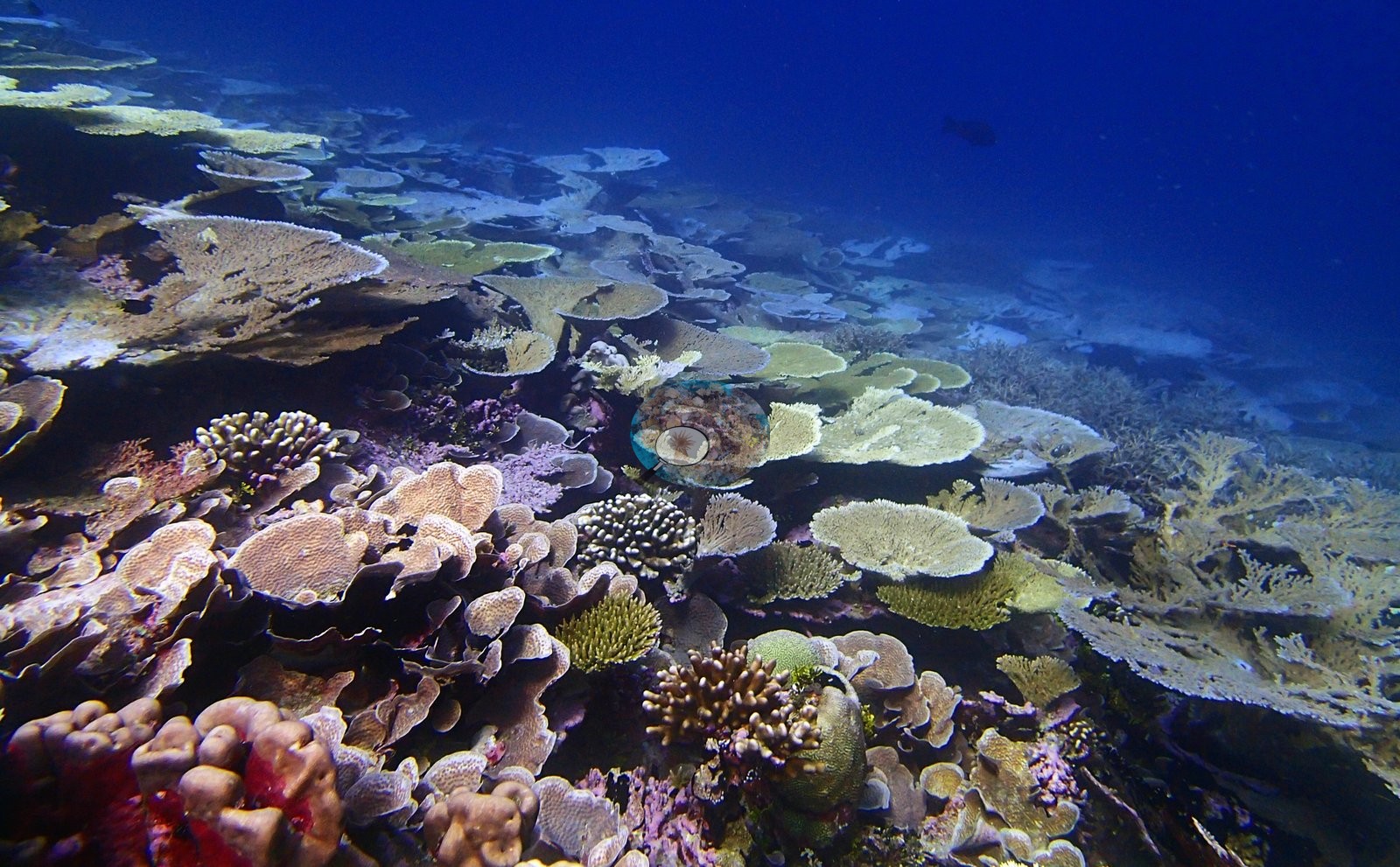
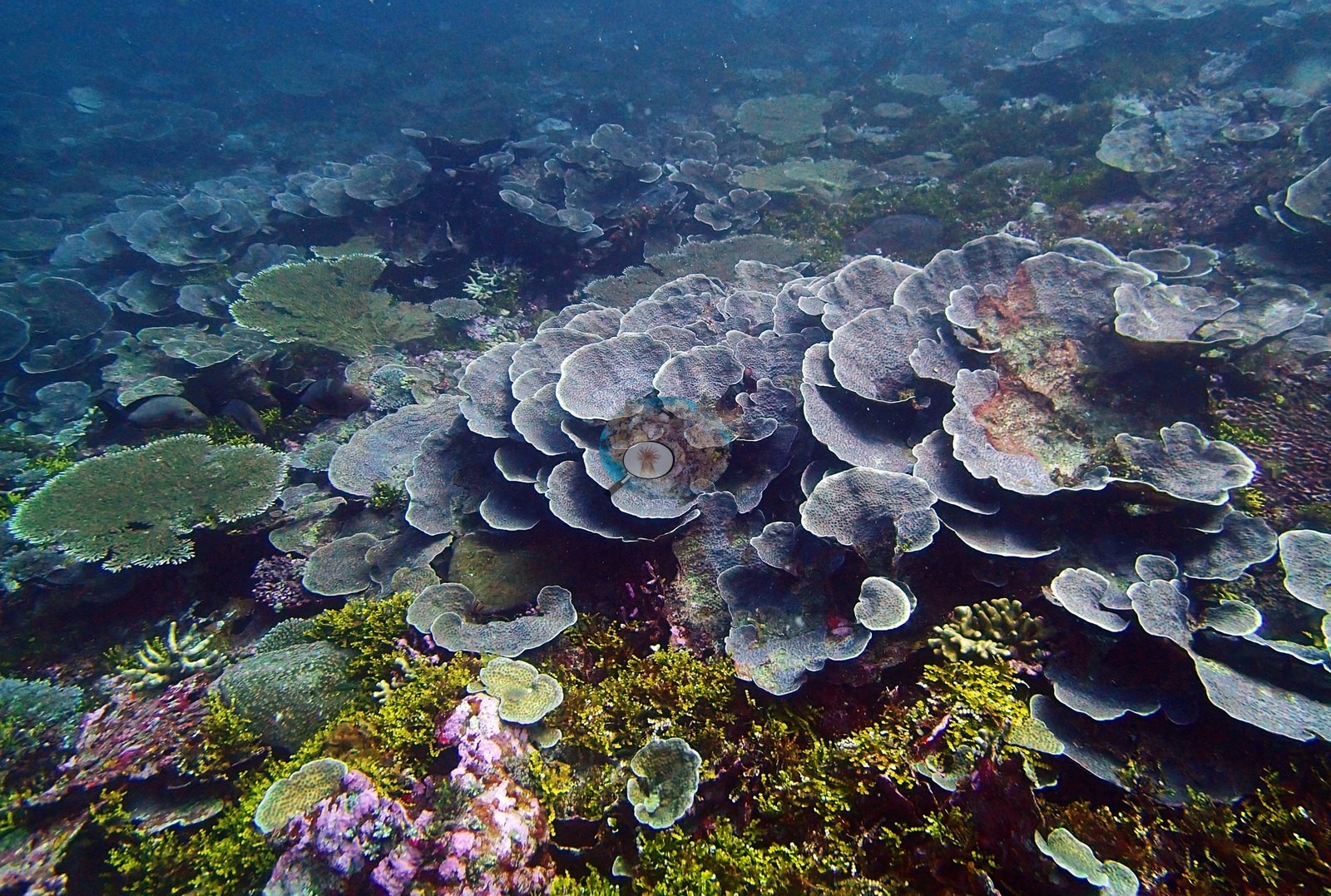
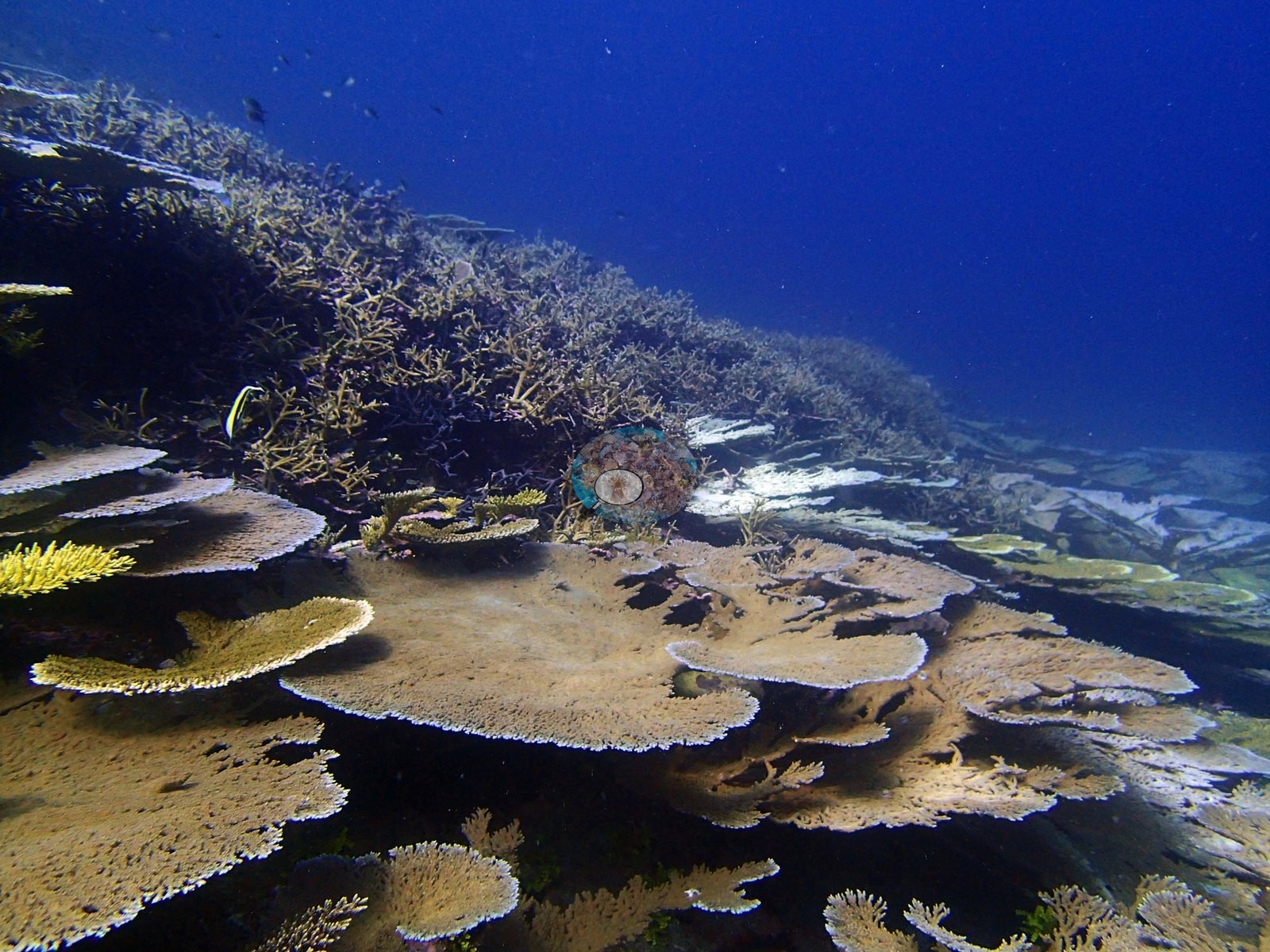
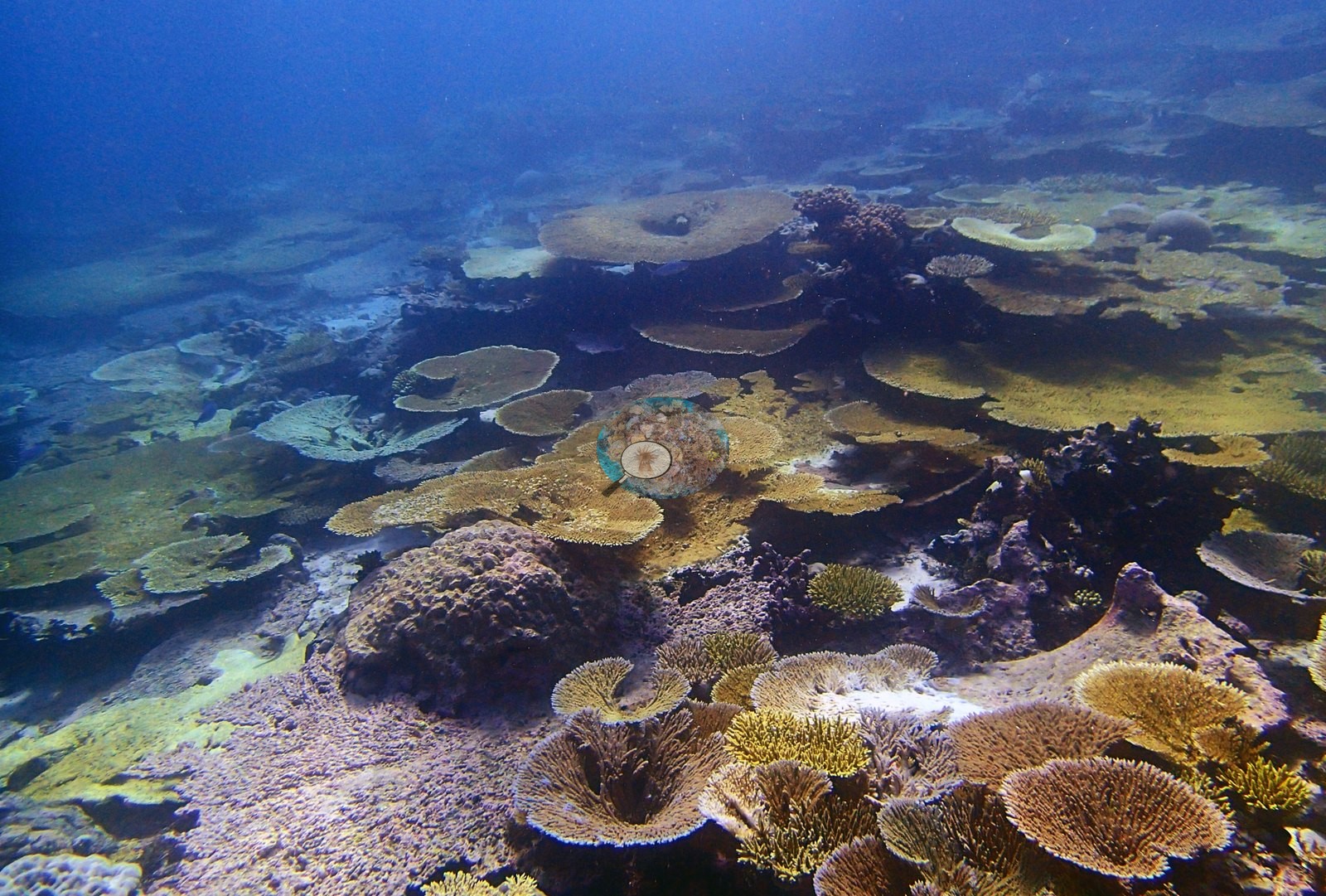
Two frames show the tabular expression of the same zone, large overlapping plates tiled across the slope into blue water, with a big brown massive lobate colony at the margin (e.g., Image 1, Image 13, Image 14, Image 28, Image 33, Image 34, Image 38).
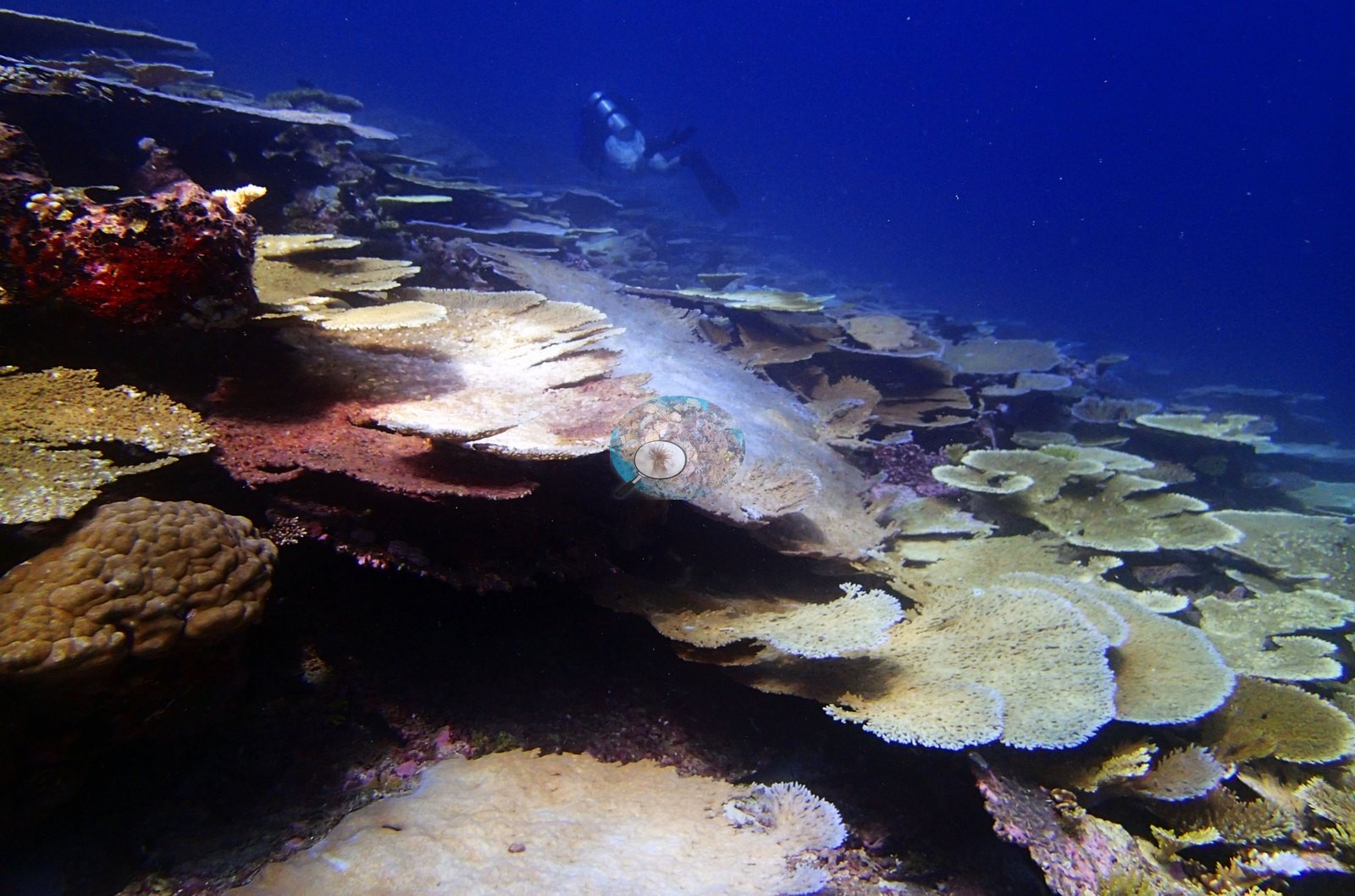
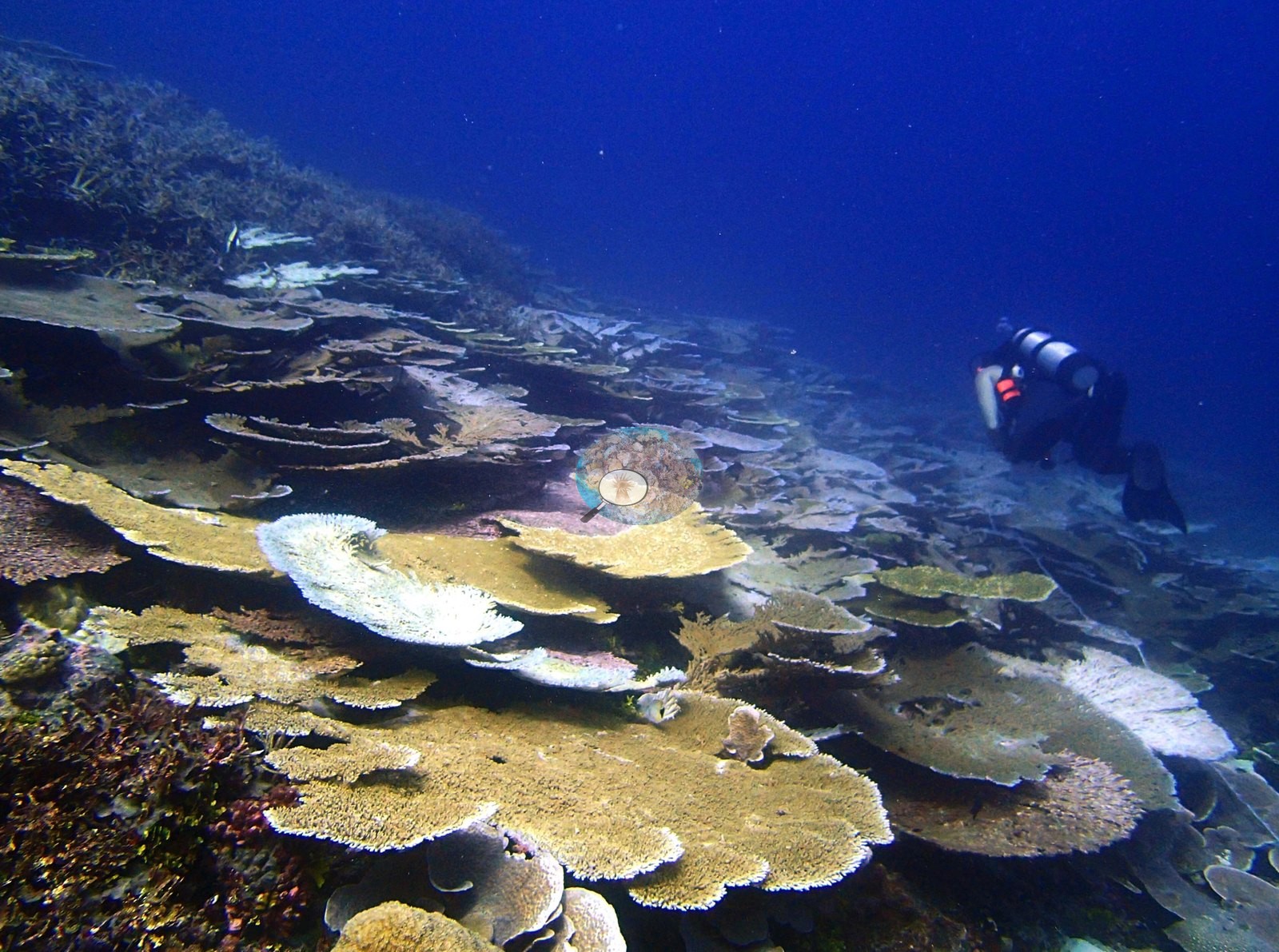
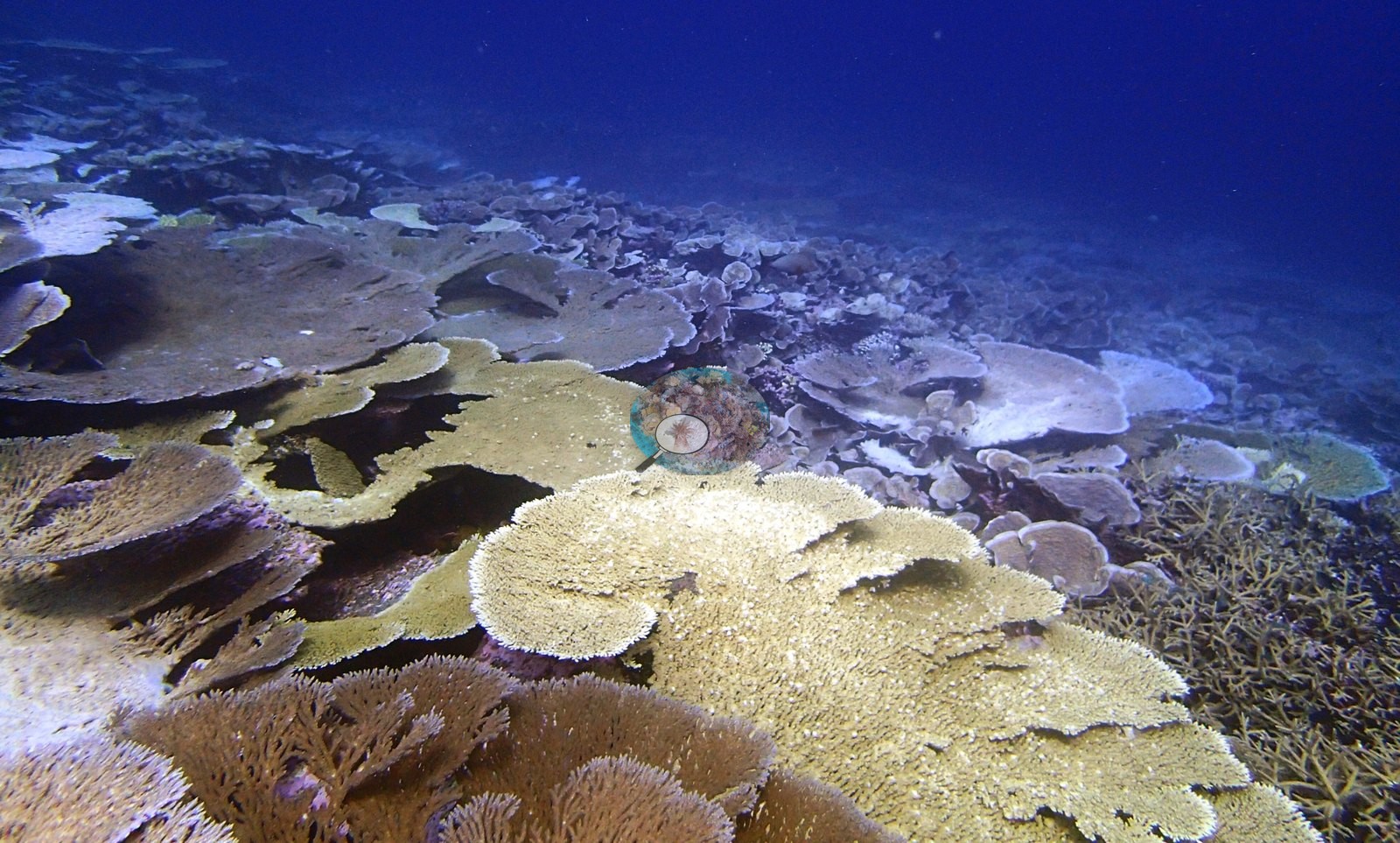
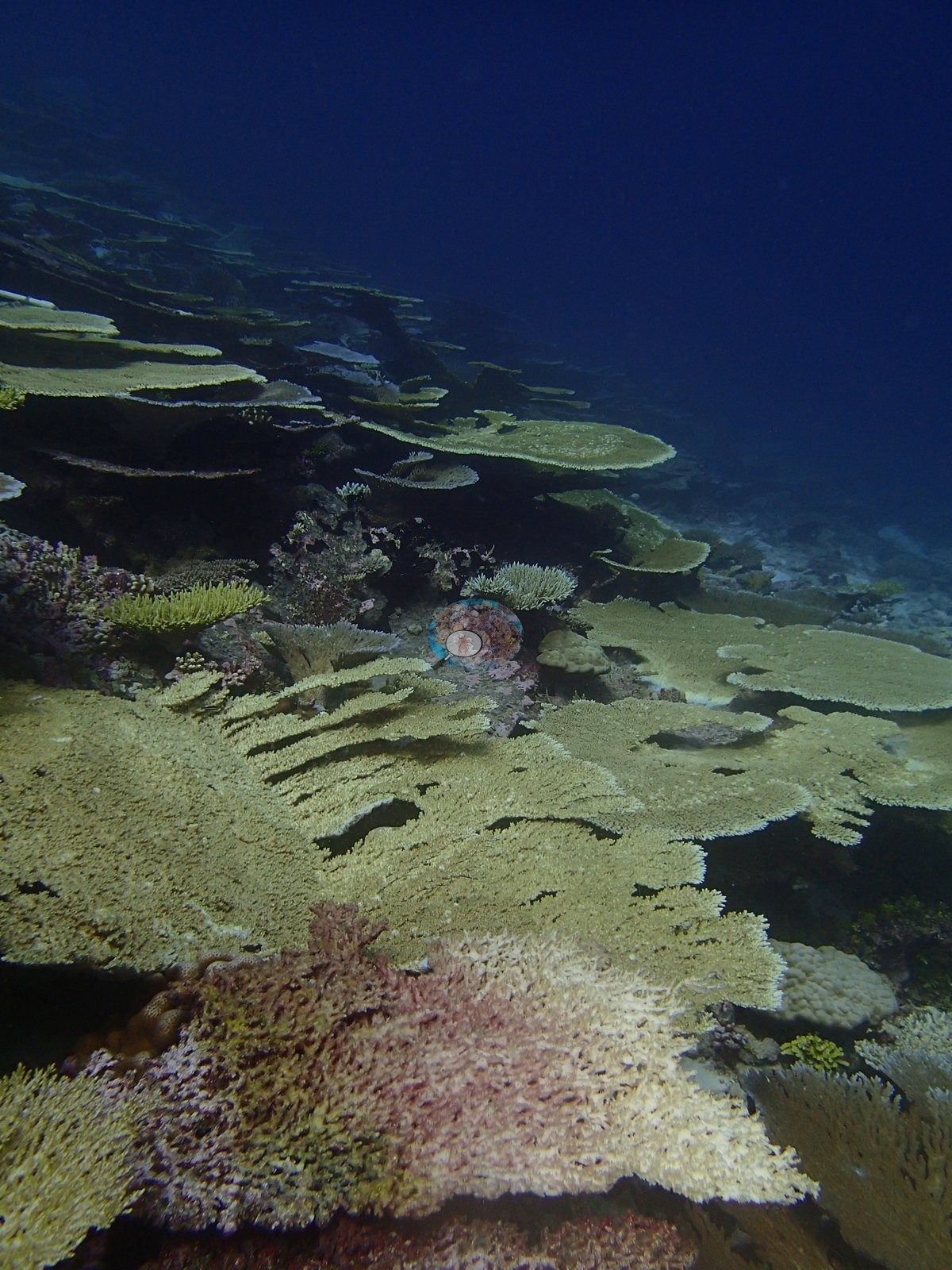
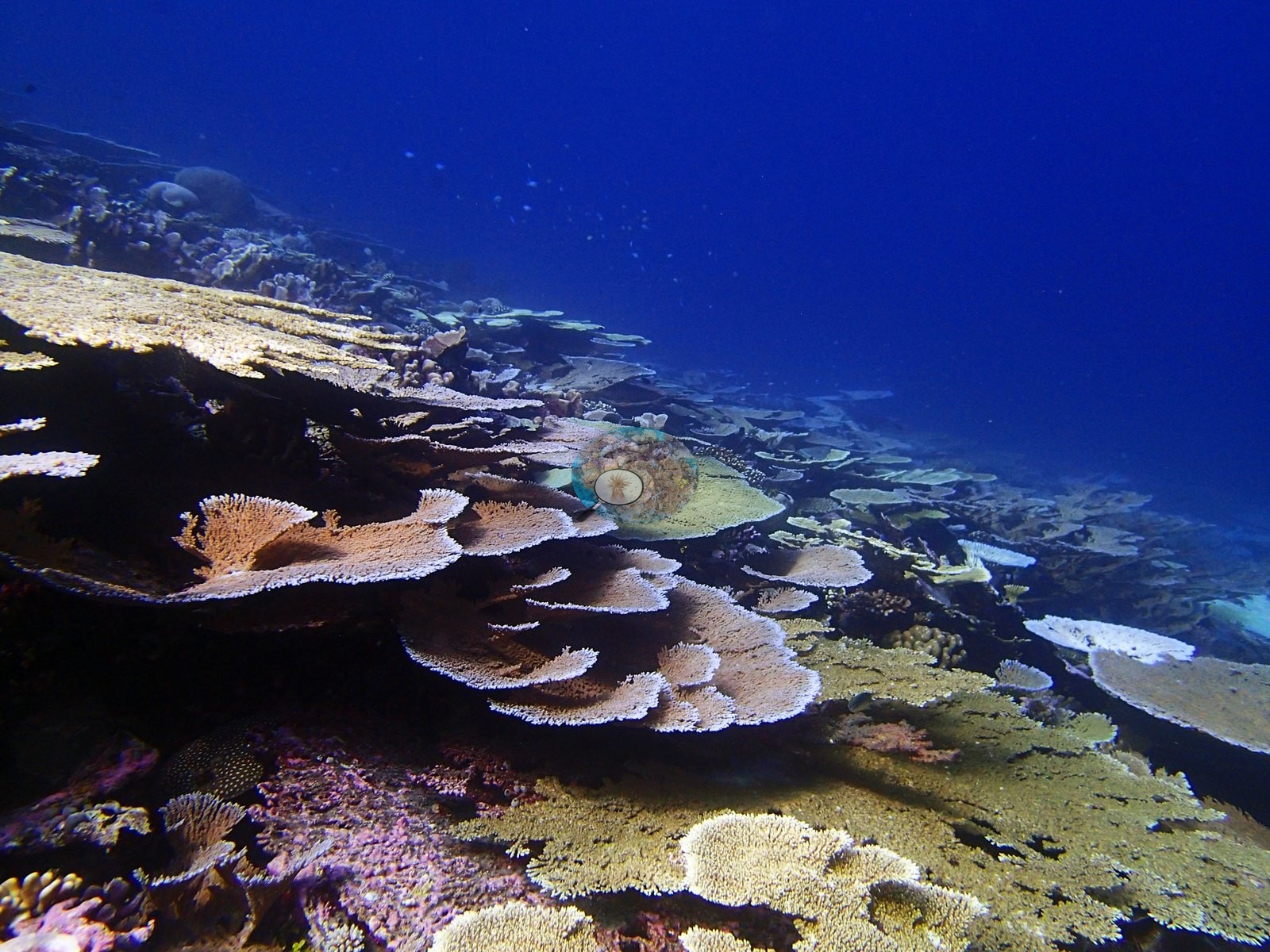
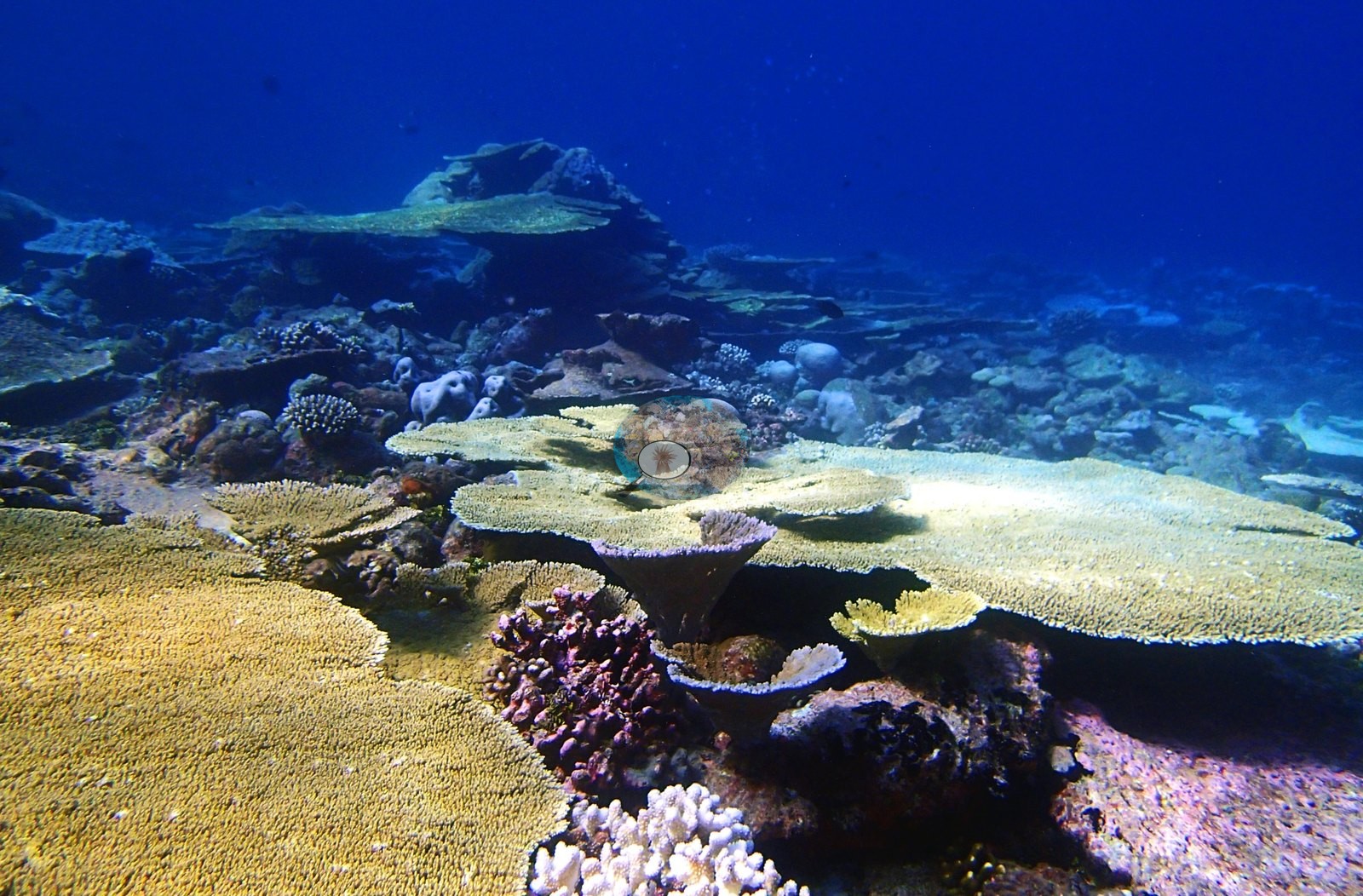
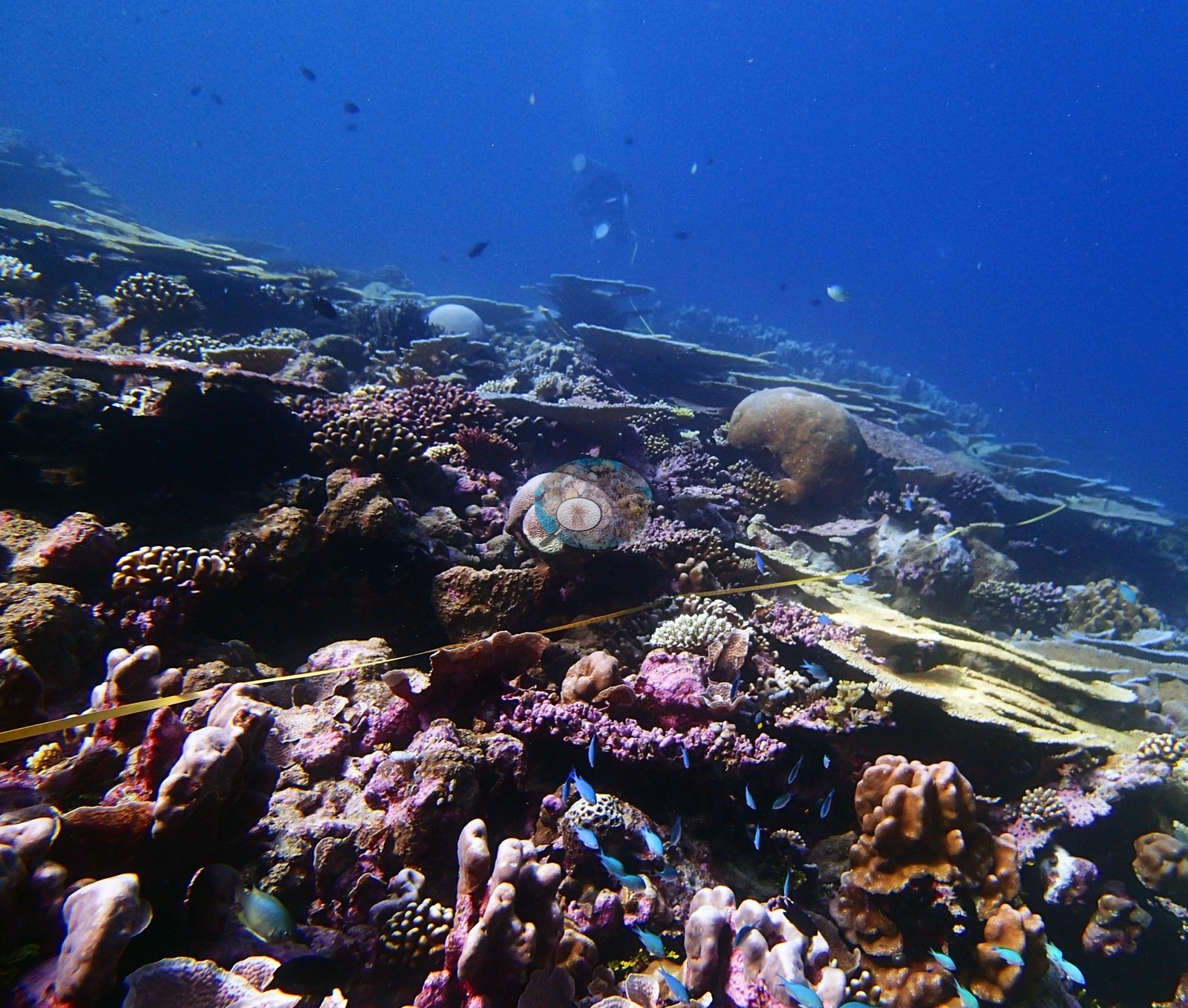
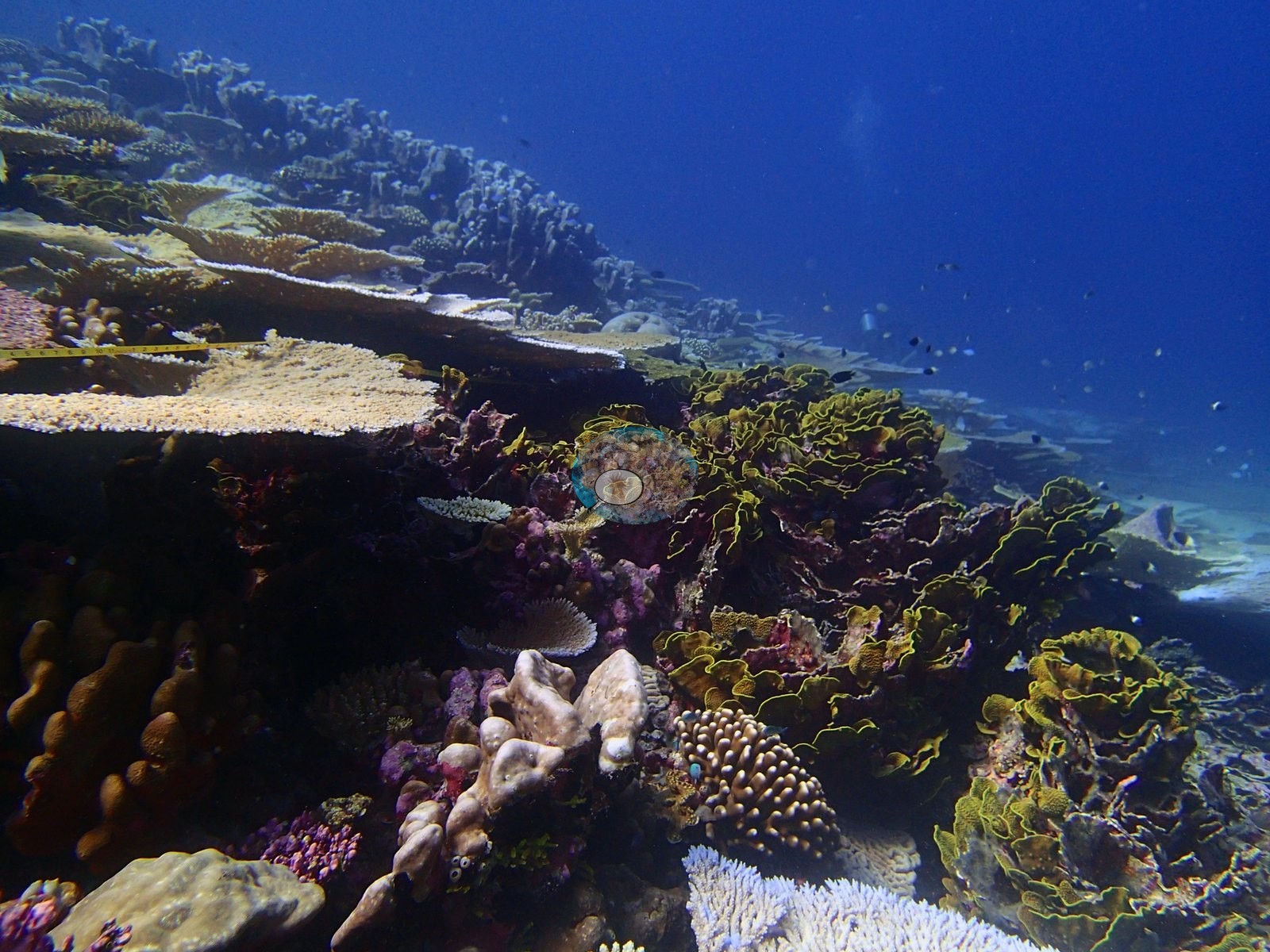
The most photogenic frame shows classic pedestalled tables, one a vivid yellow-green, standing above corymbose colonies and purple encrusting framework (e.g., Image 11, Image 31, Image 41, Image 43).
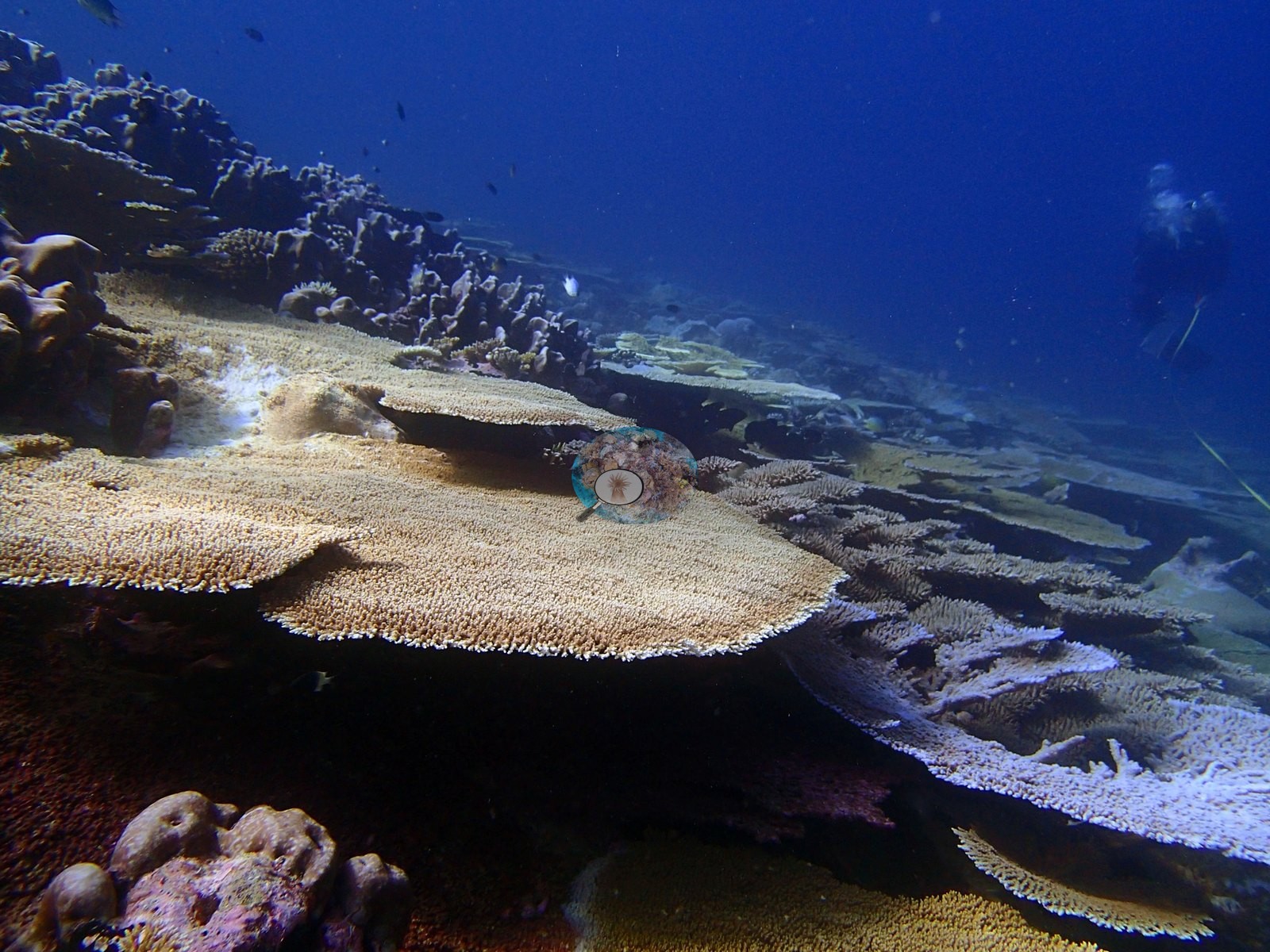
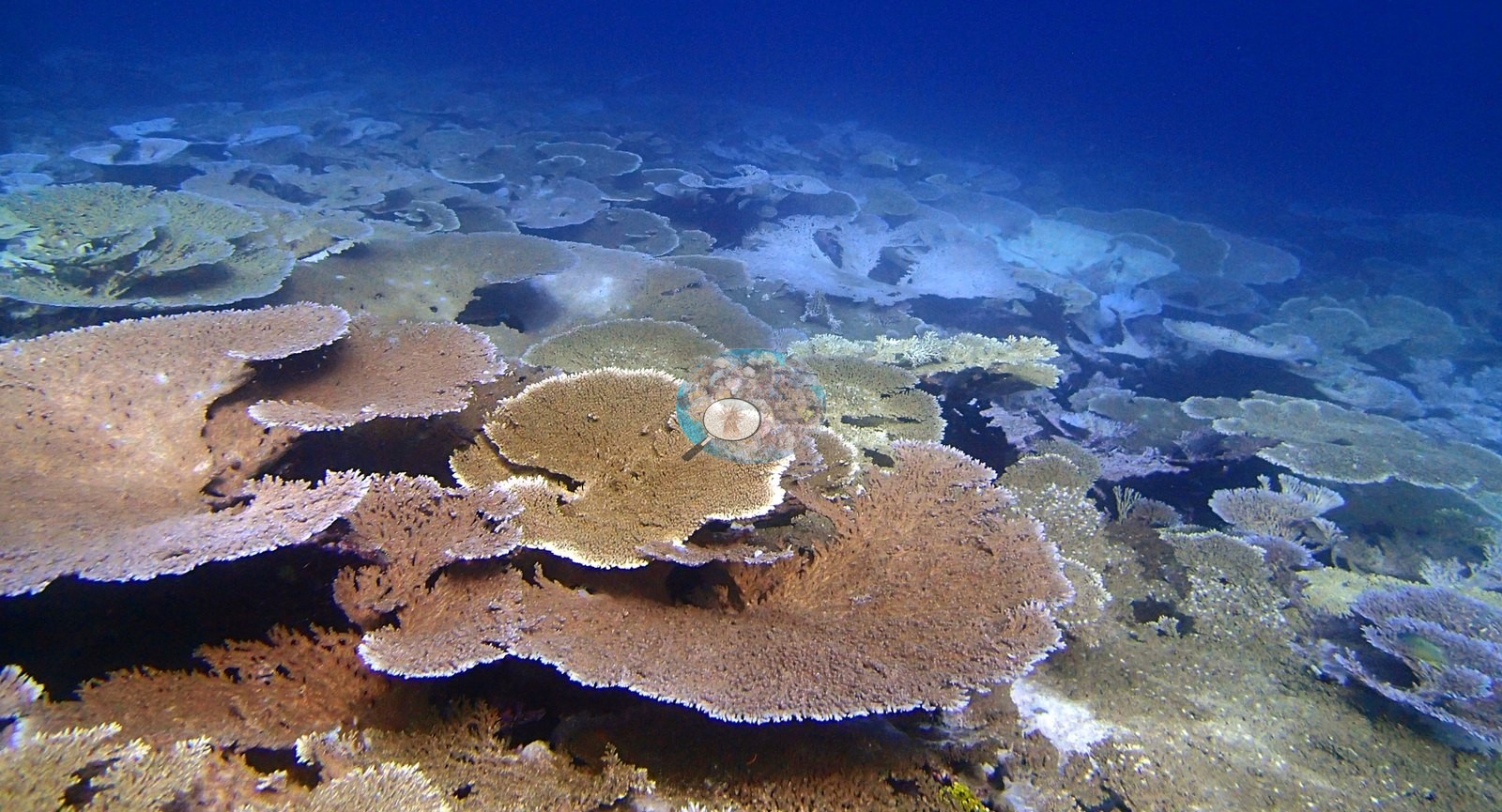
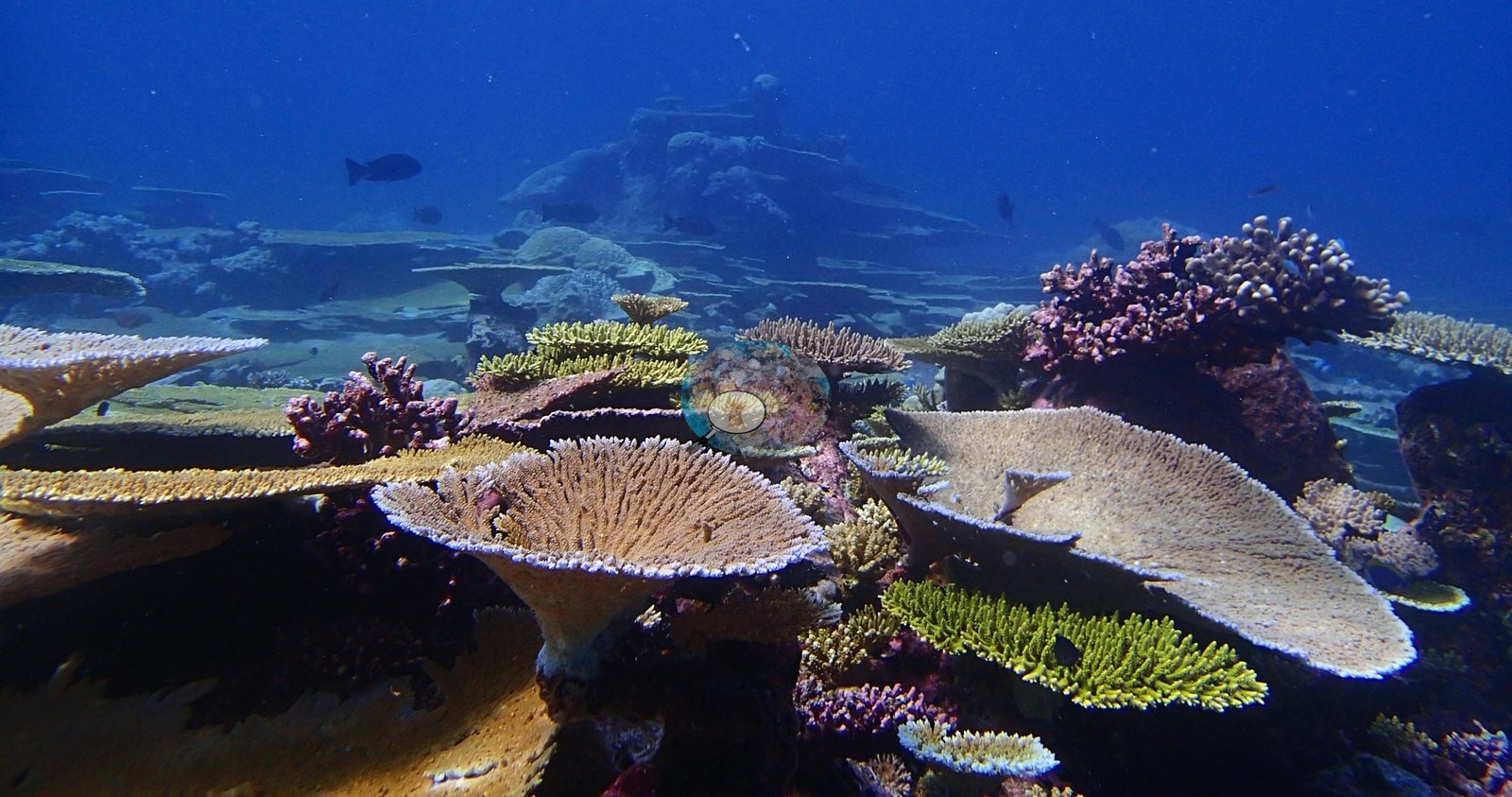
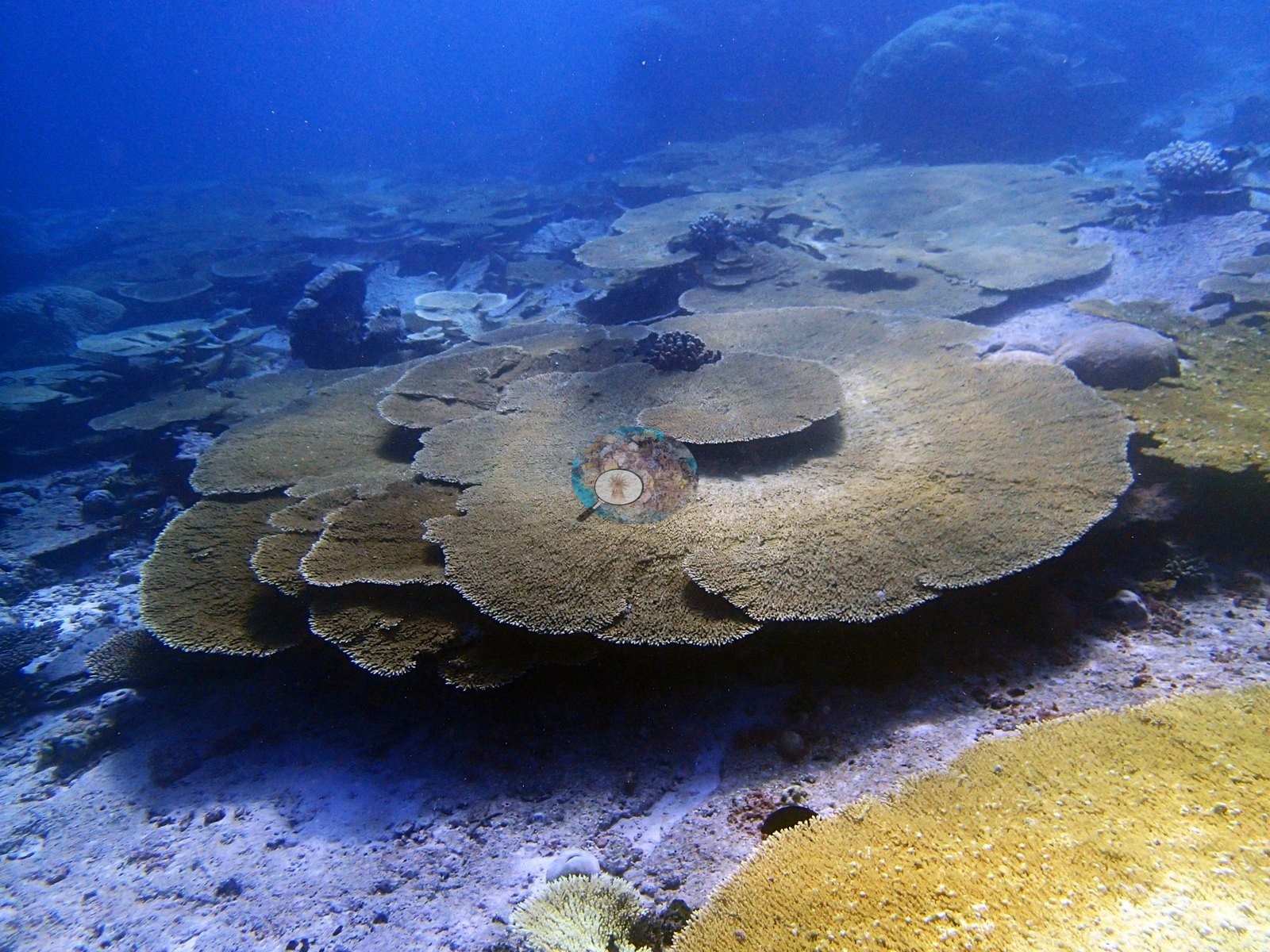
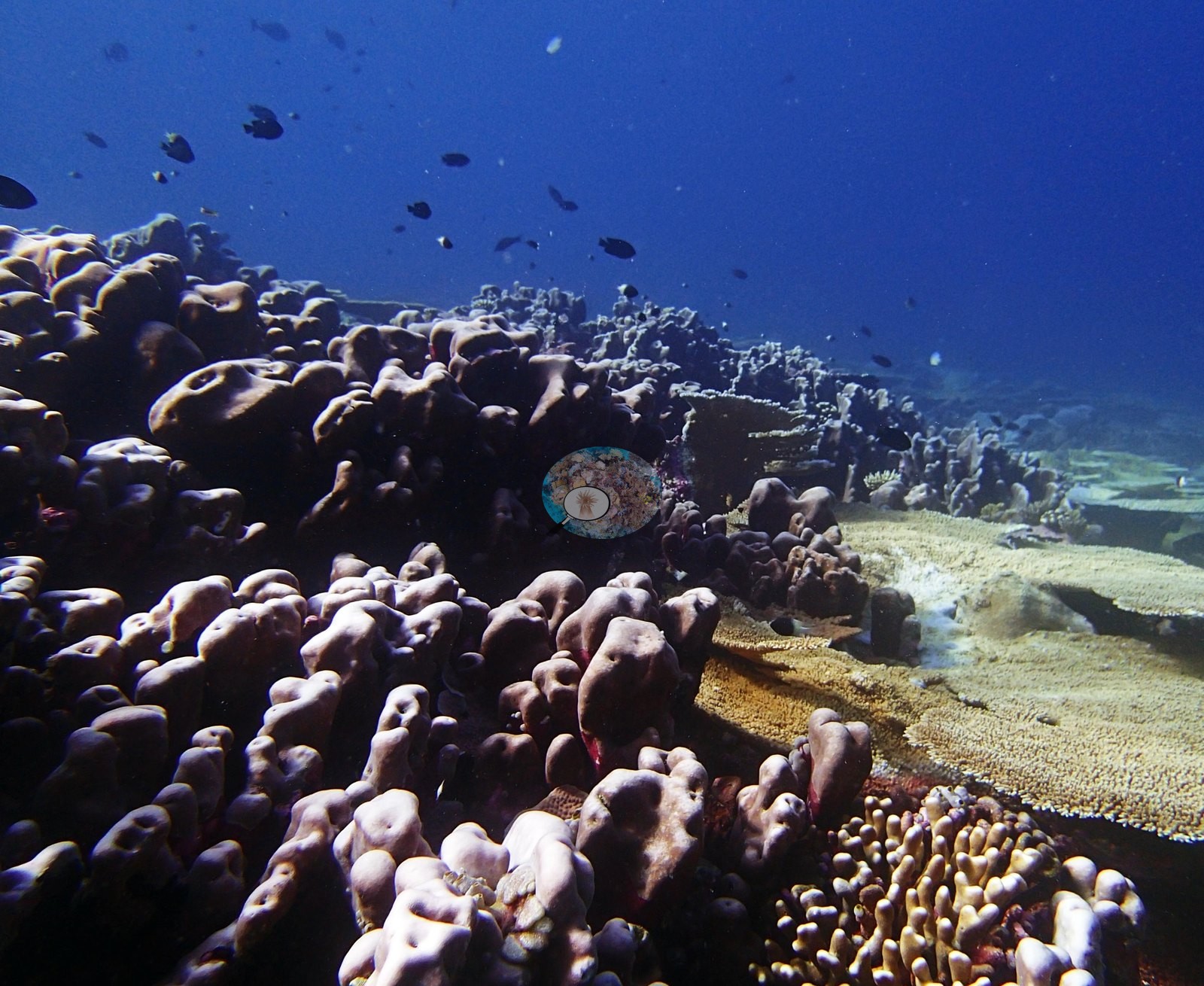
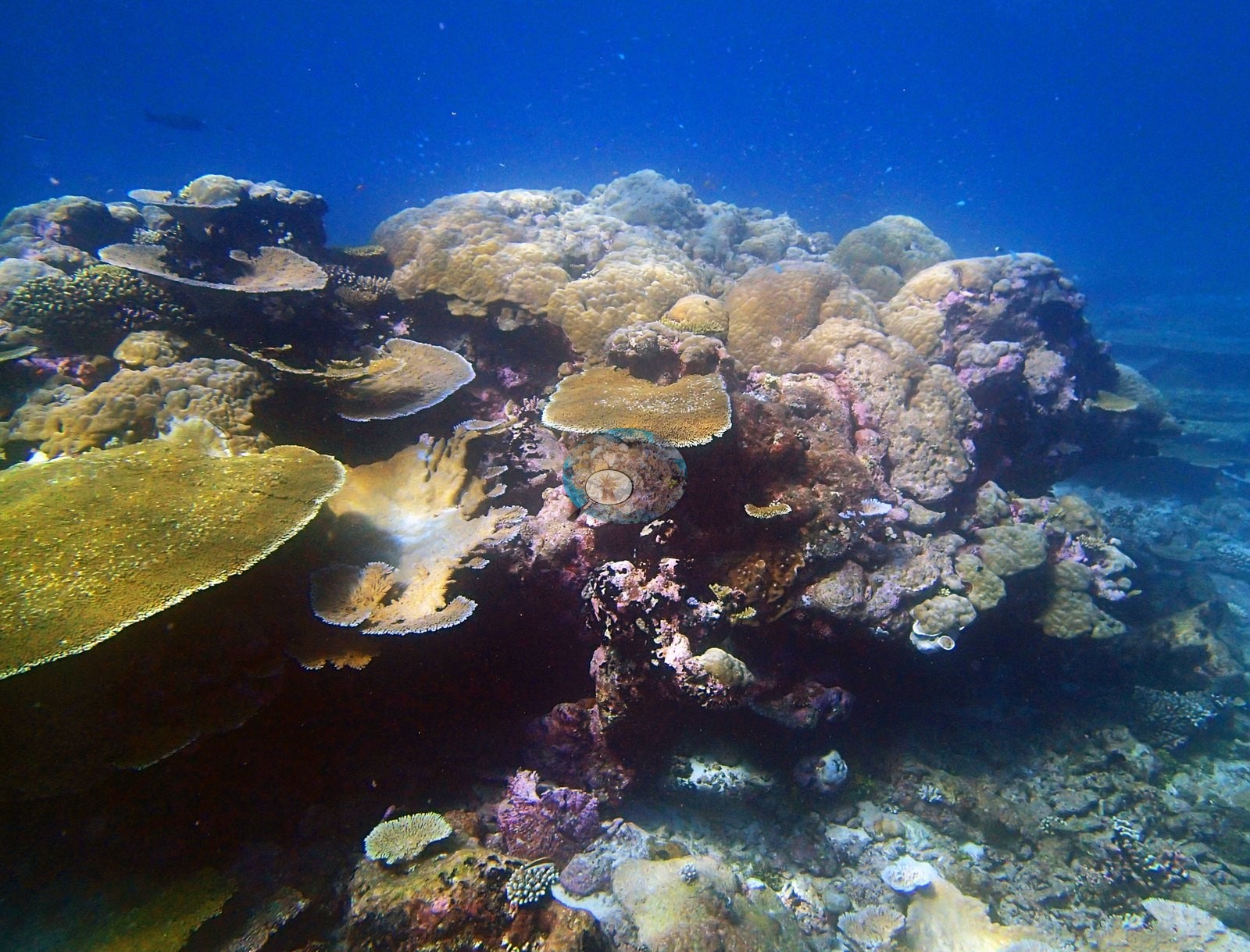
Two more frames show the tables mixed with digitate colonies, corymbose thickets, and large cream lobate domes (e.g., Image 6, Image 12, Image 16, Image 35).
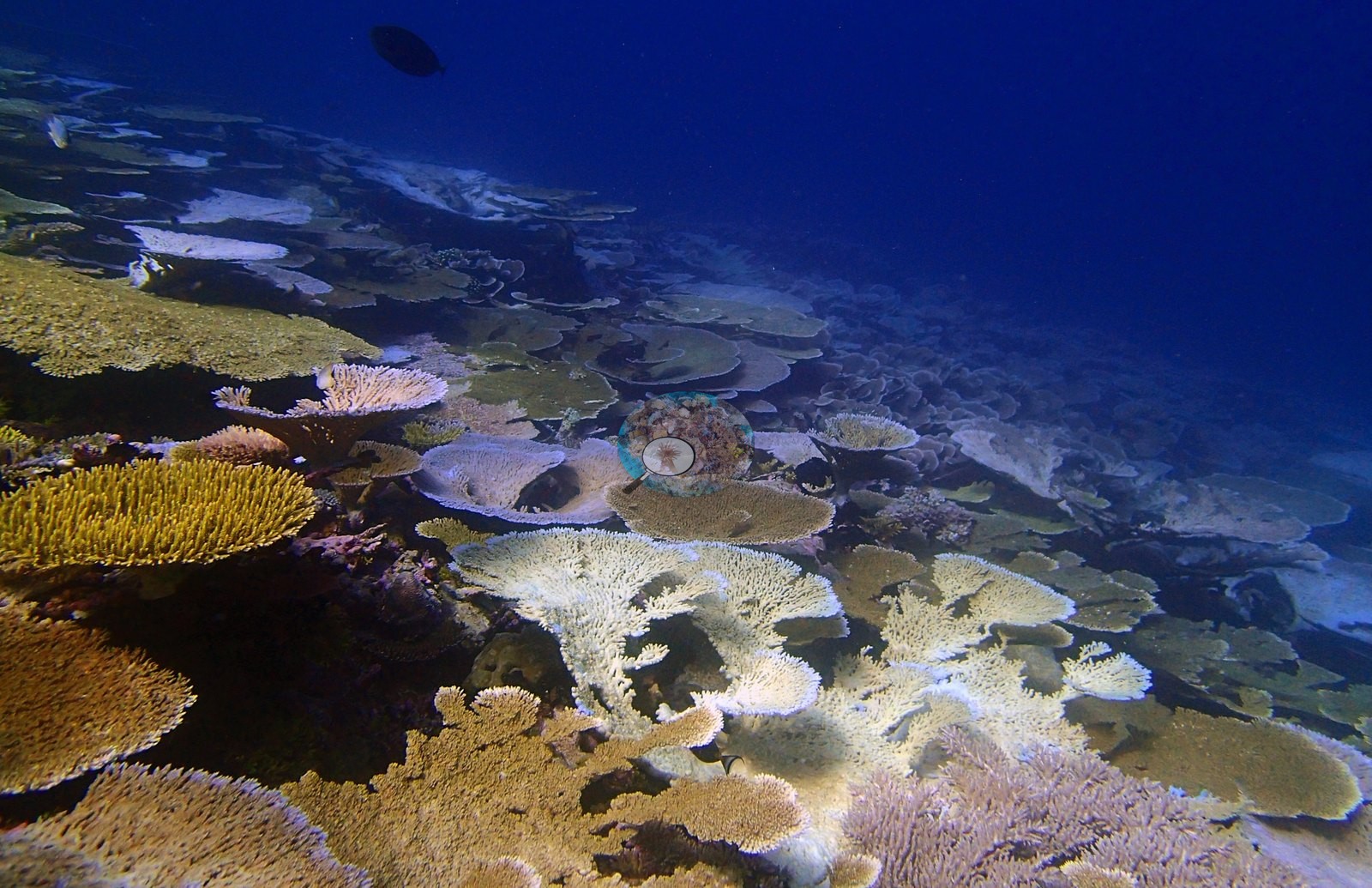
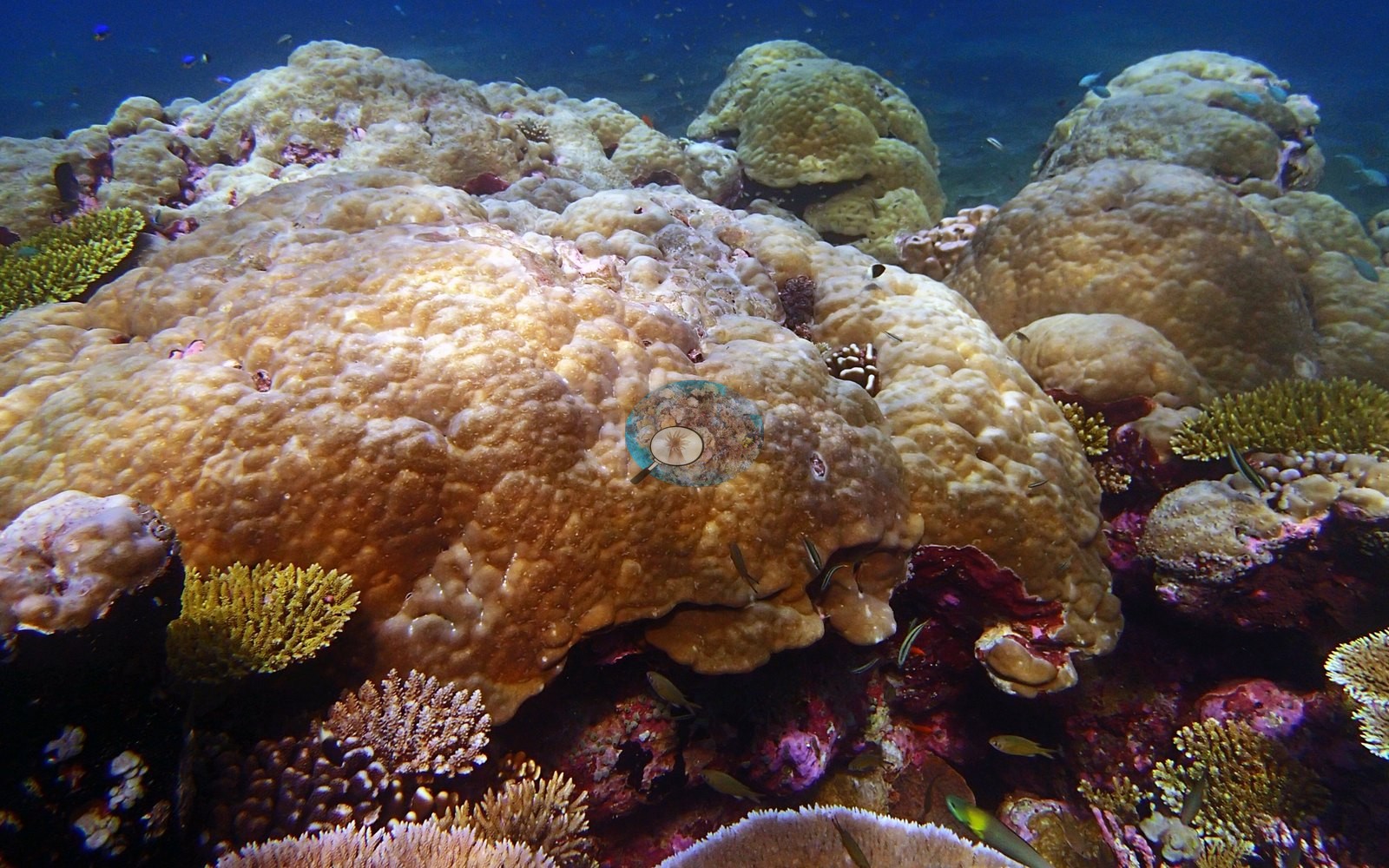
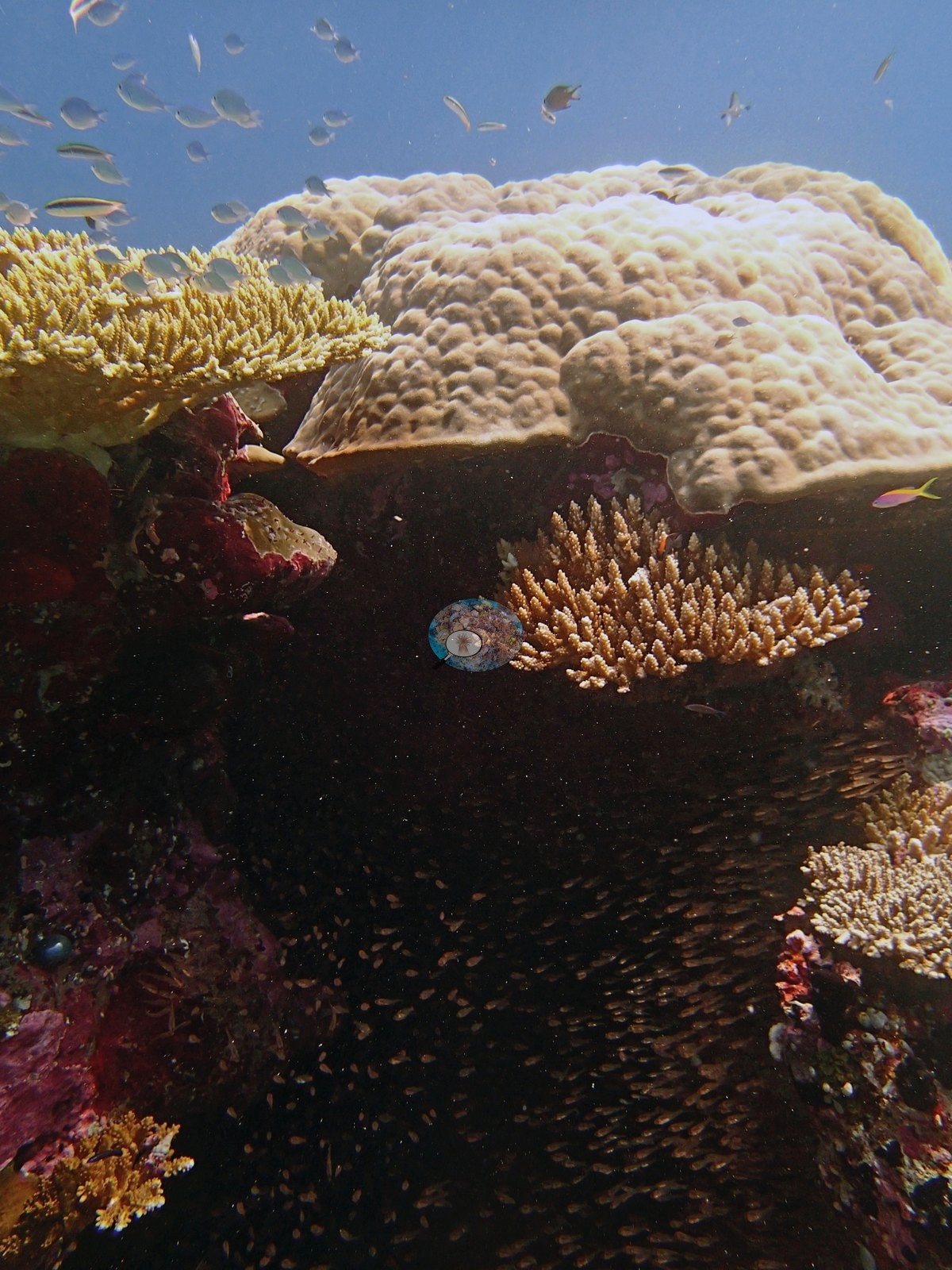
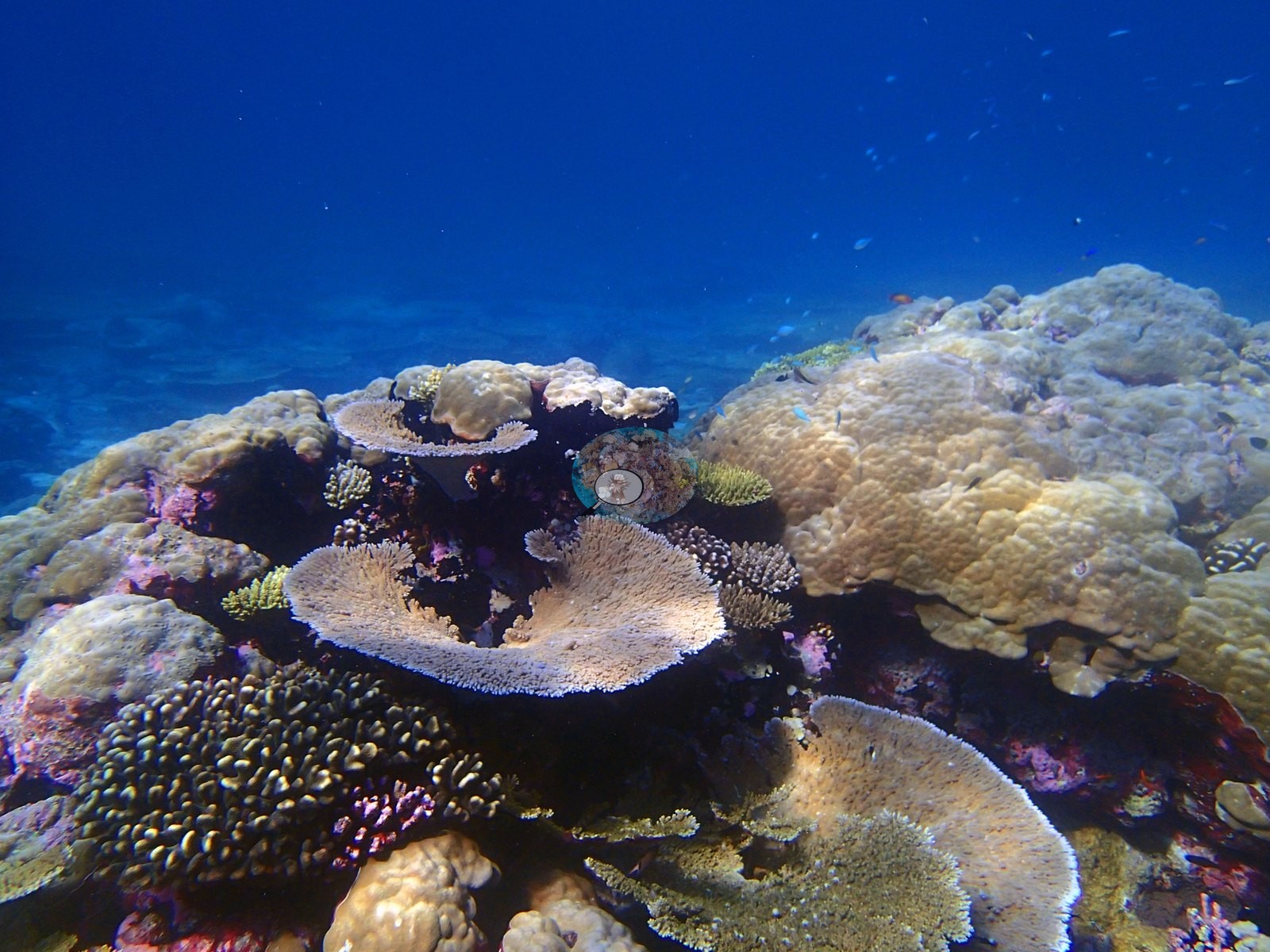
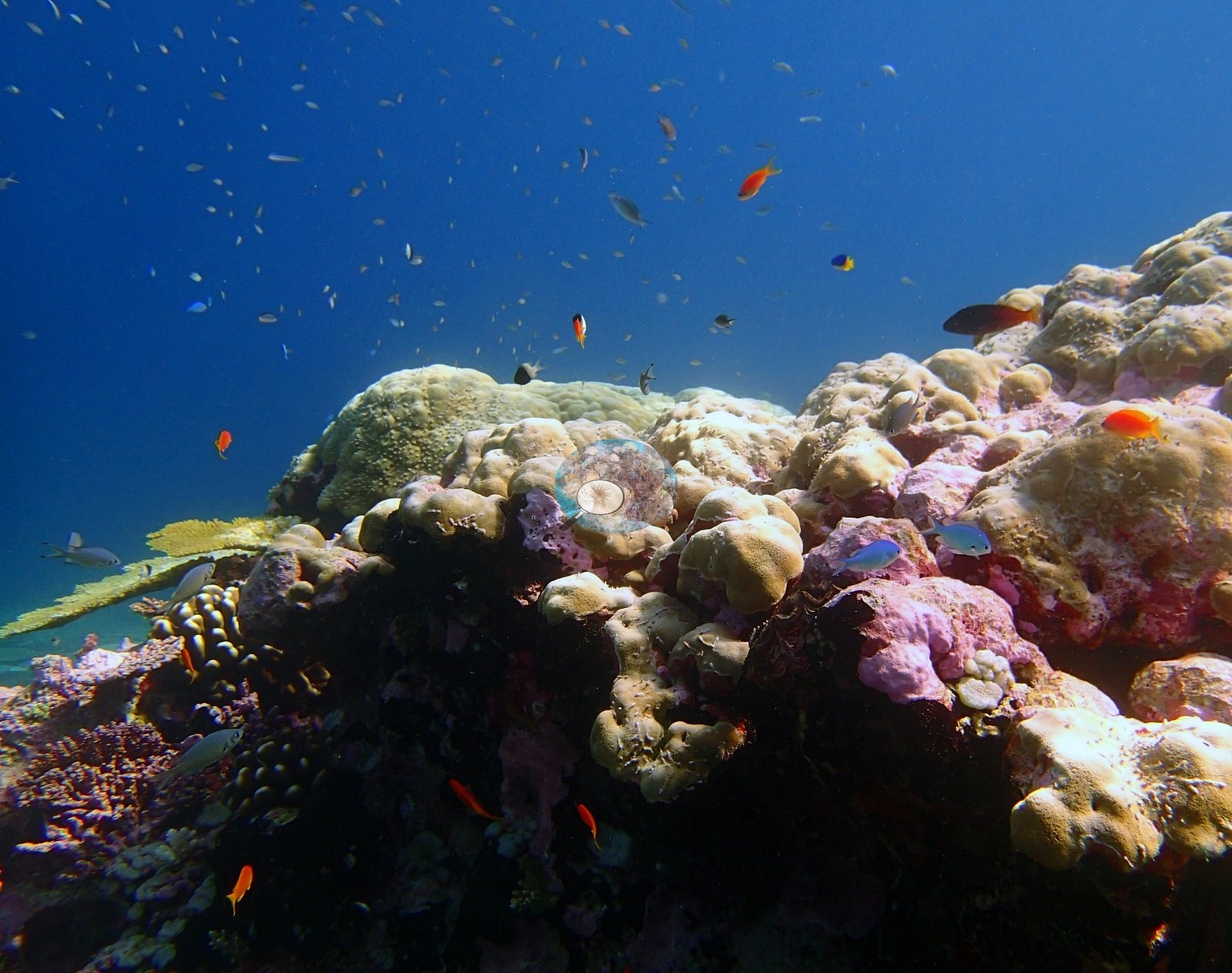
The deeper, non-Acropora community is thinner in the imagery but present (e.g., Image 10, Image 22, Image 25, Image 30).
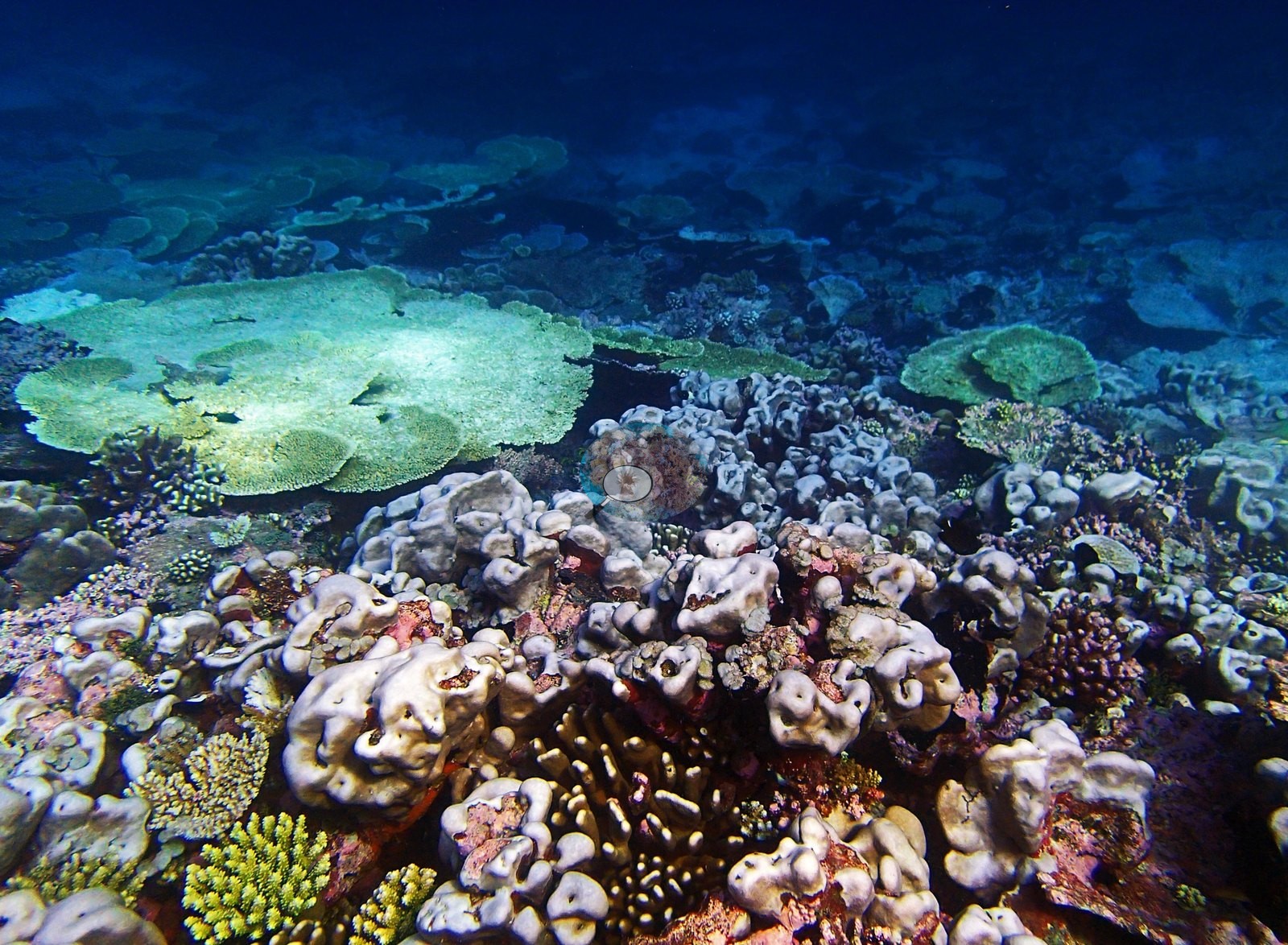
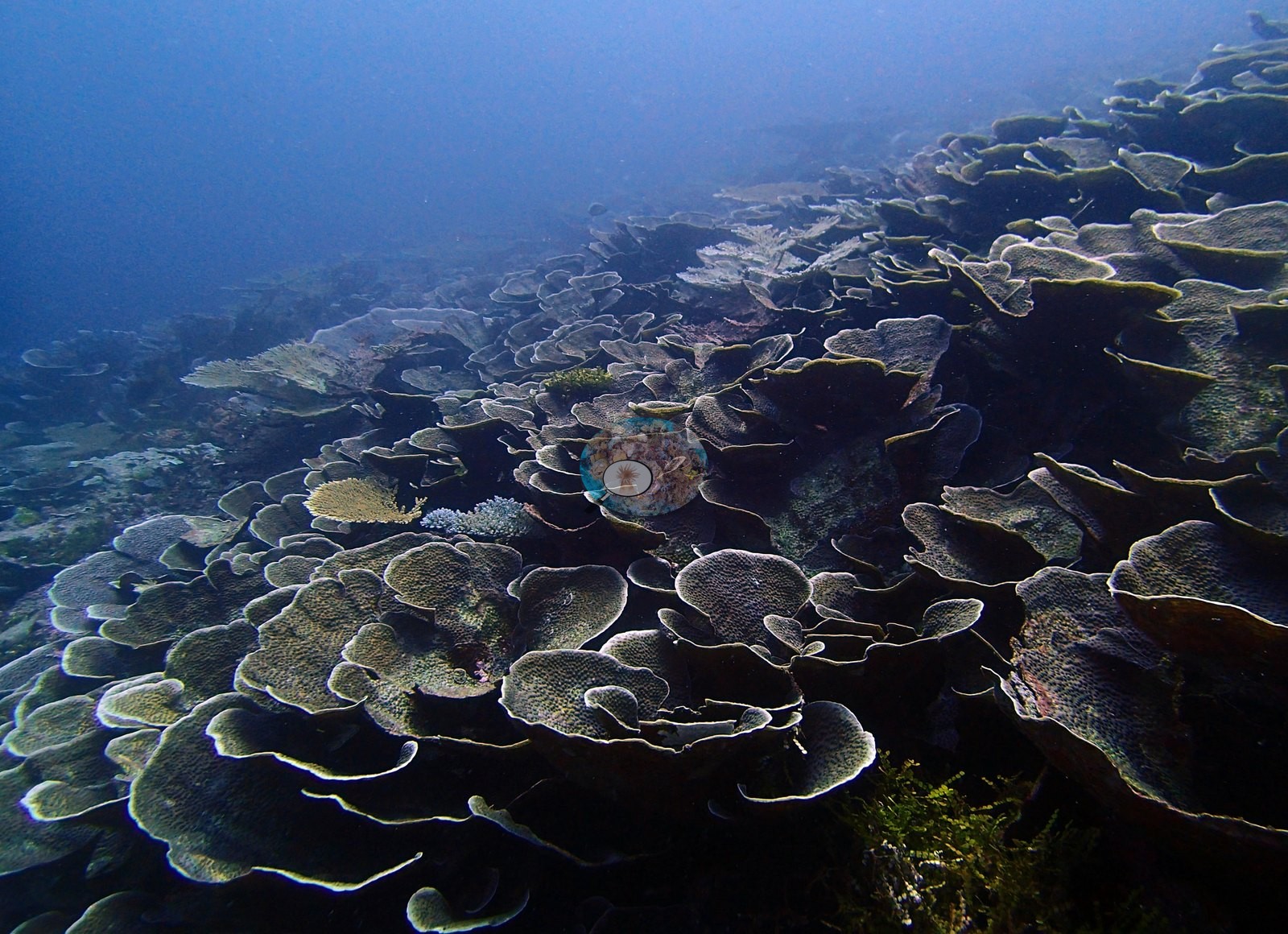
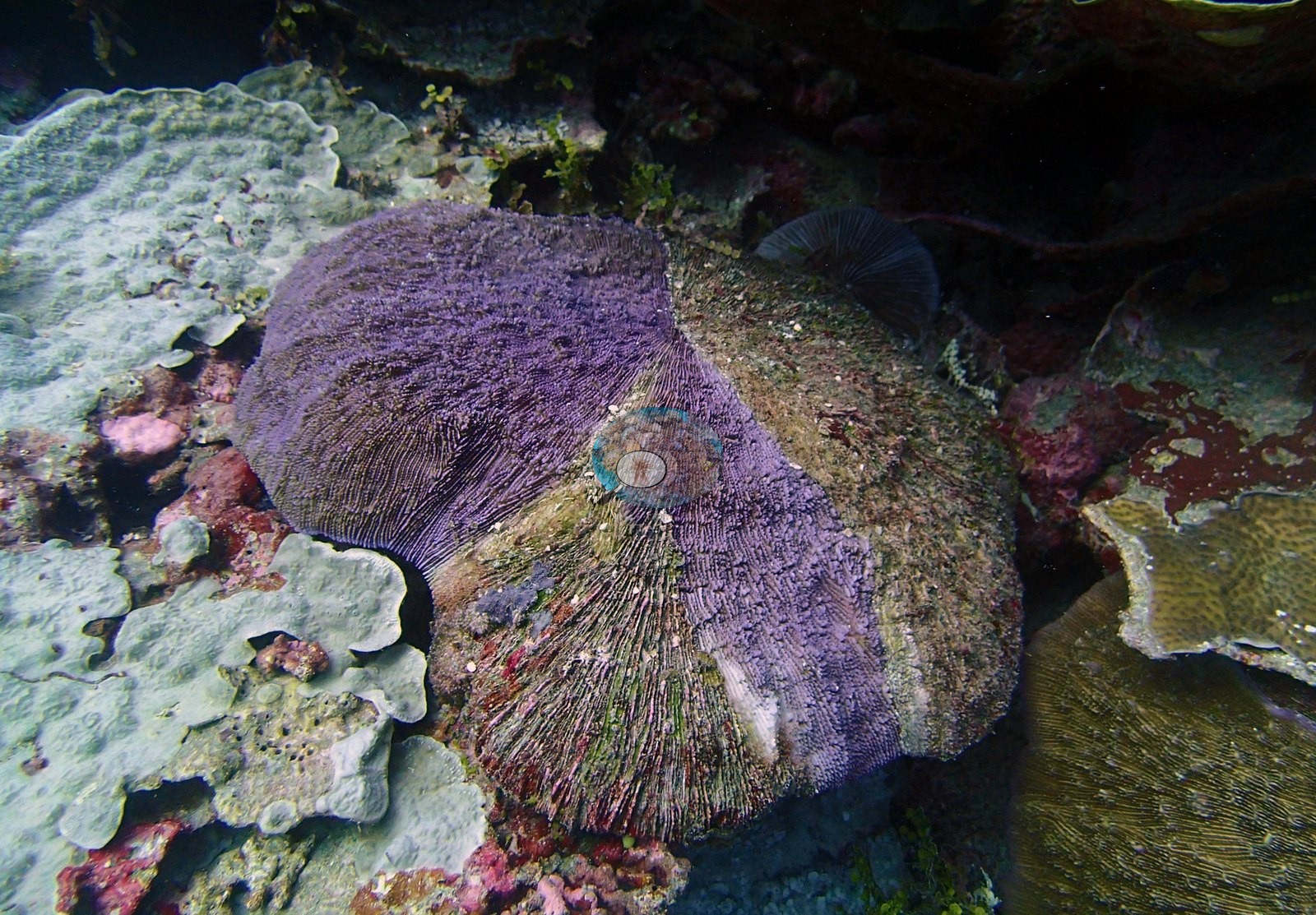
One frame holds a large purple-violet foliose colony with strongly radiating septa growing beside pale mint-green plating colonies, a small free-living fungiid, and a brown meandroid head — the foliose whorled form is consistent with Echinopora, the genus that dominates D4 and D5 (e.g., Image 3).
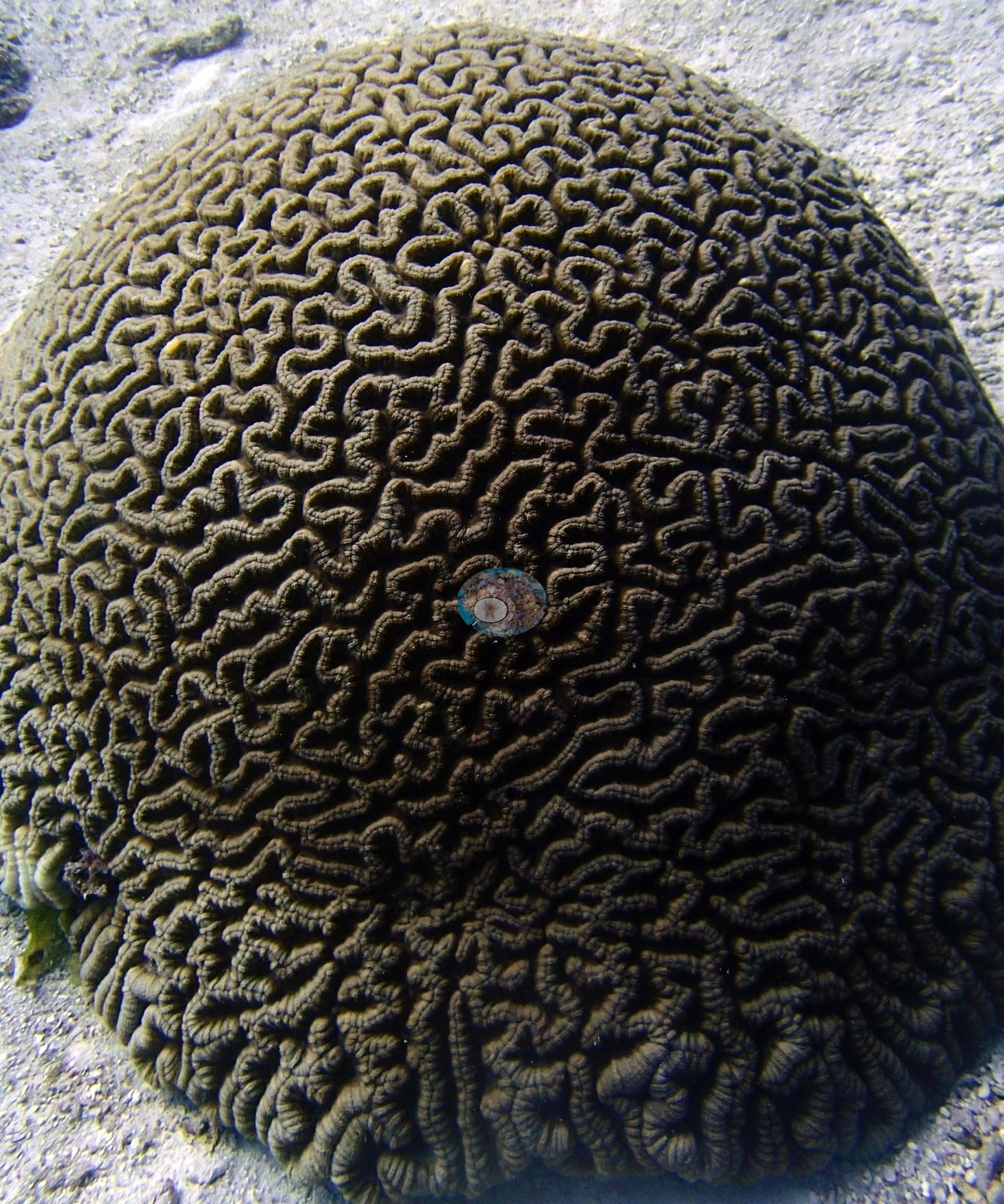
Another is a close frame of a single large meandroid brain coral dome, dark olive with deep sinuous valleys, sitting on clean sand (e.g., Image 15).
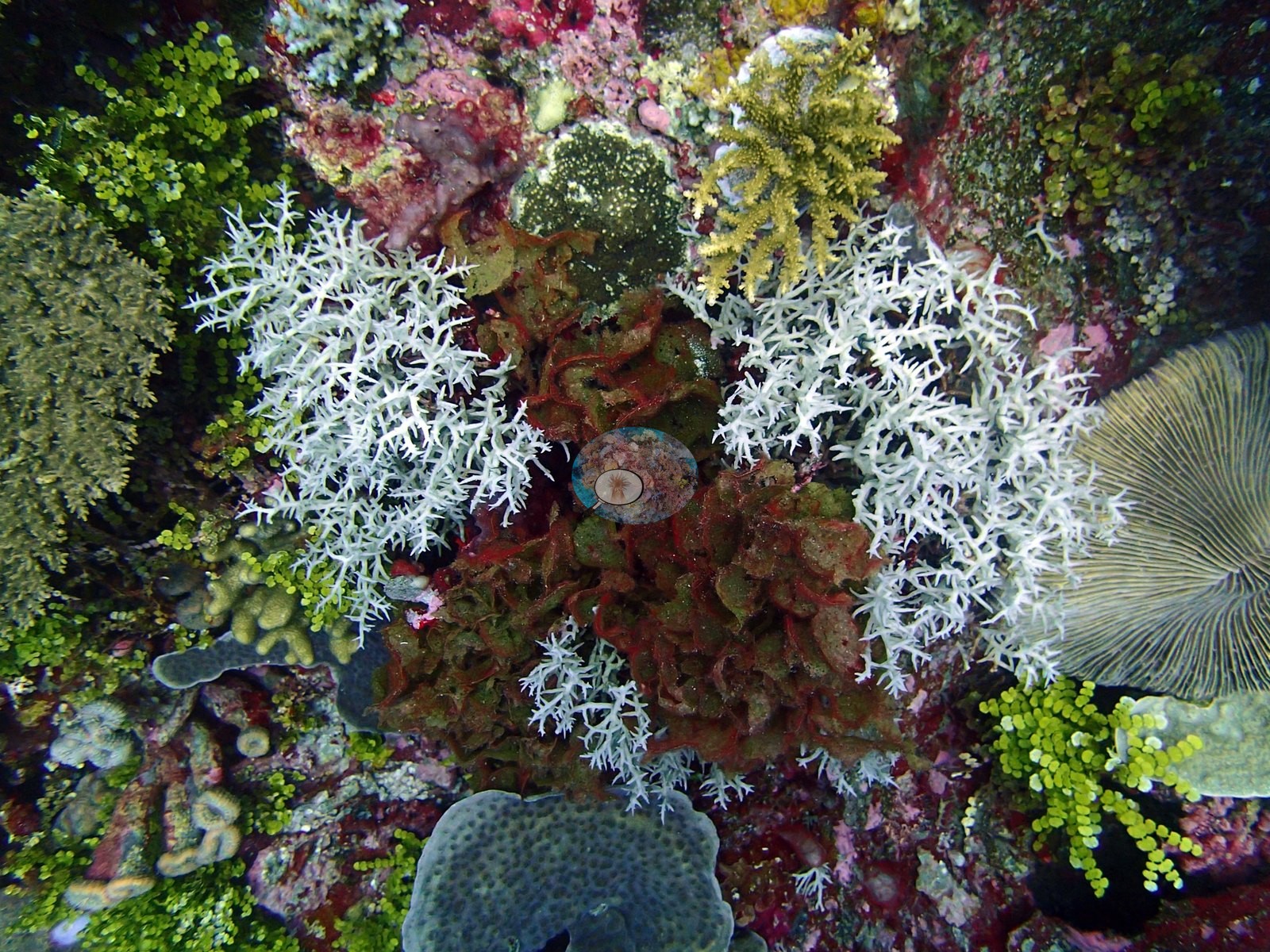
One frame shows the algal side of the reef: abundant bright green Halimeda- and Caulerpa-type growth across the foreground between pale plating colonies, digitate corals, and encrusting purple — the visible counterpart to 8.5% erect algae (e.g., Image 9).
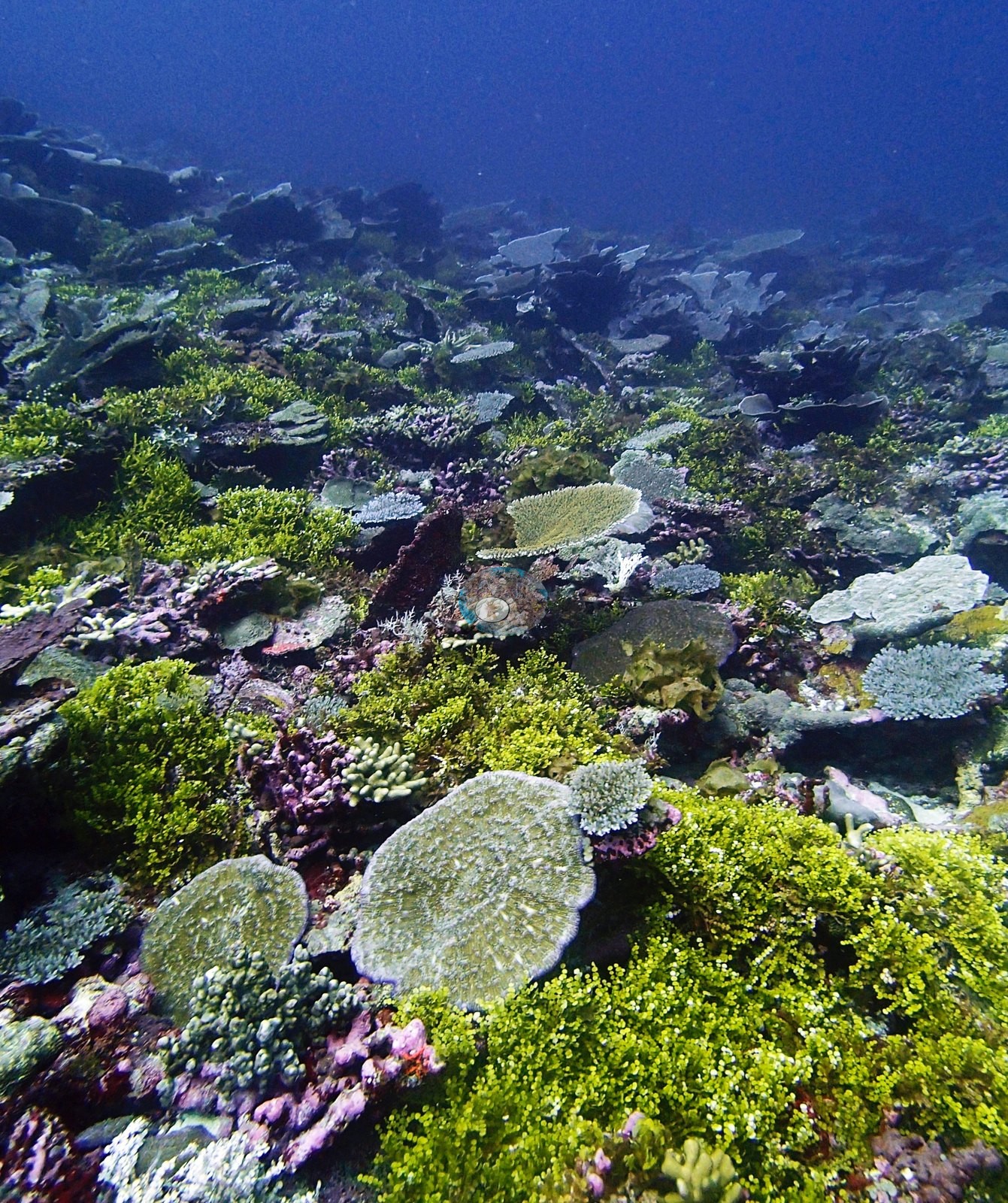
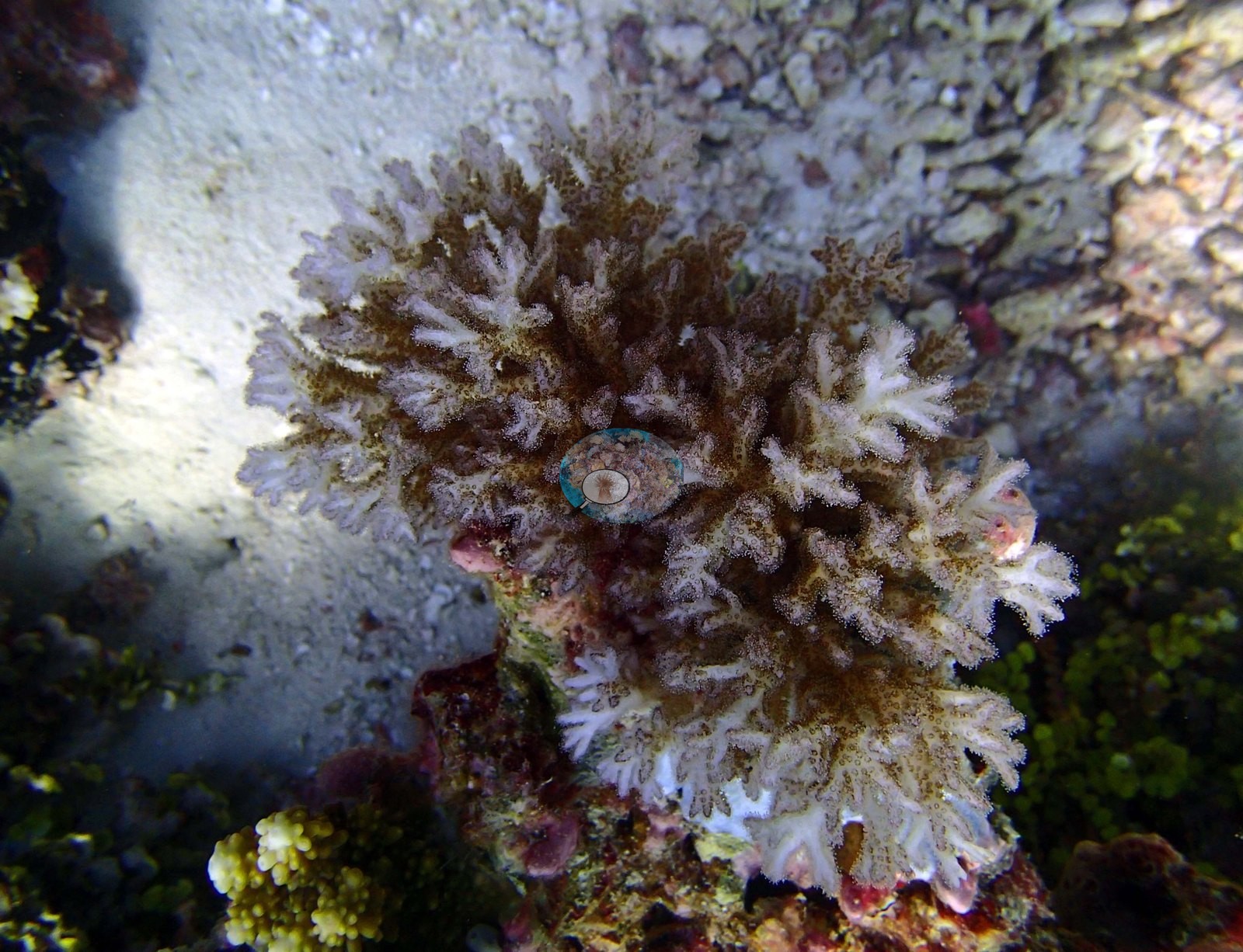
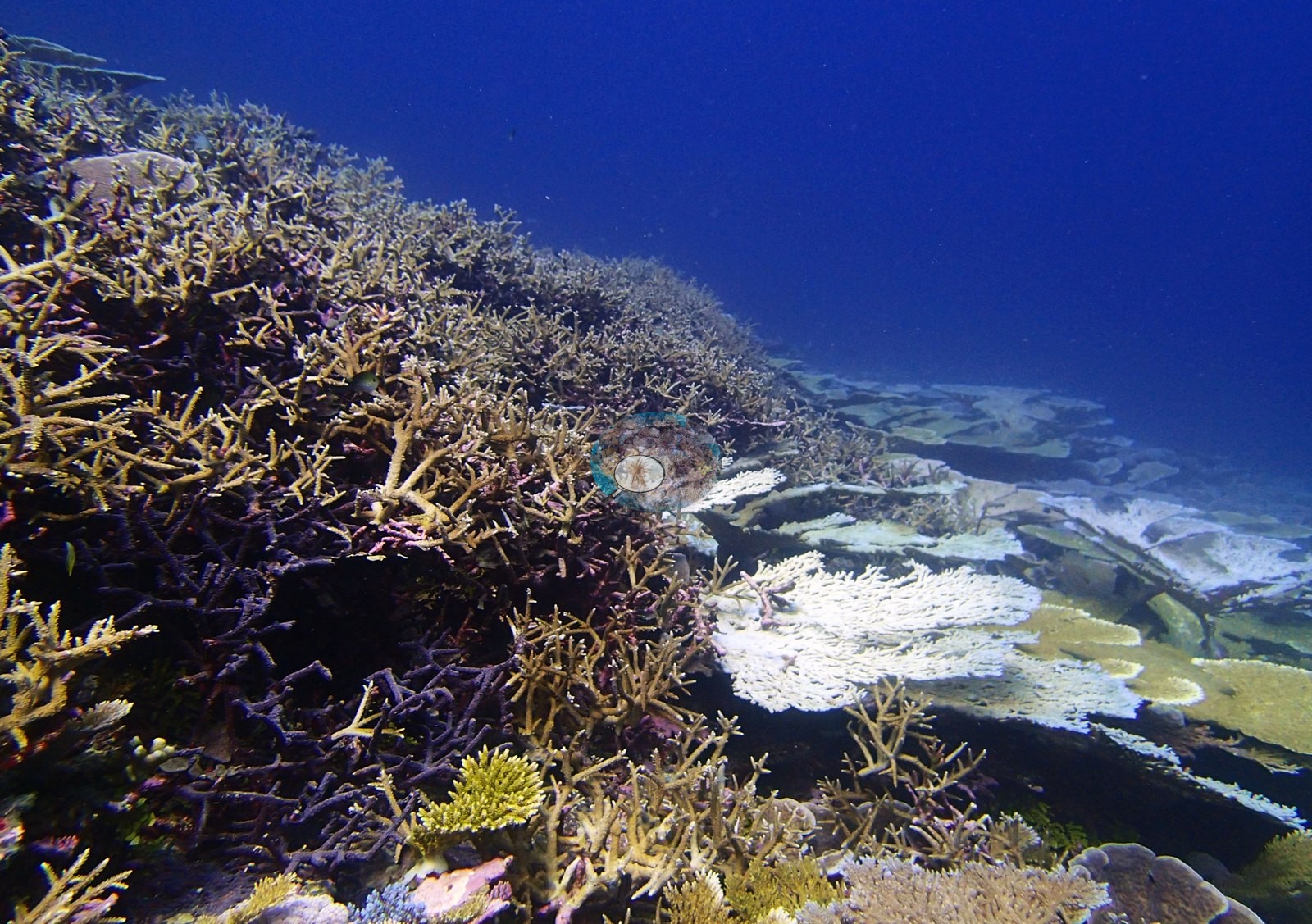
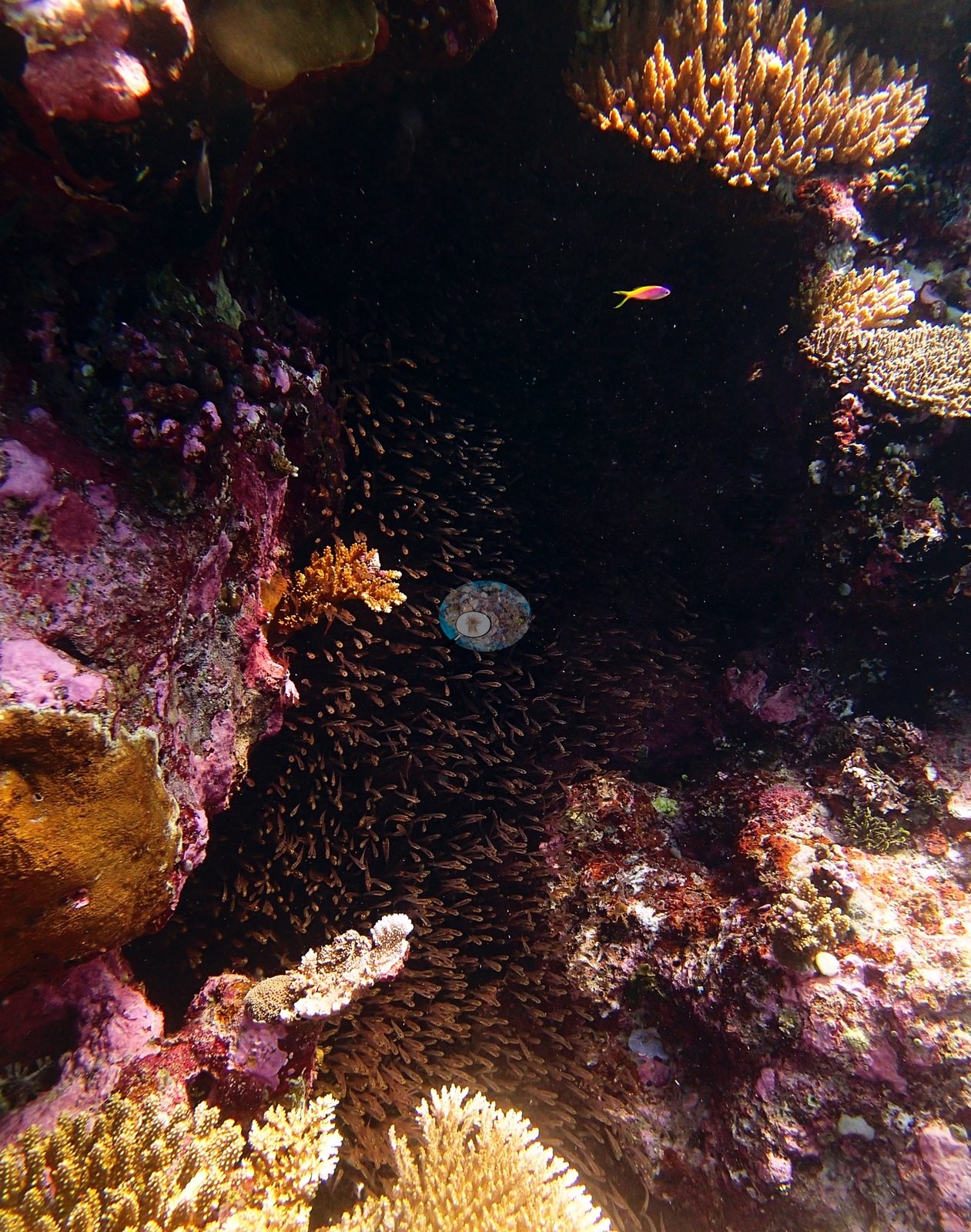
The photographs document the Acropora half in detail — staghorn fields, pedestalled tables, corymbose thickets — plus a foliose colony consistent with Echinopora, meandroid brain corals, massive lobate domes, and abundant green calcareous algae (e.g., Image 2, Image 4, Image 20, Image 24, Image 26, Image 27, Image 32, Image 47).
Coral cover
At 59.6% transect coral cover it ranks 10th of the 109 Chagos sites, against only 29.3% algae (e.g., Image 8, Image 17, Image 18, Image 21, Image 23, Image 29, Image 36, Image 46).
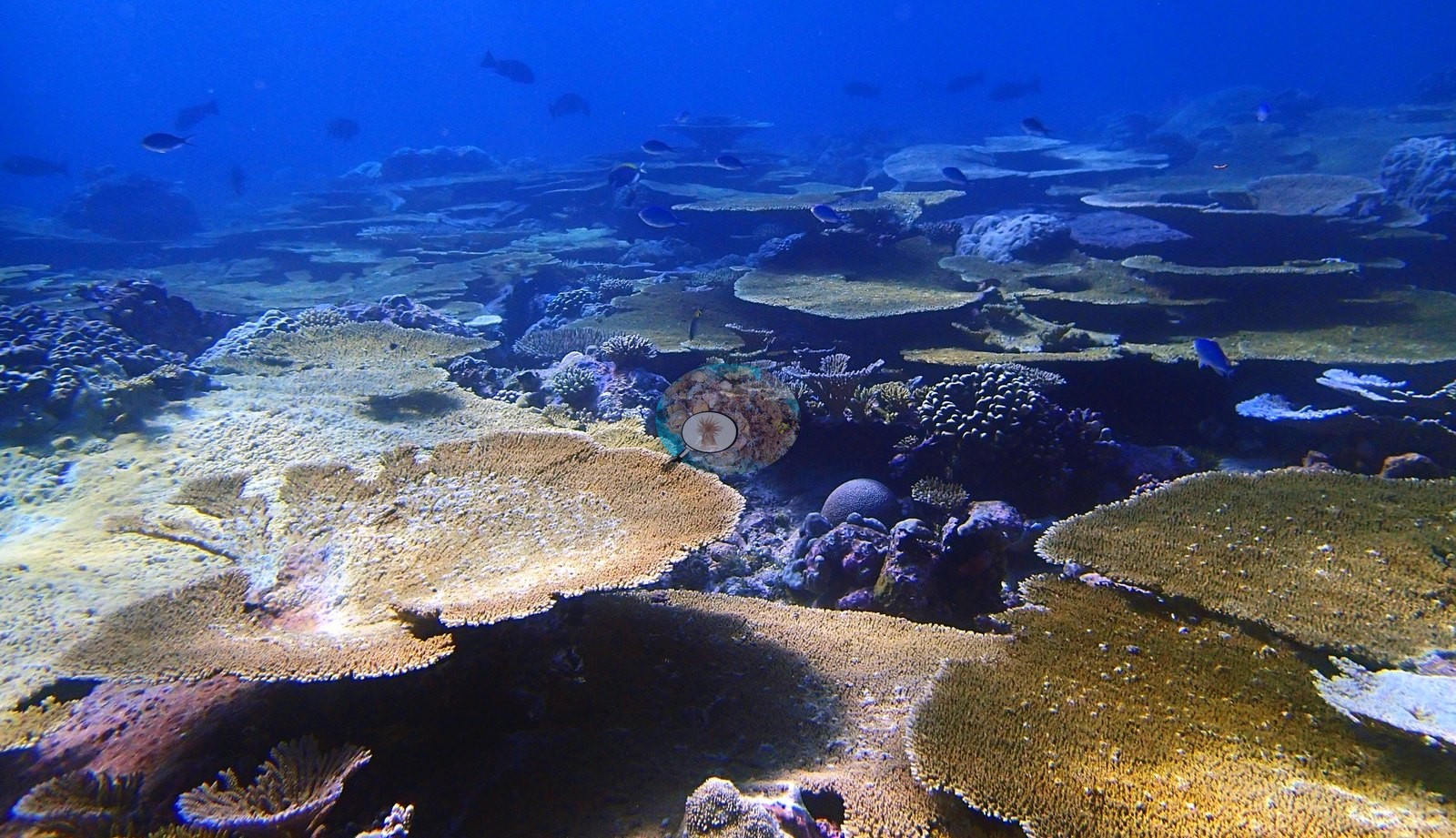
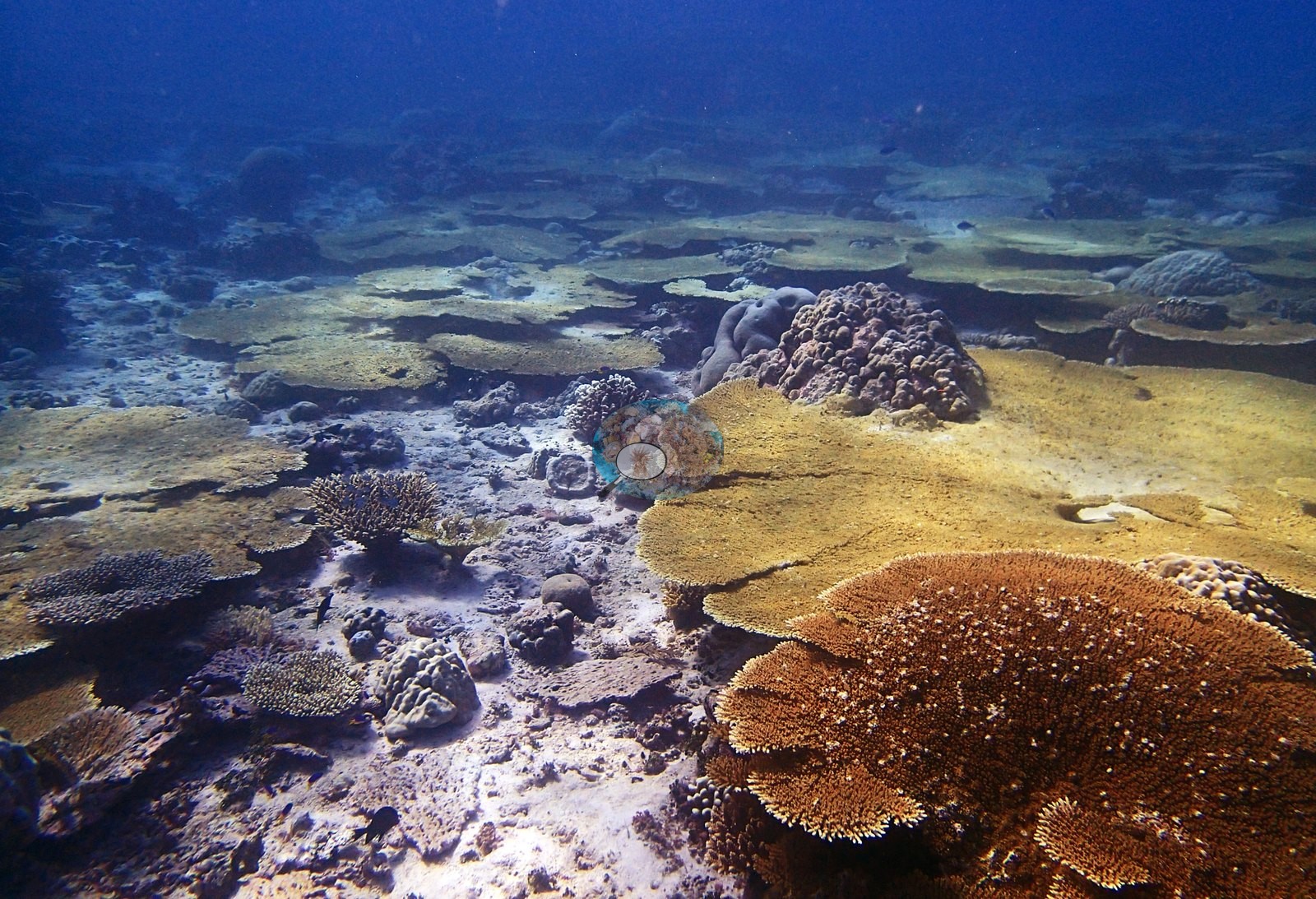
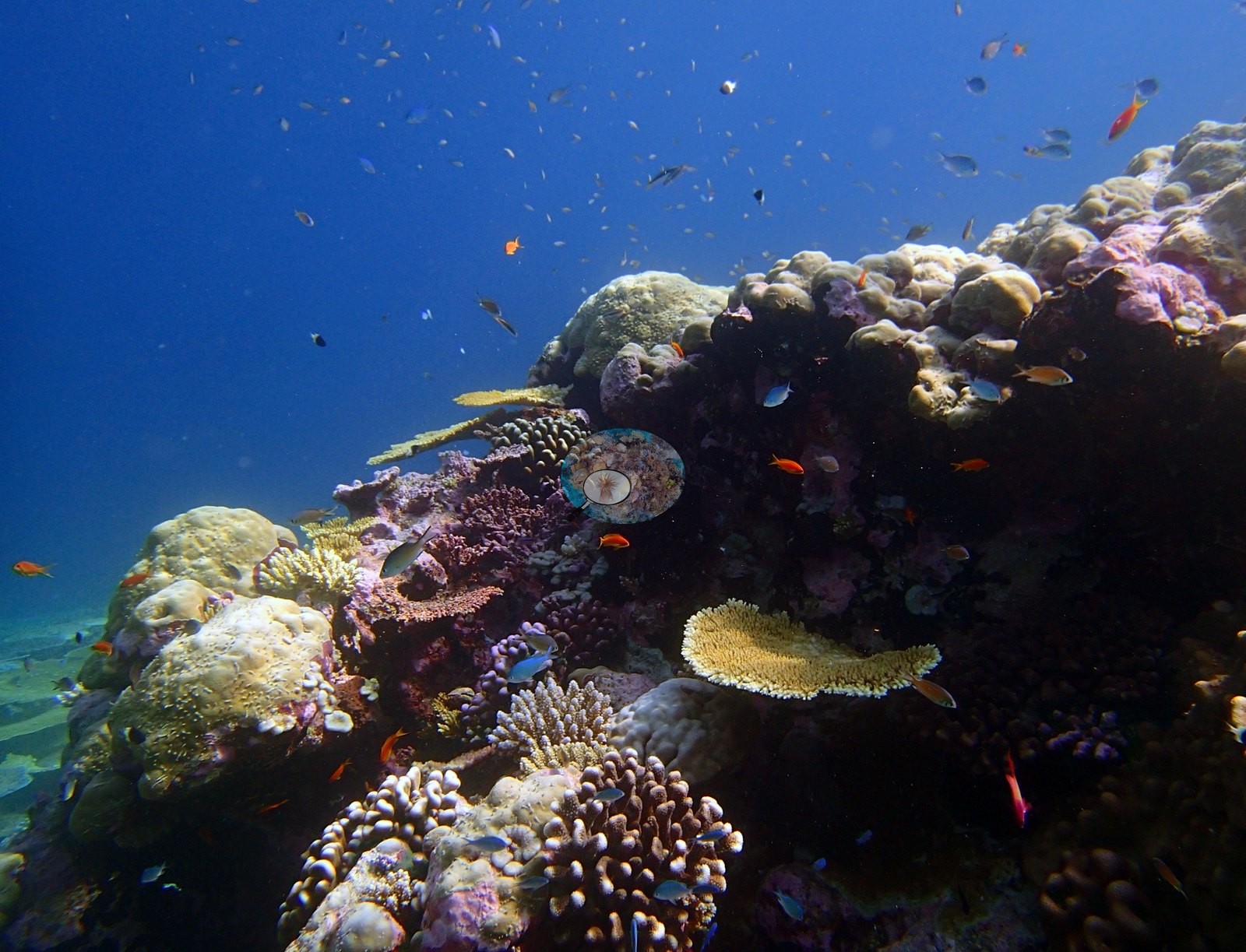
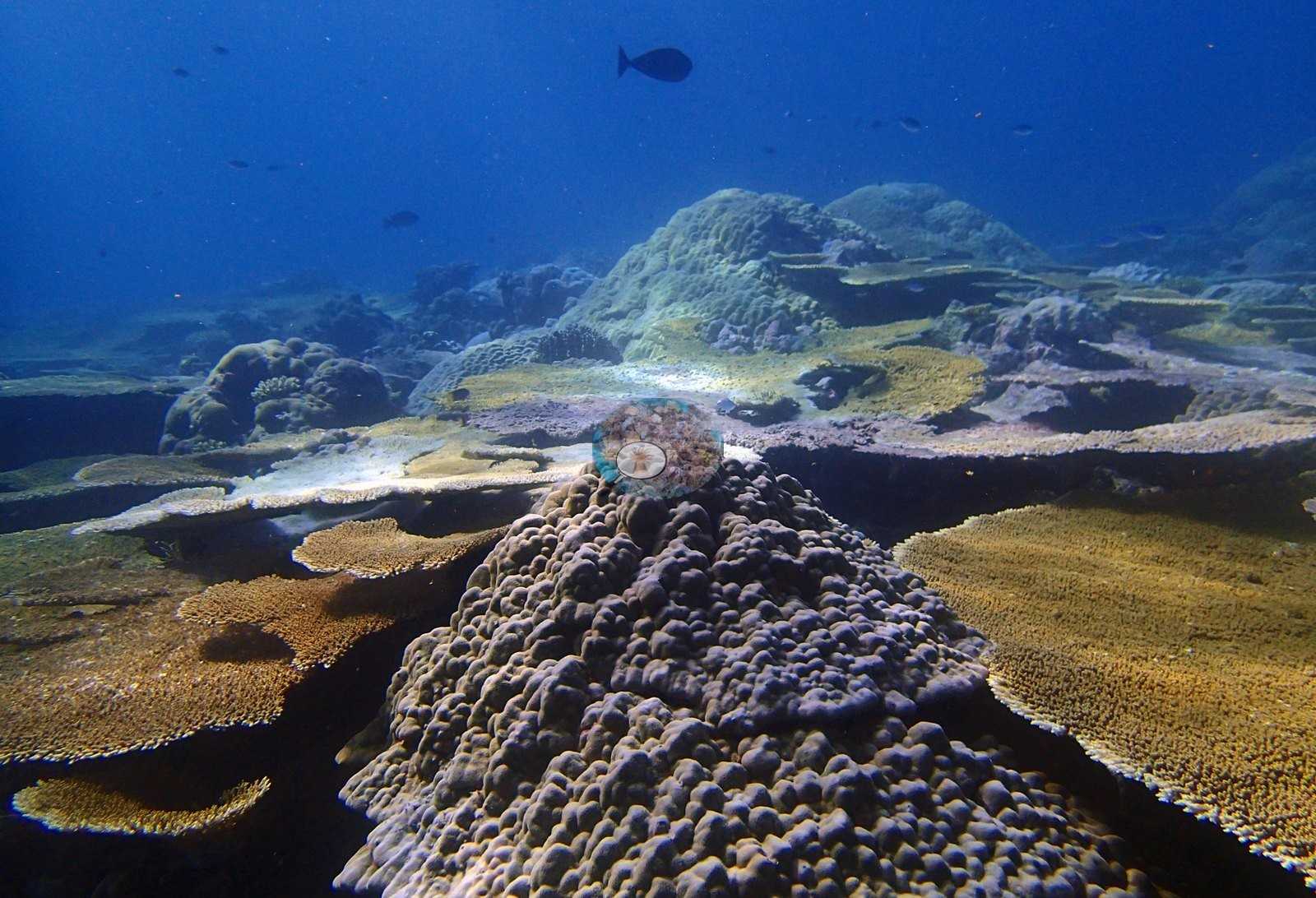
Assemblage composition. Formal surveys give 59.6% coral, 29.3% algae, and only 1.1% non-coral invertebrates, the coral 69% split between Acropora in the shallows and Echinopora at depth across just 16 genera.
Stressors
Condition is the point of tension at this site. The published image-based bleaching figure is 6.9%, ranking 52nd of the 98 Chagos sites with a value — squarely mid-range — yet the photographs contain conspicuous bleaching among the tabular Acropora. One frame shows a run of stark white tables and plates along the slope directly beside fully pigmented tan staghorn thickets, and another shows a cluster of bright white tables in the middle distance against pigmented tan neighbors (e.g., Image 40, Image 45).
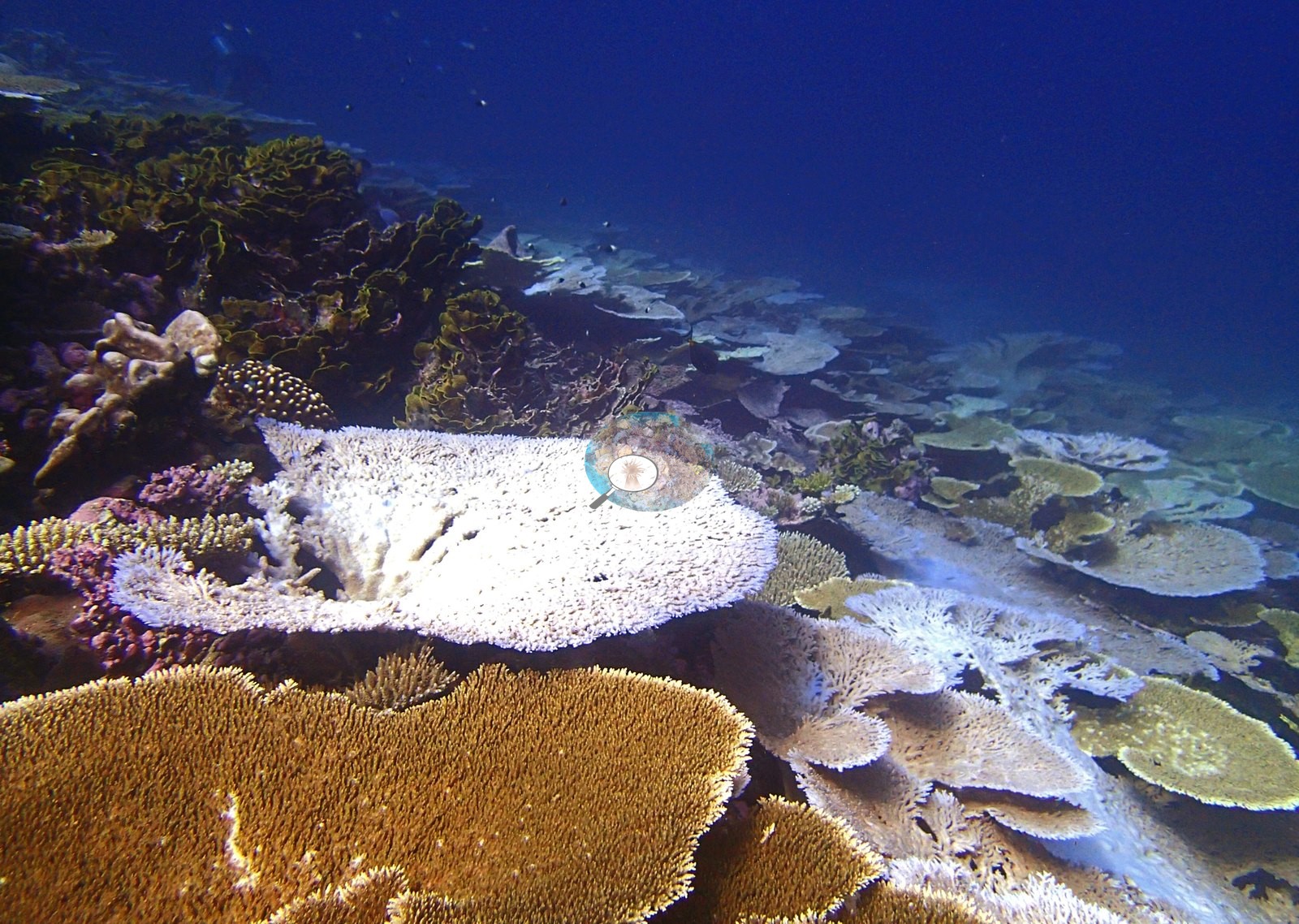
These are coherent, colony-scale, intact-tissue pallor, not growth tips or strobe artifacts. The most likely reconciliation is that the transects and the photographer sampled different parts of the reef, but this has not been tested and is flagged rather than resolved. No crown-of-thorns starfish (COTS) or other corallivores evident.
Comparisons with other data
No independent survey was made at this exact site; the nearest ones are listed in the table below.
CV model comparison
More info
Those are point counts on the photographs; this is a diver swimming a transect. The models and the reference never saw the same thing. ⚠ SITE-LEVEL ONLY. The 2,500 frames were not associated with any transect taken within 200 m of them, so transect-vs-image comparisons are site means, never frames. The transect value is already in the pin `cover` field (109 of 112 pins, sourced to the paper's suppl. S1) and is read from there, never re-imported. The transect is THE coral-cover value for this site and stands alone. The rows below it are a methods comparison only: no computer-vision value is averaged with it, feeds the headline, or carries over to the site's cover figure (Anderson, 2026-09-22).| Method | Hard-coral cover (%) |
|---|---|
| Transect (published) | 59.6 |
| In-house DINOv3 | 35.3 |
| CoralSCOP edited | 31.6 |
| Claude | 33.6 |
Independent surveys nearby
| Agency / program | Year(s) | Stations / distance | Link |
|---|---|---|---|
| Sheppard et al. (2008) | 2006 | 1 station, 3.18 km | Records ↓ |
| Spalding et al. 2025 (Chagos 2024 bleaching report) | 2024 | 2 stations, 3.26 km | Records ↓ |
| XL Catlin Seaview Survey | 2015 | 1 station, 3.25 km | Records ↓ |
 Dr. Coral (CRD)Year-average (no detectable trend)
Within 5 km, 4 independent survey stations recorded hard coral cover in 8 records between 2006 and 2024. One survey since 2021 recorded 70%; 1 best-patch value above 70% is left out, as they are not site means. This site's own estimate (60%) sits 10.4 points below the recent value (70%); the methods differ, so the comparison is context, not a like-for-like test.
Collected by other programs using different methods (the XL Catlin Seaview Survey uses photo-transects with automated image annotation), so these are context for the figures above, not a like-for-like comparison. Where a station was surveyed more than once the range is shown. Station names are not dive-site names. Values marked best patch exceed 70%: surveyors usually chose the richest area, so they are not site means.
| Agency | Site / location | Date | Hard coral cover (%) | Distance | Link |
|---|---|---|---|---|---|
| Sheppard et al. (2008) | Peros Banhos | 2006 | 44% (5 surveys) | 3.18 km | HeatCRD database |
| XL Catlin Seaview Survey | transect 36006 | 2015 | 27% | 3.25 km | — |
| Spalding et al. 2025 (Chagos 2024 bleaching report) | Peros Banhos - lagoon Knoll (N, 9-12 m) | 2024 | 80% best patch | 3.26 km | — |
| Spalding et al. 2025 (Chagos 2024 bleaching report) | Peros Banhos - lagoon Knoll (N, 6-9 m) | 2024 | 70% | 3.26 km | — |
Data & links
- Read the full site report ↗
- Download benthic survey data (CSV) ↗
- Download all LOF-GRE data (933 sites) ↗
- CoralNet image repository for this region ↗
- HeatCRD database ↗
- (reference) ↗
- Photo portfolio ↗
- Coral Reef Diagnostics page for this area ↗
All images from Coral Reef Diagnostics. Data are from Coral Reef Diagnostics and the organizations named in the data-sources table above.
 © Coral Reef Diagnostics.
References
- Mayfield AB, Dempsey AC (2026). Using tourist diver images to estimate coral cover and bleaching prevalence in a remote Indian Ocean coral reef system. Oceans 7(1):1. PDF
- Sheppard C, Harris A, Sheppard A (2008). Archipelago-wide coral recovery patterns since 1998 in the Chagos Archipelago, central Indian Ocean. Marine Ecology Progress Series 362:109-117. PDF
- Spalding M, Bourasseau M, et al. (2025). Coral bleaching and mortality in the Chagos Archipelago, 2024. British Indian Ocean Territory Administration report (gray literature). PDF