
Part of the regional summaries: Chagos Archipelago - Great Chagos Bank West / Brothers / Eagle and Chagos Archipelago
More info
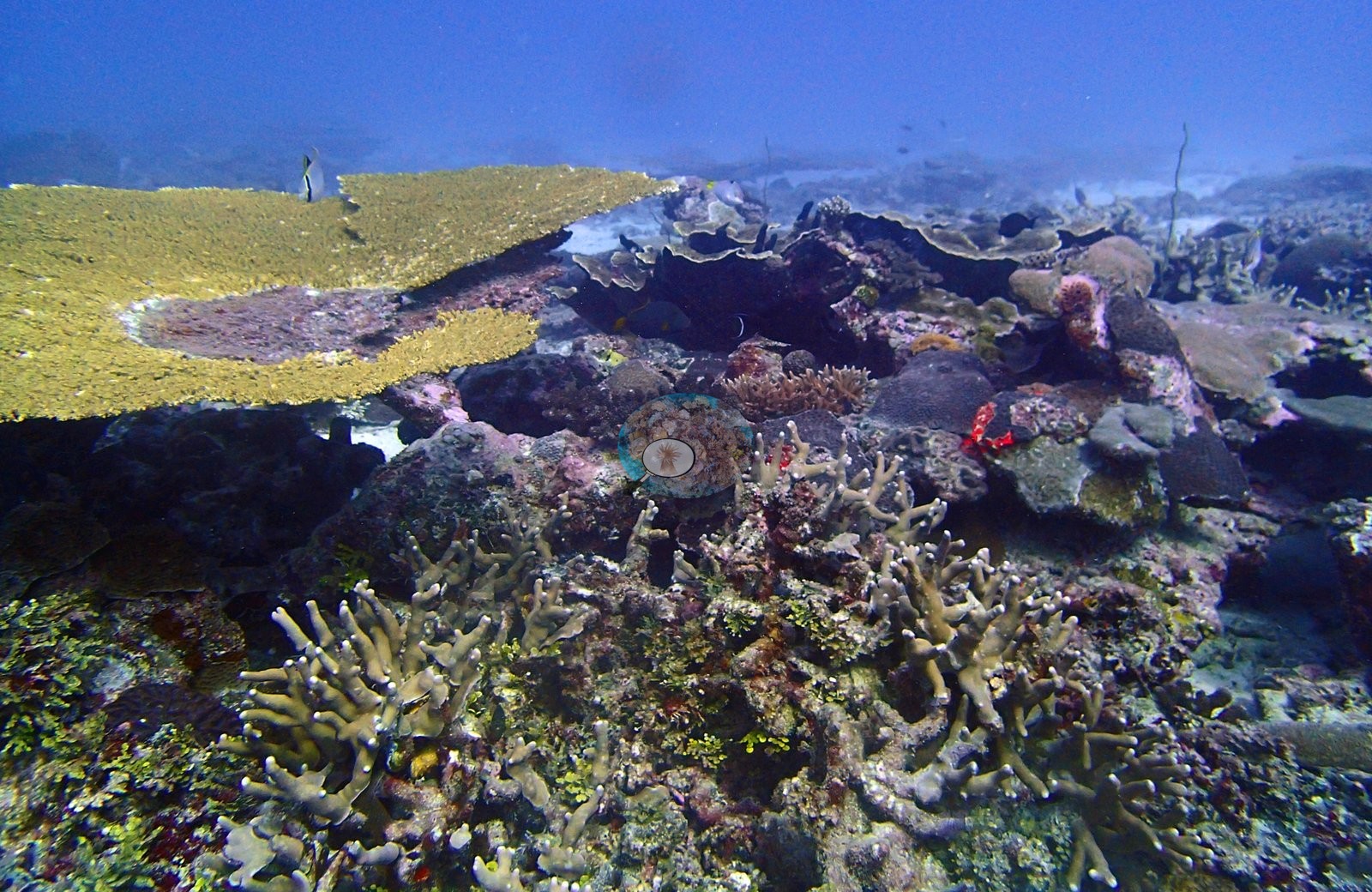
Chagos (NOAA CRW virtual station)One of the best reefs in the Chagos dataset: a sheltered lagoon patch reef at 29 m with 54% coral cover and 29 genera, including blue coral at mid-depth, with cover climbing and algae falling as the reef deepens. A fogged camera left only two photos, so its condition could barely be assessed. Surveyed on the Living Oceans Foundation's Global Reef Expedition.
🗺 Detailed map of the Global Reef Expedition dive sites, Three Brothers, Chagos (Khaled bin Sultan Living Oceans Foundation; opens in a new window)
Site description
Setting
BITB47 is a protected submerged patch reef inside the Three Brothers lagoon at 29 m, surveyed 24 March 2015, and it is one of the best reefs in this dataset: 53.7% coral against 35.5% algae, 20th of 109 Chagos sites for cover, and coral-abundant and genus-rich at once, with 29 genera, 19th of 109.
General benthic features
Only 6.6% of the benthos is bare substrate and 4.1% non-coral invertebrates. Acropora leads at 15.95% of the benthos and Porites at 12.73%, together 53% of all coral, and evenness is the highest of its group. The depth profile is the finding: cover climbs monotonically 48.2%, 55.1%, 57.9% while algae falls 43.8% to 24.4%, the middle stratum is the diversity peak carrying every one of the site's 29 genera, and leadership hands over at the bottom, where Porites jumps to 25.10% of the benthos, 43% of that stratum's coral and four times its mid-depth value, pushing Acropora into second. The blue coral Heliopora occurs at the middle stratum and nowhere else.
Coral cover
The image cover figures (CoralNet 30.0%, Coralscapes 25.7%) rest on those same two photographs and are illustrative only, never to be averaged with the transect value. Coral cover: 54%. Live hard coral measured on the in situ benthic transects of the LOF BIOT-1 expedition (Mayfield & Dempsey 2026, Oceans, supplemental S1), against algal cover of 35.5% of the benthos. The transect figure is this site's authoritative cover value; no image-derived product overrides it. Across methods the same reef reads: transects 53.7% · CoralNet points 30% · Coralscapes masks 25.7% (2 frames). These products have different sampling footprints and denominators and should not be averaged.
Stressors
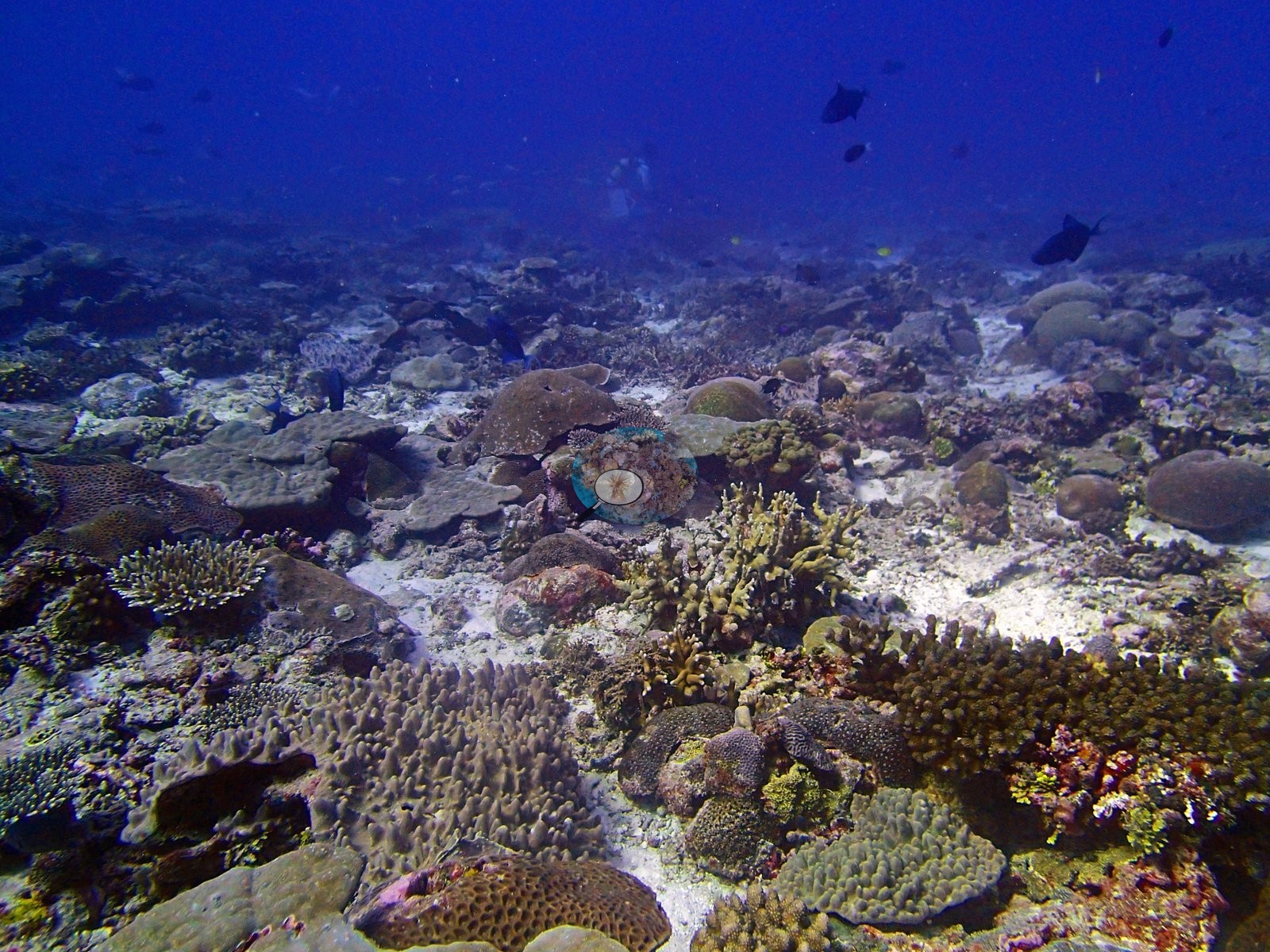
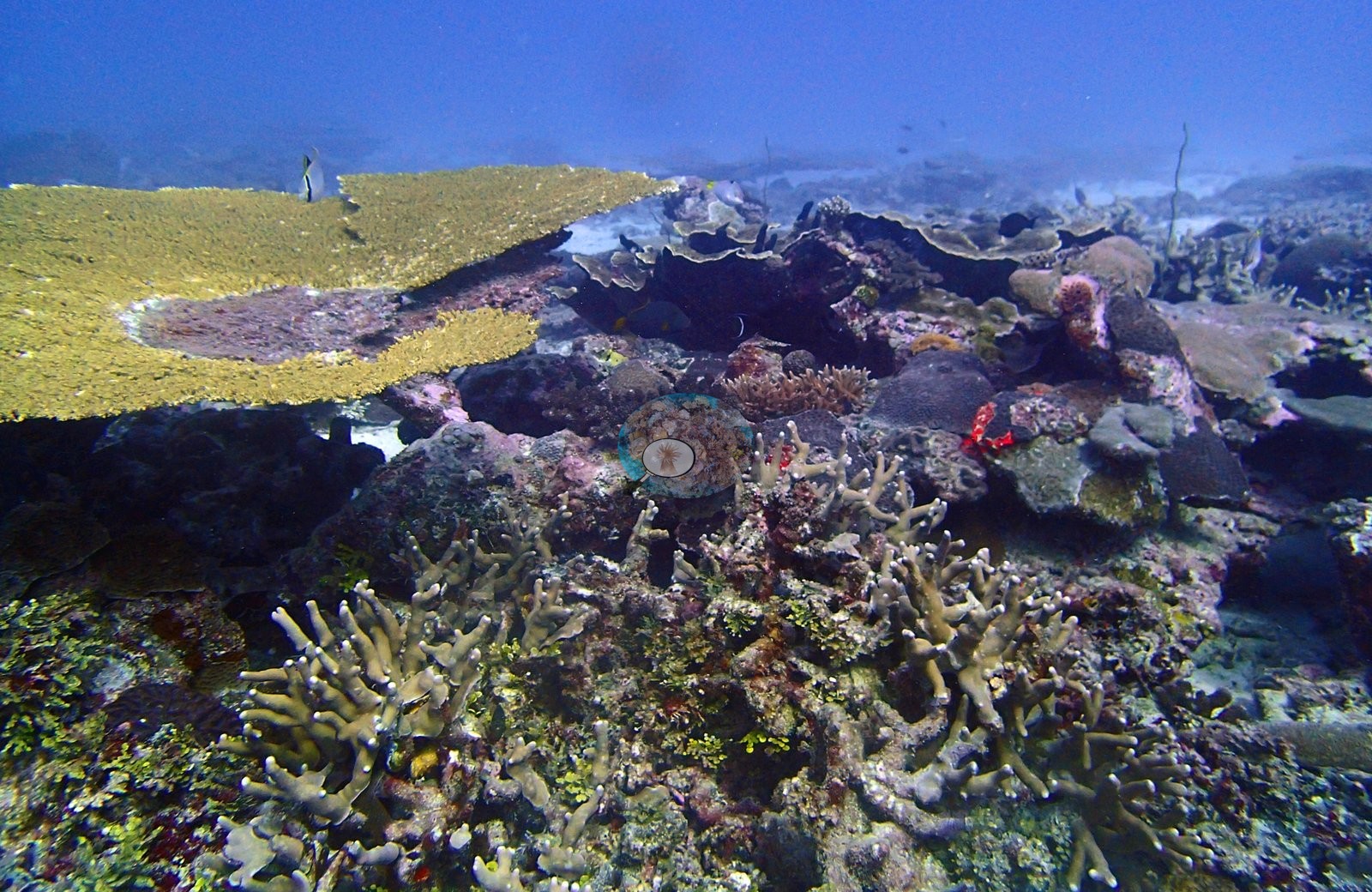
Bleaching is 5.56% on the site table's Mean(%bleaching) column, 65th of the 98 sites carrying a value, and both runs agree, so the canonical % bleaching (2nd training) figure is the same. Condition, though, cannot really be assessed: the camera housing fogged and the entire photographic record is two frames taken 64 seconds apart. They show a dense mixed high-cover mosaic and one large gold tabular Acropora carrying an older partial-mortality lesion already colonized by coralline algae; no bleaching field, crown-of-thorns, or disease is visible, but from two frames that is weak evidence (e.g., Image 1, Image 2).
Comparisons with other data
No prior survey data from this site. If you would like to share yours, please email us.
CV model comparison
More info
Those are point counts on the photographs; this is a diver swimming a transect. The models and the reference never saw the same thing. ⚠ SITE-LEVEL ONLY. The 2,500 frames were not associated with any transect taken within 200 m of them, so transect-vs-image comparisons are site means, never frames. The transect value is already in the pin `cover` field (109 of 112 pins, sourced to the paper's suppl. S1) and is read from there, never re-imported. The transect is THE coral-cover value for this site and stands alone. The rows below it are a methods comparison only: no computer-vision value is averaged with it, feeds the headline, or carries over to the site's cover figure (Anderson, 2026-09-22).| Method | Hard-coral cover (%) |
|---|---|
| Transect (published) | 53.7 |
| CoralNet | 43.0 |
| In-house DINOv3 | 35.0 |
| CoralSCOP edited | 33.2 |
| Claude | 25.5 |
Data & links
- Read the full site report ↗
- Download benthic survey data (CSV) ↗
- Download all LOF-GRE data (933 sites) ↗
- CoralNet image repository for this region ↗
- Photo portfolio ↗
- Coral Reef Diagnostics page for this area ↗
All images from Coral Reef Diagnostics. Data are from Coral Reef Diagnostics.
 © Coral Reef Diagnostics.