
Part of the regional summaries: Chagos Archipelago - Great Chagos Bank West / Brothers / Eagle and Chagos Archipelago
More info
Chagos (NOAA CRW virtual station)A high-cover reef (61%) whose signature is its giant mounds of whorled purple-brown plate coral, two to three meters across, set among dense Acropora, brain, and Porites colonies. Spotted eagle rays are the star attraction, with three photographed together gliding in open water. Surveyed on the Living Oceans Foundation's Global Reef Expedition.
Three independent survey stations shown with the program’s logo — click one to see how far it is from this site.
Thirteen other CRD dive sites within 5 km shown in orange — click a marker to open its page.
🗺 Detailed map of the Global Reef Expedition dive sites, Three Brothers, Chagos (Khaled bin Sultan Living Oceans Foundation; opens in a new window)
19 of these 30 photographs are shown beside the text that discusses them under "Site description" below.
Site description
General benthic features
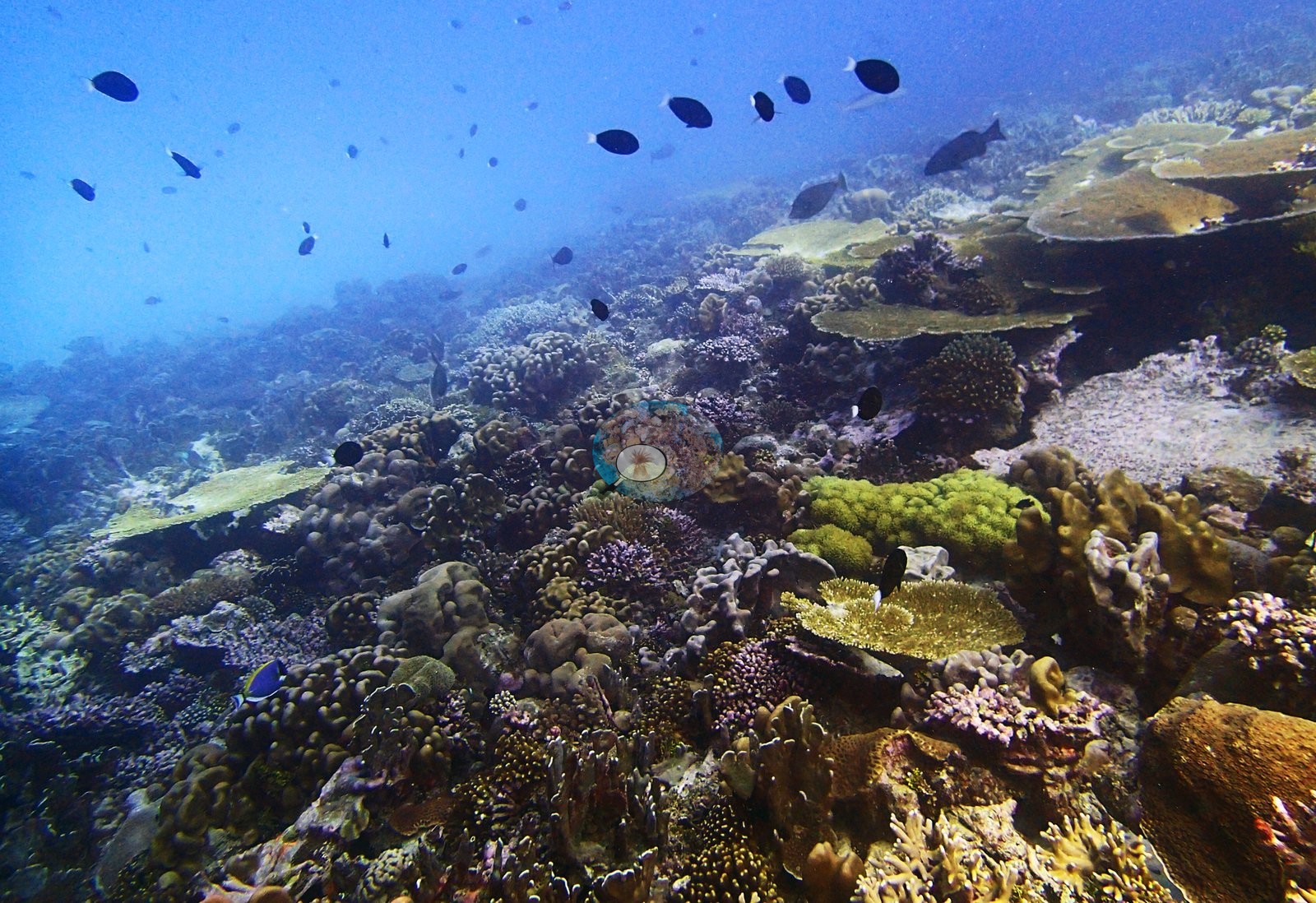
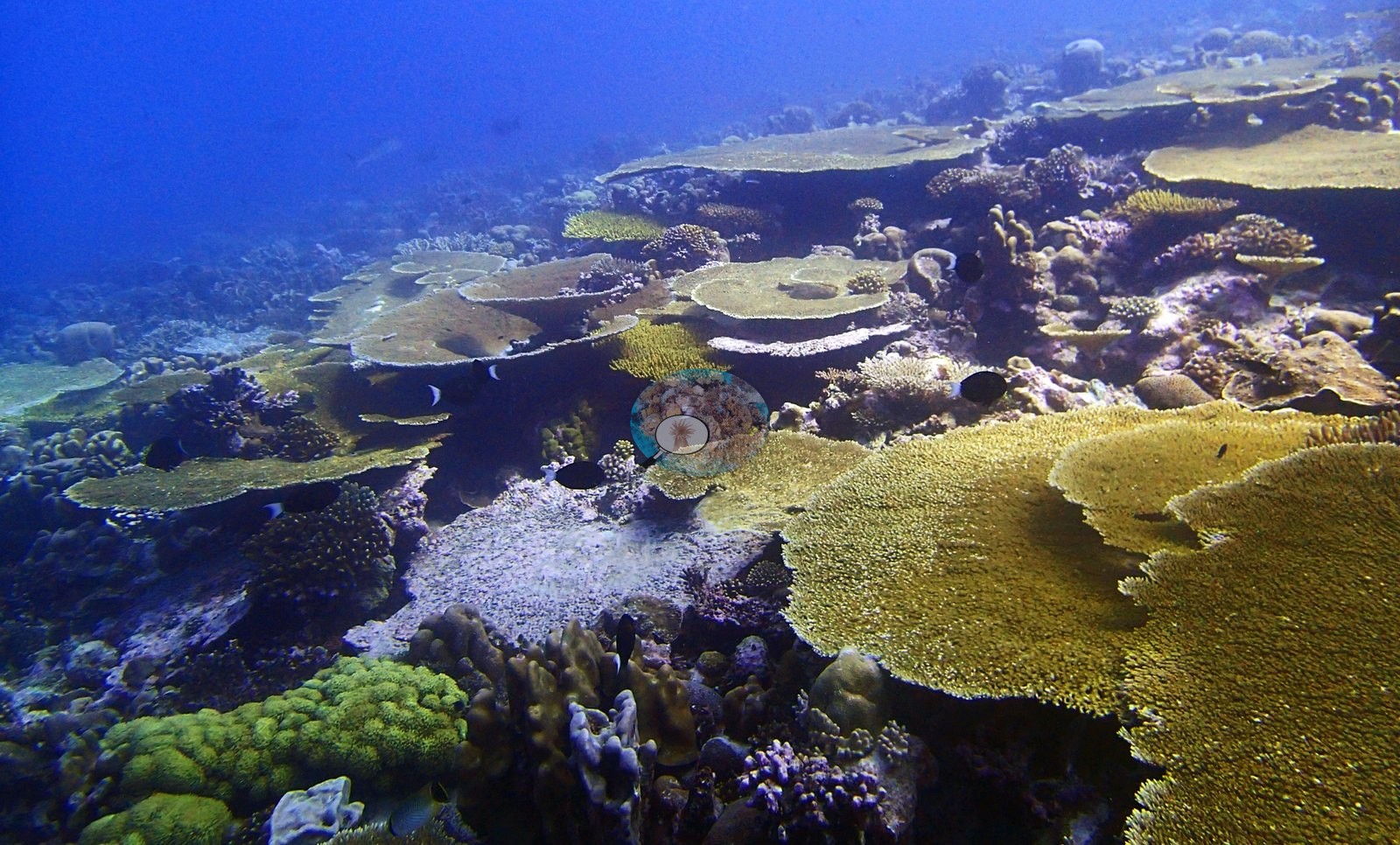
Where the reef is not plated it is foliose, and that is the site's signature (e.g., Image 4, Image 7, Image 16).
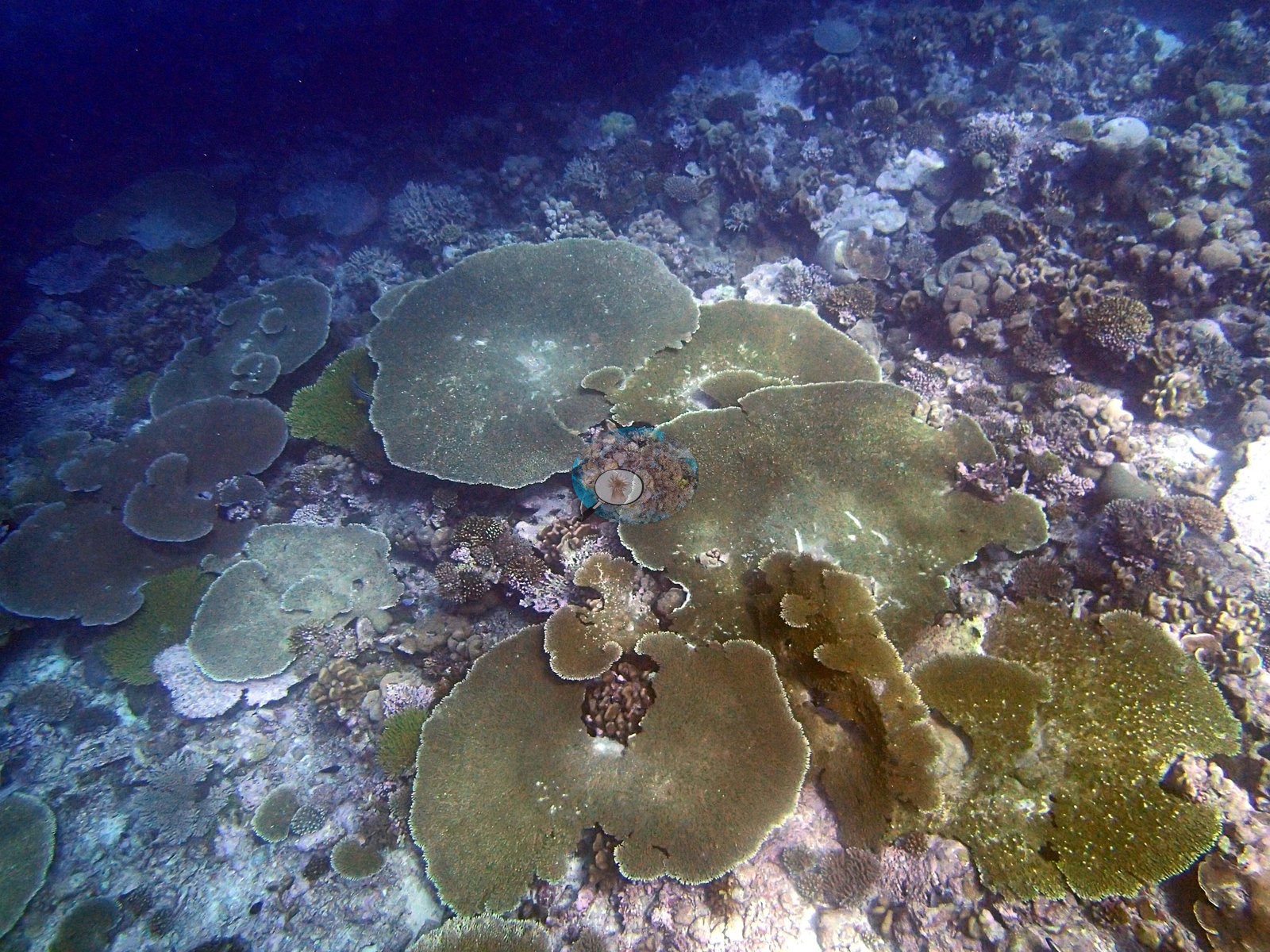
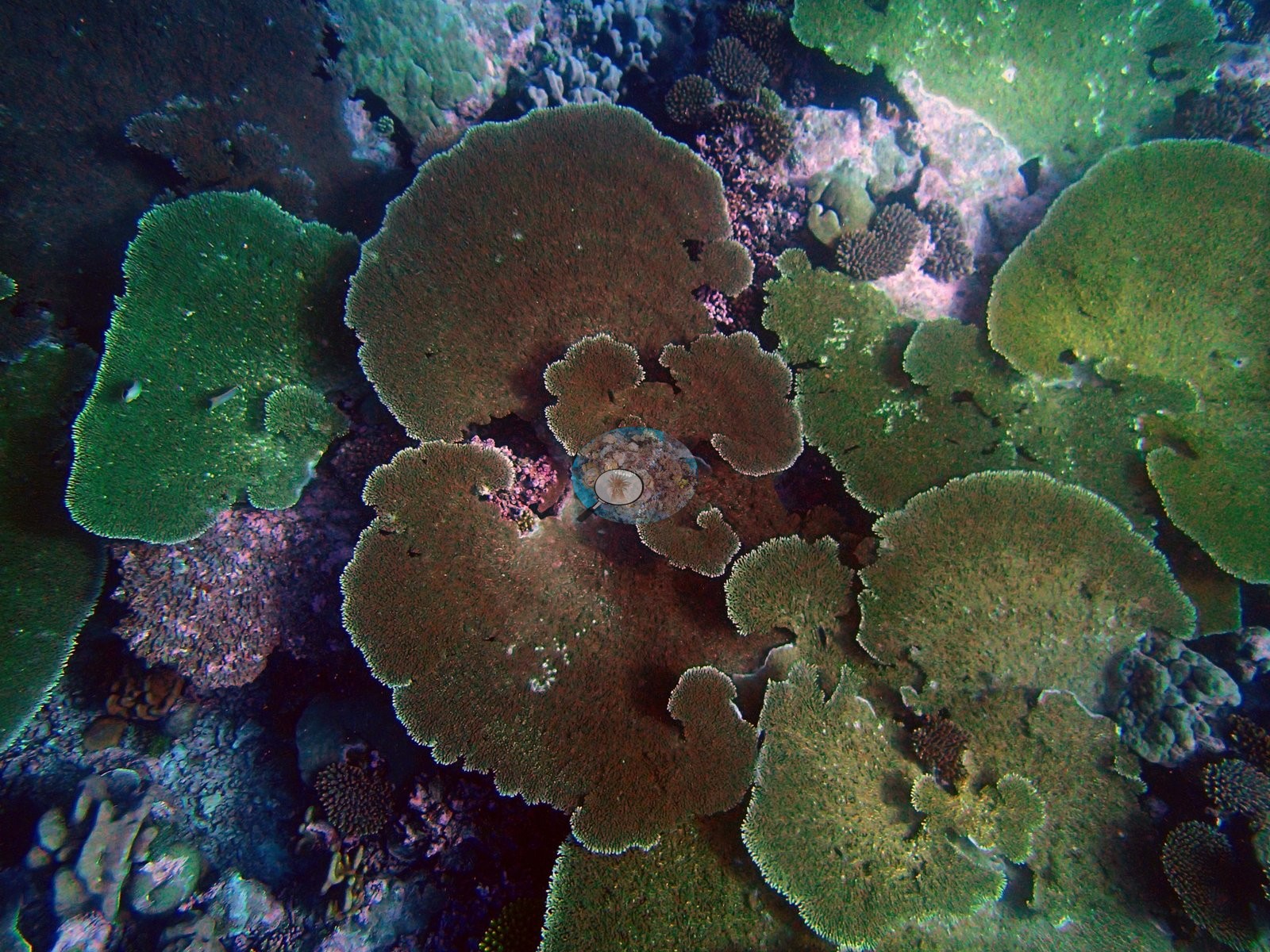
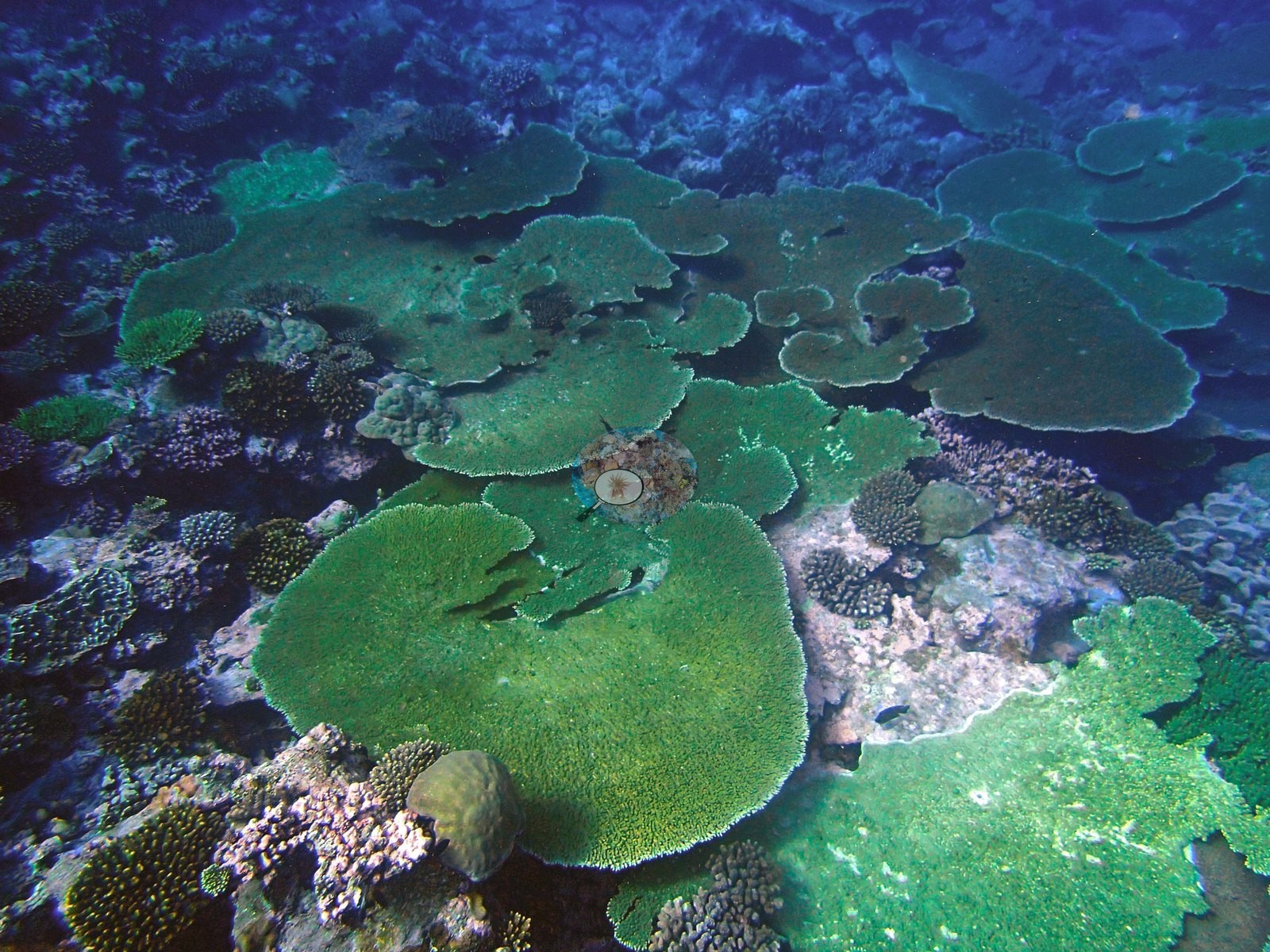
Two frames show the two most striking colonies of the redo so far — single mounded stands two to three meters across built entirely of tightly whorled purple-brown foliose plates, thousands of them, spiraling out from the center like stacked crockery and terminating in a clean pale growing margin (e.g., Image 8, Image 21).
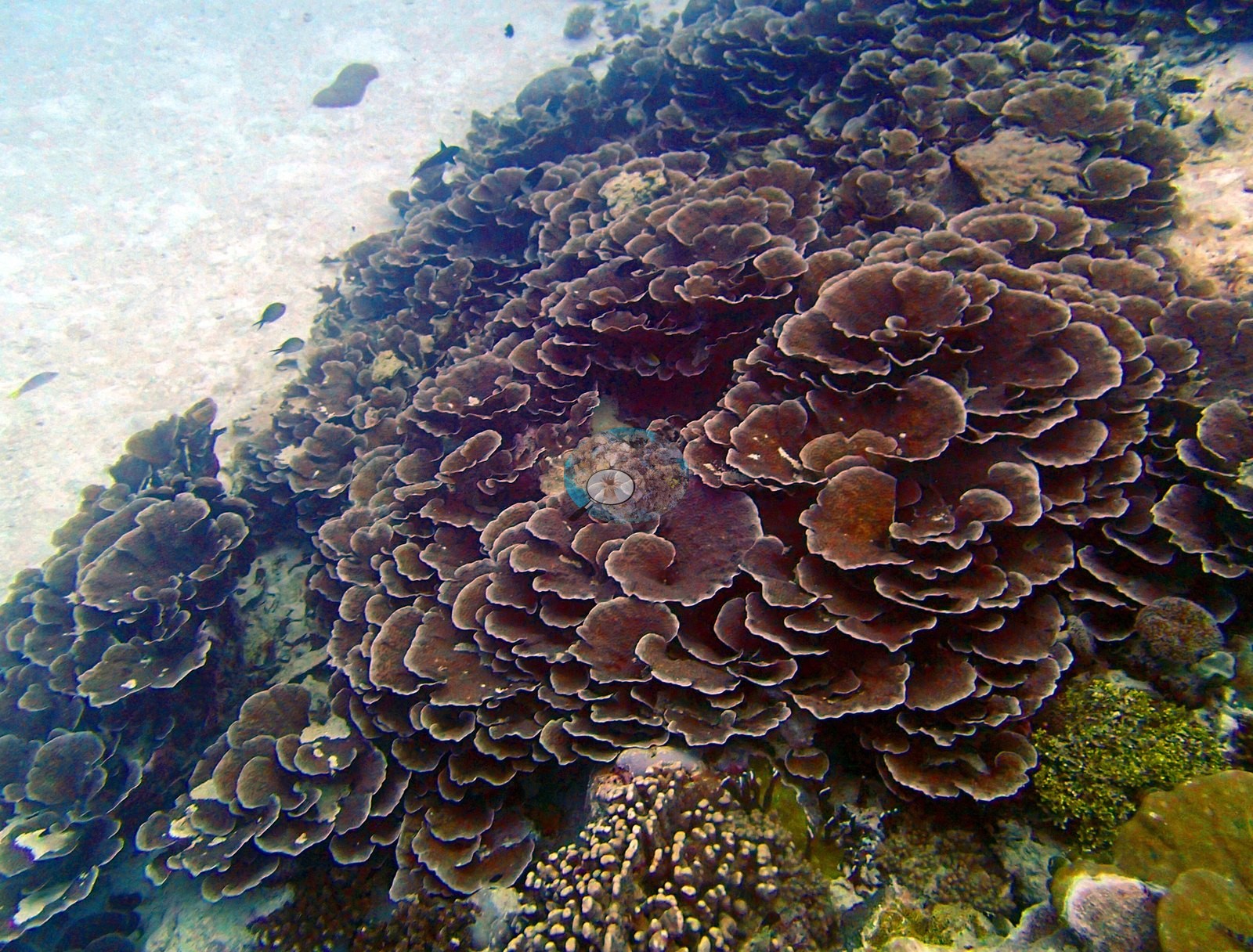
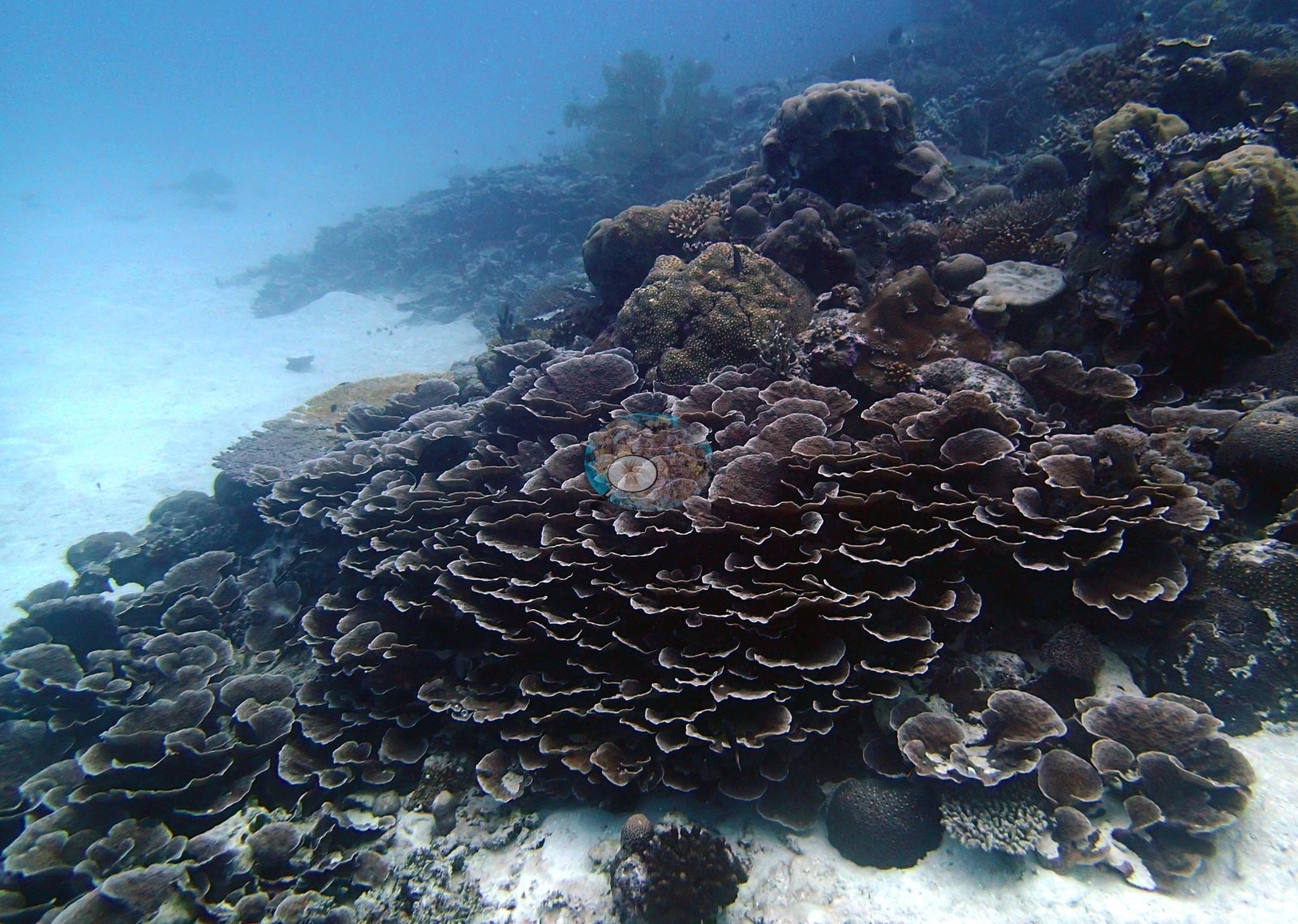
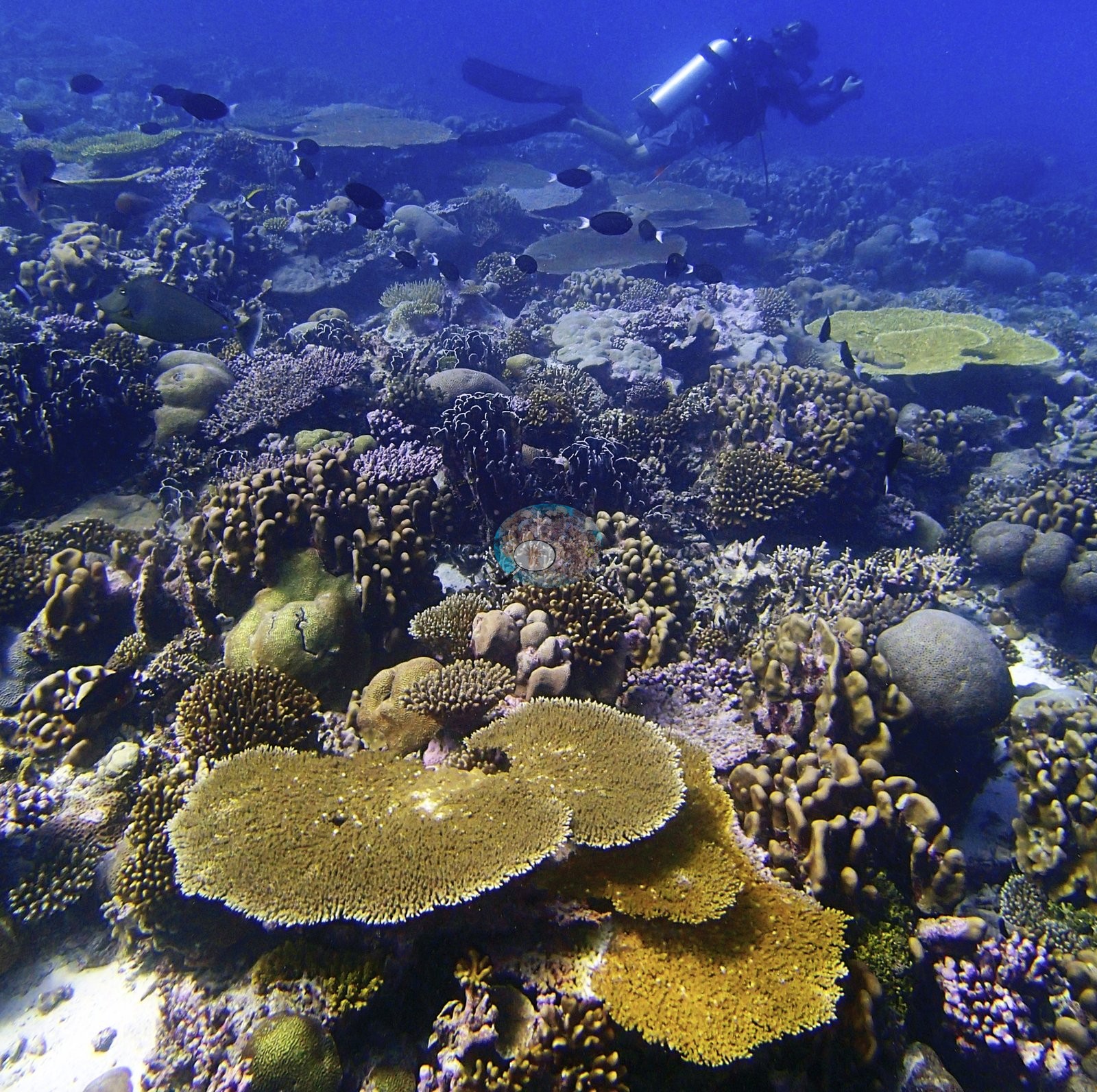
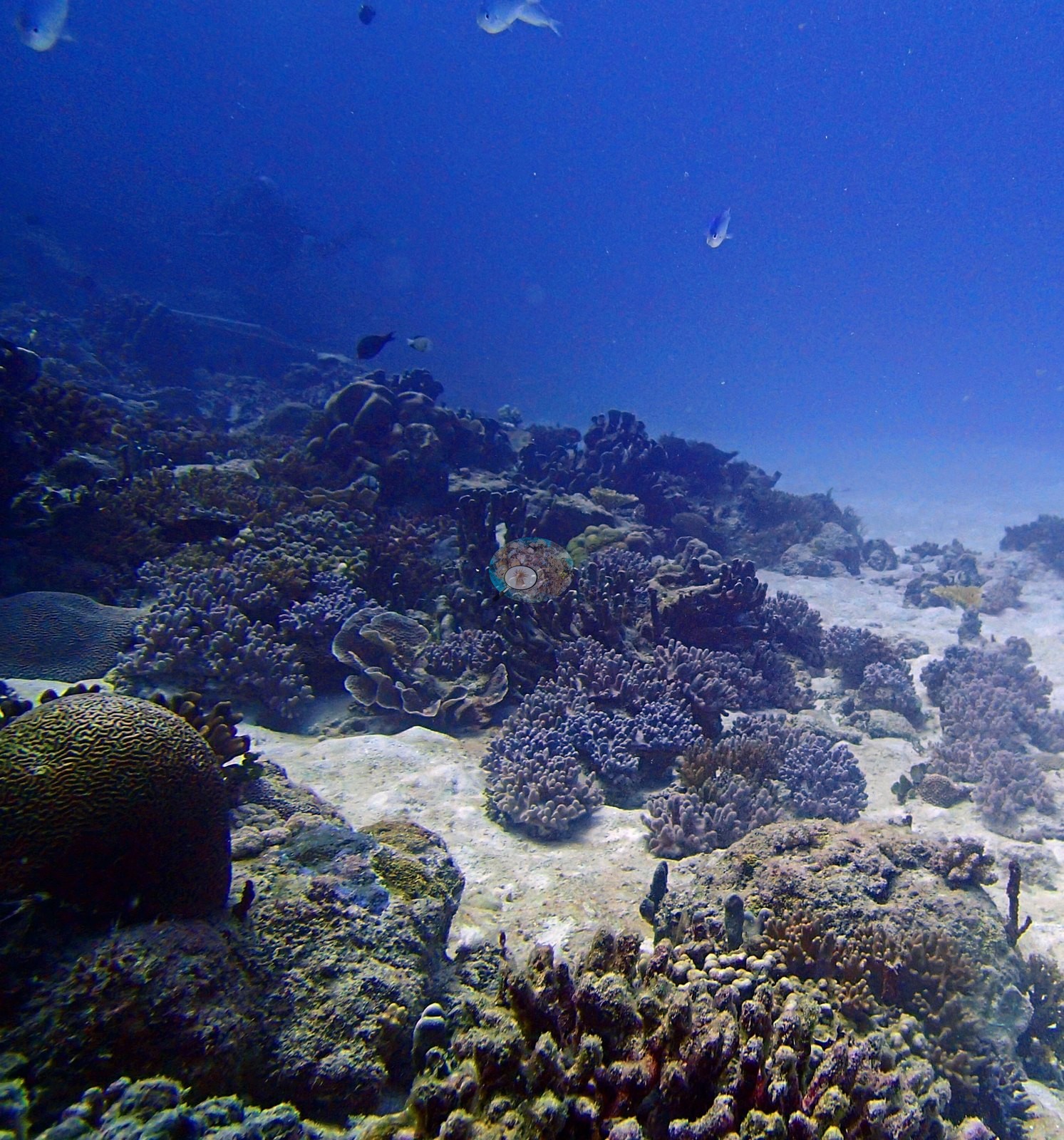
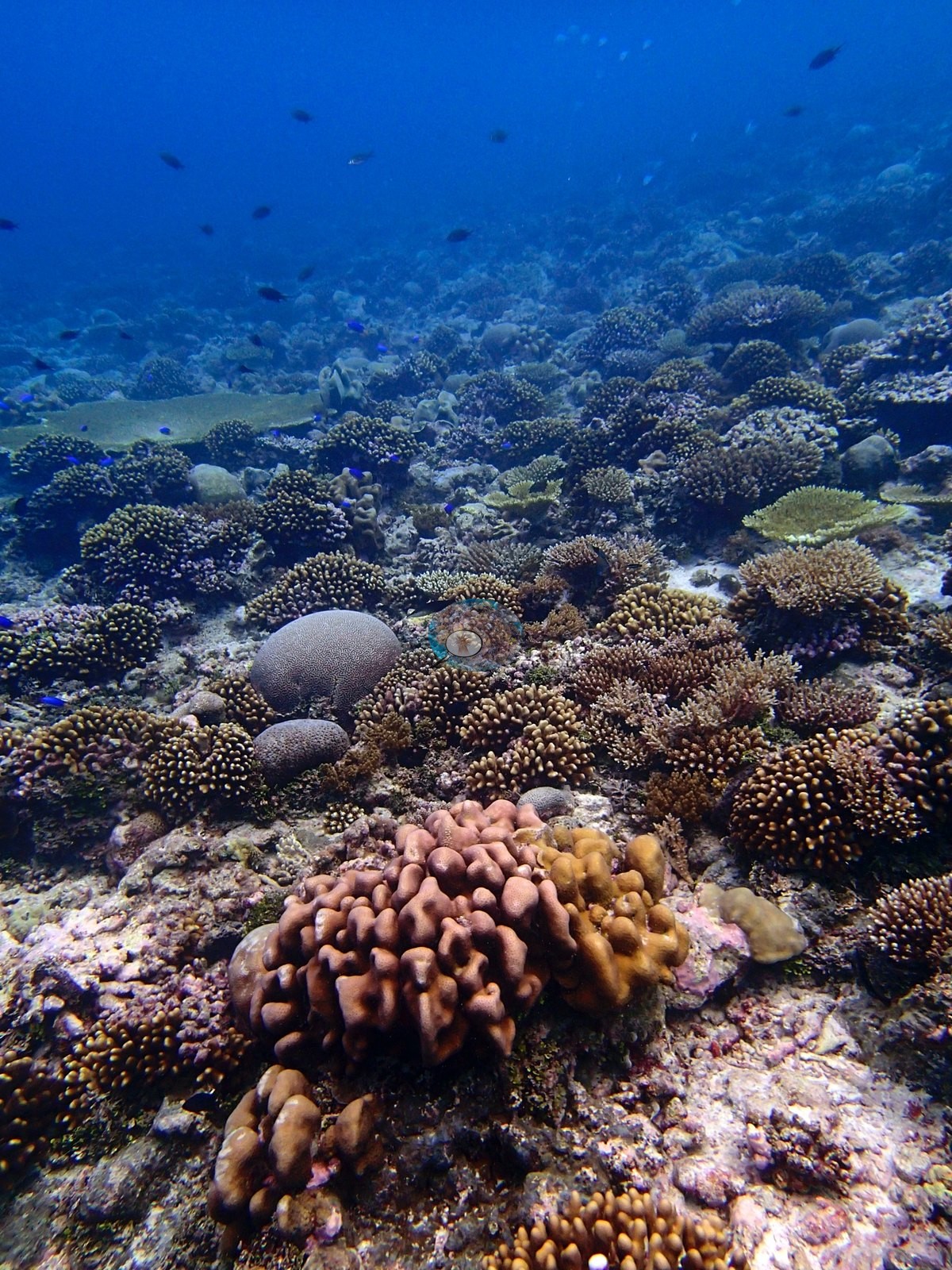
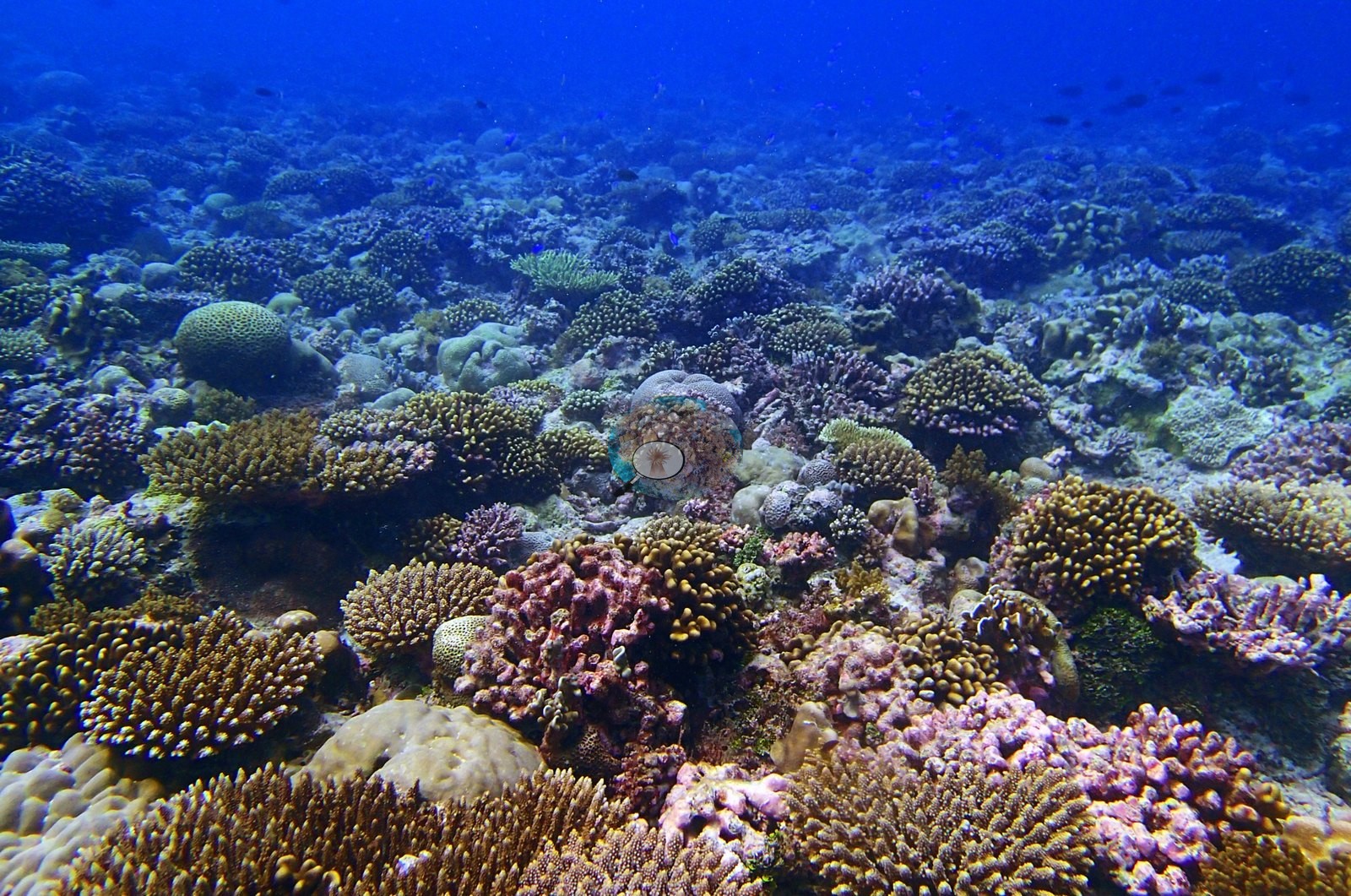
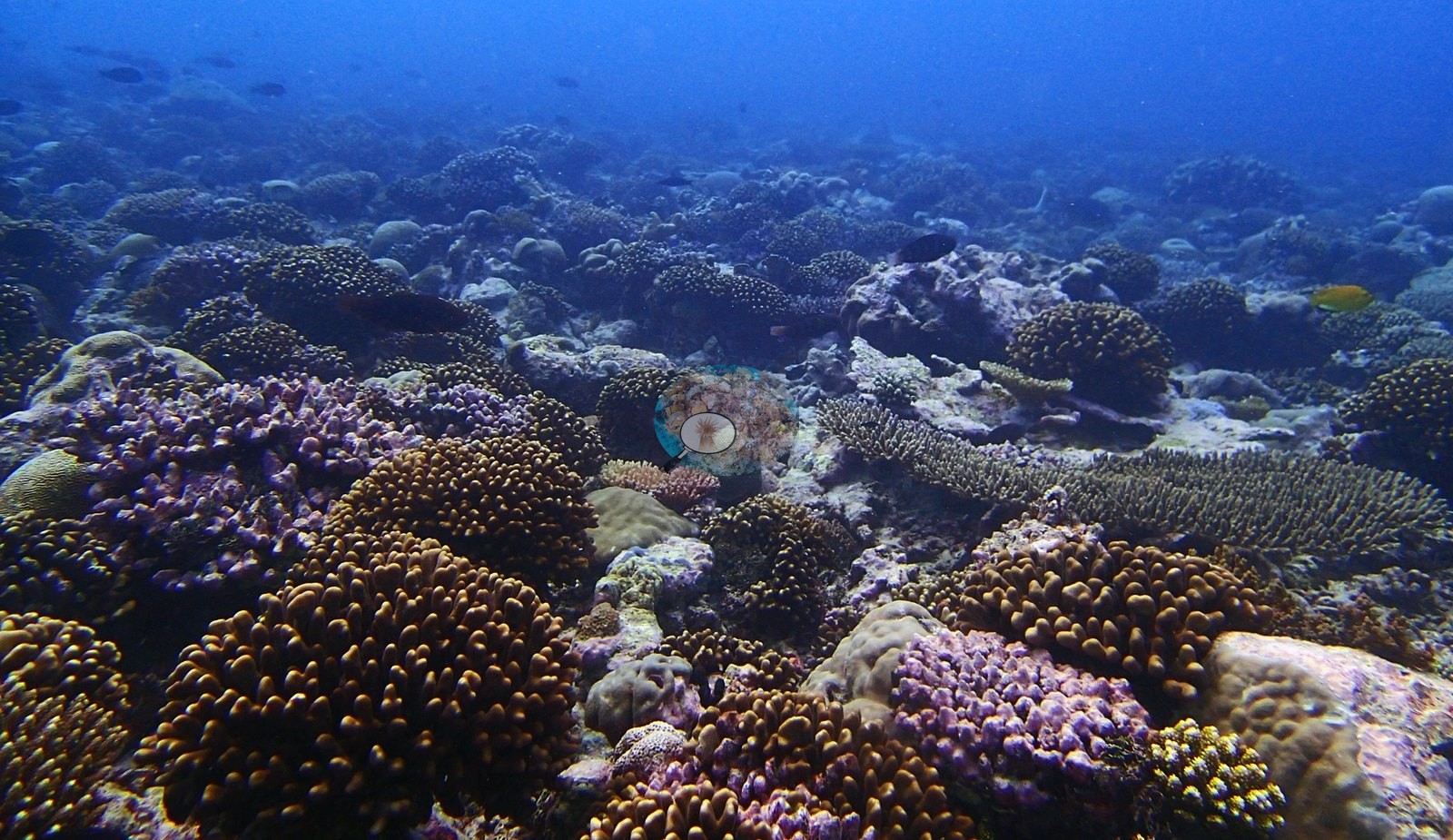
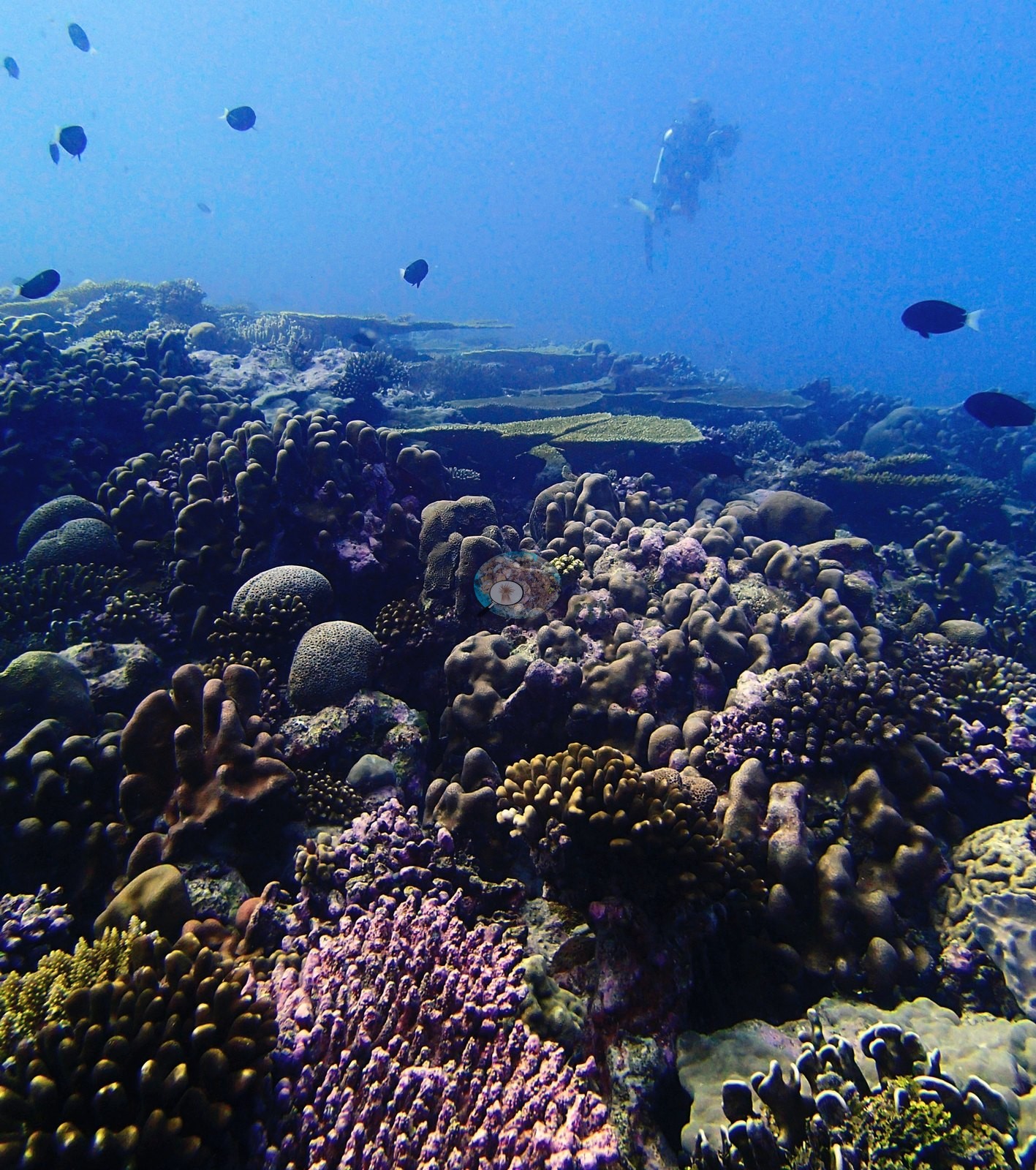
Both are compatible with Echinopora lamellosa or a foliose Montipora (the transect records both, at 1.65% and 2.10%), and neither frame carries a CV score. Between the plates and the whorls the reef is a dense mosaic: the two highest-cover wide frames at the site show pavement invisible beneath corymbose and digitate Acropora, mauve staghorn, Platygyra-type brains, Astreopora-type domes, and a huge pink-brown knobby-lobed Porites; another frame runs a whole foreground of blunt gold-and-mauve digitate colonies compatible with Stylophora, the site's third-ranked genus at 5.20%. One frame is the massive-coral frame — lobed Porites fingers, faviid domes, and purple-crusted submassives shoulder to shoulder, a diver hanging in the blue above (e.g., Image 27).
Both target pocilloporid groups are present here, which is unusual for Chagos. The imagery is consistent and unusually well supplied with candidates: four frames are close-up flash macros composed on a single pocilloporid colony, which is how a sampled colony gets documented. One is a compact cream-white verrucose colony among tan neighbors; another a pale pink-and-cream colony between a Platygyra-type brain and a cerioid Favites-type sheet, with Halimeda around it; a third a cream-yellow colony beneath a honeycomb massive; a fourth a larger tan colony with pale extended polyps, ringed by green Didemnum-type ascidians (e.g., Image 6, Image 13, Image 17, Image 28).
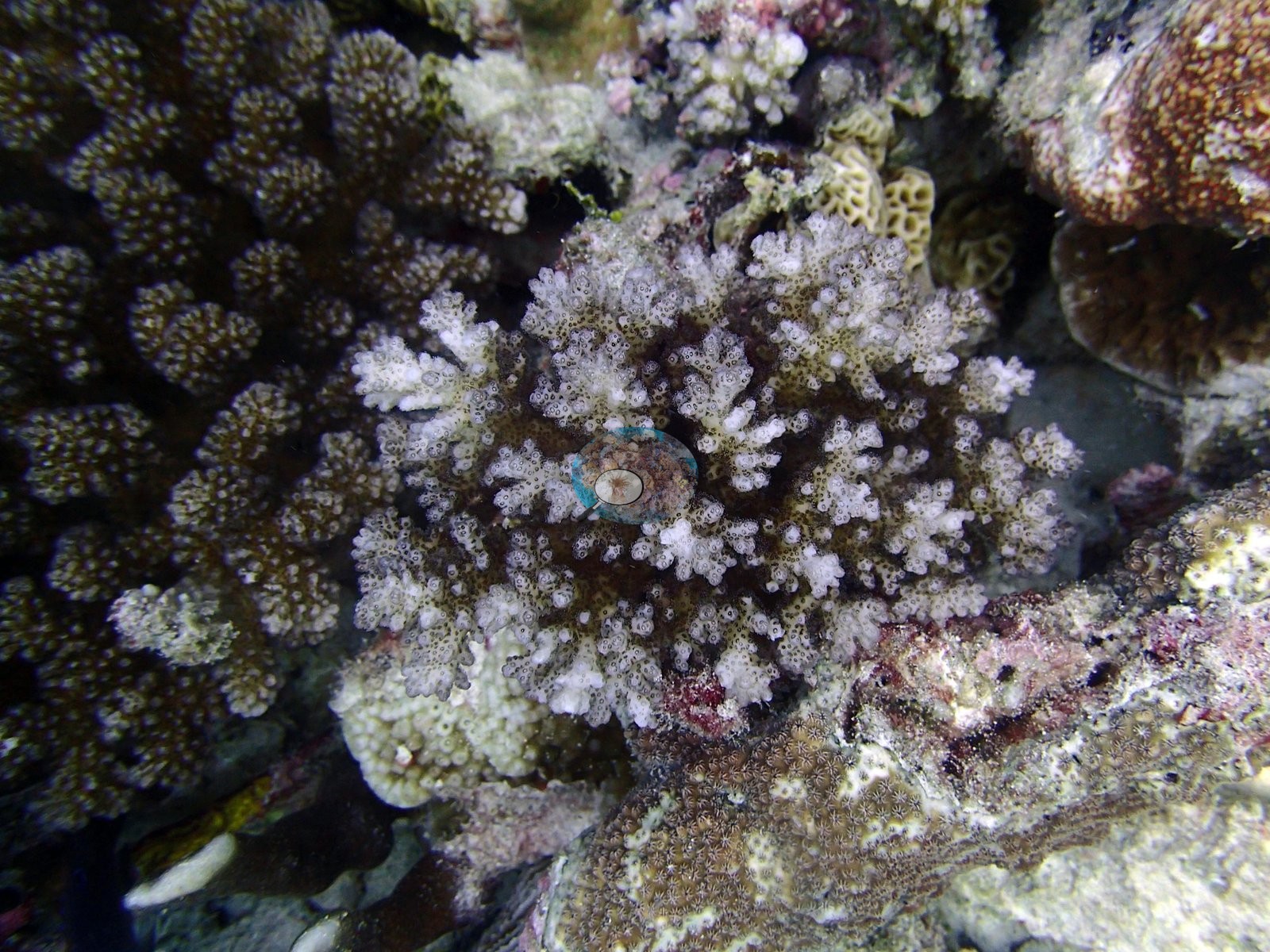
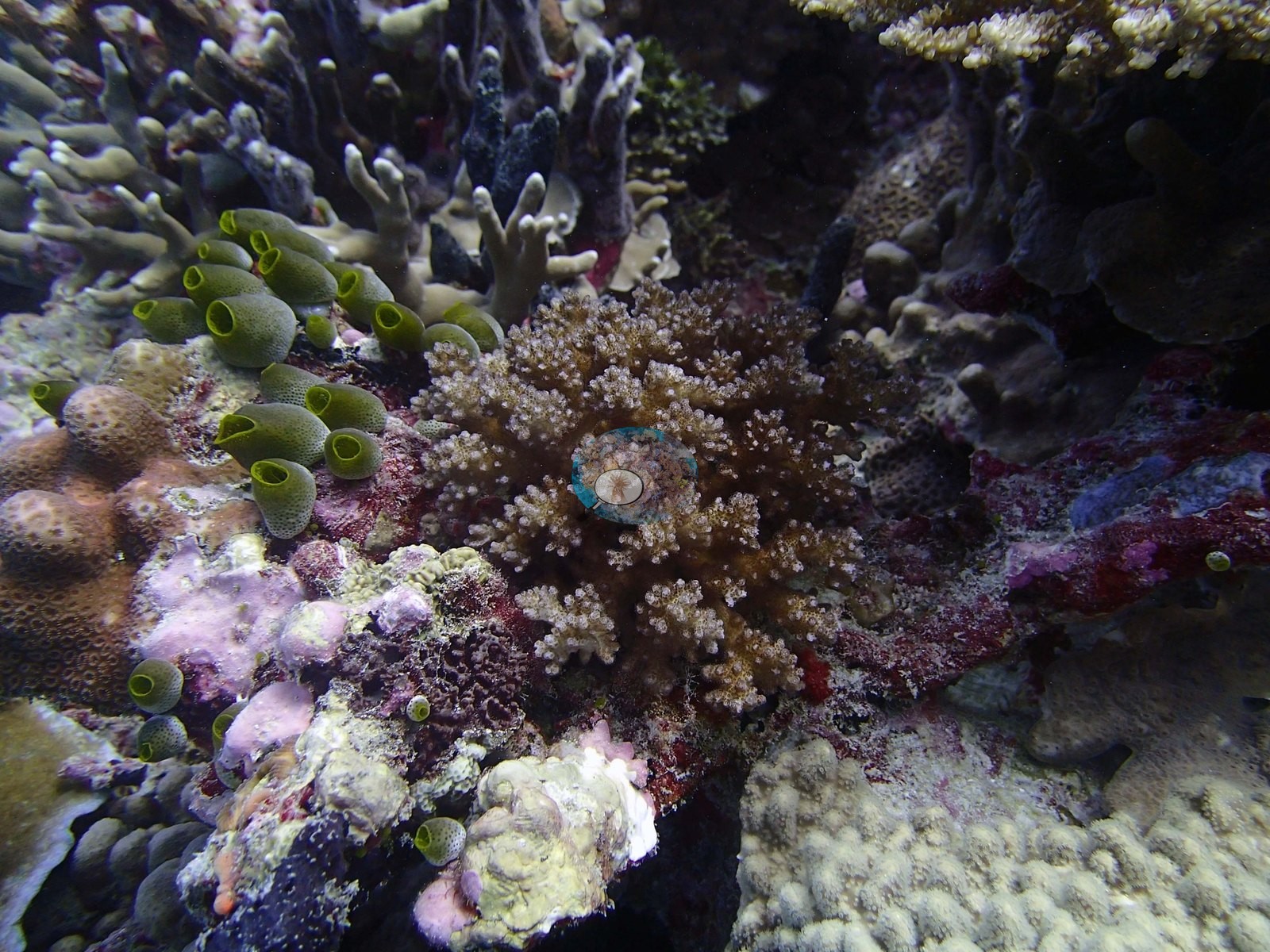
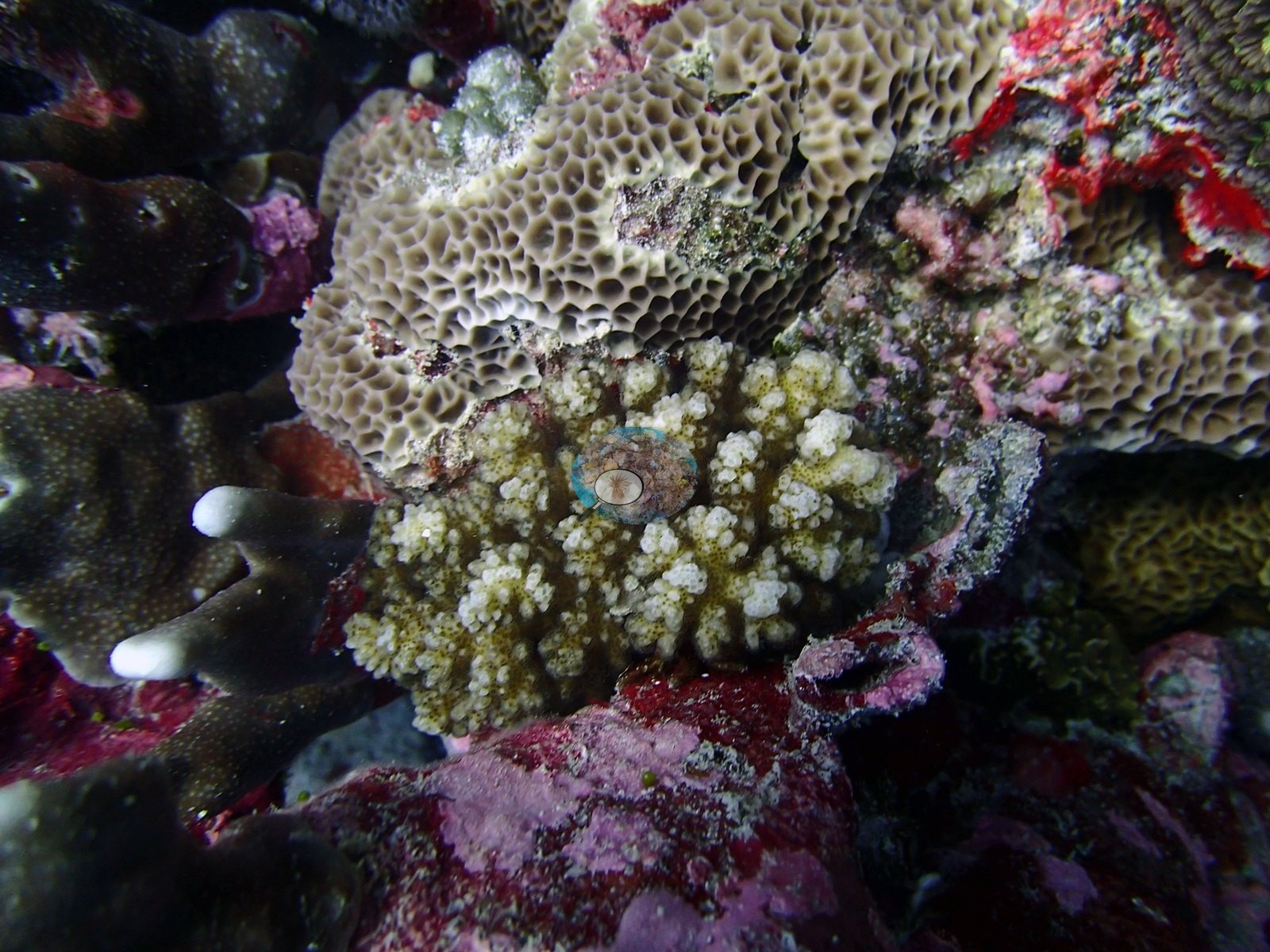
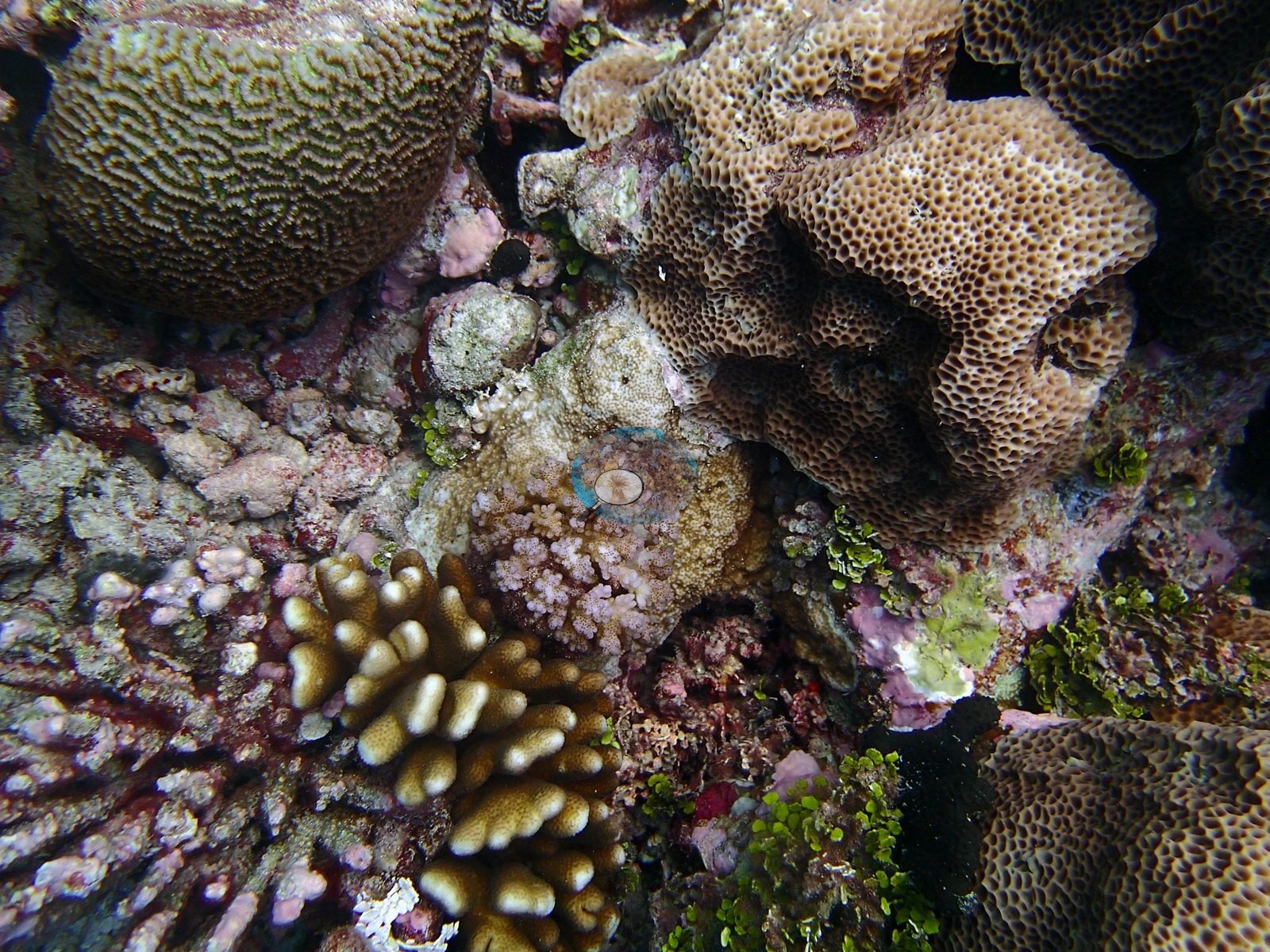
All four are compatible with the compact damicornis/acuta habit rather than the blunt verrucosa form seen at BITB27. Nothing in the folder reads as Seriatopora. Non-coral cover is dominated by turf 8.5% and crustose coralline algae 5.2% of all points.
Coral cover
Assemblage composition. This paragraph rests on 11 of the site's frames. Across those 11 the Coralscapes masks put live hard coral at 34.8% of image area, of which massive and meandroid is the largest component at 35.5%; the rest breaks down as other hard coral 18.4%, tabular Acropora 17.6%, Stylophora 9.3%, Pocillopora 6.9%, and Acropora (non-tabular) 6.9% of live cover. That spectrum is independently corroborated by the transect, which puts massive and meandroid genera at 34.3% of coral cover (vs the mask's 35.5%) and Stylophora at 8.5% (vs 9.3%) — the only site in the redo where a Coralscapes Stylophora class can be checked against a transect that actually recorded the genus. The independent 30-point annotation of the same 11 frames (330 points) gives live hard coral as 32.7% of all points and apportions it Acropora 45.4%, other hard coral 25.0%, Porites 24.1%, Pocillopora 5.6% of live coral, against a transect Acropora share of 40.6%. Frame-to-frame live cover runs 0.0–63% by point count and 0.0–60% by mask, and the two methods agree with each other well here: r = 0.724, against 0.716 corpus-wide and 0.278 at BITB30. Coral cover: 61%. Live hard coral measured on the in situ benthic transects of the LOF BIOT-1 expedition (Mayfield & Dempsey 2026, Oceans, supplemental S1), against algal cover of 27.8% of the benthos. The transect figure is this site's authoritative cover value; no image-derived product overrides it. Across methods the same reef reads: transects 61.1% · CoralNet points 32.7% · Coralscapes masks 34.8% (11 frames). These products have different sampling footprints and denominators and should not be averaged.
Stressors
Health is very good and there is no survey apparatus anywhere. Structural loss is old: Coralscapes puts dead coral at 4.43% of image area and rubble at 1.25%, and what dead framework there is has already been resurfaced in pink and mauve CCA — the pavement in three frames is almost entirely CCA-plated old framework. No COTS, no disease lesions, and no predation scars anywhere in the folder. Structural loss registers as dead coral 4.43% of image area and rubble 1.25%. Bleaching stands at 2.12% of annotated points — 7 points in total, split other hard coral 1.52% and Acropora 0.61% — while Coralscapes reads bleached at 0.05% of image area, effectively zero.
Fish and other fauna
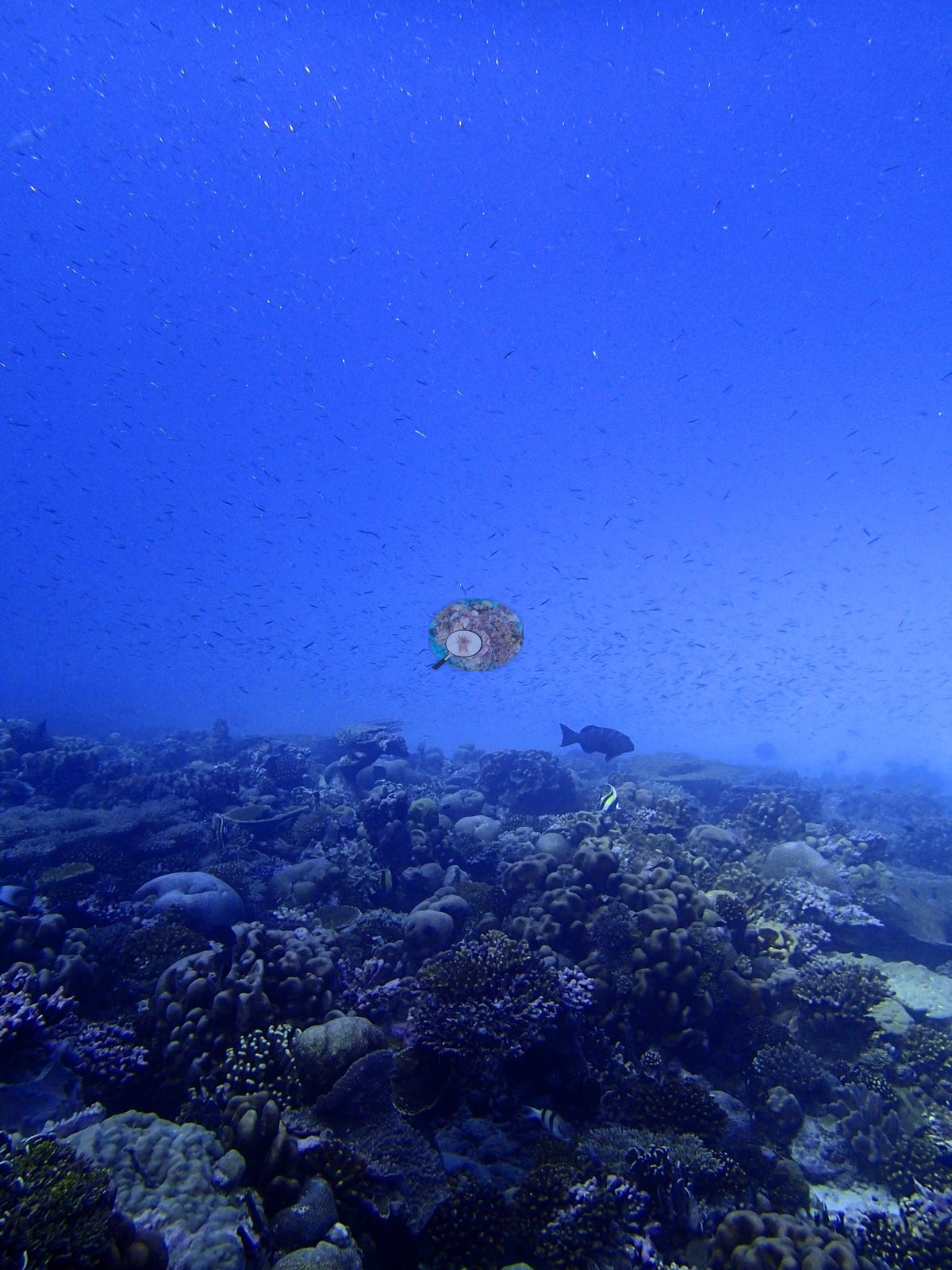
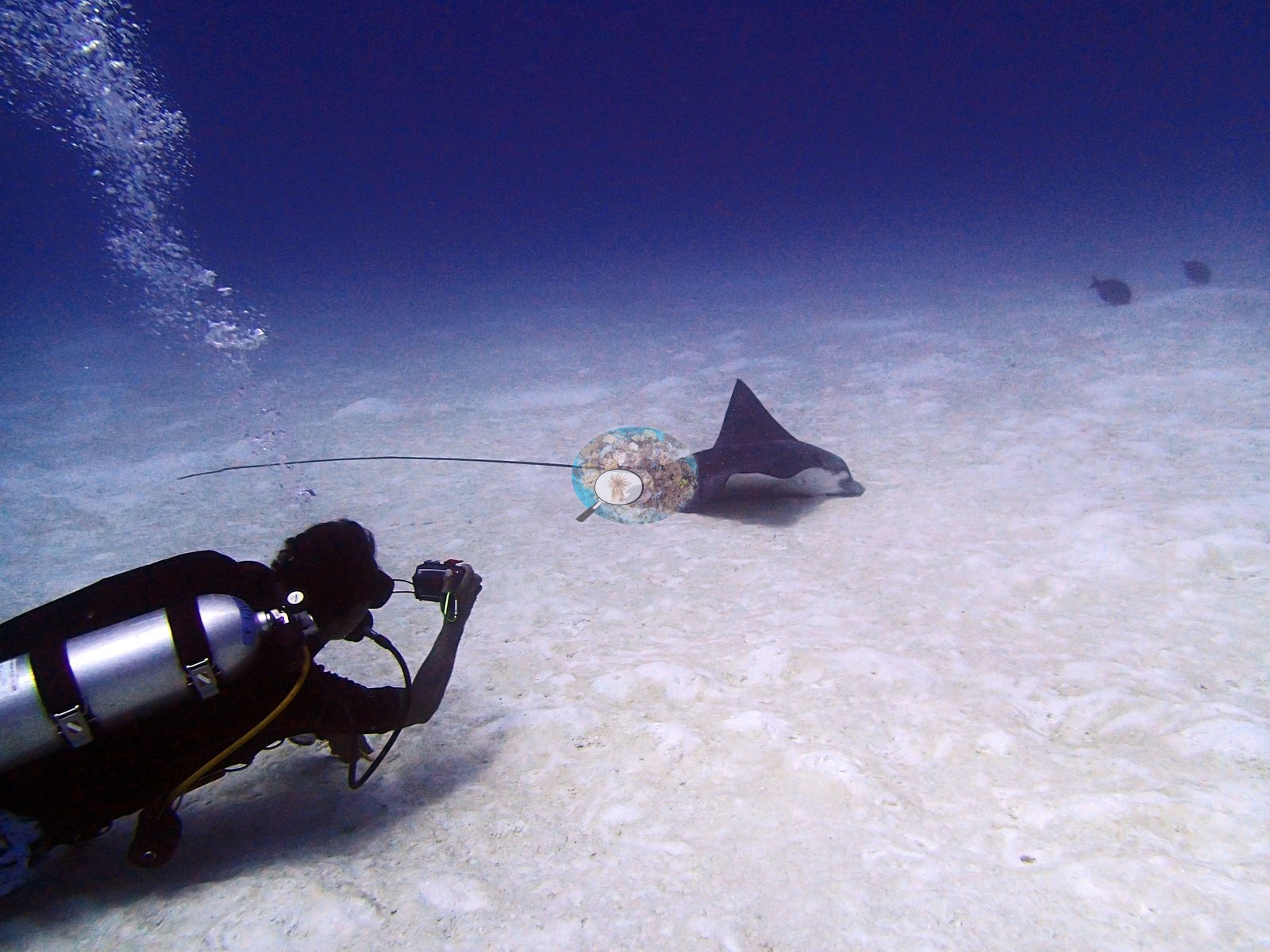
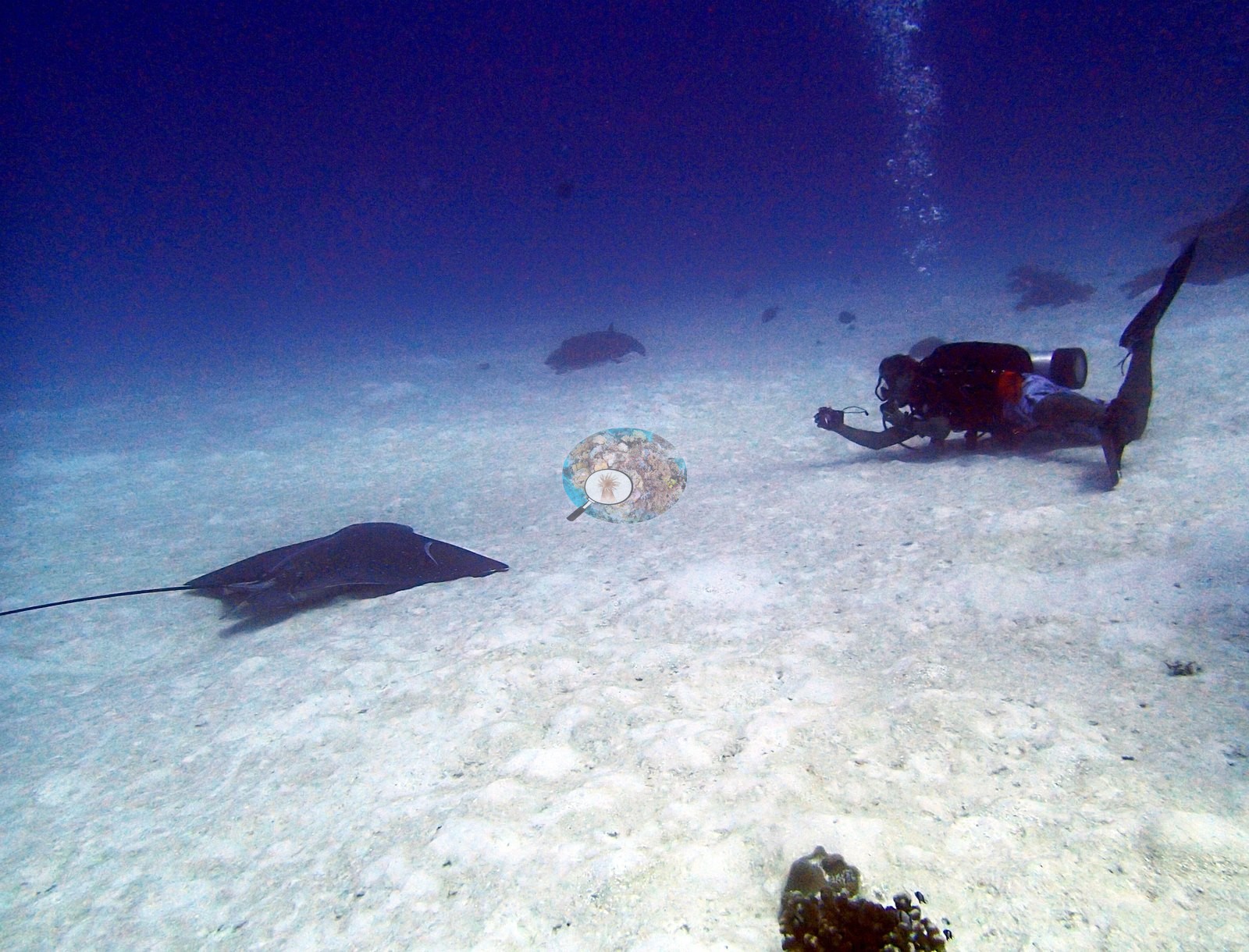
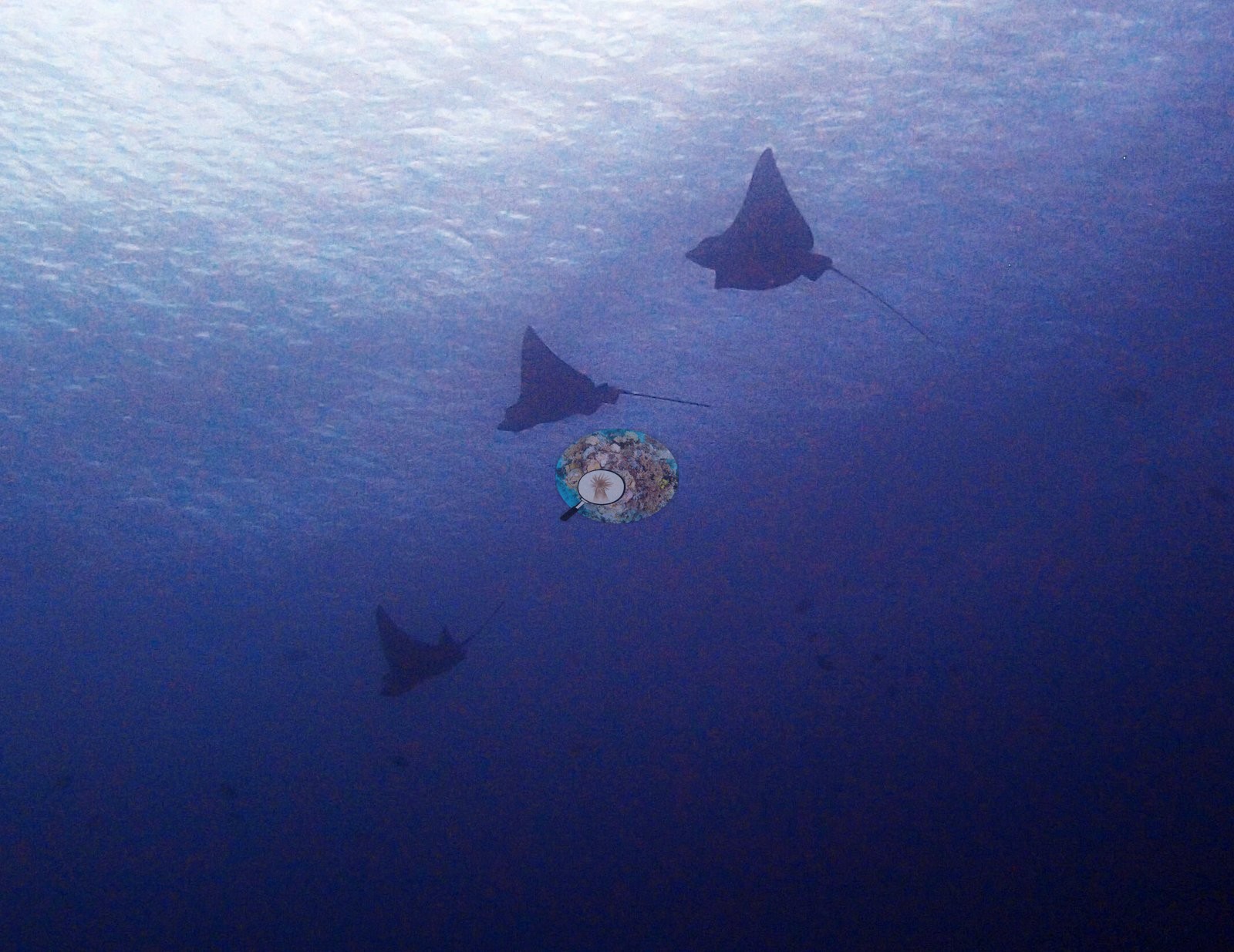
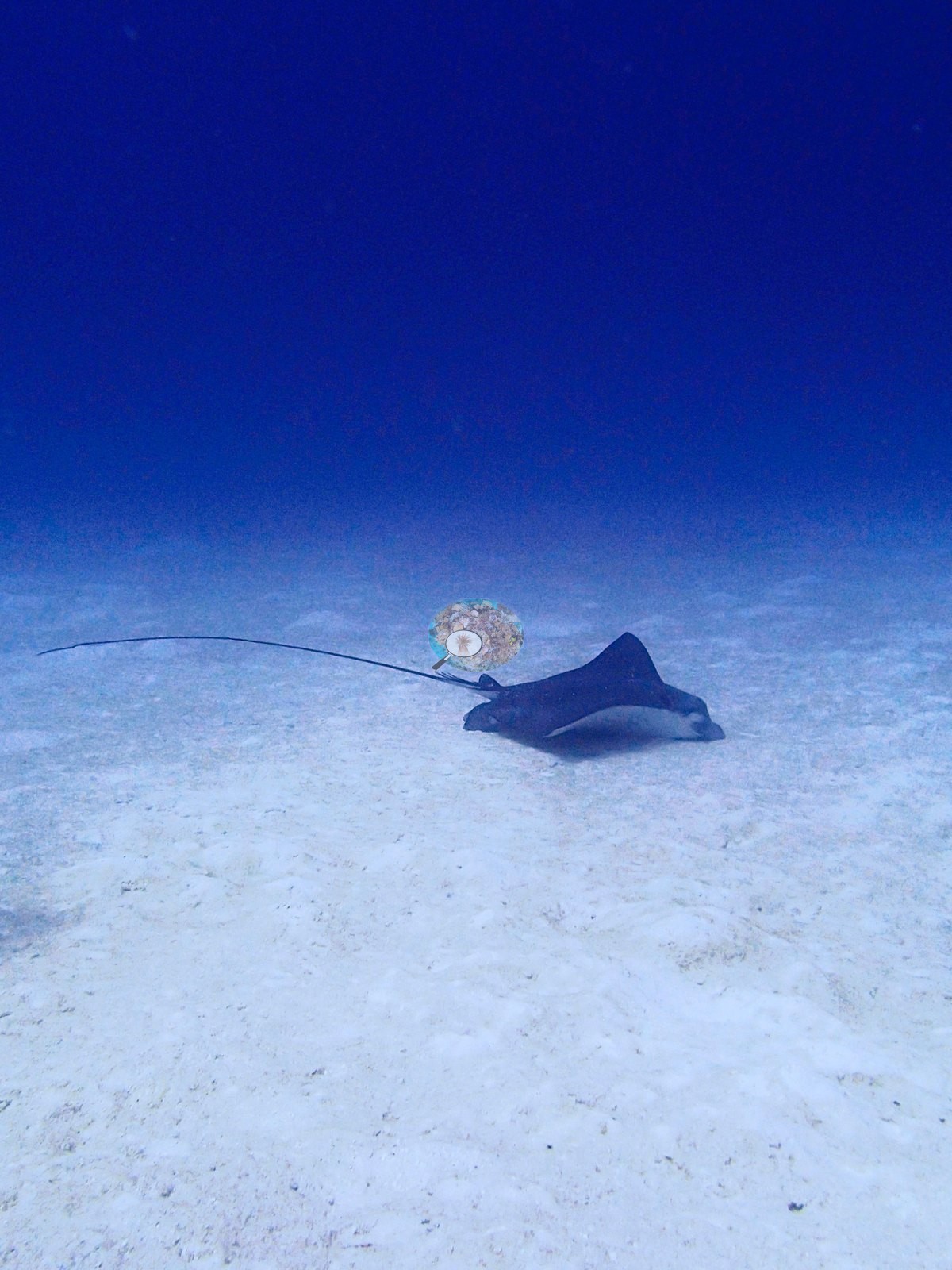
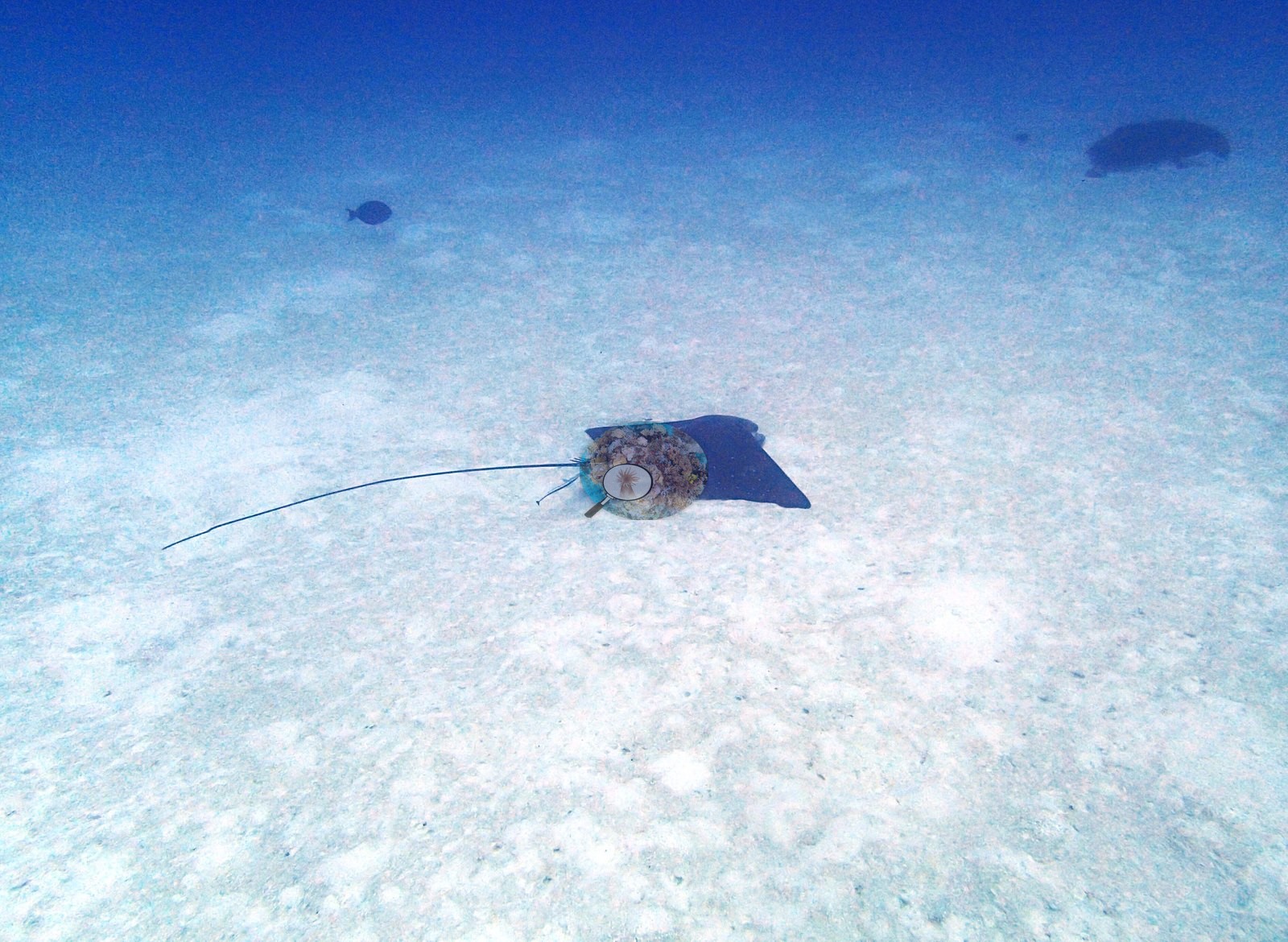
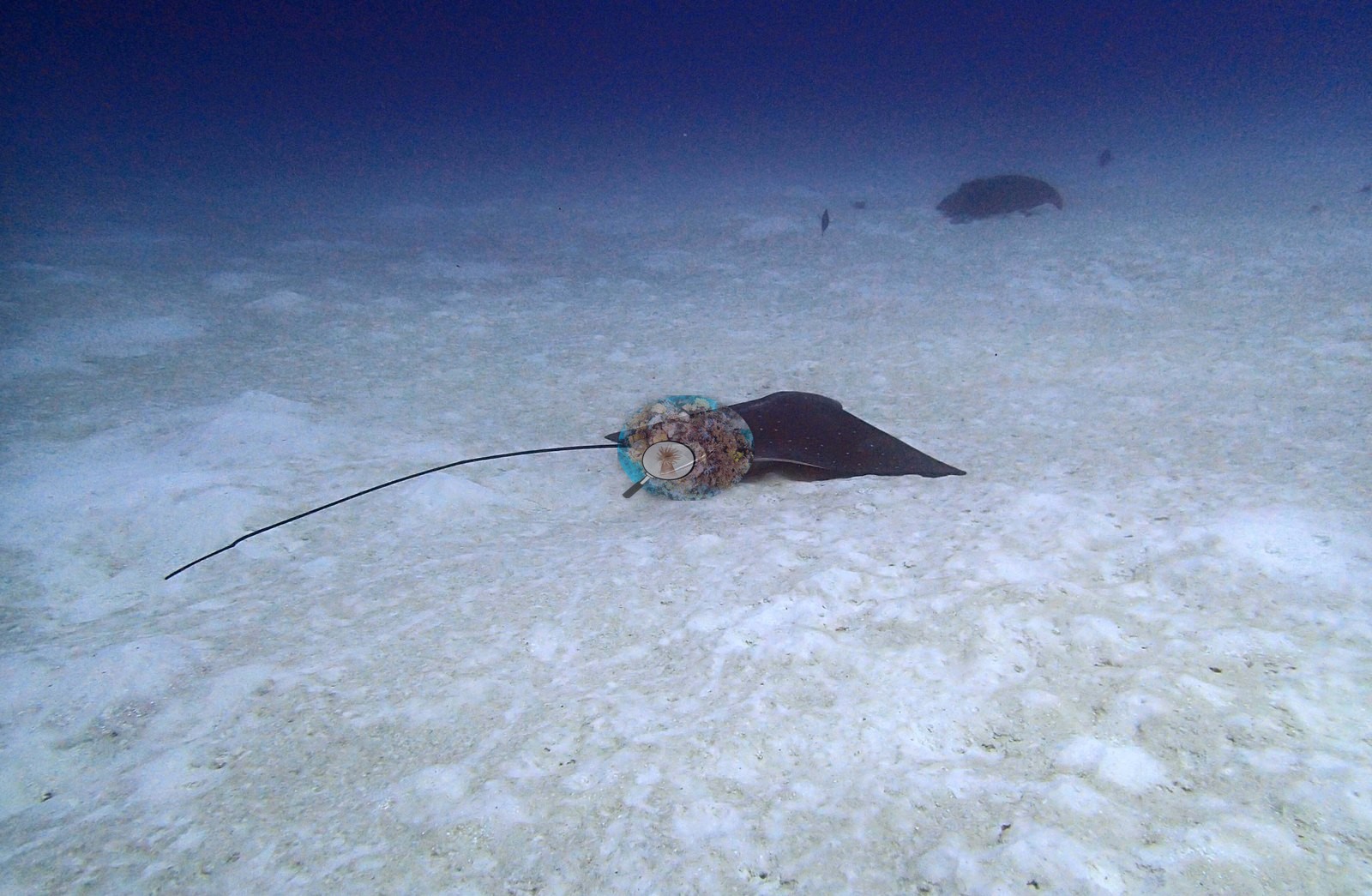
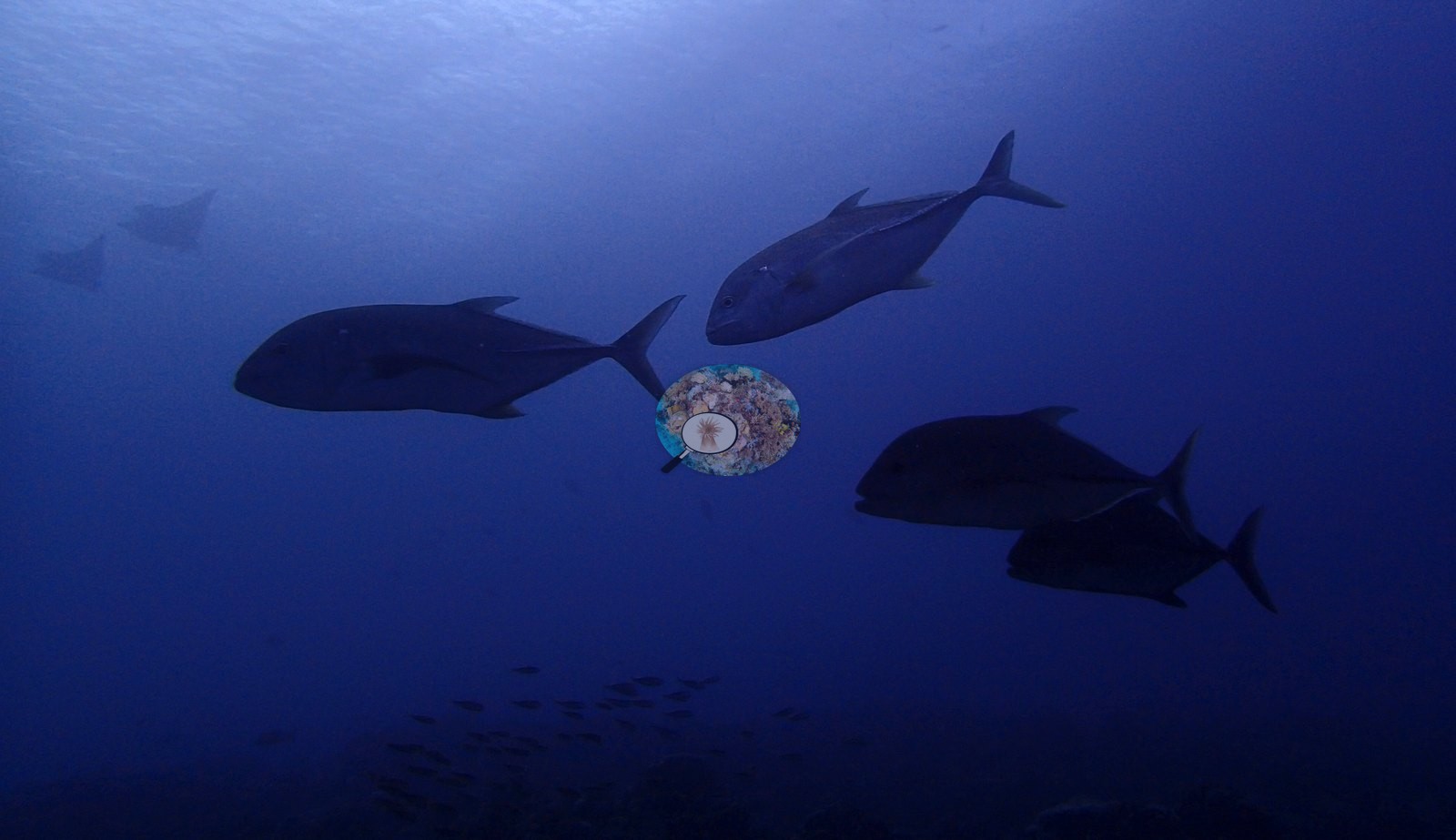
The macrofauna is the best of the redo, and it is rays. Six frames are given to spotted eagle rays compatible with Aetobatus ocellatus. One frame is the best — three rays in silhouette against open blue water, wings spread, whip tails trailing — while five others follow a single animal (in two of them with a remora on its back) planing low over a white sand flat, two more on the horizon of one of them (e.g., Image 5, Image 9, Image 18, Image 20).
Another holds three trevally in silhouette with two further ray wings behind (e.g., Image 33).
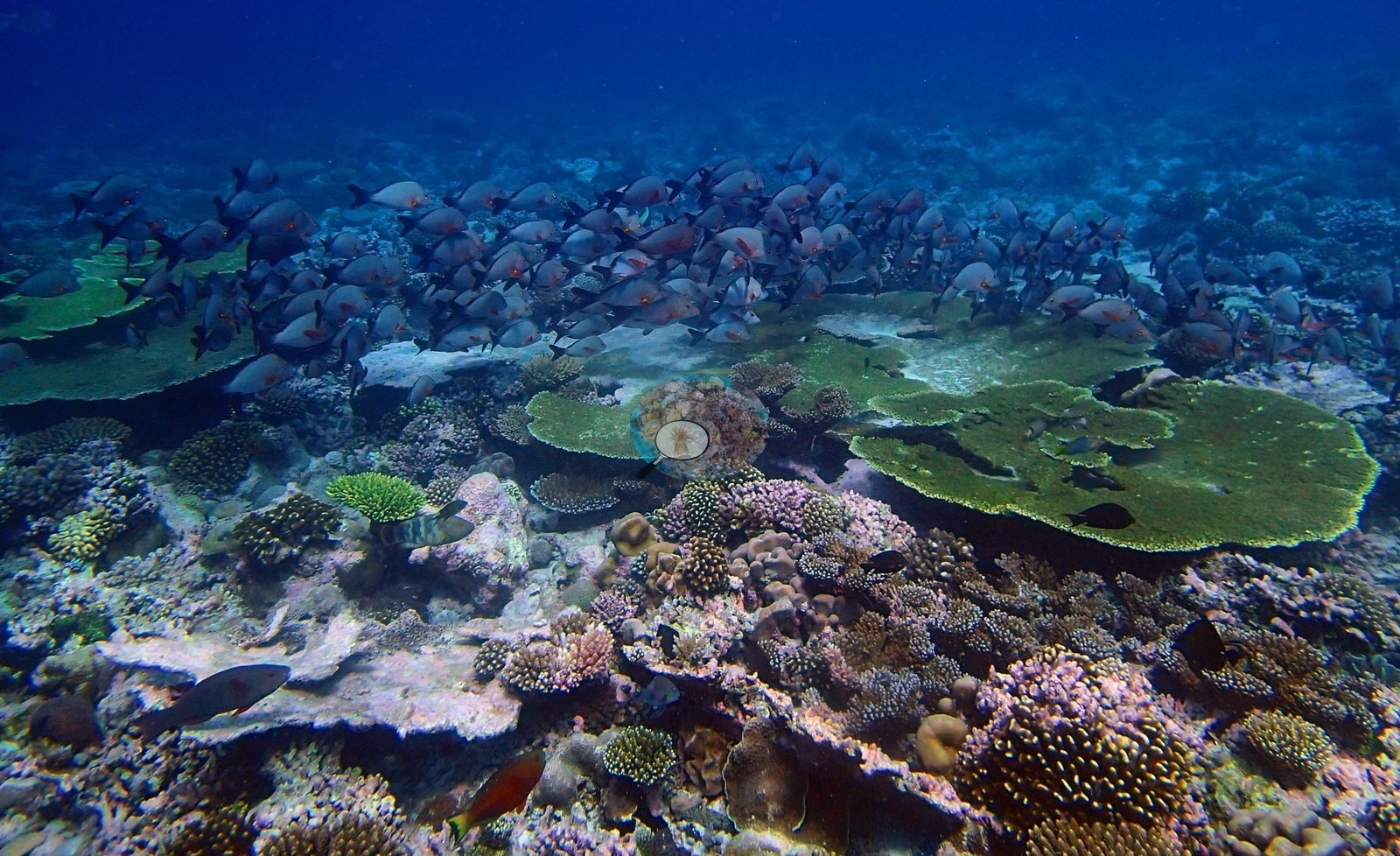
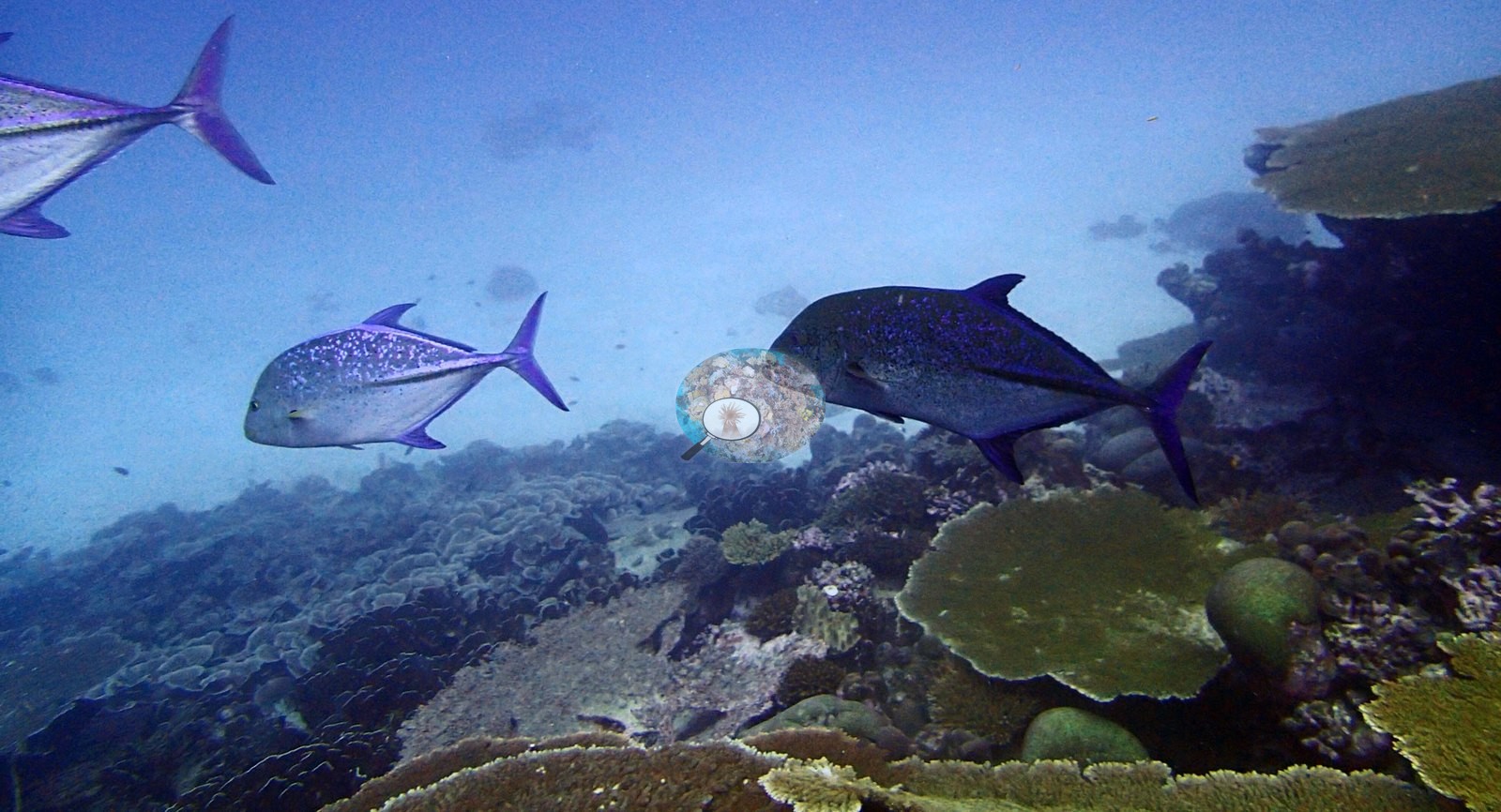
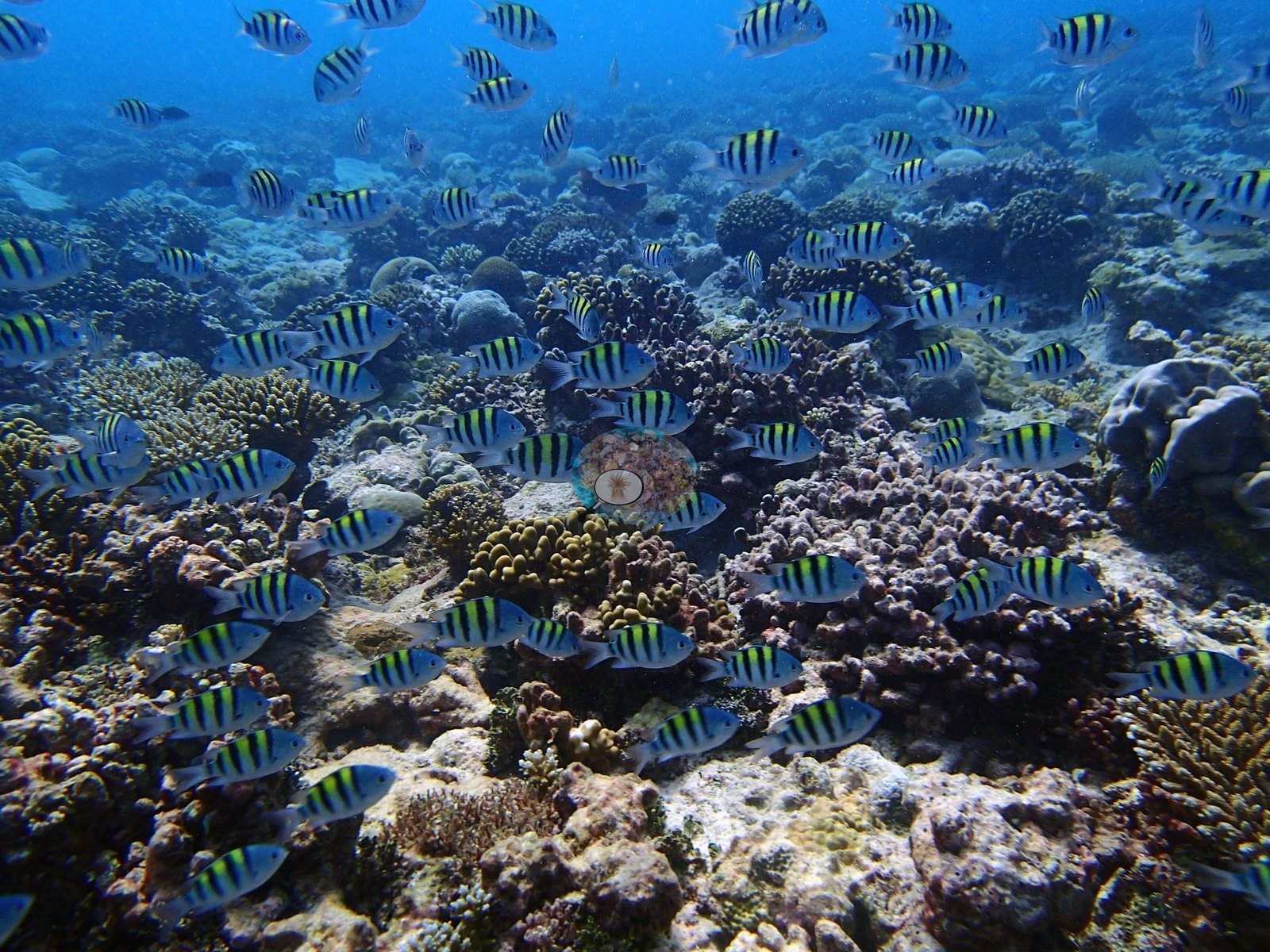
Beyond the rays: three trevally compatible with Caranx melampygus, flanks stippled electric blue, over the plate reef in one frame; large schools of humpback red snapper compatible with Lutjanus gibbus in two frames; a sergeant-major school compatible with Abudefduf in another; a dense silverside or juvenile-fusilier cloud pouring over the reef in one more; blue-green chromis, parrotfish, dark surgeonfish, and butterflyfish throughout (e.g., Image 22, Image 25, Image 30, Image 31).
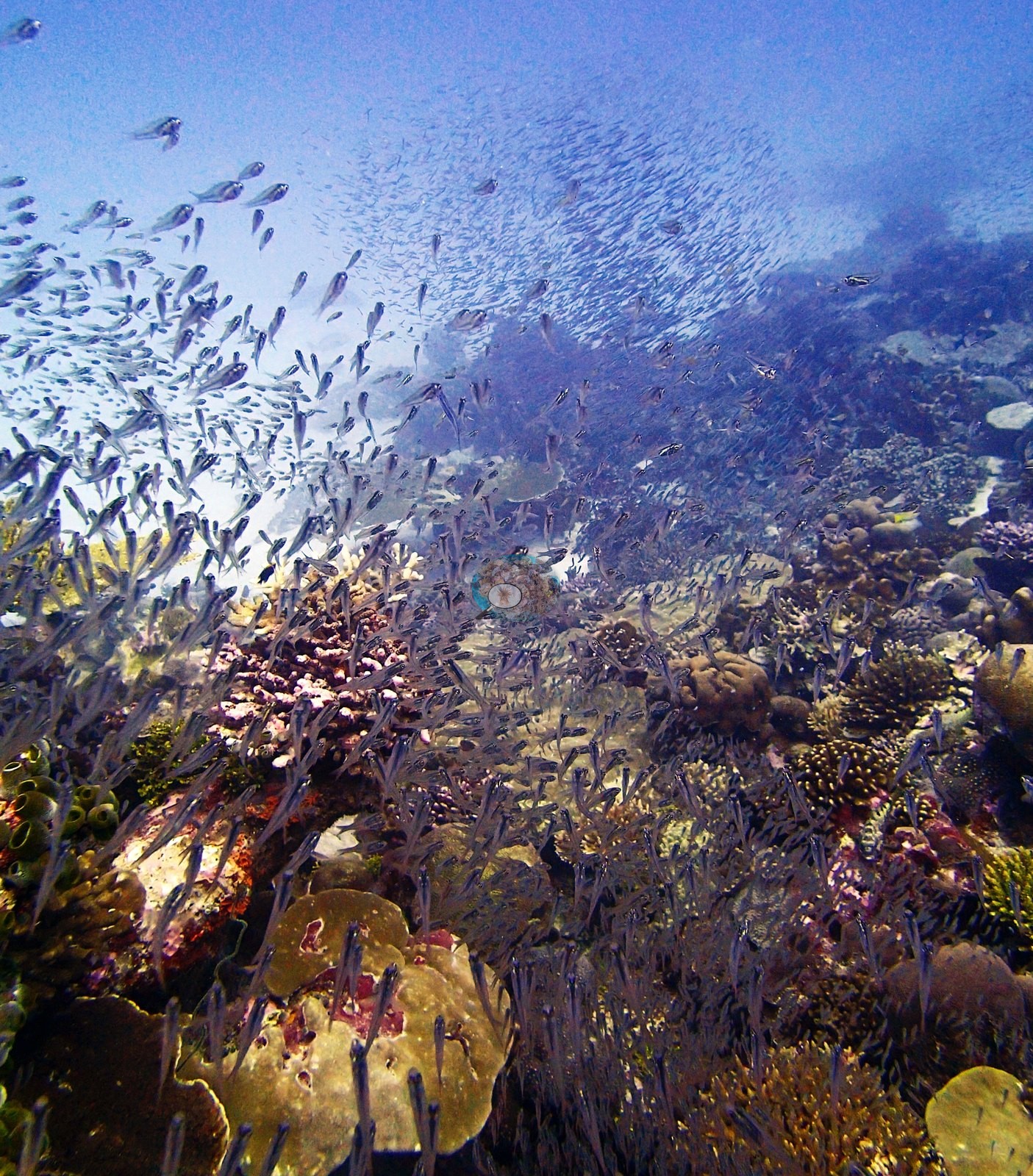
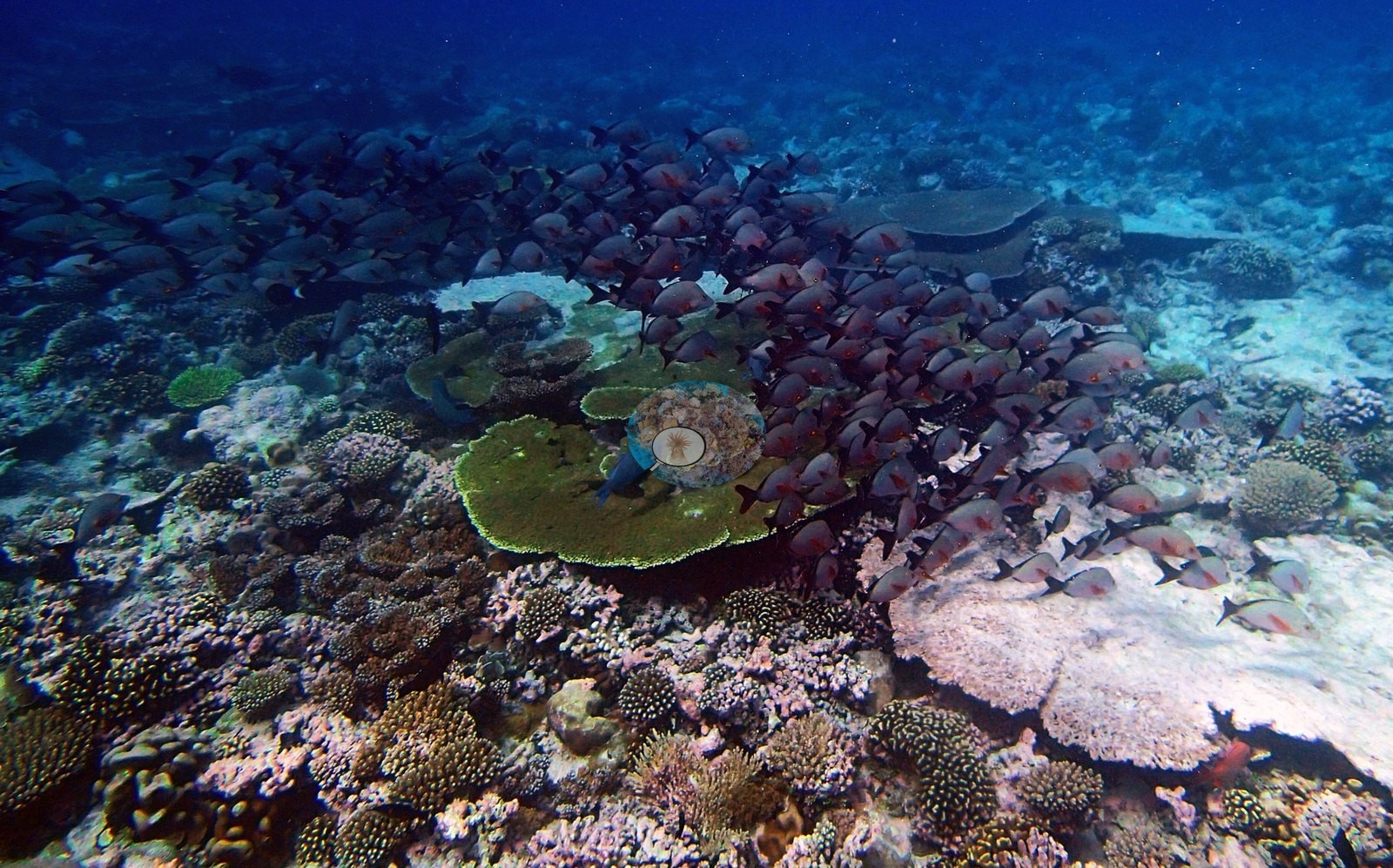
The large dark oval silhouettes on the sand horizon of three of the ray frames are not callable — humphead wrasse and a large parrotfish are both compatible, and the BIEG04 lesson applies. Conspicuous fauna and sessile invertebrates appear as sponges in 5 frames and giant clams in 1 frame.
Comparisons with other data
No independent survey was made at this exact site; the nearest ones are listed in the table below.
Other notes
The CRD site page records P. acuta/P. damicornis (ChPd/a22–25) and Seriatopora spp. (ChSe14–15) at this leeward fringing reef, with ChPa22 and ChPd24 genotyped and ChPd23 and ChPd25 sampled but not genotyped. Note that the transect scored Seriatopora at zero — the genus was collected and observed but never fell under a transect point, which is exactly the kind of presence a cover survey cannot record. No tag, label, or marker is visible on any of them, so which — if any — is ChPa22 or ChPd24 needs Anderson's judgment. No transect tape, quadrat, slate, or collecting gear appears in any of the frames reviewed — the second survey-only folder of the redo after BITB30 — although three frames show a diver (one in the water column, two photographing the eagle ray with a compact camera), and four are close-up macros composed on a colony rather than on the reef (flag 9).
CV model comparison
More info
Those are point counts on the photographs; this is a diver swimming a transect. The models and the reference never saw the same thing. ⚠ SITE-LEVEL ONLY. The 2,500 frames were not associated with any transect taken within 200 m of them, so transect-vs-image comparisons are site means, never frames. The transect value is already in the pin `cover` field (109 of 112 pins, sourced to the paper's suppl. S1) and is read from there, never re-imported. The transect is THE coral-cover value for this site and stands alone. The rows below it are a methods comparison only: no computer-vision value is averaged with it, feeds the headline, or carries over to the site's cover figure (Anderson, 2026-09-22).| Method | Hard-coral cover (%) |
|---|---|
| Transect (published) | 61.1 |
| CoralNet | 41.4 |
| In-house DINOv3 | 34.5 |
| CoralSCOP edited | 46.6 |
| Claude | 37.0 |
Independent surveys nearby
| Agency / program | Year(s) | Stations / distance | Link |
|---|---|---|---|
| Sheppard et al. (2008) | 2006 | 1 station, 4.15 km | Records ↓ |
| Spalding et al. 2025 (Chagos 2024 bleaching report) | 2024 | 1 station, 3.17 km | Records ↓ |
| XL Catlin Seaview Survey | 2015 | 1 station, 2.96 km | Records ↓ |
 Dr. Coral (CRD)Year-average (no detectable trend)
Within 5 km, 3 independent survey stations recorded hard coral cover in 7 records between 2006 and 2024. One survey since 2021 recorded 50%. This site's own estimate (61%) sits 11.1 points above the recent value (50%); the methods differ, so the comparison is context, not a like-for-like test.
Collected by other programs using different methods (the XL Catlin Seaview Survey uses photo-transects with automated image annotation), so these are context for the figures above, not a like-for-like comparison. Where a station was surveyed more than once the range is shown. Station names are not dive-site names.
| Agency | Site / location | Date | Hard coral cover (%) | Distance | Link |
|---|---|---|---|---|---|
| Sheppard et al. (2008) | Great Chagos Bank | 2006 | 41% (5 surveys) | 4.15 km | HeatCRD database |
| XL Catlin Seaview Survey | transect 36004 | 2015 | 21% | 2.96 km | — |
| Spalding et al. 2025 (Chagos 2024 bleaching report) | Great Chagos Bank - Middle Brother, lagoon (E aspect, 1-3 m) | 2024 | 50% | 3.17 km | — |
Data & links
- Read the full site report ↗
- Download benthic survey data (CSV) ↗
- Download all LOF-GRE data (933 sites) ↗
- CoralNet image repository for this region ↗
- HeatCRD database ↗
- (reference) ↗
- Photo portfolio ↗
- Coral Reef Diagnostics page for this area ↗
All images from Coral Reef Diagnostics. Data are from Coral Reef Diagnostics and the organizations named in the data-sources table above.
 © Coral Reef Diagnostics.
References
- Mayfield AB, Dempsey AC (2026). Using tourist diver images to estimate coral cover and bleaching prevalence in a remote Indian Ocean coral reef system. Oceans 7(1):1. PDF
- Sheppard C, Harris A, Sheppard A (2008). Archipelago-wide coral recovery patterns since 1998 in the Chagos Archipelago, central Indian Ocean. Marine Ecology Progress Series 362:109-117. PDF
- Spalding M, Bourasseau M, et al. (2025). Coral bleaching and mortality in the Chagos Archipelago, 2024. British Indian Ocean Territory Administration report (gray literature). PDF