
Part of the regional summaries: Chagos Archipelago - Great Chagos Bank West / Brothers / Eagle and Chagos Archipelago
More info
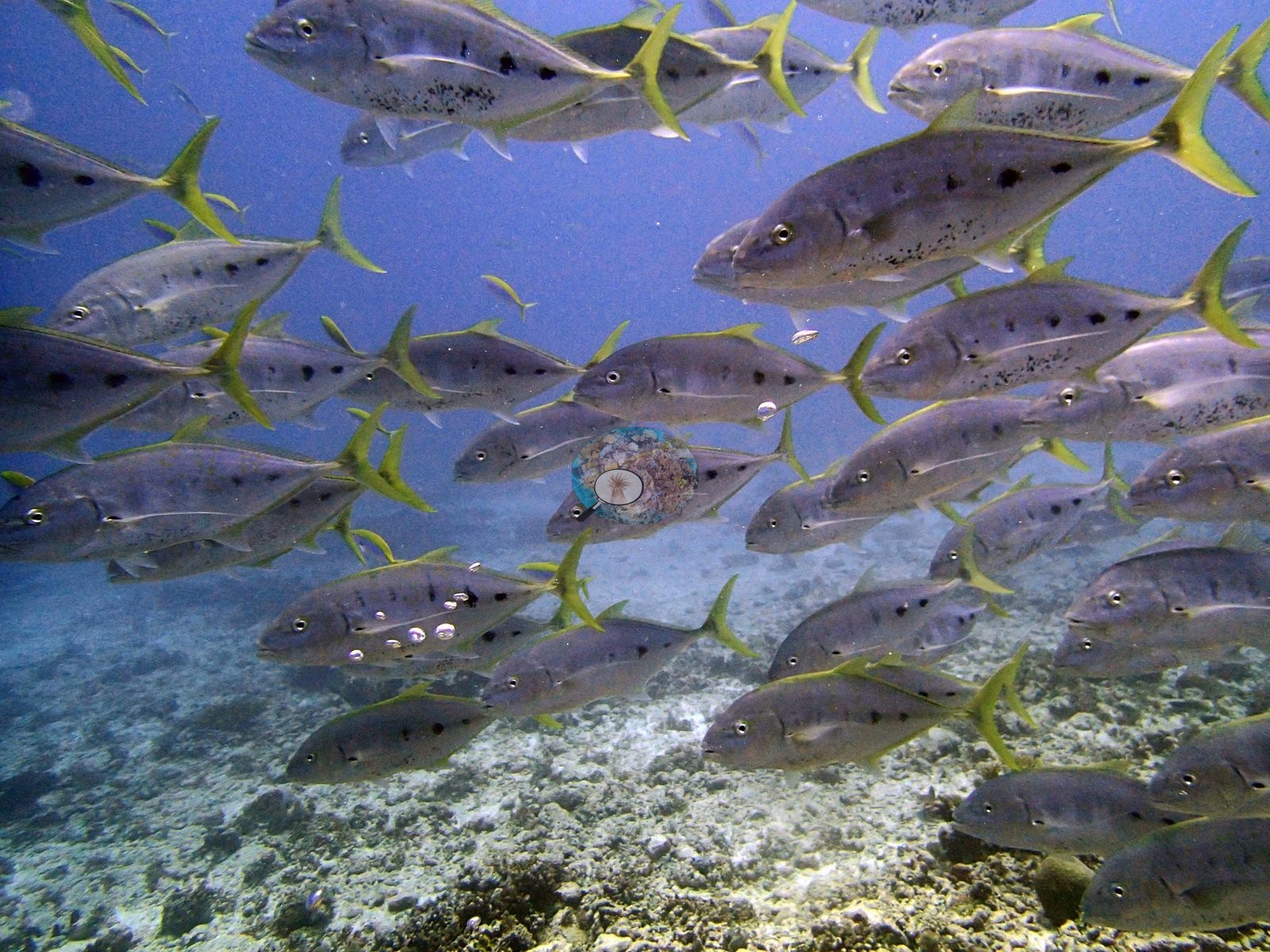
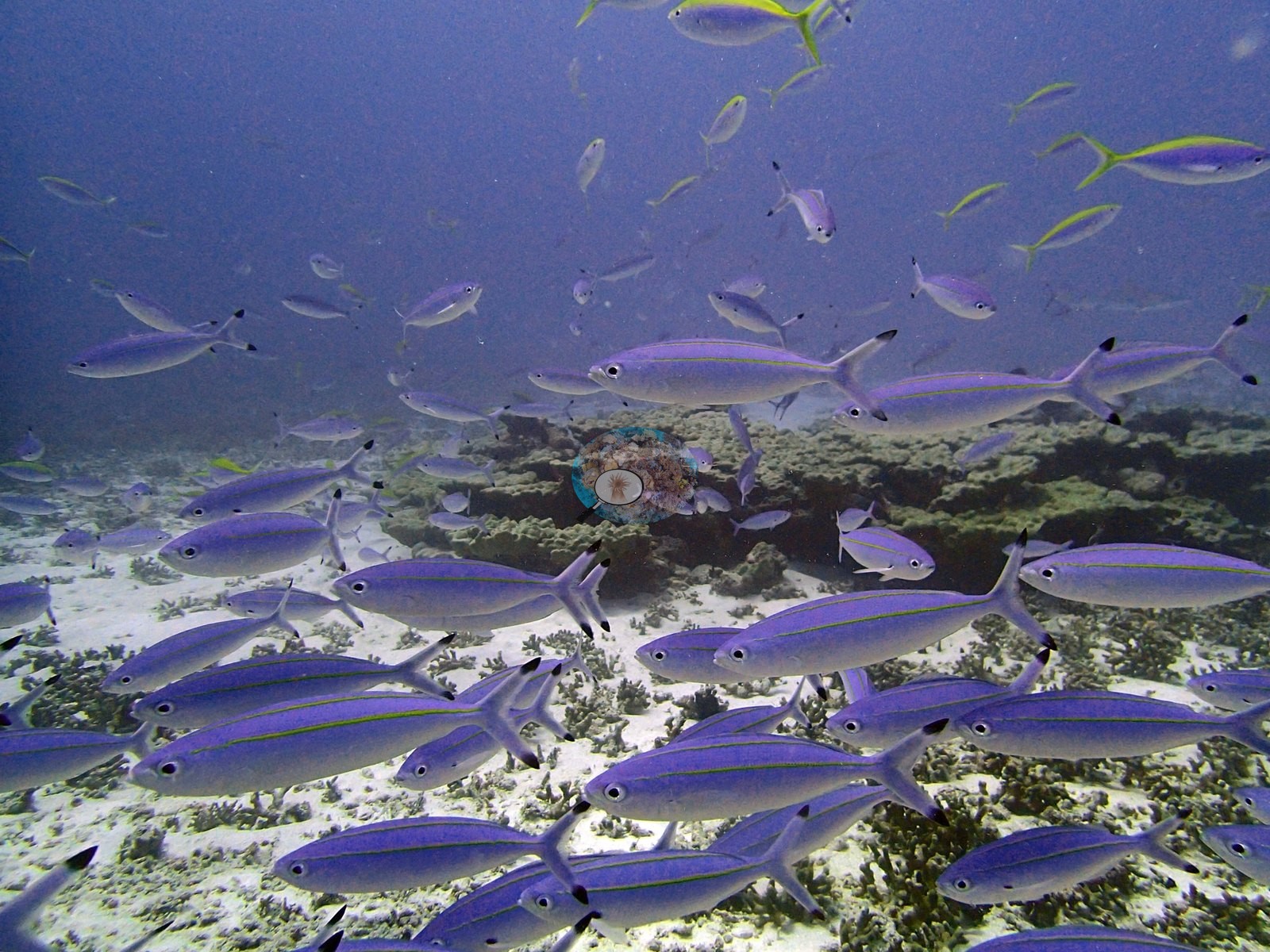
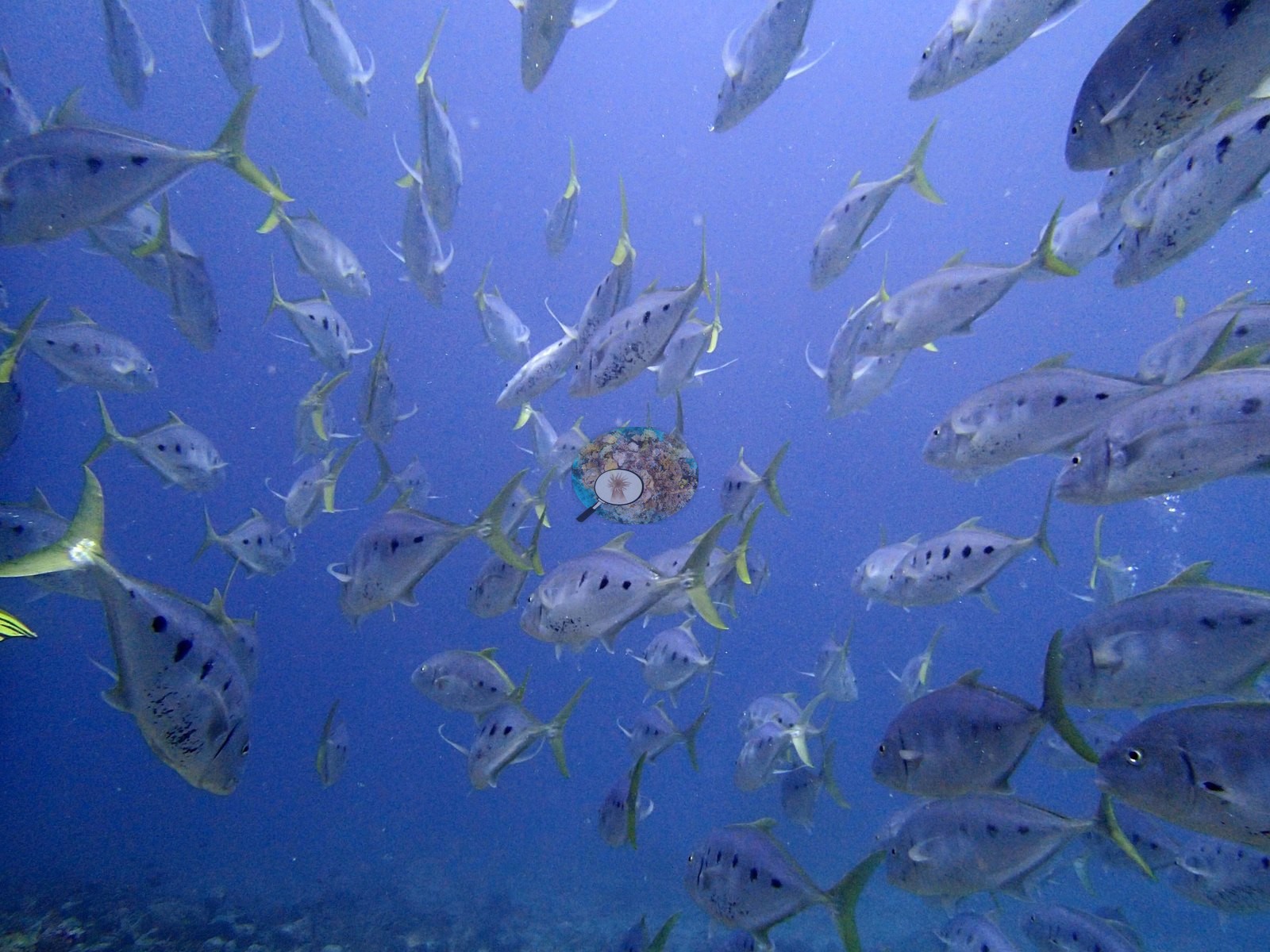
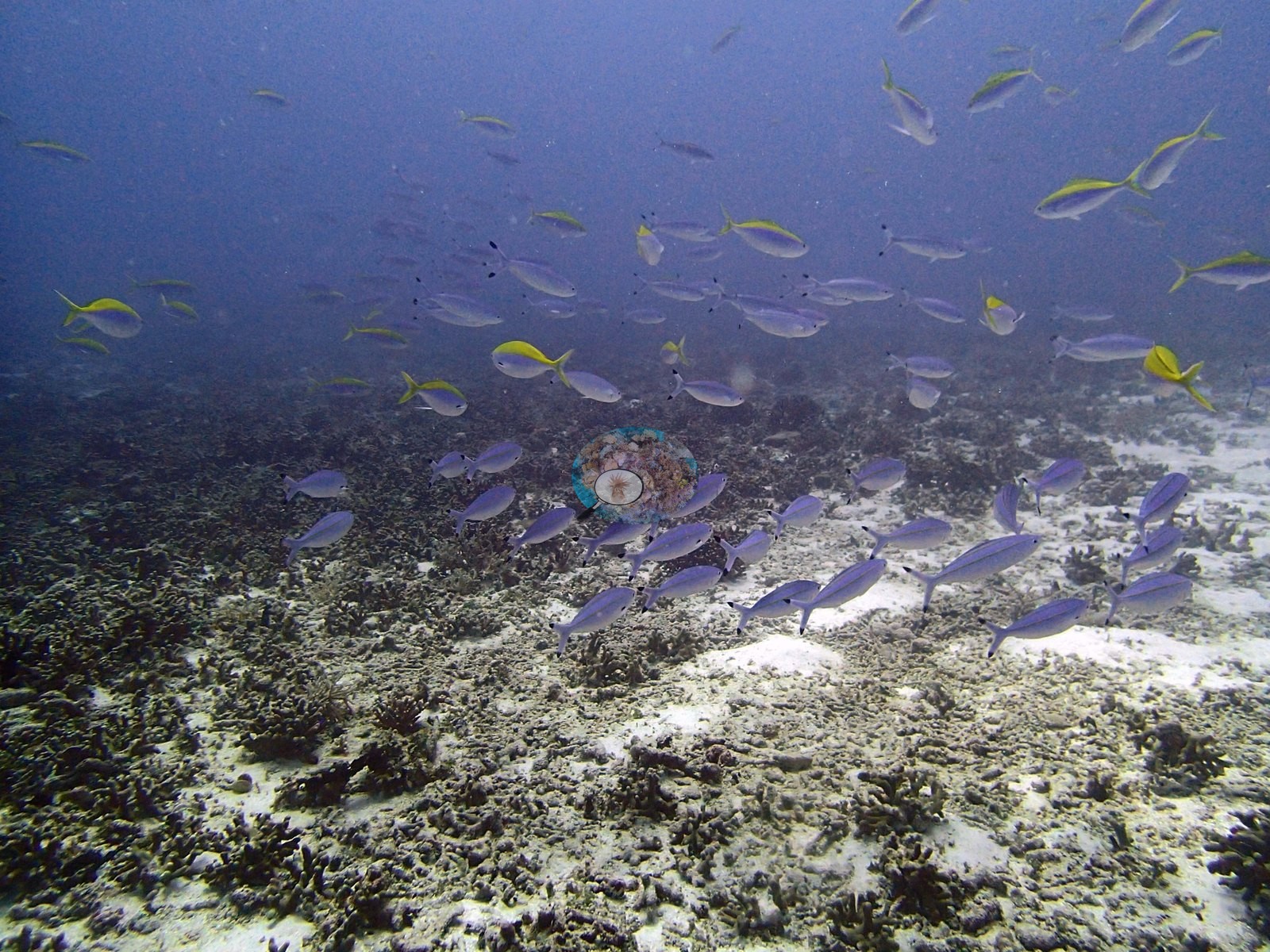
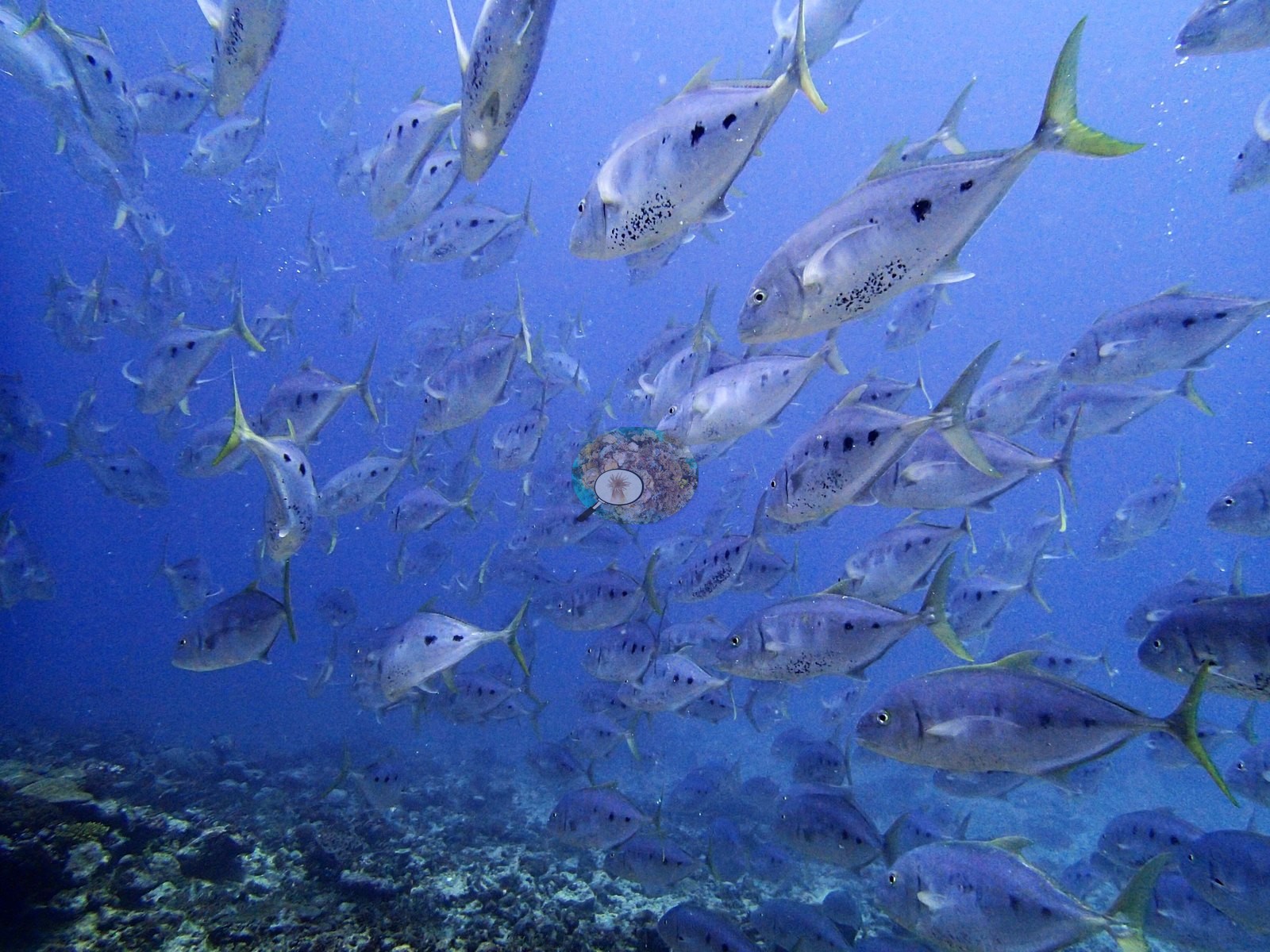
Chagos (NOAA CRW virtual station)A lower-cover bank reef (18.5%) where coral gathers in healthy patches of gold-green Acropora tables and staghorn over sand and rubble. Its highlight is an enormous school of several hundred spotted, yellow-finned trevally filling the water column, along with dense fusilier schools. Surveyed on the Living Oceans Foundation's Global Reef Expedition.
Seven other CRD dive sites within 5 km shown in orange — click a marker to open its page.
🗺 Detailed map of the Global Reef Expedition dive sites, Three Brothers, Chagos (Khaled bin Sultan Living Oceans Foundation; opens in a new window)
Site description
Setting
S1) — Anderson's own published value, surveyed 19 March 2015 at South Brother in the Three Brothers group (6.17930°S, 71.58126°E; lagoonal bank reef, submerged, inside the lagoon, protected; depth 25.7 m; in situ temperature 29.5°C, salinity 34.4).
General benthic features
Twenty-seven scleractinian genera were recorded, and the assemblage is Acropora-led but only narrowly: Acropora 4.43% of the benthos, Porites 4.07%, Pocillopora 2.51%, Platygyra 2.14%, Favia 1.43%, Favites 0.93%, Montipora 0.90%, then Ctenella 0.28% (the Chagos-endemic monotypic genus, not Cynarina), Pachyseris 0.23%, Goniastrea and Pavona 0.18% each, Galaxea and Montastrea 0.14% each, Cyphastrea, Oulophyllia, Psammocora, and Symphyllia 0.11% each, Leptastrea 0.10%, Hydnophora 0.09%, Cantharellus 0.08%, Stylophora 0.067%, Astreopora and Echinopora 0.056% each, Lobophyllia 0.033%, Leptoseris 0.022%, and a long tail to Acanthastrea and Fungia at 0.011% — with Seriatopora at exactly zero, matching the CRD page. Bare substrate at 20.48% is the highest of any Three Brothers site checked (BITB29 12.91%, BITB30 11.13%, BITB32 11.57%, BITB34 7.24%), and the depth structure explains where it sits: the D4 transects are sand-dominated (233 and 210 sand points) while the shallower D3 transects carry none at all. The 52.71% "algal cover" needs unpacking before it is read as degradation: it is crustose coralline algae 15.28% + turf 12.02% + turf-with-sediment 11.67% + macroalgae 7.94% + erect algae 5.74% + cyanobacteria 0.06% — only 13.68 pp of it is fleshy algae.
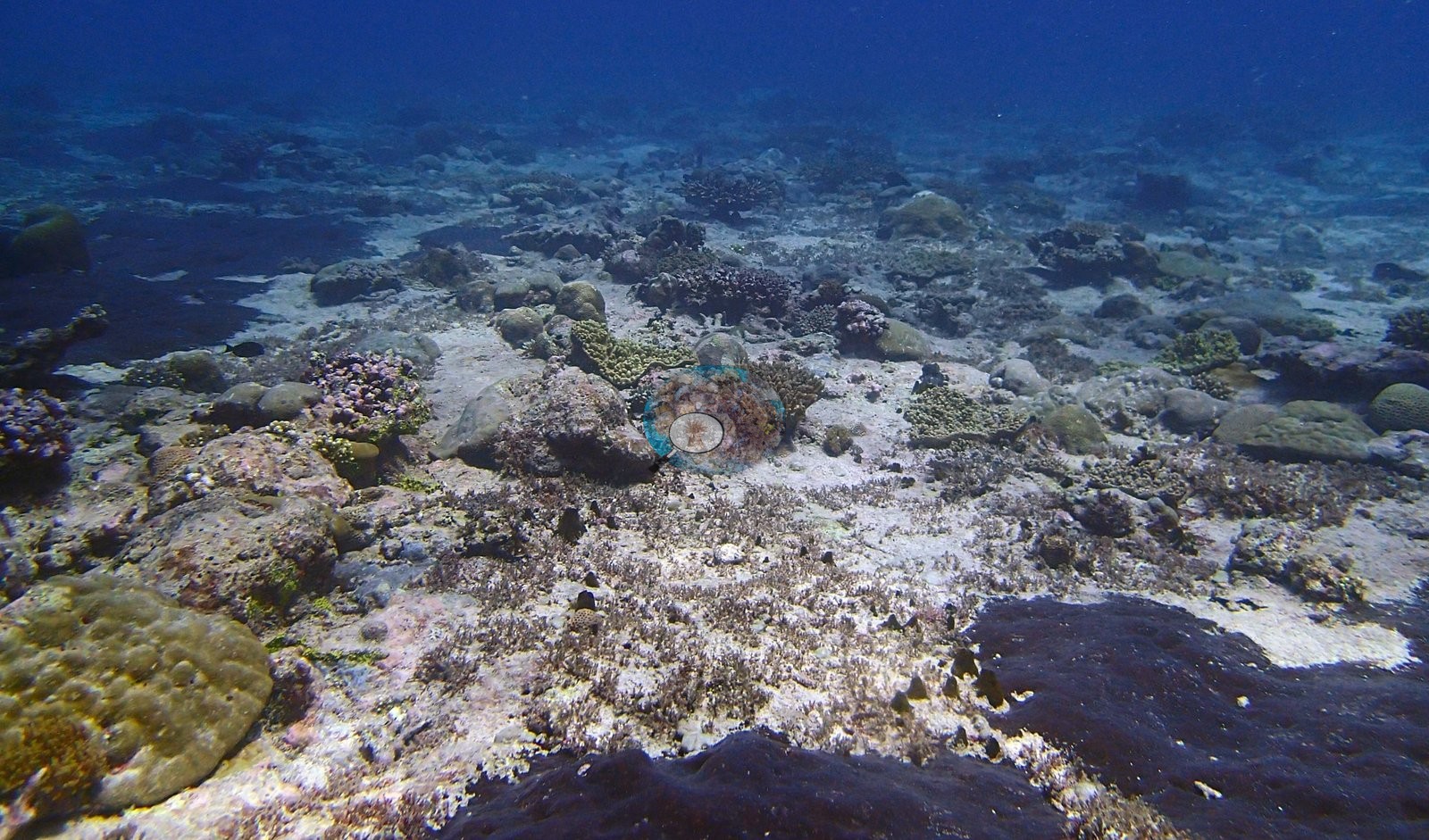
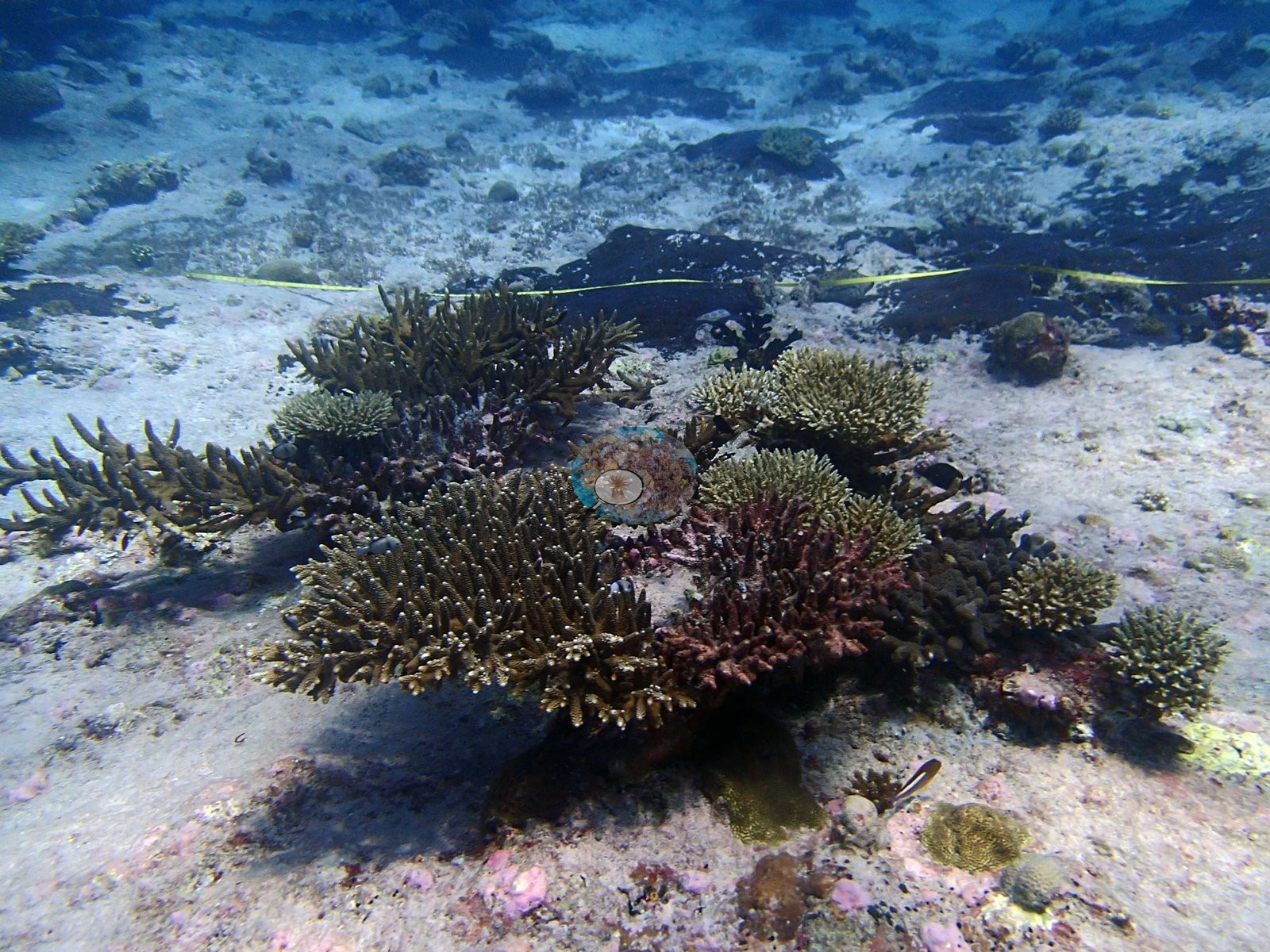
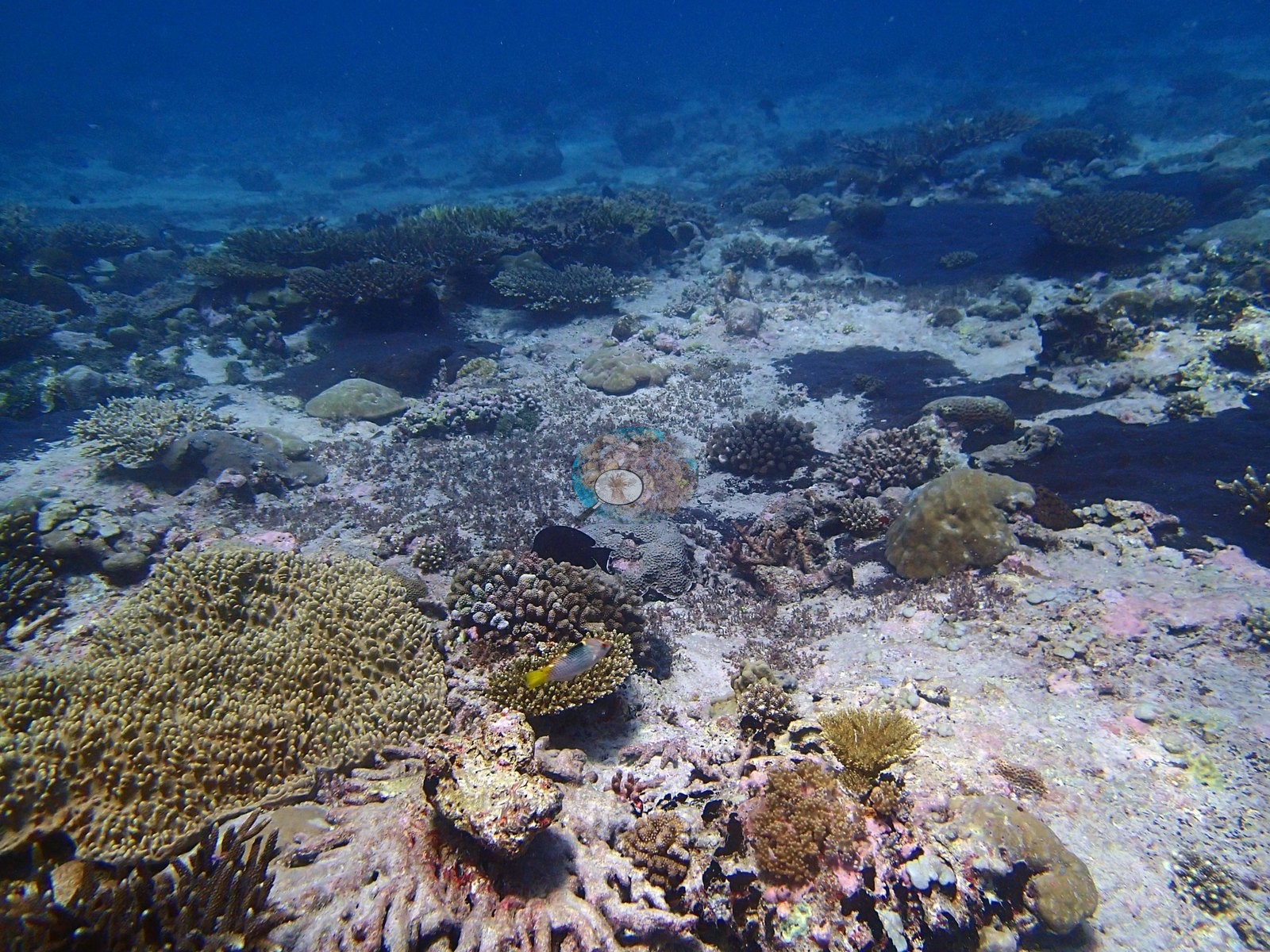
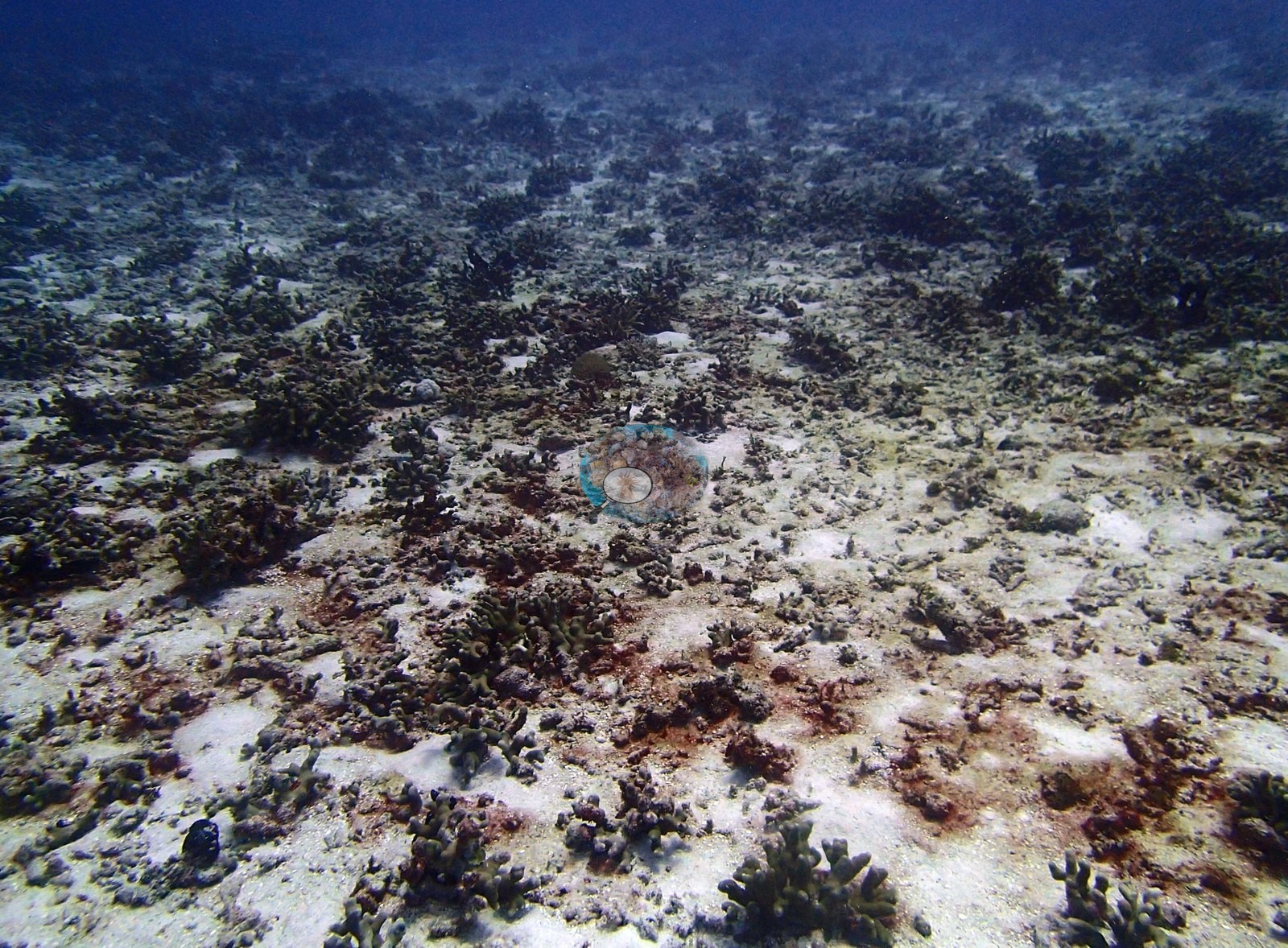
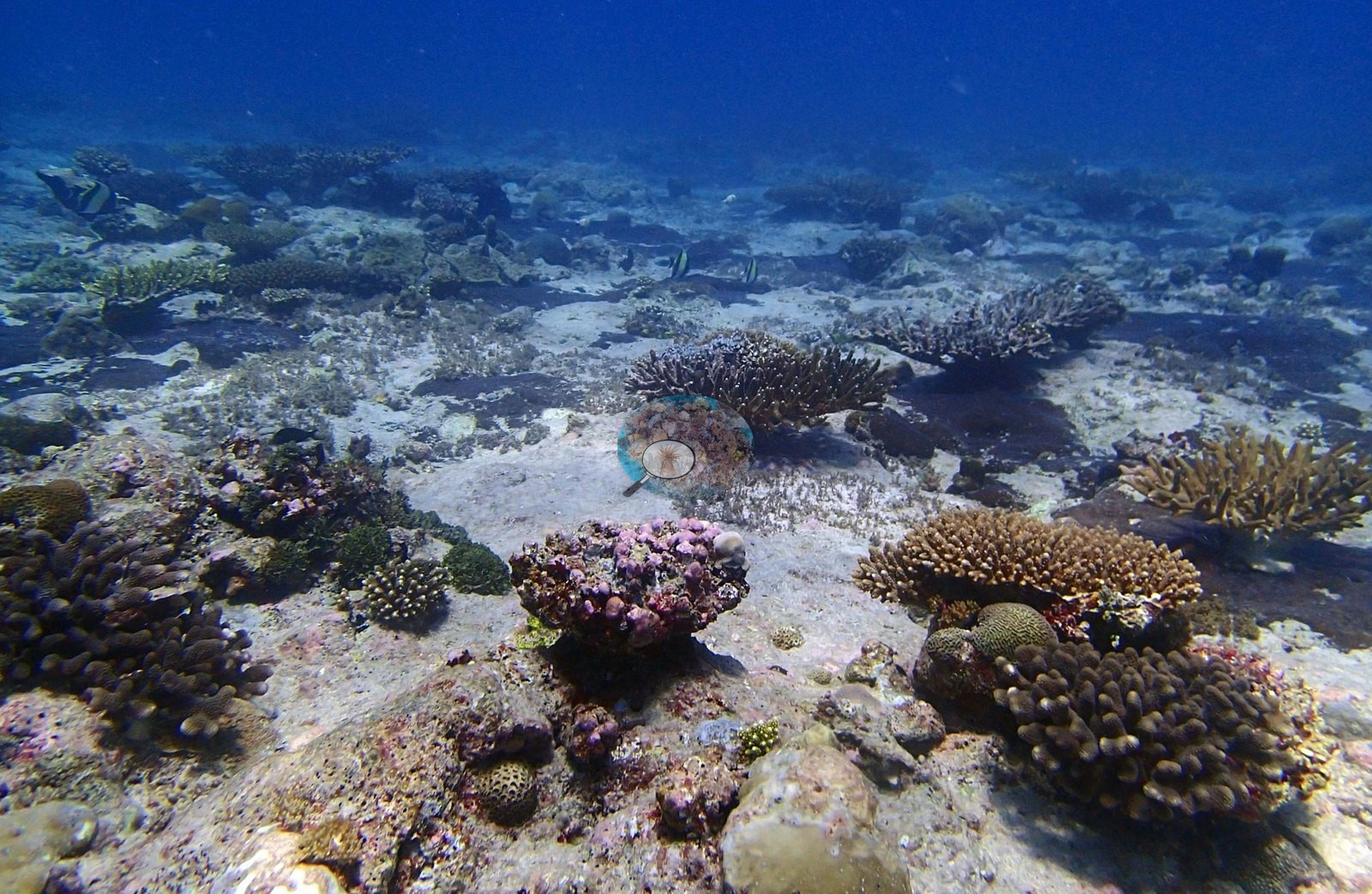
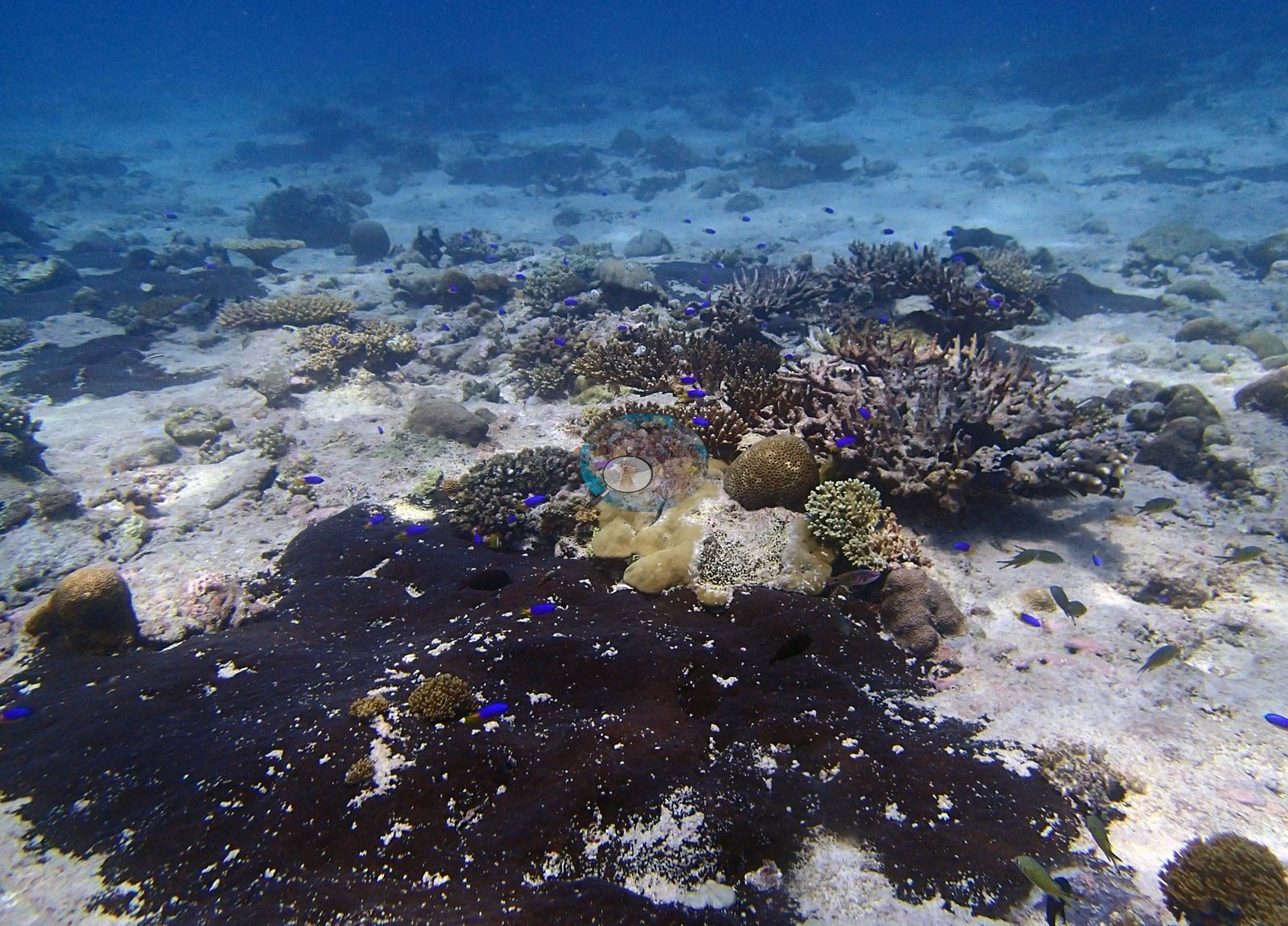
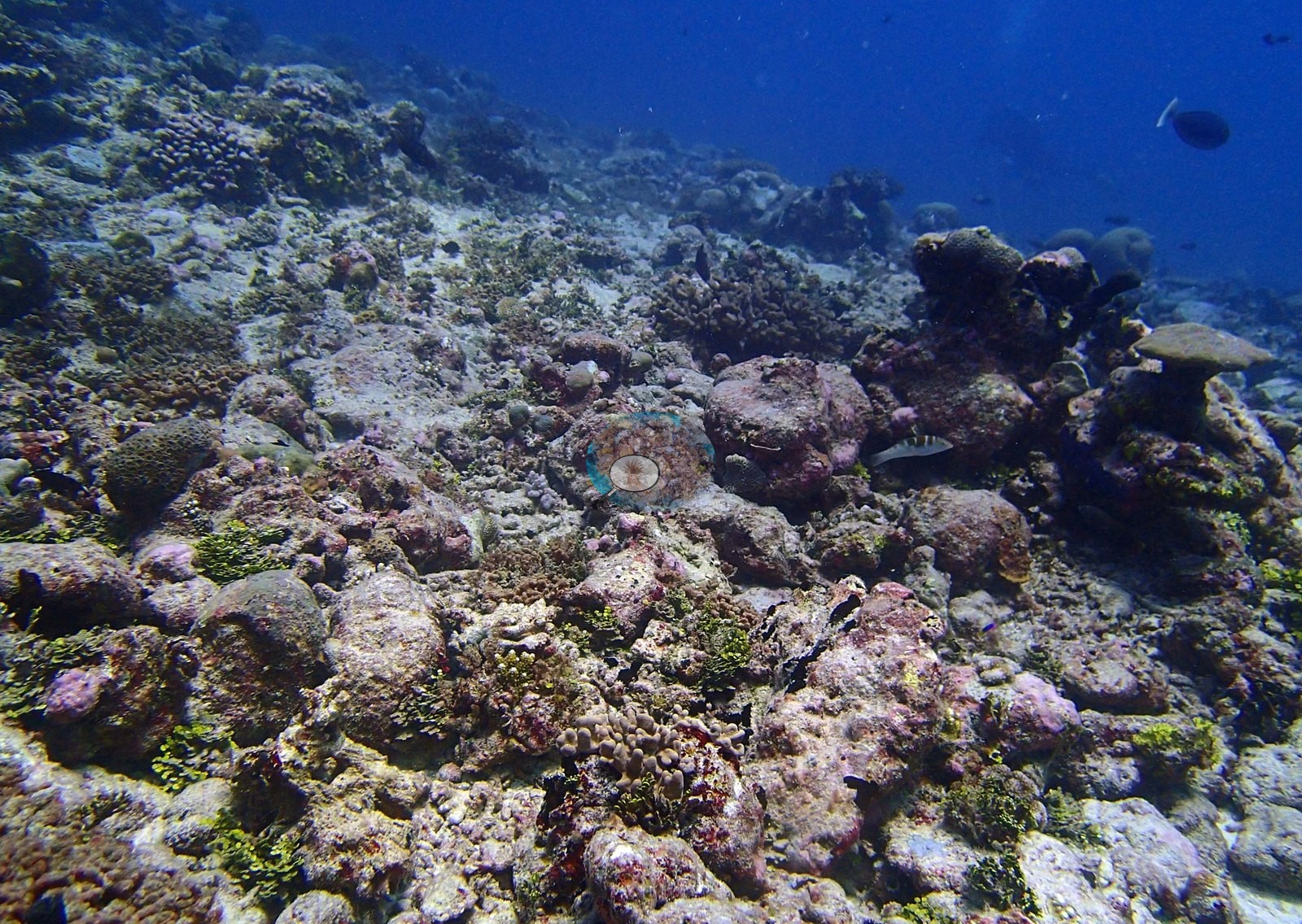
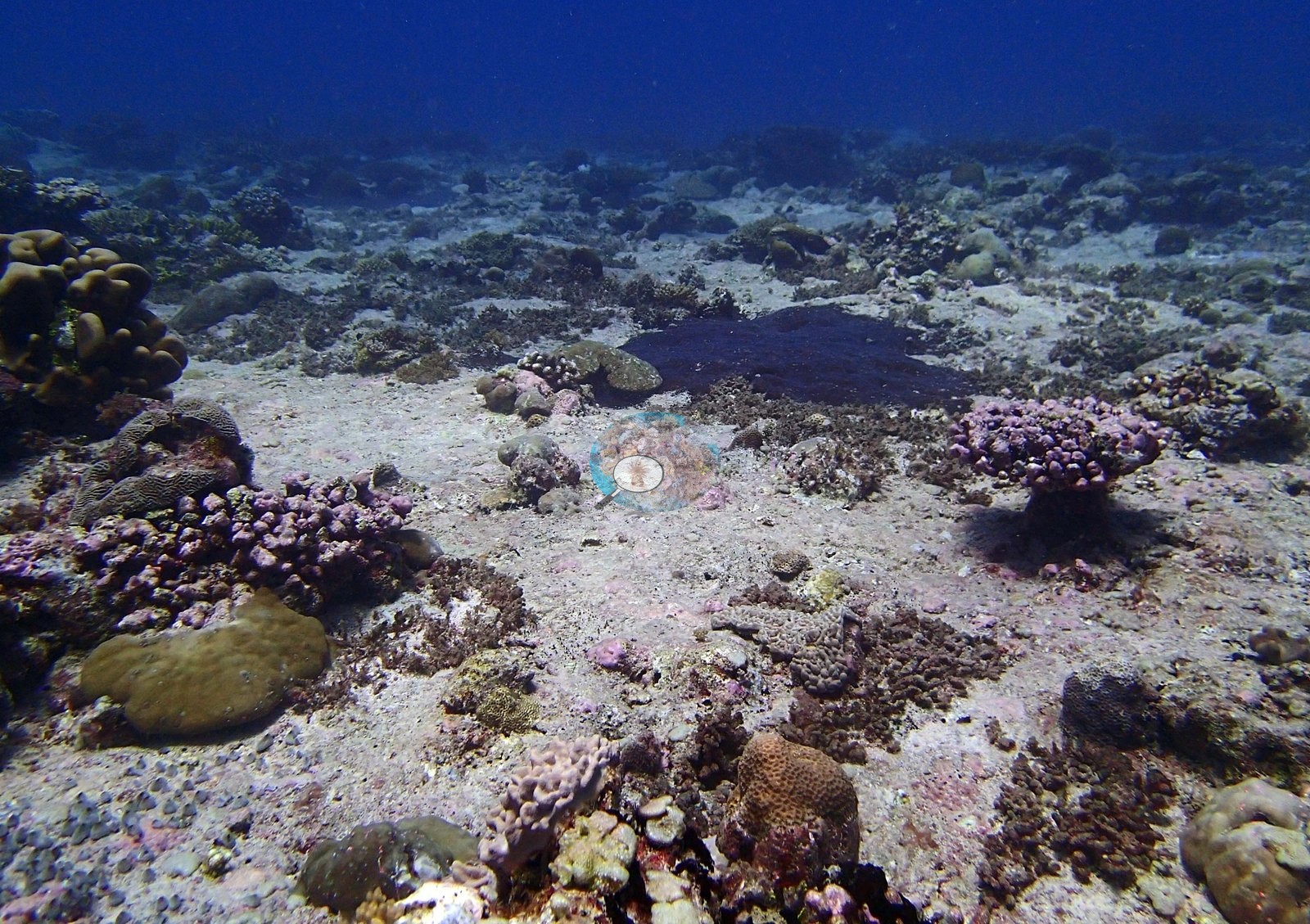
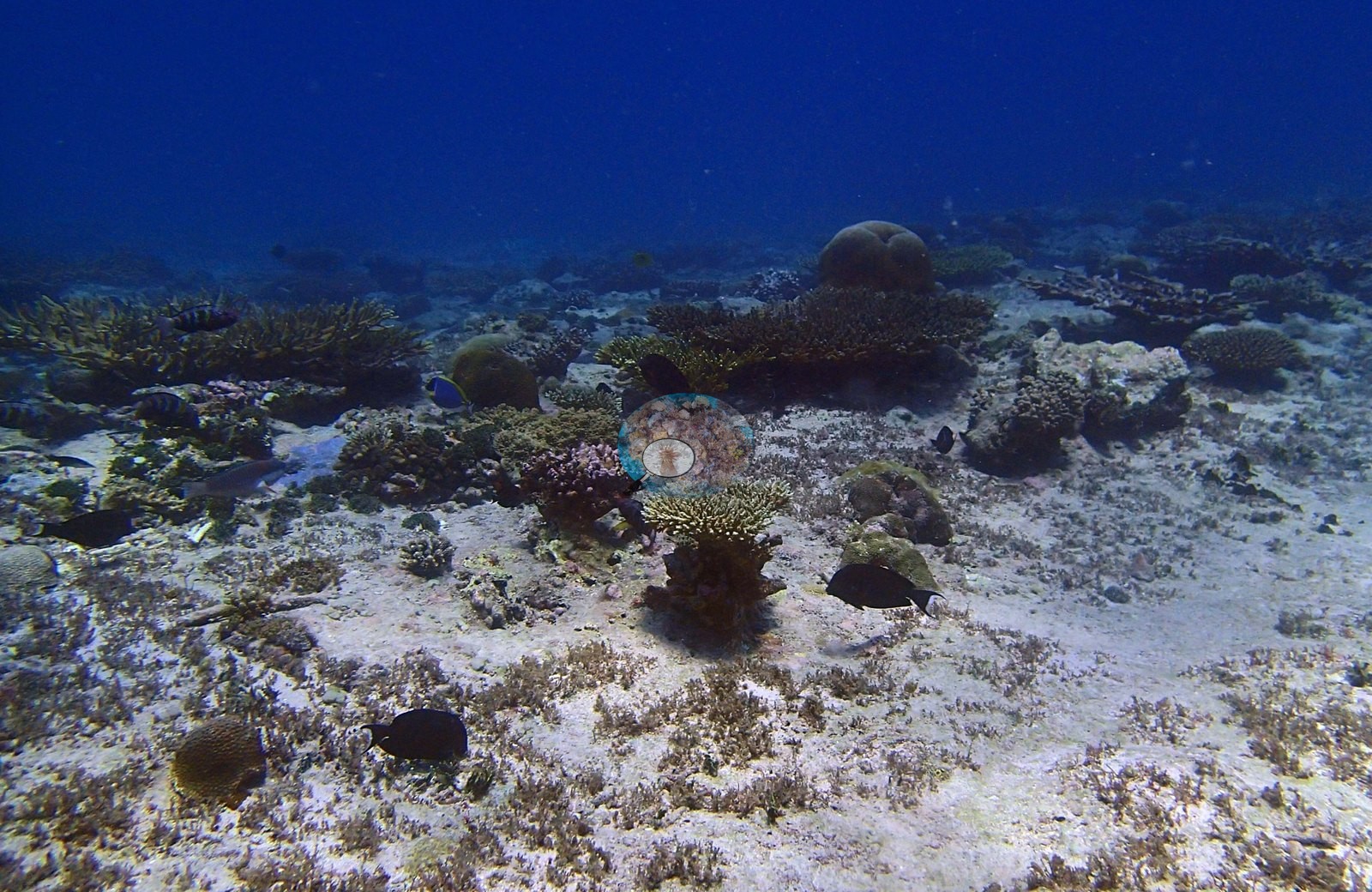
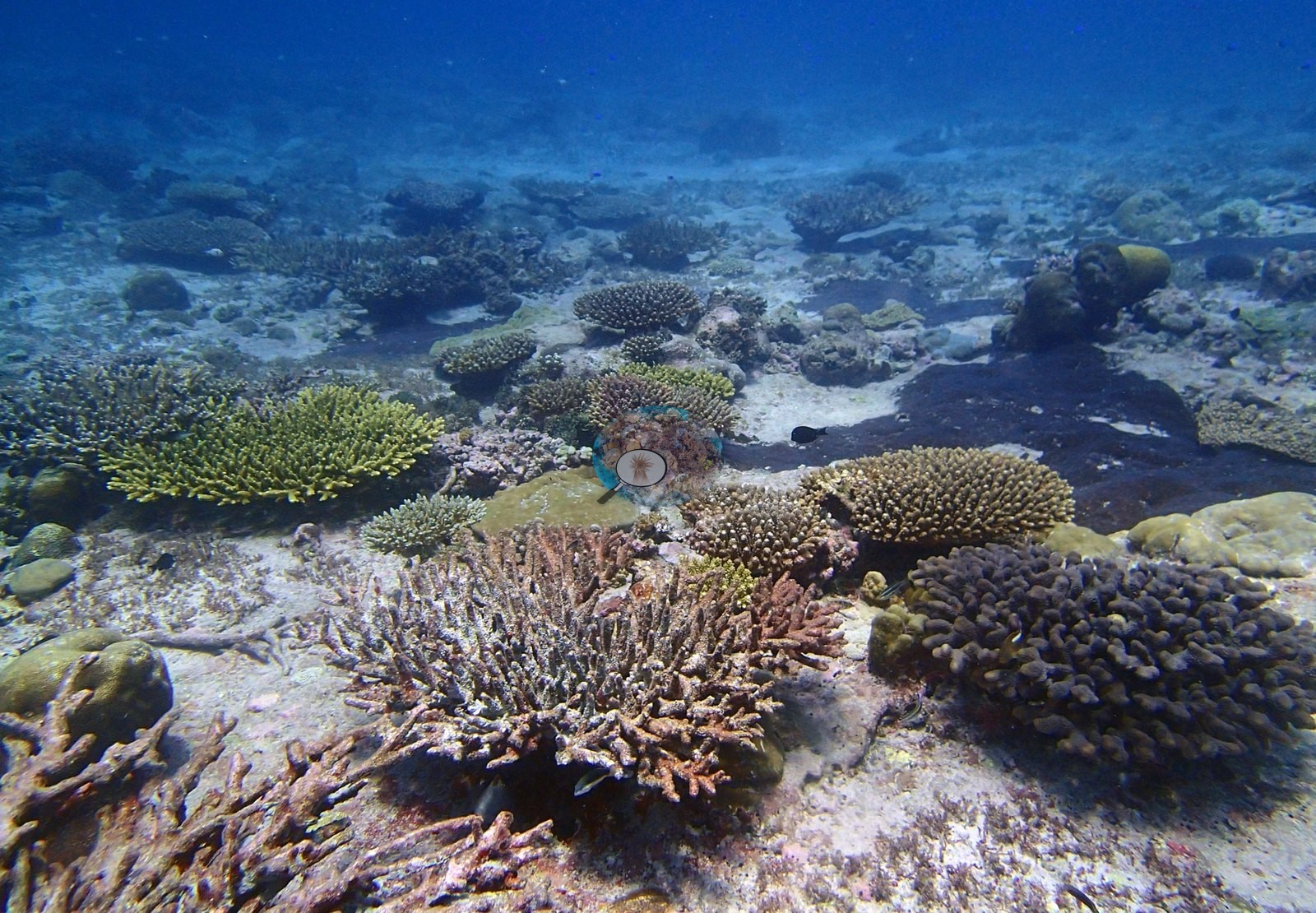
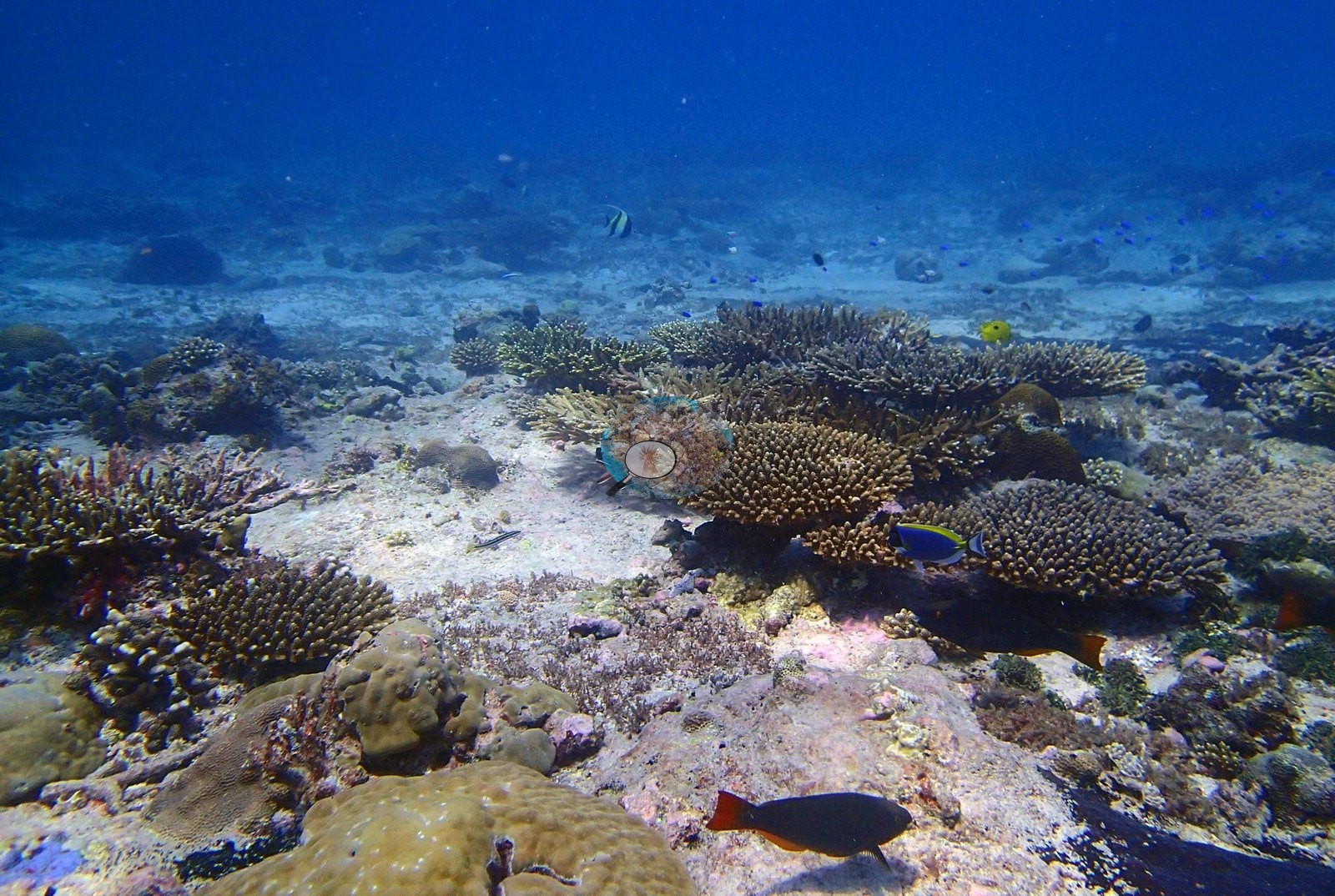
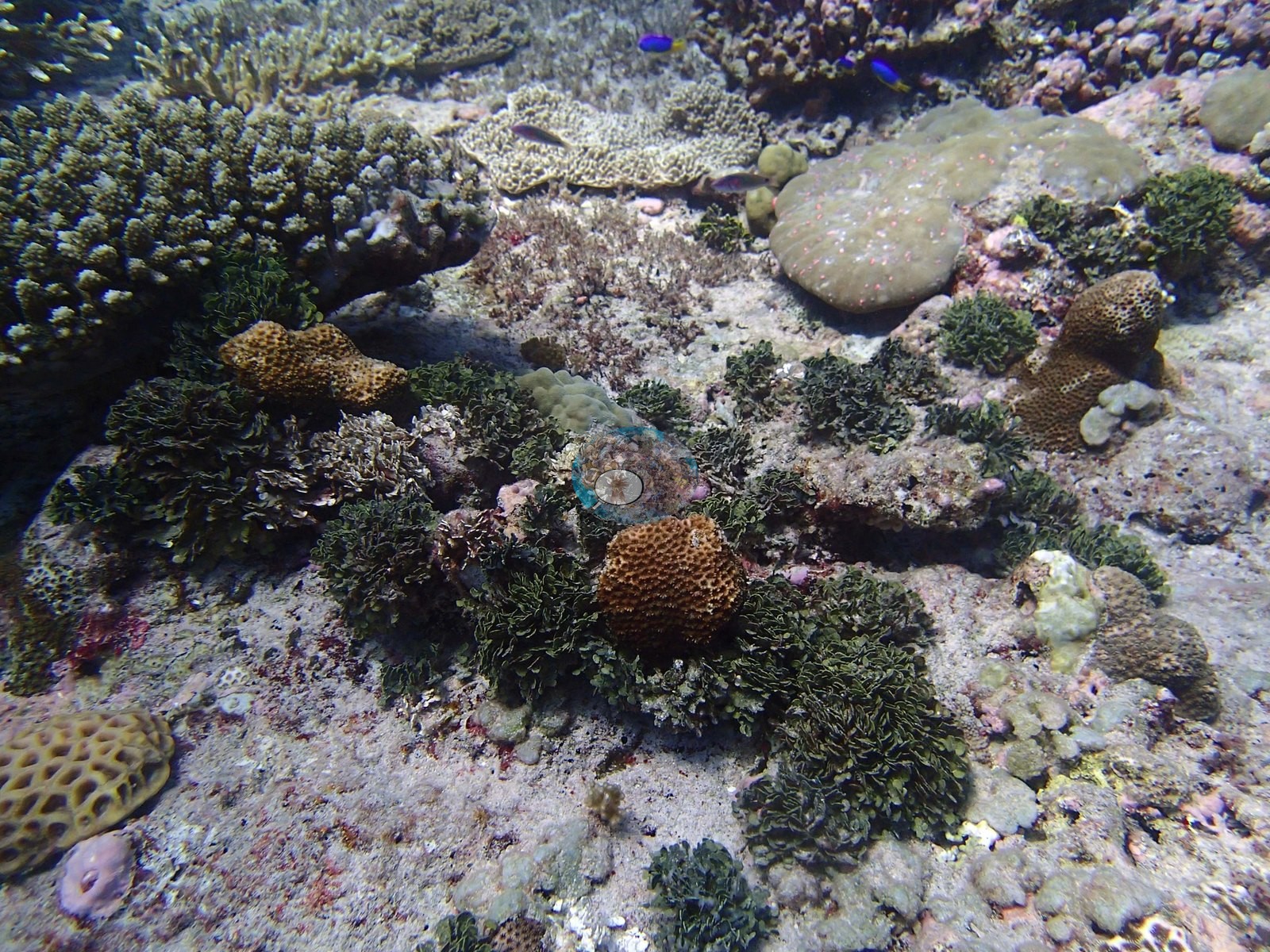
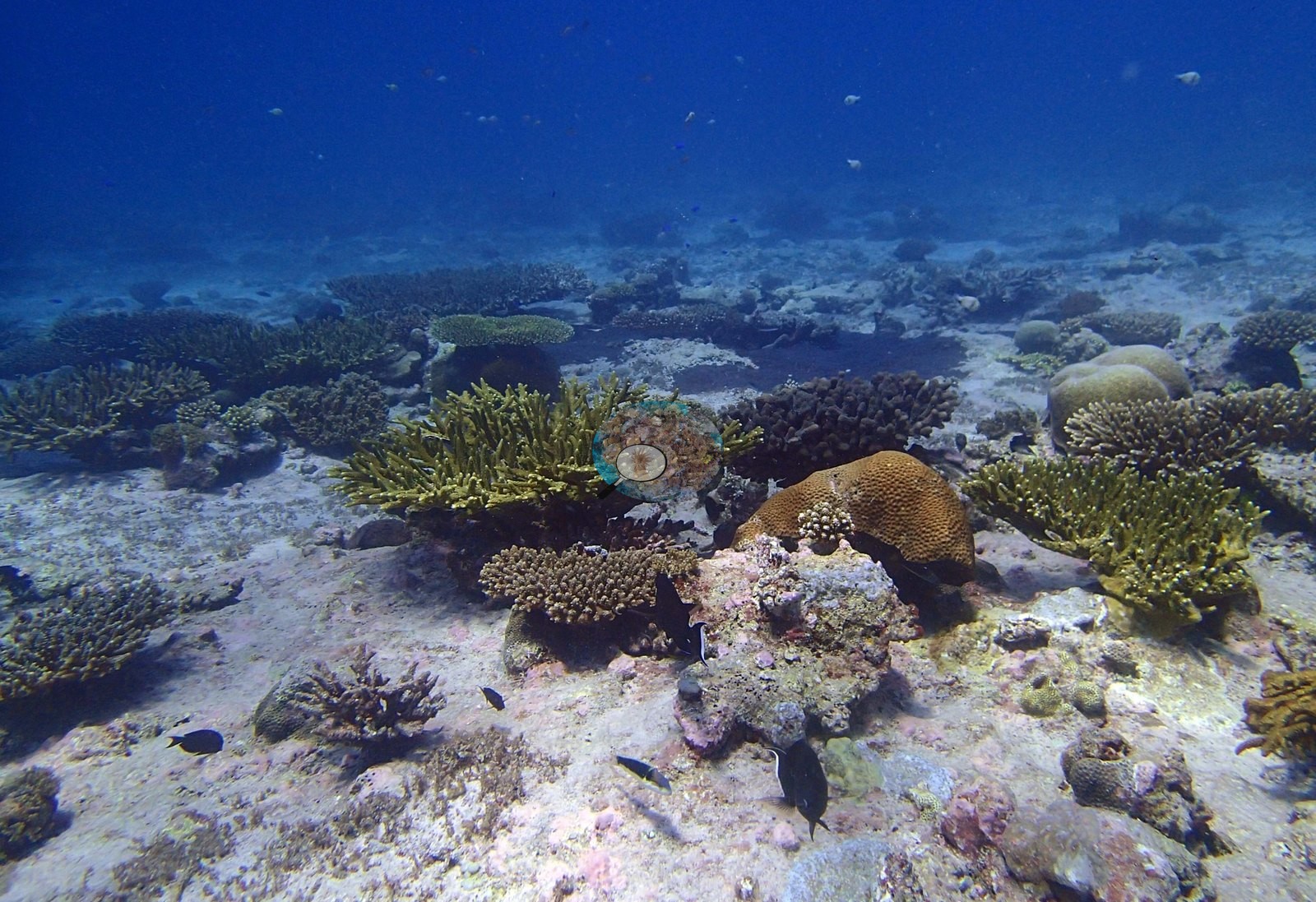
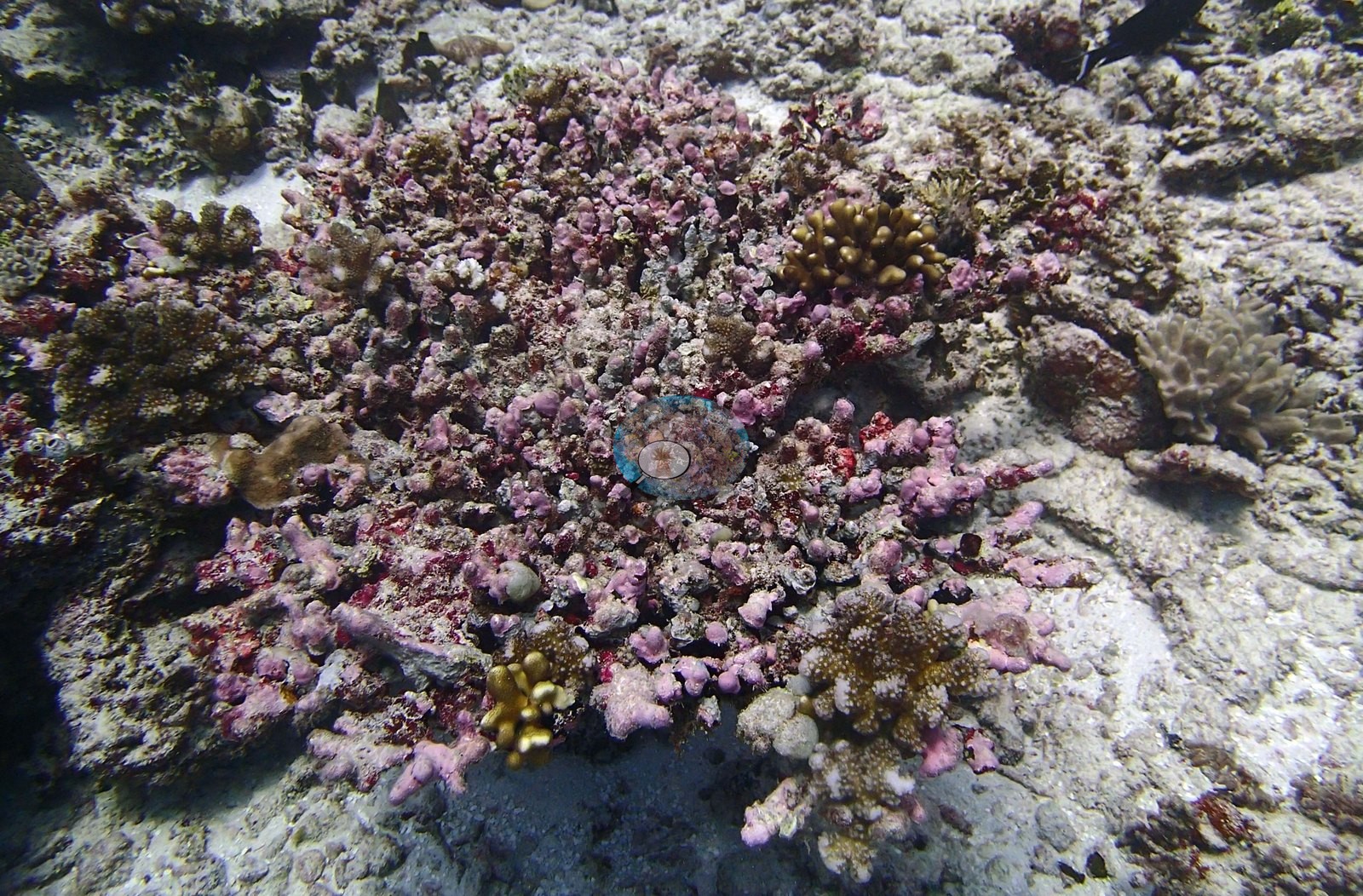
South Brother is a coral garden on a sand-and-pavement plain, and the imagery makes 18.54% look exactly right. Nothing here is continuous reef. P3190470, P3190480, P3190485, and P3190489 are the defining frames — white sand and pale consolidated pavement running to the horizon, with tan corymbose Acropora, small Porites domes and Pocillopora-type clumps on it as well-spaced, individually resolvable colonies, none touching. P3190443 is the emptiest: a low plain of small olive branching colonies over bare sand. P3190481 and P3190469 are the same ground with dark maroon algal mats spreading across the pavement, and P3190468 — pink-and-maroon CCA over old dead massive skeletons, threaded with green Halimeda — is the clearest statement of old, non-acute structural loss here. P3190487 is the closest look at the algal fraction: dense dark green algal tufts spread across pavement between gold honeycomb-textured colonies and tan encrusting sheets, with dark ruffled fleshy macroalgae compatible with Lobophora or Dictyota. The sightline in most of the wide frames runs flat into blue-gray with no structure breaking it.
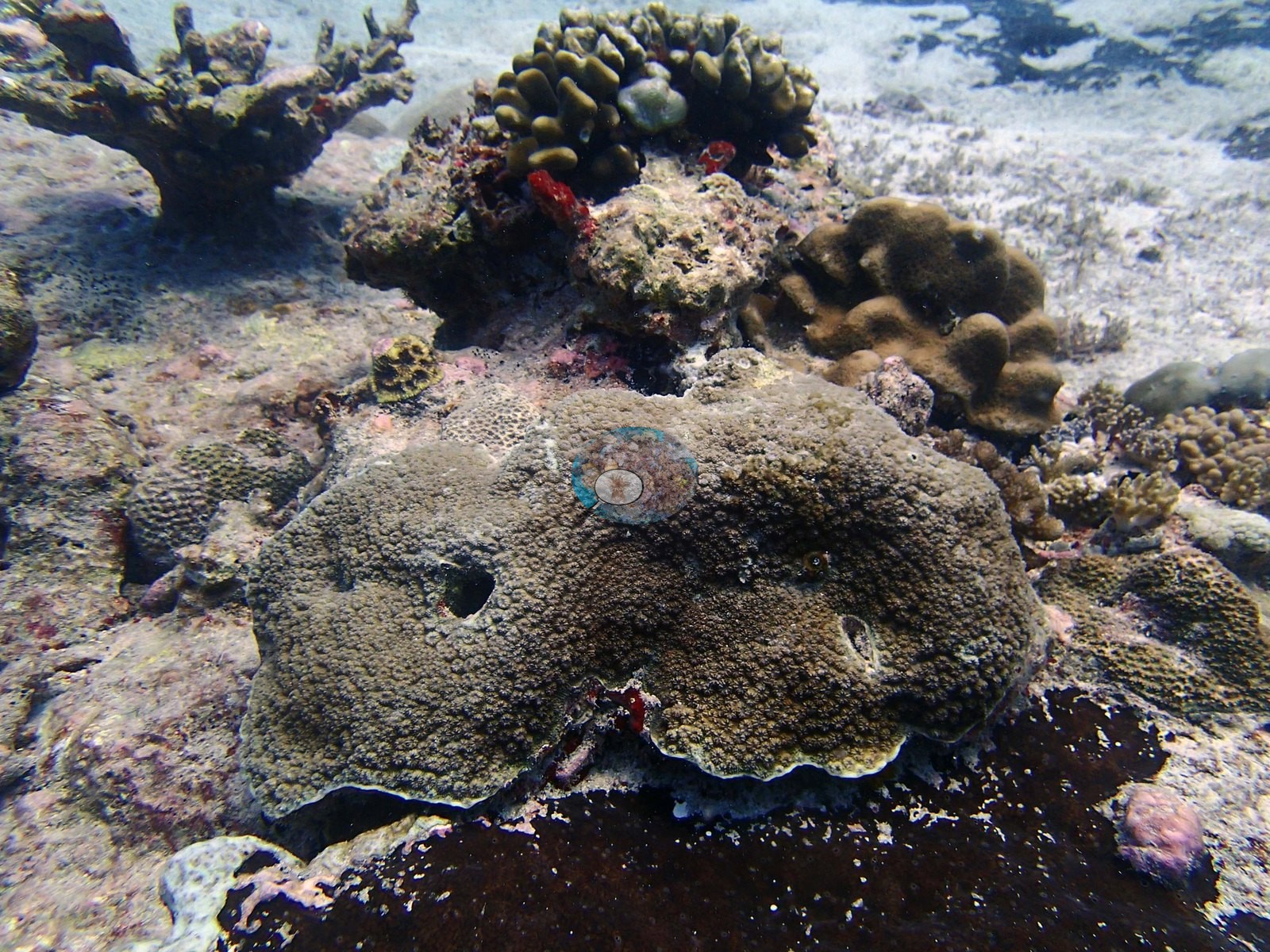
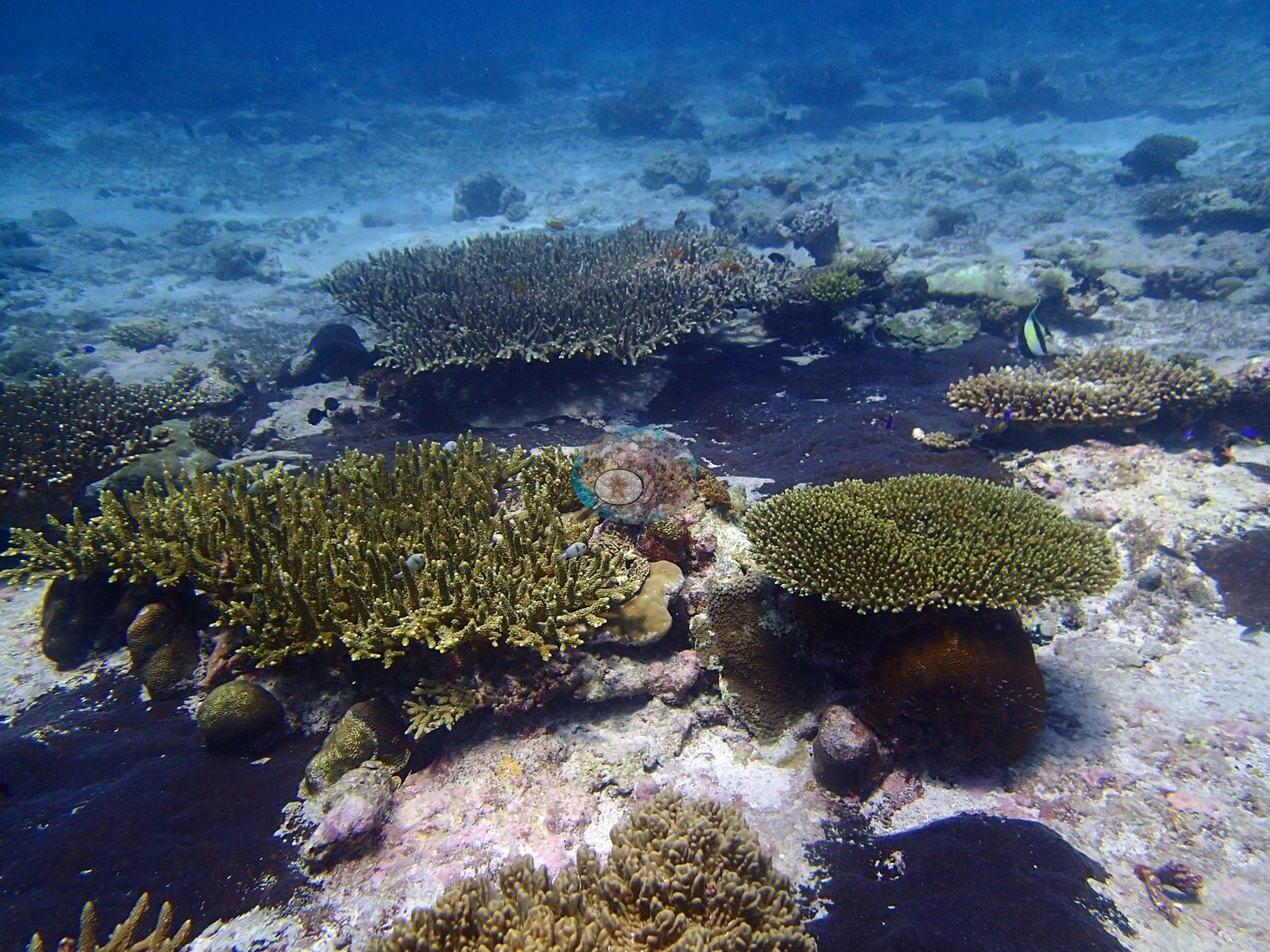
Where coral does concentrate it is healthy and acroporid. P3190484 is the highest-cover frame (36.7% by points, 30.5% by mask — frame-level image values, and the closest two-method agreement at the site): two gold-green tabular Acropora a meter and more across, over tan lobed Porites and small faviids, a Moorish idol (Zanclus cornutus) behind. P3190486 is the best mixed frame — gold digitate Acropora, a large brown knobby-columnar Porites, and a pinkish-gray branching colony that is the site's clearest partial-mortality candidate, branch tips already carrying crustose coralline algae. P3190482 is a staghorn-and-corymbose Acropora thicket with a powder-blue surgeonfish (Acanthurus leucosternon) in it. P3190490, the last frame of the dive, is the signature image: gold-green and maroon-purple branching Acropora with a yellow transect tape running clean across the upper third of the frame — one of the clearest direct images of the apparatus behind a Chagos cover figure. P3190487 and P3190488 are the two close benthic frames and carry the site's highest mask cover (34.9% and 31.6%) on encrusting and plating colonies the wide shots never resolve; P3190488 is a large tan encrusting and plating colony with a pale margin and scattered red encrusting sponge around it. From the photographs the Acropora shows in four habits — tabular plates to ~1.5 m, corymbose/digitate, gold-green arborescent staghorn, and the maroon-purple branching form in P3190490 — alongside Porites massive/domal, knobby-columnar and encrusting, Pocillopora-type verrucose clumps, faviid submassives, meandroid brains compatible with Platygyra, sheets compatible with Montipora/Pavona, and coarse honeycomb colonies compatible with Astreopora. Growth-form calls from photographs are given as "compatible with". Earlier, P3190444, P3190445, and P3190446 hold dense fusilier schools compatible with Caesio/Pterocaesio, the last banked over a broad lobate Porites dome on white sand. The independent 30-point annotation of the same frames (810 points) gives live hard coral as 12.72% of all points and apportions it Acropora 44.7%, Porites 29.1%, other hard coral 23.3%, Pocillopora 2.9% of live coral — an Acropora-led assemblage, the reverse of BITB29's Porites dominance, and consistent with the transect's Acropora 4.43% > Porites 4.07%. Non-coral cover is dominated by turf 23.0% and crustose coralline algae 6.7% of all points. The 52.71% "algal cover" needs unpacking before it is read as degradation: it is CCA 15.28% + turf 12.02% + turf-with-sediment 11.67% + macroalgae 7.94% + erect algae 5.74% + cyanobacteria 0.06%. Only 13.68 pp of it is fleshy algae.
Coral cover
The measurement at BITB33 is the benthic transect survey. Coral cover 19%, from LOF BIOT-1 in situ transects (Mayfield & Dempsey 2026, Oceans, suppl. That diver transect figure is the authoritative record of cover and community here. The photographs described below supplement it; they are qualitative only, no cover value may be read off any of them, and where the imagery and the transect appear to disagree the transect governs.
What the transects recorded. Live hard coral 18.54% against algal cover 52.71%, bare substrate 20.48% and non-coral invertebrates 8.27% of the benthos, taken on 10 transects across three depth strata (D2–D4) — below the 15-transect Chagos median, though the generic richness is nonetheless solid and is not a richness floor. The independent CRD site page gives the same reef as "coral cover=19% (LOW), algal cover=52% (HIGH)". This is a genuinely low-cover, high-heterogeneity lagoonal reef by its own transect record, and that record is the site's measurement.
Computer-vision comparison — method against method, not against the transect. All 27 frames carry both products, so the paired-frame count is n = 27 — complete coverage, nothing lost to the filename collision that affected other Three Brothers folders. CoralNet point annotation returns 12.72% live hard coral (810 points) and Coralscapes mask segmentation 11.11% of image area, against the transect's 18.54%: deviation −5.8 to −7.4 pp, mean of the three methods 14.1% ± 3.9. That is the smallest absolute deviation of the entire Three Brothers series — and it is not a better result. It is the same bias measured at the lowest-cover site, which is itself evidence the bias is multiplicative rather than additive: BITB33's raw point cover is 0.687× its transect, against 0.686 at BITB28, 0.677 at BITB27 and 0.671 at BITB29 — four sites spanning 18.5–36.6% transect cover with the ratio constant to ±0.008. A multiplicative bias yields a small absolute percentage-point gap wherever cover is low. Across the 24 Three Brothers sites with a transect value and ≥8 frames, r(transect %, gap pp) = −0.724: a site's own cover, not anything about its imagery, dominates how large its deviation looks. BITB33 should not be cited as a site where the photo methods "did better".
Two mechanisms behind the point column are measurable here. First, the Unknown pool: 25.06% of this site's points (203 of 810) are labeled Unknown — lower than every written-up neighbor (BITB27 27.92%, BITB30 29.49%, BITB29 32.24%, BITB28 32.27%) — and dropping Unk from the denominator lifts the point set from 12.72% to 16.97%, a residual of −1.57 pp against the transect. The arithmetic is explicit: 1/(1−0.2506) = 1.334, and 12.72 × 1.334 = 16.97. Two cautions: 25.06% is only modestly low (Chagos median 26.99% across 102 folders, Three Brothers median 26.63%), and across those 24 sites r(Unknown %, gap pp) is only −0.391 against −0.724 for the transect value. A smaller Unknown pool is real and contributes, but this site's gap is small mainly because this site's cover is low. It is nonetheless the cleanest natural control in the series — low Unknown, low cover, complete coverage. Second, blue-water dilution: eight frames are ≥40% water (P3190442, P3190444, P3190445, P3190463, P3190464, P3190465, P3190466, P3190482), site mean 28.64%; dropping them moves the point set 12.72 → 15.26 (+2.54 pp) and Coralscapes 11.11 → 14.25 (+3.14 pp), about 43% of the gap. The corrections do not stack — excluding Unknown on the <40%-water subset overshoots to 21.64%, and excluding water, Unknown and fish together gives 28.22% against an 18.54% transect. Excluding Unknown alone is the correction that behaves. Thirty per cent of this site's frame set is not a cover measurement at all: three lobster macros (P3190453, P3190454, P3190455), one close "spot" macro (P3190456), and four open-water fish and shark frames (P3190442, P3190463, P3190464, P3190465). On the remaining 19 frames, excluding Unknown, the point set reads 18.69% against the transect's 18.54% — but that is a statement about how the image products behave once non-survey frames are removed, not a validation of the transect, which needs none. Water scoring is also internally inconsistent (P3190490 is scored 0.0% water with 43.3% Unknown while Coralscapes reads 31.2% dark background on the same pixels; P3190488 is 0.0% water / 30.0% Unknown / 17.3% mask background), so part of the Unknown pool is misfiled water. The three products have different sampling footprints and denominators, none of them corrects the transect, and they must not be averaged. The frame counter runs P3190442→P3190490, so the edited set keeps 27 of roughly 49 exposures — a frame selection upstream of every photo-derived number above. Those three frames are composed on an animal in shadow rather than on substrate, should not be read as benthic samples, and are 11% of the CV sample. What the photographs cannot settle is the site's depth zonation, the true proportion of the bottom under turf and macroalgae, or any quantitative statement of cover — for all of that the transect and point-count records stand.
Coral cover 19%, measured on the in situ benthic transects of the LOF BIOT-1 expedition (Mayfield & Dempsey 2026, Oceans, supplemental S1) — a diver transect measurement, not a photographic or computer-vision estimate. The transect figure is this reef's authoritative cover and community record; the photographs above are illustrative only and do not qualify it. Across all 27 the Coralscapes masks put live hard coral at 11.11% of image area, of which Acropora (non-tabular) is the largest component at 30.0%; the rest breaks down as massive and meandroid 28.1%, other hard coral 19.7%, tabular Acropora 15.2% of live cover. Frame-to-frame live cover runs 0% (P3190442, P3190443, P3190456, P3190465, P3190466) to 36.7% (P3190484); per-frame point-vs-mask correlation is r = 0.590, below the Chagos-wide 0.7155. Coral cover: 19%. Live hard coral measured on the in situ benthic transects of the LOF BIOT-1 expedition (Mayfield & Dempsey 2026, Oceans, supplemental S1), against algal cover of 52.7% of the benthos. The transect figure is this site's authoritative cover value; no image-derived product overrides it. Across methods the same reef reads: transects 18.5% · CoralNet points 12.7% · Coralscapes masks 11.1% (27 frames). These products have different sampling footprints and denominators and should not be averaged.
Stressors
Several wide frames carry a flat blue-gray cast over pale pavement that makes fine condition calls unreliable at range.
Condition. Mortality here is old rather than acute: CCA-plated dead massives in P3190468, maroon-crusted pavement in P3190481 and P3190489, and the pinkish-gray branching colony in P3190486 whose branch tips already carry coralline crust — the clearest partial-mortality candidate in the set. No frame in the 27 shows unambiguous whitening. The one genuine paling candidate is P3190489, a cream-yellow lobed massive standing against a dark maroon algal mat among normally pigmented neighbors; it is not callable from the frame and may equally be a naturally pale Porites. That colony needs Anderson's judgment and it is the only one here worth asking about. No crown-of-thorns appears in any of the 27 frames, no disease lesions and no corallivore predation scars. No percentage bleached is derived from these photographs; this site's published per-site bleached fraction is a separate, authoritative number from Anderson's own annotation record, and no frame here confirms, qualifies or revises it. Structural loss registers as dead coral 3.45% of image area and rubble 11.23%. Bleaching stands at 1.60% of annotated points — 13 points — and Coralscapes puts bleached area at 0.01% of the entire site, essentially zero.
Fish and other fauna
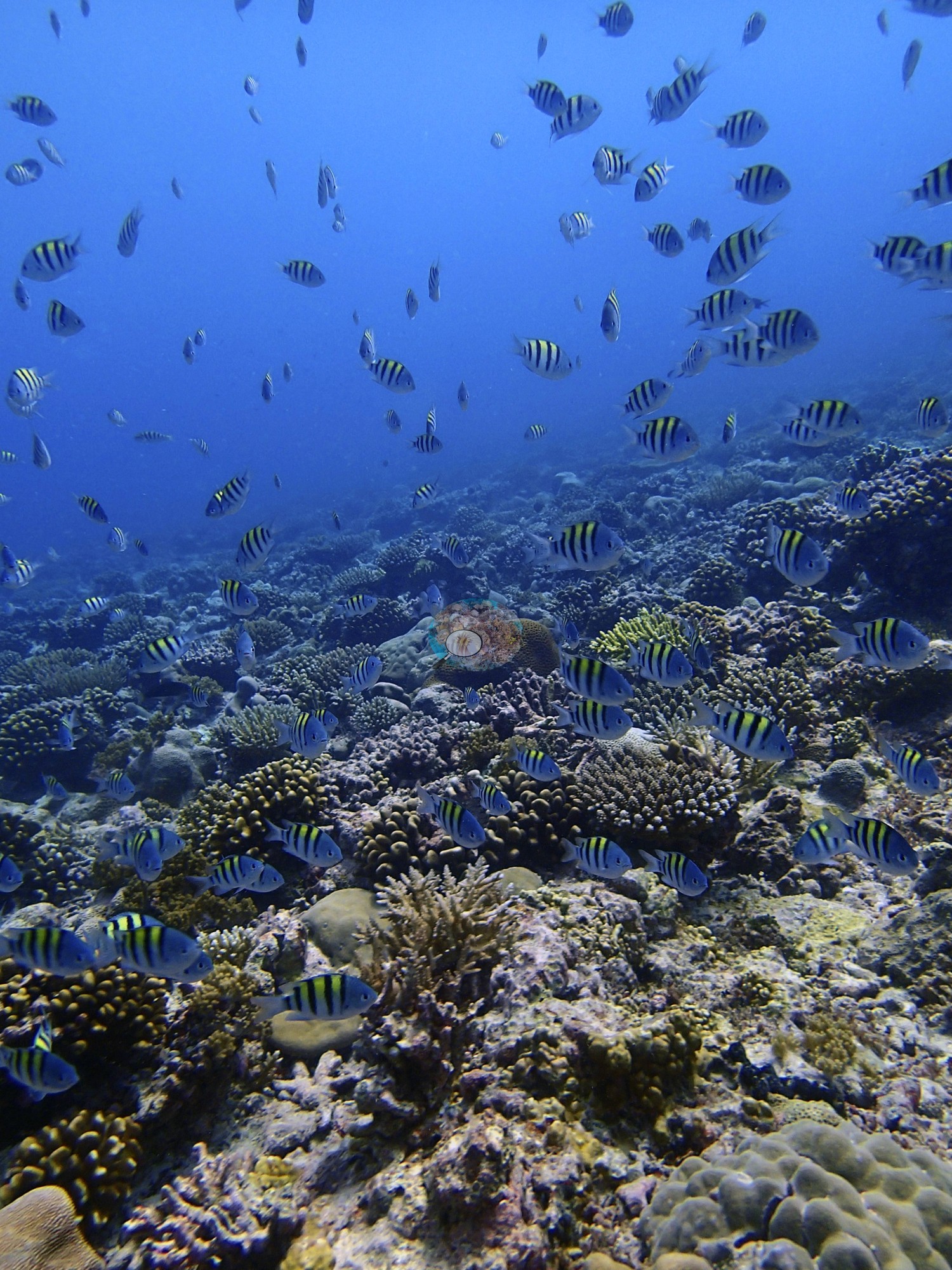
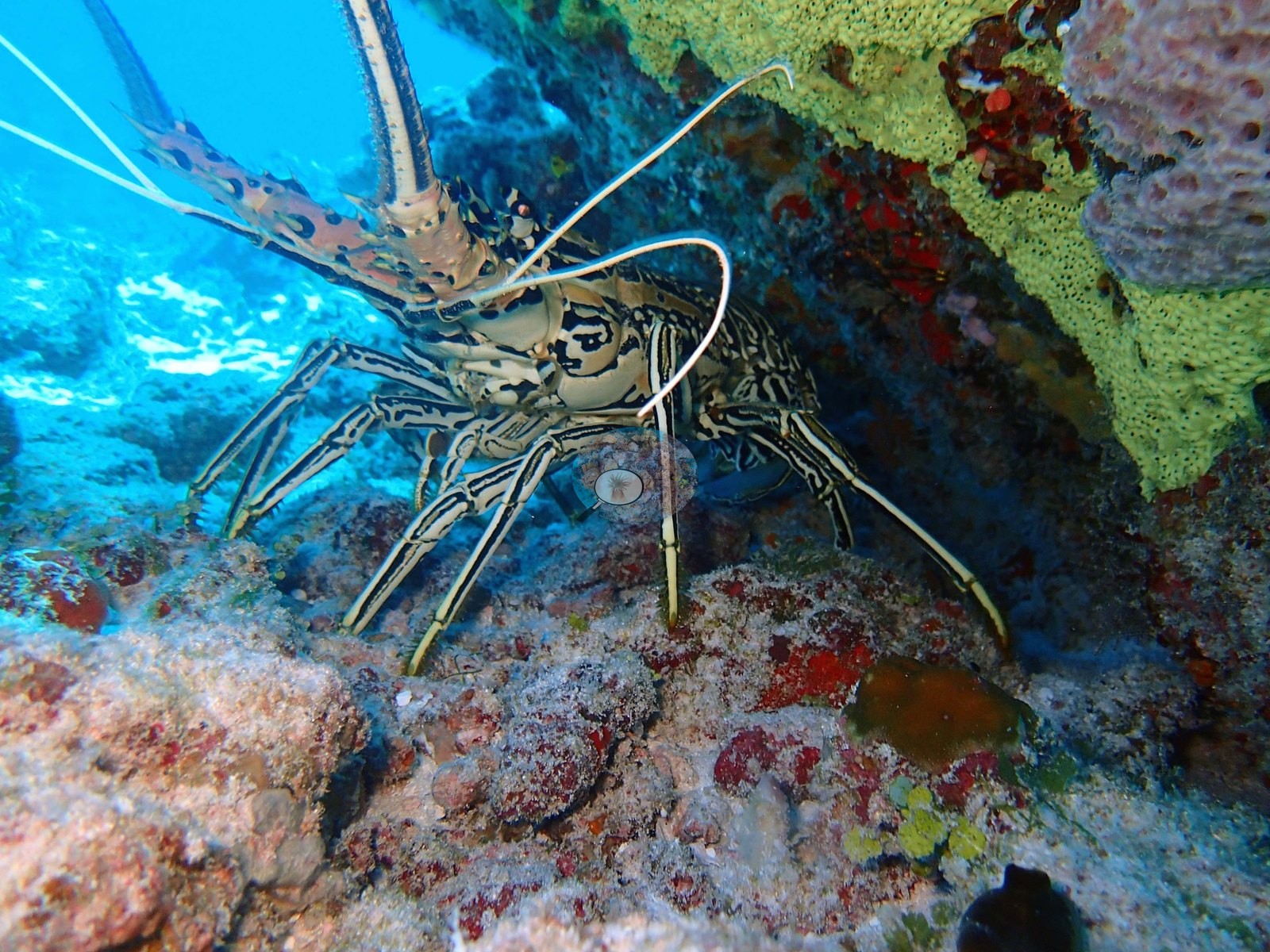
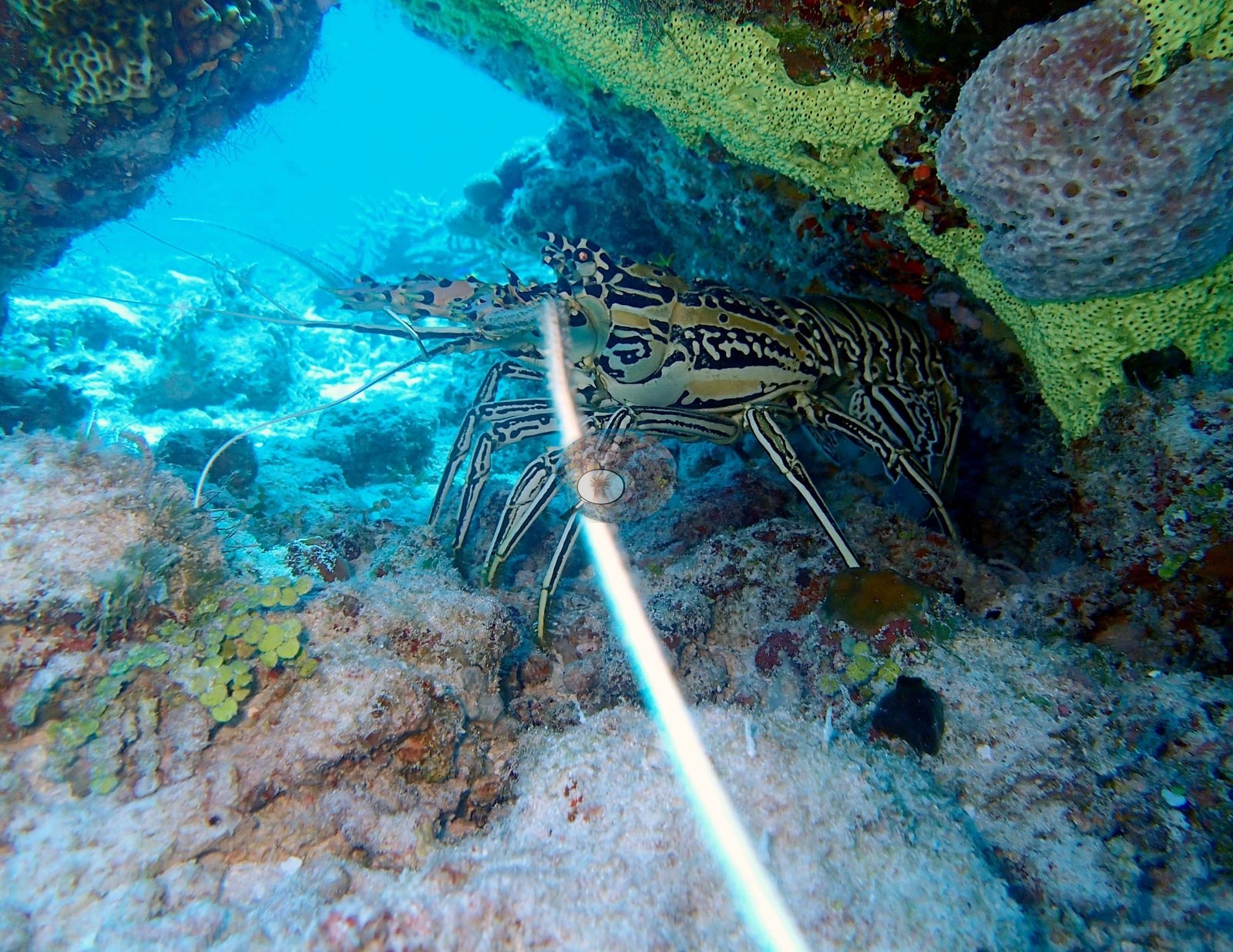
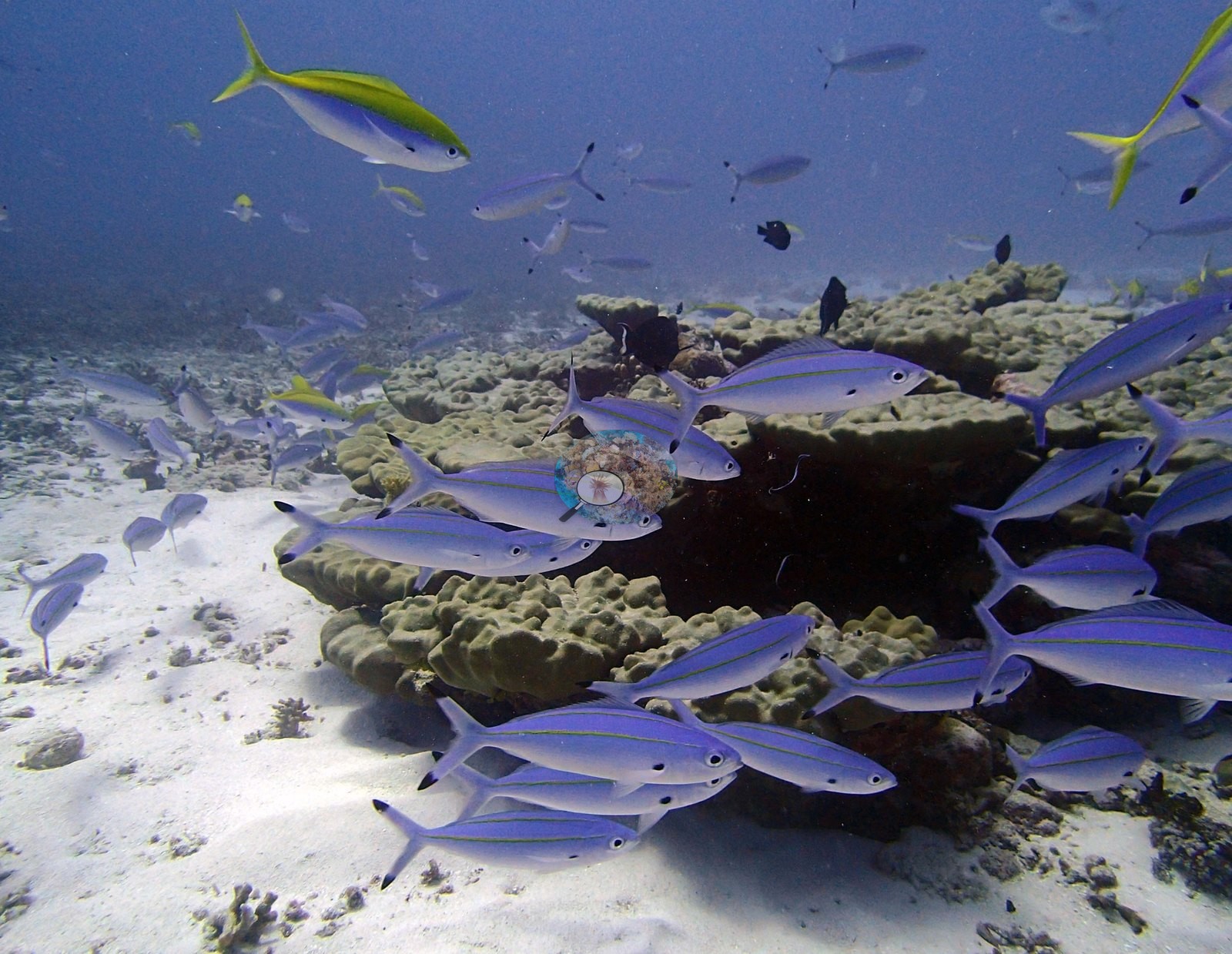
About 14 frames carry usable benthic content; five (P3190442, P3190463, P3190464, P3190465, P3190466) are water-column frames whose subject is a jack school or a shark; three (P3190453, P3190454, P3190455) are consecutive macros composed on a single lobster in shadow under a ledge, 11% of the set for one animal; three (P3190444, P3190445, P3190446) are fusilier frames with only incidental bottom. No scale reference appears in any benthic frame.
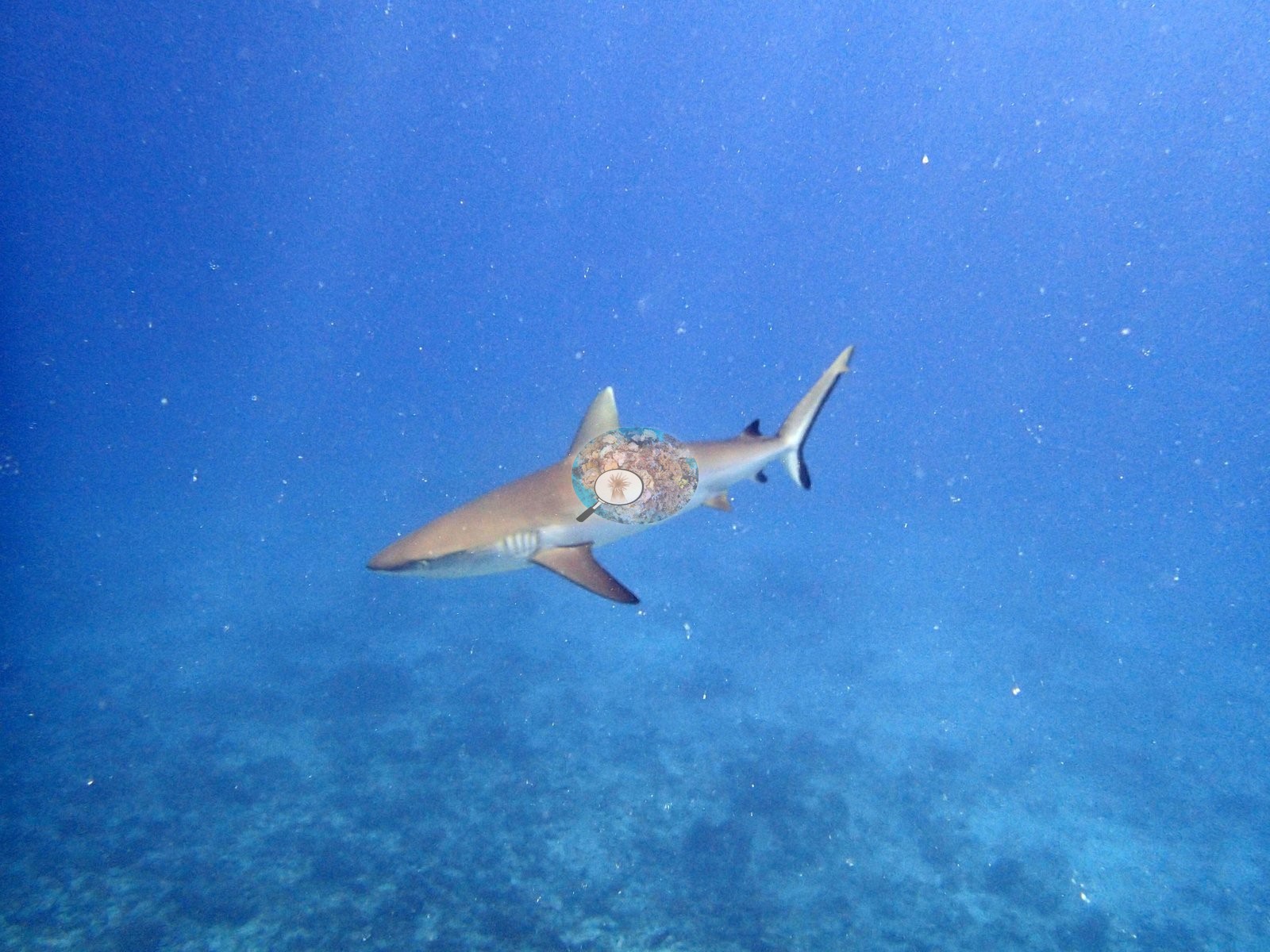
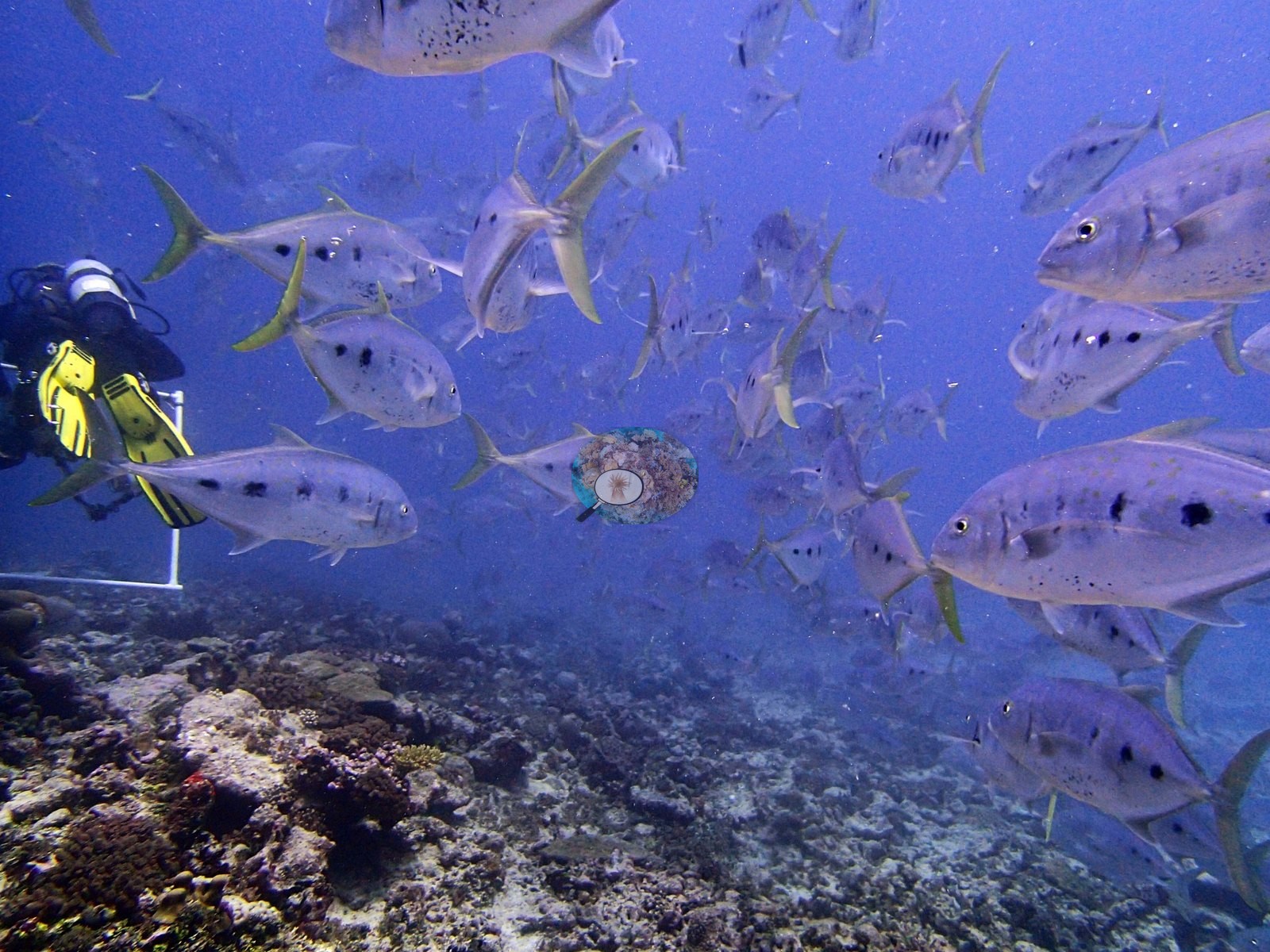
The fauna is dominated by one enormous trevally aggregation. P3190463, P3190464 and P3190465 are among the best schooling-fish frames of the redo — several hundred silvery, black-spotted, yellow-finned jacks filling the water column, compatible with Carangoides fulvoguttatus but not callable to species. P3190442, the opening frame, is a requiem shark in blue water — and it is NOT a whitetip: broad dark caudal margin, no white dorsal tip, so gray reef (Carcharhinus amblyrhynchos) or a dusky-phase relative; not callable. Beyond those: Moorish idols in P3190470, P3190484 and P3190485, a sergeant-major-type damsel and dark surgeonfish in P3190485, blue damsels, anthias, and Chromis in P3190487, P3190489 and P3190480, and an anemone with a resident fish beside a big honeycomb-textured colony in P3190480.
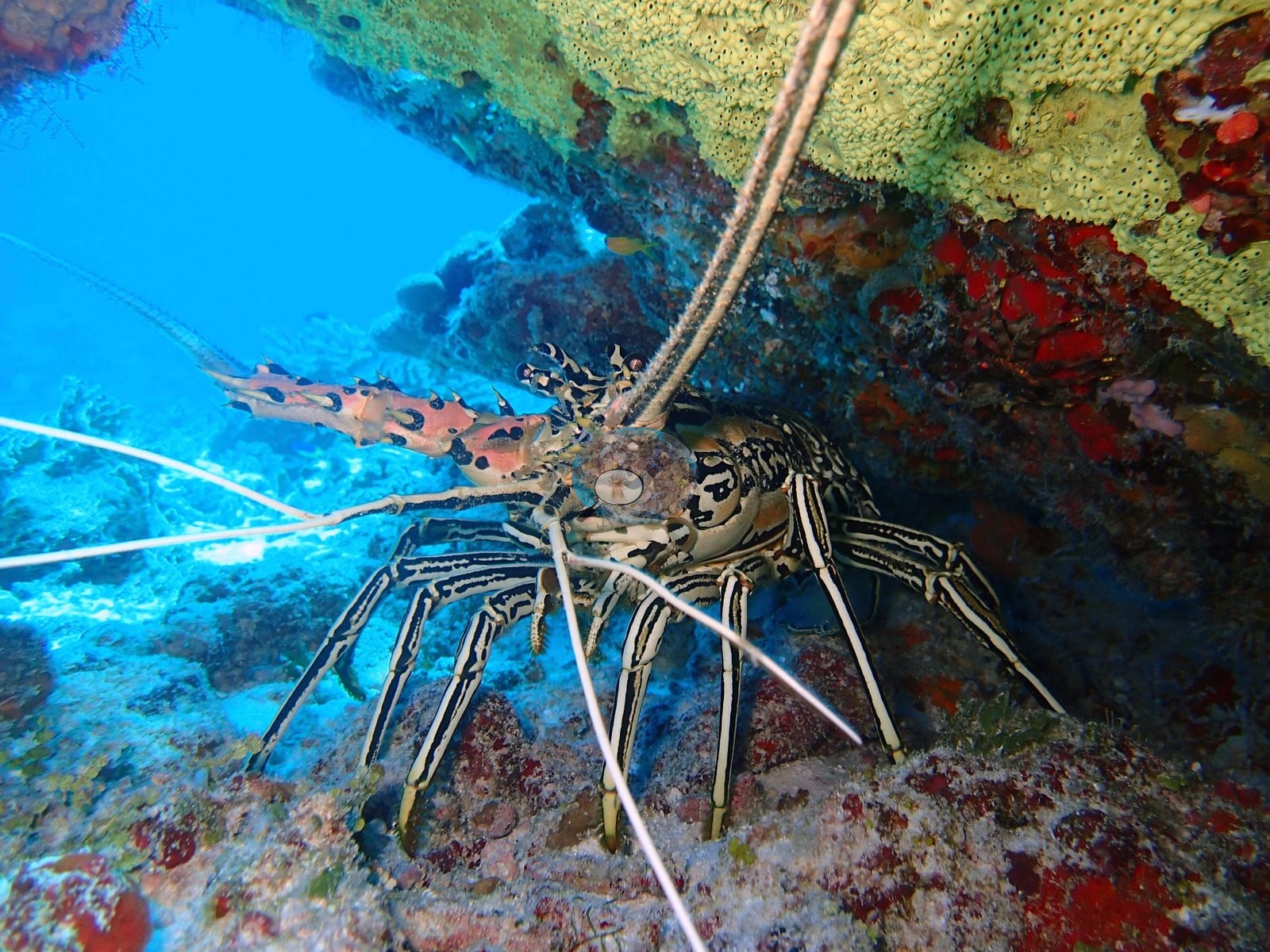
And, as at BITB29, the dive goes under a ledge. P3190453, P3190454 and P3190455 are three consecutive macros of a painted spiny lobster — boldly black-and-white banded legs, striped carapace, long pale antennae — beneath an overhang crusted in lime-yellow and red encrusting sponge, over coarse rubble, with bright turquoise water visible past the lip. Compatible with Panulirus versicolor or P. longipes; not callable. At least one animal, with a second set of antennae and legs entering the top-left of P3190454. Conspicuous fauna and sessile invertebrates appear as sponges in 15 frames, sea cucumbers in 7 frames, giant clams in 2 frames, urchins in 2 frames.
Comparisons with other data
Also on record for this site: Assemblage composition. This paragraph rests on the FULL 27-frame set.
Other notes
Image-by-image. Twenty-seven habitat frames from Anderson's own folder BiTb33-finished, shot on 19 March 2015 in a dive window of 10:25:38–11:12:31 (46 min 53 s, by DateTimeOriginal EXIF on all 27 files, Olympus TG-2). There are no sampled-colony close-ups, so the account rests entirely on the habitat set. P3190466 is the same school with a diver in it, carrying a white rectangular open frame, apparently a photoquadrat, on the reef at lower left — which confirms these are survey-time observations.
CV model comparison
More info
Those are point counts on the photographs; this is a diver swimming a transect. The models and the reference never saw the same thing. ⚠ SITE-LEVEL ONLY. The 2,500 frames were not associated with any transect taken within 200 m of them, so transect-vs-image comparisons are site means, never frames. The transect value is already in the pin `cover` field (109 of 112 pins, sourced to the paper's suppl. S1) and is read from there, never re-imported. The transect is THE coral-cover value for this site and stands alone. The rows below it are a methods comparison only: no computer-vision value is averaged with it, feeds the headline, or carries over to the site's cover figure (Anderson, 2026-09-22).| Method | Hard-coral cover (%) |
|---|---|
| Transect (published) | 18.5 |
| CoralNet | 20.3 |
| In-house DINOv3 | 11.5 |
| CoralSCOP edited | 22.3 |
| Claude | 7.9 |
Data & links
- Read the full site report ↗
- Download benthic survey data (CSV) ↗
- Download all LOF-GRE data (933 sites) ↗
- CoralNet image repository for this region ↗
- Photo portfolio ↗
- Coral Reef Diagnostics page for this area ↗
All images from Coral Reef Diagnostics. Data are from Coral Reef Diagnostics.
 © Coral Reef Diagnostics.