
Part of the regional summaries: Chagos Archipelago - Great Chagos Bank West / Brothers / Eagle and Chagos Archipelago
More info
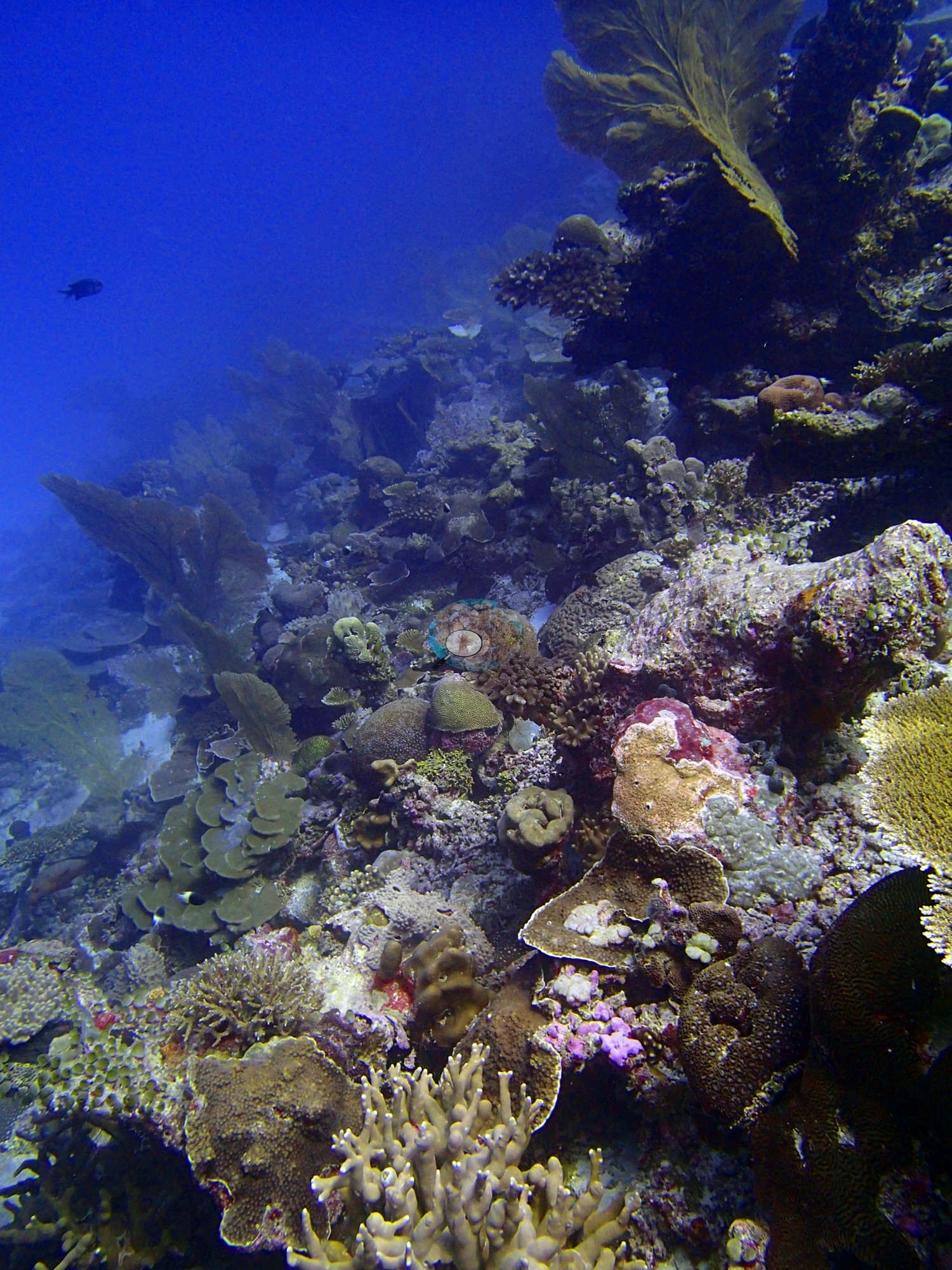
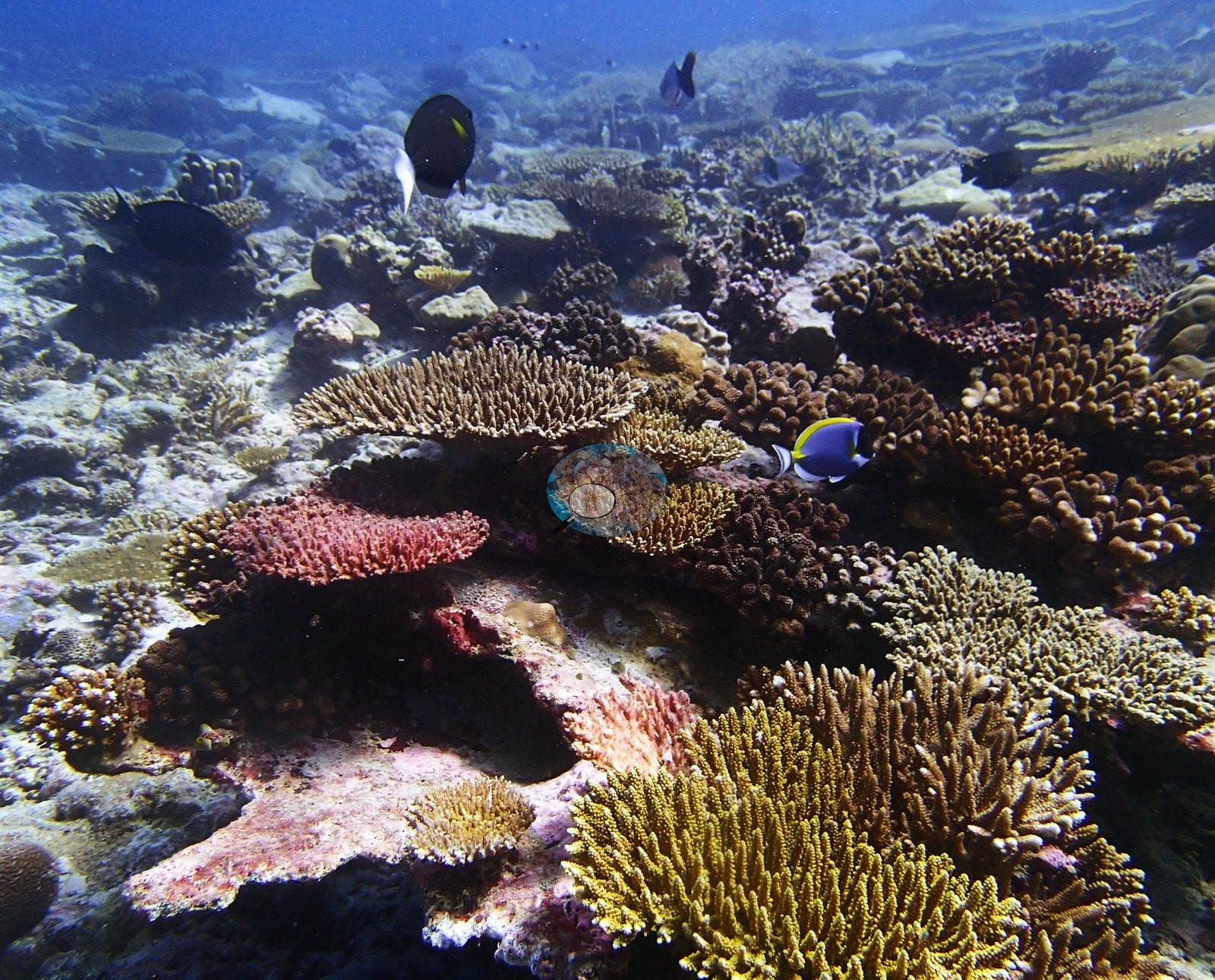
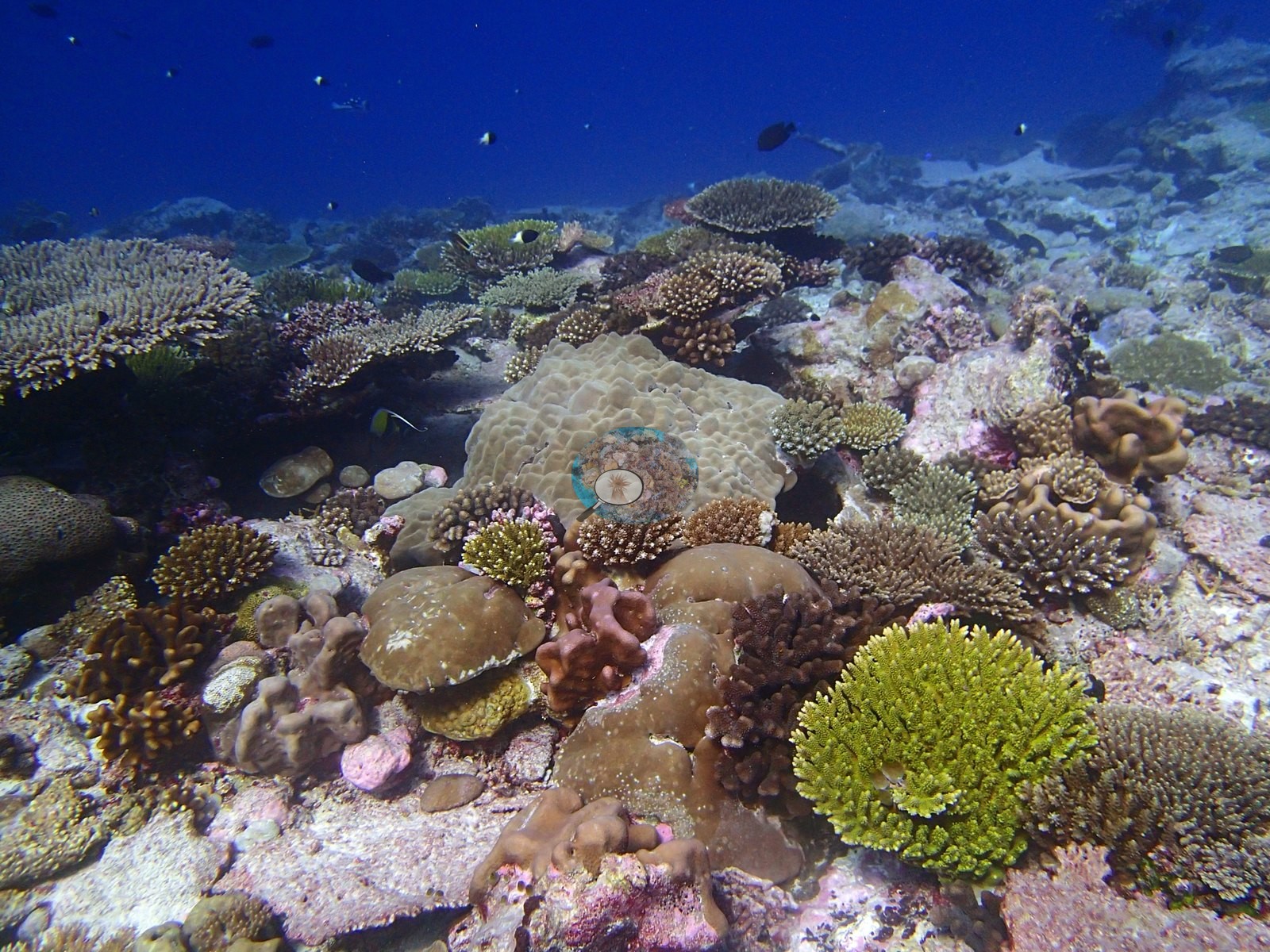
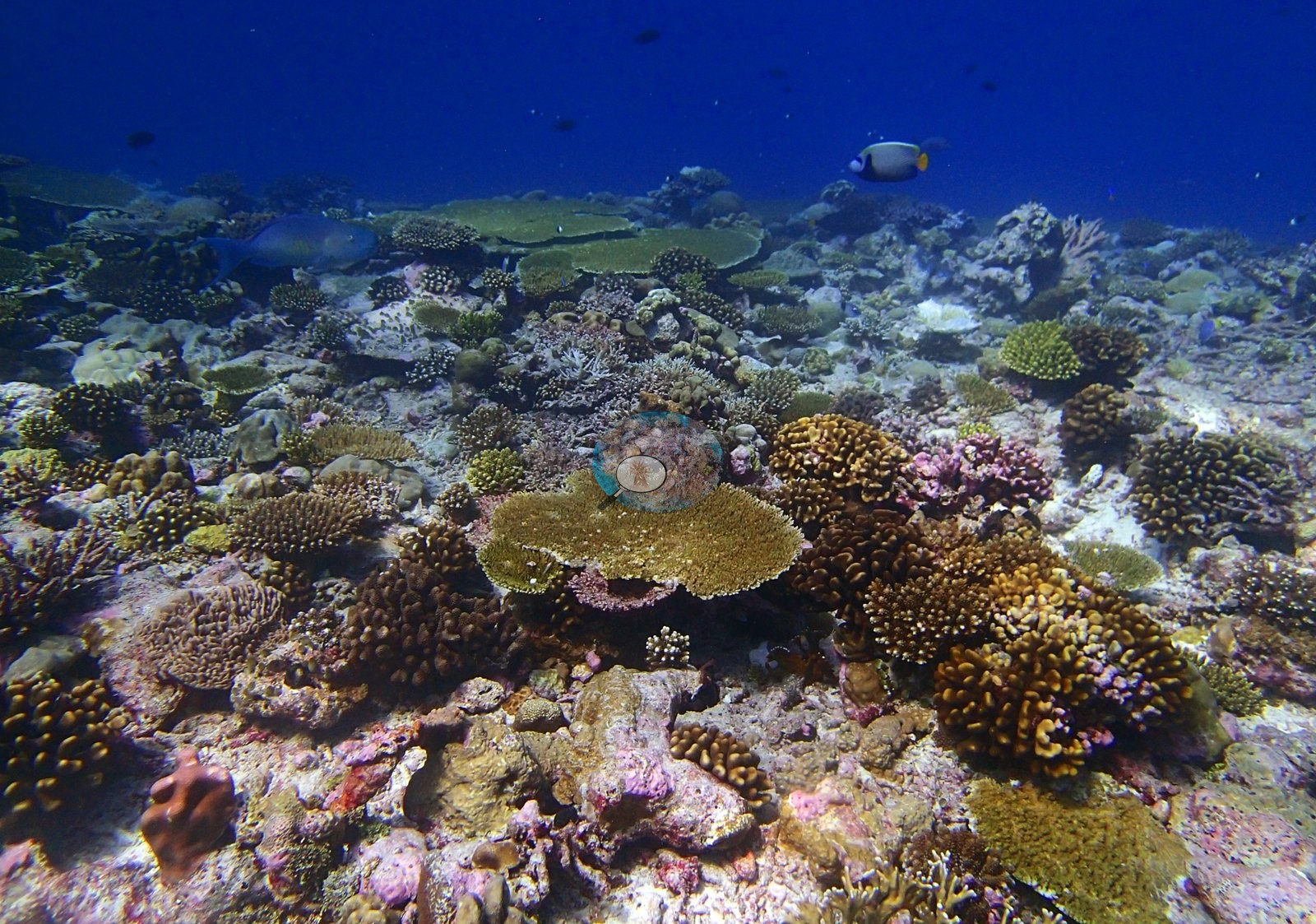
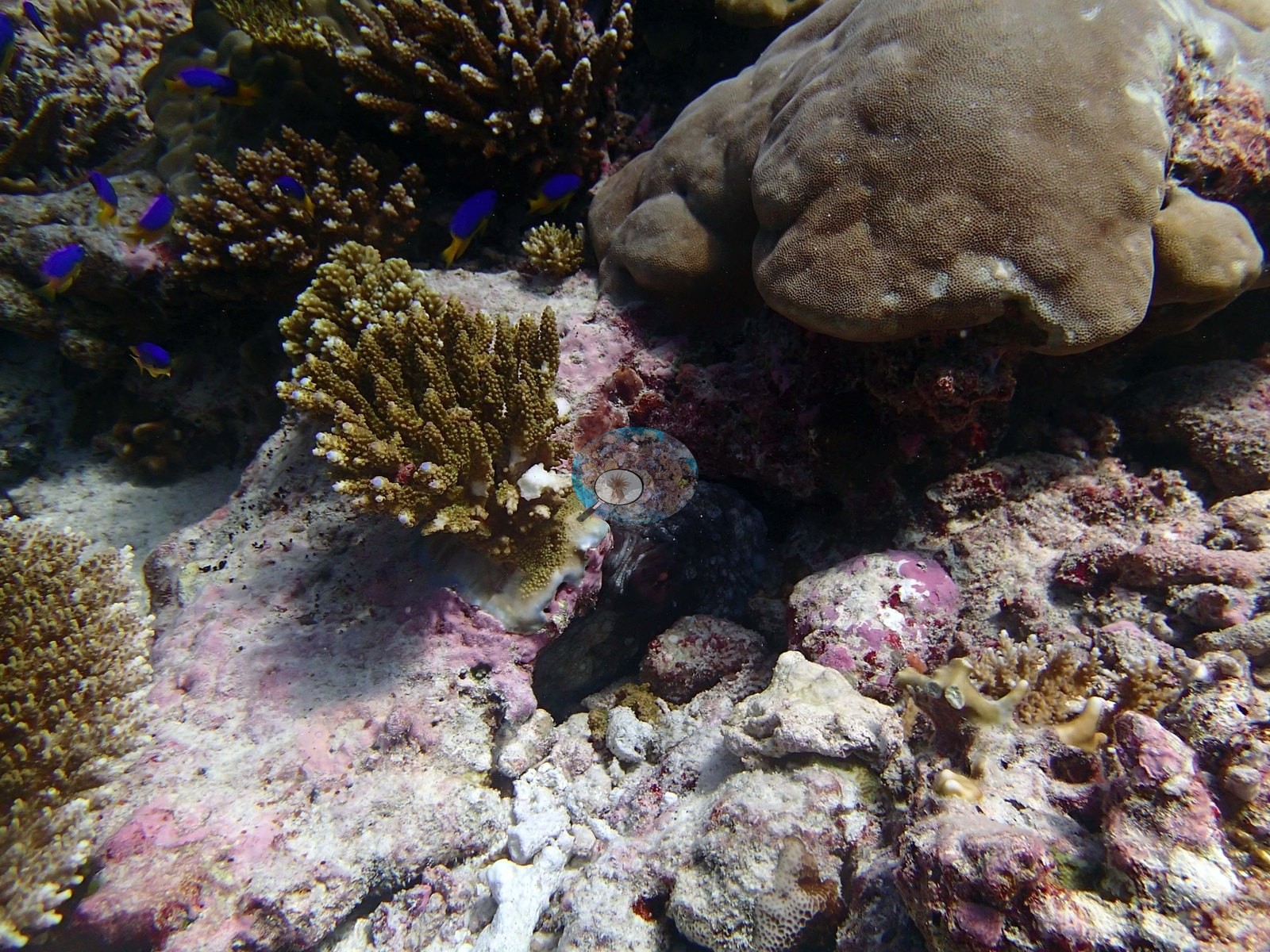
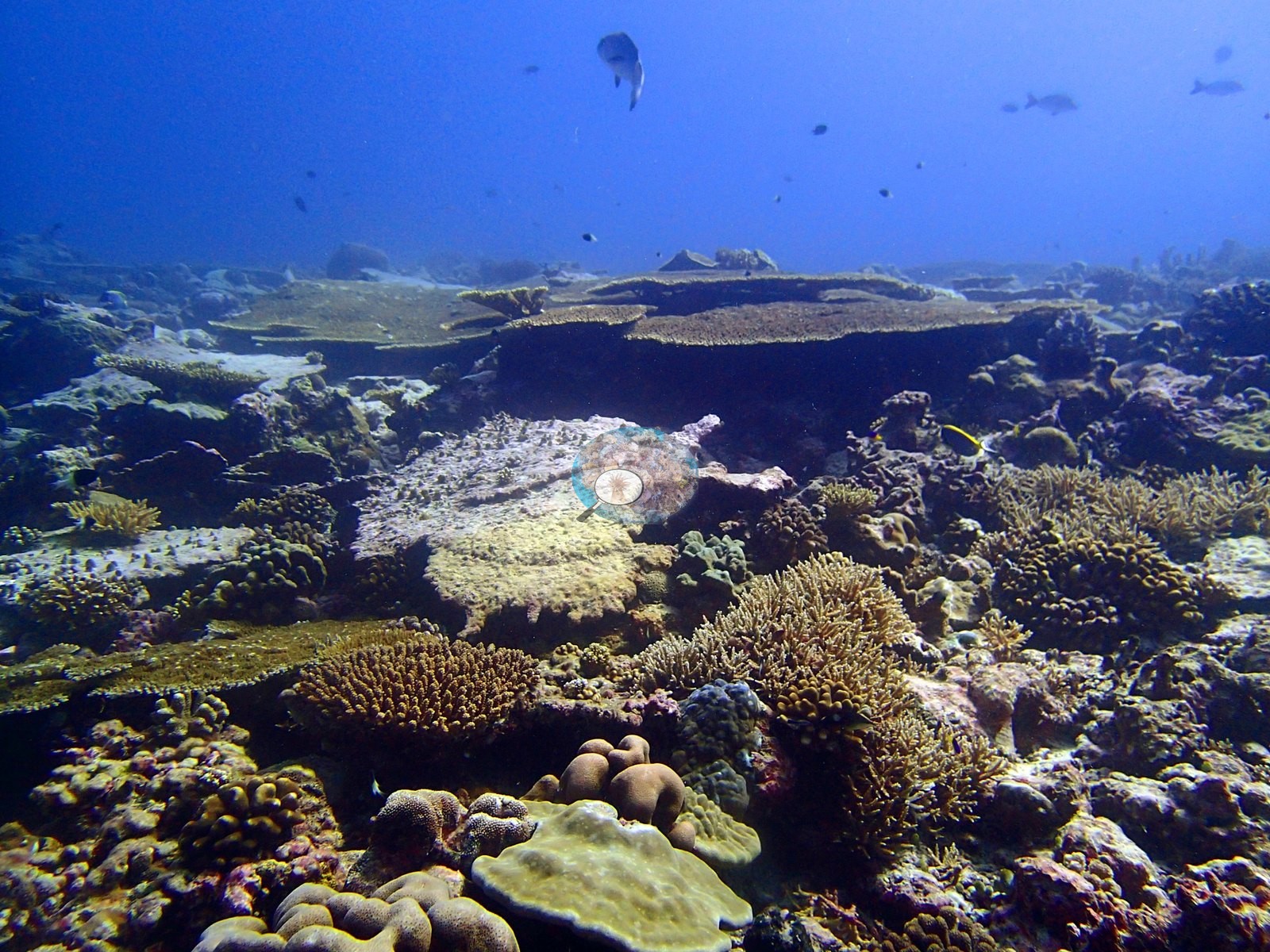
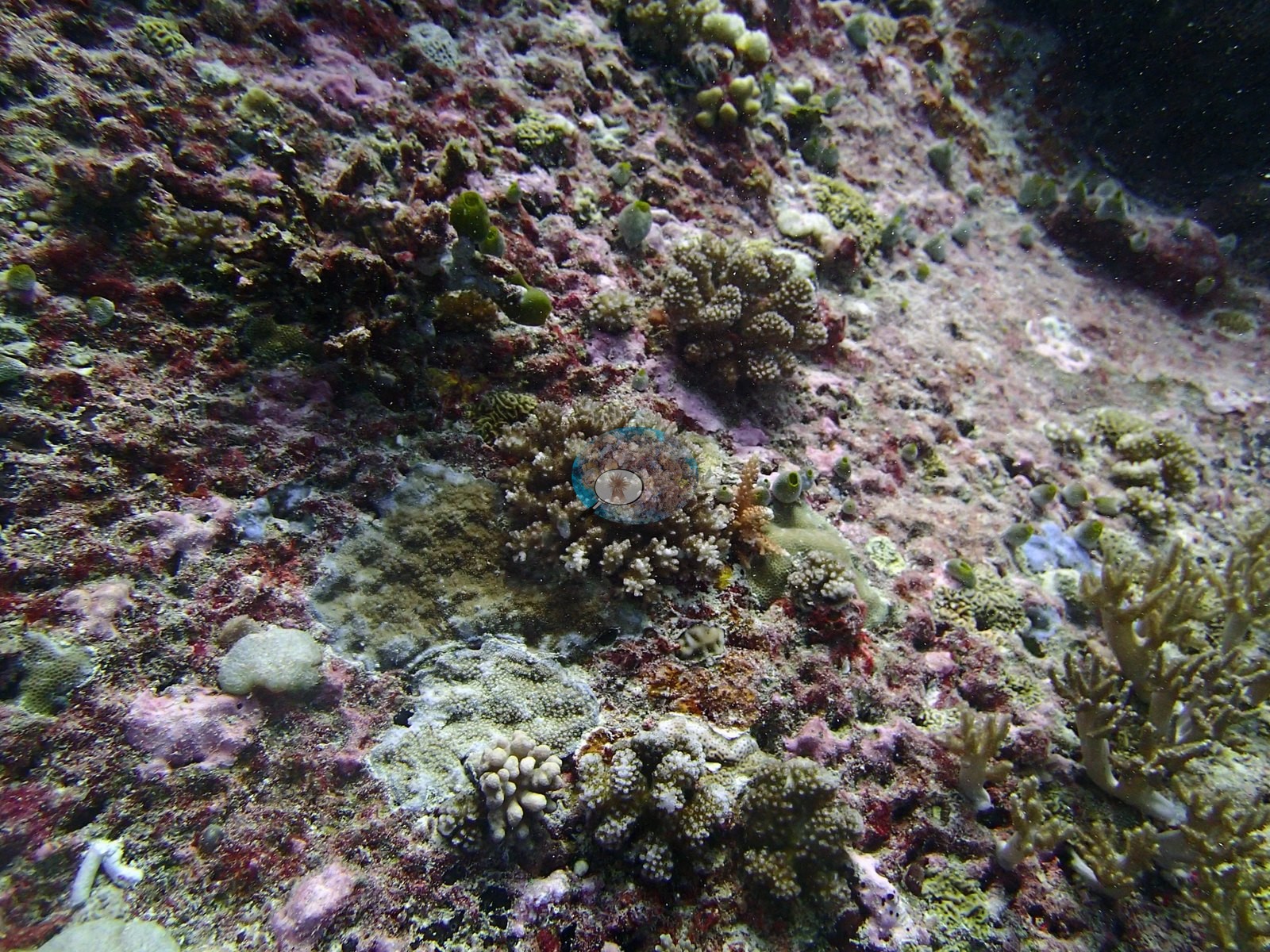
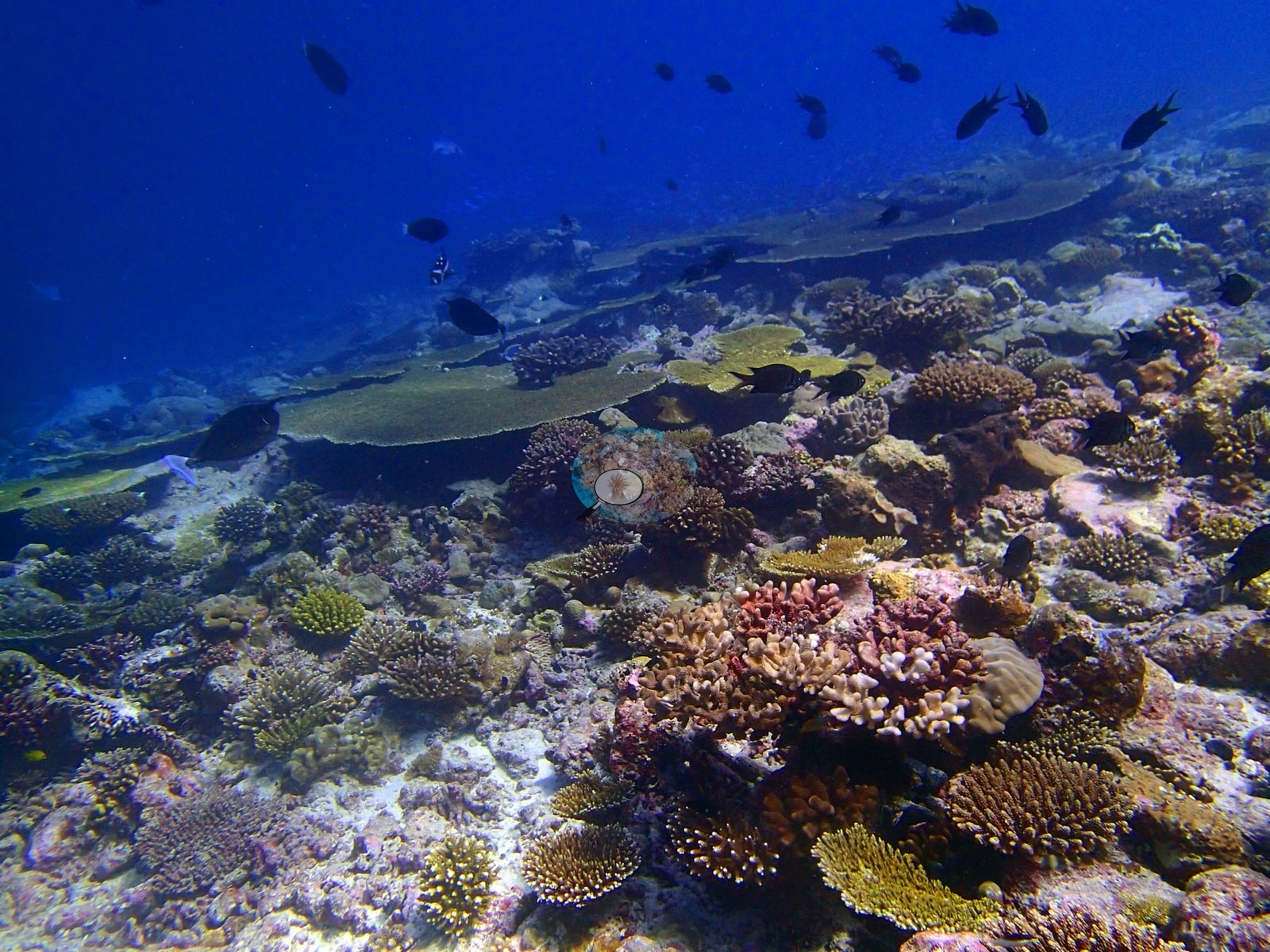
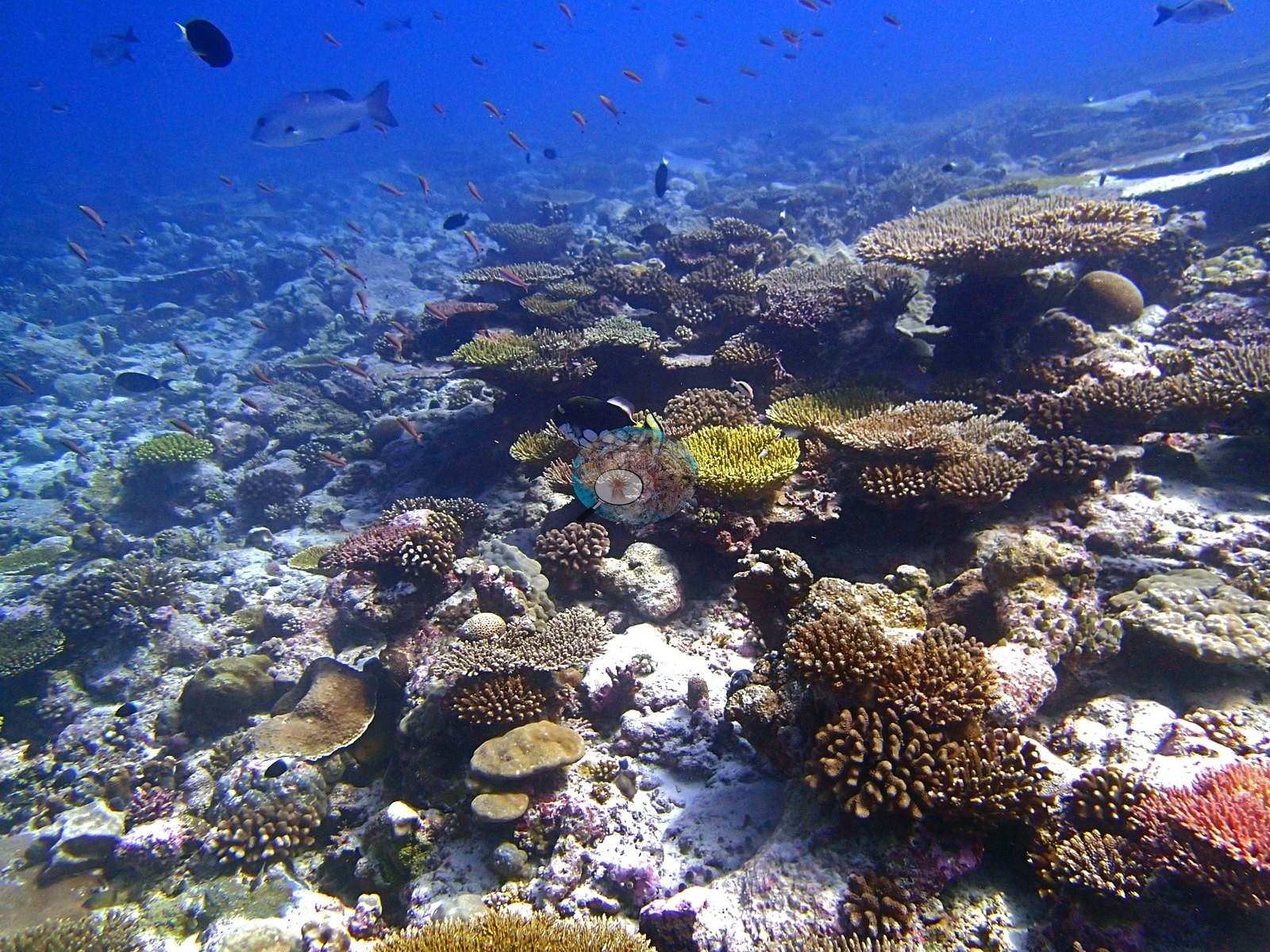
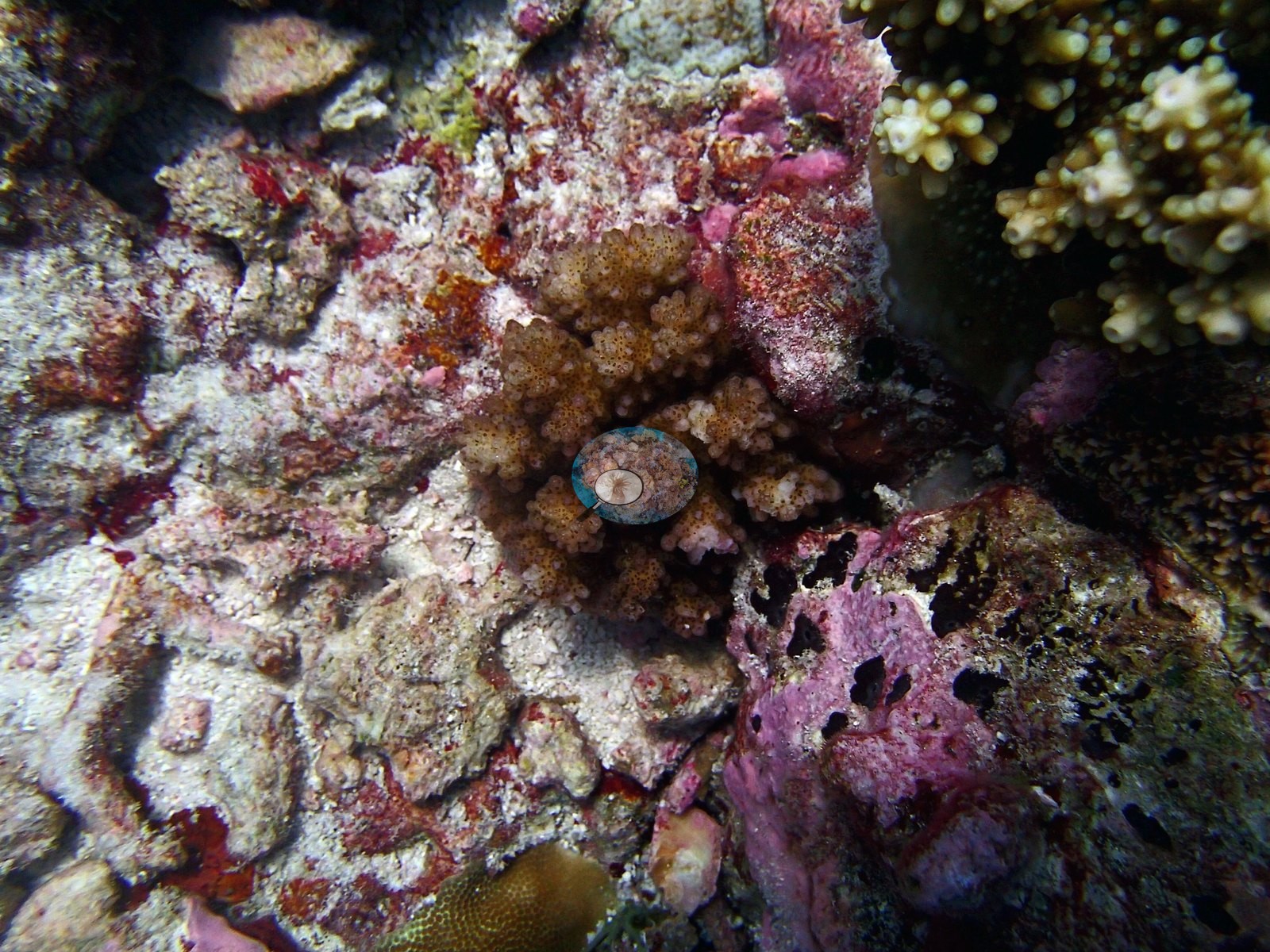
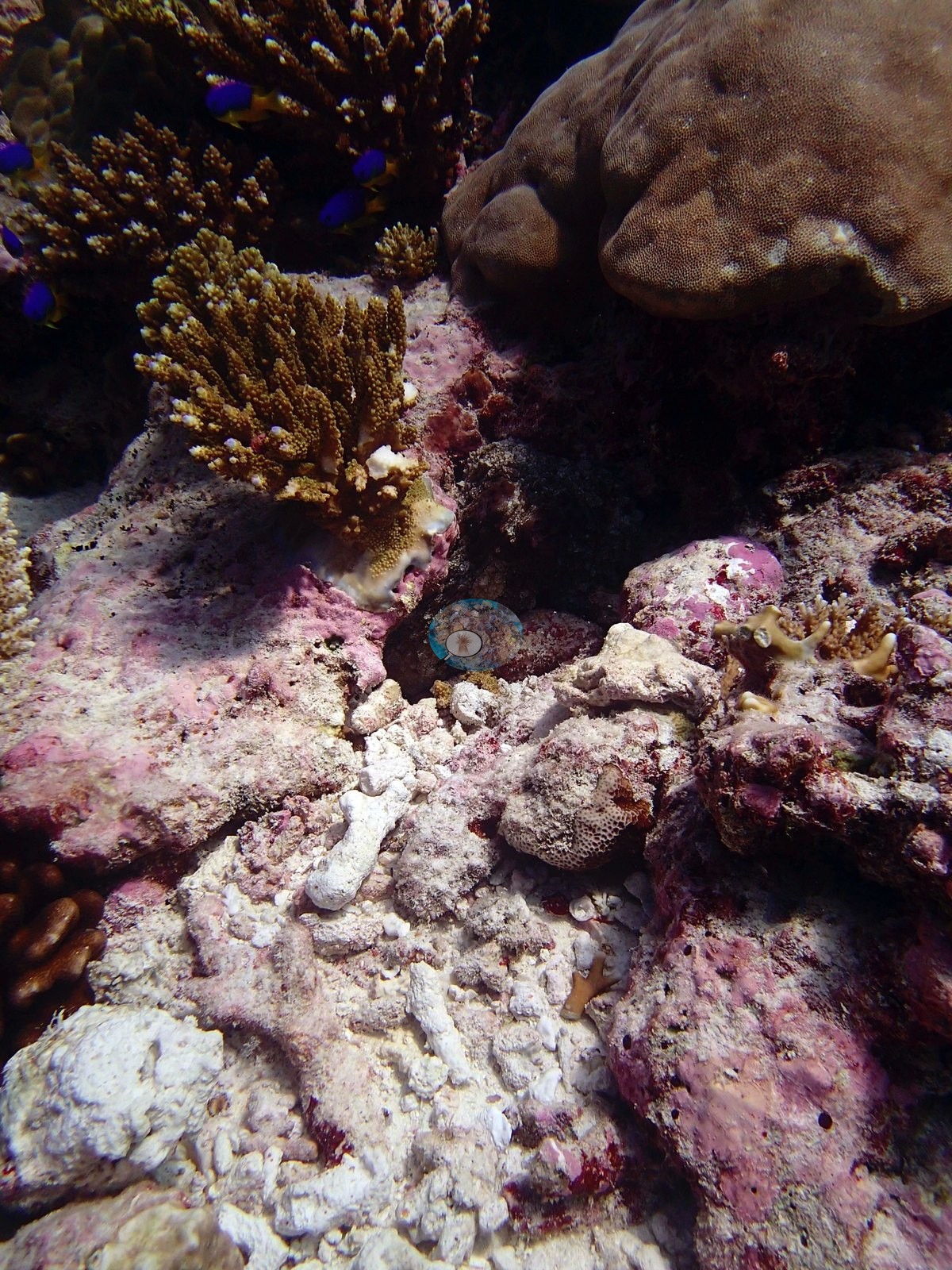
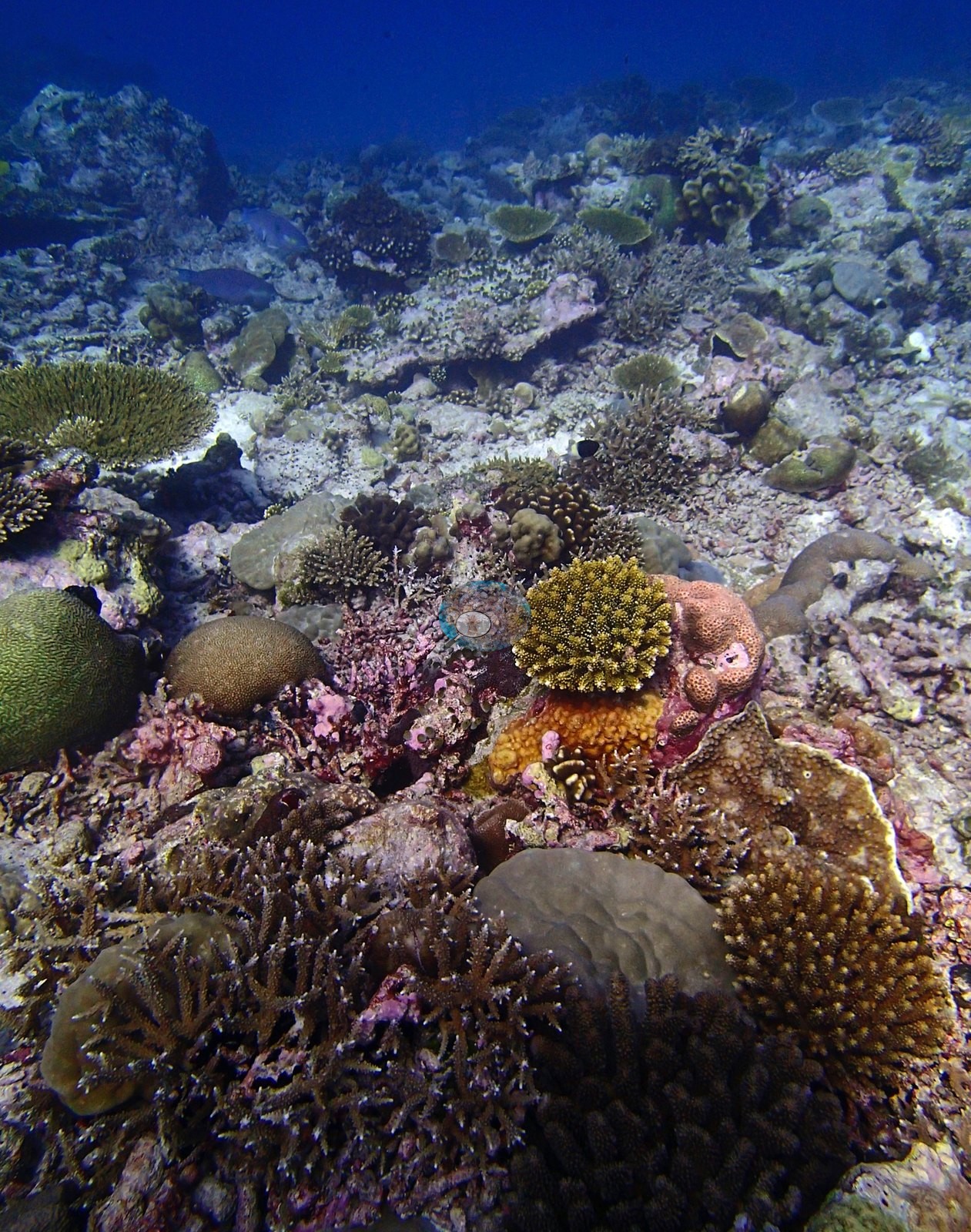
Chagos (NOAA CRW virtual station)A Great Chagos Bank reef where the ground between table corals is a fine mosaic of tiny coral colonies, sea squirts, and pink coralline algae, patrolled by a clown triggerfish. Unusually for Chagos, both of the survey's target cauliflower-type corals (P. acuta/damicornis and Seriatopora) were recorded here, and the only dead coral is old. Surveyed on the Living Oceans Foundation's Global Reef Expedition.
Three independent survey stations shown with the program’s logo — click one to see how far it is from this site.
Fourteen other CRD dive sites within 5 km shown in orange — click a marker to open its page.
🗺 Detailed map of the Global Reef Expedition dive sites, Three Brothers, Chagos (Khaled bin Sultan Living Oceans Foundation; opens in a new window)
Site description
Setting
Setting: fringing reef, protected, Redemption Rock on the western rim of the Great Chagos Bank, 6.16396°S, 71.53207°E · 29.6°C · salinity 34.3.
General benthic features
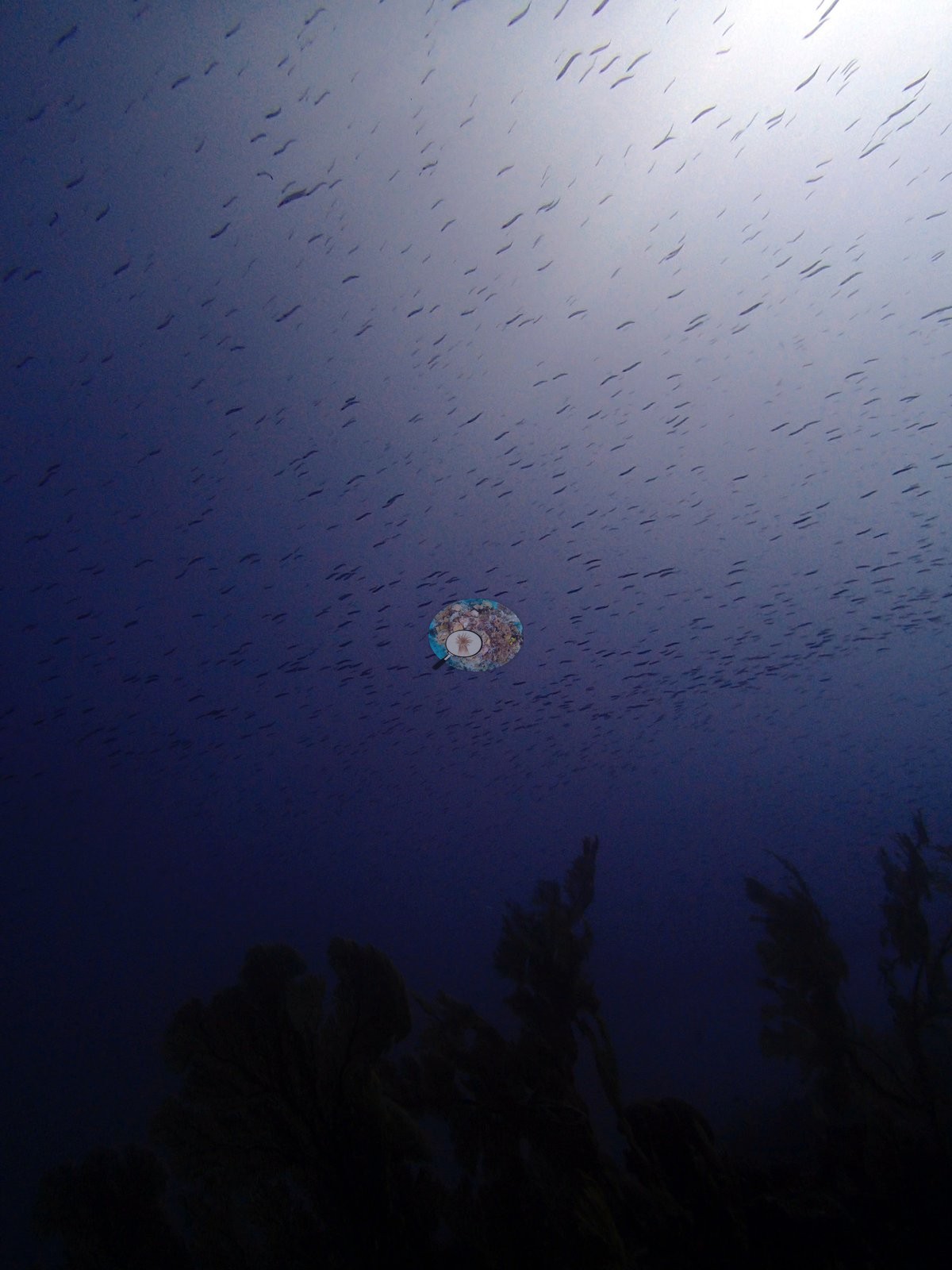
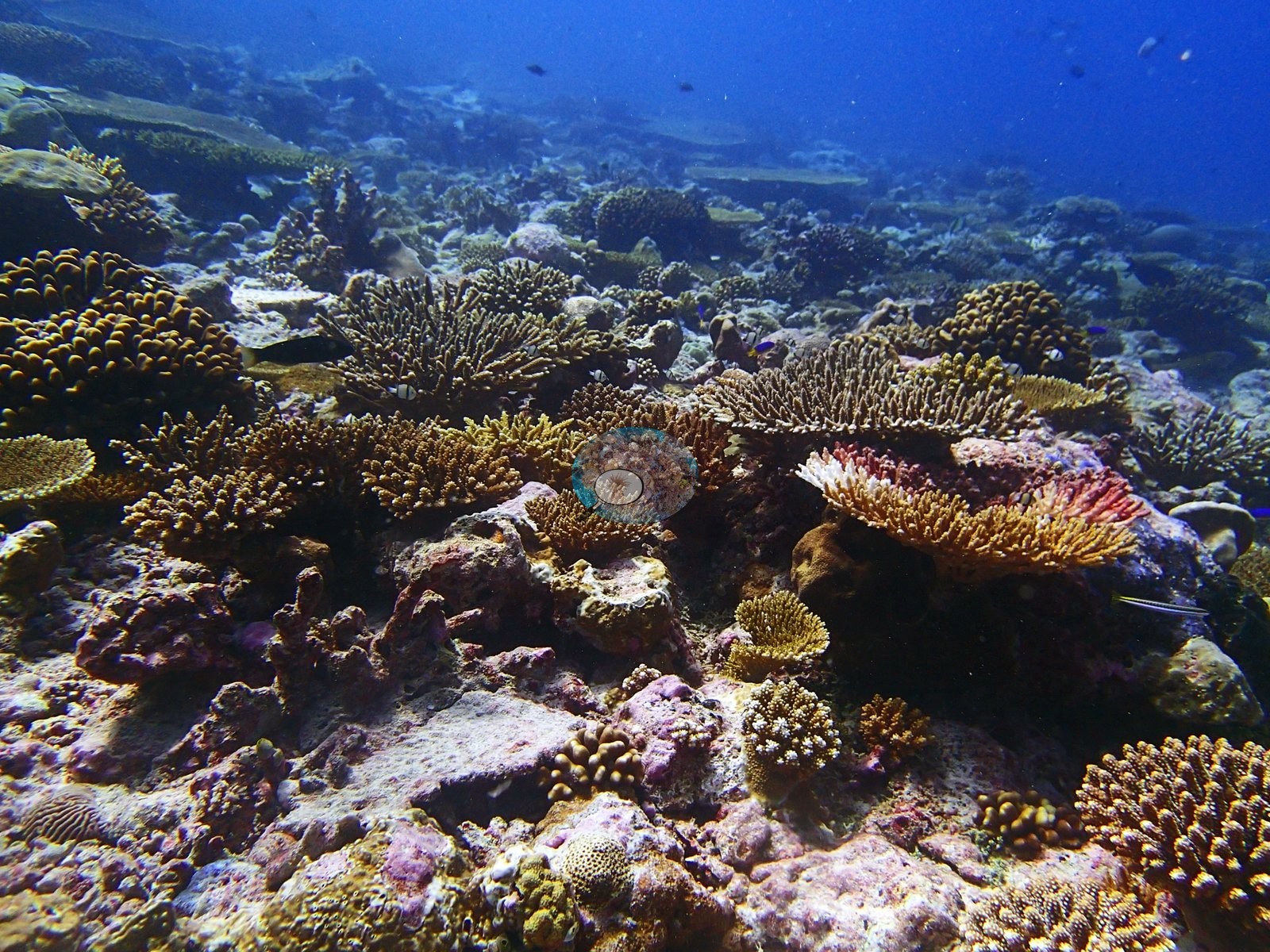
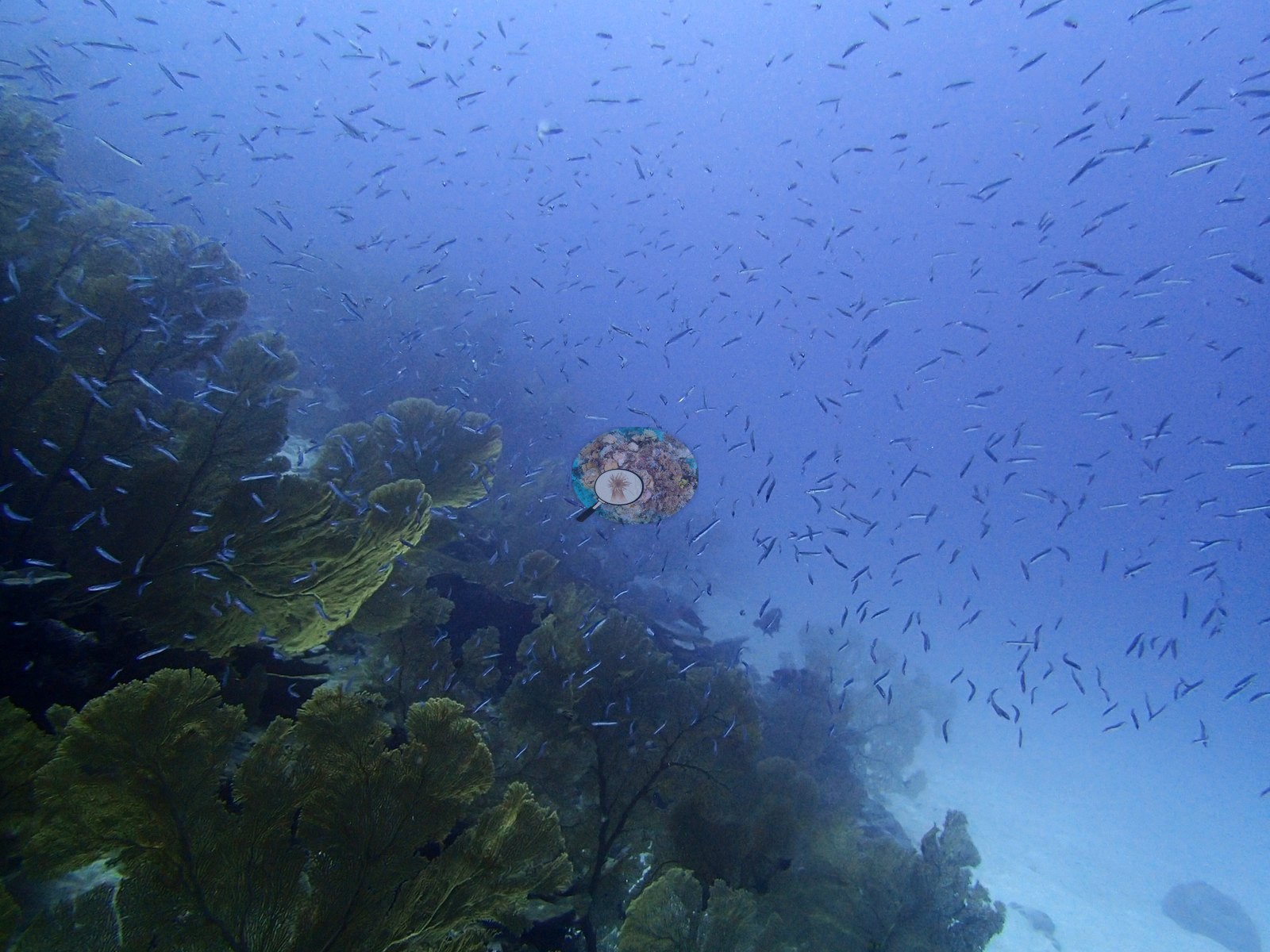
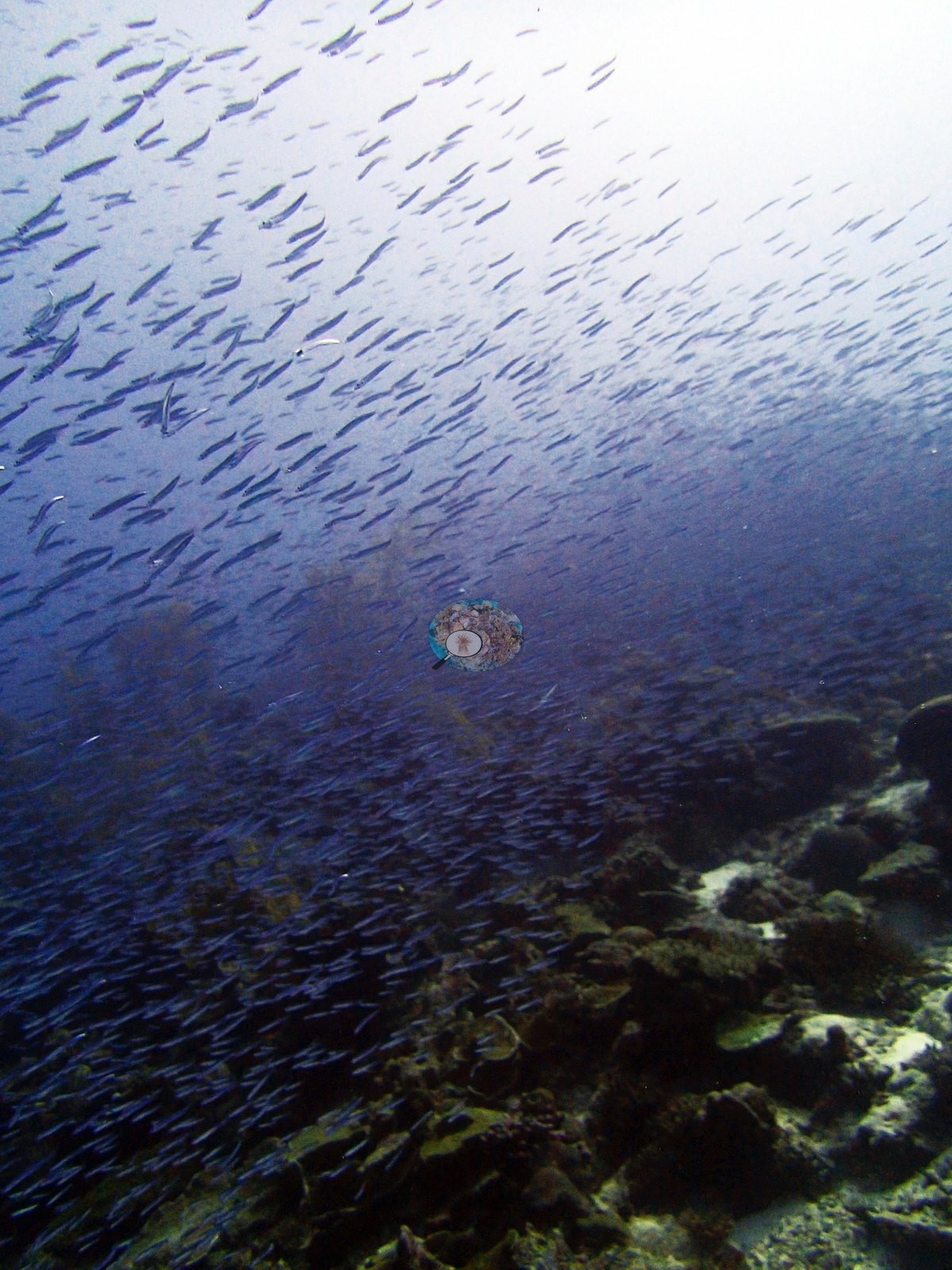
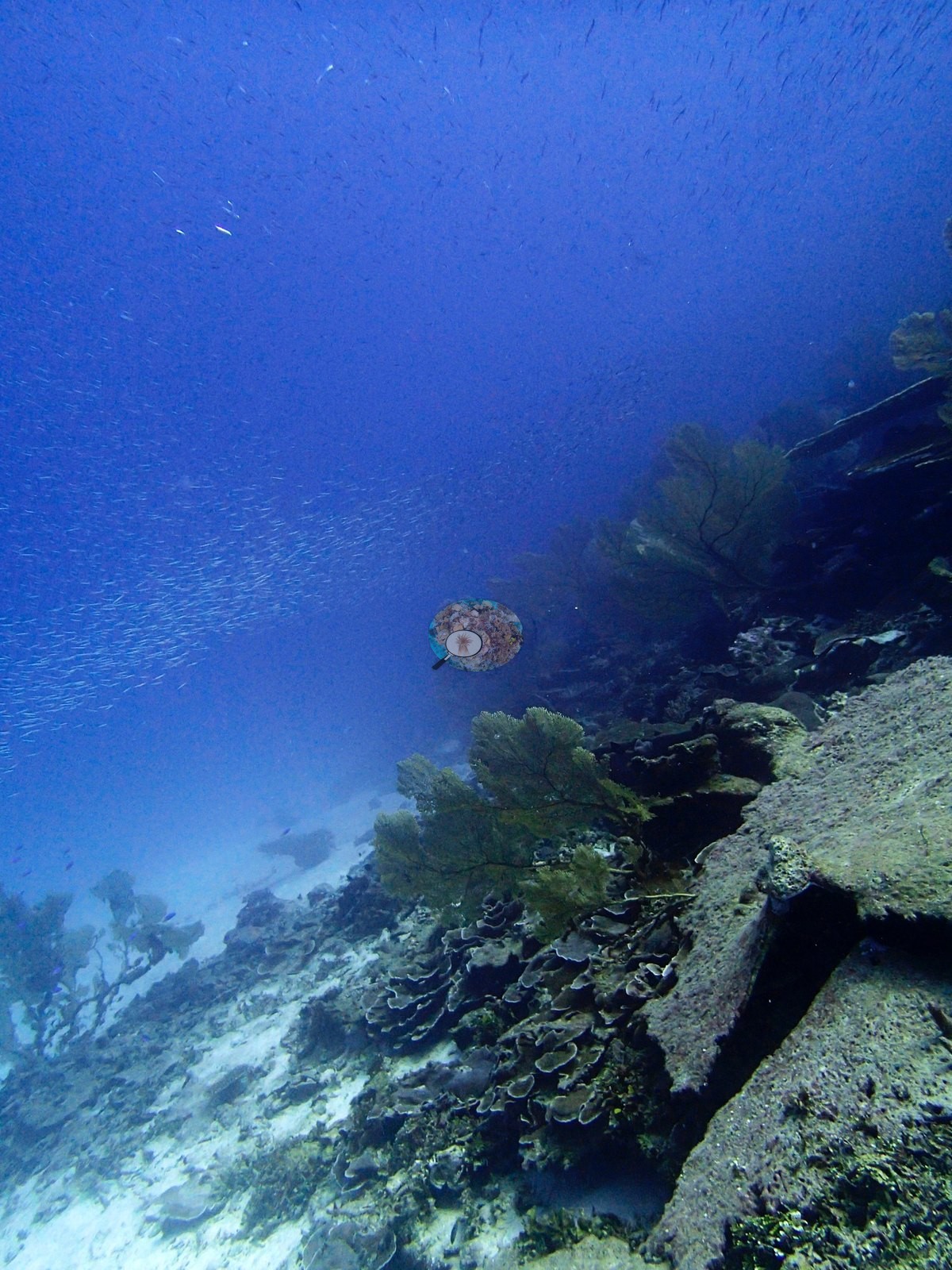
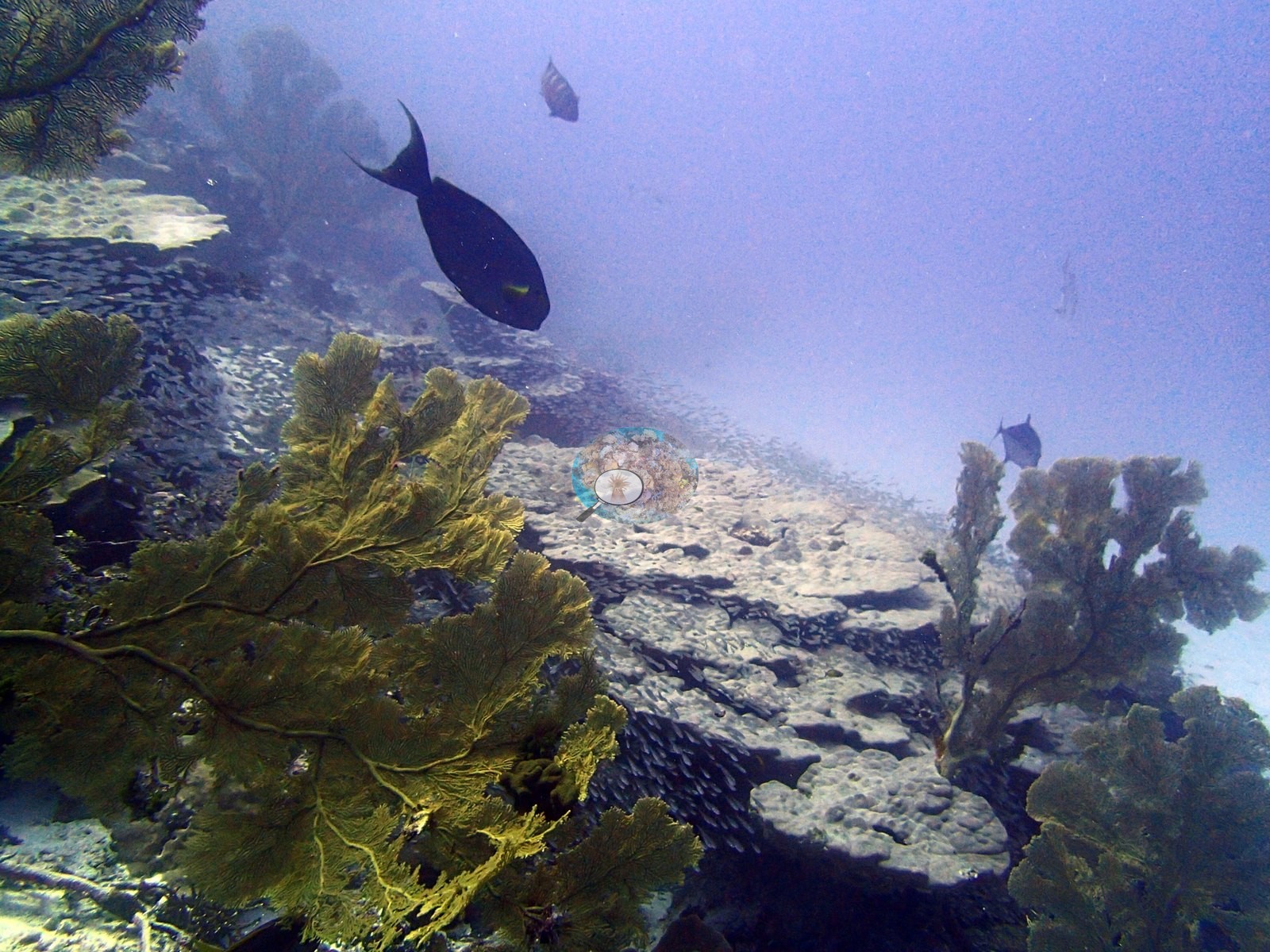
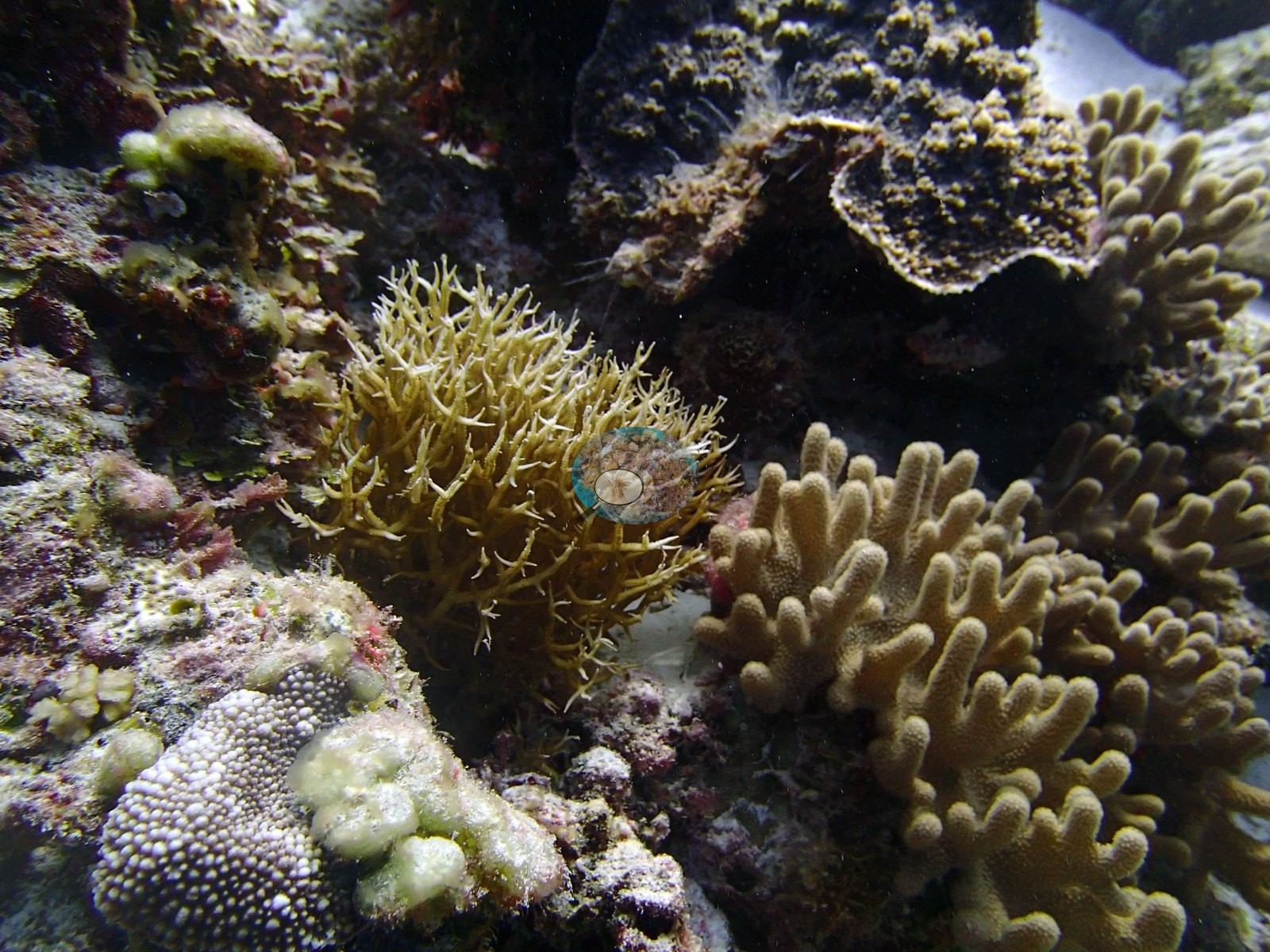
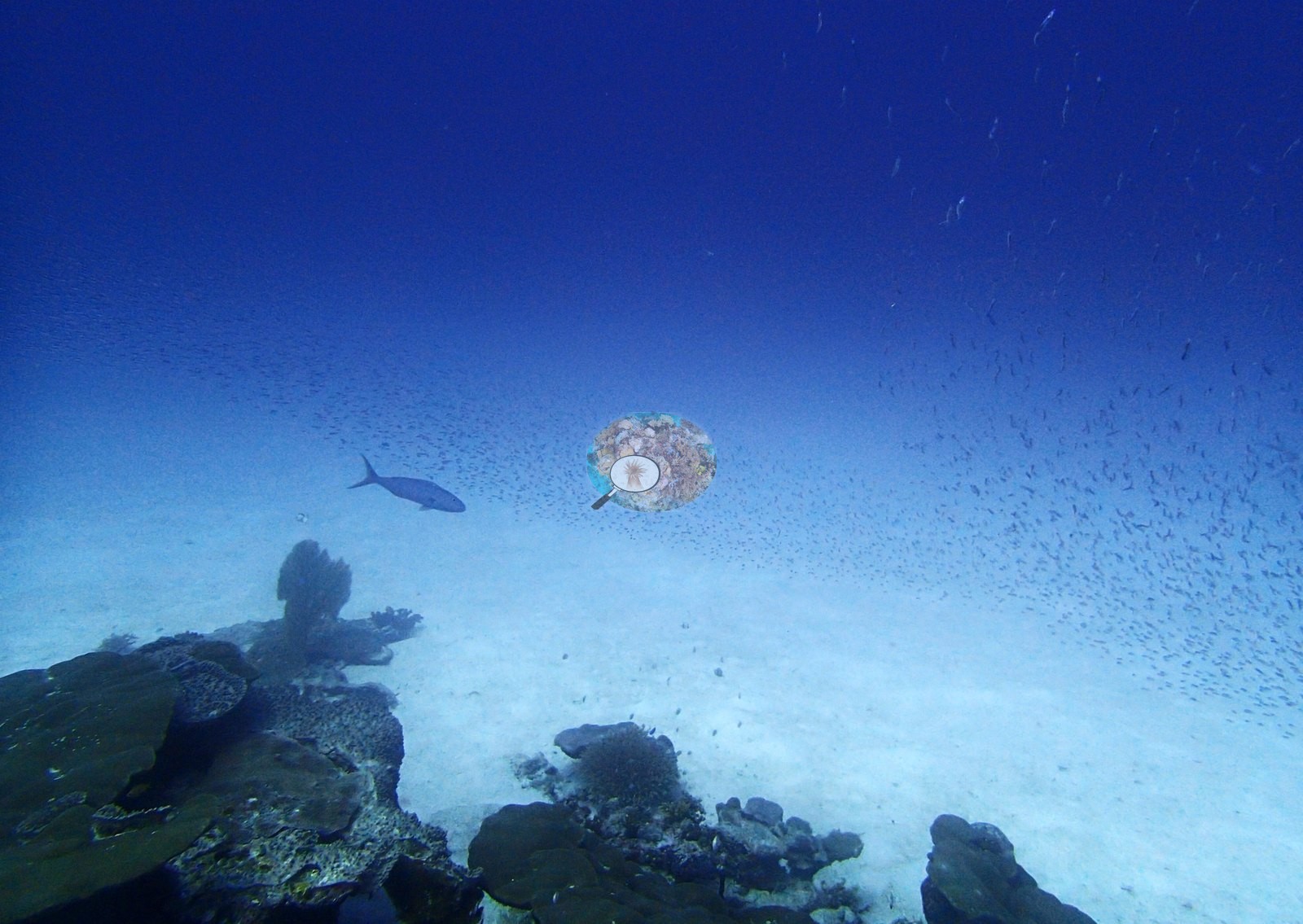
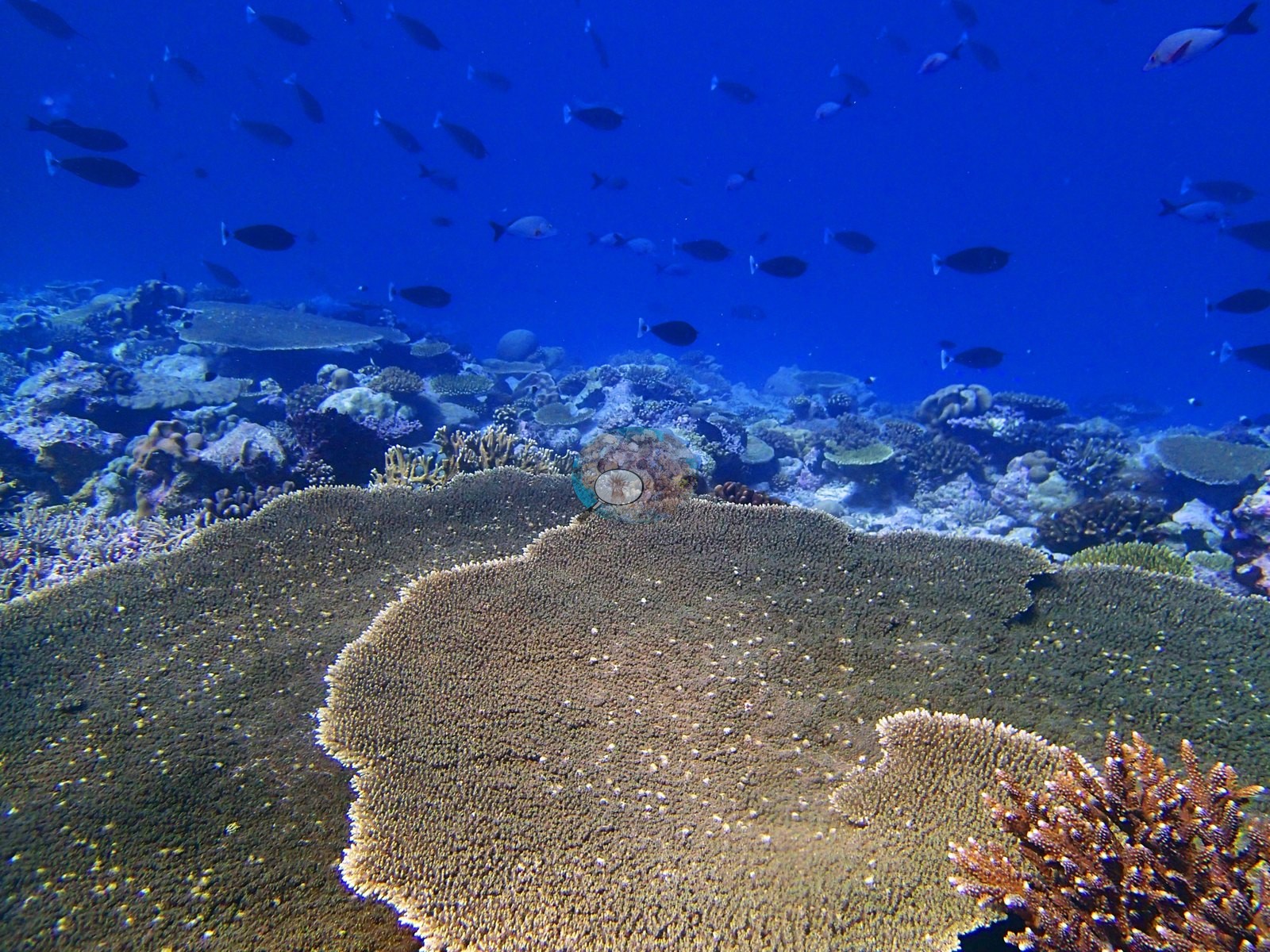
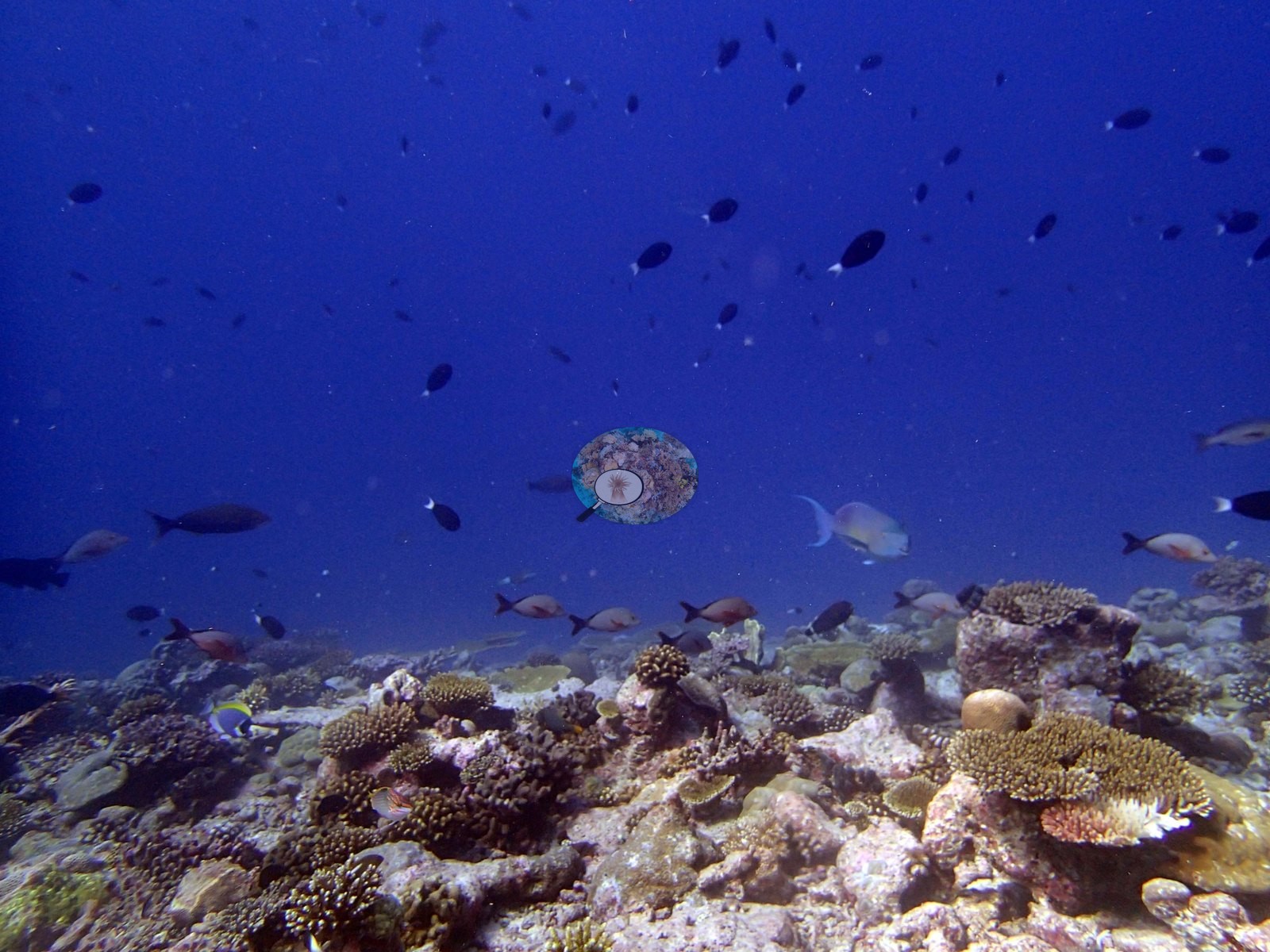
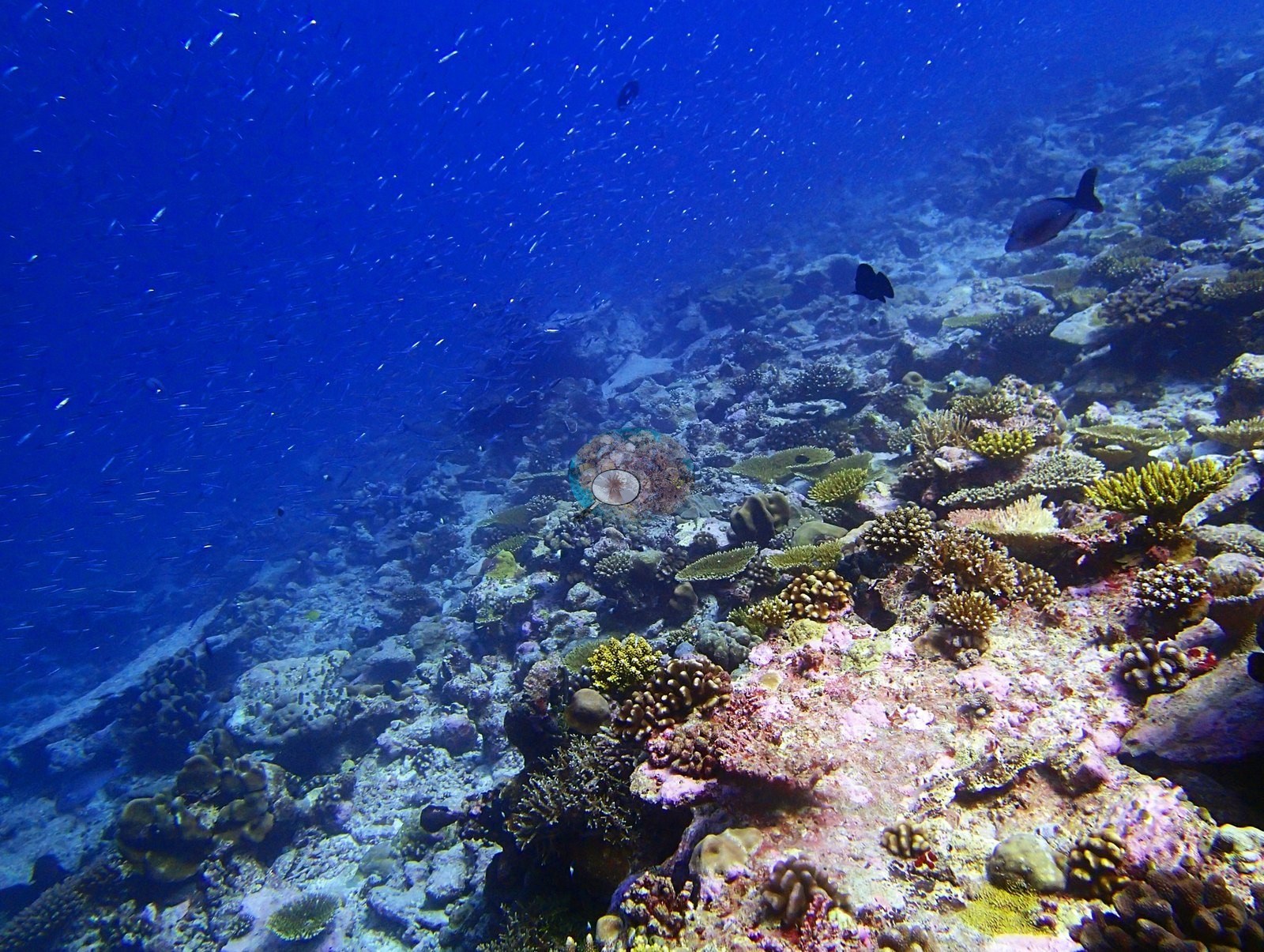
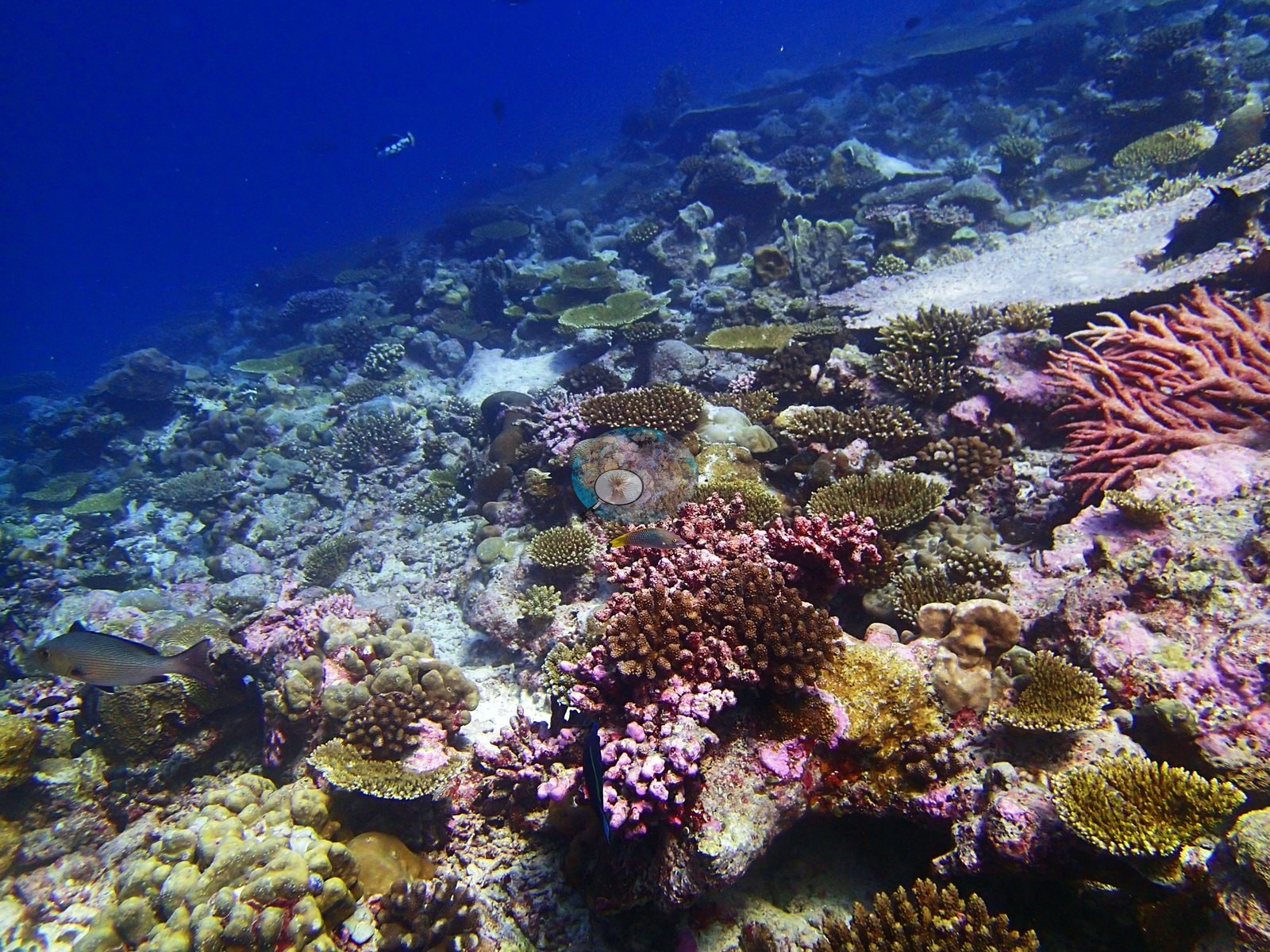
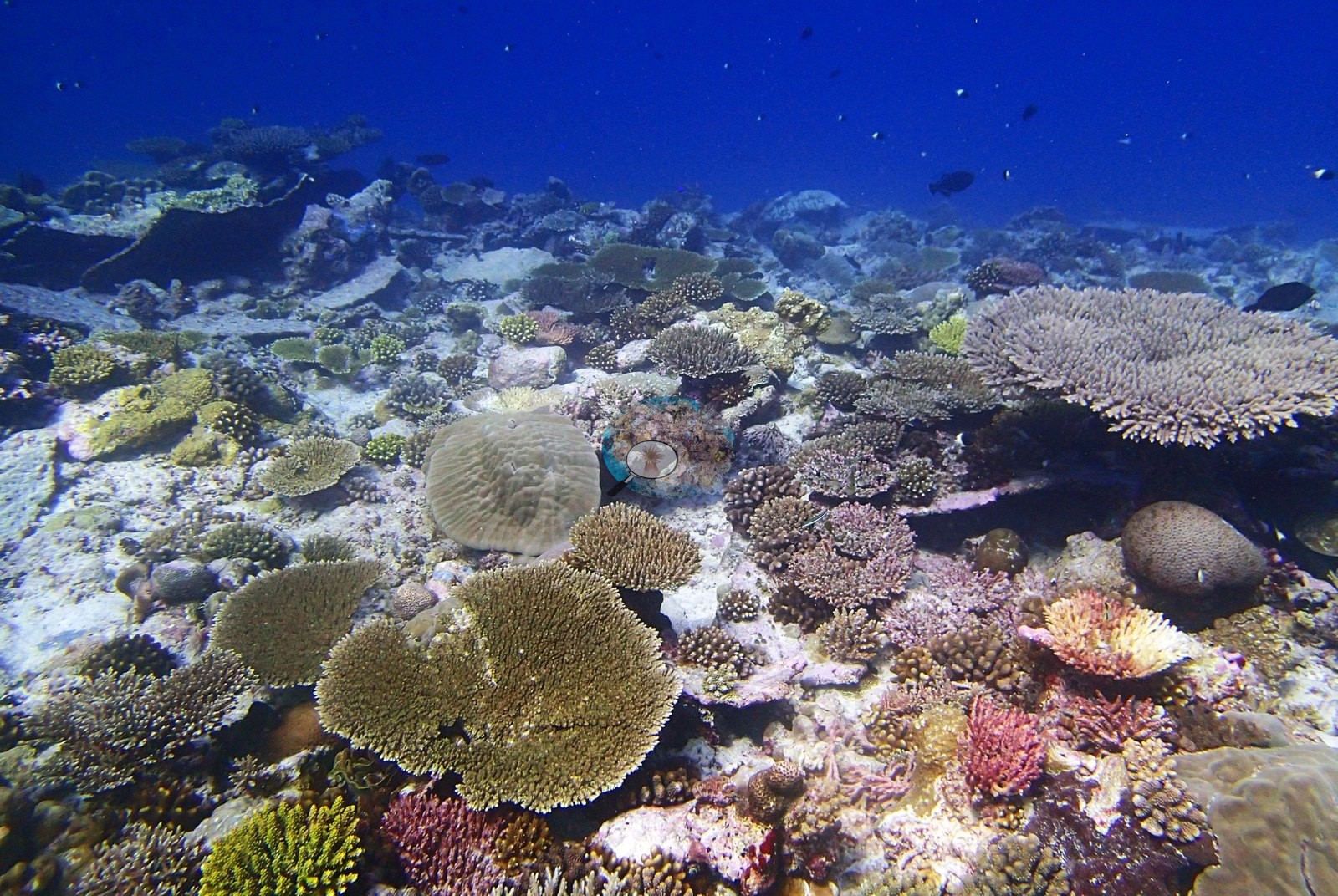
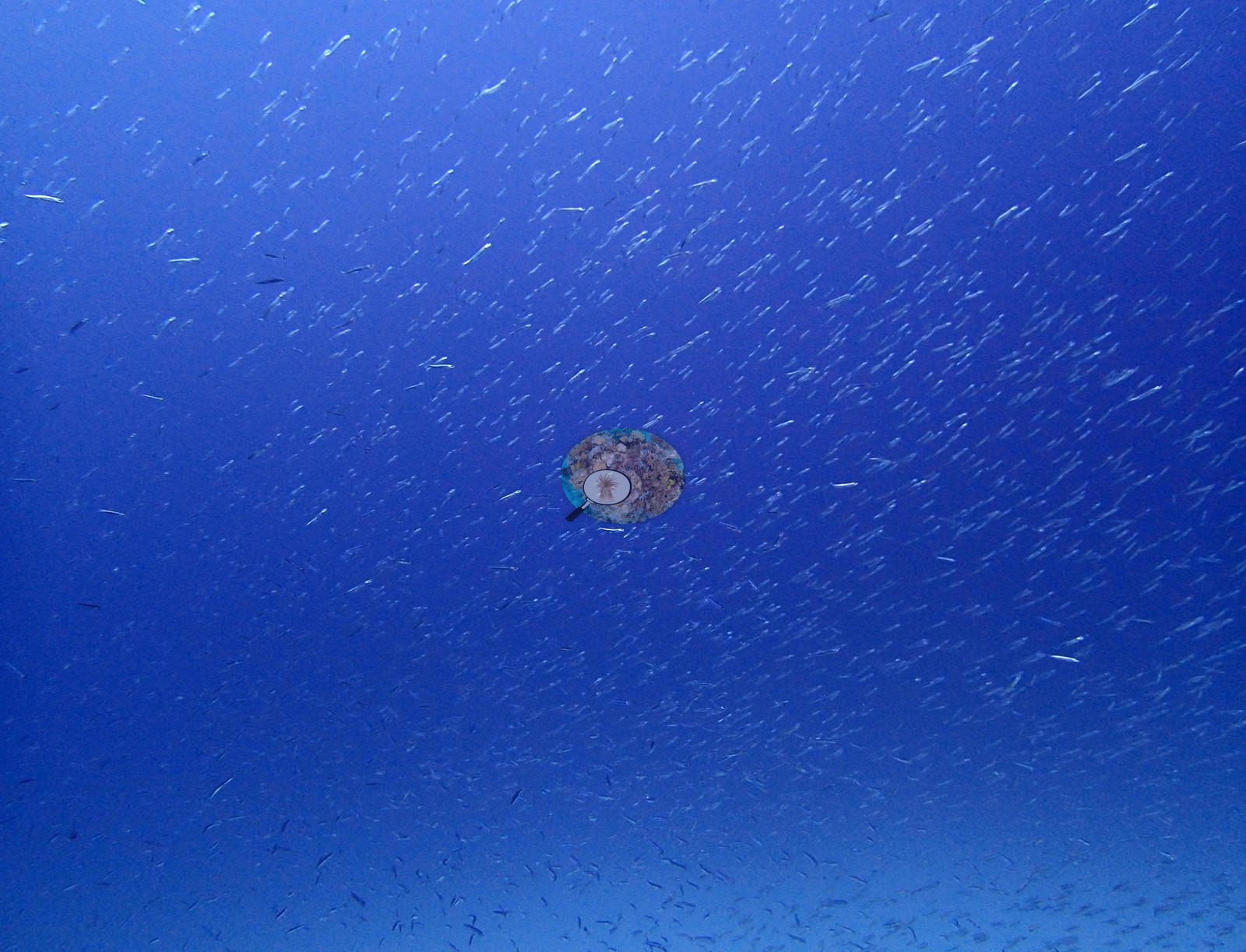
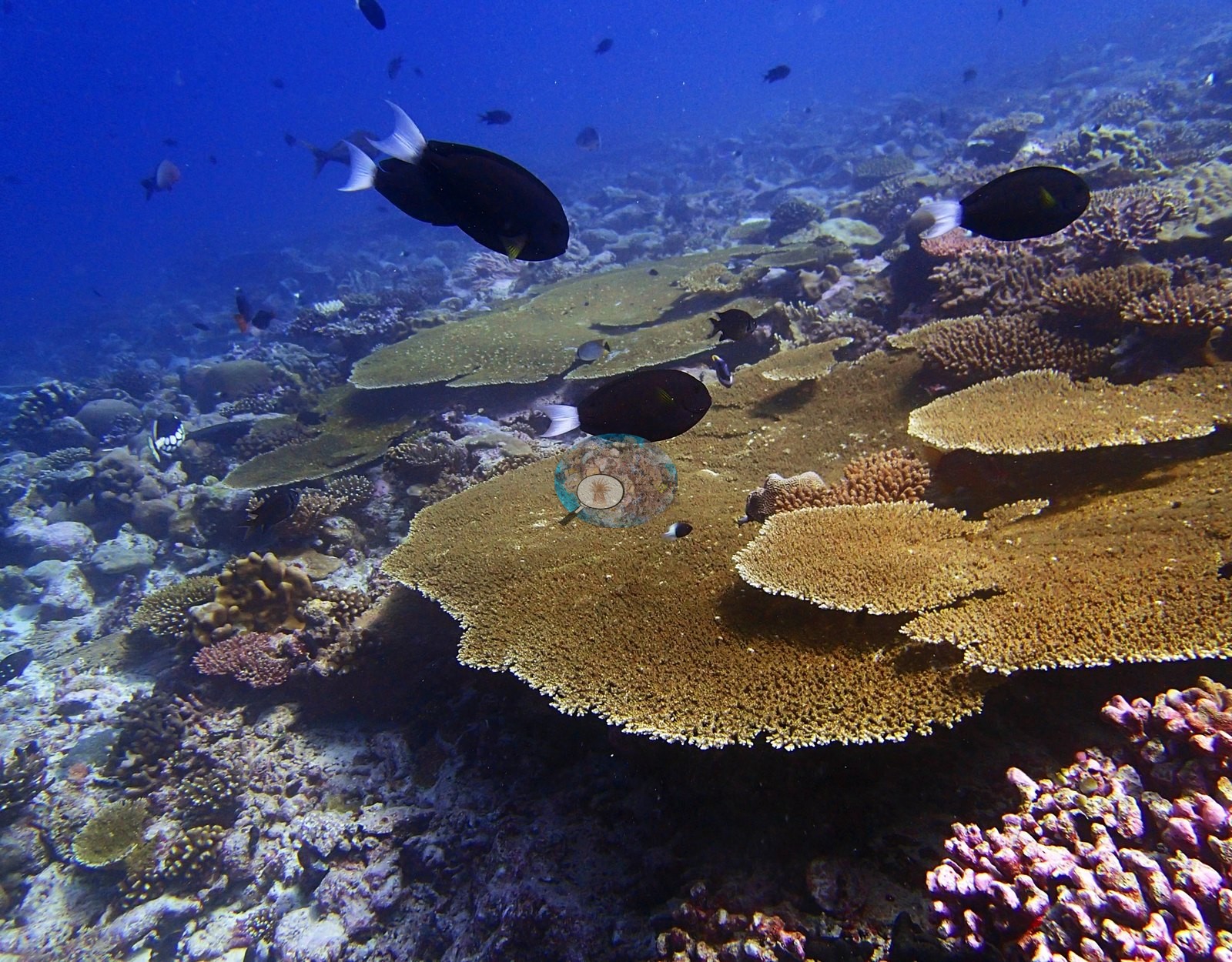
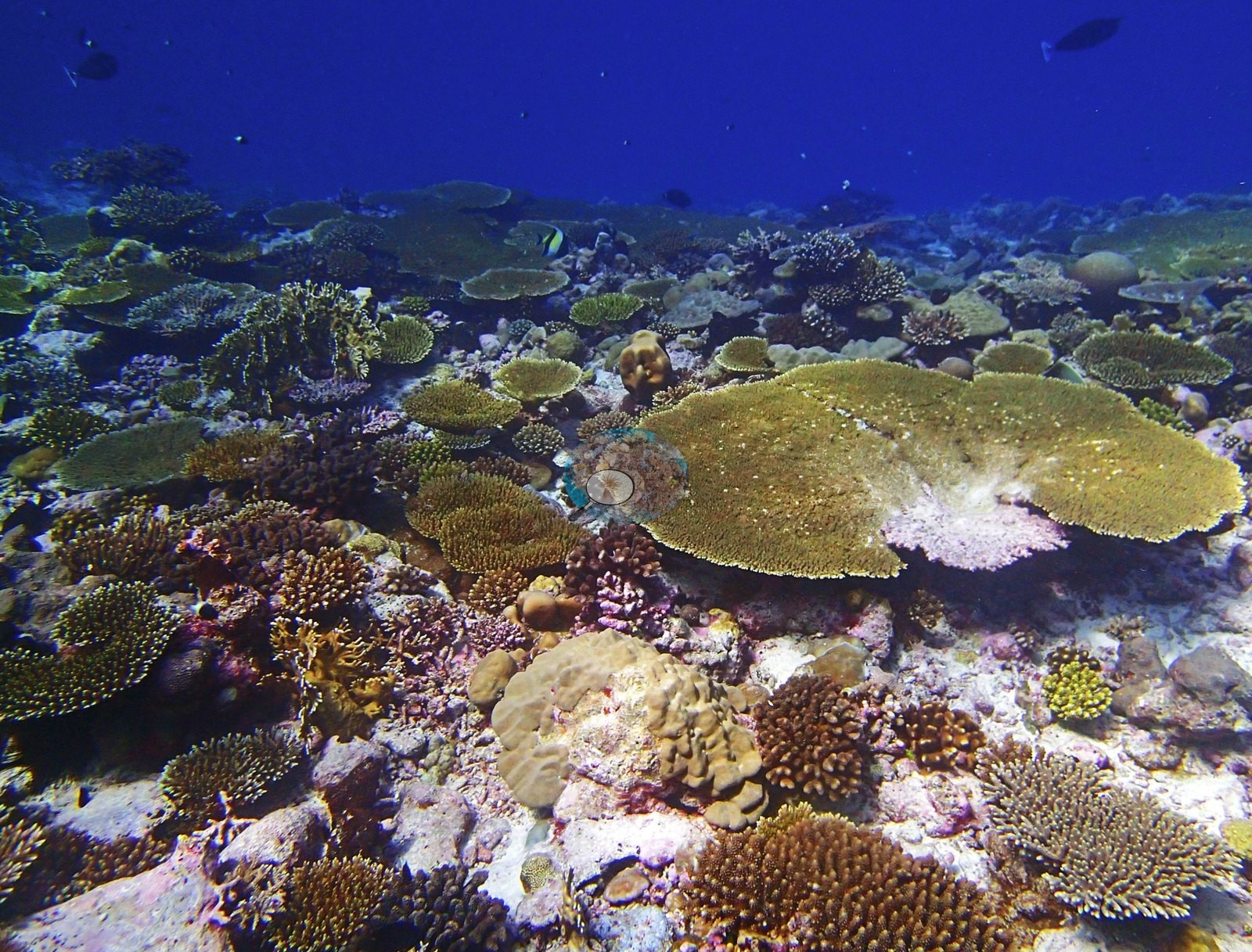
Assemblage composition from transect data — a broad, well-shared assemblage, not a monoculture. Twenty-eight scleractinian genera are non-zero. Acropora leads at 11.14% of the benthos, but only just: Porites 9.26% is close behind, then Pocillopora 3.63%, Favia 3.09%, the hydrocoral Millepora 2.51%, Montipora 2.33% and Echinopora 1.61%. The tail is long and genuinely populated: Platygyra 1.04%, Pavona 0.87%, Favites 0.84%, Montastrea 0.82%, Leptastrea 0.67%, Gardineroseris 0.62%, Goniastrea 0.47%, Astreopora 0.46%, Cyphastrea, Stylophora and Psammocora 0.39% each, Echinophyllia 0.33%, Pachyseris 0.32%, Symphyllia 0.26%, Leptoseris 0.23%, Hydnophora 0.22%, Galaxea 0.21%, Fungia 0.17%, Ctenella 0.11% (the Chagos-endemic monotypic genus), Turbinaria 0.06% and Coscinarea 0.01%. No single genus holds even a third of the coral — the transect's own statement of the same evenness the image products independently recover. On the substrate side the transects give crustose coralline algae 15.31%, turf 14.95%, bare substrate 11.13%, sediment-laden turf 5.96%, non-coral invertebrates 5.72%, macroalgae 2.36%, erect algae 2.06% and cyanobacteria 0.06%. The dive opens in blue water: P3180394, P3180397 and P3180402 are given almost entirely to fusilier and sardine schools banked against the drop-off, and P3180396 and P3180398 look along a reef edge dropping into open white sand, with large olive-gold gorgonian sea fans standing off the lip in P3180398, P3180401 and P3180418 and stacked foliose plates below them. From 14:07 the camera drops onto the reef and does not leave it, and what it finds is a continuous tabular-Acropora pavement: P3180452 is a single olive plate filling the lower half of the frame with a second behind it; P3180441 stacks three tan tables, the largest well over a meter, beneath a school of dark surgeonfish; P3180434, P3180436, P3180451, and P3180462 repeat it at wider angle, plate on plate to the limit of visibility, with corymbose and staghorn Acropora filling every gap and massive Porites domes anchoring the low ground.
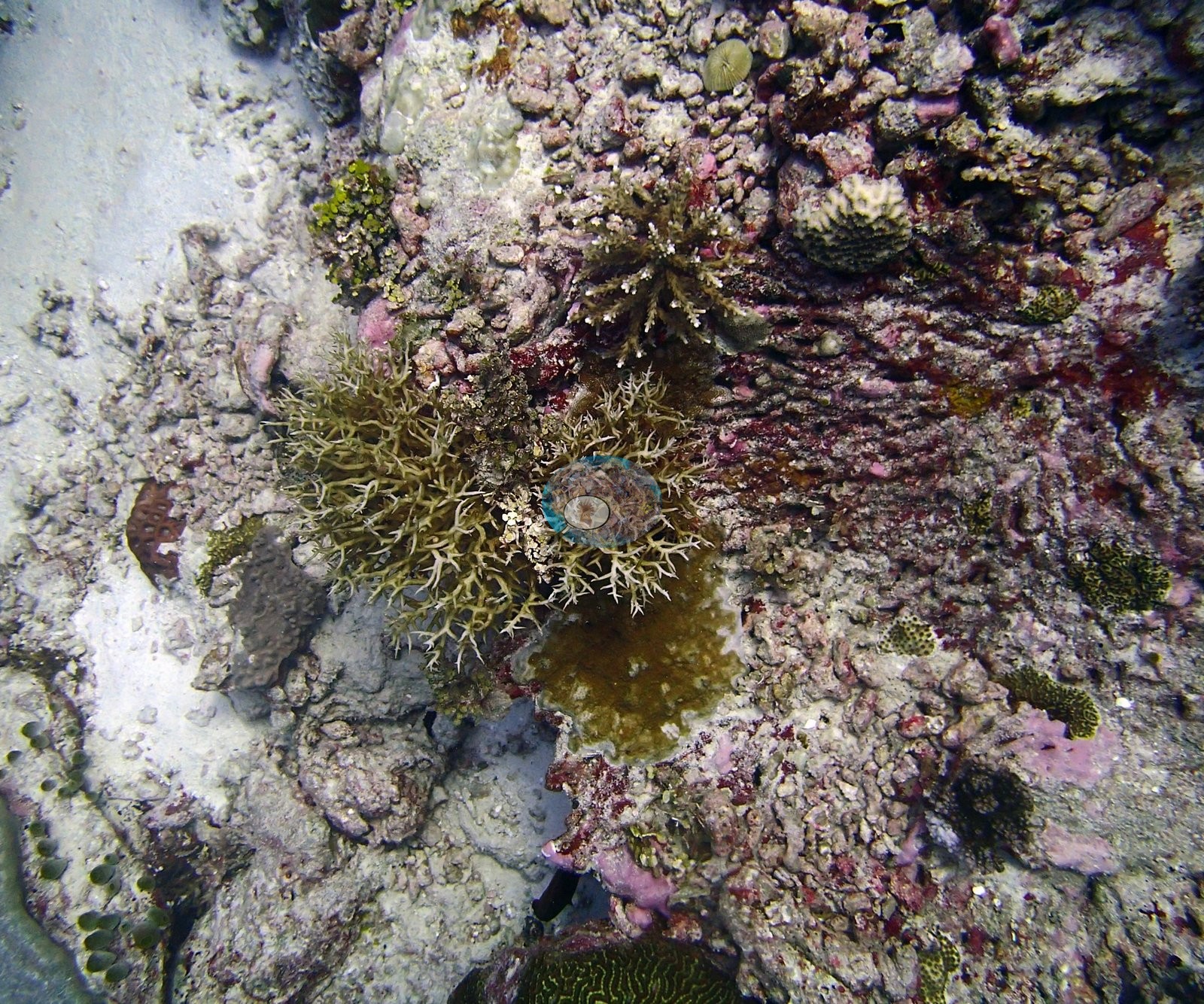
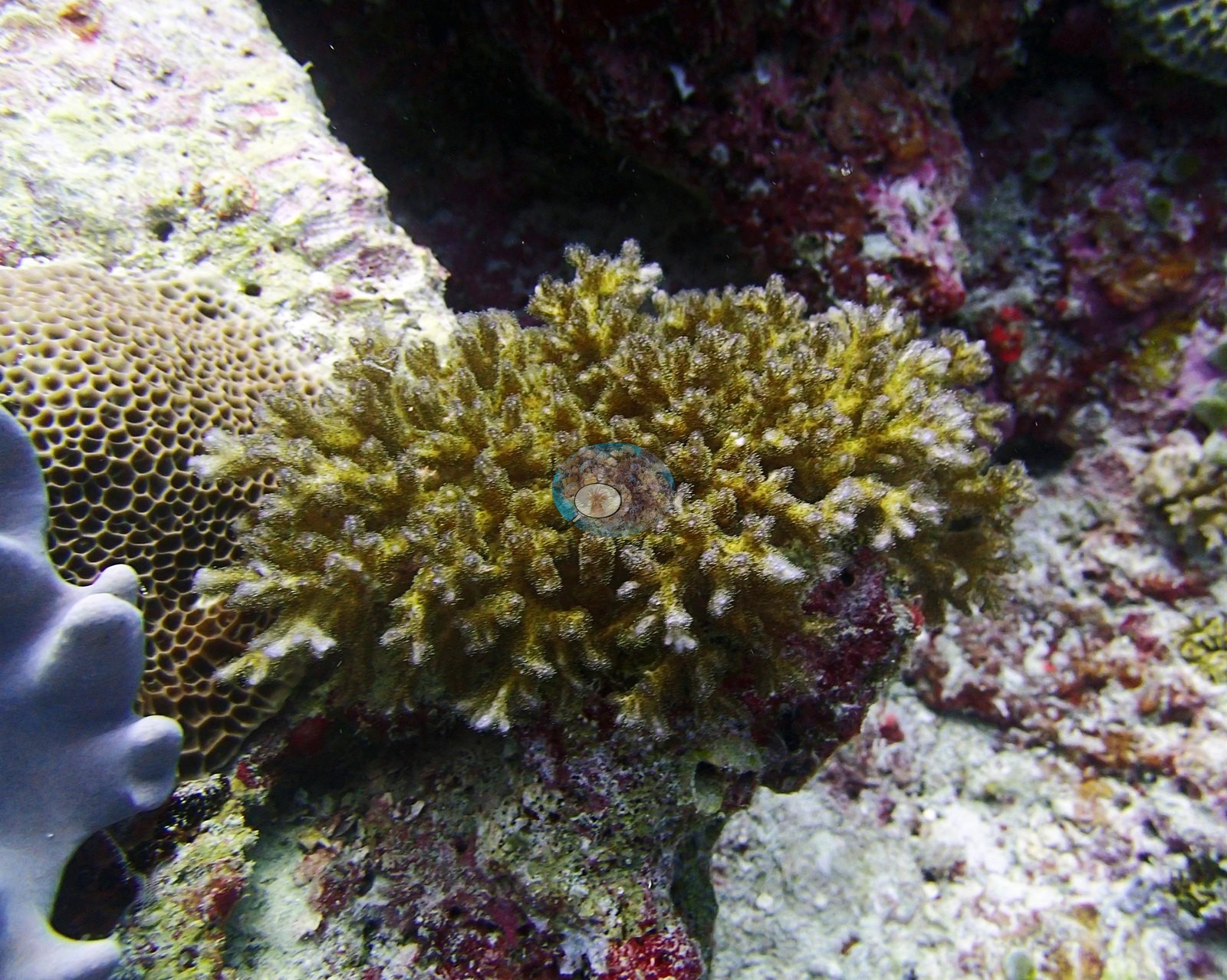
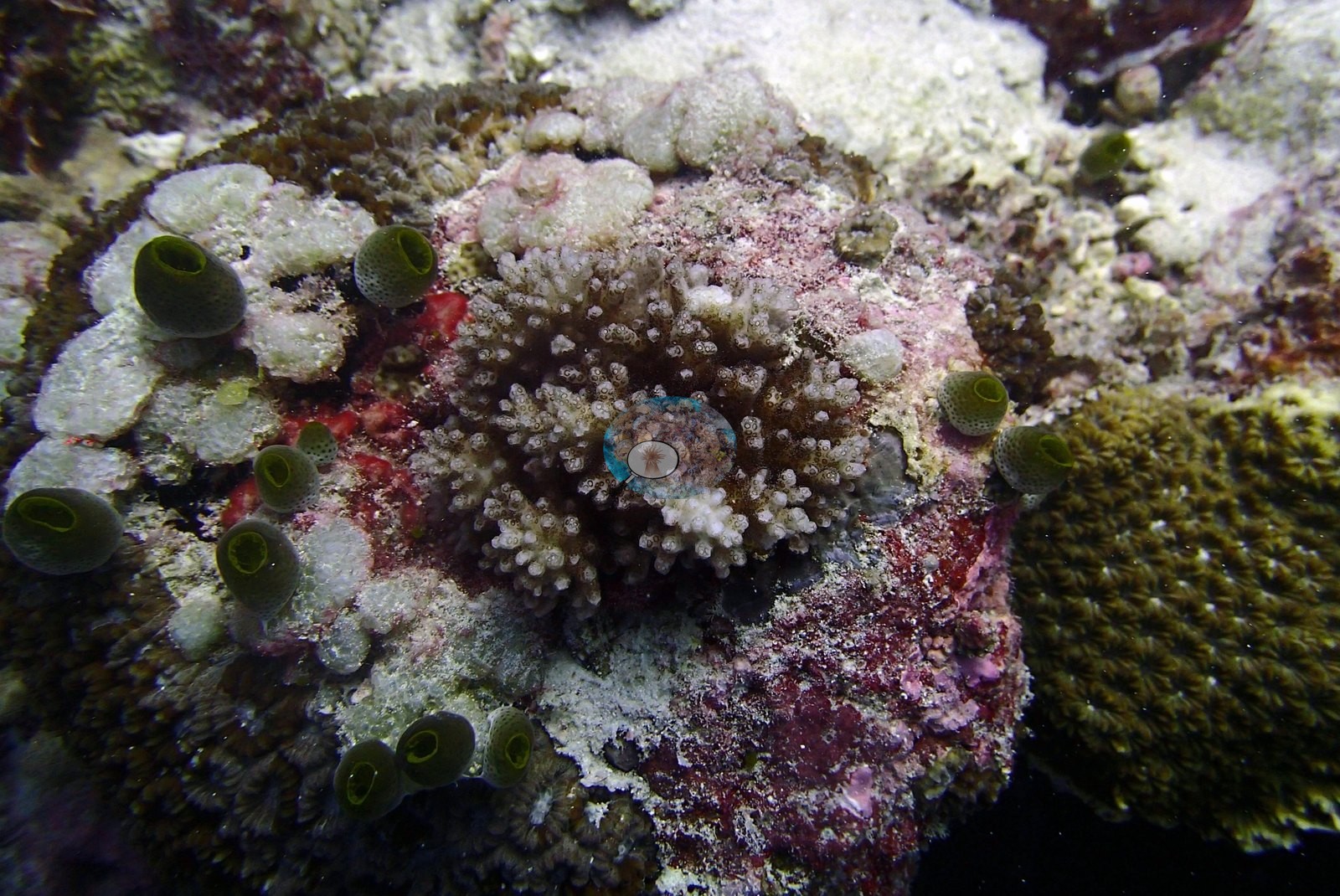
Between the tables the reef is a fine-grained mosaic, and that matters for the CV. P3180422 and P3180423 are the clearest cases — pavement carrying dozens of colonies a few centimeters across: pocilloporid clumps, Acropora recruits, encrusting Montipora-type sheets, green Didemnum-type ascidians, and pink crustose coralline algae, interleaved at a scale a 30-point grid cannot resolve. P3180444, P3180446, P3180450, P3180461, and P3180462 show the same fabric at wider angle: consolidated pink-and-mauve coralline pavement carrying a dense, close-packed assortment of small colonies — corymbose and digitate Acropora in gold, tan and vivid yellow-green, brown staghorn, small tan tables, pocilloporid clumps, cerioid, and meandroid massives, low brown domes, and encrusting sheets — with very little of any one growth form dominating a frame. P3180440 and P3180461 are the richest, packing salmon-pink encrusting plates, gold corymbose Acropora, brown branching thickets, and massive domes into one view, and P3180437 adds a clown triggerfish (Balistoides conspicillum) sitting in the middle of it. The photographic genus inventory runs to nine scleractinian groups plus two octocoral forms: Acropora in four forms (tabular plates to ~2 m, corymbose/digitate, arborescent staghorn, and a purple-mauve branching form in P3180462); Porites (massive/domal, columnar-digitate, knobby-lobed); fine compact verrucose pocilloporids; fine dichotomous branching compatible with Seriatopora/Stylophora; meandroid brains compatible with Platygyra/Leptoria (P3180423, P3180440, P3180450, P3180462); lobed meandroid compatible with Lobophyllia/Symphyllia (P3180451, P3180461); cerioid honeycomb compatible with Astreopora or a faviid (P3180417); foliose plates compatible with Echinopora/Turbinaria (P3180394, P3180424); and salmon-orange encrusting sheets compatible with Montipora (P3180440, P3180450). Plus large gorgonian sea fans in five frames, a red branching octocoral compatible with Melithaea in P3180443, a golden branching colony compatible with Millepora or an alcyonacean in P3180424, and green Didemnum-type ascidians in P3180421–422. Growth-form calls are from photographs and given as “compatible with”; no species is asserted.
Both target pocilloporid groups are present, which is unusual for Chagos. The CRD site page records P. acuta/P. damicornis (ChPd16-20) and Seriatopora spp. (ChSe09-10) here, with ChPa16-18 photographed and genotyped. The imagery is consistent: P3180421 is a flash macro of a fine verrucose pocilloporid ringed by green ascidians and red encrusting sponge, P3180463 a second, smaller, cream-tan pocilloporid on CCA pavement — both compatible with the compact damicornis/acuta habit rather than the blunt verrucosa form seen at BITB27 — and P3180423 carries a fine dichotomously-branched colony compatible with Seriatopora. Non-coral cover is dominated by turf 18.6% and crustose coralline algae 6.0% of all points.
Coral cover
The transect is this site's measurement. Coral cover 43%, from LOF BIOT-1 in situ transects (Mayfield & Dempsey 2026, Oceans, suppl. S1) — diver transects run across the site on 18 March 2015, and the authoritative record of cover and community here. Algal cover is 40.68% of the benthos. Everything photographic and model-derived below supplements the transect; none of it qualifies, softens or disputes the 42.5%.
Computer-vision method comparison — the largest method deviation in the redo, and the only one carried on complete coverage. Across all 33 frames the same reef reads transect 42.5% · CoralNet points 18.2% · Coralscapes masks 21.4% — deviation −24.3 to −21.1 pp, roughly double BITB27/28/29 and BIEA26, mean of 3 = 27.4% ± 13.2. Both image methods rest on all 33 frames: this is one of the few complete-coverage sites, and there is no unscored remainder to blame. The photographs support the transect and not the image products: from 14:07 to 14:31 every wide frame carries dense tabular and corymbose Acropora, by eye 45–60% living tissue in the table fields, so a patchy reef is rejected outright — if anything the imagery suggests the transect is conservative.
The shortfall is almost entirely a denominator artifact. A transect measures cover of the substrate; both image methods report cover of the image. 54.4% of the point budget is assigned to no benthic class at all — water 23.1%, fish 1.8%, Unknown 29.5% — and Coralscapes calls 41.5% of image area background_dark. Renormalise either method over labeled benthos and both land on the transect: live over labeled benthic points = 39.9% (44.6% including bleached) against a 42.5% transect, and Coralscapes over (100 − background − fish) = 41.9%; on the 19 wide benthic frames, 39.9% and 50.6%. Two competing explanations were tested and fail. Blue-water dilution is minor: eight frames are ≥40% water (P3180401 70.0, P3180402 56.7, P3180419 56.7, P3180462 50.0, P3180434 46.7, P3180436 46.7, P3180422 43.3, P3180421 40.0; site mean 23.1%), and dropping them lifts CoralNet 18.2→20.5 and Coralscapes 21.4→23.2 — under a tenth of the gap closed, and the gap never reverses. There is no subset escape: restricting to the 12 non-colliding frames moves the point set only 18.2→17.2% and drives Coralscapes down to 16.0%, i.e. the deviation gets worse. Every subset reads low. The recommendation that follows is a methods one: renormalise photo-derived cover over labeled benthos before any transect comparison, corpus-wide.
Frame-level agreement collapses here, and the two image methods fail in opposite directions on the fine mosaic: r = 0.278 at BITB30 against 0.716 corpus-wide. Disagreement runs from −32.6 pp on P3180465 (40.0% live by points on a frame of sponge, octopus and rubble) to +40.4 pp on P3180452 (6.7% by points against 47.0% by mask, on a frame dominated by one enormous tabular Acropora); also P3180440 +26.1, P3180449 +24.2, P3180451 +19.0 and P3180443 +18.7. On wide table frames the mask is far closer to the eye; on close-up macros the point set over-reads. Both are wrong in ways that partly cancel in the site mean, which is why the two methods agree with each other better than either agrees with the reef. The two methods also handle pale tissue incompatibly: the point set separates bleached from live, while Coralscapes reads bleached at 0.05% of image area, maximum 0.38% on any frame, folding pale tissue into live coral exactly as at BIEA24 — so its 21.4% already contains tissue the 18.2% excludes, and adding bleached points back gives 20.3%, removing two-thirds of the difference between the two image methods.
A data-integrity problem sits underneath the point column and should be known before it is reused. The manifest's coralnet_annotated: 12 is wrong; the correct basis is 33 of 33. CoralNet only ever held one image per filename, and four collided frames' point rows are visually inconsistent with BITB30's pixels: P3180394 is ~95% dark blue water with a fusilier school yet scored 0.0% water and 33.3% live; P3180421, P3180422 and P3180423 are full-frame benthic macros with no water column at all, yet scored 40.0%, 43.3% and 26.7% water. This changes nothing about the headline — Coralscapes' 21.4% is unambiguously BITB30's pixels and both methods agree on the shortfall — but the CoralNet point column for collided filenames should be treated as provisional corpus-wide. The same field disagrees with the CSV row count at 39 of 105 sites, including six recorded as 0 that in fact carry 11–47 rows. No tape, quadrat, diver, slate or collecting gear appears anywhere — this is the cleanest survey-only folder of the redo — though eight close-up macro or “spot” frames (P3180417, P3180421–424, P3180463–465) are composed on a colony rather than on the reef, and renormalised they read 34.1%/22.1% against 42.1%/48.5% for the 25 wide frames.
Assemblage composition. Both methods rest on all 33 frames — this is one of the few complete-coverage sites in the redo. Across the 33 frames the Coralscapes masks put live hard coral at 21.4% of image area, of which Acropora (non-tabular) is the largest component at 23.3%; the rest breaks down as tabular Acropora 20.9%, massive and meandroid 20.2%, other hard coral 18.6% and Stylophora 5.0% of live cover — the most evenly balanced growth-form spectrum of any site in the redo, and the only one carrying a Stylophora component. The independent 30-point annotation of the same filenames (990 points) gives live hard coral as 18.2% of all points and apportions it Acropora 49.4%, Porites 36.1%, other hard coral 10.6%, Pocillopora 3.9% of live coral. Frame-to-frame live cover runs 0–43.3% by point count and 0–47.0% by mask, and the two barely agree: r = 0.278 here against 0.716 corpus-wide. Coral cover: 43%. Live hard coral measured on the in situ benthic transects of the LOF BIOT-1 expedition (Mayfield & Dempsey 2026, Oceans, supplemental S1), against algal cover of 40.7% of the benthos. The transect figure is this site's authoritative cover value; no image-derived product overrides it. Across methods the same reef reads: transects 42.5% · CoralNet points 18.2% · Coralscapes masks 21.4% (33 frames). These products have different sampling footprints and denominators and should not be averaged.
Stressors
These are hedged photographic impressions that agree with the survey record; they do not independently confirm it.
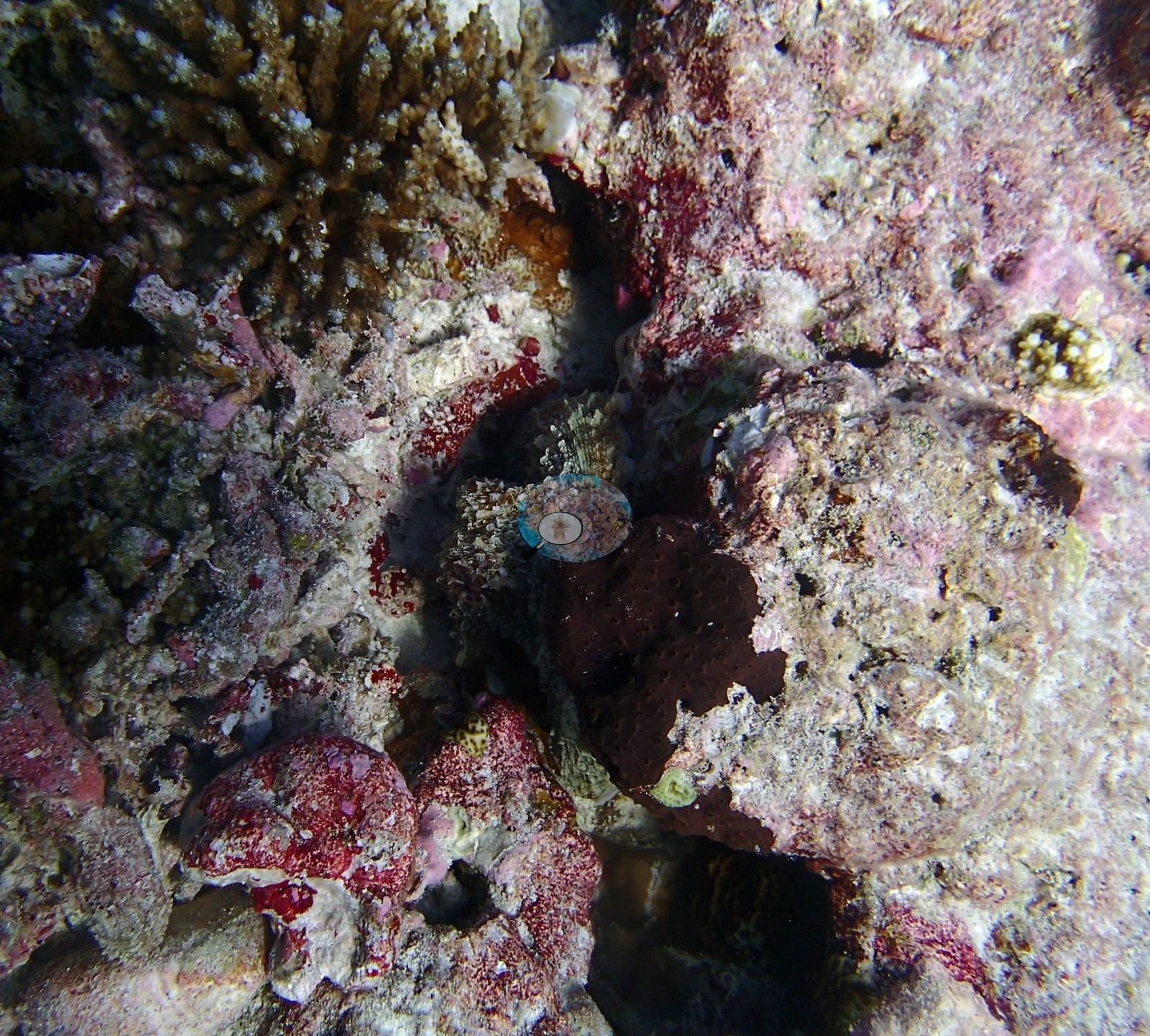
Structural loss is present but old, and there is no methodology imagery at all — zero frames of 33. The dominant structural loss is long-dead skeleton already resurfaced in pink and mauve CCA: the pavement in P3180448, P3180449, P3180463, and P3180464 is almost entirely CCA-plated old framework, and Coralscapes puts dead coral at 3.35% of image area with rubble at 2.66%.
Condition and bleaching. Anderson's published per-site figure — 13.14% of coral bleached (Mayfield & Dempsey 2026, Oceans), the most bleached site of the Three Brothers series — is the authoritative statement of condition at BITB30. Nothing below is converted into a percentage from frames, and the photographic and annotation material is not offered as a check on that figure. Qualitatively, seven frames carry paling or partial mortality and none of it is resolvable photographically: P3180446 (a white sector on a tabular plate), P3180450 (a fully white tabular colony plus a pale branching colony), P3180451 (a white band on a table margin), P3180449 (white tissue at a corymbose colony's base), P3180448 (chalky white branch fragments on CCA pavement), and P3180421 and P3180463 (pale-tan pocilloporid macros). Bleaching versus recent partial mortality versus a naturally pale morph cannot be separated from these images, and none is separated here. No crown-of-thorns, no unambiguous disease lesion and no fresh predation scar resolves in any of the 33 frames.
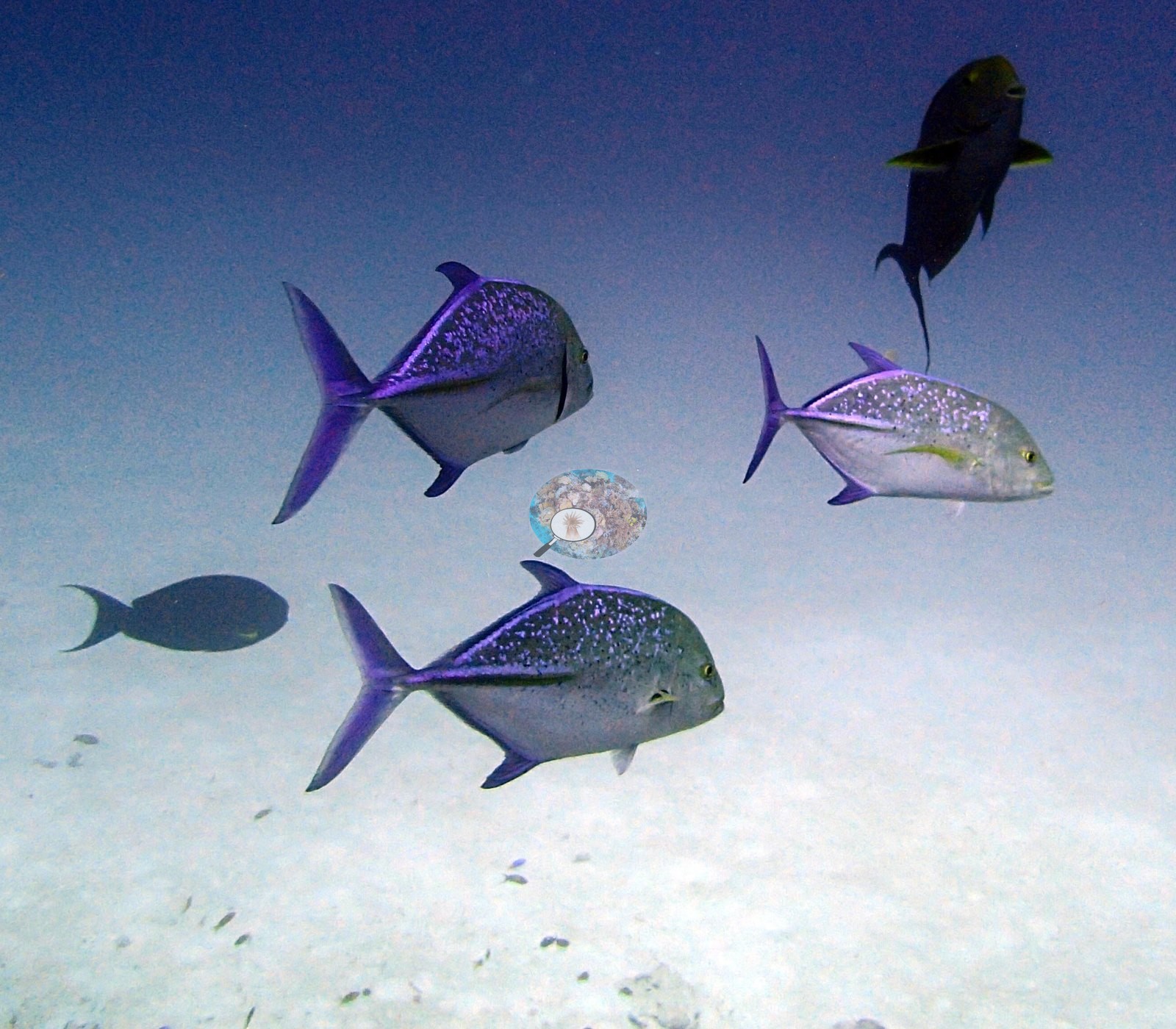
Separately, and as a matter of annotation quality rather than of reef condition, the point set's own bleaching signal is concentrated rather than distributed — the BITB28 pattern repeats. Eight of the 33 frames carry all 21 of its bleached points; 25 frames carry none, and two frames hold 48% of that signal. The most extreme is P3180419 — three bluefin trevally over bare white sand, 56.7% water by the point set's own reckoning and 0.0% live coral by mask — yet carrying 6 bleached-Acropora points, 29% of the point set's entire bleaching signal for this site. With roughly 76% of Chagos point annotations being robot predictions, P3180419 should be read as annotation provenance, not as an observation of the reef, and none of the seven frames that actually show pale tissue is among the two frames carrying half the point-set signal. That is a statement about the CoralNet annotations only. Structural loss registers as dead coral 3.35% of image area and rubble 2.66%. Bleaching stands at 2.12% of annotated points — 21 points, concentrated in Acropora 1.82% and other hard coral 0.30% — which is 10.4% of all coral points; Coralscapes by contrast reads bleached at 0.05% of image area, effectively zero.
Fish and other fauna
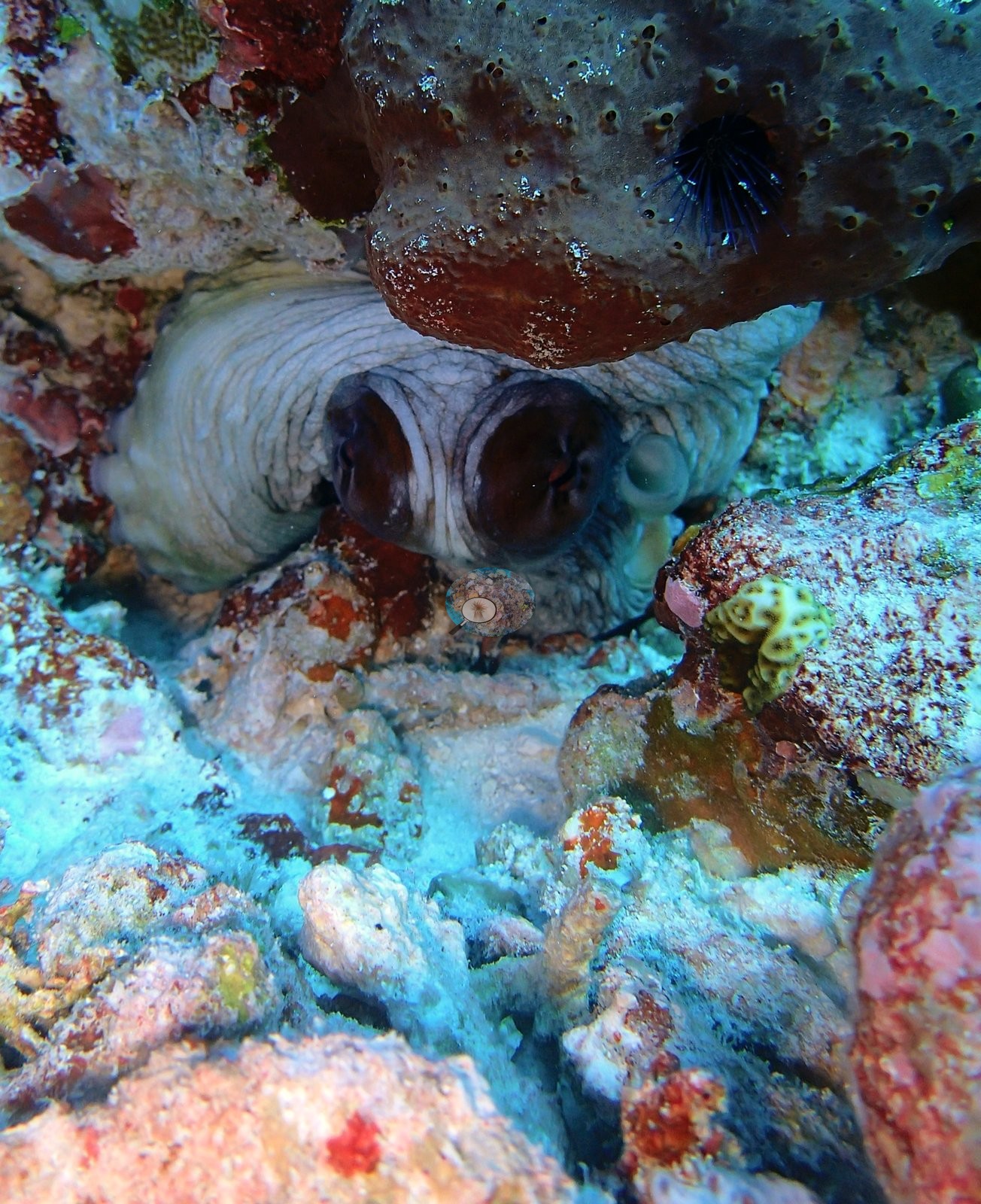
The fauna is good and the last three frames are the best of it. P3180465 is the single best macro of the redo — an octopus (Octopus cyanea-type) wedged under a gray-blue sponge overhang with both eyes open and a black Diadema-type urchin on the sponge above it. P3180419 holds three bluefin trevally (Caranx melampygus) in clean profile over white sand. Beyond those: powder-blue surgeonfish (Acanthurus leucosternon) in P3180438 and P3180447; Moorish idols (Zanclus cornutus) in P3180451 and P3180461; a large gray angelfish with white face mask and yellow caudal in P3180450, compatible with Pomacanthus xanthometopon but not callable; parrotfish, red bigeyes compatible with Priacanthus, blue-and-yellow damselfish, anthias, and chromis, and continuous fusilier and dark-surgeonfish traffic throughout. Two animals are deliberately left uncalled: the cryptic animal in P3180464 is NOT callable (scorpionfish only compatible), and a dark mass in P3180449 may be a second octopus or a dark encrusting sponge. Conspicuous fauna and sessile invertebrates appear as sponges in 22 frames, urchins in 2 frames, giant clams in 1 frame, sea cucumbers in 1 frame, anemones in 1 frame, debris in 2 frames.
Comparisons with other data
No independent survey was made at this exact site; the nearest ones are listed in the table below.
Dive record
This is the richest Three Brothers site in the series. The dive window is 13:55:55–14:31:52 in four bursts, from DateTimeOriginal EXIF on all 33 files — the afternoon dive.
Other notes
All 33 filenames carry rows in both comparison CSVs, every image_path reads BiTb30-finished, and every Coralscapes overlay is folder-qualified. Only 9 of the 33 filenames are unique in the tree — 21 collide with BiTb28-finished and 3 with a topside folder (33 − 21 = 12, which is how the manifest's number arose). All 24 collided pairs are byte-different, and BITB28's P3180394 is timestamped 08:22:54 against BITB30's 13:55:55, so these are genuinely different images.
Image-by-image analysis — BITB30 is the best reef of the Three Brothers redo, and the frames say so more loudly than the 42.5% does. All 33 frames come from Anderson's own BiTb30-finished folder; there are no sampled-colony frames.
CV model comparison
More info
Those are point counts on the photographs; this is a diver swimming a transect. The models and the reference never saw the same thing. ⚠ SITE-LEVEL ONLY. The 2,500 frames were not associated with any transect taken within 200 m of them, so transect-vs-image comparisons are site means, never frames. The transect value is already in the pin `cover` field (109 of 112 pins, sourced to the paper's suppl. S1) and is read from there, never re-imported. The transect is THE coral-cover value for this site and stands alone. The rows below it are a methods comparison only: no computer-vision value is averaged with it, feeds the headline, or carries over to the site's cover figure (Anderson, 2026-09-22).| Method | Hard-coral cover (%) |
|---|---|
| Transect (published) | 42.5 |
| CoralNet | 29.9 |
| In-house DINOv3 | 18.3 |
| CoralSCOP edited | 30.3 |
| Claude | 14.0 |
Independent surveys nearby
| Agency / program | Year(s) | Stations / distance | Link |
|---|---|---|---|
| Sheppard et al. (2008) | 2006 | 1 station, 2.48 km | Records ↓ |
| Spalding et al. 2025 (Chagos 2024 bleaching report) | 2024 | 1 station, 1.51 km | Records ↓ |
| XL Catlin Seaview Survey | 2015 | 1 station, 1.59 km | Records ↓ |
 Dr. Coral (CRD)Year-average (no detectable trend)
Within 5 km, 3 independent survey stations recorded hard coral cover in 7 records between 2006 and 2024. One survey since 2021 recorded 50%. This site's own estimate (43%) sits 7.5 points below the recent value (50%); the methods differ, so the comparison is context, not a like-for-like test.
Collected by other programs using different methods (the XL Catlin Seaview Survey uses photo-transects with automated image annotation), so these are context for the figures above, not a like-for-like comparison. Where a station was surveyed more than once the range is shown. Station names are not dive-site names.
| Agency | Site / location | Date | Hard coral cover (%) | Distance | Link |
|---|---|---|---|---|---|
| Sheppard et al. (2008) | Great Chagos Bank | 2006 | 41% (5 surveys) | 2.48 km | HeatCRD database |
| XL Catlin Seaview Survey | transect 36004 | 2015 | 21% | 1.59 km | — |
| Spalding et al. 2025 (Chagos 2024 bleaching report) | Great Chagos Bank - Middle Brother, lagoon (E aspect, 1-3 m) | 2024 | 50% | 1.51 km | — |
Data & links
- Read the full site report ↗
- Download benthic survey data (CSV) ↗
- Download all LOF-GRE data (933 sites) ↗
- CoralNet image repository for this region ↗
- HeatCRD database ↗
- (reference) ↗
- Photo portfolio ↗
- Coral Reef Diagnostics page for this area ↗
All images from Coral Reef Diagnostics. Data are from Coral Reef Diagnostics and the organizations named in the data-sources table above.
 © Coral Reef Diagnostics.
References
- Mayfield AB, Dempsey AC (2026). Using tourist diver images to estimate coral cover and bleaching prevalence in a remote Indian Ocean coral reef system. Oceans 7(1):1. PDF
- Sheppard C, Harris A, Sheppard A (2008). Archipelago-wide coral recovery patterns since 1998 in the Chagos Archipelago, central Indian Ocean. Marine Ecology Progress Series 362:109-117. PDF
- Spalding M, Bourasseau M, et al. (2025). Coral bleaching and mortality in the Chagos Archipelago, 2024. British Indian Ocean Territory Administration report (gray literature). PDF