
Part of the regional summaries: Chagos Archipelago - Great Chagos Bank West / Brothers / Eagle and Chagos Archipelago
More info
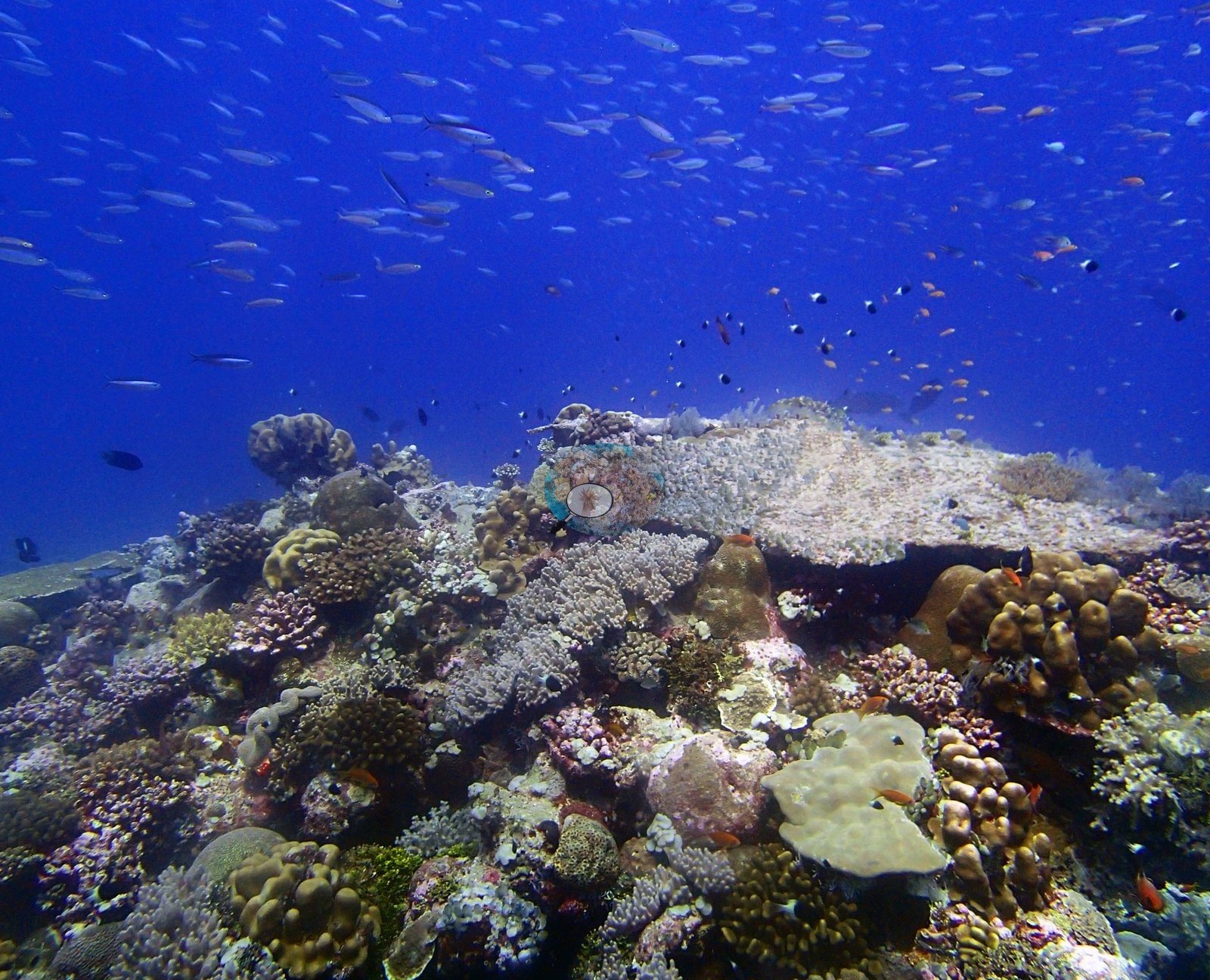
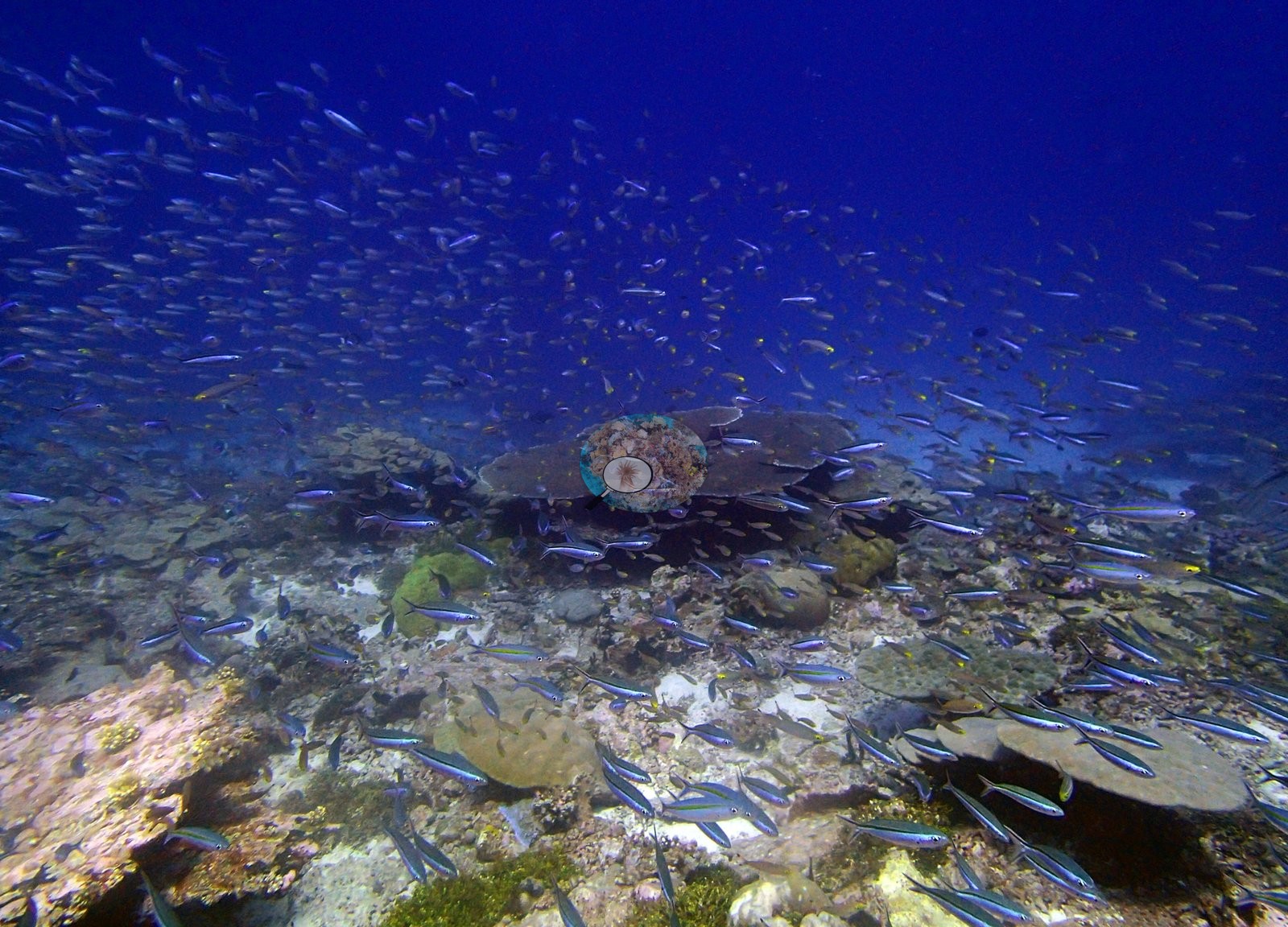
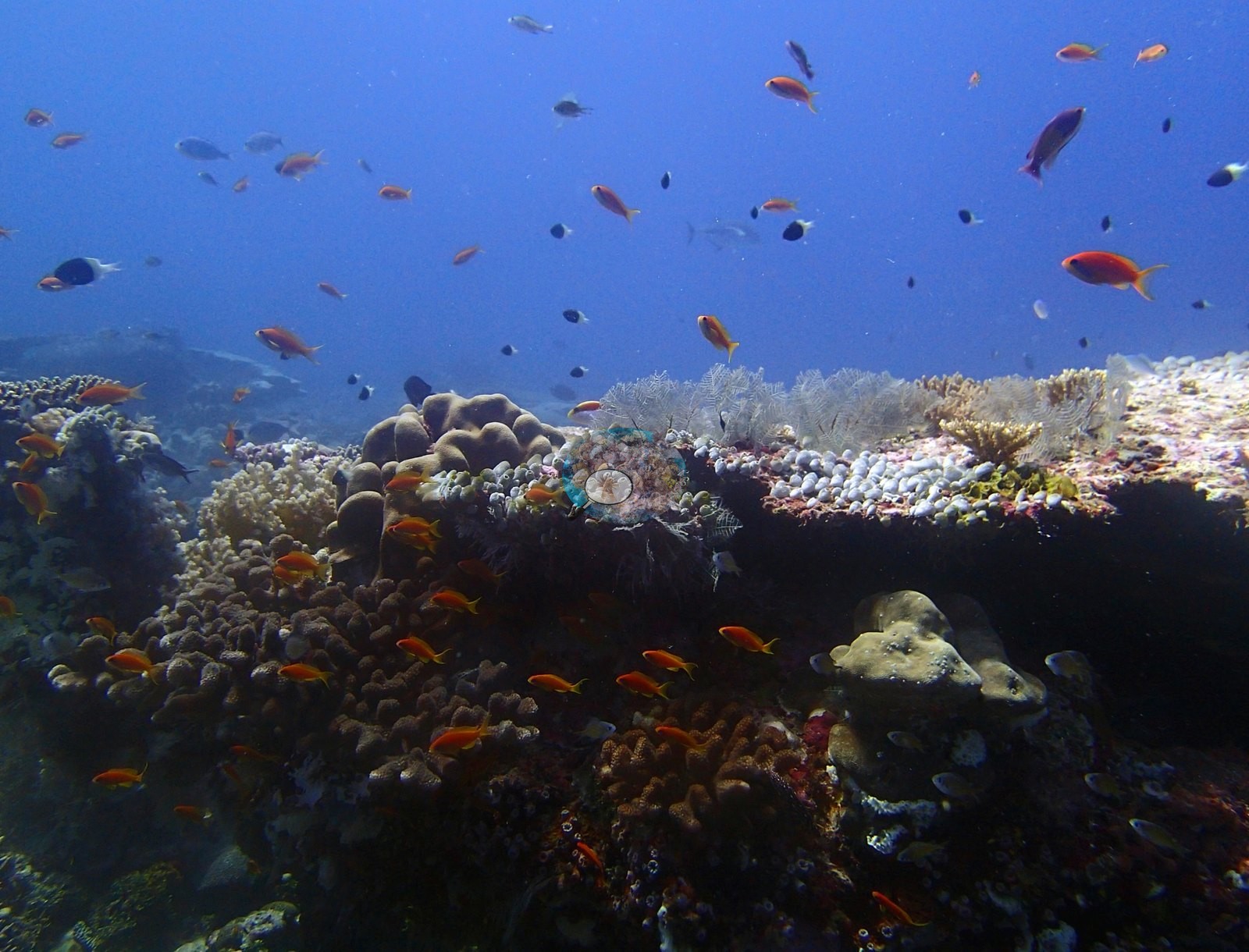
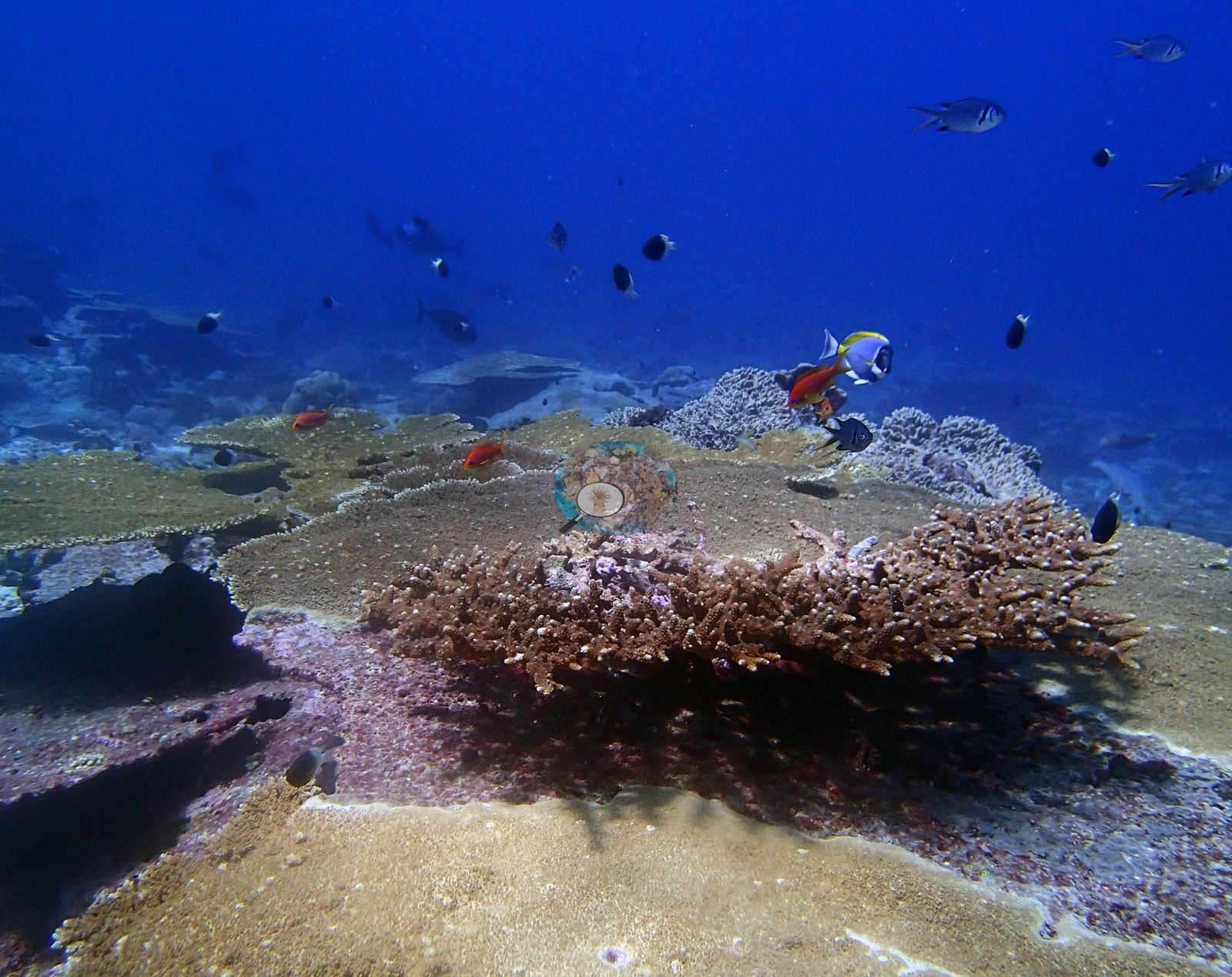
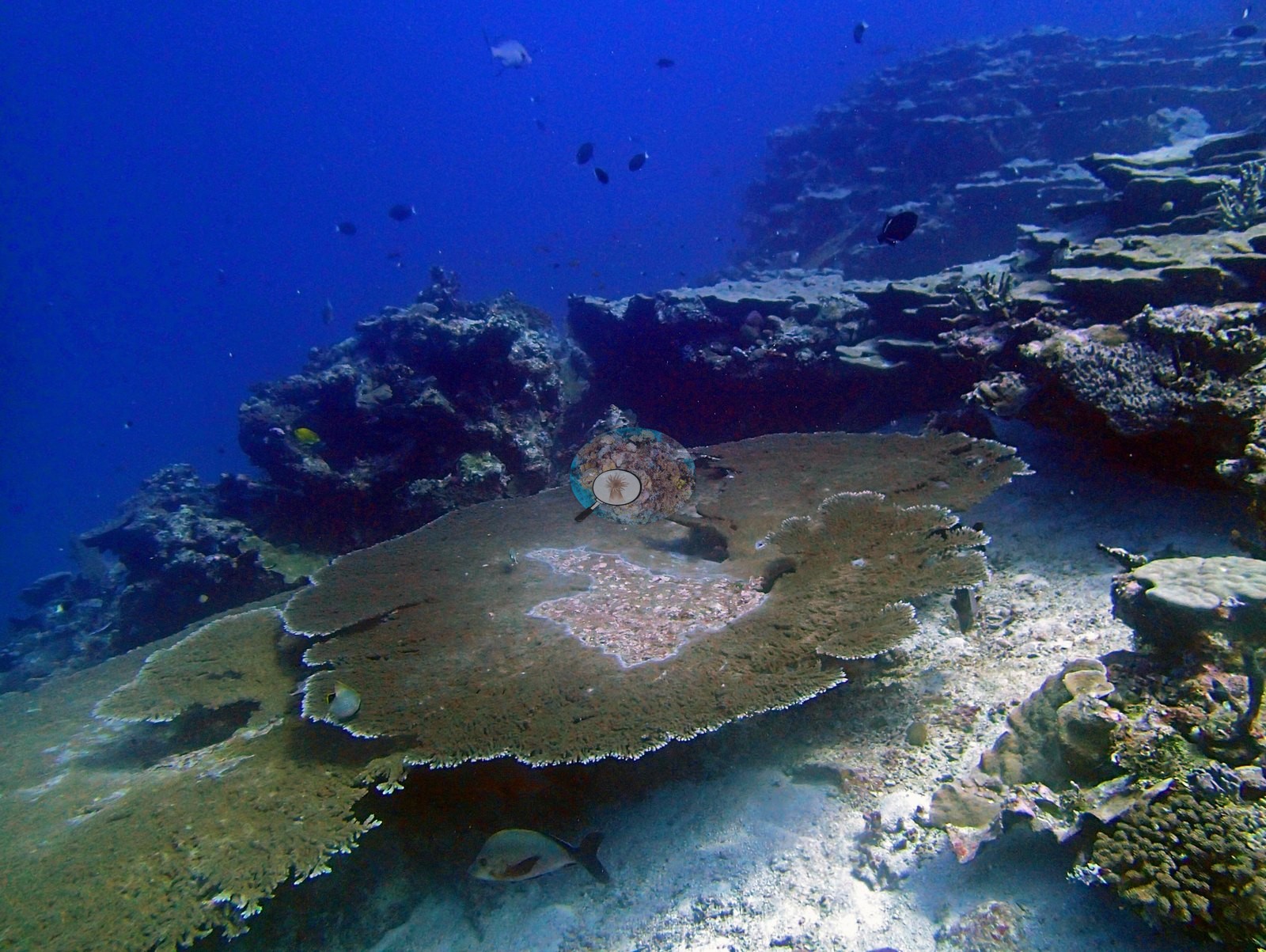
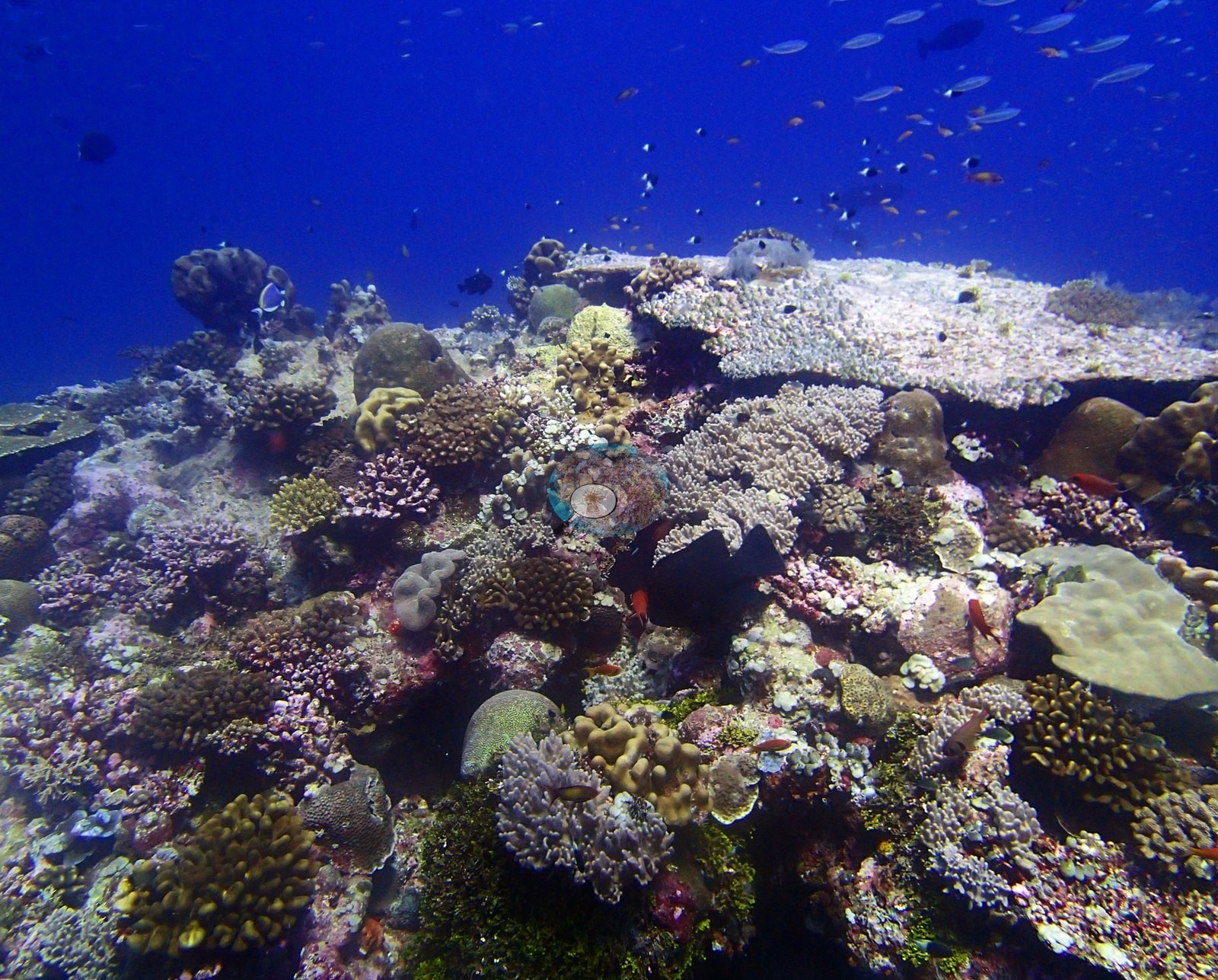
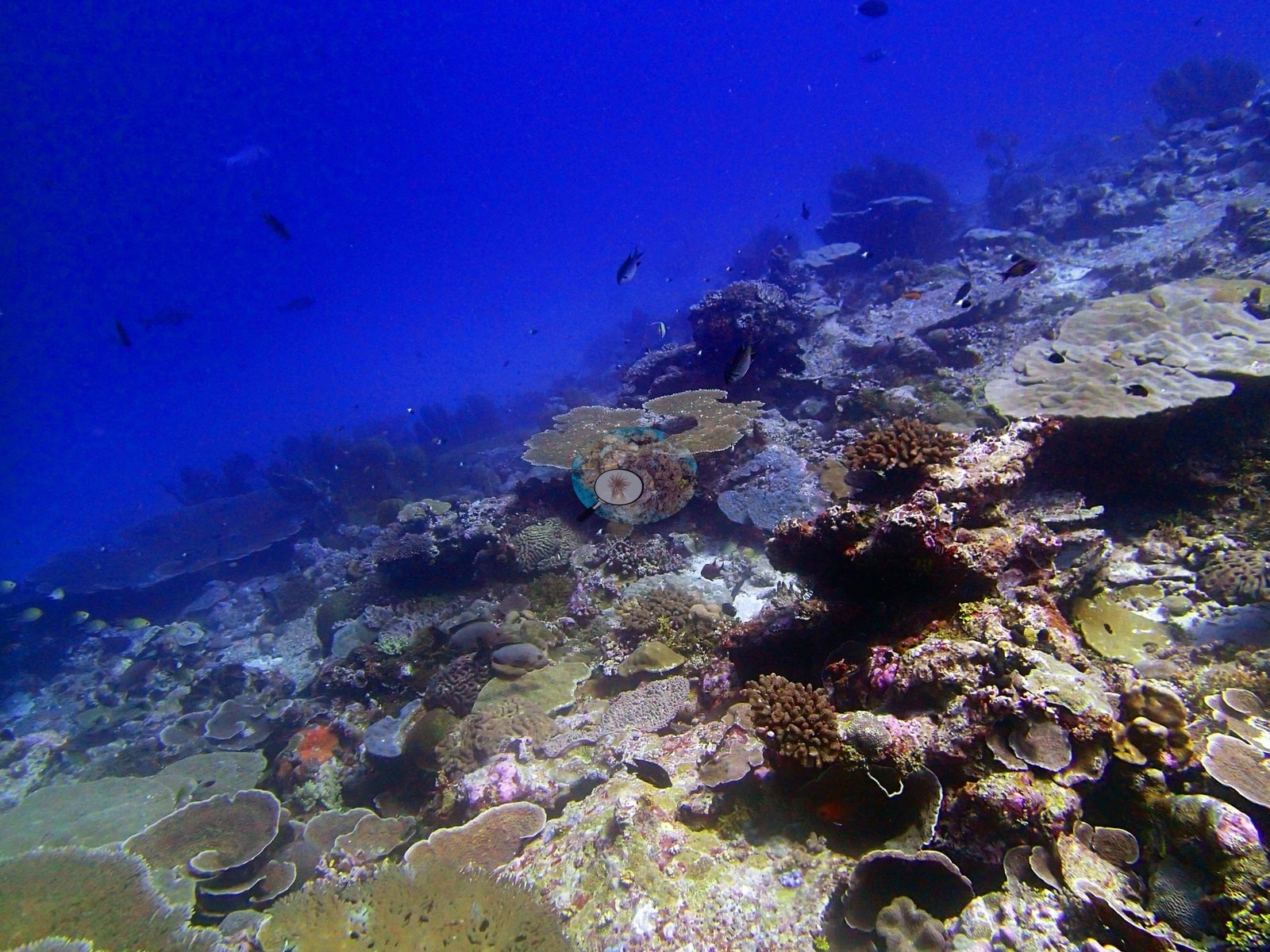
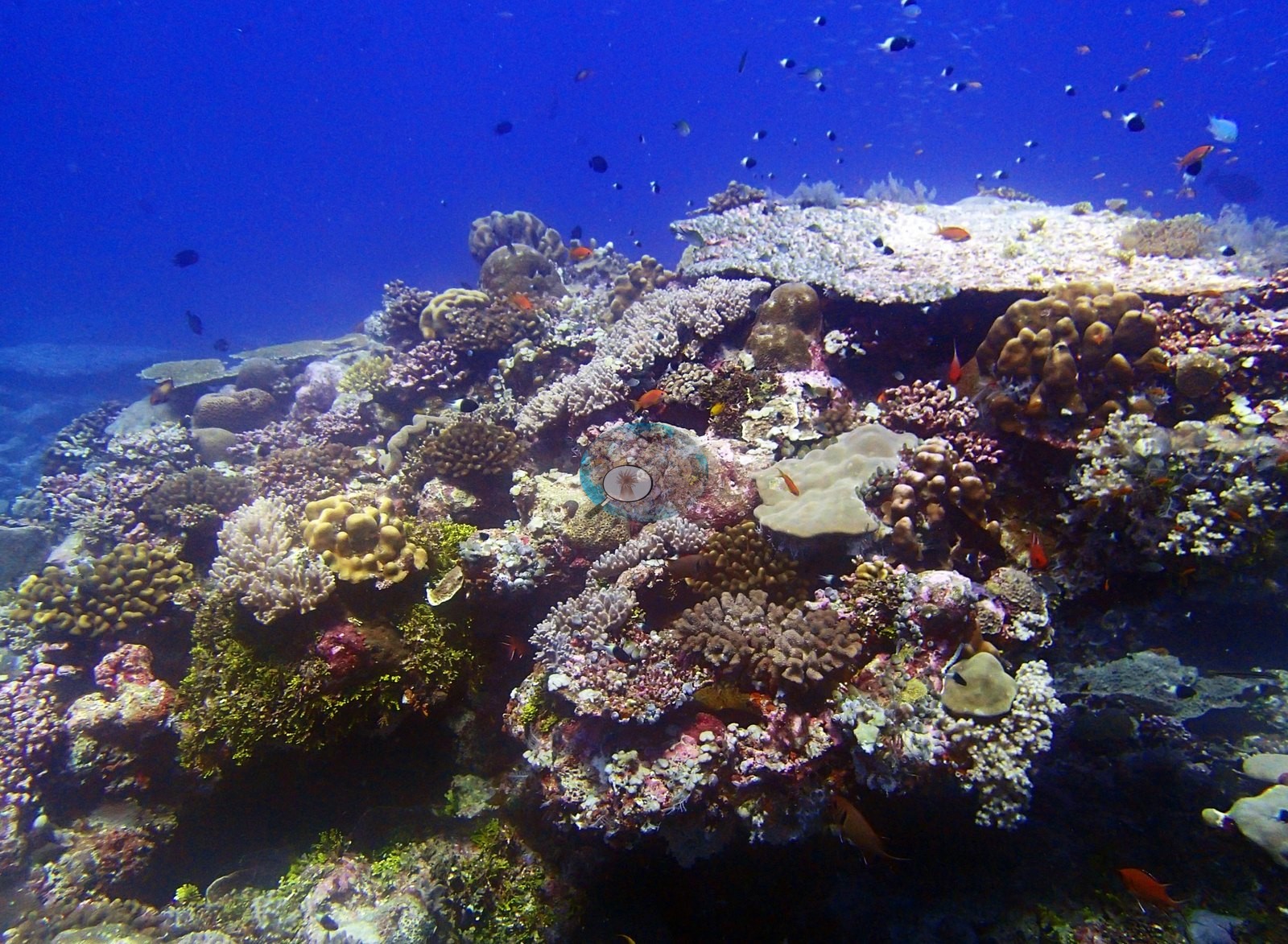
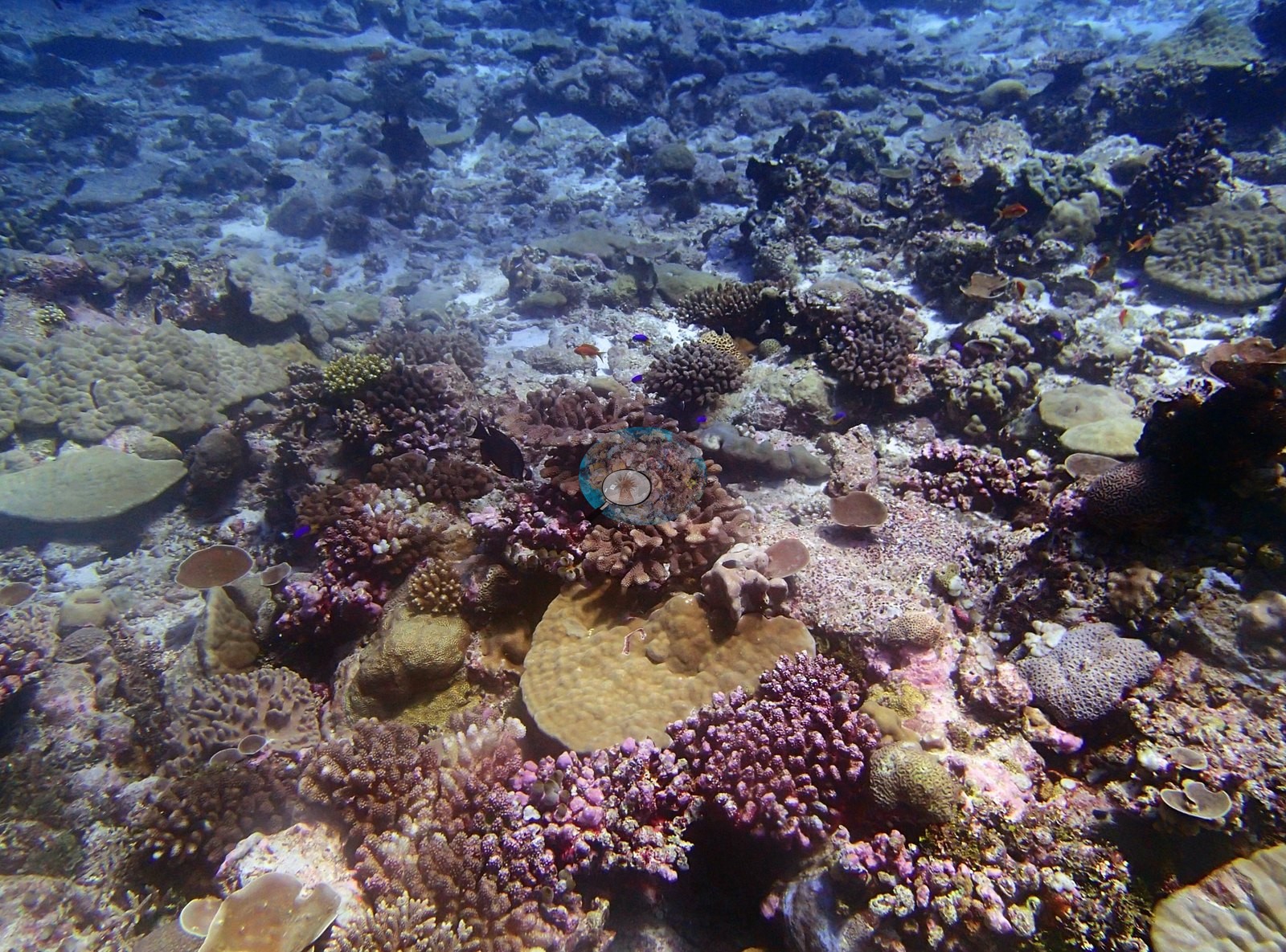
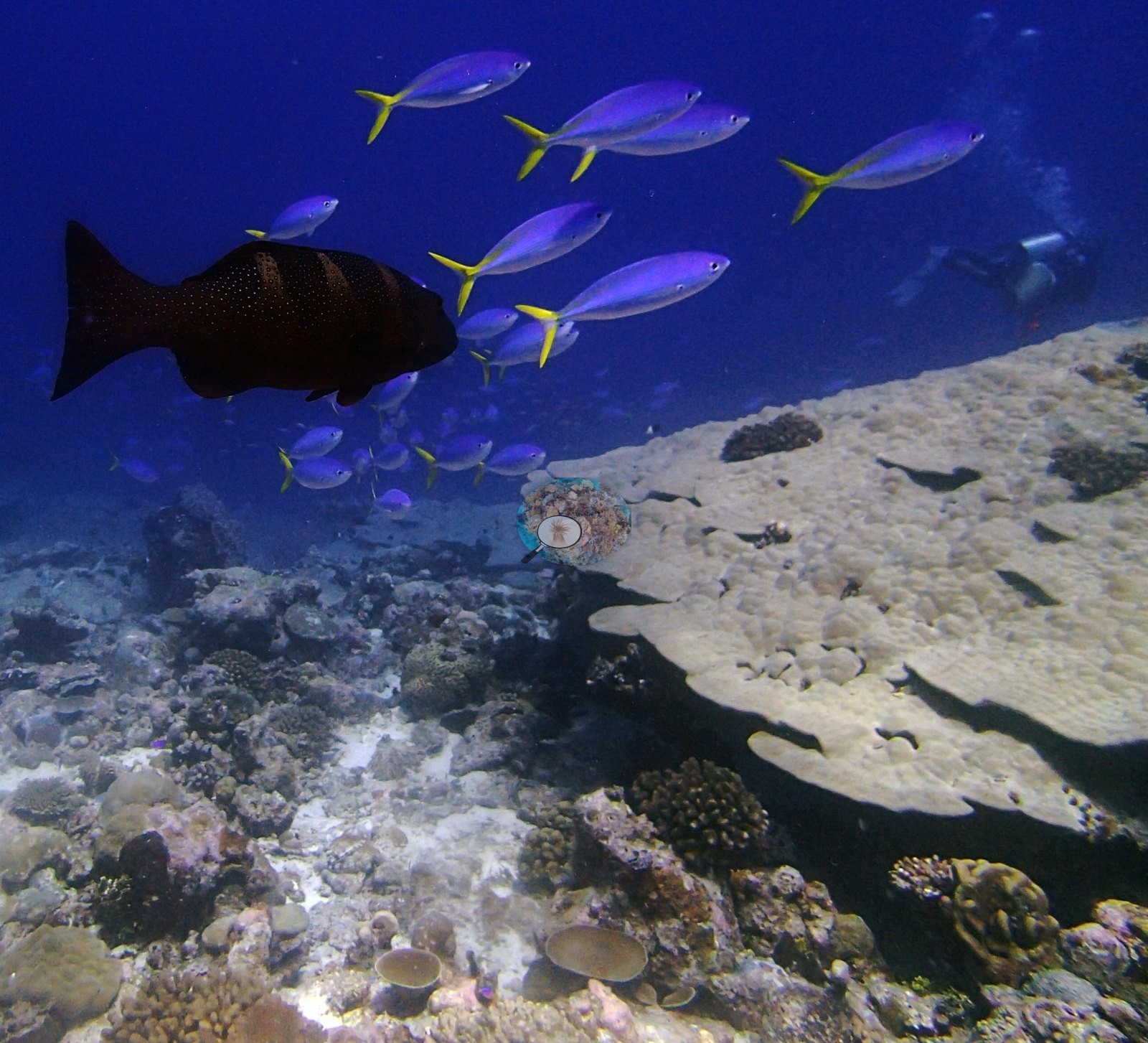
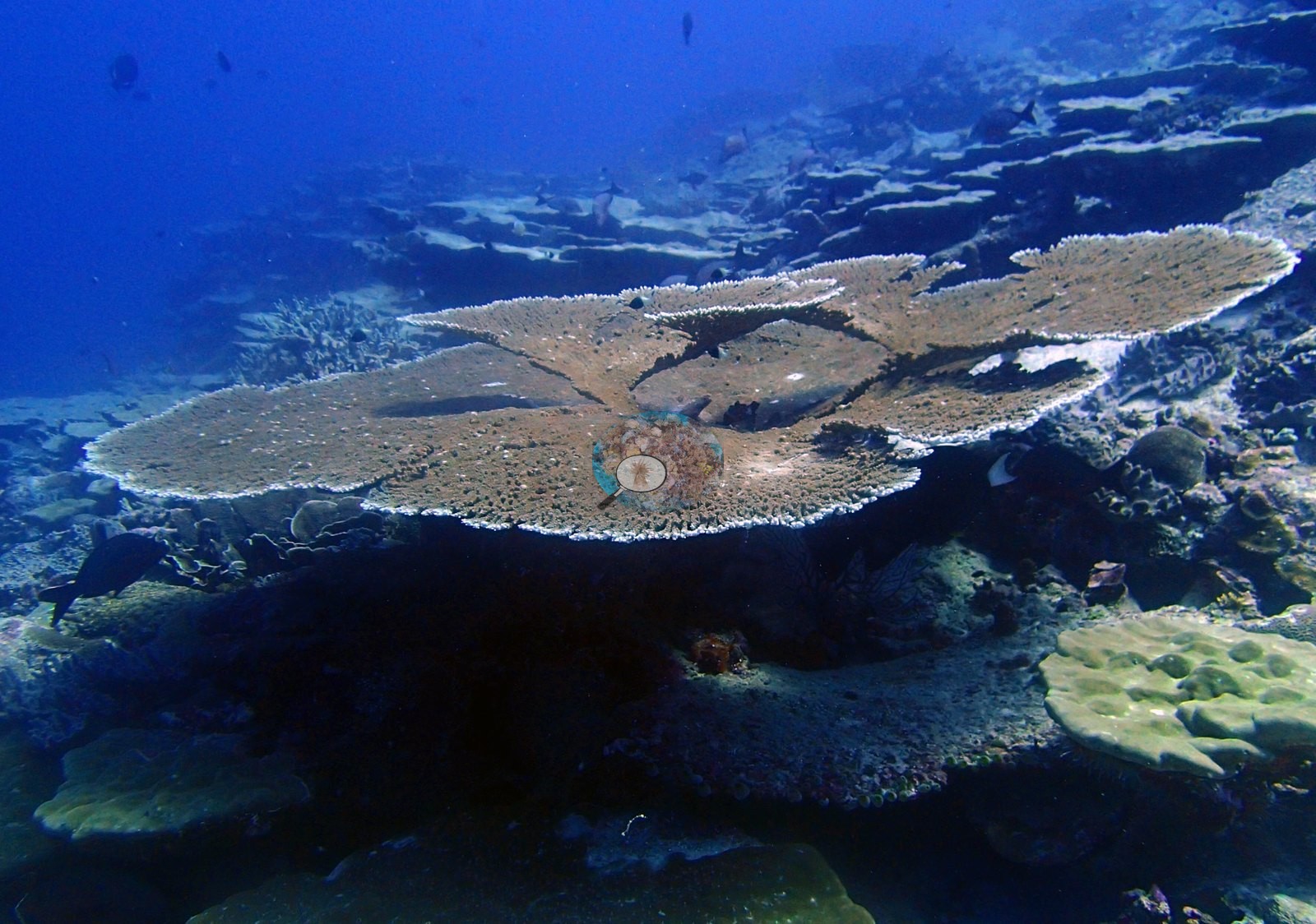
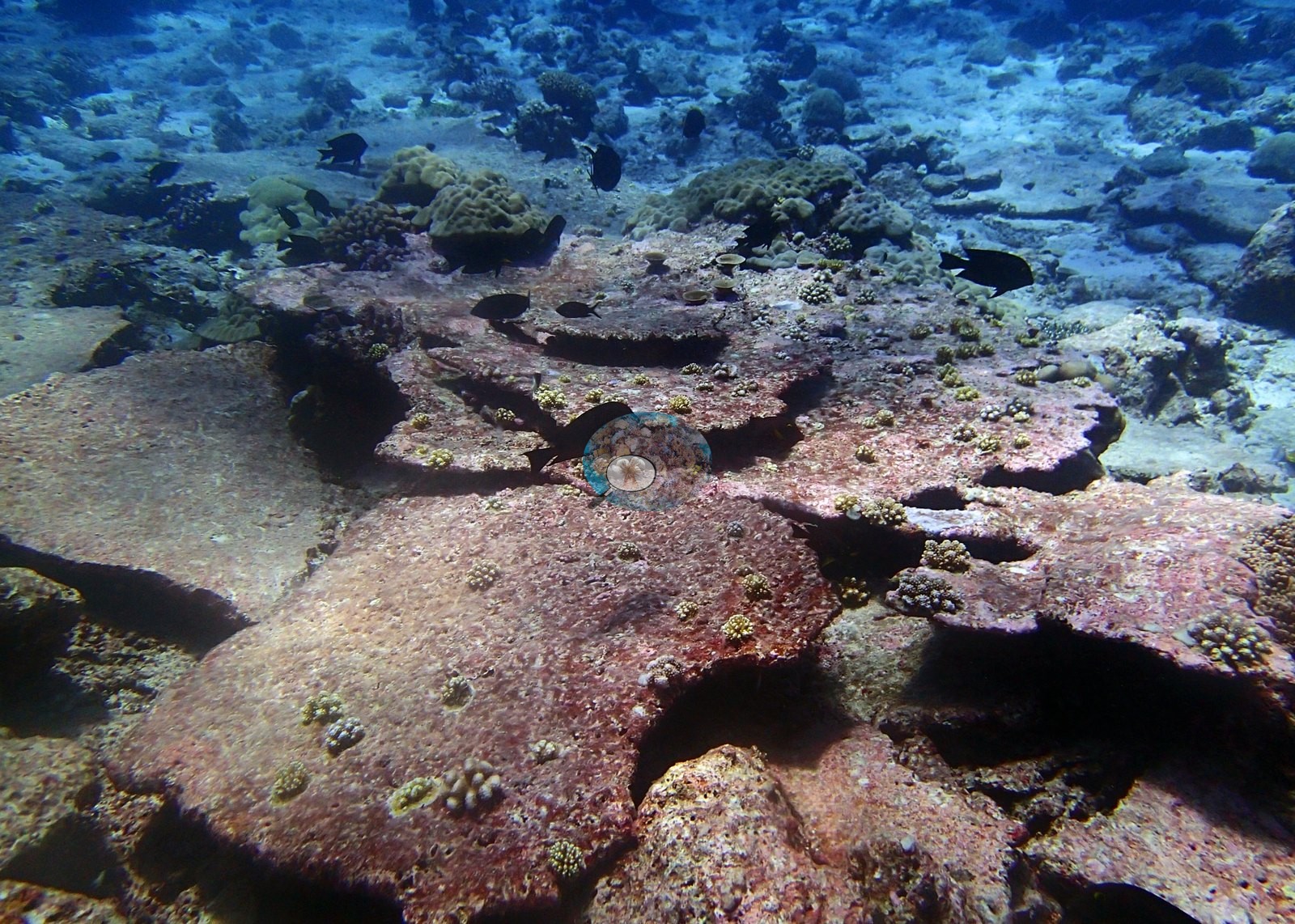
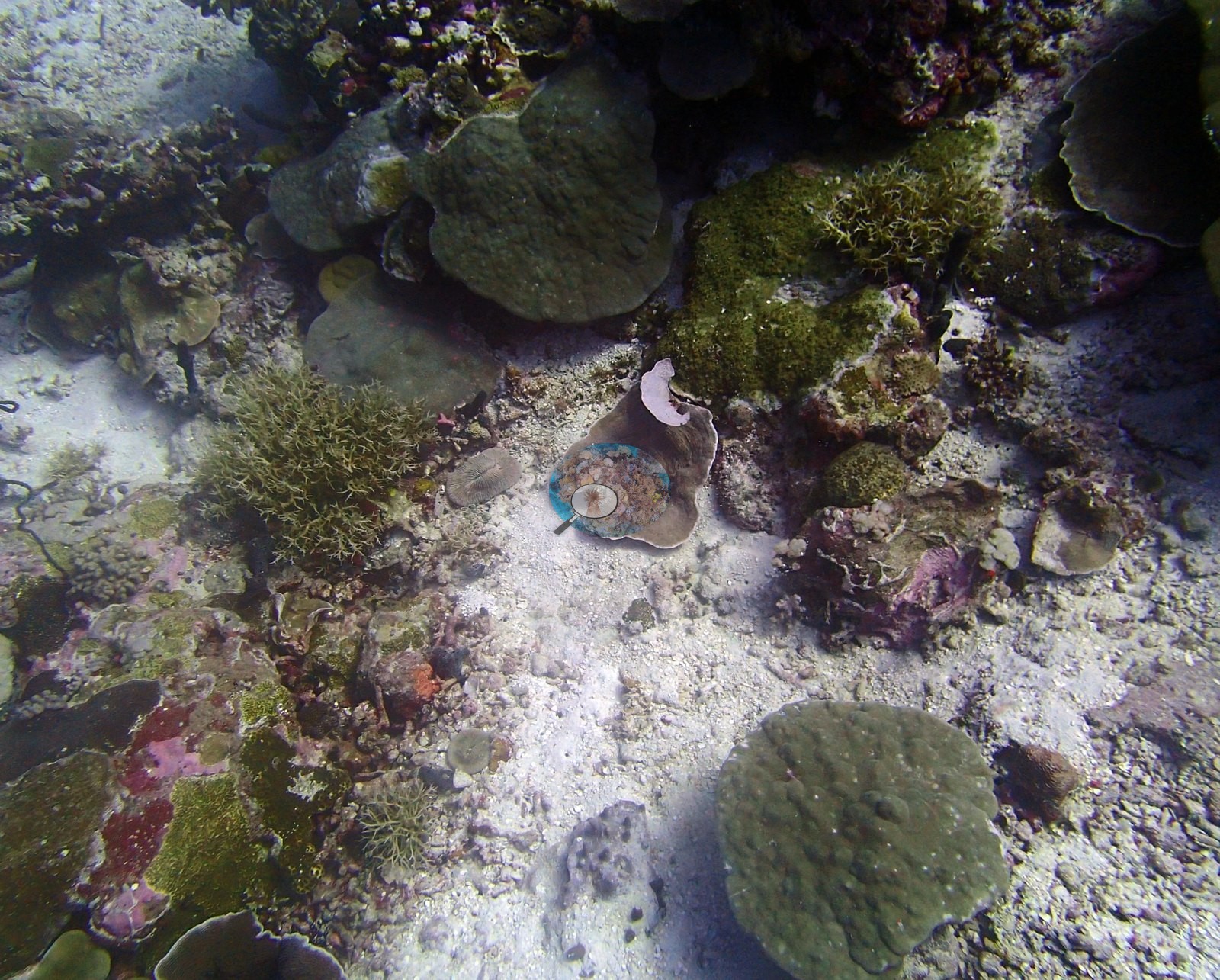
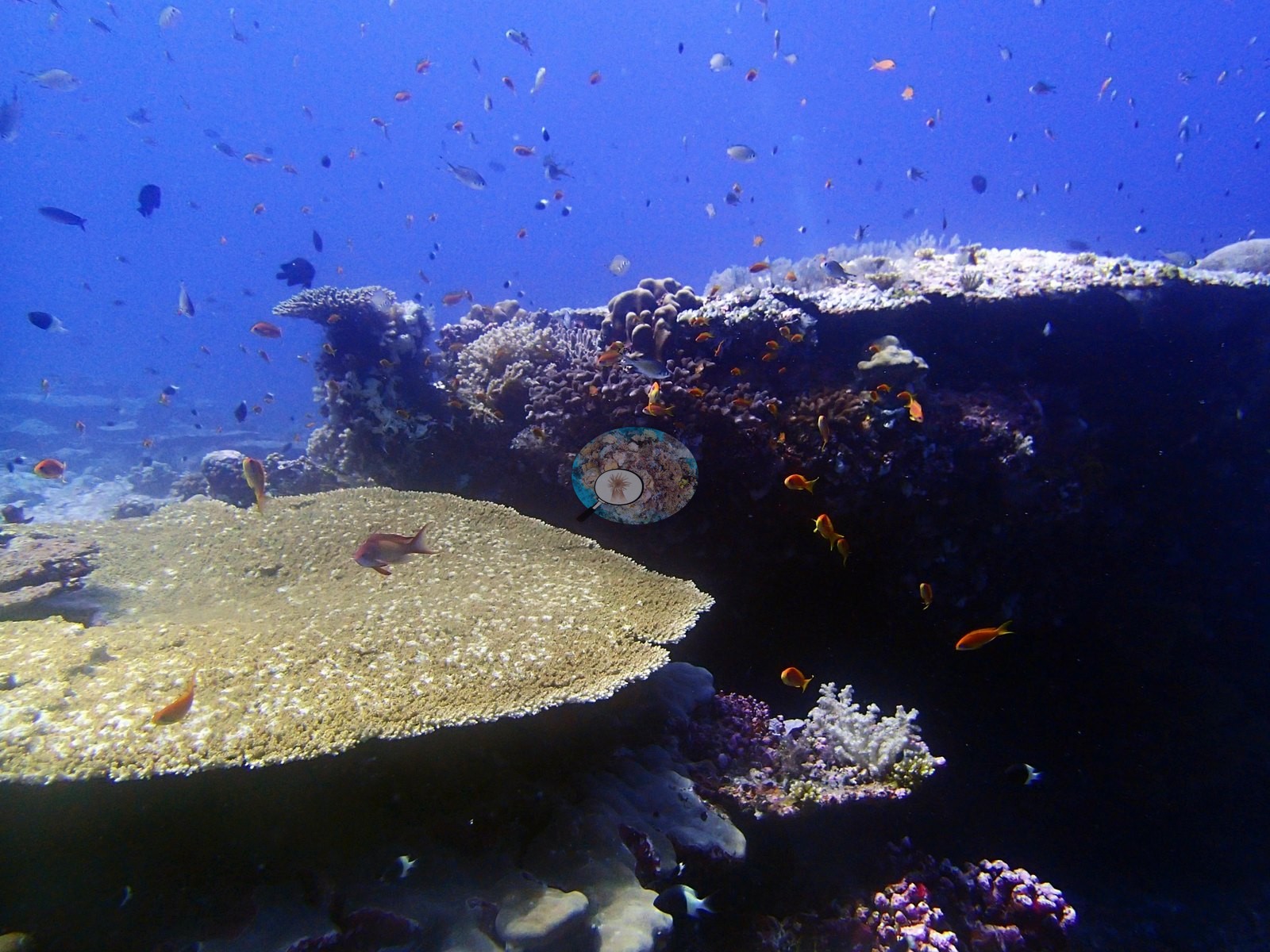
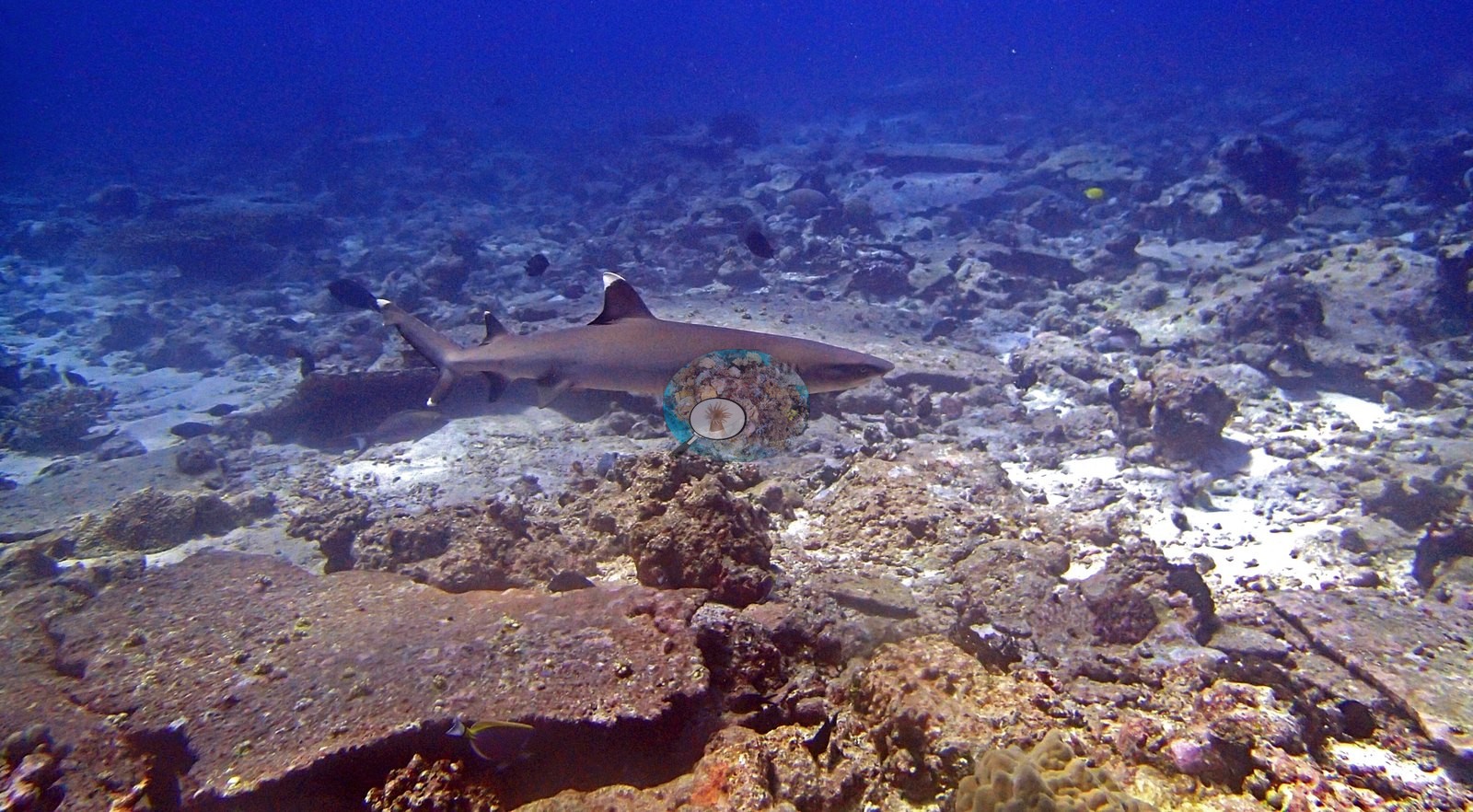
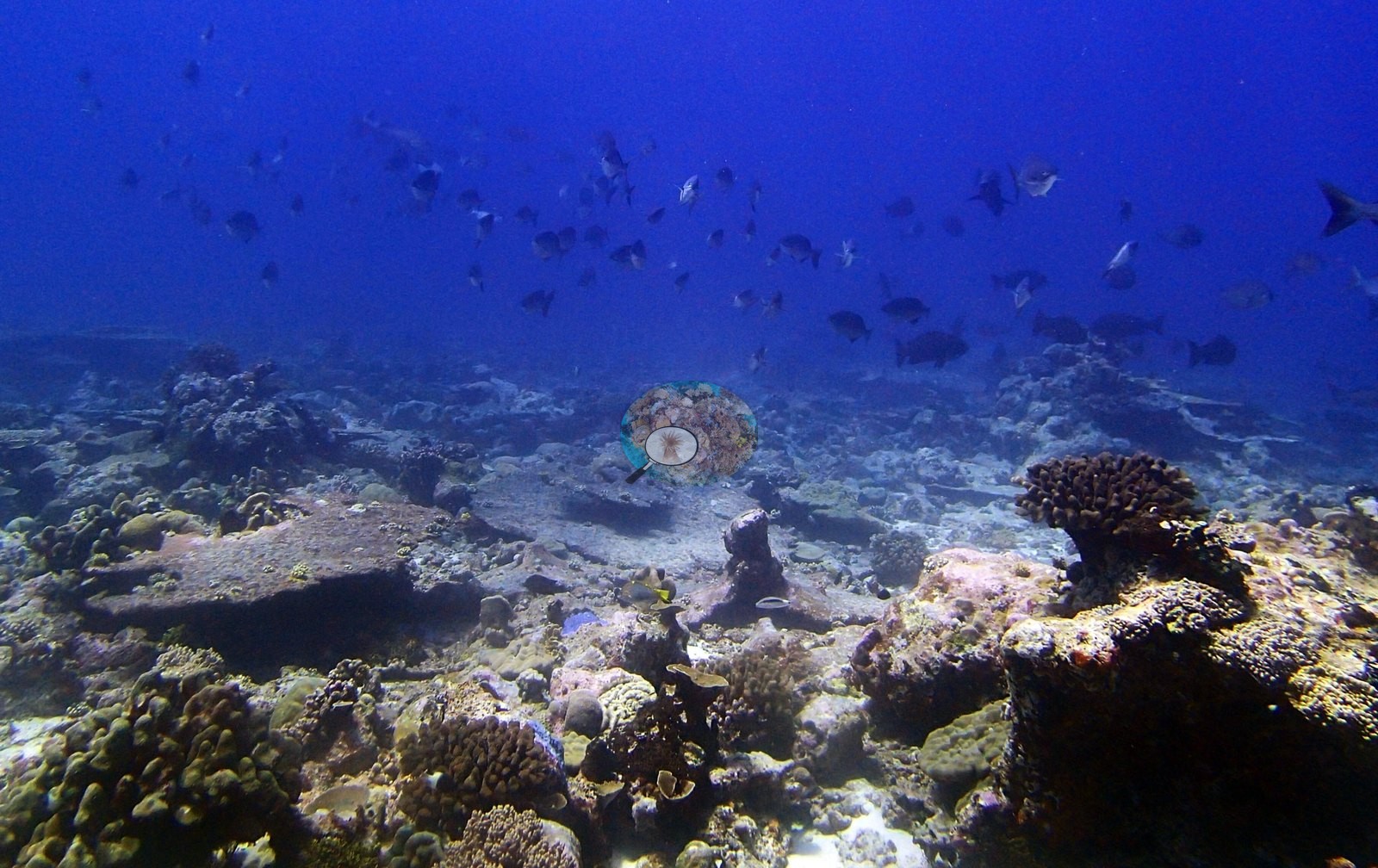
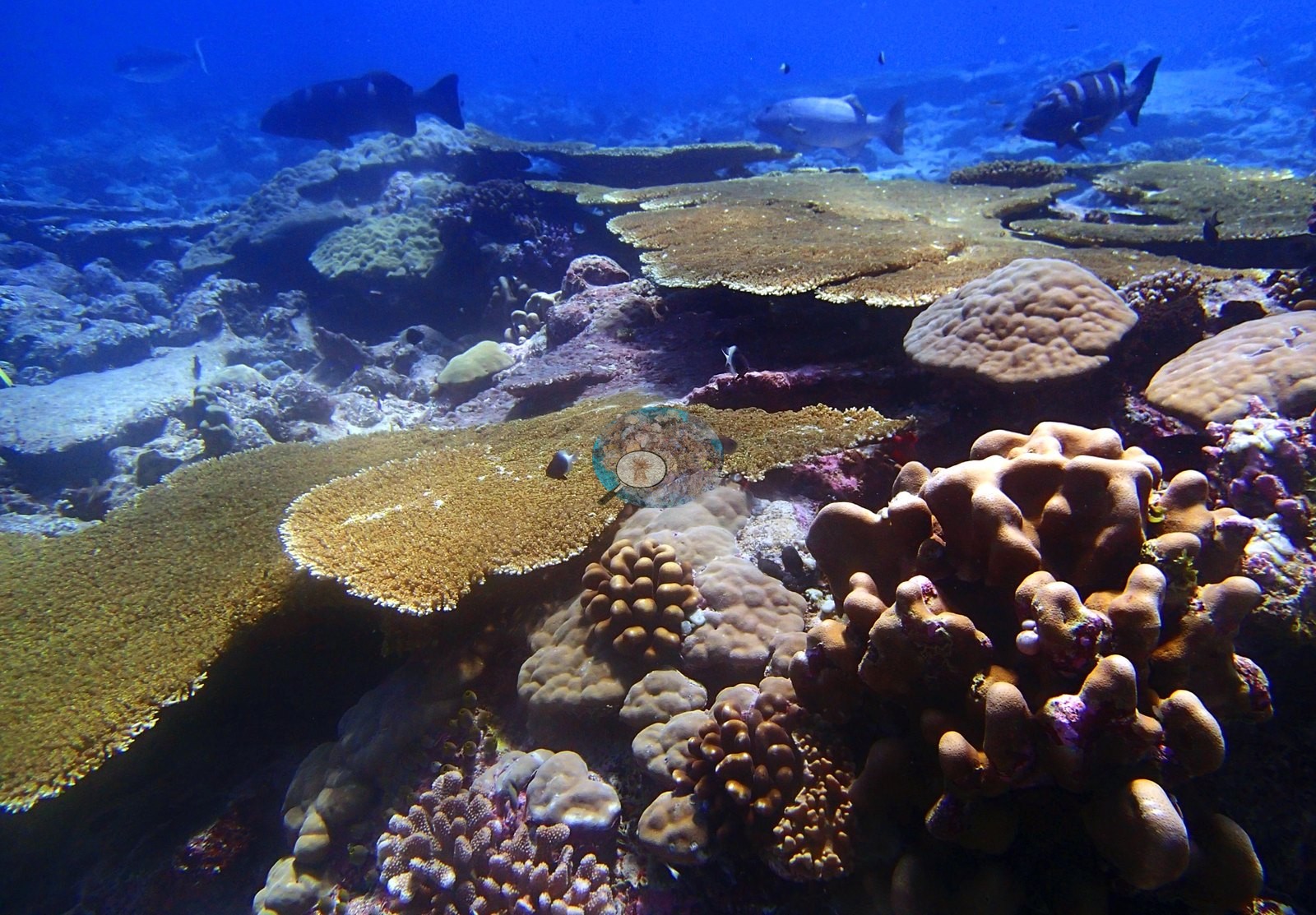
Chagos (NOAA CRW virtual station)A mixed Great Chagos Bank reef where huge, healthy Acropora tables up to three meters across and dense patches of small corals alternate with low-relief rubble and old dead tables crusted in pink algae. A whitetip reef shark and barred groupers were seen, with no crown-of-thorns or disease. Surveyed on the Living Oceans Foundation's Global Reef Expedition.
Three independent survey stations shown with the program’s logo — click one to see how far it is from this site.
Ten other CRD dive sites within 5 km shown in orange — click a marker to open its page.
🗺 Detailed map of the Global Reef Expedition dive sites, Three Brothers, Chagos (Khaled bin Sultan Living Oceans Foundation; opens in a new window)
Site description
General benthic features
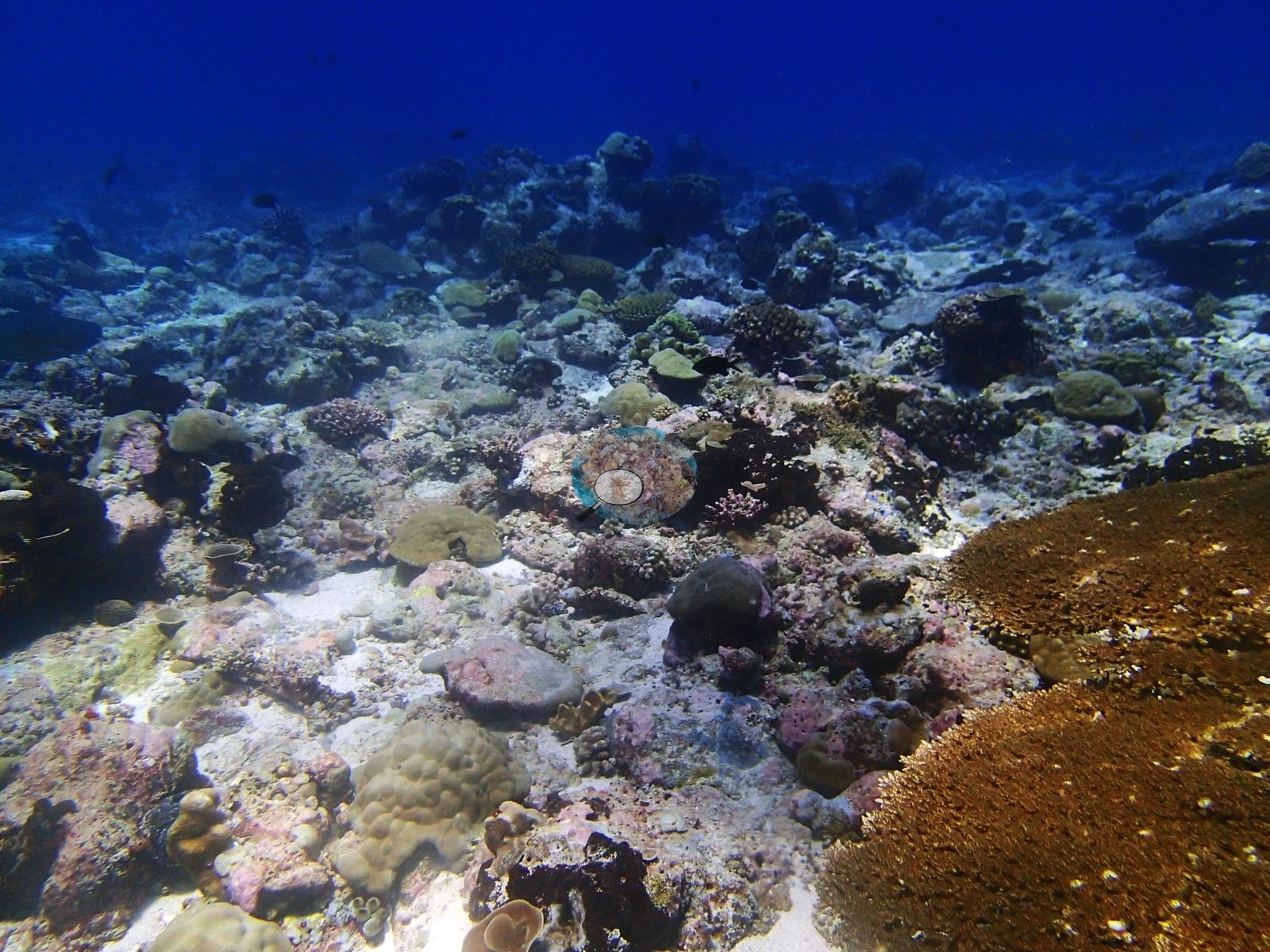
On assemblage the two products part company in an informative way. Coralscapes makes massive and meandroid much its largest live form at 53.4% of live cover, then tabular Acropora 21.6%, other hard coral 12.7% and non-tabular Acropora 6.0%; the independent 30-point annotation of the same 49 frames (1,470 points) gives Porites 52.3%, Acropora 36.6%, other hard coral 10.1% and Pocillopora 1.0% – the only Porites-dominated assemblage of the Chagos redo to that point, and the two products are in fact saying the same thing in different vocabularies: the mask model's ‘massive and meandroid’ is largely the site's big laminar and lobate Porites. Non-coral cover is dominated by turf at 14.5% and crustose coralline algae at 6.8% of all points; structural loss registers as dead coral 2.48% of image area and rubble 2.53%. Frame-to-frame live cover runs from 0% to 60.0% (P3180493 highest, P3180544 poorest), and two structural facts explain most of that spread. First, the mosaic frames P3180504, P3180512, P3180514, and P3180519 read as densely covered by eye – small colonies packed shoulder to shoulder – while the point set gives them 20.0%, 16.7% and 36.7%; small, tightly packed colonies with turf and coralline algae in every interstice are exactly what a 30-point grid under-reads. The reef photographs as three distinct grounds, and the 53-minute swim crosses all of them.
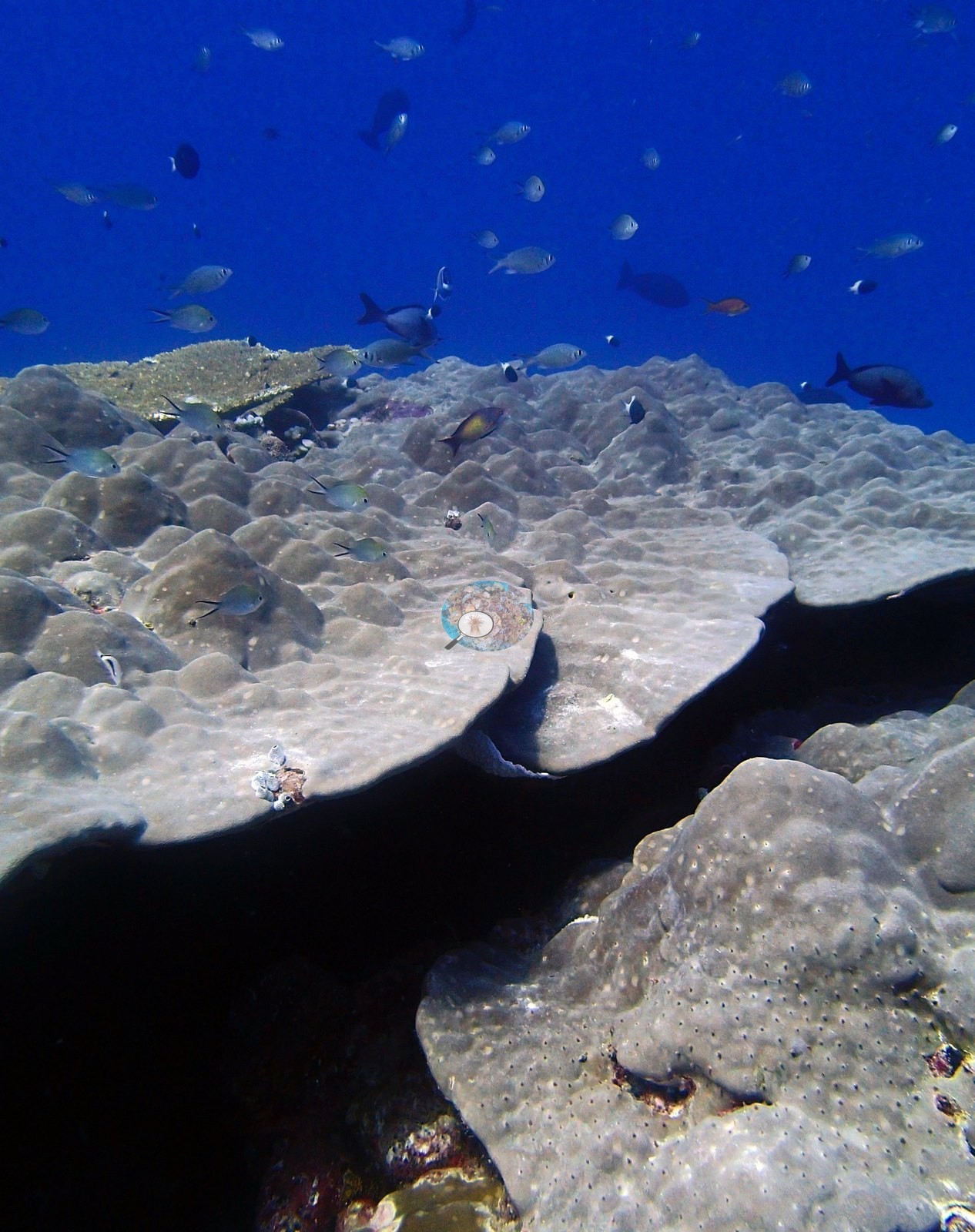
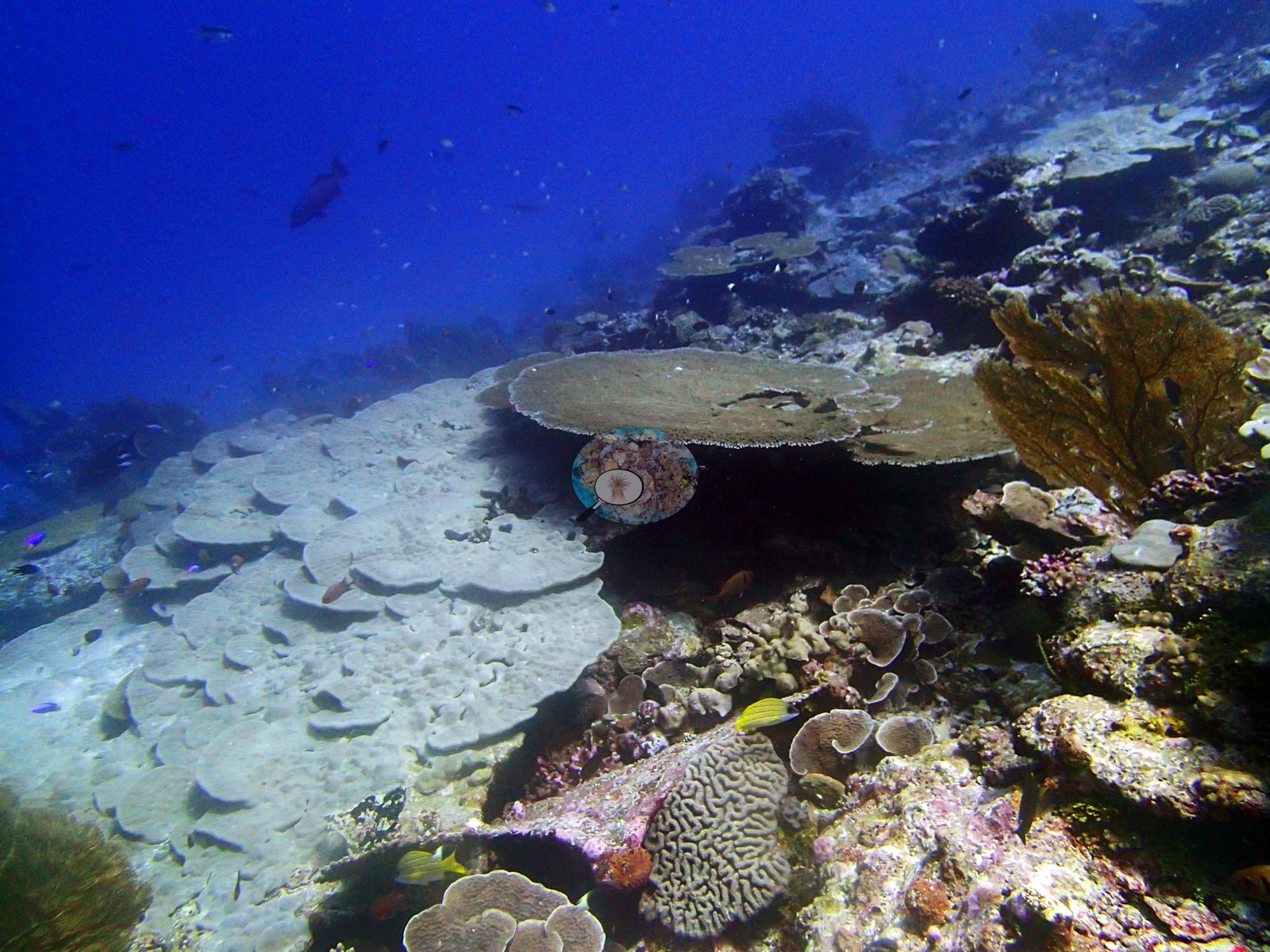
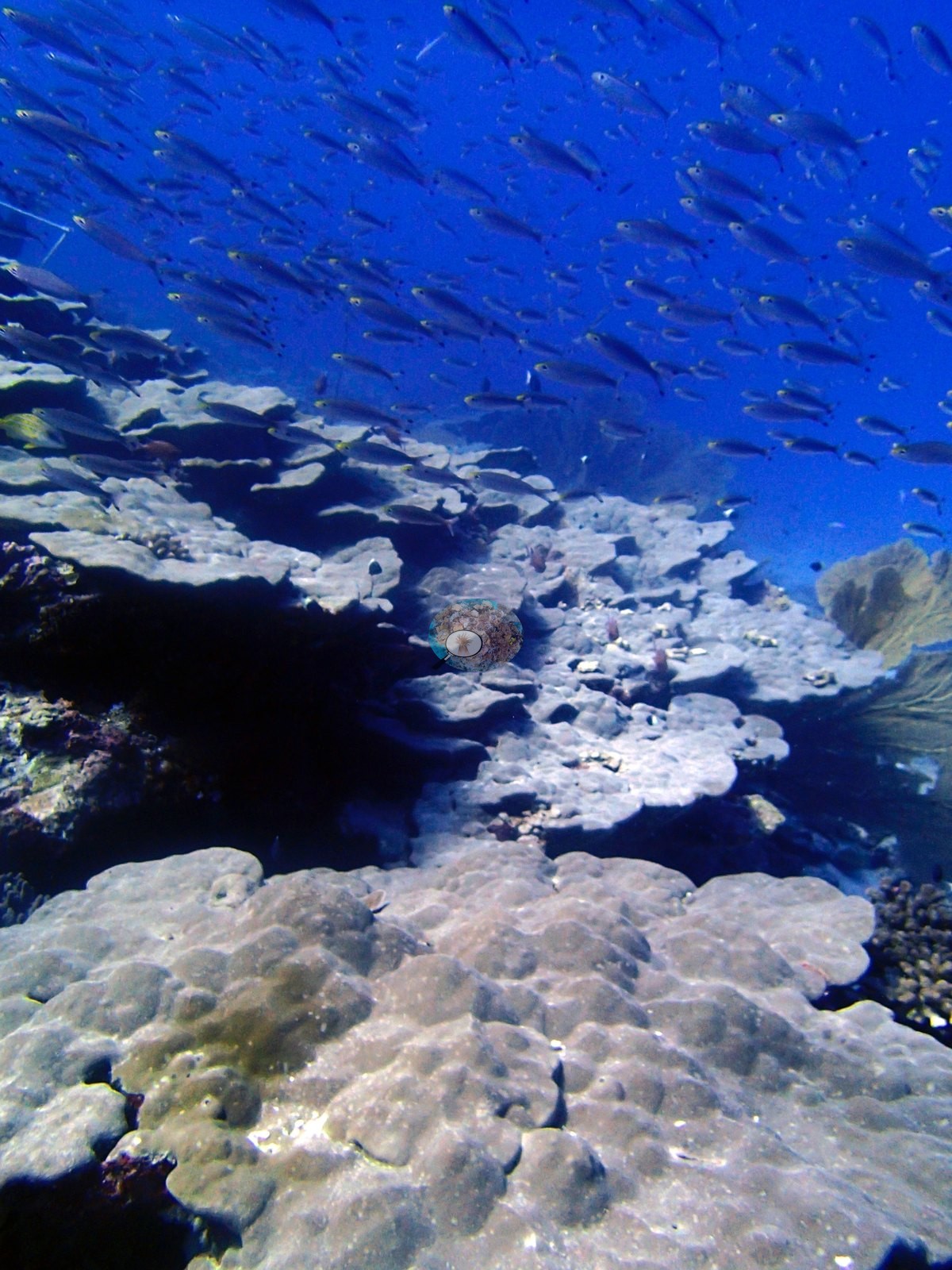
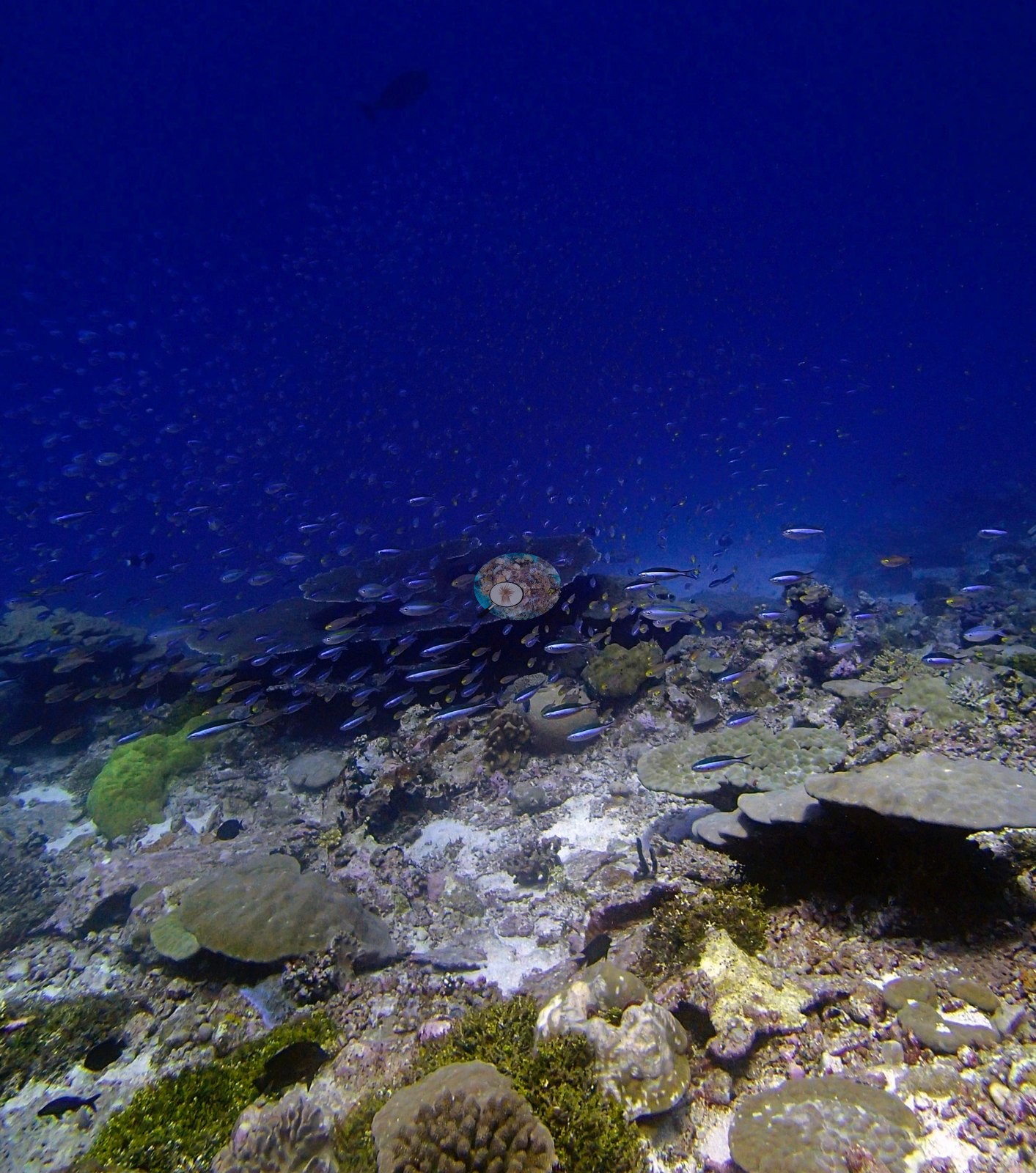
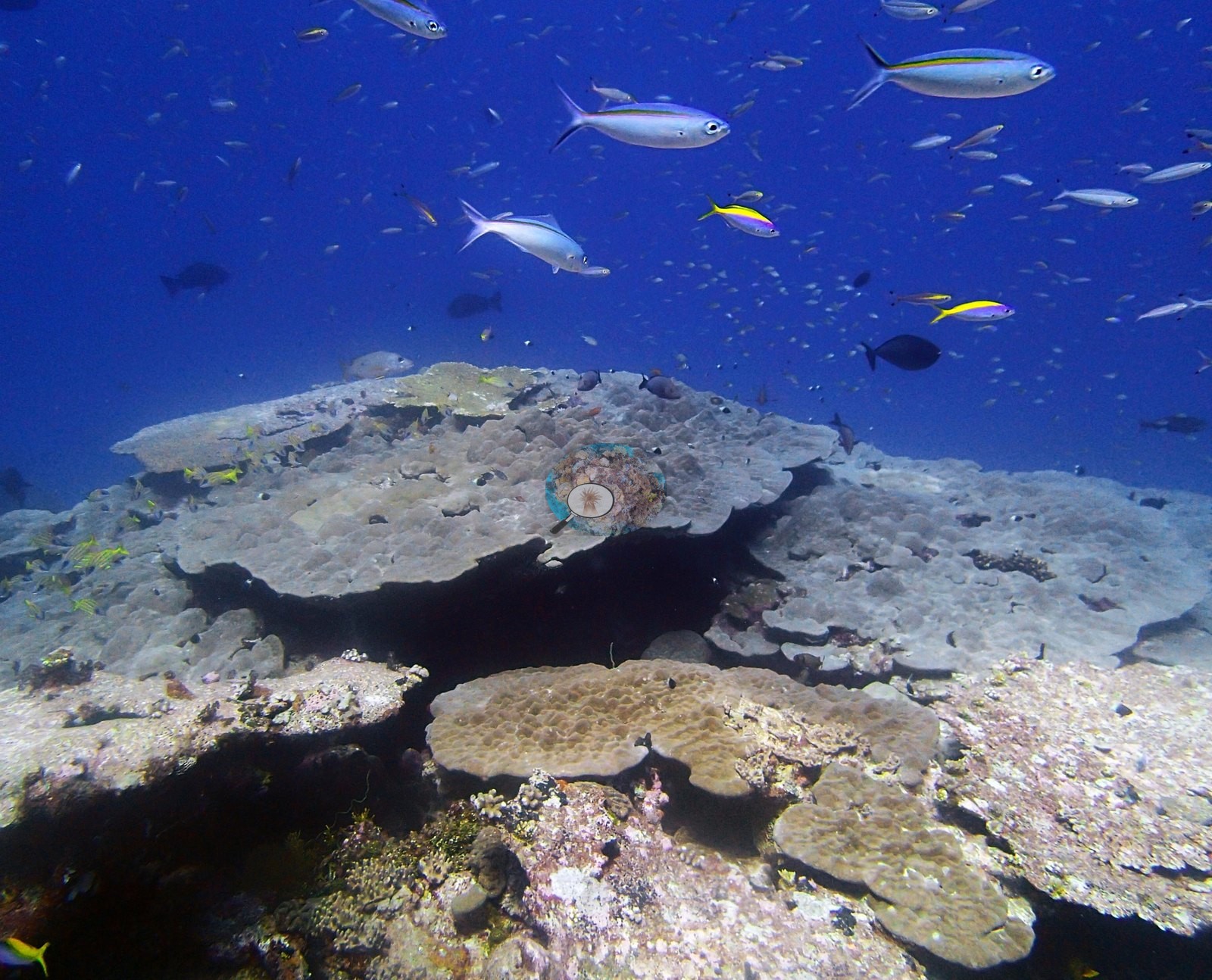
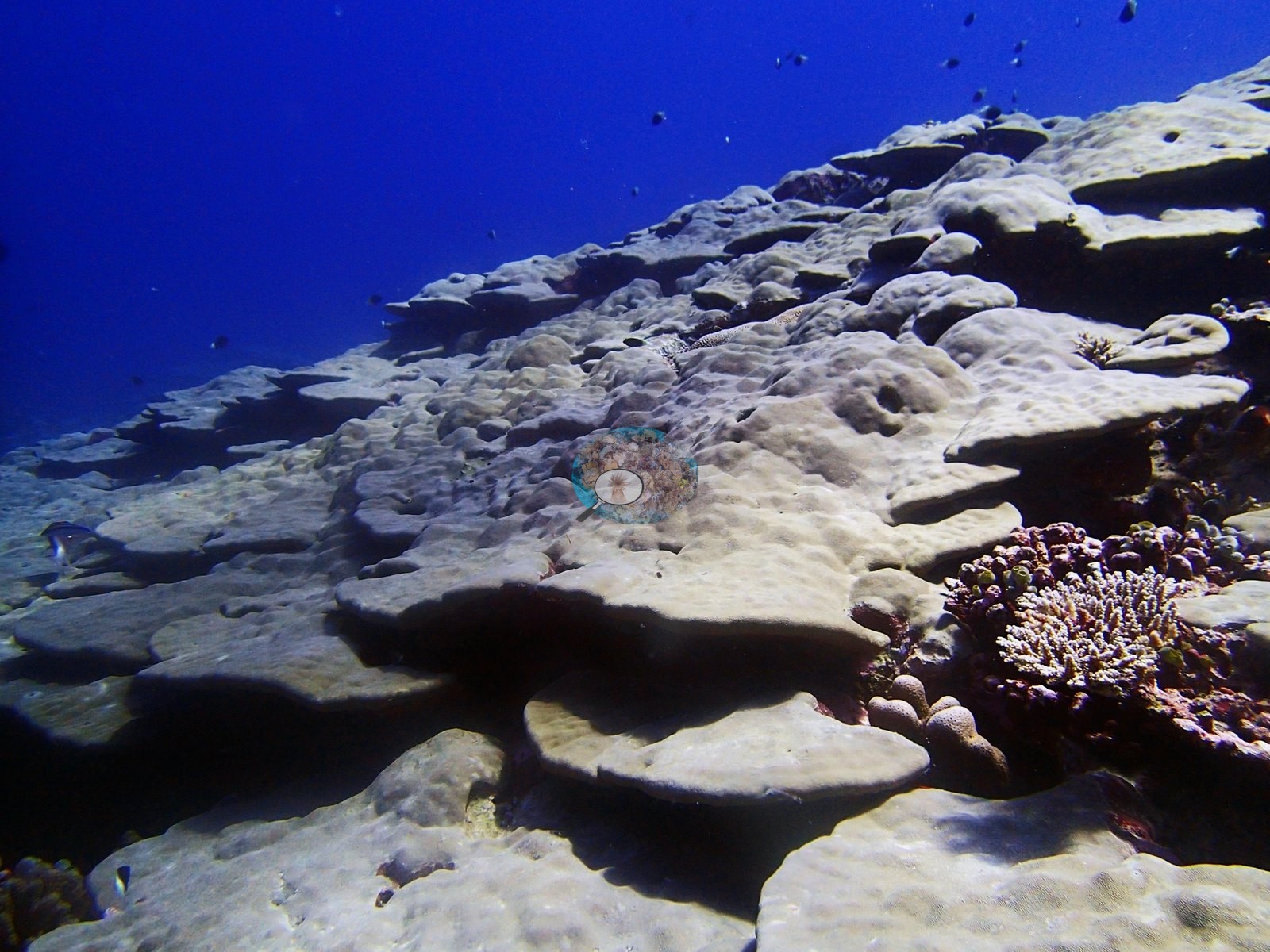
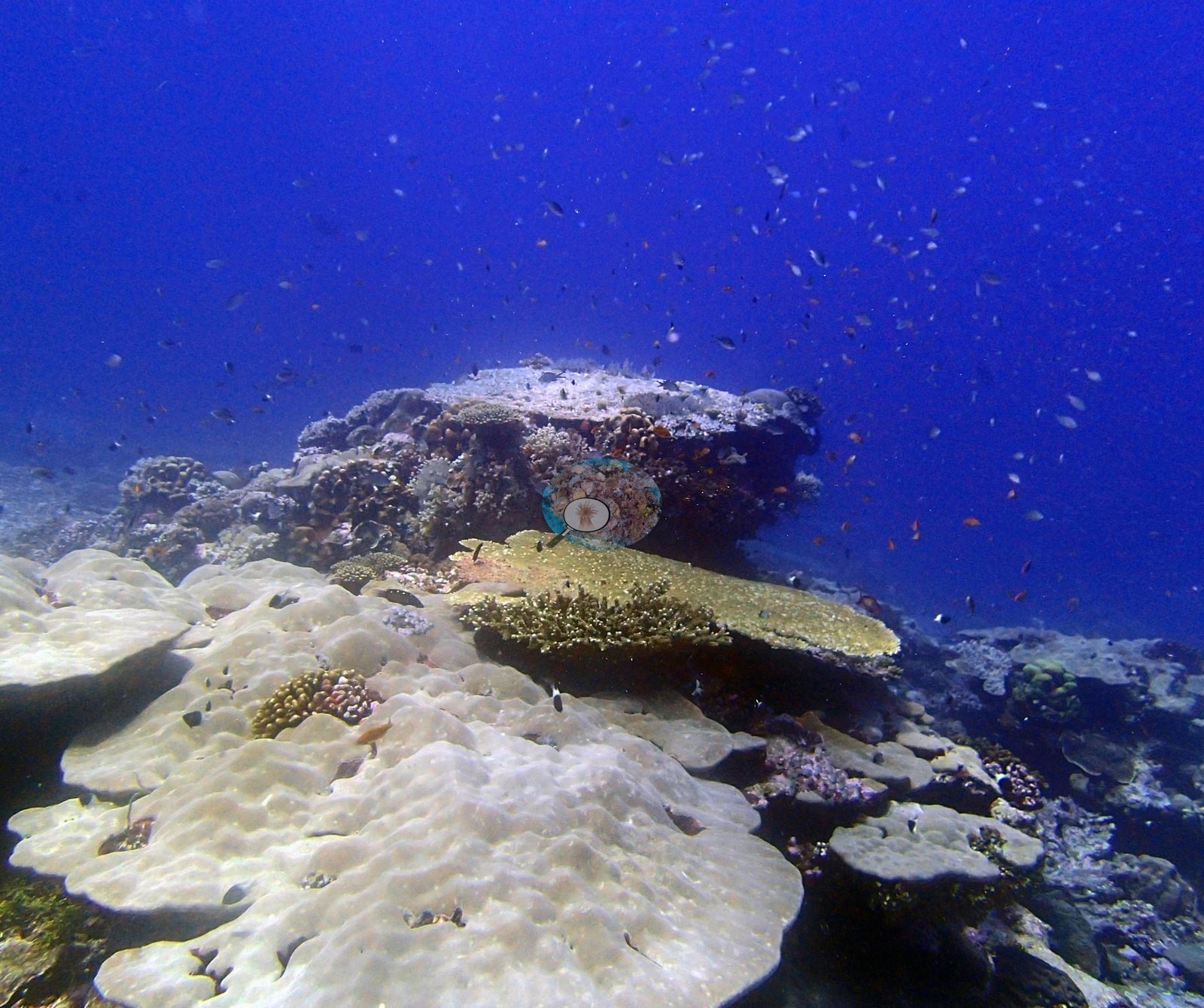
First, a plate-and-dome ground carried by large pale Porites. P3180469, P3180471, P3180473, P3180474, P3180475, P3180476, P3180510, and P3180511 are all built around broad cream-to-fawn laminar and lobate Porites – overlapping shingled plates a meter and more across, stacked down the slope, with small massives, mustard encrusting sheets, and occasional pink corymbose Acropora tucked between them. P3180475 shows the polyp texture clearly on one tan colony; P3180493 frames the underside of one such plate at close range.
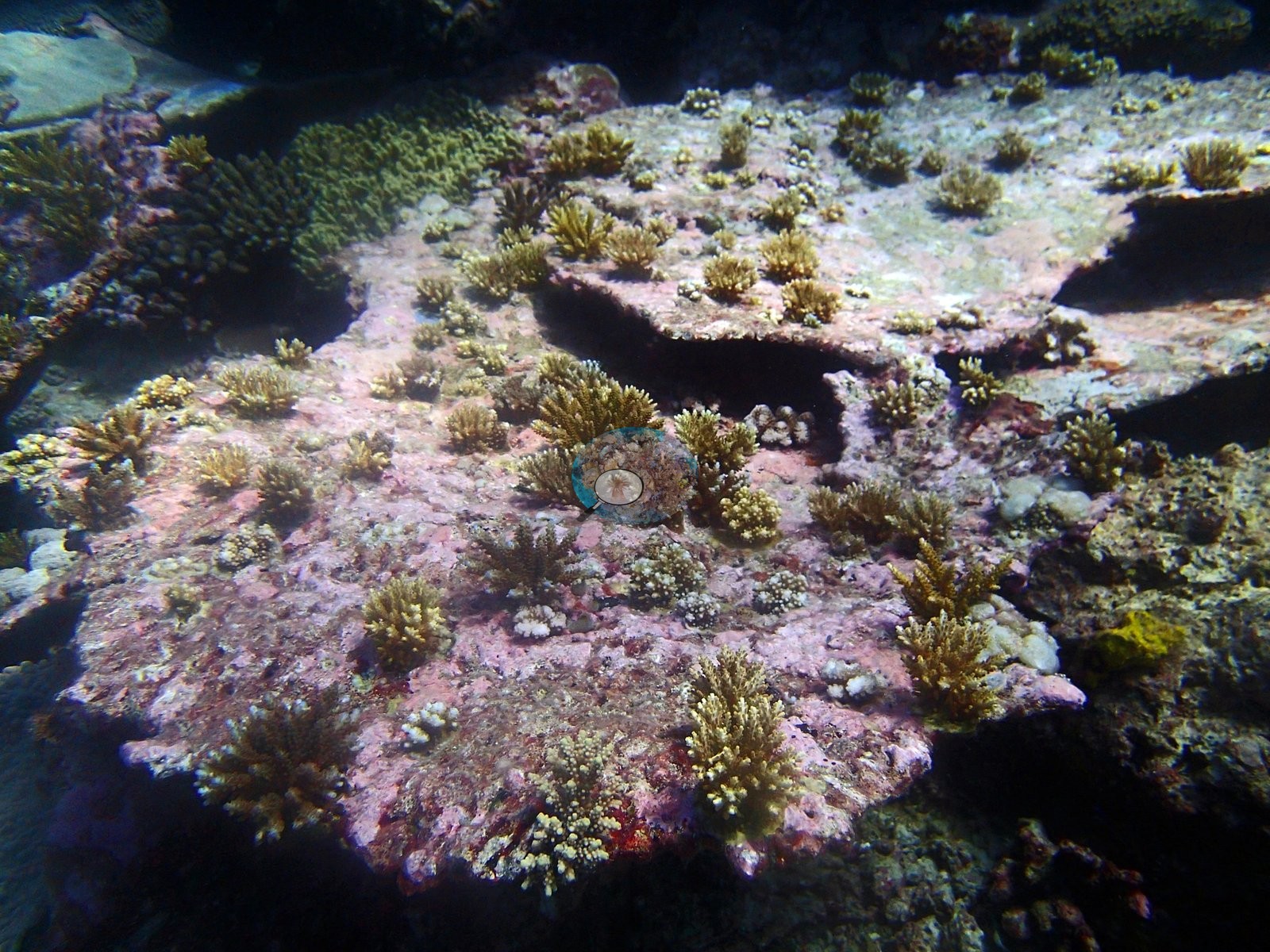
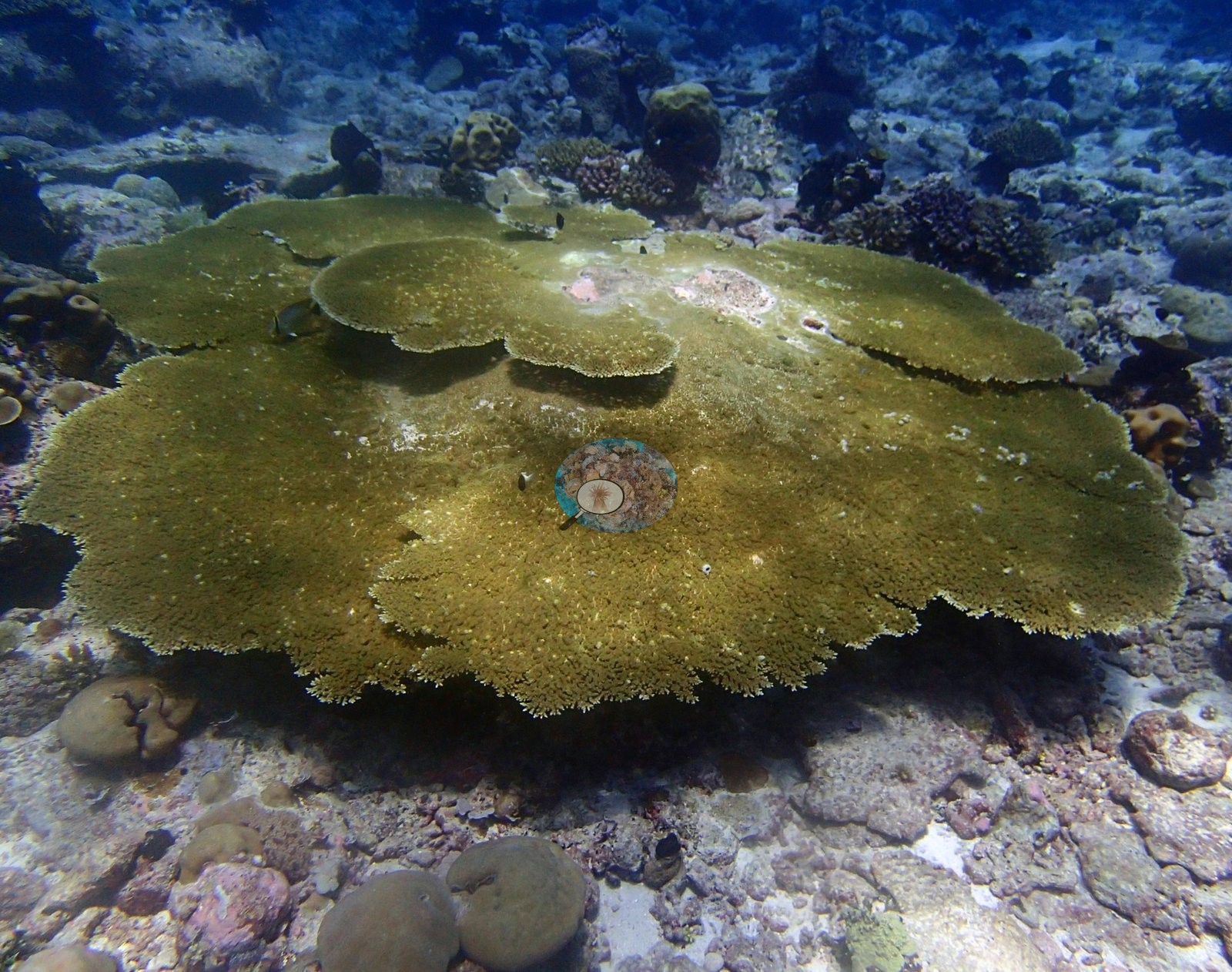
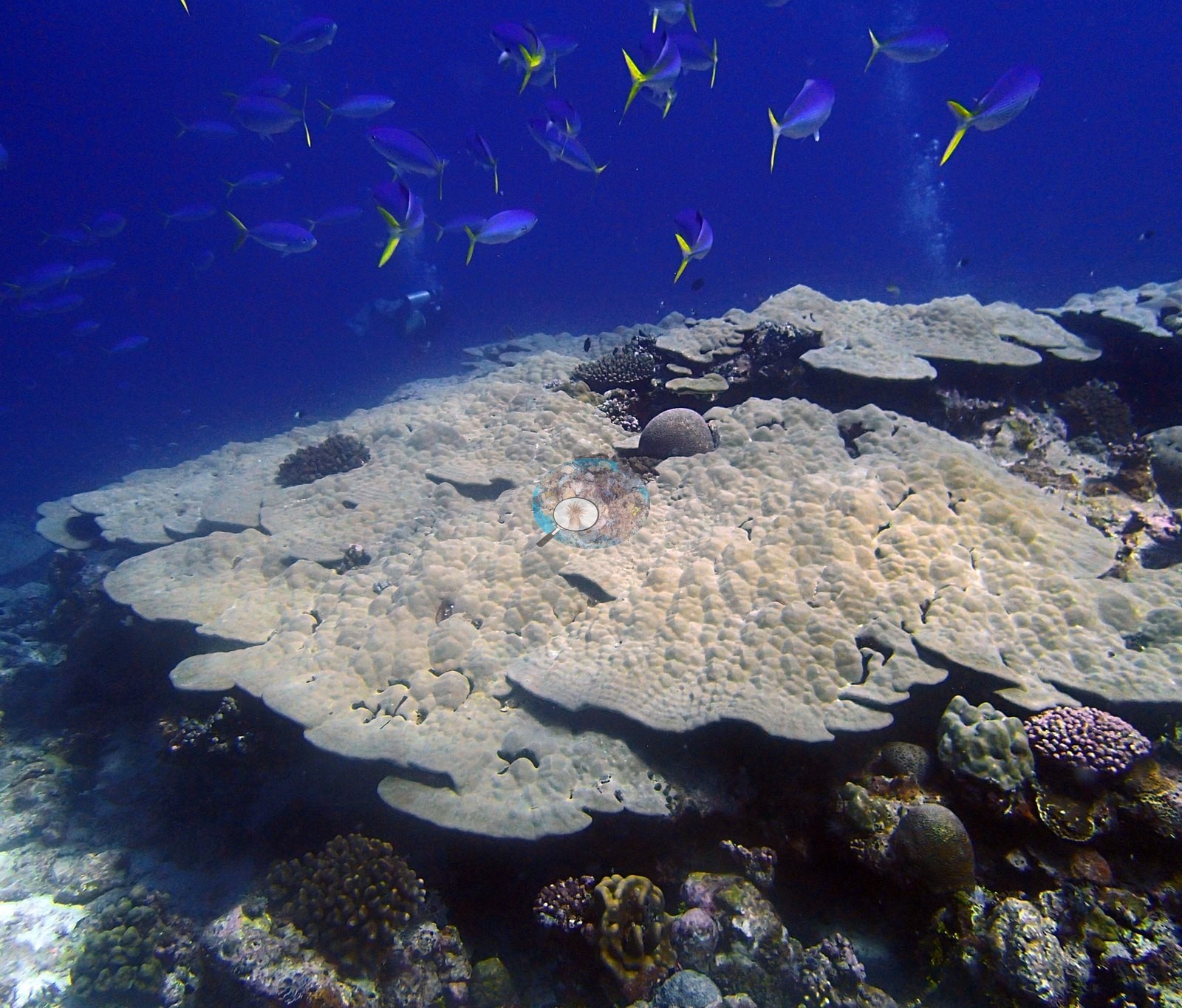
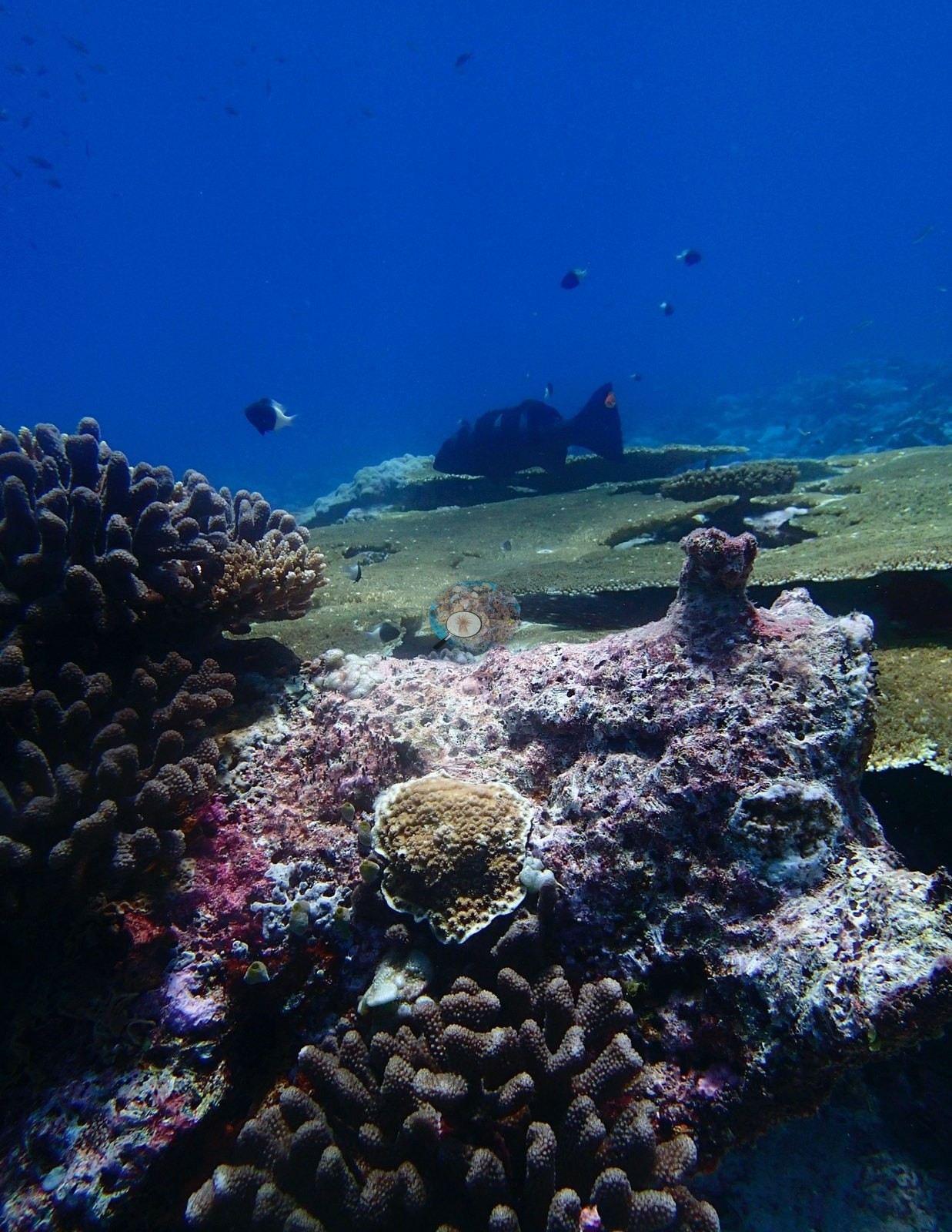
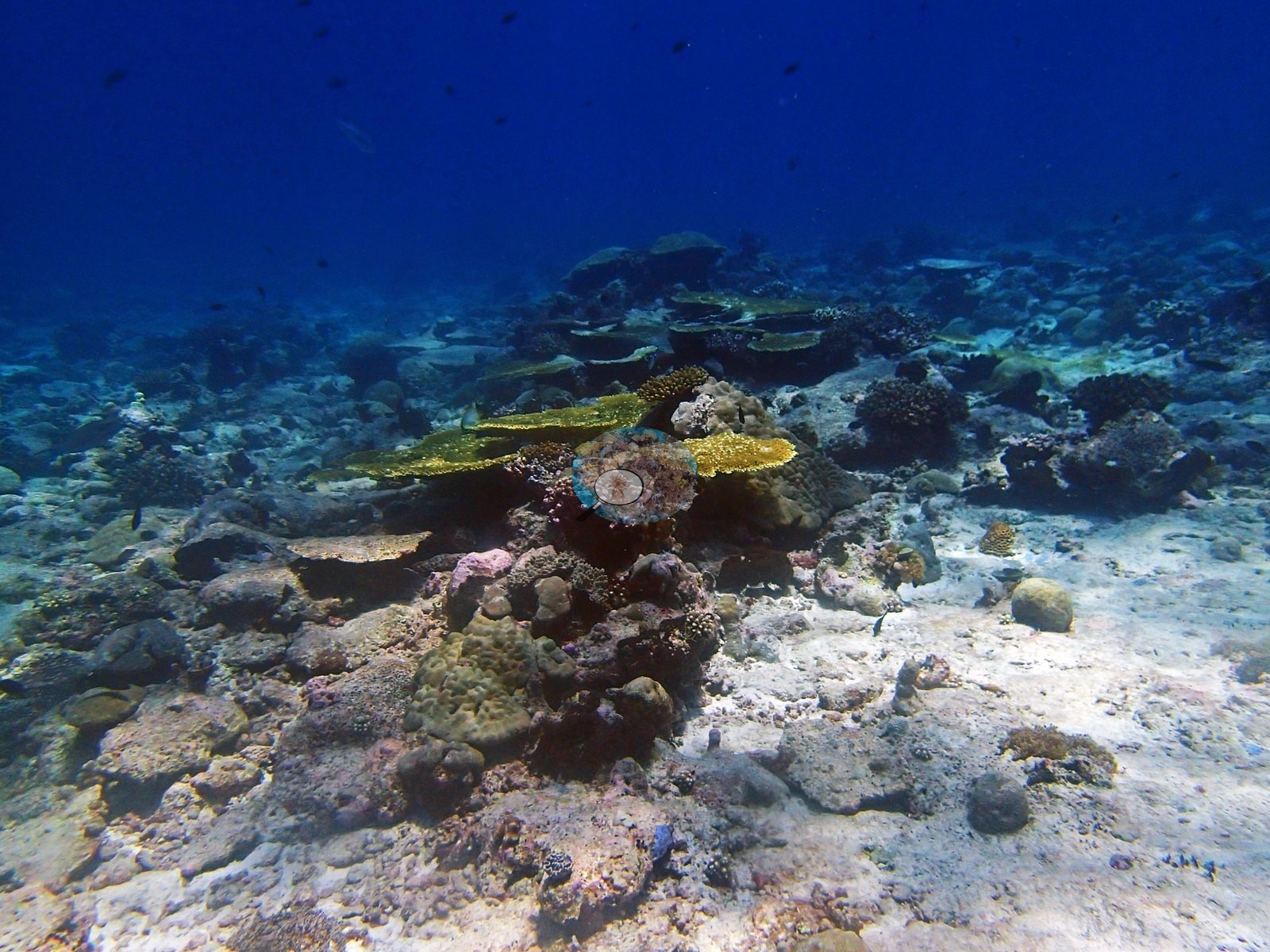
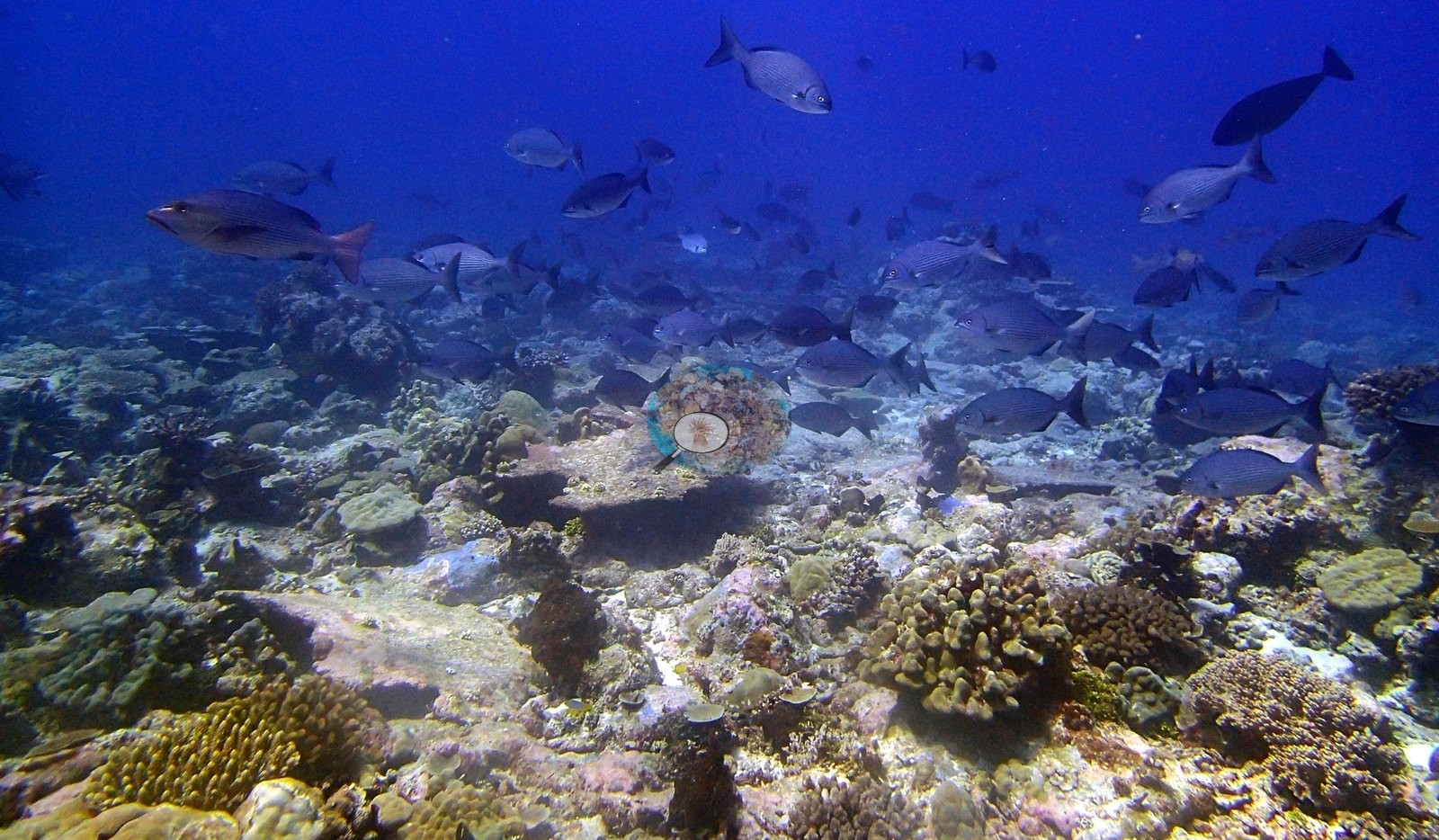
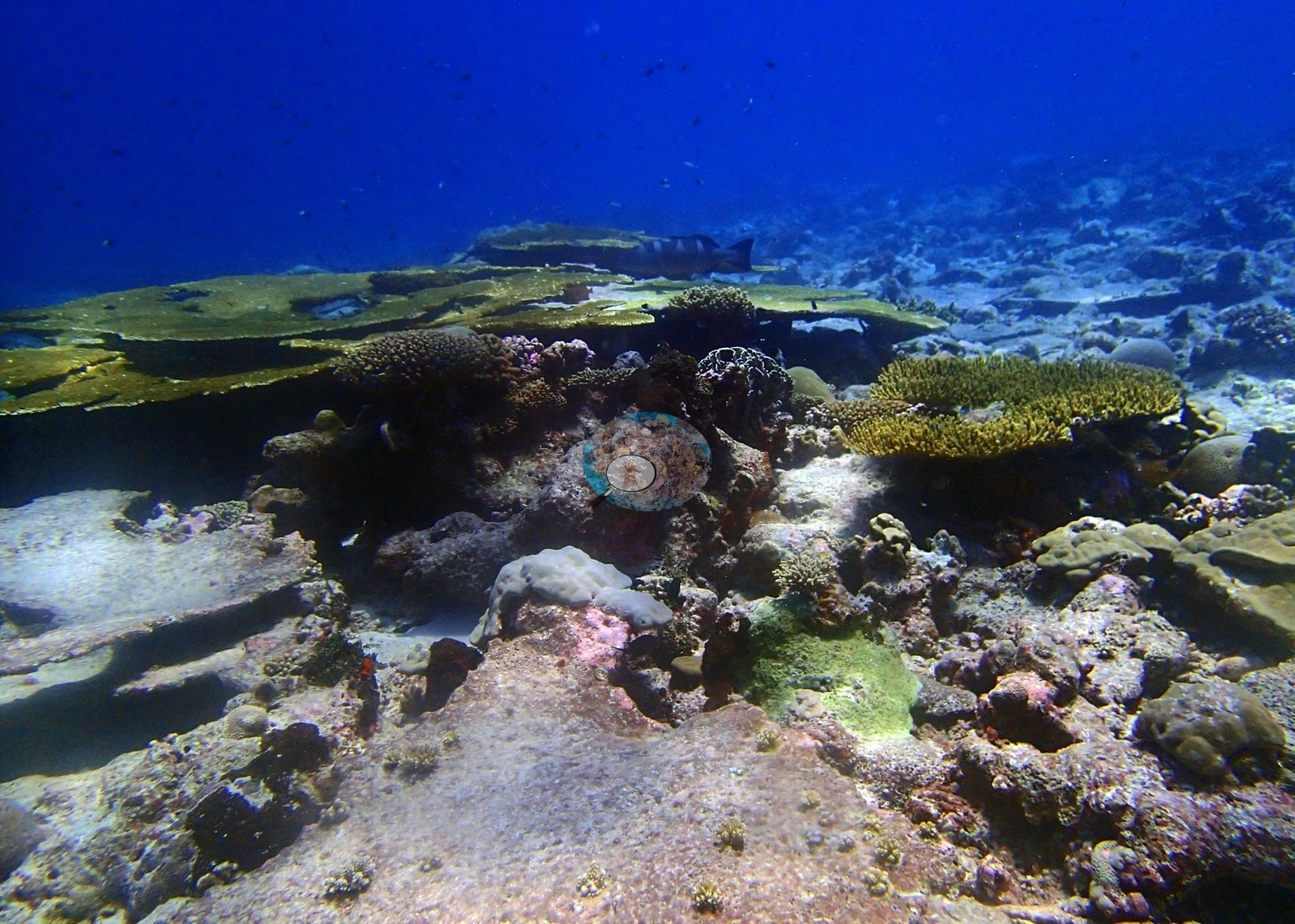
Second, a tabular-Acropora ground, and the Acropora here is present, large and healthy where it occurs. P3180526 is the signature frame – one olive-gold tabular plate two to three meters across standing alone over rubble pavement, margin unbroken, a small healed pale scar at the center. P3180537 is the best mixed frame: gold tables over tan lobed Porites with three large dark barred groupers behind. P3180477, P3180478, P3180505, P3180539, and P3180543 each carry one or more clean tables; in P3180478 the table's center is bare and algal-crusted while its margin is alive.
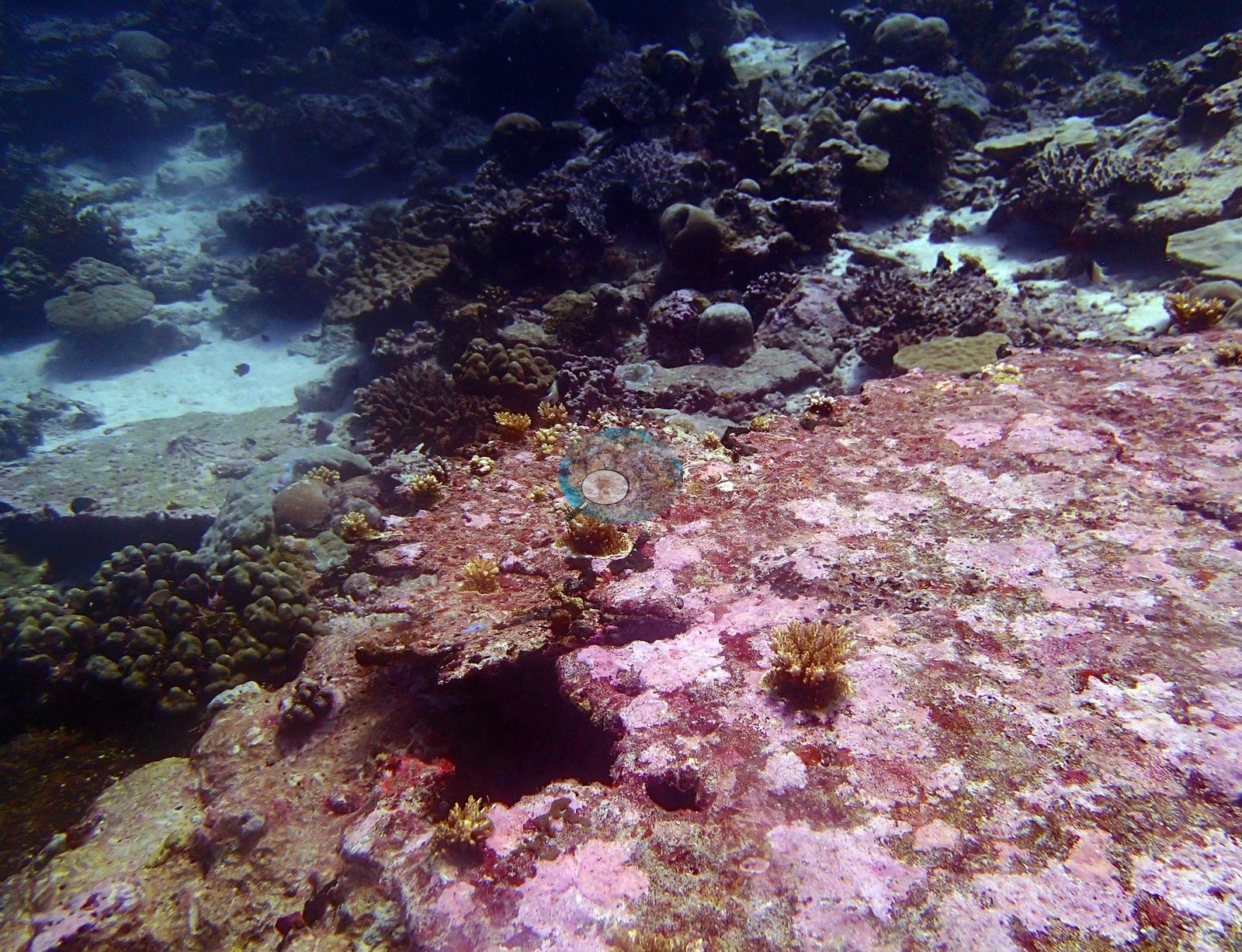
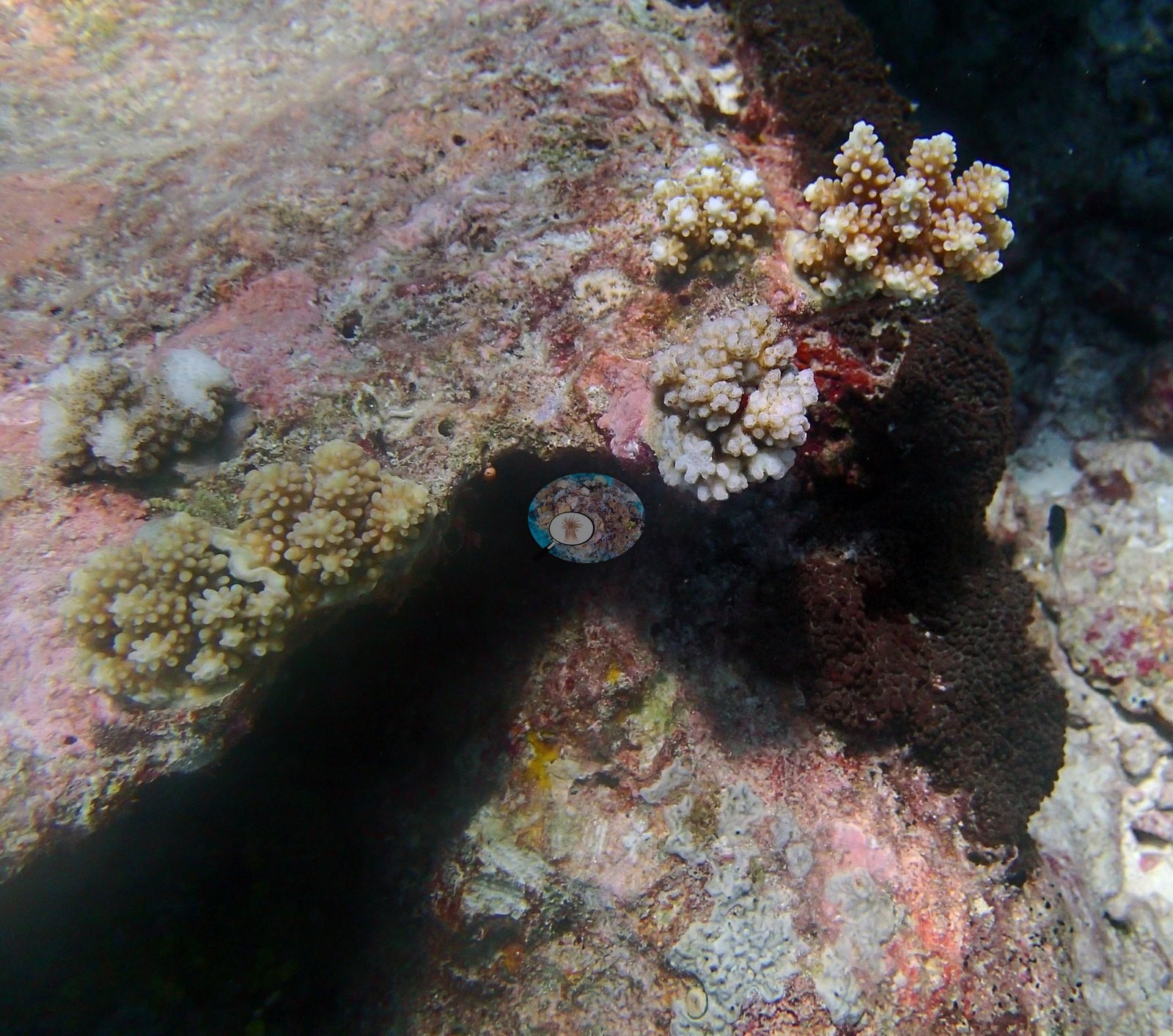
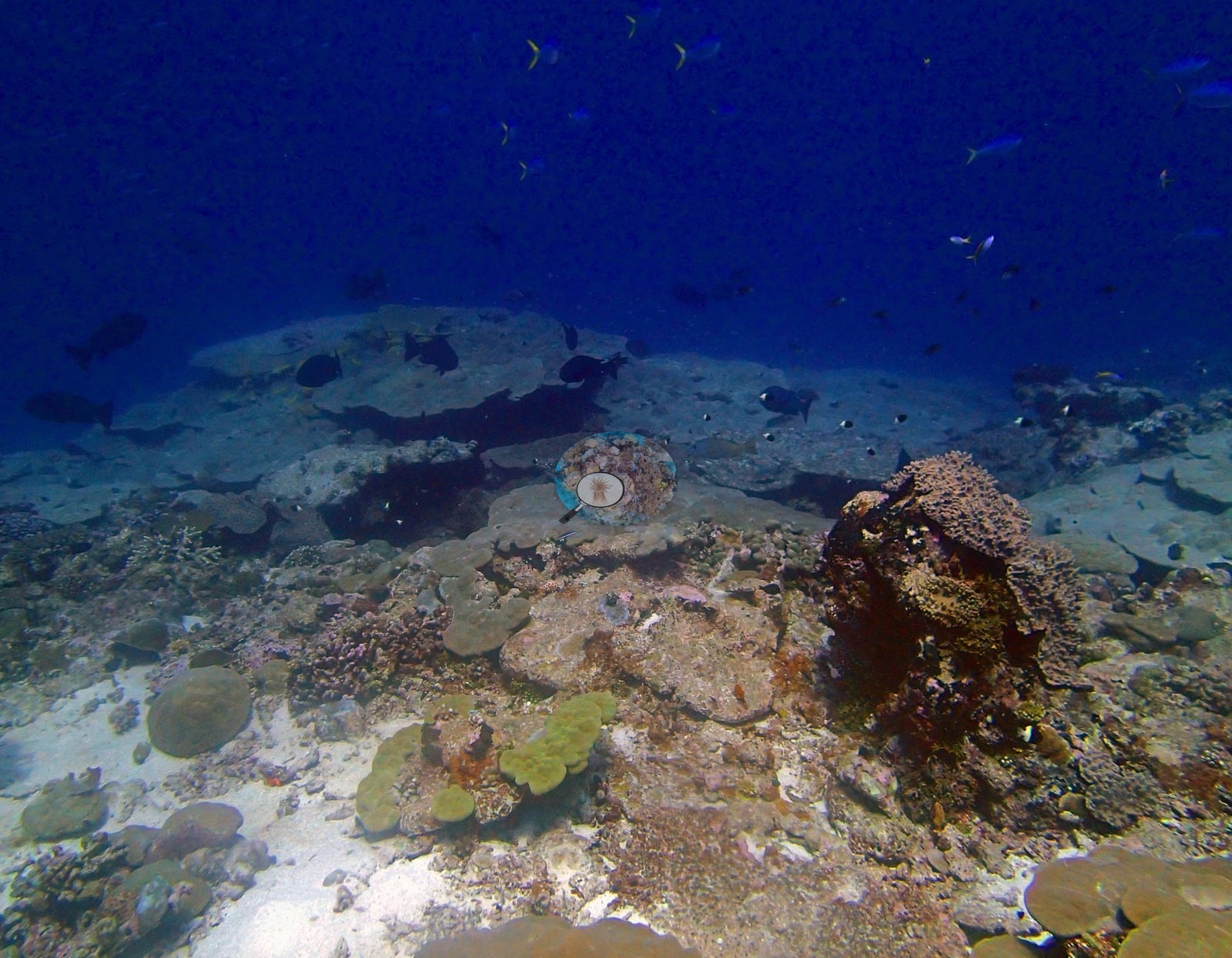
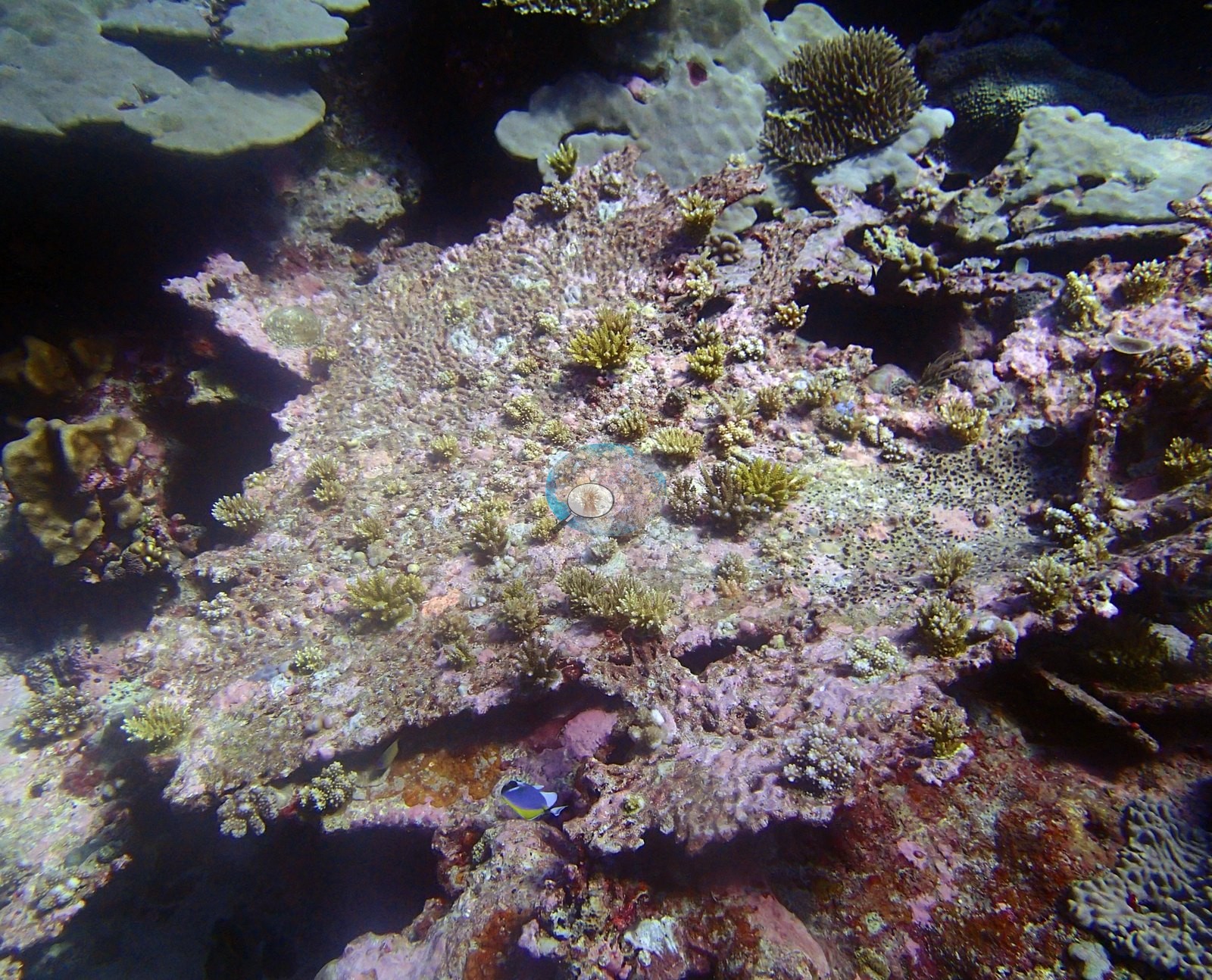
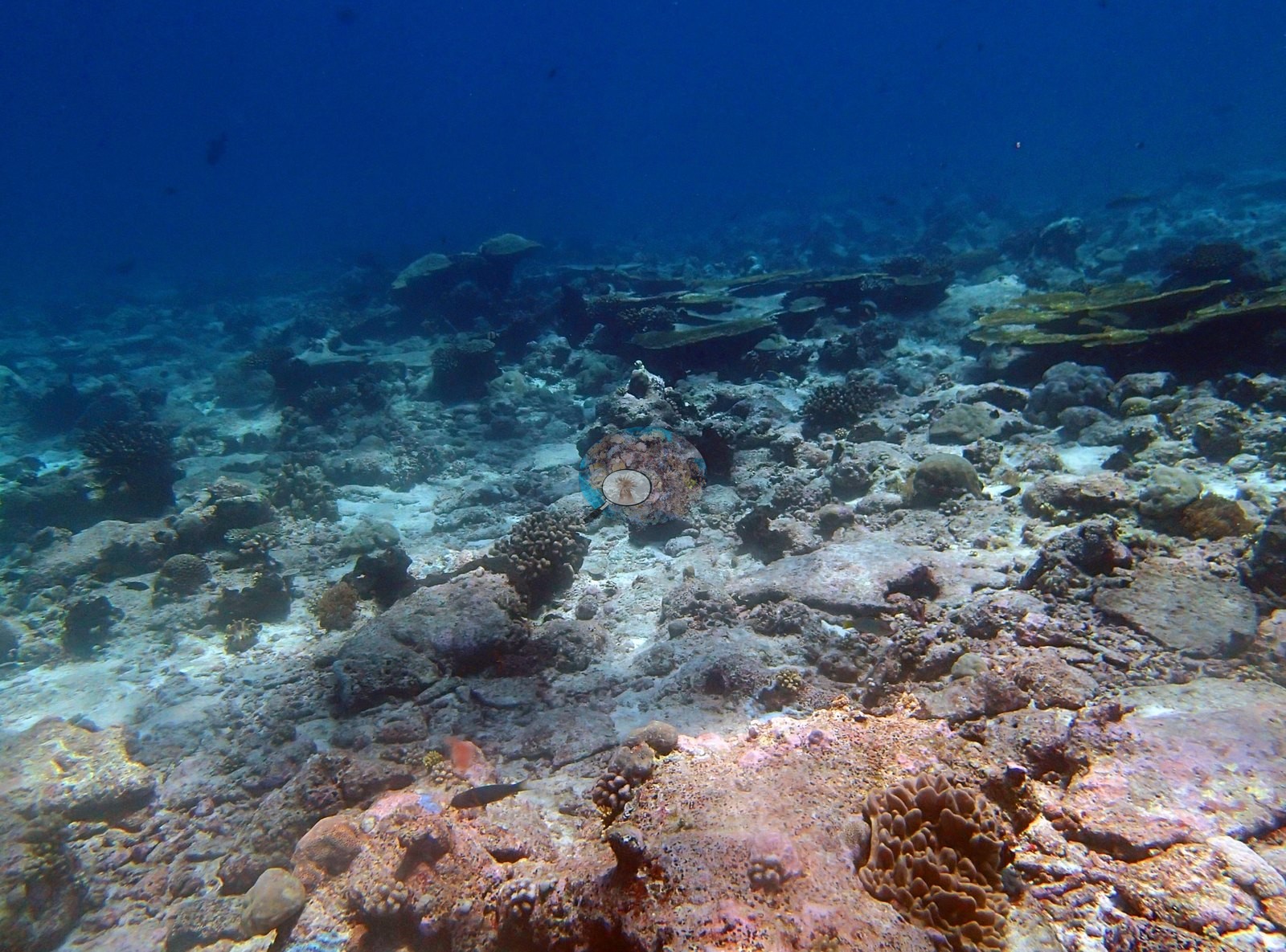
Third – and it takes up a large share of the swim – low-relief consolidated pavement, rubble and old dead tabular plates already resurfaced in maroon and pink crustose coralline algae. P3180502 states it most plainly: a broad sheet of pink-maroon coralline-crusted rock carrying nothing but a few tiny yellow Acropora recruits. P3180540 is a downward view of dead tables crusted maroon carrying only scattered tan Acropora recruits; P3180491, P3180516, P3180517, P3180527, P3180542, and P3180543 are the same ground at wide angle, and P3180518 puts a whitetip reef shark (Triaenodon obesus) over a rubble plain with almost no coral in frame. This low-cover habitat is real and is not an artifact of the photography – roughly a third of the swim crosses it, and it is part of what this reef is. Set against it, P3180504, P3180512, P3180514, and P3180519 are the mosaic frames: dense fields of small colonies packed shoulder to shoulder – mauve and pink pocilloporid clumps, corymbose Acropora, tan Porites knobs, faviids, yellow-green foliose, and Montipora-type encrusting sheets, all fringed with pink coralline algae and turf. P3180541 is the close settlement frame – cream-tan branching recruits established directly on a coralline-crusted ledge beside dark encrusting coral, composed for settlement or size rather than for cover. Across all 49 the Coralscapes masks put live hard coral at 17.19% of image area, of which massive and meandroid is much the largest component at 53.4%; the rest breaks down as tabular Acropora 21.6%, other hard coral 12.7%, Acropora (non-tabular) 6.0% of live cover. The independent 30-point annotation of the same frames (1470 points) gives live hard coral as 20.3% of all points and apportions it Porites 52.3%, Acropora 36.6%, other hard coral 10.1%, Pocillopora 1.0% of live coral — the only Porites-dominated assemblage of the redo so far. Non-coral cover is dominated by turf 14.5% and crustose coralline algae 6.8% of all points.
Coral cover
The LOF benthic transect is this site's measurement. Coral cover at BITB29 (North Brother, Three Brothers, Great Chagos Bank west, dived 18 March 2015) is 30.2% live hard coral, from the LOF BIOT-1 in situ transects (Mayfield & Dempsey 2026, Oceans, suppl. S1), against algal cover of 50.7% of the benthos. That diver-transect survey is the authoritative record of cover and community here. The computer-vision products and the frame-by-frame account below supplement it. No cover value may be read off a photograph, no image-derived product overrides the transect, and nothing in the imagery qualifies or revises it.
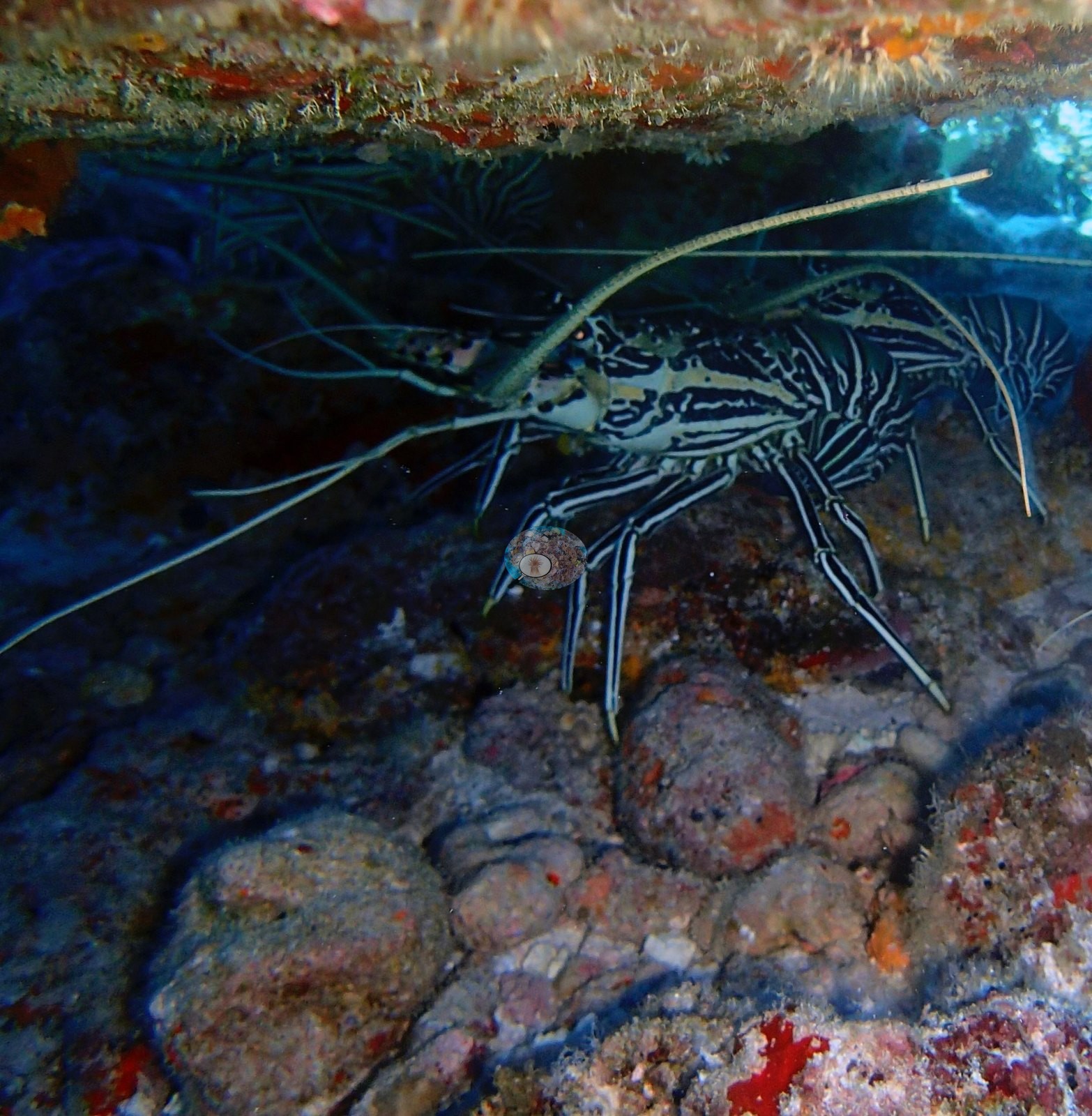
Method comparison – transects, points and masks. This is one of the few Chagos sites where the paired image audit rests on the FULL frame set – all 49 frames, unlike its Three Brothers neighbors. Across methods the same reef reads transects 30.2% · CoralNet points 20.3% · Coralscapes masks 17.2% (49 frames). Both image products read below the transect, the expected direction at a mid-to-high-cover site. Second, the last eight frames of the dive are a lobster den under a ledge, and they are 16% of the CV sample: composed on animals in shadow rather than on substrate, they run a mean Unknown fraction of 46.7% against 29.4% elsewhere, mask cover near zero, and they carry 9 of the site's 20 bleached points (flag 4). Those frames are in the denominator of every image statistic above. These products have different sampling footprints and denominators and should not be averaged; the 30.2% transect stands as the site's cover value. Frame-to-frame live cover runs 0% to 60.0% (P3180493 highest-cover, P3180544 poorest). Coral cover: 30%. Live hard coral measured on the in situ benthic transects of the LOF BIOT-1 expedition (Mayfield & Dempsey 2026, Oceans, supplemental S1), against algal cover of 50.7% of the benthos. The transect figure is this site's authoritative cover value; no image-derived product overrides it. Across methods the same reef reads: transects 30.2% · CoralNet points 20.3% · Coralscapes masks 17.2% (49 frames). These products have different sampling footprints and denominators and should not be averaged.
Stressors
Structural loss here is old rather than acute. The dead plates are already coralline-resurfaced and carrying recruits, and there are no crown-of-thorns, no disease lesions and no fresh predation scars in any of the 49 frames. Survey apparatus appears once: a thin yellow survey line runs across the lower part of P3180508 – the only apparatus visible in the whole set.
Condition. The one condition question the imagery cannot settle here is bleaching. The cream color of the big Porites plates in P3180469, P3180471, P3180474, and P3180510 is the dive's dominant visual impression, and it is not photographically separable from paling – Chagos Porites is often this color at depth. P3180539 holds one distinctly cream-white massive dome among normally pigmented neighbors. Beyond that the reef reads as pigmented. No bleaching percentage is estimated from these frames and none is tested against them; Anderson's published per-site percentage bleached is the authoritative figure for this reef. The 20 bleached points in the annotation are a property of the point set – and 9 of them fall in the eight under-ledge lobster macros, where there is essentially no coral in frame at all.
One taxonomic note. The CRD site page records that Seriatopora spp. WERE present here and three colonies (ChSe06–08) were sampled, plus other pocilloporids for a collaborator – one of the few Chagos sites where it was found. Nothing in the 49 frames unambiguously shows it: the fine-branched pocilloporid clumps in P3180467, P3180512, P3180514, and P3180519 are compatible in habit, but at this resolution Seriatopora is not separable from small Pocillopora or Stylophora. The field record stands; the photographs neither confirm nor contradict it. Structural loss registers as dead coral 2.48% of image area and rubble 2.53%. Bleaching stands at 1.36% of annotated points — 20 points, mostly Acropora 0.95% — as a property of the point annotation itself; Anderson's published per-site bleached fraction is a separate, authoritative number and is neither derived from nor tested against these frames.
Fish and other fauna
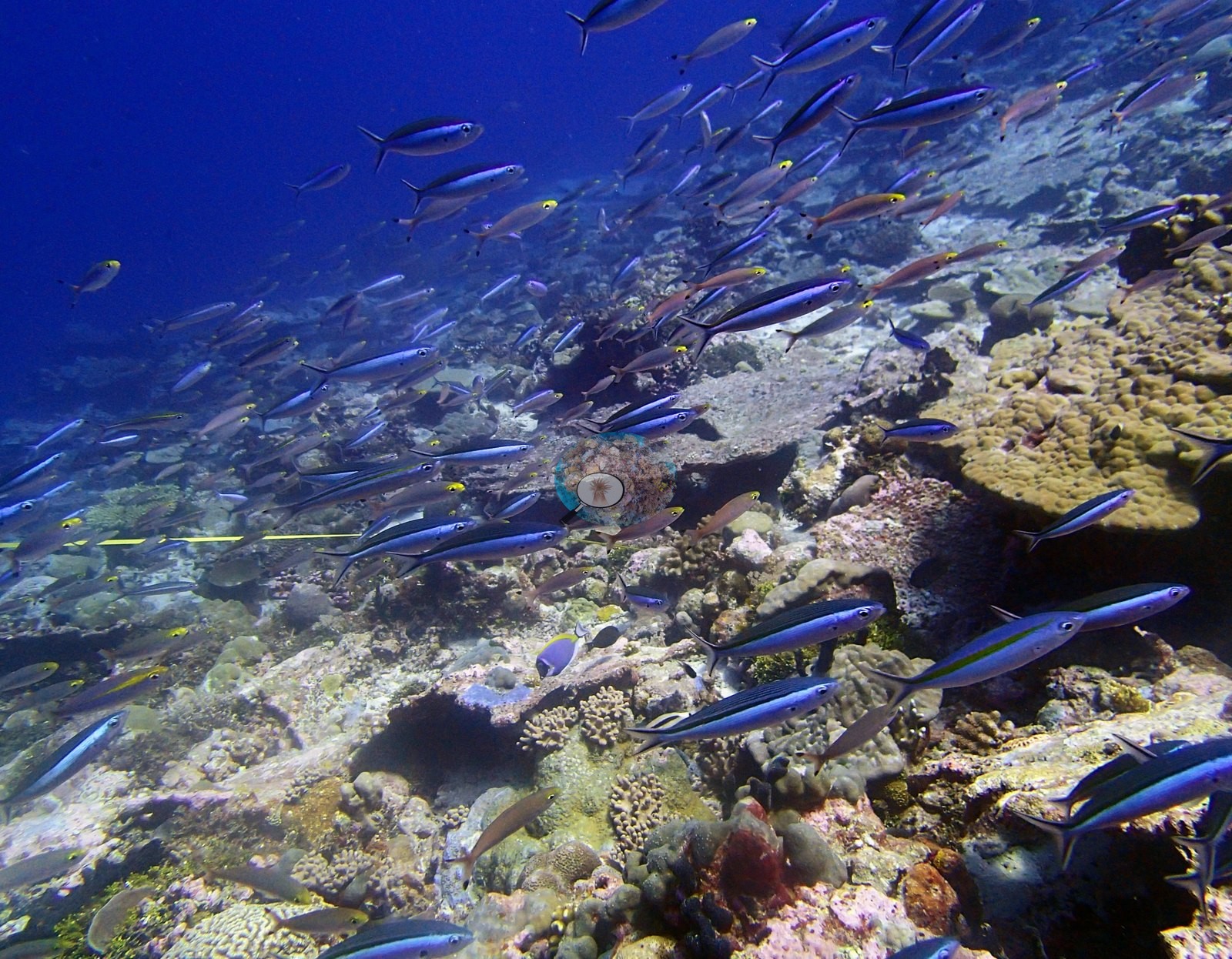
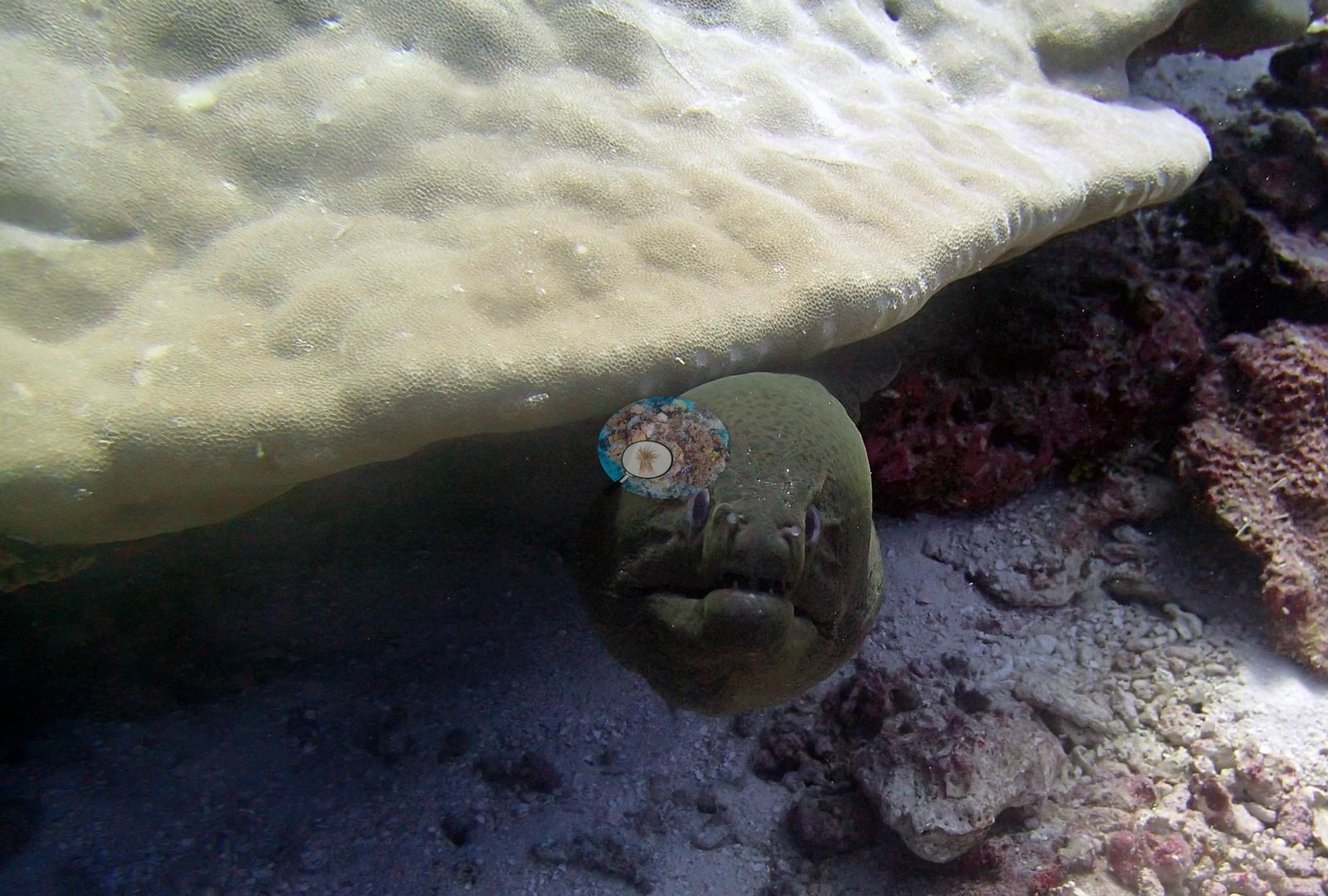
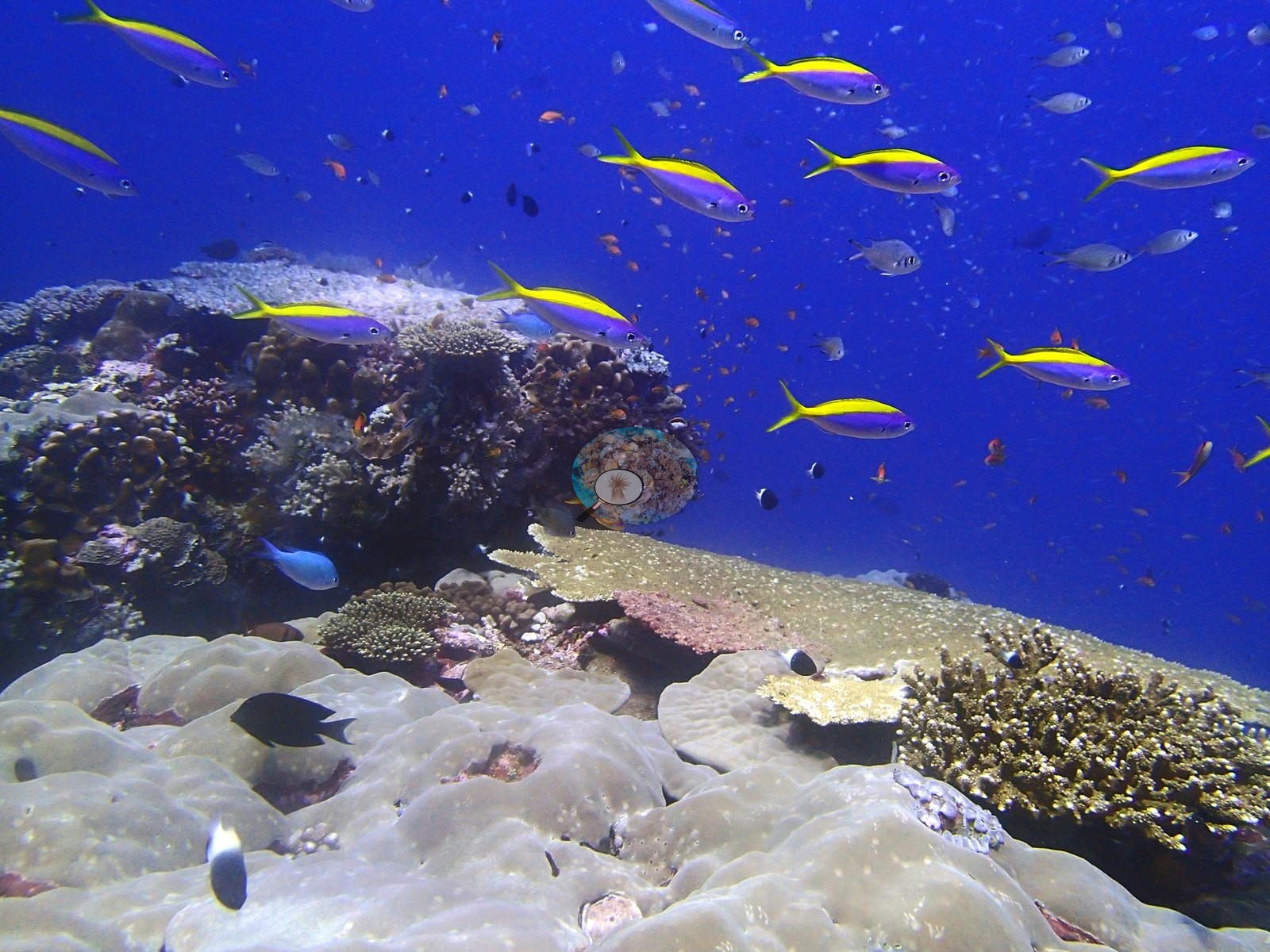
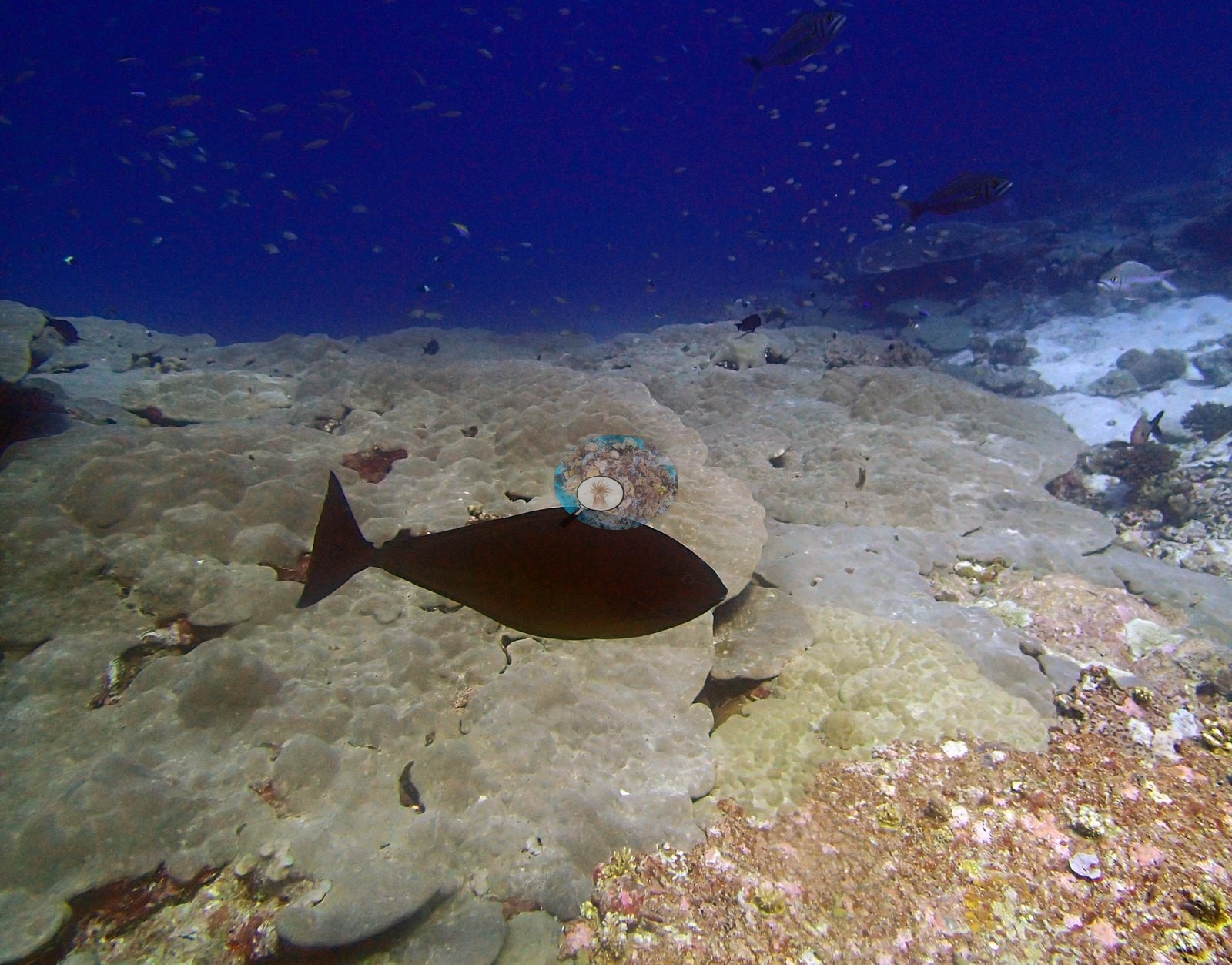
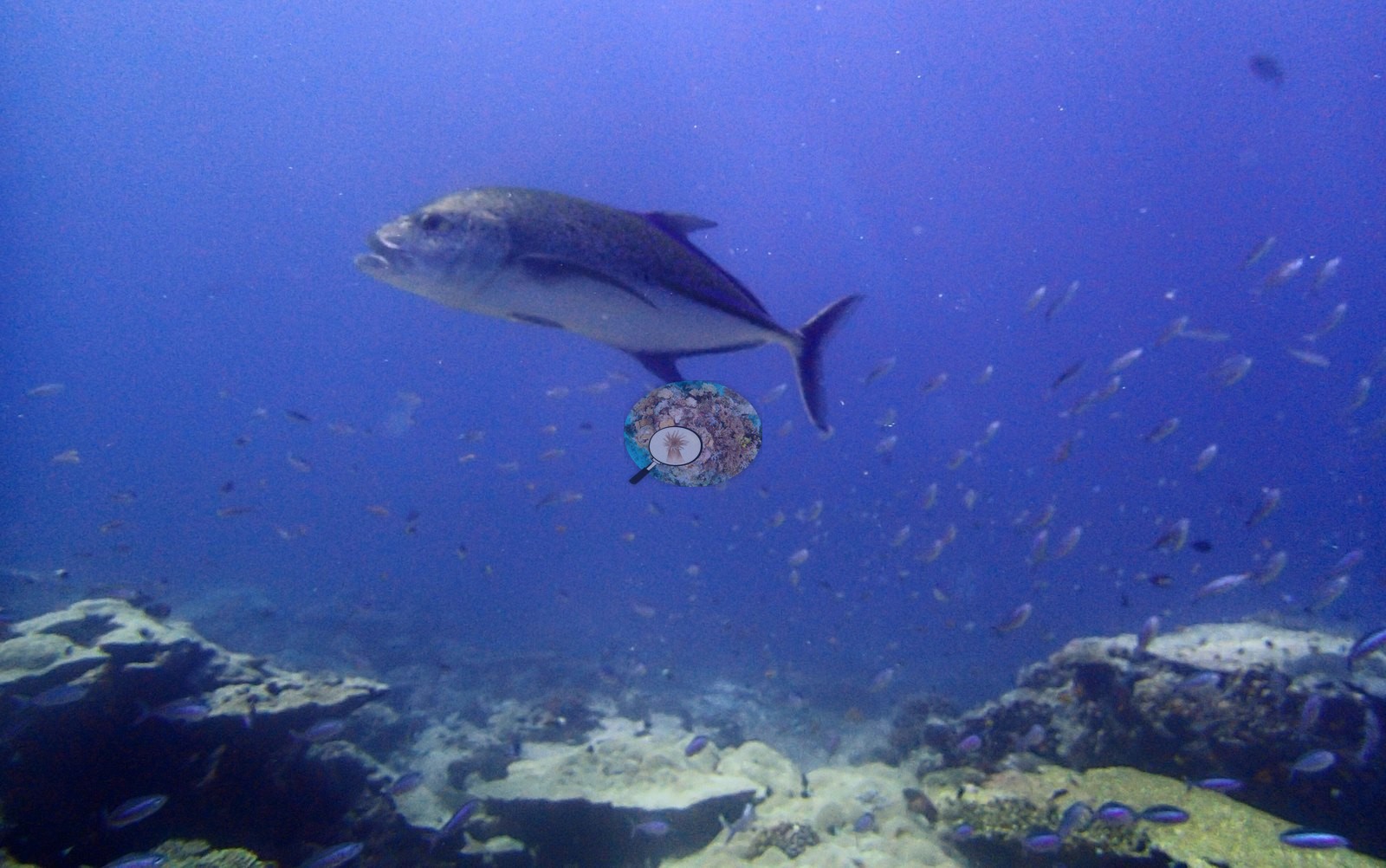
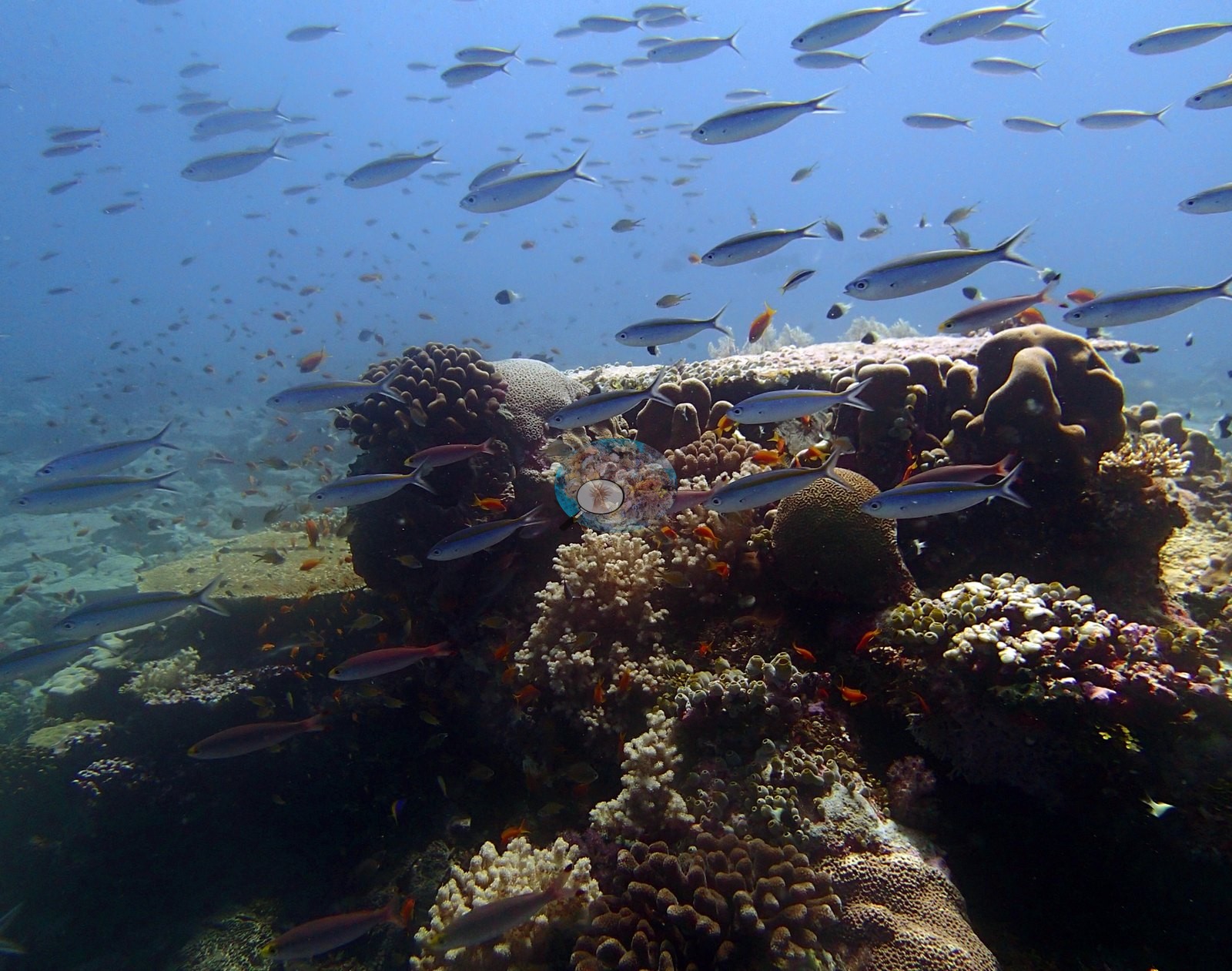
The macrofauna is the strongest of the Three Brothers series. P3180493 is the standout – a giant moray (Gymnothorax javanicus-type) looking out from beneath a broad pale Porites plate, in the highest-cover frame at the site. P3180509 holds a large silver jack in open blue water, compatible with Caranx ignobilis or C. melampygus, not callable at that range; P3180470 a heavy dark grouper with pale saddle bars, compatible with a dark-phase blacksaddled coralgrouper (Plectropomus laevis) – the same unresolvable animal as BITB27's P3170460. Beyond those: bluestripe snapper (Lutjanus kasmira) in P3180500; powder-blue surgeonfish (Acanthurus leucosternon) in P3180508, P3180511 and P3180515; yellowback fusiliers compatible with Caesio xanthonota in P3180470, P3180503 and P3180506, with further blue-and-yellow fusiliers in P3180471, P3180473, P3180508, and P3180511; a rudderfish or dark snapper school compatible with Kyphosus in P3180517; dense orange anthias in P3180503, P3180504 and P3180505; and a large gorgonian sea fan beside a table in P3180500. Sponges register in 29 of the 49 frames, giant clams in 2, urchins in 2 and sea cucumbers in 2.
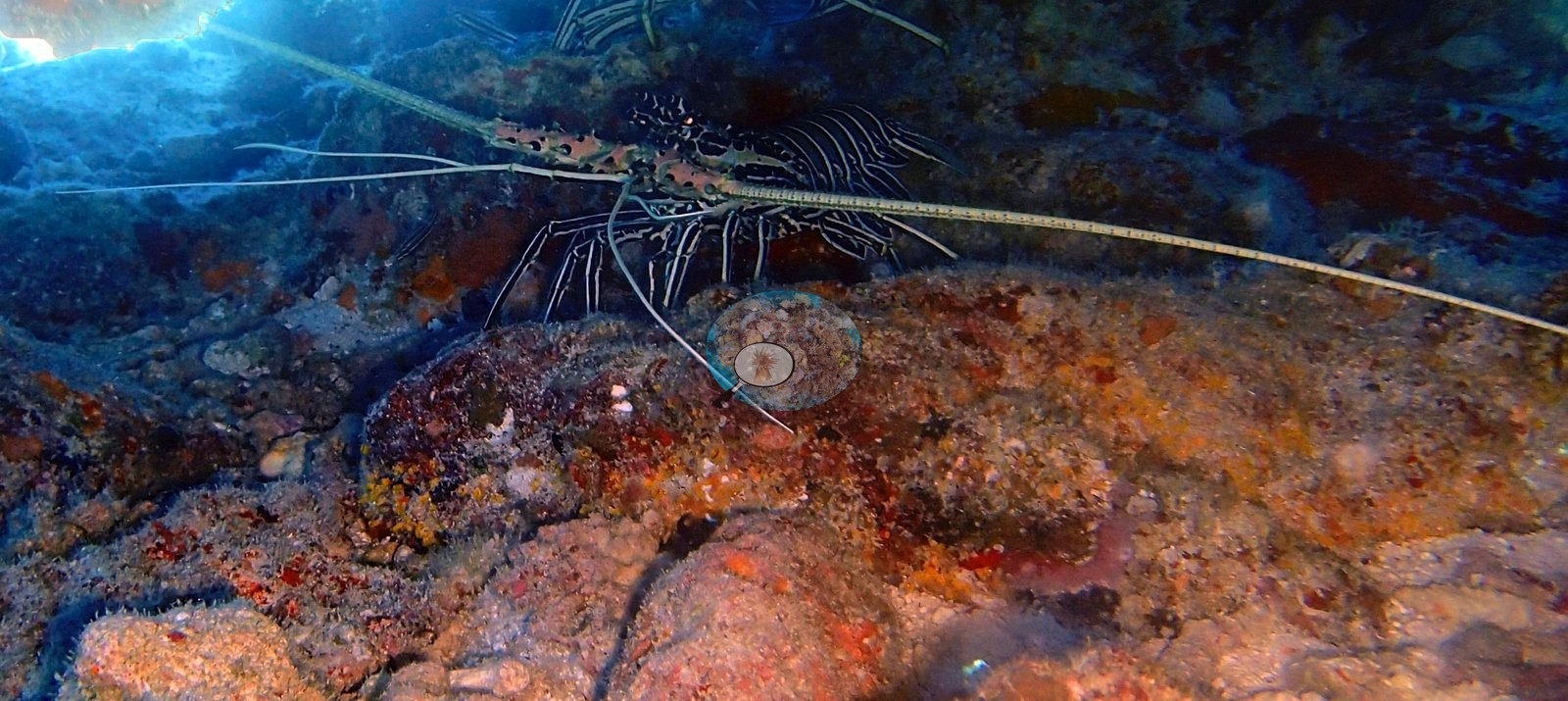
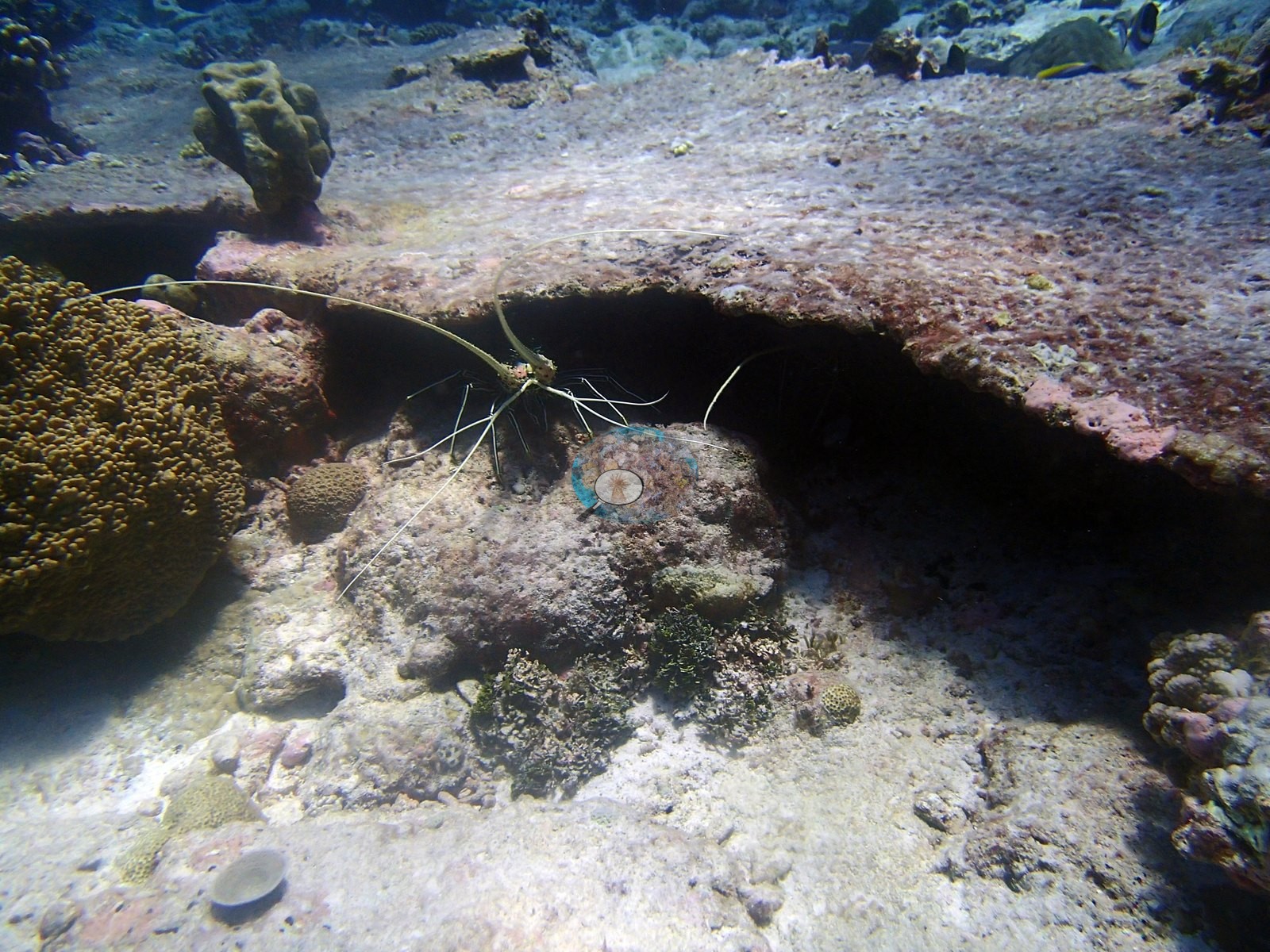
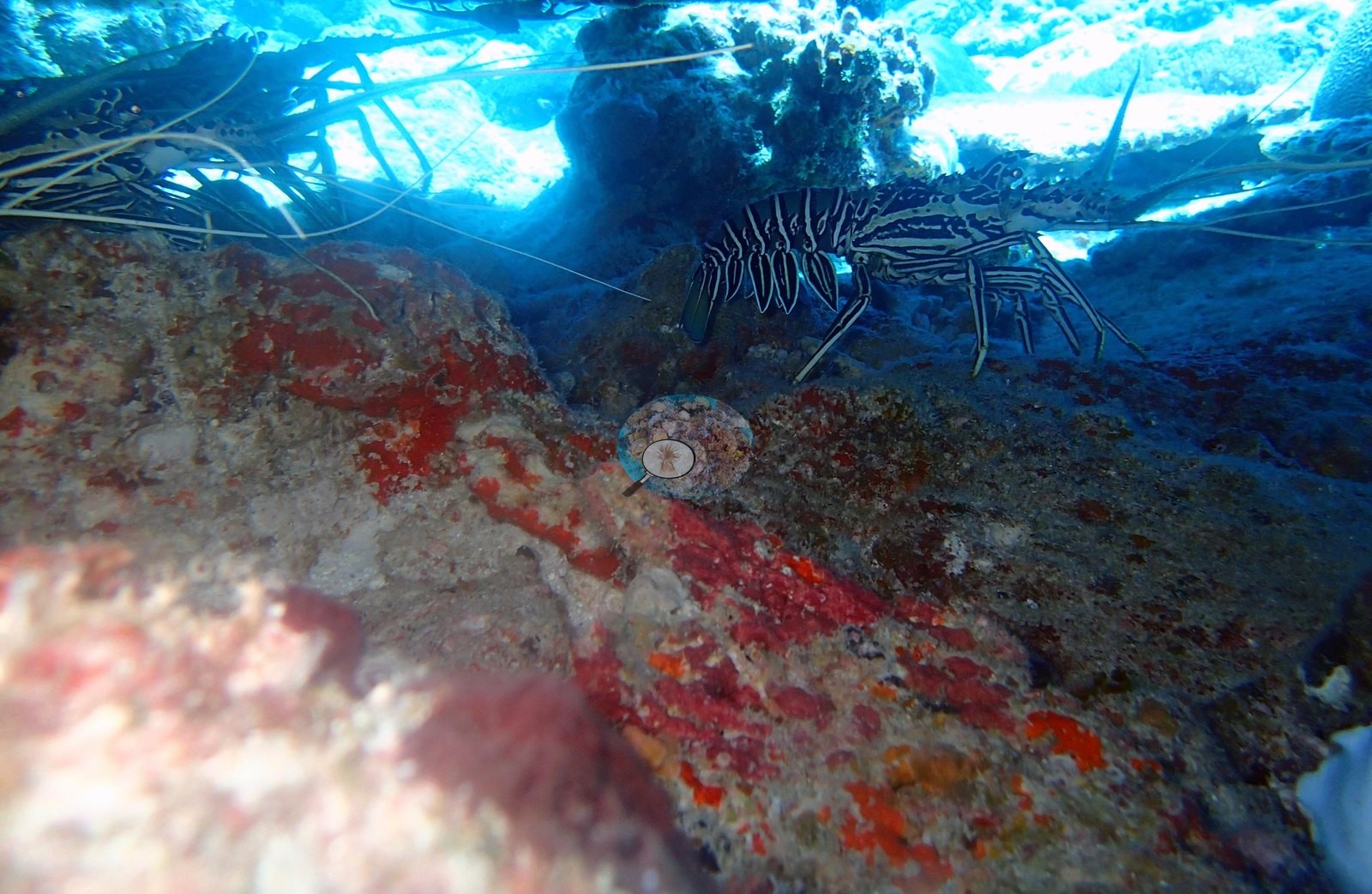
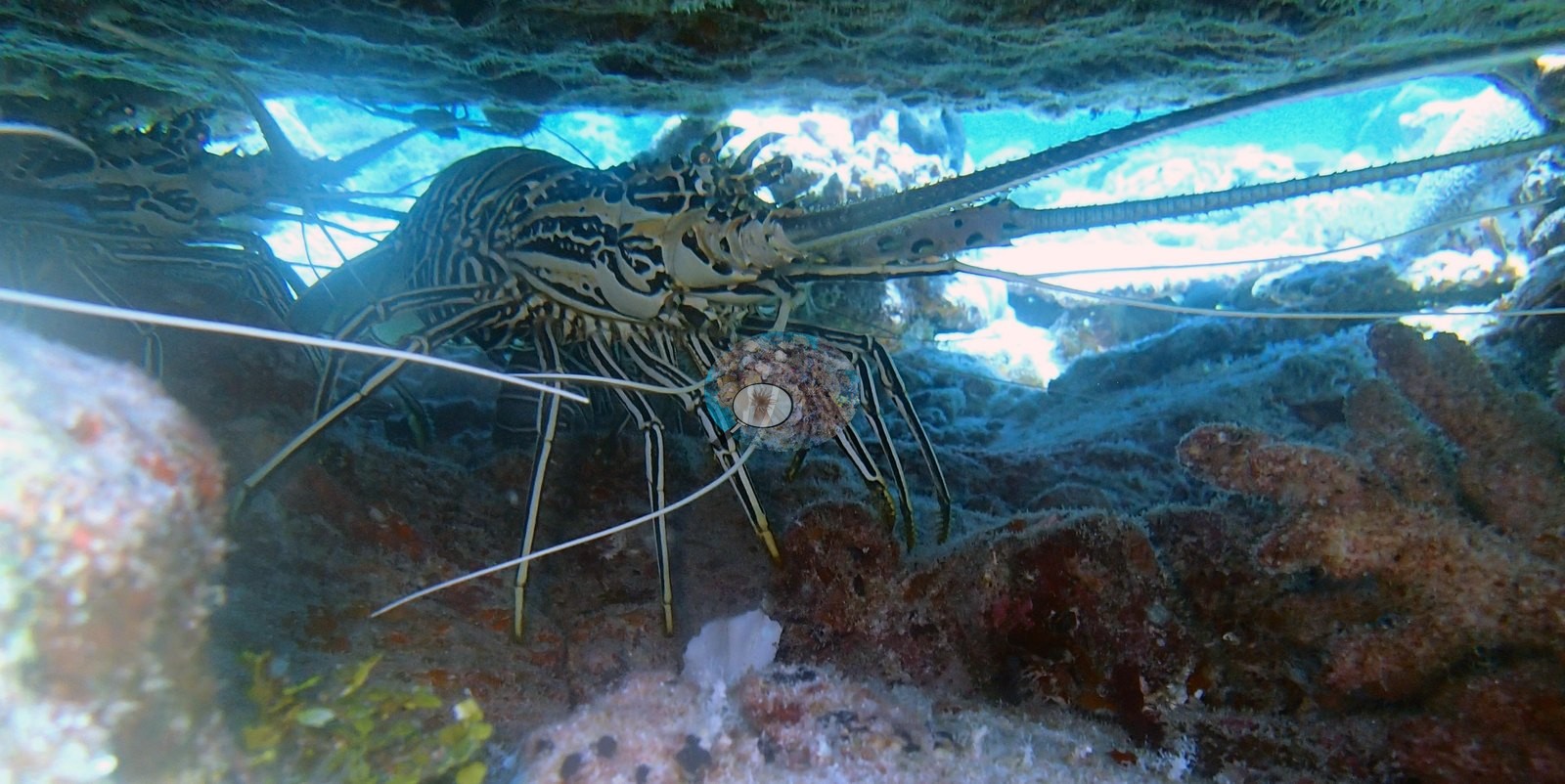
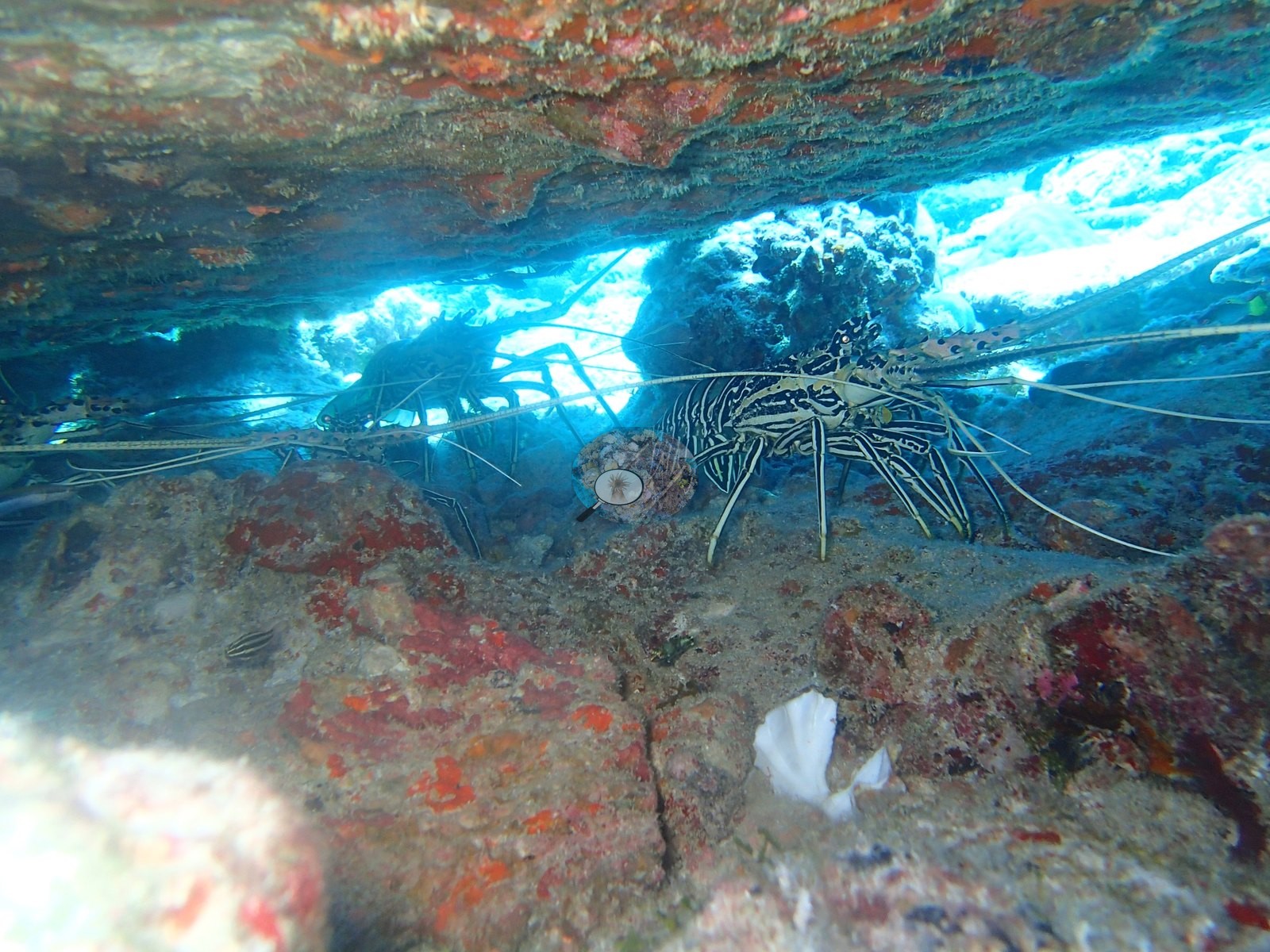
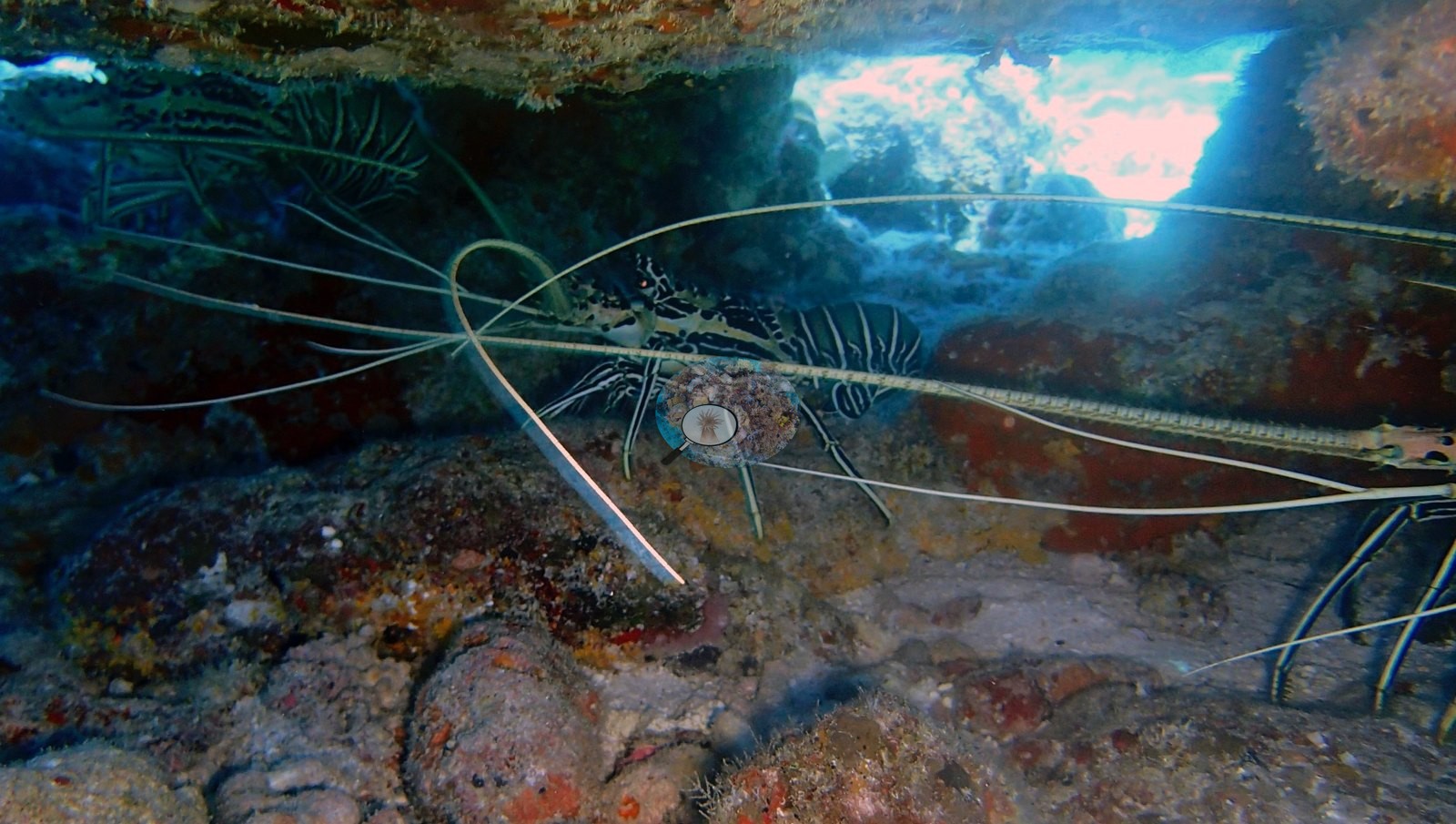
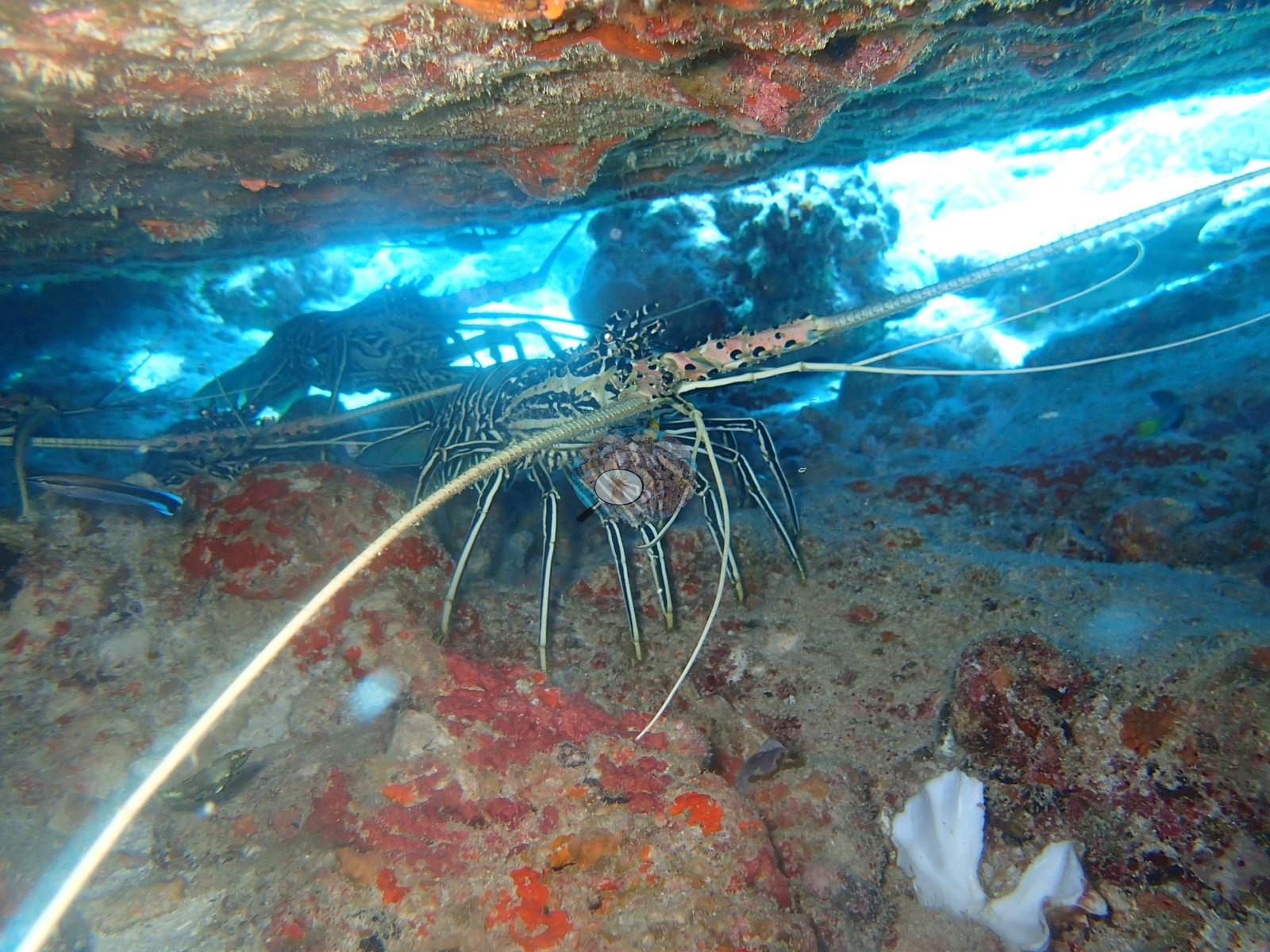
The last two minutes of the dive are not a reef survey at all, and that matters more here than anywhere else in the redo. From 11:22:15 the camera goes under a plate overhang and stays: P3180544, P3180545, P3180547, P3180548, P3180549, P3180550, P3180551, and P3180553 are eight consecutive macros of a spiny lobster den – at least three and probably four Panulirus-type animals with boldly black-and-white banded legs and striped carapaces, compatible with P. versicolor or P. longipes and not callable from these frames – under a red-sponge-crusted ledge over coarse rubble. They are the best invertebrate record in the redo, and, as noted in the method section above, they are also 16% of the CV sample and carry a disproportionate share of its noise. Conspicuous fauna and sessile invertebrates appear as sponges in 29 frames, giant clams in 2 frames, urchins in 2 frames, sea cucumbers in 2 frames.
Comparisons with other data
Also on record for this site: Assemblage composition. This paragraph rests on the FULL 49-frame set, unlike its Three Brothers neighbors.
Other notes
Image-by-image. Forty-nine habitat frames, P3180467 to P3180553, from Anderson's folder BiTb29-finished, which carries no field annotation of bleaching or site quality. All 49 are wide or medium reef views – there are no sampled-colony close-ups – and a handful (P3180472, P3180538, P3180542) are hazy or backscattered. No quadrat or scale bar appears anywhere, so no colony dimension quoted here is measured.
CV model comparison
More info
Those are point counts on the photographs; this is a diver swimming a transect. The models and the reference never saw the same thing. ⚠ SITE-LEVEL ONLY. The 2,500 frames were not associated with any transect taken within 200 m of them, so transect-vs-image comparisons are site means, never frames. The transect value is already in the pin `cover` field (109 of 112 pins, sourced to the paper's suppl. S1) and is read from there, never re-imported. The transect is THE coral-cover value for this site and stands alone. The rows below it are a methods comparison only: no computer-vision value is averaged with it, feeds the headline, or carries over to the site's cover figure (Anderson, 2026-09-22).| Method | Hard-coral cover (%) |
|---|---|
| Transect (published) | 30.2 |
| CoralNet | 29.6 |
| In-house DINOv3 | 23.7 |
| CoralSCOP edited | 25.9 |
| Claude | 18.5 |
Independent surveys nearby
| Agency / program | Year(s) | Stations / distance | Link |
|---|---|---|---|
| Sheppard et al. (2008) | 2006 | 1 station, 3.12 km | Records ↓ |
| Spalding et al. 2025 (Chagos 2024 bleaching report) | 2024 | 1 station, 3.49 km | Records ↓ |
| XL Catlin Seaview Survey | 2015 | 1 station, 3.72 km | Records ↓ |
 Dr. Coral (CRD)Year-average (no detectable trend)
Within 5 km, 3 independent survey stations recorded hard coral cover in 7 records between 2006 and 2024. One survey since 2021 recorded 50%. This site's own estimate (30%) sits 19.8 points below the recent value (50%); the methods differ, so the comparison is context, not a like-for-like test.
Collected by other programs using different methods (the XL Catlin Seaview Survey uses photo-transects with automated image annotation), so these are context for the figures above, not a like-for-like comparison. Where a station was surveyed more than once the range is shown. Station names are not dive-site names.
| Agency | Site / location | Date | Hard coral cover (%) | Distance | Link |
|---|---|---|---|---|---|
| Sheppard et al. (2008) | Great Chagos Bank | 2006 | 41% (5 surveys) | 3.12 km | HeatCRD database |
| XL Catlin Seaview Survey | transect 36004 | 2015 | 21% | 3.72 km | — |
| Spalding et al. 2025 (Chagos 2024 bleaching report) | Great Chagos Bank - Middle Brother, lagoon (E aspect, 1-3 m) | 2024 | 50% | 3.49 km | — |
Data & links
- Read the full site report ↗
- Download benthic survey data (CSV) ↗
- Download all LOF-GRE data (933 sites) ↗
- CoralNet image repository for this region ↗
- HeatCRD database ↗
- (reference) ↗
- Photo portfolio ↗
- Coral Reef Diagnostics page for this area ↗
All images from Coral Reef Diagnostics. Data are from Coral Reef Diagnostics and the organizations named in the data-sources table above.
 © Coral Reef Diagnostics.
References
- Mayfield AB, Dempsey AC (2026). Using tourist diver images to estimate coral cover and bleaching prevalence in a remote Indian Ocean coral reef system. Oceans 7(1):1. PDF
- Sheppard C, Harris A, Sheppard A (2008). Archipelago-wide coral recovery patterns since 1998 in the Chagos Archipelago, central Indian Ocean. Marine Ecology Progress Series 362:109-117. PDF
- Spalding M, Bourasseau M, et al. (2025). Coral bleaching and mortality in the Chagos Archipelago, 2024. British Indian Ocean Territory Administration report (gray literature). PDF