
Part of the regional summaries: Chagos Archipelago - Great Chagos Bank West / Brothers / Eagle and Chagos Archipelago
More info
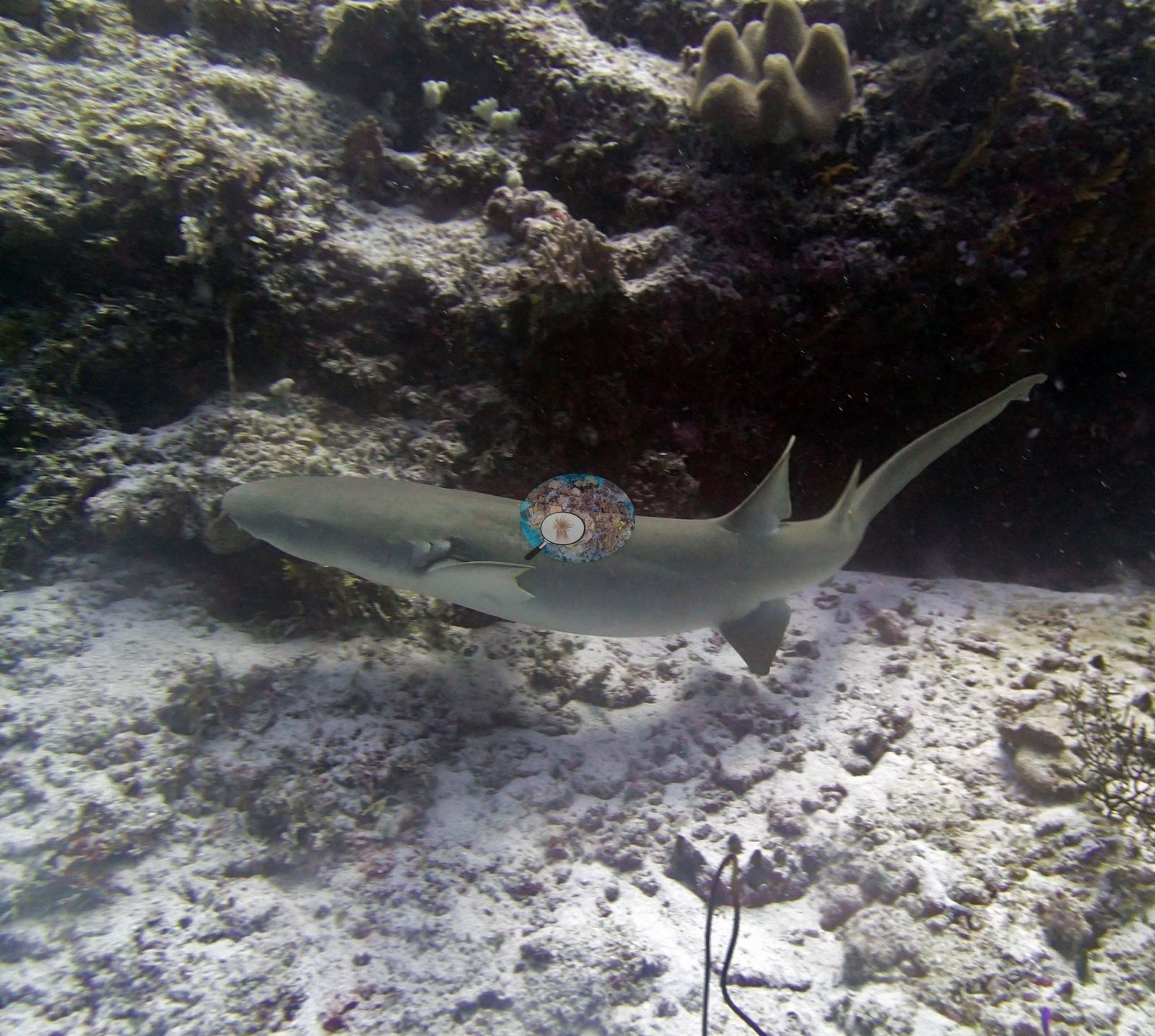
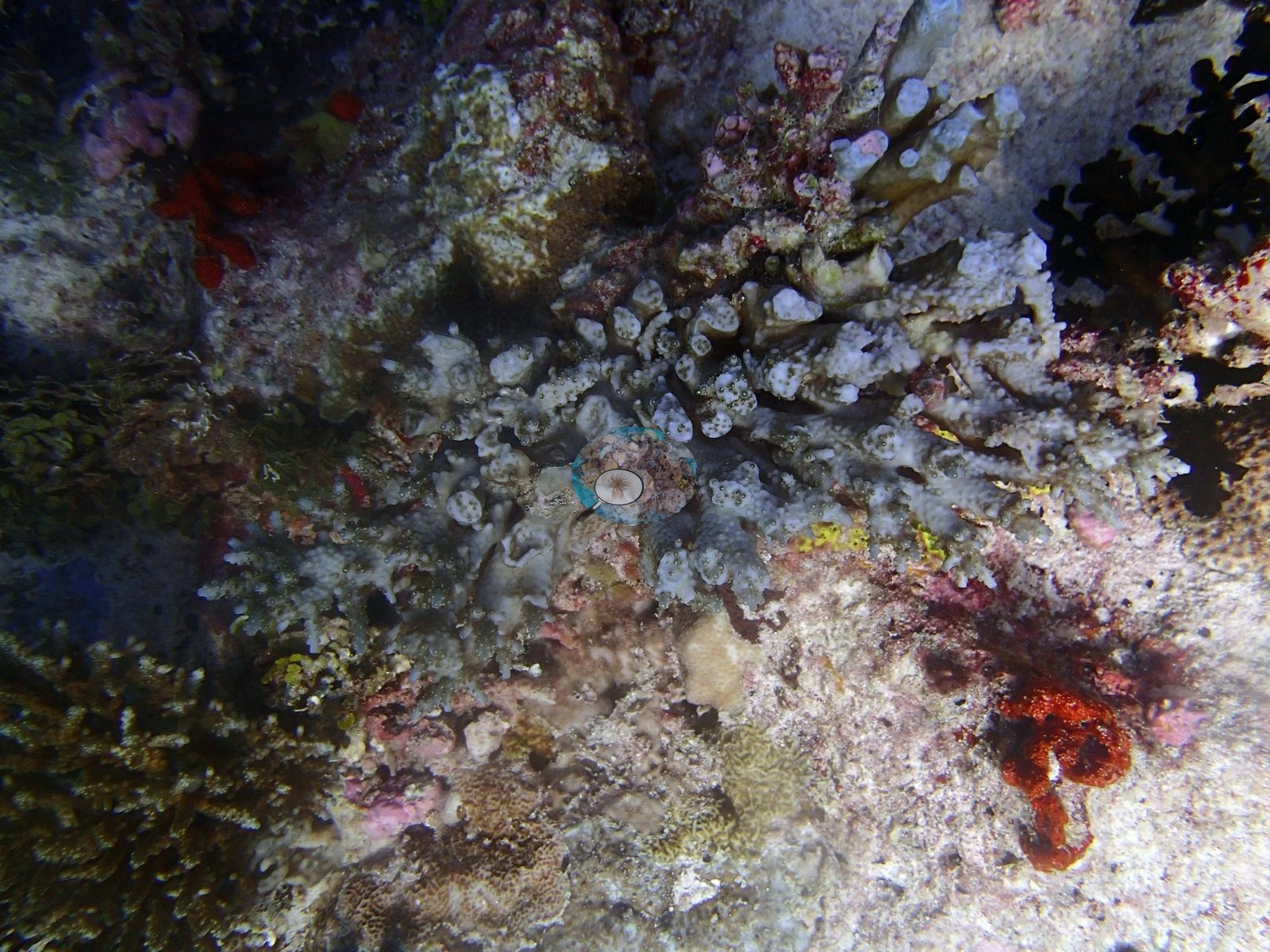
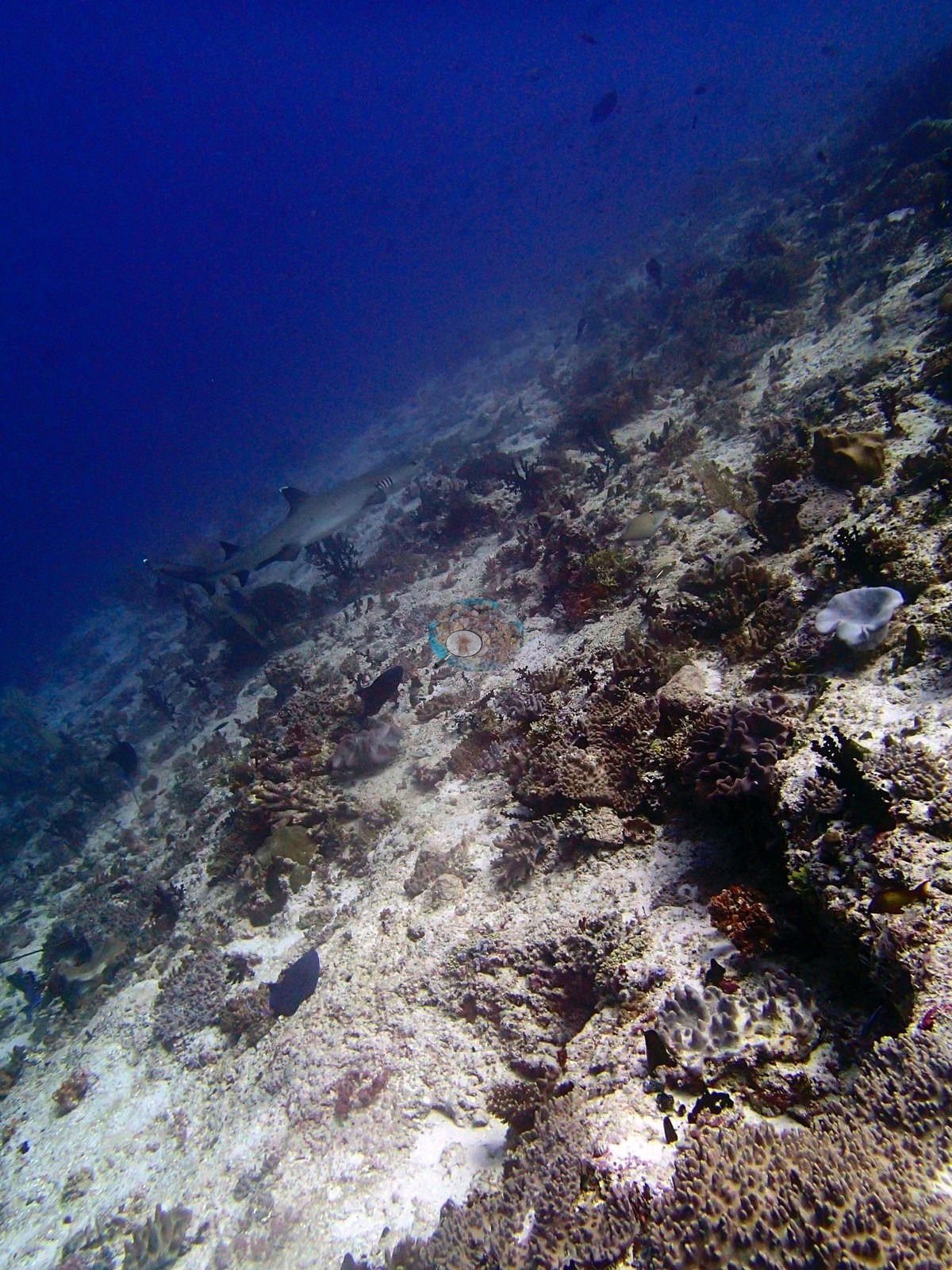
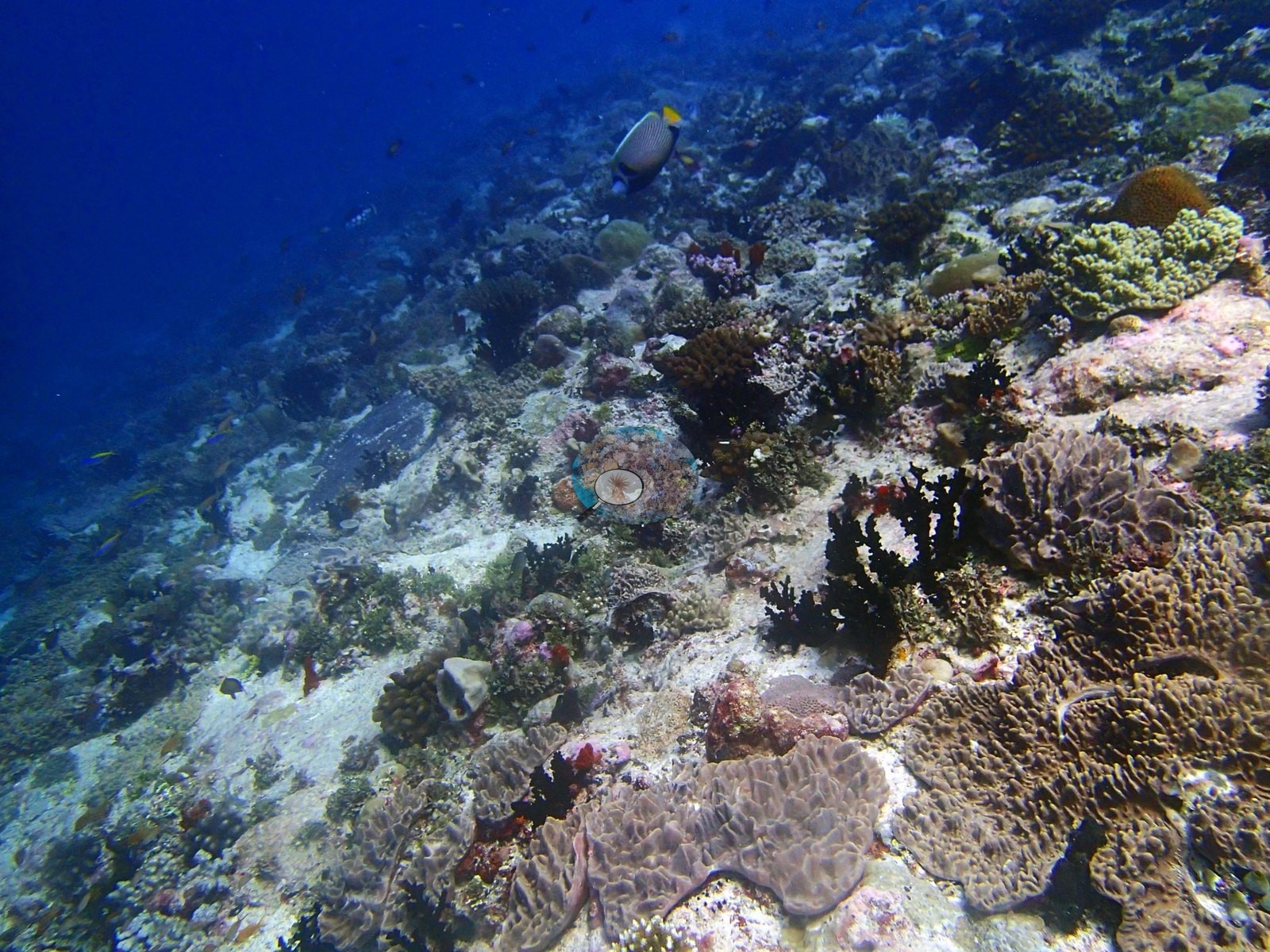
Chagos (NOAA CRW virtual station)BIEA20 has 11% coral cover, concentrated in patches of yellow-tan Porites, ridged foliose plates, and brain corals, with black coral whips and bushes a recurring feature. This site produced the finest shark photograph in the whole collection - a whitetip reef shark cruising close over white sand - plus a giant clam, an emperor angelfish, and a two-spot red snapper; one branching colony was found chalky white with early algal film, a possible early mortality signal. Surveyed on the Living Oceans Foundation's Global Reef Expedition.
Five other CRD dive sites within 5 km shown in orange — click a marker to open its page.
🗺 Detailed map of the Global Reef Expedition dive sites, Eagle Island, Chagos (Khaled bin Sultan Living Oceans Foundation; opens in a new window)
Site description
Setting
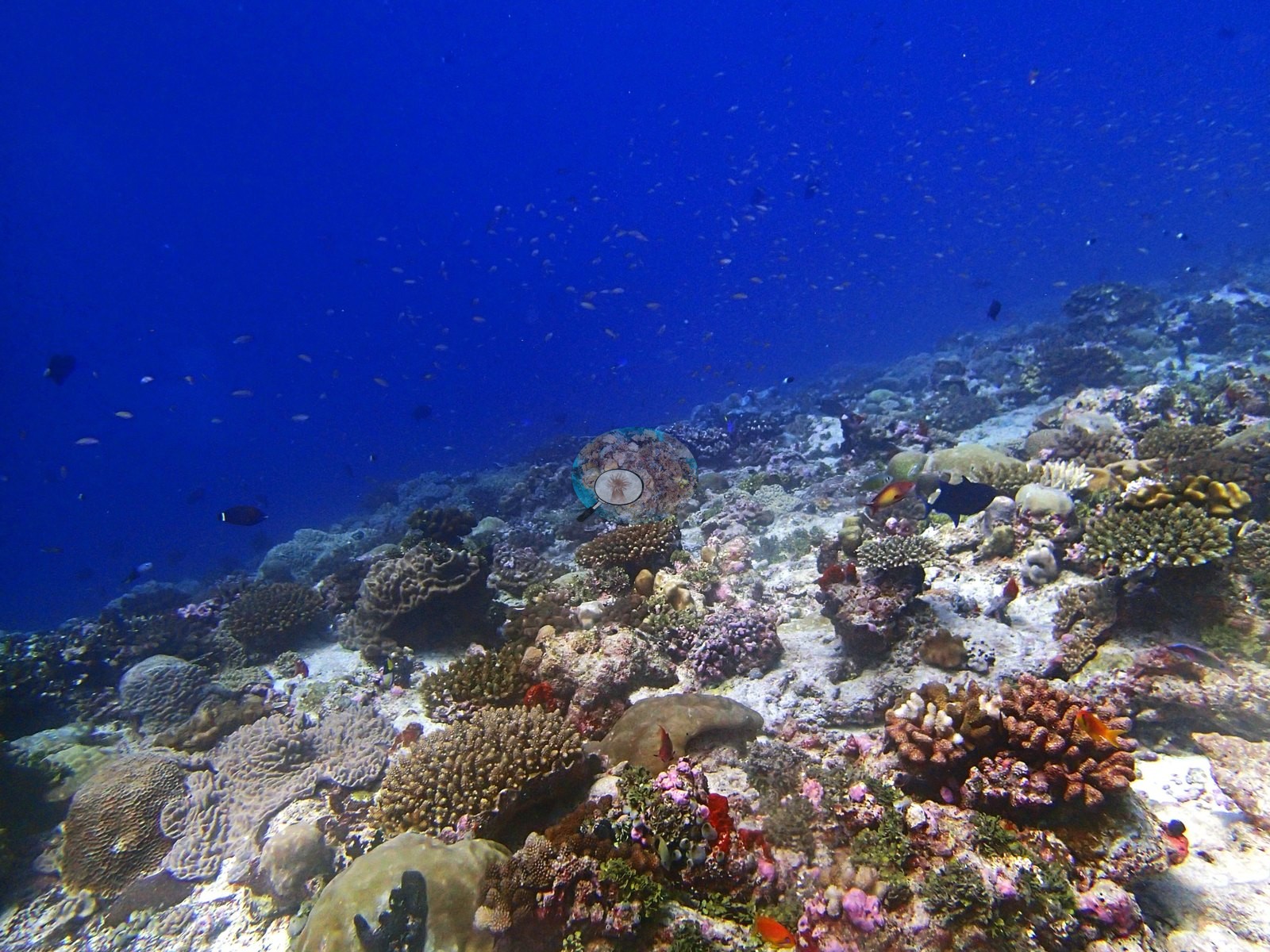
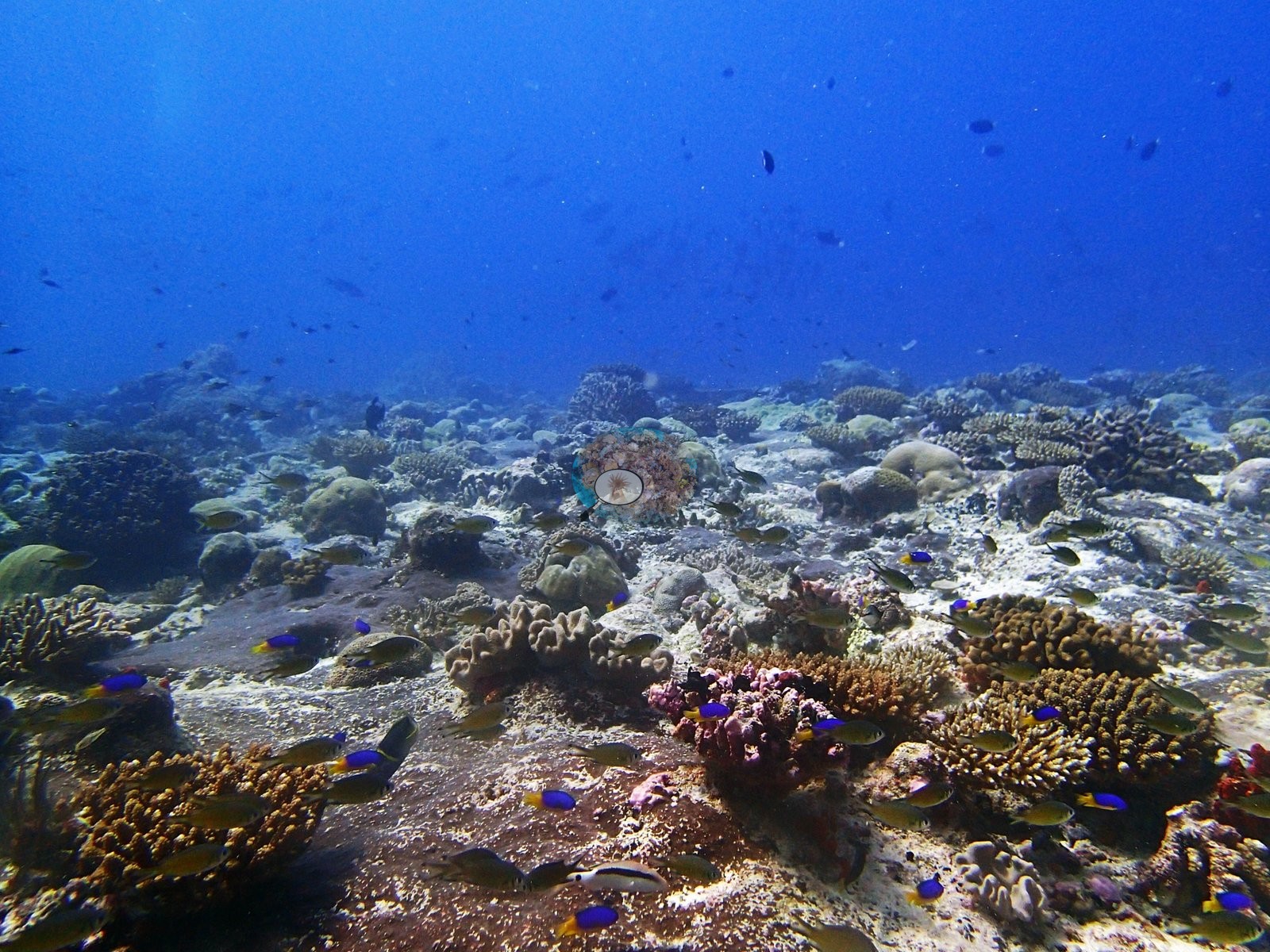
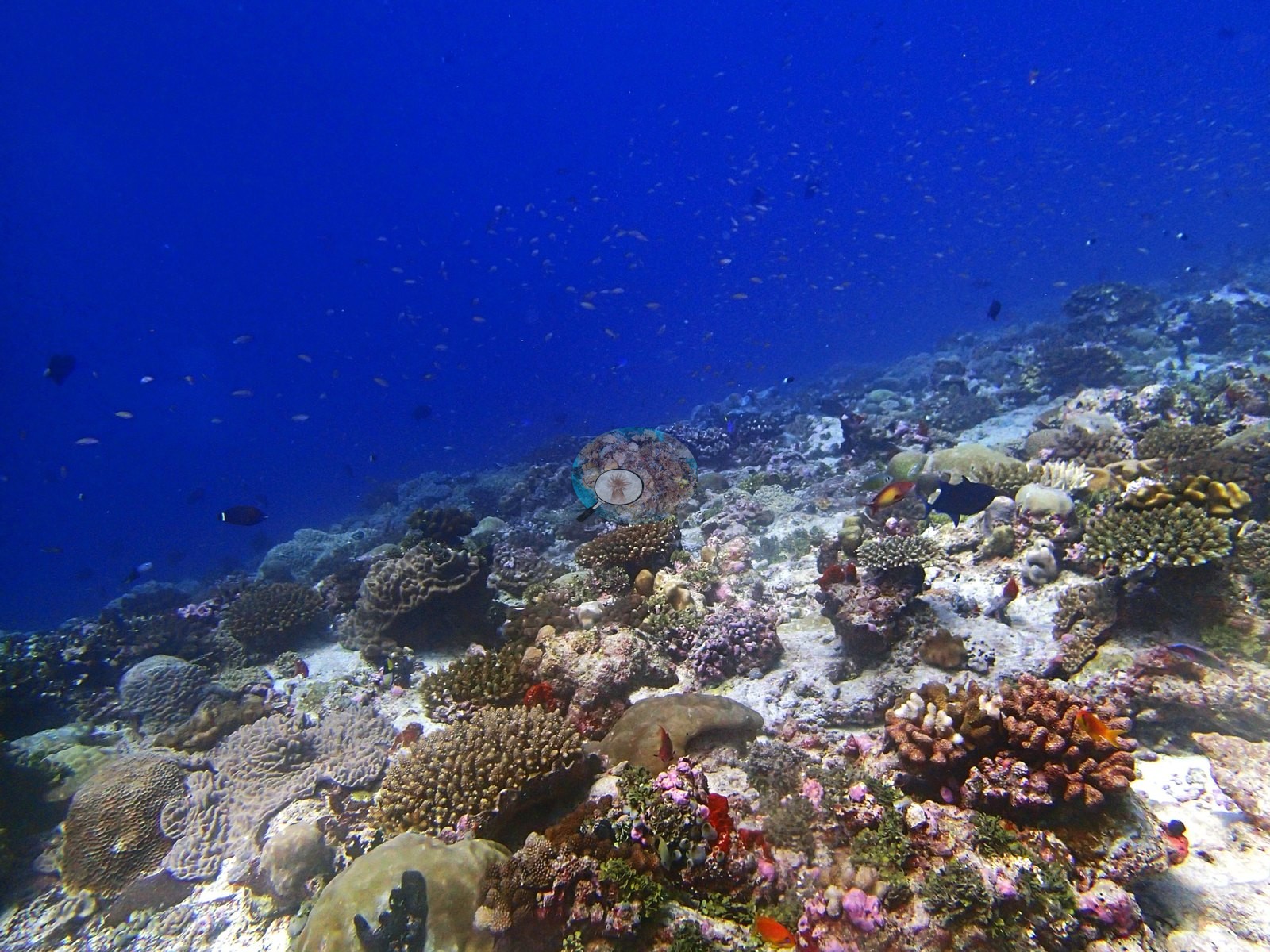
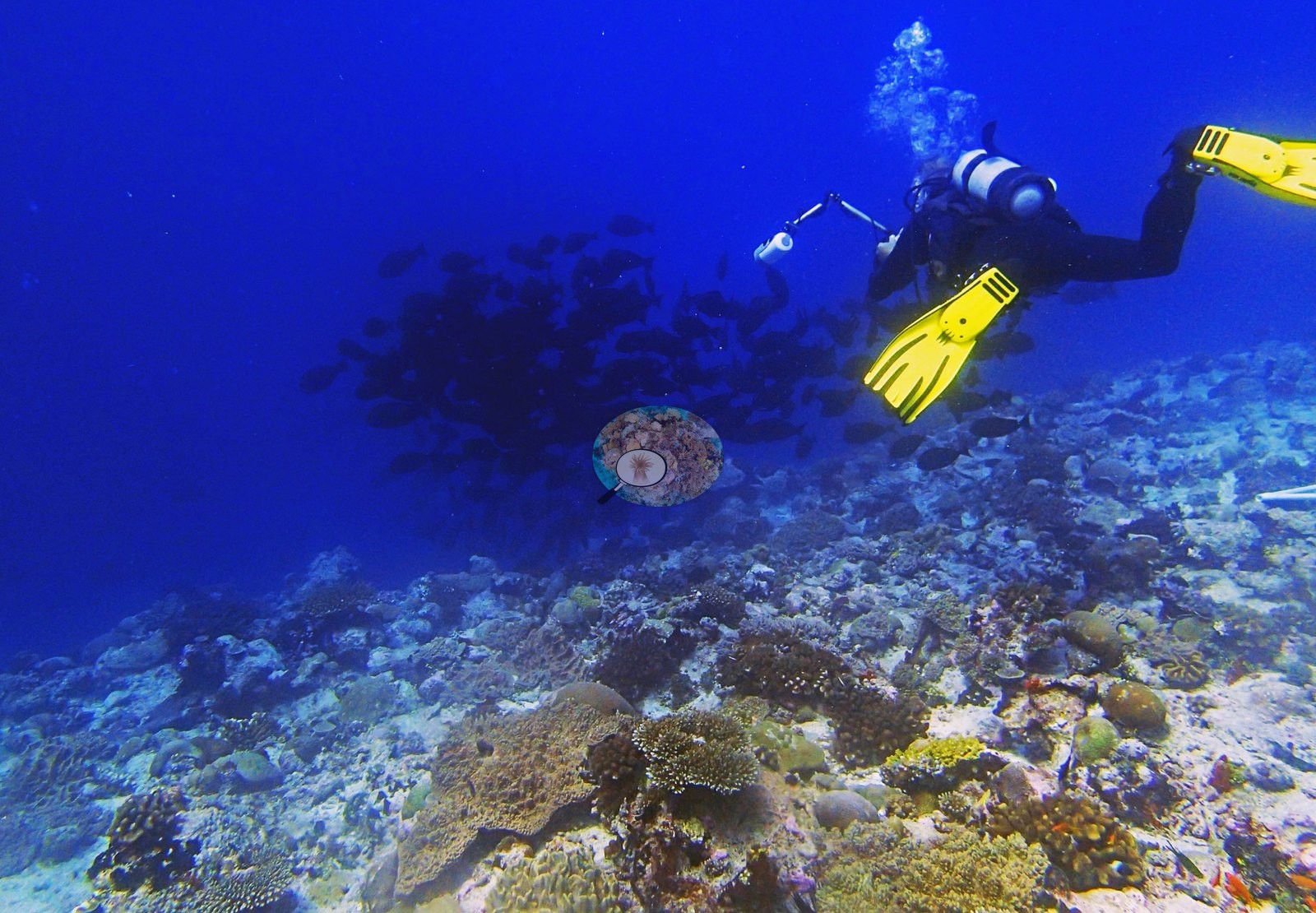
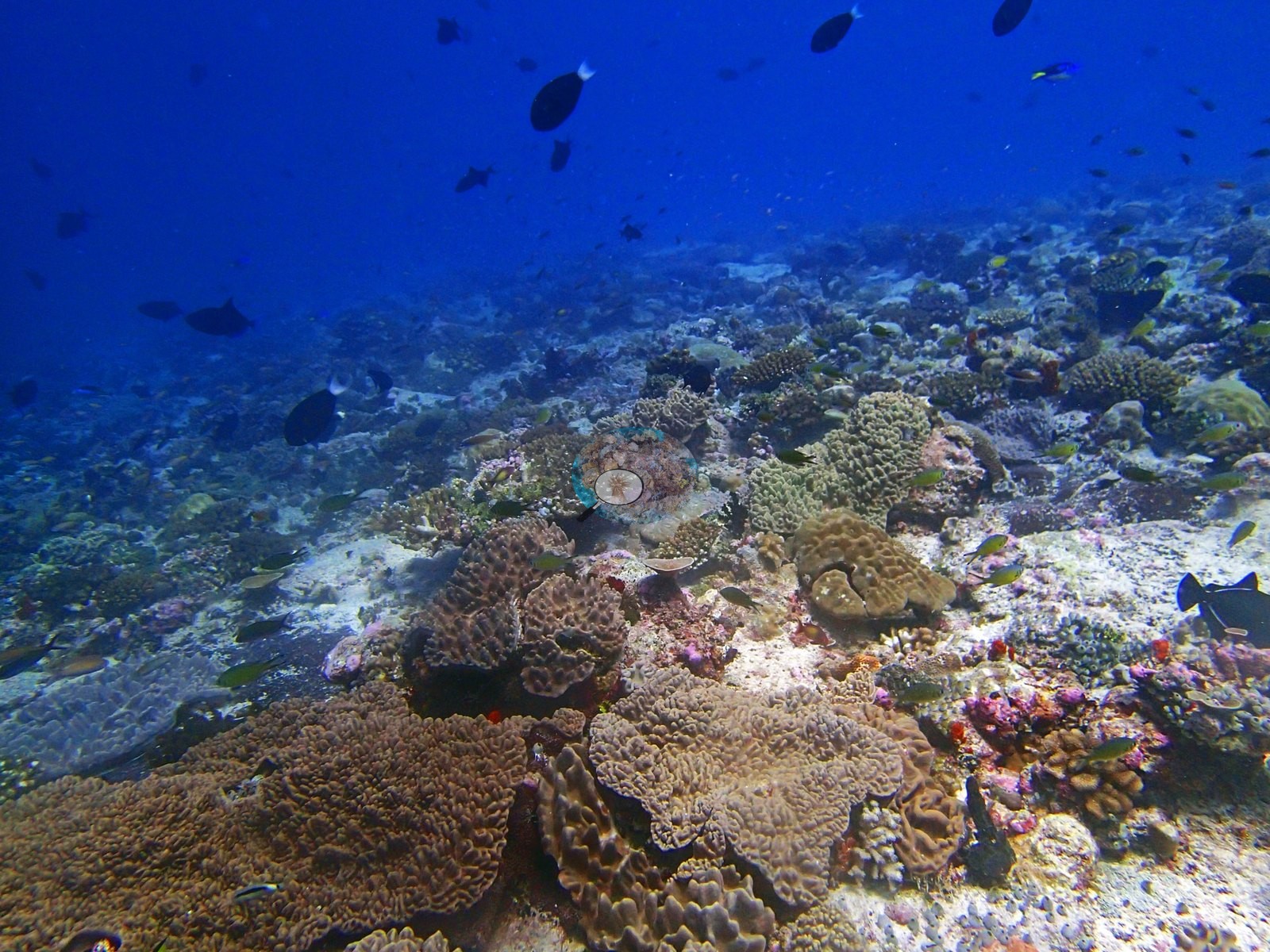
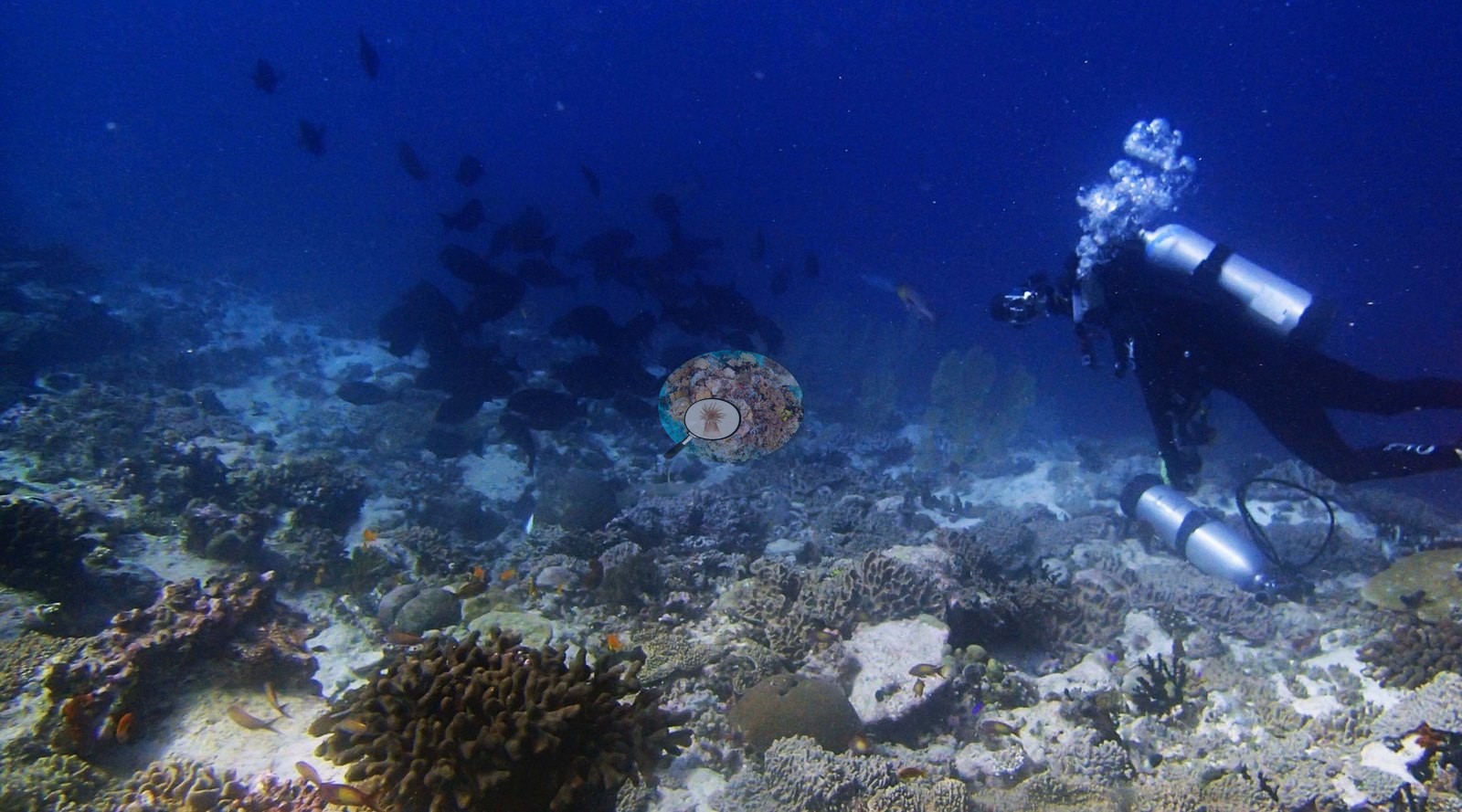
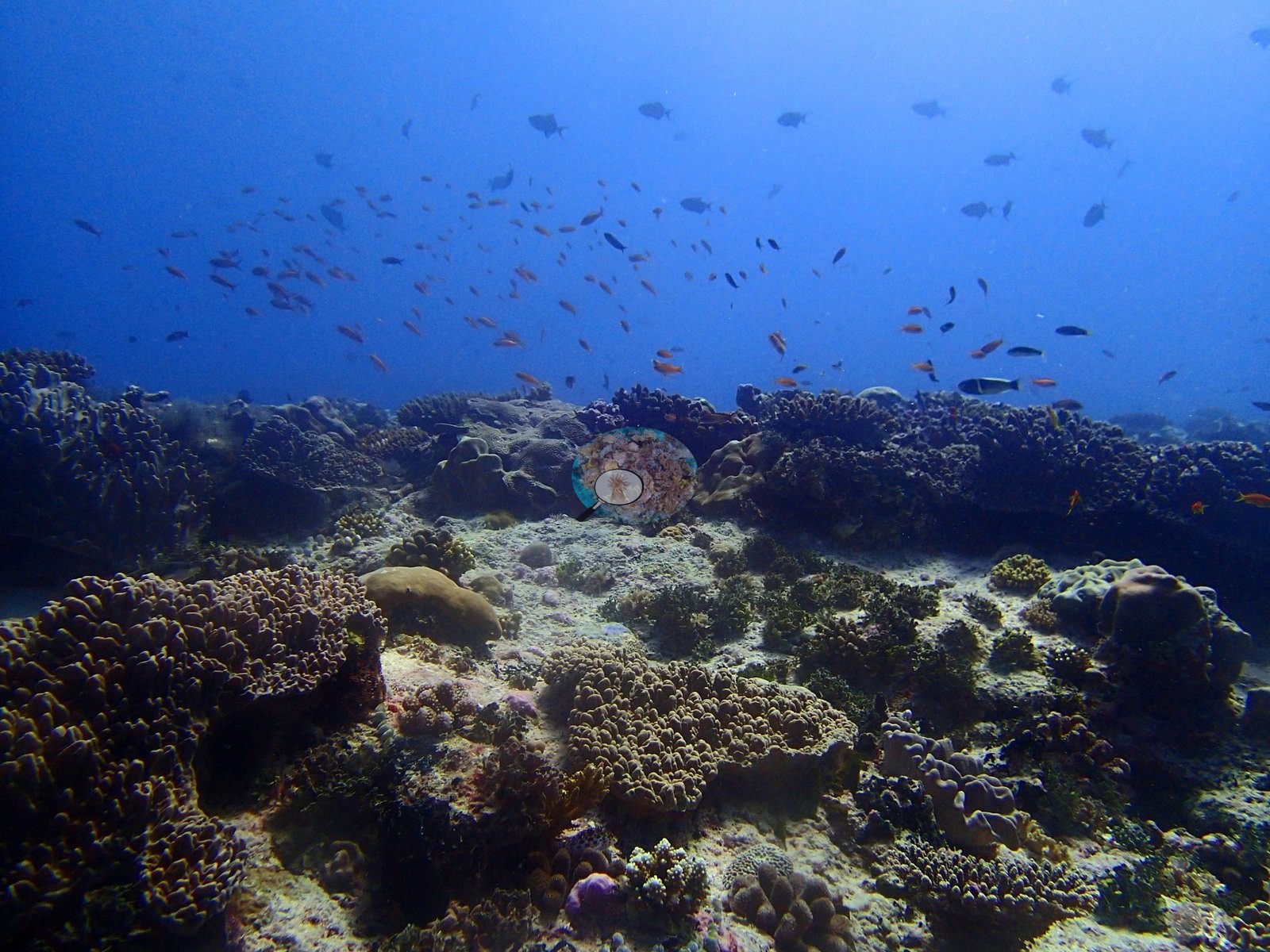
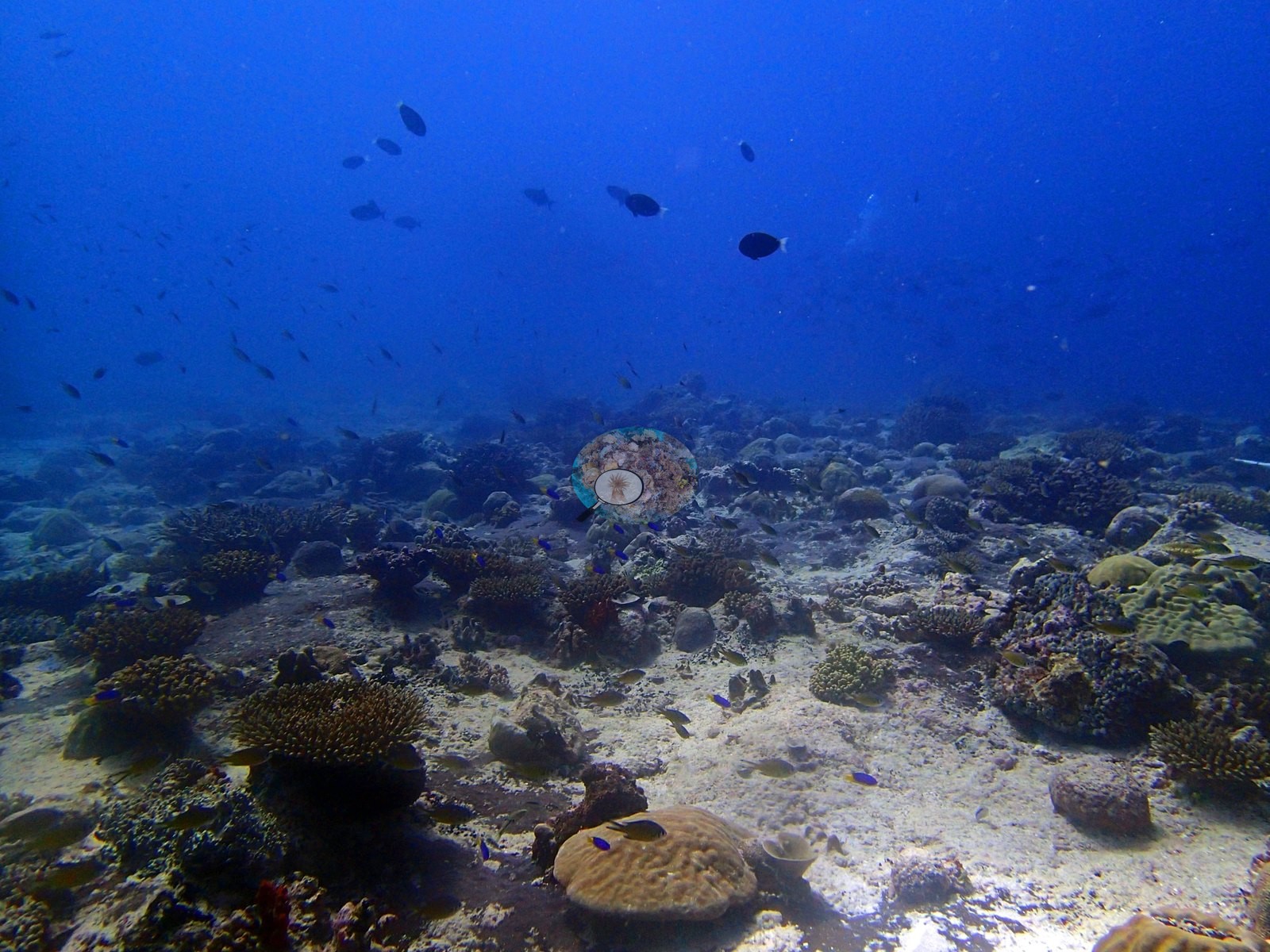
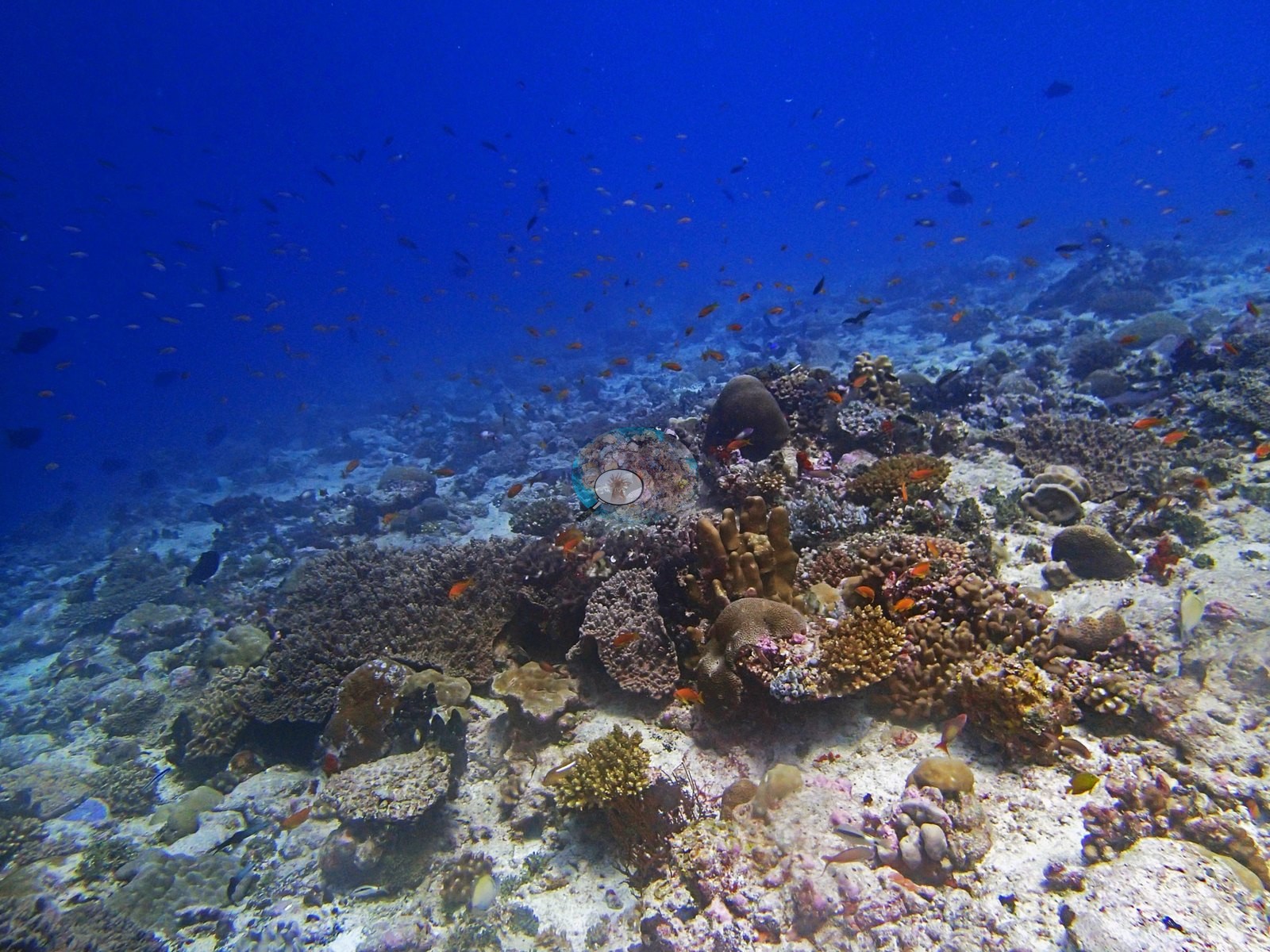
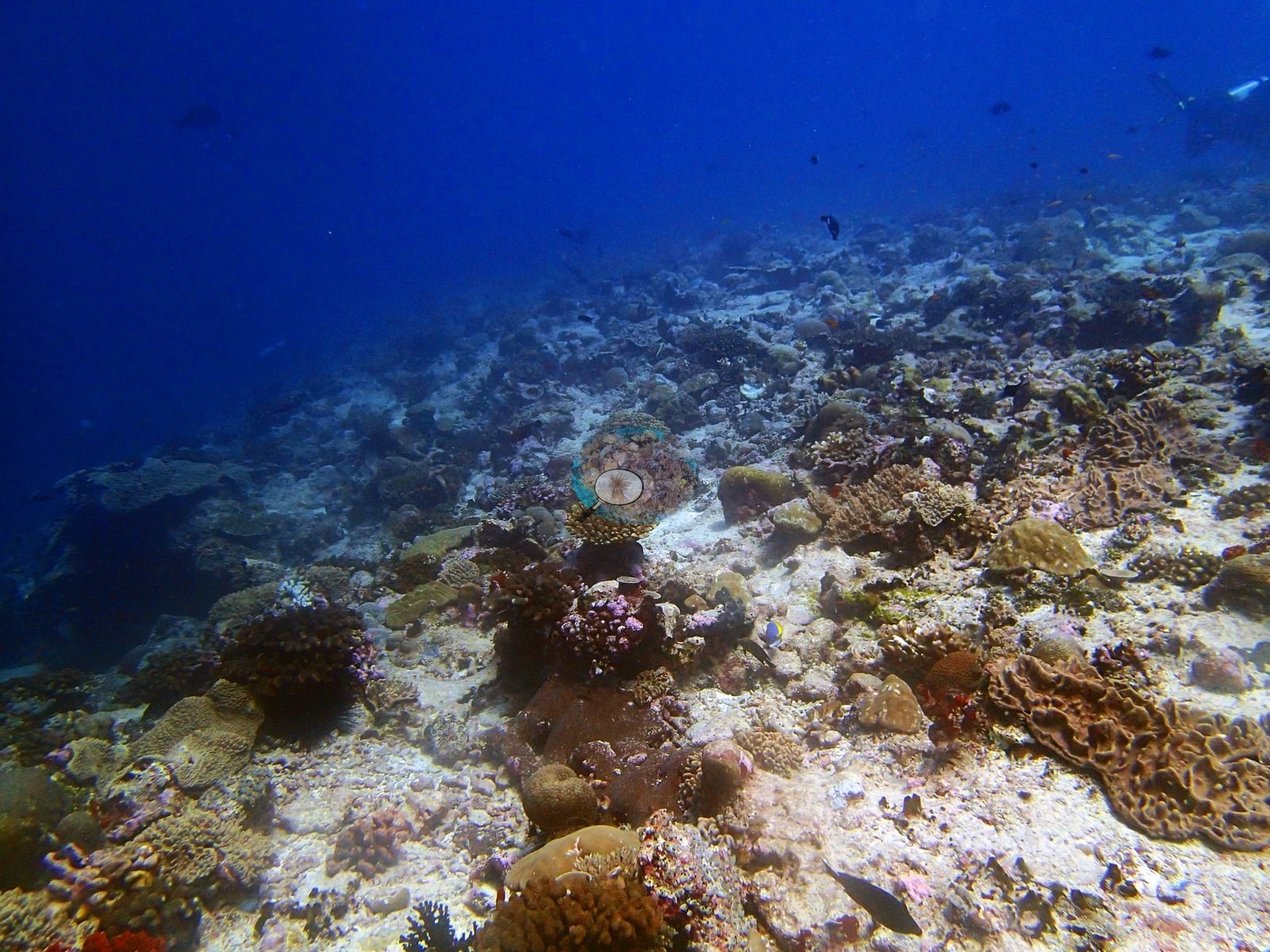
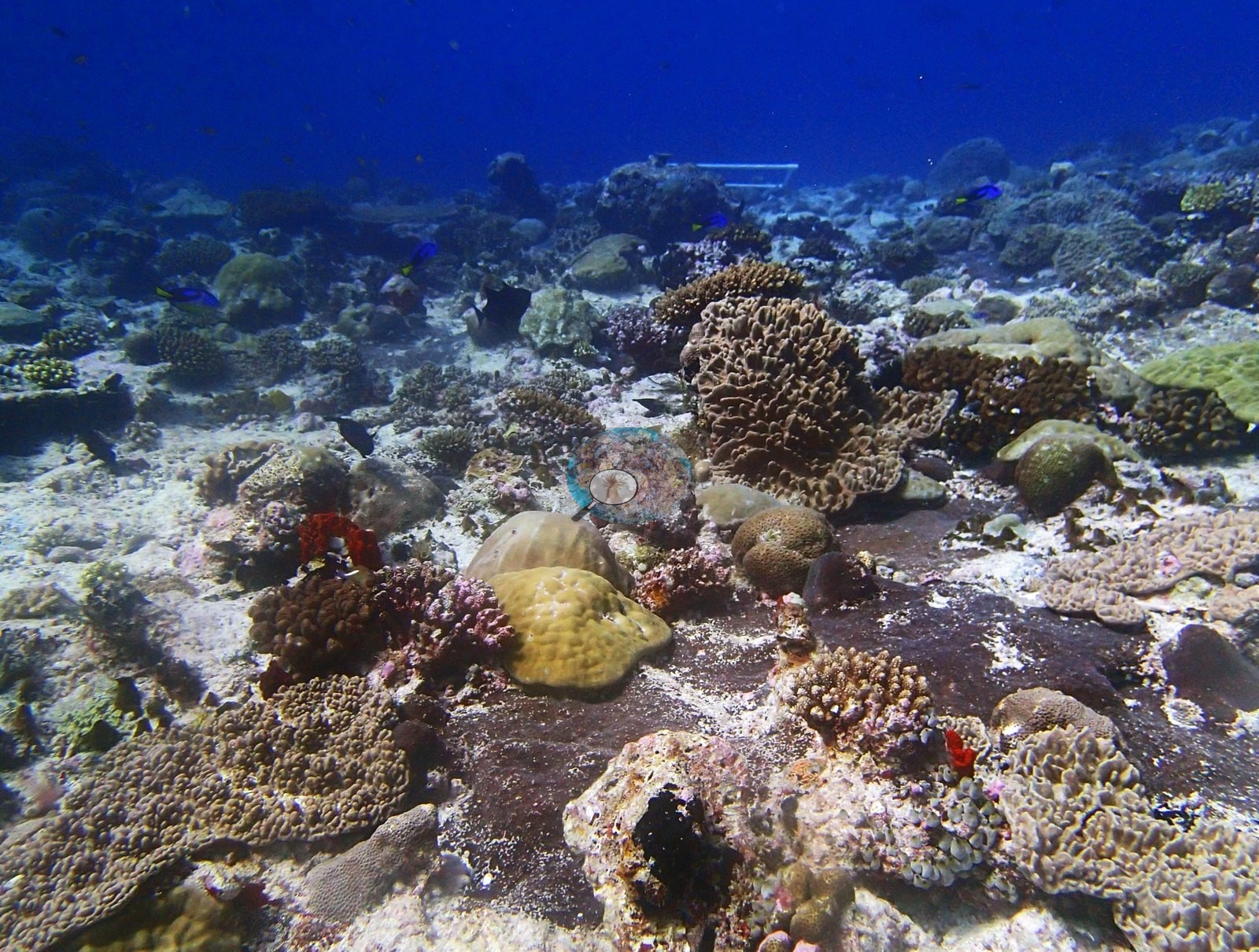
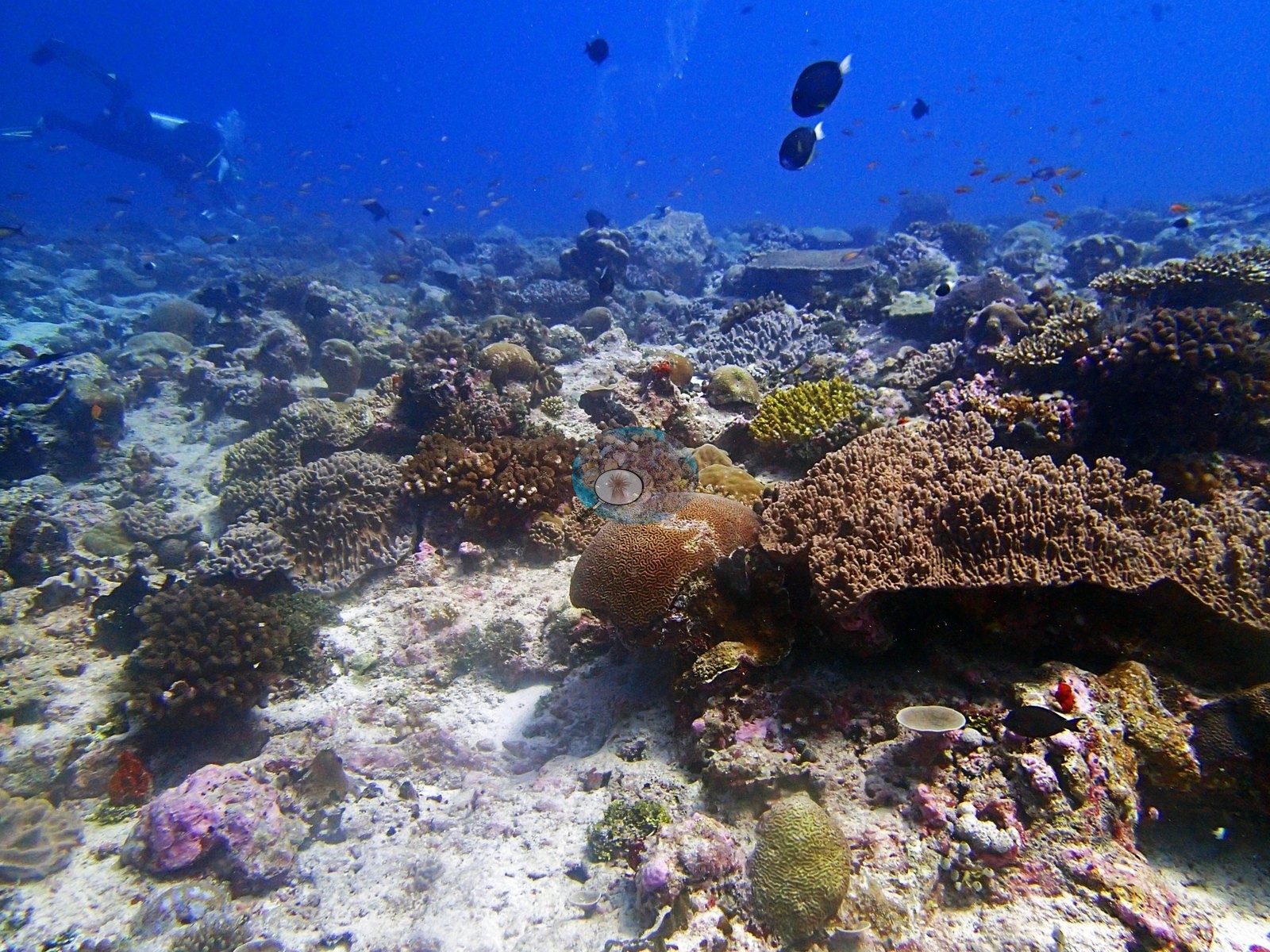
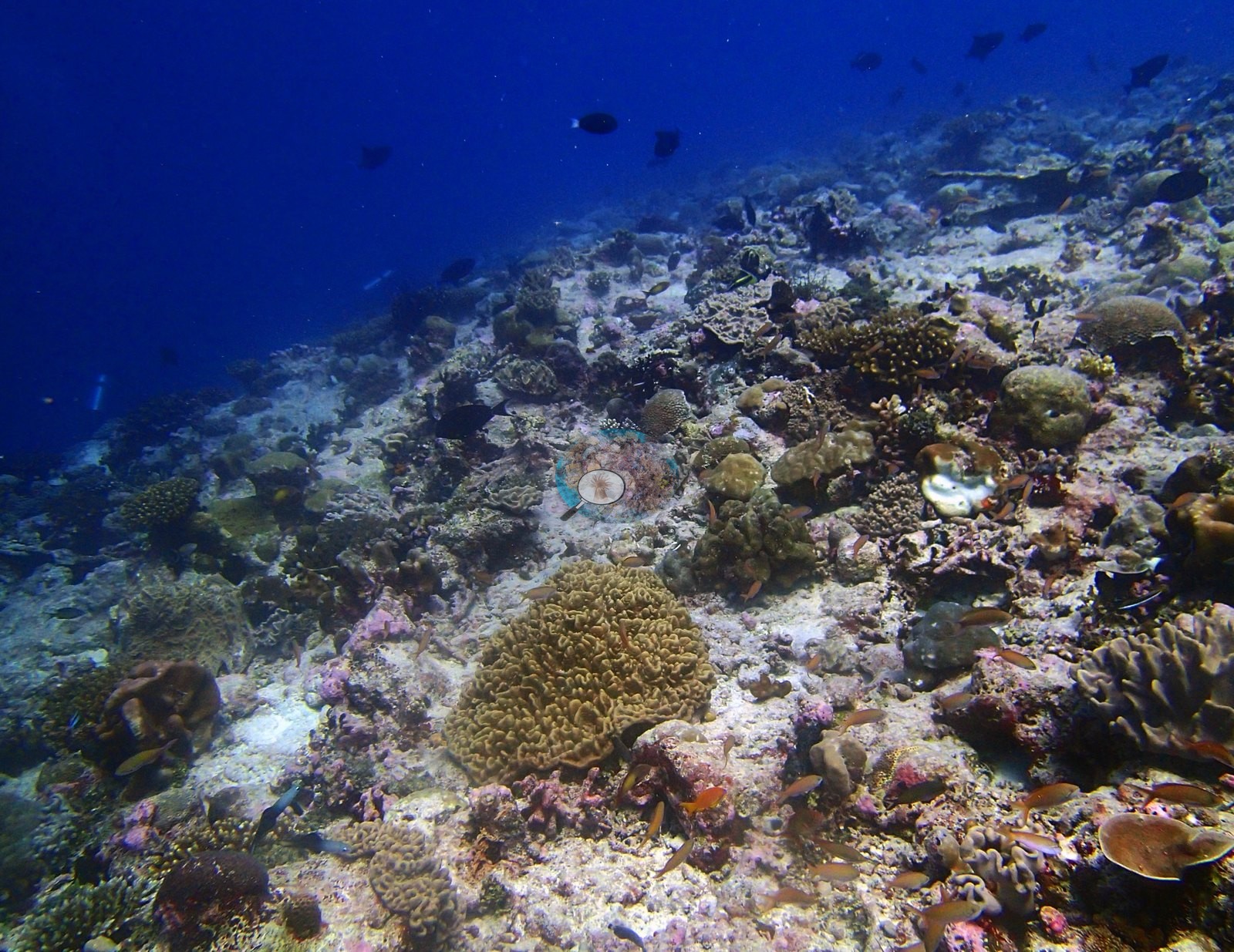
Where the bottom is visible, the reef reads as low-relief, gently sloping carbonate pavement rather than a high-relief spur system: broad pale rubble-and-sand flats with colonies set into them singly or in loose bands, and a blocky undercut ledge with dark shaded recesses in P3150248.
General benthic features
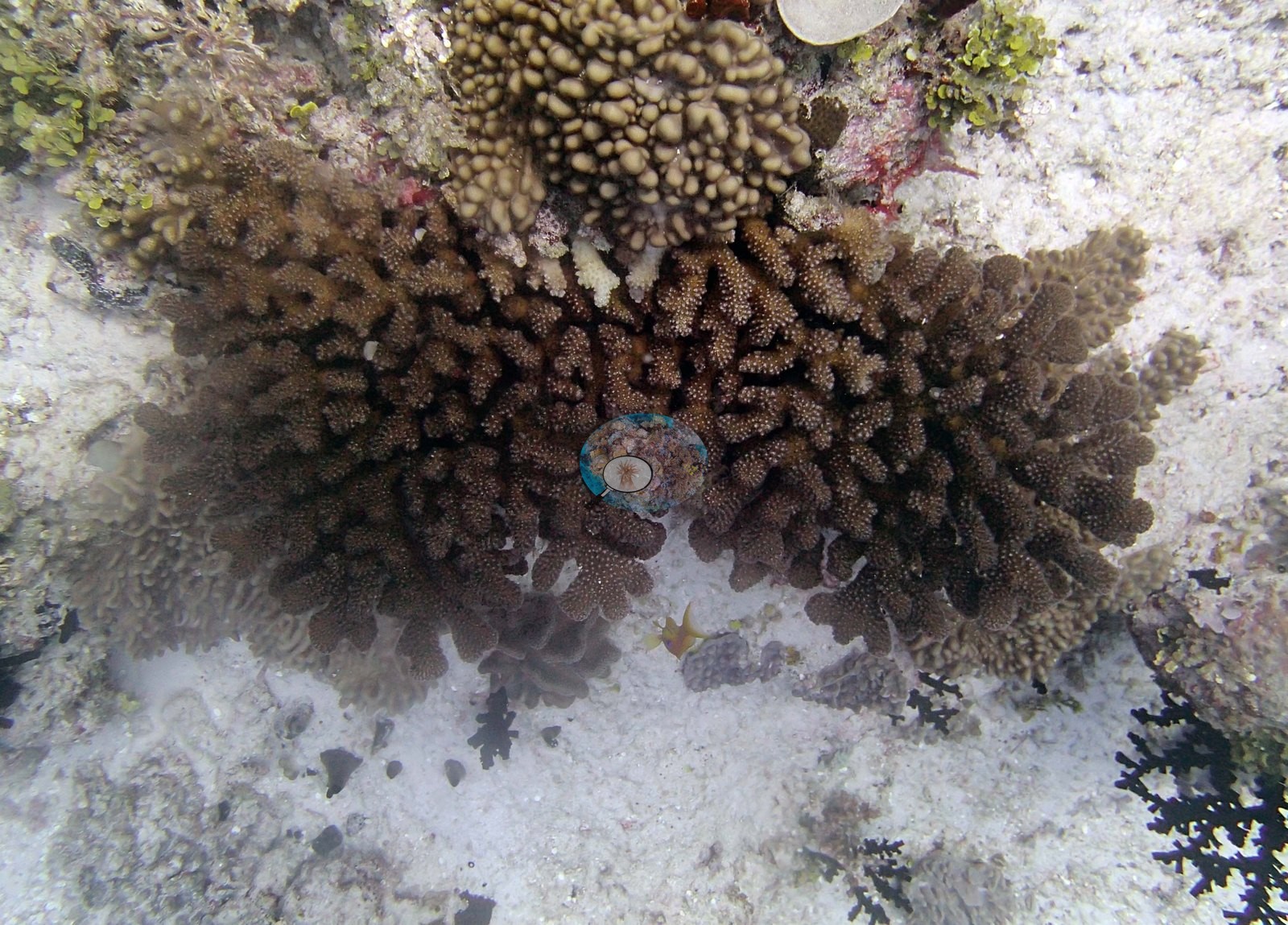
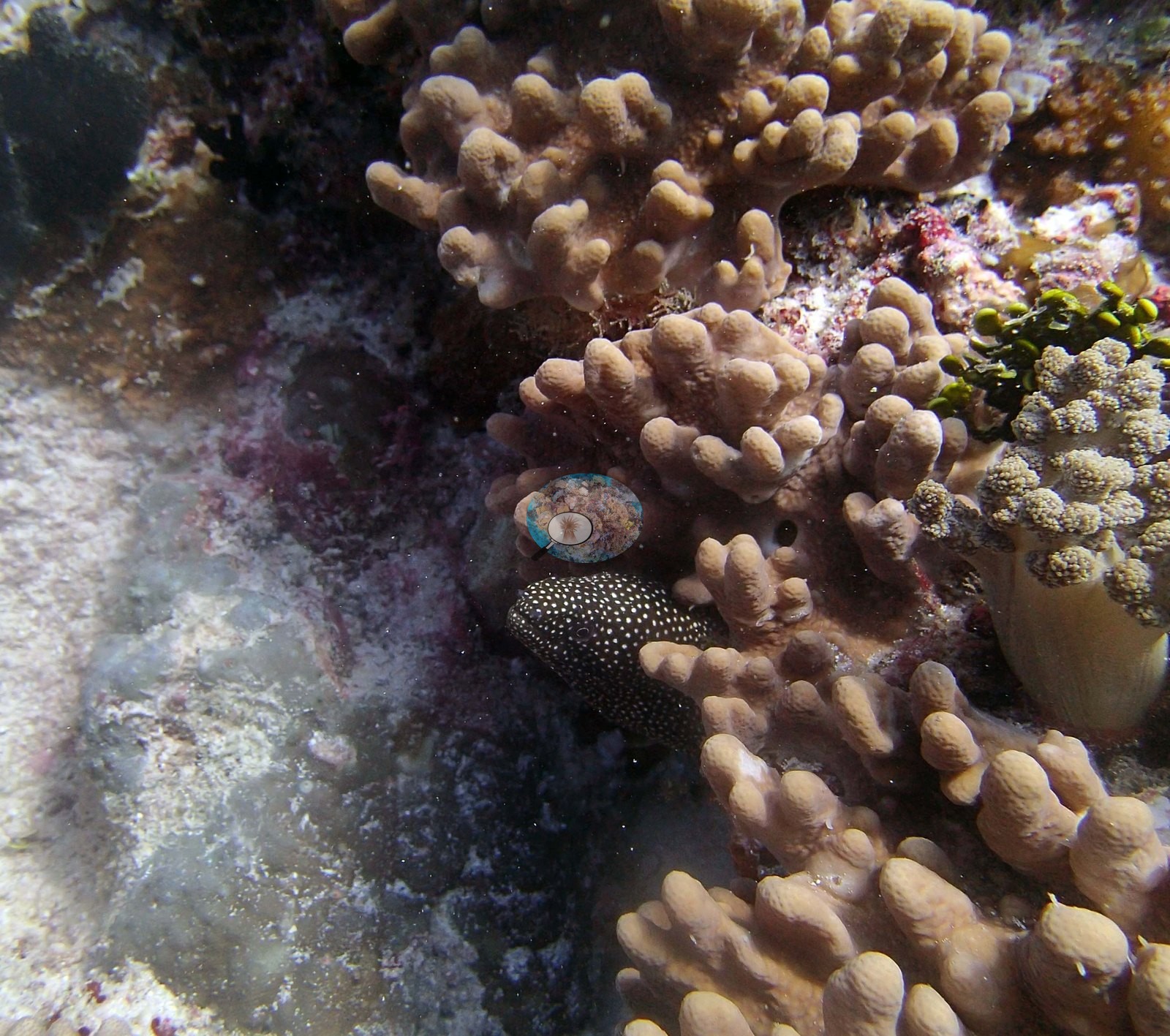
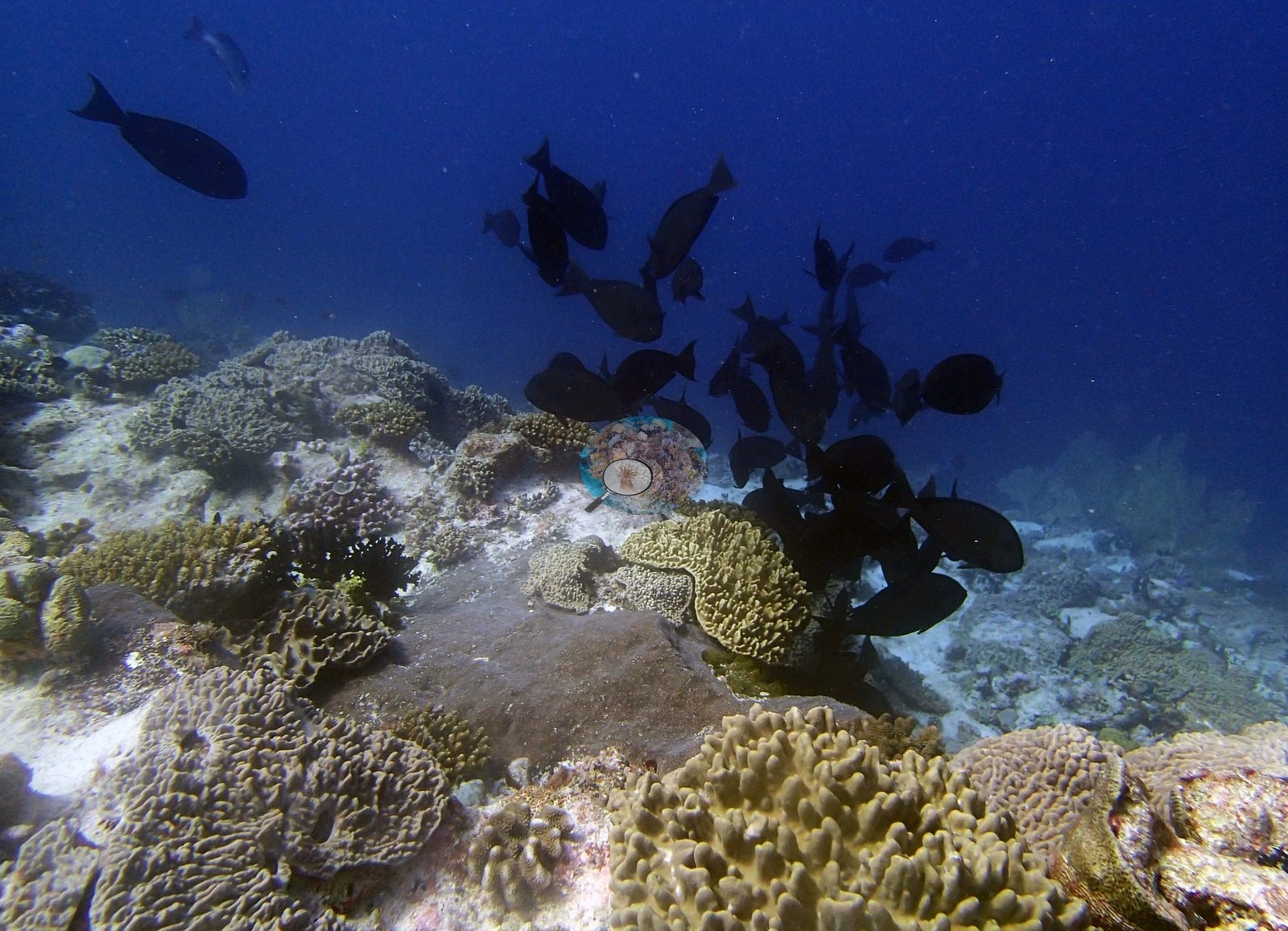
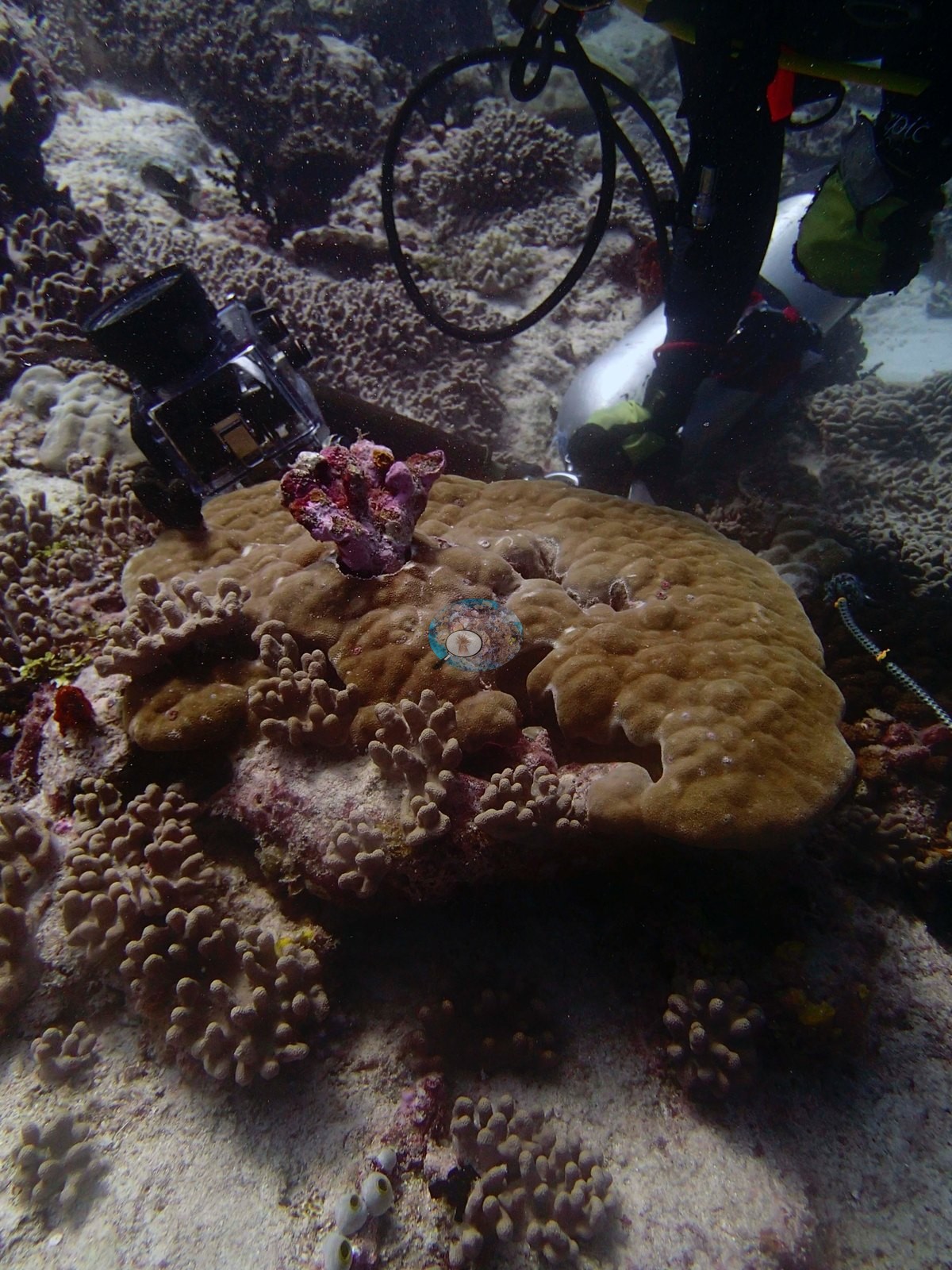
The two image products disagree on assemblage, and the disagreement is about label sets. Coralscapes makes massive and meandroid its largest live component (37.1% of live cover), then other hard coral 25.9%, tabular Acropora 14.5%, Pocillopora 9.8% and non-tabular Acropora 8.1%; the independent 30-point annotation of the same frames (1,230 points) apportions live coral to Porites 36.6%, Acropora 35.9%, other hard coral 22.5% and Pocillopora 4.9%. The site's conspicuous ridged foliose plates – compatible with Echinopora or Merulina – and its meandroid brains have no dedicated class in either vocabulary and are absorbed into ‘other hard coral’ and ‘massive and meandroid’. Non-coral cover in the point set is dominated by turf (15.6% of all points) with crustose coralline algae at only 3.2%; structural loss registers as dead coral 0.8% of image area and rubble 4.6%. Where coral does concentrate it is worth looking at. P3150276, P3150280 and P3150292 carry large yellow-tan foliose and columnar Porites; P3150290, P3150297 and P3150298 show brown ridged foliose plates compatible with Echinopora or Merulina spreading over the pavement, and comparable ridged tan plates appear again in P3150291 and P3150301; P3150291 also holds a tan meandroid brain compatible with Platygyra; and P3150279 – the site's highest-cover benthic frame at 46.7% live by point count – is a stand of pale tan digitate Porites with a spotted moray eel (Gymnothorax sp.) looking out from between the branches. Beyond those, low massive domes recur, including one large smooth-surfaced Porites dome carrying a red-pink encrusting sponge in P3150273; small branching and corymbose colonies sit over sand in P3150272; mushroom corals lie loose on the pavement in P3150290 and P3150291; and small tables and staghorn thickets occupy the brighter reef top in P3150305. Green calcareous algae, pink and maroon coralline crusts, red and orange encrusting sponges and small fleshy soft-coral tufts are present throughout, and open pavement between colonies is conspicuous in most benthic frames. Black corals are a quiet but repeated feature: antipatharian whips beside the shark in P3150248 and again in P3150272, and bushes in P3150262 and P3150274. Non-coral cover is dominated by crustose coralline algae 3.2%, turf 15.6% of all points.
Coral cover
The LOF benthic transect is this site's measurement. Coral cover at BIEA20 (Great Chagos Bank – West, dived 15 March 2015) is 10.8% live hard coral, from the LOF BIOT-1 in situ transects (Mayfield & Dempsey 2026, Oceans, suppl. S1), against algal cover of 50.2% of the benthos. That diver-transect survey is the authoritative record of cover and community at this site. The computer-vision products and the frame-by-frame account below supplement it. No cover value may be read off a photograph, no image-derived product overrides the transect, and nothing in the imagery qualifies or revises it.
Method comparison – transects, points and masks. All 41 frames were paired between the two image products, making this one of the larger paired sets in the Chagos series. Across methods the same reef reads transects 10.8% · CoralNet points 11.5% · Coralscapes masks 9.3% (41 frames) – the three products land within 2.2 pp of one another, which is unusually tight, and the point set sits fractionally above the transect exactly as the archipelago-wide low-cover pattern predicts. That agreement should not be over-read: frame-to-frame live cover across the same 41 frames runs from 0% to 46.7%, so the site-level convergence is an average over a very heterogeneous set rather than per-frame accuracy. These products have different sampling footprints and denominators and should not be averaged; the 10.8% transect stands as the site's cover value. (The 1.1% bleached-point value – 13 points – in the retained block below is a property of the 1,230-point annotation, a computer-vision output, not a site condition estimate.)
Also on record for this site: Assemblage composition. Across 41 analyzed frames the Coralscapes masks put live hard coral at 9.3% of image area, of which massive and meandroid is the largest component at 37.1%; the rest breaks down as other hard coral 25.9%, tabular Acropora 14.5%, Pocillopora 9.8%, Acropora (non-tabular) 8.1% of live cover. The independent 30-point human annotation of the same frames (1230 points) gives live hard coral as 11.5% of all points and apportions it Porites 36.6%, Acropora 35.9%, other hard coral 22.5%, Pocillopora 4.9% of live coral. Frame-to-frame live cover runs 0% to 46.7%. Coral cover: 11%. Live hard coral measured on the in situ benthic transects of the LOF BIOT-1 expedition (Mayfield & Dempsey 2026, Oceans, supplemental S1), against algal cover of 50.2% of the benthos. The transect figure is this site's authoritative cover value; no image-derived product overrides it. Across methods the same reef reads: transects 10.8% · CoralNet points 11.5% · Coralscapes masks 9.3% (41 frames). These products have different sampling footprints and denominators and should not be averaged.
Stressors
The second, independent review confirms both are visible at sheet resolution. If they are a photoquadrat and a transect tape, this site holds a direct image of the apparatus behind the 10.8% figure – but the identification still needs confirming on the full-resolution originals before it is published as such.
Condition – mortality is localized but real. P3150281 is the single most degraded frame at the site: a branching colony gone chalky gray-white, corallite texture still sharp but no live tissue color, ringed by dark maroon crusts and with a green algal film beginning to take it, alongside red-orange sponges. Coralscapes reads 10.85% dead on this frame, by far its highest at BIEA20, and the point annotation places two bleached points on it. Whether this is terminal bleaching or a colony already dead some weeks is not resolvable from a photograph, but it is not a healthy pale morph. P3150292 holds a second, much smaller white patch. Elsewhere in the set the corals are pigmented brown, tan, olive, and yellow, and this is a 15 March dive, on the early leg of the expedition. No bleaching percentage is estimated from these images and none is tested against them; Anderson's published per-site percentage bleached is the authoritative figure for this reef. Structural loss registers as dead coral 0.8% of image area and rubble 4.6%. Bleaching stands at 1.1% of annotated points — 13 points in total — concentrated in Acropora 0.6%, other hard coral 0.3%, Pocillopora 0.2% of points. No crown-of-thorns starfish (COTS) or other corallivores evident.
Fish and other fauna
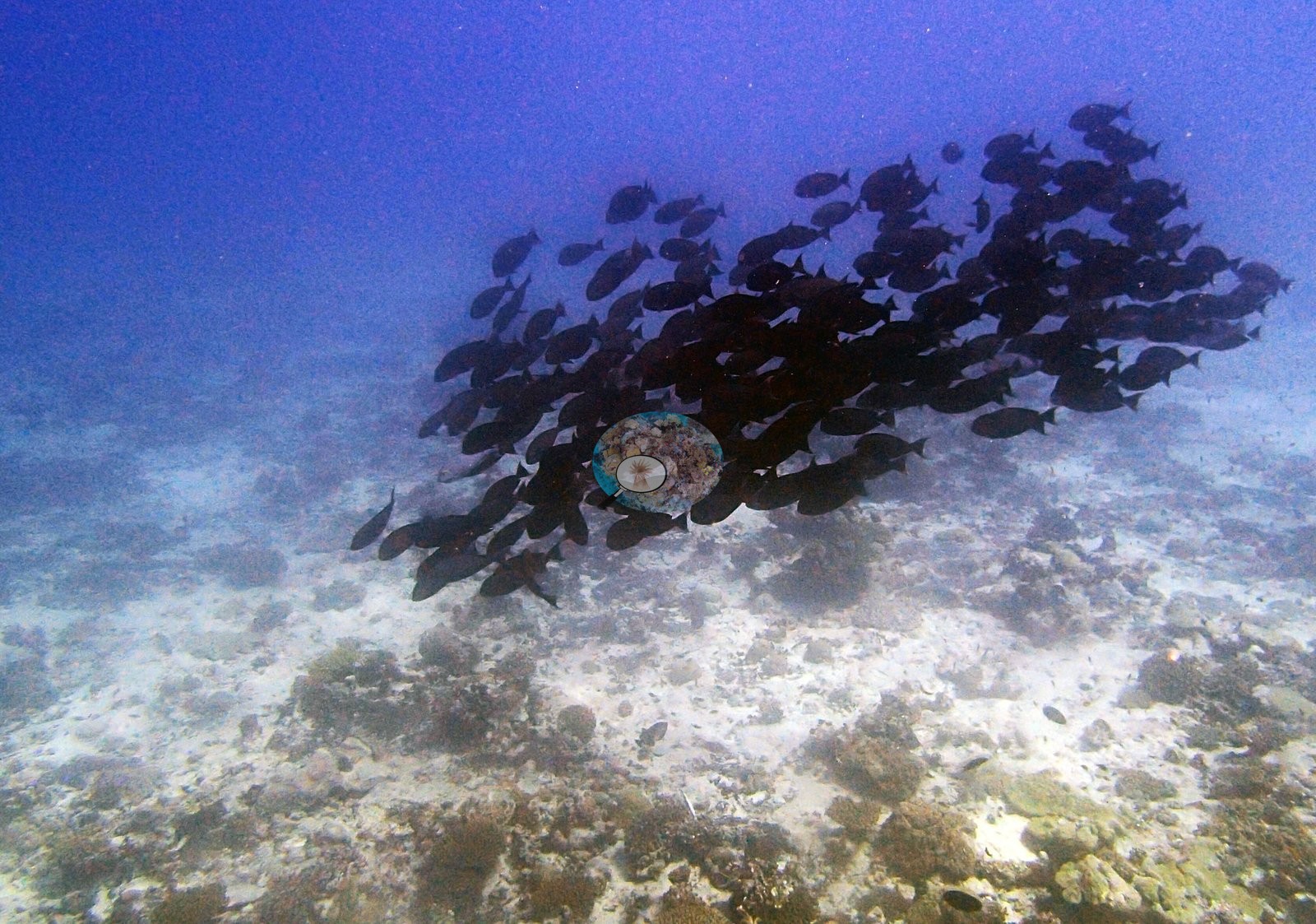
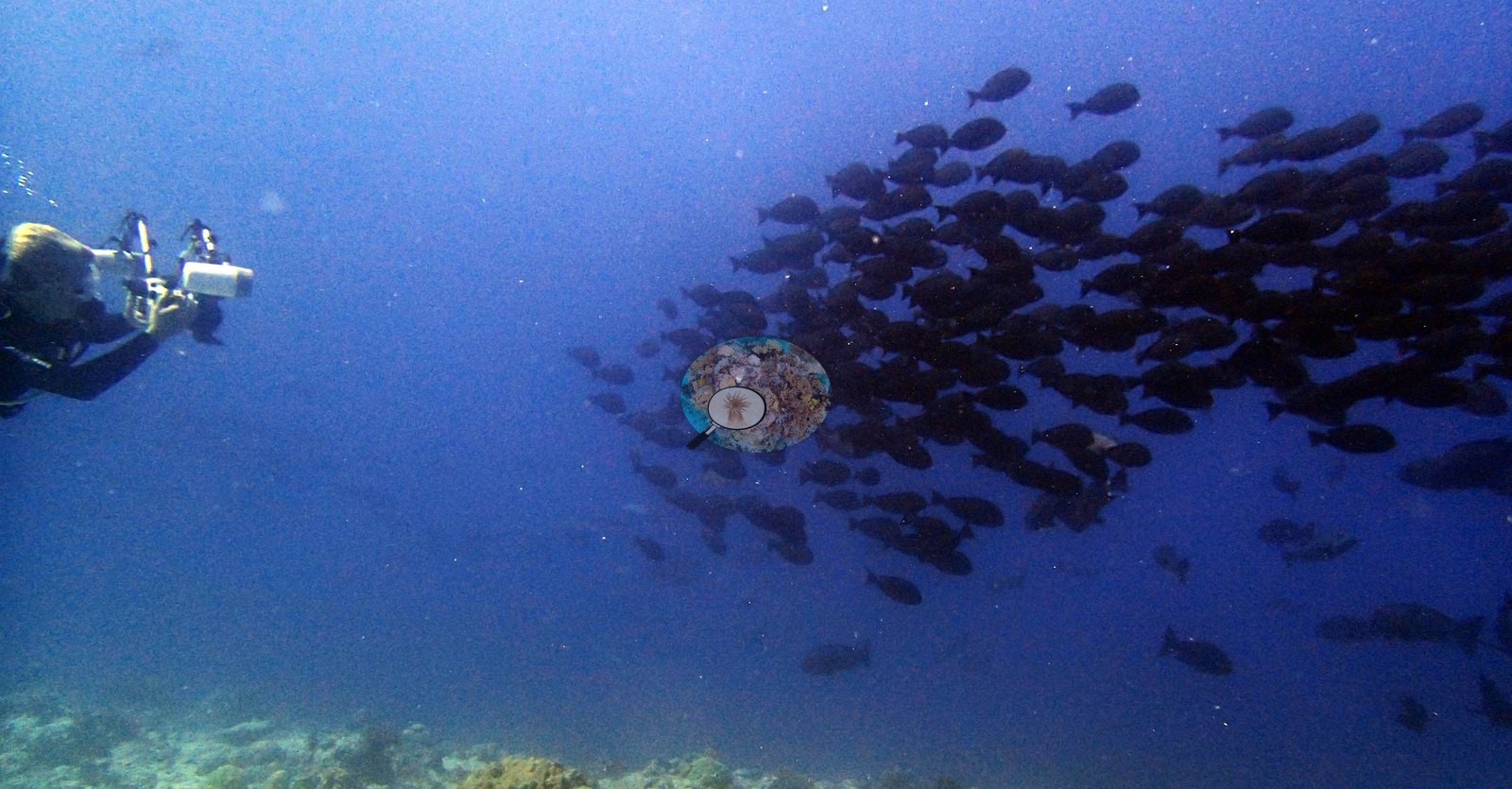
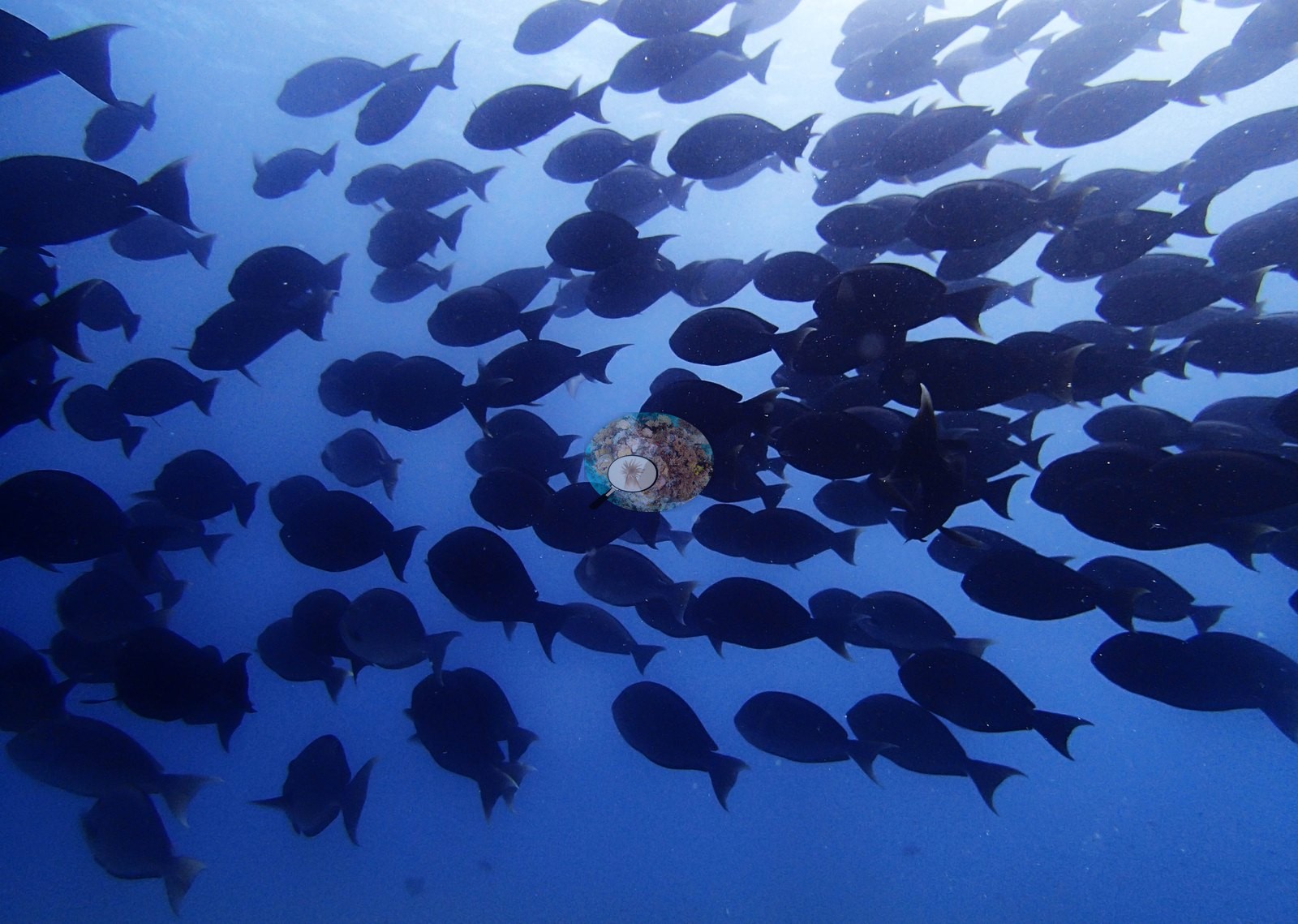
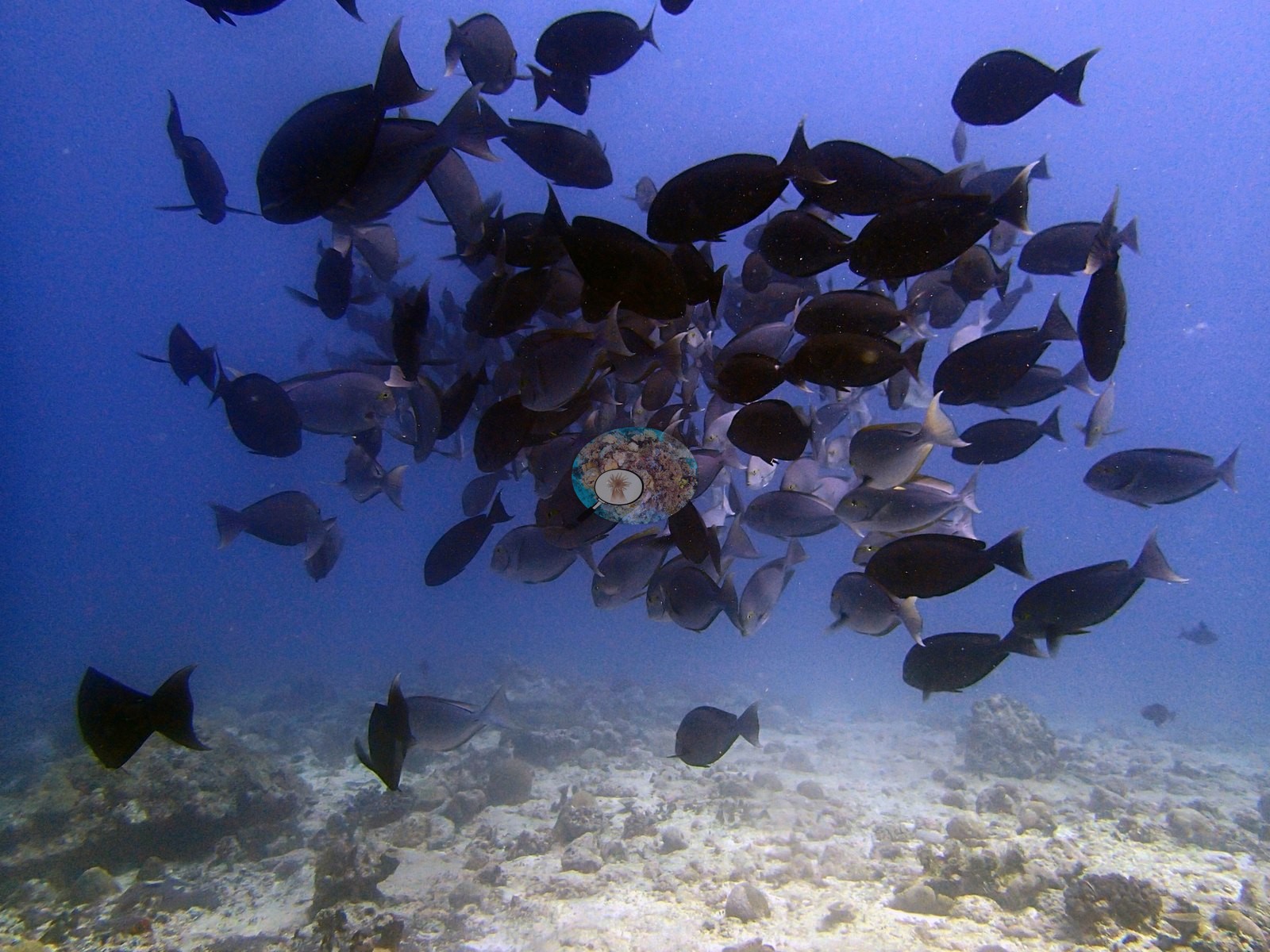
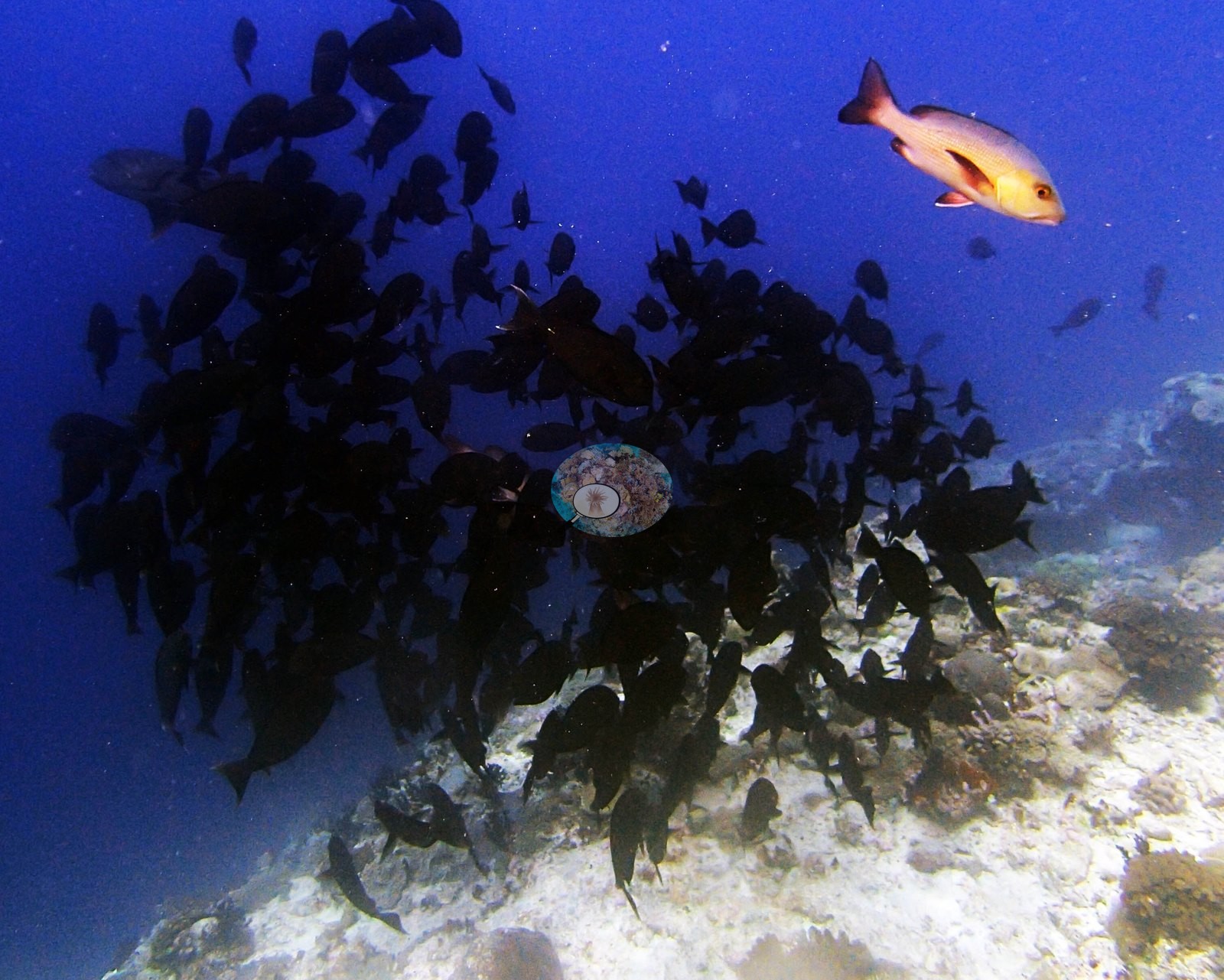
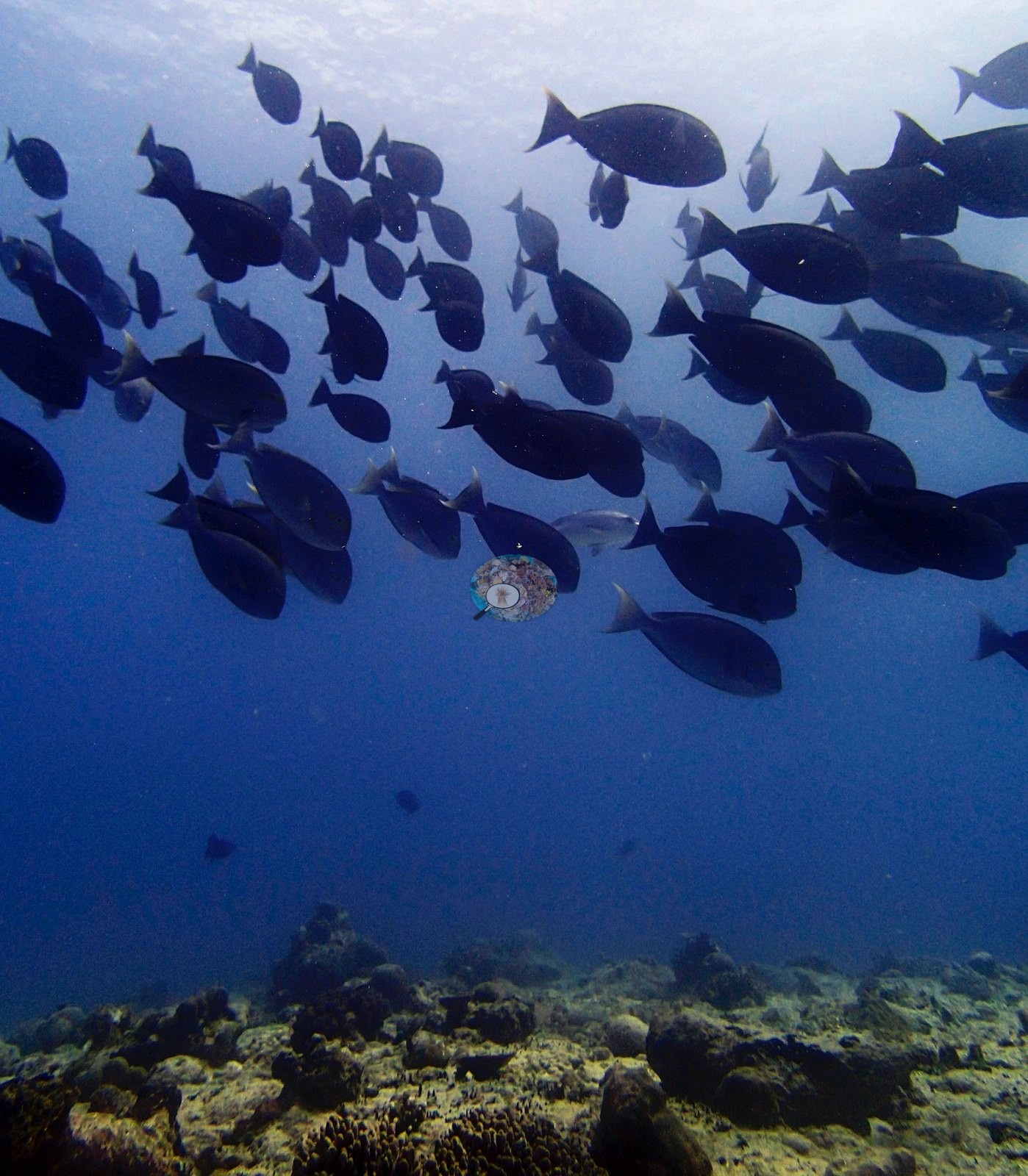
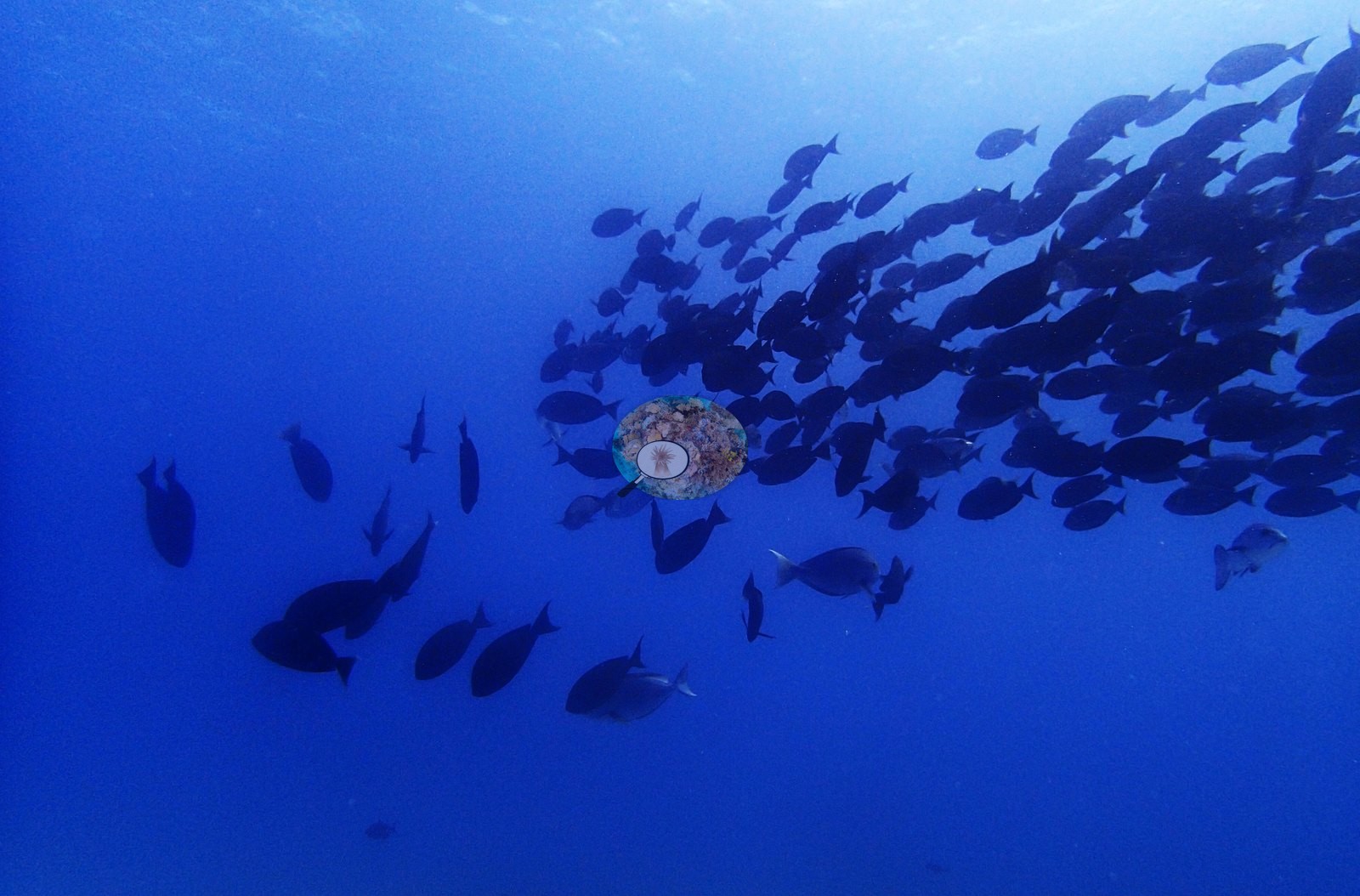
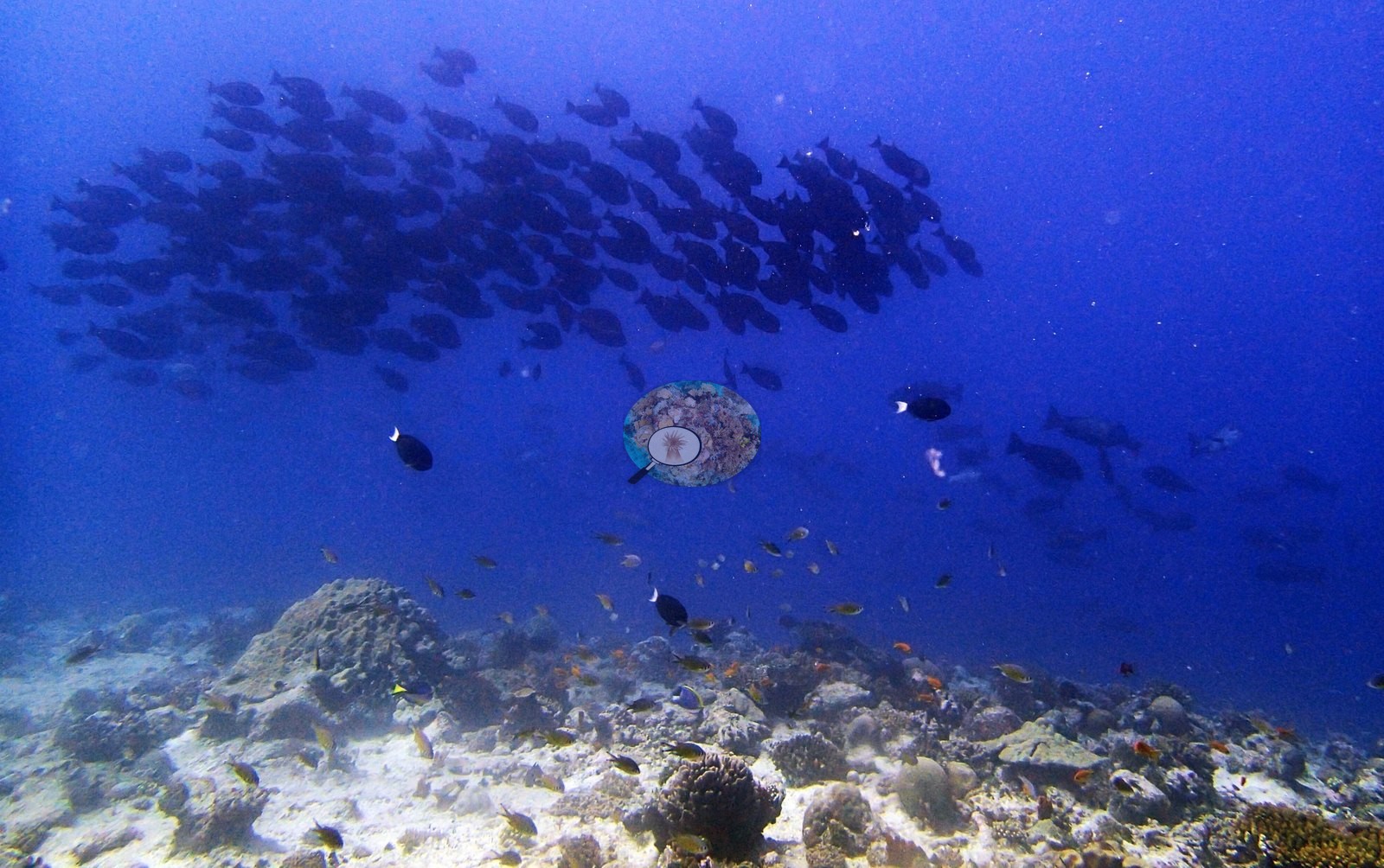
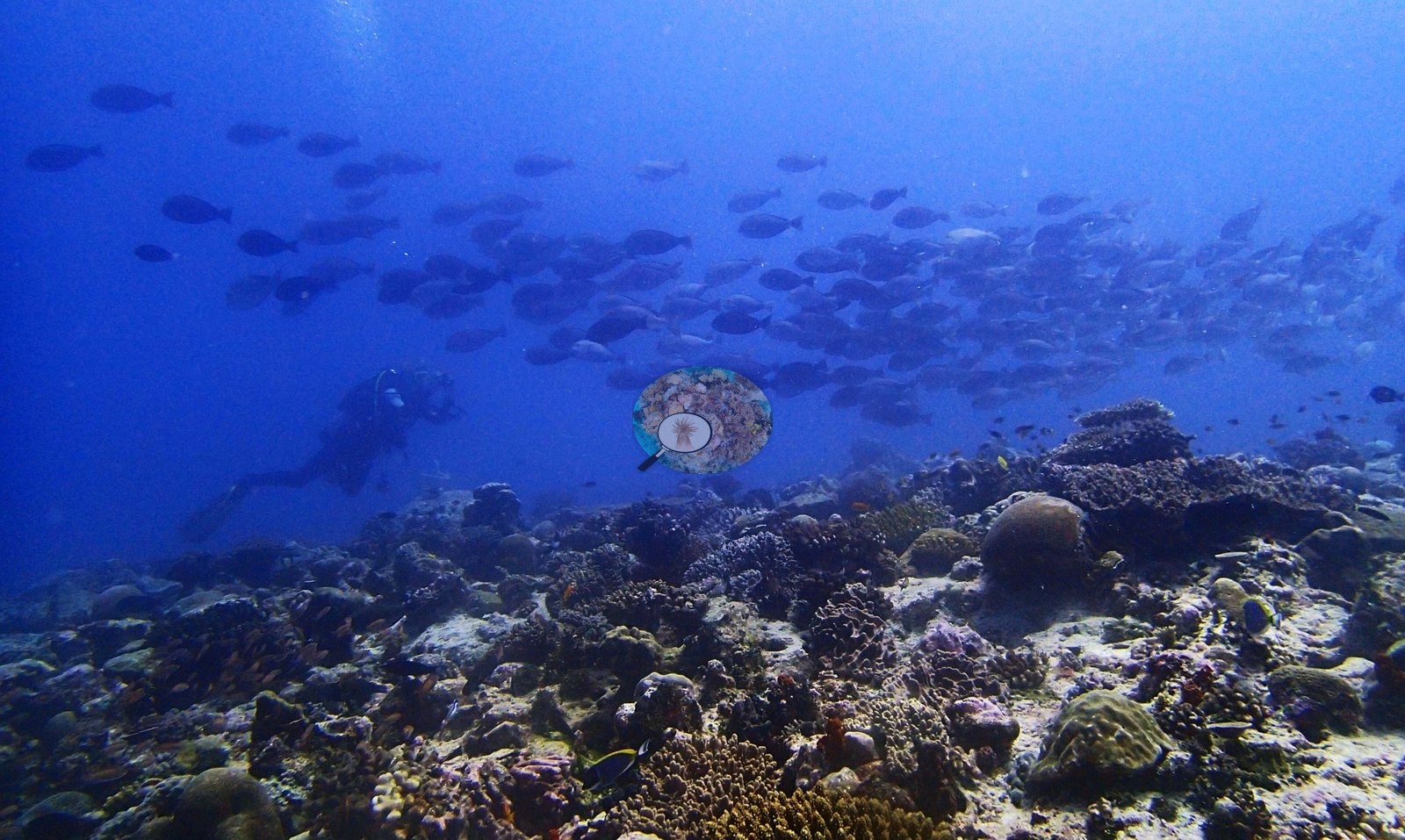
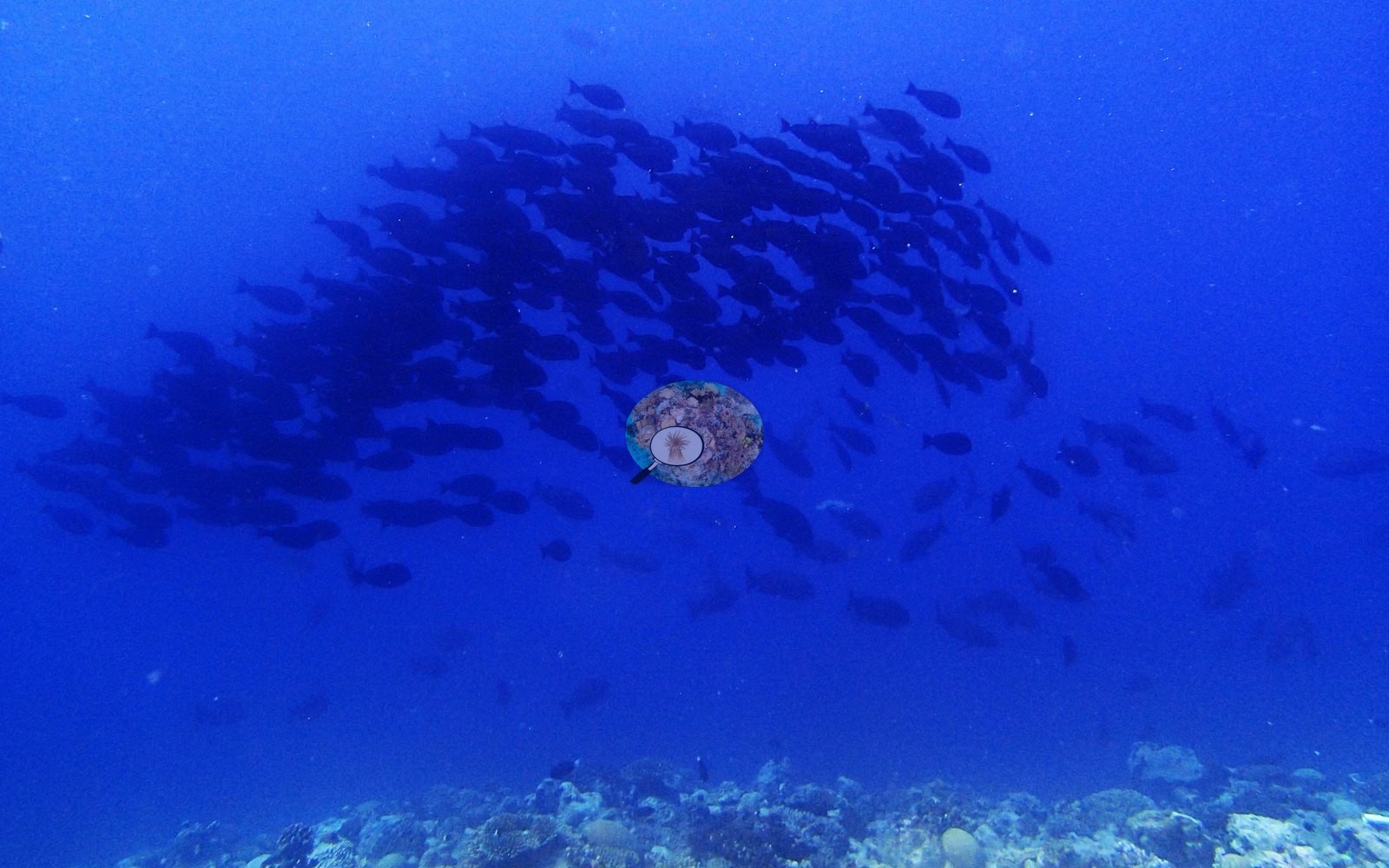
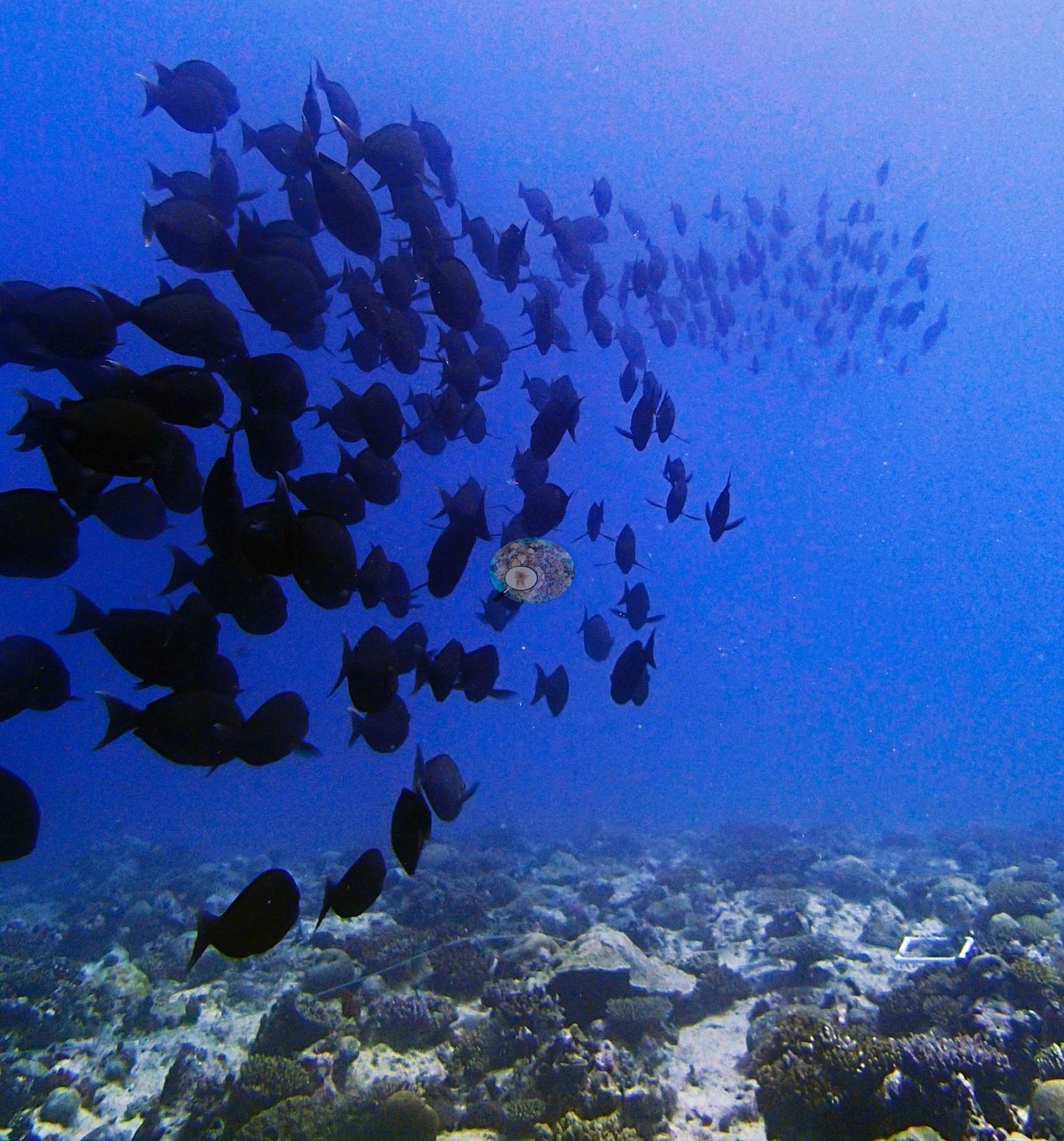
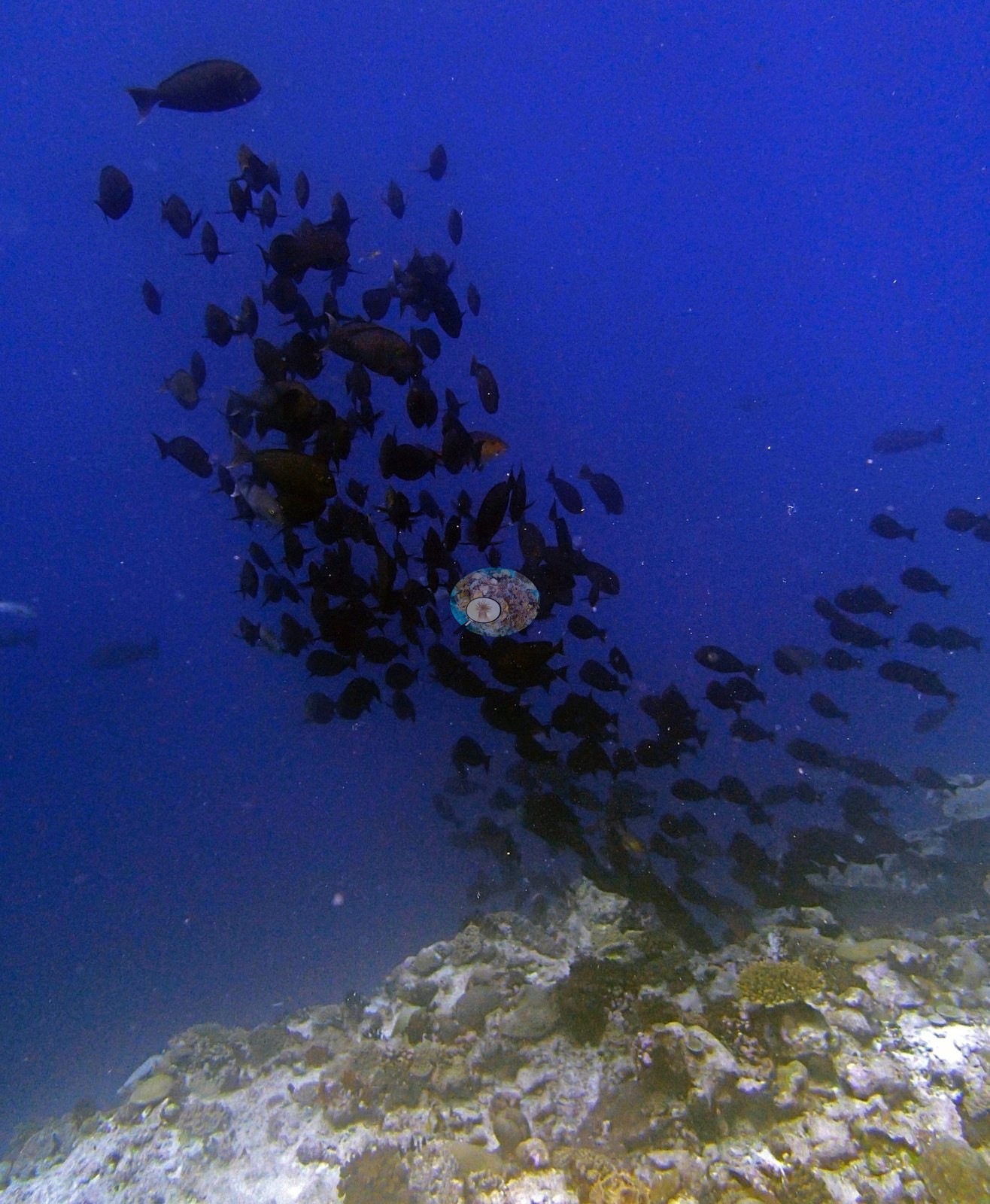
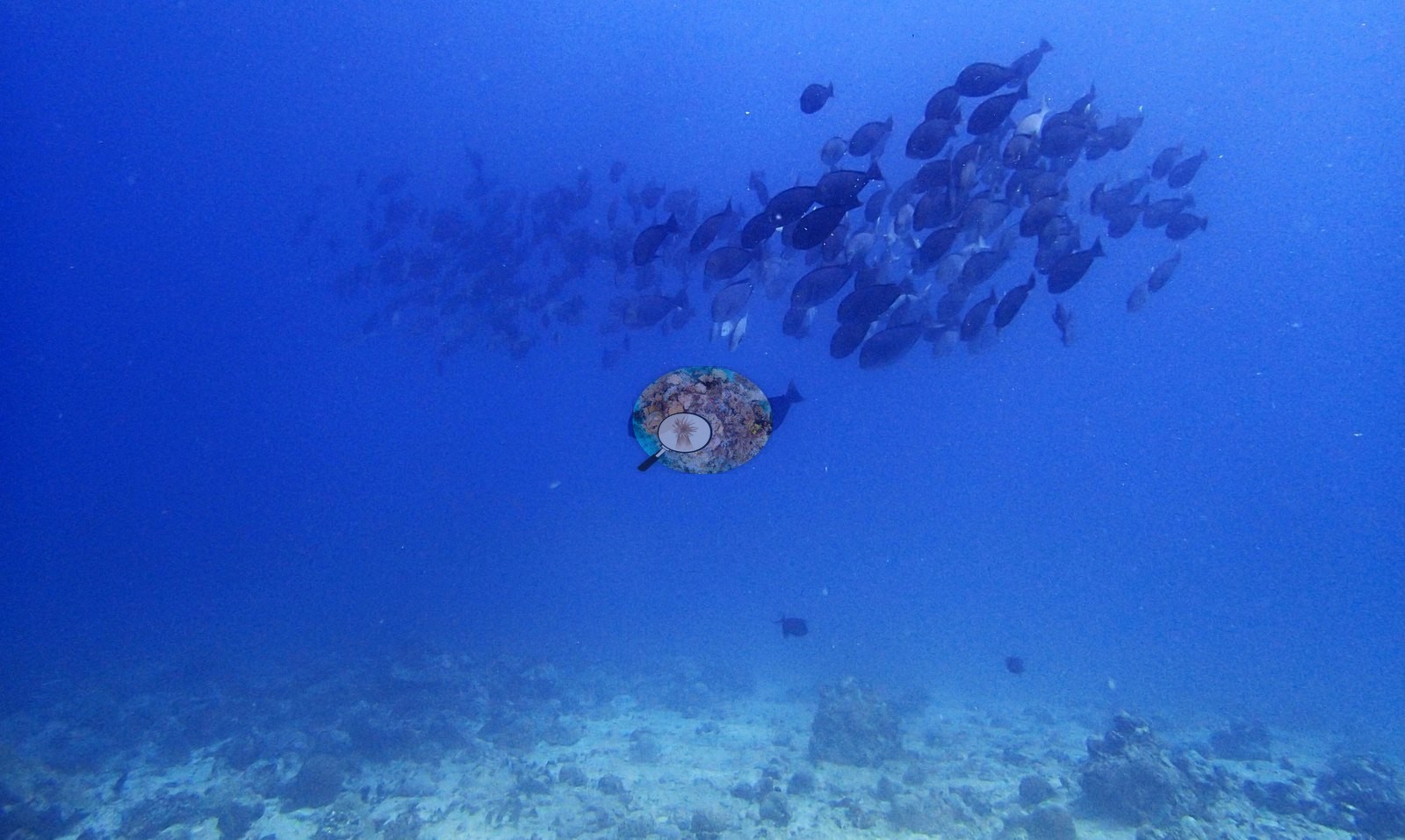
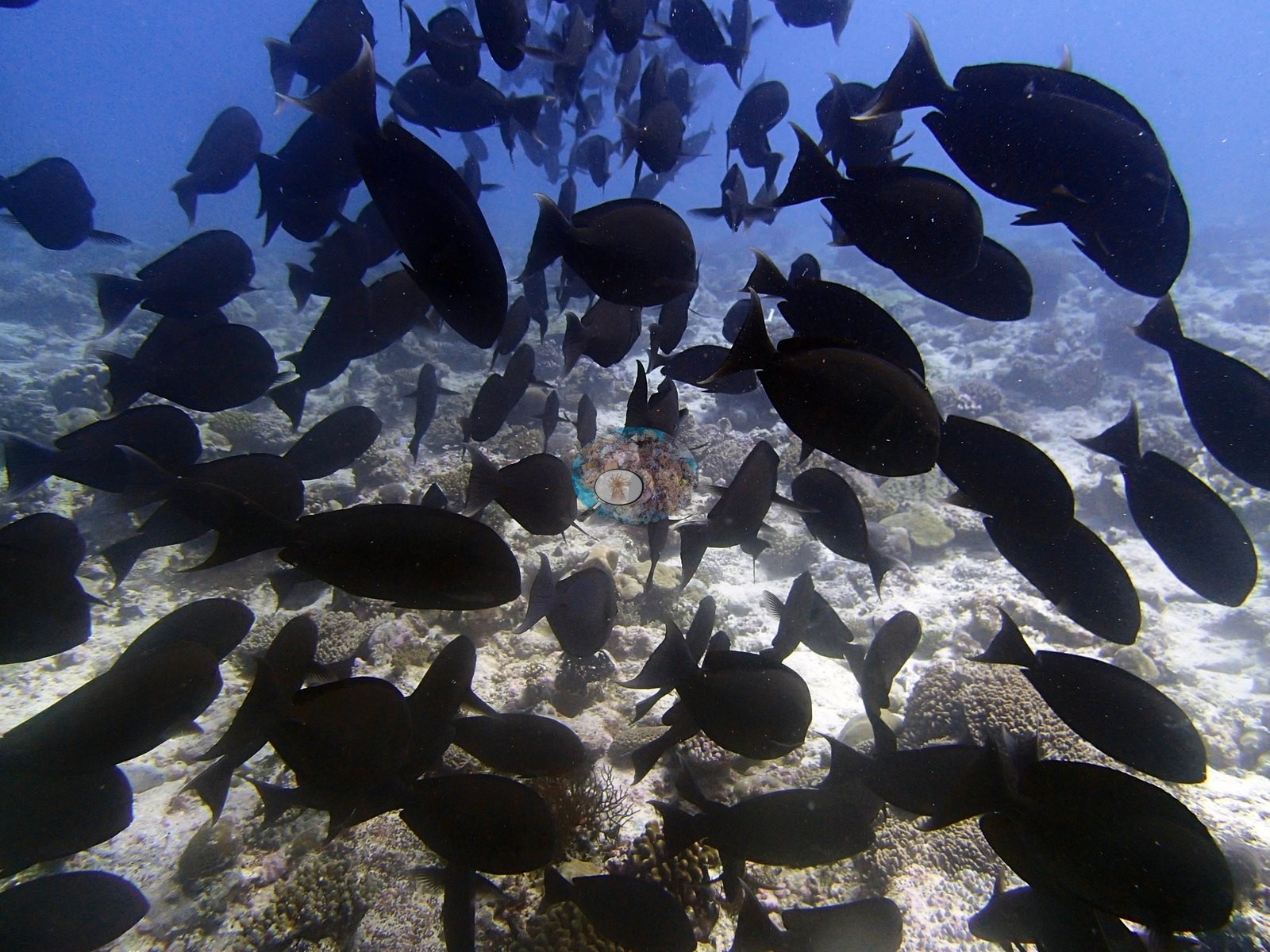
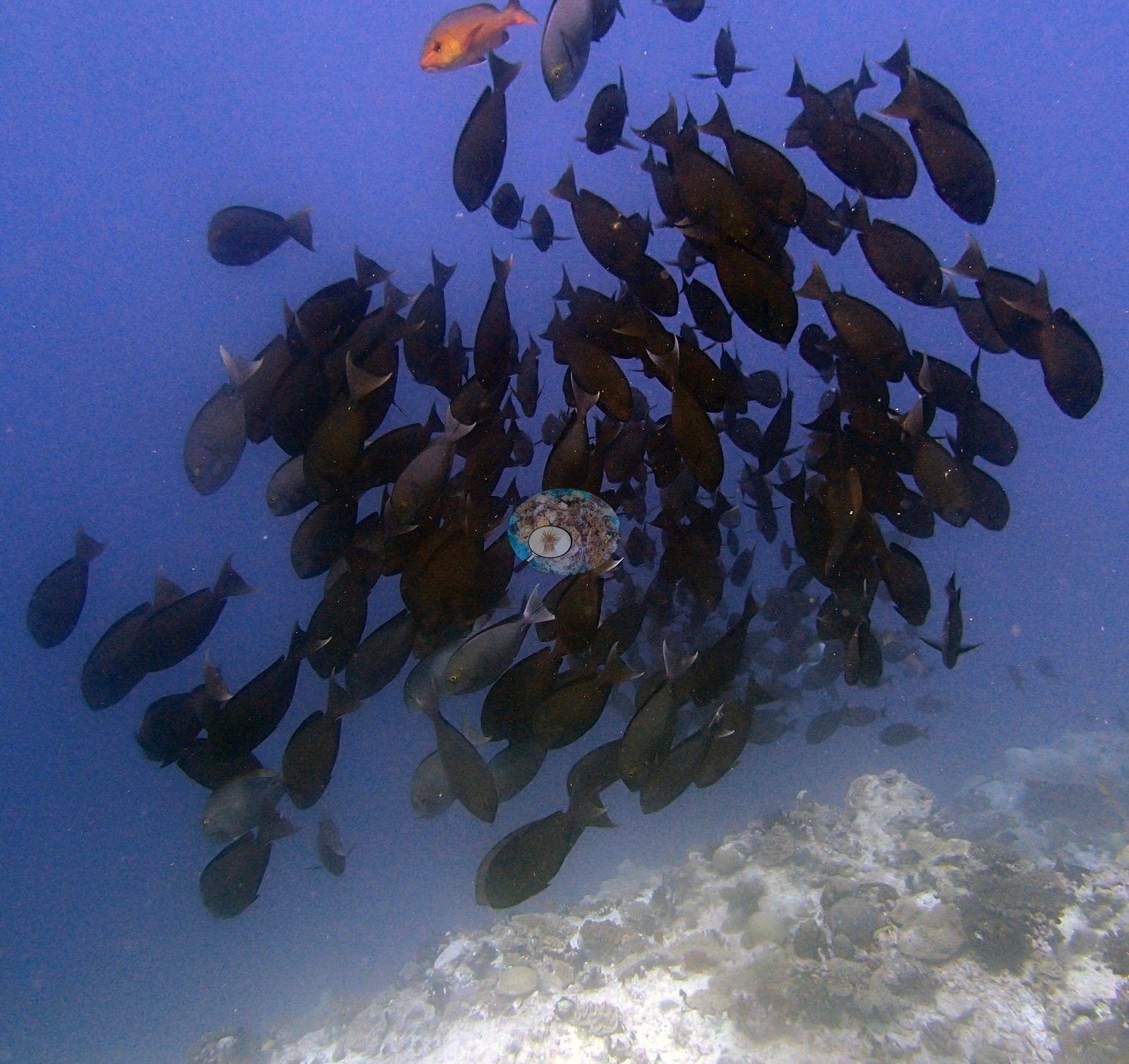
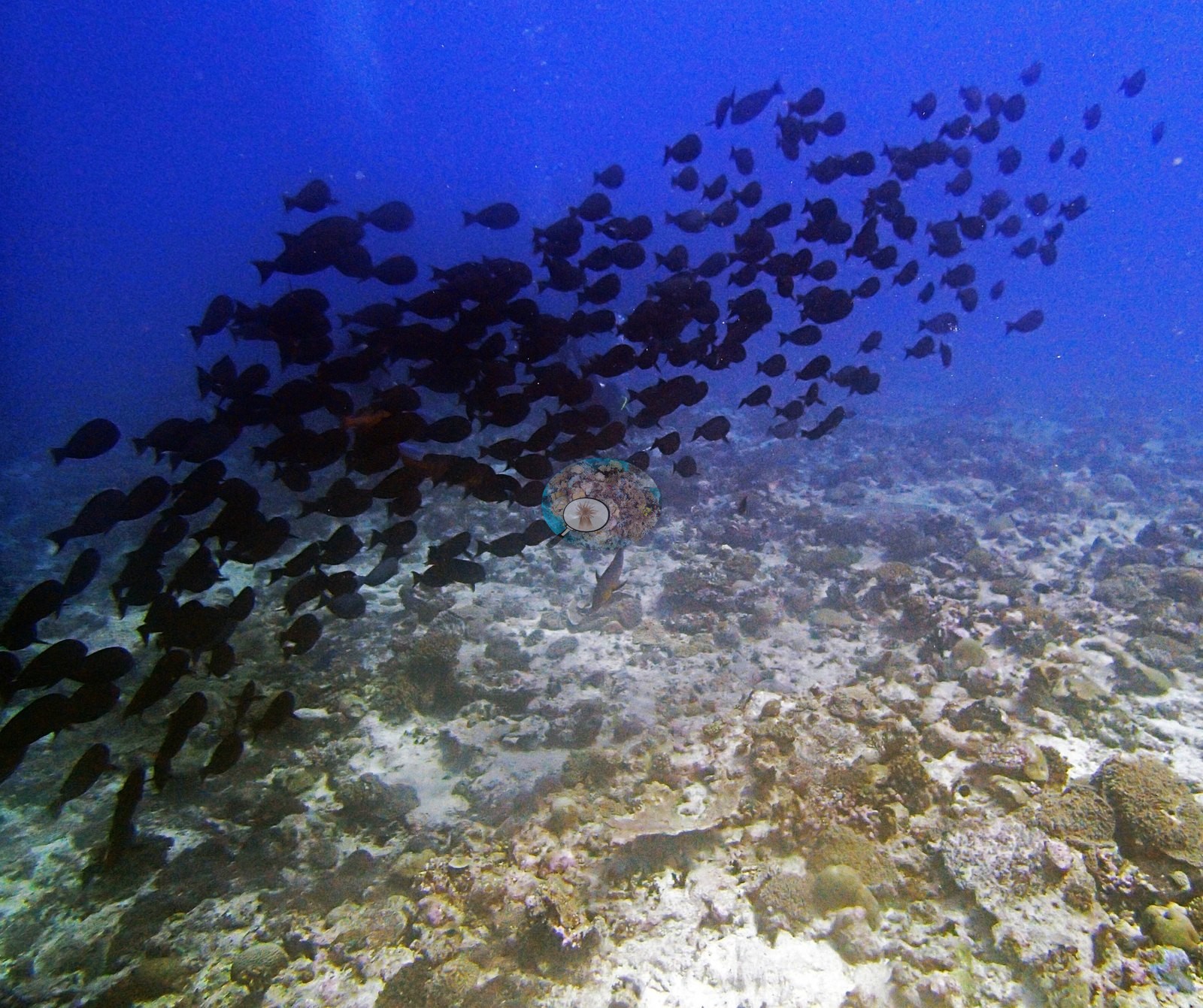
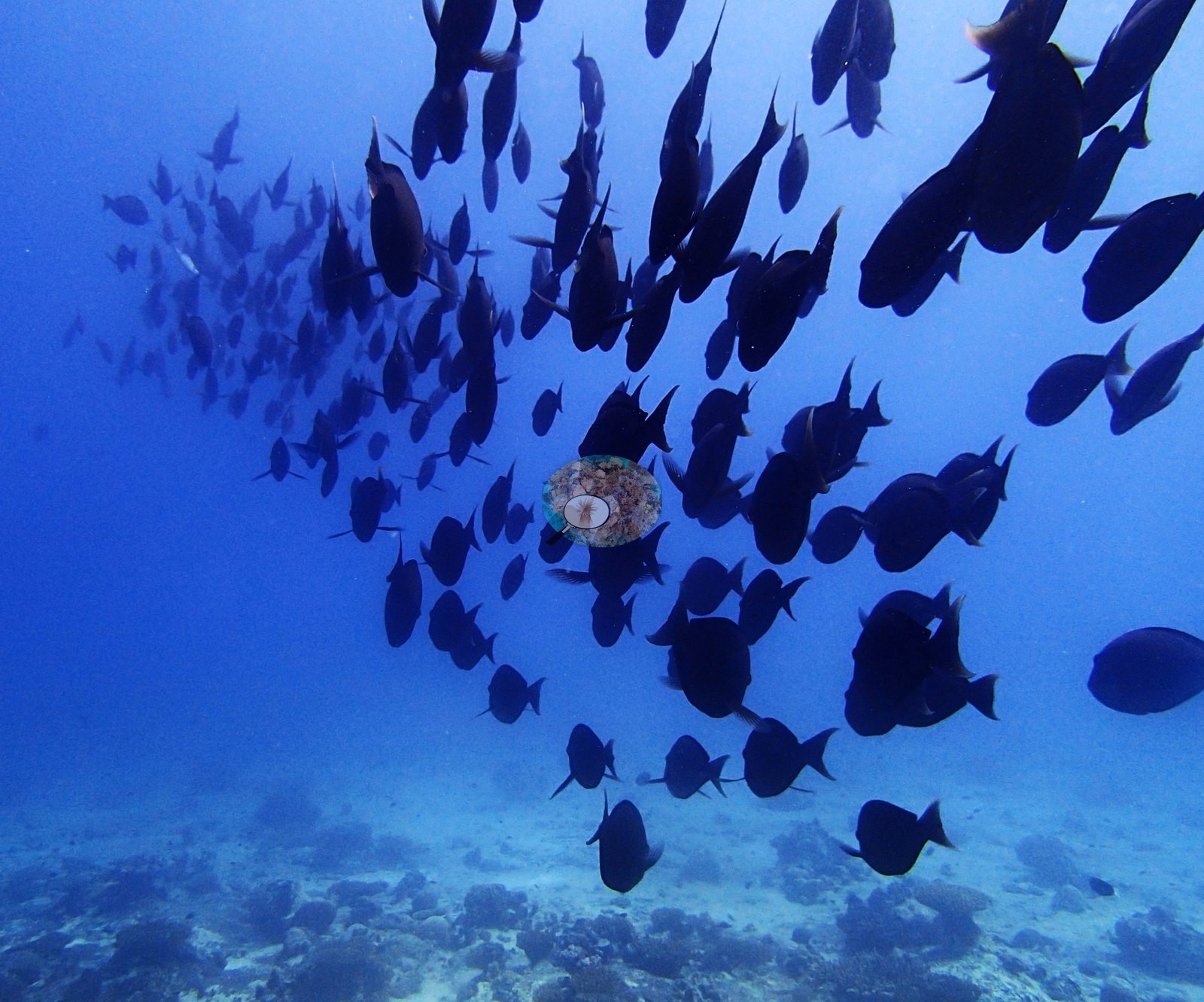
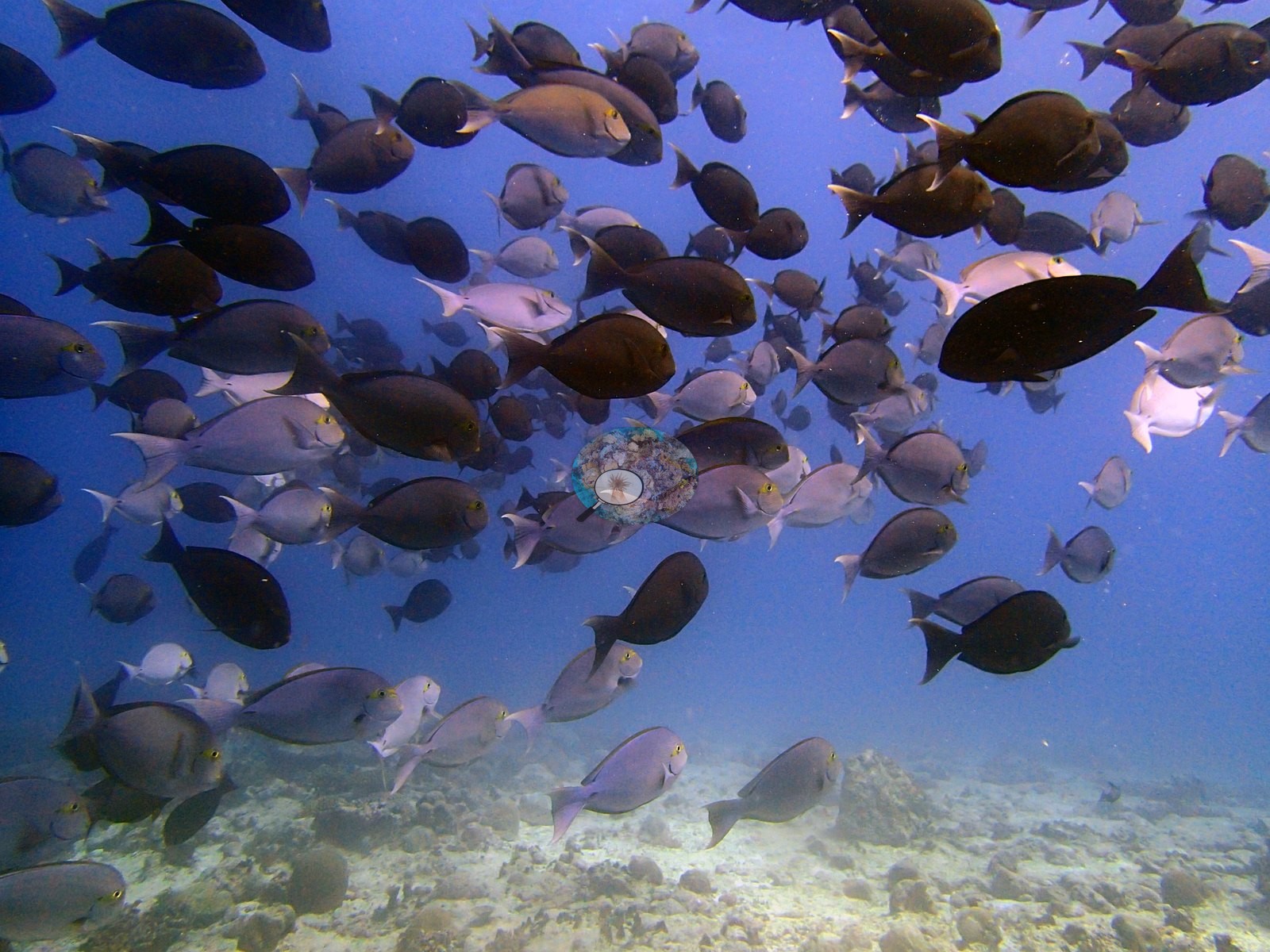
One structural fact governs how much weight the image products can carry here: roughly half the folder is water-column photography. About eighteen of the 41 frames are of a single enormous mixed surgeonfish aggregation in open blue water and contribute no benthic detail at all, and several more are blue-water or distant-fish frames.
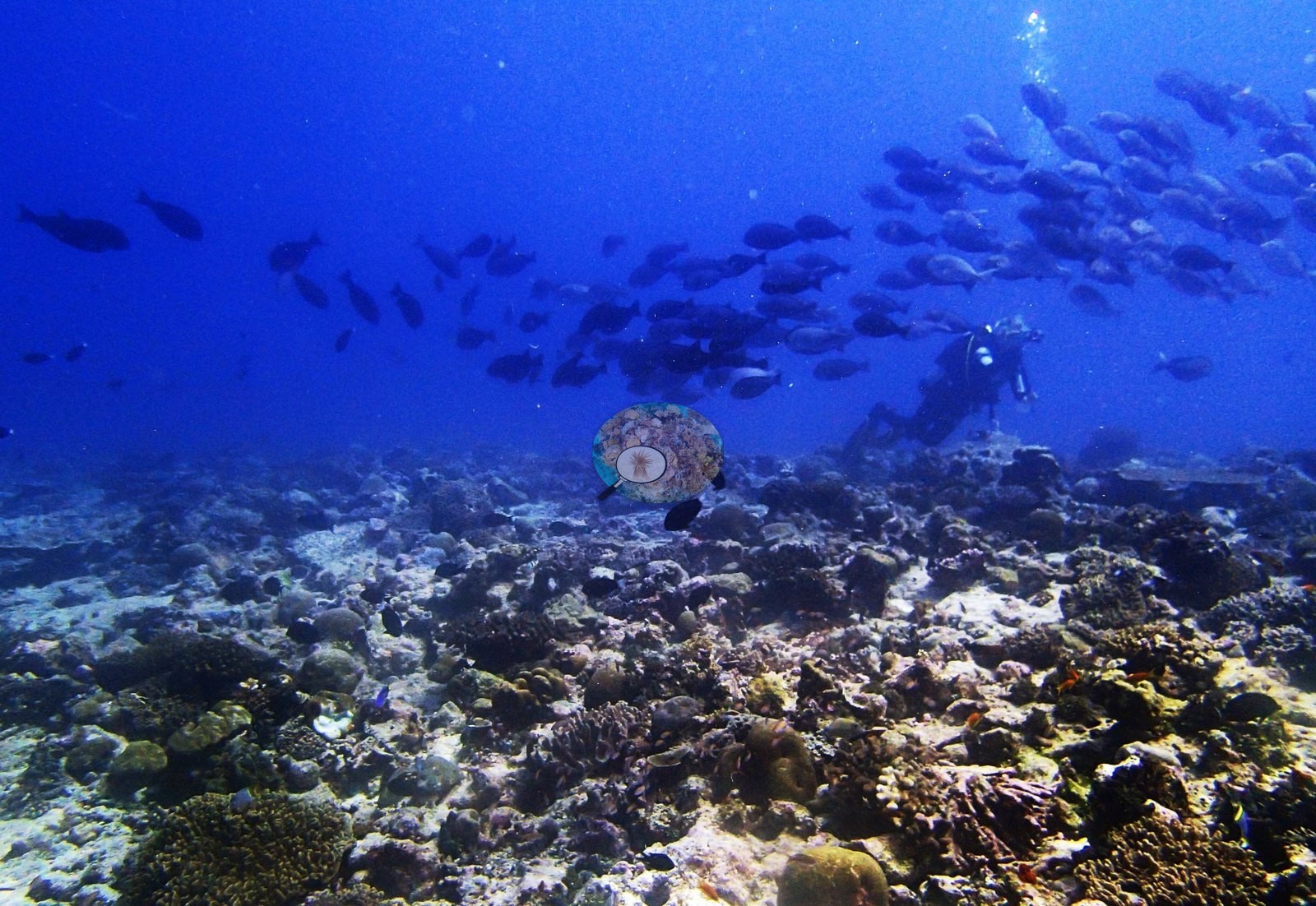
The single most striking thing about the folder is that it is not primarily a benthic record. Roughly half the frames – P3150283 to P3150289, P3150302, P3150304, and P3150306 to P3150313 – are given over to an enormous mixed surgeonfish aggregation moving over the reef in open blue water, dark brown and pale-lavender bodies packed shoulder to shoulder and filling the frame in several shots. As a record of fish biomass at an unfished site these are exceptional; as benthic frames they carry almost nothing.
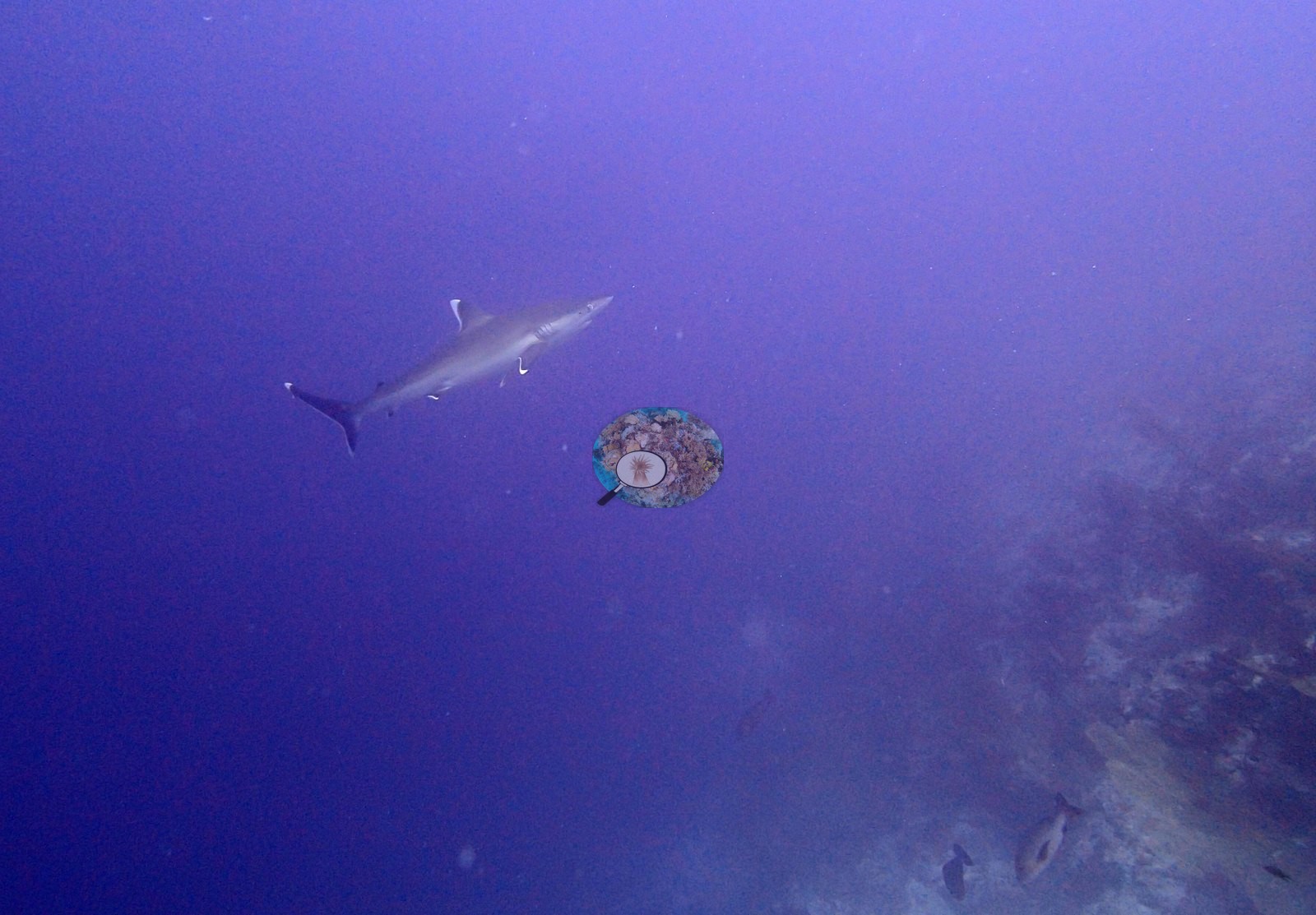
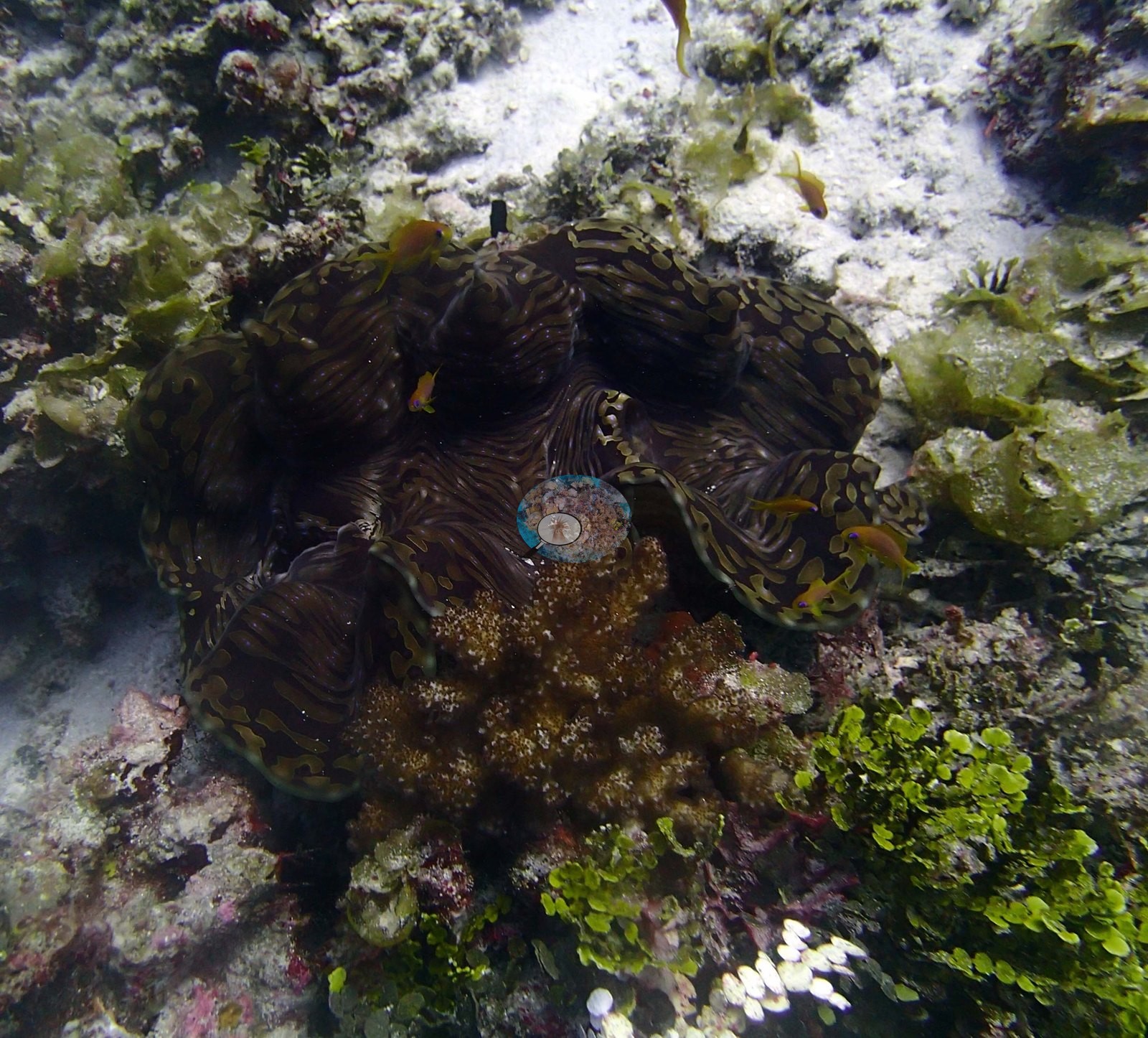
The macrofauna is among the best in the Chagos set. P3150248 is the finest shark frame in the collection – a whitetip reef shark (Triaenodon obesus), close and sharply lit, cruising over white sand beneath a maroon-crusted overhang, its white dorsal and caudal tips unmistakable. A whitetip appears again on the slope in P3150262, and P3150259 holds a second, different requiem shark in open blue water – dark caudal margin but a pale first-dorsal tip, so gray reef (Carcharhinus amblyrhynchos) or silvertip (C. albimarginatus); it is not callable from the frame, and the BIEG04 lesson (Chagos ‘whitetips’ that proved to be silvertips) argues for leaving it hedged. Beyond the sharks: a giant clam (Tridacna) with its mantle open and boldly patterned in P3150250; an adult emperor angelfish (Pomacanthus imperator) in P3150274; a two-spot red snapper (Lutjanus bohar) in P3150308; a coral hind (Cephalopholis miniata-type) in P3150307; powder-blue surgeonfish (Acanthurus leucosternon) in P3150301; a Diadema-type long-spined urchin in P3150290, with a second urchin frame at P3150310; blue-and-yellow damselfish swarming P3150300 and over the reef top in P3150301; and black triggerfish, hogfish, cleaner wrasse, and orange anthias clouds throughout, notably P3150280, P3150282, and P3150298. Sponges register in 16 of the paired frames, urchins in 2, giant clams in 1, sea cucumbers in 1 and anemones in 1. Conspicuous fauna and sessile invertebrates appear as sponges in 16 frames, urchins in 2 frames, giant clams in 1 frame, sea cucumbers in 1 frame, anemones in 1 frame.
Comparisons with other data
No prior survey data from this site. If you would like to share yours, please email us.
Other notes
Those frames are still in the paired denominator.
Image-by-image. Forty-one habitat frames, P3150248 to P3150313, from Anderson's folder BiEa20-finished. There are no sampled-colony frames, so the account rests entirely on the wide set. Color is generally good – this is an edited folder – but several wide frames are hazy and blue-shifted with depth, and no scale bar appears anywhere, so no colony dimension here is measured.
This is also the mission's best-documented methodology site, and that is worth recording deliberately. Eight frames show the survey being made. P3150273 – a camera housing and strobe arm in the foreground aimed squarely at a massive Porites dome, a diver with a slate behind it (the frame the old description meant by ‘two divers photographing a coral colony’). P3150275 – a diver with a camera and, lying on the reef beside them, a second twin-cylinder set. P3150303 and P3150305 – divers with housings and twin strobes filming the fish schools. P3150277 and P3150278 – divers working over the rubble plain. And two frames that may be the most useful of all: P3150311 carries a distinct white rectangular open frame lying flat on the substrate at lower right, with a thin pale line running away from it across the reef, and P3150301 shows a similar rectangular frame silhouetted in the background at upper center.
CV model comparison
More info
Those are point counts on the photographs; this is a diver swimming a transect. The models and the reference never saw the same thing. ⚠ SITE-LEVEL ONLY. The 2,500 frames were not associated with any transect taken within 200 m of them, so transect-vs-image comparisons are site means, never frames. The transect value is already in the pin `cover` field (109 of 112 pins, sourced to the paper's suppl. S1) and is read from there, never re-imported. The transect is THE coral-cover value for this site and stands alone. The rows below it are a methods comparison only: no computer-vision value is averaged with it, feeds the headline, or carries over to the site's cover figure (Anderson, 2026-09-22).| Method | Hard-coral cover (%) |
|---|---|
| Transect (published) | 10.8 |
| CoralNet | 24.6 |
| In-house DINOv3 | 16.0 |
| CoralSCOP edited | 27.1 |
| Claude | 22.2 |
Data & links
- Read the full site report ↗
- Download benthic survey data (CSV) ↗
- Download all LOF-GRE data (933 sites) ↗
- CoralNet image repository for this region ↗
- Photo portfolio ↗
- Coral Reef Diagnostics page for this area ↗
All images from Coral Reef Diagnostics. Data are from Coral Reef Diagnostics.
 © Coral Reef Diagnostics.