
Part of the regional summaries: Chagos Archipelago - Great Chagos Bank West / Brothers / Eagle and Chagos Archipelago
More info
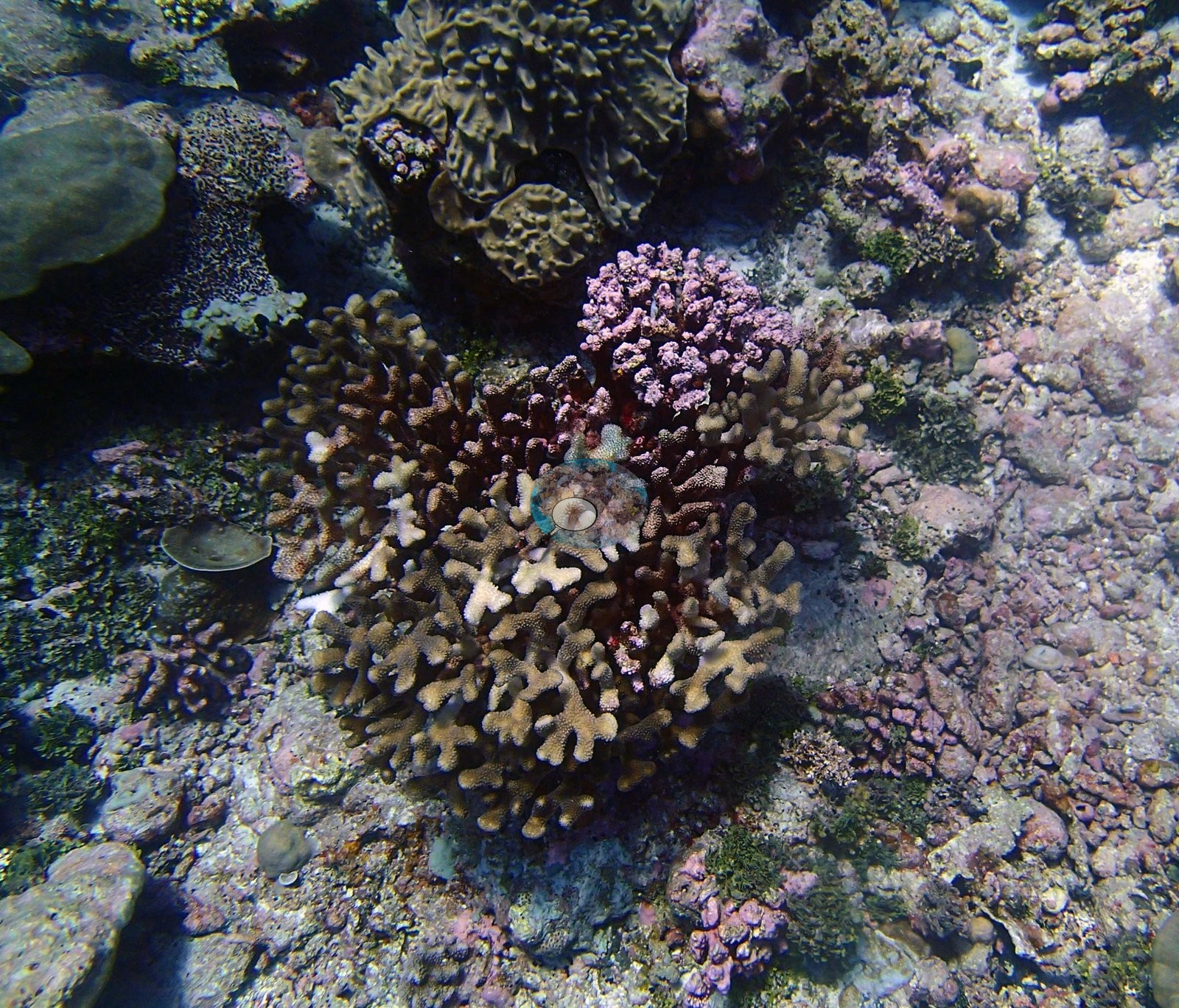
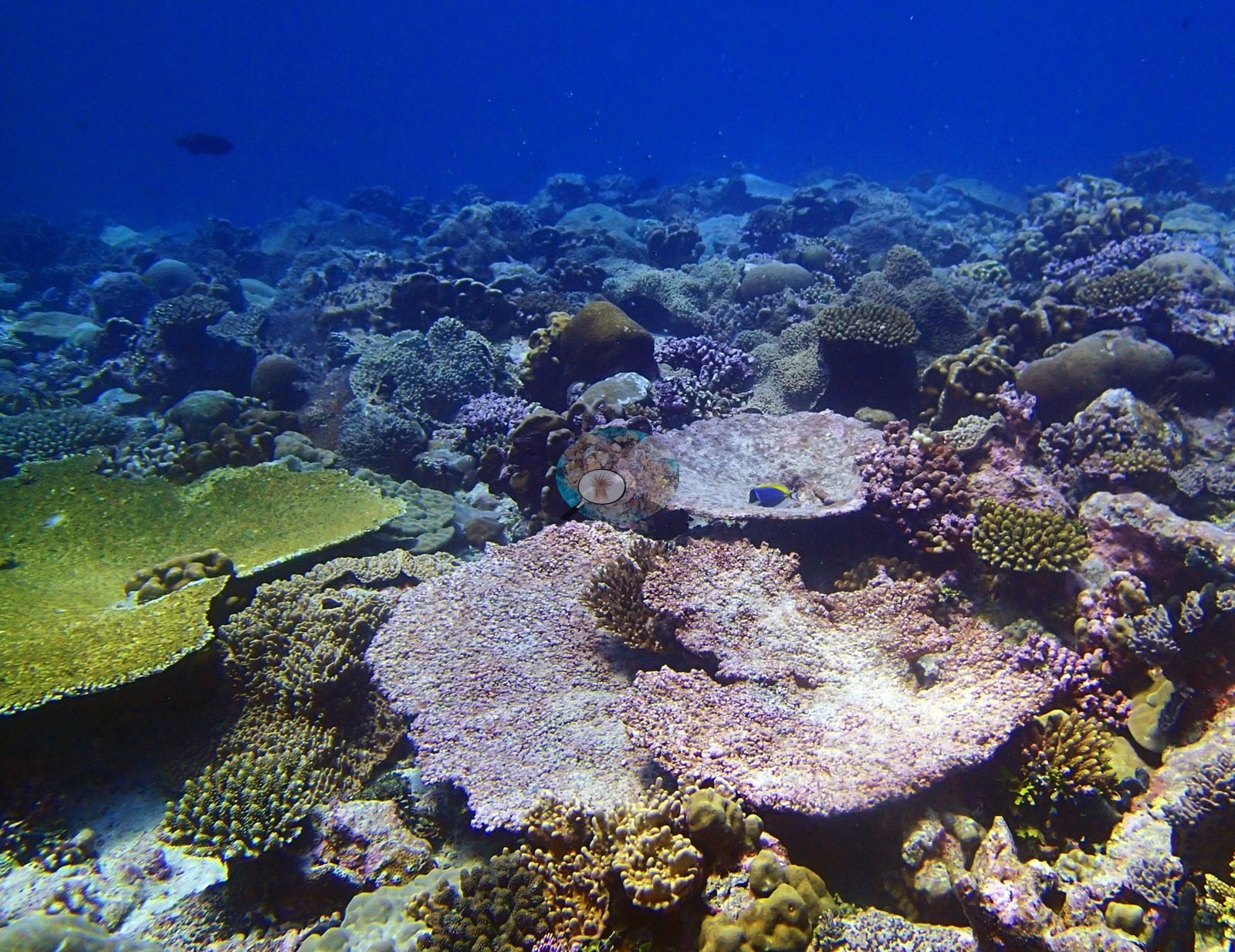
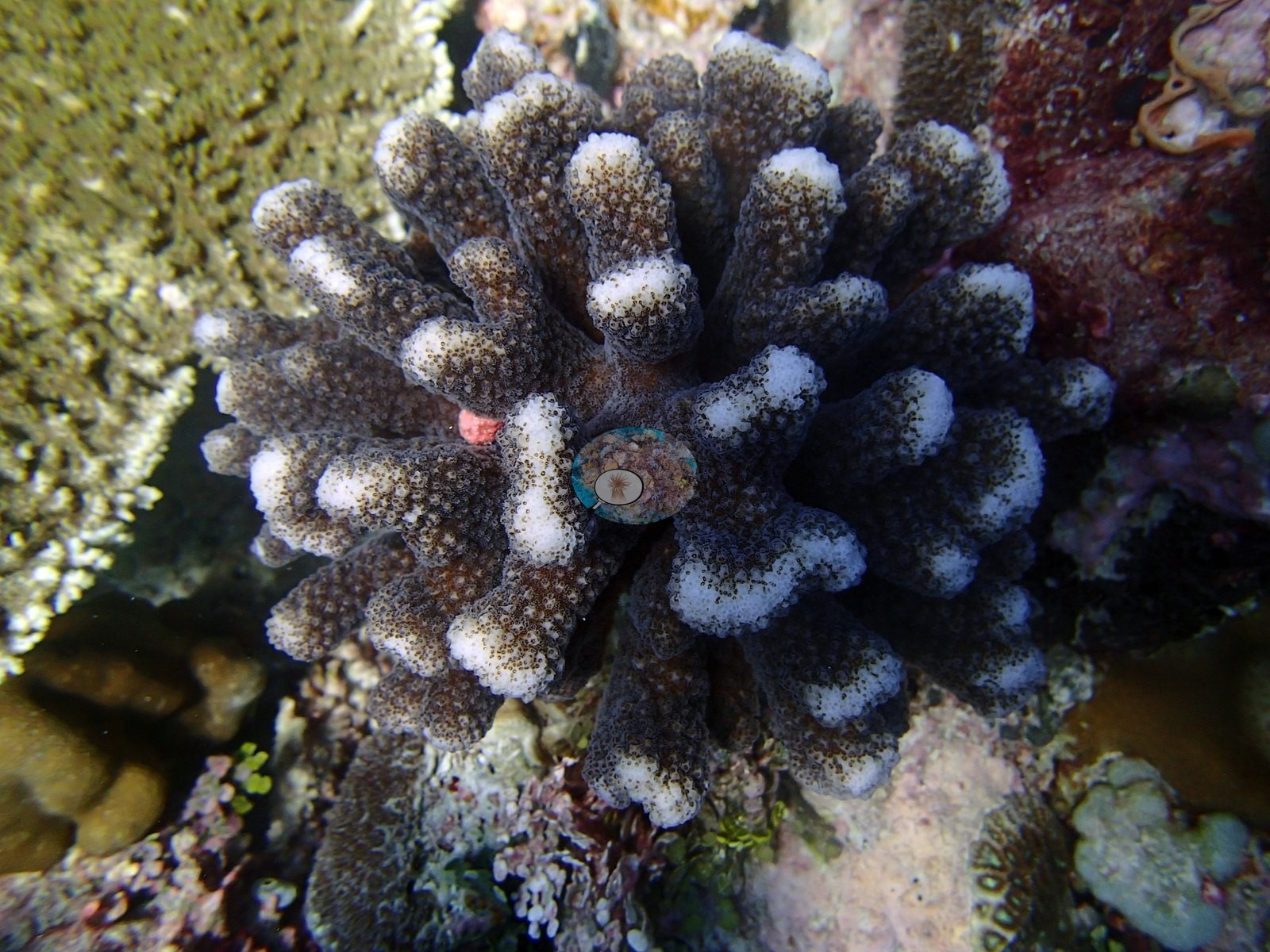
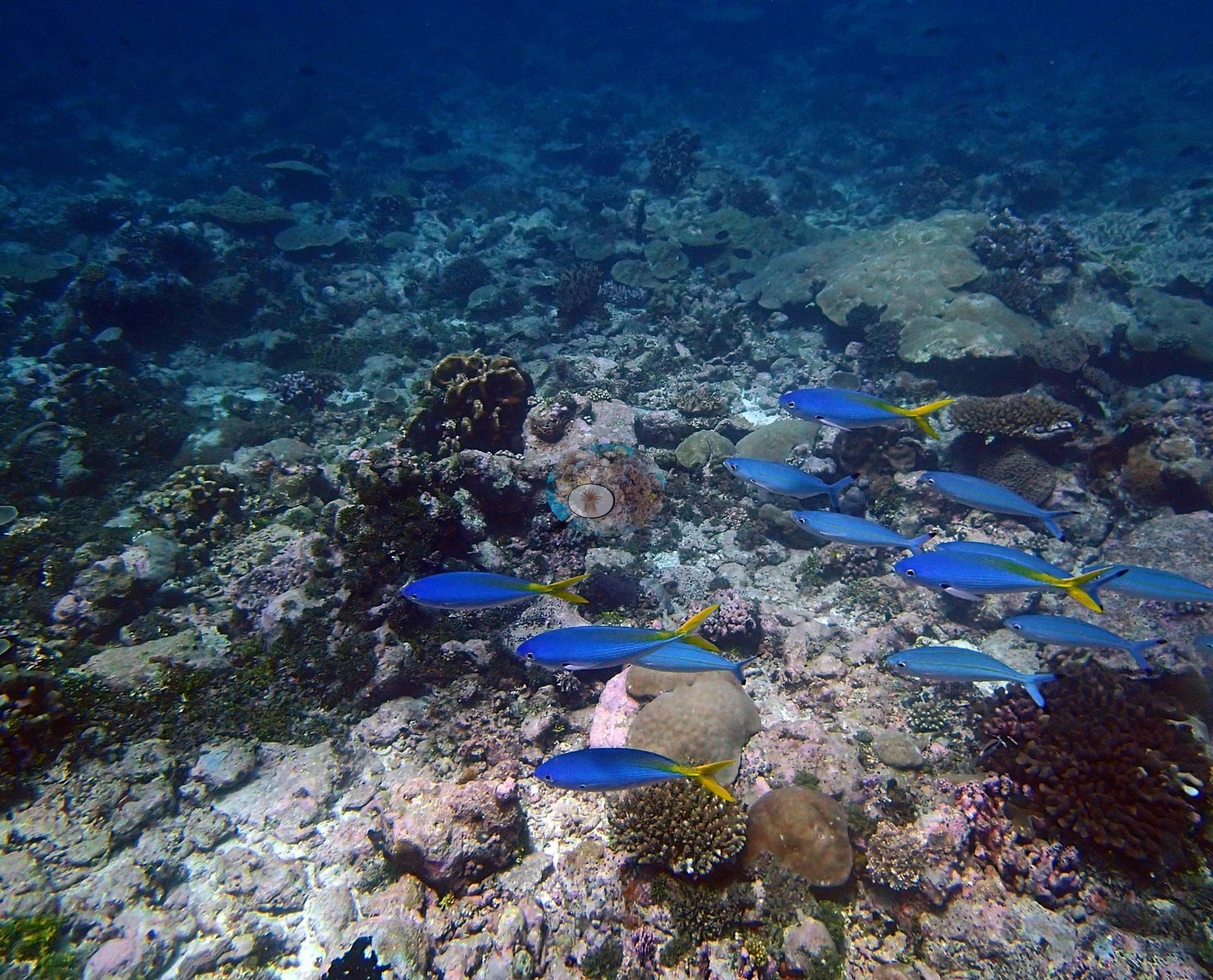
Chagos (NOAA CRW virtual station)BIEA19 has 28% coral cover and includes one of the clearest images of patchy coral bleaching in the whole Chagos set - a thick-branched Pocillopora colony strikingly mottled with bone-white patches interleaved among fully pigmented brown tissue. Dead and dying tabular Acropora were also documented nearby, alongside blue-and-yellow fusiliers and a powder-blue surgeonfish. Surveyed on the Living Oceans Foundation's Global Reef Expedition.
Four other CRD dive sites within 5 km shown in orange — click a marker to open its page.
🗺 Detailed map of the Global Reef Expedition dive sites, Eagle Island, Chagos (Khaled bin Sultan Living Oceans Foundation; opens in a new window)
Site description
Setting
Reef type: bank, protected.
General benthic features
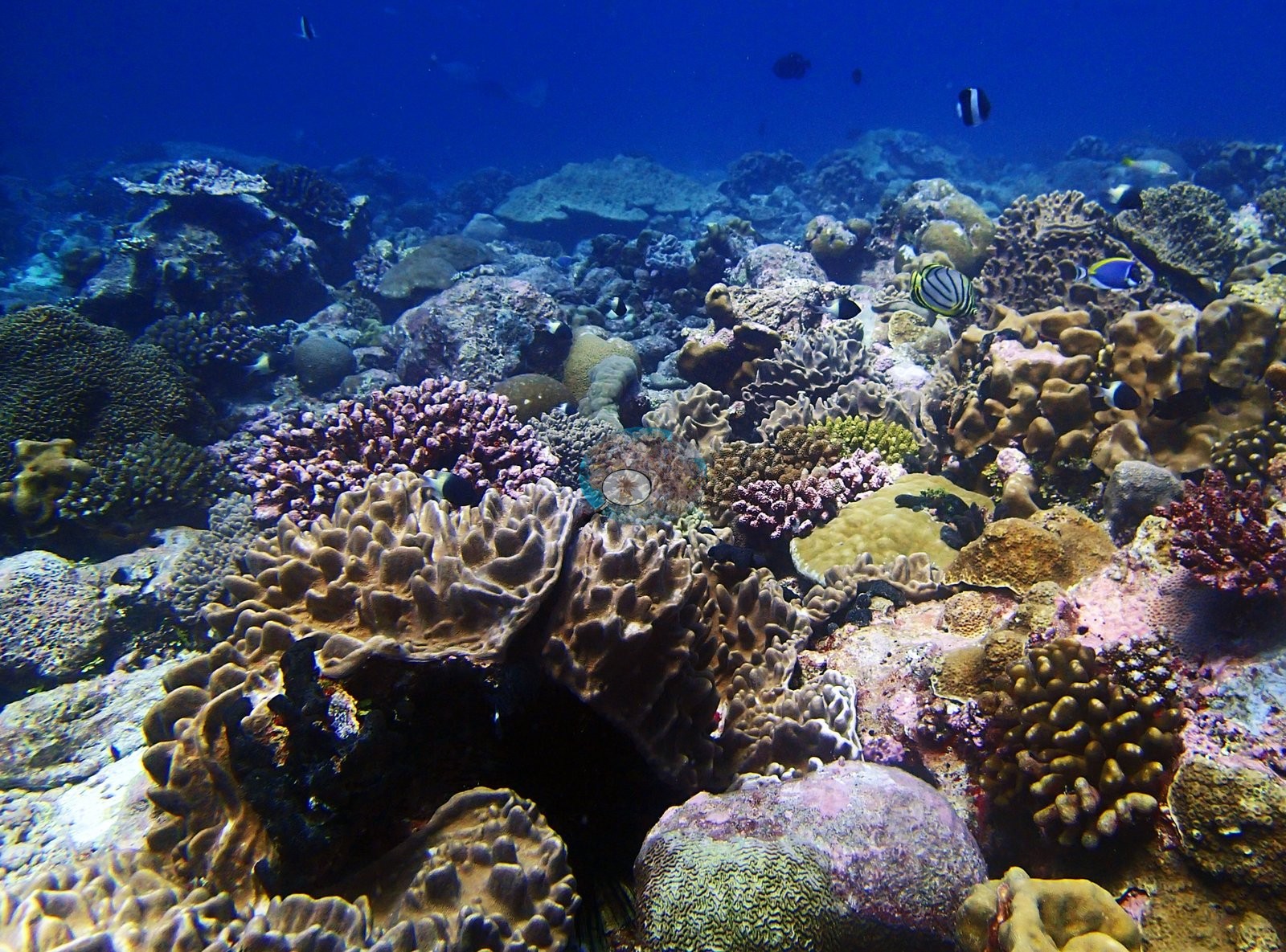
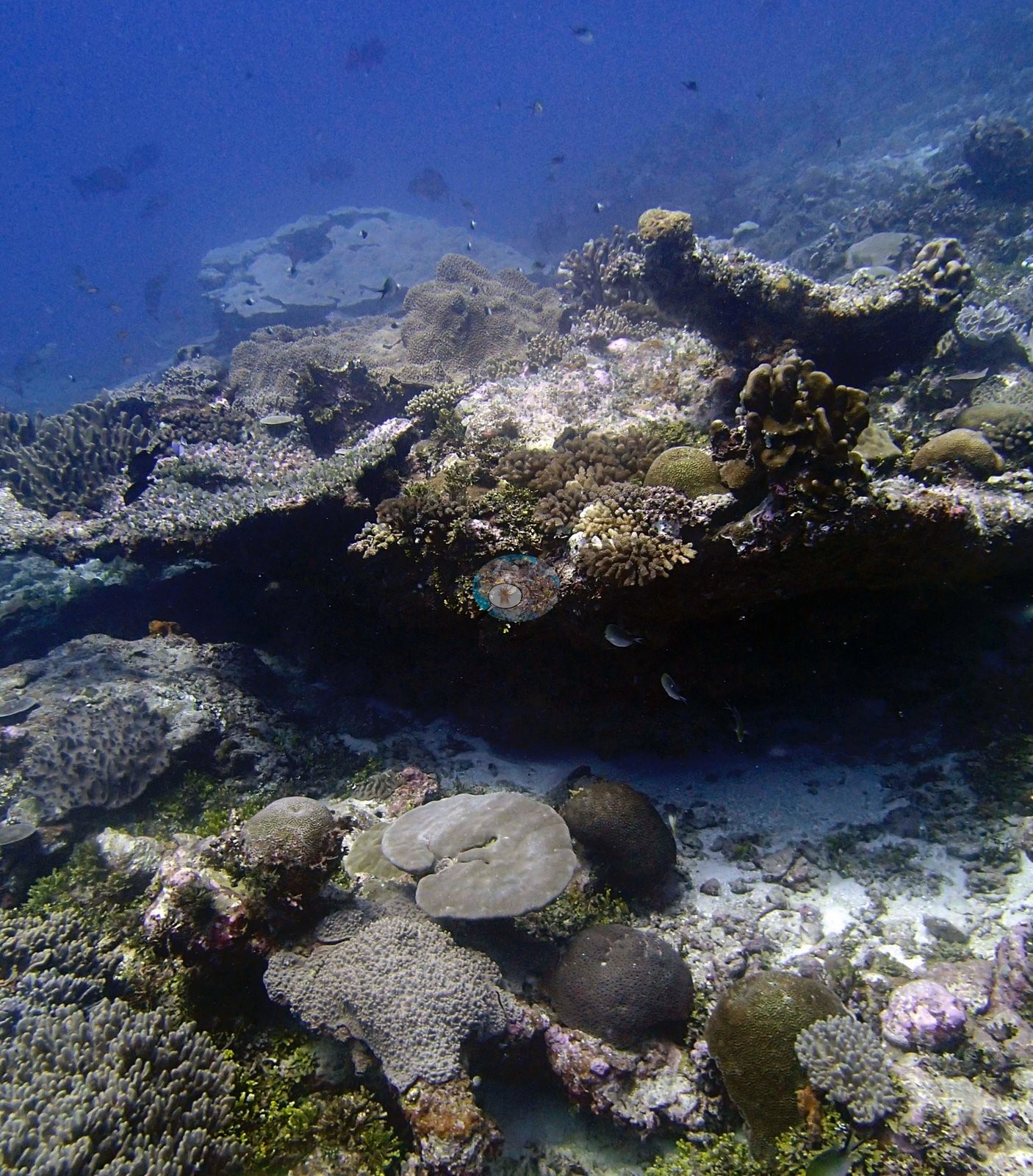
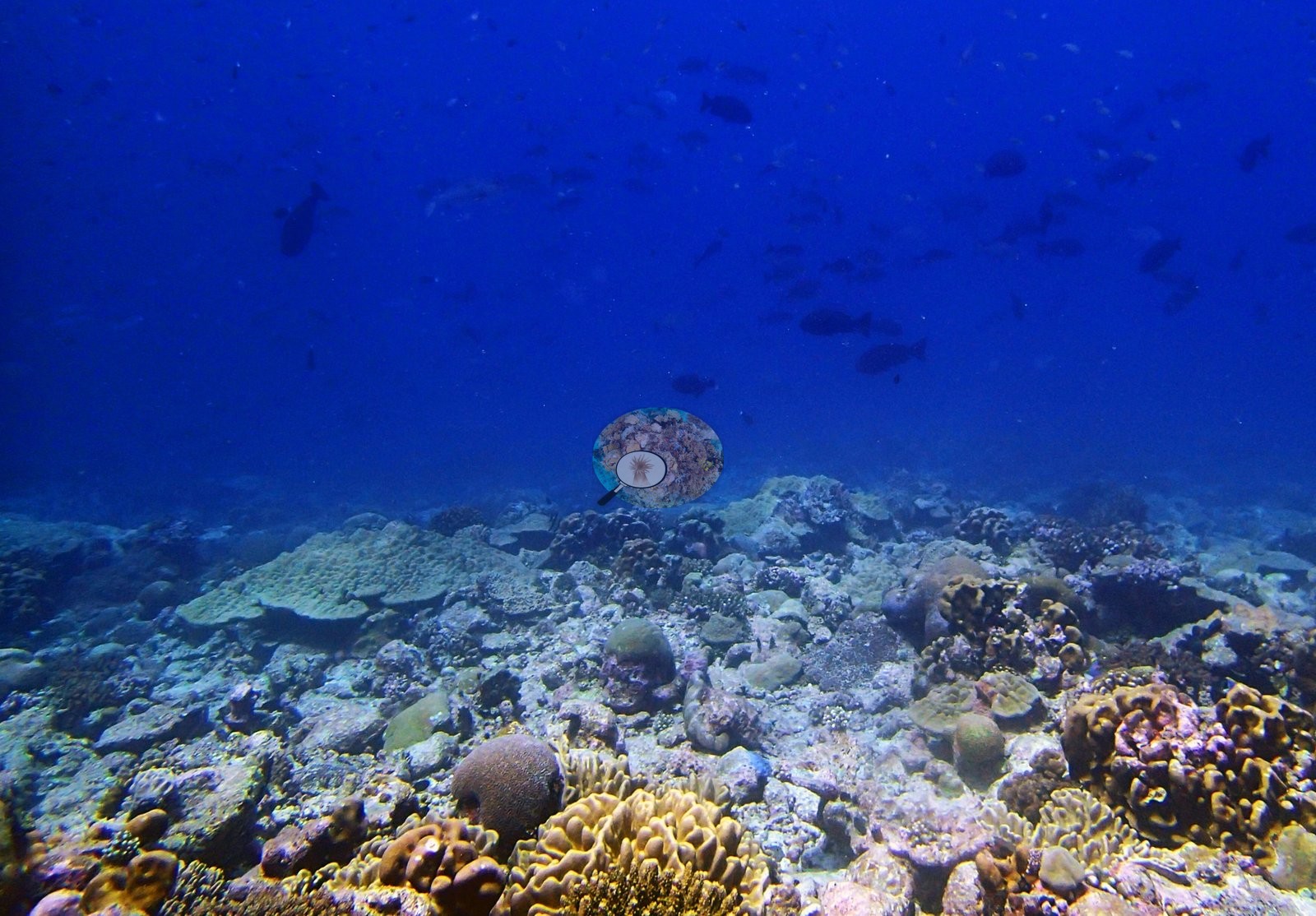
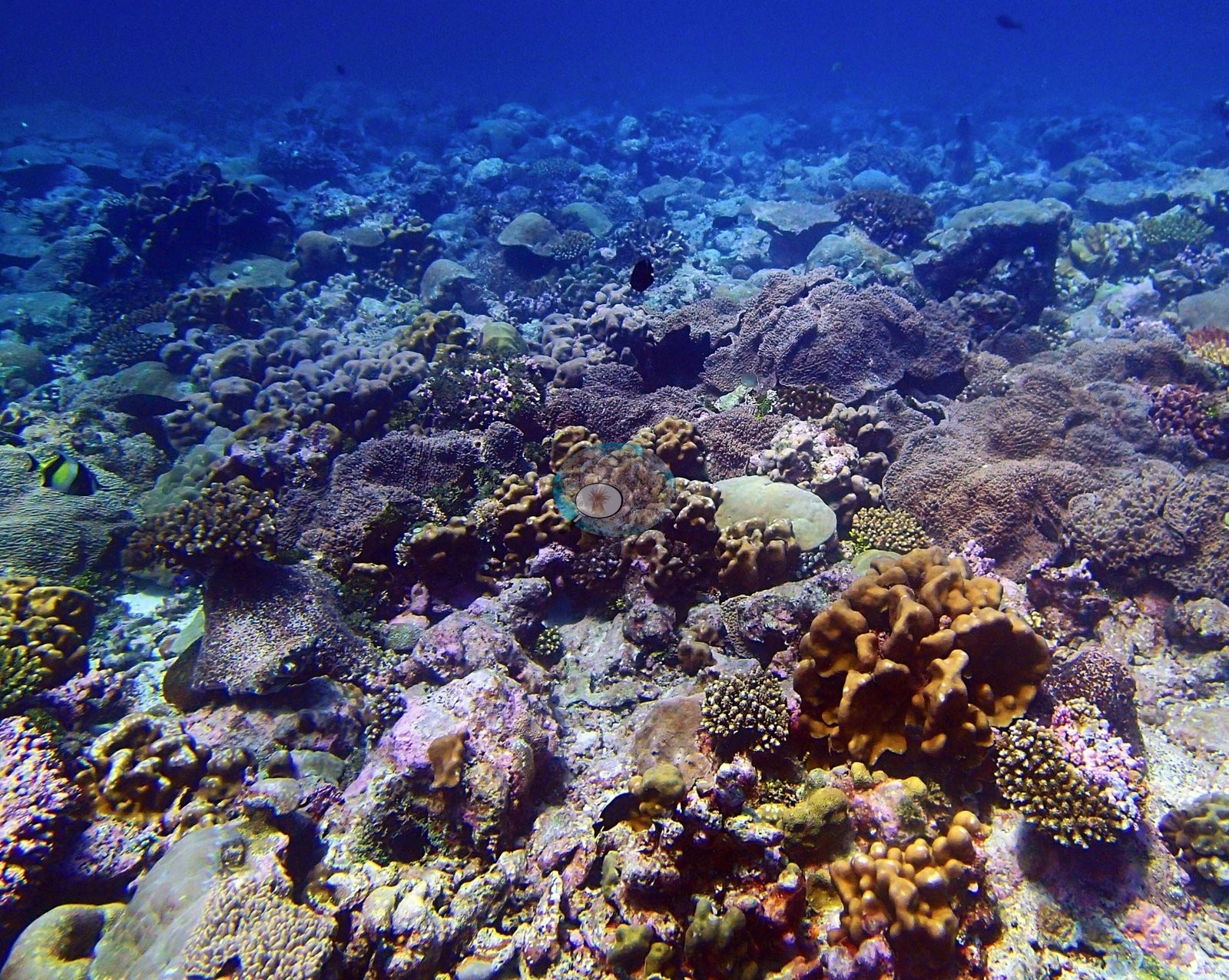
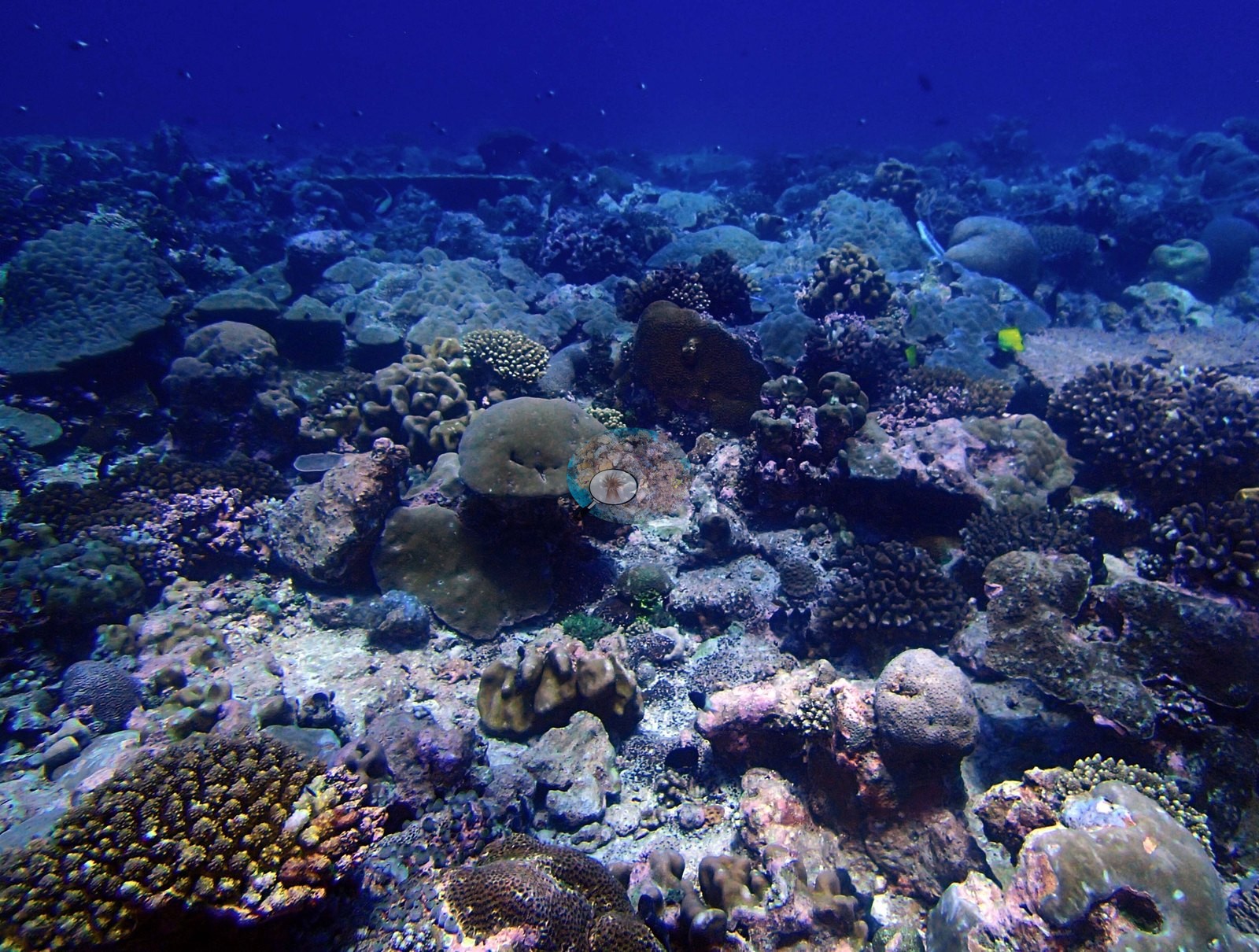
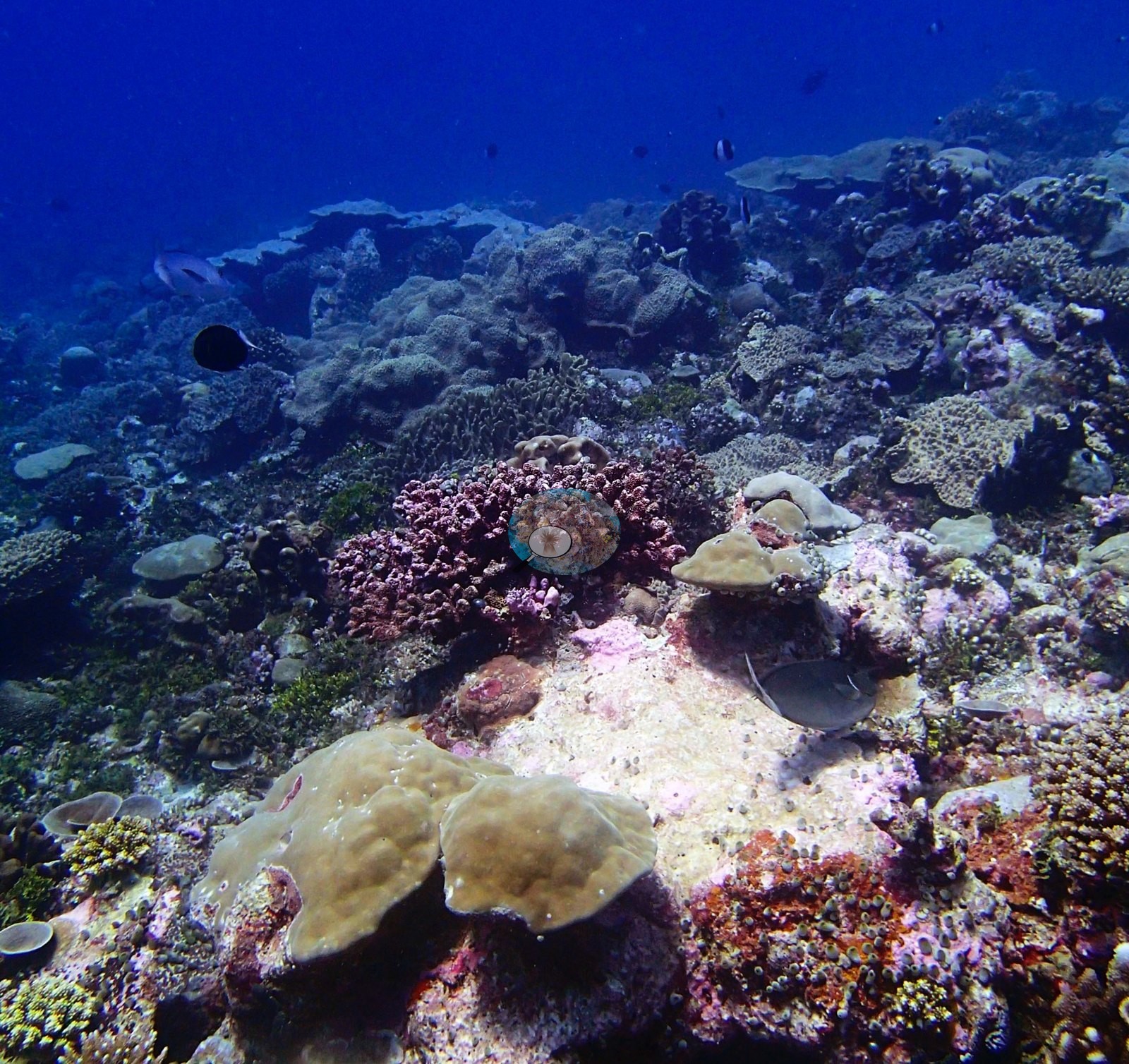
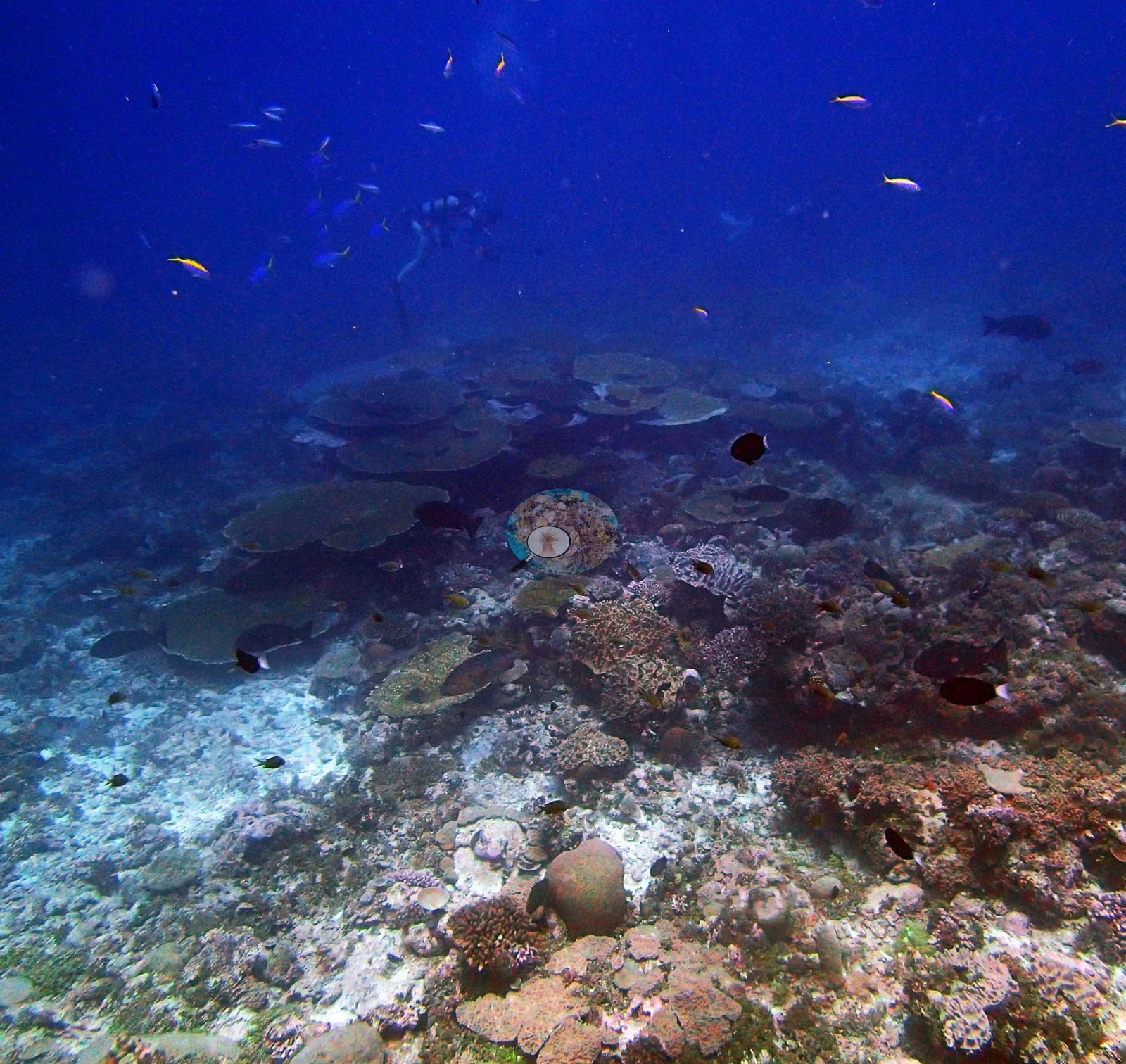
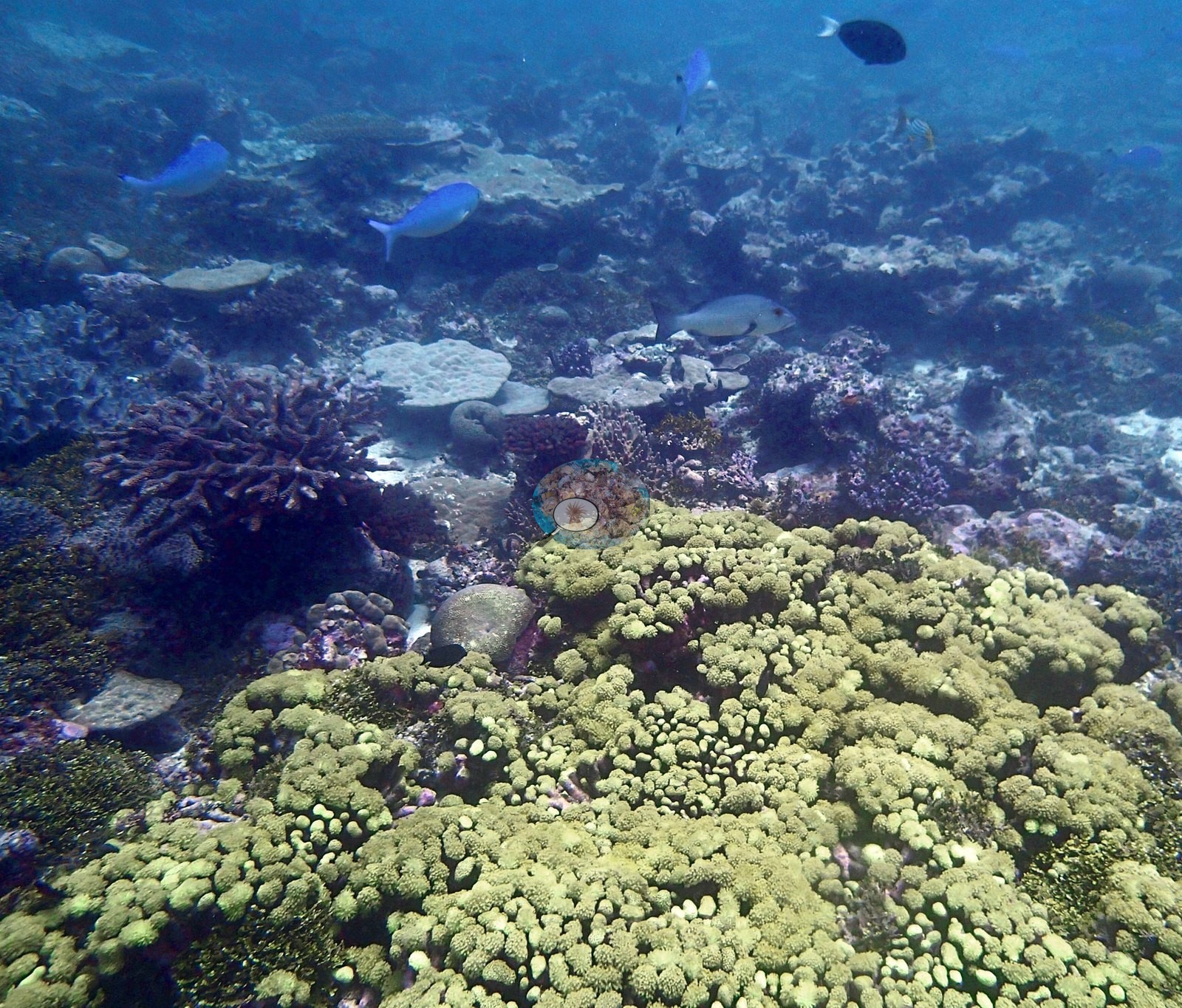
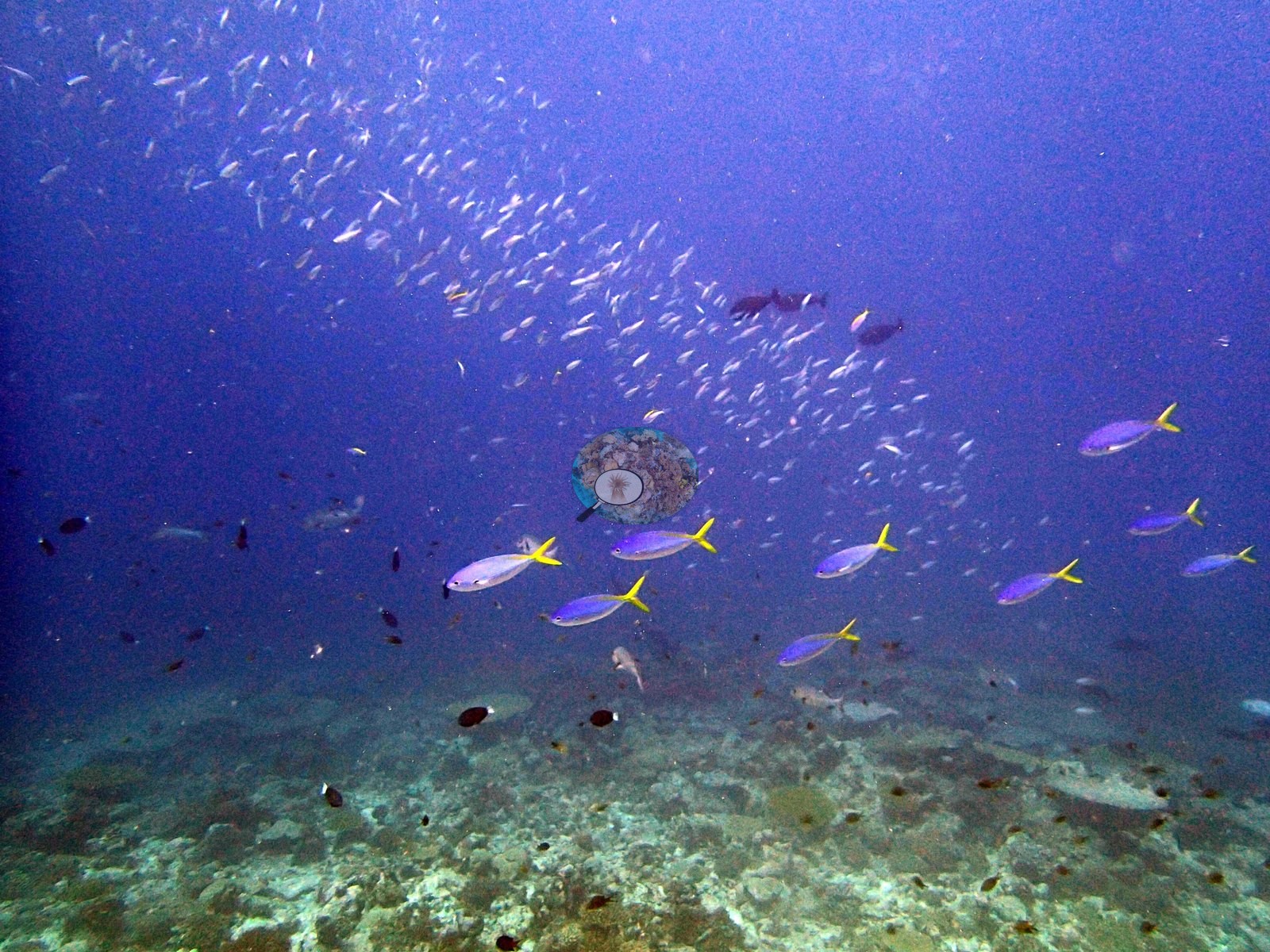
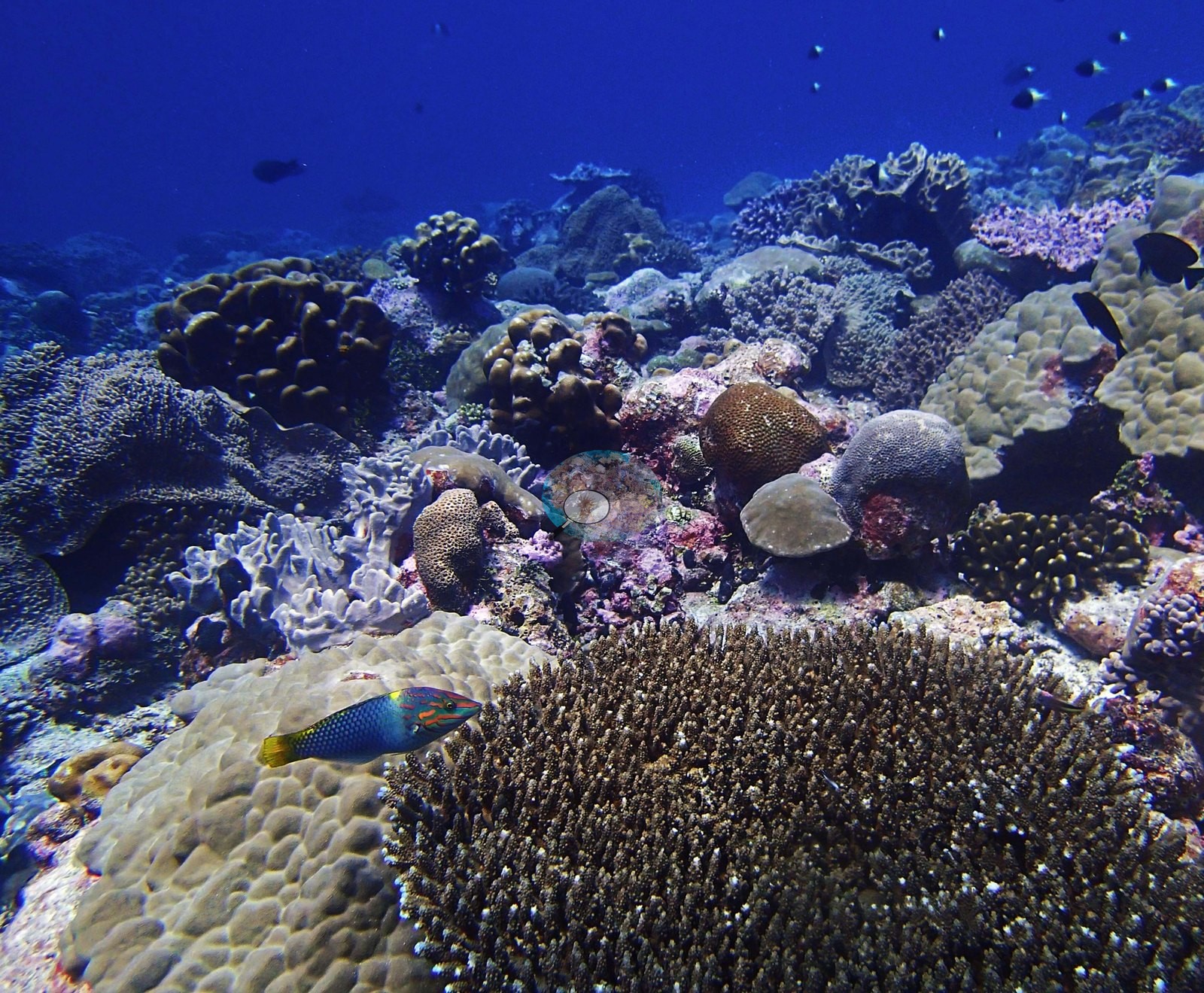
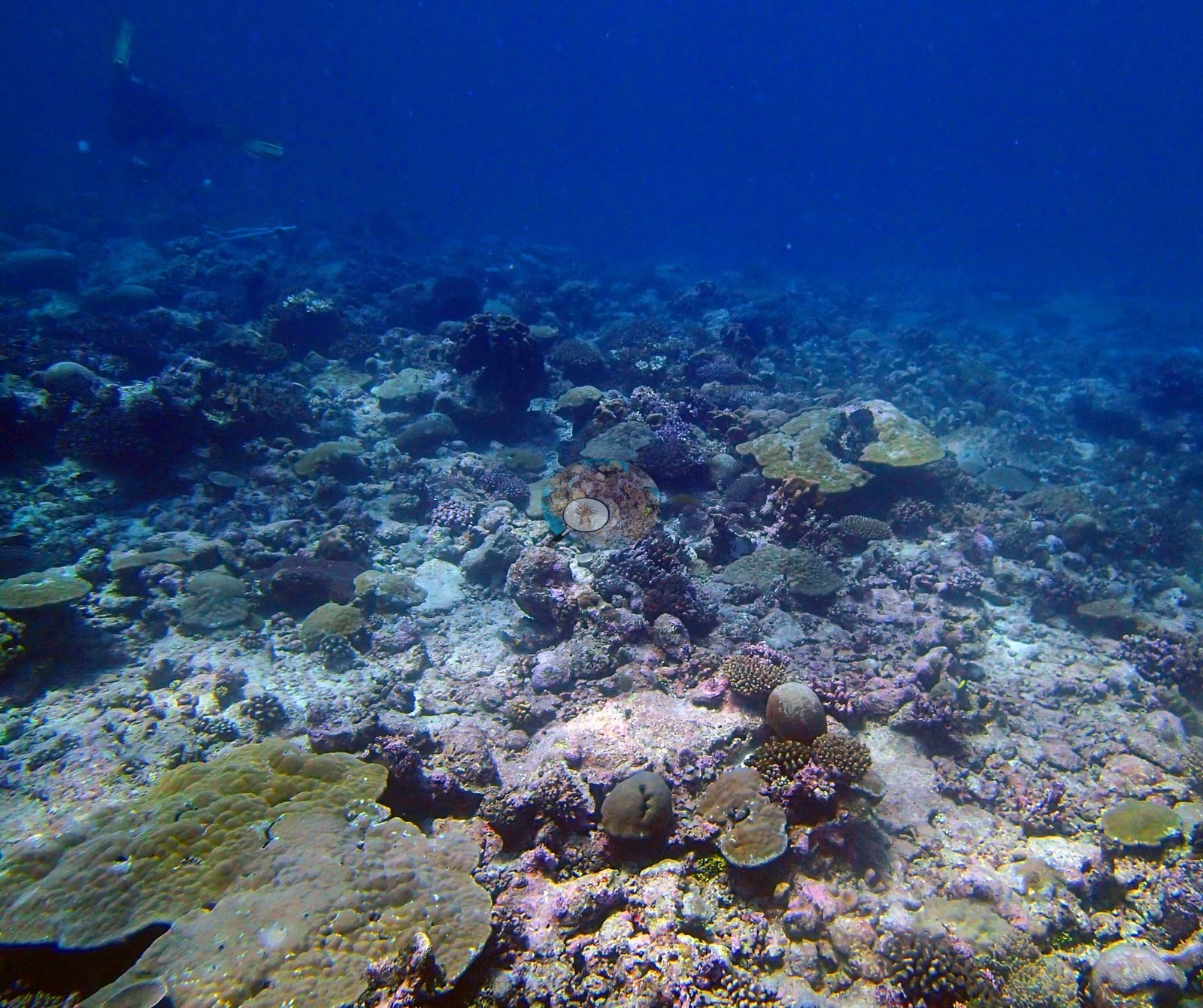
The transect genus list is the community record (LOF BIOT-1 survey, supplemental file S1) and it is a broad one — 26 scleractinian genera: Porites 7.47%, Acropora 5.58%, Pocillopora 3.85%, Favia 3.27%, Montipora 1.54%, Platygyra 1.20%, Favites 0.77%, Echinopora 0.62%, Stylophora 0.58%, Gardineroseris 0.48%, Pavona 0.43%, Montastrea 0.42%, Astreopora 0.30%, Cyphastrea 0.21%, Leptastrea 0.19%, Goniastrea 0.18%, Galaxea 0.09%, Symphyllia 0.08%, Pachyseris 0.06%, and Acanthastrea, Goniopora, Psammocora, Hydnophora, Leptoseris, Echinophyllia, and Fungia each at 0.05% or less. The substrate and algal categories run crustose coralline algae 20.42%, non-coral invertebrates 14.82%, erect algae 14.31%, turf 9.94%, bare substrate 7.73%, macroalgae 3.70% and sediment-laden turf 1.55%. Coralscapes gives massive and meandroid forms the largest share of live area at 32.6%, then other hard coral 30.6%, tabular Acropora 18.5%, Pocillopora 6.8% and non-tabular Acropora 5%; the point set gives Acropora 39.8% of live coral, other hard coral 31.3%, Porites 24.1% and Pocillopora 4.8%. Non-coral cover in the point set is crustose coralline algae 6.4% and turf 14% of all points; structural loss registers as dead coral 2.7% of image area and rubble 5.8%. The site's defining character in the photographs is colony density without relief. P3150394, P3150395 and P3150399 show pavement packed almost edge to edge with massive and submassive Porites domes, encrusting sheets, columnar knobs, and small plates, none of them rising far off the substrate, P3150395 the densest view in the set. Against that low-relief matrix sit two features that carry most of the structure. The first is the lime-green to yellow-green carpet of P3150368 and P3150384, densely packed short blunt branchlets spreading across meters of bottom — the colony whose genus is contested above. The second is large tabular Acropora: P3150384 and P3150398 show plates up to a meter across overlapping in tiers, and P3150371 pairs a big brown table with a cream domal Porites while a checkerboard wrasse (Halichoeres hortulanus) works between them. P3150371 also carries upright blade-like pale blue-white plates compatible with the hydrocoral Millepora (M. platyphylla-type), the first hydrocoral record of the Eagle Island block and hedged as such. P3150367 looks under the lip of a low spur or ledge, framework above and a sand-floored recess beneath, with tabular colonies and gray-brown massives ranged along it. At the sparse end, P3150378 and P3150396 are low, rubbly, largely open bottom with widely spaced small colonies, and P3150398 looks out over a field of overlapping tables in the middle distance that is too blue-attenuated to score — do not read their gray as death. That range across fifteen frames is itself the reason the transect, not any photograph, is the site's cover value.
Coral cover
The measurement at BIEA19 is the LOF BIOT-1 benthic transect survey. Coral cover 28%, from LOF BIOT-1 in situ transects (Mayfield & Dempsey 2026, Oceans, suppl. S1) — a diver transect measurement, published by Anderson himself, and the authoritative record of cover and community at this site. Against it the transects put algal cover at 49.9% of the benthos. Everything below — the computer-vision products and the frame-by-frame account — supplements that transect; no cover value may be read off any photograph, and where imagery and transect appear to differ, the transect governs. The computer-vision comparison. Across the 15 analyzed frames the Coralscapes masks put live hard coral at 21.3% of image area and the independent 30-point annotation (450 points) at 18.4% of all points, against the transect's 27.5% — deviations of −6.2 and −9.1 percentage points, with a mean of the three methods of 22.4% ± 4.6. Frame composition explains much of that gap: dropping the four blue-water frames leaves 11 benthic frames on which CoralNet reads 21.8% and Coralscapes 26.3%, narrowing the spread to −5.7 and −1.2 pp. The two image methods also apportion the coral differently. These are image products with their own footprints, denominators and class schemes; they are reported here as a method comparison and do not qualify the transect. One genus-level disagreement inside the image products matters and is unresolved: the 30-point annotation of P3150368 scored eight of its points Acropora, while the morphology of that same cover-forming carpet colony — short, blunt-tipped, uniformly textured branchlets with no visible axial corallites — reads instead as Porites (P. rus/cylindrica-type) or Montipora. Coralscapes reads 14.9% dead coral there, its highest value at the site, with P3150400 at 8.2% and P3150394 at 5.8%. P3150394 carries a thin, straight, pale line running horizontally across the upper background that is consistent with a transect tape, with a blue elongate object at the right that could be the reel; it is not confirmable at the resolution reviewed and is worth a full-resolution check — if it is a tape, this frame photographs the survey that produced the site's cover value, and BIEA19 joins BIDI08, BIEG04 and BIEA18 in that record. Live hard coral measured on the in situ benthic transects of the LOF BIOT-1 expedition (Mayfield & Dempsey 2026, Oceans, supplemental S1), against algal cover of 49.9% of the benthos. The transect figure is this site's authoritative cover value; no image-derived product overrides it. Across methods the same reef reads: transects 27.5% · CoralNet points 18.4% · Coralscapes masks 21.3% (15 frames). These products have different sampling footprints and denominators and should not be averaged.
Stressors
Bleaching stands at 1.6% of annotated points, concentrated in other hard coral 1.3% and Pocillopora 0.2%. Mortality is present and structural. P3150384 is the key frame: a pale mauve-white table that has lost its polyp texture and a uniformly gray, algal-filmed table beside it, both still standing in growth position, alongside a living green table. Living and dead tabular Acropora in one frame makes this a useful image for the mortality-and-persistence question. Condition and bleaching. P3150385 is the site's condition frame and it is unambiguous: a frame-filling macro of a thick-branched Pocillopora-type colony that is strongly mottled, bone-white branch tips and patches interleaved with fully pigmented brown tissue across the same colony — textbook patchy partial bleaching, and one of the clearest such images in the Chagos set. It belongs with BIDI16.5/P3140329 and BIEG05/P3110481 in the partial-colony-bleaching image set. An earlier description of this site stated 'no whitened colonies evident in the reviewed photos' and carried 'Flags: None'; both were wrong, and both are corrected here. That correction is to a previous photo read, not to any published figure: no bleached fraction is estimated from these frames, and Anderson's published per-site percentage bleached for the Chagos sites (Mayfield & Dempsey 2026, Oceans) is the authoritative number. The point audit's own reading of P3150385 — six bleached points, six of the site's seven — is an image-annotation product and is reported as such above. The seventh point is doubtful: P3150400 shows a large tan digitate colony with several white branch ends but also a cleanly snapped white branch stub, and the white in that frame reads as fresh physical breakage rather than bleaching; score it as damage unless the full-resolution frame says otherwise. Beyond those, colonies through the set are normally pigmented in brown, tan, green, and gray, and no disease lesion or predation scar resolves.
Fish and other fauna
Sponges appear in 11 frames, sea cucumbers in 3, urchins in 1. Faunally the site is quiet but distinctive: blue-and-yellow fusiliers compatible with Caesio stream through P3150368, P3150396, P3150397, and P3150398 in loose schools, a powder-blue surgeonfish (Acanthurus leucosternon) — a characteristically Indian Ocean species — sits at the center of P3150384, and P3150397 holds a Moorish idol, damselfishes, dark surgeonfish, and a cloud of small silvery juveniles.
Comparisons with other data
Also on record for this site: Coral cover: 28%.
Dive record
Survey conditions on 15 Mar 2015 at 6.202°S, 71.3588°E: in situ temperature 28.8°C, salinity 34.4.
Other notes
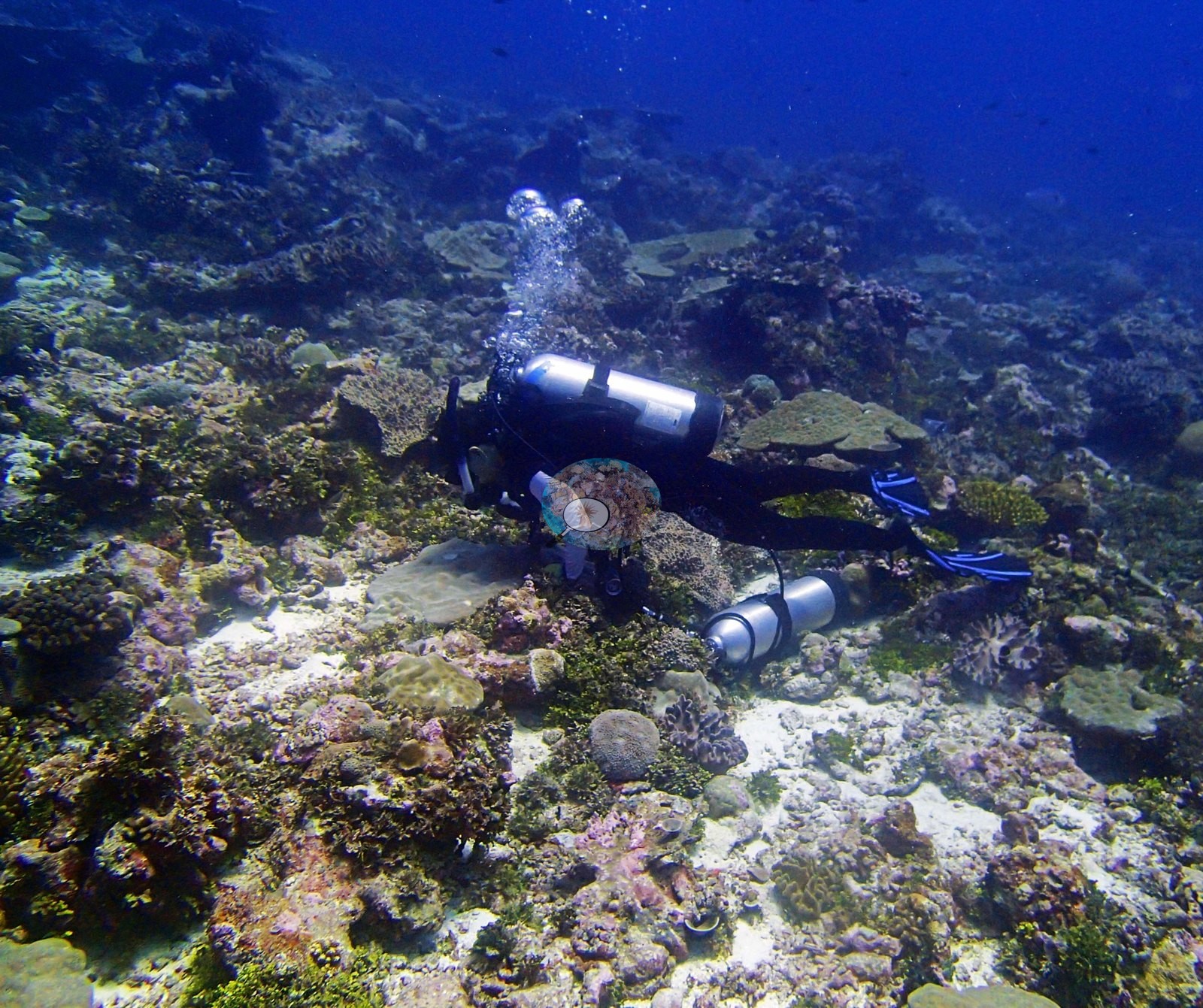
No depth-stratified (D1–D4) breakdown is carried for this site in the pin material. Both cannot be right, this is a large and repeated taxon here, and the call propagates into any genus-level image summary, so the genus of that colony is deliberately left unnamed and flagged for Anderson's eye. Note also that this site is a clean negative control for the blue-water annotation problem seen at BIEA18 and BIDI16.5: four frames here are 43–63% water and all seven bleached points fall on 0%-water frames. Image-by-image. All 15 habitat frames (P3150367 through P3150400) from Anderson's folder BiEa19-finished were reviewed; there are no sampled-colony frames, and the folder sits under edited site photos for website, so these are publication-edited, post-processed frames rather than raw survey imagery. Two frames record the survey rather than the reef. P3150369 shows a diver at work, head-down at the substrate in black wetsuit and white gloves, bubbles streaming, with a second silver cylinder lying on the reef beside them — a spare tank or a sample container. A diver's fin is visible in the top corner of P3150399. No scale object, quadrat or depth cue appears in any frame, so no colony dimension or zonation can be read from them.
CV model comparison
More info
Those are point counts on the photographs; this is a diver swimming a transect. The models and the reference never saw the same thing. ⚠ SITE-LEVEL ONLY. The 2,500 frames were not associated with any transect taken within 200 m of them, so transect-vs-image comparisons are site means, never frames. The transect value is already in the pin `cover` field (109 of 112 pins, sourced to the paper's suppl. S1) and is read from there, never re-imported. The transect is THE coral-cover value for this site and stands alone. The rows below it are a methods comparison only: no computer-vision value is averaged with it, feeds the headline, or carries over to the site's cover figure (Anderson, 2026-09-22).| Method | Hard-coral cover (%) |
|---|---|
| Transect (published) | 27.5 |
| CoralNet | 27.2 |
| In-house DINOv3 | 25.5 |
| CoralSCOP edited | 39.2 |
| Claude | 30.8 |
Data & links
- Read the full site report ↗
- Download benthic survey data (CSV) ↗
- Download all LOF-GRE data (933 sites) ↗
- CoralNet image repository for this region ↗
- Photo portfolio ↗
- Coral Reef Diagnostics page for this area ↗
All images from Coral Reef Diagnostics. Data are from Coral Reef Diagnostics.
 © Coral Reef Diagnostics.