
Raja Ampat - Pulau Koon dive 1
Part of the regional summary: Indonesia - Raja Ampat
More info
Maluku (NOAA CRW virtual station) · Banda Sea ecoregion mean=7.3°C-heating weeksPulau Koon's first dive is a low-relief, sediment-influenced slope of open sand and rubble overgrown with coralline crusts, with hard coral present only as scattered colonies - large plating Montipora and Turbinaria stand out - rather than continuous framework. A green turtle and a manta ray were photographed amid a current-swept, planktivore-rich setting. Condition looks generally healthy.
Penyelaman pertama Pulau Koon berupa lereng berelief rendah yang dipengaruhi sedimen, berisi pasir dan pecahan karang terbuka yang ditumbuhi kerak koralin, dengan karang keras hadir hanya sebagai koloni yang tersebar — Montipora lembaran besar dan Turbinaria yang menonjol — alih-alih kerangka yang menyambung. Seekor penyu hijau dan seekor pari manta terfoto di tengah suasana yang tersapu arus dan kaya ikan pemakan plankton.
Terjemahan ringkasan ini oleh AI; versi bahasa Inggris yang berlaku. Translated from the site’s shorter map summary.
Two other CRD dive sites within 5 km shown in orange — click a marker to open its page.
5 of these 7 photographs are shown beside the text that discusses them under "Site description" below.
Site description
Setting
Pulau Koon, the first of the trip's three dives on this island, off the eastern tip of Seram in the Banda Sea - not Raja Ampat, despite the build-tree name. That combination - manta in the blue, a wall of planktivores over the reef crest, and a scoured sand-and-rubble bottom - reads as a current-swept site, though no current measurement exists and none should be inferred. Visibility was moderate: the close-down frames are clear at short range but the mid-water frames go quickly hazy blue, and the manta shots are grainy and low-contrast. Light in the deeper frames is dim and blue-shifted, consistent with a mid-to-deep slope, but no depth is recorded for this folder and none should be inferred.
General benthic features
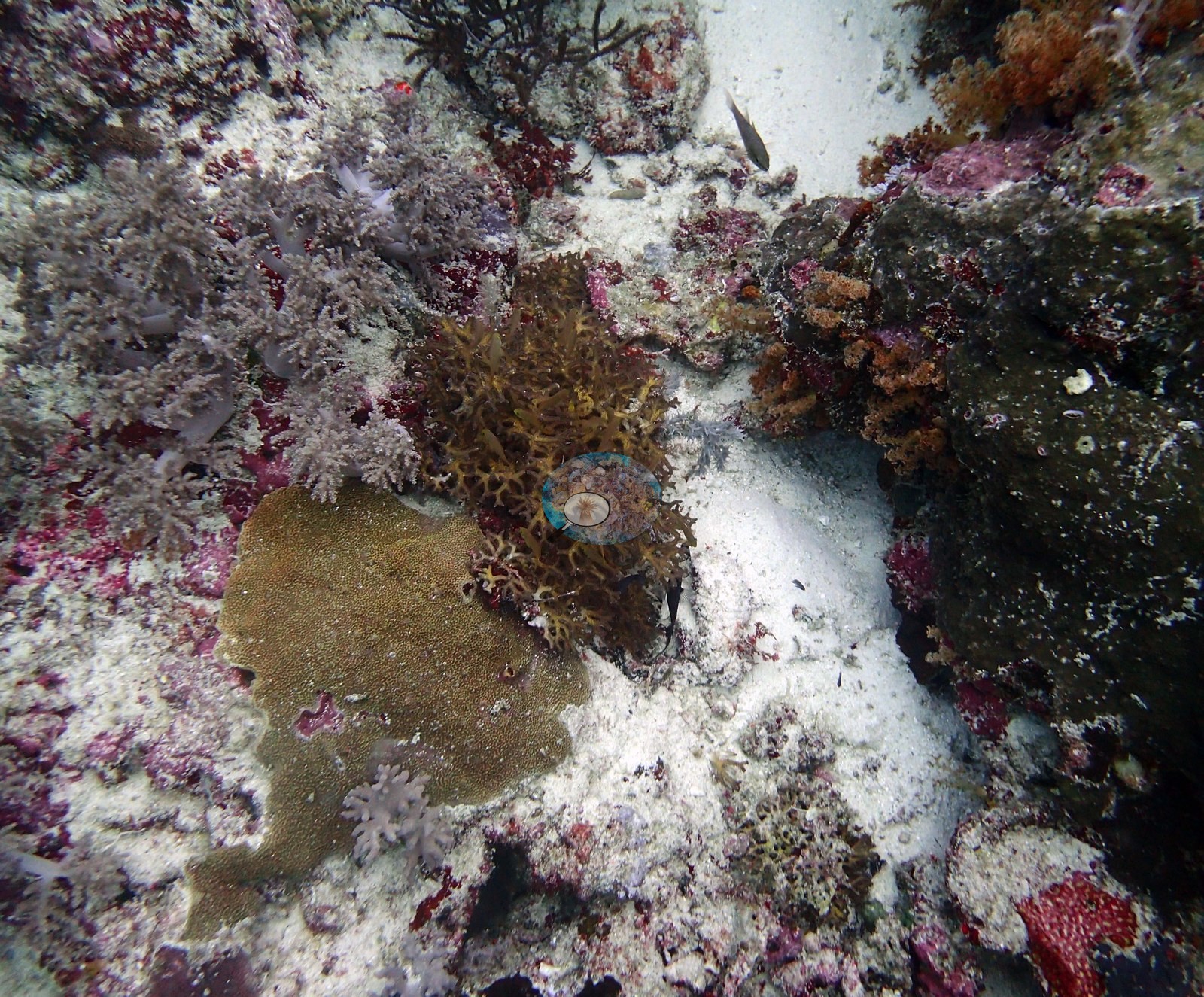
What the nine frames reviewed show is a low-relief, sediment-influenced lower slope rather than a coral garden. Open white carbonate sand and coral rubble take up a large share of every benthic frame, with the hard substrate between the sand patches heavily overgrown by crustose coralline algae - pink, mauve, and lilac crusts are the single most conspicuous encrusting cover in the close-down frames - along with dark red encrusting algae or sponge (e.g., Image 1).
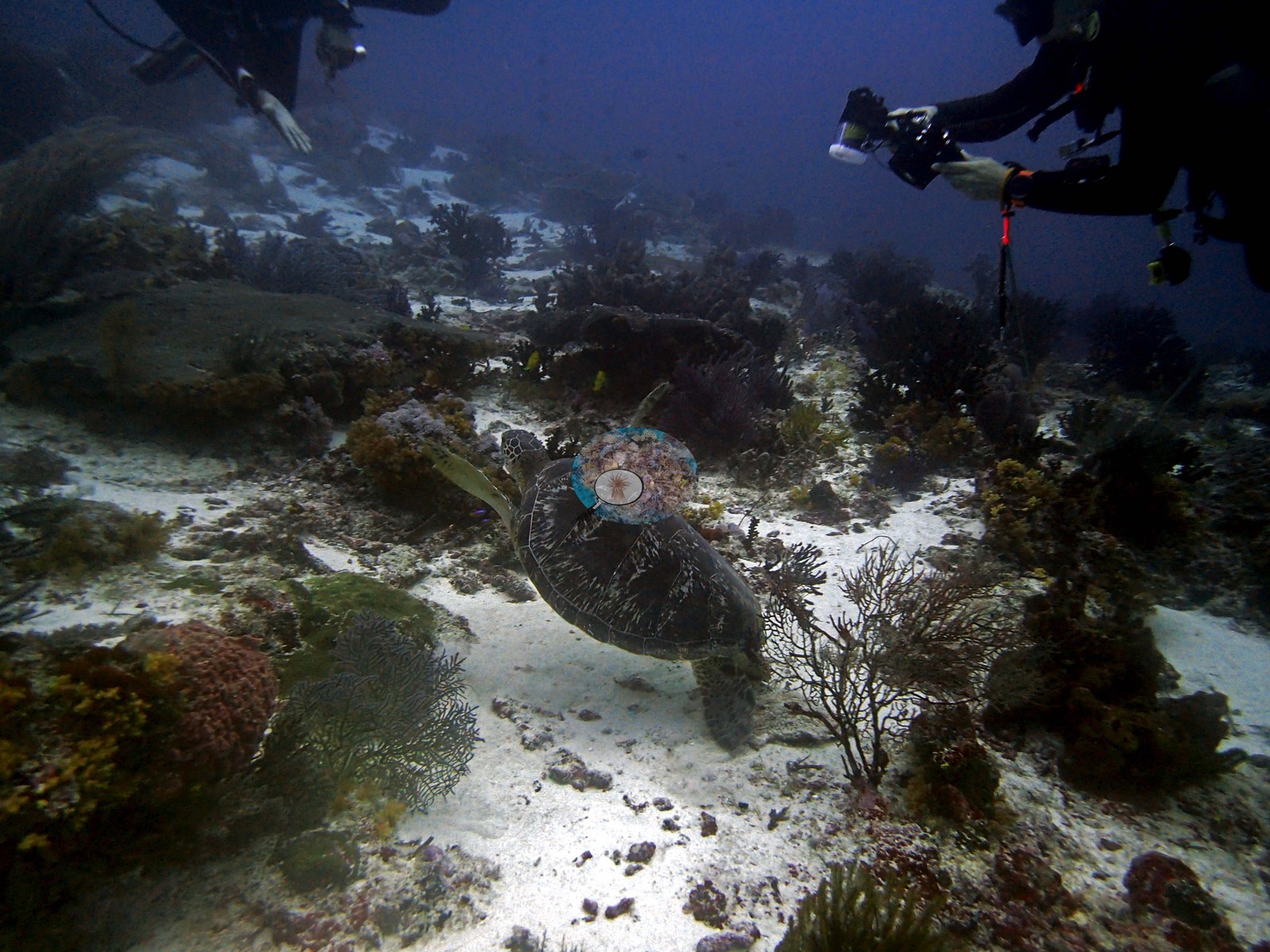
Hard corals are present as scattered discrete colonies rather than as continuous framework. The most striking are large thin plating and foliose colonies: a tiered, shingled stack of deep maroon-brown plates with pale living margins and a finely pitted surface, most consistent with Montipora; broad, near-horizontal gray-purple plates lying almost flat on the sand-rubble floor with clean white growing rims, consistent with Turbinaria or a plating Montipora; and one very large low-domed to encrusting colony over a meter across on the deeper slope, smooth-surfaced and olive-gray with a whorled skirted margin, which I could not resolve to genus from the imagery (e.g., Image 2).
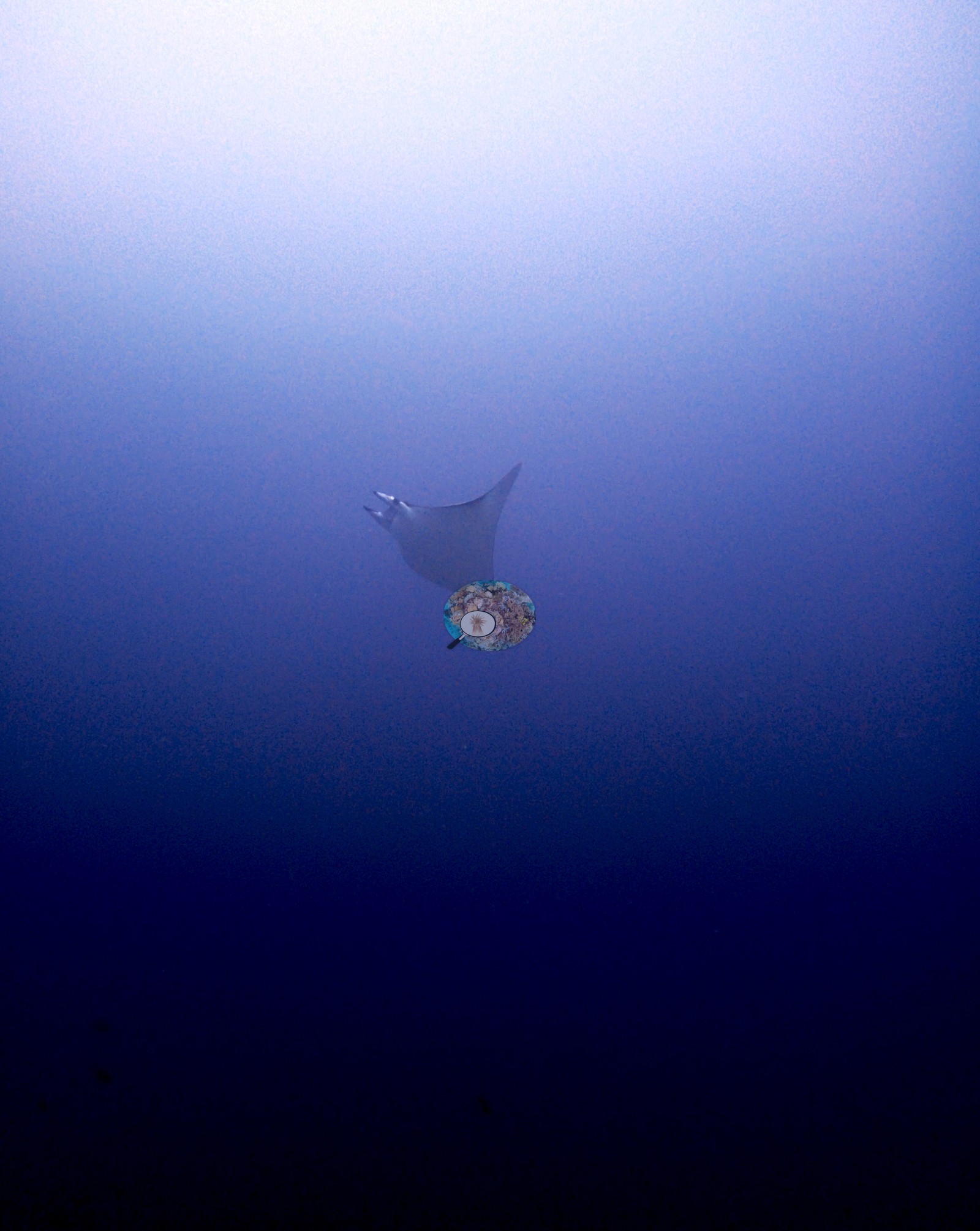
Small tan encrusting-to-submassive colonies with fine porous surfaces, consistent with Porites, sit low among the coralline crusts. There are no big tabulate Acropora, no staghorn thickets, and no massive brain corals in this sample. Soft corals and other invertebrates carry much of the color. Pale lilac and white arborescent soft corals of the Nephtheidae type grow in small clumps through the coralline pavement, with orange and salmon soft corals on the flanks of rubble mounds. A single very large barrel sponge, deep red-purple with strongly grooved ridged walls and roughly a meter tall, is the set piece of one frame - consistent with Xestospongia testudinaria (e.g., Image 3).
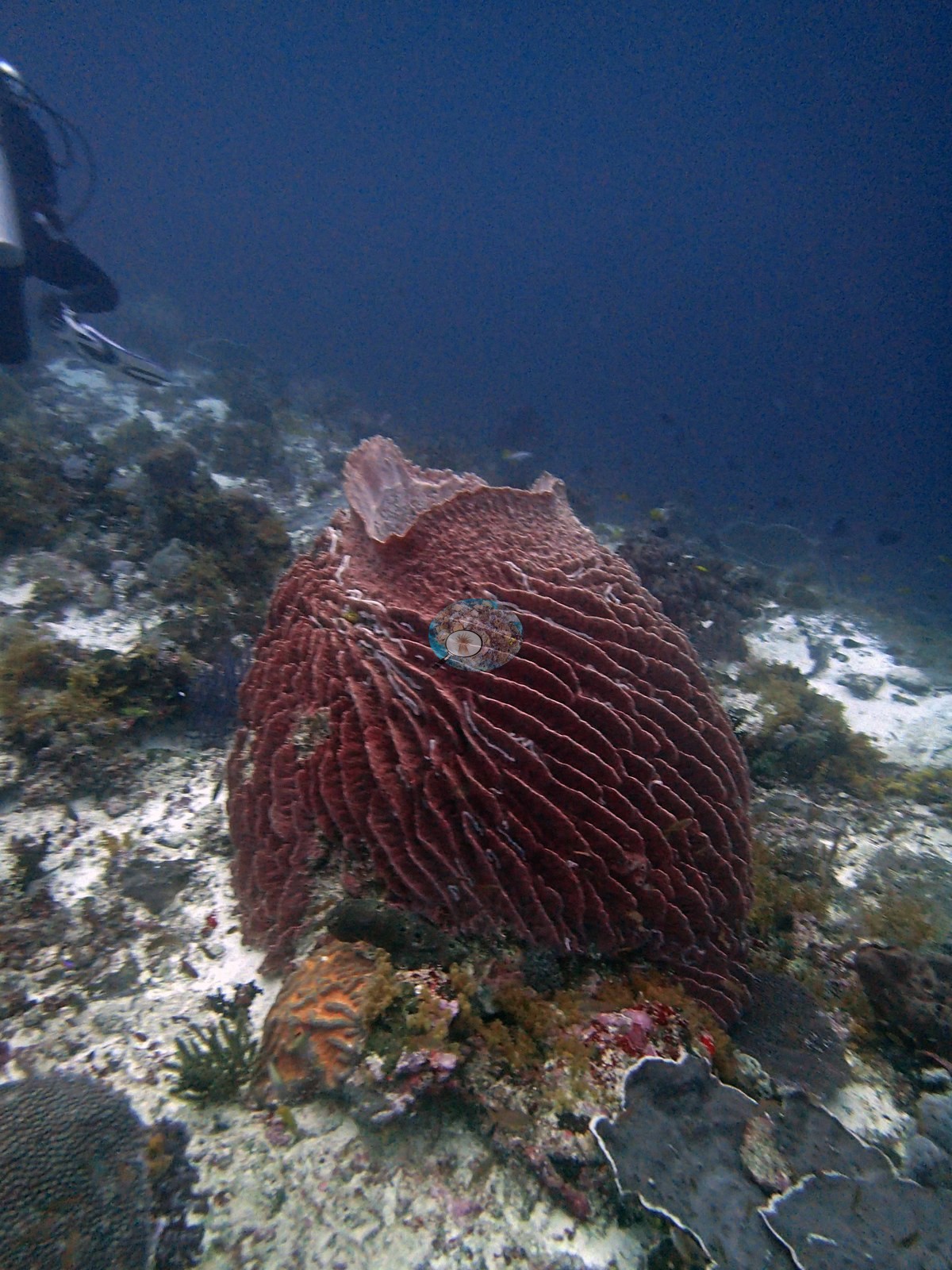
Other sponges include orange encrusting crusts, a small purple-brown barrel, and dark ball sponges growing directly on the big dome coral. Black-coral bushes (Antipathes-type) are frequent in the deeper, sandier frames, standing as dark feathery shrubs straight out of the sand-rubble floor, along with a fine gray-white mesh gorgonian sea fan and free-living crinoids. A recurring yellow-ochre colony with a finely anastomosing, net-like or lace-like skeleton appears in two frames pressed against the plating corals; from photographs alone I cannot separate a lace bryozoan of the Triphyllozoon type from a reticulate hydrocoral, and I am not asserting either. Several frames also carry yellow-brown bushy growths on rubble that read as either macroalgae or dense turf.
Coral cover
Insufficient photos to estimate coral cover (only nine frames from this dive).
Stressors
Condition looks generally healthy in the frames available. There is no bleaching front, no crown-of-thorns, no obvious disease lesion, and no anchor or blast damage. Two small white patches of bare skeleton show on the upper surface of one maroon plating colony - too small and too few to call anything more than minor partial mortality. The abundance of open rubble, sand, and coralline-crusted pavement is worth noting, but with only seven benthic frames I cannot say whether that reflects long-standing sedimentary habitat, past disturbance, or simply where the photographer chose to point the camera.
Fish and other fauna
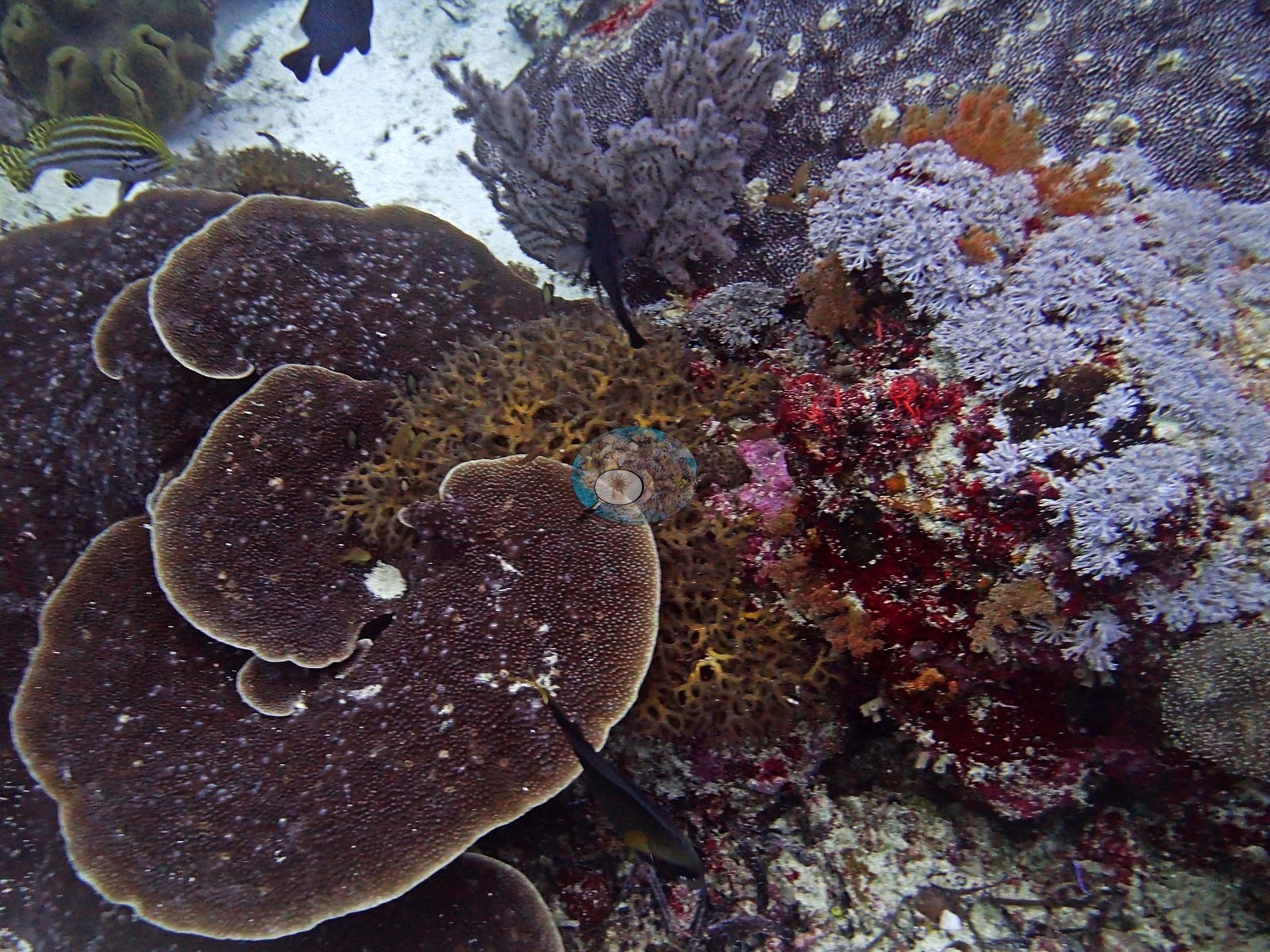
The vertebrate highlights are what mark this dive. A green turtle (consistent with Chelonia mydas) was photographed twice, first at rest on a sand patch among black-coral bushes and crinoids and then swimming low over the sand, with two other divers and their strobes in frame both times (e.g., Image 4).
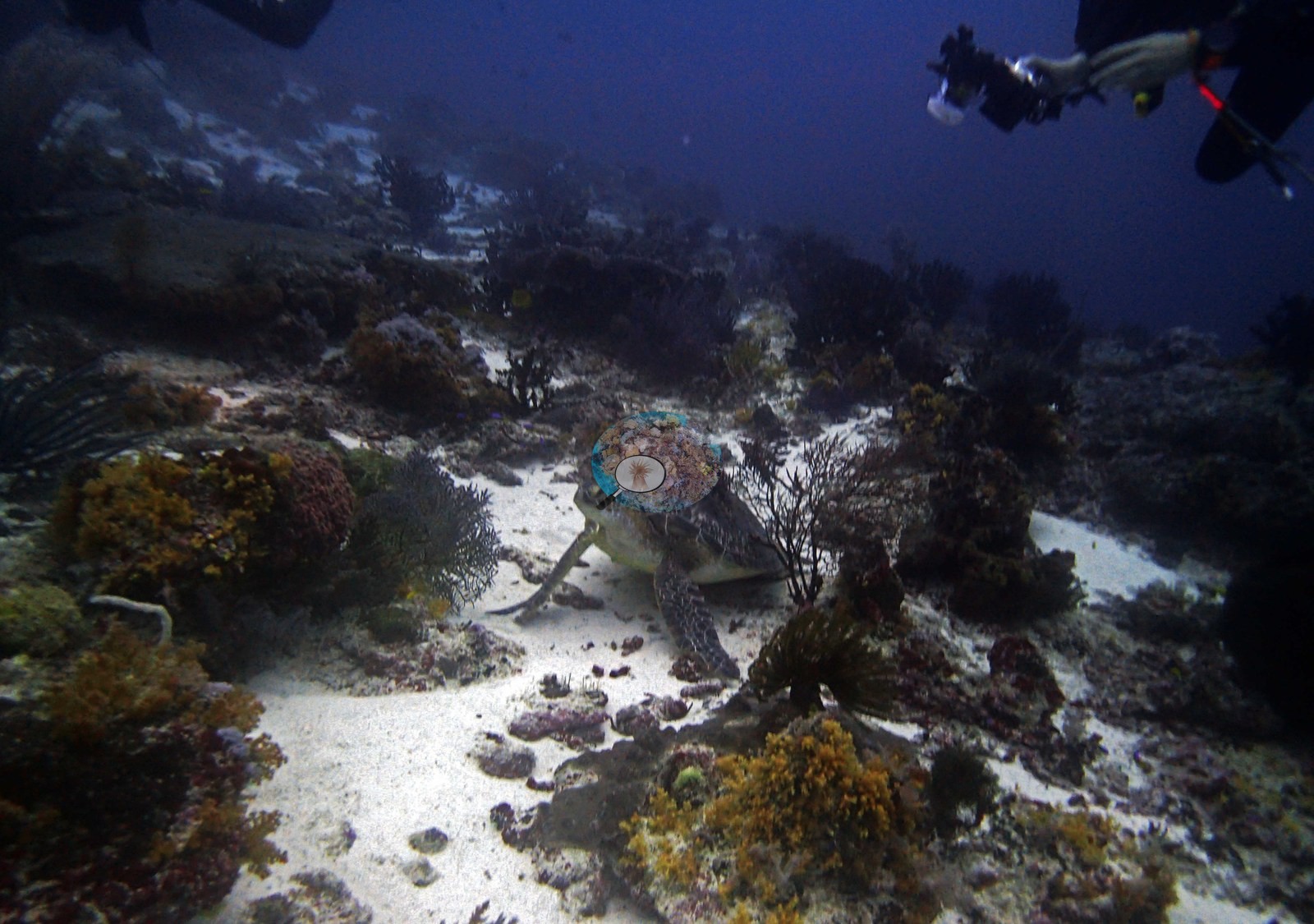
Two frames show a manta ray in open blue water: one is a distant silhouette above a dark reef top with a dense cloud of small planktivores filling the water column, the other is a clean lone manta against blue with no substrate at all (e.g., Image 5).
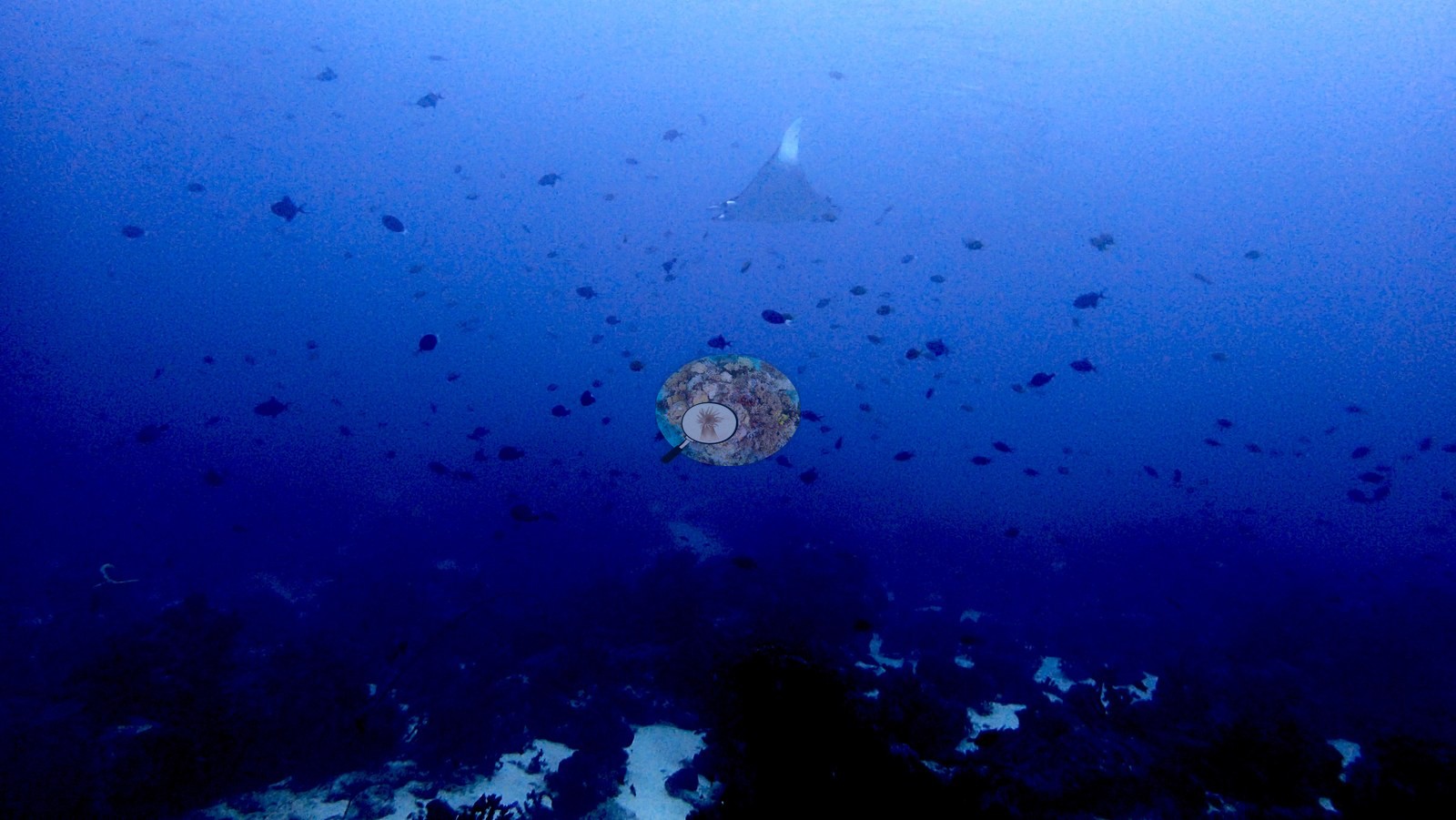
Reef fish in the frames are modest: a black-and-yellow striped sweetlips, scattered dark damselfishes and chromis over the plate corals, a small yellow-tailed fish over the sand, and a few unidentifiable planktivores in the mid-water.
Comparisons with other data
No prior survey data from this site. If you would like to share yours, please email us.
Dive record
Anderson's dive log records three separate dives at Pulau Koon on 17 October 2018, and the camera's own file numbering here (PA171167 through PA171179) is consistent with that date; site 1, site 2, and site 3 are three different sites and are described separately.
Other notes
The only man-made objects in frame are the divers themselves, their fins, tanks, and camera-strobe rigs.
Data & links
All images from Coral Reef Diagnostics.
© Coral Reef Diagnostics.