
Raja Ampat - My Reef

Part of the regional summary: Indonesia - Raja Ampat
More info
West Papua (NOAA CRW virtual station)My Reef is a Fam Archipelago seamount with coral extending to 35 m and high cover and diversity concentrated in the 8-15 m band, headlined by wobbegong sharks, gray reef and blacktip sharks, and a marble ray - though some Seriatopora hystrix colonies at 15 m and shallower looked sickly, a stressor flag worth follow-up. A blind Claude computer-vision point count puts coral cover around 33%.
My Reef adalah gunung bawah laut di Kepulauan Fam dengan karang yang menjangkau hingga 35 m serta tutupan dan keanekaragaman tinggi yang terpusat pada pita 8-15 m, dengan sorotan berupa hiu wobbegong, hiu karang abu-abu dan hiu sirip hitam, serta seekor pari marmer — meskipun sejumlah koloni Seriatopora hystrix pada kedalaman 15 m dan lebih dangkal tampak tidak sehat, sebuah tanda tekanan yang layak ditindaklanjuti. Penghitungan titik buta visi komputer Claude memperkirakan tutupan karang sekitar 33%.
Terjemahan ringkasan ini oleh AI; versi bahasa Inggris yang berlaku.
Five independent survey stations shown with the program’s logo — click one to see how far it is from this site.
Two other CRD dive sites within 5 km shown in orange — click a marker to open its page.
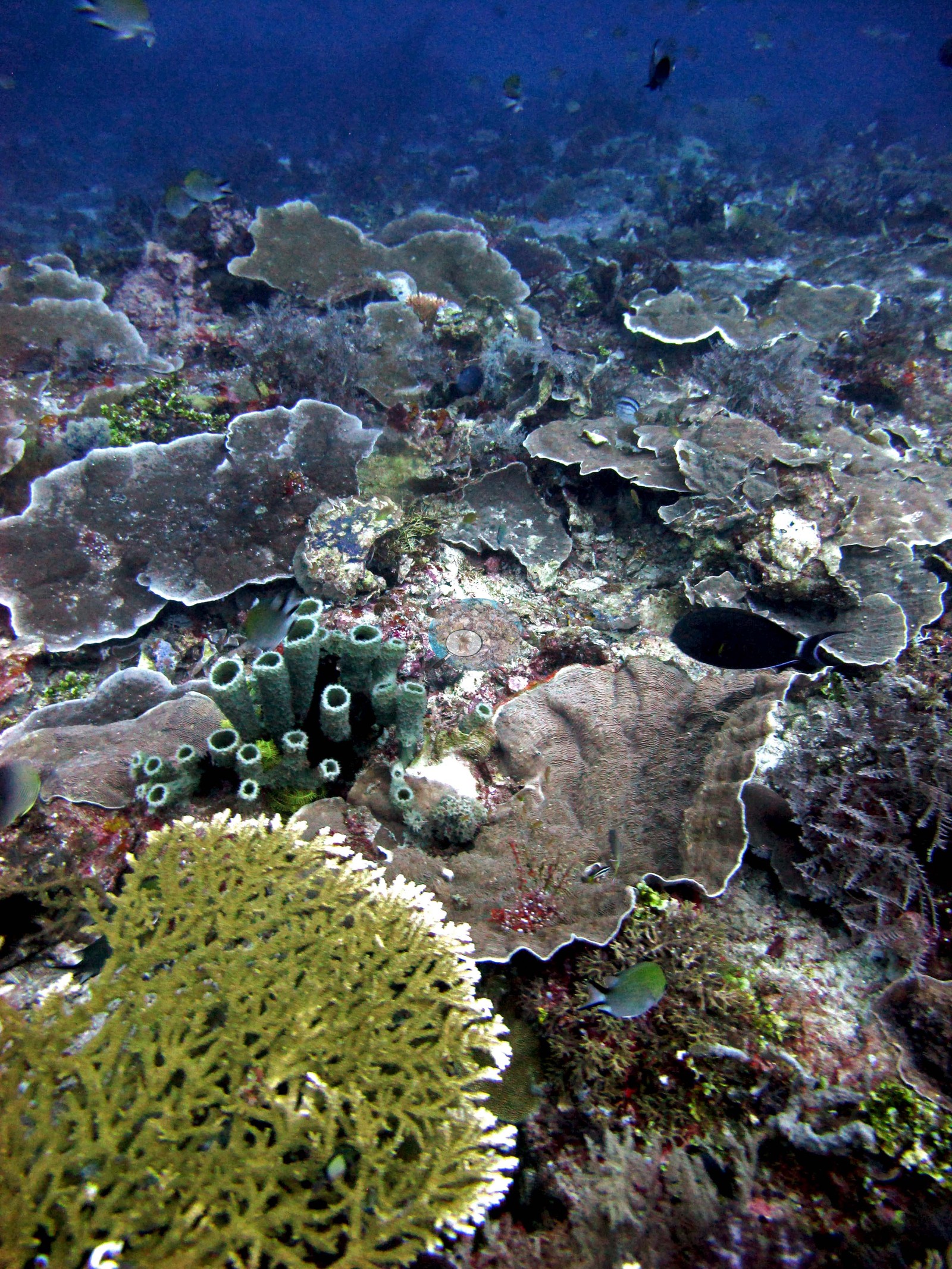
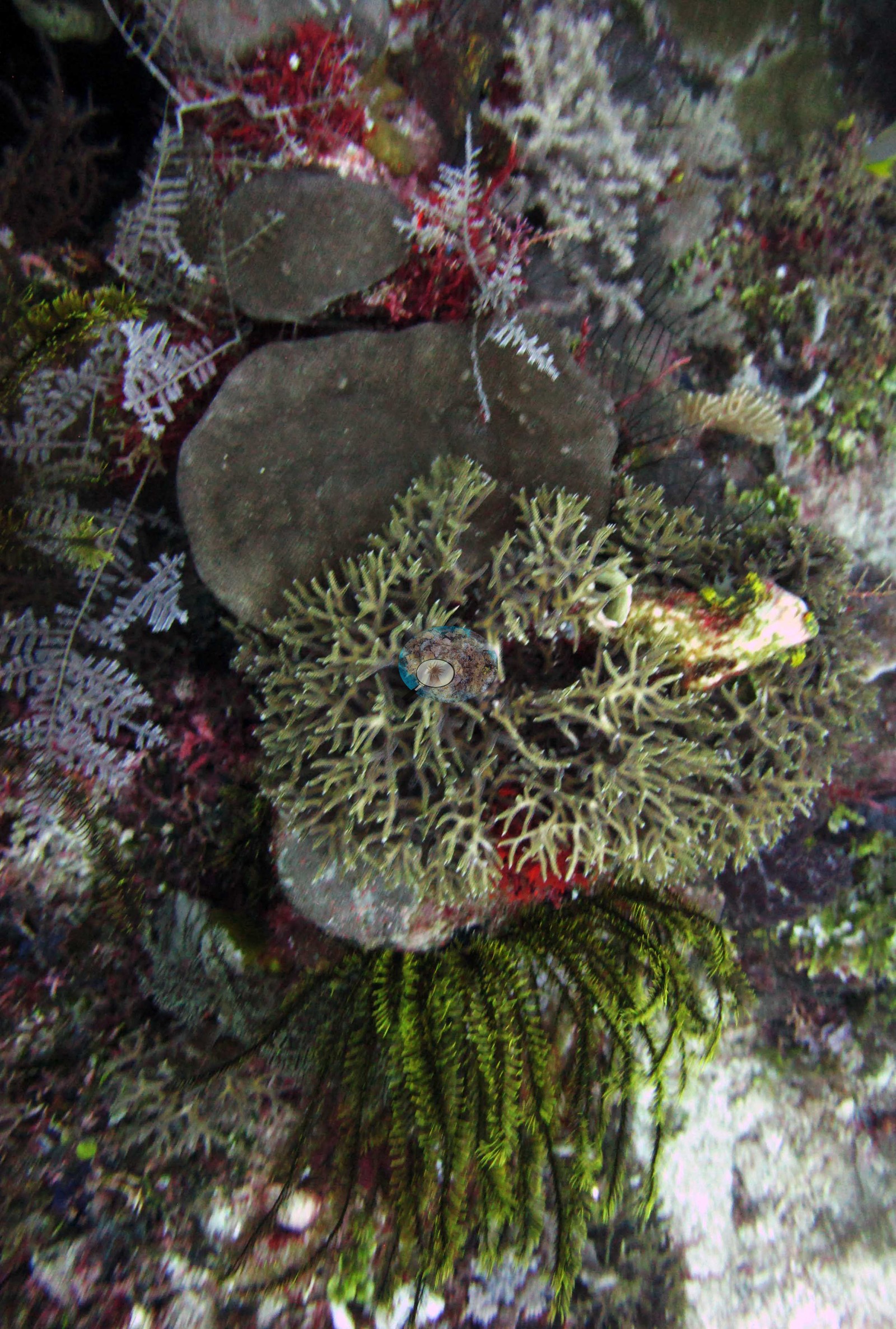
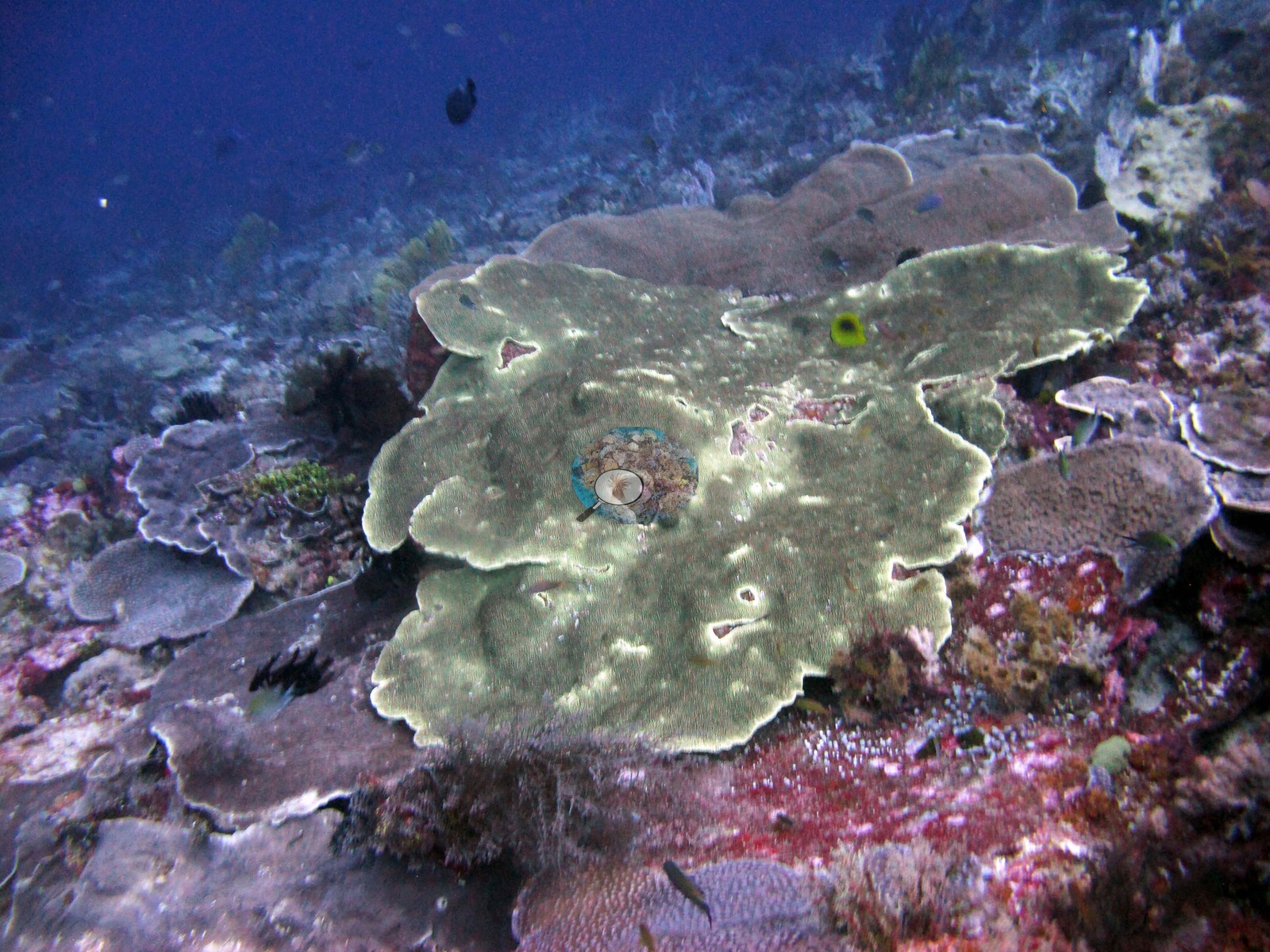
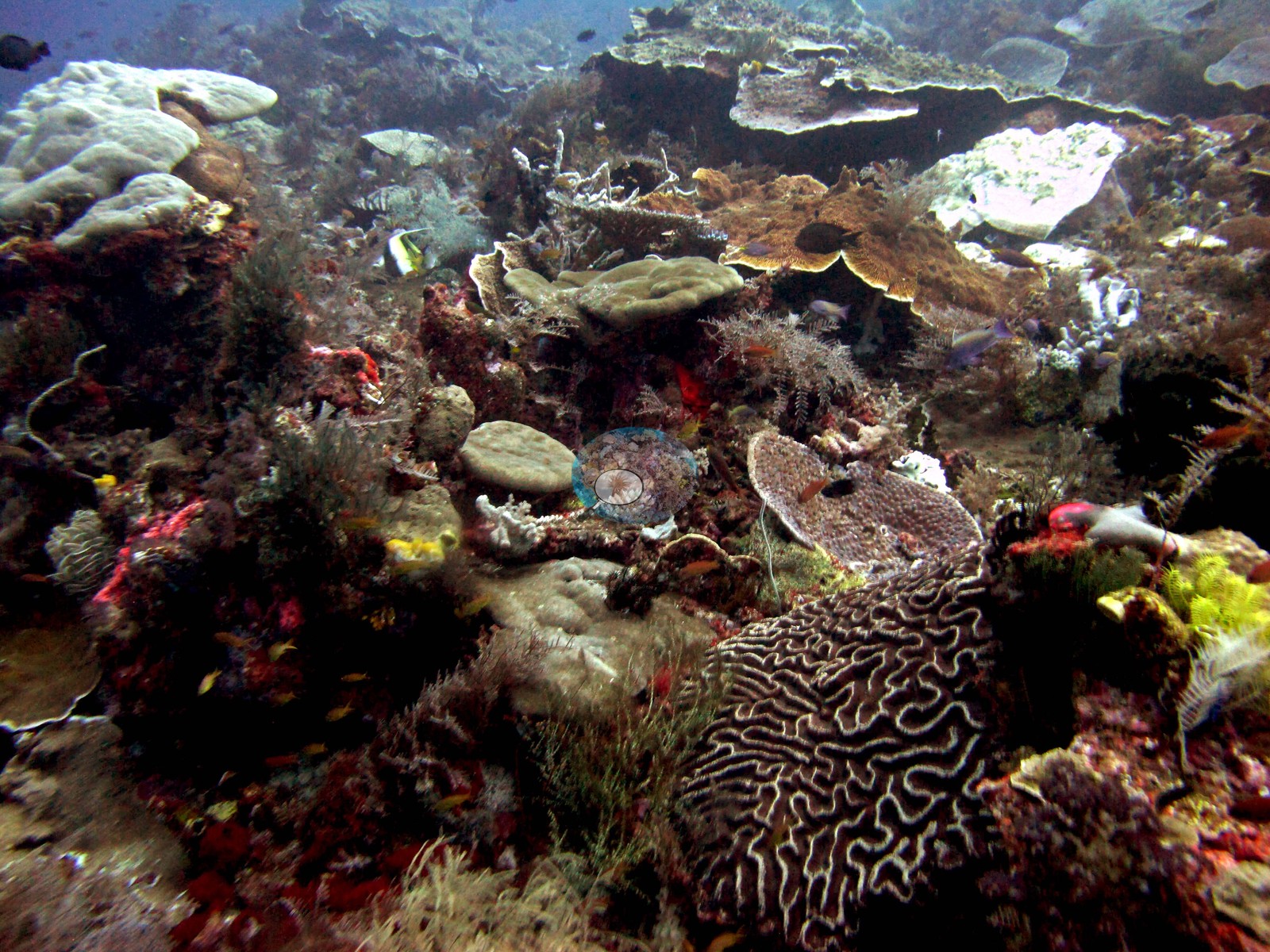
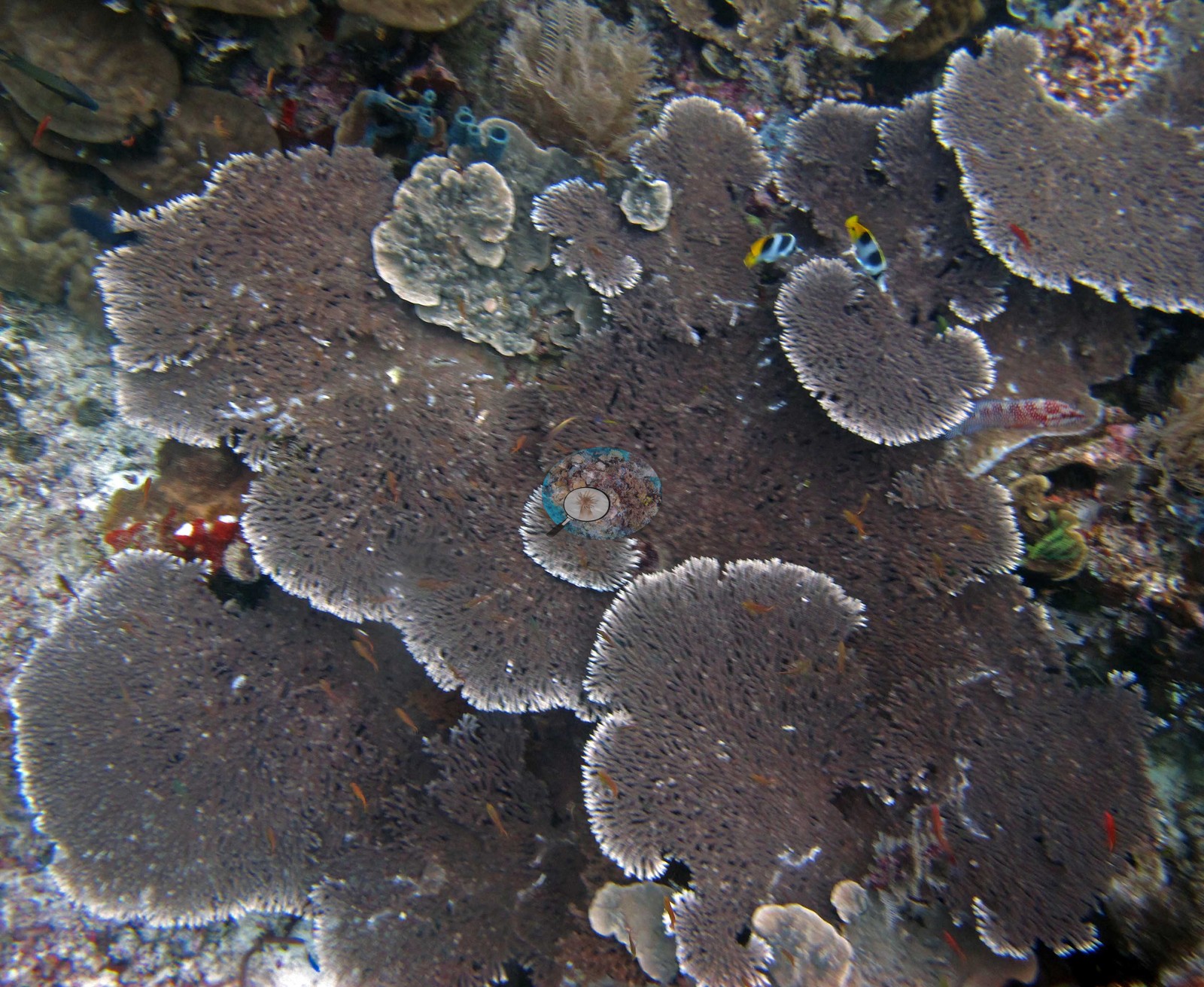
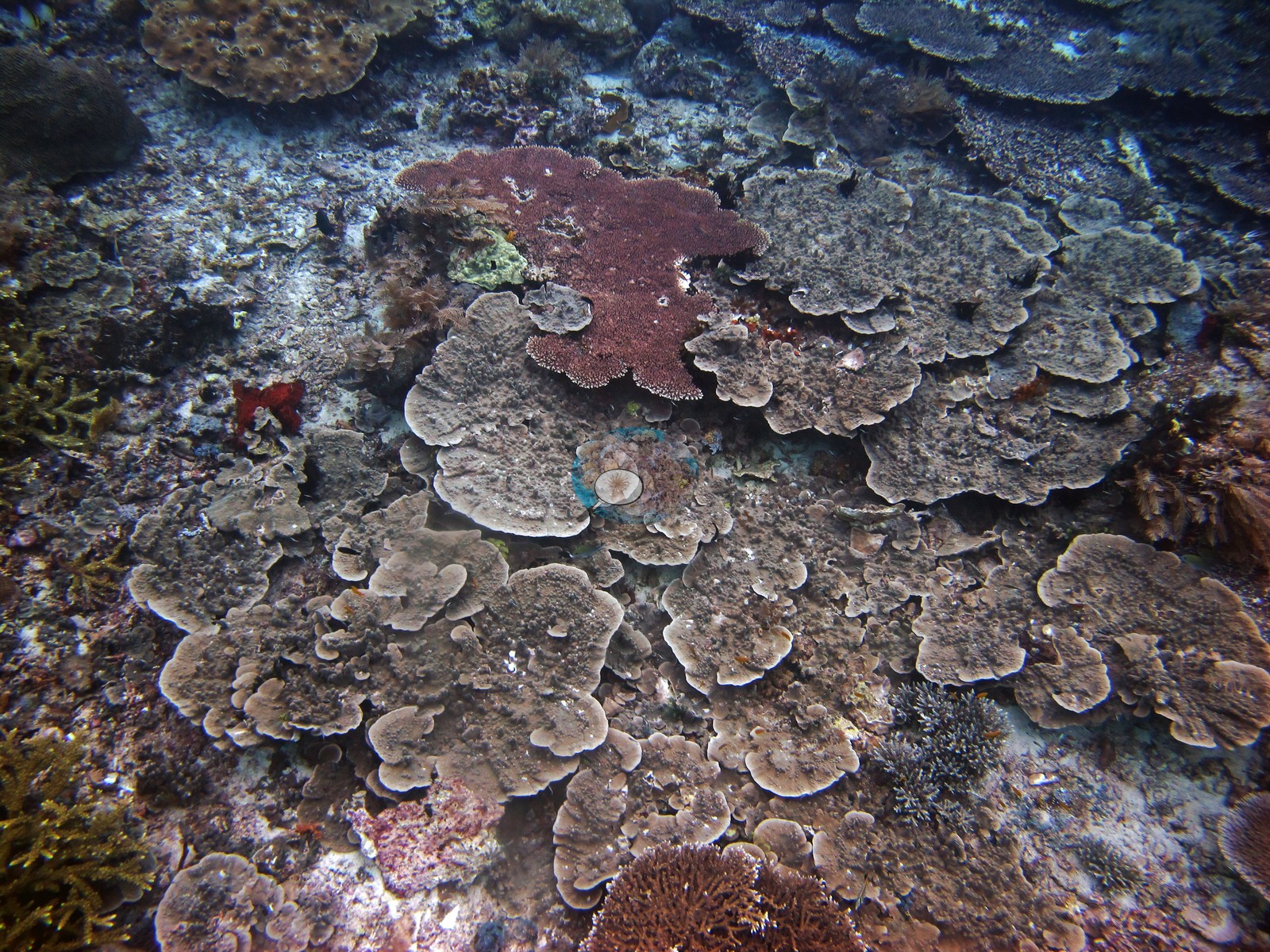
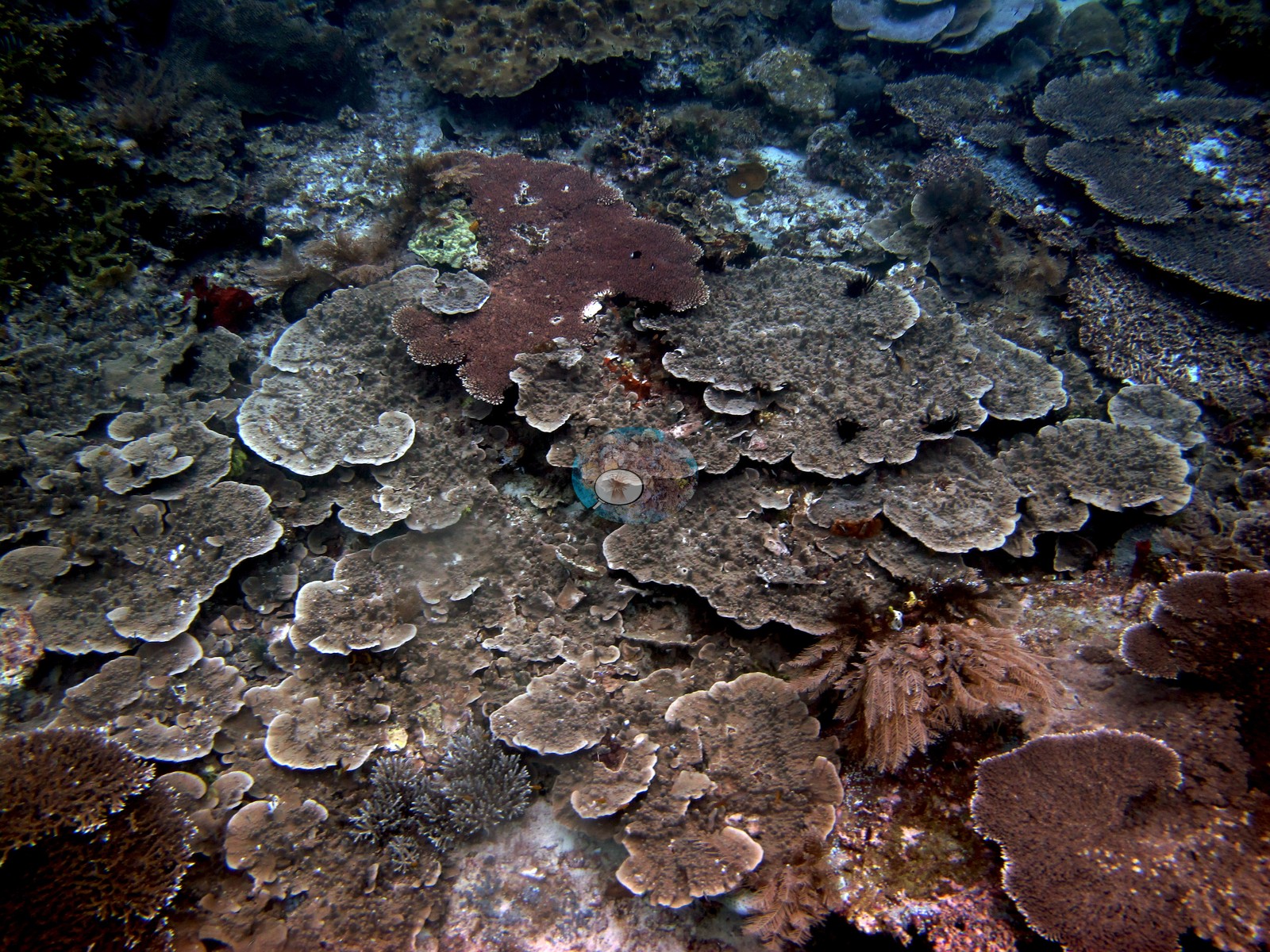
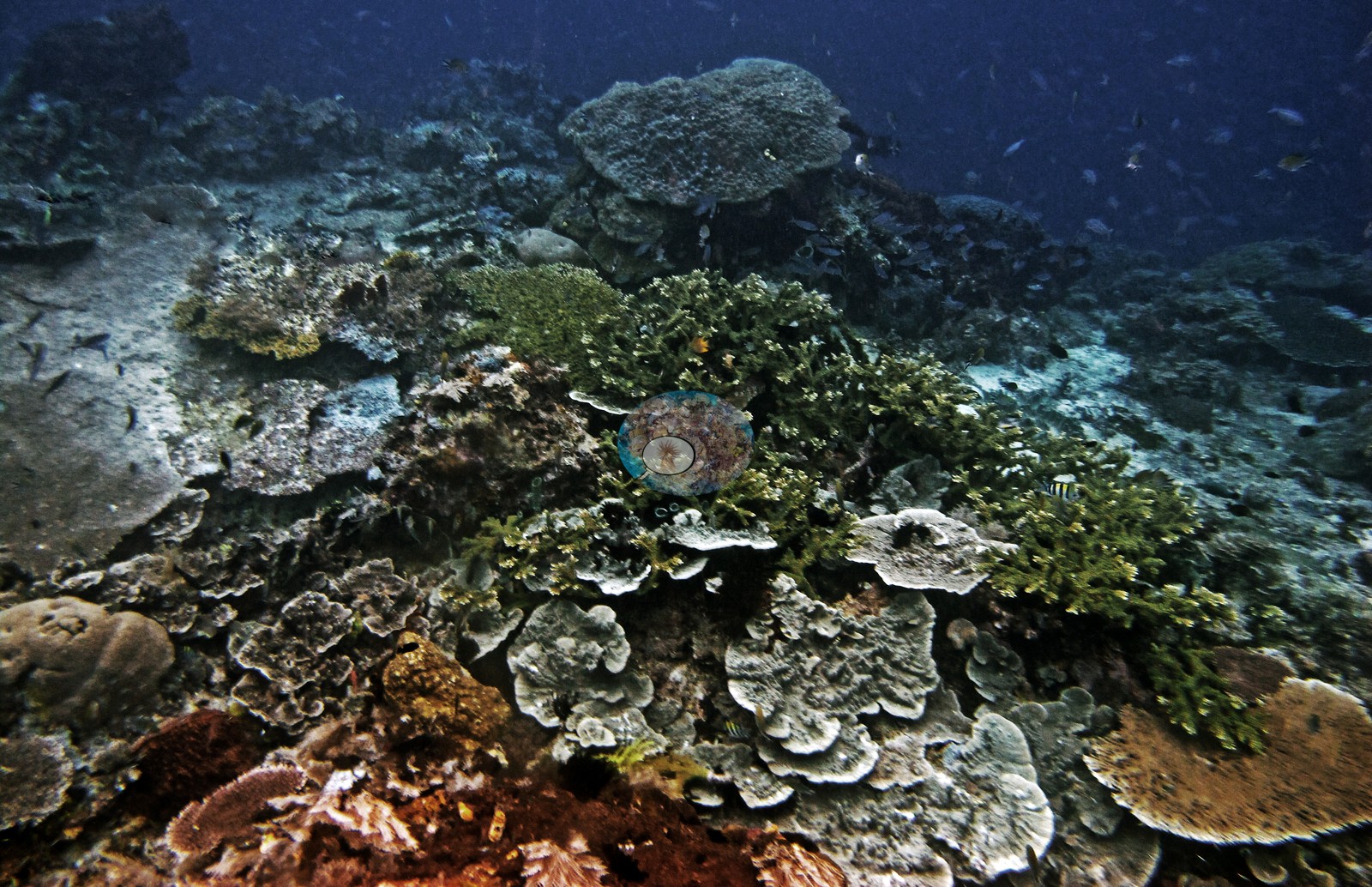
Site description
Setting
His own note that the dive was "dark on account of having dived so early" is visible in the photographs themselves: the deep frames are dim, green-blue and low-contrast, and it is only in the second half of the set that the light and color come up. The reef top.
General benthic features
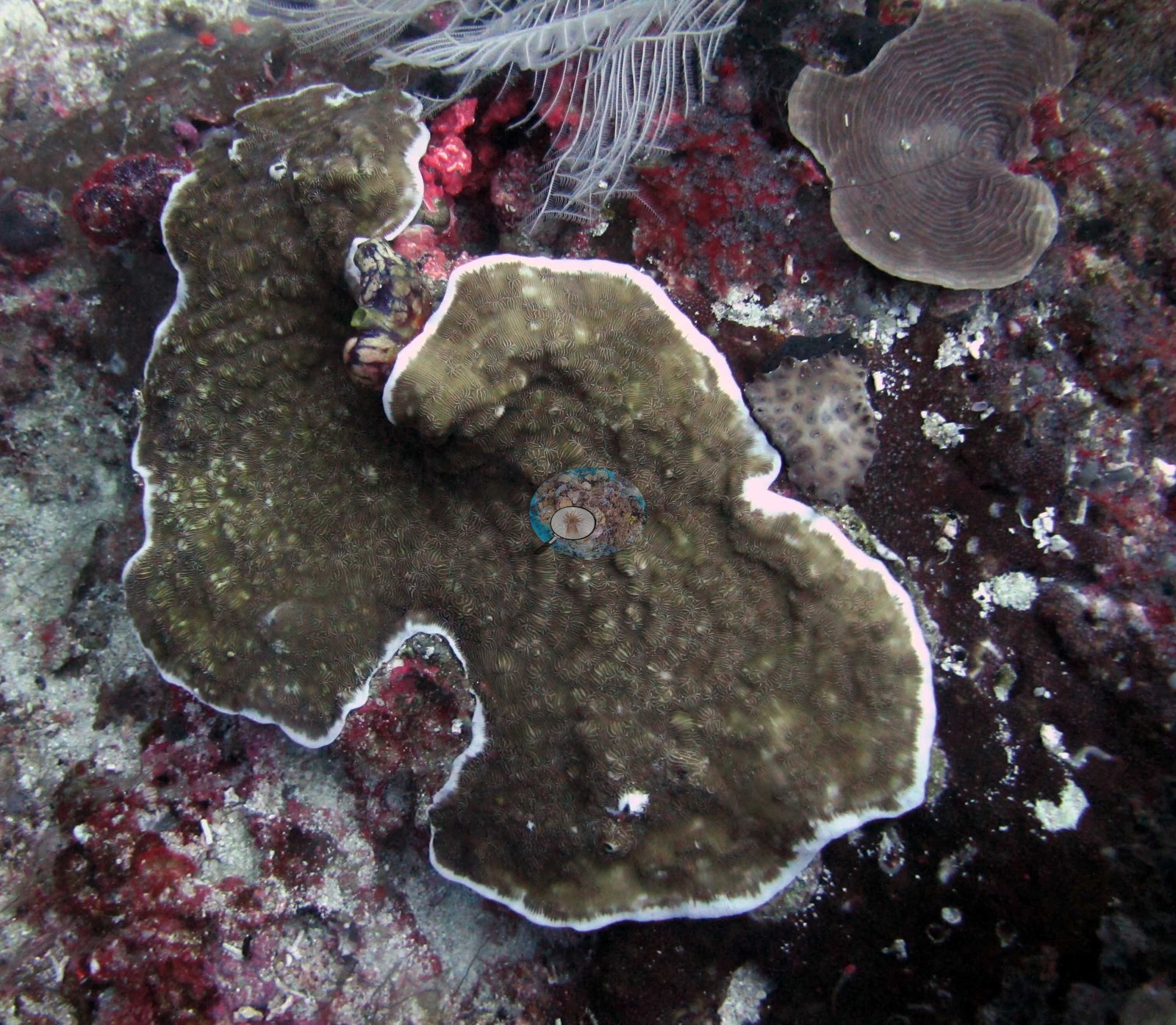
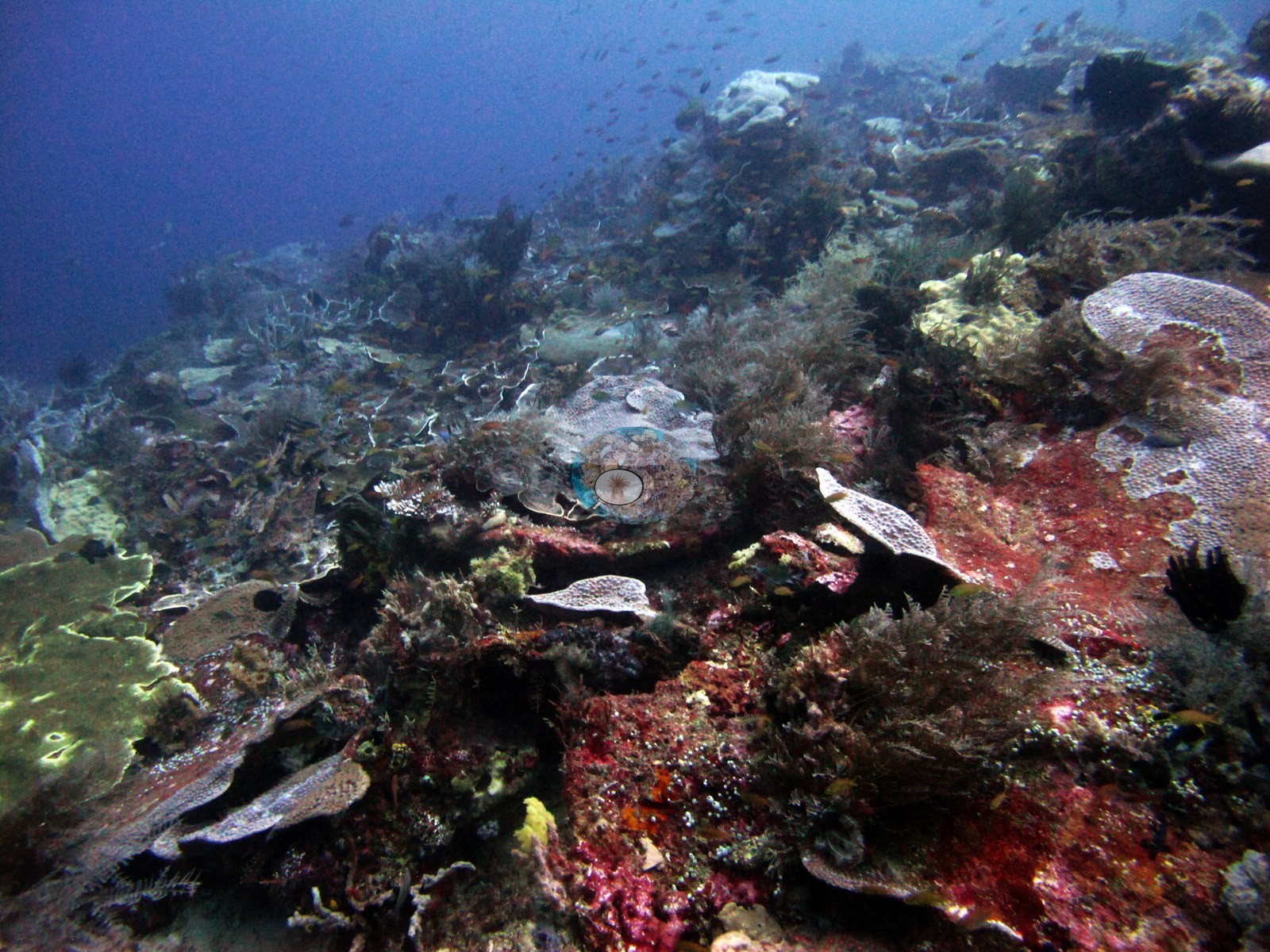
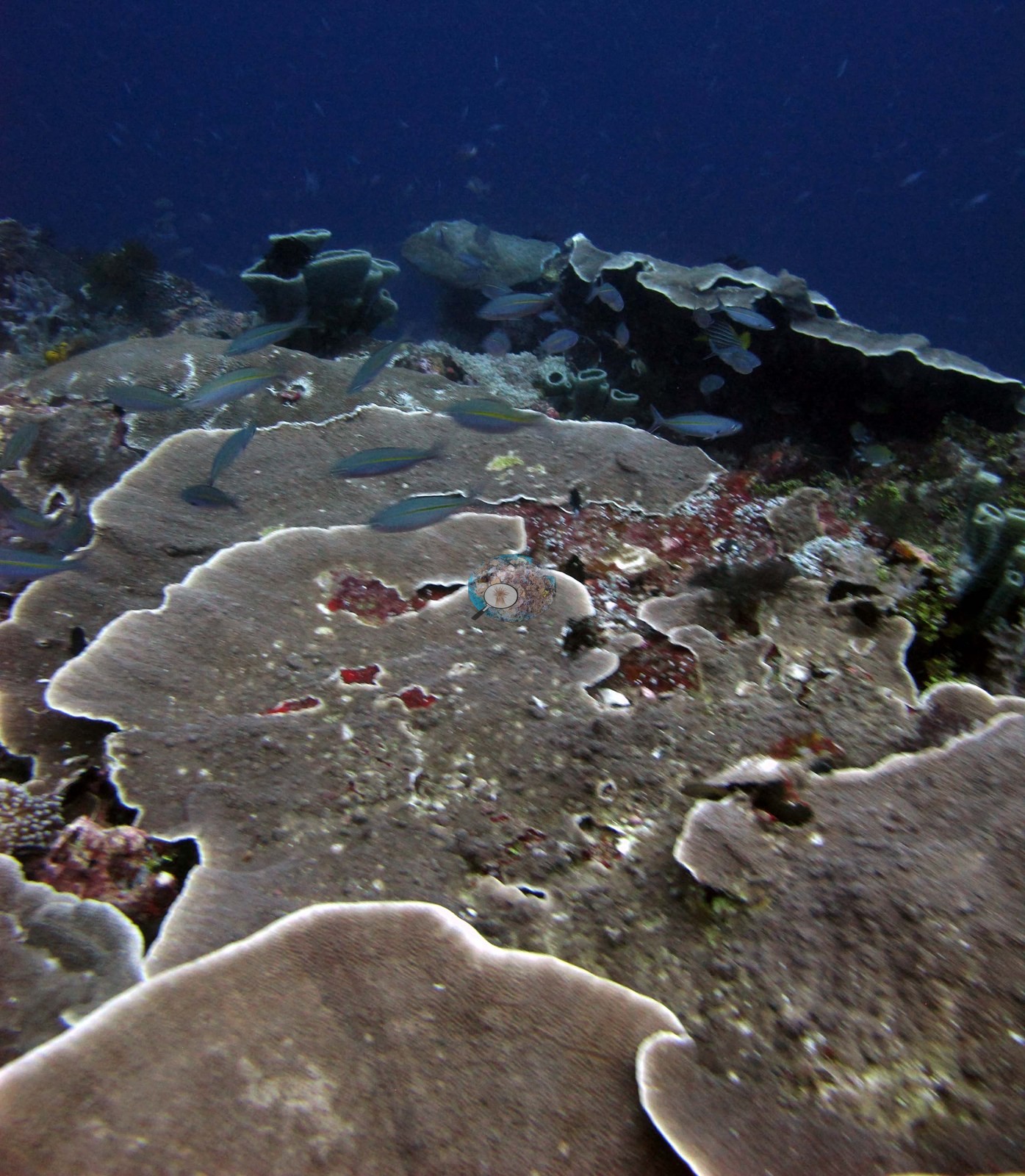
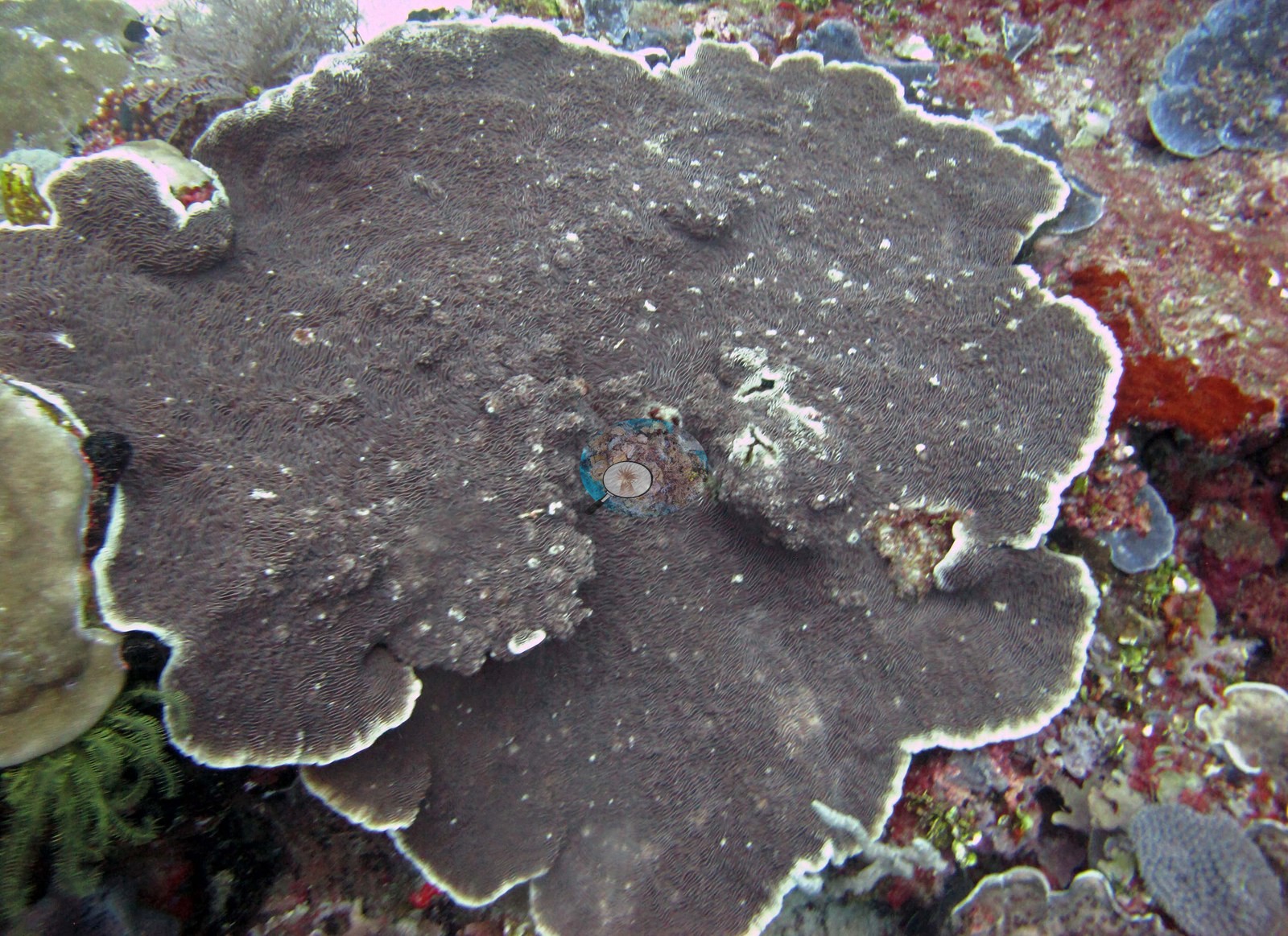
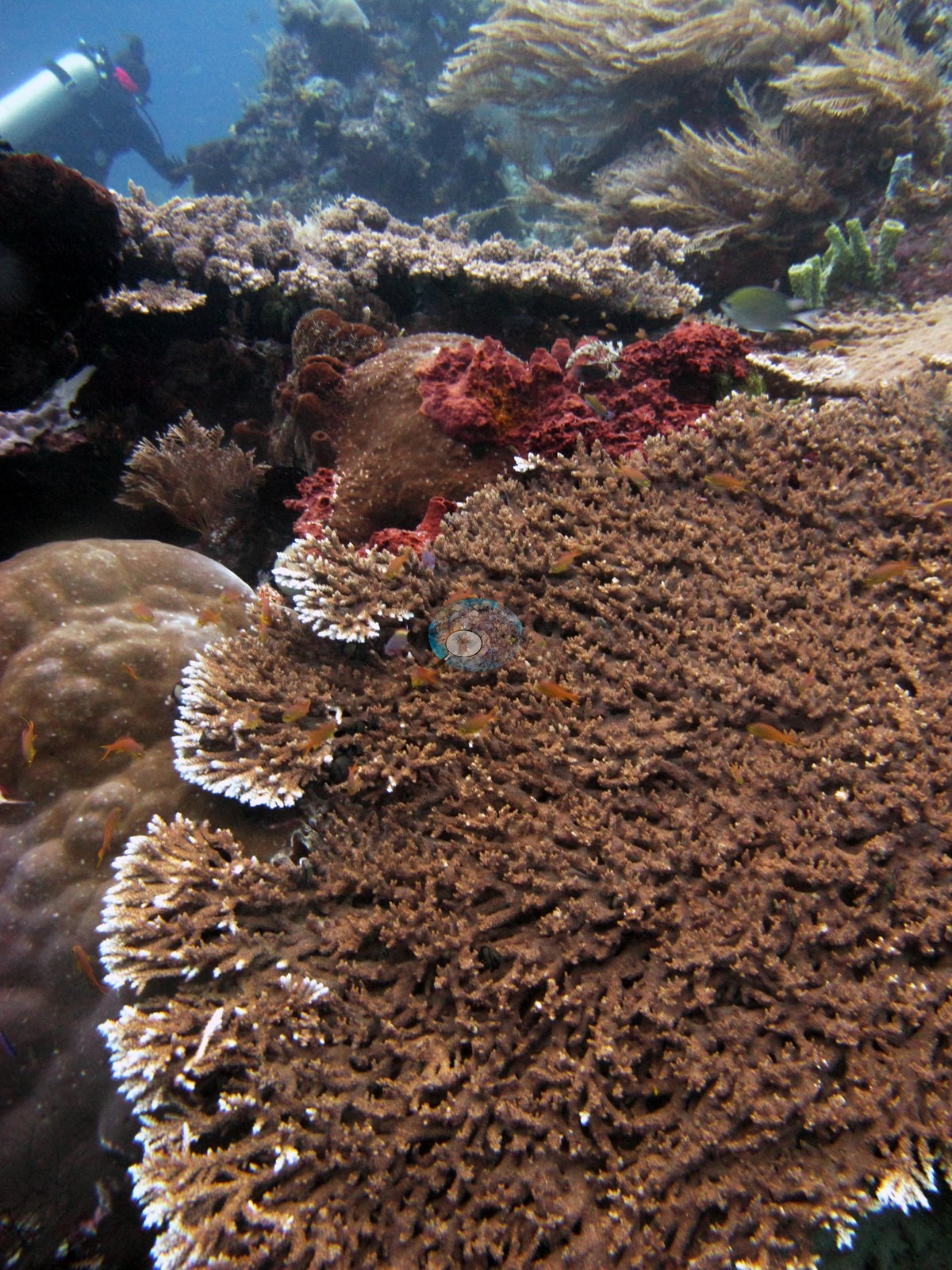
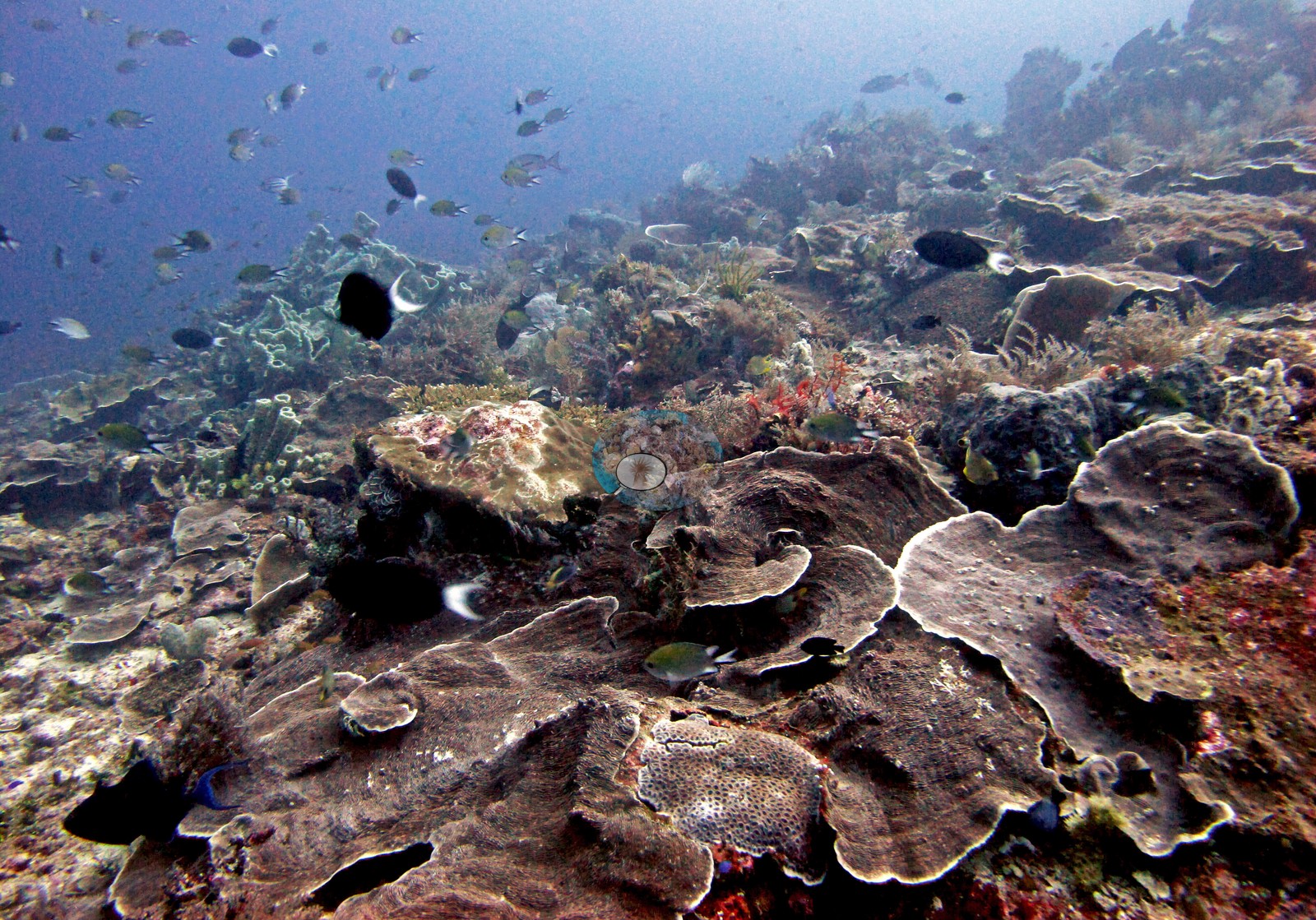
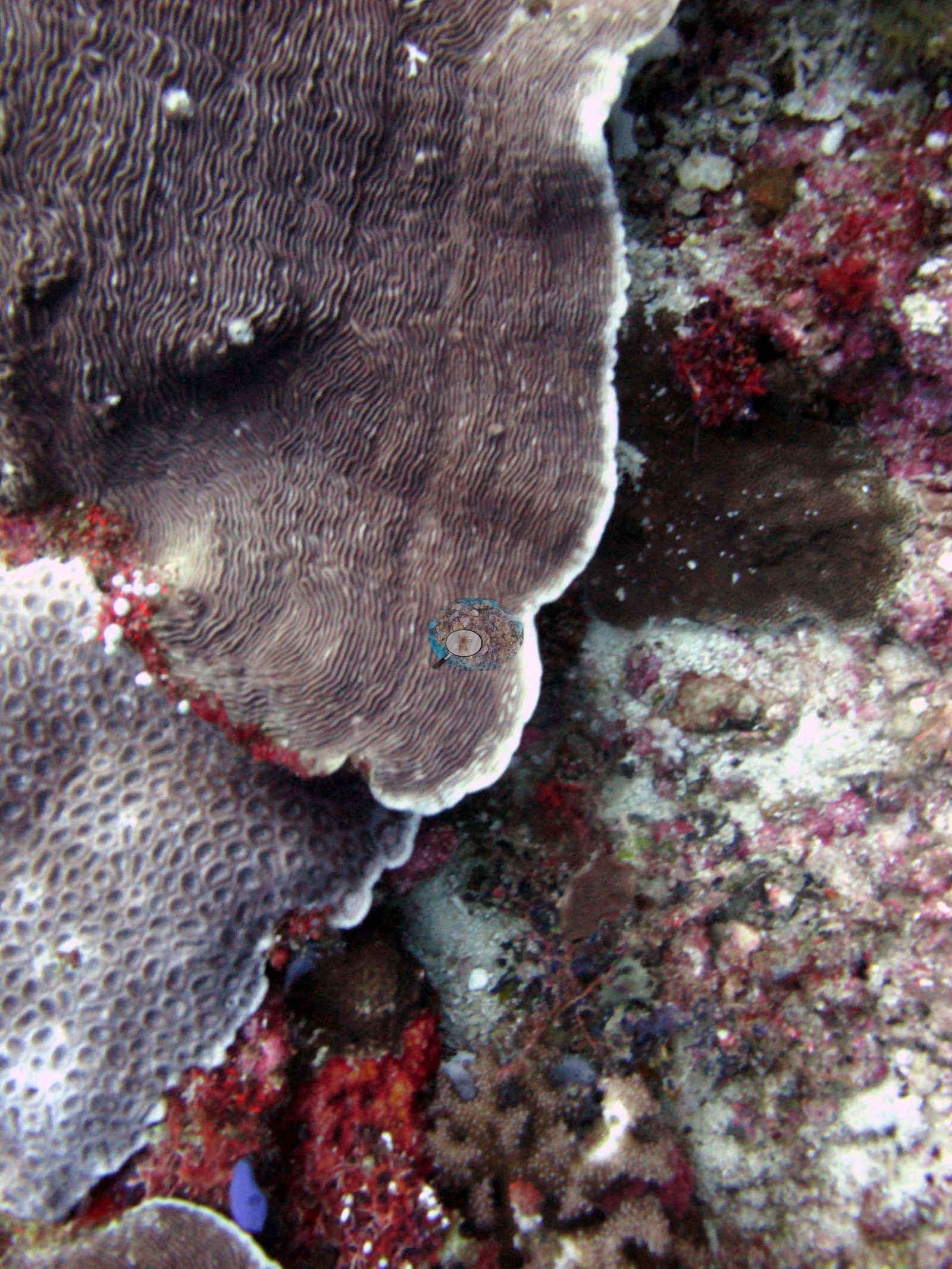
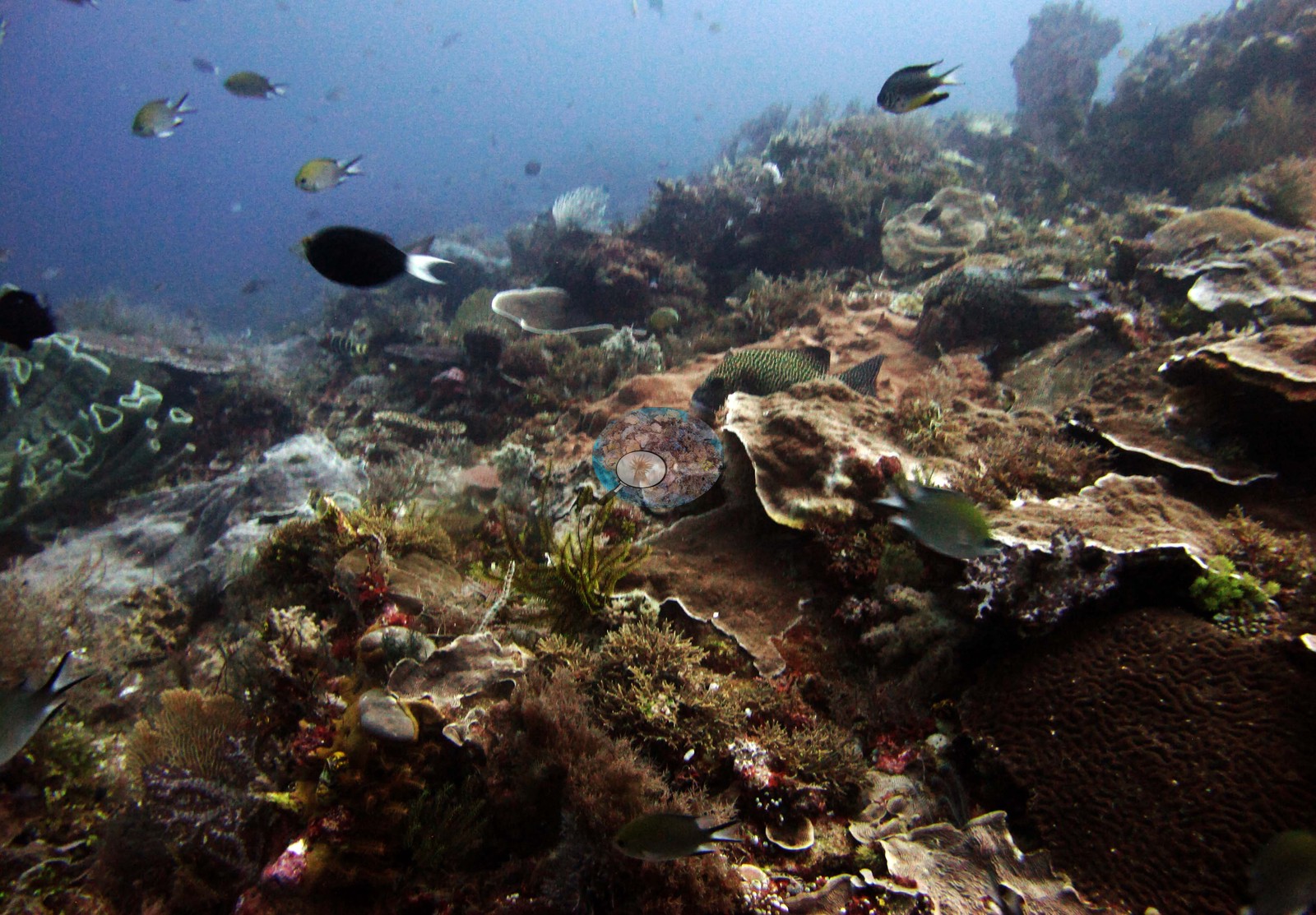
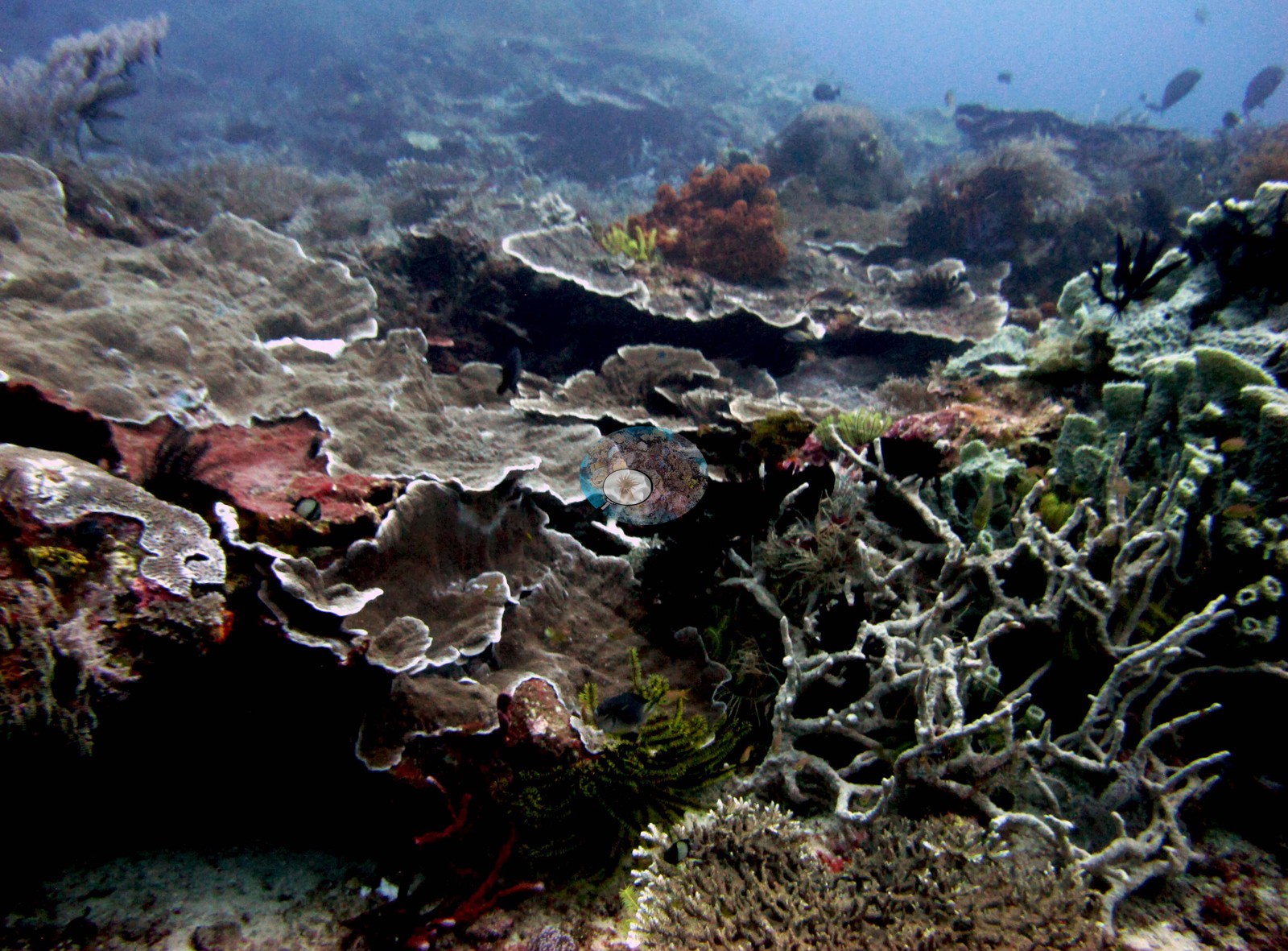
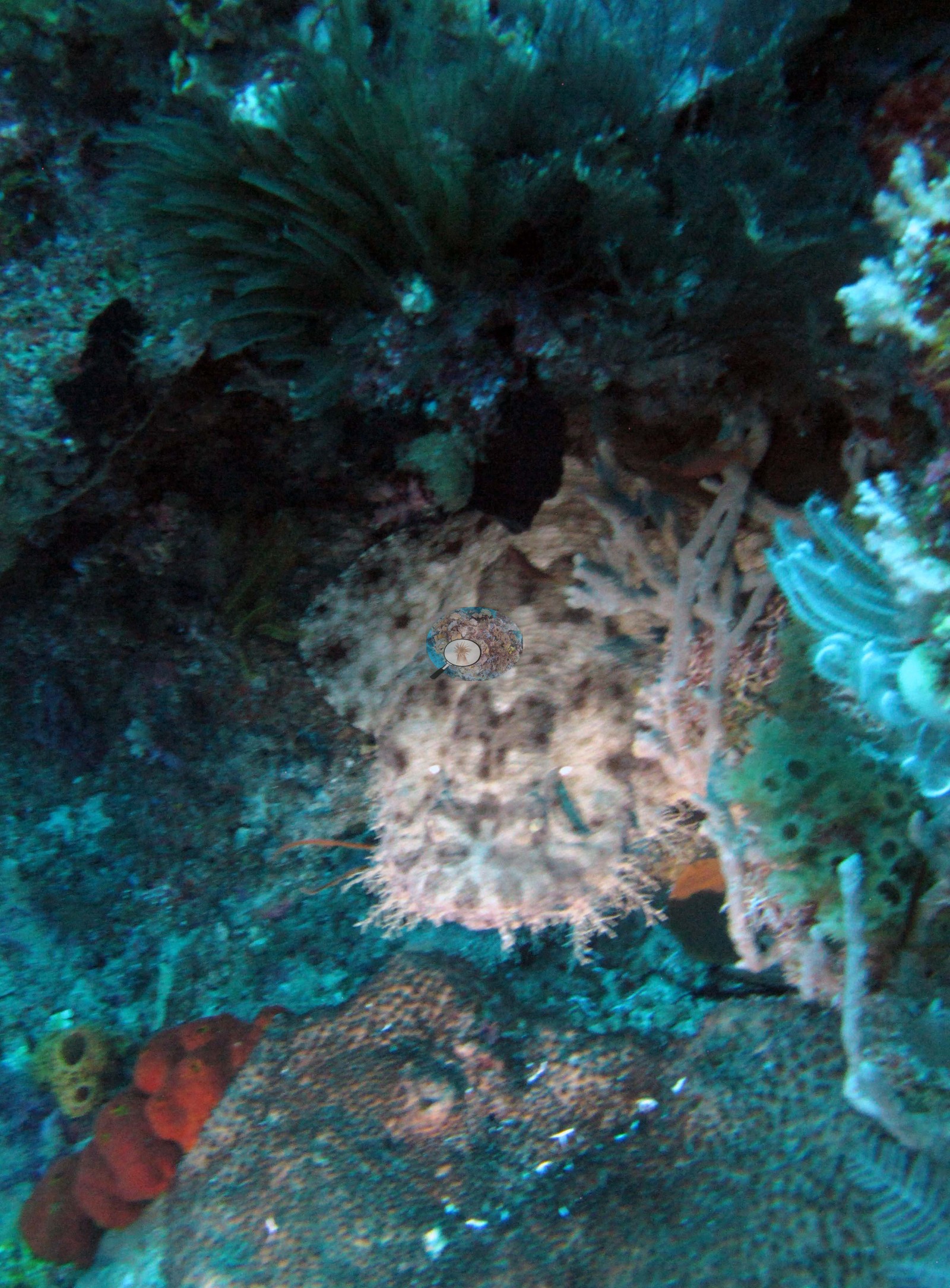
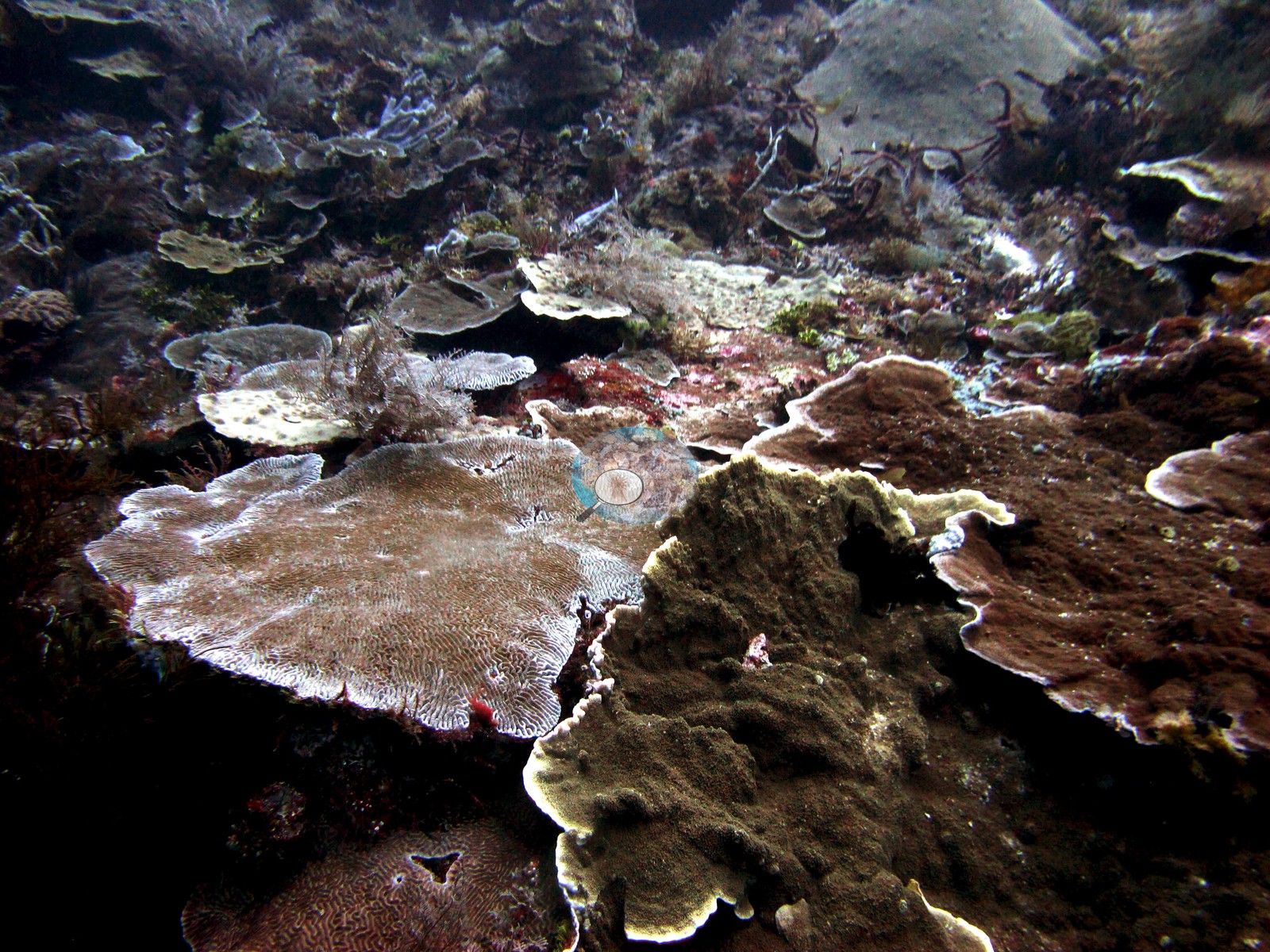
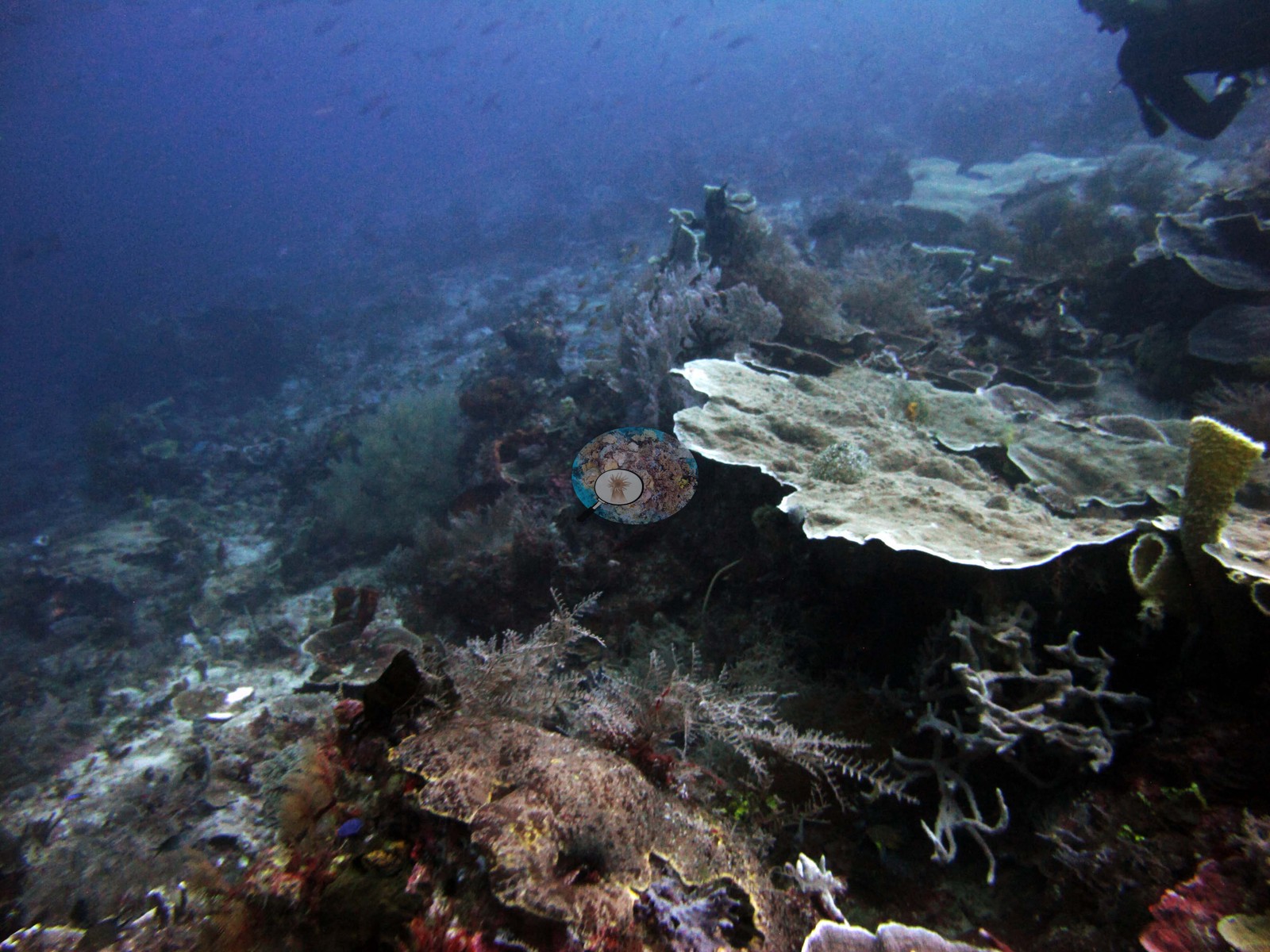
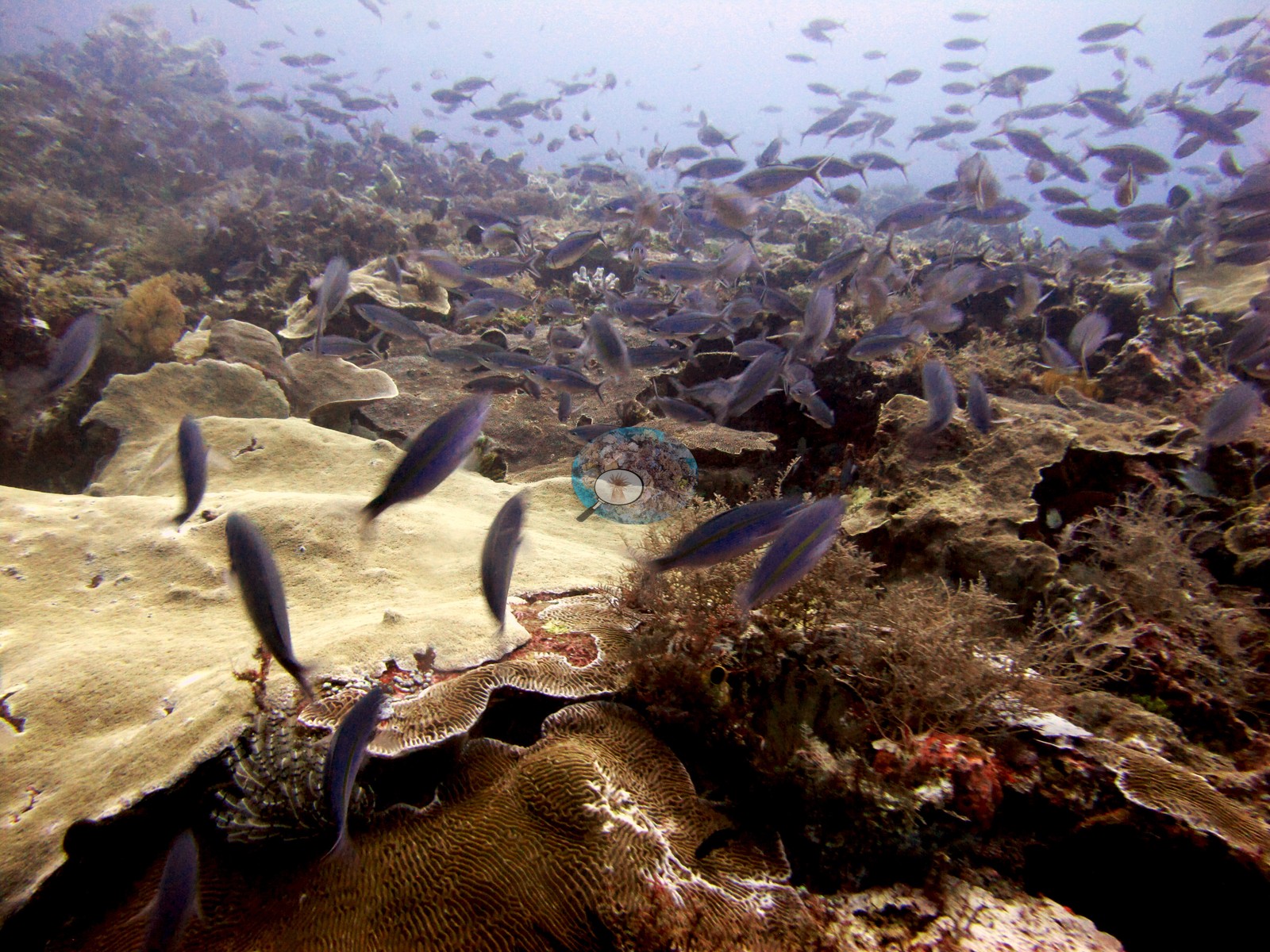
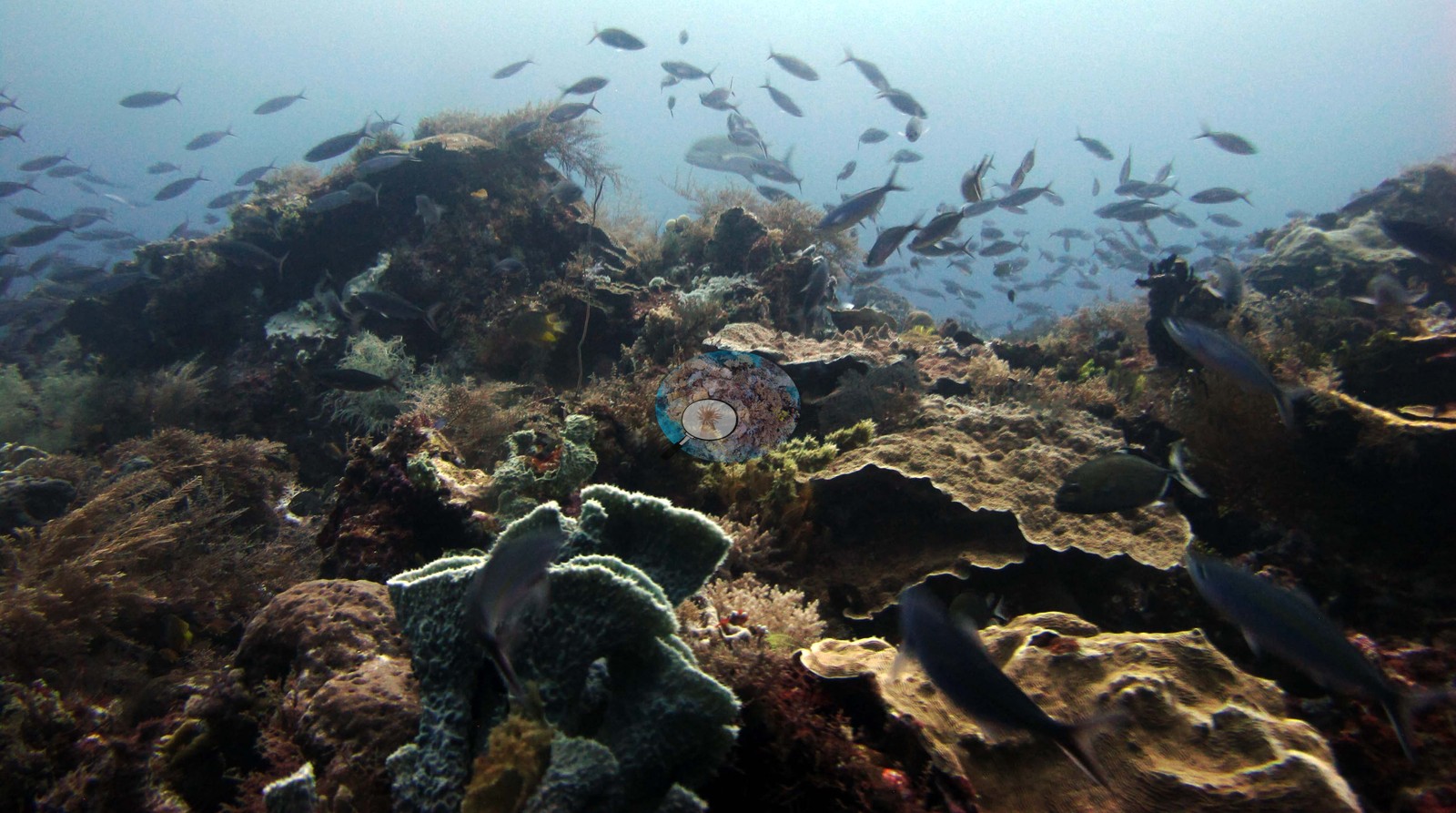
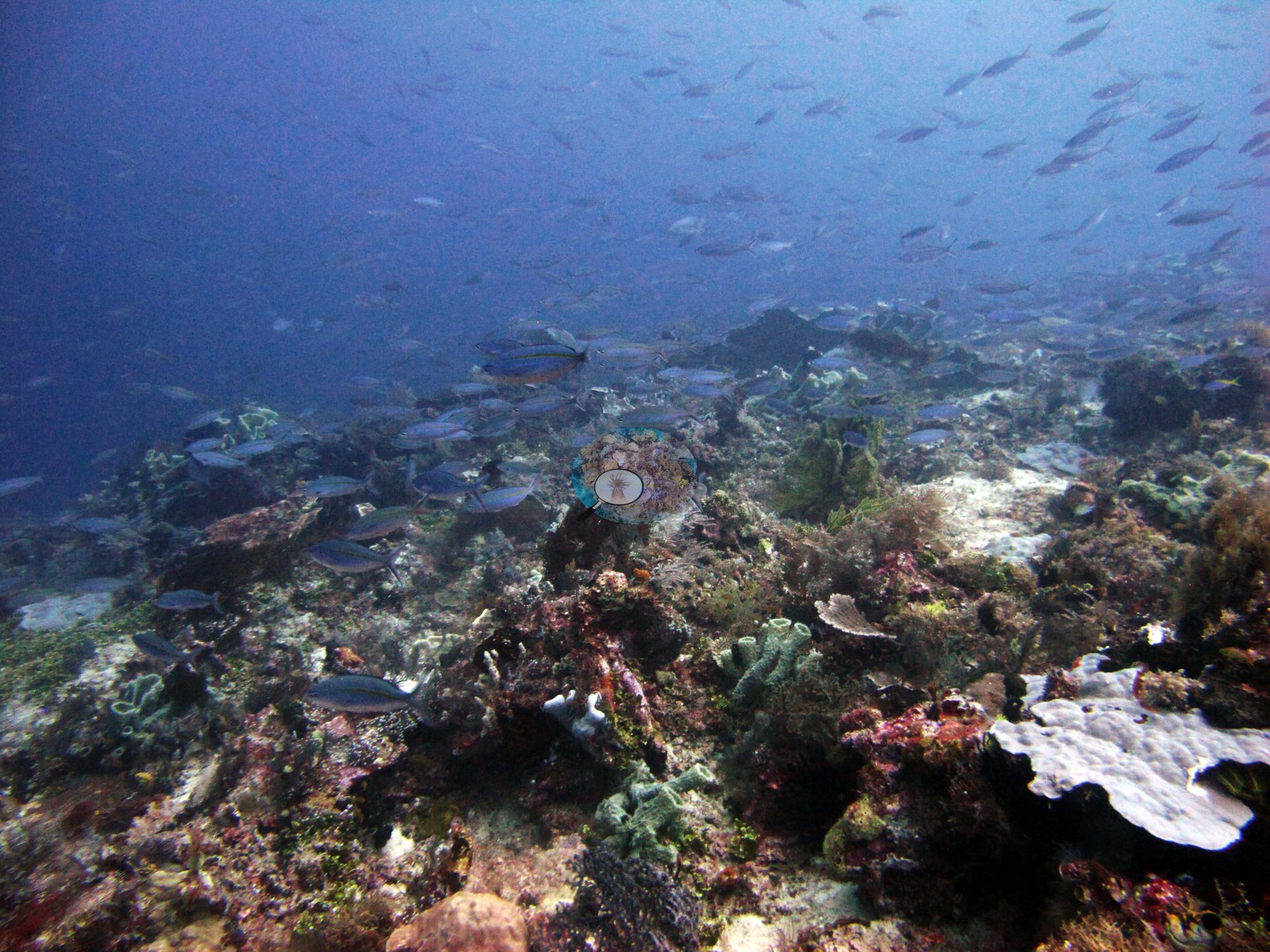
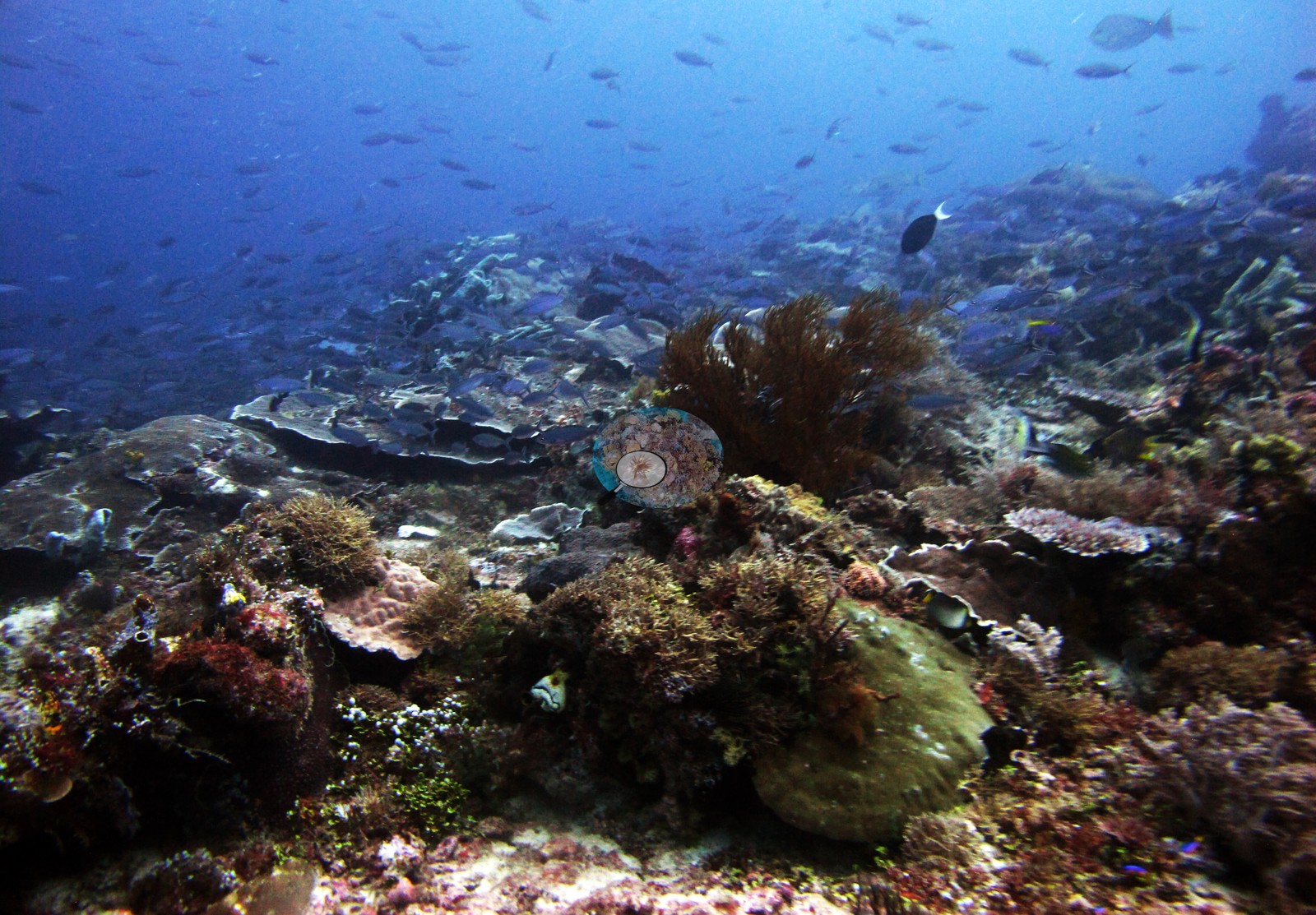
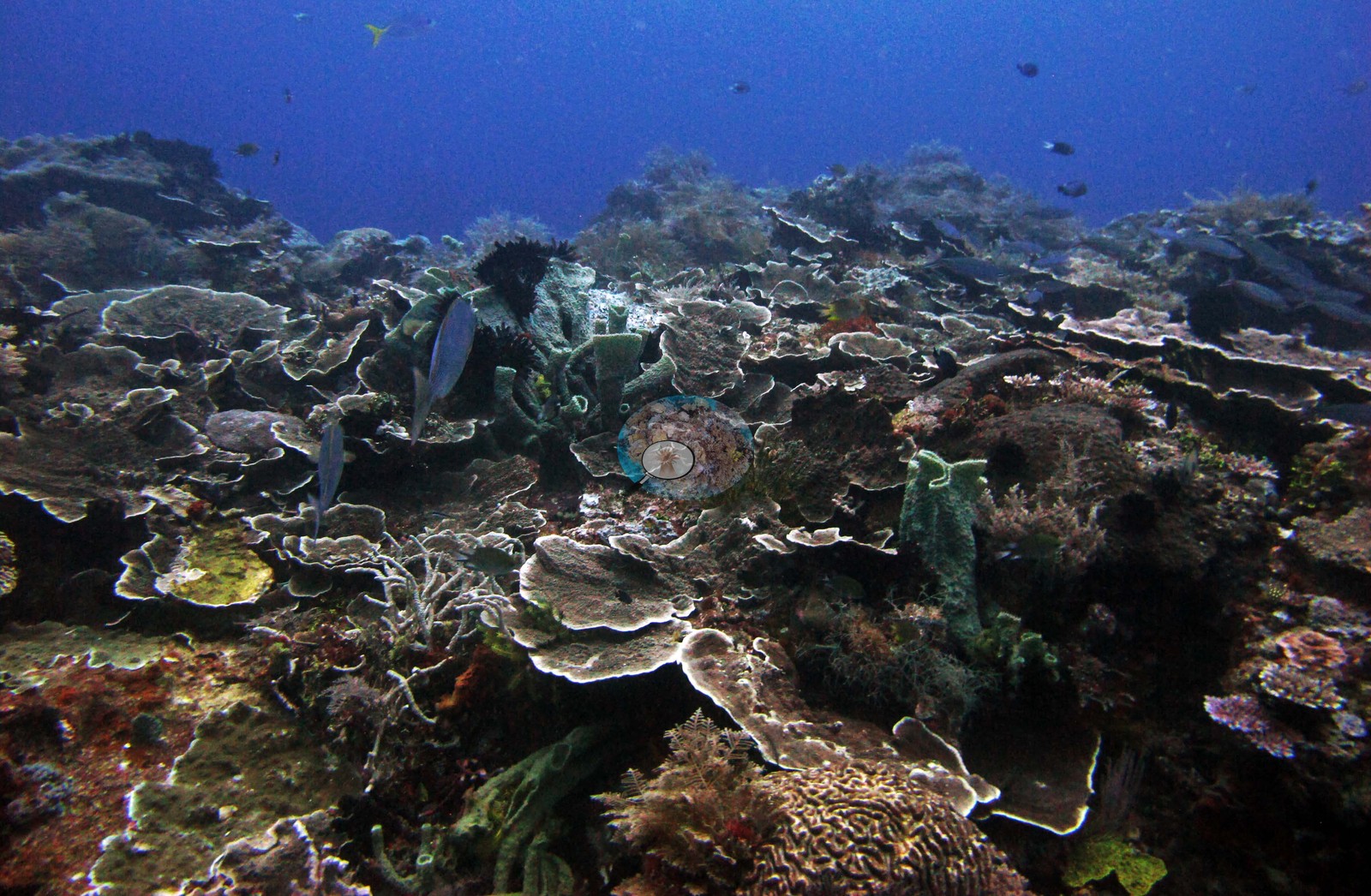
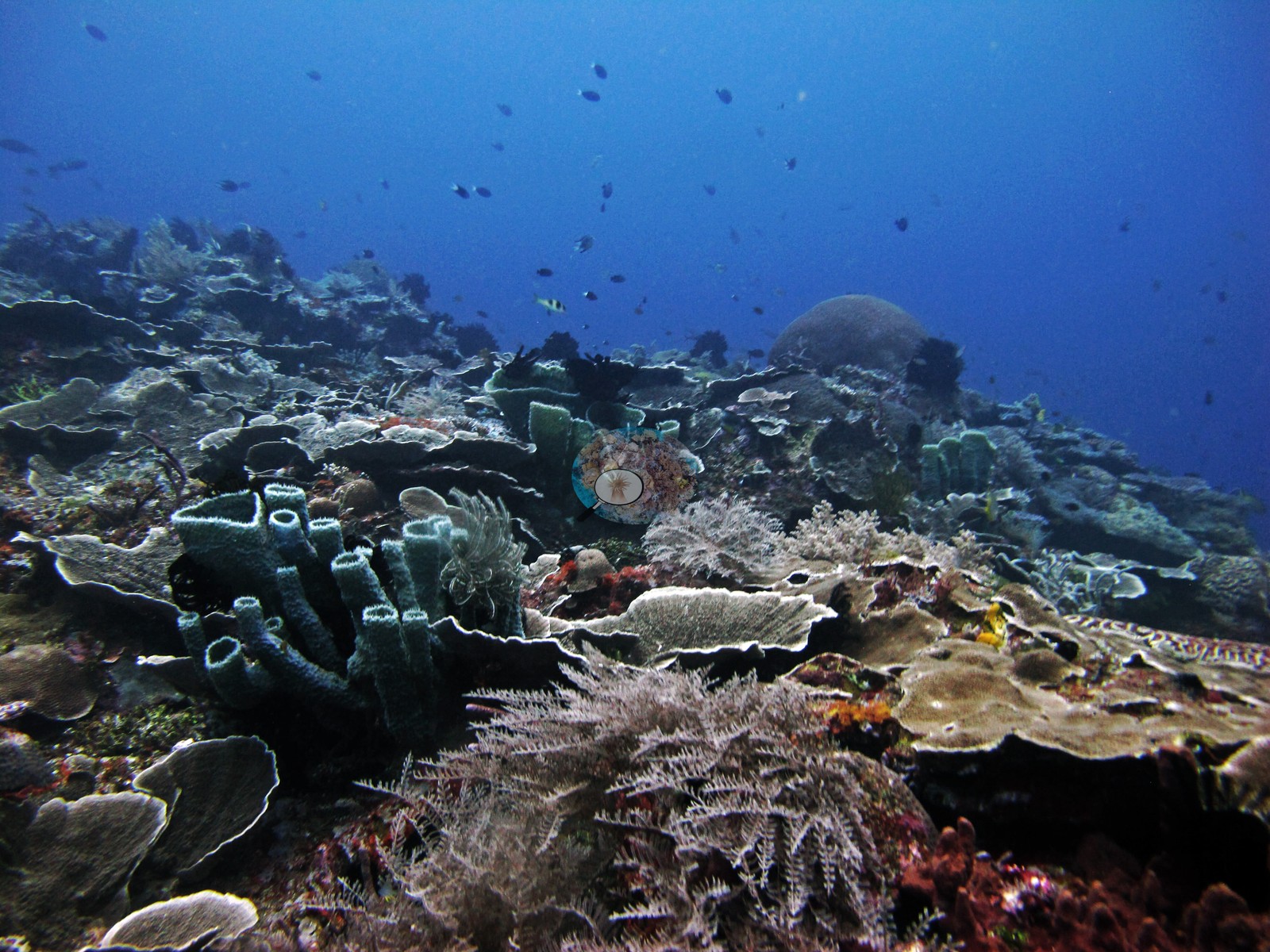
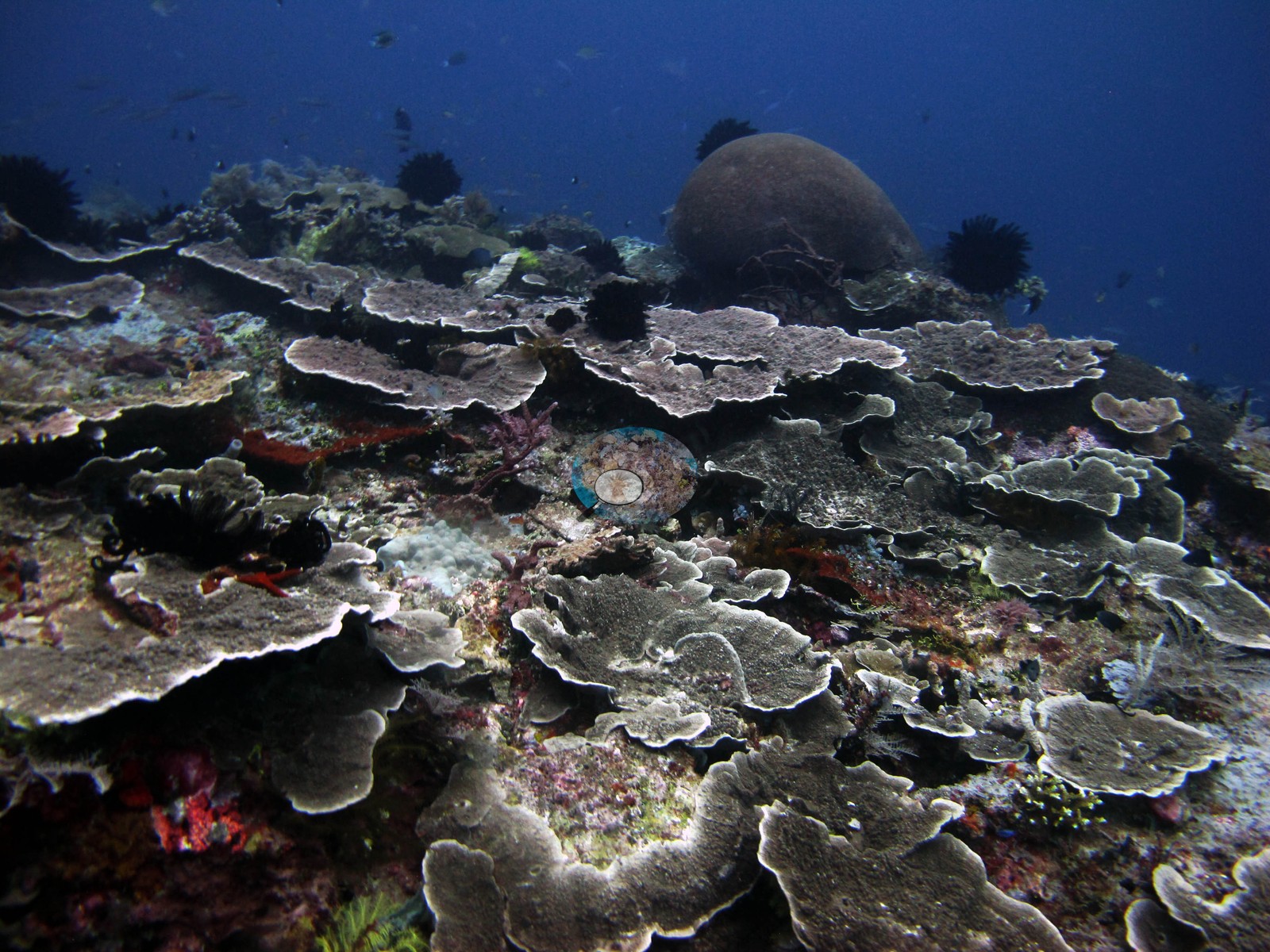
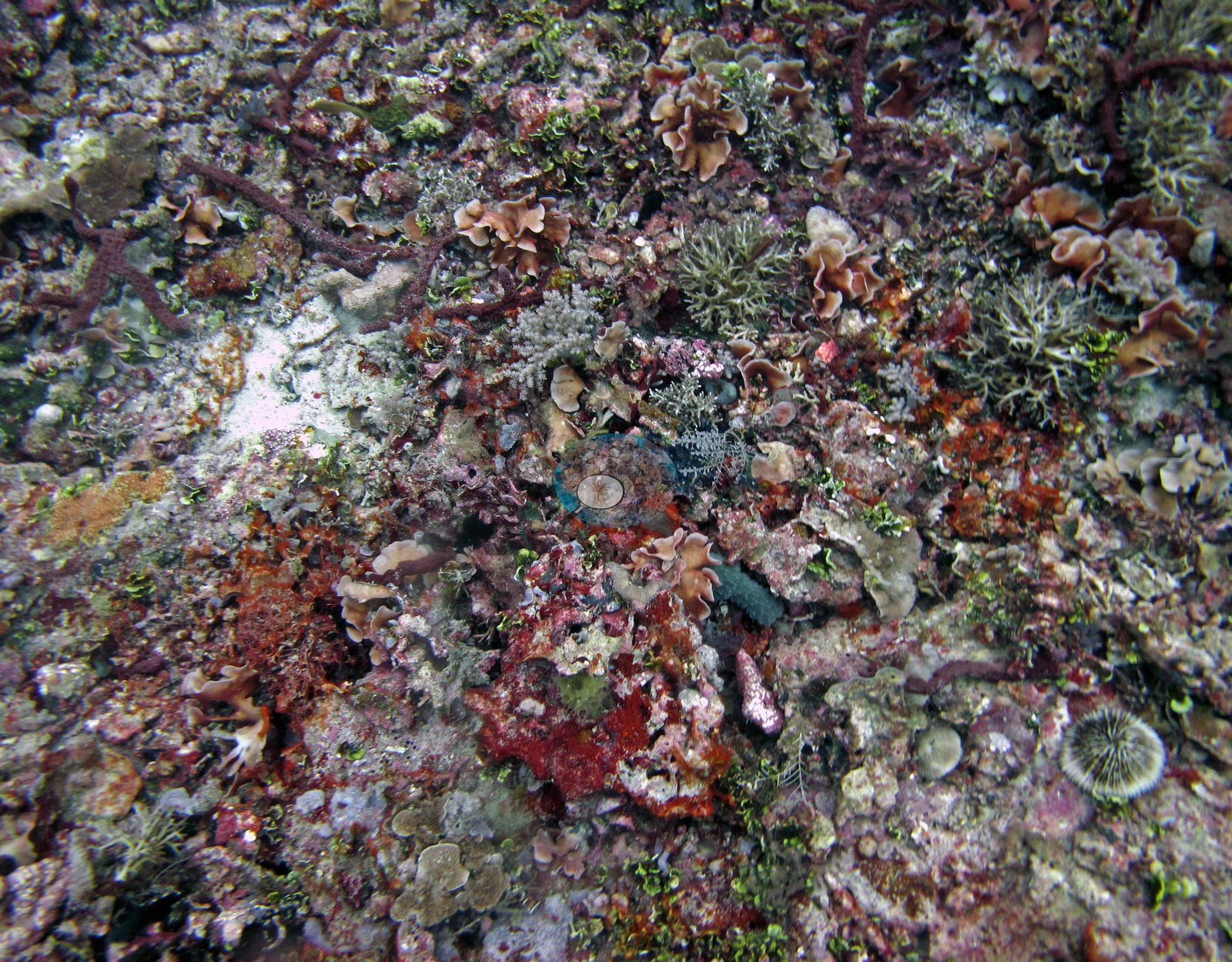
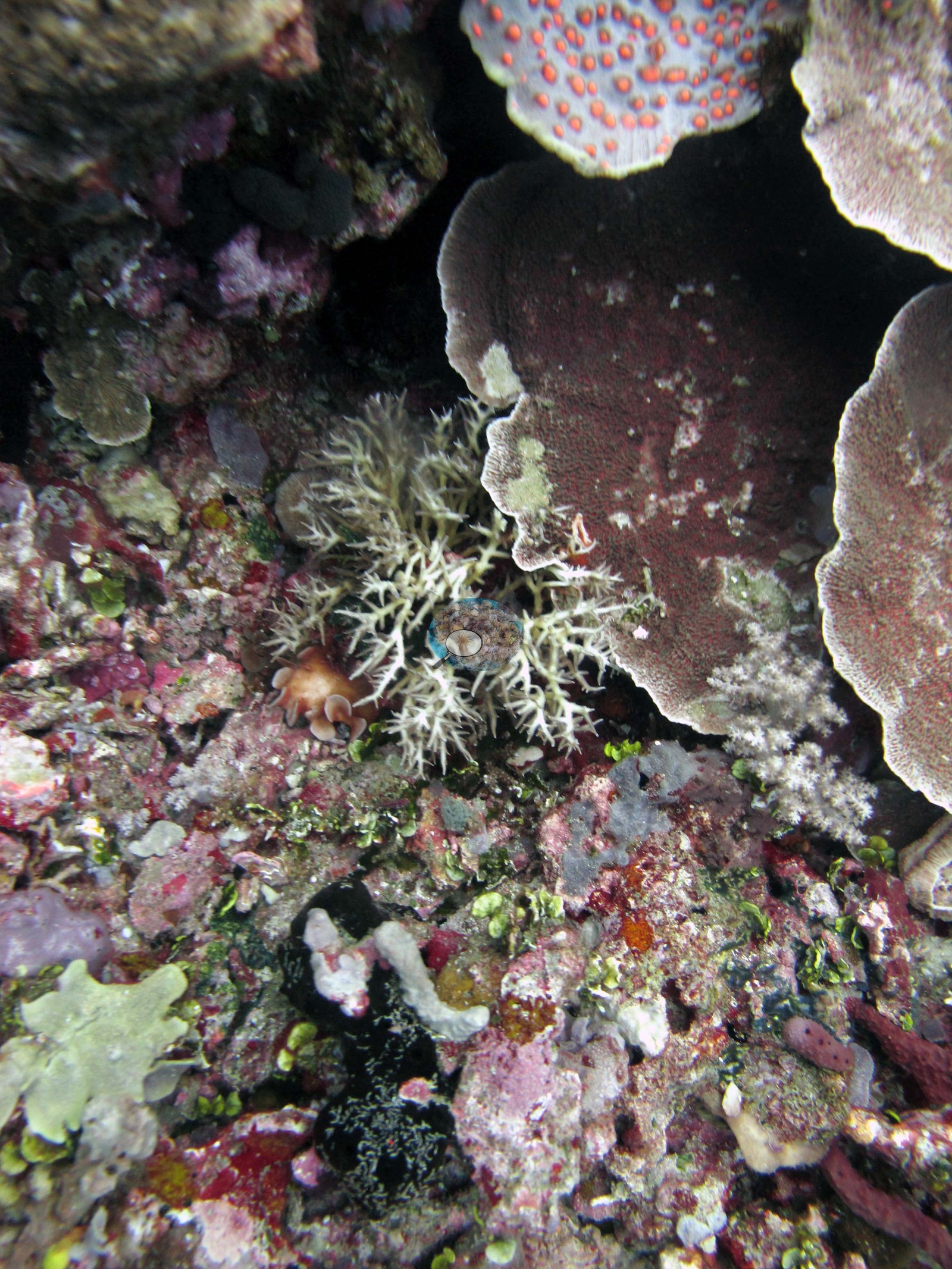
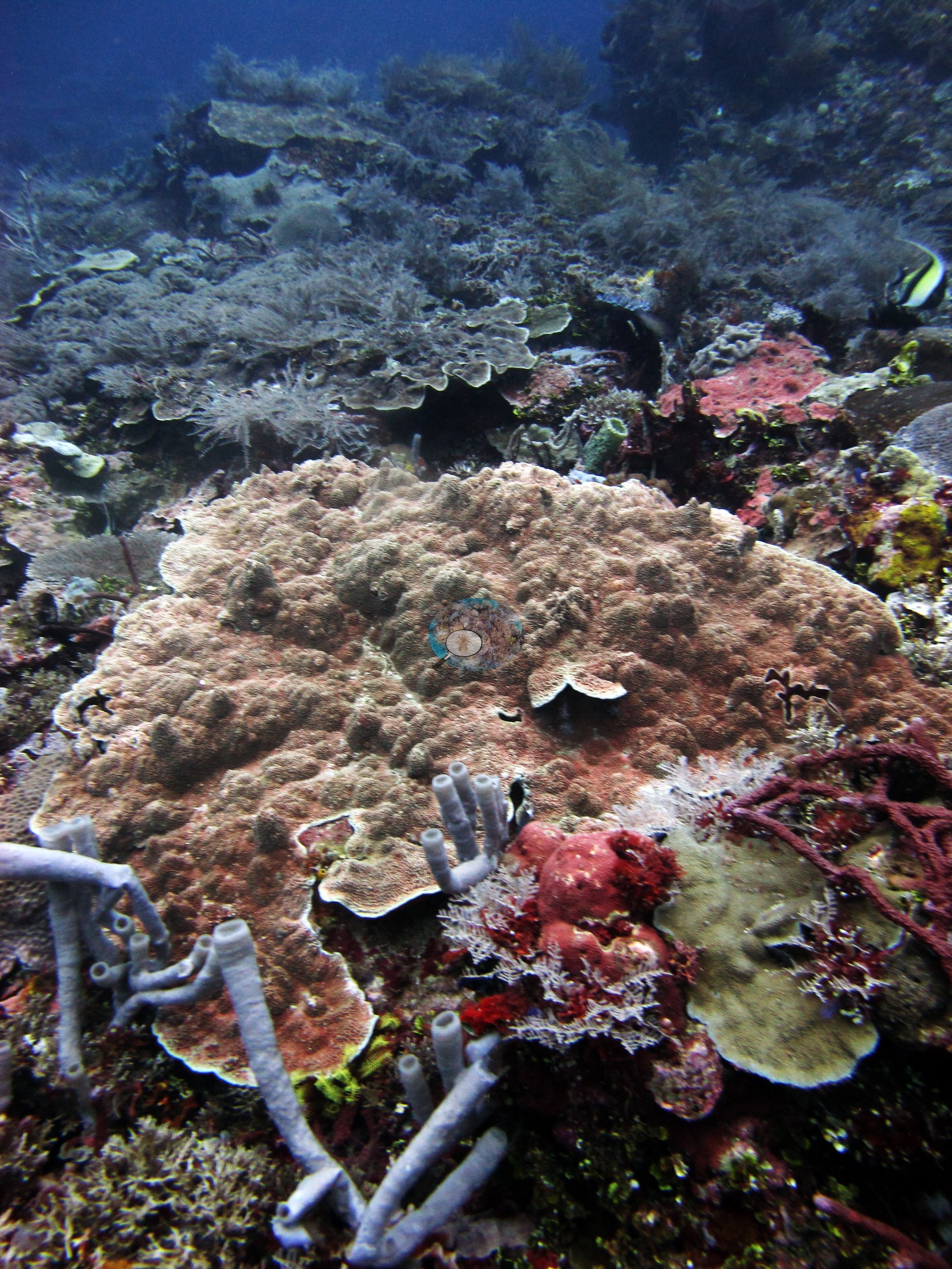
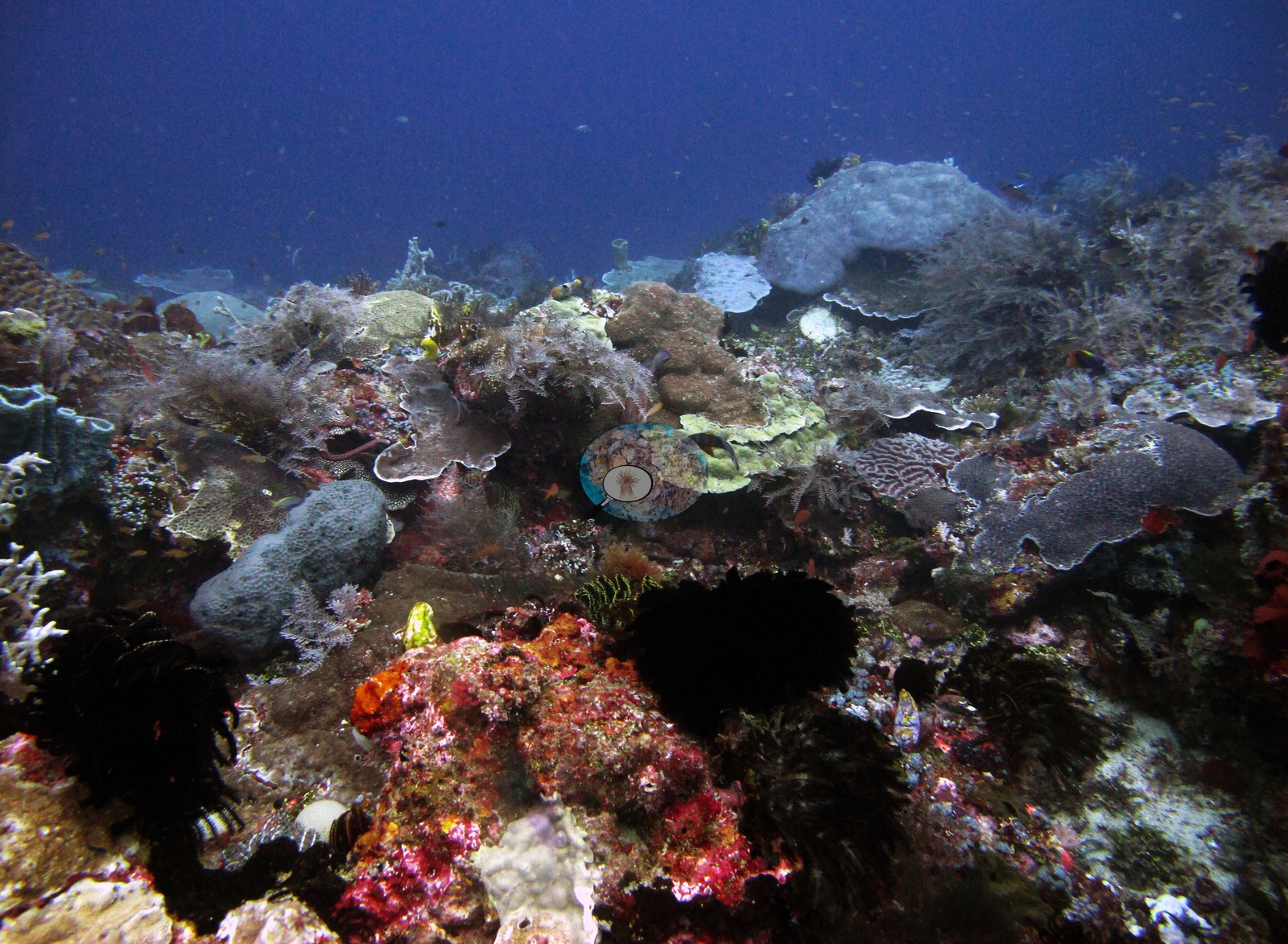
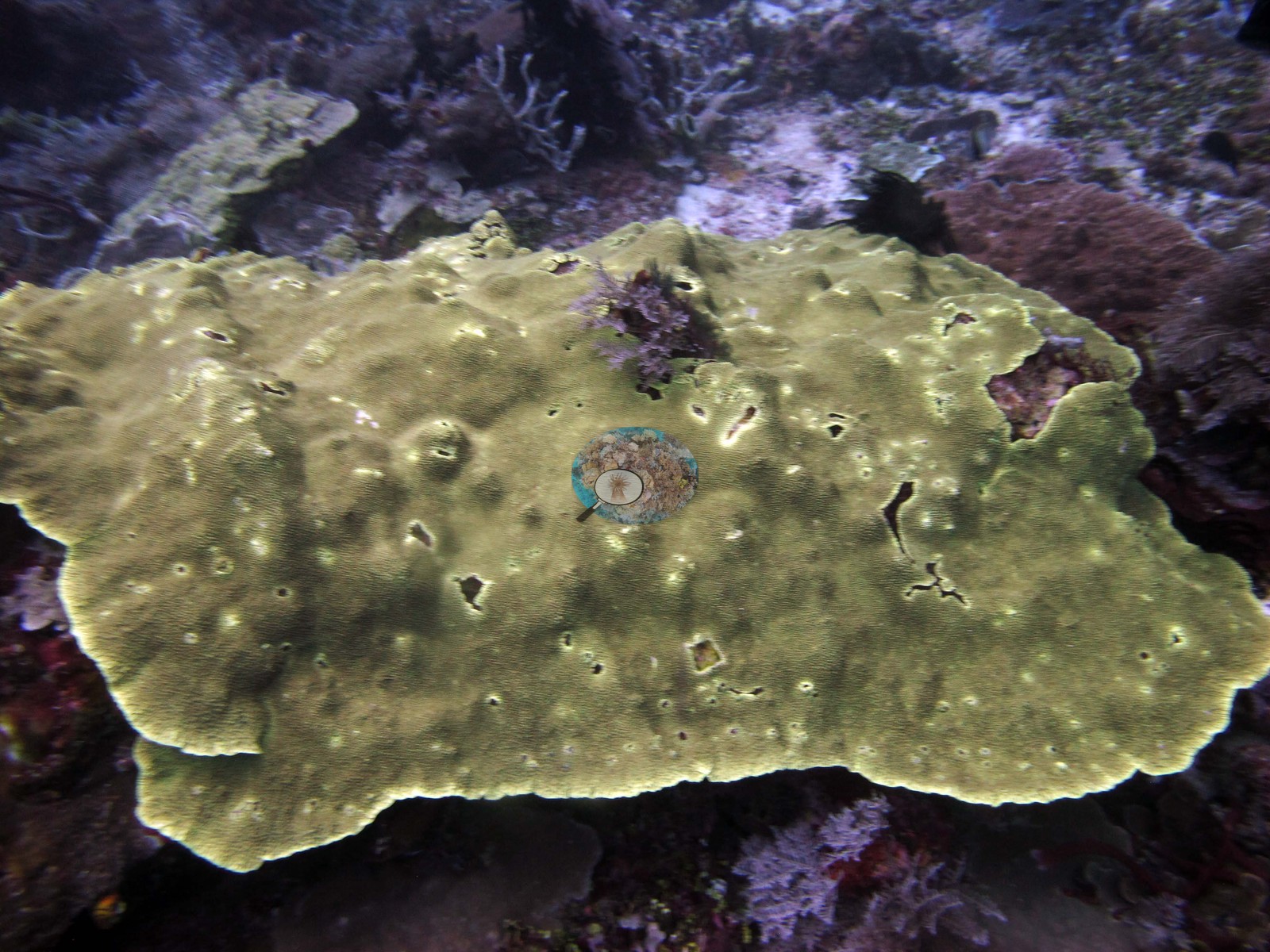
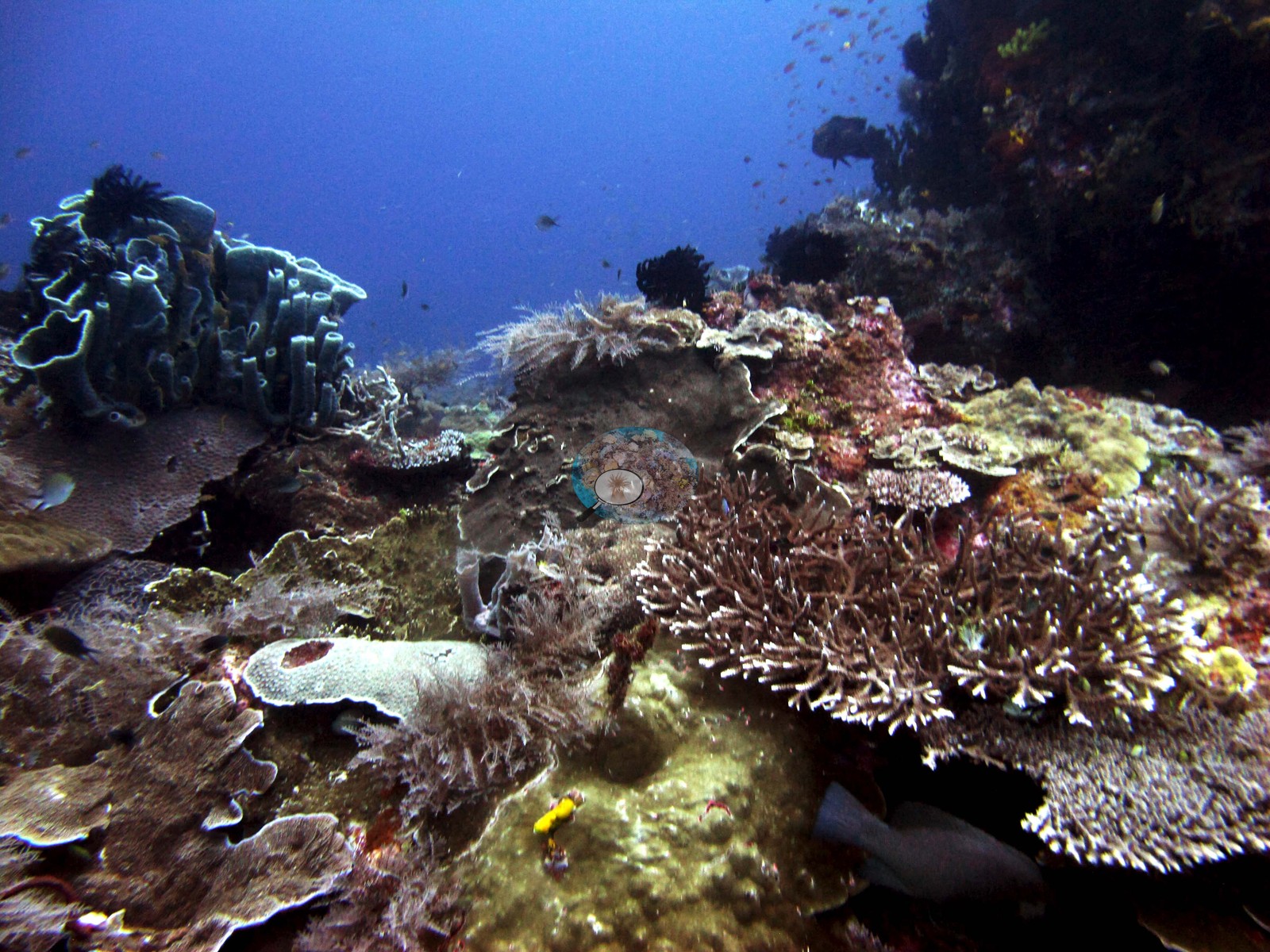
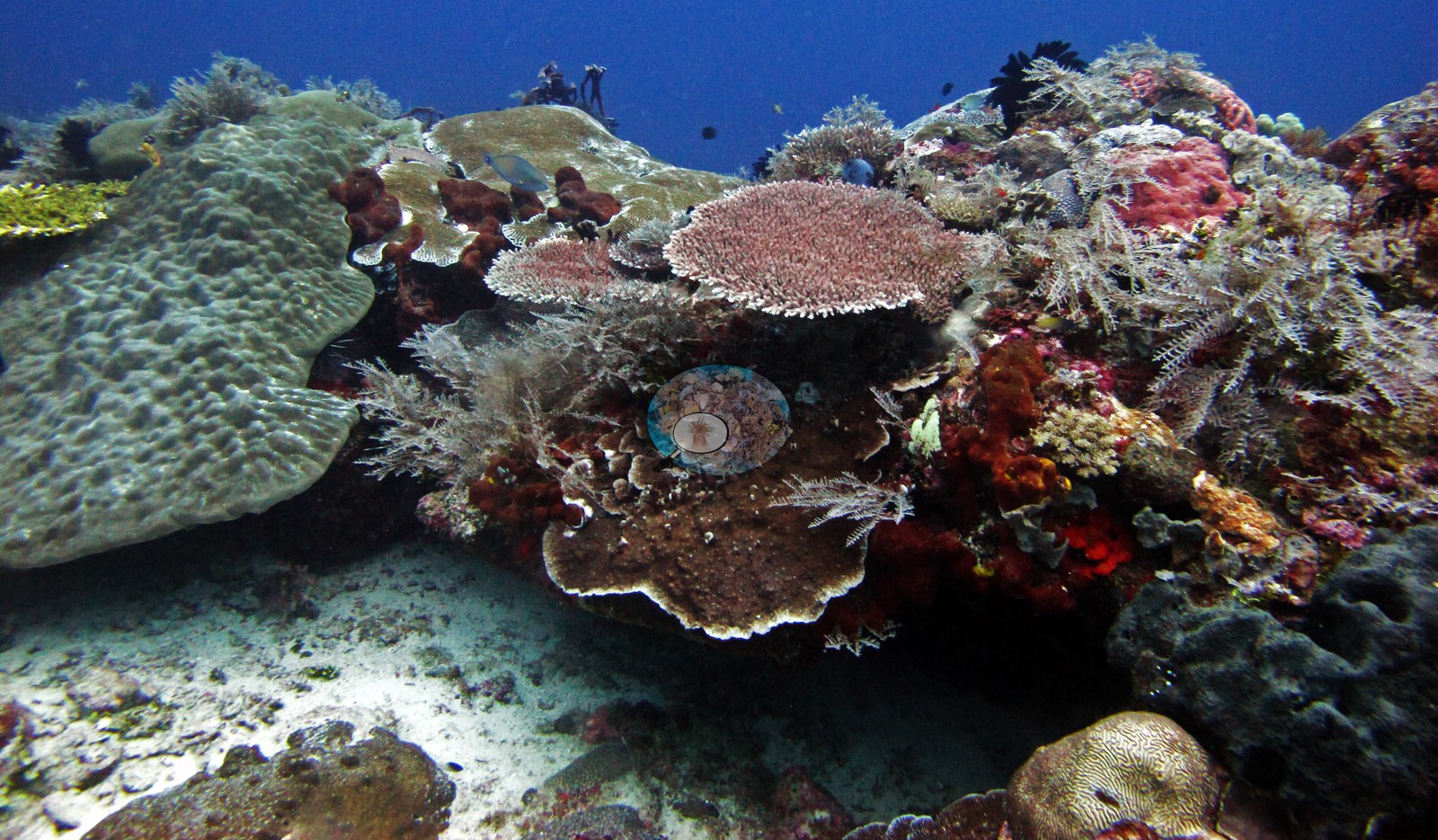
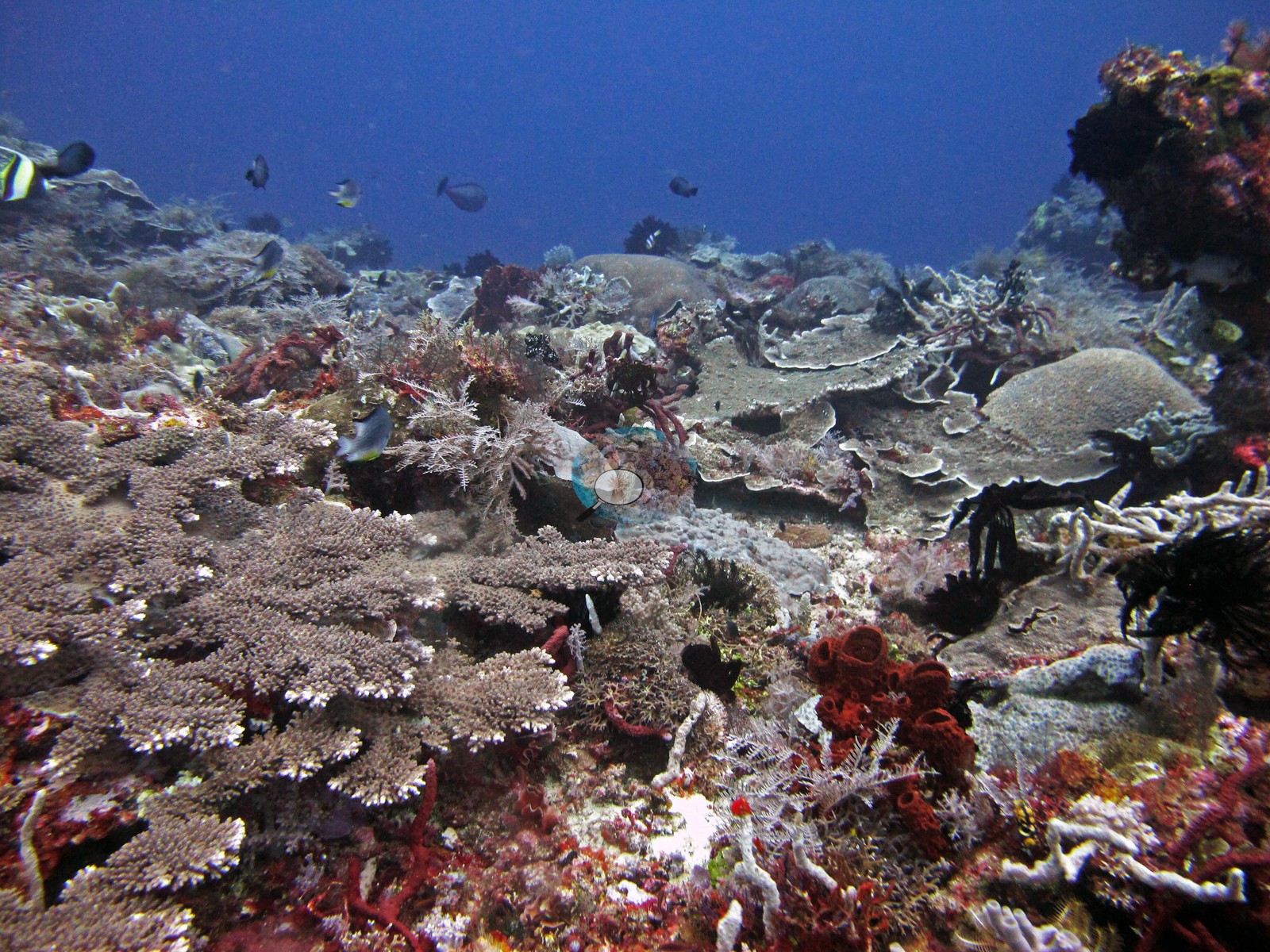
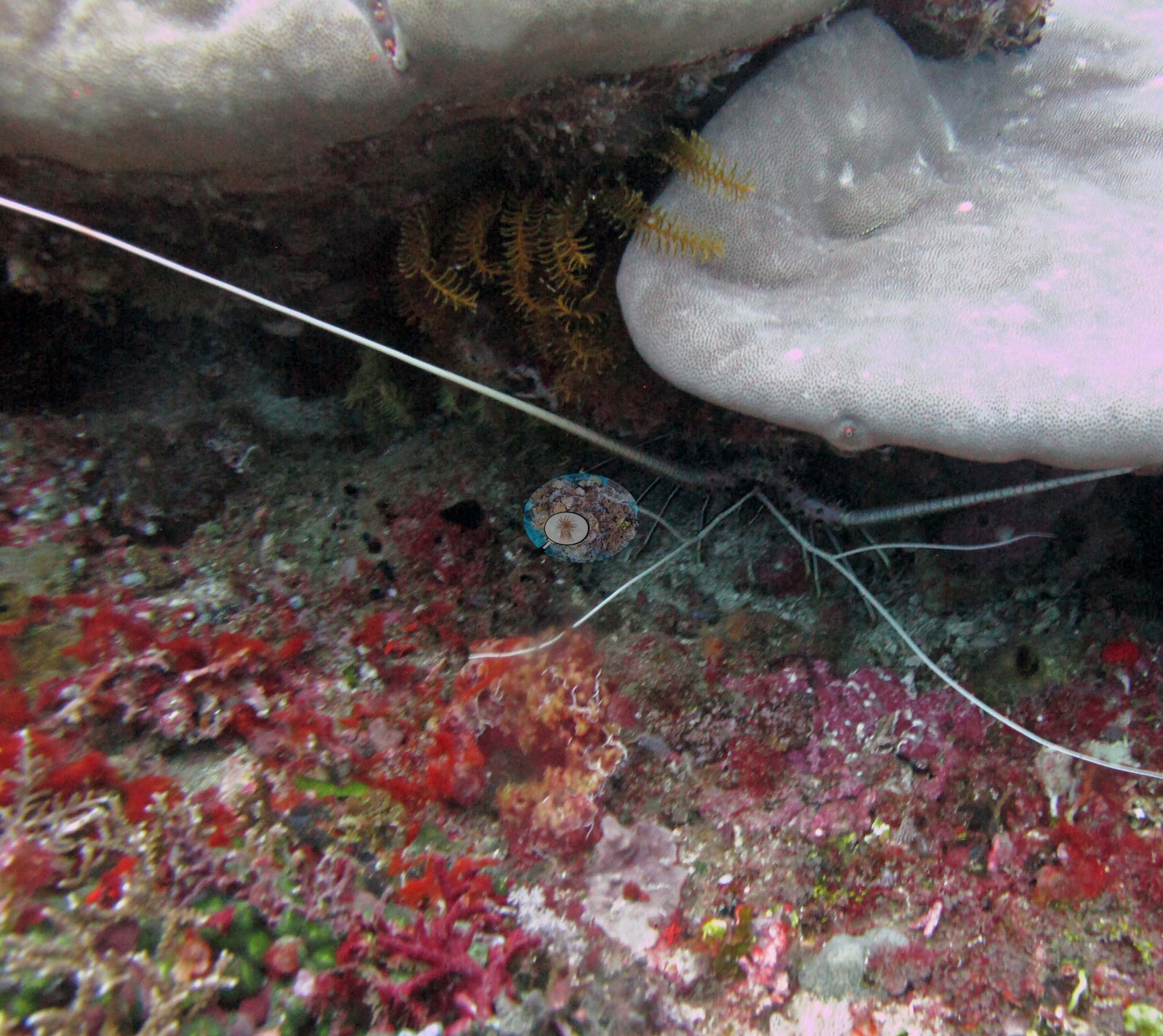
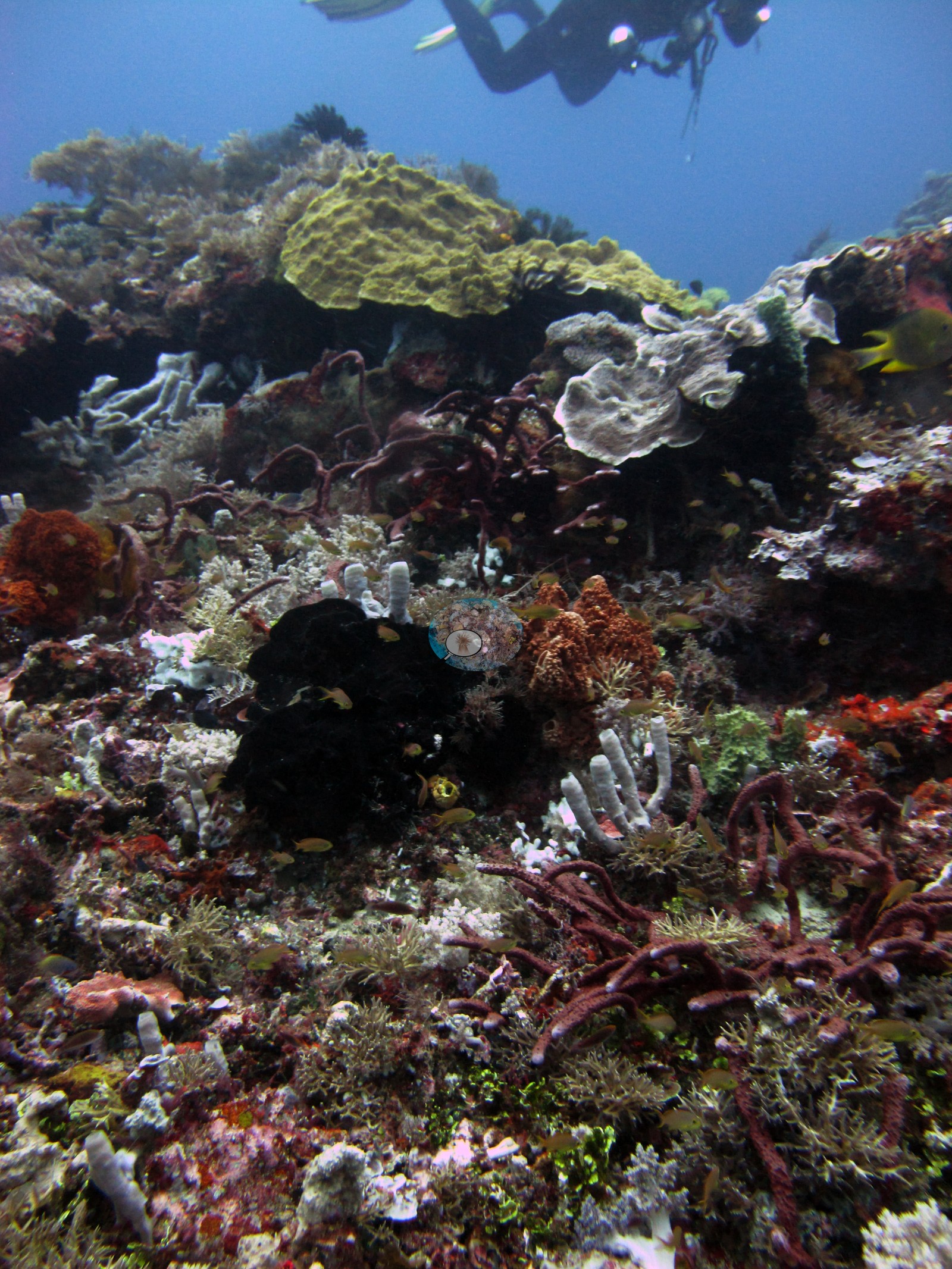
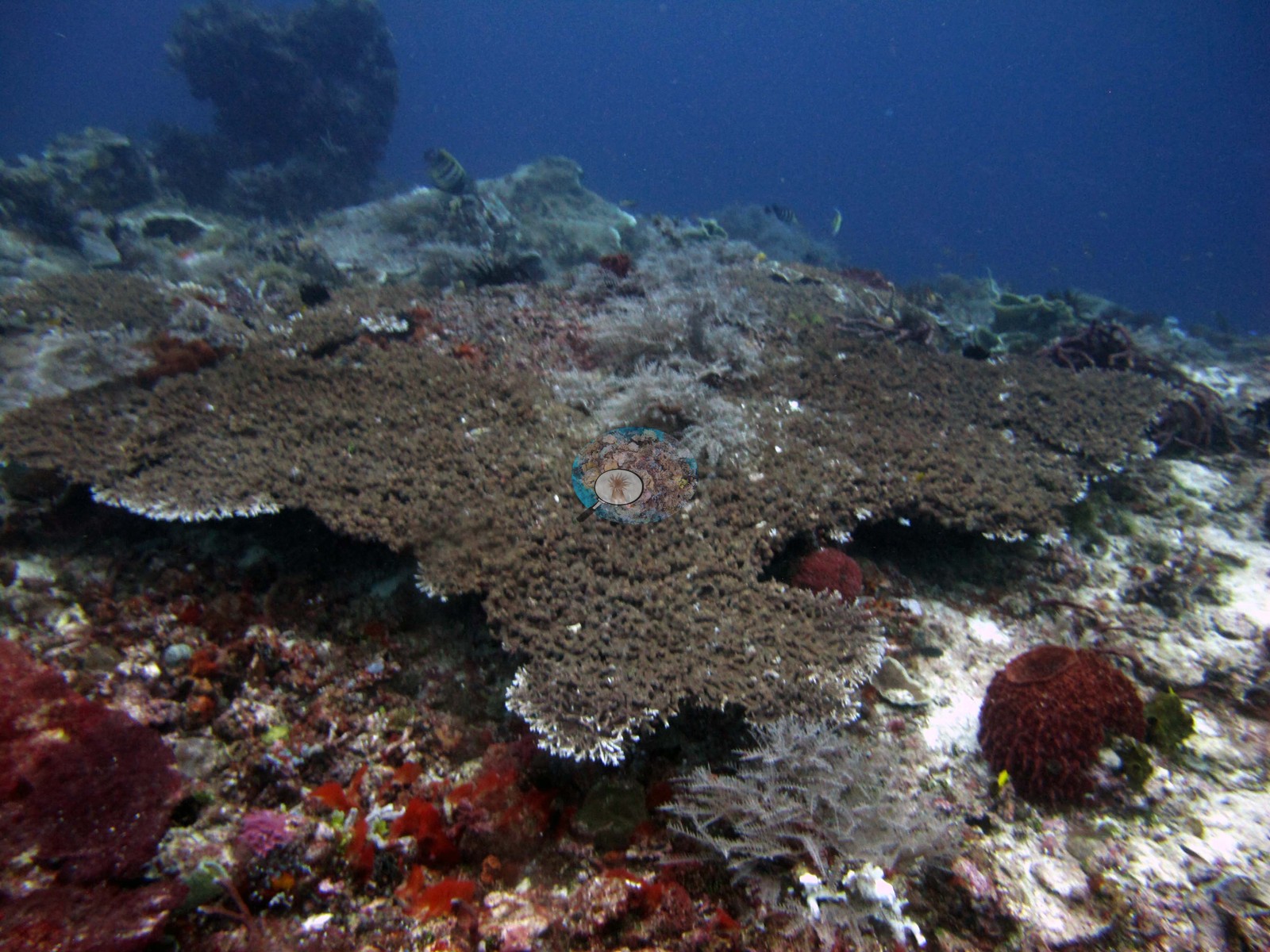
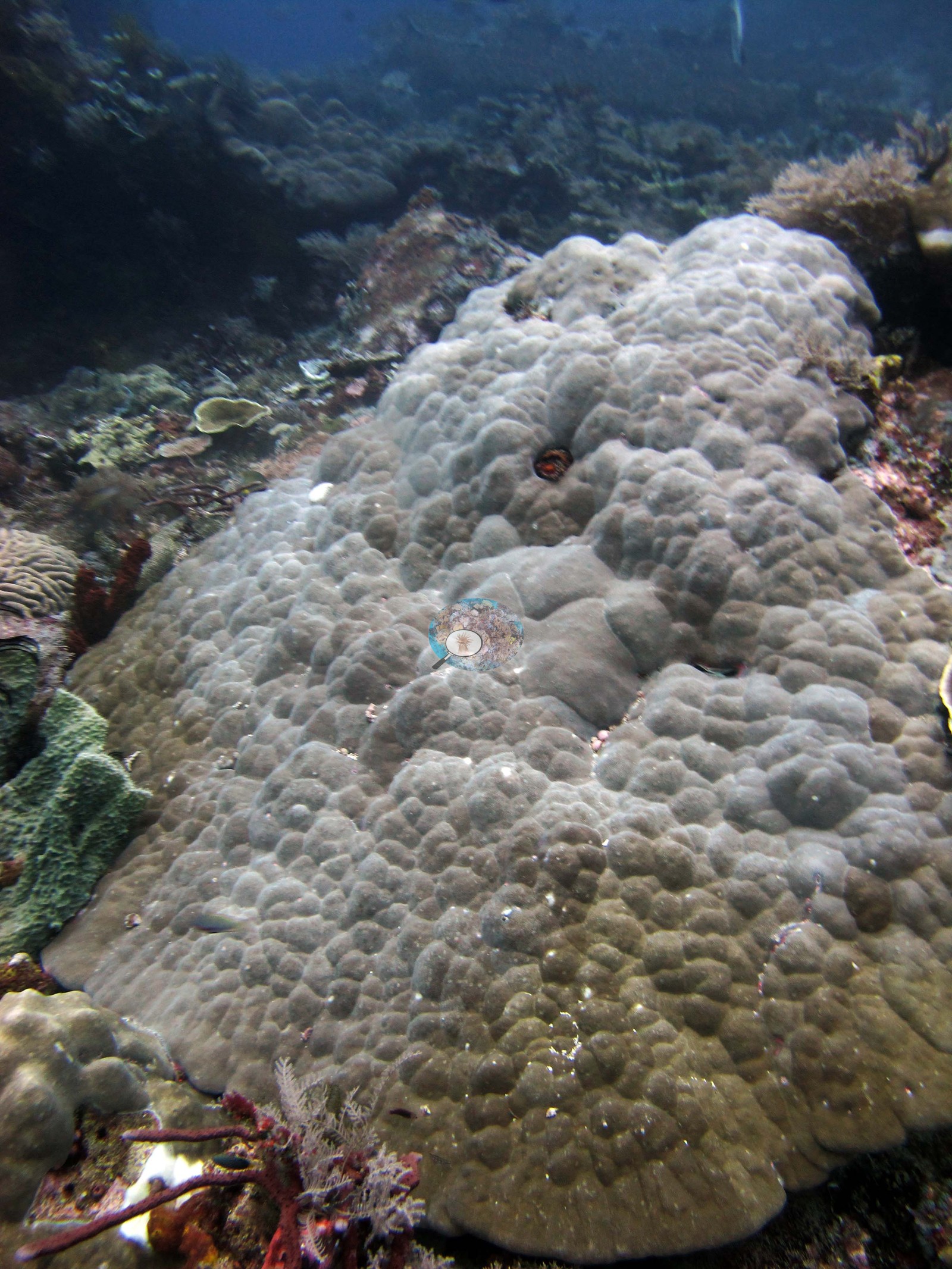
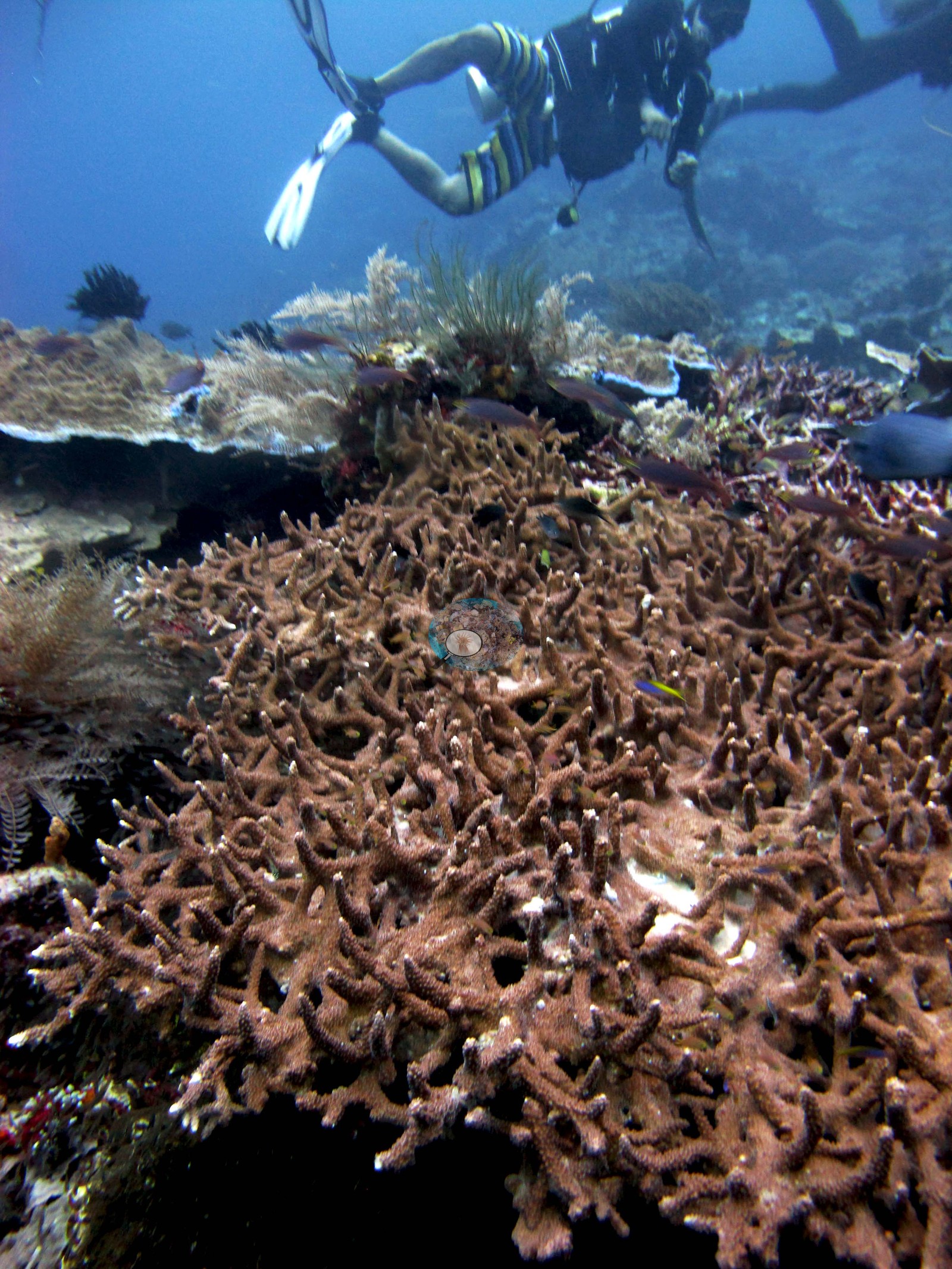
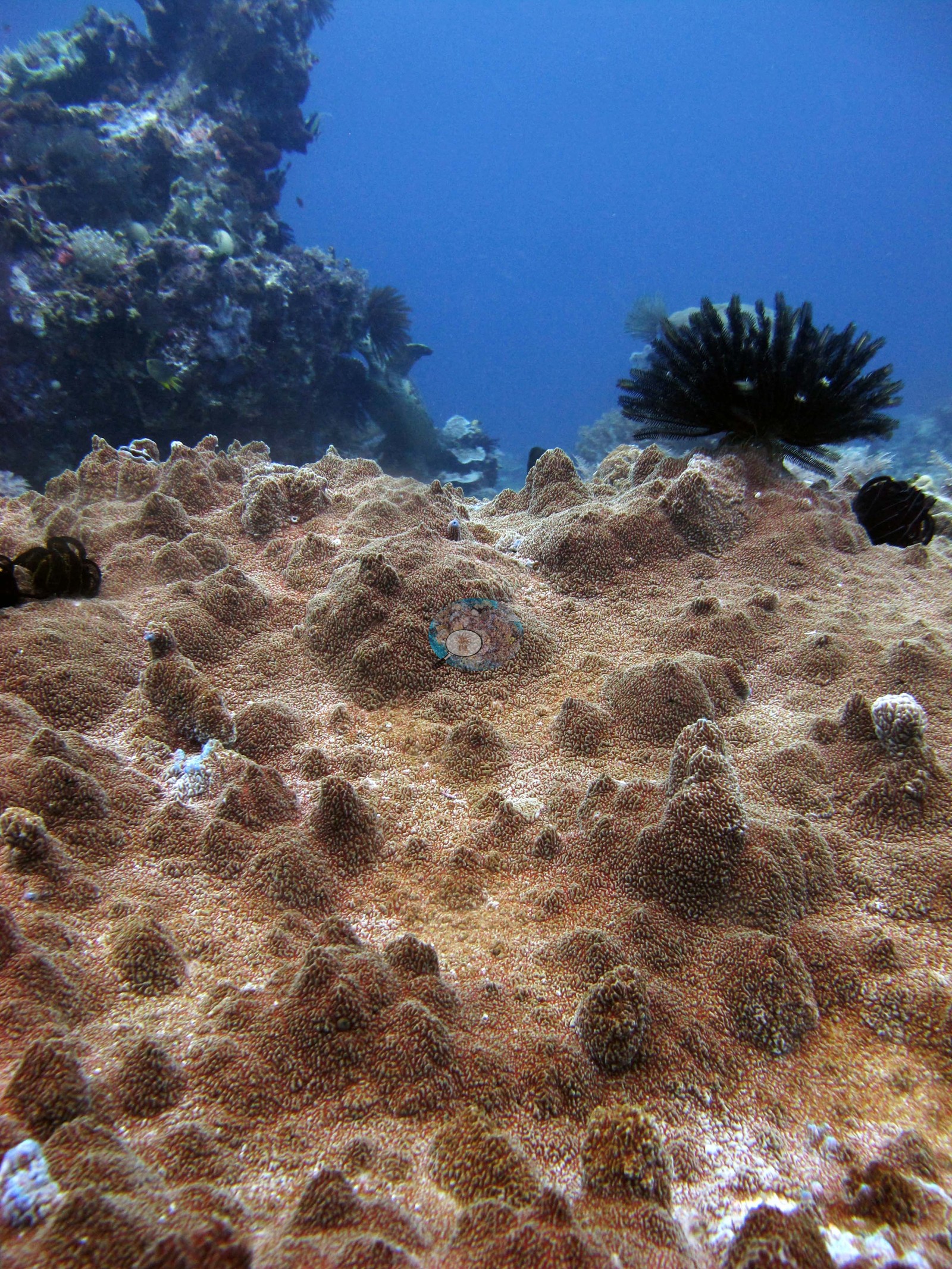
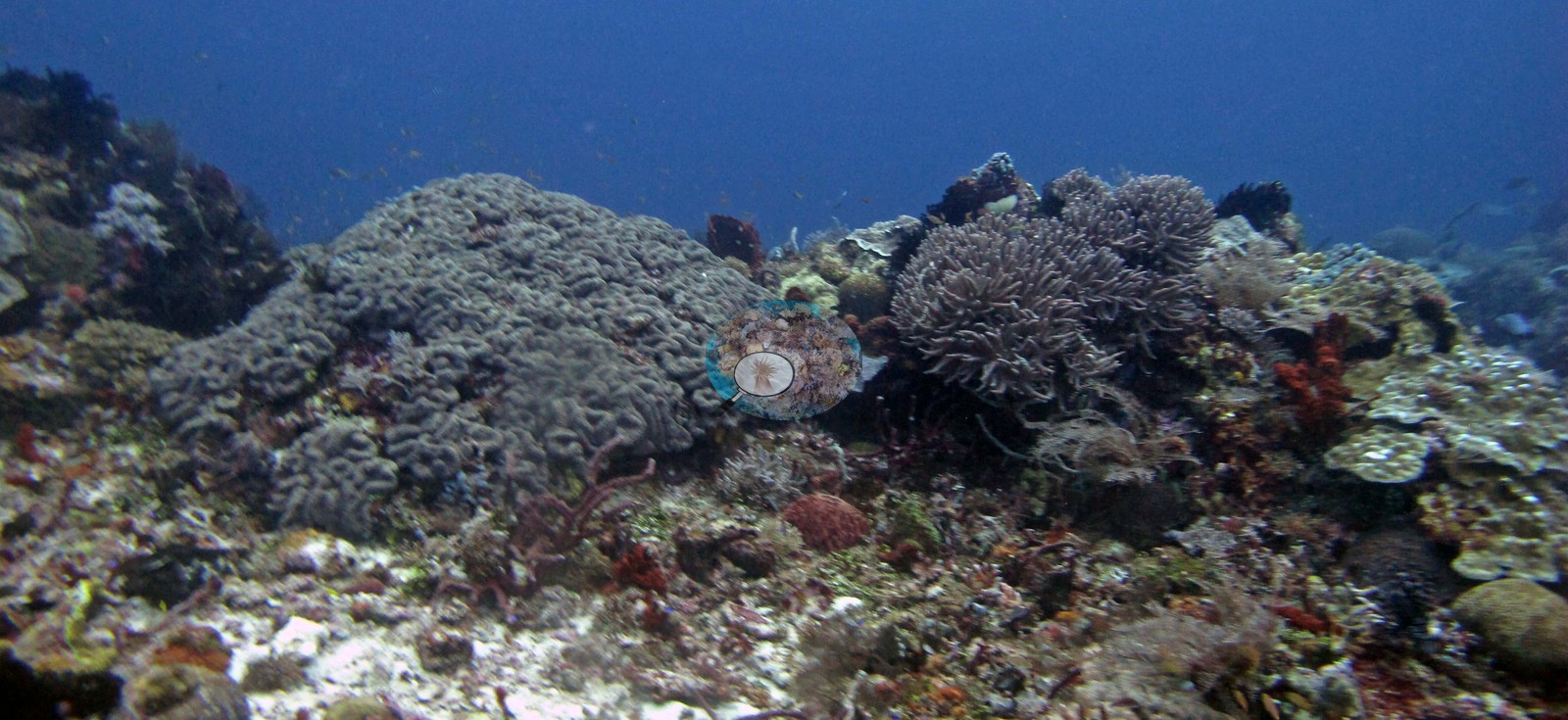
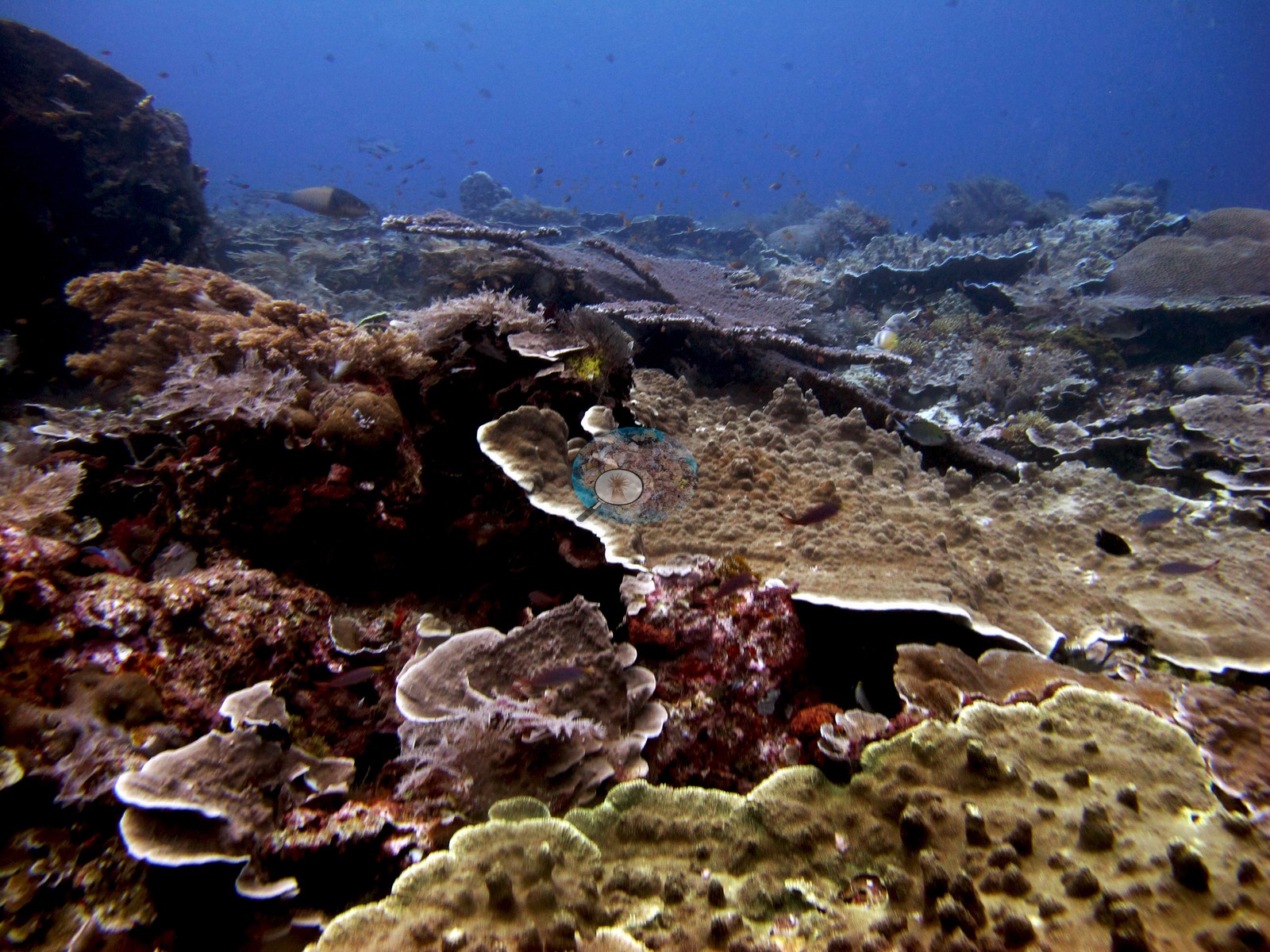
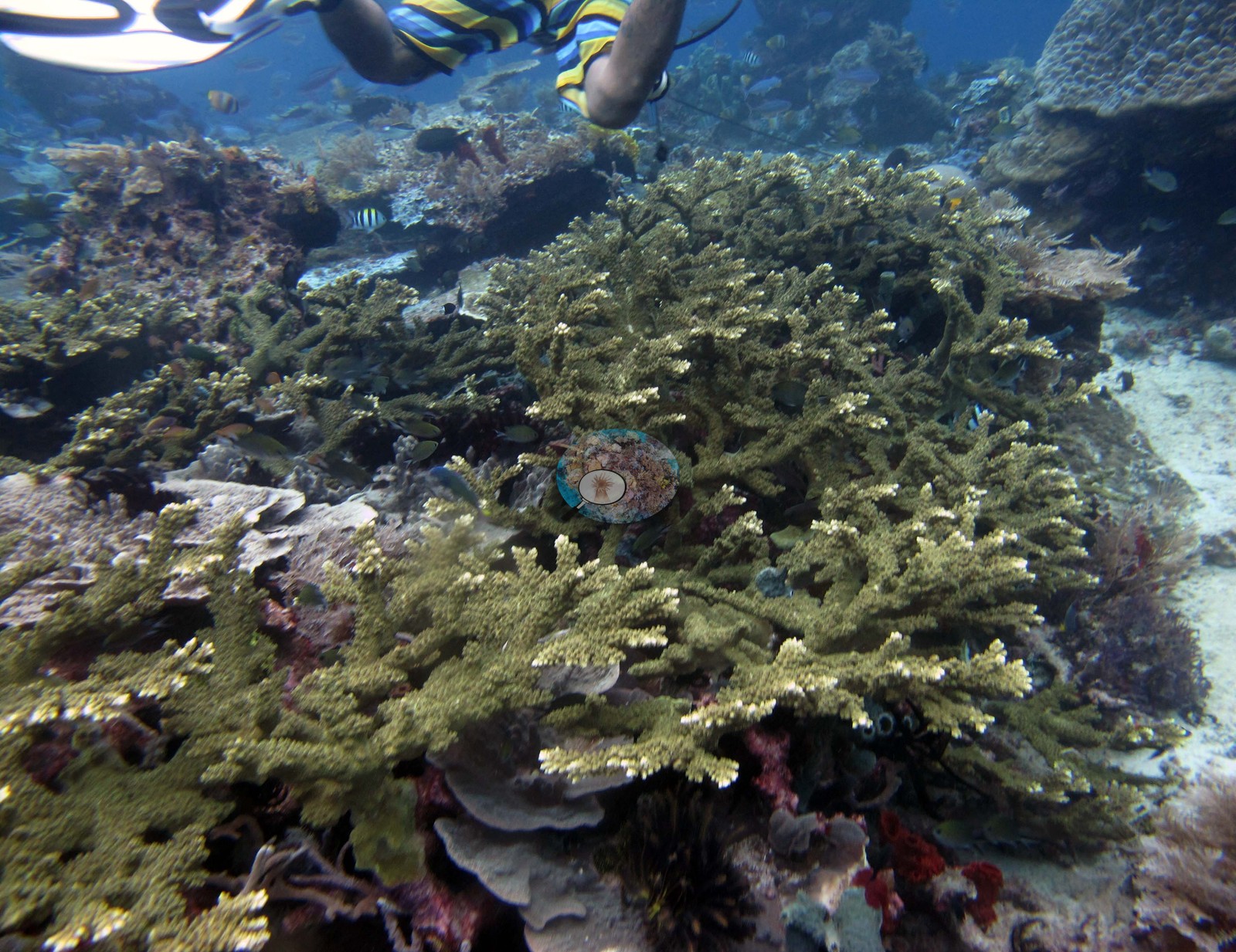
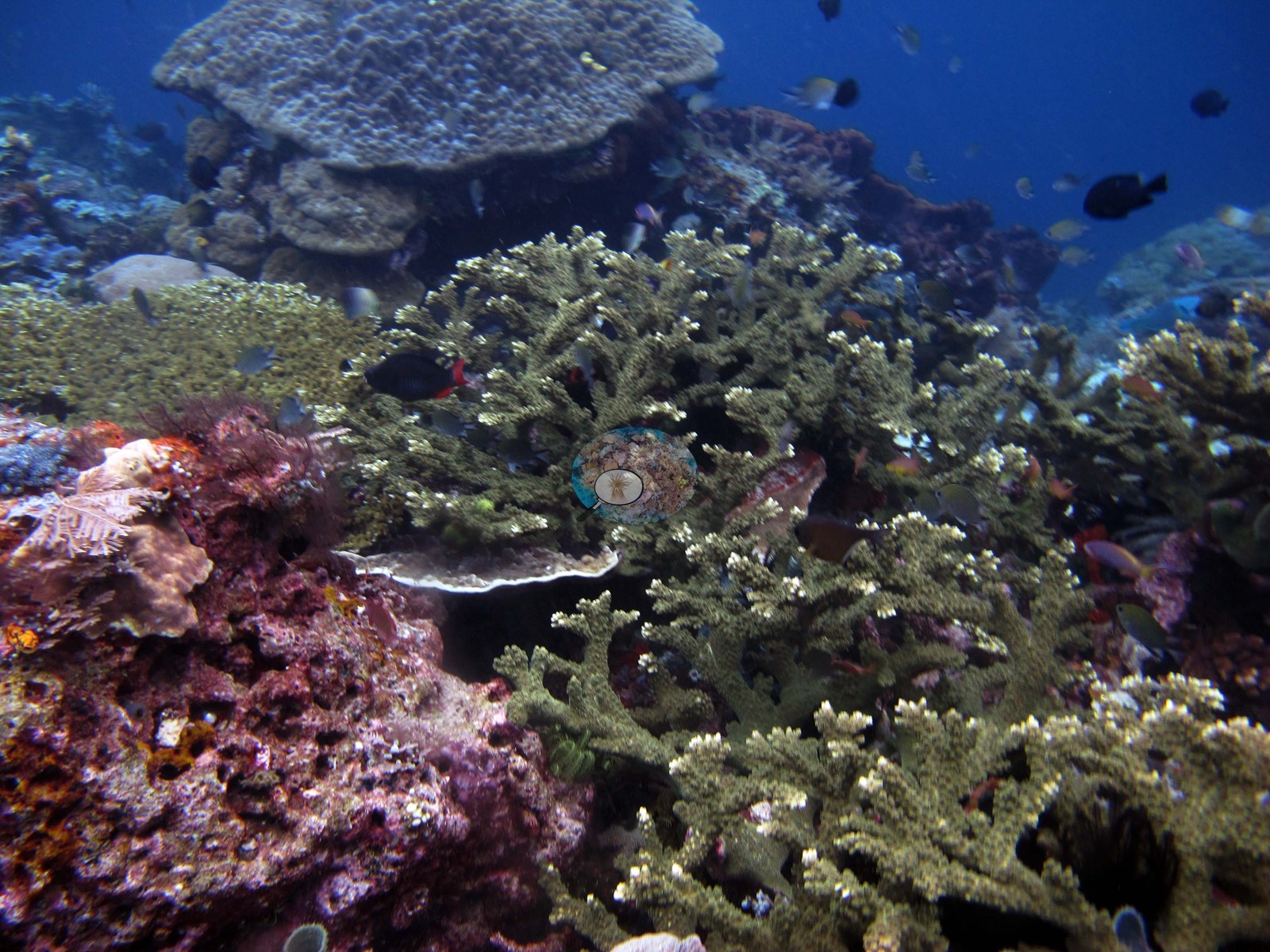
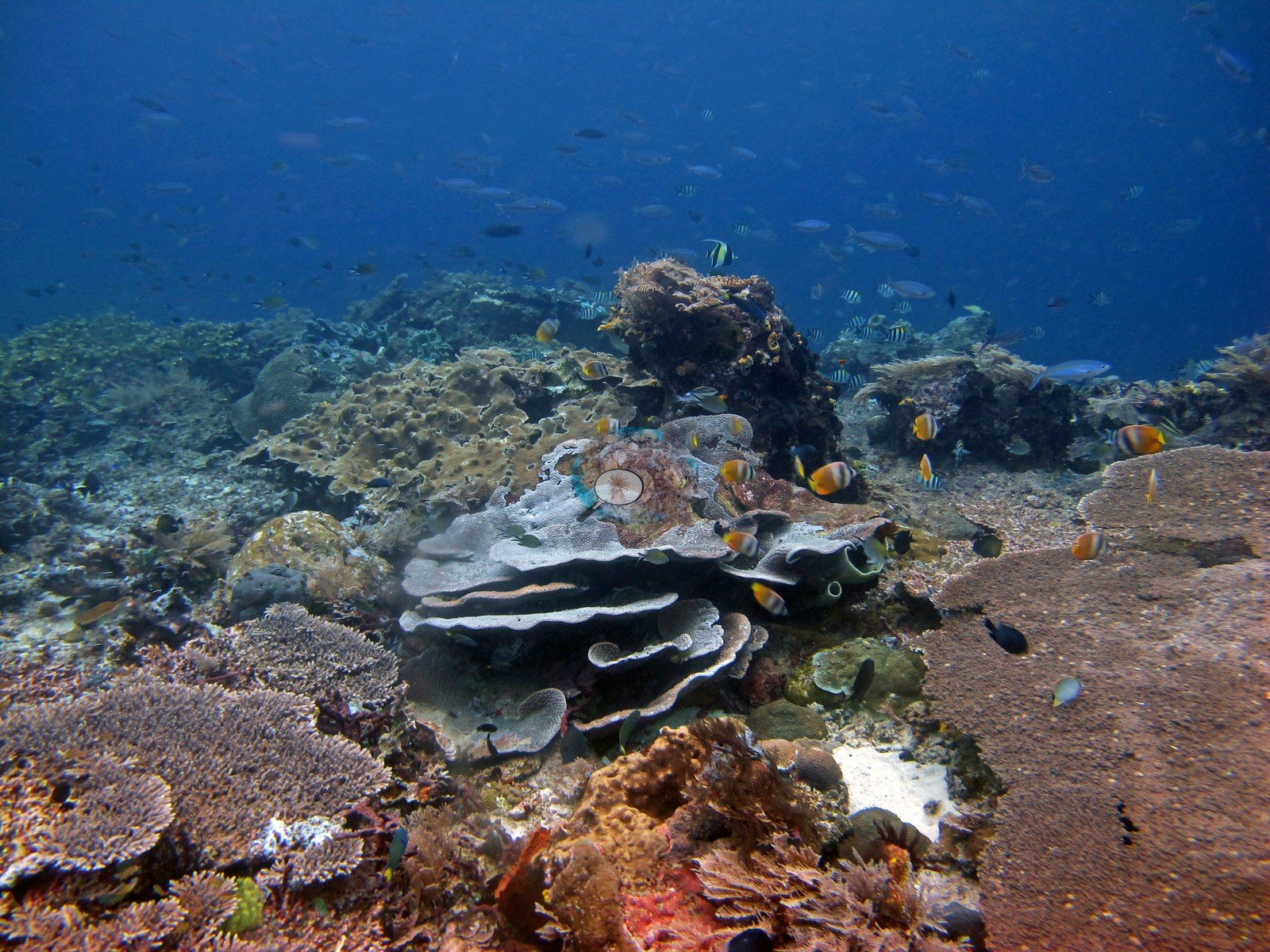
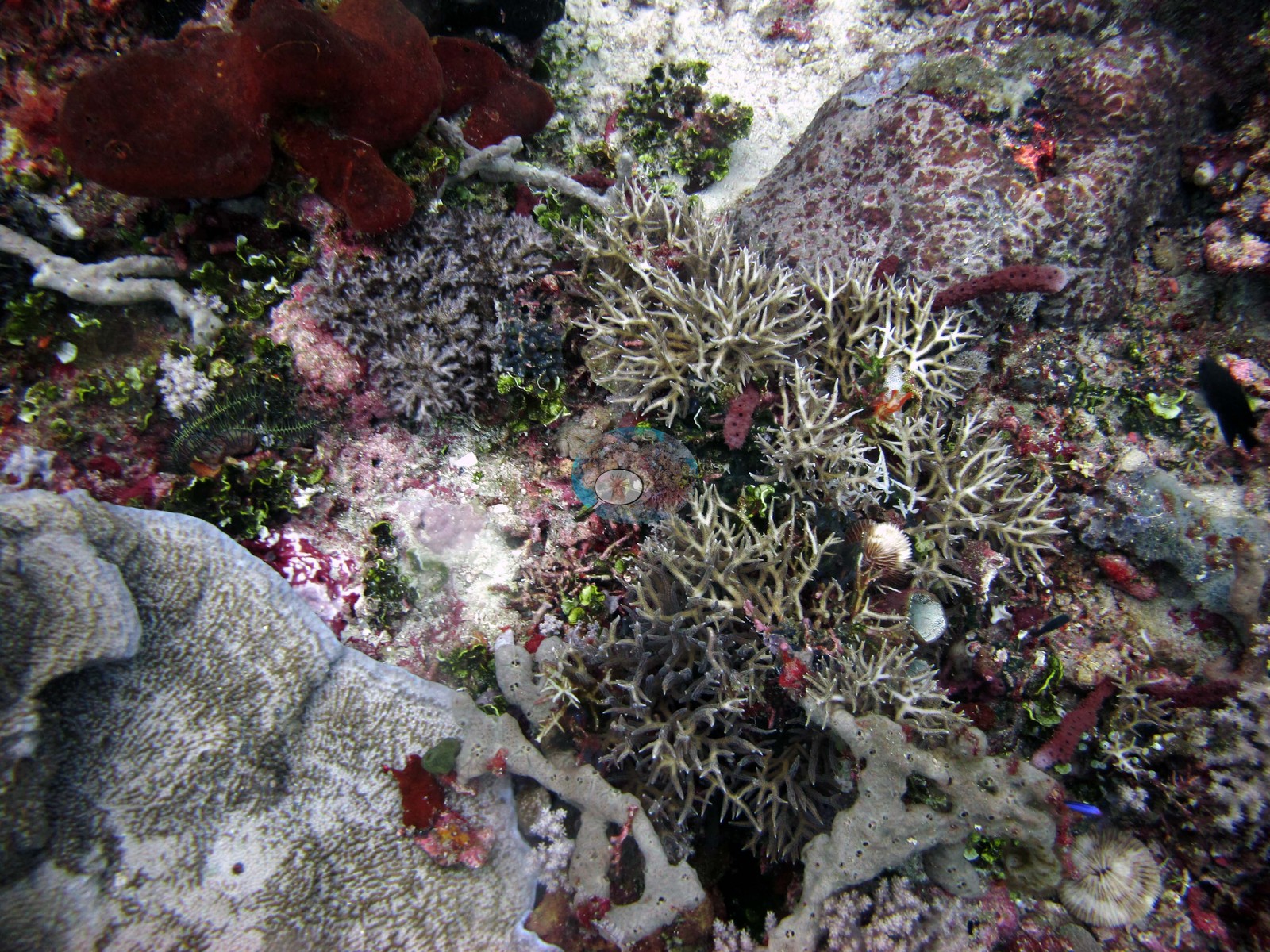
The deep opening. H1 (IMG_0868) is shot straight down onto a large gray-brown foliose/encrusting plate with a bright white active growing margin, sitting in a bed of pink crustose coralline and red encrusting sponge, white crinoid arms entering at the top and a small finely-ridged concentric disc colony at the upper right. H2 (IMG_0869) pulls back to a dim, hazy low-relief bottom - sand patches, turf clumps, small crinoids, damselfishes, and a banded sweetlips-type fish low in the frame - the least coral-dominated view in the set. H3 (IMG_0870) is the large spotted ray lying on open sand; his dive notes record this as the marble ray, his first of the trip, and the frame is exactly as he predicted, soft and low-contrast from the borrowed G11. H4 (IMG_0876) is a tight close-up of a pale brown fine-branched digitate colony wedged between a gray finger sponge and vivid red encrusting sponge with crinoids and magenta coralline around it. H5 (IMG_0879) has a diver in the upper frame over a low-relief bottom carrying several flat-lying pale brown laminar plates. H6 (IMG_0880) is the first genuinely dense frame: a reef top shingled with brown laminar plating colonies, all with white margins, damselfishes and anthias in the water above. H7 (IMG_0881) is the tightest deep close-up - a large plate covered in fine concentric ridges with a brilliant white margin, abutting a pale encrusting colony, in red sponge. H8 (IMG_0882) is a mixed slope of layered plates, encrusting brown colonies and green algal patches. H9 (IMG_0883) packs pale gray plates with white rims, green tube/urn sponges and a yellow-green branching Acropora into one frame against blue water. The mid-depth reef face. H10 (IMG_0884) is a vertical close-up of a yellow-green fine-branched colony under a gray disc plate, with green feather-like growth below. H11 (IMG_0886) is a reef face heavily coated in red and pink coralline and red sponge, with plating colonies scattered through it. H12 (IMG_0887) is the most conspicuous single colony of the deep half: a large pale green-white foliose sheet with irregular lobes and open perforations, growing across a mauve coralline base. H13 (IMG_0888) is a high-relief mixed patch - a massive dome, brown plates, a sinuous meandroid brain coral low center, crinoids and red sponge. H14 (IMG_0889) splits the frame between layered brown-mauve laminar plates on the left and a dense white-gray branching thicket on the right, with orange soft coral between. H15 (IMG_0890) is a heavily blue-teal cast vertical frame - a pale bushy branching colony center, teal crinoids above, red, and orange sponges below, and a coarsely textured dome at lower right - color is unreliable here, so it is described at growth-form level only. H16 (IMG_0892) is a broad pale table plate in the foreground with concentric ridging; H17 (IMG_0893) is a hazy distant view of a pale table plate on a low ridge and is good only for gross form. H20 (IMG_0897) is a wide reef top of rubble, turf and red coralline with a conspicuously bright white plate at lower right, and H21 (IMG_0898) shows the same reef top with a brown bushy gorgonian/soft coral at right. H22 (IMG_0900) is one of the strongest frames of the dive - large pale tan tabular plates stacked with white margins, fusiliers streaming over them. H23 (IMG_0901) is the densest coral frame in the set: a high-relief ridge of overlapping pale plates and encrusting colonies threaded with green tube sponges against deep blue. H24 (IMG_0905) is the same reef top with a large green-teal tube-sponge cluster and white crinoids; the abundant green sponge his notes single out as absent further south is a recurring element from H9 through H32. H27 (IMG_0910) is the most worked-over frame in the set, an overhead of rubble and turf with only scraps of red-brown foliose material. Growth-form variety through the middle of the dive. H28 (IMG_0911) is a dense biodiversity close-up - dark maroon plating colony, an orange-spotted encrusting colony, a whitish fine-branched colony and several sponges in one frame. H29 (IMG_0912) centers a large tan knobbly massive/encrusting mound with gray tube sponges rising beside it. H30 (IMG_0914) is a reef face dominated by red-orange encrusting sponge and coralline rather than coral. H31 (IMG_0915) is a single big yellow-green encrusting sheet colony filling the frame on mauve substrate, and H33 (IMG_0918) does the same with a large flat mauve-gray plate. H32 (IMG_0917) is a high-diversity high-relief frame - teal tube sponges, white-gray branching thickets, yellow-green encrusting colonies, and brown foliose plates together. H34 (IMG_0919) puts a pinkish corymbose Acropora table on a ledge beside a teal-gray massive colony. H35 (IMG_0920) is a wide mid-relief reef top of pale plates, branching colonies, crinoids, and urchins. H36 (IMG_0923) is shot up under a ledge: the smooth underside of a pale massive colony, a yellow-armed crinoid on it, red coralline below, and a long slender white whip crossing the frame. The shallows. H37 (IMG_0924) has a diver above a reef top of yellow-green plating colonies, red-brown branching soft corals and gray tube sponges. H38 (IMG_0931) is a single large flat-topped brown corymbose Acropora table standing clear over rubble. H39 (IMG_0932) is a large pale cream knobbly massive dome filling the frame. H40 (IMG_0936) is a big pinkish-brown thick-branched colony occupying the lower half with a diver above it. H41 (IMG_0938) is an overhead of a broad tan colony studded with conical columnar protrusions - a distinctive form, and his notes attribute the large shallow areas near 10 m to P. rus and P. rus-like Montipora, which is his call, not one read off this frame. H42 (IMG_0939) is a dim distant view of gray plating and massive mounds, form only. H43 (IMG_0942) is a reef top of pale laminar plates and a tan encrusting sheet in hazy blue. H44 (IMG_0948) is rich and close - a brown corymbose Acropora field, a pale corymbose colony, red and pink soft corals, a massive dome, and sea whips with a diver at the top edge. H45 (IMG_0951) is a bushy yellow-green branching Acropora colony with a diver above. H53 is his file pocilloporids.jpg - a cluster of fine-branched pale colonies with dark red sponge above and a smooth massive colony at lower left; the identification is his label, not a read of the imagery. H47 (IMG_0953) is a yellow-green bushy branching Acropora clump on a maroon coralline base. H48 (IMG_0954) is a sand-and-rubble slope with a stack of gray-white foliose whorls and a mauve corymbose plate, orange anemonefish-type fish present. H49, H50 and H51 (IMG_0955-0957) are the signature frames of the shallow reef here: a near-continuous pavement of overlapping gray-mauve laminar and foliose plates with white margins running to the limit of the frame, one maroon-brown plate colony standing out in the middle of it in H50 and H51, and two yellow-banded anemonefish in H49. H52 (IMG_0959) closes the set on a dim wide view of a plate and foliose mound with green algae. What the frames support, and what they don't. Across 54 frames the site reads as a high-relief seamount with plating and foliose growth forms dominant at both ends of the depth range, massive domes and meandroid brain corals scattered through, branching and corymbose Acropora concentrated in the shallows, and sponges - especially the green tube sponges - a persistent structural element. His own notes give the taxonomy and the depth structure, and they stand as the authority: Seriatopora hystrix and Pocillopora acuta throughout, Pachyseris common, highly pigmented plates at depth, high cover and diversity at 15 m and again at 8-9 m.
Coral cover
Coral cover: 33% — a blind Claude computer-vision point count of 54 of Anderson's edited photographs (20 points per photo; water, fish, and obstructions excluded). Other computer-vision methods are listed in the method table. The blind Claude pass scored no coral point as bleached or pale.
Stressors
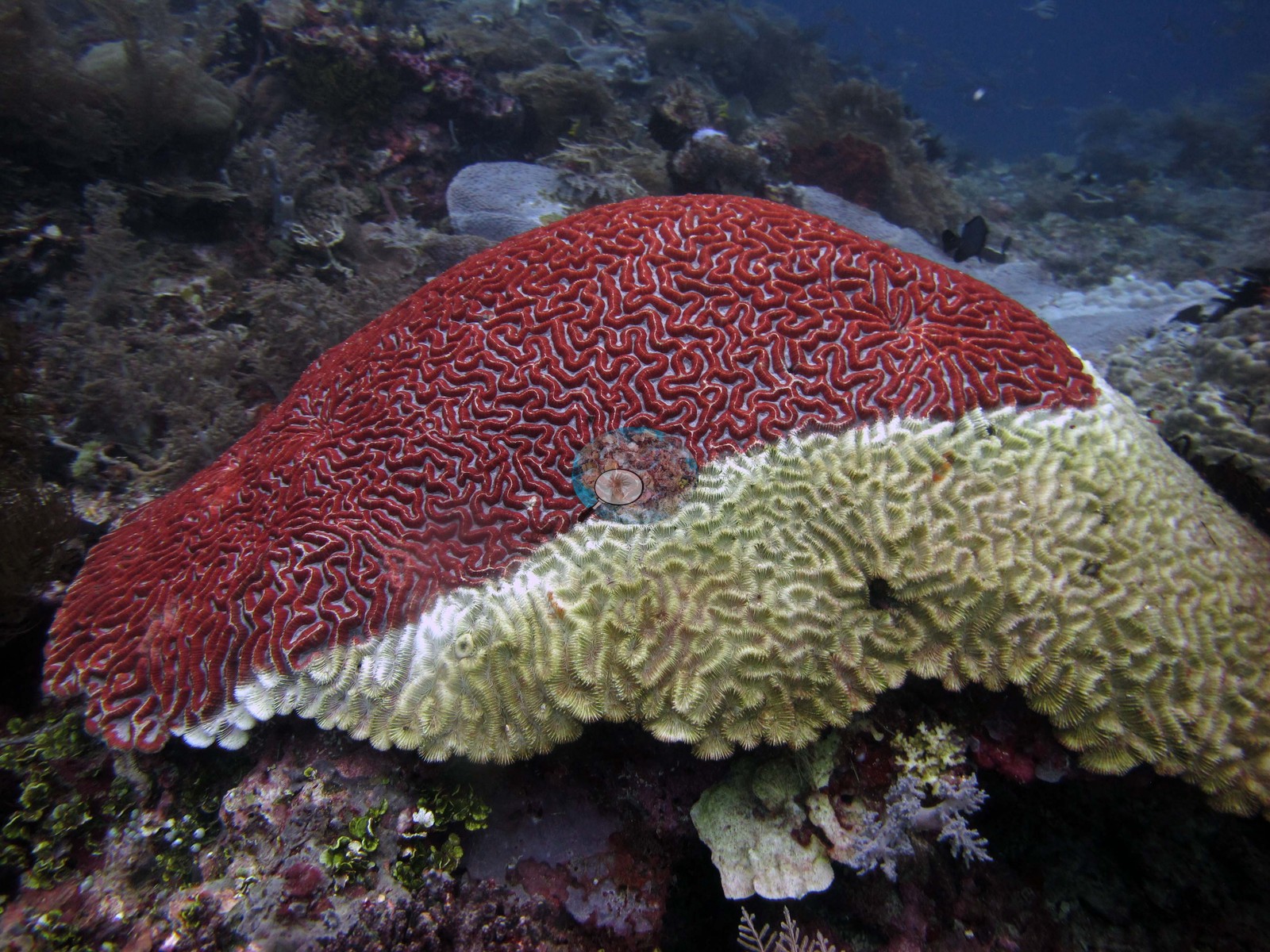
H25 (IMG_0906) is an extensive shingle of thin pale plates layered one over another with a massive dome behind. H26 (IMG_0908) is the single most striking colony of the dive: a hemispherical meandroid brain-coral dome, the upper half deep maroon-red and the lower half pale cream, with an abrupt boundary between the two - described here as a pigmentation contrast only, with no bleaching figure derived or implied. Visible compromise in the imagery is limited and local - the turf-and-rubble frame at H27, the bright white plate at H20, the pigmentation split on the H26 brain dome - and nothing in the set shows anything like widespread bleaching. His note that some Seriatopora hystrix were sickly at 15 m and above is his in-water observation; the frames here do not independently document it. The early-morning low light also means the deep half of the set under-represents color and fine detail relative to the shallow half, so the set is not evenly informative with depth. No crown-of-thorns starfish (COTS) or other corallivores evident.
Fish and other fauna
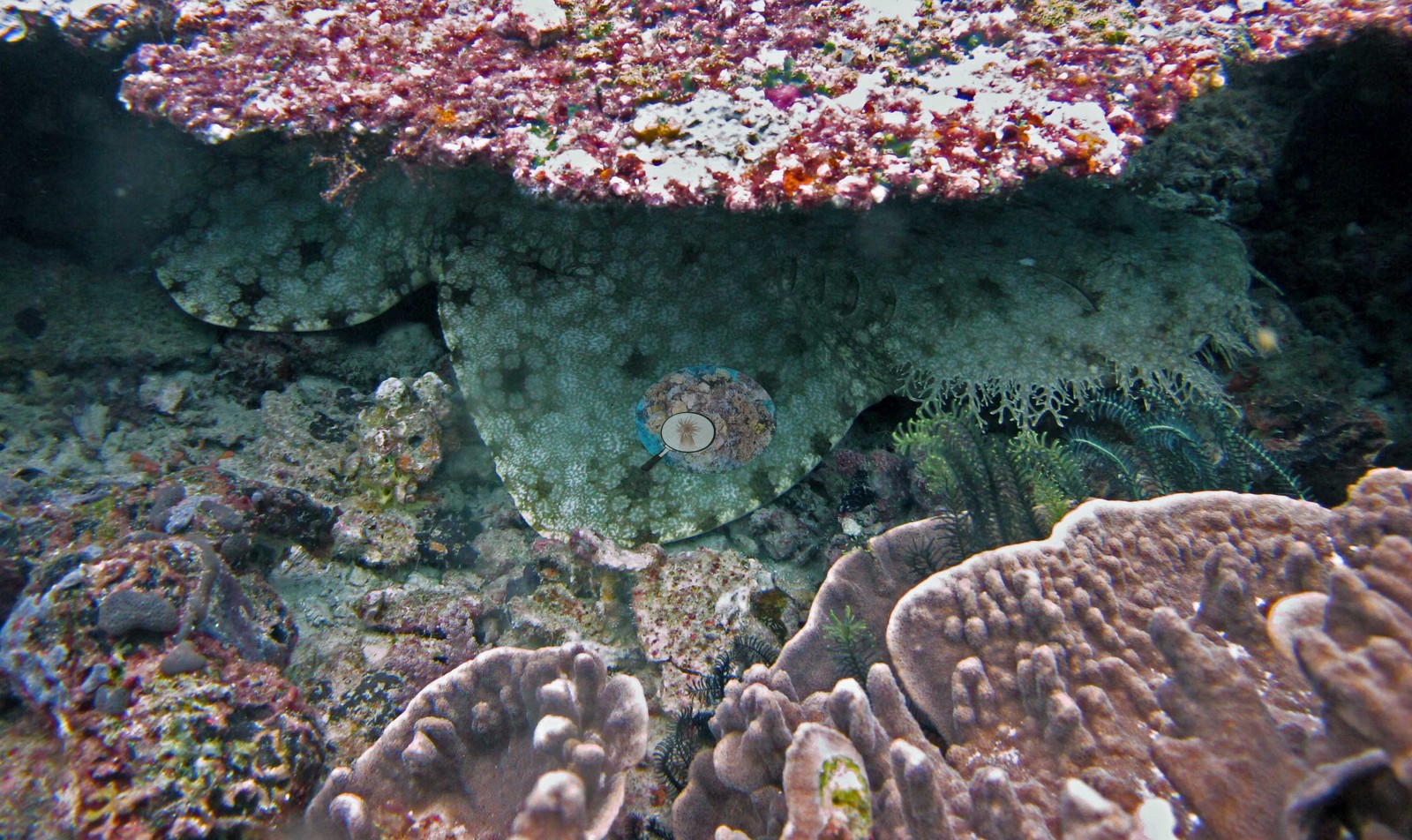
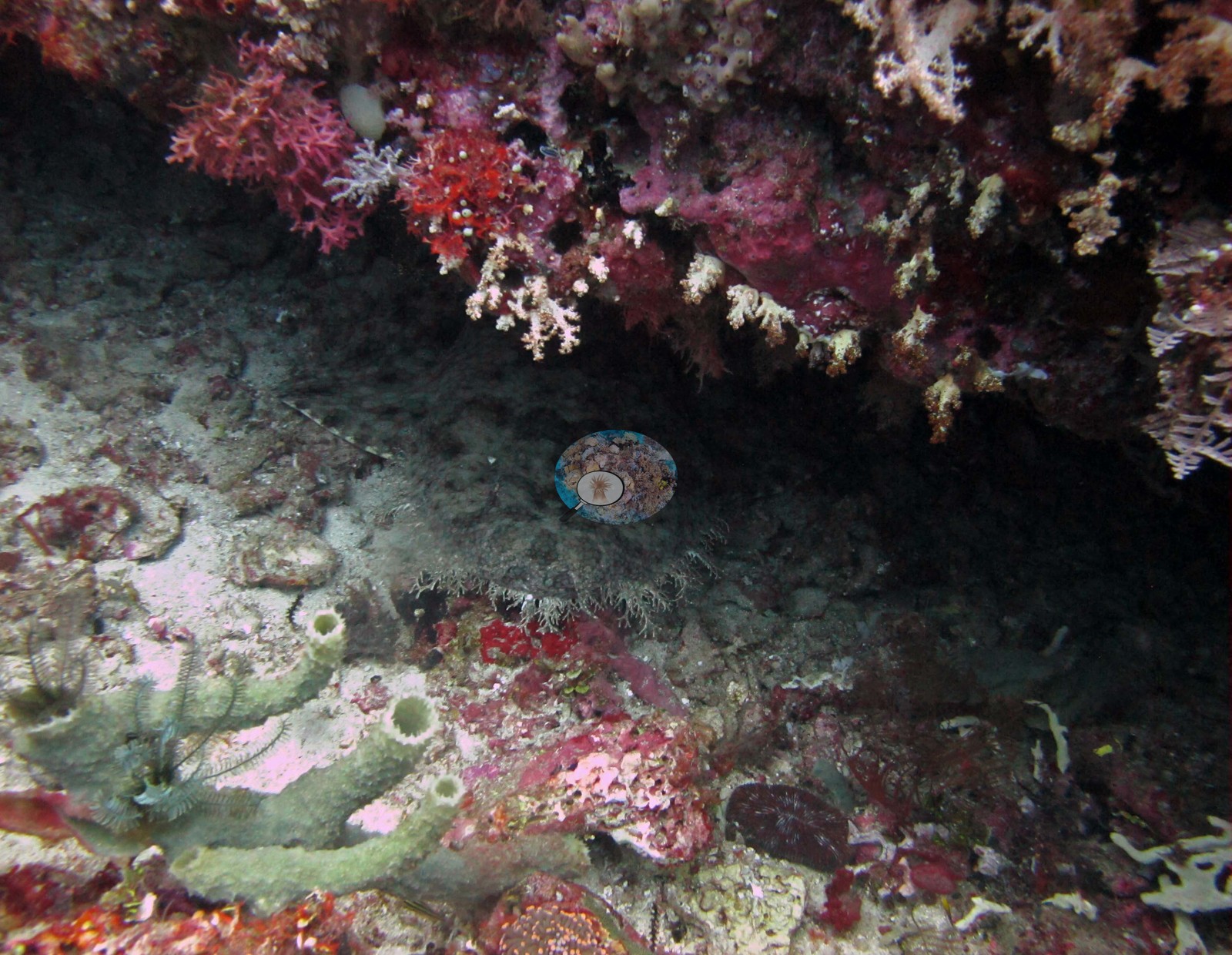
H18 (IMG_0895) is a fish frame: a large school of small fish over a golden-lit massive dome, consistent with his "fish biomass at 25-30 m=high-very high" note, though the photographs are not a fish survey. H19 (IMG_0896) is backlit and hazy, fish school over dark foliose colonies. The closing run, and the wobbegong. H46 (IMG_0952) looks under a plate ledge encrusted with pink coralline, and a large flattened mottled bottom-resting shark is lying in the shadow beneath it - consistent with the three wobbegongs his notes record for this dive, a personal record. H54 is his own file wobbegong.jpg, another under-ledge frame with pink-red soft corals along the overhang and pale nodular colonies below; at contact-sheet scale the animal itself is not resolvable, but the filename is his field annotation and stands.
Comparisons with other data
No independent survey was made at this exact site; the nearest ones are listed in the table below.
Dive record
Dive 23, "My Reef", 21 October 2018 - a seamount in the Fam Archipelago, entered at 07:02 to a maximum of 33.5 m at 27 degrees C. 54 habitat frames, six contact sheets, no topside frames.
CV model comparison
More info
DINOv3 and CoralSCOP were run on the same photos and are listed for comparison. Coralscapes v2 and v1 were also run but are not shown: Anderson does not consider Coralscapes reliable for these photos. No diver transect exists for this trip, so agreement between the rows is not accuracy, and as of September 2026 no computer-vision method estimates coral cover accurately on new images; treat every row as indicative.| Method | Hard-coral cover (%) |
|---|---|
| In-house DINOv3 | 31.8 |
| CoralSCOP edited | 39.2 |
| Claude (edited photos) | 33.2 |
Independent surveys nearby
| Agency / program | Year(s) | Stations / distance | Link |
|---|---|---|---|
| Conservation International (CI) | 2025 | 4 stations, 1.68–4.69 km | Records ↓ |
| Social Ecological Research Frontiers (SERF) / University of Rhode Island (URI) / Thriving Oceans | 2018 | 1 station, 1.67 km | Records ↓ |
Within 5 km, 5 independent survey stations recorded hard coral cover in 14 surveys between 2018 and 2025. Surveys since 2021 average 41% (range 38–45%, n=5); 1 best-patch value above 70% is left out, as they are not site means. This site's own estimate (33%) is indistinguishable from the recent range (38–45%): the 4.4-point gap is inside the ±7 percentage-point noise between methods; the methods differ, so the comparison is context, not a like-for-like test.
Collected by other programs using different methods, so these are context for the figures above, not a like-for-like comparison. Where a station was surveyed more than once the range is shown. Station names are not dive-site names. Values marked best patch exceed 70%: surveyors usually chose the richest area, so they are not site means.
Data & links
All images from Coral Reef Diagnostics. Data are from Coral Reef Diagnostics and the organizations named in the data-sources table above.
© Coral Reef Diagnostics.