
Kenya - Pilot Nursery (Pate [Lamu]) snorkel
Part of the regional summary: Kenya
More info
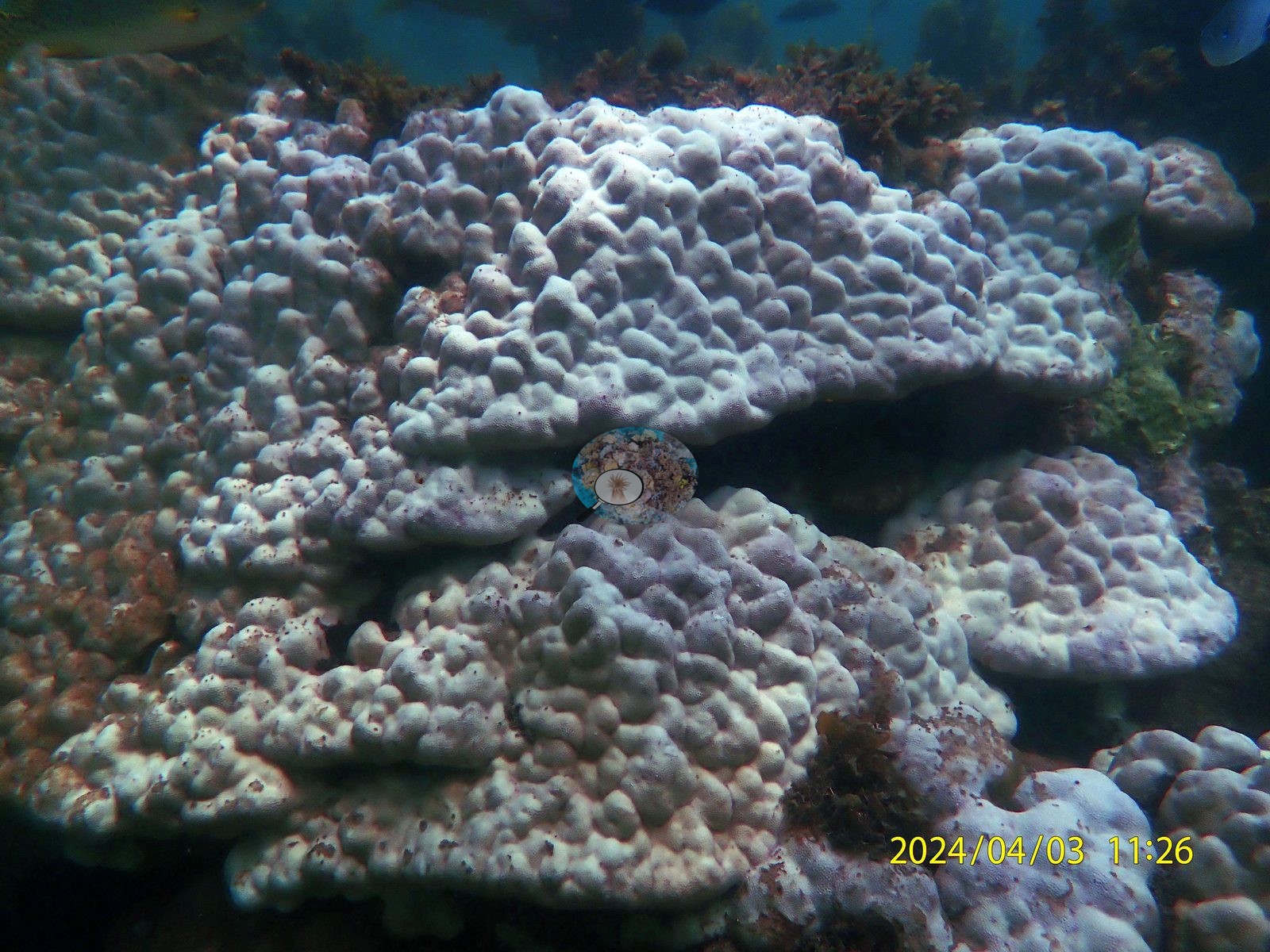
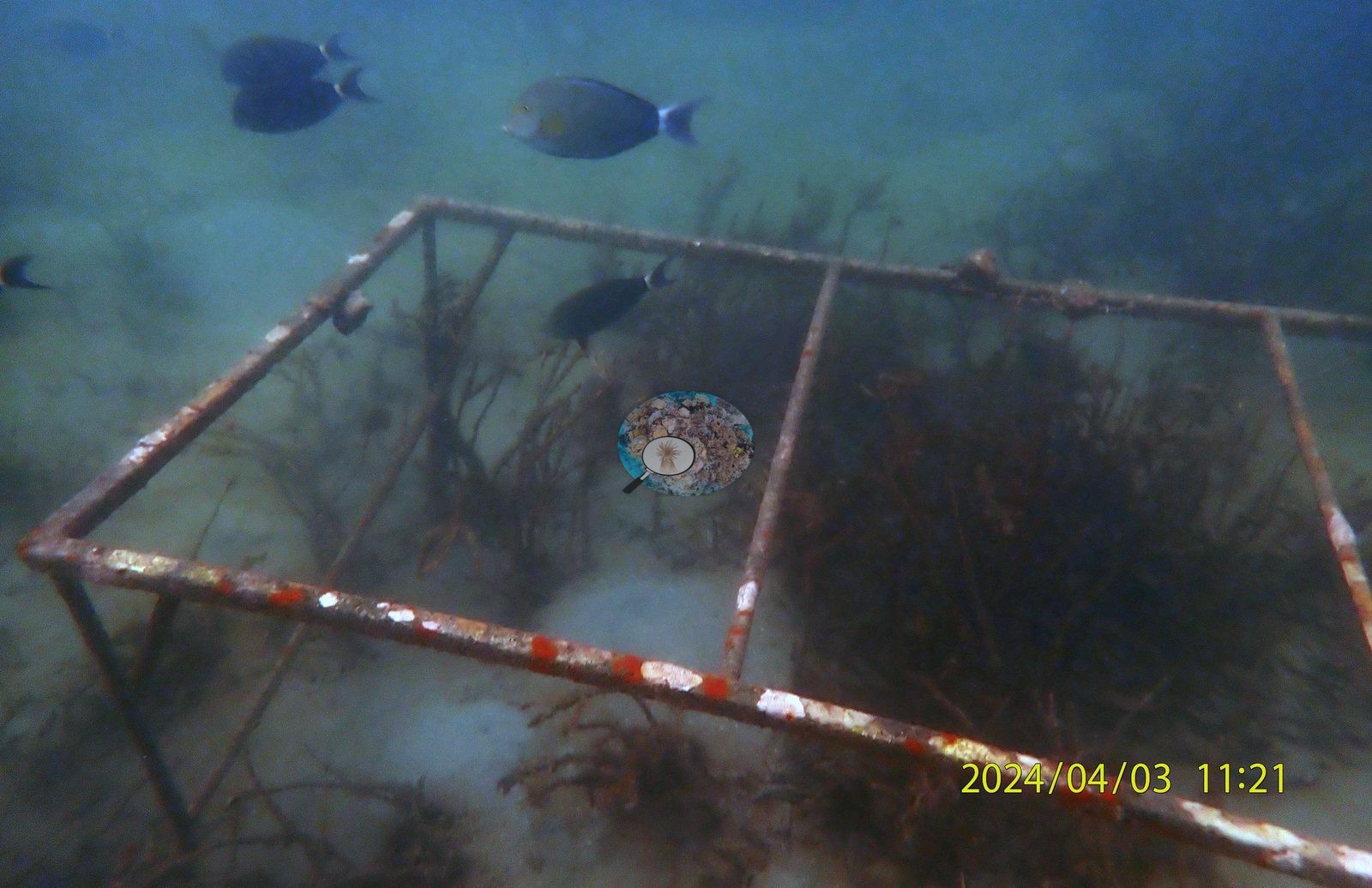
Kenya (NOAA CRW virtual station)Pilot Nursery, off Pate Island, pairs empty rusting rebar restoration tables with stocked concrete beams carrying small outplanted Acropora and Pocillopora fragments - a genuine mix of pigmented and bleached nubbins rather than a uniform outcome. The natural reef here is continuous nodular Porites pavement rather than scattered heads, and it was found extensively bleached and heavily overrun by fleshy macroalgae, which grows up through the empty nursery tables. Published cover was 14% with 93.6% of coral tissue bleached, among the highest bleaching figures in the Kenya survey; large schools of blackspotted sweetlips and a lionfish were recorded.
Eneo la majaribio la urejeshaji nje ya Kisiwa cha Pate katika maji ya kijani yenye tope chini ya tandiko lililosimama la mwani mnene. Meza za chuma zilizounganishwa kweli ni tupu, lakini nguzo za saruji zinabeba zaidi ya vipandikizi ishirini vilivyogandishwa, na vipande hivyo viko katika hali bora kuliko Porites ya asili iliyo jirani iliyopauka karibu kwa usawa.
Tafsiri ya muhtasari huu kwa AI; Kiingereza ndicho kinachotumika rasmi. Translated from the site’s shorter map summary.
One other CRD dive site within 5 km shown in orange — click a marker to open its page.
Site description
Setting
The full 33-frame set confirms the setting the four published frames suggested -- turbid green water, low-relief hardground, sand flats, and a standing canopy of red-brown fleshy macroalgae -- but it substantially revises what is on the nursery structures and how much life is here.
General benthic features
Two kinds of restoration hardware are in the set, and they are in very different condition. The welded steel rebar tables are genuinely empty: five photographs all show open frames of rusting bar standing over bare sand with macroalgae growing up through them and no coral on them at all (e.g., Image 4).
The cast beams and blocks, though, are stocked. Five frames show twenty-plus outplanted nubbins cemented along the beams -- small corymbose Acropora and nodular Pocillopora-type fragments, most of them a few centimeters across -- together with pink crustose coralline patches, an orange encrusting sponge, and a heavy turf film on the concrete. The natural benthos is dominated by massive Porites, and at a scale the earlier note understates: this is not scattered heads but continuous nodular Porites pavement (e.g., Image 1).
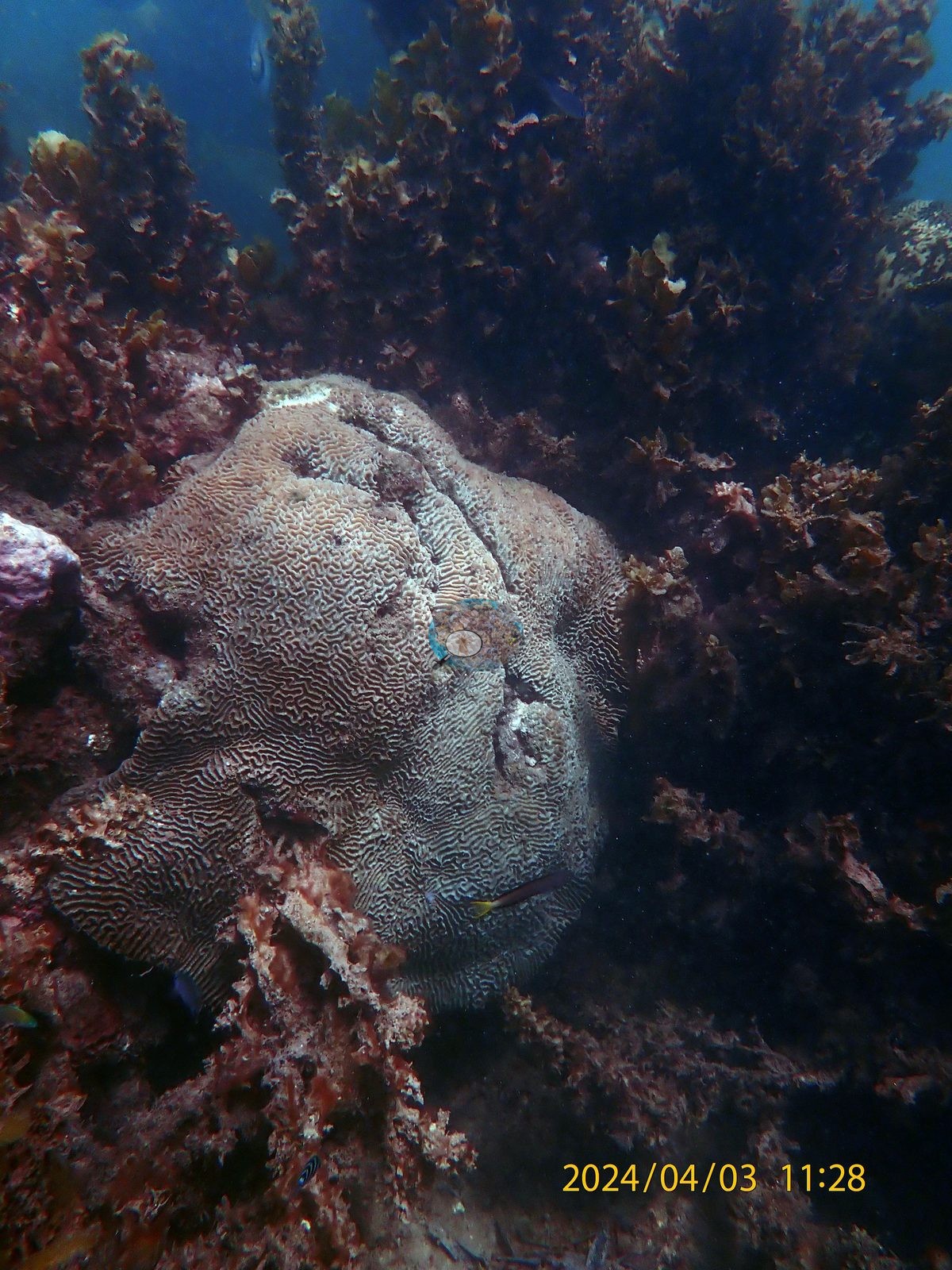
Two wide frames show a single knobby Porites carpet running out of frame in both directions, pale cream-green washed with lilac-mauve, with a handful of dark patches where tissue has already gone and algae has taken the skeleton. Beyond Porites, the set names more of the community than the earlier record did. Cerioid faviids are present too -- two frames show a cream, polygonal-corallite massive colony with red-brown weed already climbing over its flanks. One frame is the counterpoint: a thumb-up beside a small cream-tan branching colony holding on in the algal canopy. Orange and yellow branching sponges stand on the algal-covered rock in one frame and are the brightest color in the set -- they are sponges, not coral. Macroalgae is the other headline. One frame sums up the site: bare white skeleton and rubble between bushy stands of fleshy weed, with almost nothing intact in between (e.g., Image 2).
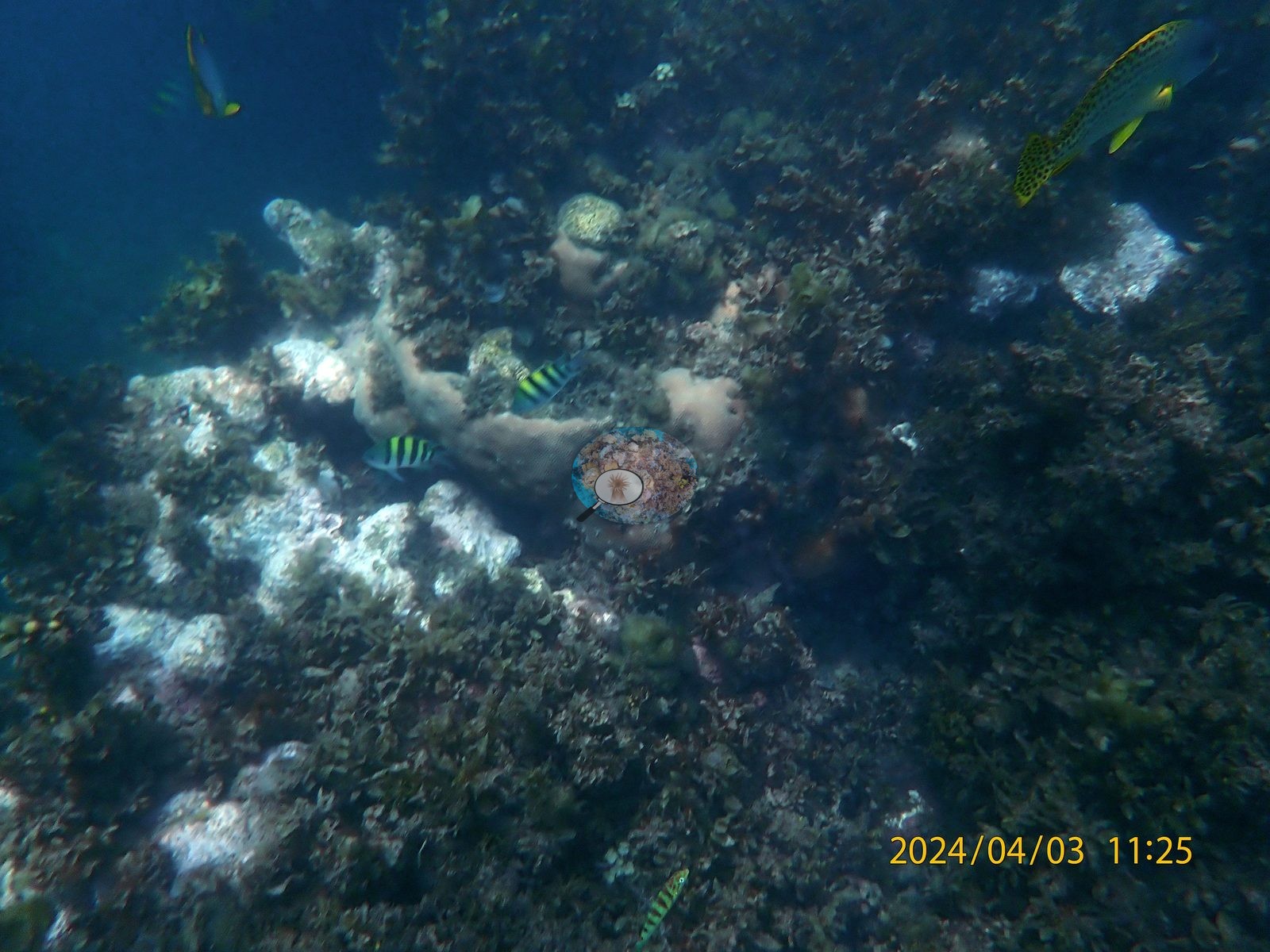
The same canopy stands well clear of the hardground in five frames, and it grows up through the empty steel tables, which is exactly the space outplants would need (e.g., Image 3).
Coral cover
This is nursery stock and must not be read as natural cover. Coral cover 14% -- and 93.6% of hard coral tissue bleached (March-April 2024). Measured from 21 white-balanced photographs taken at this site during the 2024 Western Indian Ocean mass bleaching event and point-annotated in CoralNet, published in Mayfield, A.B. (2025) A Citizen Science Approach for Documenting Mass Coral Bleaching in the Western Indian Ocean. Environments 12(8):276. doi:10.3390/environments12080276. Across the 20 Kenyan sites the mean was 30% coral cover and 77.1% of tissue bleached.
Stressors
The condition of those fragments relative to the natural reef is the interesting part. The outplants are a mixed bag rather than a wipeout. One frame carries a fully brown-pigmented nodular colony on the upper beam alongside a bone-white branching fragment on the same face and a tan-gold branching nubbin on the lower beam. Another has two tan-gold Acropora-type fragments with polyps visibly extended sitting a hand's width from two chalk-white bleached nubbins. A third runs cream-tan nubbins up the beam leg with one stark white colony at the foot. So a real fraction of the outplanted stock still held pigment on 3 April. The natural massive corals around them did not. One frame shows the same growth form at close range, colony after colony bleached to a uniform pale mauve-white with the nodules structurally intact and no algal overgrowth -- bleached, not dead. One frame is a bleached Porites ledge, chalk-white with a pink cast, overhanging a shaded gap. The lilac-pink tone recurs often enough across separate frames to read as pigmented bleaching rather than an artifact, but the frames are color-adjusted, so the exact hue should not be over-interpreted; the whiteness and the intact skeletal structure are what carry the call. Meandroid Platygyra brains are frequent and are the site's mortality signal: one frame is a large pale mauve-gray brain hemmed in by macroalgae, another shows Anderson's hand thumb-down over a pale Platygyra carrying a small tan corymbose Acropora on its crown, and a third is a meter-scale brain that Anderson recorded as dead. A solitary fungiid lies loose on the substrate in one frame, pale cream and, by Anderson's call, dead. There are no crown-of-thorns and no disease lesions anywhere in the 33 frames reviewed. Seawater here measured 32.0°C during the survey (the Kenya survey-wide mean of 32.0°C matched the 1998 event), and NOAA recorded a peak of 13.5 degree-heating weeks on 18 April 2024, the highest for Kenya since records began in 1985. In situ temperatures ran 1.3 degrees C above NOAA's estimates, so the true heat stress was likely nearer 22 DHWs.
Fish and other fauna
The fish are far busier than the earlier record allowed. Blackspotted sweetlips (Plectorhinchus gaterinus) are here in large aggregations, not as a single individual: three frames are dense schools of them over sand, dozens are stacked under the bleached Porites ledge, and singles and small groups appear in four more frames. Surgeonfish and parrotfish cruise the open sand and the empty frames in three photographs; sergeant majors (Abudefduf) work the beams in two; a butterflyfish appears in two; small wrasses are on the rock throughout. A lionfish (Pterois) sits against the nursery structure in two frames -- the only predator of note in the set.
Comparisons with other data
No prior survey data from this site. If you would like to share yours, please email us.
Dive record
Snorkel survey on 3 Apr 2024, 11:21-11:34, at about 6 m on the pilot restoration site off Pate Island, Lamu, in the middle of the 2024 Western Indian Ocean mass bleaching event. Surveys were run with PMCC / Northern Rangelands Trust.
CV model comparison
More info
The like-for-like row is the recomputed manual, not the published one. ⚠ The CV columns are on the OLD all-30 denominator while the published manual is on the settled rule; on these frames that understates cover by ~3.0 pp. The 50-frame batch is 6.3 pp poorer in cover than the survey average, so the CV columns are subset-distorted as well as denominator-shifted. Round Reef and Uyombo roll up 15 and 16 quadrat codes respectively. CoralSCOP (SAM-based mask-sum), edited photos: n/a — CoralSCOP was never run on Kenya edited copies; owner's ruling 2026-09-17: 'for kenya, it's only on unedited'| Method | Hard-coral cover (%) |
|---|---|
| Manual (published) | 14.0 |
| CoralNet | 19.0 |
| In-house DINOv3 | 32.6 |
| CoralSCOP unedited | 11.2 |
| Claude | 10.0 |
Data & links
- CoralNet image repository for this region ↗
- Photo portfolio ↗ Email for access.
- Coral Reef Diagnostics page for this area ↗
All images from Coral Reef Diagnostics. Data are from Coral Reef Diagnostics.
© Coral Reef Diagnostics.