
Kenya - Ocean Trust Nursery (Pate [Lamu]) snorkel
Part of the regional summary: Kenya
More info
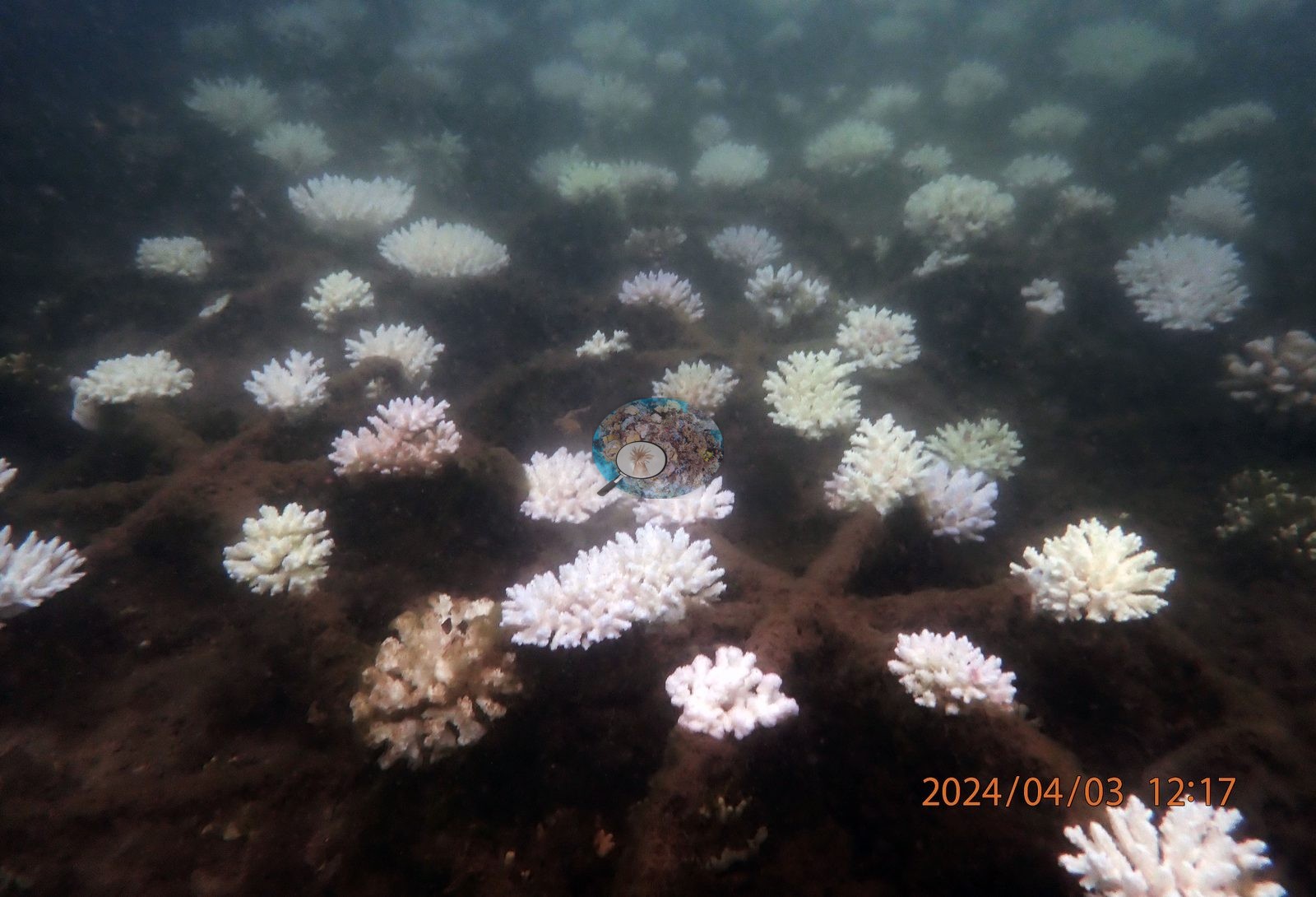
Kenya (NOAA CRW virtual station)Ocean Trust Nursery, the final and worst-hit site of the 2024 Kenya survey, combines MARS-style restoration hardware (hexagonal reef stars, rope lines, a rebar frame) with an older, richer natural reef built on large stacked plate-coral stands. Nearly everything here was bleached (95.4% of tissue, the highest figure of any Kenya site), though one striking frame captured a natural branching thicket showing the full gradient at once - bone-white, cream, tan, and deep wine-red pigmented branches touching each other - the clearest evidence that the response was colony-specific rather than uniform. Published cover was 29%, though as a stocked restoration plot this figure shouldn't be compared directly with natural-reef sites.
Eneo la mwisho la utafiti wa Kenya wa 2024 na lililoathirika vibaya zaidi kati ya ishirini: usakinishaji wa urejeshaji uliowekwa juu na kando ya mwamba wa asili nje ya Kisiwa cha Pate. Vipandikizi juu ya aina zote tatu za miundo kwa wingi ni vyeupe kama mfupa, na rangi ya kahawia hapa haionyeshi kwa uhakika tishu hai.
Tafsiri ya muhtasari huu kwa AI; Kiingereza ndicho kinachotumika rasmi. Translated from the site’s shorter map summary.
One other CRD dive site within 5 km shown in orange — click a marker to open its page.
Site description
Setting
The site is a restoration installation set on and beside natural reef, and the two have to be read separately.
General benthic features
The restoration hardware. The full set shows three distinct structure types, not one. Coated-steel hexagonal MARS-style reef stars are pegged flat to the hardground and photographed from directly above, their six-sided webbing plainly visible with a coral fragment lashed to each junction (e.g., Image 1).
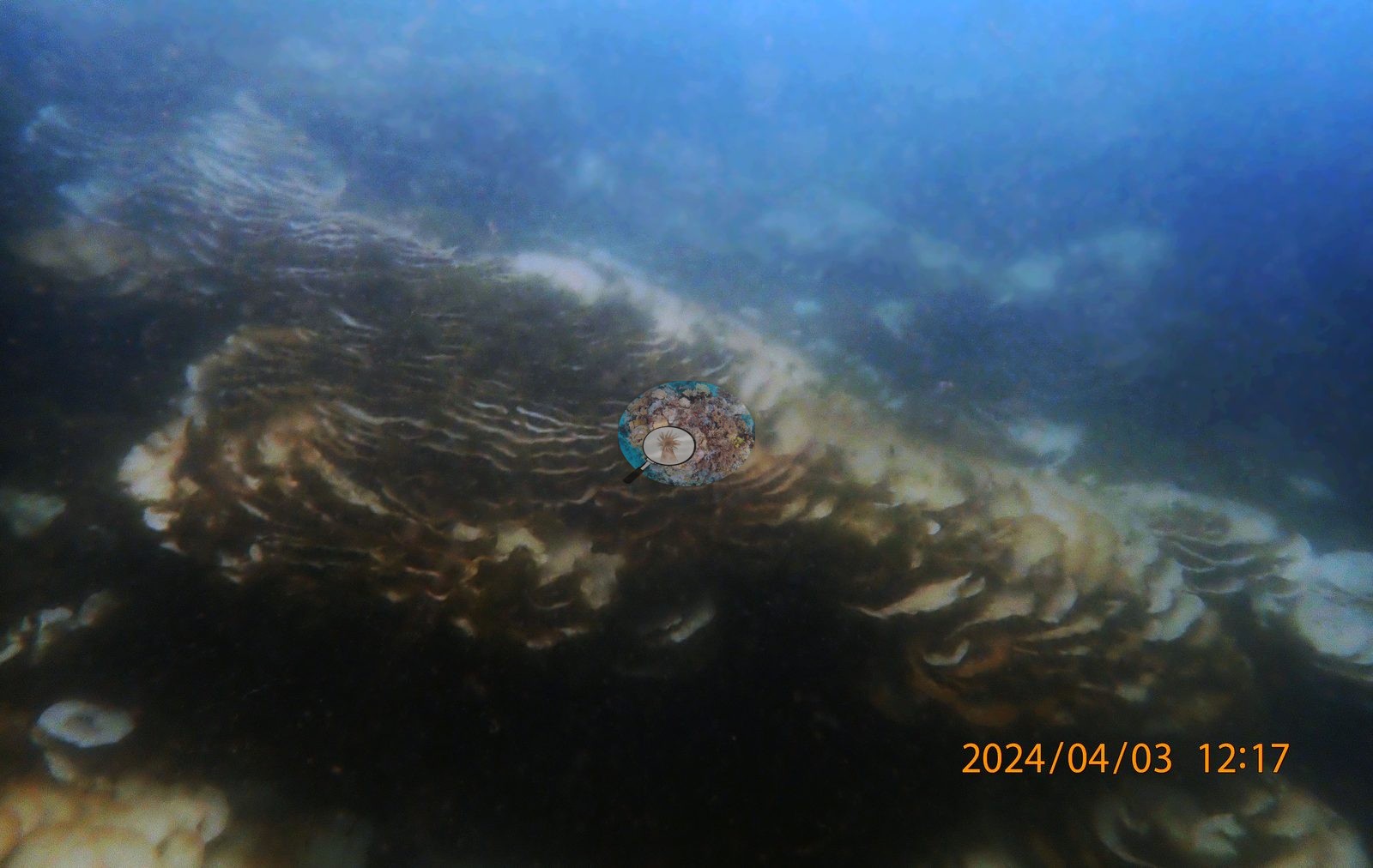
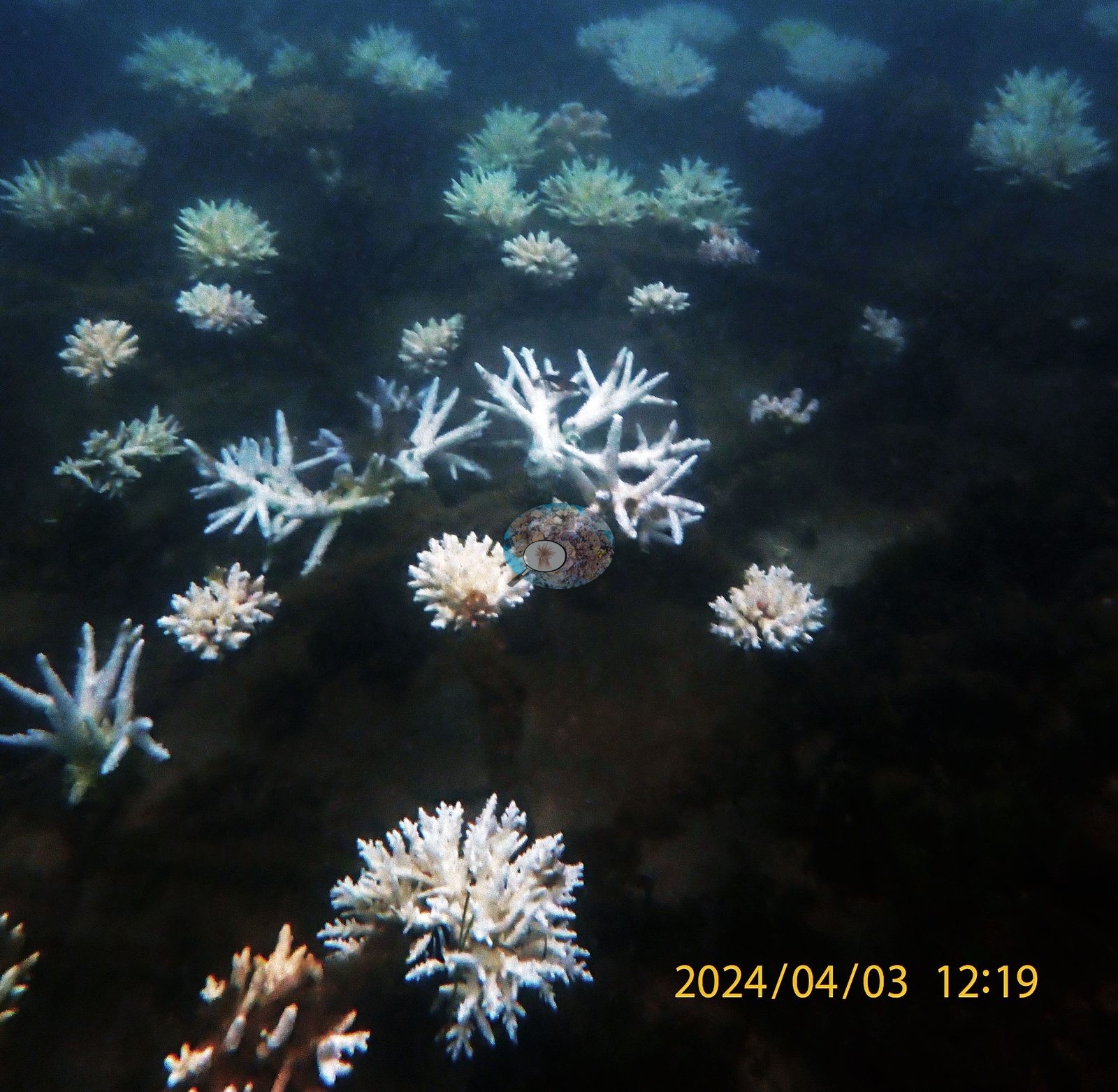
Separate from those, long horizontal rope lines run in parallel ranks across the bottom with staghorn and corymbose Acropora fragments tied out at wide intervals -- sparse stocking, the fragments standing as isolated points on dark turf-covered rock rather than forming any canopy. Third, a vertical rebar frame with ladder-like horizontal rungs is guyed to a round surface float, fragments hung along the rungs; it is the only structure in the set standing up into the water column, and it is the one place where pigmented fragments are conspicuous. One rope also runs directly across the crown of a large massive Porites-type dome, so the hardware is anchored on living reef in at least one spot. The natural reef. It is older, structurally far richer than the nursery, and the frames at 12:23-12:27 are dominated by very large monospecific stands of laminar coral -- tightly stacked, concentrically whorled plates with fine parallel ridges, running meters across and standing up in tiers. These are the reef's defining feature (e.g., Image 4).
Coral cover
Coral cover 29% -- and 95.4% of hard coral tissue bleached (March-April 2024). Measured from 62 white-balanced photographs taken at this site during the 2024 Western Indian Ocean mass bleaching event and point-annotated in CoralNet, published in Mayfield, A.B. (2025) A Citizen Science Approach for Documenting Mass Coral Bleaching in the Western Indian Ocean. Environments 12(8):276. doi:10.3390/environments12080276, Supplemental File S1. This is a published manual point-annotation value, not a computer vision estimate. Cover and condition must be read together: 29% cover is unremarkable for the region, but 95.4% of that cover being bleached is the finding, and this is a stocked restoration plot on turf-covered hardground rather than a natural fringing reef, so the cover figure should not be compared like-for-like with the other Kenyan sites.
Stressors
Condition of the outplants. Across every structure type the fragments are overwhelmingly bone- to porcelain-white: whole frames of them at 12:18-12:20 and again at 12:28-12:29 on the reef stars (e.g., Image 3).
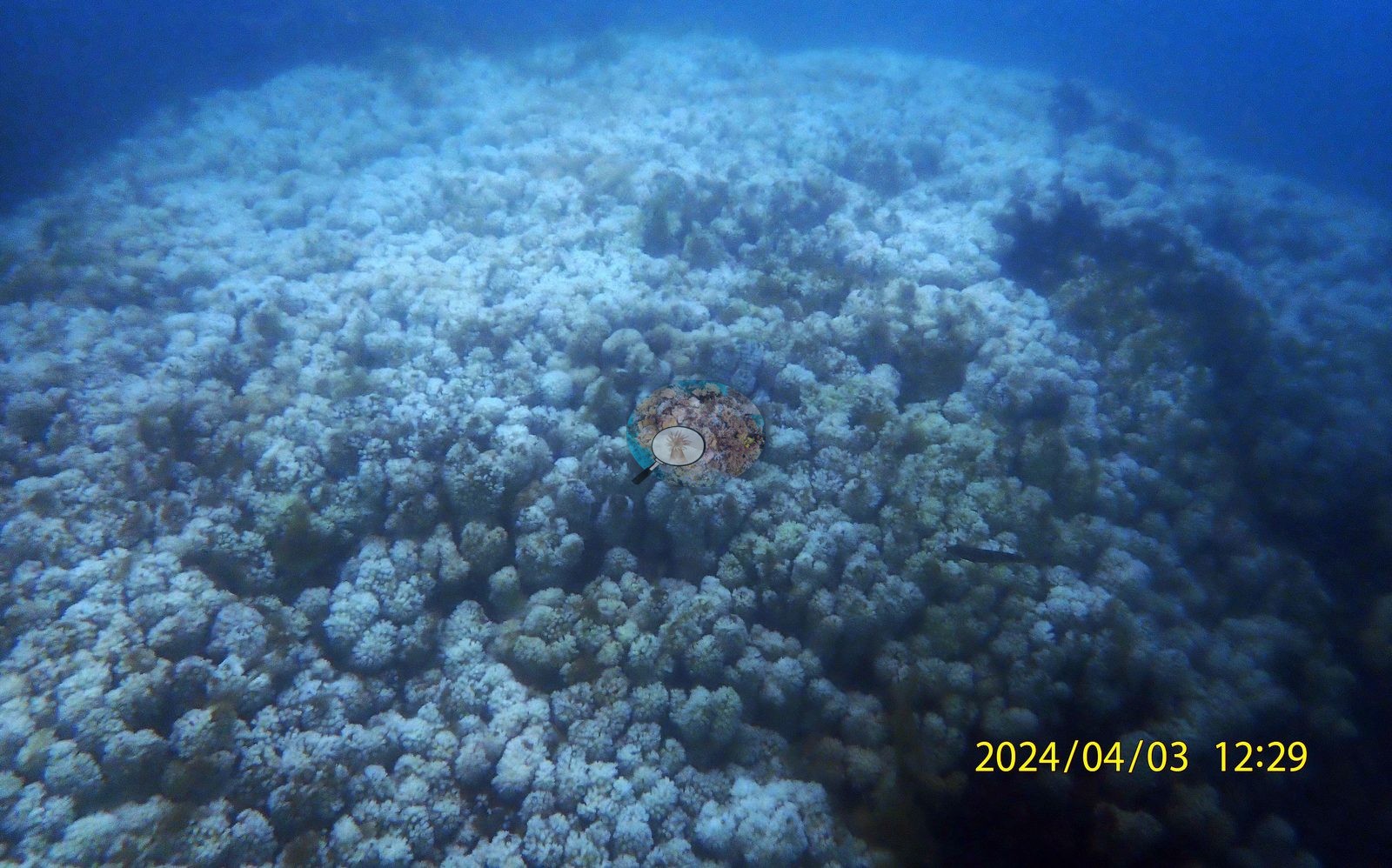
A real but small minority holds pigment. One frame is the single most informative for that -- an overhead of one grid where roughly fifteen fragments include three or four in solid olive-tan and two with a lilac-pink cast, the rest stark white. The rebar frame carries several tan-olive fragments among the white ones. Anderson's own frames warn against reading that tan too generously: one frame is a hand indicating a tan-brown corymbose colony that he records as dead skeleton taken over by turf, not surviving tissue, and the same demonstration is repeated at 12:18 in two more frames with a tan colony held against a white neighbor. Some proportion of the apparently pigmented fragments in this set are therefore dead, algal-covered skeleton rather than survivors. Their condition is partial rather than total: one frame is a single colony split across the image, salmon-pink on one side and chalk-white on the other; two are pale pink-cream throughout; three are cream-olive with green algal fuzz creeping over the upper plates; and one is a close-up of white plate skeleton with dark brown-green algal bands settled into every valley -- tissue already gone, not merely paled. Alongside the plates: a large dome of dense knobby corallites gone uniformly pale; two big white massive colonies in teal water; a white massive Porites-type dome with a dead brown patch on its shoulder; white meandroid and fleshy massive heads with algal invasion along their margins; and pale lavender knobby colonies. One frame is the summary image -- an entire branching stand, meters across, uniformly bleached bluish-white with not one pigmented branch in it (e.g., Image 2).
Another frame is a large columnar colony with cream-white column tops over dark maroon-brown lower tissue, recorded by Anderson as dying rather than intact. Where pigment did survive. Two frames at 12:30, at the very end of the swim, are the exception in the set and worth naming. One frame is a broad mound of dense branching coral in pale pink-cream, and another -- the single best frame here -- is a mixed natural thicket showing the whole gradient at once on touching branches: bone white, cream, tan, deep chocolate, and saturated wine-red fully pigmented colonies side by side. That within-thicket gradient, on colonies of the same growth form growing into one another, is the clearest evidence at this site that the response was strongly colony-specific rather than uniform, and it is not something color adjustment can manufacture. No crown-of-thorns anywhere in the set. No lesion pattern separable from bleaching, algal overgrowth, and post-mortality turf. The stress signal here is thermal, compounded by turbidity and by the heavy algal turf already holding the hardground between colonies. Seawater here measured 32.0°C during the survey (the Kenya survey-wide mean of 32.0°C matched the 1998 event), and NOAA recorded a peak of 13.5 degree-heating weeks on 18 April 2024, the highest for Kenya since records began in 1985. In situ temperatures ran 1.3 degrees C above NOAA's estimates, so the true heat stress was likely nearer 22 DHWs.
Fish and other fauna
Fauna is thin. A few small planktivores hang over the rope lines and reef stars and small damselfish sit in the plate stacks; there is no schooling fish life and no large mobile fauna in any of the 55 frames reviewed.
Comparisons with other data
No prior survey data from this site. If you would like to share yours, please email us.
Dive record
Snorkeled 3 Apr 2024, 12:17-12:30, in about 2 m of green, particle-laden water off Pate Island in the Lamu archipelago -- the final site of the 2024 Kenya survey, and the worst-hit of the twenty. Surveys were run with PMCC / Northern Rangelands Trust.
Other notes
The nursery is run by the Ocean Trust (MARS) program -- https://www.buildingcoral.com/.
CV model comparison
More info
The like-for-like row is the recomputed manual, not the published one. ⚠ The CV columns are on the OLD all-30 denominator while the published manual is on the settled rule; on these frames that understates cover by ~3.0 pp. The 50-frame batch is 6.3 pp poorer in cover than the survey average, so the CV columns are subset-distorted as well as denominator-shifted. Round Reef and Uyombo roll up 15 and 16 quadrat codes respectively. CoralSCOP (SAM-based mask-sum), edited photos: n/a — CoralSCOP was never run on Kenya edited copies; owner's ruling 2026-09-17: 'for kenya, it's only on unedited'| Method | Hard-coral cover (%) |
|---|---|
| Manual (published) | 28.9 |
| CoralNet | 28.1 |
| In-house DINOv3 | 40.3 |
| CoralSCOP unedited | 10.9 |
| Claude | 26.7 |
Data & links
- Site info: Ocean Trust / Building Coral ↗
- CoralNet image repository for this region ↗
- Photo portfolio ↗ Email for access.
- Coral Reef Diagnostics page for this area ↗
All images from Coral Reef Diagnostics. Data are from Coral Reef Diagnostics.
© Coral Reef Diagnostics.