
Kenya - Kilifi Bay (Kilifi)
Part of the regional summary: Kenya
More info
Kenya (NOAA CRW virtual station) · East African Coral Coast ecoregion mean=4.1°C-heating weeksKilifi Bay is one of the most severely bleached sites in this Kenya survey (87.0% of coral tissue, above the 77.1% average), with whole wide-angle frames reading white from foreground to horizon - branching Acropora hit hardest, but massive corals did not escape either, splitting roughly evenly between bleached and pigmented. Foliose plate corals were the most consistent survivors, and only one crown-of-thorns starfish was seen across 131 photographs. Published cover was 25%.
Mojawapo ya rekodi kamili zaidi za upaukaji katika mkusanyiko wa Kenya, juu ya sakafu ya mwamba na vitobo vilivyotengana katika Ghuba ya Kilifi. Nyota moja tu ya bahari yenye miiba inaonekana hapa, tofauti na Bofa iliyo umbali wa 2 km siku hiyo hiyo, na sahani za Turbinaria zilihifadhi rangi vizuri zaidi ilhali matawi na mawe yalipauka.
Tafsiri ya muhtasari huu kwa AI; Kiingereza ndicho kinachotumika rasmi. Translated from the site’s shorter map summary.
One other CRD dive site within 5 km shown in orange — click a marker to open its page.
3 of these 4 photographs are shown beside the text that discusses them under "Site description" below.
Site description
Setting
Water quality is not uniformly turbid: the wide horizon shots over the deeper hardground are dim and green-gray, but the shallower sand-and-bommie frames are shot in clear blue water with 10 m-plus visibility. The reef is also more varied than a flat: broad low-relief pavement and hardground carpeted in dark red fleshy macroalgae and turf runs into clean rippled sand, and out of that sand rise discrete bommies a meter or more high, each carrying its own small coral community.
General benthic features
Fleshy red macroalgae, turf, and green Halimeda patches occupy most of the rock between colonies across the whole site. Other fauna and other observations: soft corals do well here -- large tan Sarcophyton and Lobophytum leathers in full pigment in two frames, pale cream xeniid and nephtheid soft corals in three others, and some leathers bleached bone-white.
Coral cover
Coral cover 25% -- and 87.0% of hard coral tissue bleached (March-April 2024). Measured from 134 white-balanced photographs taken at this site during the 2024 Western Indian Ocean mass bleaching event and point-annotated in CoralNet, published in Mayfield, A.B. (2025) A Citizen Science Approach for Documenting Mass Coral Bleaching in the Western Indian Ocean. Environments 12(8):276. doi:10.3390/environments12080276. This is a published diver-photograph point-annotation value, not a computer vision estimate.
Stressors
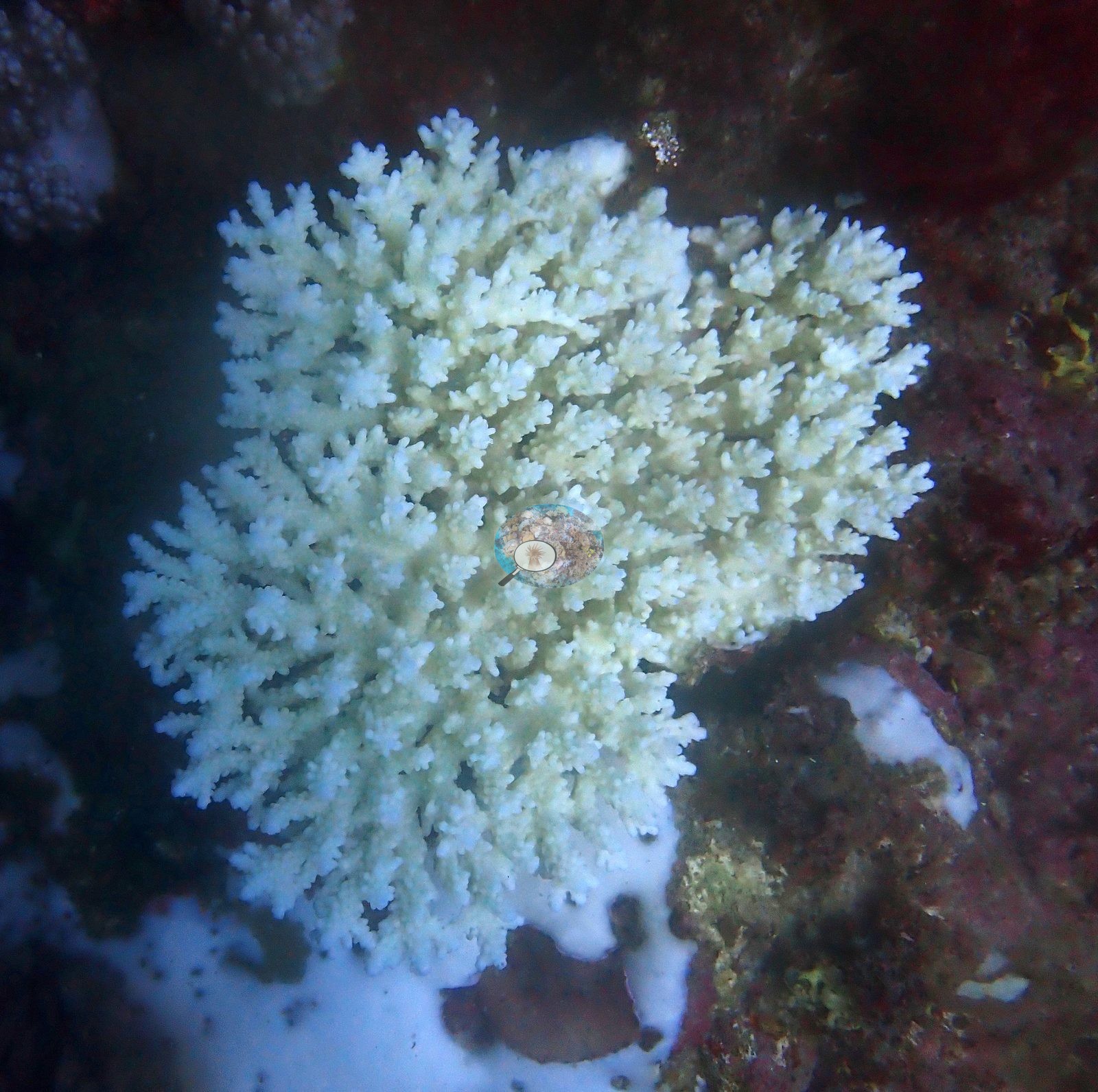
The dominant impression across the set is white. Twelve whole wide-angle frames are white from foreground to horizon: white Acropora tables and corymbose colonies, white foliose plates, white massives, with red algal rock between them. Acropora took it hardest and most completely. Stark bone-white corymbose and branching colonies recur throughout, in seven frames, and the tables in two others are white across their whole upper surface with no retained pigment anywhere on the colony (e.g., Image 4).
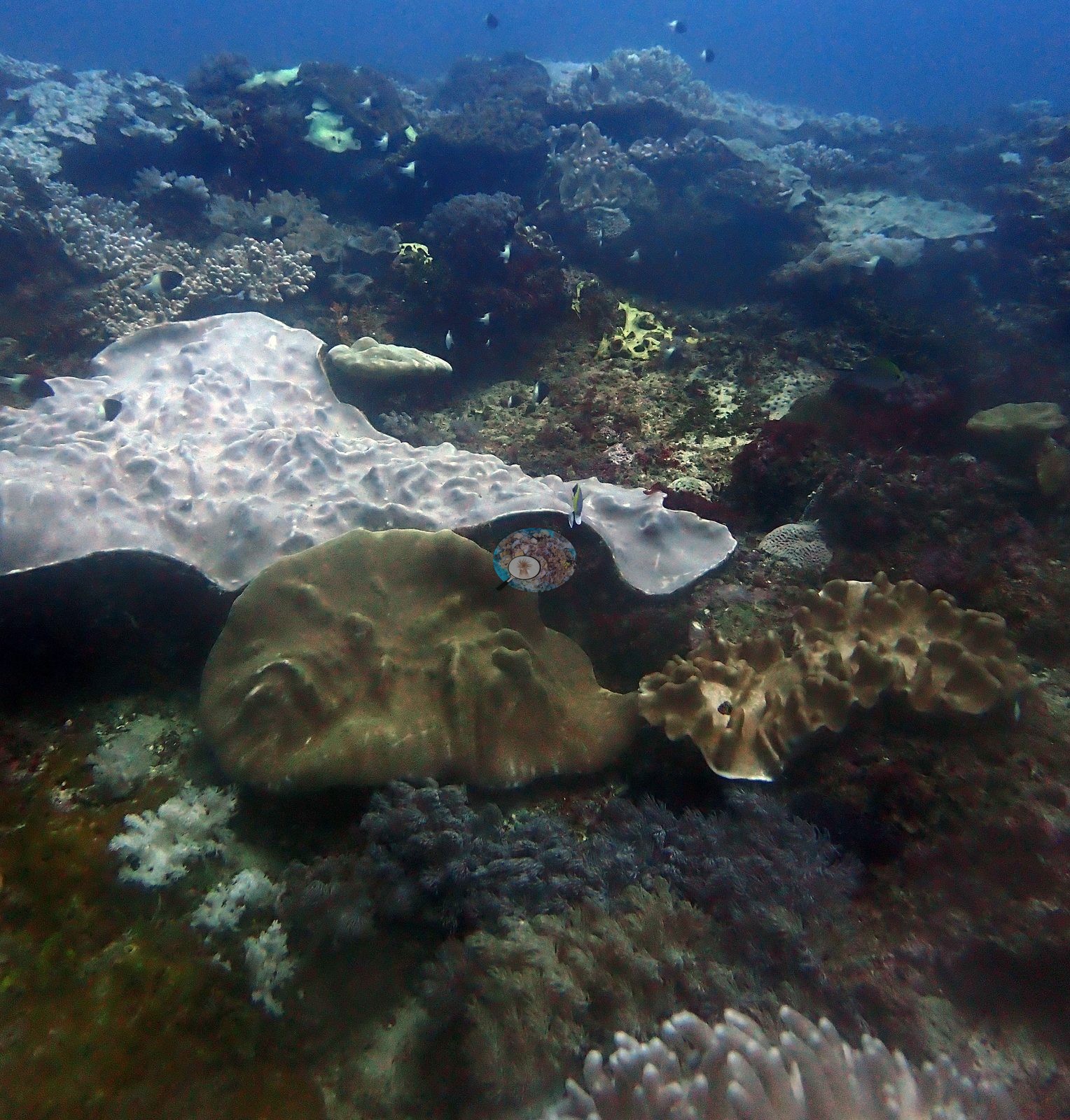
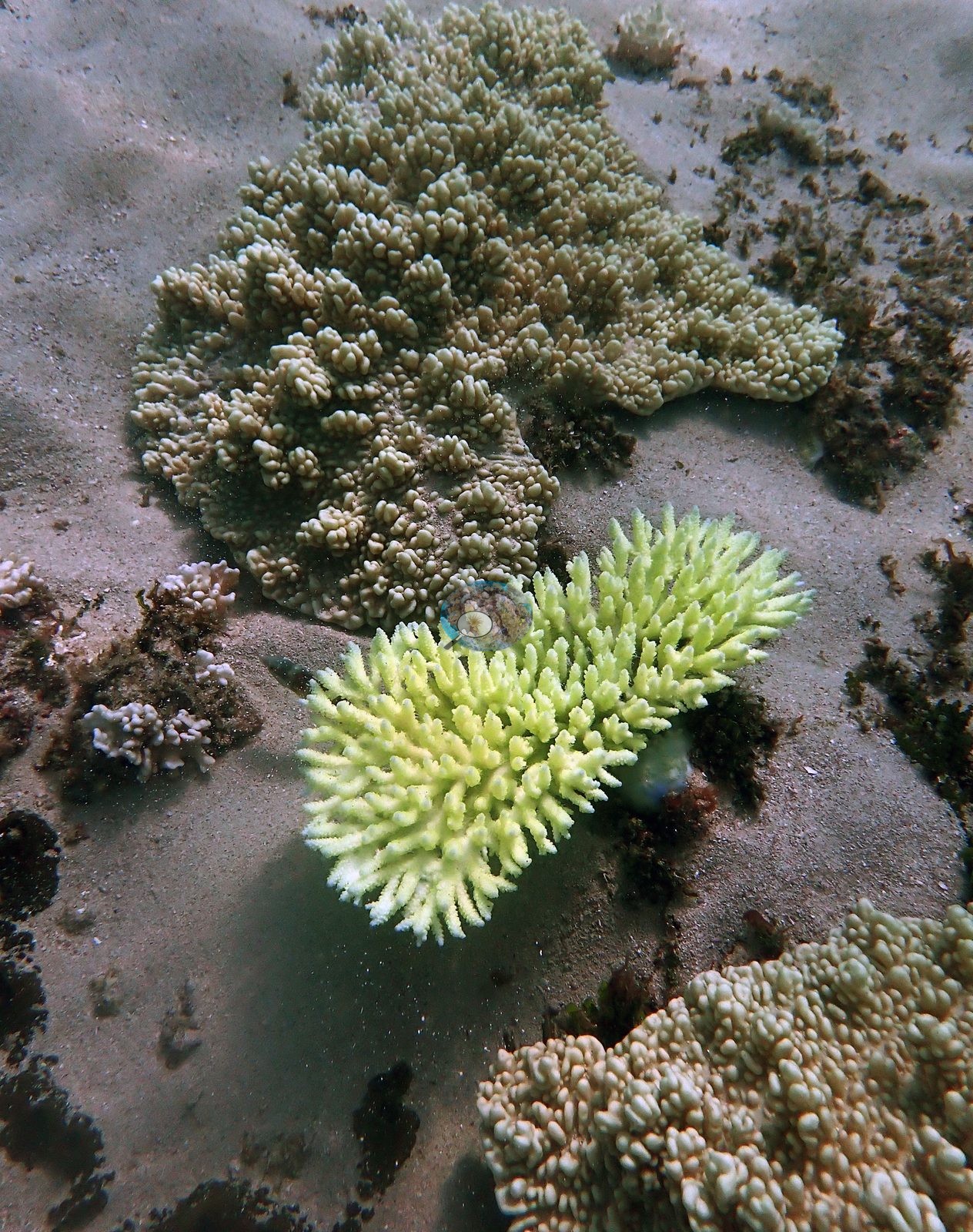
The massive corals did NOT escape, and this is the main correction the full set makes. Fully white massive and encrusting colonies appear in nine frames. One frame is the clearest single image of the split: a large snow-white bleached massive in the left foreground sits a body-length from a tan-brown Favites-type dome that is fully pigmented. Another frame goes a step further -- a bleached dome whose upper surface is already eroded and colonized, i.e. mortality, not just paling. That said, a real minority of massives held color and they are worth naming: a rich chocolate-brown Porites on open sand, an olive-yellow dome, a large boulder whose lower half is dark with turf and algae, a dull gray-green Goniastrea-type colony, a yellow-cream large-corallite massive, a gray-green Platygyra ringed by pink coralline, a brown Favites, and the pigmented dome in that split frame. So both outcomes are present at Kilifi Bay; "the massives were spared" is not supportable. The group that most conspicuously kept pigment is the foliose plate corals -- Turbinaria-type olive, gold, and tan stands run through six frames, and another frame shows a broad olive-green plate with a clean blue-white living margin. The same inversion was found at neighboring Bofa: the plates outlasted the branches and the boulders. Stress coloration is a genuine feature of this site and the full set documents it far better than the four published frames did. Vivid chartreuse yellow-green corymbose Acropora sit directly beside cream and white colonies in six frames (e.g., Image 3).
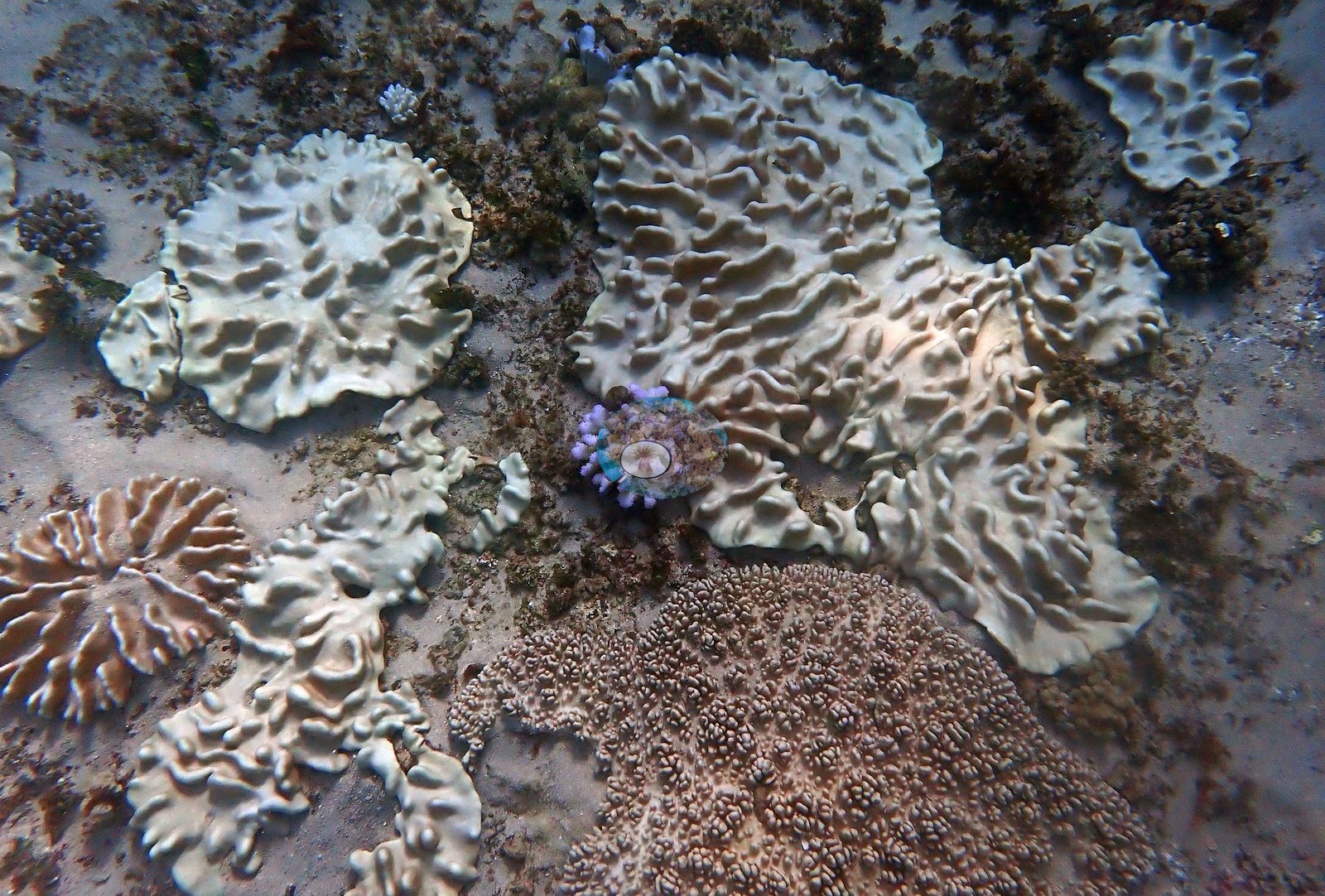
Violet and lilac Acropora appear in five frames, and a whole stand of pale rose-mauve Acropora fills another. These are pigment responses, not health -- in every case the colored colony is in the same frame, at the same distance, as a colony that has gone white. The edited frames are color-adjusted, so the saturation of these colors should be treated as indicative rather than measured. Two of Anderson's overhead frames remain the best single images here. One frame is a bed of meandroid ridge-and-valley plate corals, six or seven colonies, almost all bleached to a mint-cream white, with one at the lower left still holding brown pigment down in its valleys, a small violet corymbose colony beside them, and a large knobby brown massive that is entirely unaffected (e.g., Image 2).
Another frame is the counterpoint: a gold-and-olive foliose plate stand in full pigment with pale bleached colonies receding behind it. Mortality and algal takeover are visible, not just bleaching. One frame shows a domed colony whose surface has been wholly overgrown by maroon and purple filamentous algae with an orange sponge at its base; comparable algal colonization of skeleton shows in the eroded dome above and along the red-turfed pavement in three frames. Crown-of-thorns are present but scarce, and Kilifi Bay is nothing like Bofa in this respect. Exactly ONE Acanthaster was photographed, in a single frame -- a large animal with a dark maroon-brown disc and blue-gray banded arms and spines, on red algal rock with a bleached white Acropora immediately above it and bleached white lobate colonies below. No second individual appears anywhere in the 131 frames reviewed. One frame is a close-up of a bleached massive with long fleshy daisy-like polyps fully extended, white with a faint yellow cast. Two frames are close-ups of plocoid massives caught mid-bleach, corallite centers still faintly colored against paling tissue. Typical recent thermal stress: mean annual maximum of 4.1 degree heating weeks (2021-2025, NOAA CRW; East African Coral Coast ecoregion). Seawater here measured 31.3°C during the survey (the Kenya survey-wide mean of 32.0°C matched the 1998 event), and NOAA recorded a peak of 13.5 degree-heating weeks on 18 April 2024, the highest for Kenya since records began in 1985. In situ temperatures ran 1.3 degrees C above NOAA's estimates, so the true heat stress was likely nearer 22 DHWs.
Fish and other fauna
The other seastars in the set are harmless and should not be confused with it: a reticulated black-on-cream mosaic seastar (Pentaceraster-type) in two frames, a brown pentagonal cushion star (Culcita-type) in one of them, smooth slender-armed salmon and gray five-armed seastars (Linckia/Nardoa-type) in four frames, and a brilliant cobalt-blue Linckia laevigata on top of a bommie in another. One frame holds an unidentified reef invertebrate with a fan of electric-blue and white lamellae. One frame has a small moray tucked into a crevice among pale Porites and Montipora; another is a well-camouflaged crab on red-algal rubble; small planktivores and surgeonfish work the bommies and a loose aggregation hangs over the deep hardground in a further frame.
Comparisons with other data
No prior survey data from this site. If you would like to share yours, please email us.
Dive record
Dived 26 Mar 2024 at about 13 m in Kilifi Bay during the 2024 Western Indian Ocean mass bleaching event. Surveys were run with 3 Degrees South.
Other notes
The full 131-frame set is one of the most complete bleaching records in the Kenya collection, and it changes the picture the four published frames gave.
CV model comparison
| Method | Hard-coral cover (%) |
|---|---|
| Manual (published) | 25.1 |
| CoralNet | 25.6 |
| In-house DINOv3 | 31.4 |
| CoralSCOP unedited | 18.5 |
Data & links
- CoralNet image repository for this region ↗
- Photo portfolio ↗
- Coral Reef Diagnostics page for this area ↗
All images from Coral Reef Diagnostics. Data are from Coral Reef Diagnostics.
© Coral Reef Diagnostics.