
Kenya - Diani Beach (Diani) snorkel
Part of the regional summary: Kenya
More info
Kenya (NOAA CRW virtual station) · East African Coral Coast ecoregion mean=4.1°C-heating weeksDiani Beach's reef is built mainly on large foliose and tiered plate corals, with branching and corymbose Acropora and meandroid brain corals also well represented on fuller review. Bleaching affected about three-quarters of coral tissue (75.4%, close to the Kenya-wide average) as a genuine colony-by-colony mosaic - nearly every frame shows some combination of fully bleached, intermediate, and still-pigmented coral - with the dense branching Acropora thickets holding color most consistently rather than the plate corals, which went both ways. Published cover was 35%, more than double a 2014 reading nearby (16.0%).
Mwamba mkubwa zaidi na wenye mwinuko wa juu kuliko picha zilizochapishwa zilivyodokeza, uliogeliwa kwa mrija nje ya Ufukwe wa Diani wakati wa safari ya papa-nyangumi. Upaukaji wa matumbawe ya sahani ni takriban nusu yenye rangi na nusu nyeupe-krimu, ilhali vichaka vinene vya Acropora ya matawi vilishikilia rangi zao vizuri zaidi; hakuna nyota za bahari zenye miiba katika seti hii.
Tafsiri ya muhtasari huu kwa AI; Kiingereza ndicho kinachotumika rasmi. Translated from the site’s shorter map summary.
Four independent survey stations shown with the program’s logo — click one to see how far it is from this site.
Site description
Setting
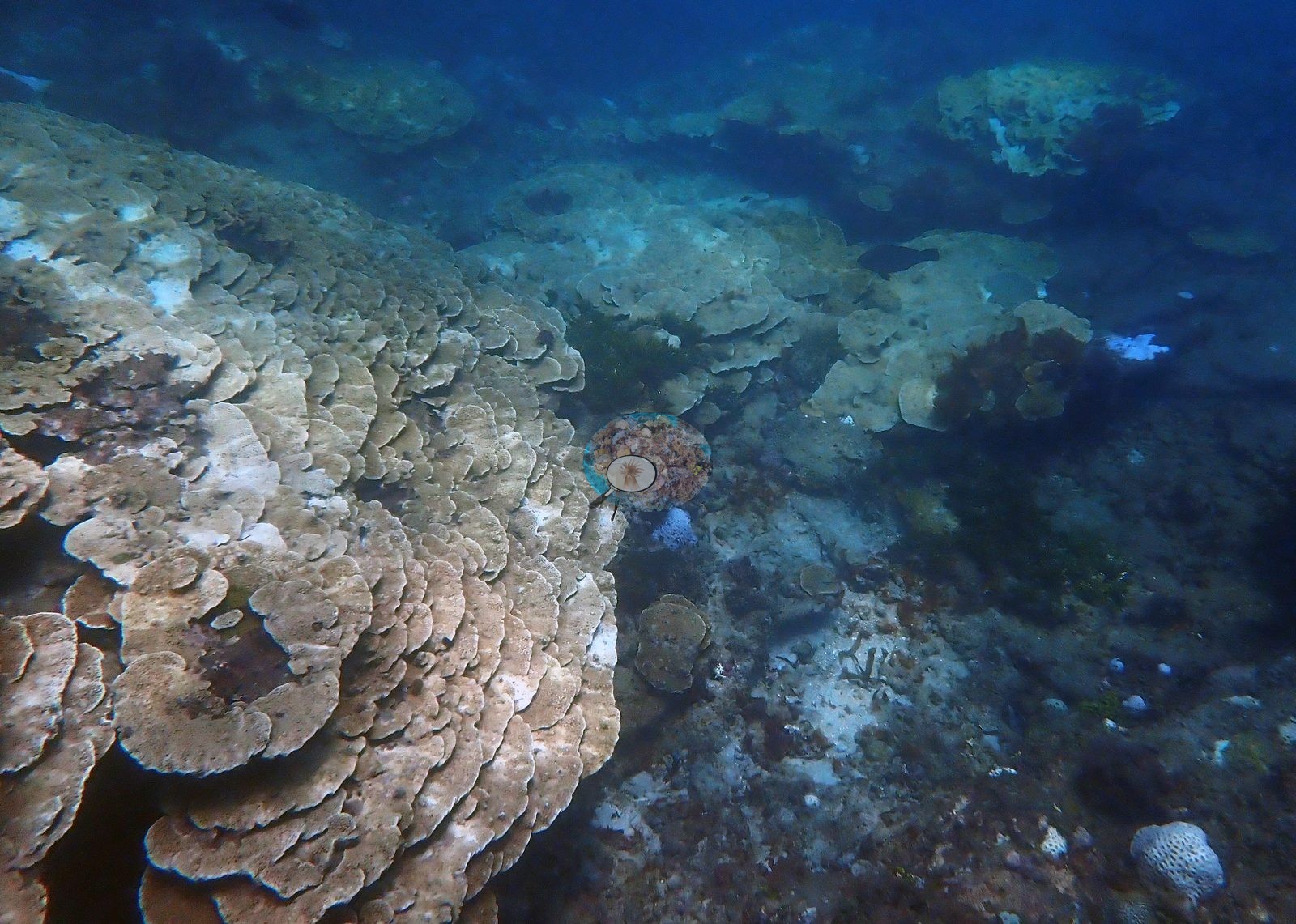
Setting. Water quality is not uniform across the set. Roughly two-thirds of the frames are clear blue-green with 10 m-plus visibility and open blue water above a sloping reef; a minority are distinctly green and turbid. But this is not the low-relief flat the earlier text described: two frames look down a genuine reef slope falling into blue water, and the reef carries meter-scale coral structure of its own.
General benthic features
The substrate between colonies is turfed hardground, rubble, and dark red-brown fleshy macroalgae, with pink coralline pavement in the shallows. Structure. The backbone of Diani is foliose plate coral, and the full set confirms that emphatically. Tiered, shingled plate mounds a meter and more across recur throughout -- three frames center on stacked plate colonies tall enough to be the dominant feature of their frames, and five more show plate beds running away across the reef (e.g., Image 1).
Several of the largest mounds carry a small gray-white massive colony perched on their upper surface (e.g., Image 3).
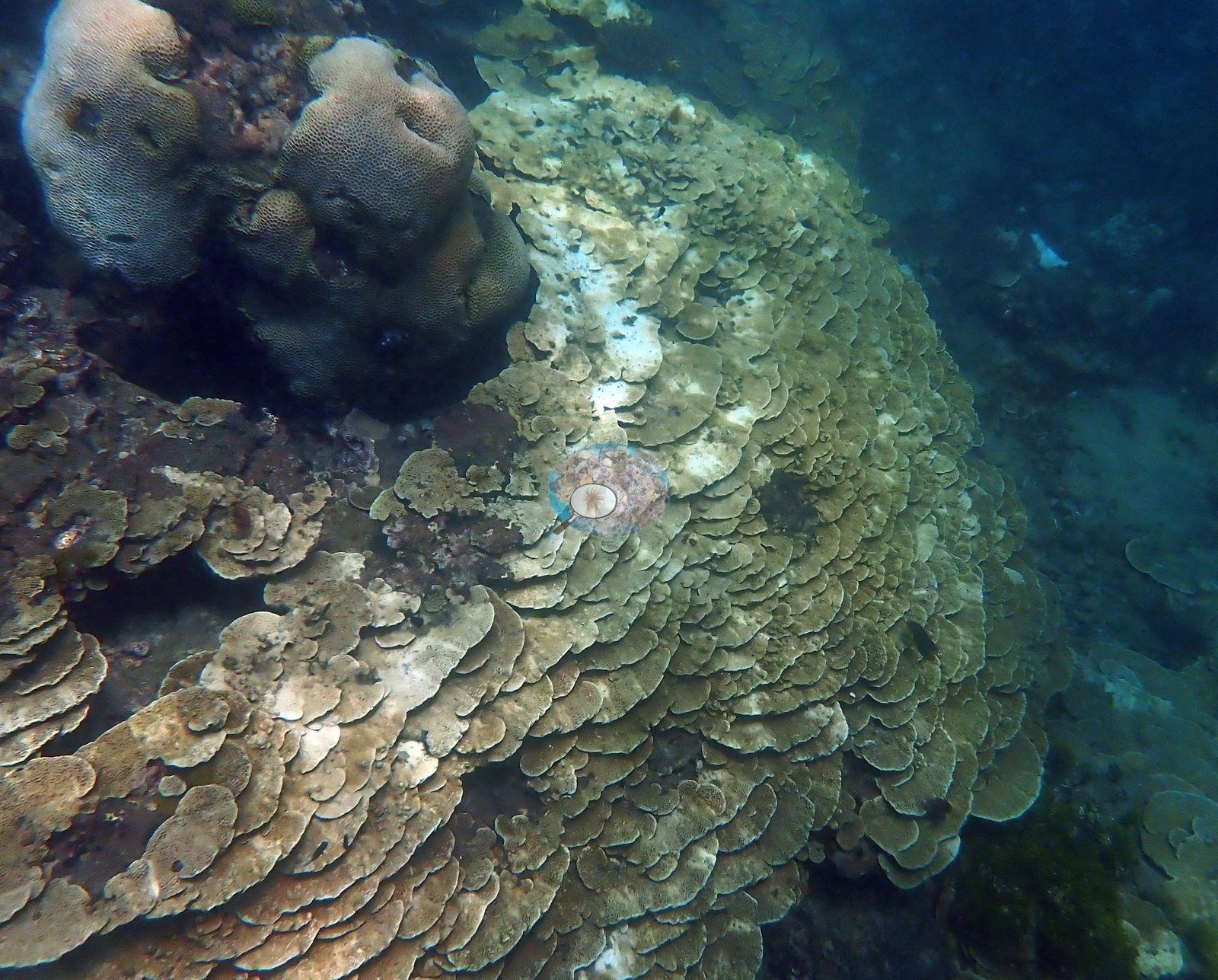
Community. The four-frame pass recorded only foliose plates and tabular Acropora. The full set adds two groups that are abundant here. First, branching and corymbose Acropora: dense thickets run through four frames, and scattered corymbose colonies appear in eight others. Second, massives and meandroid brains: pale Platygyra-type brains in five frames, and mauve to gray-brown massive Porites and faviid boulders in four others. Gold-green Turbinaria plates and a large rust-red encrusting-foliose colony round out the assemblage.
Coral cover
Coral cover 35% -- and 75.4% of hard coral tissue bleached (March-April 2024). Measured from 50 white-balanced photographs taken at this site during the 2024 Western Indian Ocean mass bleaching event and point-annotated in CoralNet, published in Mayfield, A.B. (2025) A Citizen Science Approach for Documenting Mass Coral Bleaching in the Western Indian Ocean. Environments 12(8):276. doi:10.3390/environments12080276. This is a published diver-photograph point-annotation value, not a computer vision estimate. Across the 20 Kenyan sites the mean was 30% coral cover and 77.1% of tissue bleached.
Stressors
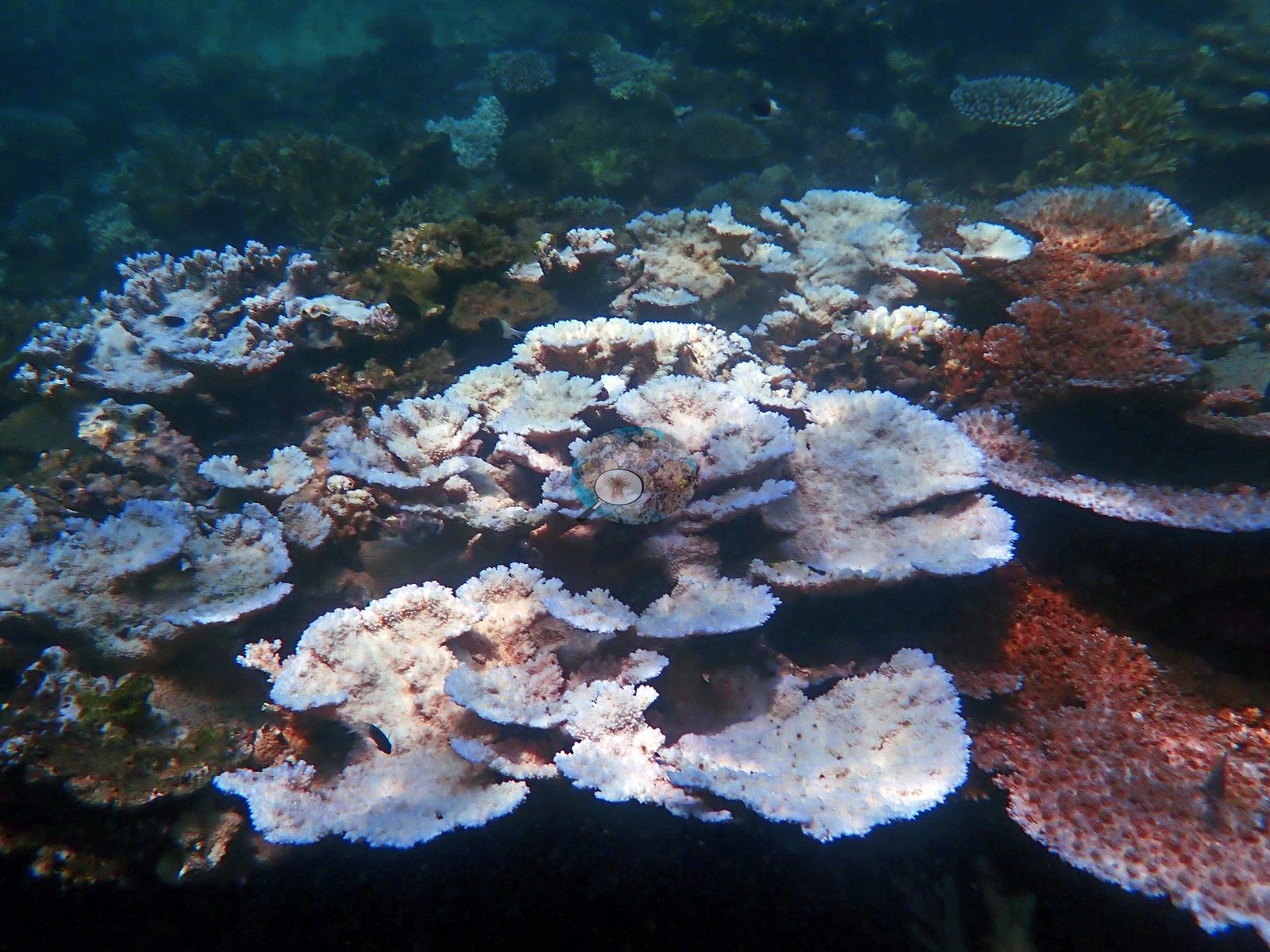
Bleaching. Three-quarters of the hard coral tissue here was bleached, and the set shows it as a mosaic rather than a wipeout, with almost every frame containing colonies in more than one state. Fully white colonies: the field of stark-white tabular and plating Acropora in one frame, with a single rust-red pigmented plate on the right edge for contrast; white corymbose Acropora scattered across four frames; a bleached plate stack; white foliose colonies against an orange-brown Acropora thicket; and a close-up of a plating acroporid gone cream-white with blue-white margins and a healthy brown colony immediately above it (e.g., Image 2).
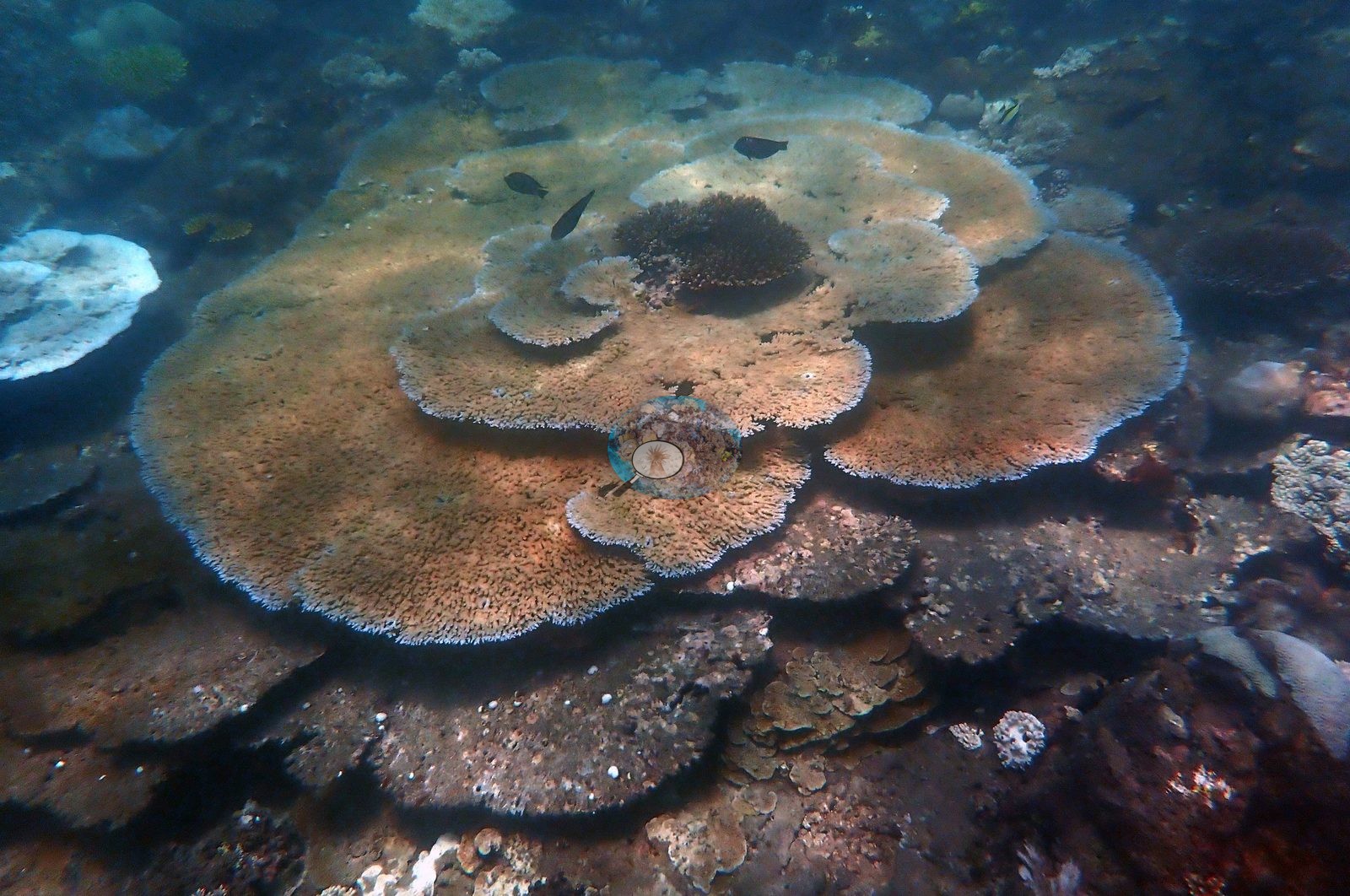
Intermediate colonies: one frame shows the two-meter tiered table, washed tan-gold across the plate with pale blue-white growing margins and one small chocolate-brown corymbose colony riding on top that has not bleached at all, a white plate beside it -- three conditions in one frame (e.g., Image 4).
Colonies in three frames are pale mauve-pink, stressed but still pigmented. The earlier reading that the foliose plates were the site's most resilient element does not survive the full set. Some plate mounds did hold pigment -- the gold-tan tiered colonies of four frames, and the olive plate beds of two more -- but as many are cream to gray-white (four frames, and the white foliose colonies of another). The groups that most consistently kept full brown-gold pigment at Diani were the dense branching Acropora thickets and the rust-red encrusting colony -- while the meandroid brains beside that same red colony are pale gray-white. Massive Porites went both ways: pigmented mauve and gray-brown domes in two frames, pale ones in two others. No crown-of-thorns appear anywhere in the set. One mauve Porites carries pale patches that may be recent tissue loss, but at this resolution that is not a confident disease call. Typical recent thermal stress: mean annual maximum of 4.1 degree heating weeks (2021-2025, NOAA CRW; East African Coral Coast ecoregion). Seawater here measured 32.0°C during the survey (the Kenya survey-wide mean of 32.0°C matched the 1998 event), and NOAA recorded a peak of 13.5 degree-heating weeks on 18 April 2024, the highest for Kenya since records began in 1985. In situ temperatures ran 1.3 degrees C above NOAA's estimates, so the true heat stress was likely nearer 22 DHWs.
Fish and other fauna
Fauna is sparse in the frames: a wrasse in one, small damsels and anthias over the Acropora in two others, and a scattering of fish in another.
Comparisons with other data
No independent survey was made at this exact site; the nearest ones are listed in the table below.
Dive record
Snorkeled 16 Mar 2024 off Diani Beach during the 2024 Western Indian Ocean mass bleaching event, on the whale-shark trip that covered reefs 4 and 5. Surveys were run with Whale Shark Adventures.
Other notes
The full 46-frame set is a much larger reef than the four published frames suggested, and it changes three things: the relief, the community, and which groups actually held their pigment.
CV model comparison
| Method | Hard-coral cover (%) |
|---|---|
| Manual (published) | 34.9 |
| CoralNet | 34.2 |
| In-house DINOv3 | 38.7 |
| CoralSCOP unedited | 22.3 |
Independent surveys nearby
Within 5 km, 4 independent survey stations recorded hard coral cover in 2014. The most recent nearby survey is from 2014, so these values predate recent heat stress. This site's own estimate (35%) sits 13.9 points above the range of these surveys (13–21%); the methods differ, so the comparison is context, not a like-for-like test.
Collected by other programs using different methods (MERMAID is a data platform: each MERMAID row names the organization that did the survey, and its method is in the row's hover text), so these are context for the figures above, not a like-for-like comparison. Where a station was surveyed more than once the range is shown. Station names are not dive-site names.
| Agency | Site / location | Date | Hard coral cover (%) | Distance | Link |
|---|---|---|---|---|---|
| WCS Kenya via MERMAID | Nzidzani | 2014 | 16% | 0.57 km | Darling E. 2018. Kenya CRCP legacy. MERMAID |
| WCS Kenya via MERMAID | Chale-Mwaromba | 2014 | 21% | 0.59 km | Darling E. 2018. Kenya CRCP legacy. MERMAID |
| WCS Kenya via MERMAID | Kinondo | 2014 | 13% | 1.06 km | Darling E. 2018. Kenya CRCP legacy. MERMAID |
| WCS Kenya via MERMAID | Chale-Makonde | 2014 | 14% | 1.29 km | Darling E. 2018. Kenya CRCP legacy. MERMAID |
Data & links
- CoralNet image repository for this region ↗
- Photo portfolio ↗
- Coral Reef Diagnostics page for this area ↗
All images from Coral Reef Diagnostics. Data are from Coral Reef Diagnostics and the organizations named in the data-sources table above.
© Coral Reef Diagnostics.