
Kenya - Chipopo (Pate [Lamu]) snorkel
Part of the regional summary: Kenya
More info
Kenya (NOAA CRW virtual station)Chipopo, on Pate Island in the remote Lamu archipelago, is a coral-restoration site - rope-and-rebar nursery trees and concrete outplant tables - where most hanging fragments were found bleached chalk-white, with only a pigmented minority of shorter, tighter branching stock surviving. The natural reef around the array is thinly documented but shows the same split: some massive Porites held color while others bleached completely, with early signs of tissue loss already visible on a few colonies. Published cover was 13% (largely reflecting how much coral has been placed here rather than natural growth) with 76.0% of that standing stock bleached.
Eneo la urejeshaji wa matumbawe nje ya Kisiwa cha Pate katika visiwa vya Lamu, ardhi ya kaskazini kabisa na yenye nyaraka chache zaidi katika mfululizo wa Kenya. Weupe unatawala vipandikizi kwa takriban theluthi mbili hadi robo tatu, na kifo cha sehemu pamoja na kufunikwa na mwani tayari kinaonekana.
Tafsiri ya muhtasari huu kwa AI; Kiingereza ndicho kinachotumika rasmi. Translated from the site’s shorter map summary.
Two other CRD dive sites within 5 km shown in orange — click a marker to open its page.
Site description
Setting
Water quality is not uniform across the pass: the tree frames early in the run are green and particle-laden with the structure fading into murk within a few meters, while the later frames over hardground and the wide tree shot are appreciably clearer and blue-green.
General benthic features
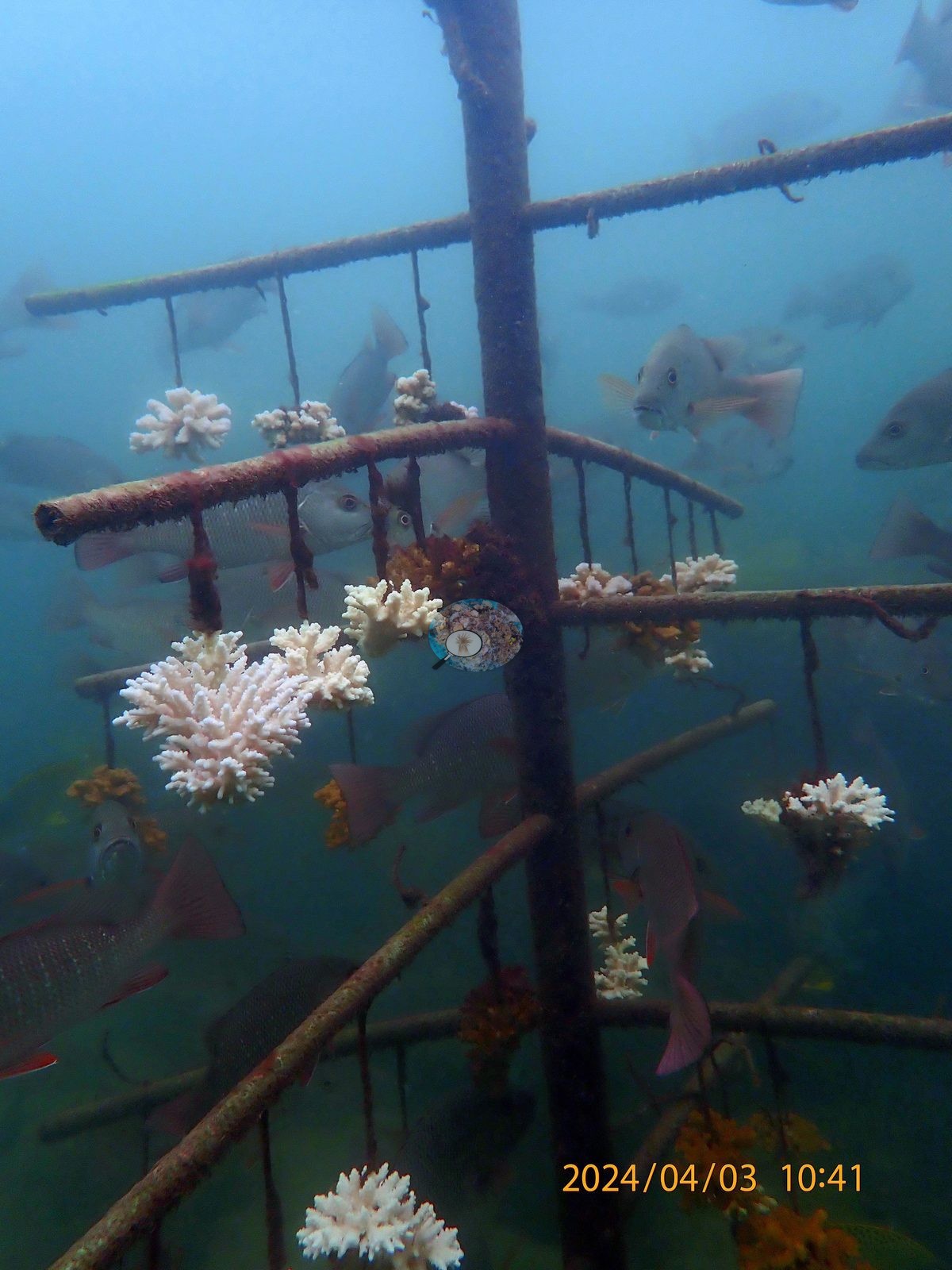
What the photographs show first is infrastructure. Multi-tiered rope-and-rebar nursery trees carry fragments on short droppers from every cross-arm, and separate steel and concrete outplant tables sit on sand nearby (e.g., Image 3).
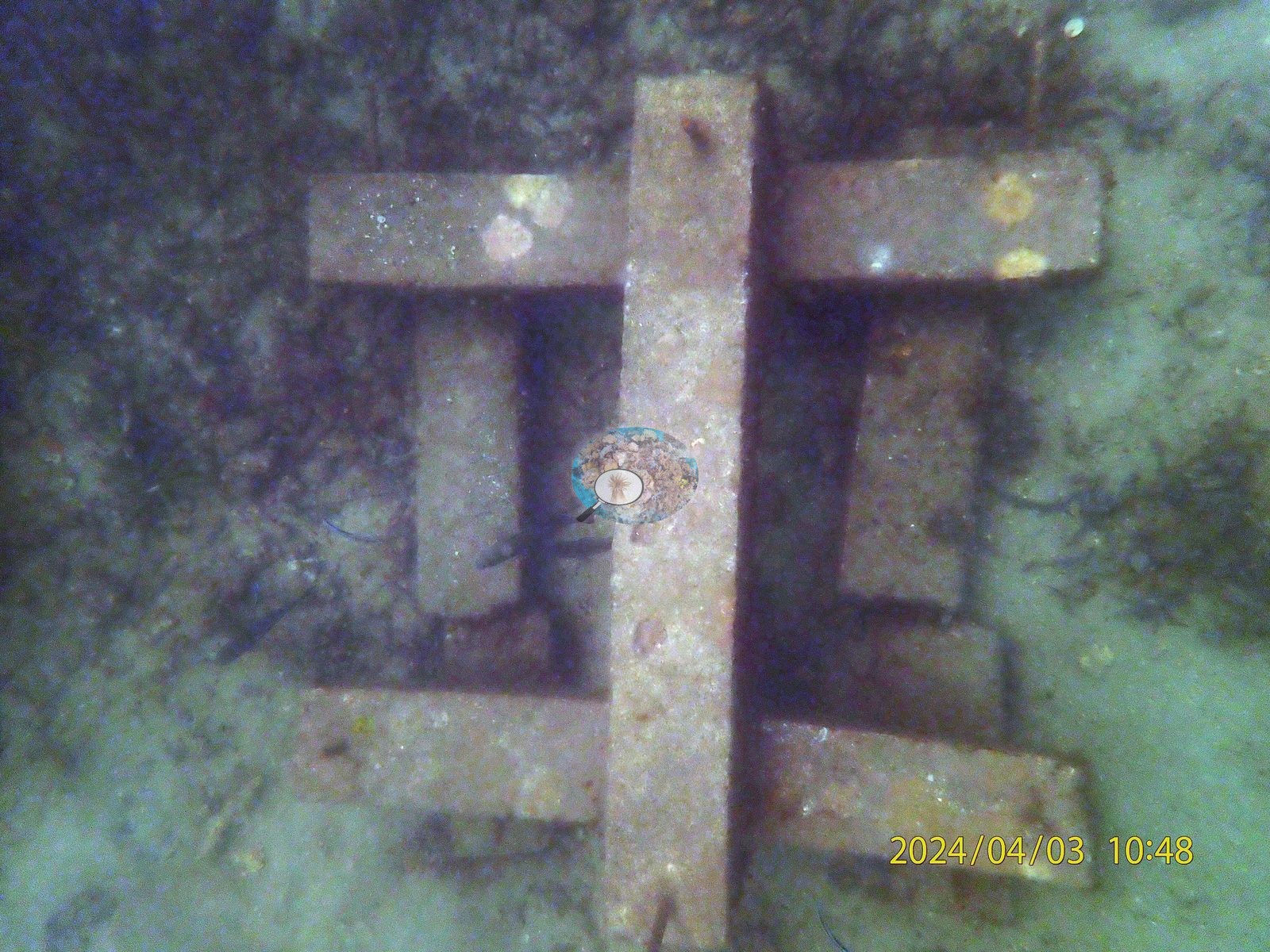
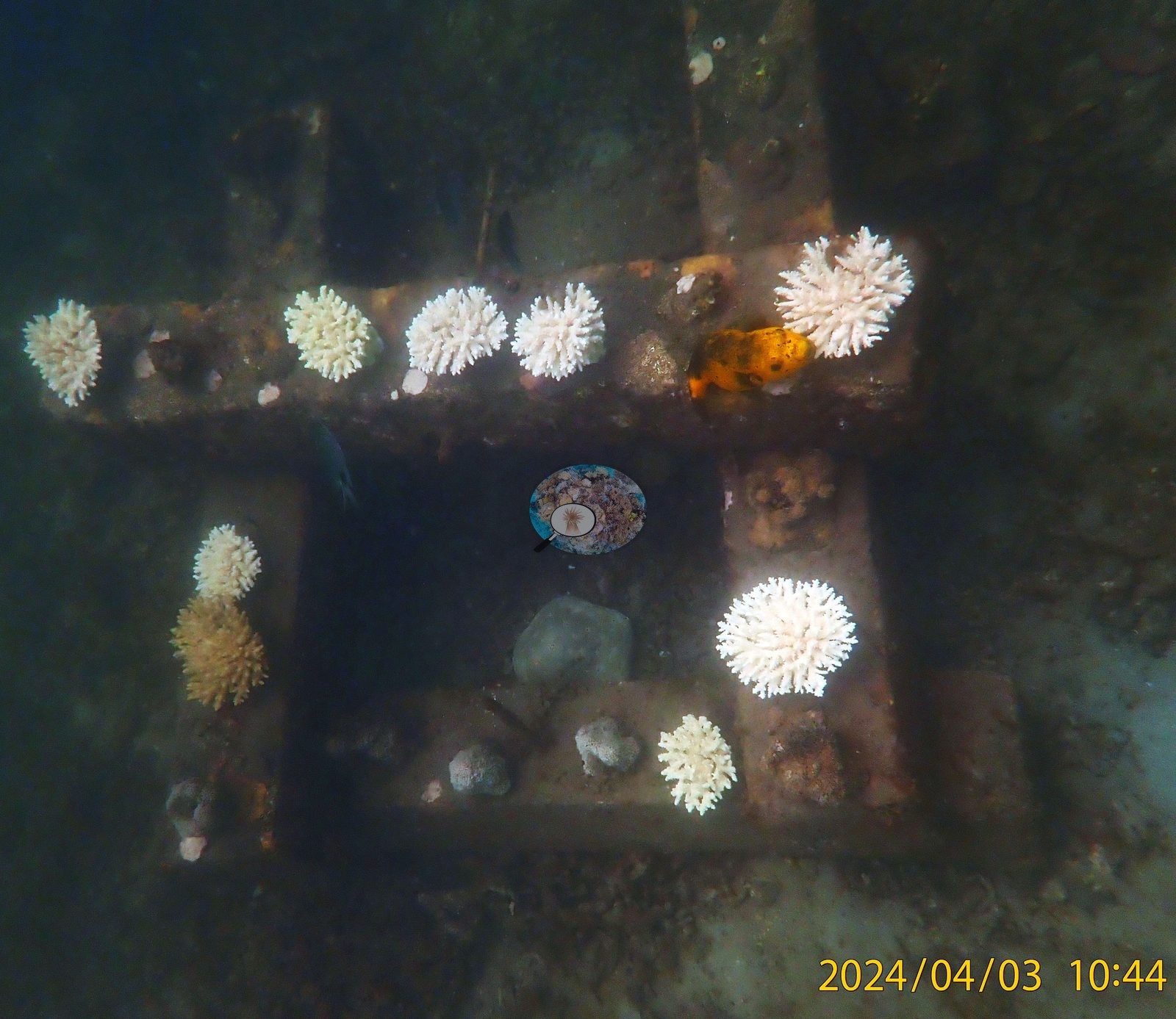
One steel outplant frame carries no coral at all -- bare, algae-filmed metal over sand (photographed at 10:48) -- and another frame shows a table with just two small fragments on it, so the array is not uniformly stocked (e.g., Image 4).
The natural benthos around the array is thinly but genuinely documented, and it is not simply sand. Low hardground boulders carry dense red-brown fleshy macroalgae and turf with coral colonies emerging from it. The single richest natural frame in the set shows one boulder carrying orange-brown encrusting and submassive colonies that are clearly pigmented, with a bleached white meandroid brain coral (Platygyra-type) on its upper surface.
Coral cover
Coral cover 13% -- and 76.0% of hard coral tissue bleached (March-April 2024). Measured from 40 white-balanced photographs taken at this site during the 2024 Western Indian Ocean mass bleaching event and point-annotated in CoralNet, published in Mayfield, A.B. (2025) A Citizen Science Approach for Documenting Mass Coral Bleaching in the Western Indian Ocean. Environments 12(8):276. doi:10.3390/environments12080276, Supplemental File S1 (May 2025 analysis). This is a published, human-supervised photo point-annotation value, not a computer vision estimate, and it is not to be recomputed. Read it as a restoration-site number: the frames it was drawn from are dominated by nursery hardware over sand, so the figure partly measures how much coral has been put here rather than what the reef grew on its own. It also counts bleached coral as coral -- at the moment of the survey roughly three-quarters of that small standing stock was white.
Stressors
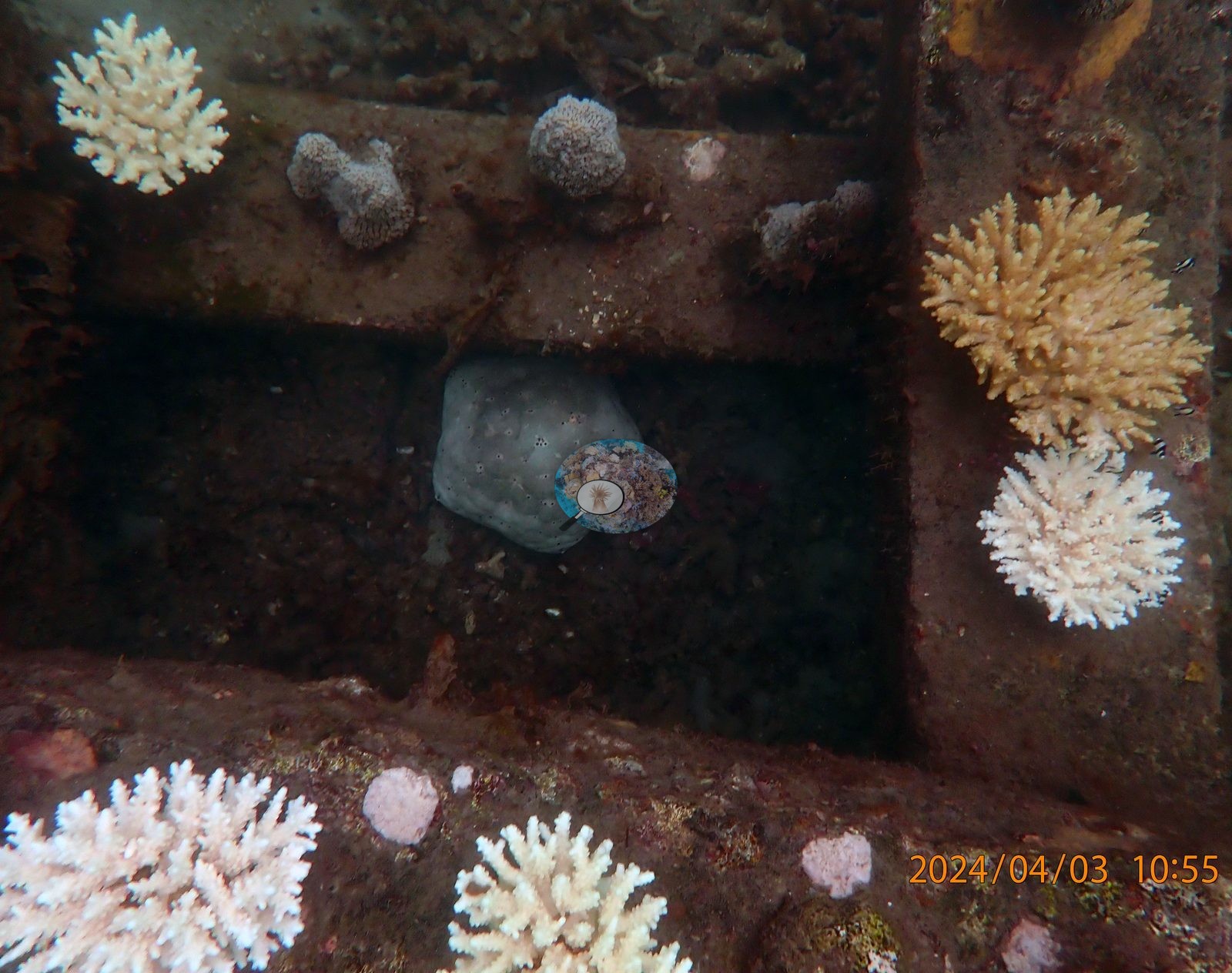
Bleaching is the dominant signal and it is unambiguous on structure, not just on color. On the nursery trees the majority of hanging fragments are chalk-white with crisp, unfouled branch tips (one frame holds roughly a dozen white fragments to three or four pigmented ones; another shows a whole tree of white fragments and nothing else). The tables are the same: one table has about ten stark-white branching fragments in a single frame against one or two cream-tan ones, and four more frames each repeat the pattern with five or six white fragments to one gold-tan holdout (e.g., Image 1).
The clearest single piece of evidence is a frame where a thumbs-down gesture is held between two branching colonies on the same beam: one gold-tan and pigmented, the immediately adjacent one bone-white. That within-frame contrast is what the bleaching call rests on, and it survives any color adjustment. A real pigmented minority does persist on the structures, concentrated on the shorter, tighter branching stock rather than the fine staghorn Acropora: rust-orange to gold-brown clusters recur in six frames, and a gold-tan branching colony with humbug damselfish sheltering in it sits on a concrete beam. Whether all of that rust-brown is living pigment rather than algal fouling on dead skeleton cannot be settled from color-adjusted frames, and it should not be over-read. Several massive corals here held their pigment: a salmon-orange lobate Porites beside a paler coarse-textured massive colony, a knobby tan-gold Porites-type bommie with pink coralline and sponges around its base, tan-brown massive domes in two frames, and a strikingly green massive colony with large corallites that Anderson singled out for a thumbs-up. Others did not: one frame shows a meter-scale multi-lobed massive Porites bleached chalk-white from base to crown with a faint lilac cast, another shows a second white dome on macroalgal rock, and a third shows two more white lobate colonies. Partial mortality is visible, which matters because it is a step beyond paling. The crown of the big bleached Porites carries a discrete khaki-green algal-filmed patch and a rust-brown streak down its flank where tissue has gone, verified at full resolution; another frame shows a comparable filmed patch on a second dome; and one frame -- a hand pointing at a single outplant plug -- shows a pale, polyp-extended colony (Goniopora-type) whose entire center is overgrown with green filamentous algae while its margins are still pale living tissue. So the site is not purely at the peak-paling stage: some tissue was already lost by 3 April. No crown-of-thorns starfish and no disease lesions appear anywhere in the 45 frames. Seawater here measured 32.0°C during the survey (the Kenya survey-wide mean of 32.0°C matched the 1998 event), and NOAA recorded a peak of 13.5 degree-heating weeks on 18 April 2024, the highest for Kenya since records began in 1985. In situ temperatures ran 1.3 degrees C above NOAA's estimates, so the true heat stress was likely nearer 22 DHWs.
Fish and other fauna
Fish life on and around the array is conspicuous and the structure is plainly working as habitat regardless of the state of the coral on it. Dense aggregations of snapper- and emperor-type fish crowd the trees, schools of yellow bluestripe snapper (Lutjanus kasmira) with dark surgeonfish behind work the tables, and a loose school of blue-green parrotfish passes through in another frame. The single best fish frame shows a dark-bodied terminal-phase parrotfish with vivid blue and red fins and flank stripes swimming through the hanging bleached fragments. Also recorded: humbug damselfish in a gold Pocillopora-type colony, blue-purple surgeonfish and fusiliers over a table, a rabbitfish and butterflyfish, and a bright blue-green parrotfish over the outplant table. Invertebrates are sparse but include one clear highlight -- a gray-blue pentagonal cushion star (Culcita) sitting in a shaded bay of a concrete outplant table surrounded by bleached fragments (verified at full resolution) -- plus orange encrusting sponges on the frames, mauve and lilac encrusting patches on the concrete, and mauve-pink nubbin colonies set into the table itself (e.g., Image 2).
Comparisons with other data
No prior survey data from this site. If you would like to share yours, please email us.
Dive record
Snorkeled 3 April 2024 off Pate Island in the Lamu archipelago, northern Kenya, during the 2024 Western Indian Ocean mass bleaching event. The full 45-frame set runs 10:41 to 11:06 -- one continuous working pass over a coral-restoration site -- and it is worth saying at the outset what this set is and is not. Surveys were run with the Pate Marine Community Conservancy and the Northern Rangelands Trust.
Other notes
Pate is the most northerly and least-documented ground in the Kenya series, and the 45 frames reviewed are effectively the whole visual record of it. They document a nursery and outplant array in detail and the reef immediately around it in outline. They do not document a reef traverse, a depth profile, or anything beyond a few tens of meters of the array, and nothing below should be read as a statement about the wider Lamu reef system. Two frames show a spherical mooring buoy heavily fouled with red-brown algae and carrying two small pale coral colonies growing on it -- settlement on floating hardware, which is worth noting at a restoration site.
CV model comparison
More info
The like-for-like row is the recomputed manual, not the published one. ⚠ The CV columns are on the OLD all-30 denominator while the published manual is on the settled rule; on these frames that understates cover by ~3.0 pp. The 50-frame batch is 6.3 pp poorer in cover than the survey average, so the CV columns are subset-distorted as well as denominator-shifted. Round Reef and Uyombo roll up 15 and 16 quadrat codes respectively. CoralSCOP (SAM-based mask-sum), edited photos: n/a — CoralSCOP was never run on Kenya edited copies; owner's ruling 2026-09-17: 'for kenya, it's only on unedited'| Method | Hard-coral cover (%) |
|---|---|
| Manual (published) | 12.8 |
| CoralNet | 17.3 |
| In-house DINOv3 | 21.5 |
| CoralSCOP unedited | 11.8 |
| Claude | 30.0 |
Data & links
- CoralNet image repository for this region ↗
- Photo portfolio ↗ Email for access.
- Coral Reef Diagnostics page for this area ↗
All images from Coral Reef Diagnostics. Data are from Coral Reef Diagnostics.
© Coral Reef Diagnostics.