
Kenya - Brain Coral (Mombasa)
Part of the regional summary: Kenya
More info
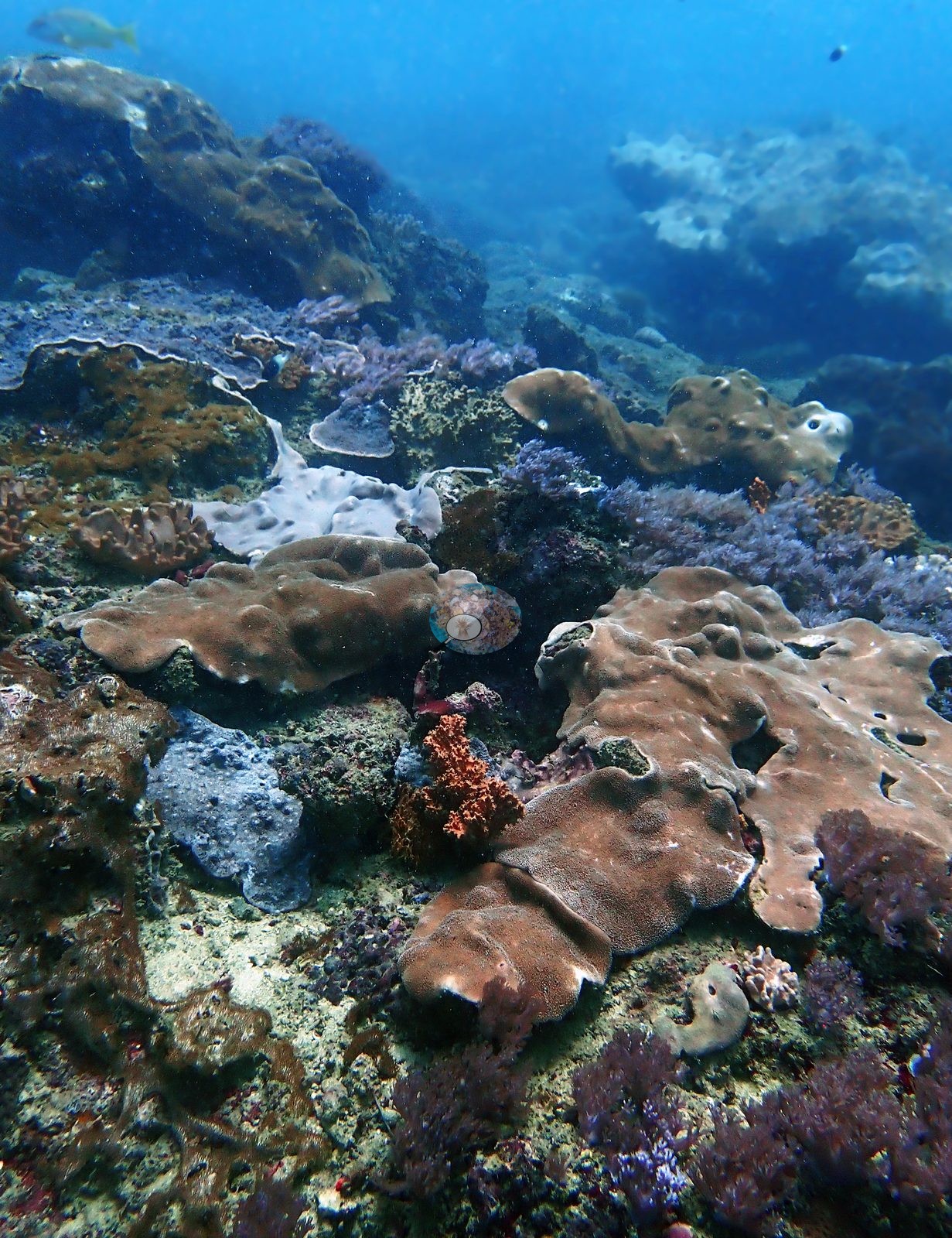
Kenya (NOAA CRW virtual station) · East African Coral Coast ecoregion mean=4.1°C-heating weeksBrain Coral, in Mombasa Marine Park, is a low-relief reef built on massive and plating corals rather than branching thickets, its name earned by an unusually rich set of Platygyra and Lobophyllia-type brain corals alongside huge helmet-shaped Porites domes. Bleaching here was well below the Kenyan average - 46.6% of tissue against a 77.1% mean across the 20 surveyed Kenya sites - with massives and brain corals holding pigment noticeably better than the thinner plate corals; dense schools of bluestripe snapper (one frame captioned 'effective MPA') were a highlight. Published cover was 27%, up from 19.5% at a nearby site surveyed in 2022.
Mwamba wa kijani, wenye mtawanyiko wa mwanga, wa matumbawe makubwa na ya sahani ndani ya Hifadhi ya Bahari ya Mombasa, ambapo matumbawe ya ubongo yenye mikunjo ni kipengele bainifu pamoja na matumbawe laini mengi. Takriban picha moja kati ya sita inaonyesha upaukaji usio na shaka kimuundo, sawa na asilimia 46.6 iliyochapishwa; hakuna nyota za bahari zenye miiba (crown-of-thorns) zinazoonekana katika picha 156.
Tafsiri ya muhtasari huu kwa AI; Kiingereza ndicho kinachotumika rasmi. Translated from the site’s shorter map summary.
Sixteen independent survey stations shown with the program’s logo — click one to see how far it is from this site.
Two other CRD dive sites within 5 km shown in orange — click a marker to open its page.
Site description
Setting
Water and habitat. Mombasa's reputation is earned here: a large share of the wide frames are green, hazy, and backscattered, with the far reef dissolving within a few meters, and one frame is filed by the photographer as "murky waters of Mombasa". A minority of frames -- mostly those shot upward into open water over the deeper bommies -- are genuinely blue and clear. The reef itself is a low- to moderate-relief mosaic: rounded bommies and long runs of encrusting-to-plating pavement, sand and rubble lanes between them, and turf, crustose coralline, and fine sediment on everything not held by living tissue.
General benthic features
There are no branching thickets of any size; this is a massive-and-plate reef. The brain corals. The site name is borne out by the full set in a way the four published frames could not show. Meandroid colonies are one of the defining elements: a meter-scale domed brain coral of Platygyra type, cleanly ridged and photographed square-on; a broad, deeply folded Lobophyllia/Symphyllia type colony in violet; a second large meandroid dome with pale, worn ridges; a compact green meandroid colony sitting in rubble; and smaller Platygyra-type heads recurring in the wide shots. Alongside them sit the other two structural pillars: very large helmet-shaped massive Porites mounds -- four consecutive frames are devoted to a single dome big enough to fill the frame, its crown paled and its flanks still pigmented -- and cerioid Favites/Goniastrea colonies whose deep maroon-brown reticulate corallites are among the most strongly pigmented corals in the entire set. The rest of the community. Laminar and foliose plates are everywhere: Turbinaria-type cups and folded vases, thin Montipora/Echinopora-type sheets with clean white growing margins, ridged Pachyseris-type colonies, and one striking dark plate speckled with white polyps (e.g., Image 3).
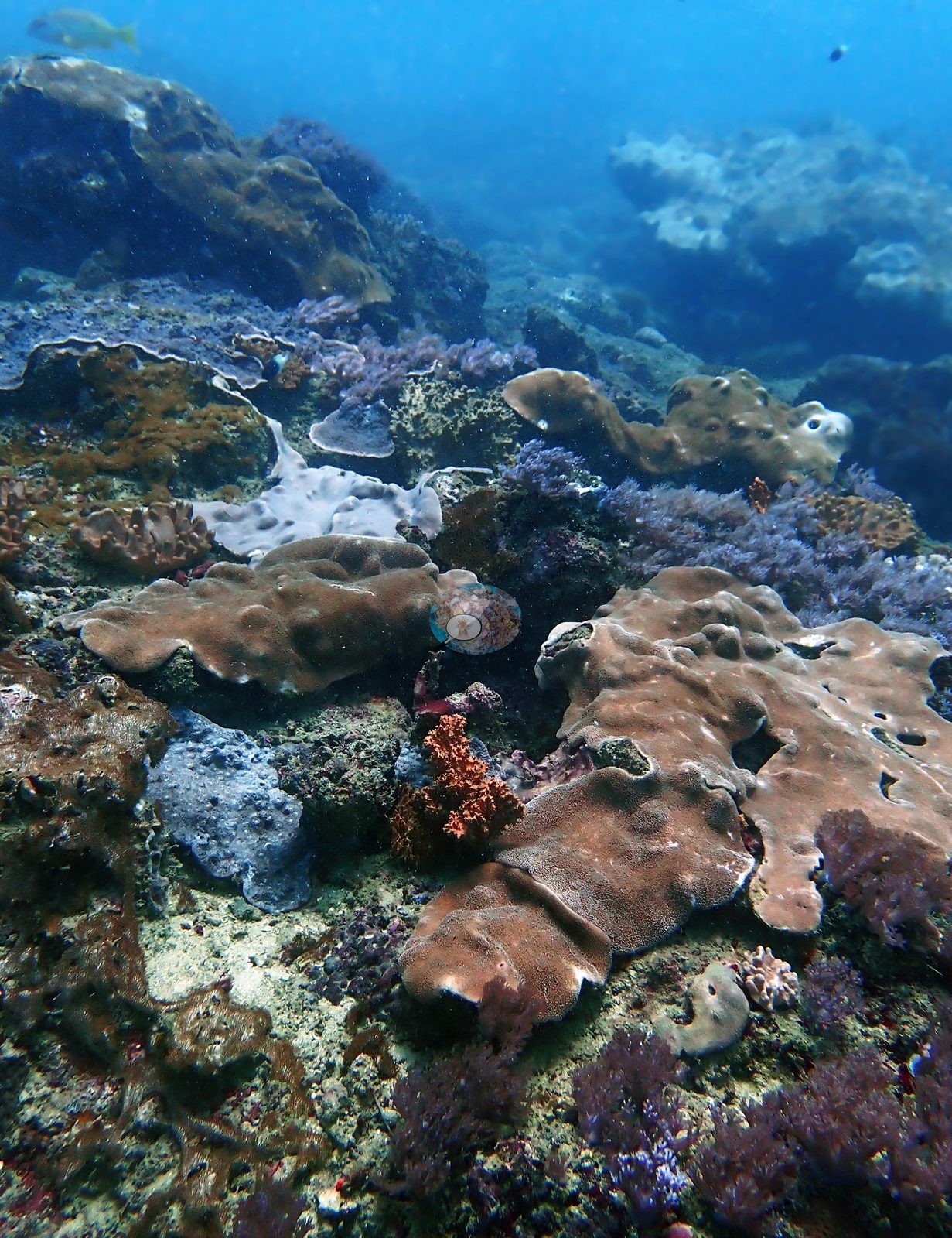
Galaxea appears in close-up with green tentacle tips fully extended and looking untouched. Acropora is present but subordinate -- a few tables, some corymbose colonies with pale tips and stands of fine yellow-brown branching colonies -- and Pocillopora/Stylophora-type verrucose colonies fill gaps between the massives (e.g., Image 4).
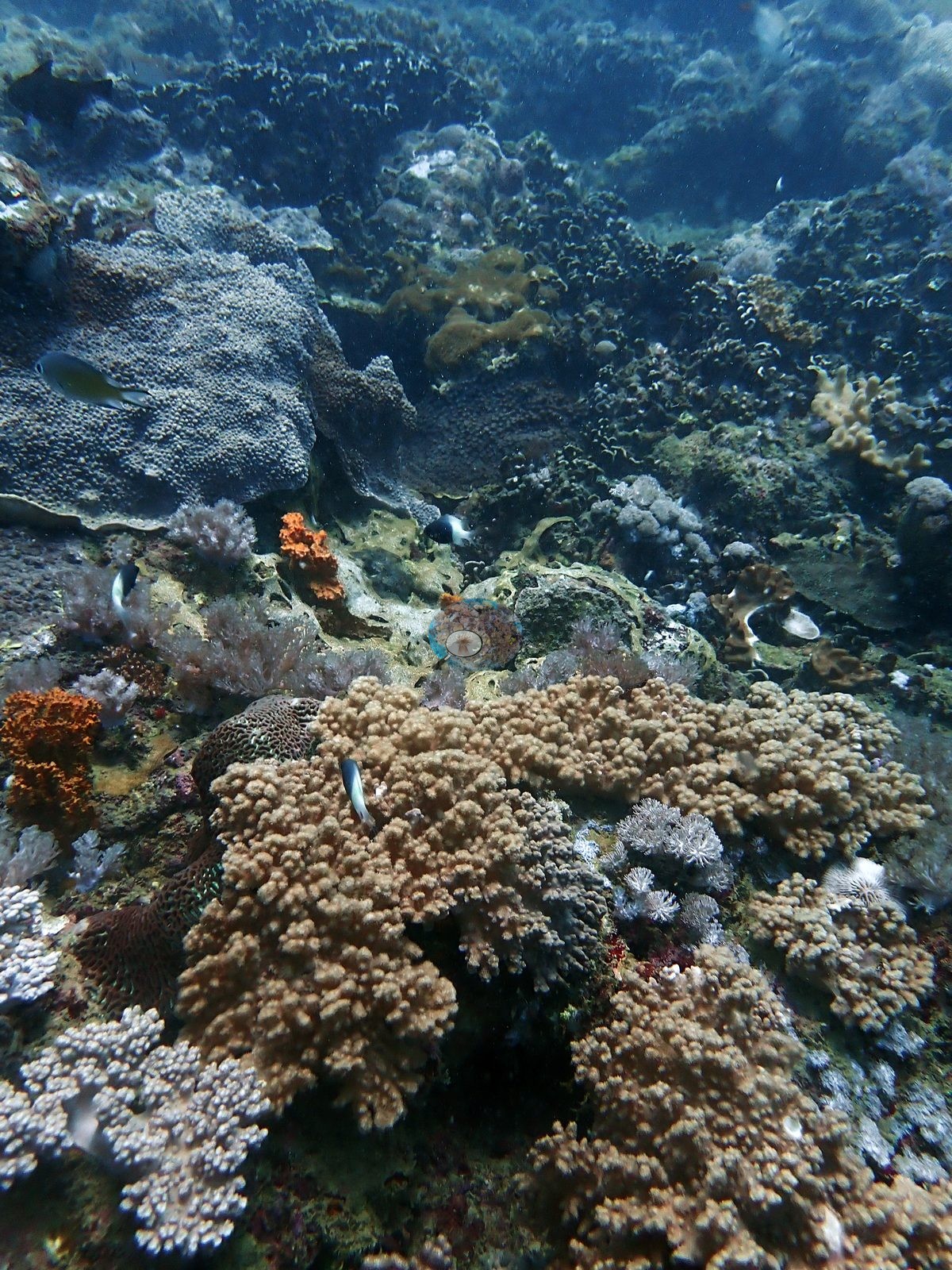
Soft corals are abundant and, in places, dominant: brown Sarcophyton leathers by the dozen, Sinularia, purple and lilac soft-coral fields spread over rubble, and orange-red Dendronephthya-type colonies off the rock (e.g., Image 2).
Coral cover
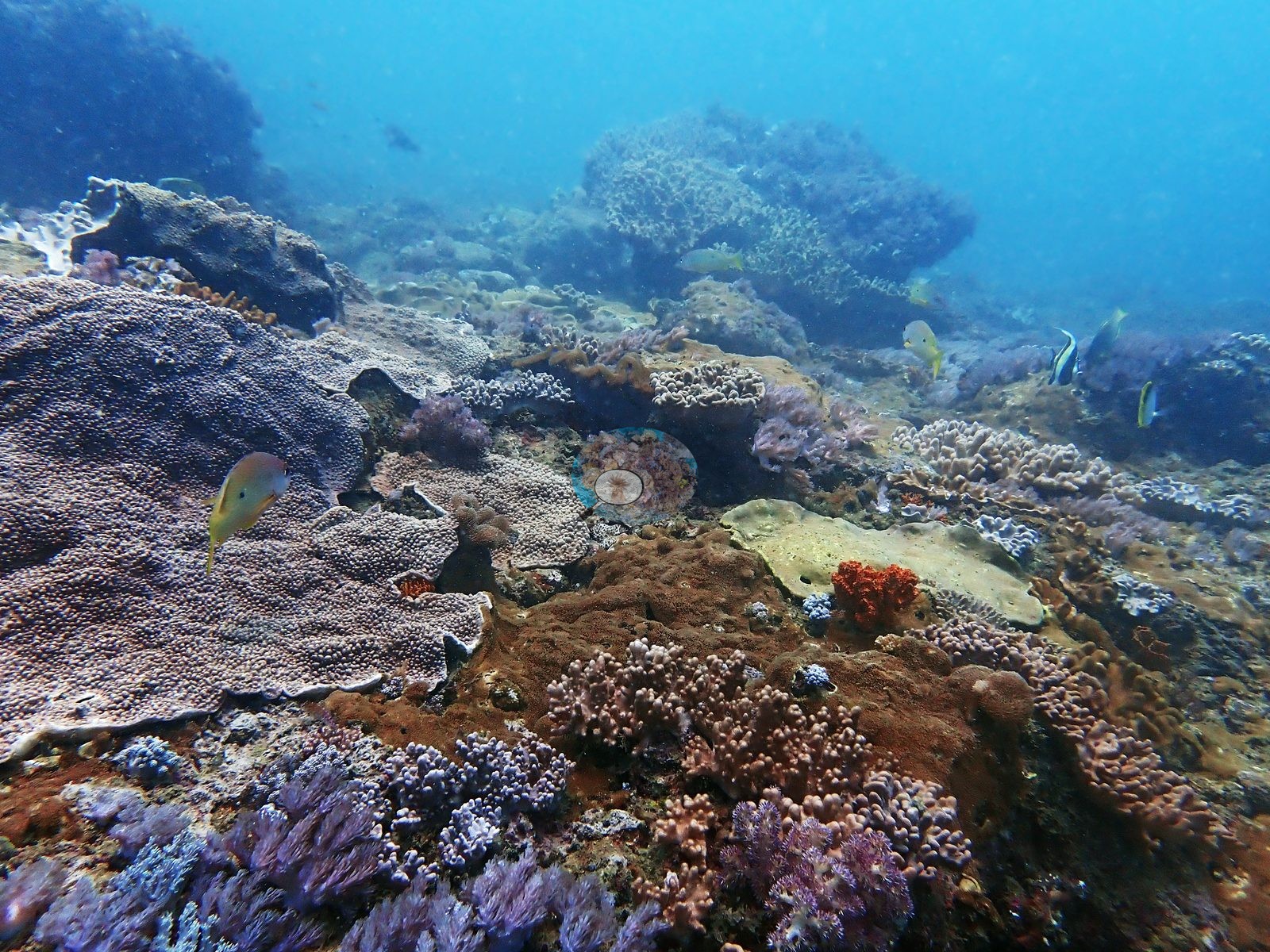
Coral cover 27% -- and 46.6% of hard coral tissue bleached (March-April 2024). Measured from 136 white-balanced photographs taken at this site during the 2024 Western Indian Ocean mass bleaching event and point-annotated in CoralNet, published in Mayfield, A.B. (2025) A Citizen Science Approach for Documenting Mass Coral Bleaching in the Western Indian Ocean. Environments 12(8):276. doi:10.3390/environments12080276. This is a published diver-photograph point-annotation value, not a computer vision estimate.
Stressors
One frame of a free-living Fungia disc shows bare skeleton with the septa still sharp -- recent mortality, not old rubble. Bleaching, read from structure. Roughly one frame in six carries at least one colony that is unambiguously bleached on structural grounds: bone-white foliose and laminar plates standing out against pigmented neighbors; a stark white bulbous colony; a white encrusting sheet with a sharp margin against brown tissue; several chalk-white plates in an otherwise brown plate field; and a large pale plating colony whose surface texture is intact but whose tissue is white throughout. Against that, a great many colonies are plainly still pigmented -- the maroon Favites, the olive-green plates, the brown leathers, most of the massive domes. The impression from the full set is a reef about half-affected, with the massives and the meandroid brains holding pigment better than the thin plates: consistent with the published figure of 46.6% of hard coral tissue bleached, which is far below the 77.1% Kenyan mean. Note again that the frames are color-adjusted, so the widespread lilac and mauve casts are not counted as bleaching here. Typical recent thermal stress: mean annual maximum of 4.1 degree heating weeks (2021-2025, NOAA CRW; East African Coral Coast ecoregion). Also on record for this site: Seawater here measured 32.5°C during the survey (the Kenya survey-wide mean of 32.0°C matched the 1998 event), and NOAA recorded a peak of 13.5 degree-heating weeks on 18 April 2024, the highest for Kenya since records began in 1985. In situ temperatures ran 1.3°C above NOAA's estimates, so the true heat stress was likely nearer 22 DHWs. No crown-of-thorns starfish (COTS) or other corallivores evident.
Fish and other fauna
Fish and macro life. Bluestripe snapper (Lutjanus kasmira) are the signature: dense schools recur in eight separate frames, some hundreds strong, streaming over the bommies with yellow-and-blue-striped sweetlips, emperors, and fusiliers mixed in -- one frame is filed simply as "effective MPA" (e.g., Image 1).
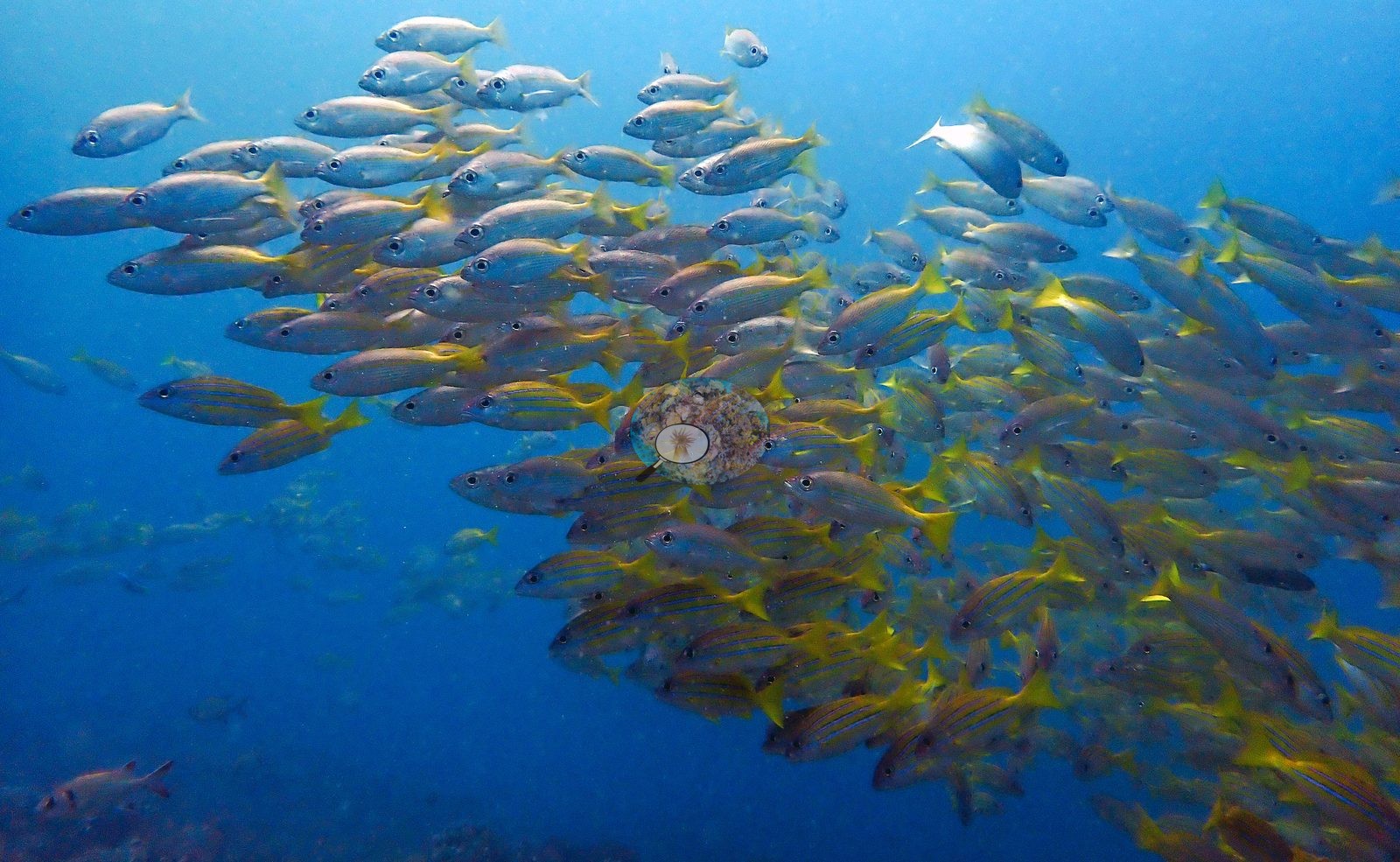
Also recorded: longfin batfish (Platax), a grouper wedged under a plate, parrotfish and wrasse working the rubble, clouds of anthias and cardinalfish over a coral head, damselfish and chromis throughout, two scorpionfish sitting cryptic on coral, a large spotted-black-and-white sweetlips in midwater, a sea cucumber, a blue Linckia sea star and an orange star, and a ray whose tail is visible under a ledge. The nudibranch fauna is unusually well documented for a single dive: a pale blue dorid with a black-and-white dorsal stripe and orange rhinophores photographed five times, a black dorid with orange and yellow spots and a turquoise mantle margin photographed four times, and a Phyllidia varicosa-type colony in blue-gray, black, and yellow in two frames.
Comparisons with other data
No independent survey was made at this exact site; the nearest ones are listed in the table below.
Dive record
Surveyed 11 Mar 2024 at about 12 m with Mombasa Marine Park, during the 2024 Western Indian Ocean mass bleaching event. Surveys were run with Mombasa Marine Park.
Other notes
This account is written from the site's complete photographic record -- 156 frames read one by one -- rather than from the four frames published to the map.
CV model comparison
| Method | Hard-coral cover (%) |
|---|---|
| Manual (published) | 27.4 |
| CoralNet | 27.4 |
| In-house DINOv3 | 42.7 |
| CoralSCOP unedited | 23.7 |
Independent surveys nearby
| Agency / program | Year(s) | Stations / distance | Link |
|---|---|---|---|
| Global bleaching + environmental database | 2016 | 2 stations, 0.55–0.82 km | Records ↓ |
| Mangubhai et al. (2007) | 2003 | 1 station, 1.13 km | Records ↓ |
| McClanahan et al. 2016 | 2016 | 1 station, 4.60 km | Records ↓ |
| WCS Kenya via MERMAID | 2009–2022 | 14 stations, 0.36–1.69 km | Records ↓ |
 Dr. Coral (CRD)Year-average (no detectable trend)
Within 5 km, 18 independent survey stations recorded hard coral cover in 69 records between 2003 and 2022. Of the 1 station surveyed in more than one year, 1 changed by less than 5 percentage points between their first and latest surveys. The longest record, Mombasa (WCS Kenya via MERMAID, 0.80 km away), went from 20% in 2013 to 20% in 2022. One survey since 2021 recorded 20%. This site's own estimate (27%) sits 7.9 points above the recent value (20%); the methods differ, so the comparison is context, not a like-for-like test.
Collected by other programs using different methods (MERMAID is a data platform: each MERMAID row names the organization that did the survey, and its method is in the row's hover text), so these are context for the figures above, not a like-for-like comparison. Where a station was surveyed more than once the range is shown. Station names are not dive-site names.
Show all 18 independent survey records
| Agency | Site / location | Date | Hard coral cover (%) | Distance | Link |
|---|---|---|---|---|---|
| Mangubhai et al. (2007) | Coral Gardens | 2003 | 22% | 1.13 km | HeatCRD database |
| WCS Kenya via MERMAID | Mombasa Starfish | 2009 | 24% (2 images) | 0.93 km | Darling E. 2018. Kenya CRCP legacy. MERMAID |
| WCS Kenya via MERMAID | Mombasa Braincoral | 2009 | 14% (6 images) | 1.32 km | Darling E. 2018. Kenya CRCP legacy. MERMAID |
| WCS Kenya via MERMAID | Taa | 2009 | 14% (2 images) | 1.35 km | Darling E. 2018. Kenya CRCP legacy. MERMAID |
| WCS Kenya via MERMAID | Shark Point 2 | 2009 | 9.7% (6 images) | 1.69 km | Darling E. 2018. Kenya CRCP legacy. MERMAID |
| WCS Kenya via MERMAID | Kasa_Mombasa (mean of 4 surveys, 2009–2010) | 2010 | 19% (12 images) | 0.36 km | Darling E. 2018. Kenya CRCP legacy. MERMAID |
| WCS Kenya via MERMAID | Bamburi Wreck | 2010 | 10% (2 images) | 0.99 km | Darling E. 2018. Kenya CRCP legacy. MERMAID |
| WCS Kenya via MERMAID | Mombasa | 2013–2022 | 20% (4 images) | 0.80 km | Darling E. 2018. Kenya CRCP legacy. MERMAID; Darling E, Kosgei J, McClanahan T, Muthiga N, Oddenyo R. 2022. Kenya-Marine Monitoring_2022. MERMAID |
| WCS Kenya via MERMAID | Mombasa Mushroom (mean of 2 surveys, 2009–2016) | 2016 | 23% (4 images) | 0.55 km | Darling E. 2018. Kenya CRCP legacy. MERMAID |
| WCS Kenya via MERMAID | Mombasa Coral Gardens 3 | 2016 | 23% (2 images) | 0.93 km | Darling E. 2018. Kenya CRCP legacy. MERMAID |
| WCS Kenya via MERMAID | Mombasa Coral Gardens 2 | 2016 | 23% (2 images) | 0.93 km | Darling E. 2018. Kenya CRCP legacy. MERMAID |
| WCS Kenya via MERMAID | Mombasa 2 | 2016 | 18% (4 images) | 1.21 km | Darling E. 2018. Kenya CRCP legacy. MERMAID |
| WCS Kenya via MERMAID | Mombasa 3 | 2016 | 15% (4 images) | 1.26 km | Darling E. 2018. Kenya CRCP legacy. MERMAID |
| McClanahan et al. 2016 | RasIwatine (Kenya) | 2016 | 22% | 4.60 km | — |
| Global bleaching + environmental database | Mushroom | 2016-04-10 | 31% | 0.55 km | — |
| Global bleaching + environmental database | Coral Gardens 1 | 2016-05-12 | 23% | 0.82 km | — |
| WCS Kenya via MERMAID | Mombasa Green turtle | 2017 | 54% (3 images) | 0.36 km | Darling E. 2018. Kenya CRCP legacy. MERMAID |
| WCS Kenya via MERMAID | Mombasa Coral Gardens (mean of 6 surveys, 2009–2017) | 2017 | 21% (12 images) | 0.93 km | Darling E. 2018. Kenya CRCP legacy. MERMAID |
Data & links
- CoralNet image repository for this region ↗
- HeatCRD database ↗
- (reference) ↗
- Coral Reef Diagnostics page for this area ↗
All images from Coral Reef Diagnostics. Data are from Coral Reef Diagnostics and the organizations named in the data-sources table above.
© Coral Reef Diagnostics.
References
- Mangubhai S, Harrison P, Obura D (2007). Patterns of coral larval settlement on lagoon reefs in the Mombasa Marine National Park and Reserve, Kenya. Marine Ecology Progress Series 348:149-159. PDF
- Mayfield AB (2025). A Citizen Science Approach for Documenting Mass Coral Bleaching in the Western Indian Ocean. Environments 12:276. PDF