
Kenya - Bofa (Kilifi)
Part of the regional summary: Kenya
More info
Kenya (NOAA CRW virtual station) · East African Coral Coast ecoregion mean=4.1°C-heating weeksBofa, in Kilifi, had severe bleaching (88.3% of tissue) that overturned the usual pattern - the most completely bleached colonies here were massive Porites domes and brain corals, not the branching Acropora, while foliose Turbinaria plate corals were the clear survivors. This site's real story is crown-of-thorns predation: at least nine or ten individual starfish were confirmed across the photographs, repeatedly found draped directly onto already-bleached coral. Published cover was 32%.
Mwamba wa sakafu ngumu na mawe nje ya Bofa, Kilifi, katika maji safi zaidi kuliko Ghuba ya Kilifi iliyo jirani, uliopigwa picha wakati wa tukio la upaukaji mkubwa wa Bahari ya Hindi Magharibi la 2024. Nyota tisa hadi kumi tofauti za bahari zenye miiba zilithibitishwa katika picha 14, mara kwa mara zikiwa zimetandaa juu ya koloni zilizopauka, na Porites makubwa na Platygyra yalikuwa…
Tafsiri ya muhtasari huu kwa AI; Kiingereza ndicho kinachotumika rasmi. Translated from the site’s shorter map summary.
One other CRD dive site within 5 km shown in orange — click a marker to open its page.
Site description
Setting
The full photo set confirms the character the four published frames suggested: water clearer than at neighboring Kilifi Bay, a blue-green rather than gray cast, and a genuine hardground-and-boulder reef with relief, broken by clean sand channels and sand-floored gaps between rock.
General benthic features
The community is mixed and structurally intact. Massive Porites domes and lobate colonies, meandroid Platygyra brains, broad monospecific stands of foliose Turbinaria, corymbose and digitate Acropora, Pocillopora, encrusting Montipora plates, favids, and cream Sarcophyton leathers all recur across the set. The rock between colonies is heavily carpeted in dark red fleshy macroalgae and turf, with green Halimeda-type patches.
Coral cover
Coral cover 32% -- and 88.3% of hard coral tissue bleached (March-April 2024). Measured from 97 white-balanced photographs taken at this site during the 2024 Western Indian Ocean mass bleaching event and point-annotated in CoralNet, published in Mayfield, A.B. (2025) A Citizen Science Approach for Documenting Mass Coral Bleaching in the Western Indian Ocean. Environments 12(8):276. doi:10.3390/environments12080276. This is a published diver-photograph point-annotation value, not a computer vision estimate. Across the 20 Kenyan sites the mean was 30% coral cover and 77.1% of tissue bleached.
Stressors
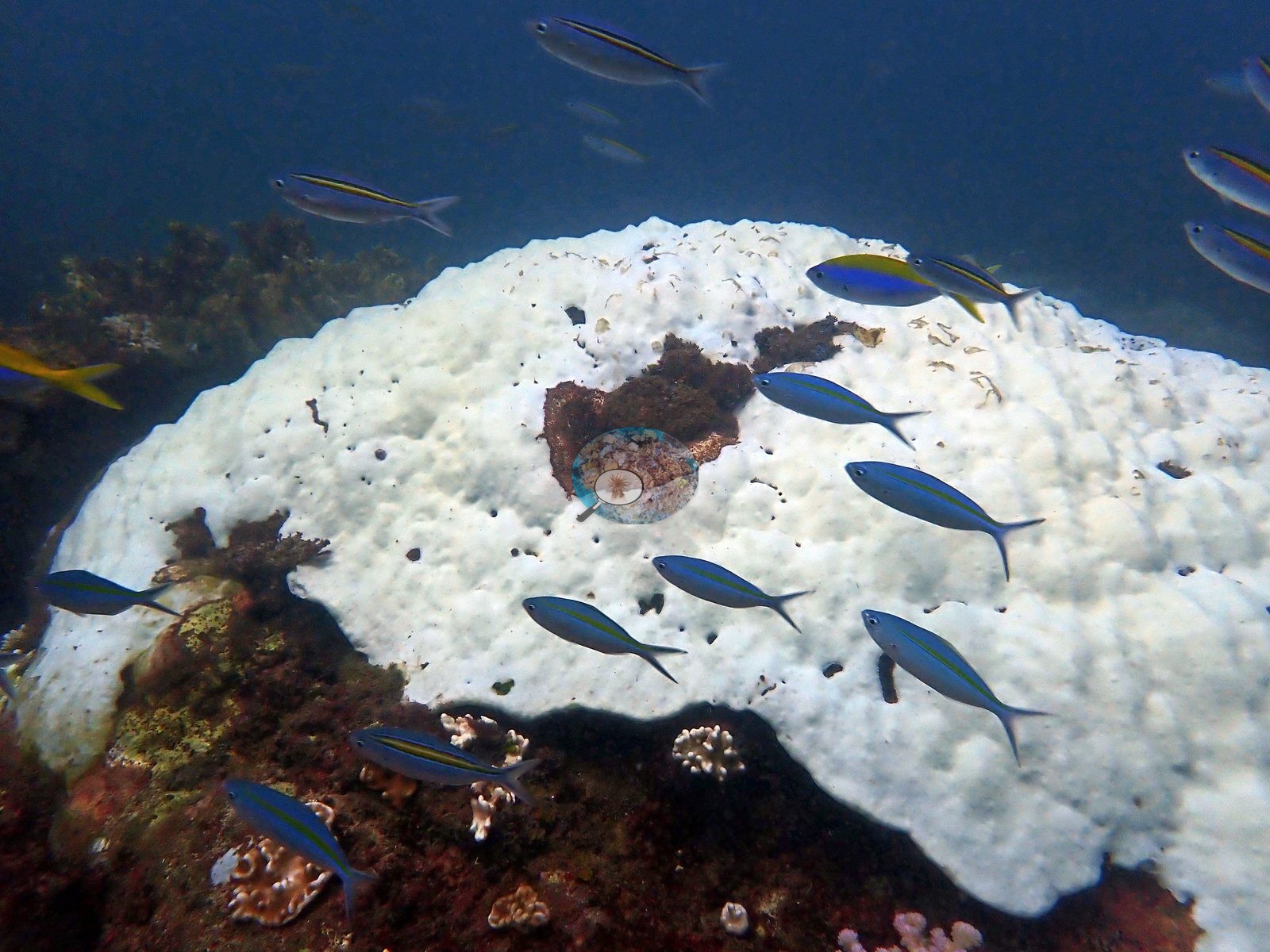
On bleaching, the full set overturns the earlier reading that the massive corals were largely spared. The most completely bleached colonies at this site are massive ones. A meter-plus Porites dome is bleached porcelain-white across its whole surface with two brown patches where tissue is already gone; a second large massive Porites is stark white in another of Anderson's own frames; and further white massive and lobate colonies appear in six more frames (e.g., Image 1).
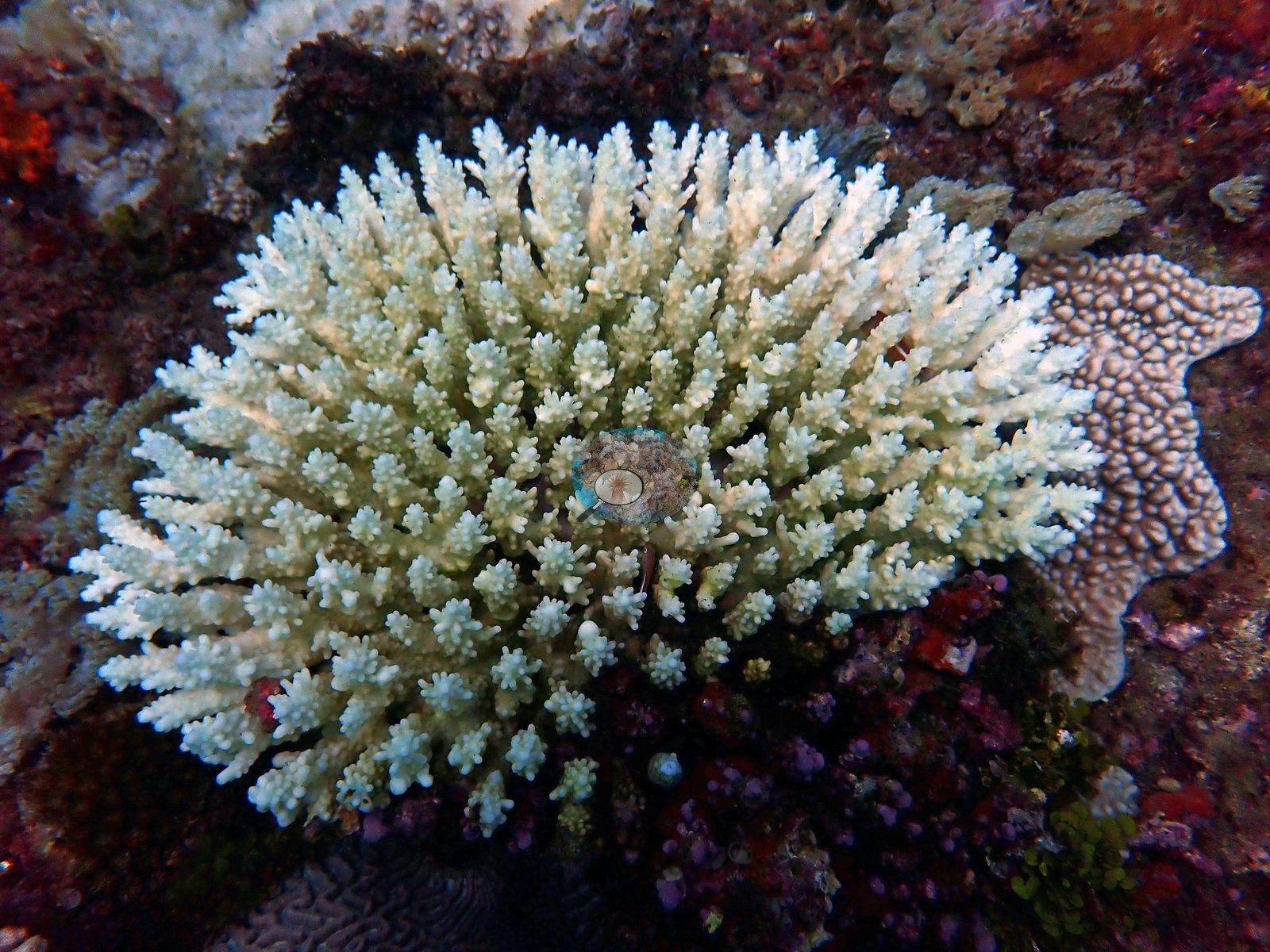
A close-up of one massive Porites shows it white except for a single narrow band of retained brown. The Platygyra brains follow the same pattern rather than resisting it: one large brain has gone uniformly pale gray-white, another is split roughly two-thirds bleached and one-third olive-brown, and a third is white with algal patches. A minority of massive colonies did hold pigment, and they are worth naming because they are the exception, not the rule: a salmon-brown Porites sitting immediately beside a pale one, a mottled mauve-brown dome, a tan Porites, a cream-tan lobate colony, a fully pink Platygyra, and a mauve-pink knobby colony. The group that most conspicuously kept its color at Bofa was the foliose Turbinaria. Olive, tan, and gold plate stands run through five frames, and another is a broad olive-tan Turbinaria field with only one white colony in it. So the reef does read two-tier, but the tiers are the other way round from the earlier description: the plates held pigment better than the boulders. Acropora sits with the boulders on the losing side, mostly bone-white, some pale cream-yellow, and only occasionally still pink or tan (including the pigment gradient visible within one stand) (e.g., Image 2).
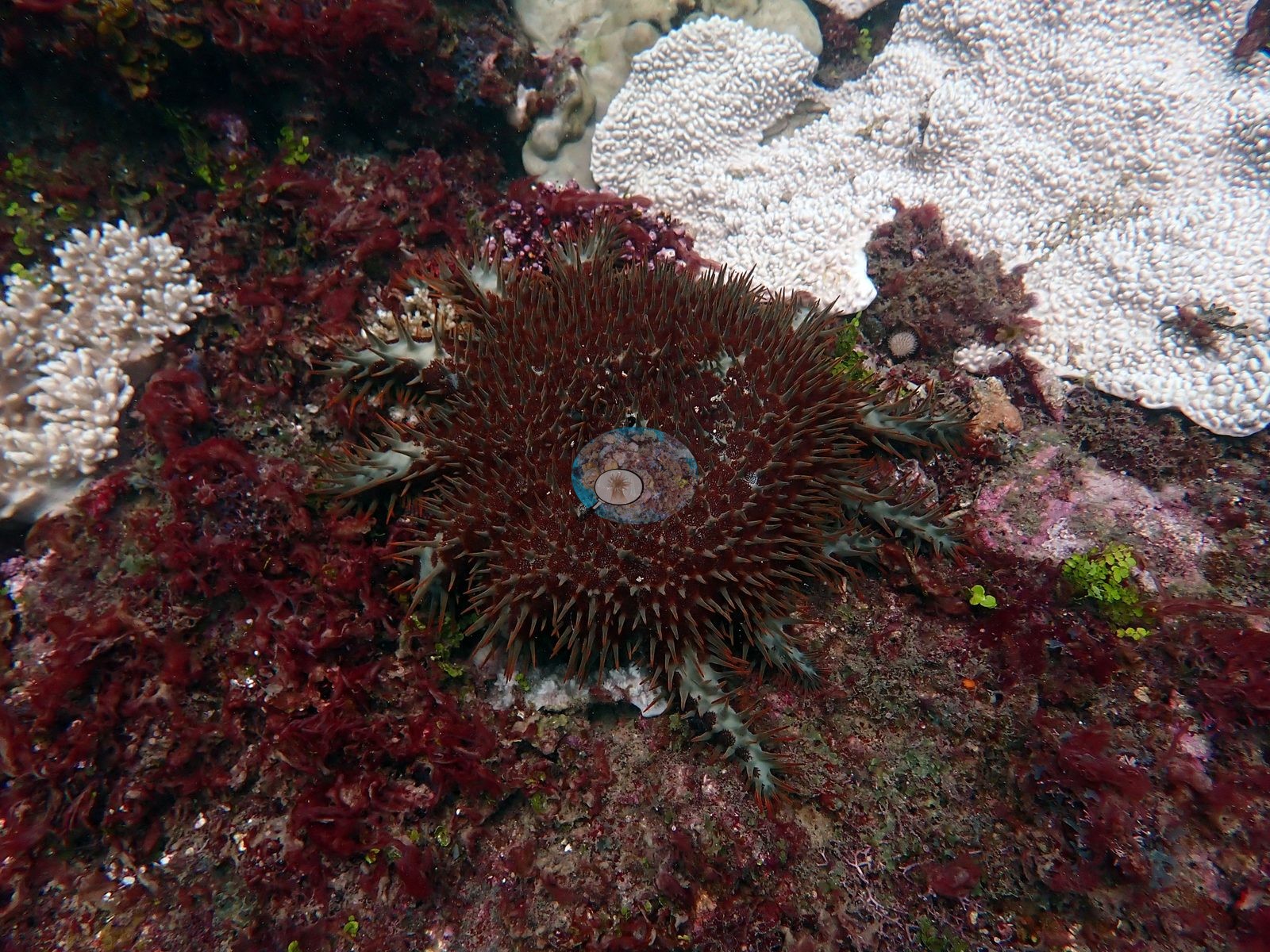
Crown-of-thorns predation is the site's real story and the full set settles its scale. Acanthaster appear in 14 of the 95 frames reviewed, and at least nine distinct individuals can be confirmed -- probably ten. Two frames each hold two animals at once: one has a seastar above and one below the same white bleached corymbose Acropora, and the other has two on the reef beneath a bleached Acropora stand. The rest are separable by scene and color morph, which ranges from dark maroon and purple with blue-gray banded arms to olive-black with pale spines (e.g., Image 3).
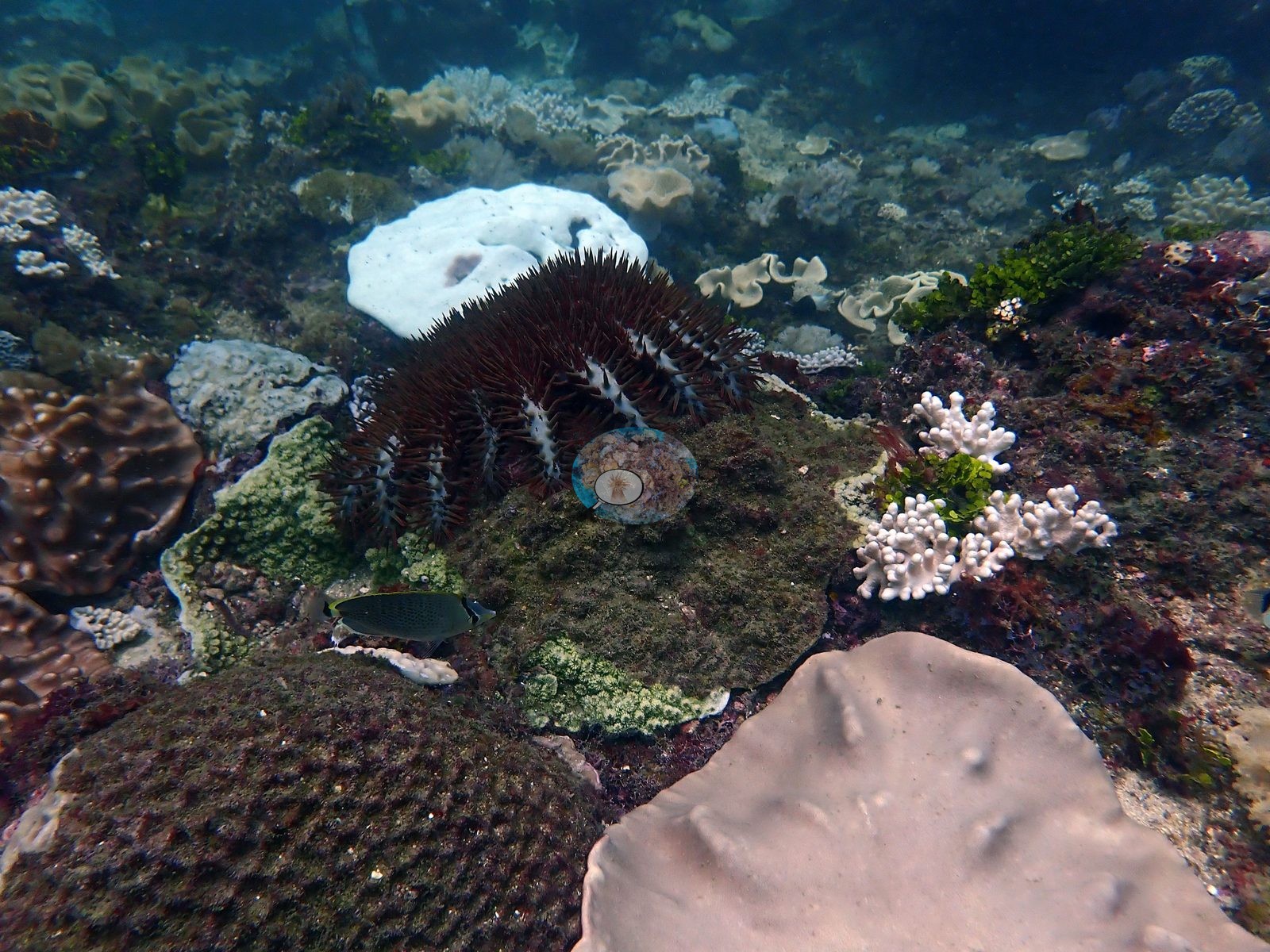
They are repeatedly draped directly onto bleached tissue -- on a stark white plate, over a white dome, hard against white Acropora -- which is predation stacked on top of thermal stress rather than either alone (e.g., Image 4).
Typical recent thermal stress: mean annual maximum of 4.1 degree heating weeks (2021-2025, NOAA CRW; East African Coral Coast ecoregion). Seawater here measured 31.3°C during the survey (the Kenya survey-wide mean of 32.0°C matched the 1998 event), and NOAA recorded a peak of 13.5 degree-heating weeks on 18 April 2024, the highest for Kenya since records began in 1985. In situ temperatures ran 1.3 degrees C above NOAA's estimates, so the true heat stress was likely nearer 22 DHWs.
Fish and other fauna
Several other seastars in the set are not Acanthaster and should not be counted with them: smooth five-armed salmon and orange species in six frames, and blue Linckia laevigata in two frames. Other fauna recorded: aggregated black Diadema urchins under a pigmented overhang and on the reef top; a spotted sea cucumber; a bright orange gastropod among the red macroalgae; small red-and-white gobies sheltering in a bleached Acropora; a loose school of fusiliers streaming across the bleached dome; and a large Heteractis-type anemone that is itself pale and cream, still holding anemonefish.
Comparisons with other data
No prior survey data from this site. If you would like to share yours, please email us.
Dive record
Dived 26 Mar 2024 at about 11 m off Bofa, Kilifi, during the 2024 Western Indian Ocean mass bleaching event. Surveys were run with 3 Degrees South.
CV model comparison
| Method | Hard-coral cover (%) |
|---|---|
| Manual (published) | 32.4 |
| CoralNet | 34.0 |
| In-house DINOv3 | 47.6 |
| CoralSCOP unedited | 26.6 |
Data & links
- CoralNet image repository for this region ↗
- Photo portfolio ↗
- Coral Reef Diagnostics page for this area ↗
All images from Coral Reef Diagnostics. Data are from Coral Reef Diagnostics.
© Coral Reef Diagnostics.