
Indonesia - Komodo NP: Padar Island (Padar Kecil)
Part of the regional summary: Indonesia - Komodo
More info
East Nusa Tenggara (NOAA CRW virtual station) · Lesser Sunda ecoregion mean=6.9°C-heating weeksA Komodo site built around a small wrecked fishing boat, its hull fouled with turf, tunicates, and barnacles, where the 5-10 m band is almost wall-to-wall soft coral in rust, orange, olive, and lavender despite the high cover figure. Hundreds of mushroom corals were piled in the shallows, and a superbly camouflaged frogfish was photographed.
Satu penyelaman, 23 Januari 2019, 14:40, 65 menit, kedalaman maksimum 22.3 m menurut catatannya, 25.6 derajat C, jarak pandang 5-10 m, dan arus lemah, di lokasi yang terbentuk di sekitar bangkai perahu nelayan kecil.
Terjemahan ringkasan ini oleh AI; versi bahasa Inggris yang berlaku. Translated from the site’s shorter map summary.
Site description
General benthic features
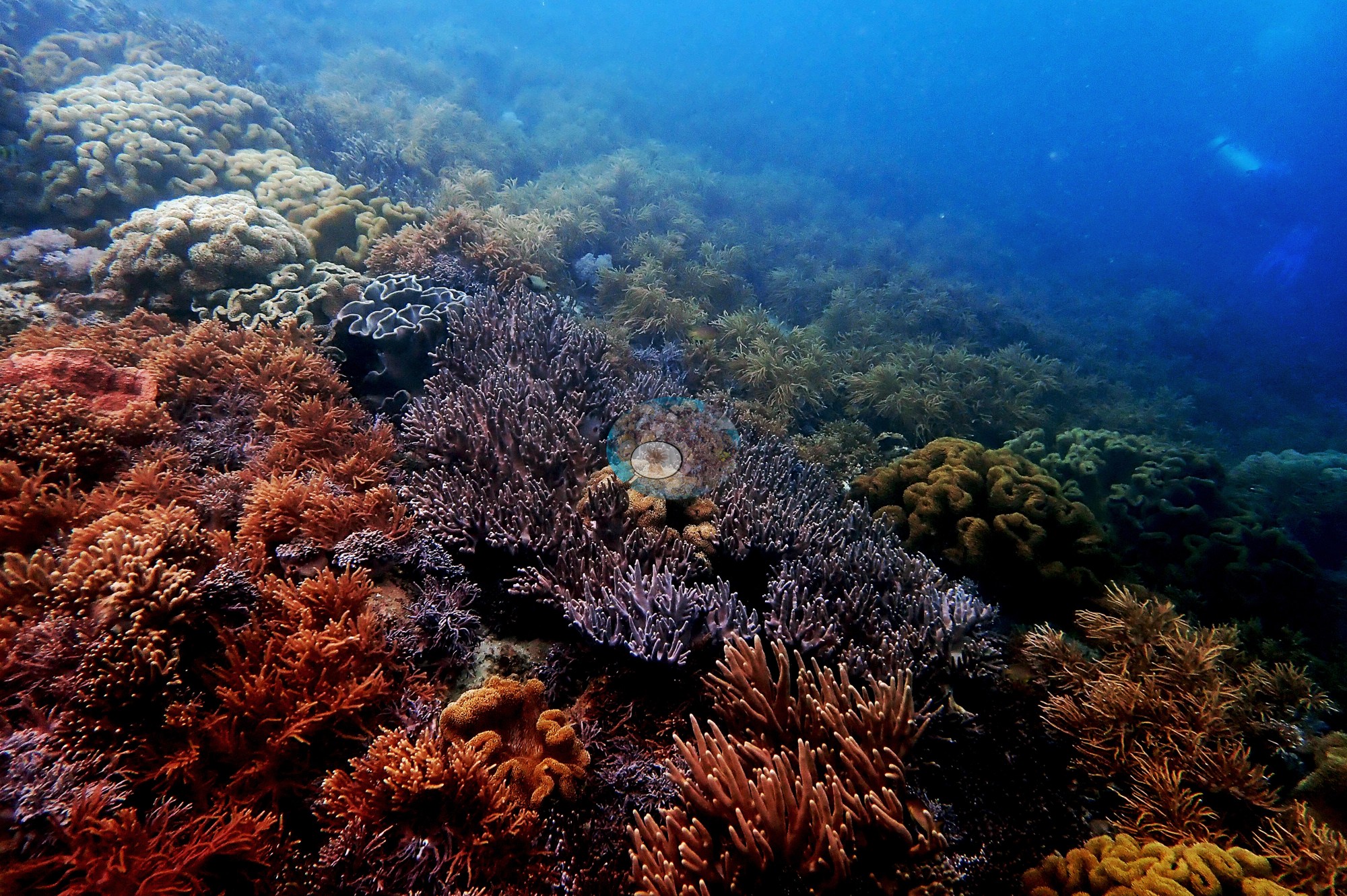
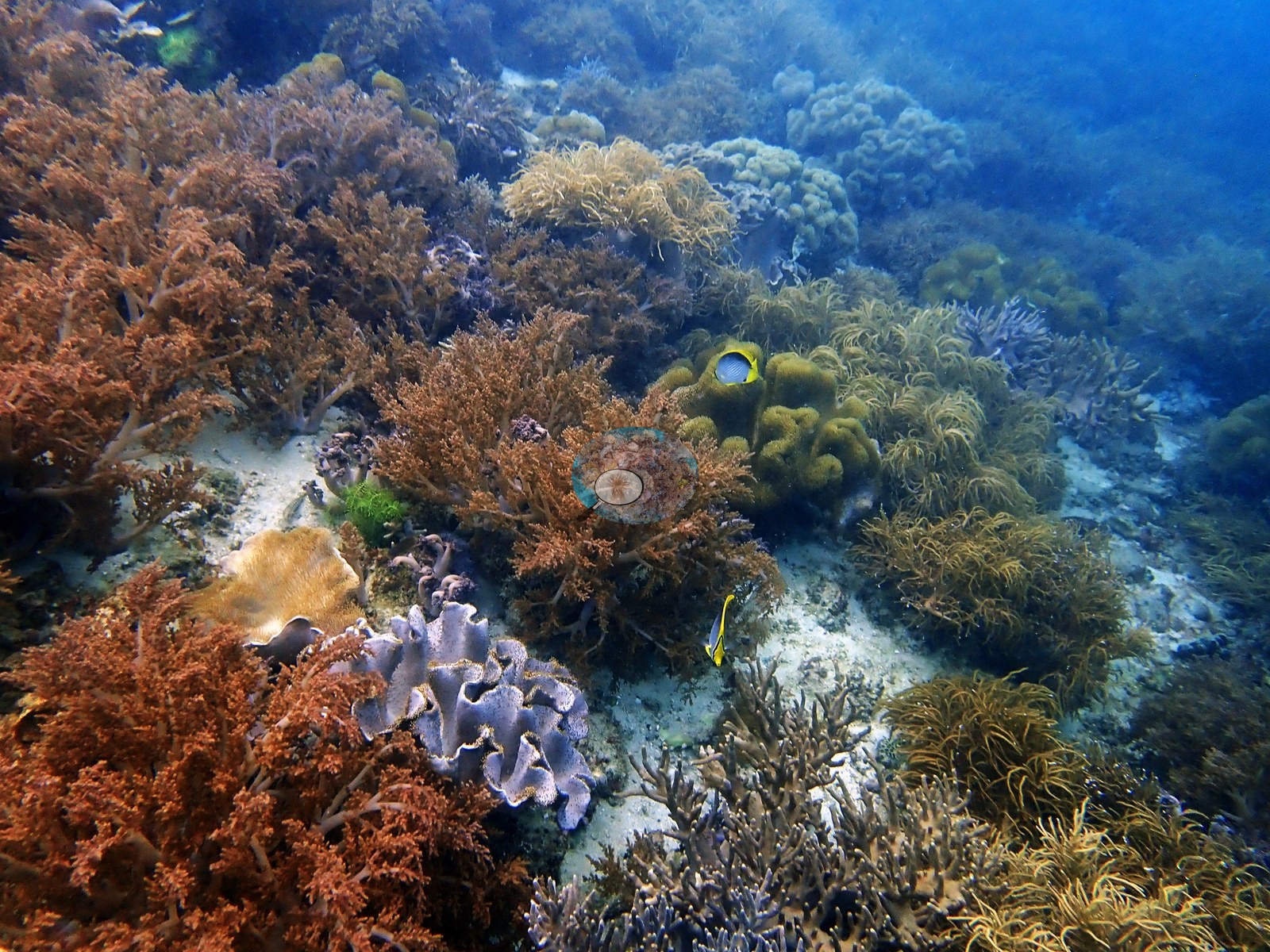
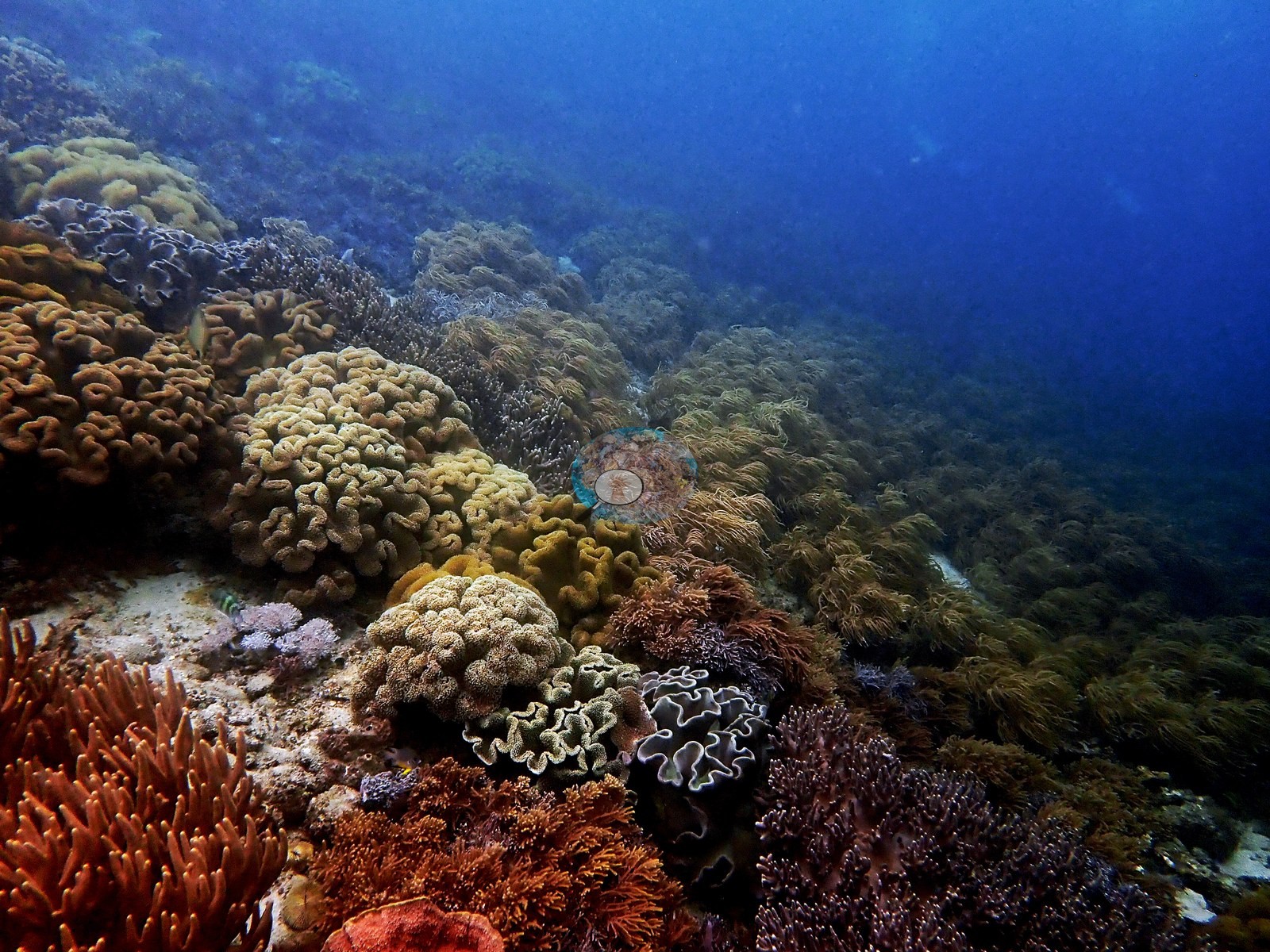
The photographs are dominated by soft coral, which is worth saying plainly because this site carries a high cover figure. Two wide frames are almost wall-to-wall octocoral: rust and orange Sinularia trees, olive-green tufted soft corals, cream and lavender convoluted leathery colonies of the Lobophytum and Sarcophyton type, and rust-red nephtheids, running unbroken into blue water with only narrow white sand channels and a tan plating coral for contrast; a blue-and-yellow butterflyfish, a longnose butterflyfish, and a parrotfish are the fish in frame (e.g., Image 4, Image 5).
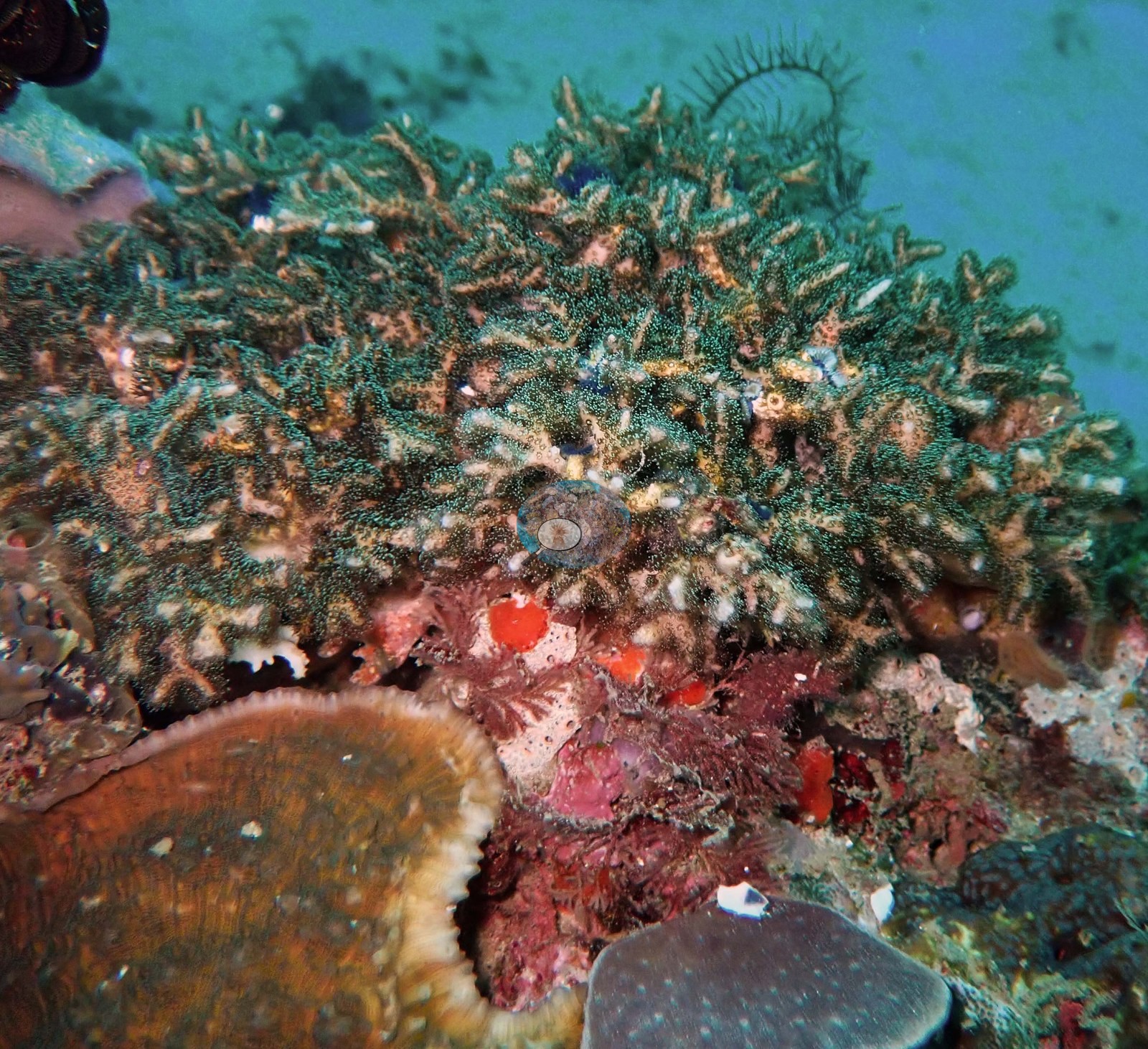
This is exactly the belt he logged as nearly all soft coral from 5 to 10 m, blanketing the benthos. The hard coral evidence is one close frame: a dark green branching Acropora bush with pale and bare branch tips, and immediately below it a large orange-brown mushroom coral with a pale margin - one of the hundreds of fungiids he found piled at 2-4 m - set among red sponge, magenta crustose coralline algae, and a crinoid (e.g., Image 1).
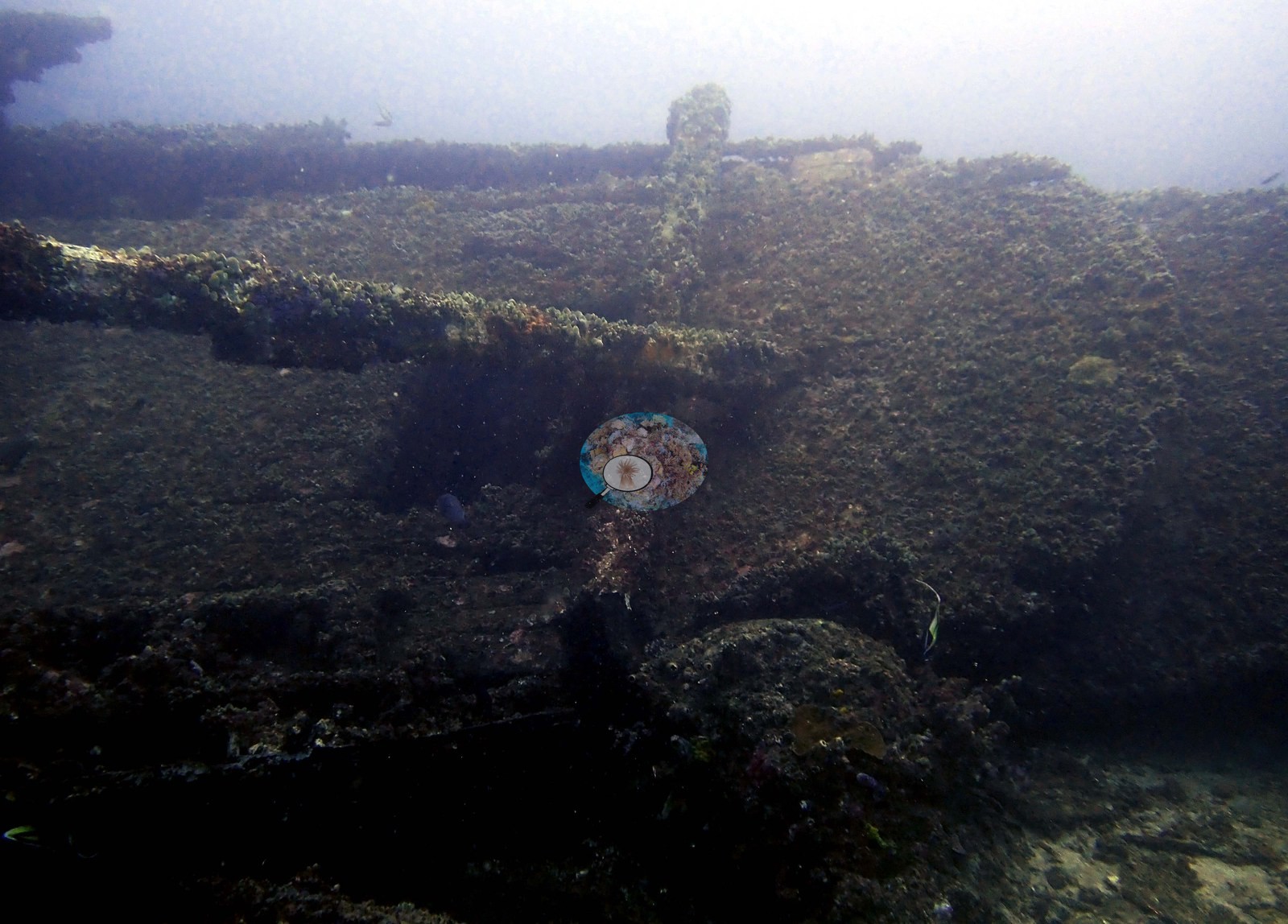
One frame is the wreck itself: a hazy view along a heavily fouled hull, uniformly coated in turf and green fouling growth with a dark hold opening, and no coral recruits visible at that scale, consistent with his note that it carried urn tunicates and barnacles but few recruits (e.g., Image 2).
Coral cover
Coral cover: 8.1% — a blind Claude computer-vision point count of 56 of Anderson's edited photographs (20 points per photo; water, fish, and obstructions excluded). Other computer-vision methods are listed in the method table.
Stressors
No bleaching or disease lesions are resolvable. No crown-of-thorns starfish (COTS) or other corallivores evident.
Fish and other fauna
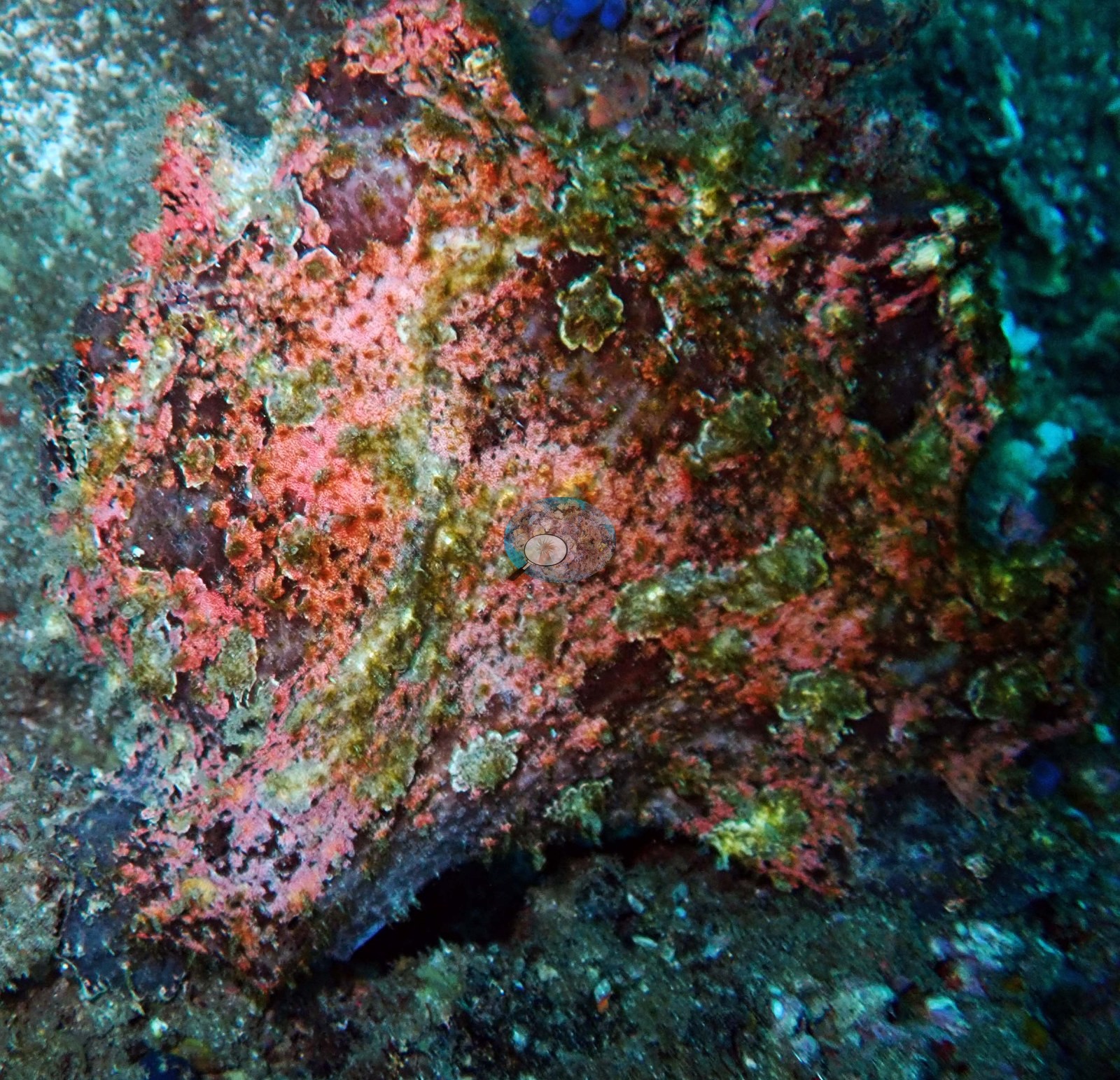
The last frame is a superbly camouflaged frogfish, pink and olive mottled to match the coralline-encrusted rock it sits on, betrayed only by its mouth line (e.g., Image 3).
Comparisons with other data
Also on record for this site: Got good pictures and even a video to show how abundant they were. Flying gurnard (second of trip/life), Stylophora pistillata, sand @ 14 m (with garden eels). Small coral bommies at 15 m but mostly sand. Cool, CCA-coated scorpionfish, larval nudibranchs growing on soft coral. Plerogyra, Pachyseris, never-before-seen ascidian (colonial), first pipefish of trip, 1 Pocillopora acuta, beautiful mantis shrimp (got good pics). Also featured tunicates and damselfish nests. Fungia only hard coral common above 5 m, though some Acropora tables also present.
Dive record
One dive, 23 January 2019, 14:40, 65 minutes, max 22.3 m by his log, 25.6 degrees C, 5-10 m visibility, and weak current, on a site built around a small wrecked fishing boat.
CV model comparison
More info
DINOv3 and CoralSCOP were run on the same photos and are listed for comparison. Coralscapes v2 and v1 were also run but are not shown: Anderson does not consider Coralscapes reliable for these photos. No diver transect exists for this trip, so agreement between the rows is not accuracy, and as of September 2026 no computer-vision method estimates coral cover accurately on new images; treat every row as indicative.| Method | Hard-coral cover (%) |
|---|---|
| In-house DINOv3 | 24.0 |
| CoralSCOP edited | 45.8 |
| Claude (edited photos) | 8.1 |
Dive history
| Date | Time in | Max depth (m) | Bottom time (min) |
|---|---|---|---|
| 2019-01-23 | 14:40 | 22.3 | — |
Data & links
All images from Coral Reef Diagnostics. Data are from Coral Reef Diagnostics.
© Coral Reef Diagnostics.