
Indonesia - Komodo NP: Nando Point

Part of the regional summary: Indonesia - Komodo
More info
East Nusa Tenggara (NOAA CRW virtual station)A night dive at Nando Point that Anderson noted would have been a beautiful reef dive by day — tons of hard coral — though the usual nocturnal critter parade didn't show, and the photographs are mostly polyp and invertebrate close-ups.
Penyelaman malam di Nando Point yang menurut catatan Anderson akan menjadi penyelaman terumbu yang indah pada siang hari - banyak sekali karang keras - meskipun parade hewan kecil malam yang biasa tidak muncul, dan foto-fotonya sebagian besar adalah close-up polip dan invertebrata.
Terjemahan ringkasan ini oleh AI; versi bahasa Inggris yang berlaku.
Two independent survey stations shown with the program’s logo — click one to see how far it is from this site.
Site description
Setting
Anderson's log describes tons of hard coral here, enough that it would have been a beautiful reef dive by day.
General benthic features
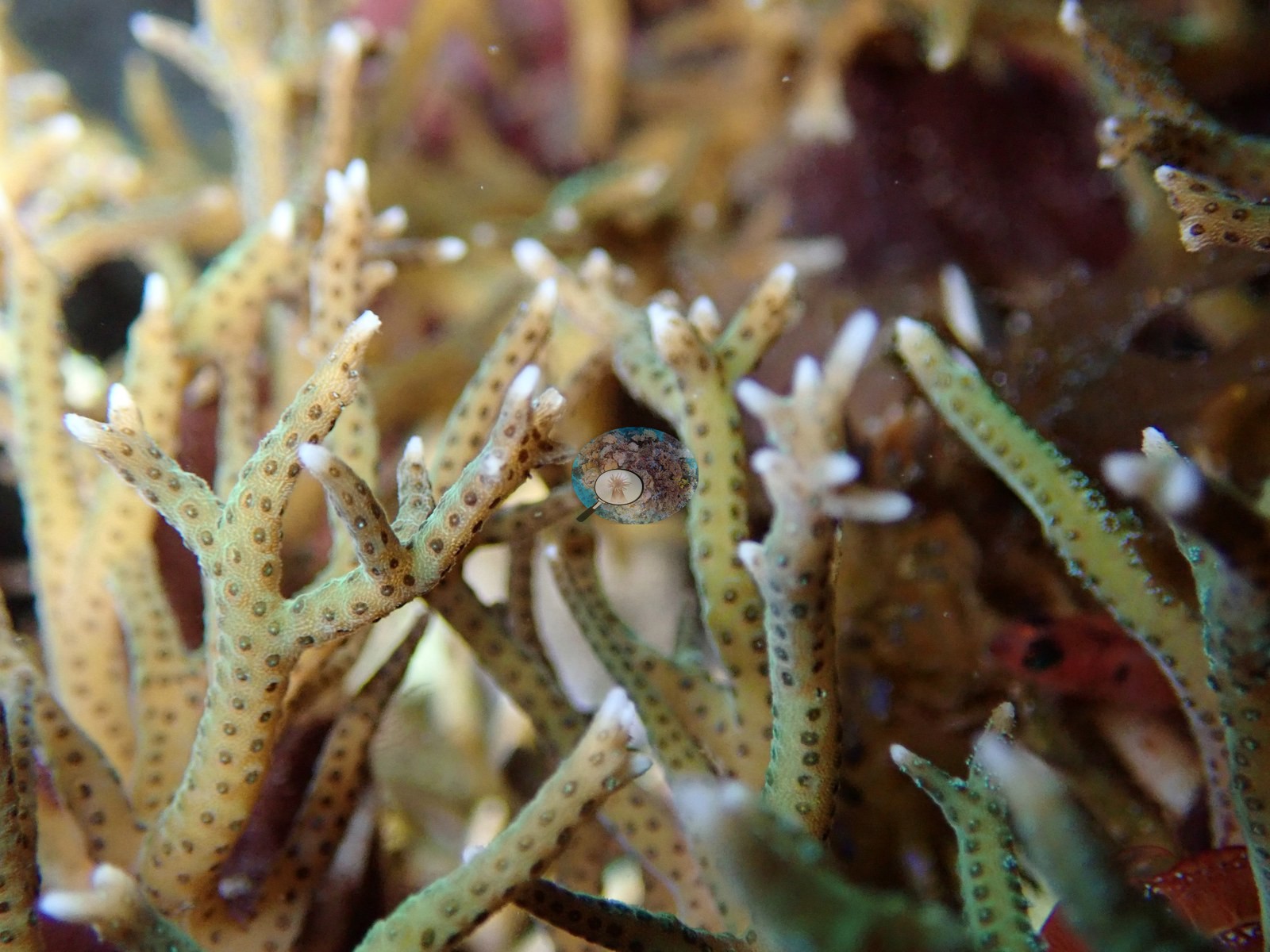
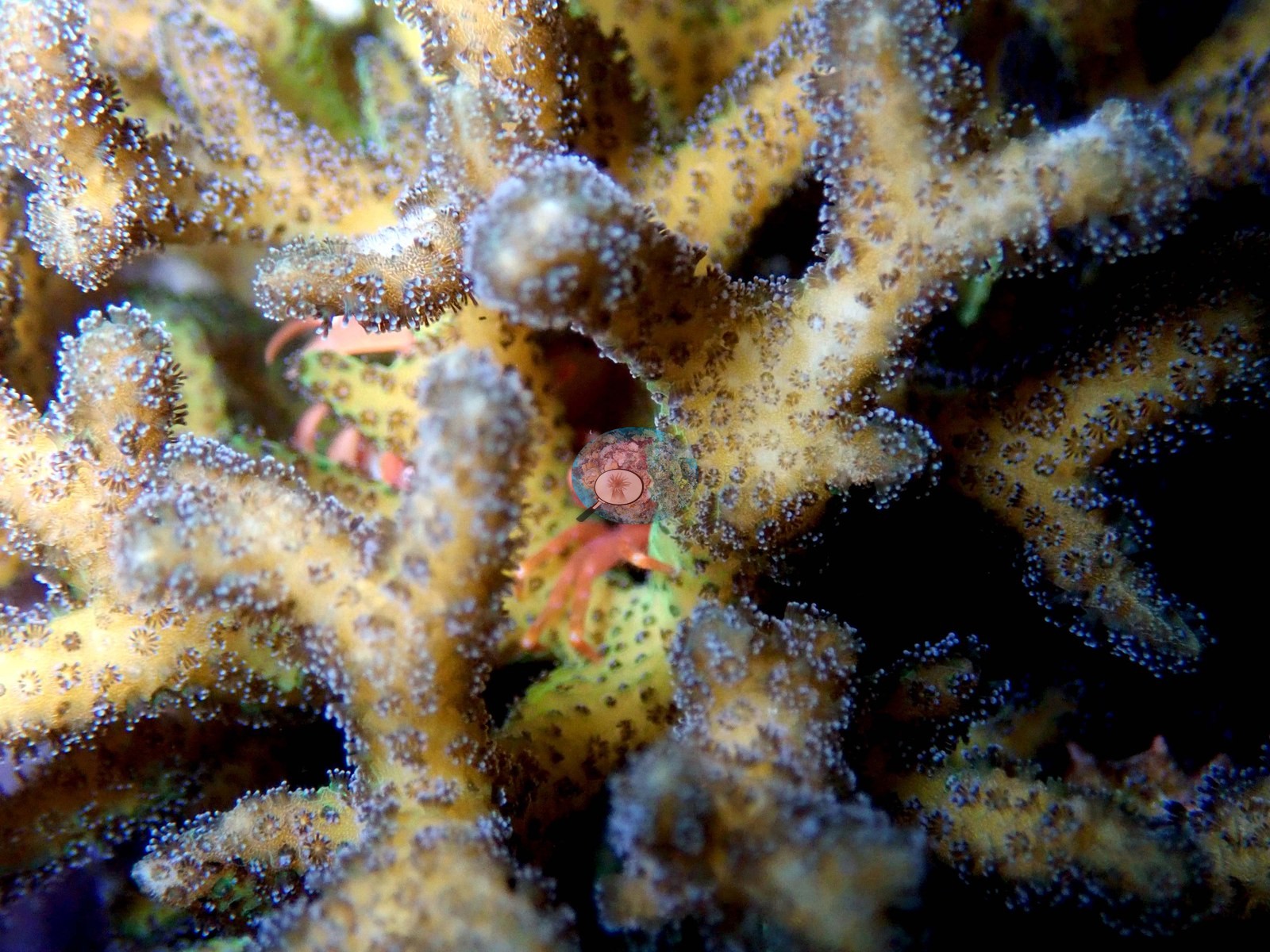
The five photographs are night close-ups, so they cannot show the reef at habitat scale. Two of them are close studies of what the log says Anderson went after — polyps. Branching coral tips fill the frame with every polyp fully extended, tiny tentacle crowns standing out in silver-gray rings over yellow-tan and green-tinged branches, with small scarlet crustaceans tucked deep in the branch axils (e.g., Image 4, Image 5).
Coral cover
- No coral-cover figure is published for this site.
- Nothing on the map attaches a coral-cover measurement to this site — the account above is descriptive background, not a survey result.
Stressors
Anderson's dive log for this night dive (19 January 2019) notes tons of hard coral and great conditions, and records no bleaching, disease, or other stressor. No crown-of-thorns starfish (COTS) or other corallivores were evident.
Fish and other fauna
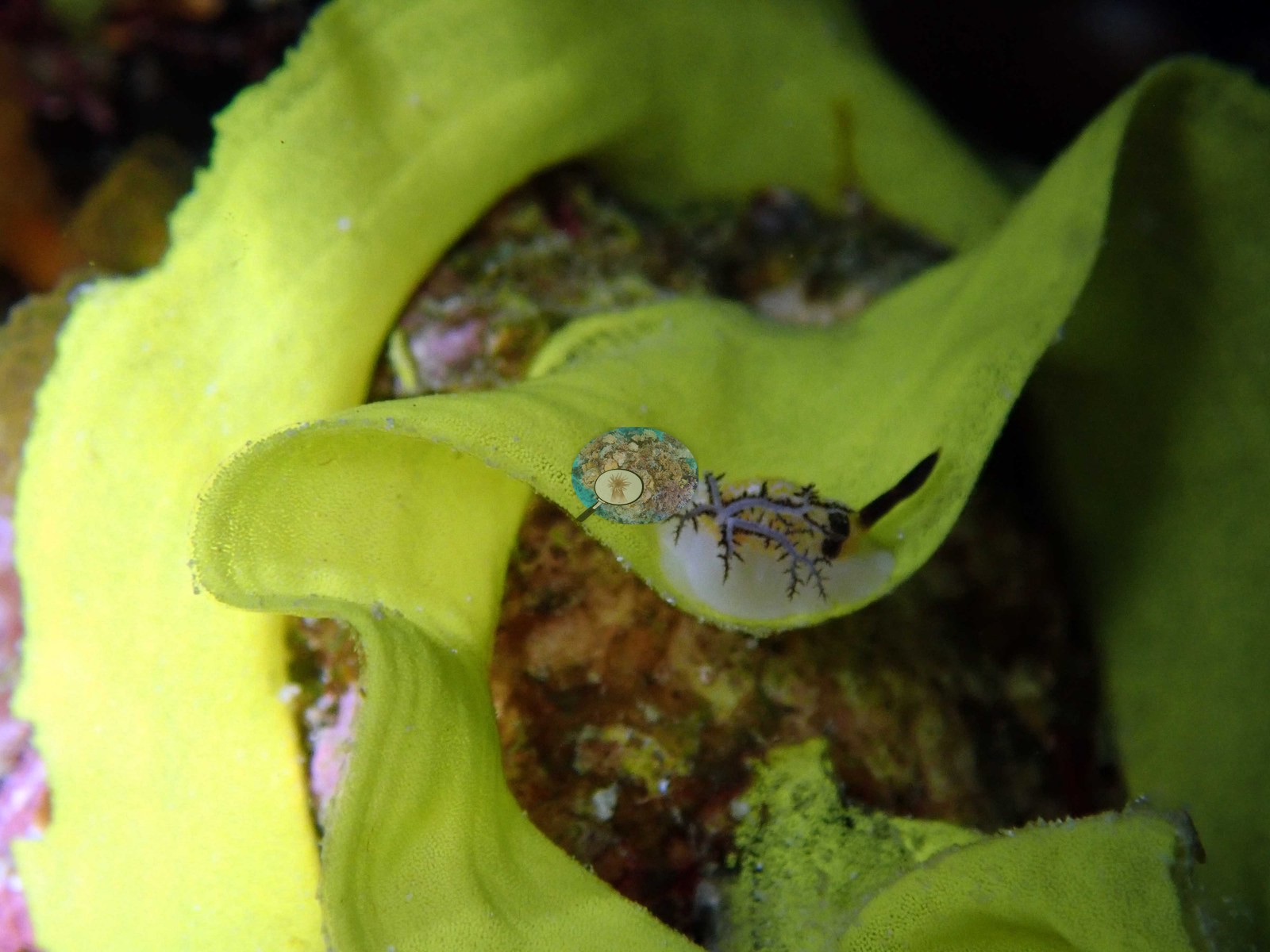
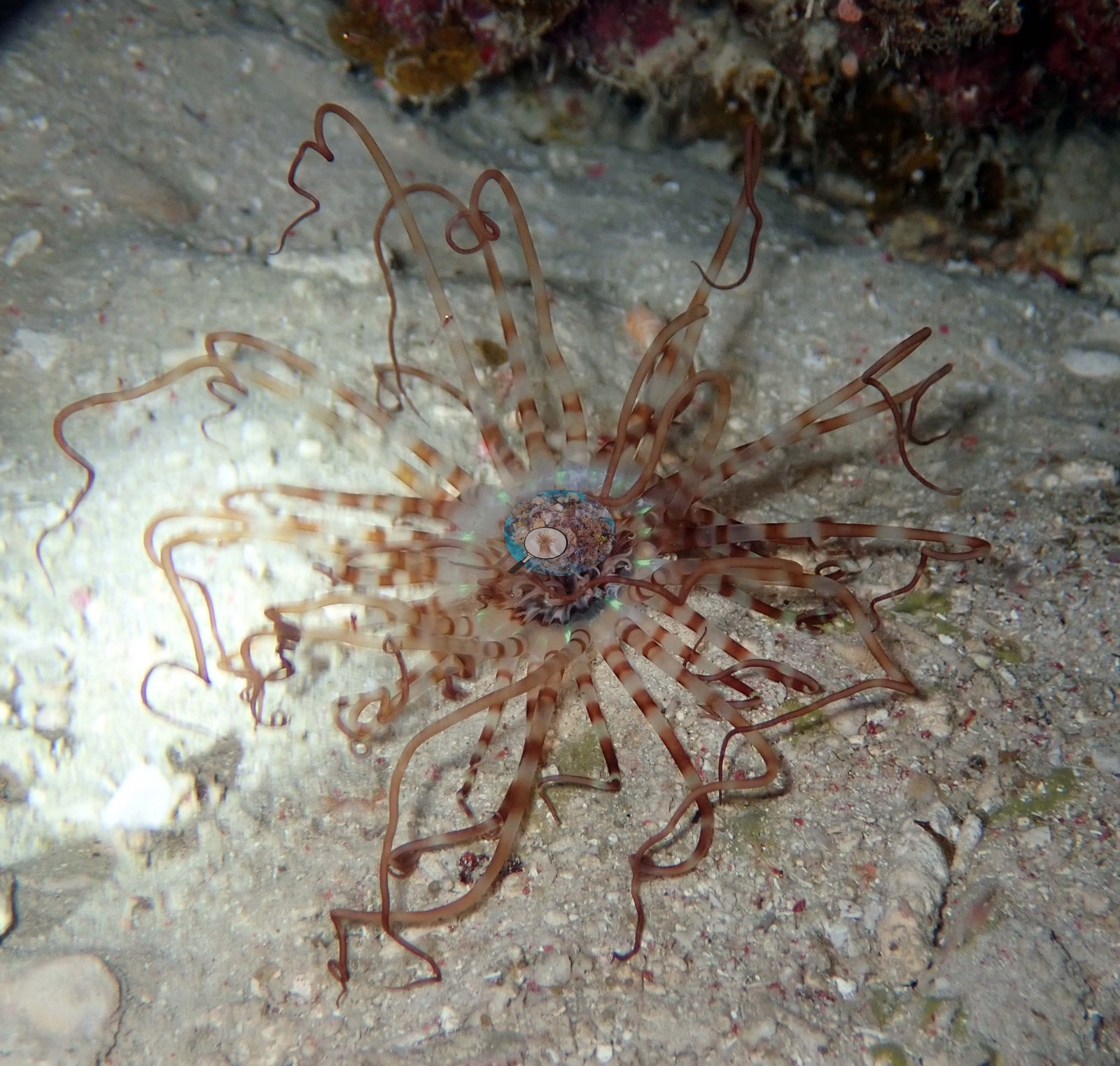
The rest is invertebrate portraiture: a large red Spanish dancer, contracted, with its white gill rosette, on a mottled encrusting mat, a thick acid-yellow leafy sponge whose folds shelter a small white nudibranch marked with fine dark rays, and a banded tube-dwelling anemone (cerianthid) spreading long chocolate-and-cream striped tentacles over pale sand (e.g., Image 1, Image 2, Image 3).
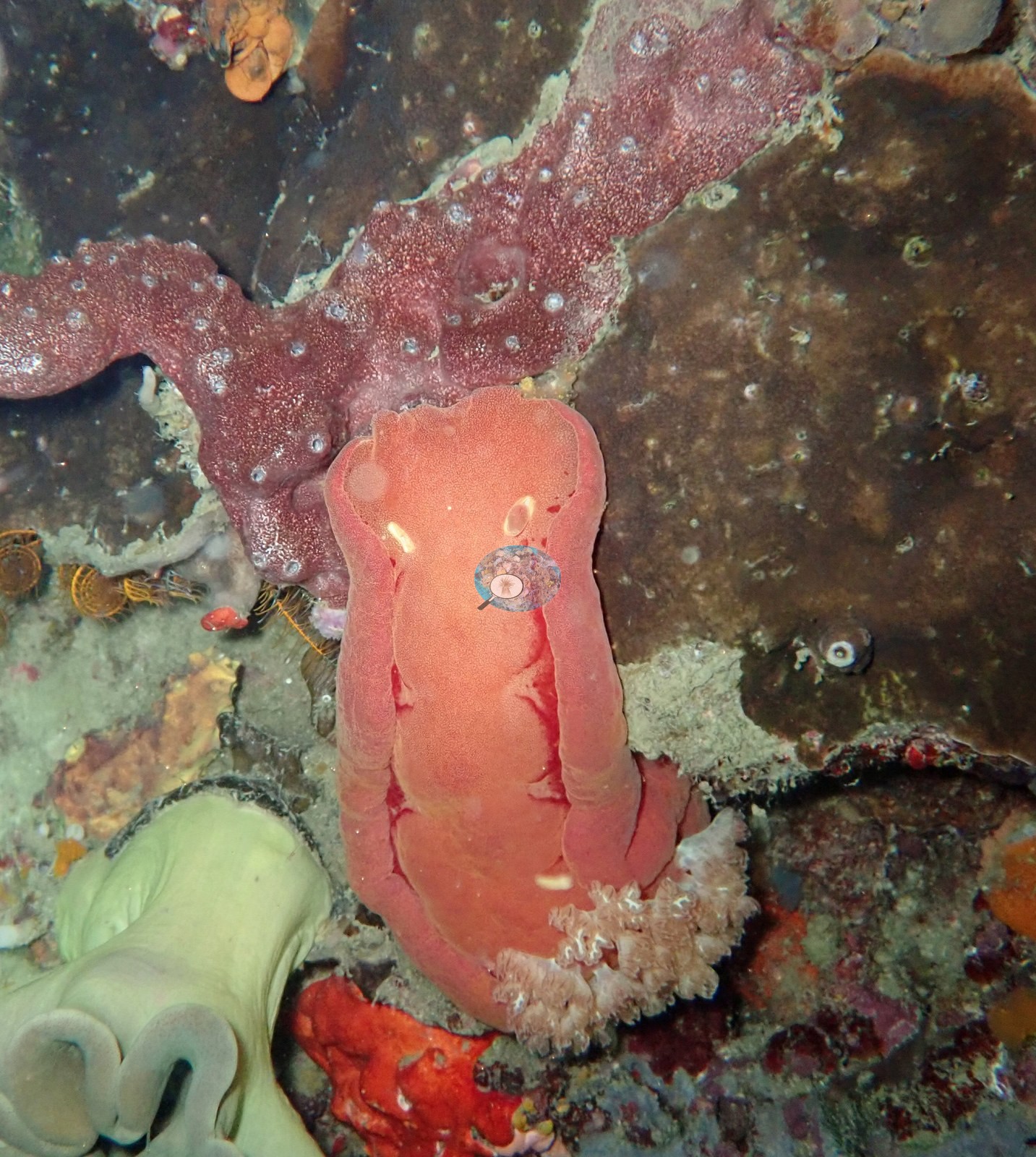
Anderson's log records monster Spanish dancers, foot-long nudibranchs, and shrimp on this dive.
Comparisons with other data
We found no other surveys at this site as of 2026. Within 5 km, two independent stations (Reef Check and WWF-US / WWF-Indonesia) recorded station-year means of 53–55% hard coral cover between 2014 and 2016; the nearest, WWF-US / WWF-Indonesia at TNK04, 3.21 km away, read 55% in 2016.
Dive record
Nando Point in Komodo National Park, dived as a night dive on 19 January 2019 from 18:52 to 19:37, maximum depth 19.2 m, 26.7°C (dive-computer average; the log note reads 25.6°C) — Anderson's own log notes it would have been a beautiful reef dive in daylight, with "tons of hard coral", but was an atypical night dive in that the usual parade of nocturnal critters did not show up.
Independent surveys nearby
| Agency / program | Year(s) | Stations / distance | Link |
|---|---|---|---|
| Reef Check | 2014 | 1 station, 3.25 km | Records ↓ |
| WWF-US / WWF-Indonesia | 2016 | 1 station, 3.21 km | Records ↓ |
Within 5 km, 2 independent survey stations recorded hard coral cover in 3 surveys between 2014 and 2016. The most recent nearby survey is from 2016, so these values predate recent heat stress.
Collected by other programs using different methods (Reef Check uses point-intercept transects), so these are context for the figures above, not a like-for-like comparison. Where a station was surveyed more than once, the cell shows either the range of its values or, as a single value, the mean of surveys made in one year. Station names are not dive-site names.
| Agency | Site / location | Date | Hard coral cover (%) | Distance | Link |
|---|---|---|---|---|---|
| Reef Check | Sebayor Kecil | 2014 | 53%, mean of 2 surveys (5 m and 10 m) | 3.25 km | — |
| WWF-US / WWF-Indonesia | TNK04 | 2016 | 55% | 3.21 km | Amkieltiela, Abdillah T, Amkieltiela A, Andradi-Brown D, Lazuardi E. 2016. Komodo MPA. MERMAID |
Data & links
All images from Coral Reef Diagnostics. Data on this page are from Coral Reef Diagnostics (the dive record) and the organizations named in the data sources above; Coral Reef Diagnostics has no coral cover estimate of its own at this site.
© Coral Reef Diagnostics.