
Part of the regional summaries: Tonga - Vava'u and Tonga

More info
Southern Tonga (NOAA CRW virtual station)The southwest end of Treasure Island in Vava'u, where a wide shallow terrace carries 60-80% cover of lilac, blue, and tan branching and table corals. Below 10 m the slope turns sandy and rubbly with scattered plating corals and Halimeda patches, and cushion stars, trumpet tritons, and sea cucumbers were counted. Surveyed on the Living Oceans Foundation's Global Reef Expedition.
Ko e ngataʻanga tonga hihifo ʻo Treasure Island ʻi Vavaʻu, ʻa ia ʻoku ʻi ai ha tuʻunga mamaha fālahi (shallow terrace) ʻoku ʻufiʻufi ʻaki ʻa e 60-80% ʻe he feo fakavaʻavaʻa mo fakatēpile (table) lanu laileki, pulū, mo e lanu kelekele (tan). ʻI lalo ʻi he 10 m, ʻoku ʻoneʻone mo maka momoa (rubble) ʻa e tafaʻaki mo e ngaahi feo fakapaleti (plating) mavahevahe mo e ngaahi konga Halimeda, pea naʻe lau ʻa e fetuʻu tahi (cushion stars), ngaahi trumpet triton, mo e ngaahi loli (sea cucumbers).
AI translation of this summary; the English is authoritative. (low confidence)
CTD-cast midpoint of 26.1–26.2°C
Four other CRD dive sites with their own pages within 5 km shown in orange — click a marker to open its page.
🗺 Detailed map of the Global Reef Expedition dive sites, Vava'u, Tonga (Khaled bin Sultan Living Oceans Foundation; opens in a new window)
27 of the 35 photographs on this page are shown beside the text that discusses them under "Site description" below.
Site description
Setting
Southwest end of Treasure Island, Vava'u: a fringing reef with a wide shallow terrace at 3-5 m.
General benthic features
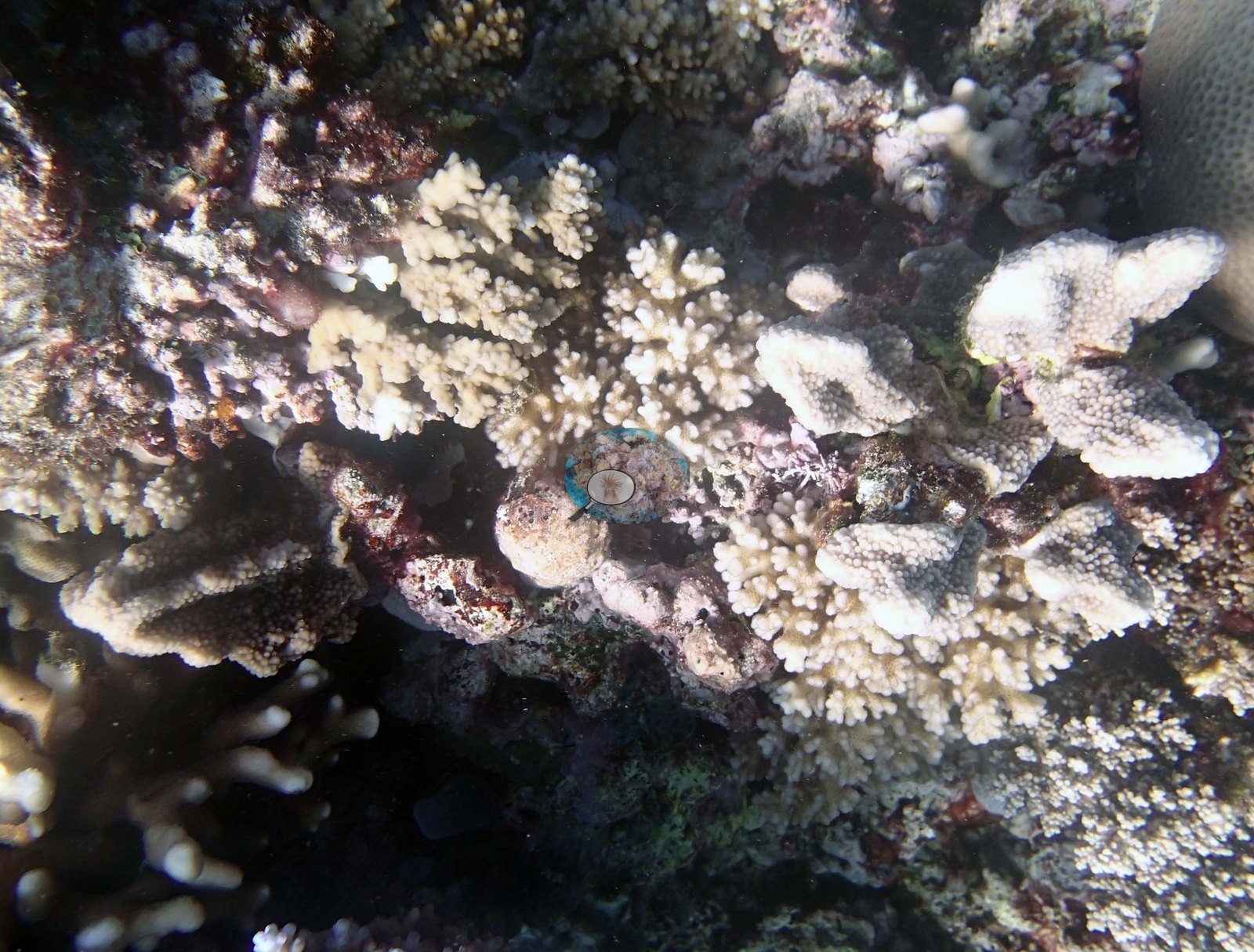
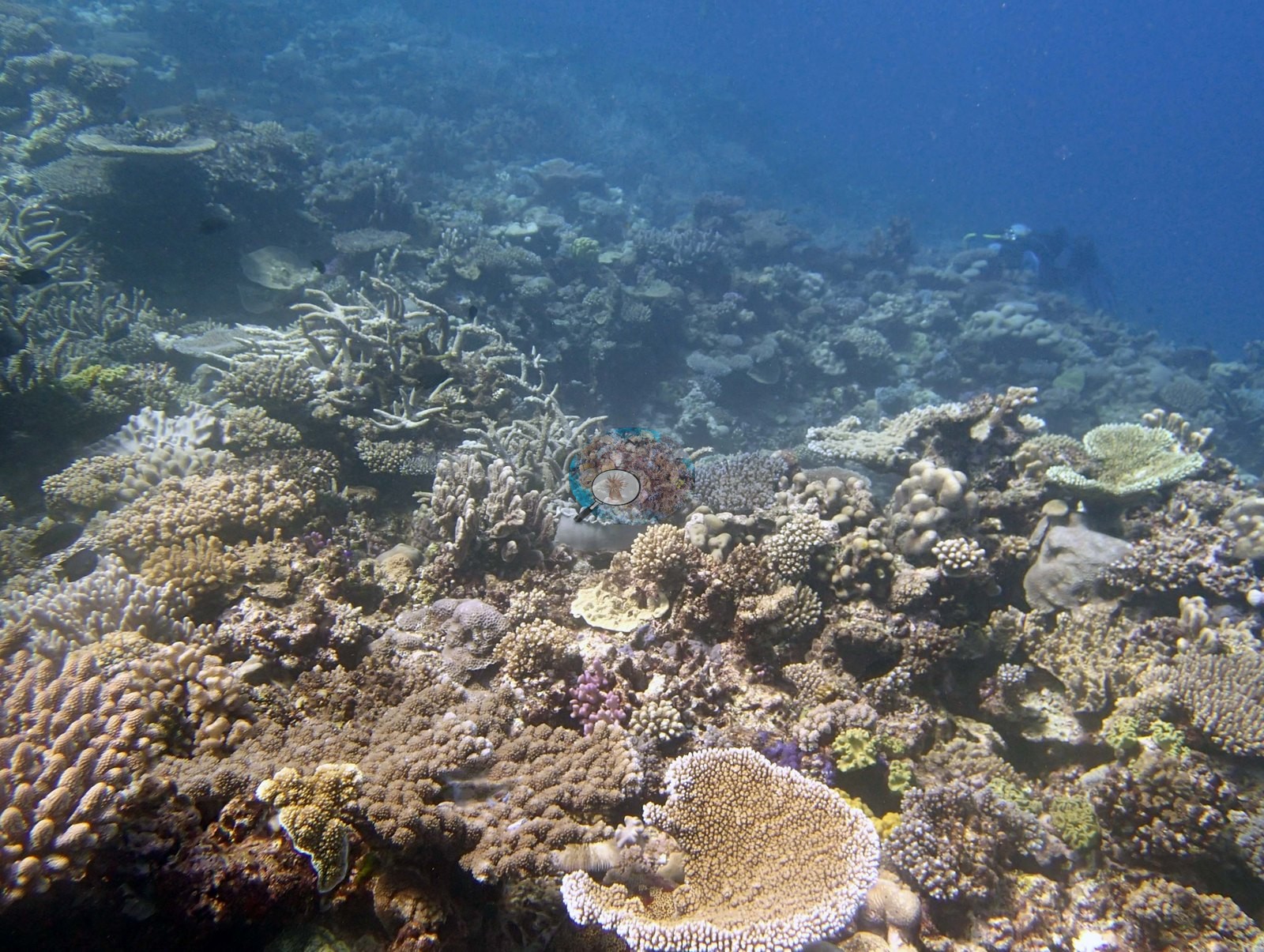
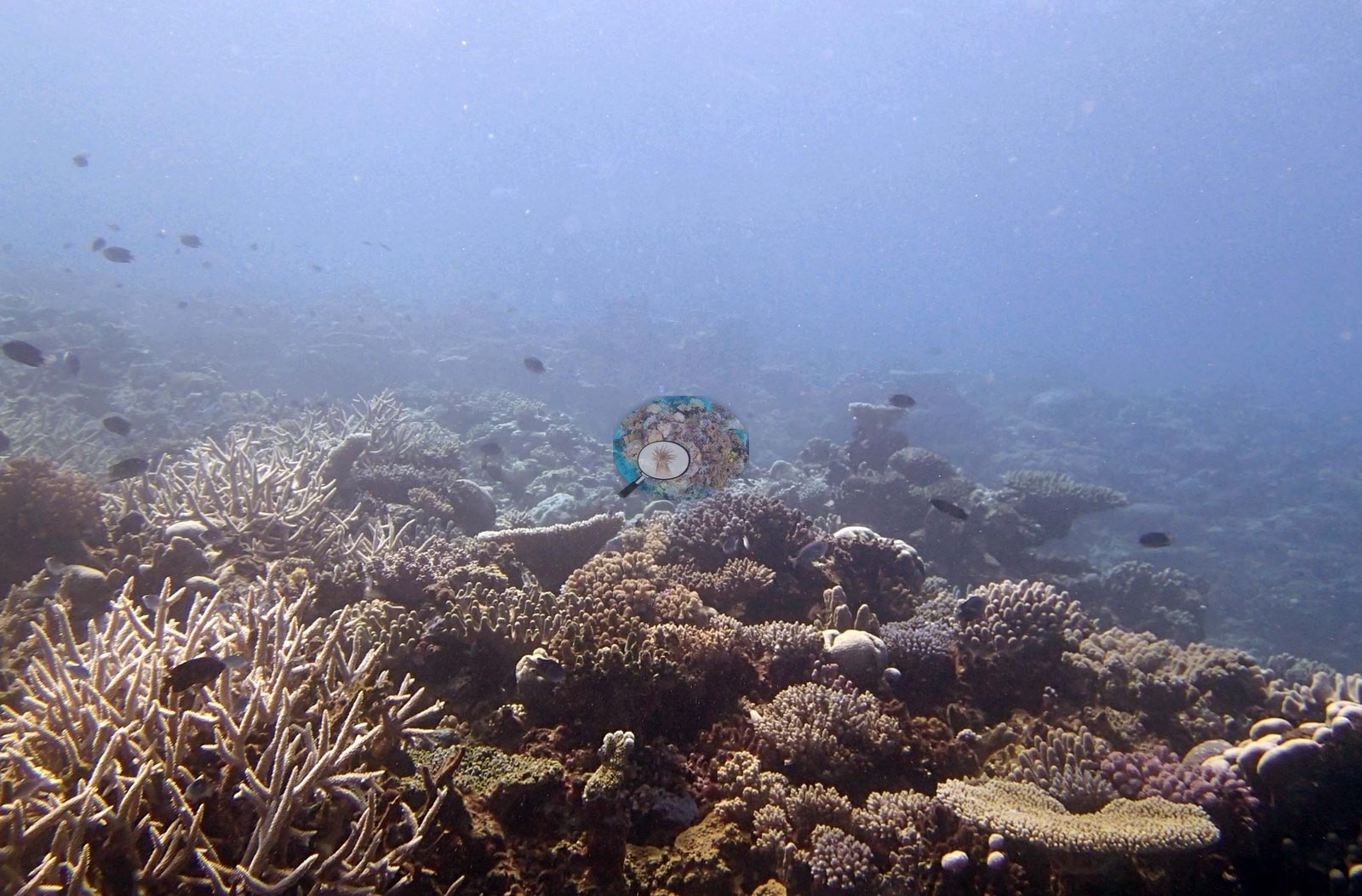
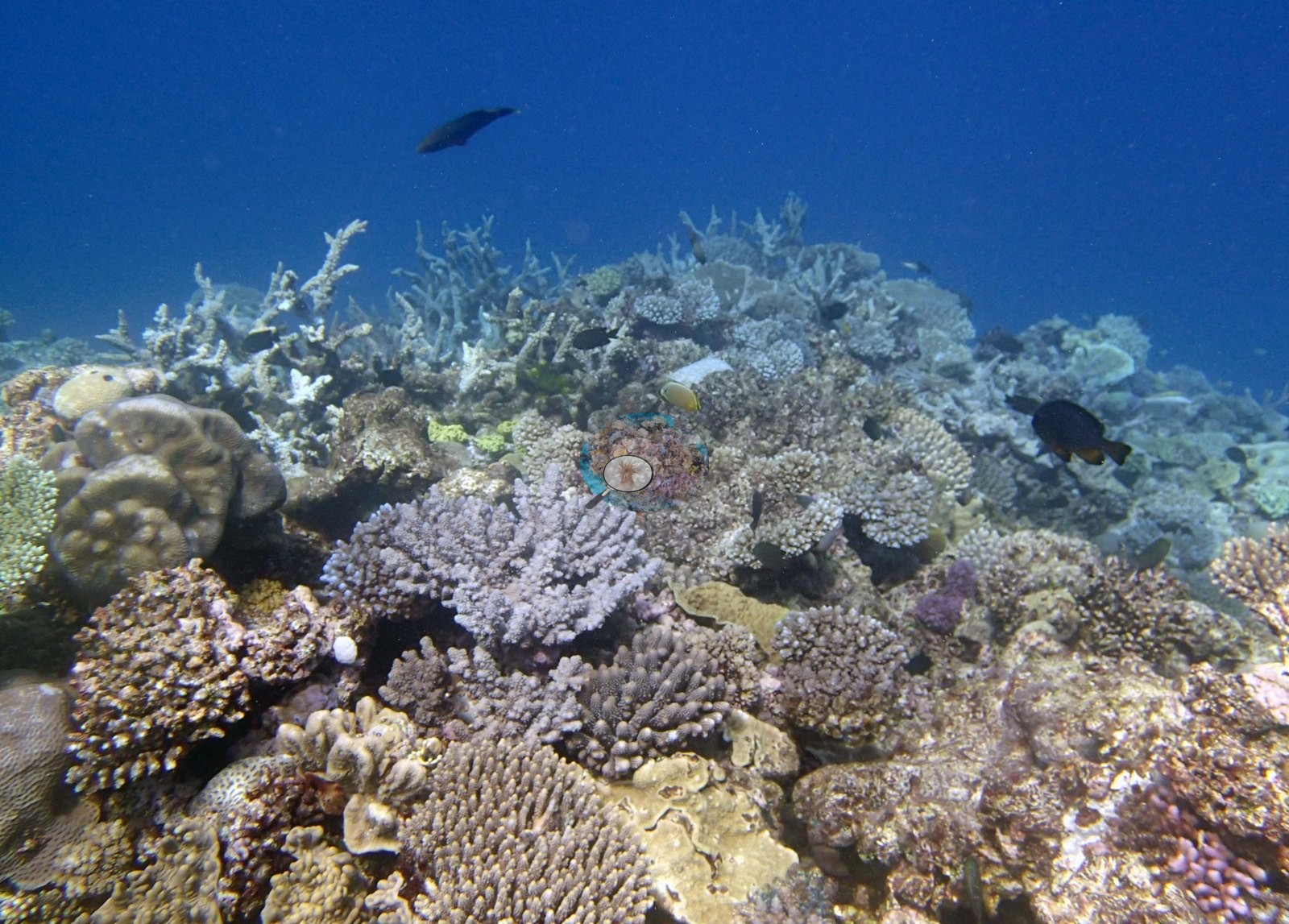
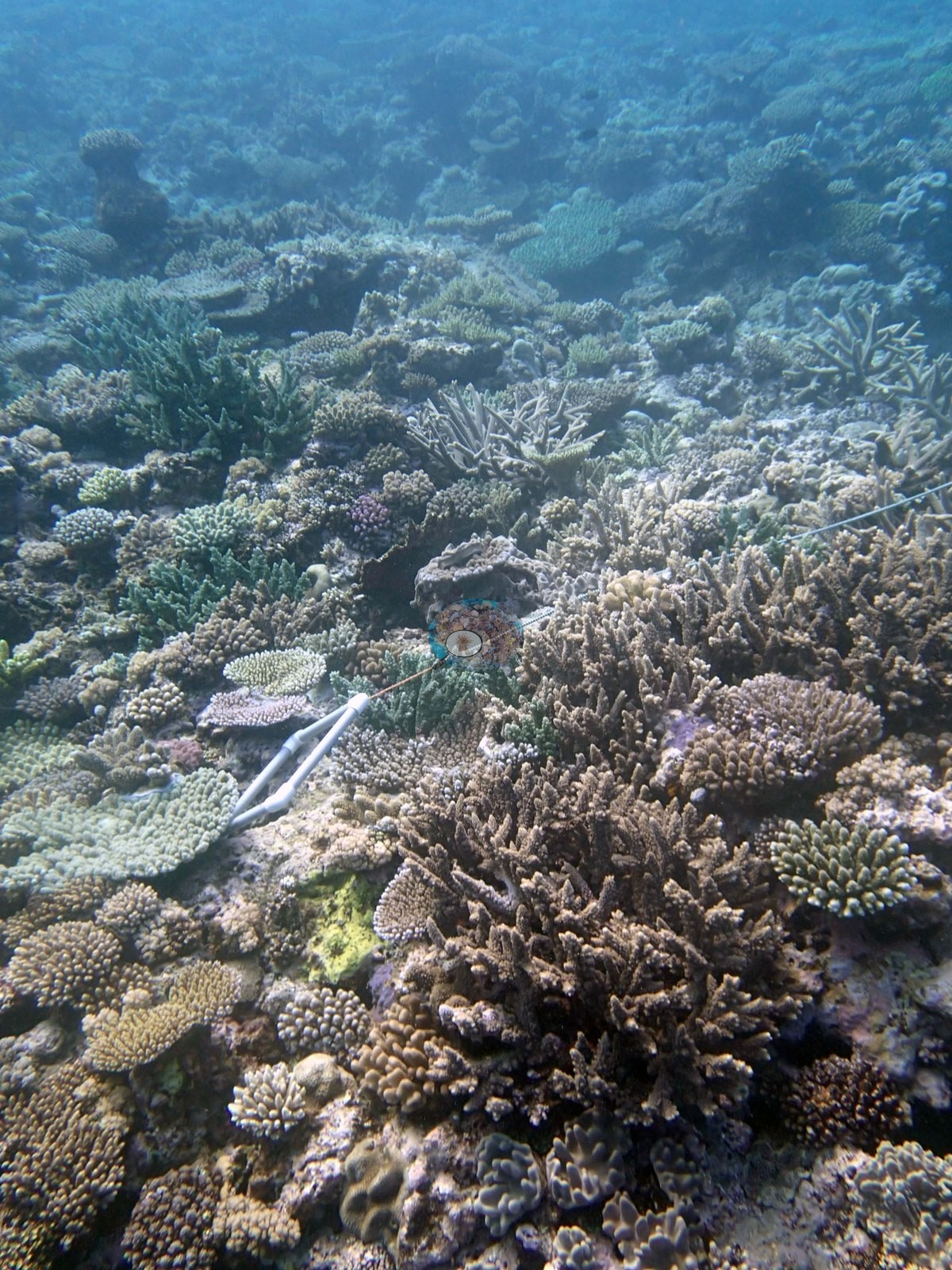
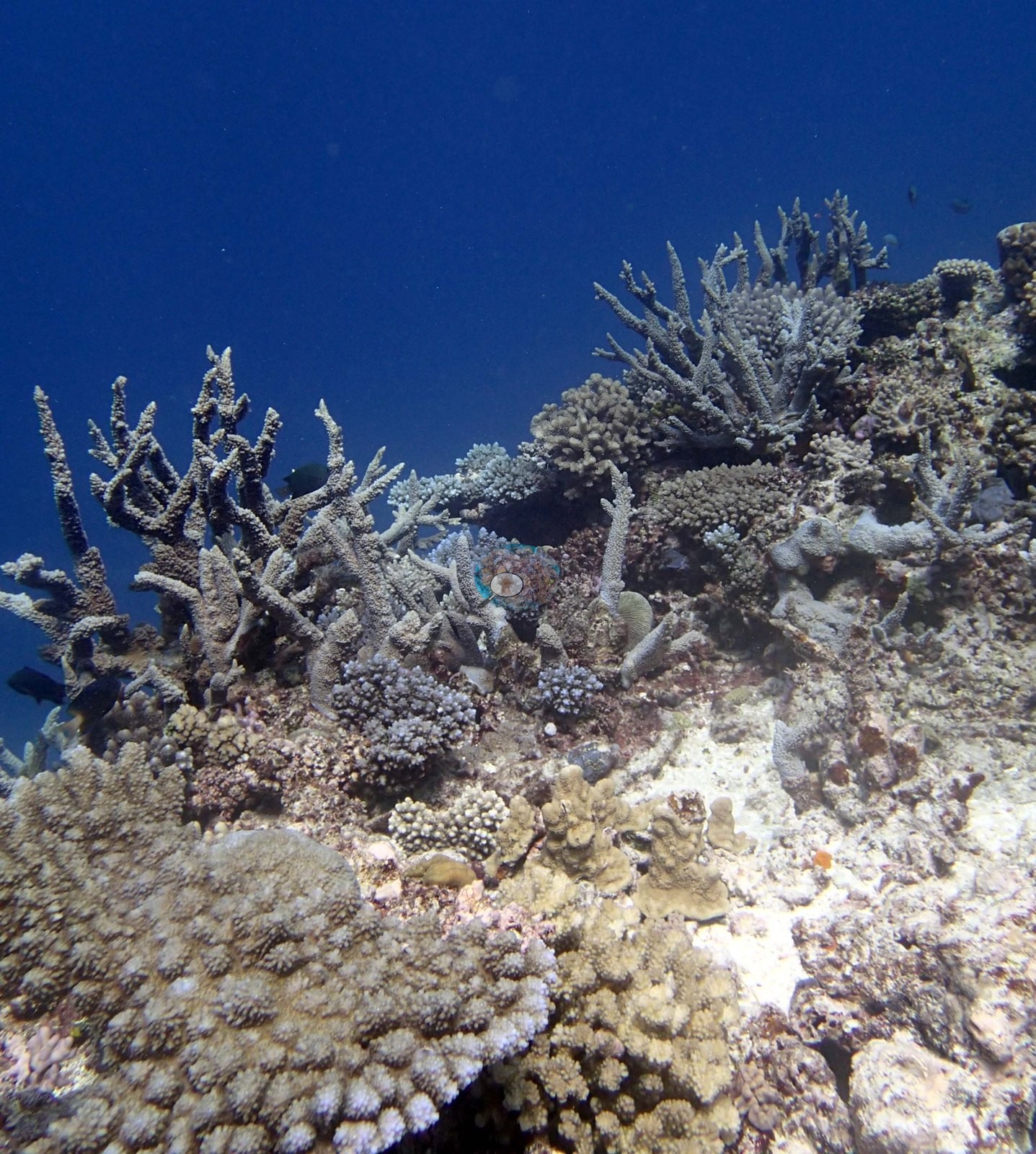
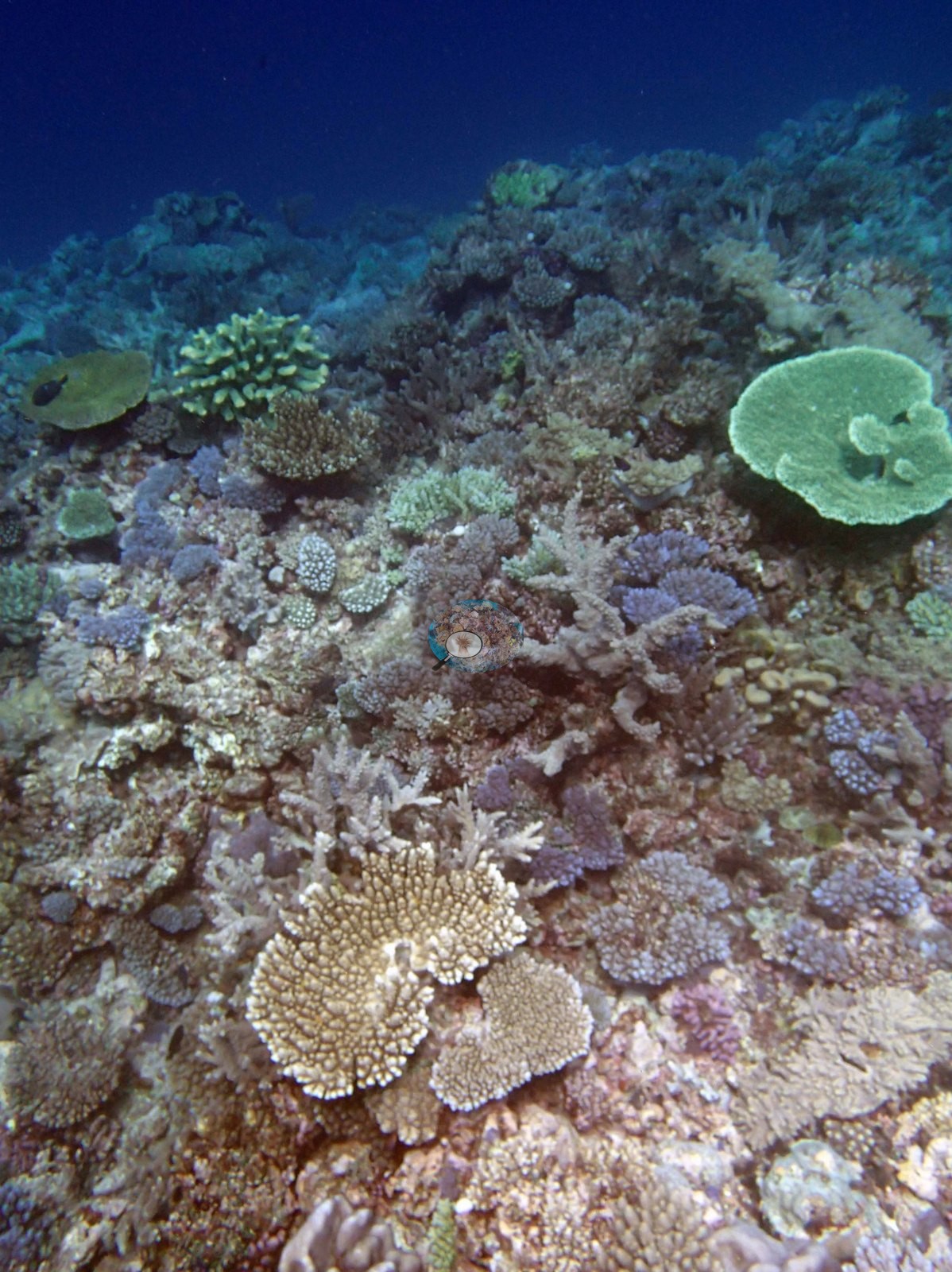
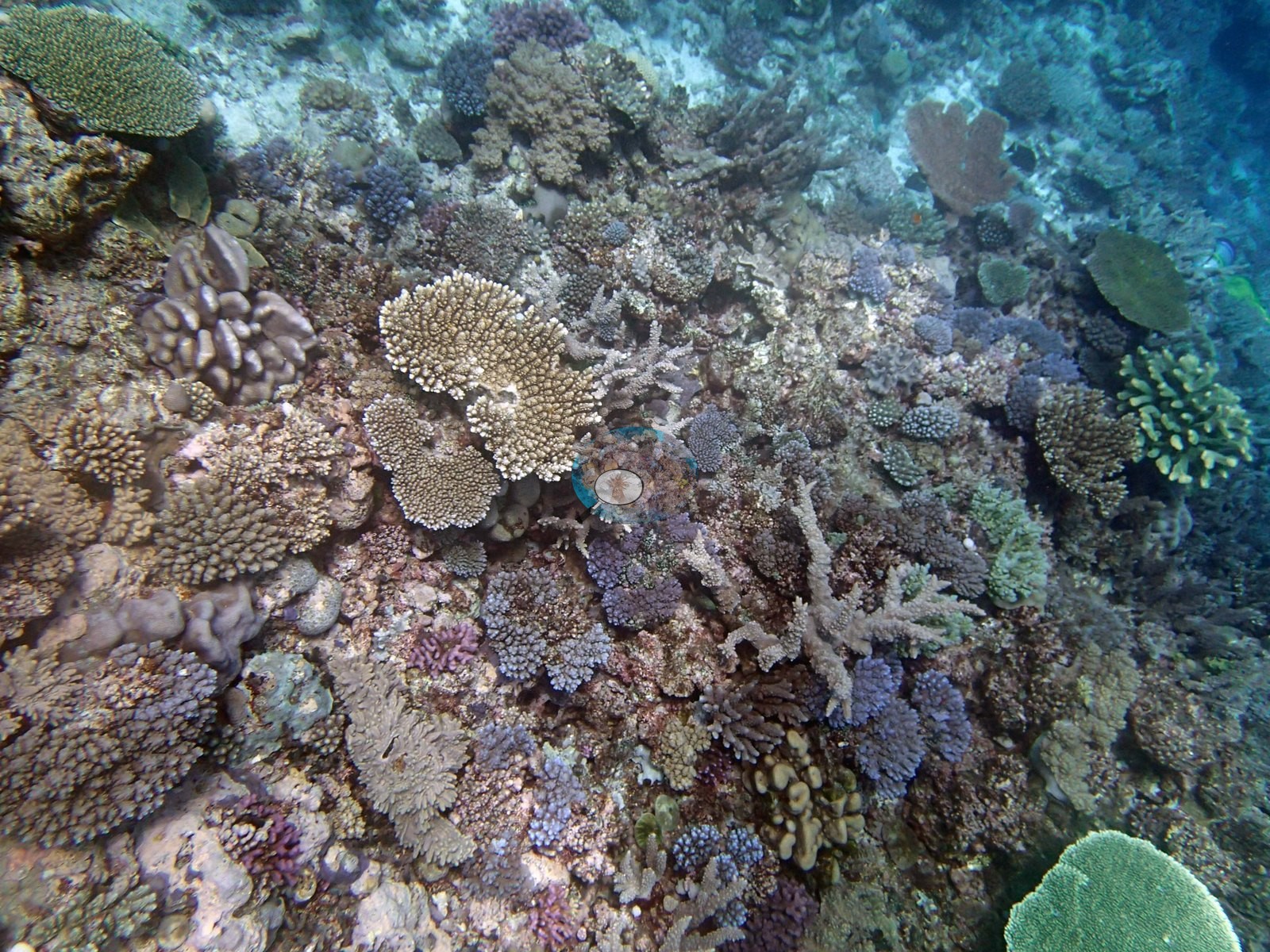
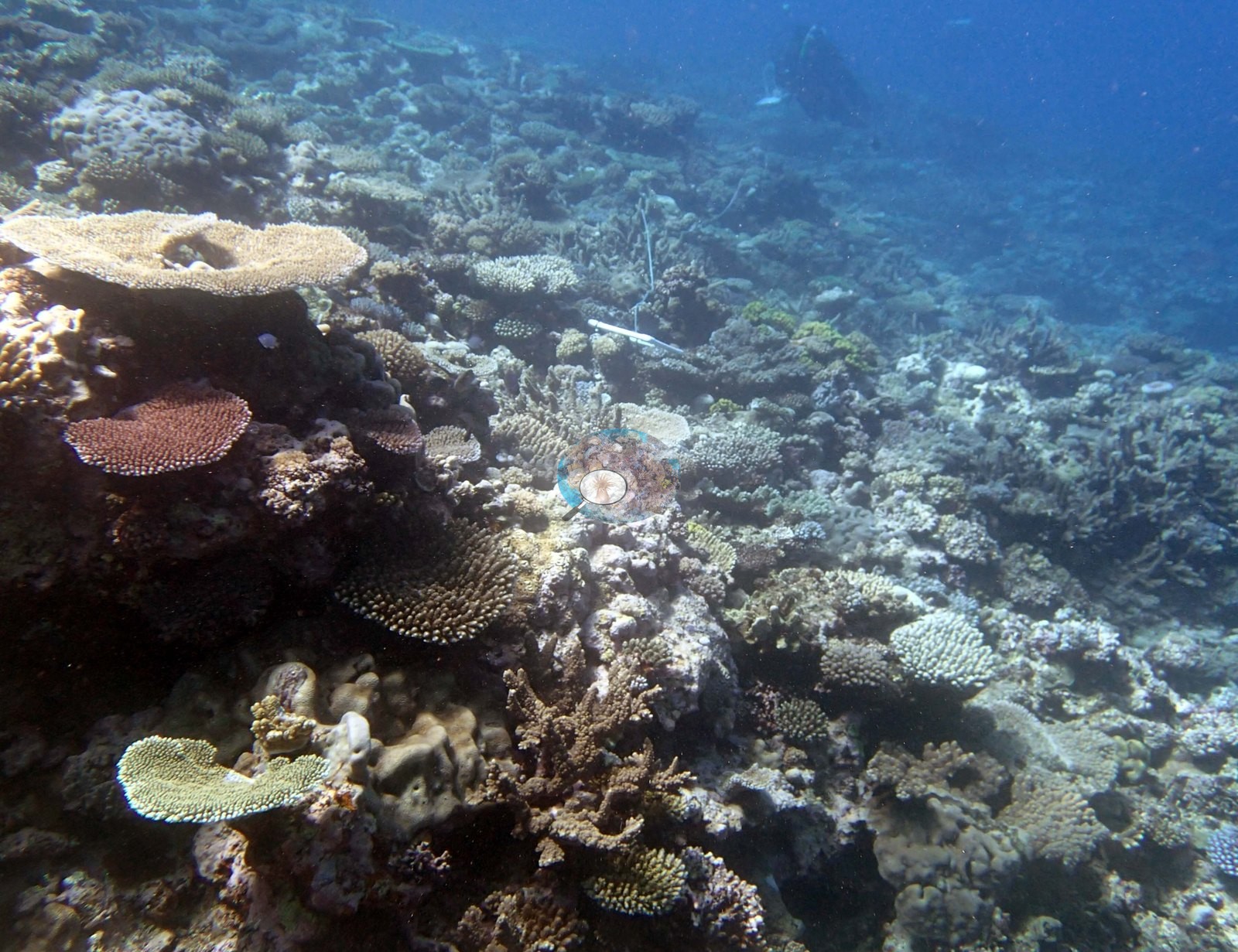
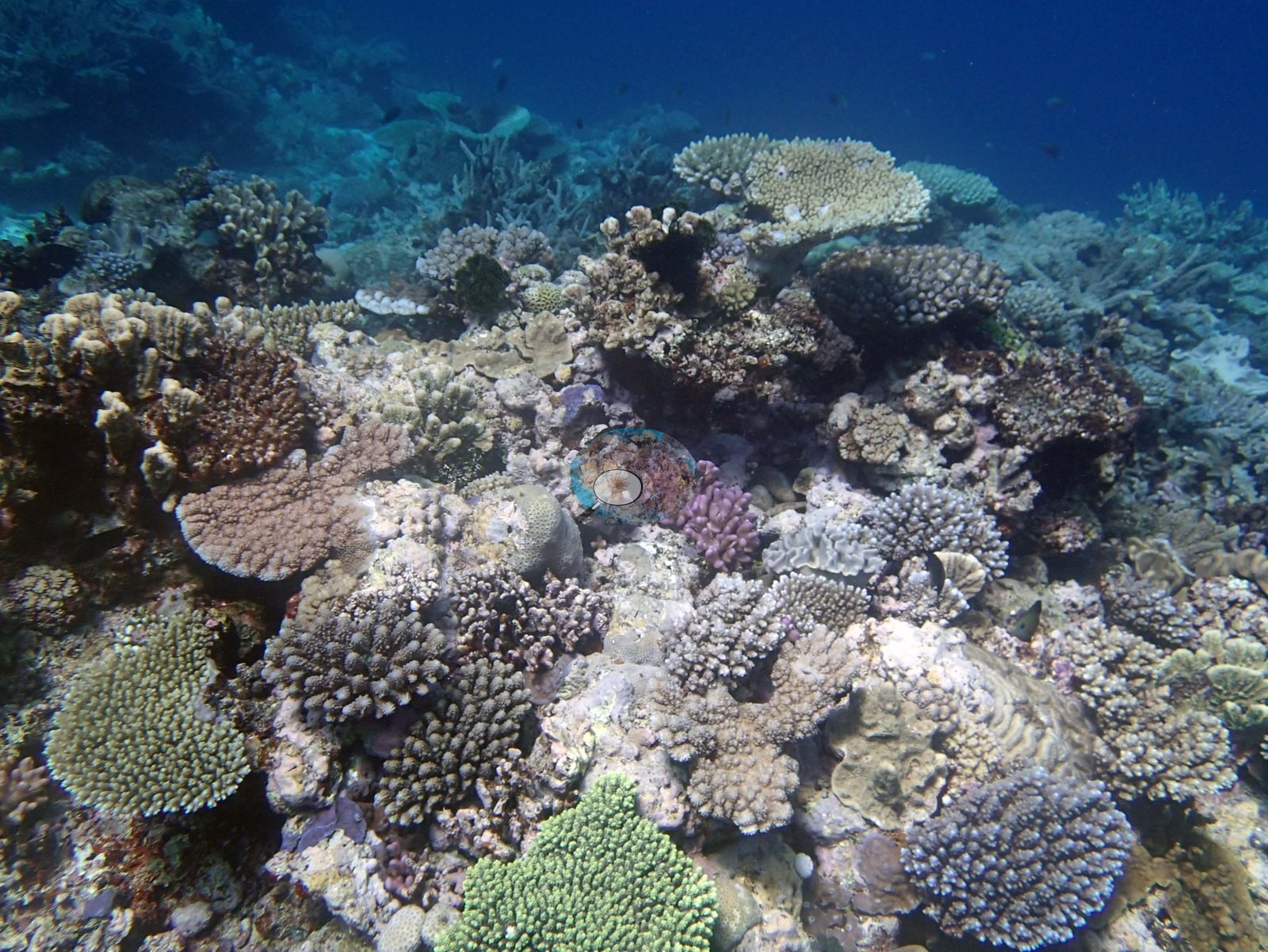
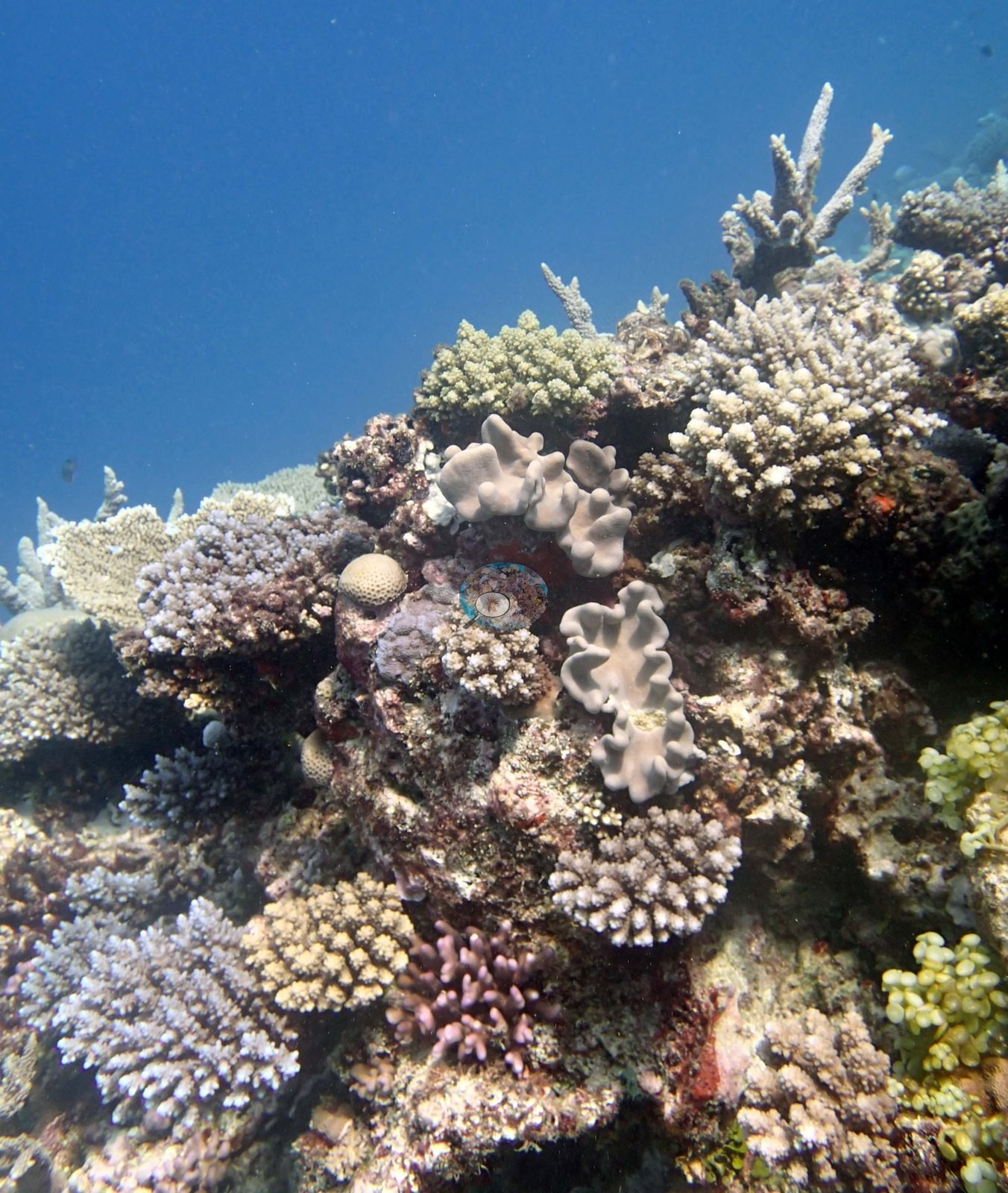
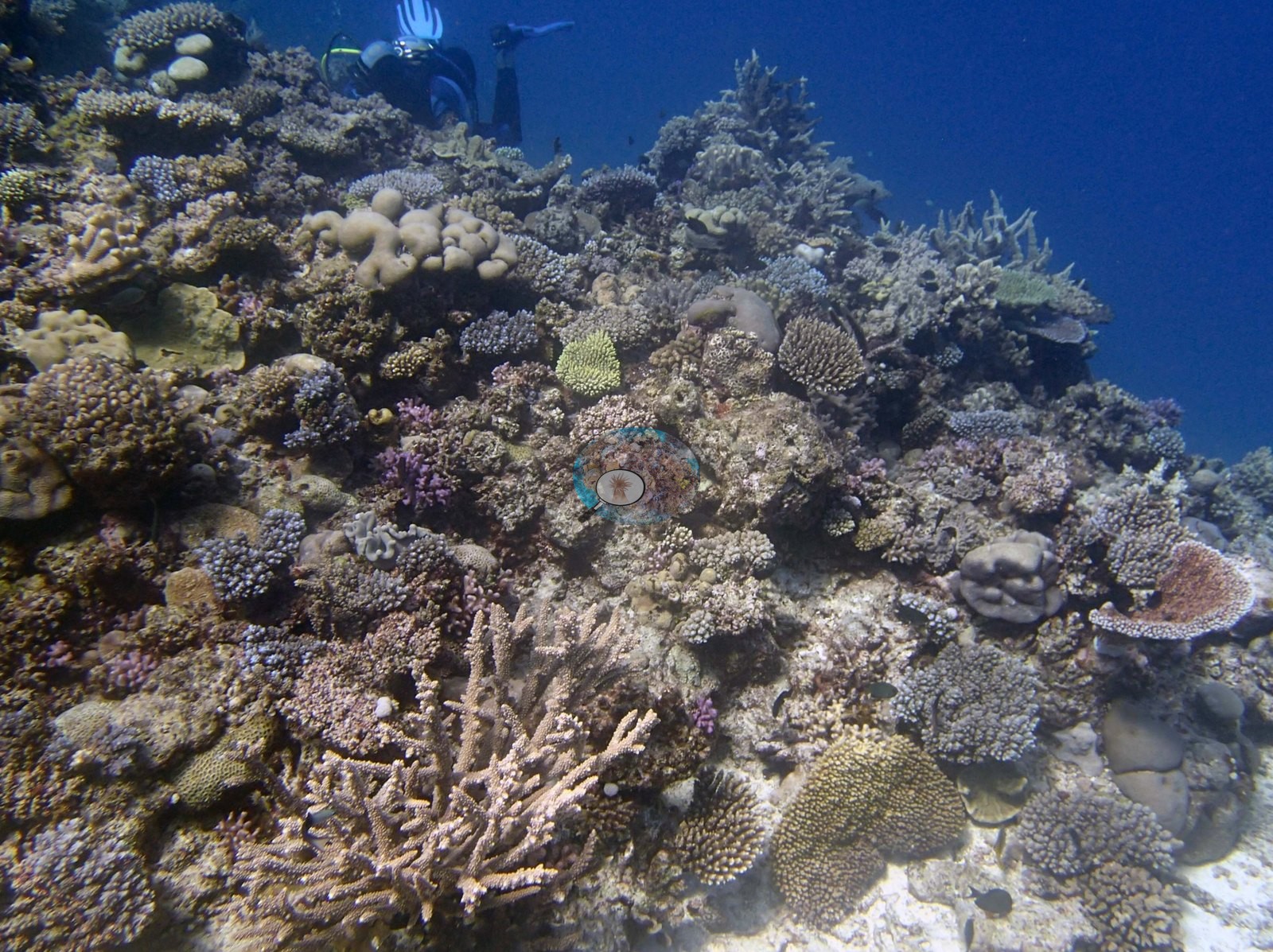
The habitat set spans the site from reef top to slope, and the dominant impression is an acroporid reef with a wide variety of growth forms. The shallow reef-top frames (e.g., Image 24, Image 25, Image 10, Image 16, Image 22, Image 17, Image 29, Image 6 background, Image 27) show close-packed thickets of arborescent and staghorn Acropora standing up off the substrate, in cream, gold, tan, and pale mauve, interlocking with corymbose and digitate colonies beneath them; Image 29 and Image 10 are almost wall-to-wall branching coral, and Image 22 catches a thicket silhouetted against open blue.
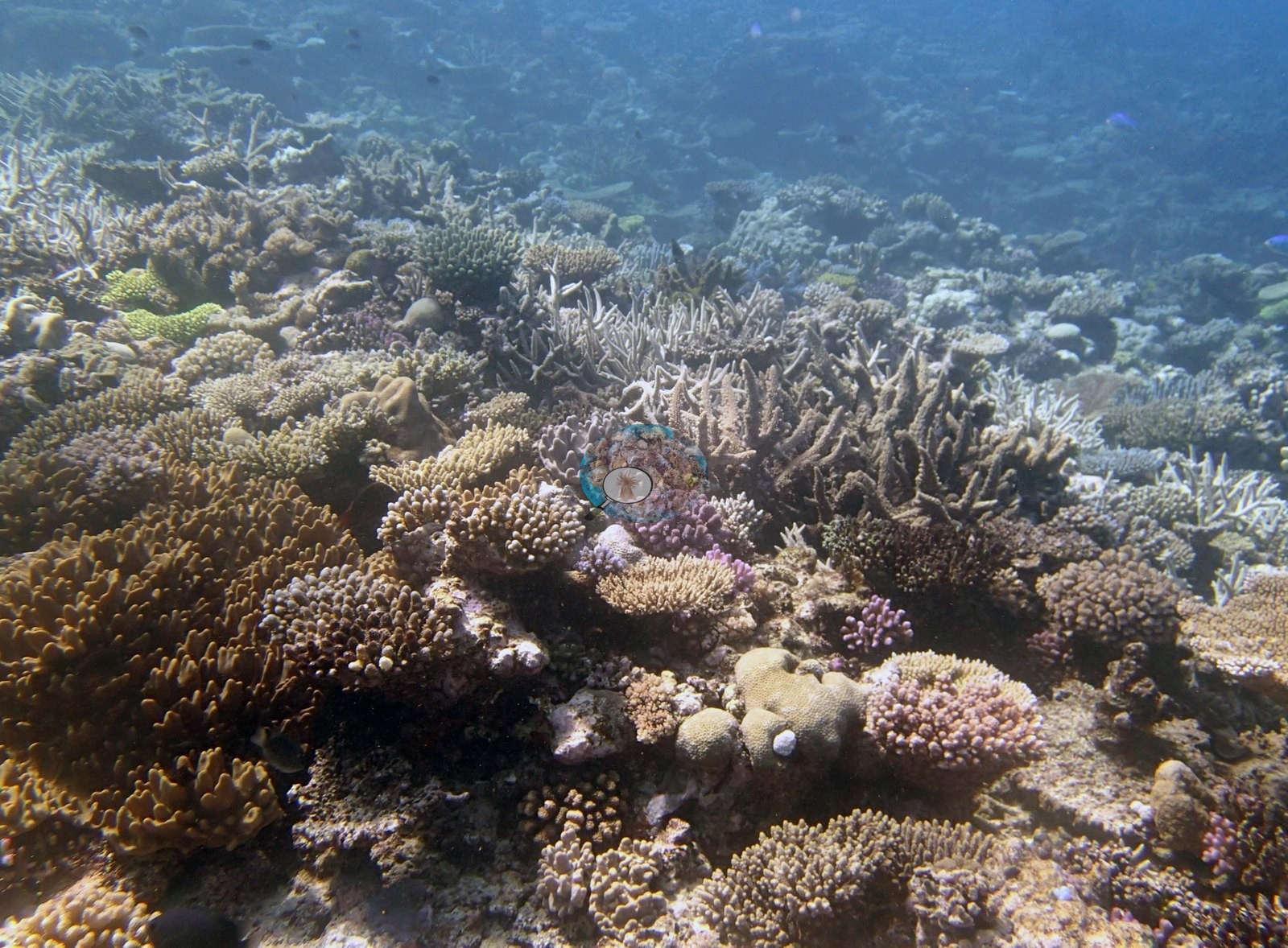
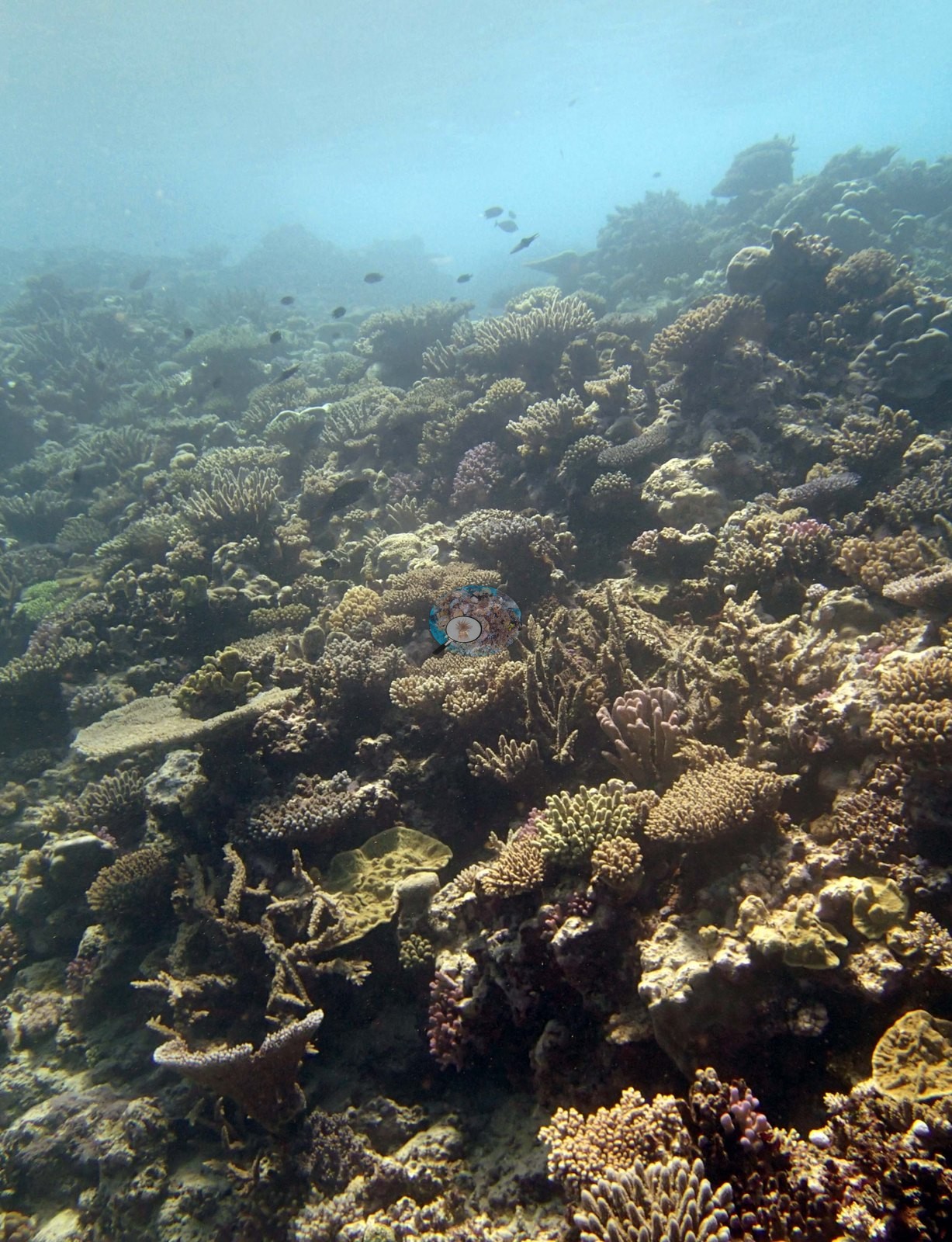
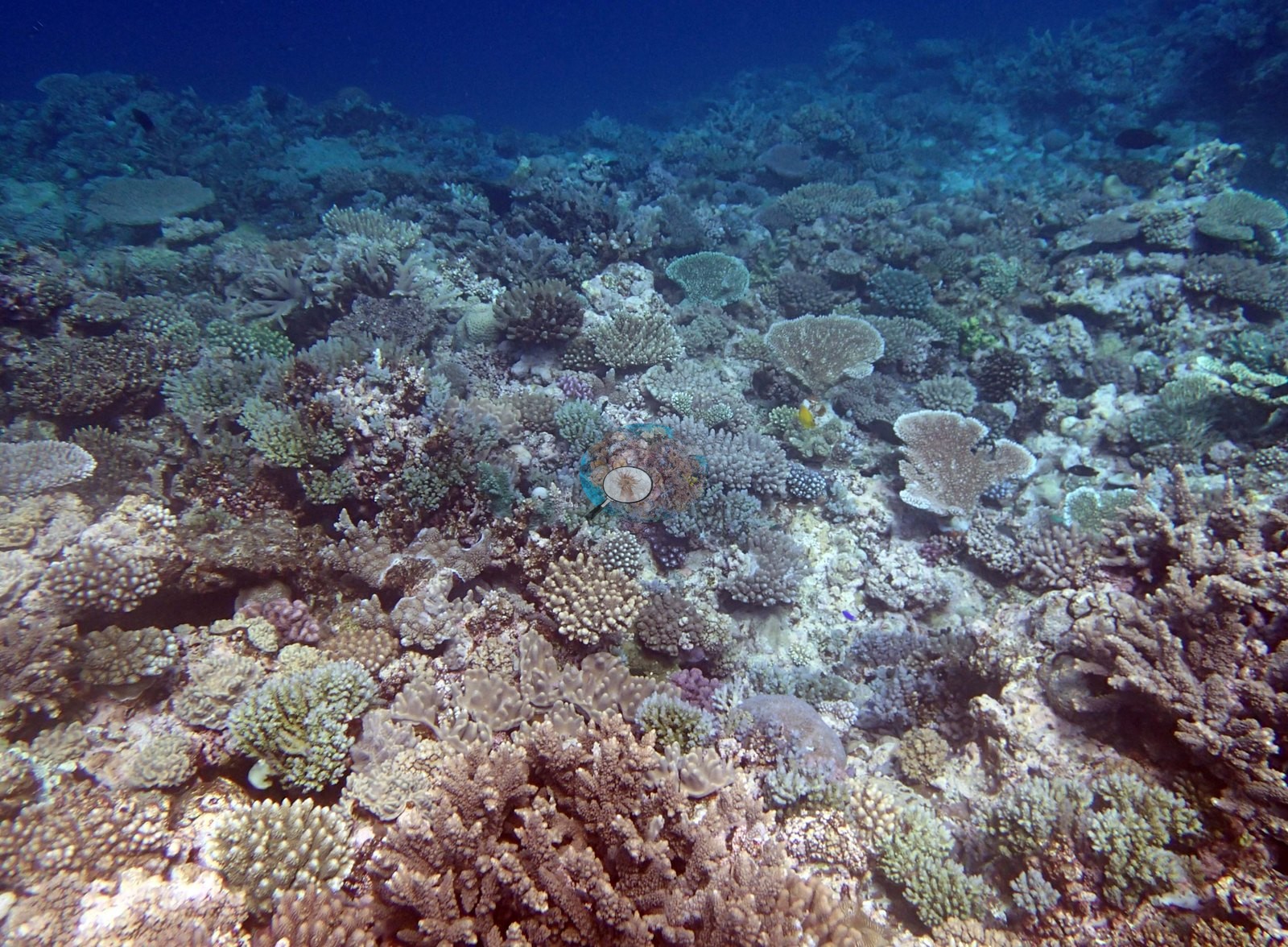
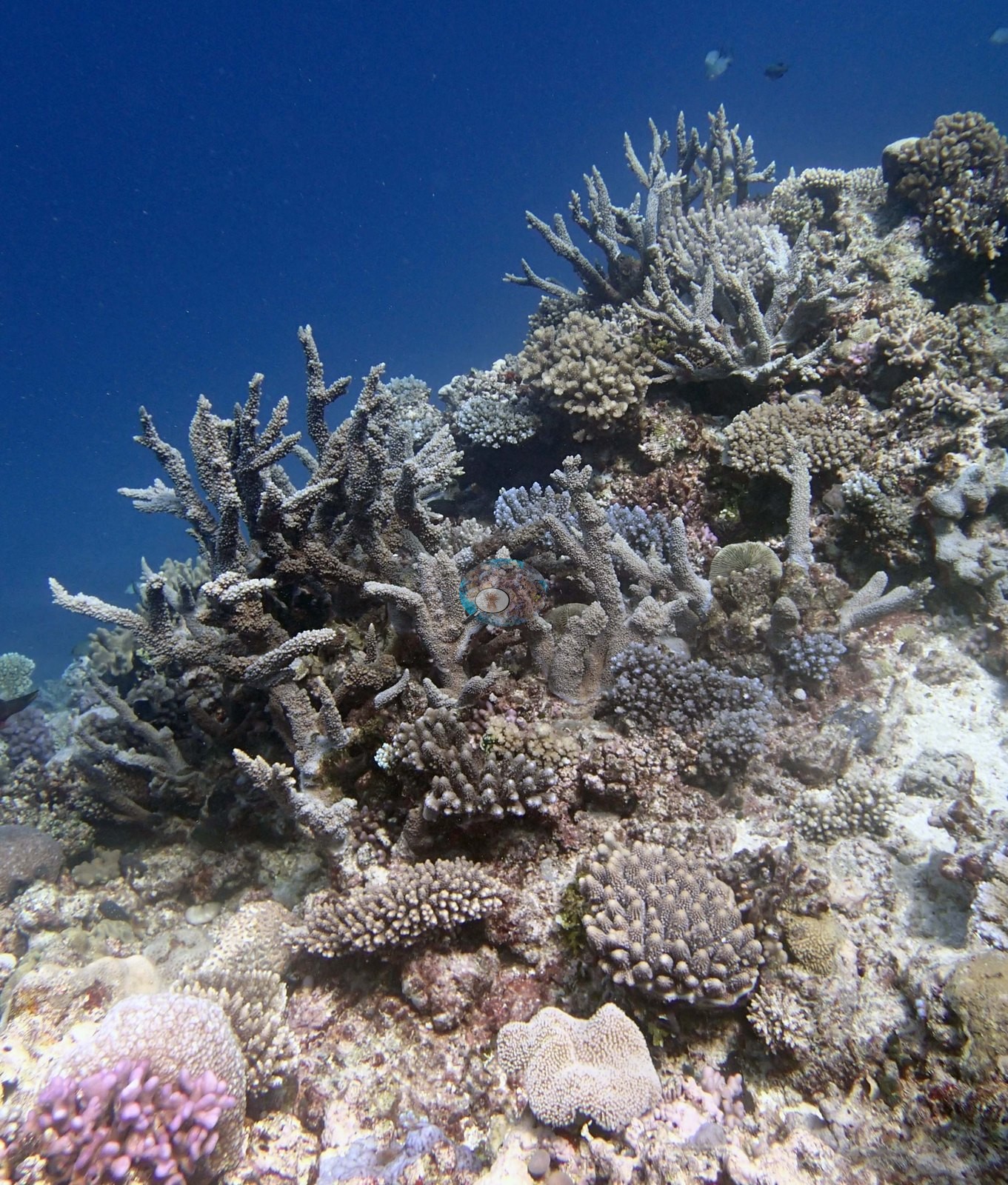
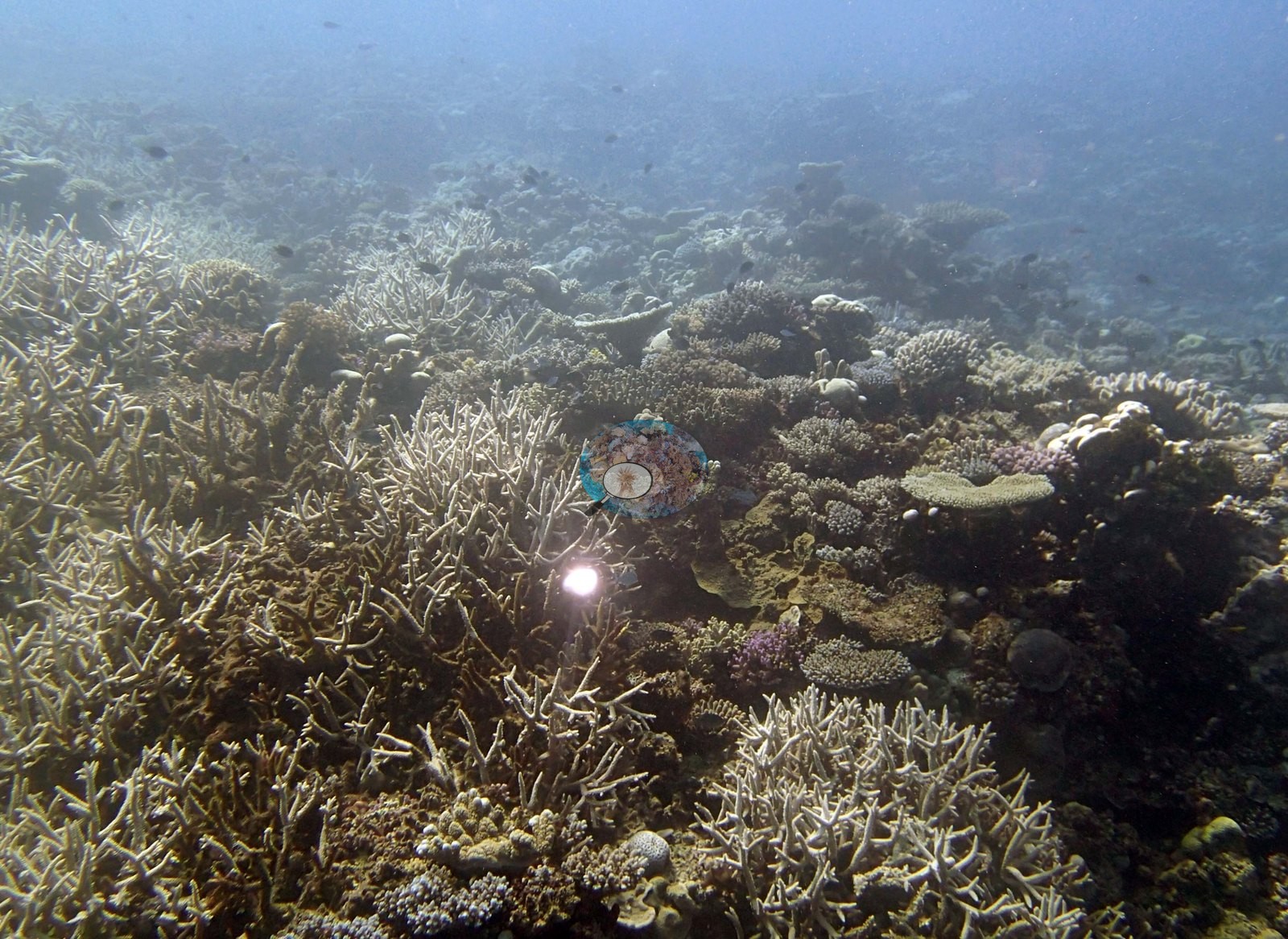
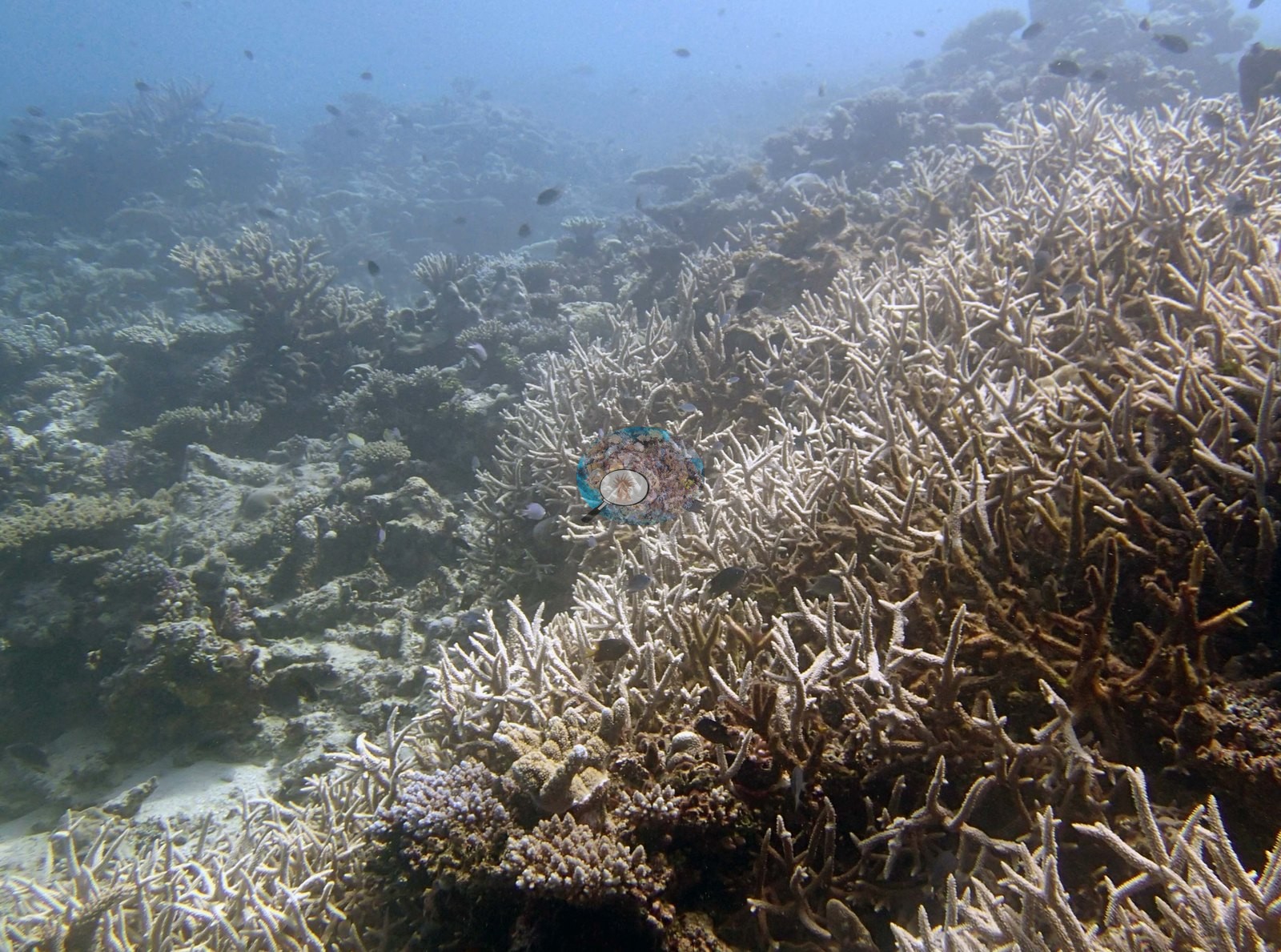
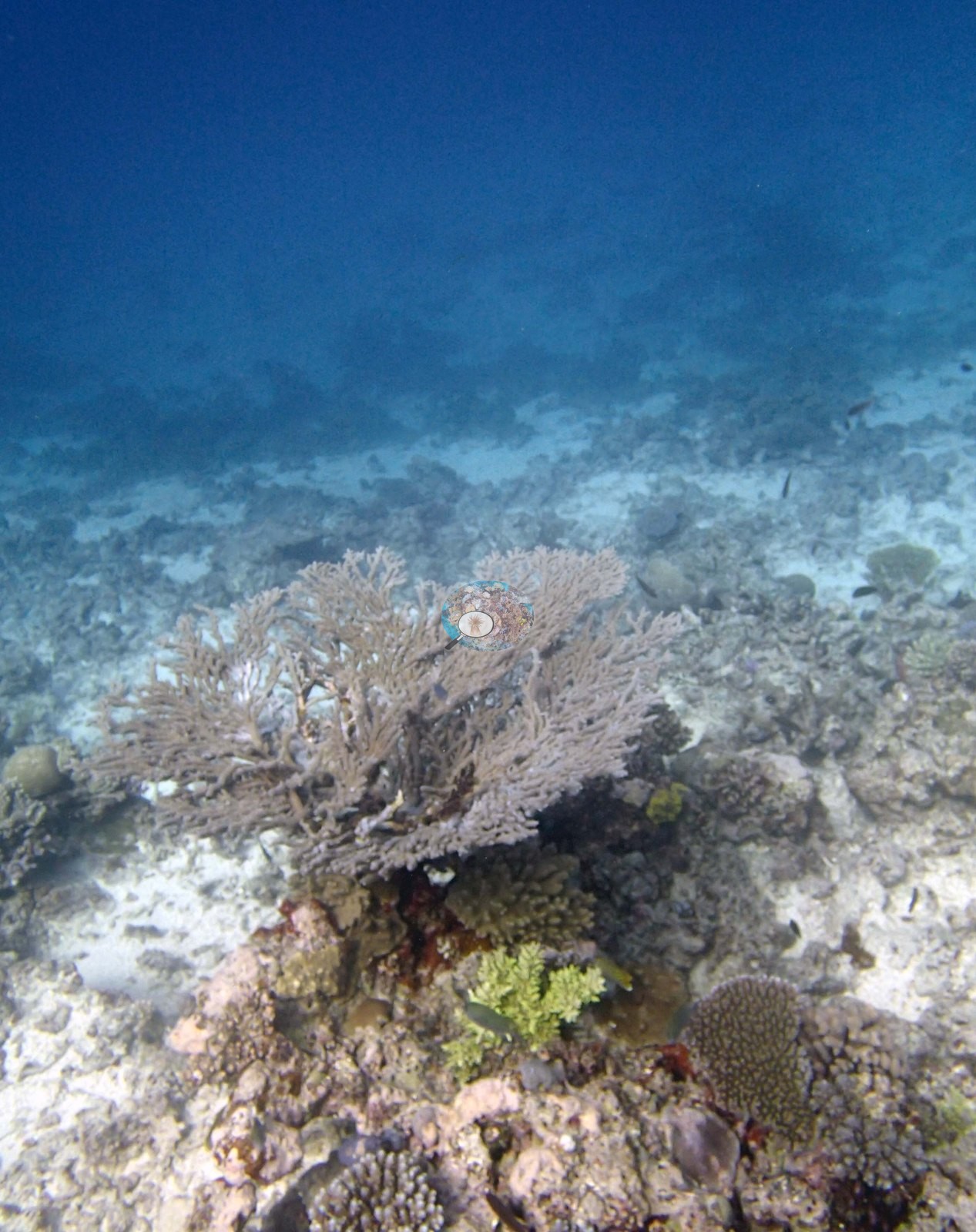
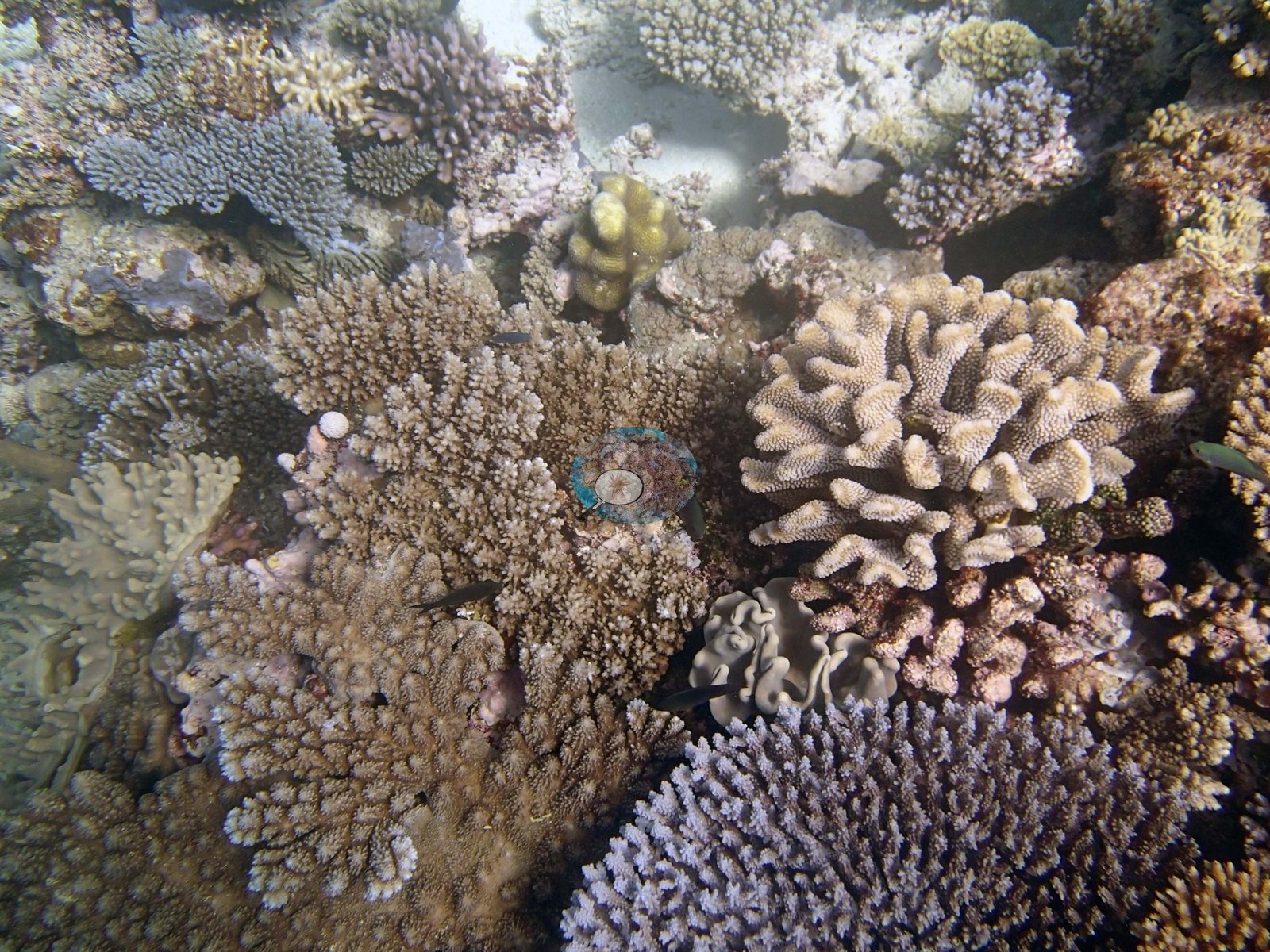
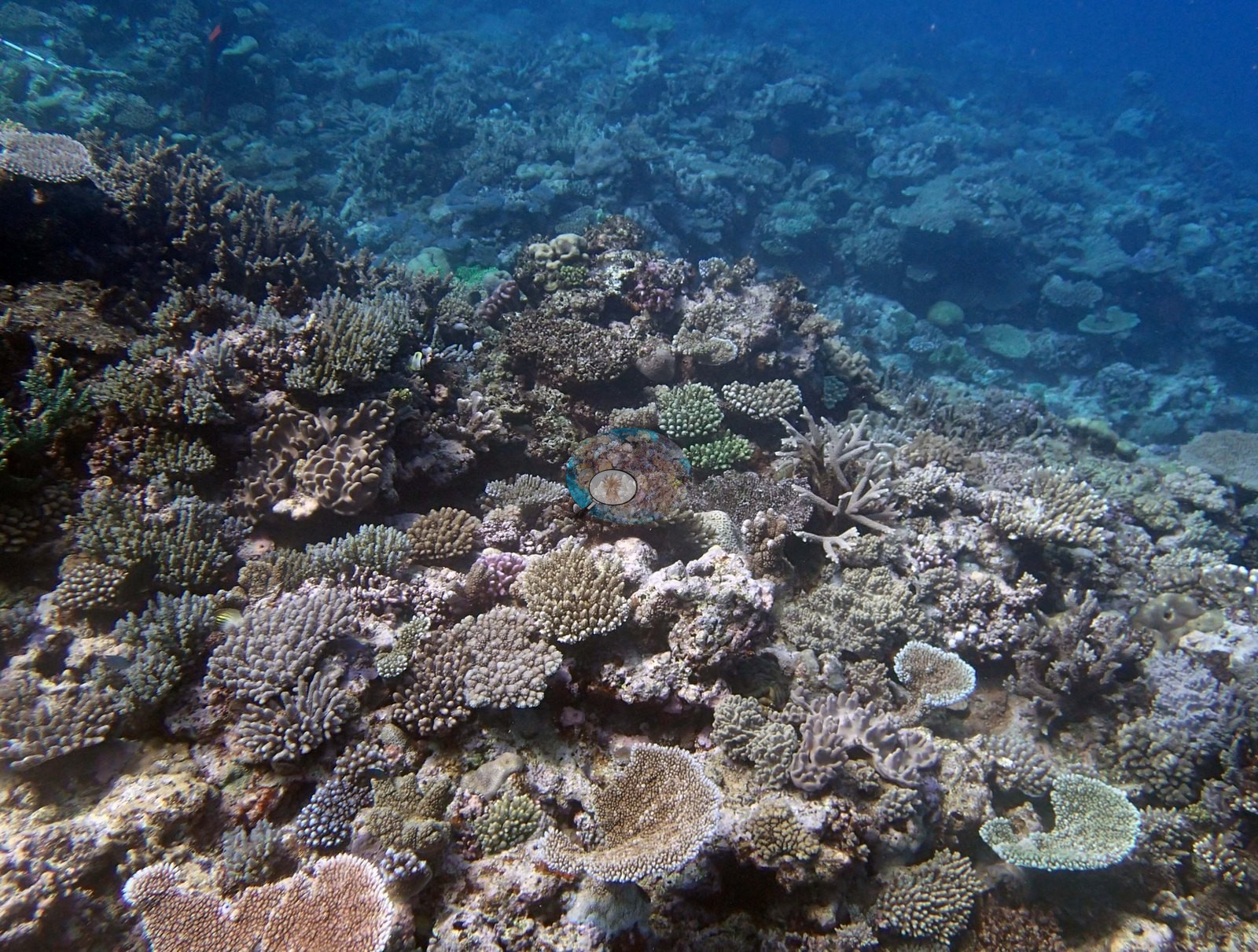
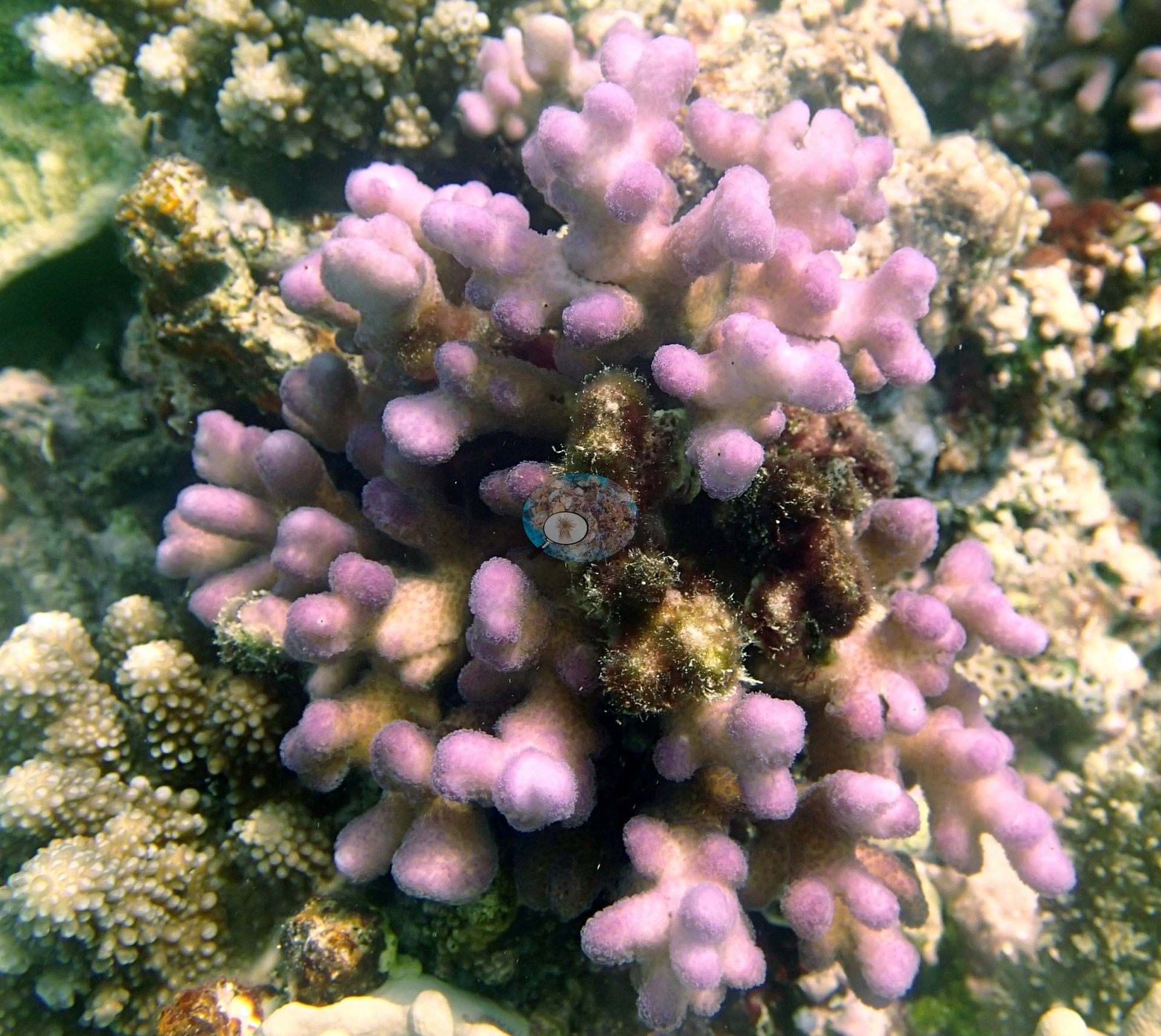
Between and below the thickets the assemblage broadens considerably: thin tabular acroporids from plate- to meter-class (e.g., Image 7, Image 34, Image 32, Image 12, Image 28, Image 15), pale-lilac and mauve corymbose colonies, bright chartreuse-green digitate and encrusting colonies (e.g., Image 33, Image 32, Image 12, Image 15), foliose and encrusting plates, small lumpy massive Porites, meandroid brain colonies including a striking salmon-orange convoluted colony in the foreground of Image 2, free-living mushroom-coral discs on pavement in Image 18, and blunt-branched pink and mauve pocilloporids throughout — one of which Anderson identified as Stylophora in Image 3.
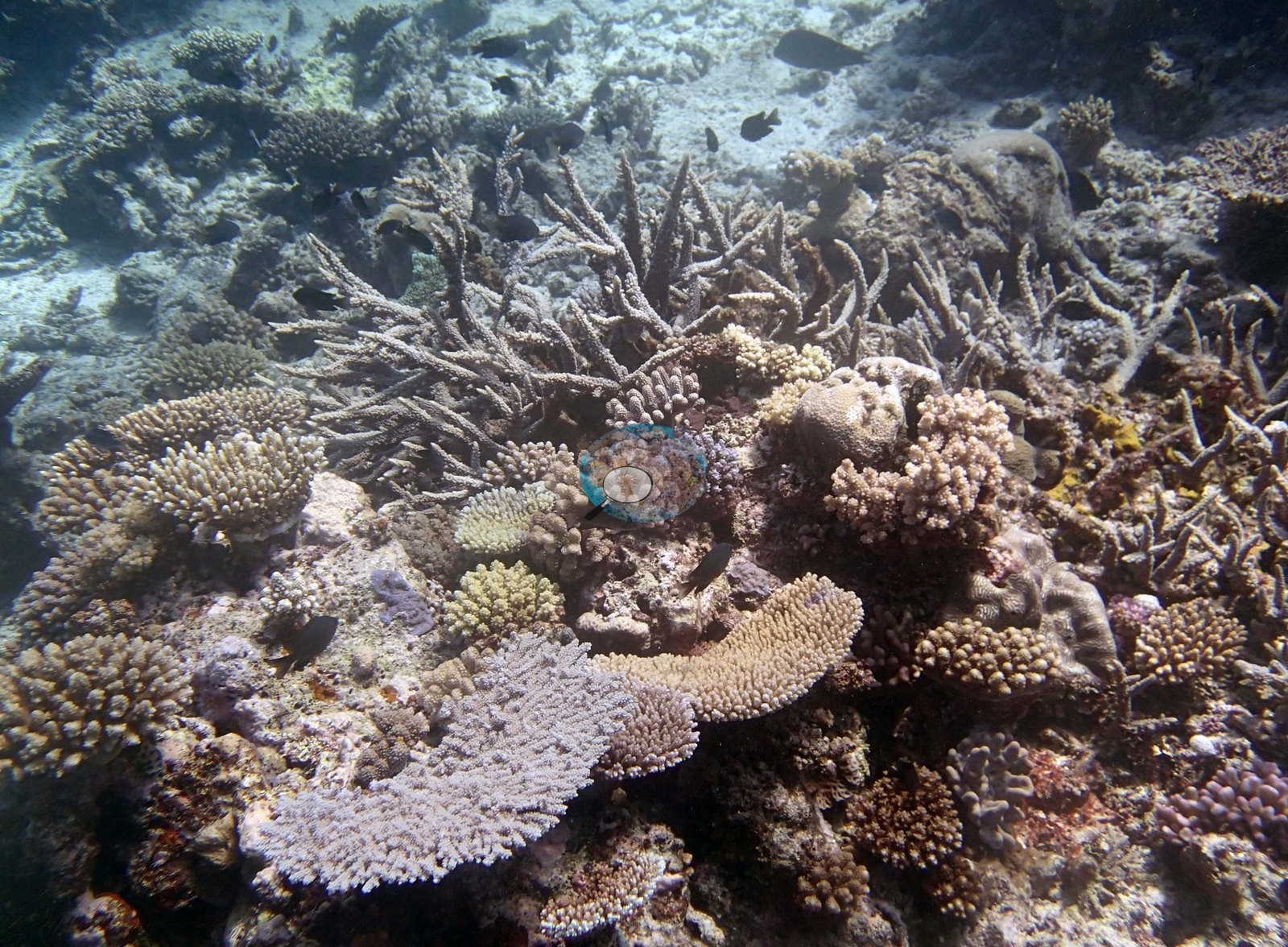
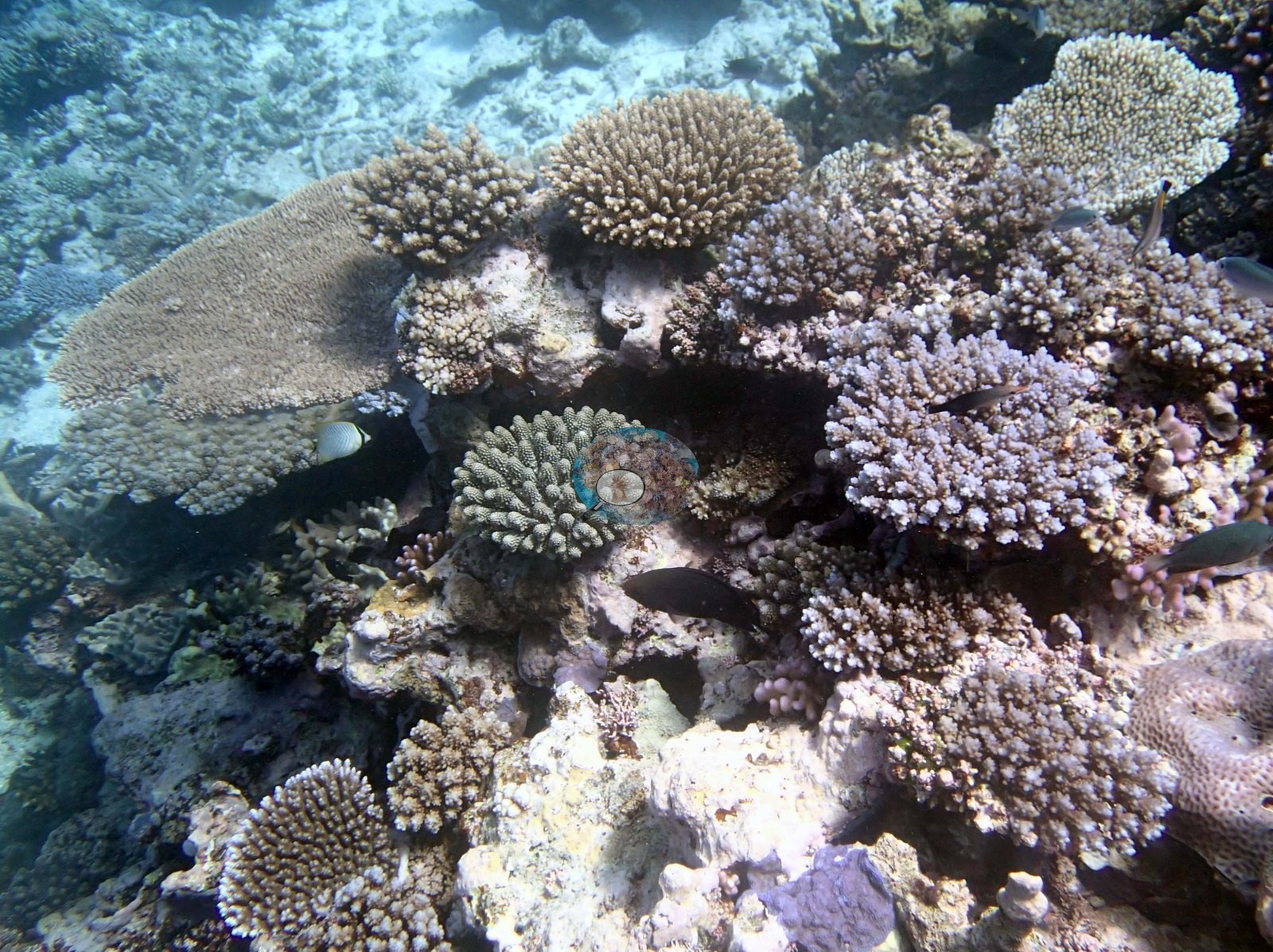
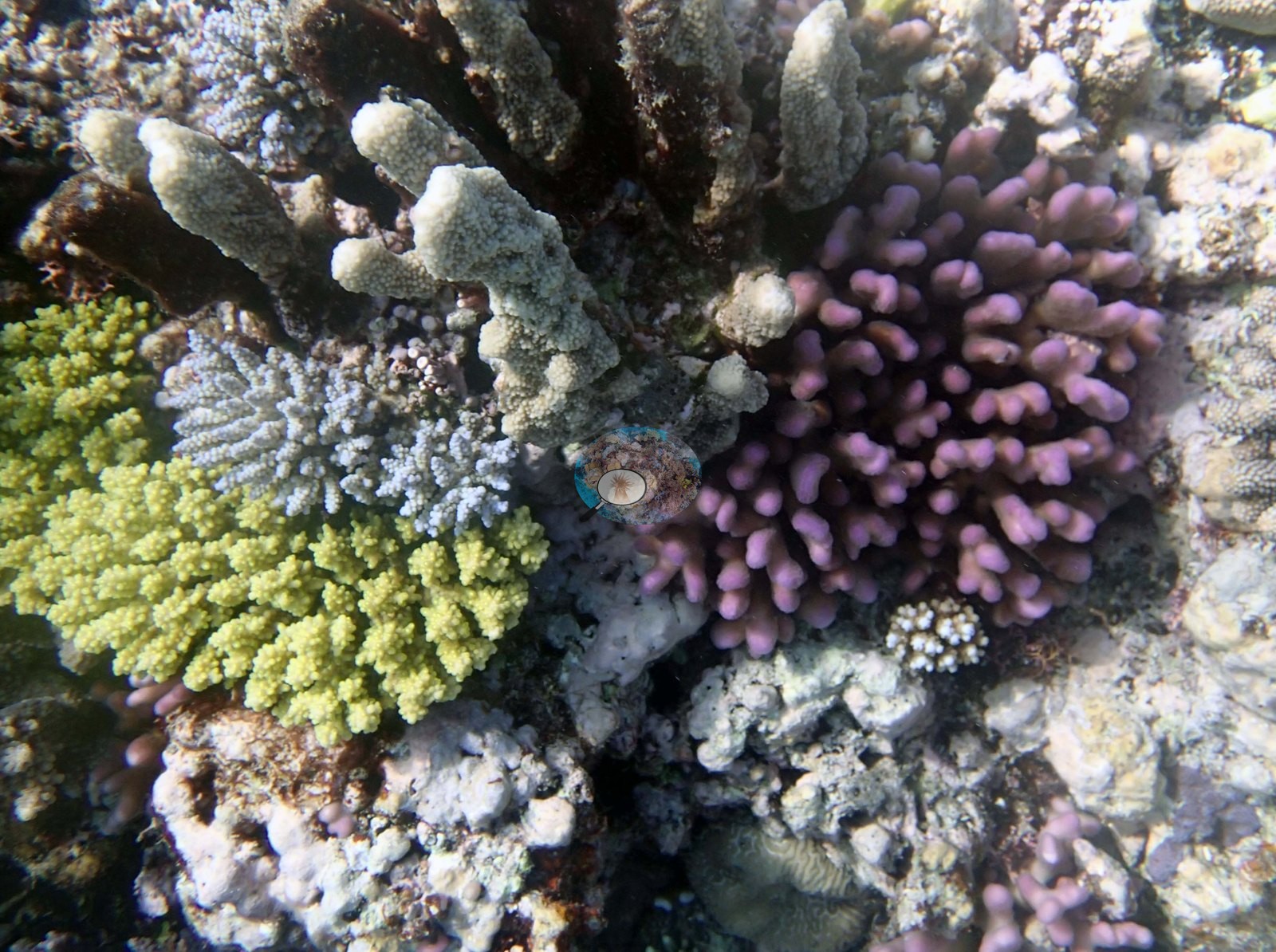
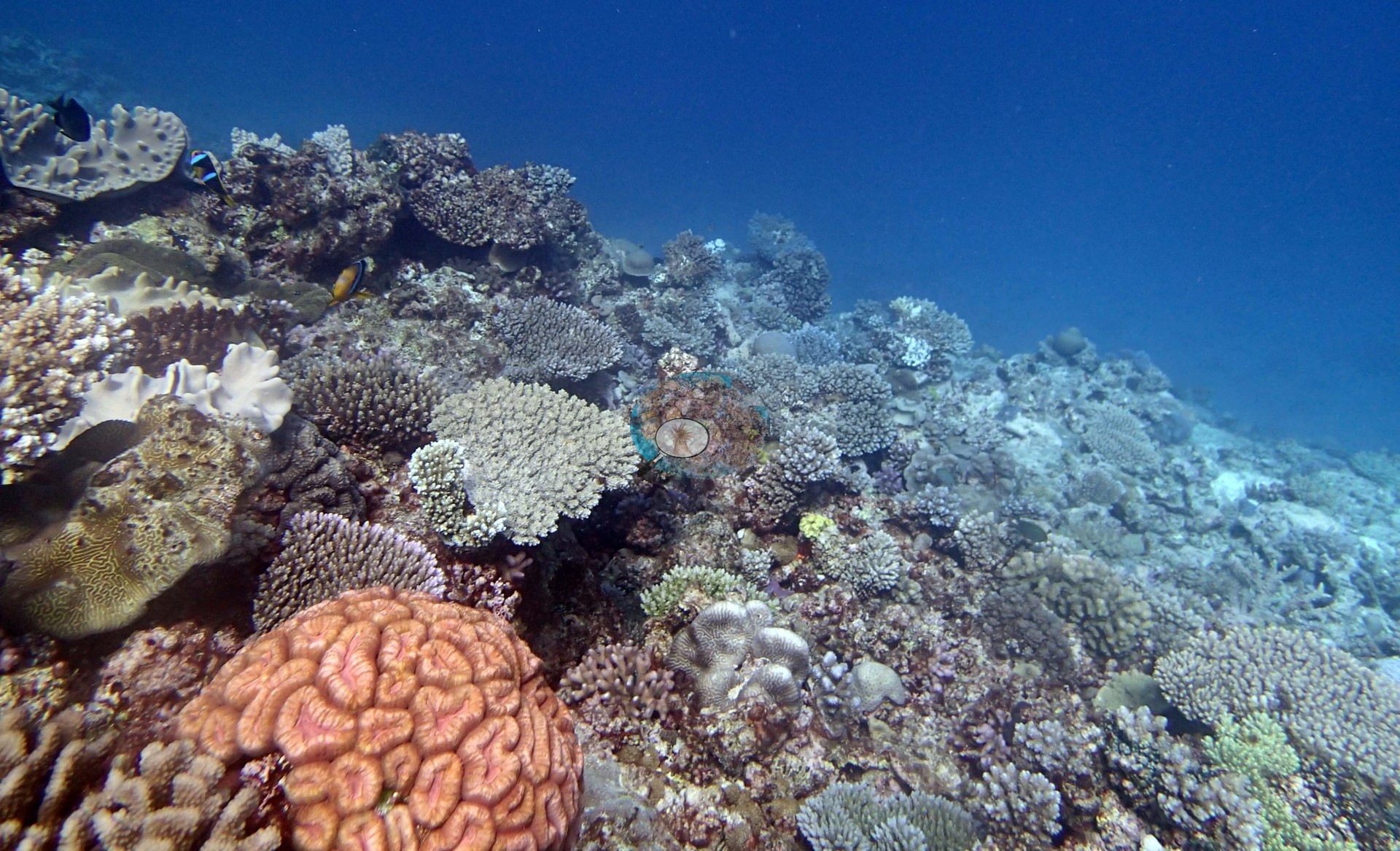
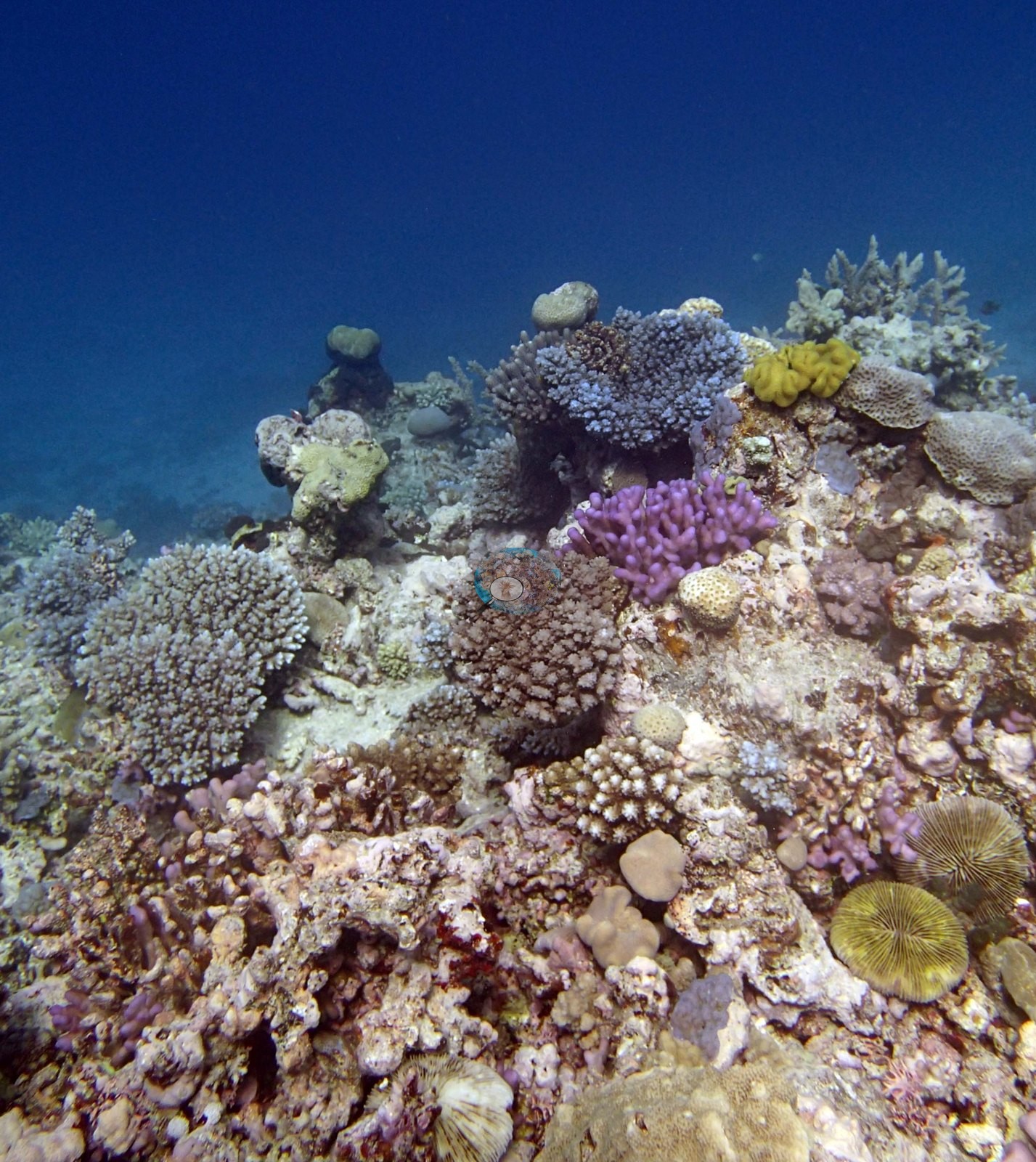
Octocorals are present but subordinate: a gray-tan mushroom-shaped leather coral in Image 5 and Image 27, yellow soft-coral clusters at the edge of Image 5 and Image 6, and in Image 6 a large gray-brown gorgonian sea fan standing on rubble at the deeper, sparser edge of the site.
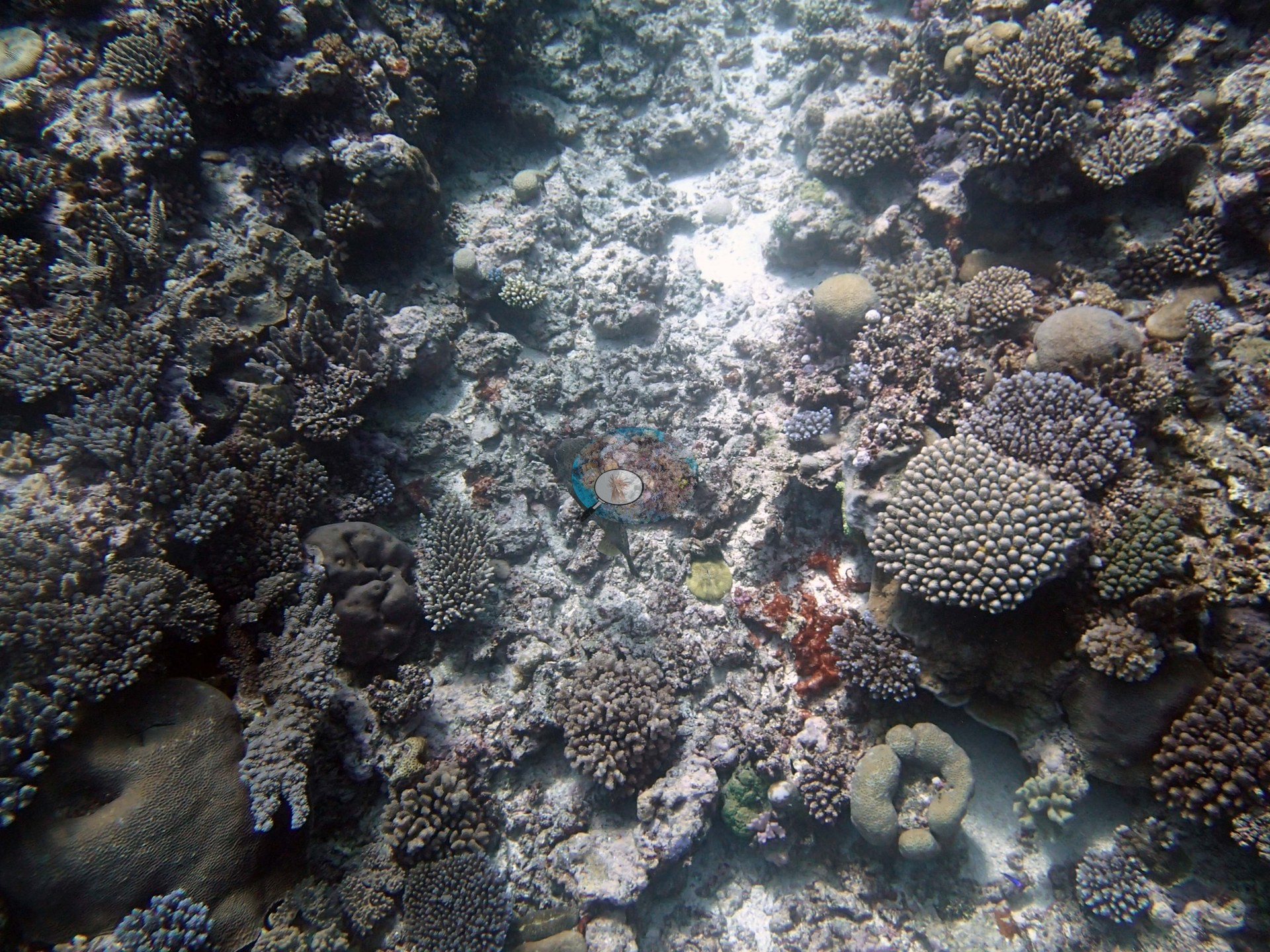
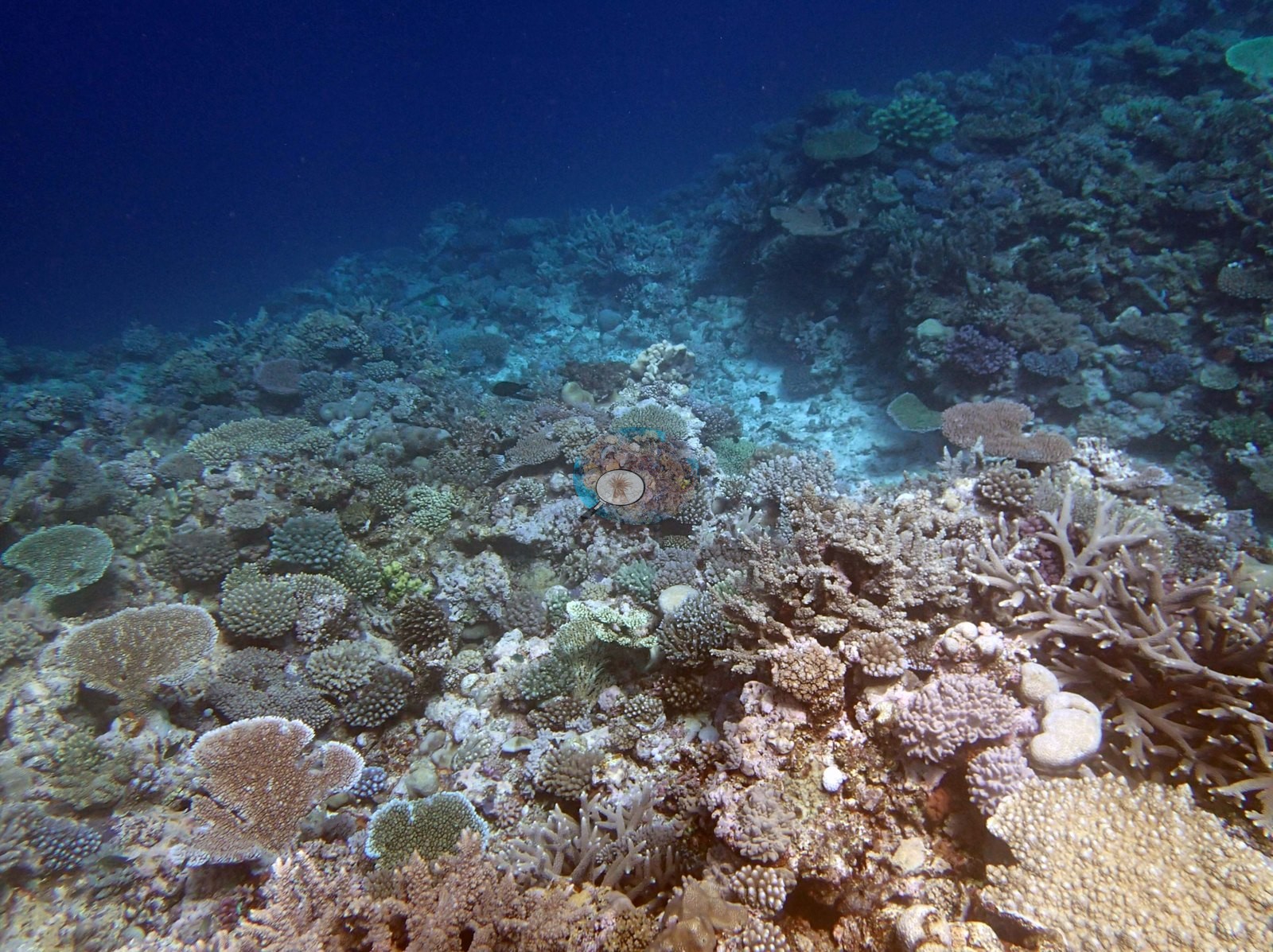
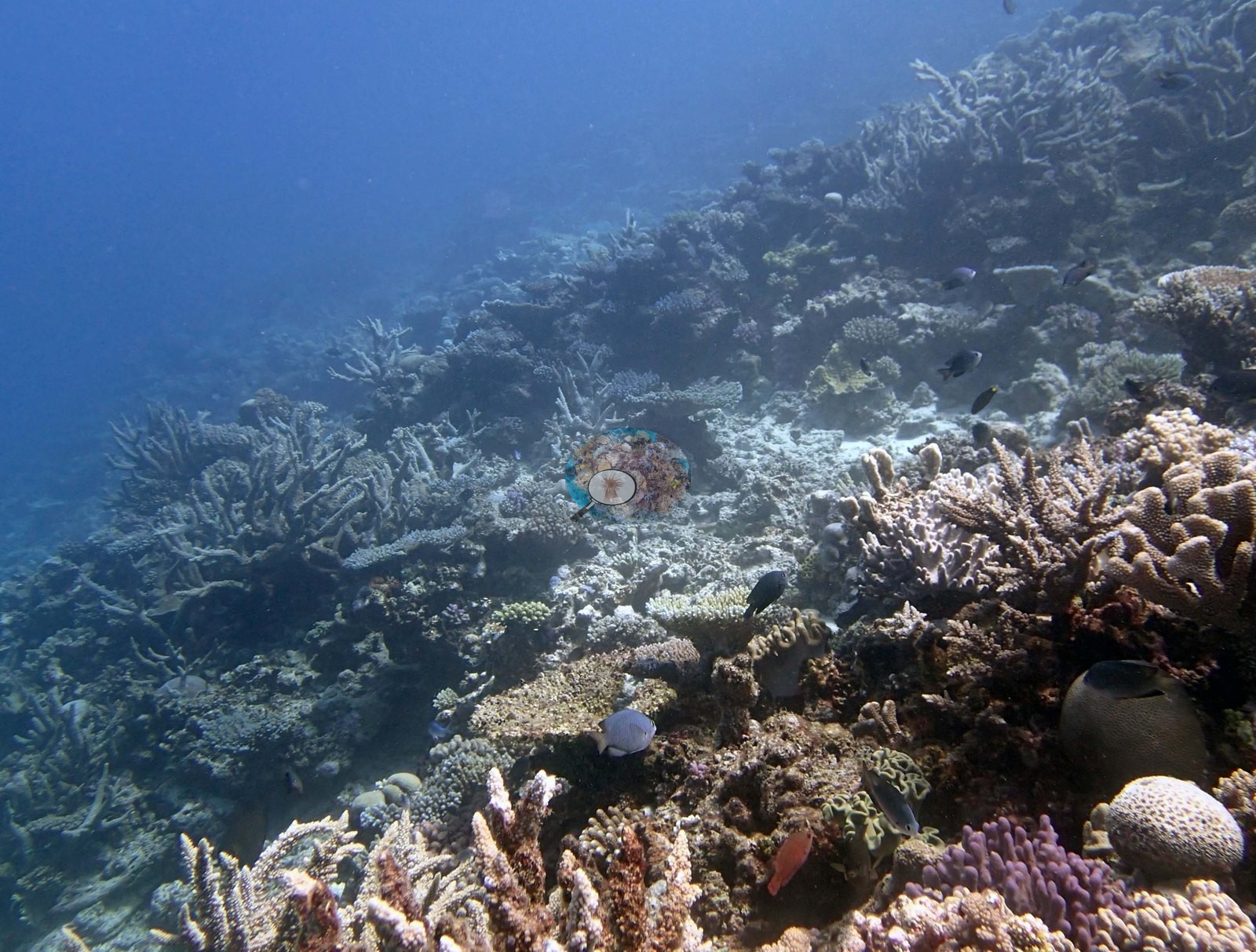
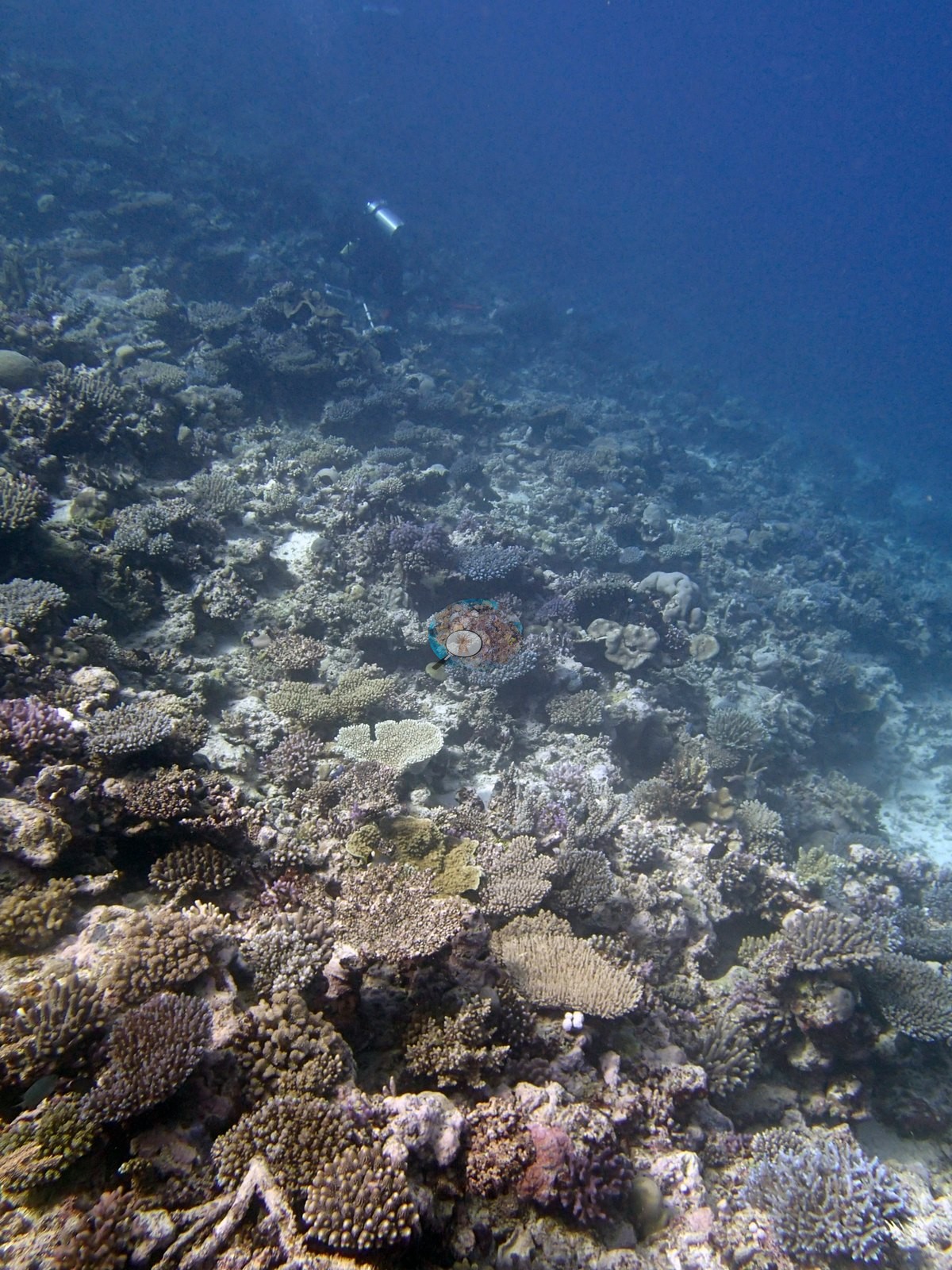
Relief is built from a high-cover reef top that gives way downslope to more open pavement, sand, and rubble; Image 21, Image 28, and Image 26 look down a slope where colonies become progressively more scattered against pale sediment, and Image 1 is a near-vertical view over bright pale pavement carrying only small isolated colonies.
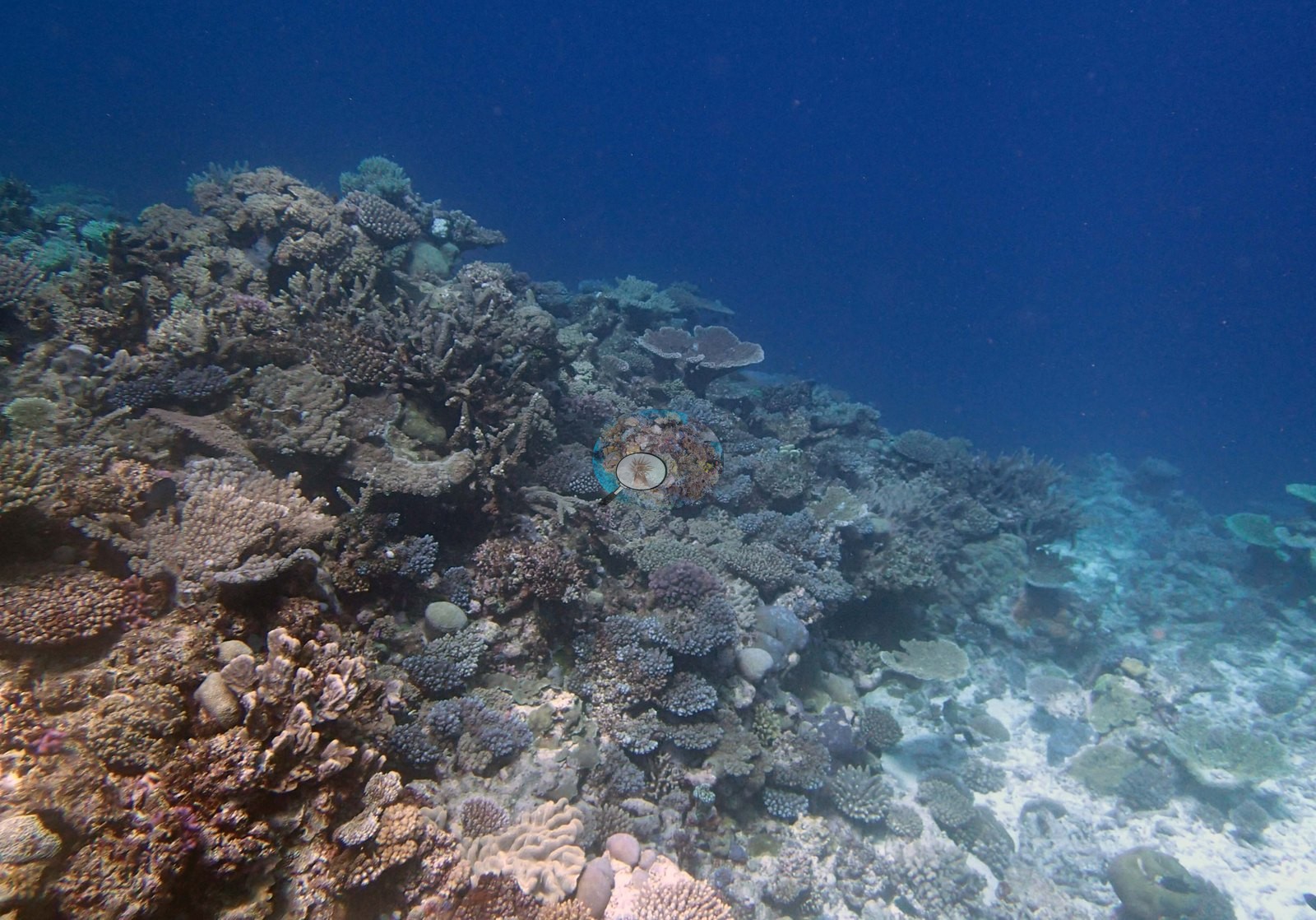
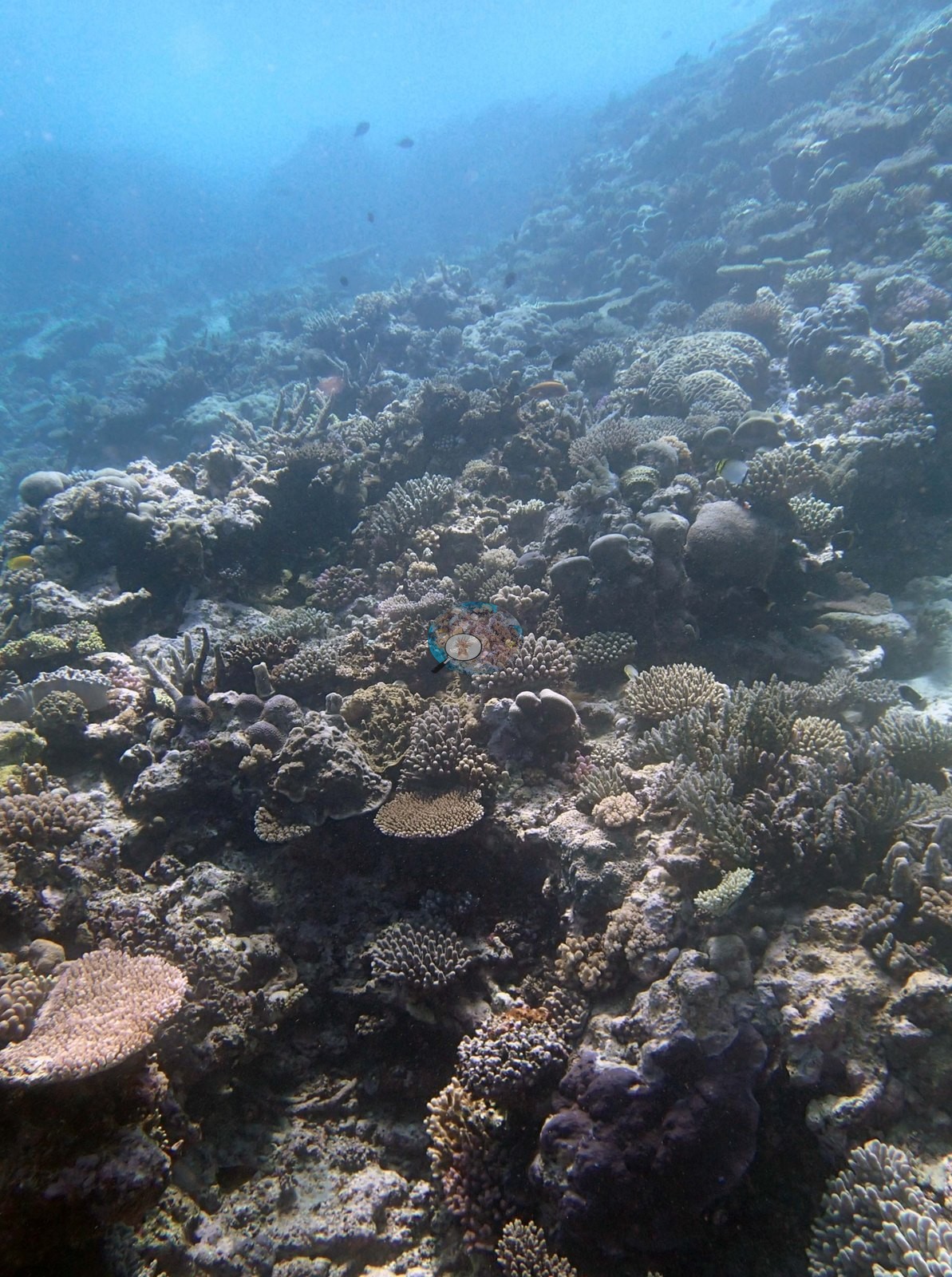
This fringing reef had a wide shallow area (3-5 m) with very high cover (60-80%) of branching corals, especially digitate, thick table, and staghorn acroporids, Montipora, Pocillopora, Favia stelligera, and Goniastrea colonies with damselfish lawns in some areas. At 10 m the slope became mostly sandy with large areas of rubble interspersed among coral patches. There were small table acroporids, Montastrea, Favia, Mycedium, and other corals. The slope had numerous table acroporids, Mycedium, Montipora plates, Merulina, Favites, and Leptastrea and small patches of Pachyseris rugosa. Patches of Halimeda, especially deeper covered 20-30% of the benthos.
Coral cover
- Reference: Khaled bin Sultan Living Oceans Foundation, Global Reef Expedition (in situ transect)
- 38%, from the Khaled bin Sultan Living Oceans Foundation's in situ transect survey (Global Reef Expedition site data); the photographs illustrate the site.
- Coral Health Index 3.00/5 (Mayfield et al. 2021, Platax).
- Cover increased to 10-15% at 15 m then dropped off to 5.0–10% at 20 m and 1.0–2.0% at 30 m before ending in sand.
- Transect mean 38 ± 12% SE (n = 5 transects; Living Oceans Foundation per-transect benthic data); the headline above is this all-transect mean.
Stressors
Condition can be settled only in part from these frames. Many of the shallow-frame colonies photograph pale cream or bone-tinged, but these are bright, high-sun shallow frames with strong surface light, and pale rendering under those conditions is not reliable evidence of bleaching on its own. One staghorn stand in the foreground thicket of Image 14 is different: it is gray-white along whole branches, with corallites intact, directly beside tan-cream staghorn and pigmented corymbose and massive colonies, a bleached but still-living stand.
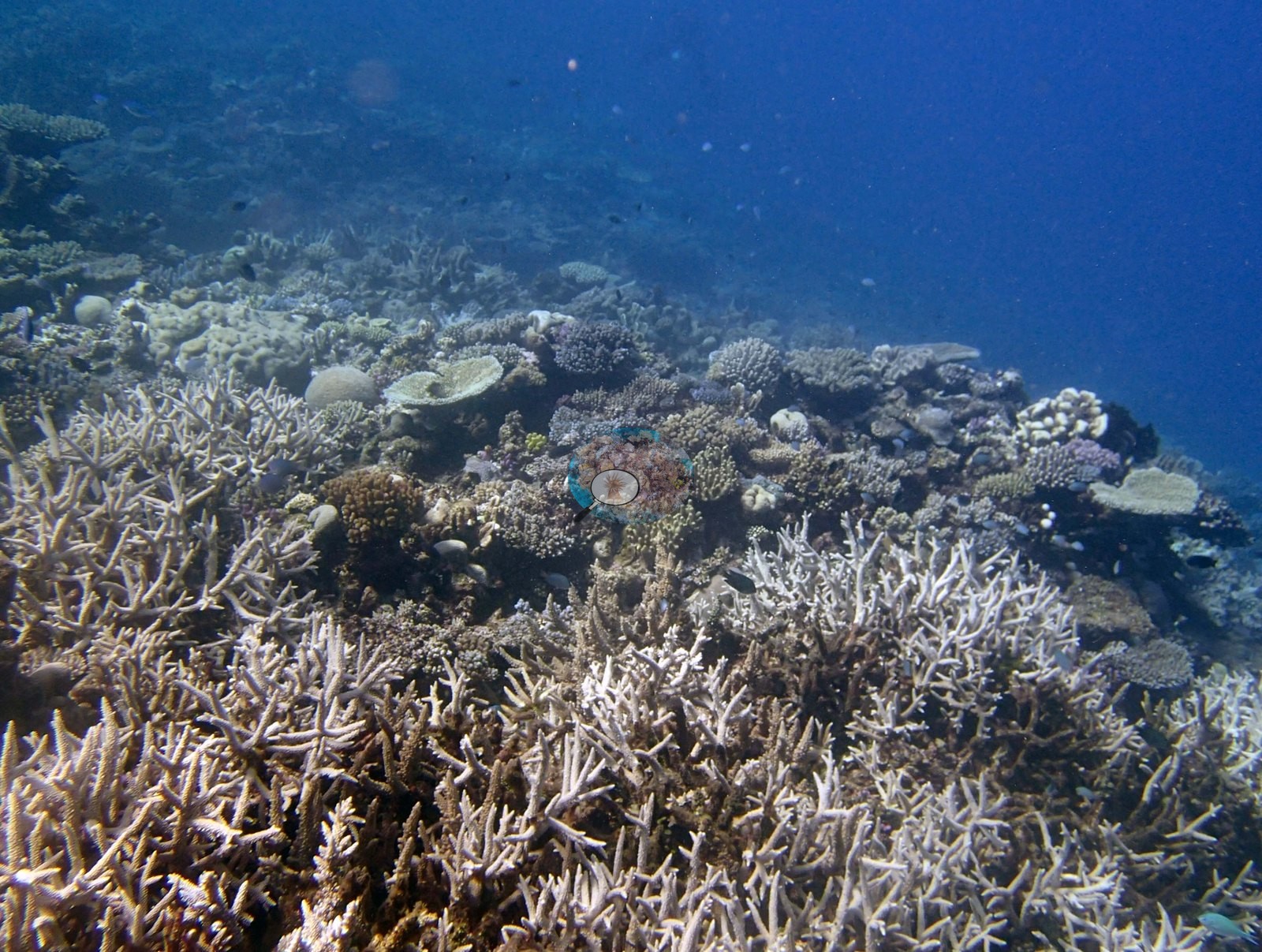
No disease lesion, predation scar, or crown-of-thorns damage resolves with confidence at these ranges. Anderson's sampling sheet records one of the four colonies sampled here (colony 112) as 5% dead or bleached and the other three as healthy. Broad areas of white and pale pavement between colonies in Image 10, Image 18, Image 34, and Image 1 are equally consistent with clean coralline pavement, old consolidated rubble, or sediment, and the frames cannot distinguish those. The 2013 survey notes for this site record four Culcita cushion stars (Khaled bin Sultan Living Oceans Foundation expedition site notes, 2013; regional summary in Bruckner 2014). Typical recent thermal stress: mean annual maximum of 8.1°C-weeks (Degree Heating Weeks, 2021-2025, NOAA CRW; Southern Tonga virtual station). The Living Oceans Foundation transects here recorded 2.0% cyanobacteria and no recently dead coral.
Fish and other fauna
Fish appear steadily but without large aggregations: damselfishes and chromis working the branching thickets, butterflyfish and a red-orange wrasse-type fish, scattered surgeonfish and small planktivores, and divers visible in the water column in Image 30, Image 31, and Image 28.
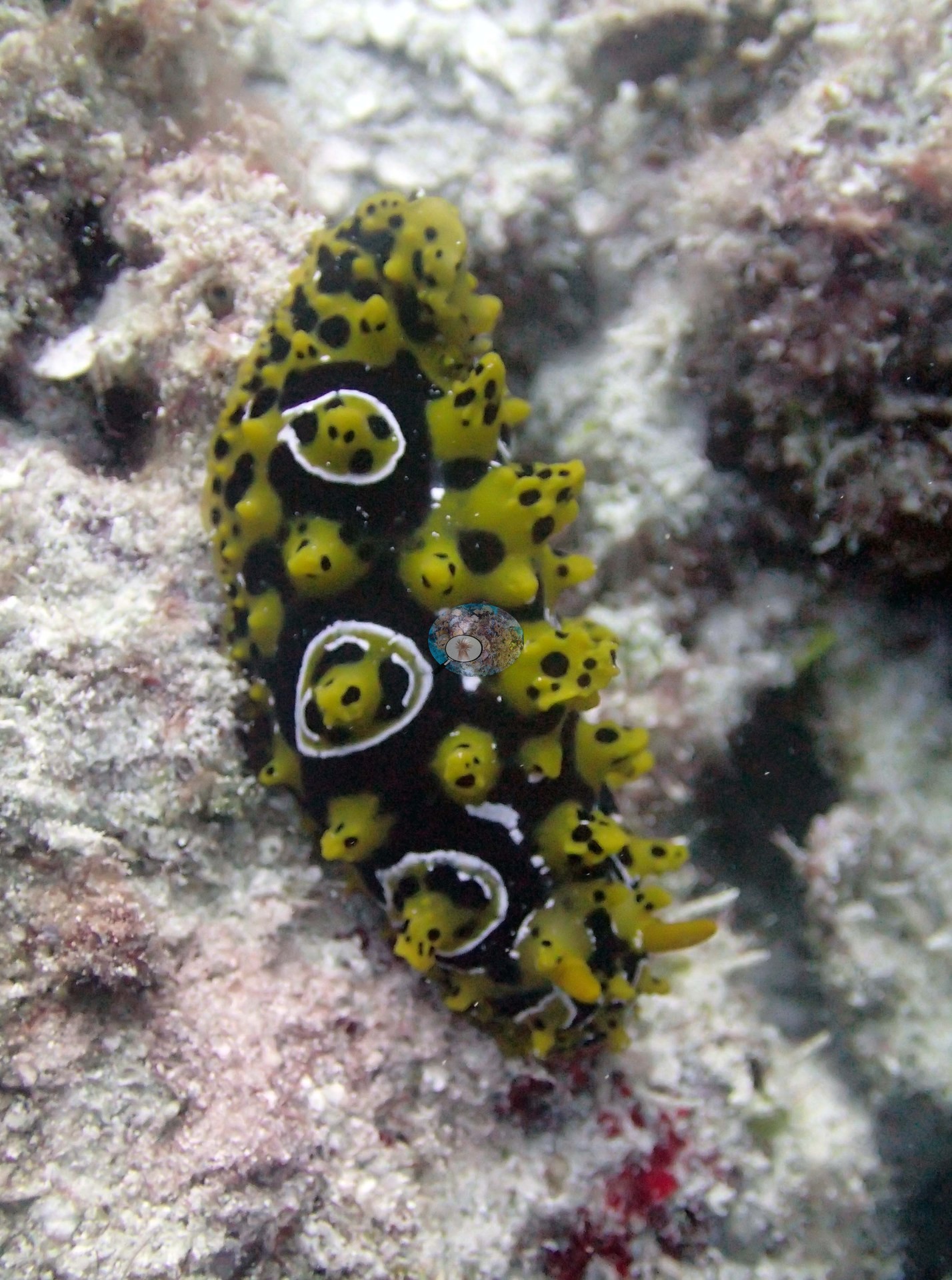
Found 2 trumpet tritons and 8 sea cucumbers (most at 25 m). Image 4 is Anderson's frame of a nudibranch.
Comparisons with other data
TOVA53 (Vava'u) was surveyed on 28 September 2013 during the Khaled bin Sultan Living Oceans Foundation Global Reef Expedition.
Dive record
Photo review of 35 habitat frames plus 21 sampled-colony close-ups from the 28 September 2013 dive at TOVA53 (Vava'u, southwest end of Treasure Island).
Other notes
The account on this page is written from the habitat frames only; the colony images are treated purely as a record of what was sampled. Four Pocillopora colonies were sampled at TOVA53 (colonies 112, 113, 114, and 115); 112 and 113 are labeled P. acuta and 114 and 115 P. damicornis in Anderson's own field records. The 21 close-ups are repeat macro, tag, and setting shots of only those four colonies — polyps extended over verrucose branches, numbered tags in frame — and describe the colonies, not the reef.
CV model comparison
More info
The photo row below is a methods comparison only: it is never averaged with the transect and never used as the headline. It compares site means only: the photos come from the same survey dive as the transect but not from the same points.| Method | Hard coral cover (%) | Photos (n) ± SE |
|---|---|---|
| Transect mean (all transects) | 37.9 | |
| CoralSCOP unedited | 38.6 | n = 34 · SE 2.0 |
| Claude (edited photos) | 39.7 | n = 34 · SE 2.3 |
The two computer-vision methods agree within 1.1 pp (38.6–39.7%) and read within 1.8 pp of the in-water transect (37.9%).
See a more detailed, stand-alone version of this table.
Data & links
- Download benthic survey data (CSV) ↗
- Download all LOF-GRE data (933 sites) ↗
- Photo portfolio ↗
- Coral Reef Diagnostics region page ↗
All images from Coral Reef Diagnostics. Data are from the Khaled bin Sultan Living Oceans Foundation Global Reef Expedition and Coral Reef Diagnostics.
© Coral Reef Diagnostics.
References
- Mayfield AB, Dempsey AC, Chen CS (2021). Assessing coral health in the Kingdom of Tonga with a coral health index. Platax 18:53-78. DOI
- Bruckner AW (2014). Global Reef Expedition: Kingdom of Tonga. Field Report. Khaled bin Sultan Living Oceans Foundation, Landover, MD. 28 pp. PDF