
Part of the regional summaries: Tonga - Vava'u and Tonga

More info
Southern Tonga (NOAA CRW virtual station)A leeward fringing reef in Vava'u whose 3-8 m shallows carry dense 50-80% cover of branching and table acroporids, most in excellent condition, although Anderson's sampling sheet records four of the eight Pocillopora colonies sampled as 60-95% bleached. The steep slope below is more broken, with overturned corals but a diverse assemblage, and several large giant clams and many sea cucumbers were seen. Surveyed on the Living Oceans Foundation's Global Reef Expedition.
Ko ha hakau matafonua (fringing reef) ʻi he tafaʻaki maluʻi mei he matangi (leeward) ʻi Vavaʻu ʻoku ʻi hono feituʻu mamaha ʻo e 3-8 m ʻa e ʻufiʻufi fefuʻifuʻi ʻo e 50-80% ʻe he ngaahi acroporid fakavaʻavaʻa mo fakatēpile (table), ko e lahi taha ʻoku lelei ʻaupito hono tuʻunga, neongo ʻoku lēkooti ʻe he pepa sampling ʻa Anderson ko e kulupu ʻe fā ʻi he kulupu Pocillopora ʻe valu naʻe toʻo sīpinga mei ai naʻe hinehina ʻaki ʻa e 60-95%. Ko e tafaʻaki tuʻu ʻi lalo ʻoku fasifasi ange, mo e ngaahi feo kuo fulihi ka ko ha kulupu kehekehe, pea naʻe sio ki ha ngaahi vāsuva (giant clams) lalahi mo e ngaahi loli (sea cucumbers) lahi.
AI translation of this summary; the English is authoritative. (low confidence)
CTD-cast midpoint of 25.8–26.7°C
Two other CRD dive sites with their own pages within 5 km shown in orange — click a marker to open its page.
🗺 Detailed map of the Global Reef Expedition dive sites, Vava'u, Tonga (Khaled bin Sultan Living Oceans Foundation; opens in a new window)
Site description
Setting
Survey team's site notes: Fringing reef on the leeward side of an island. The reef ended at 30-32 m in sand.
General benthic features
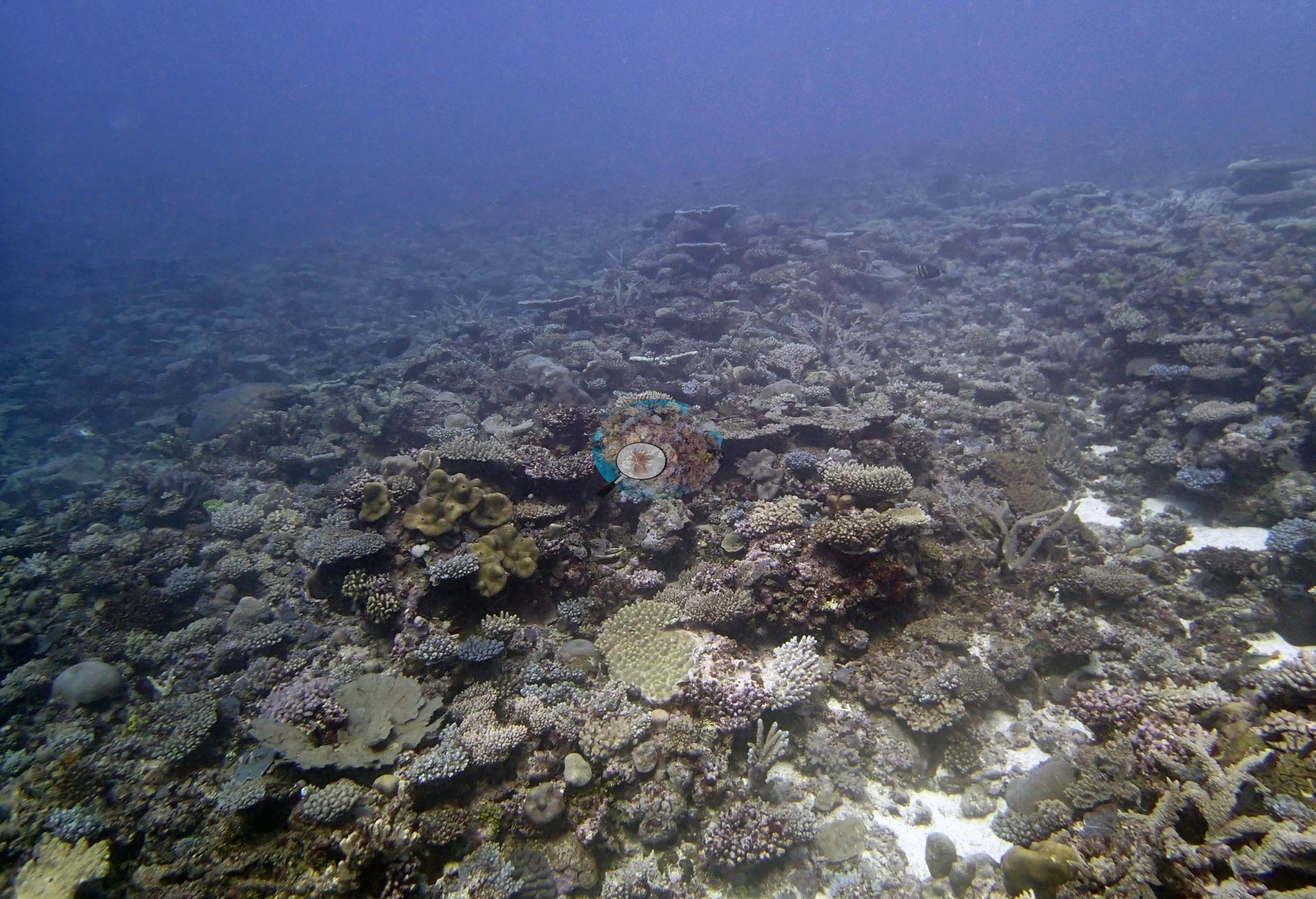
Shallows from 3-8 m had a dense cover (50 to 80%) of branching acroporids, staghorns, digitate acroporids, table acroporids, thick branched acroporids, Pocillopora, Hydnophora, faviids, Coscinaraea, and many other species with 20-30% cover by soft corals (e.g., Image 3).
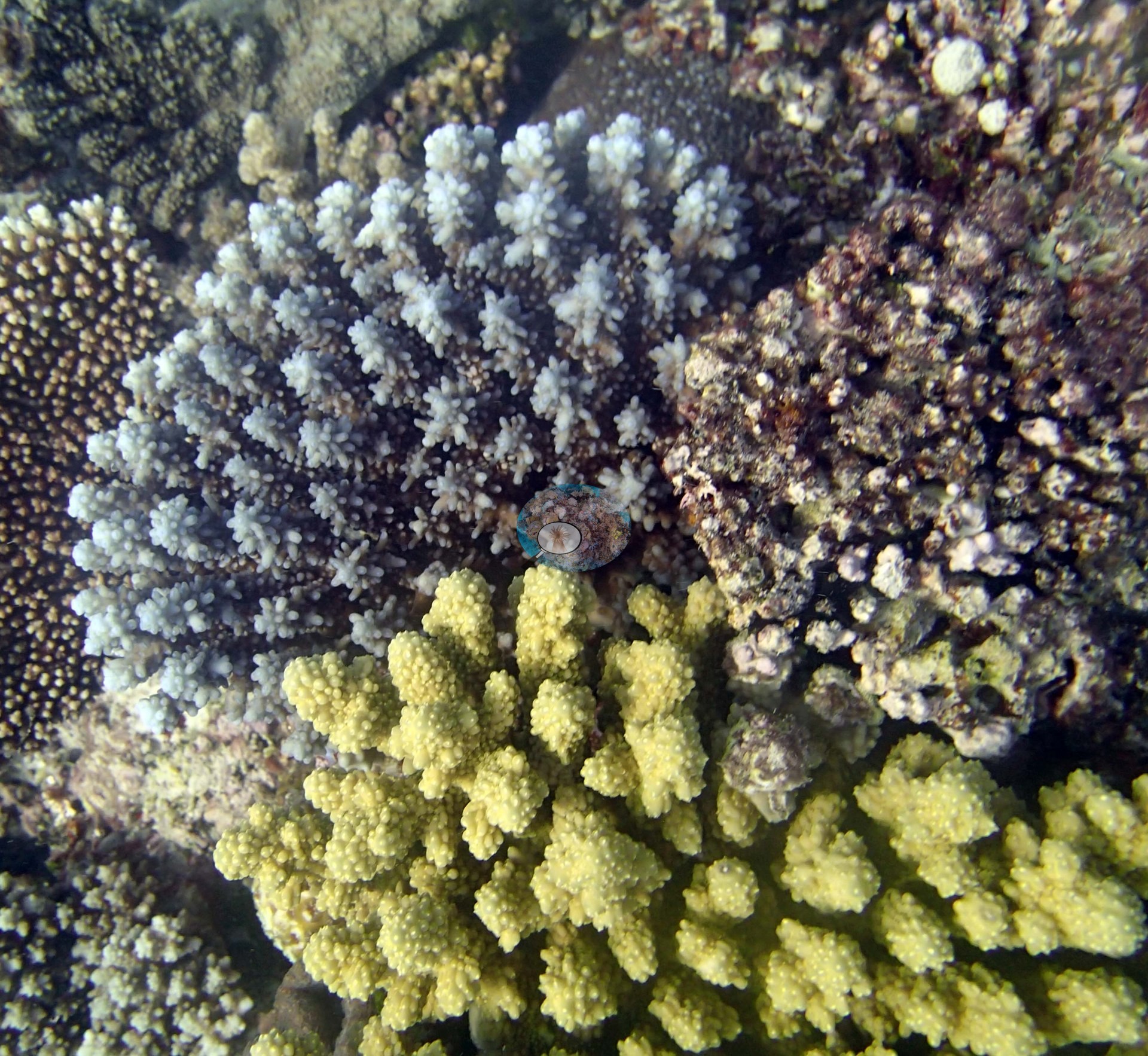
There was a build-up of up to 1.5 m but no real grooves or sand channels. On the steep slope cover declines to 20-30% with a lot of overturned and broken corals, but the slope had an interesting diverse assemblage of corals, including Echinophyllia, Astreopora, acroporids, Pocillopora, Coscinaraea, numerous faviids, Galaxea, Montastrea, Montipora, Mycedium, Acanthastrea, and many other species (e.g., Image 1, Image 2).
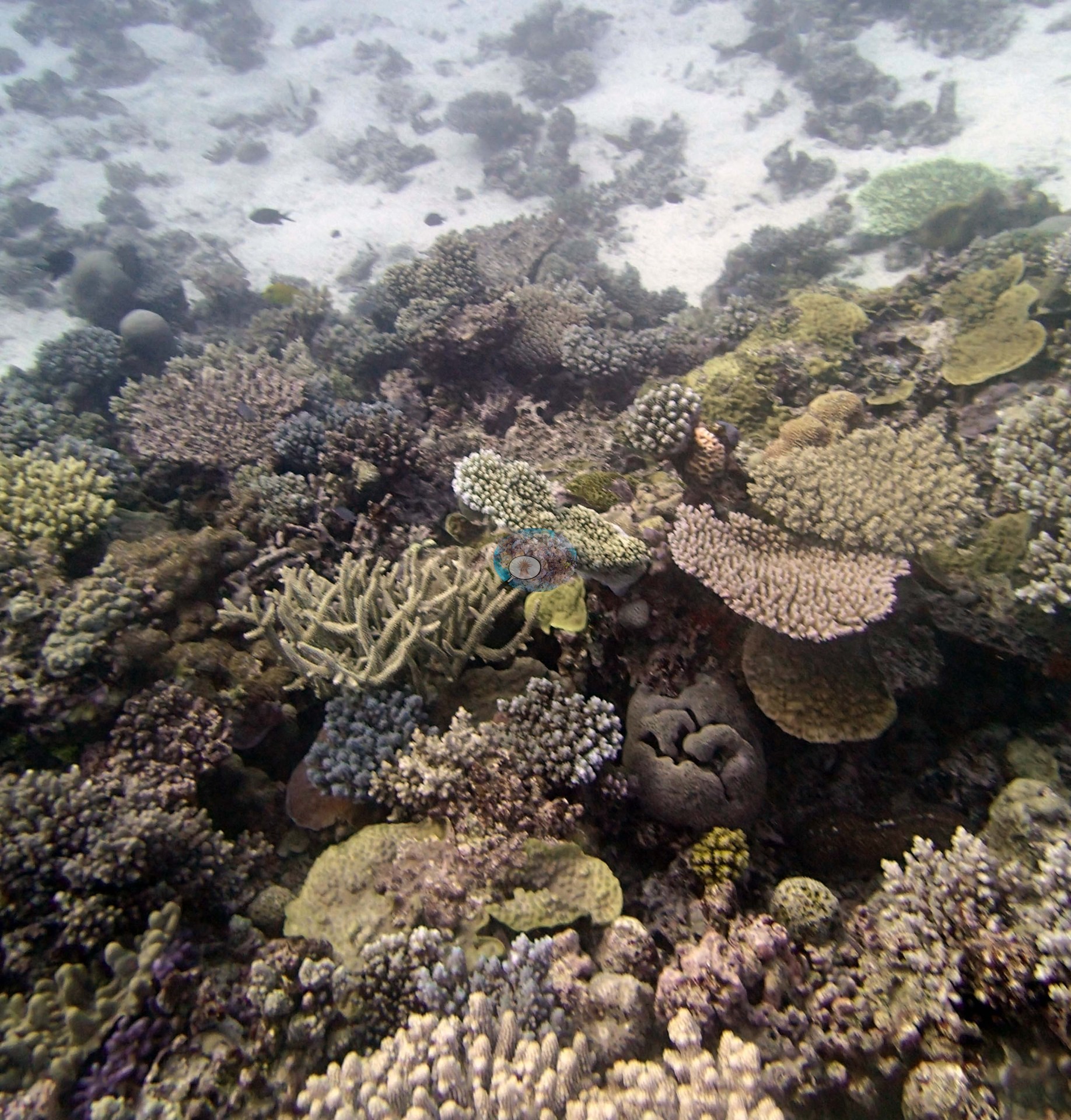
Shallow slope had some large stands of branching Porites; in several deeper locations were 2-5 m assemblages of bottlebrush acroporids. Table acroporids below 15 m were up to 2 m wide with about 10% dead colonies. At the base of the reef were small thickets of staghorn coral. There was little macroalgae; up to 30% turf and 30% CCA with about 2.0–5.0% cyanobacteria (a by-eye estimate; the survey transects recorded 0.7%).
Coral cover
- Reference: Khaled bin Sultan Living Oceans Foundation, Global Reef Expedition (in situ transect)
- Coral cover 44% (the expedition's in situ transects).
- Transect mean 44 ± 12% SE (n = 5 transects; Living Oceans Foundation per-transect benthic data); the headline above is this all-transect mean.
- Coral Health Index 3.71/5 (Mayfield & Dempsey 2025, Discover Oceans formula).
Stressors
Most corals were in excellent condition, with few snails and about 5% dead acroporids. Anderson's own sampling sheet for this dive nevertheless records heavy bleaching in the Pocillopora sampled: four of the eight colonies 60-95% bleached (three of them noted as unhealthy) and a fifth 15% bleached. The 2013 survey notes for this site record three Culcita cushion stars and snails on about 1 to 3% of the corals (Khaled bin Sultan Living Oceans Foundation expedition site notes, 2013; regional summary in Bruckner 2014). The Living Oceans Foundation transects here recorded 0.7% cyanobacteria and no recently dead coral.
Fish and other fauna
Many sea cucumbers were present and several large giant clams.
Comparisons with other data
Apart from the Living Oceans Foundation survey shown here, we found no other surveys at this site as of 2026. If you would like to share yours, please email us.
Dive record
TOVA47 (Vava'u): surveyed 26 Sep 2013 during the Khaled bin Sultan Living Oceans Foundation Global Reef Expedition.
Data & links
- Download benthic survey data (CSV) ↗
- Download all LOF-GRE data (933 sites) ↗
- Photo portfolio ↗
- Coral Reef Diagnostics region page ↗
All images from Coral Reef Diagnostics. Data are from the Khaled bin Sultan Living Oceans Foundation Global Reef Expedition and Coral Reef Diagnostics.
© Coral Reef Diagnostics.
References
- Mayfield AB, Dempsey AC (2025). Machine-learning algorithms for identifying climate-resilient corals in the Republic of Palau. Discover Oceans 2:45. PDF
- Bruckner AW (2014). Global Reef Expedition: Kingdom of Tonga. Field Report. Khaled bin Sultan Living Oceans Foundation, Landover, MD. 28 pp. PDF