
Part of the regional summaries: Tonga - Vava'u and Tonga
More info
Southern Tonga (NOAA CRW virtual station)A leeward fringing reef off a small southwestern island in Vava'u, where coral peaks at 30-50% around 5 m among small branching and table corals, then thins with depth into rubble and scattered staghorn stands. Patches of Halimeda and Caulerpa algae and about 10% cyanobacteria (a by-eye estimate; the transects recorded 3.0%) cover parts of the reef. Surveyed on the Living Oceans Foundation's Global Reef Expedition.
Ko ha hakau matafonua (fringing reef) ʻi he tafaʻaki maluʻi mei he matangi (leeward) ʻi ha kiʻi motu ʻi he tonga hihifo ʻo Vavaʻu, ʻoku māʻolunga taha ai ʻa e feo ʻi he 30-50% ʻi he meimei 5 m ʻi he lotolotonga ʻo e kiʻi feo fakavaʻavaʻa mo fakatēpile (table), pea ʻoku siʻi ange ʻi he loloto ange ki he maka momoa (rubble) mo e ngaahi vao staghorn mavahevahe. ʻOku ʻufiʻufi ha ngaahi konga ʻo e hakau ʻe he ngaahi konga ʻo e limu Halimeda mo e Caulerpa pea mo e meimei 10% ʻo e cyanobacteria (ko ha fakafuofua ʻaki e mata; naʻe lēkooti ʻe he ngaahi transect ʻa e 3.0%).
AI translation of this summary; the English is authoritative. (low confidence)
CTD-cast midpoint; the cast read 26.4°C throughout
One other CRD dive site with its own page within 5 km shown in orange — click a marker to open its page.
🗺 Detailed map of the Global Reef Expedition dive sites, Vava'u, Tonga (Khaled bin Sultan Living Oceans Foundation; opens in a new window)
Site description
Setting
Fringing reef on the leeward side of a small island in the southwest. Gentle slope from 3-5 m that is relatively low relief (30-60 cm) with some framework build-up at 6-8 m of up to 1 m and multiple canopy layers, then a slightly steeper slope to 20 m where the reef ends in sand. There are scattered thick branched Isoporids in the sand then a second reef system 50-100 m seaward that starts at 35 m and slopes to the depths.
General benthic features
The shallows above 5 m have very low cover with scattered corals and 10-20 cm relief. At 5 m depth the area has much more coral (30-50%), but it is dominated by small corals up to 30-40 cm in height, mostly digitate, small thick branched tabular corals, small to medium faviids, and other corals. At the edge of the slope to about 12 m are patches with small thick-branched staghorn corals and small thickets up to 3 m across intermixed with other acroporids, Pocillopora, faviids, Coscinaraea, Hydnophora, plates of Montipora, and other species. Below 15 m the reef has more rubble, with scattered areas of high coral cover intermixed with low cover. There are many more massive corals, including medium F. stelligera, Leptoria, small Porites, Favites, and Goniastrea, many Cyphastrea colonies, and plates of Mycedium. There are also several stands of staghorn coral. Reef has patches of up to 30% Halimeda, small (1-2 m) patches of dense Caulerpa, and about 10% cyanobacteria (a by-eye estimate; the transects recorded 3.0%) and 20% turf algae. What the two sea-star frames do show of the surrounding substrate is pale carbonate pavement and rubble bound by pink crustose coralline algae, with small massive and encrusting corals, a single short Acropora branch, a sea urchin, and patches of fine green and brown algal turf at the frame edges.
Coral cover
- Reference: Khaled bin Sultan Living Oceans Foundation, Global Reef Expedition (in situ transect)
- Coral cover declines to 20% at 15 m and 10-15% at 30 m.
- Coral cover: 38%.
- That figure is from the LOF-GRE in situ transect (the mean of all of this station's own transects in the expedition's per-transect benthic data), which put total algal cover (all algal groups) at 54% of the benthos.
- The transect value is this site's authoritative cover figure; no photograph, crop, or computer vision product overrides it.
- Transect mean 38 ± 10% SE (n = 6 transects; Living Oceans Foundation per-transect benthic data); the headline above is this all-transect mean.
Stressors
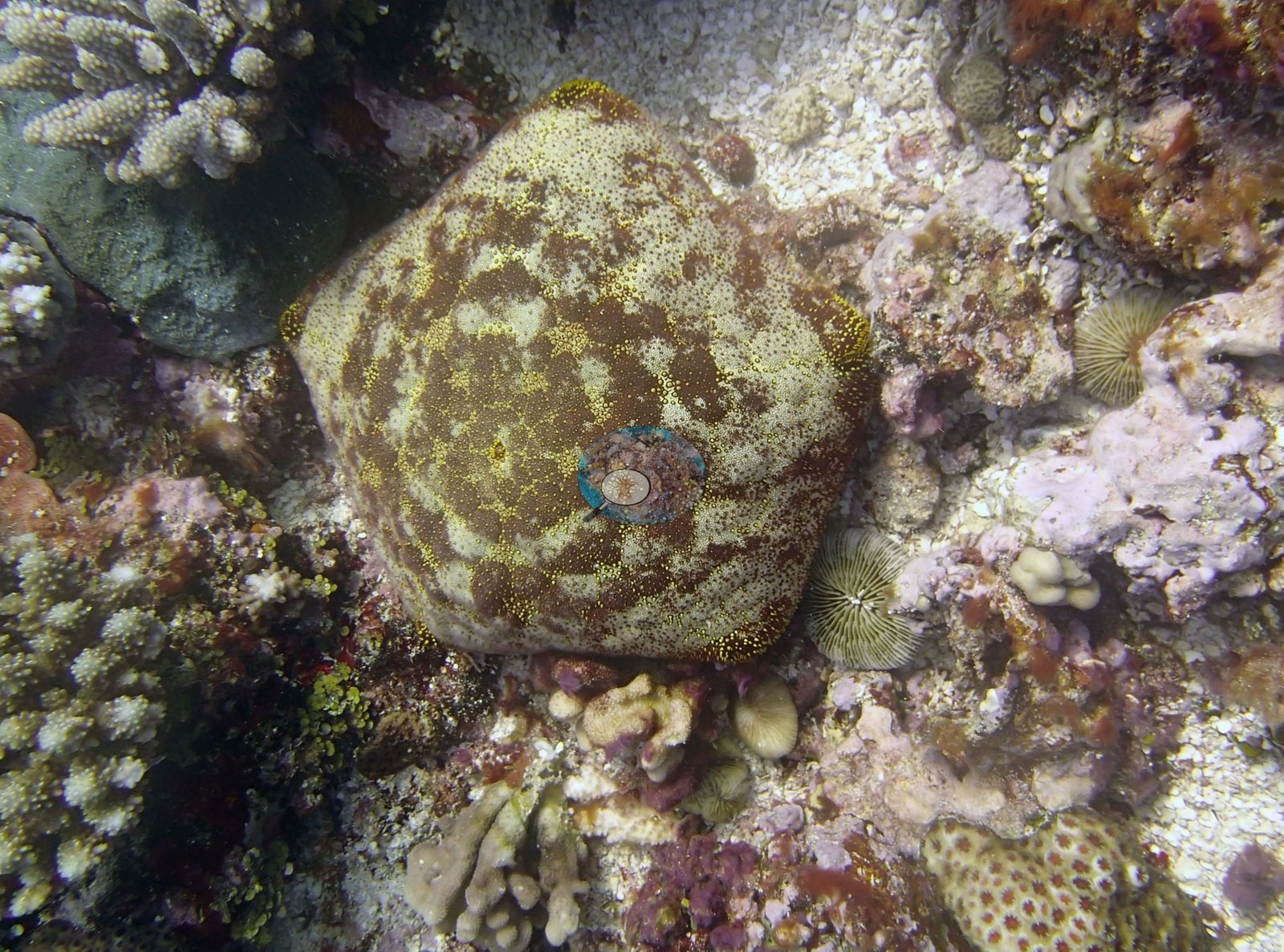
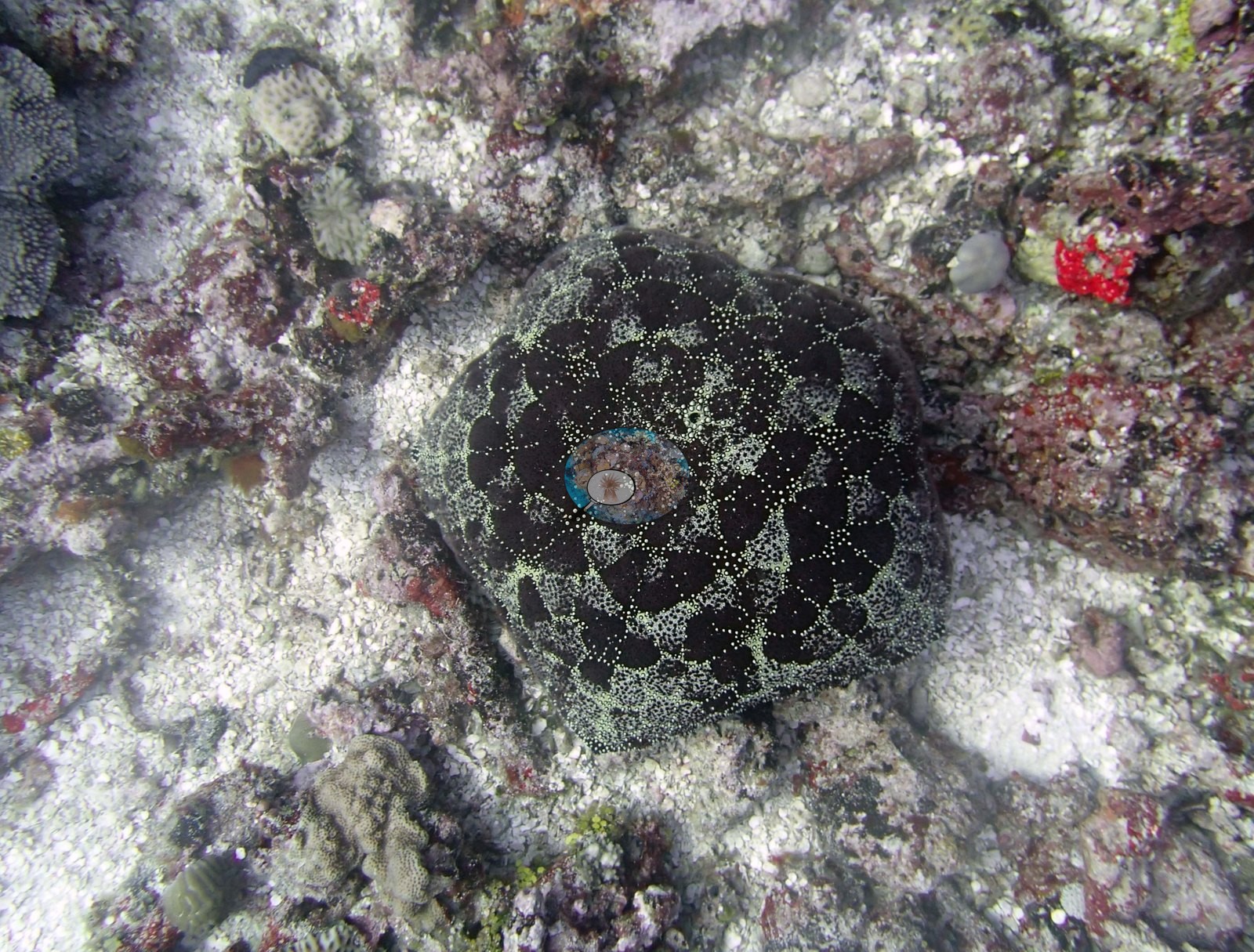
The surveyors recorded about 10% cyanobacteria on the reef (a by-eye estimate; the transects recorded 3.0%), and Anderson photographed two Culcita cushion stars, coral predators, resting on the bottom (e.g., Image 1, Image 2).
The Living Oceans Foundation transects here recorded no recently dead coral.
Fish and other fauna
Moderately high numbers of sea cucumbers. Two differently pigmented sea stars appear, one dark chocolate-mottled and one pale cream and olive.
Comparisons with other data
The expedition's own site table classifies TOVA45 as a fringing reef on an intermediate aspect, surveyed in the lagoon. Alongside the hard coral already reported for this site, the same transects recorded 30% crustose coralline algae, 7.7% turf, 6.4% macroalgae, 6.5% erect algae, and 3.0% cyanobacteria (54% algae in all). Non-living substrate came to 53% pavement, 4.6% dead coral, 2.9% rubble, and 1.1% sand. Paired fish transects recorded about 18 fish species per transect and about 17 kg per 100 m2 of biomass. The benthic figures are means of all of this station's own transects in the expedition's per-transect benthic records, and the fish figures come from its paired fish transects; all are survey results, not photographic estimates.
Dive record
TOVA45 (Vava'u): surveyed 26 September 2013 during the Khaled bin Sultan Living Oceans Foundation Global Reef Expedition.
Other notes
Photographic record: only two frames survive from this station, and both are close-focus shots of pincushion sea stars (Culcita) resting on the bottom rather than wide views of the reef. These frames are far too tight and too few to characterize the site's structure, zonation, or condition; the in situ survey account above and the transect data carry that. No Pocillopora colonies were sampled at TOVA45 — Anderson noted that none of the target Pocillopora ('no Pdam') was found here.
Data & links
- Download benthic survey data (CSV) ↗
- Download all LOF-GRE data (933 sites) ↗
- Photo portfolio ↗
- Coral Reef Diagnostics region page ↗
All images from Coral Reef Diagnostics. Data are from the Khaled bin Sultan Living Oceans Foundation Global Reef Expedition and Coral Reef Diagnostics.
 © Coral Reef Diagnostics.