
Part of the regional summaries: Fiji - Northern Lau (Vanua Balavu / Cicia / Nayau) and Fiji - Lau

More info
Fiji (NOAA CRW virtual station)A slope (dived to 31.4 m) on Vanua Vatu's west side so densely packed with small branching, corymbose, and plating colonies that bare rock barely shows, at 49% cover. Its centerpiece is a half-meter brain coral (Anderson's identification). Surveyed on the Living Oceans Foundation's Global Reef Expedition.
E dua na baba (a nunu kina ki na 31.4 m) ena yasana i ra i Vanua Vatu e vonu vakalevu sara ena lase lalai vakatabataba, vakaveitabaki (corymbose), kei na vakaiteba (plating) ka dredre ni laurai na vatu lala, ka 49% na ubi ni lase (coral cover). Na kena ka bibi duadua e dua na lase vakamona (brain coral) e veimama ni mita na kena raba (na yaca e vakaiyacataka kina ko Anderson).
AI translation of this summary; the English is authoritative. (low confidence)
CTD-cast midpoint of 26.6–26.7°C
Two other CRD dive sites with their own pages within 5 km shown in orange — click a marker to open its page.
🗺 Detailed map of the Global Reef Expedition dive sites, Vanua Vatu, Fiji (Khaled bin Sultan Living Oceans Foundation; opens in a new window)
6 of the 7 photographs on this page are shown beside the text that discusses them under "Site description" below.
Site description
Setting
FJVV35 sits on the west side of Vanua Vatu (dived to 31.4 m), with 49% living coral by point-count survey.
General benthic features
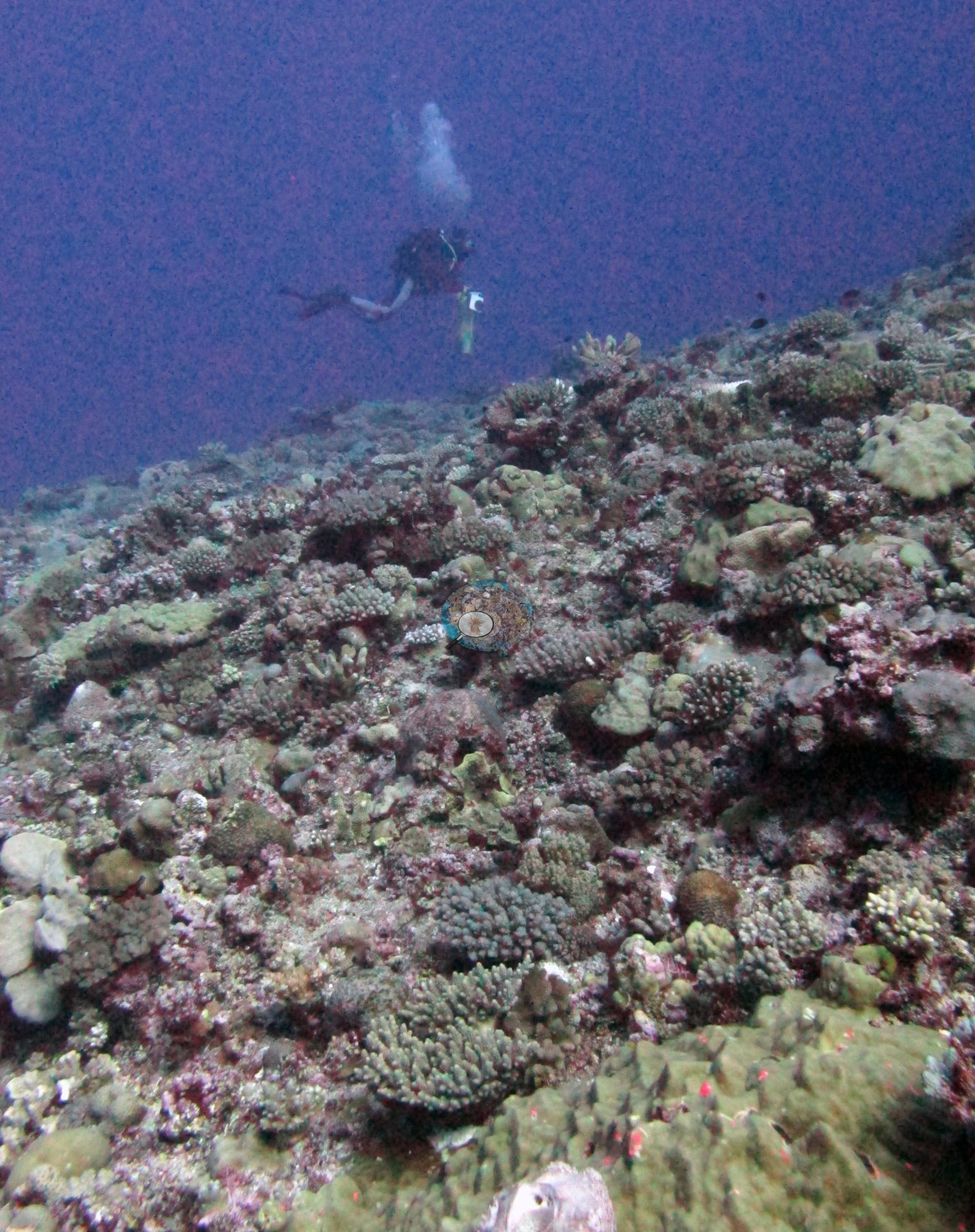
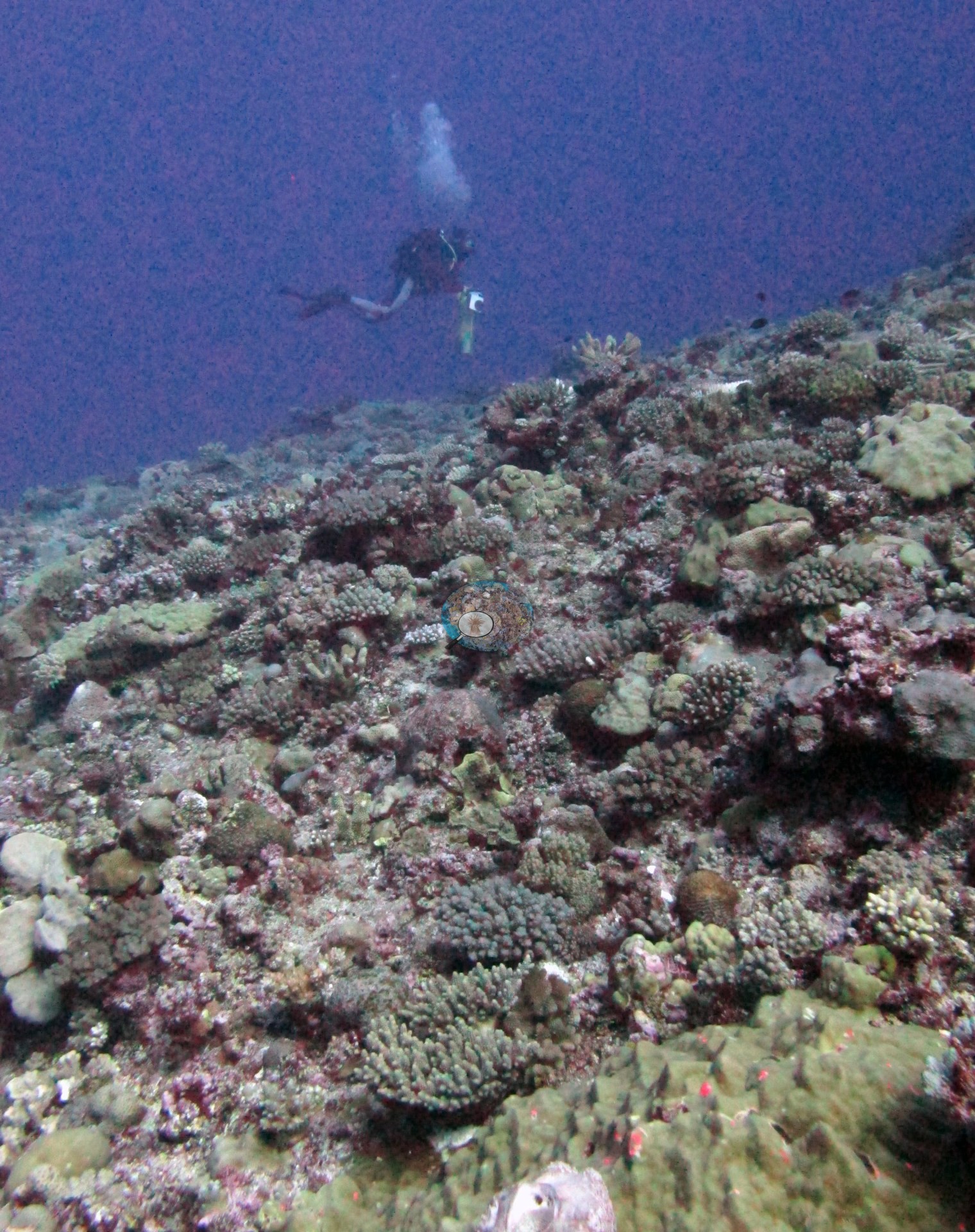
The wide frames look down onto a slope so densely packed with small colonies that bare rock barely shows: hundreds of corymbose and digitate cushions and knobby branching heads, pale green encrusting and plating colonies, low mounding heads, all set into pavement washed pink and mauve with crustose coralline algae and stained dark red by turf (e.g., Image 1).
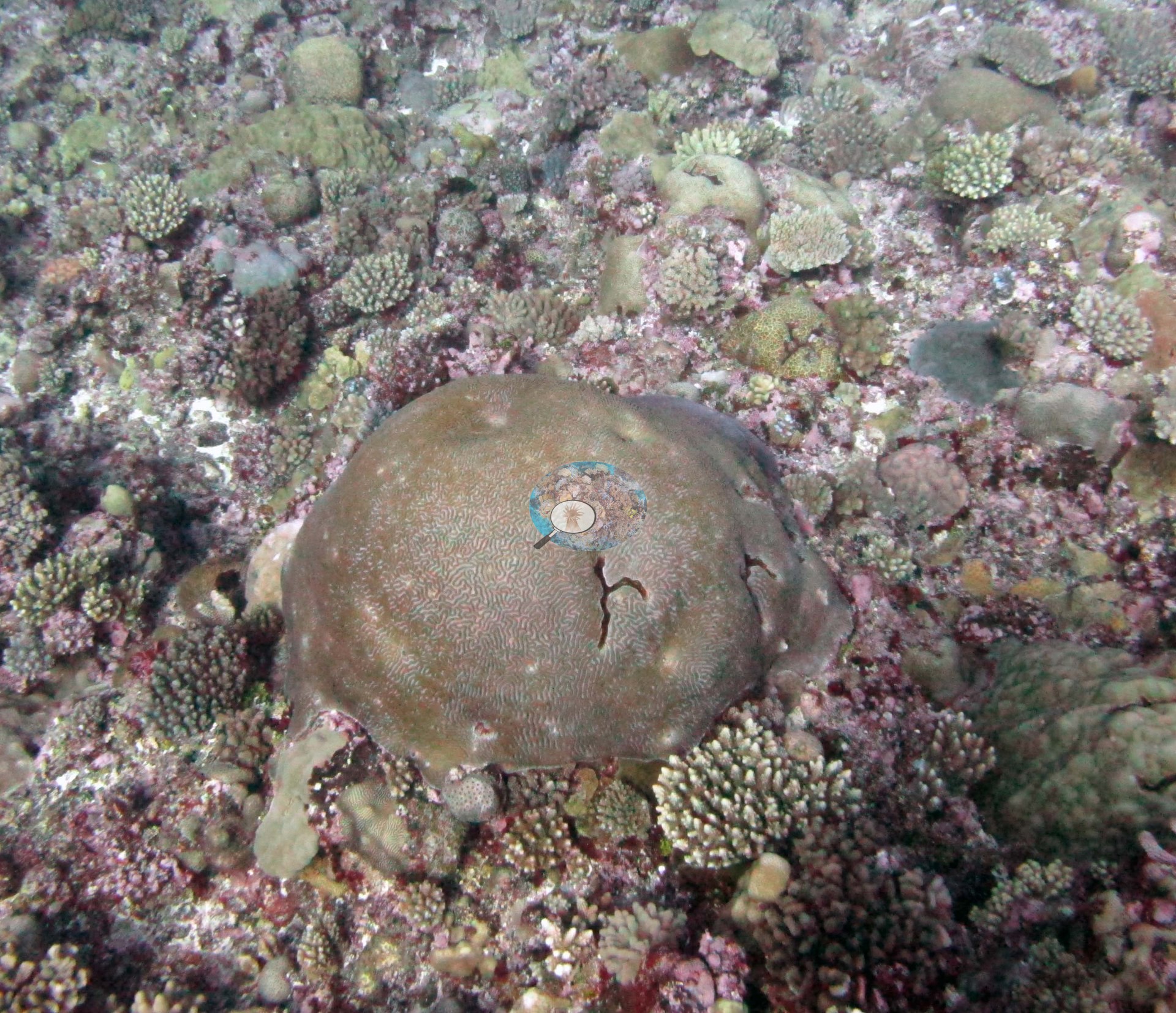
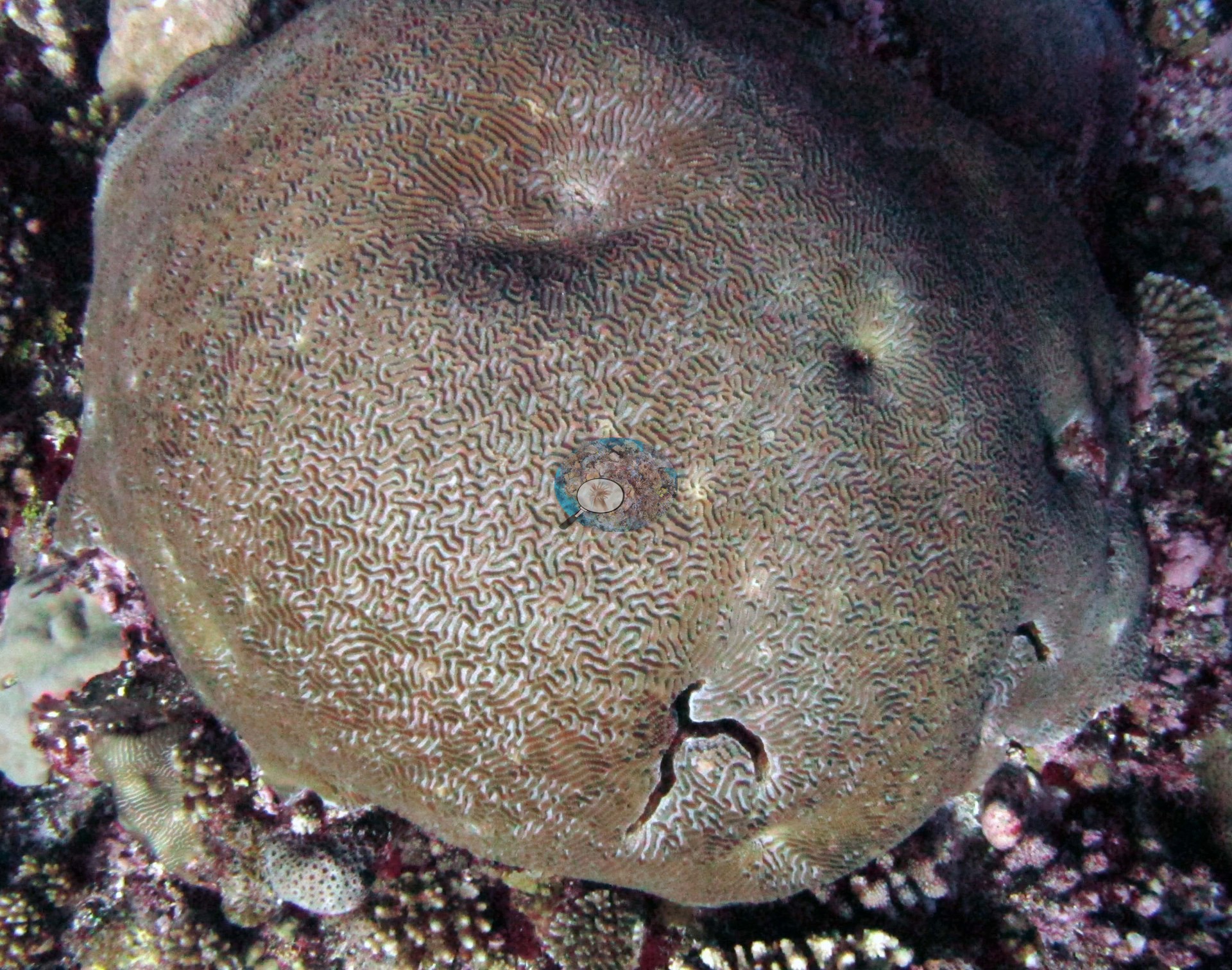
The centerpiece is a boulder-sized brain coral (Anderson's identification), its dome half a meter across and covered edge to edge in fine, uniformly narrow meandering valleys in olive and gray-green, with only a couple of small dark scars breaking the surface (e.g., Image 4).
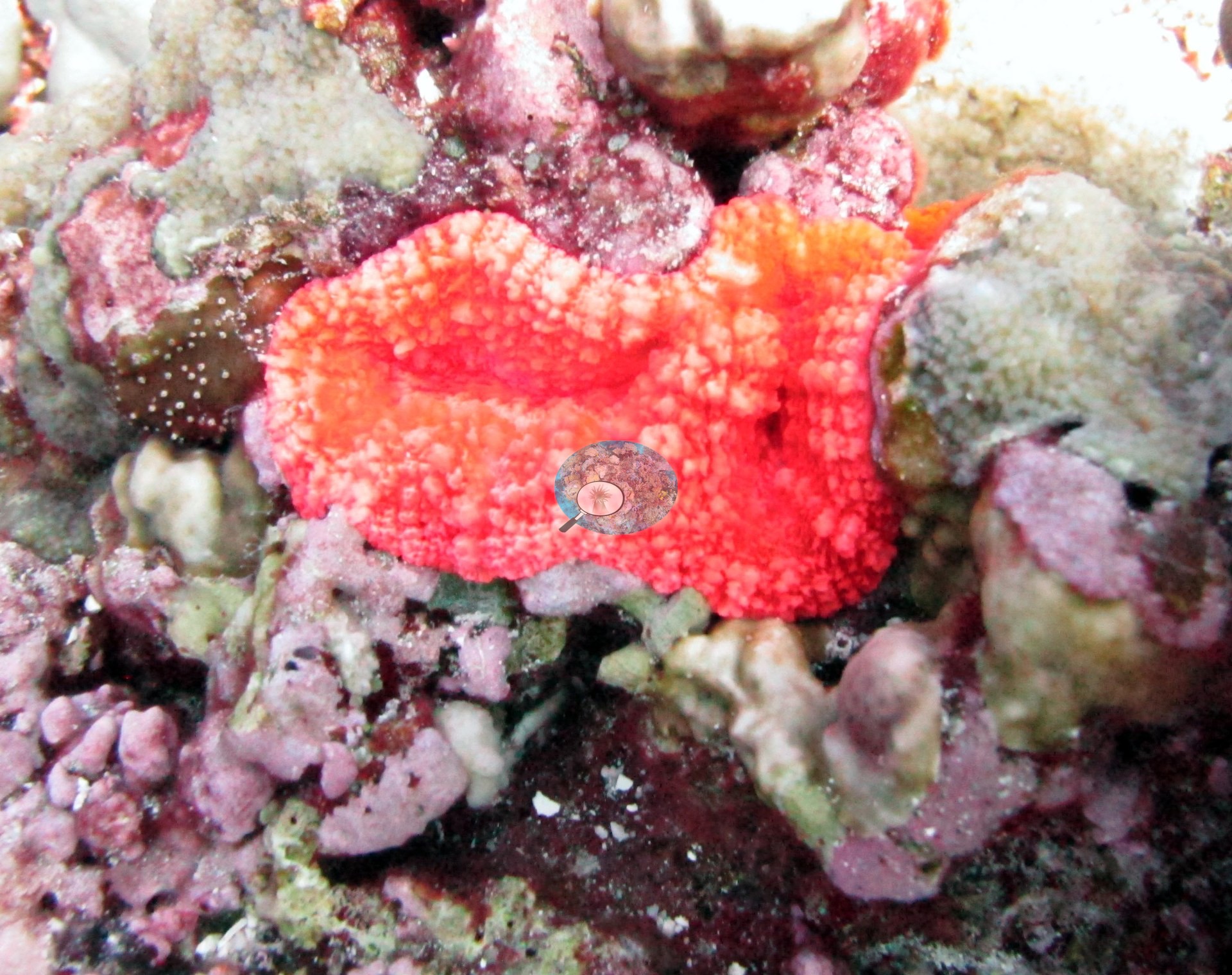
One macro frame picks out a vivid red, fluorescent mussid coral (Anderson's field ID), its lobed surface studded with pale-tipped tubercles, on coralline-crusted rock (e.g., Image 3).
Coral cover
- Reference: Khaled bin Sultan Living Oceans Foundation, Global Reef Expedition (in situ transect)
- Transect mean 49 ± 6.2% SE (n = 5 transects; Living Oceans Foundation per-transect benthic data); the headline above is this all-transect mean.
Stressors
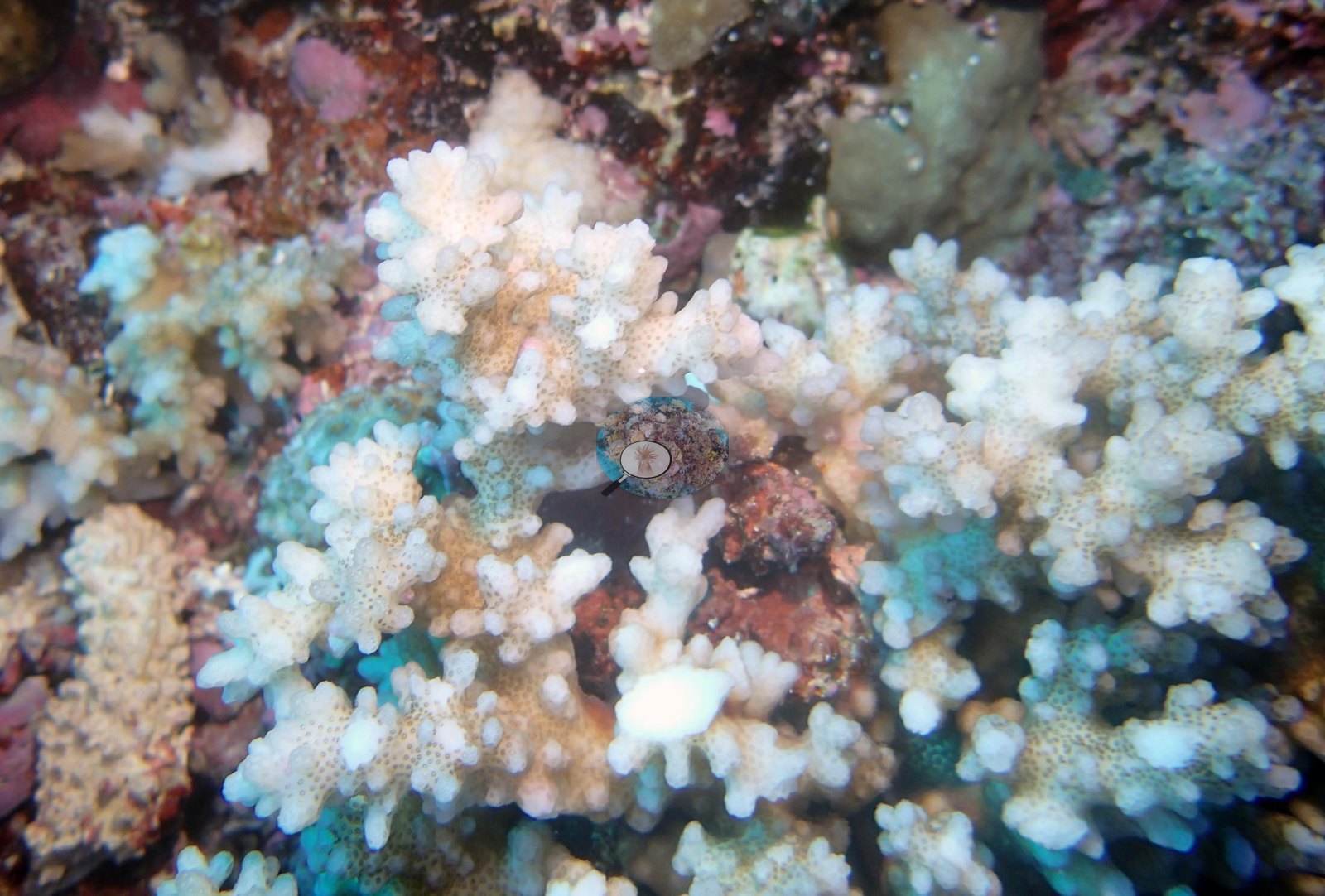
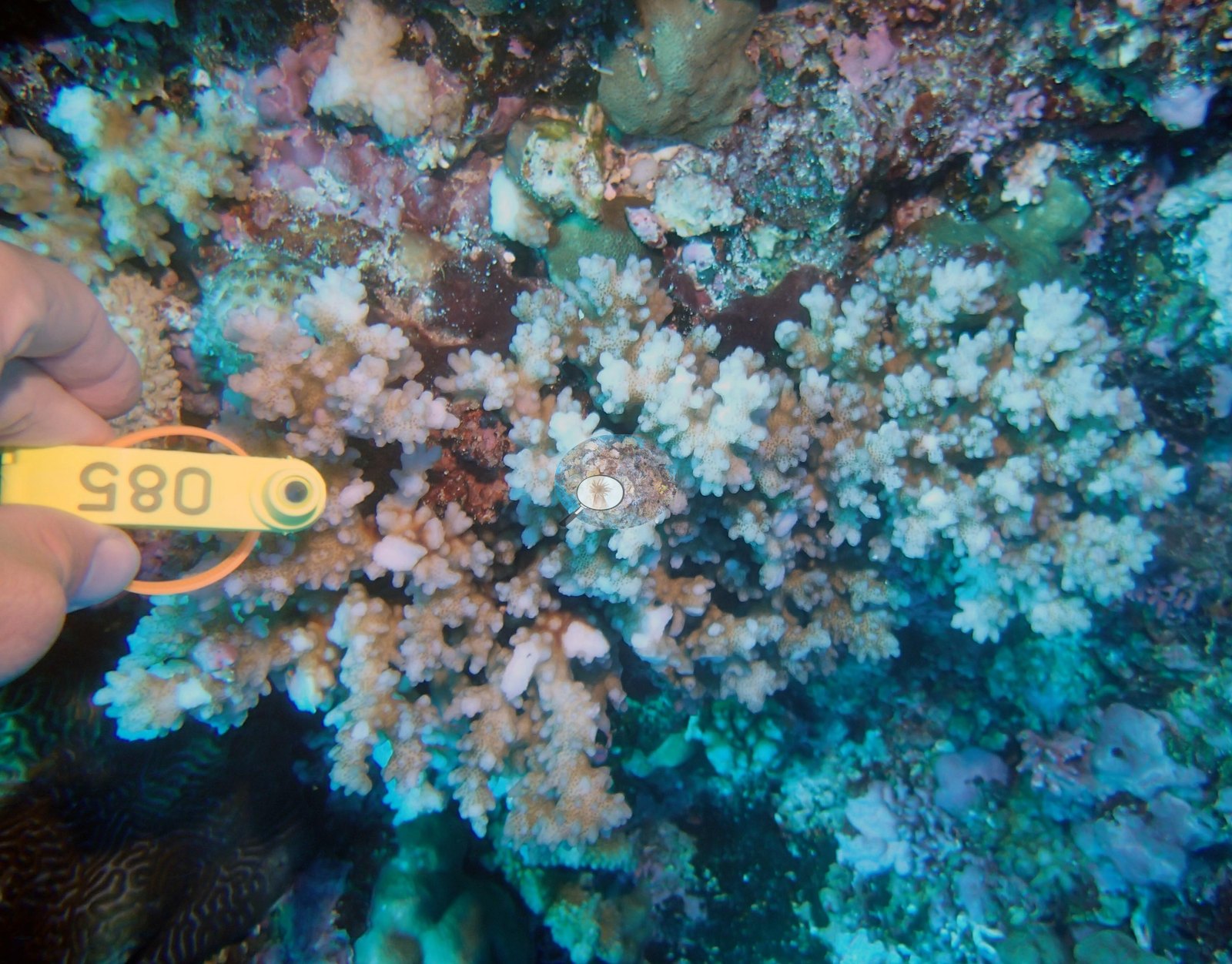
No disease or crown-of-thorns damage is visible in these photographs; light was dim and blue at this depth. Anderson's sampling sheet records the Pocillopora colony sampled here (F70) as 70% bleached, and the frames of that colony (e.g., Image 6, Image 7) show it white to cream over most of its branches.
The Living Oceans Foundation transects here recorded 7.4% cyanobacteria and no recently dead coral.
Comparisons with other data
Apart from the Living Oceans Foundation survey shown here, we found no other surveys at this site as of 2026. If you would like to share yours, please email us.
Other notes
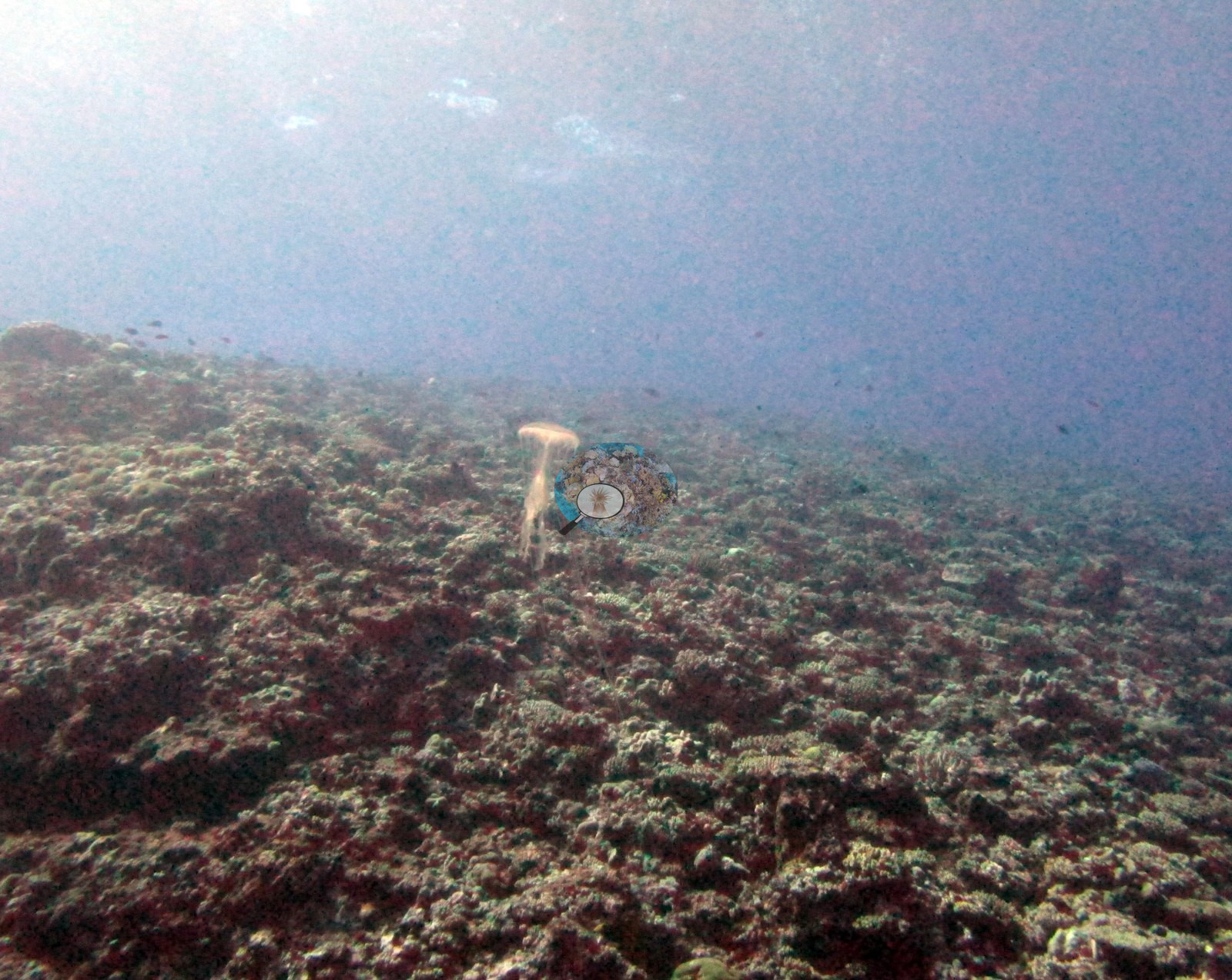
A diver hangs in the deep blue above the slope in one frame, tiny against it, trailing bubbles (e.g., Image 2).
Survey team's site notes: Sites FJVV36, FJVV37, FJVV35 were all located on the west side of the island. Large colonies of massive Porites were intermixed with Halimeda clumps. Up around 15 m typical spur and groove morphology. CCA and smaller acroporids were common in the shallows. Peyssonnelia was common throughout all depths. Overall coral cover was high around the island, mainly because of large colonies of Porites and plating corals.
Data & links
- Download benthic survey data (CSV) ↗
- Download all LOF-GRE data (933 sites) ↗
- Photo portfolio ↗
- Coral Reef Diagnostics page for this area ↗
All images from Coral Reef Diagnostics. Data are from the Khaled bin Sultan Living Oceans Foundation Global Reef Expedition and Coral Reef Diagnostics.
© Coral Reef Diagnostics.