
Part of the regional summaries: Fiji - Northern Lau (Vanua Balavu / Cicia / Nayau) and Fiji - Lau
More info
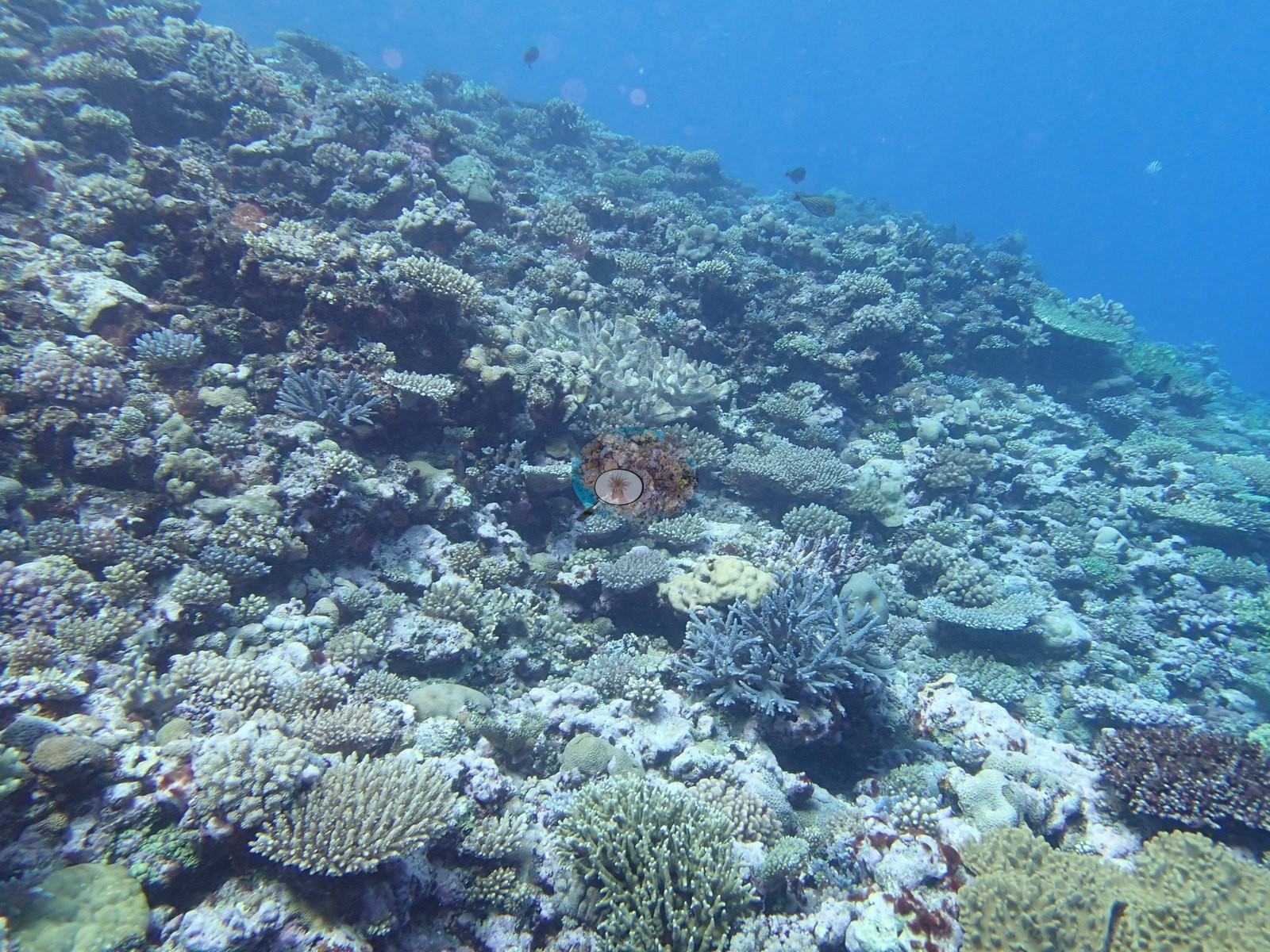
Fiji (NOAA CRW virtual station)A Mago spur-and-groove reef where a coral-dense upper terrace of table and branching Acropora gives way to a steep, hazier deep face with black coral. Two big table corals look pale under a blue cast, and the survey notes record crown-of-thorns predation with large areas of white coral, plus several tables flipped over, possibly by storms. Surveyed on the Living Oceans Foundation's Global Reef Expedition.
E dua na cakau vakaivakarau ni spur-and-groove e Mago, ka na vanua raraba i cake e vonu ena lase, na Acropora vakatepeli kei na vakatabataba, e veisau ki na bati e titobu ka tu dodonu, e kabukabu cake kina na wai, kei na lase loaloa (black coral). E rua na lase tepeli levu e rairai vulavula vakalailai (pale) ena rarama karakarawa ni wai, ka na ivola ni vakadidike e vola na kana ni bula (crown-of-thorns) kei na vanua levu ni lase vulavula, kei na vica na lase tepeli e vuki tu, ka rairai vakavuna na draki ca (storms).
AI translation of this summary; the English is authoritative. (low confidence)
CTD-cast midpoint; the cast read 27.1°C throughout
Two other CRD dive sites with their own pages within 5 km shown in orange — click a marker to open its page.
🗺 Detailed map of the Global Reef Expedition dive sites, Mago, Fiji (Khaled bin Sultan Living Oceans Foundation; opens in a new window)
12 of the 21 photographs on this page are shown beside the text that discusses them under "Site description" below.
Site description
General benthic features
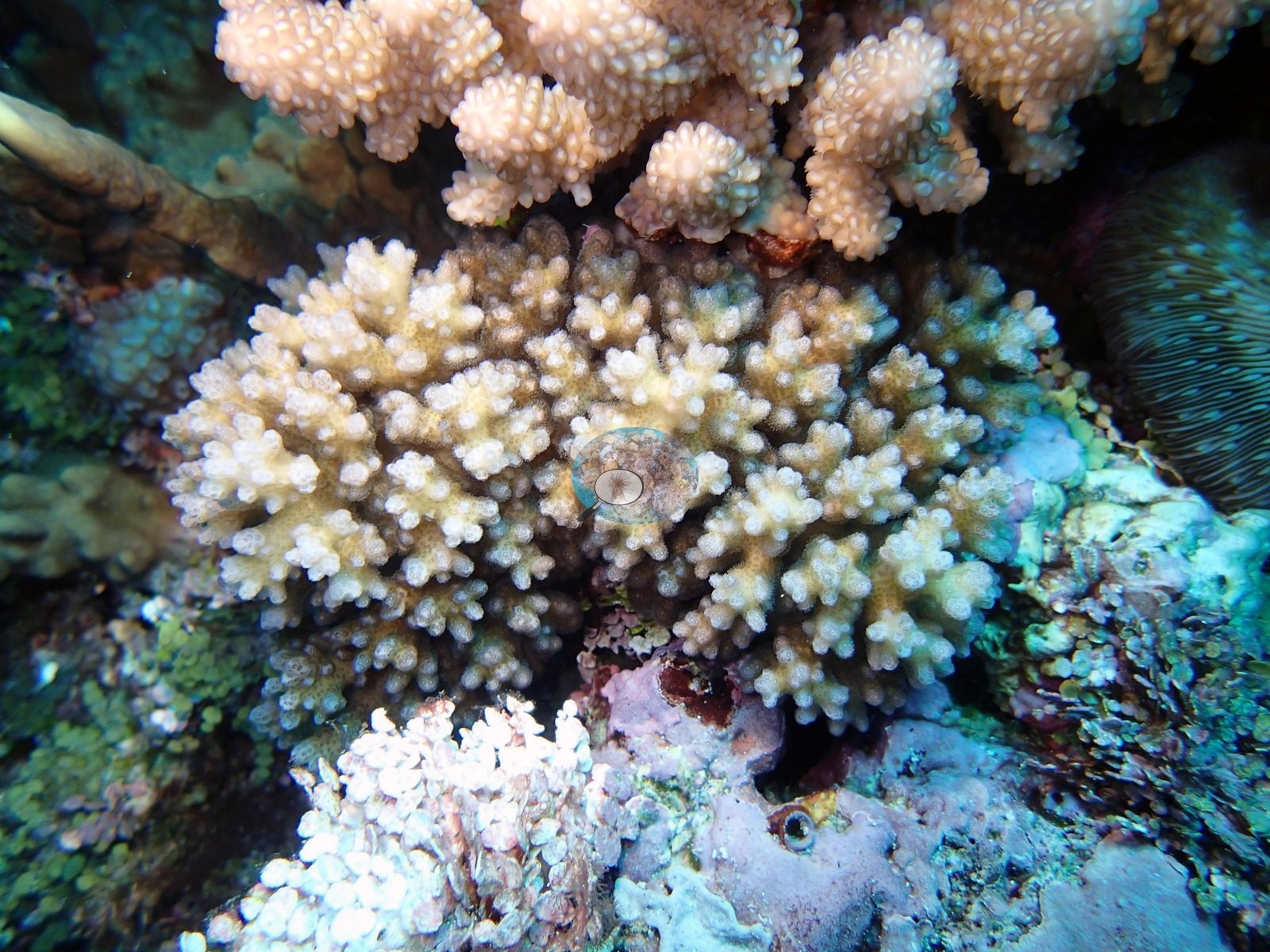
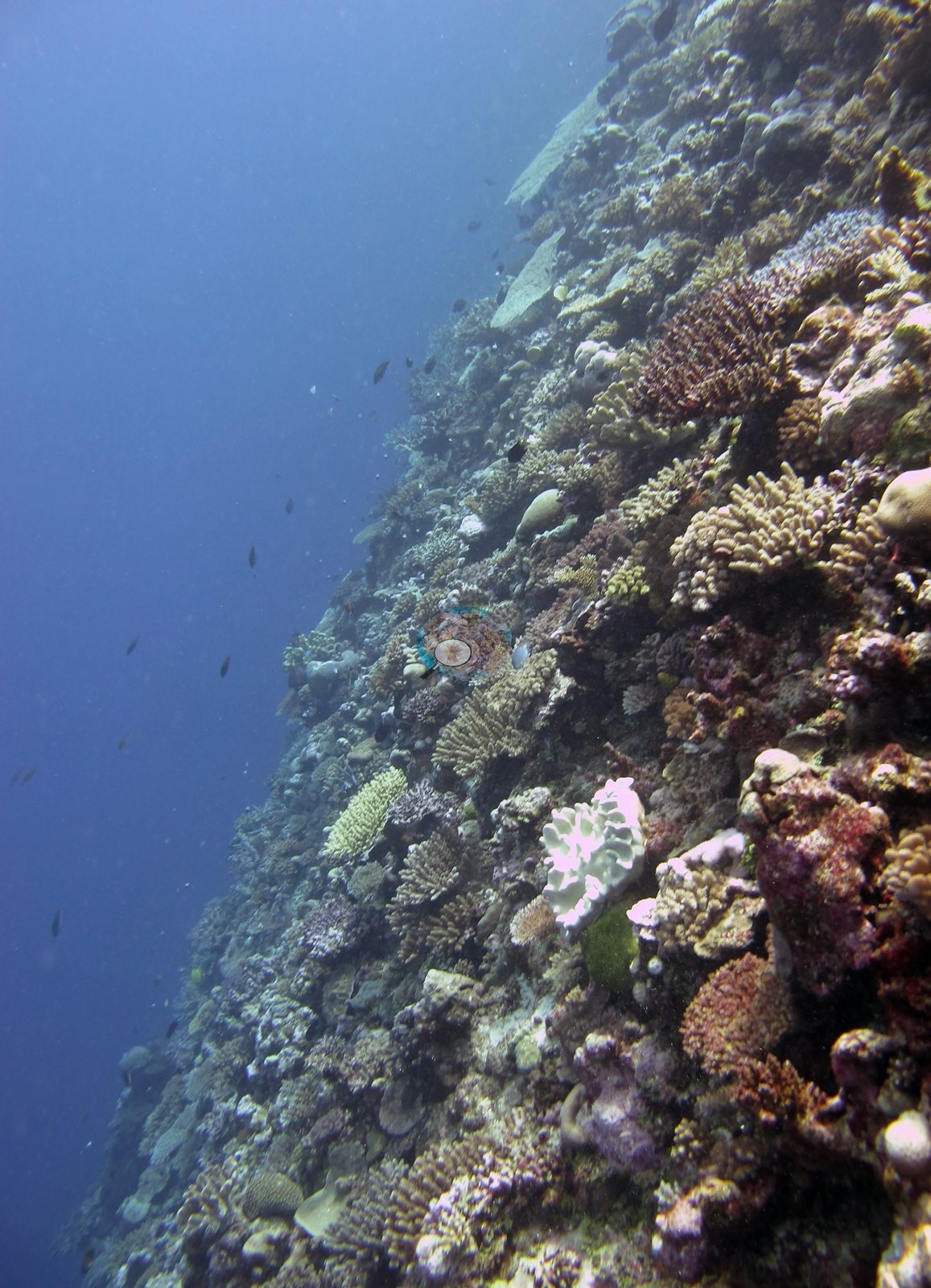
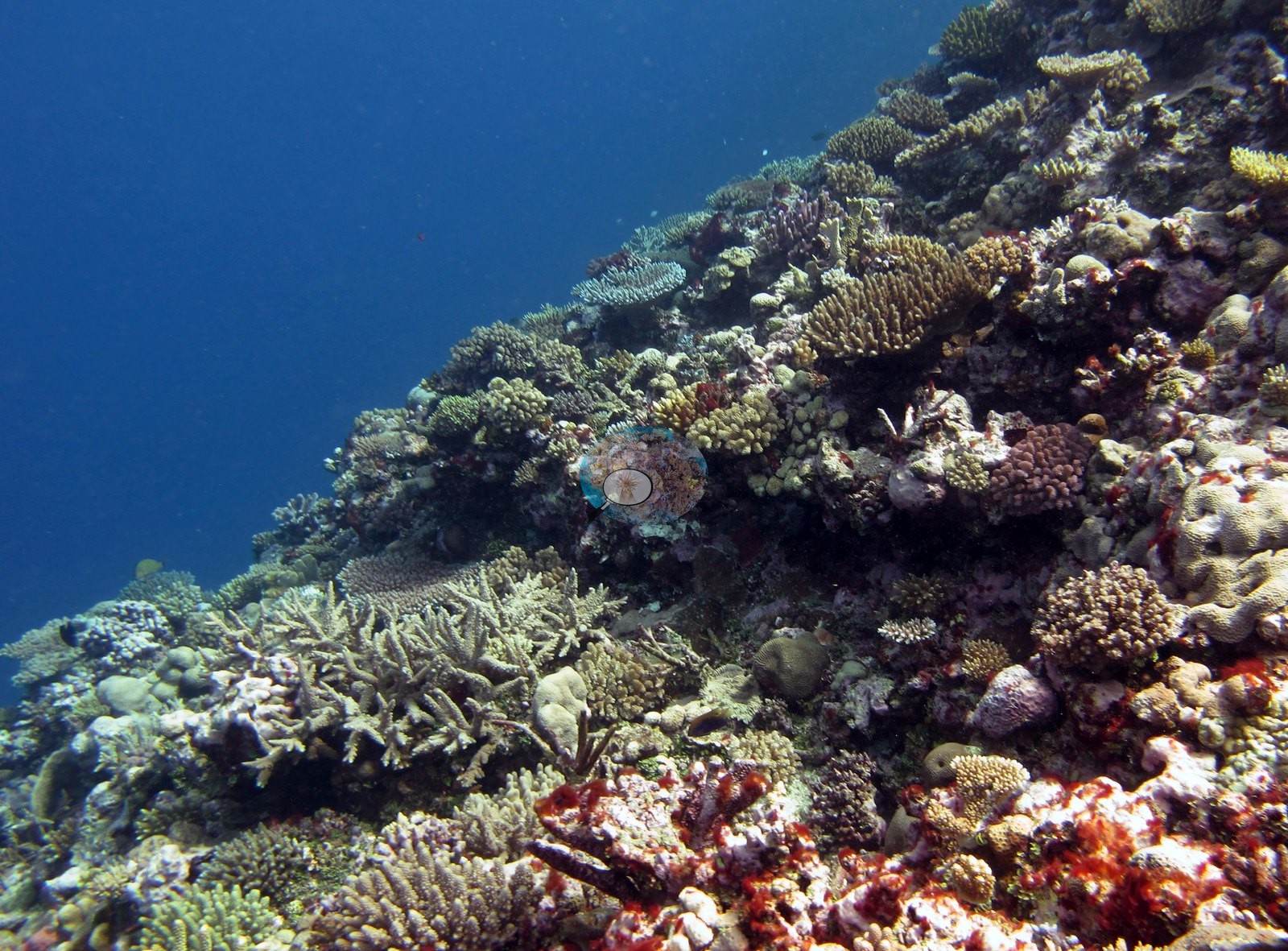
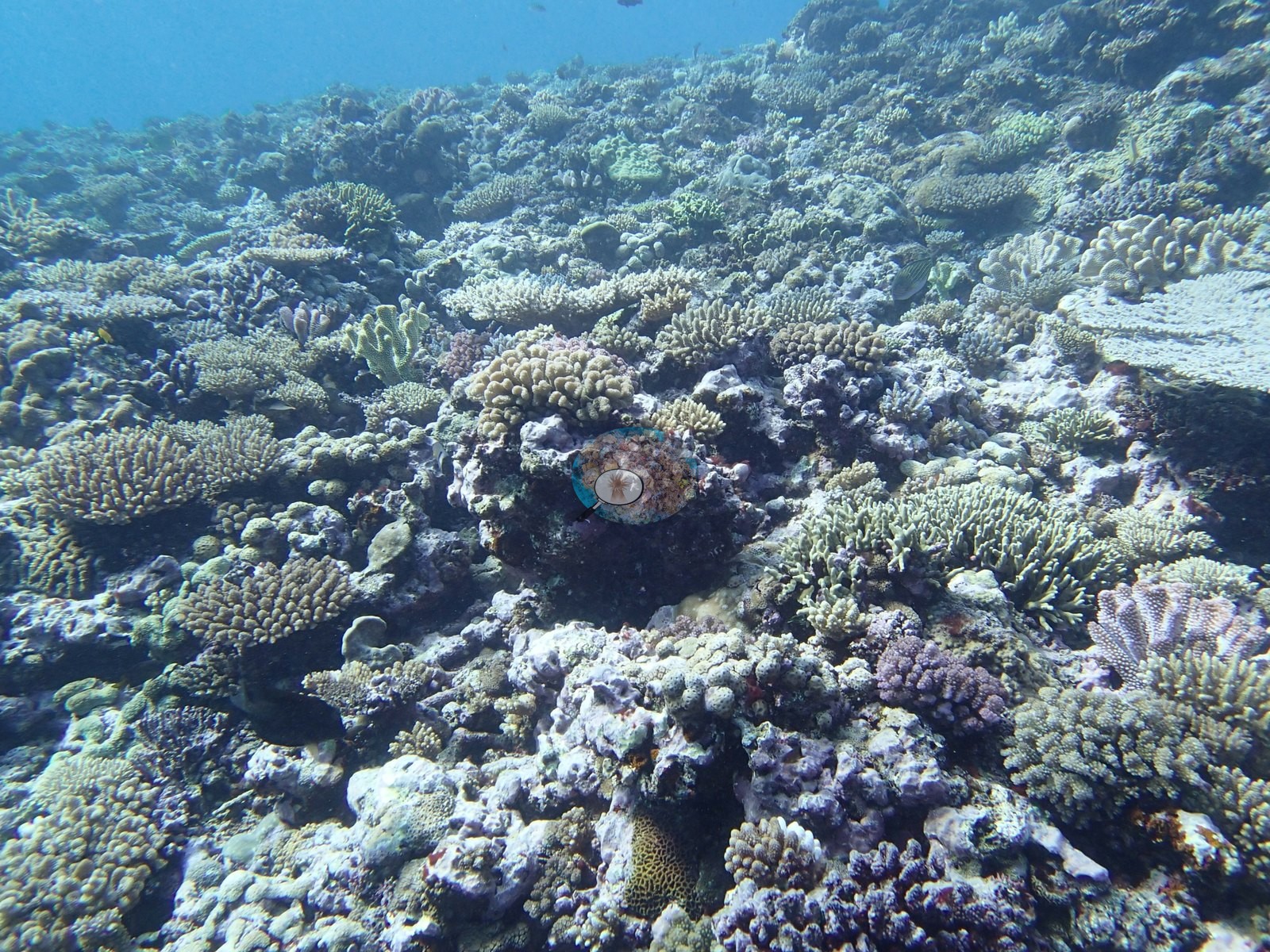
The depth sequence is clear: the upper slope is coral-dense and the deep face is not. The upper terrace appears in four frames as a broad, densely occupied shoulder: tan and pale-green tabulate Acropora plates, staghorn and corymbose colonies, mauve and lilac corymbose Acropora, small porous massives, olive-green digitate colonies, and vivid red-orange encrusting sponge, all bound together by pink and white crustose coralline algae (e.g., Image 5, Image 6, Image 7, Image 11).
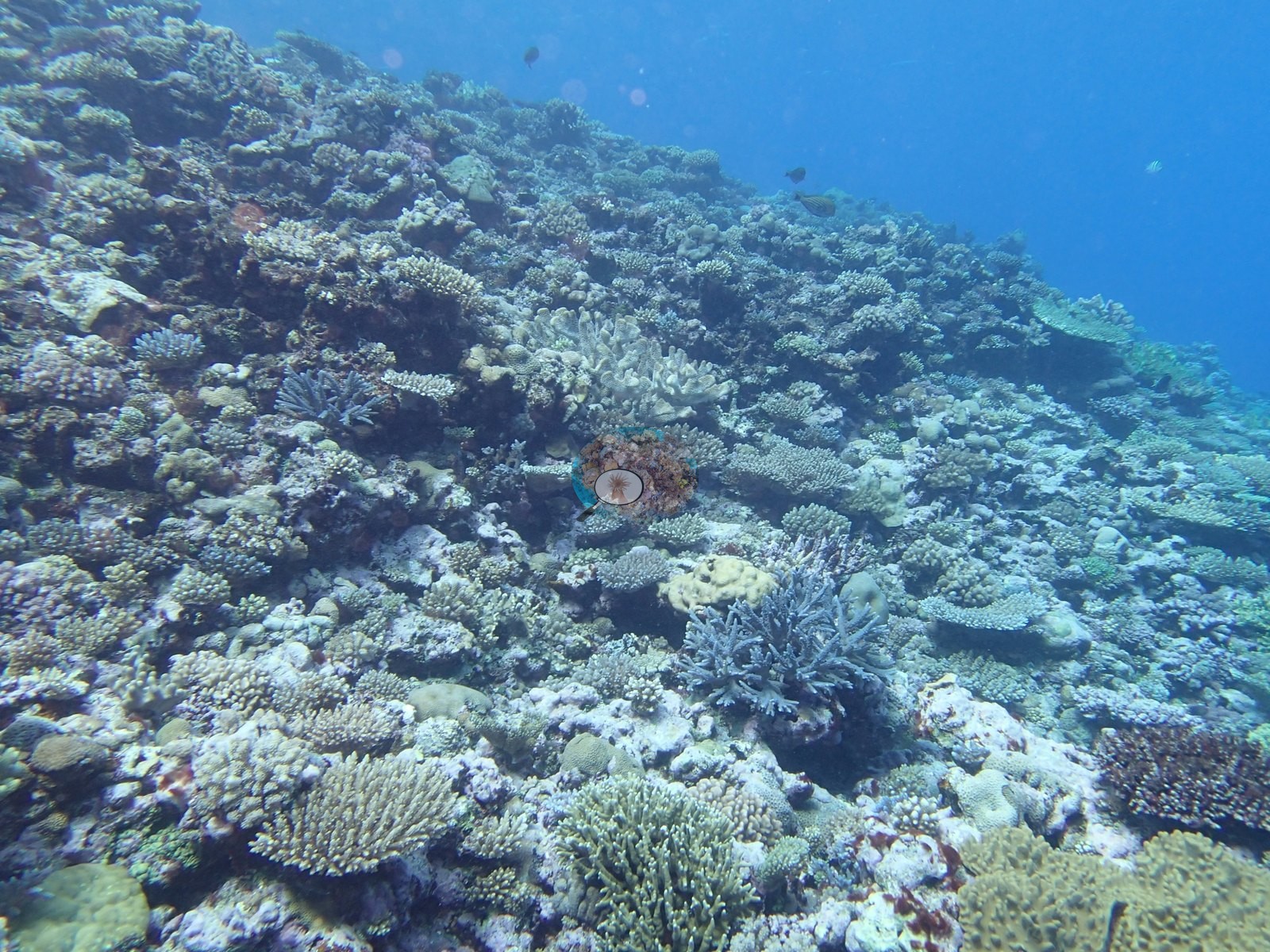
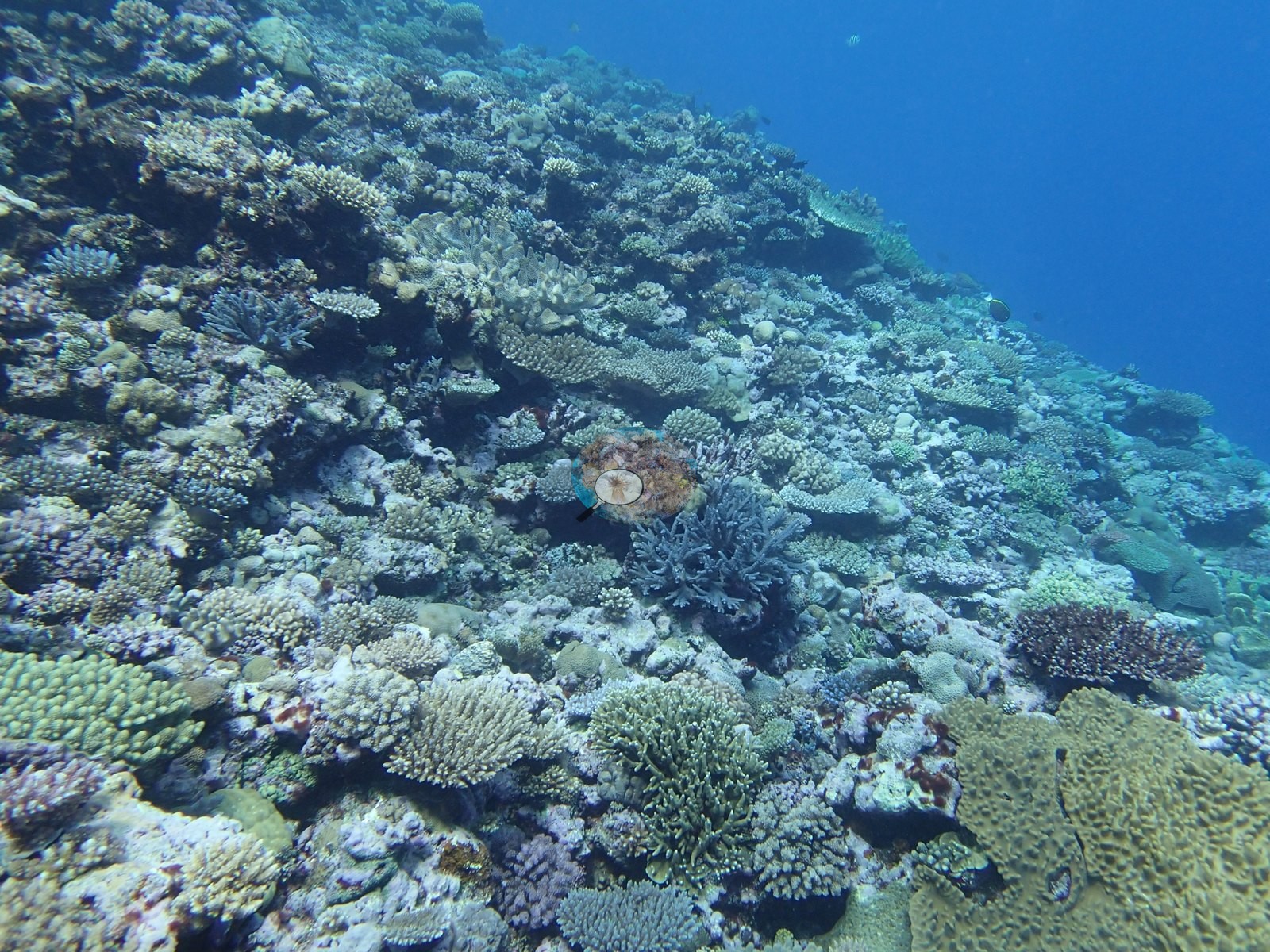
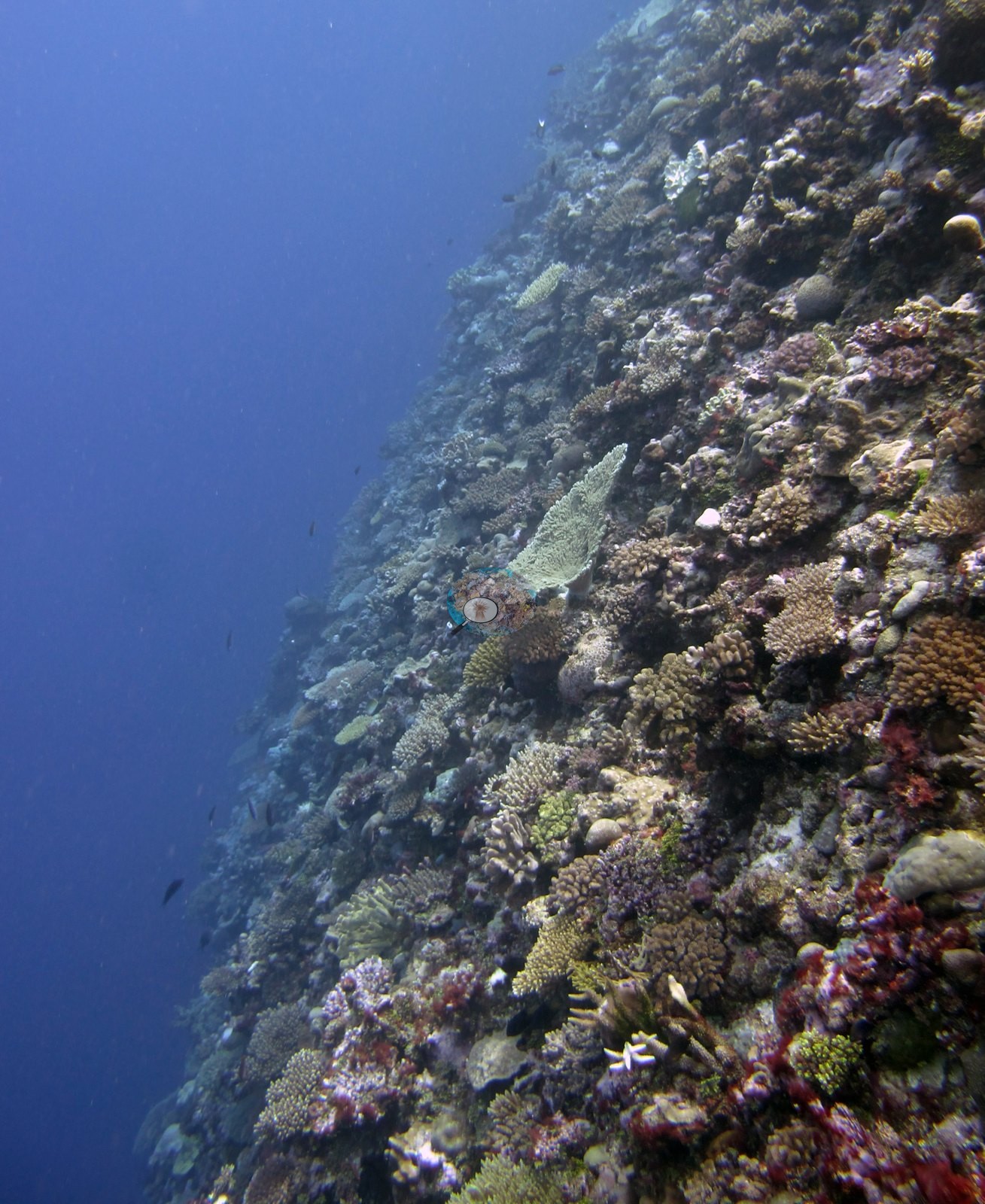
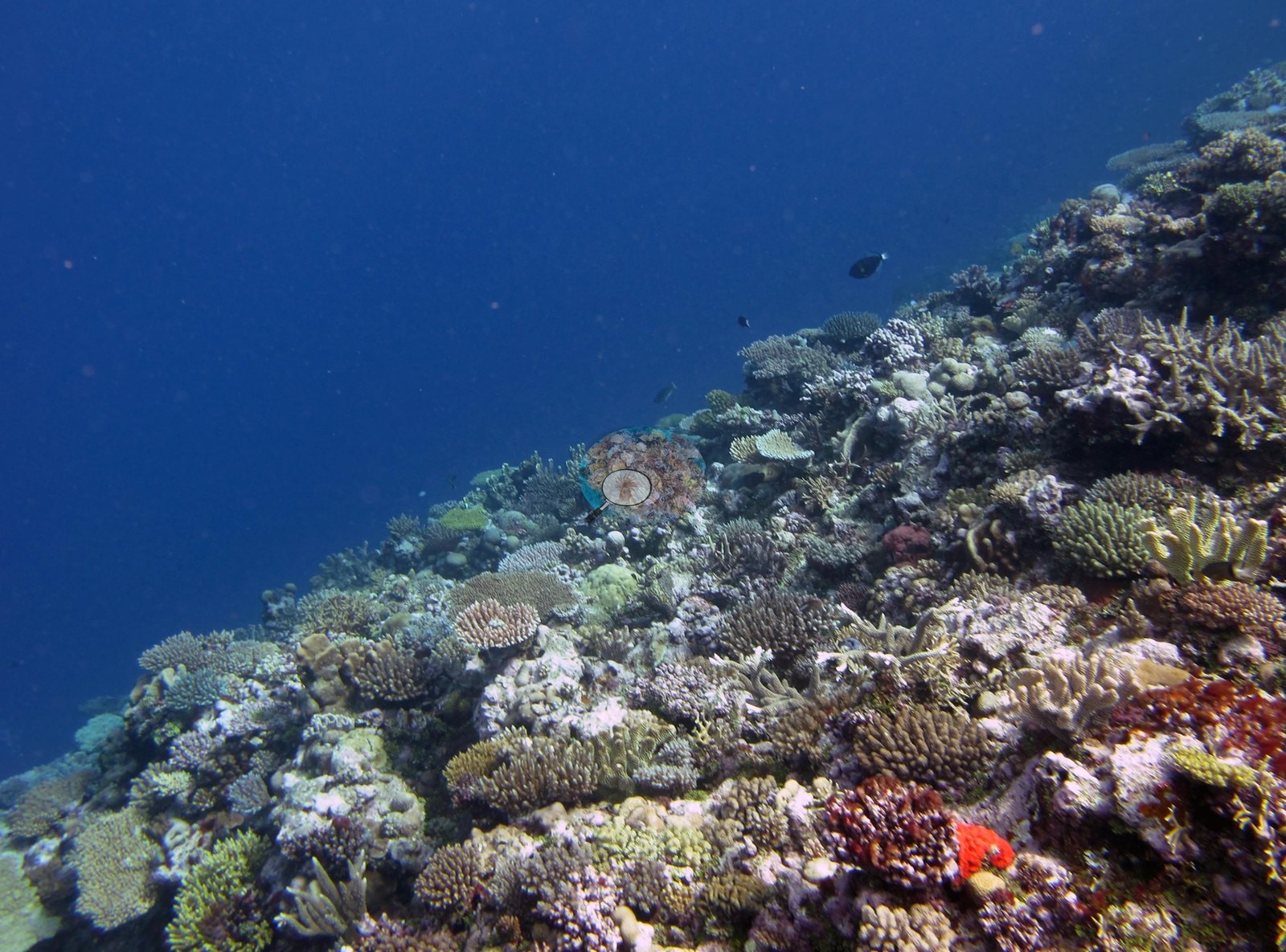
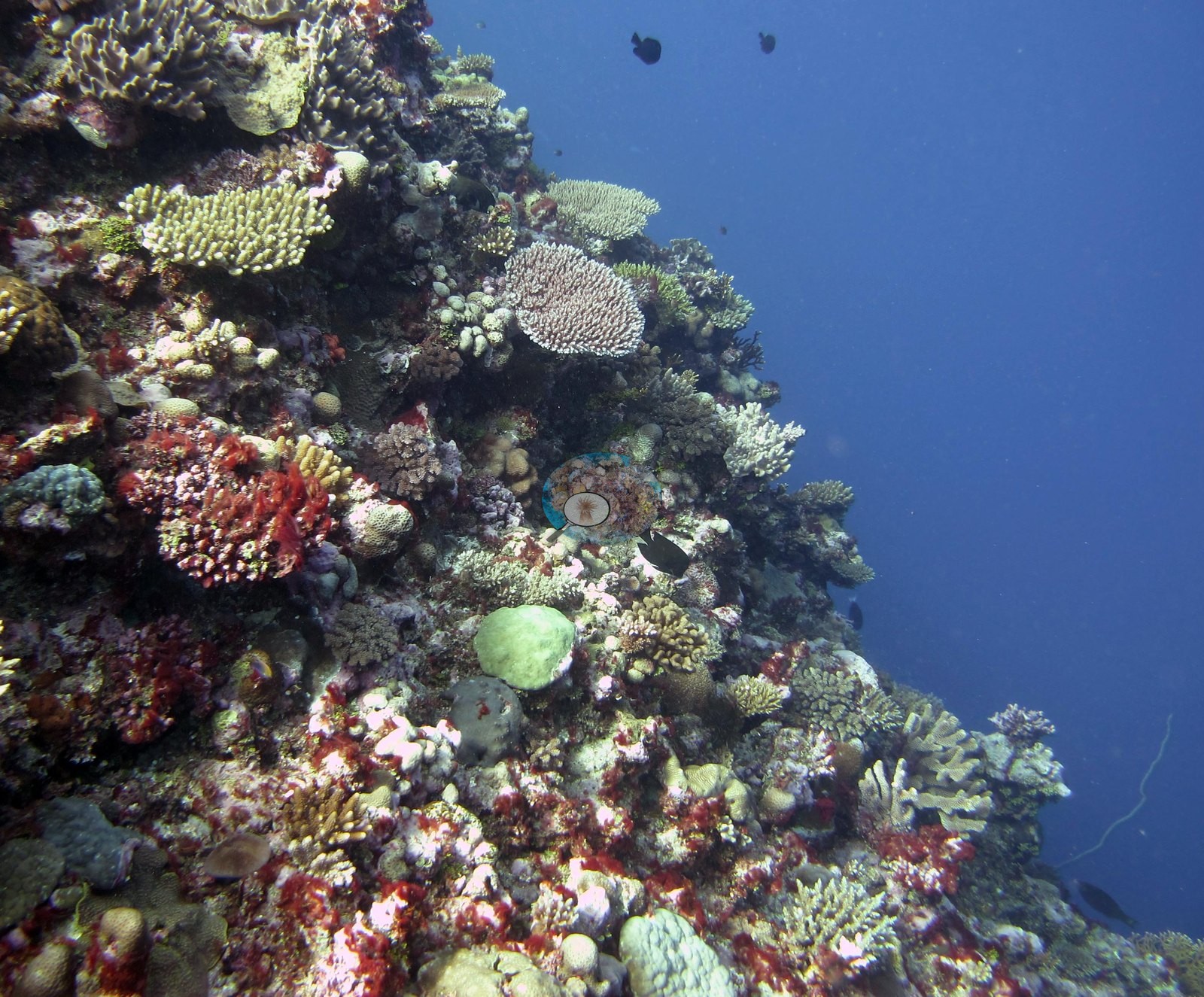
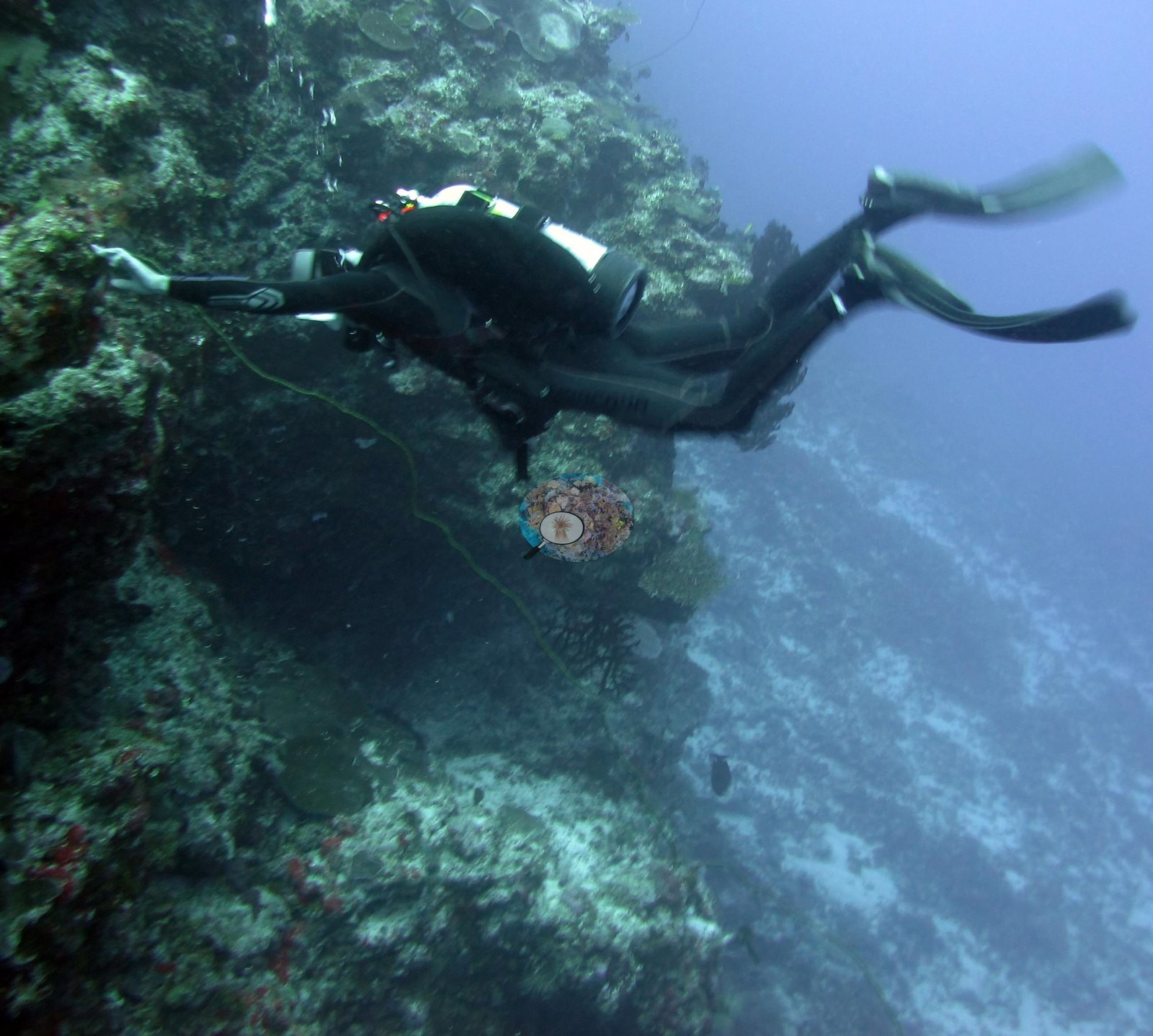
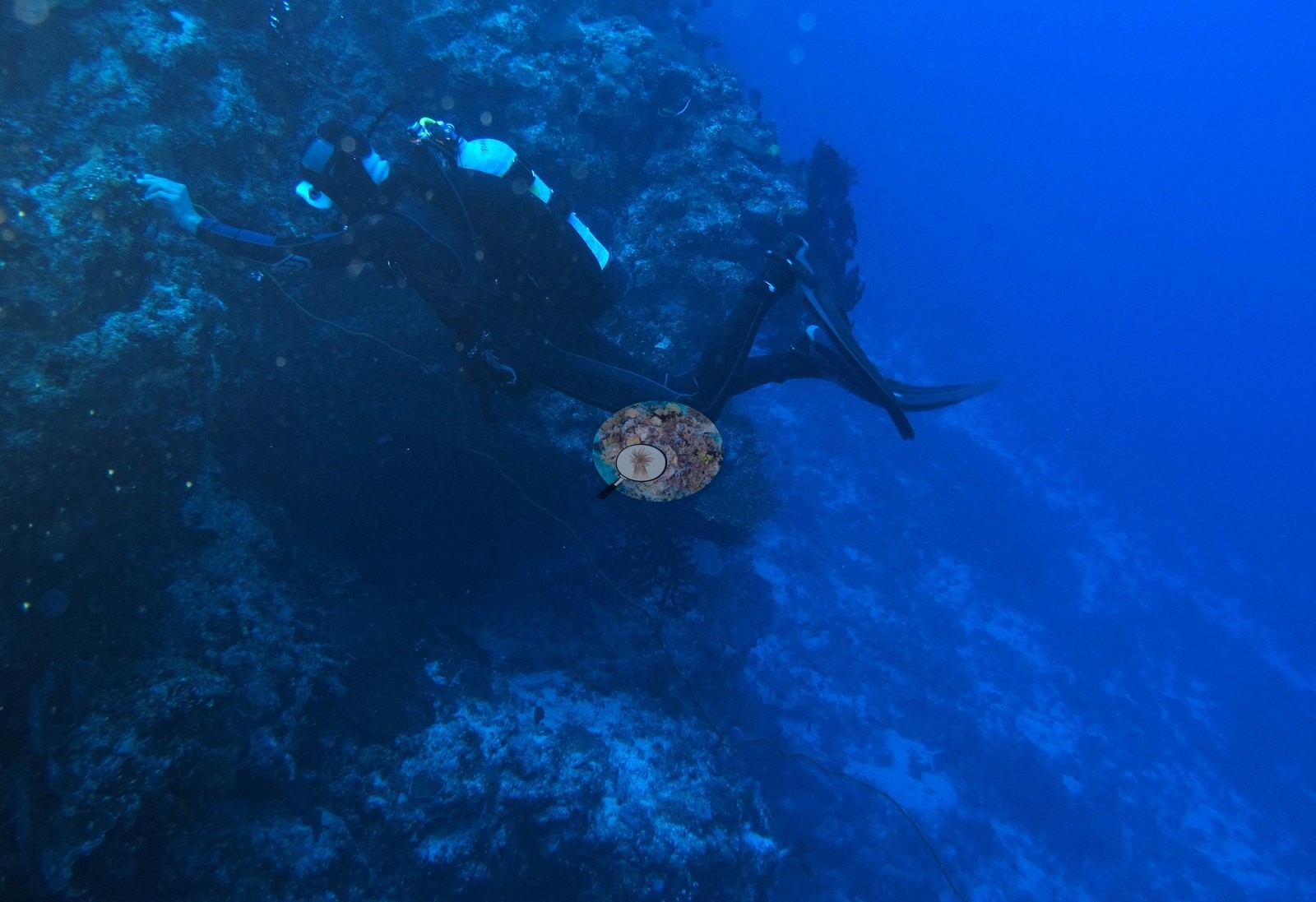
Below that the profile steepens: two frames look along a coral-covered ramp dropping into open blue (Image 20, and the shoulder of Image 18), and one shows a near-vertical, hazy, green-cast buttress where visible coral thins sharply and encrusting growth and dark framework take over, the wall behind the diver in Image 16.
Coral cover
- Reference: Khaled bin Sultan Living Oceans Foundation, Global Reef Expedition (in situ transect)
- Coral cover 42%, from the LOF-GRE in situ benthic transect (the mean of all of this station's own transects in the expedition's per-transect benthic data) — a diver transect and the authoritative figure here; the strong contrast between the shallow frames and the deep frames is a reminder that a single site figure averages across that gradient.
- Transect mean 42 ± 7.1% SE (n = 7 transects; Living Oceans Foundation per-transect benthic data); the headline above is this all-transect mean.
Stressors
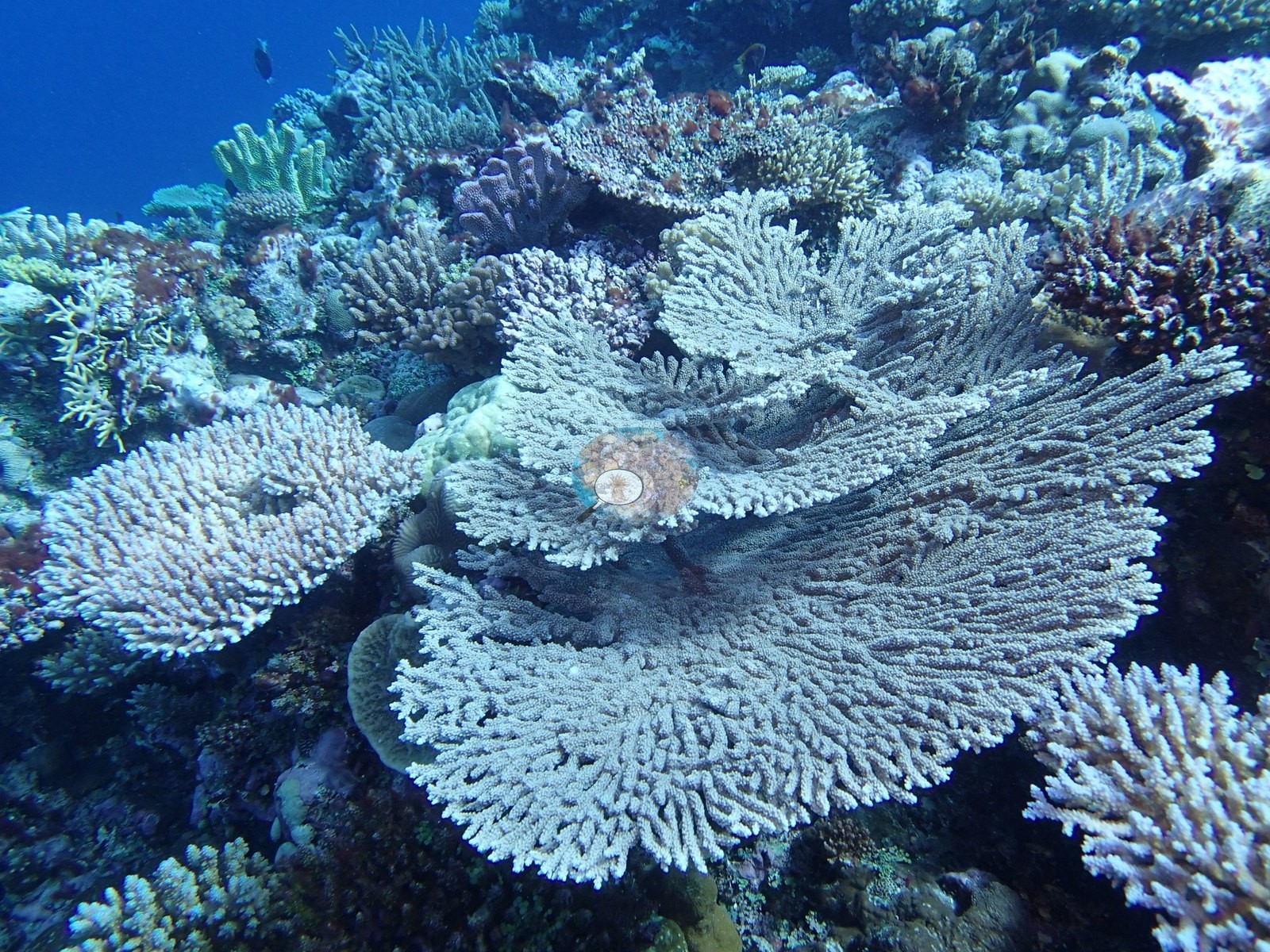
Image 10 and Image 11 show two large tables.
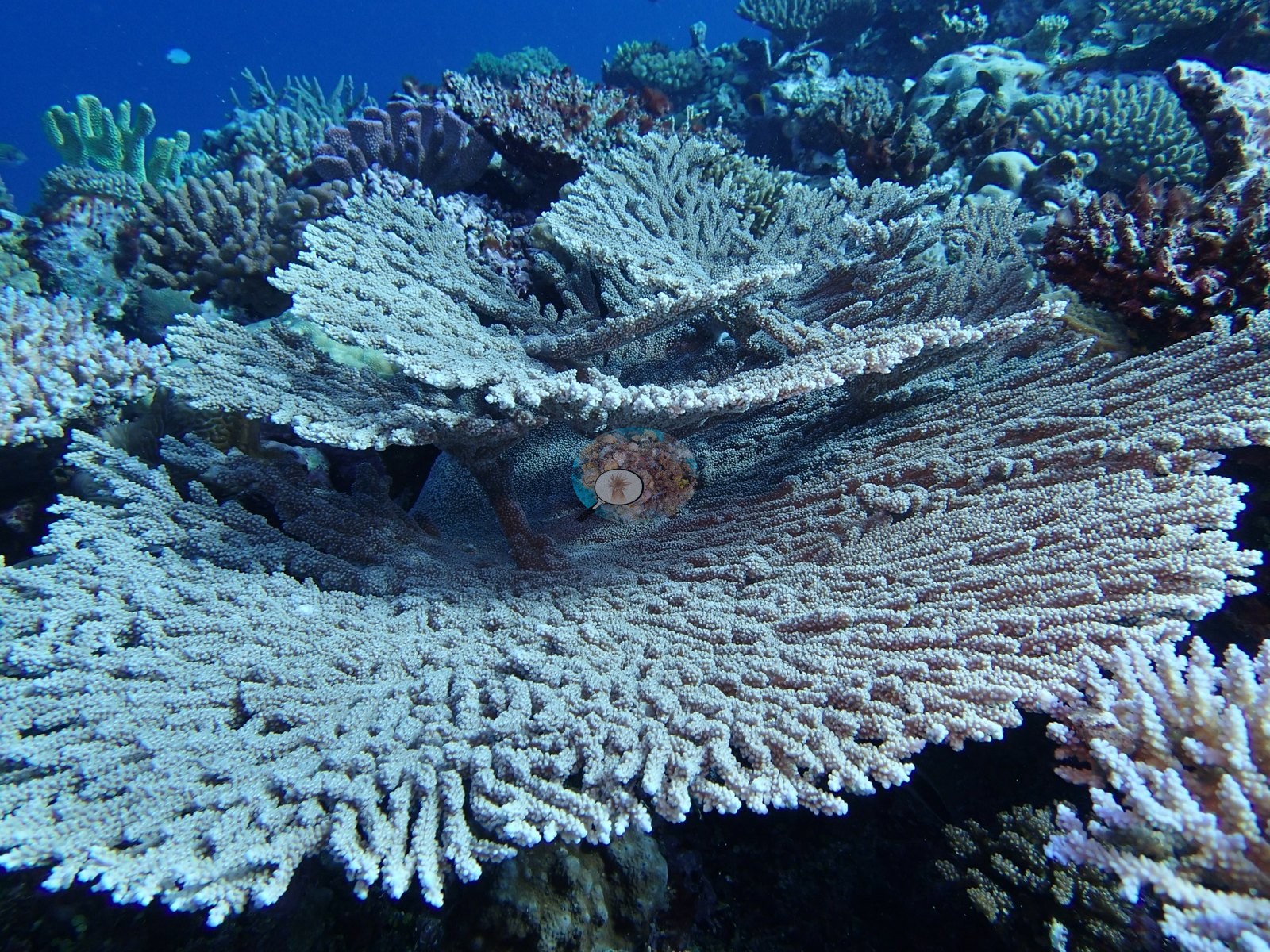
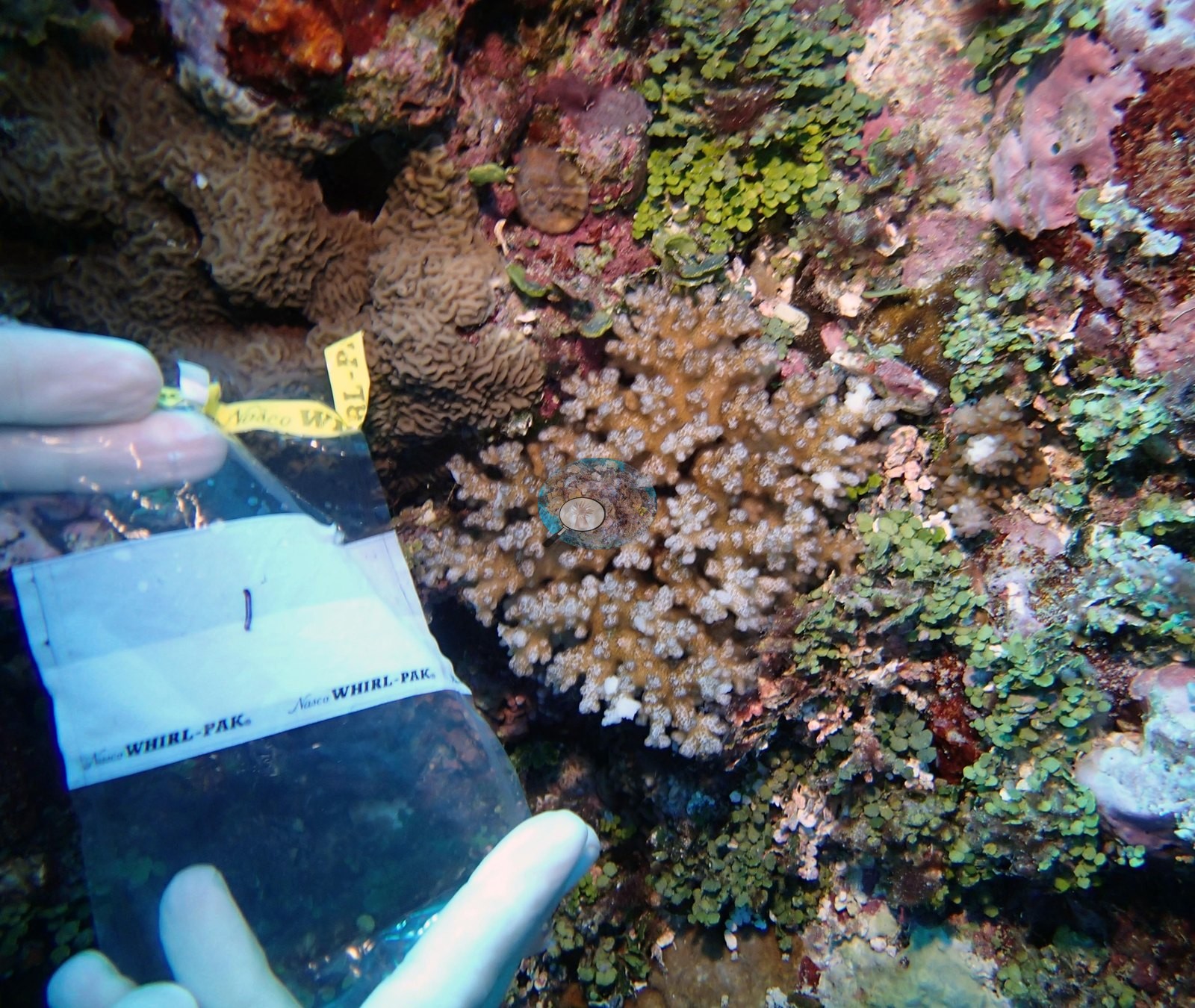
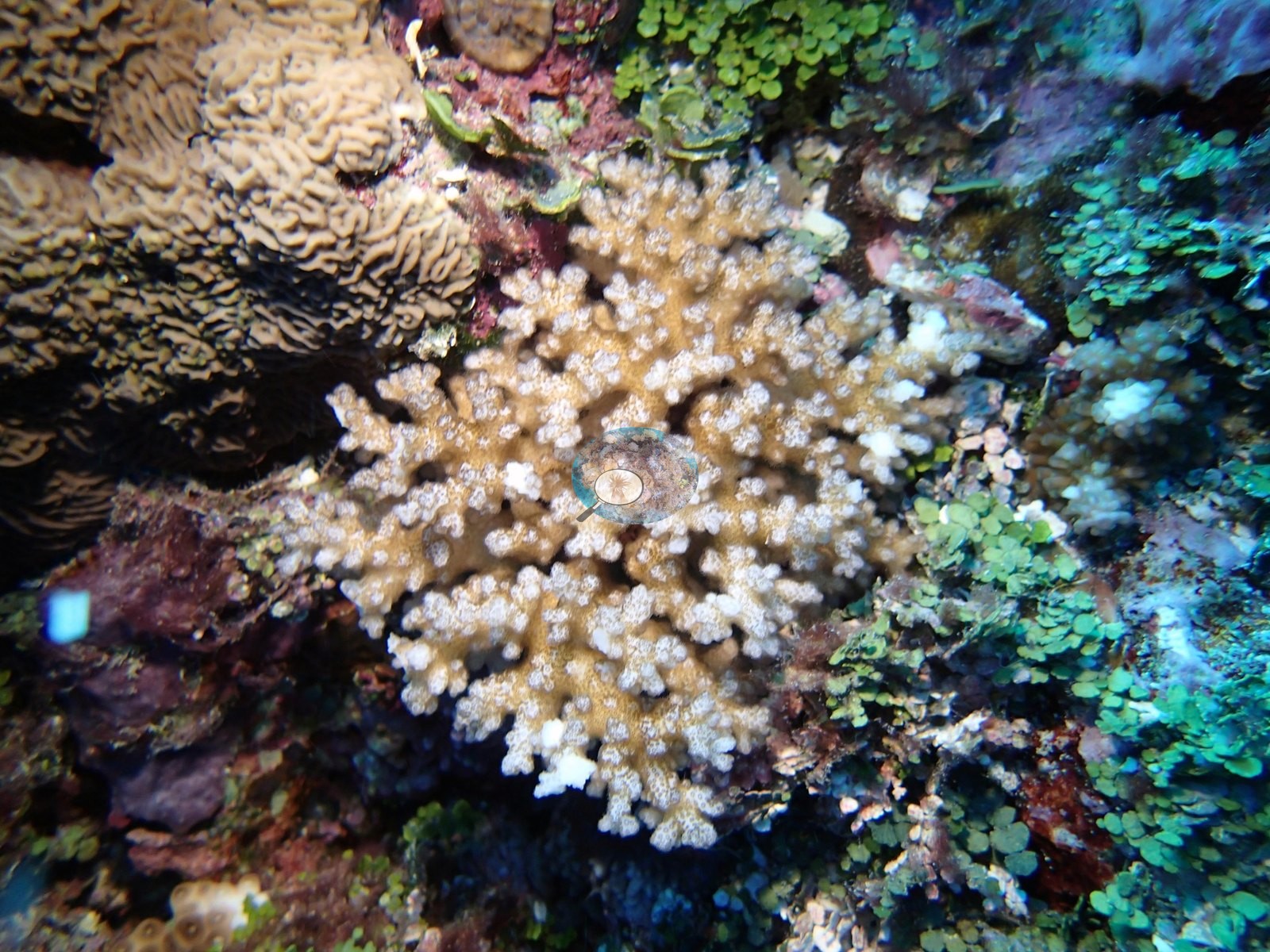
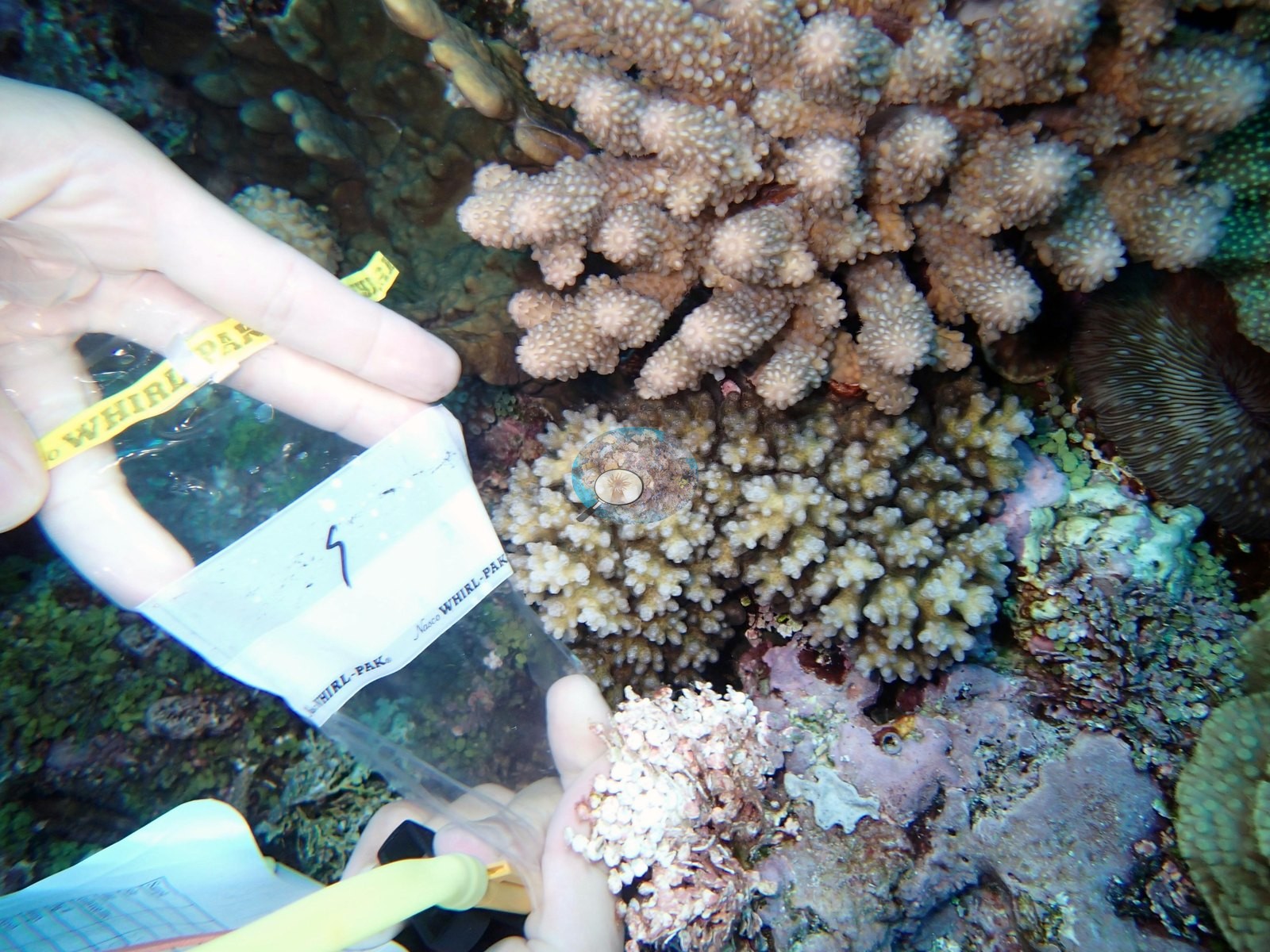
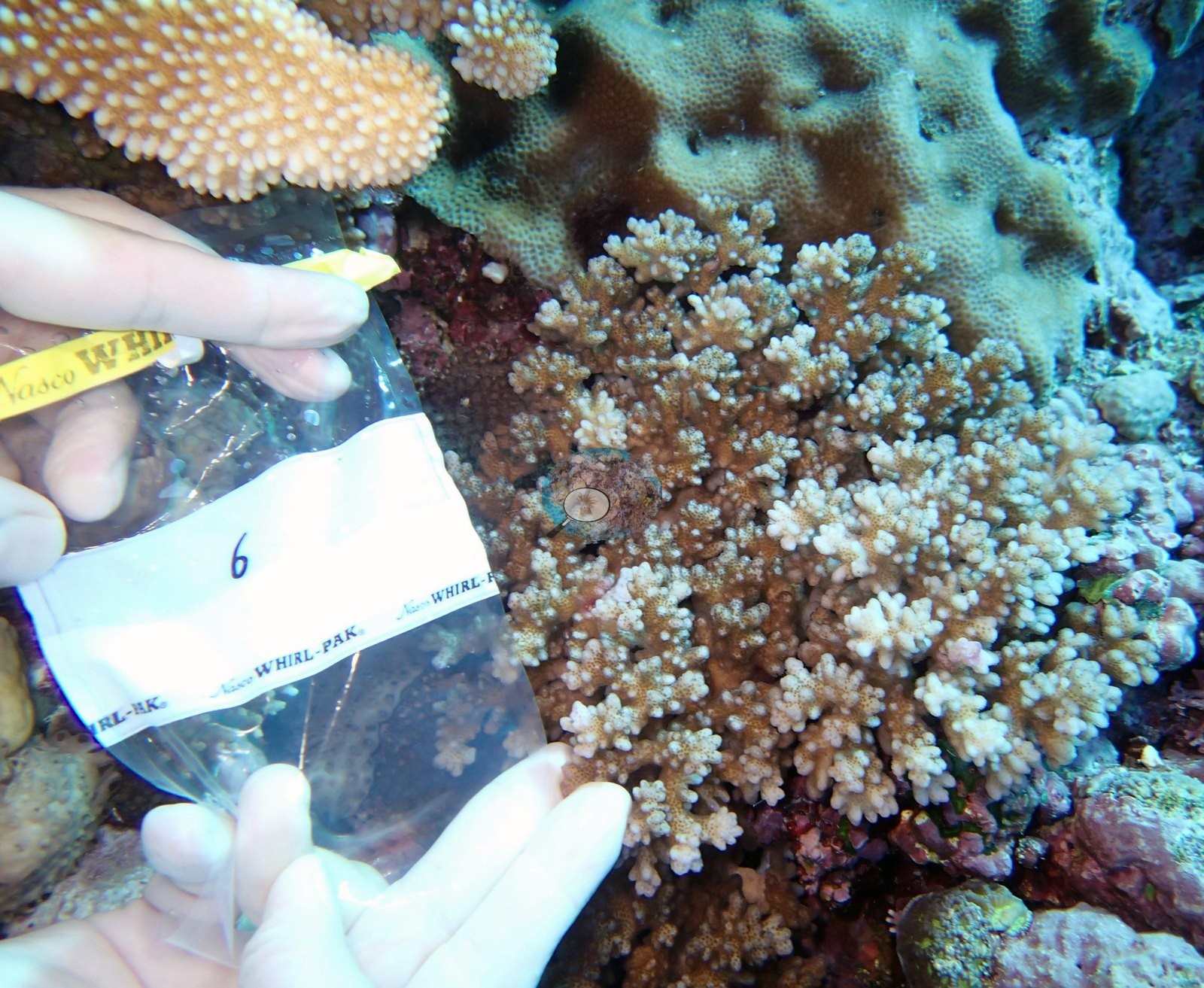
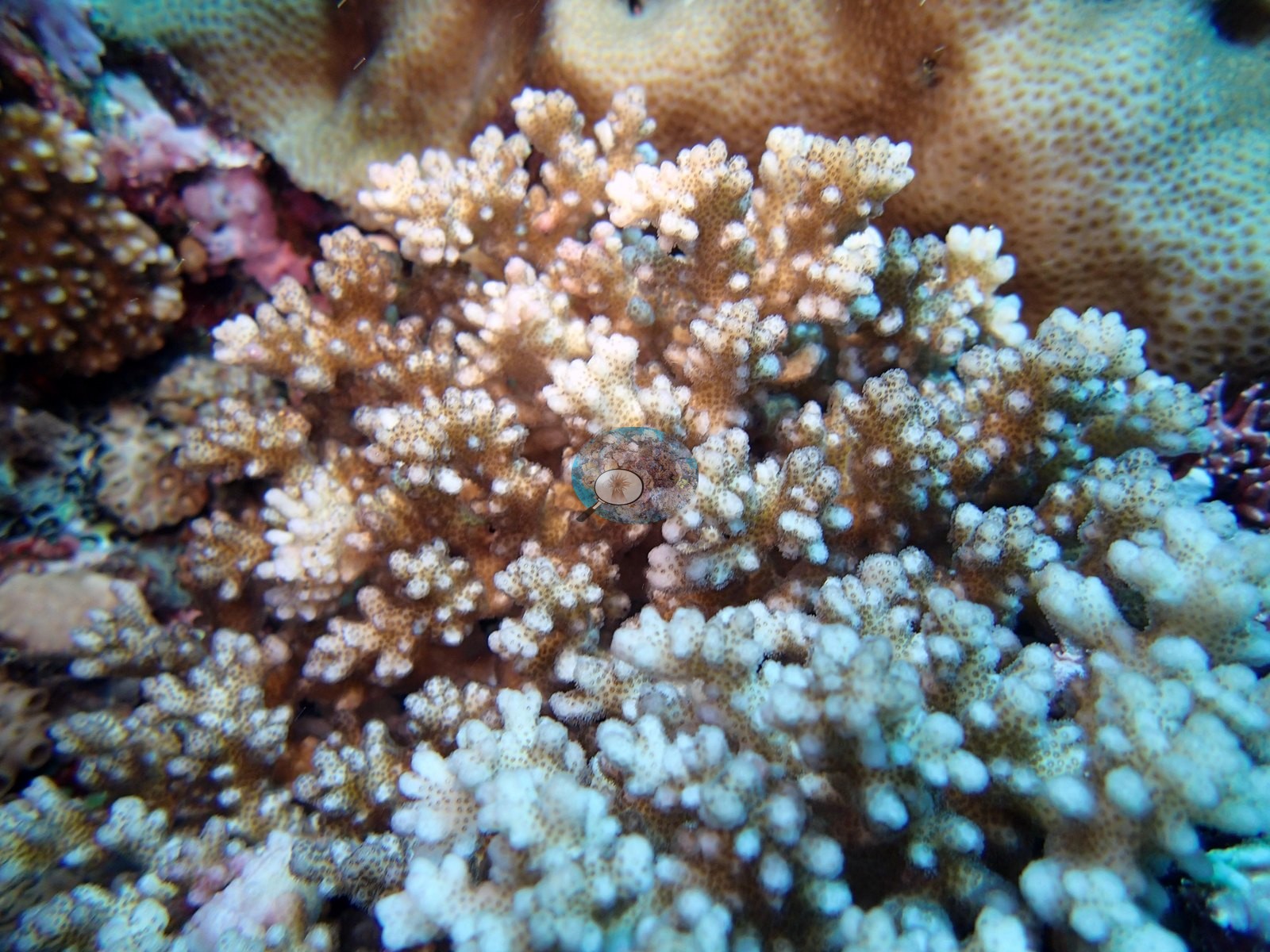
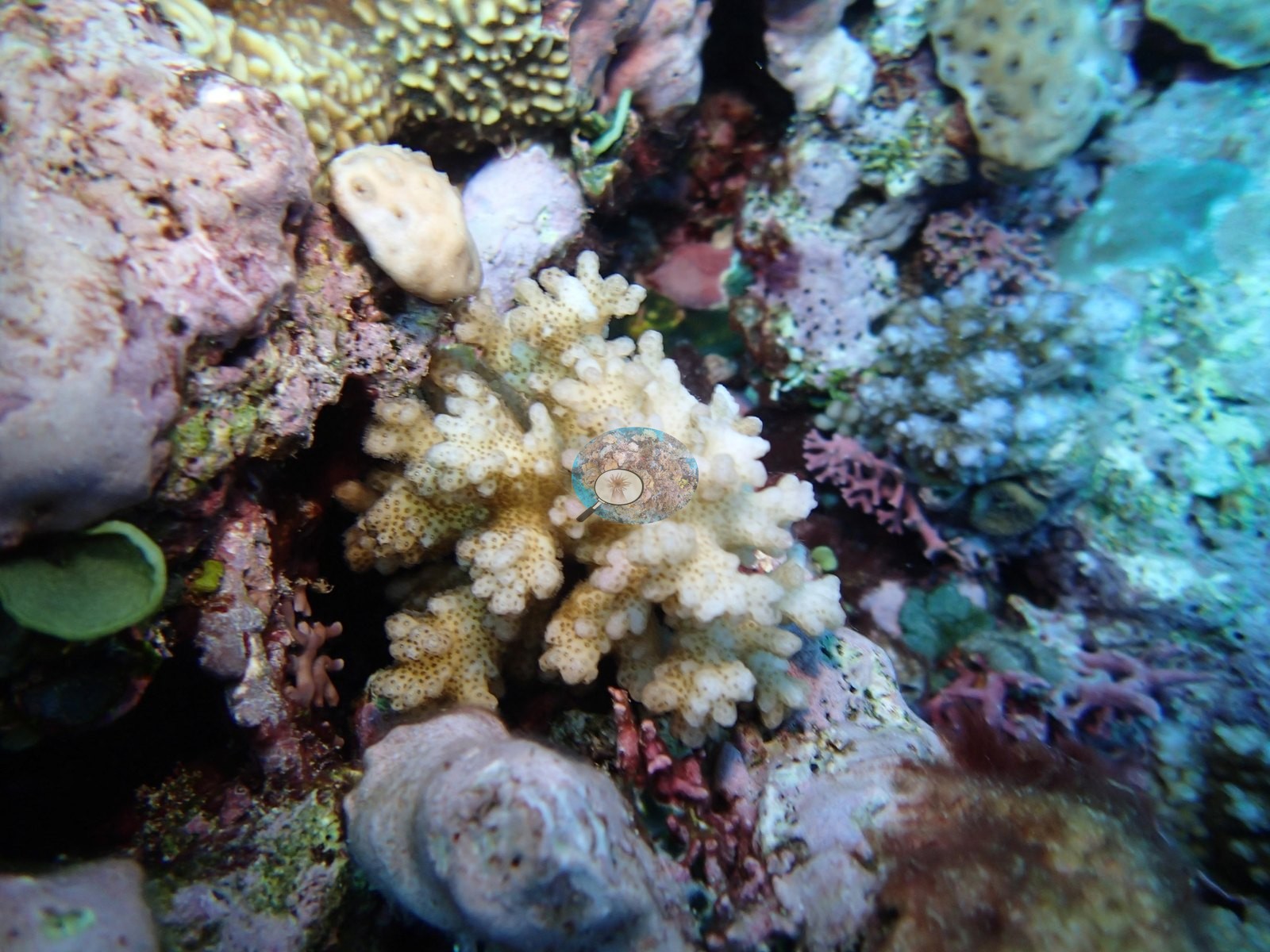
Each is filled by a large tabulate Acropora — one of them a meter-plus plate over a second, collapsed table beneath it — that renders pale gray-white under a strong blue cast, with brownish polyp pigment still visible across the plates and red-brown undersides, while neighboring staghorn and corymbose colonies in the same frame are normally pigmented. Paling cannot be separated from natural pale color in blue light in these frames; the site's own survey note, retained below, records COTS predation with large areas of white corals and several large tables turned over by possible storm damage, which may account for the collapsed one. No feeding starfish is visible in any frame. That is a description of two colonies, not an estimate of how much of the reef was affected. Anderson's sampling sheet records two of the five colonies sampled here as partly bleached (F106 50%, F108 20%), and the frames of F108 show its pale branches (e.g., Image 12, Image 13, Image 14).
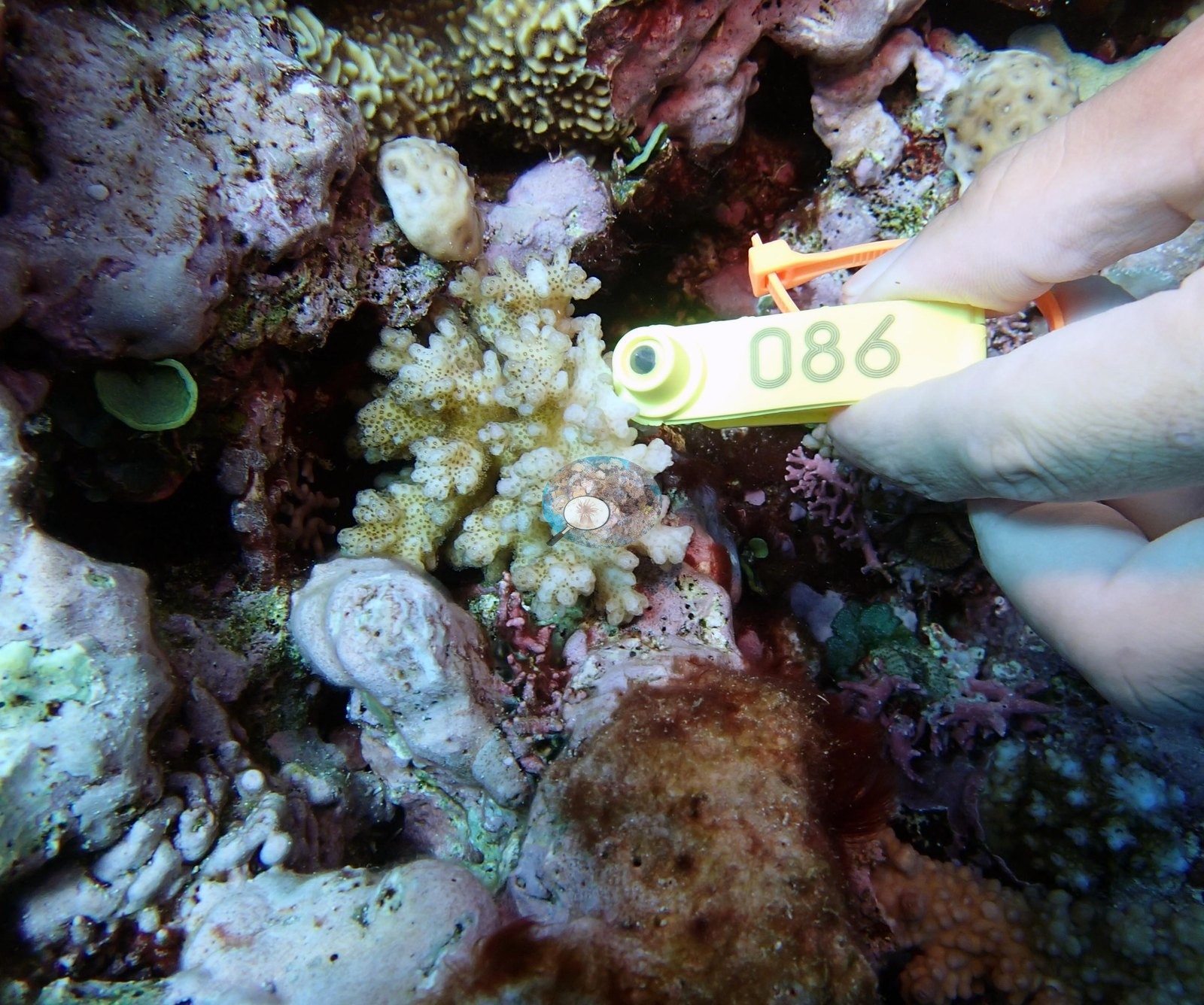
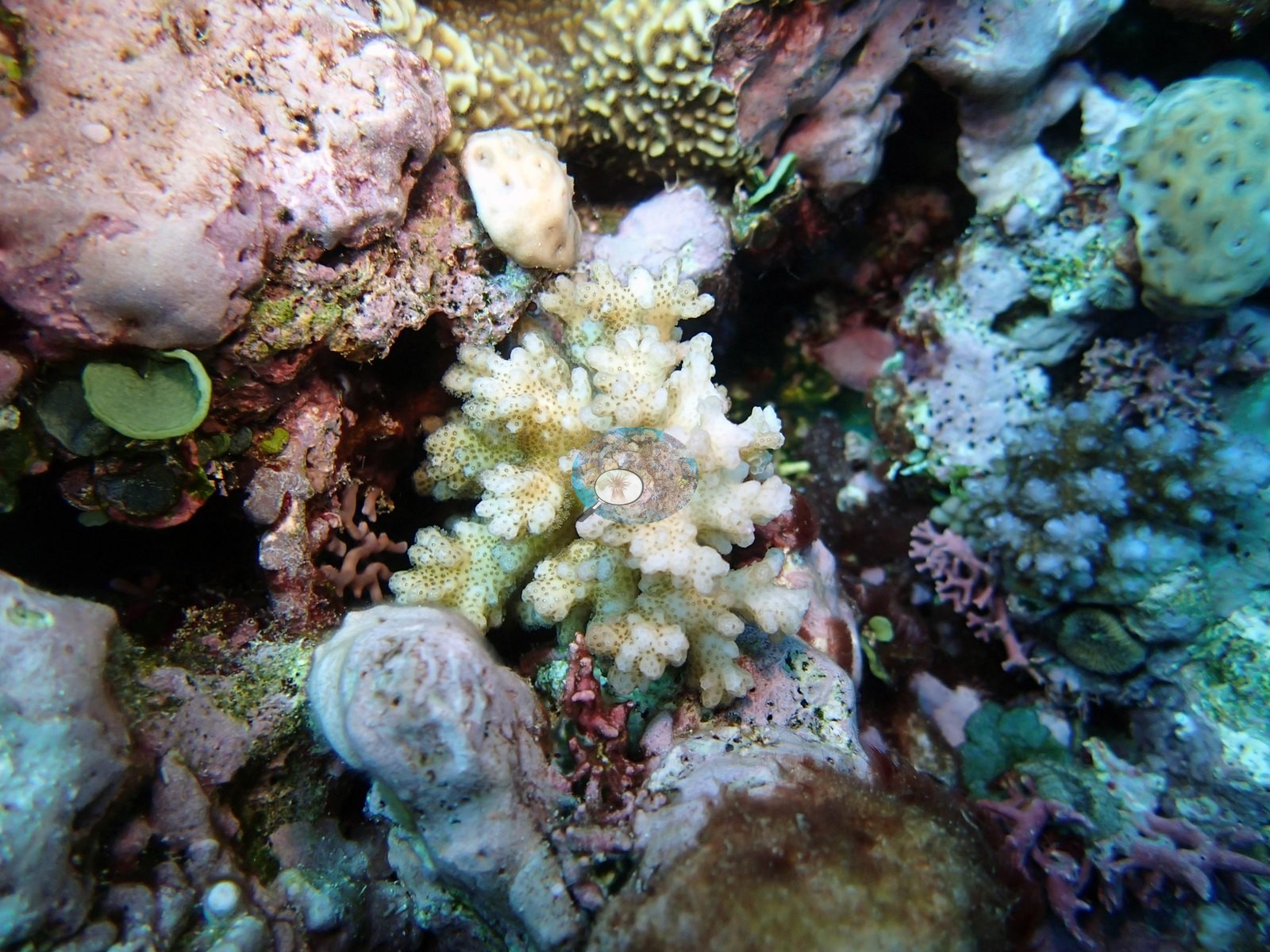
None of the four coral colonies from this site with an outlier score was flagged as a physiological outlier (Mayfield et al. 2017, PLoS ONE). The Living Oceans Foundation transects here recorded 7.9% cyanobacteria and no recently dead coral.
Comparisons with other data
Apart from the Living Oceans Foundation survey shown here, we found no other surveys at this site as of 2026. If you would like to share yours, please email us.
Other notes
Two frames are the divers themselves — one finning down a wall near the dive's 30.5 m maximum (e.g., Image 15) and one of a second diver over the deep face, where Anderson noted black coral on the wall (e.g., Image 16).
Survey team's site notes: Spur and groove assemblages with steep slope with large isolated colonies of Porites lobata and tabular acroporids. Some evidence of COTS predations with large areas of white corals were present. Halimeda algae clumping were found interspersed among branching corals. Large sheeting colonies and plating corals were common on the steep slopes. Several large table acroporids had been turned over from possible storm damage. Colonies were common around 30 m at the base of the steep slope.
Data & links
- Download benthic survey data (CSV) ↗
- Download all LOF-GRE data (933 sites) ↗
- Photo portfolio ↗
- Coral Reef Diagnostics page for this area ↗
All images from Coral Reef Diagnostics. Data are from the Khaled bin Sultan Living Oceans Foundation Global Reef Expedition and Coral Reef Diagnostics.
 © Coral Reef Diagnostics.